How to W.R.A.P decisions in Life

Every living being in this universe is subjected to make decisions for their survival – be it an ant and or a humpback whale. Fortunately, humans are the only beings gifted with the power of discrimination of understanding what is right or wrong for us and making a decision accordingly. Decisions can either be positive or otherwise but the quality of your decisions will determine how deeply they would impact your life.

It's A WRAP - Better Decision Making

Chip and Dan Heath, in their book ‘ Decisive: How to Make Better Choices in Life and Work’, talk about a Framework called W.R.A.P for making better decisions
WRAP consists of four elements:
W- Widen your options
R- Reality test your assumptions
A- Attain distance before deciding
P- Prepare to be wrong

Widen your options

There is a misconception that having a lot of options can lead to confusion and is as same as seeing only the big picture. So, people narrow their frames of you and often lose possible options that could have worked better for them.
You can start finding more options by creating a mindset where none of the options you are considering is available. What else can you do? Think about it and be surprised about how many new options crop up!

Reality test your assumptions

While encountering a decision-making situation, we all tend to select the options that support our preconceived beliefs and actions. But that might not work all the time.
We can overcome this by seeking out relevant data that might redeem or discard the options at hand. Also, for example, if you have a piece of work or a product to be published you can sample your work ok for a response from a small group first instead of jumping right into the market. Reason out to yourself why you would want to make a particular choice.

Attain distance before deciding

We often let our short-term emotions cloud our rationality and take hasty decisions. It is imperative to have a well-settled mind before making an important life decision.
Try broadening your point of view. Ask yourself what a reliable third person would do in such circumstances- step into your friend’s shoes or think like someone who you look up to. This can give you a fresh perspective of the situation at hand and make you take a better decision.

Prepared to be wrong

Voice Blog: In Order To Be Original, Prepare to Be WRONG - Ben Francia

We predict a lot in our life. What if a decision that you made is based on such predictions and things actually don’t turn up the way you wanted? What then? You should be ready to acknowledge the decision’s flaw.
Think about working back from a possible future. For example, suppose your work has been published and was poorly received. Think about how the work could have been made better so that you really don’t have to face that situation. Come up with backup ideas that can act like your ‘insurance’ and protect you in case things go the other way.

The next time when you faced a situation, remember that the process is as important as the decision itself. You are the master of your life- so make sure that the decision you made don’t make your life different from what you wanted.
Trust the process!

Bandwagon Effect

What Is the Bandwagon Effect?

The bandwagon effect is a psychological phenomenon in which people do something primarily because other people are doing it, regardless of their own beliefs, which they may ignore or override. This tendency of people to align their beliefs and behaviors with those of a group is also called a herd mentality. The term “bandwagon effect” originates from politics but has wide implications commonly seen in consumer behavior and investment activities. This phenomenon can be seen during bull markets and the growth of asset bubbles.

Understanding the Bandwagon Effect

The bandwagon effect arises from psychological, sociological, and, to some extent, economic factors. People like to be on the winning team and they like to signal their social identity. Economically, some amount of bandwagon effect can make sense, in that it allows people to economize on the costs of gathering information by relying on the knowledge and opinions of others. The bandwagon effect permeates many aspects of life, from stock markets to clothing trends to sports fandom.

Politics

In politics, the bandwagon effect might cause citizens to vote for the person who appears to have more popular support because they want to belong to the majority. The term “bandwagon” refers to a wagon that carries a band through a parade. During the 19th century, an entertainer named Dan Rice traveled the country campaigning for President Zachary Taylor. Rice’s bandwagon was the centerpiece of his campaign events, and he encouraged those in the crowd to “jump on the bandwagon” and support Taylor. By the early 20th century, bandwagons were commonplace in political campaigns, and “jump on the bandwagon” had become a derogatory term used to describe the social phenomenon of wanting to be part of the majority, even when it means going against one’s principles or beliefs.

Consumer Behavior

Consumers often economize on the cost of gathering information and evaluating the quality of consumer goods by relying on the opinions and purchasing behavior of other consumers. To some extent, this is a beneficial and useful tendency; if other people’s preferences are similar, their consumption decisions are rational, and they have accurate information about the relative quality of available consumer goods, then it makes perfect sense to follow their lead and effectively outsource the cost of gathering information to someone else.

However, this kind of bandwagon effect can create a problem in that it gives every consumer an incentive to free ride on the information and preferences of other consumers. To the extent that it leads to a situation where information regarding consumer products might be underproduced, or produced solely or mostly by marketers, it can be criticized. For example, people might buy a new electronic item because of its popularity, regardless of whether they need it, can afford it, or even really want it.

Bandwagon effects in consumption can also be related to conspicuous consumption, where consumers buy expensive products as a signal of economic status. 

Investment and Finance

Investing and financial markets can be especially vulnerable to bandwagon effects because not only will the same kind of social, psychological, and information-economizing factors occur, but additionally the prices of assets tend to rise as more people jump on the bandwagon. This can create a positive feedback loop of rising prices and increased demand for an asset, related to George Soros’ concept of reflexivity.

For example, during the dotcom bubble of the late 1990s, dozens of tech startups emerged that had no viable business plans, no products or services ready to bring to market, and in many cases, nothing more than a name (usually something tech-sounding with “.com” or “.net” as a suffix). Despite lacking in vision and scope, these companies attracted millions of investment dollars in large part due to the bandwagon effect.

5 courses every upcoming entrepreneur must do

In the current business environment, one must always be eager to adapt and learn new skills in order to survive and grow. Here’s a list of 5 courses a budding entrepreneur must do to flourish in the current environment, keeping in mind the trends and skills essential in the present scenario.

1. Digital Marketing

With businesses taking over social media platforms to increase their reach and improve their customer relations, Digital Marketing is the need of the hour. It is a brilliant way to interact, build and promote the brand. The traditional ways of advertising like print, radio and tv ads are not as effective as email marketing, targeted ads, paid searches, etc. It is the new way of doing business and every entrepreneur must know how to grow their business this way.

On some business-friendly platforms like Instagram and Facebook, one can also use analytical tools to know more about their audience like geographical location, age range, gender etc which can give helpful insights about the target audience of the business.

The course includes Social Media Marketing, Email Marketing, Search Engine Optimisation, Google ads and Google analytics.

2. Successful Negotiation: Essential Strategies and skills

Starting a new business requires efficient communication and negotiation skills. Whether it’s negotiating prices and contracts with vendors, suppliers or the customers, pitching the business plan to potential investors, communicating with the stakeholders of the company, it always comes in handy.

In order to grow a business, every entrepreneur should know how to negotiate and build profitable relationships for the business. This course not only improves the business communication skills of the entrepreneur but also, helps him/her in identifying the interests of the other party while negotiating which successfully helps them in finding a middle ground efficiently.

3. Start-up funding

The first step of officially starting a new business is getting funding, convincing investors, banks, financial institutions that the business plan is viable and has the potential to grow. It is important for an entrepreneur to work on his/her pitching skills in order to communicate effectively with the potential investors of the business. He/she should also know the process of getting the funding and the different sources and instruments he/she can select from according to the nature of the business and the funds required.

4. Business Modelling/Strategy

This course is not only essential for the success and future of the business but also needed to pitch the business plan to potential investors. The mere idea, concept and product/service is not enough to attract investors. Such investments generally involve huge amounts of seed capital and therefore, investors like to study the business model to assess the risk, returns, viability, market research analysis, cost structure of the business to determine its potential.

5. Brand Management

In a world where customer loyalty and retention are the priority, this course would help an entrepreneur learn how to retain and build a relationship with its customers. With every brand’s focus on customer relations, this will give the entrepreneur an edge over its competitors if applied effectively.

Customers value brands that are transparent, environment friendly and ones that value their customers and their feedback. Brand Management not only helps in retaining customers but also helps in building long-term relationships with them, thus establishing a stable and loyal consumer base.

5 reasons to choose a career in digital marketing

We are in the digital age, where the emergence of digital marketing as opposed to the traditional forms of marketing is clearly visible. As a result, most of the jobs today in the marketing and advertising industry demand expertise in field like media planning, content management, and social media. And digital marketing also has countless alternatives and techniques related to it, you can get innovative and explore different avenues for your advertising strategies on a careful spending plan.

Today, as we can see all generations from Gen Z, millennials and elders are online 24X7 and to attract them, nowadays businesses use digital media as a source of communication. There were as many as 2 lakh job offerings for digital marketing in 2016, and this demand is estimated to increase 10x over the next few years. Due to the fact that the digital world is ever-evolving, digital marketing experts have an unprecedented opportunity to develop their skills as storytellers and impact many sectors.

E-commerce marketing platforms such as Instagram and Facebook introduce new features continuously to help brands communicate with users, resulting in increasing brand loyalty. Reports suggest that by 2021 there will be around 635.8 million web users in India. According to McKinsey, the number of people using smartphones will again double by 2023.

Digital marketing methods have a similar objectives as that of traditional marketing tools. Promoting through advanced channels offer many benefits to publicists, including quantifiable ROI.

Reasons to choose a career in digital marketing:-

1.Highly demanded profession – Unlike any other marketing, digital marketing is much easier to launch your professional career. learning how the business runs and acquiring the correct knowledge of the online industry is the least it takes your way to be a digital marketing expert. Indeed one can also learn without an entry-level position you can also feature your abilities and work through contributing to a blog and online media exercises.

2.Broader spectrum of choices – As digitisation becomes popular among enterprises, organisations across from new businesses to big corporate houses are now looking for experts in the field of digital marketing with applicable experience. Many big brands like Google are looking for new generation digital marketers especially in the areas of AI which are on the uprising emerging innovations as it turns out to be more standard and offers adaptability.

3.Keeps you up to date – Working in this industry where something comes up new every day implies a quick-moving environment. An individual doing SEO, for example, should stay aware of the metrics which are updated constantly. Advertisers likewise should also see all the rules regarding different channels.

4.Higher Compensation – This market is a competitive industry where all the people rival for their gifted ability in the industry. This implies that people with higher abilities can have higher compensation and also many extraordinary perks and even rewards replying upon their job.

5.One man, too many hats – Another explanation that this field will be among the top vocations in the year 2021is its versatility. Digital marketing experts can show considerable amount of authority in more than one zone depending upon the enthusiasm and the abilities they posses. As the business develops further more options may further introduce themselves making this field more significant.

9 skills to have on your resume.

Photo by Sora Shimazaki on Pexels.com

There are endless skills that you can include on any resume, and you have to decide which ones will be the most effective. There are hard, industry-specific technical skills, as well as soft skills that every job demands.

Hard skills are technical abilities that are specific to a particular job and are often measurable. For software developers, their set of hard skills would include specific programming languages. Soft skills are interpersonal or creative abilities that can come naturally or be strengthened over time. Some examples of soft skills are adaptability, self-motivation, and the ability to work under pressure.

1. Problem Solving

No matter what the job is, eventually something will go wrong and employers want to know that you’re capable of coming up with a quick and effective solution. In fact, there are jobs that are essentially nothing but solving problems for the company, the clients, or both.

2. Critical Thinking

Being able to think rationally and thoughtfully is the basis of critical thinking. Employers want workers who can think through a problem or a project and determine the best steps needed. Critical thinkers come up with new and better ways to work, making it an invaluable skill to put on a resume.

3. Flexibility

Many organizations and industries covet employees who are dynamic and adaptable to every situation, or who have a natural ability to use a variety of methods and approaches in different circumstances to get the best end result.

 4. Communication

Whether it’s written or verbal, being able to communicate with your boss, coworkers, and clients/customers in all situations is very valuable. The better you are at it, the better results you will generate.

5. Teamwork

Most jobs will sometimes require you to work with other people at some point, and employers want to know that you can succeed in a team environment. Some jobs will prize this skill more than others.

6. Organization

This is not just about having a neat desk, but organizing tasks and projects for your coworkers, management, and at the very least, yourself! If you want to show off your organization skills, having a tightly structured resume certainly helps.

 7.Creativity

Thinking outside of the box and coming up with creative solutions can be a real asset in any role. Perhaps you’re good at thinking about something in a way that hasn’t been done before. Creativity can be shown on your resume through a problem you solved or through a creative skill like writing or design.

8.Responsibility

Part of being a good employee is taking responsibility for your duties and even owning up to mistakes. Most managers don’t want to have to check in on their employees to ensure every part of their job is getting done. Responsibility means doing what you need to do to complete your tasks.

9. Attention to Detail

On the job you need to ensure you follow all instructions in order to complete your work. This can be especially important when you work with others. Paying attention to detail will be needed at any role you have. Consider times when you caught or fixed a potential mistake due to your attention to detail.

Web Development

When browsing the internet and forging, do you ever feel like making various web pages? Ok, if yes, you can probably go to web development. One of the basic skills that almost every technological enthusiast should learn, this skill is one of the most fascinating and easiest. Now, what’s the web development?

Web development refers to building, creating, and maintaining websites. It includes aspects such as web designweb publishing, web programming, and database management.

While the terms “web developer” and “web designer” are often used synonymously, they do not mean the same thing. Technically, a web designer only designs website interfaces using HTML and CSS. A web developer may be involved in designing a website, but may also write web scripts in languages such as PHP and ASP. Additionally, a web developer may help maintain and update a database used by a dynamic website.

Web development includes many types of web content creation. Some examples include hand coding web pages in a text editor, building a website in a program like Dreamweaver, and updating a blog via a blogging website. In recent years, content management systems like WordPress, Drupal, and Joomla have also become a popular means of web development. These tools make it easy for anyone to create and edit their website using a web-based interface.

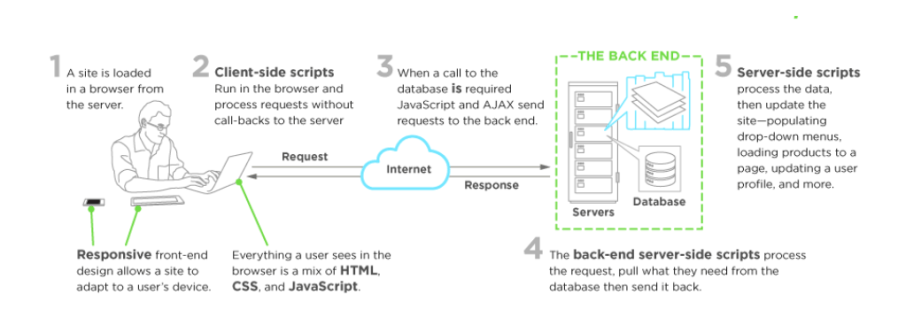
Web Development has many terms associated with it like front-end. back-end, and full-stack developer. What are they and in which perspective are they used?

front end developer

A front-end developer is a person who is responsible for the looks and design of the website. The design of the site aims to ensure that, when users open the site, they see the information in a format that is easily readable and relevant. This is further complicated by the fact that consumers are now using a vast range of devices of different screen sizes and resolutions, thereby requiring the designer to take these considerations into account when constructing the web. They need to ensure that their site is correctly positioned in different browsers (cross-browser), different operating systems (cross-platform) and different devices (cross-device), which require careful planning on the developer’s side.

The front end section is constructed using some of the languages discussed below:

HTML: HTML is the HyperText Markup Language. It is used to build the front end portion of a web page using a markup language. HTML is a mixture of Hypertext and Markup. Hypertext describes a connection between a web page. The markup language is used to define the text documentation within the tag that defines the web page structure.

CSS: Cascading Style Sheets affectionately referred to as CSS is a simple language designed to simplify the process of making web pages presentable. CSS allows you to apply styles to your web pages. More significantly, CSS helps you to do this independent of HTML.

JavaScript: JavaScript is a well-known scripting language used to build magic on blogs that render the web interactive for the user. It is used to improve the functionality of a website to run cool games and web-based applications.

Front End Framework and libraries

AngularJS: AngularJs is a front-end open-source JavaScript platform that is predominantly used to build single-page web applications (SPAs). It is a constantly growing and evolving platform that offers better ways to build web applications. Changes static HTML to dynamic HTML. It is an open-source project that can be freely used and updated by anyone. It extends HTML attributes with Directives, and data is bound with HTML.

React.js: React is a declarative, efficient, and flexible JavaScript library for creating user interfaces. ReactJS is an open-source, component-based front end library responsible for the view layer of the application only. It’s being maintained by Facebook.

Bootstrap: Bootstrap is a free and open-source collection of tools for creating responsive websites and web applications. It is the most popular HTML, CSS, and JavaScript framework for the development of responsive, mobile-first websites.

jQuery: jQuery is an open-source JavaScript library that simplifies the interaction between an HTML / CSS document or, more precisely, a Document Object Model (DOM) and a JavaScript document. Developing terminology, jQuery simplifies HTML document traversing and handling, browser event handling, DOM animations, Ajax interactions, and JavaScript cross-browser creation.

SASS: is the most accurate, mature, and robust CSS extension language. It is used to expand the features of the current site CSS, including everything from variables, inheritance, and nesting to ease.

Certain libraries and frameworks are Semantic-UI, Framework, Materialize, Backbone.js, Express.js, Ember.js, etc.

back-end developer

Backend is the server-side of the web. It stores and arranges data, and also ensures that everything on the client-side of the website works fine. It’s the part of the website you can’t see and interact with. It’s the portion of the software that doesn’t come into direct contact with users. Parts and features developed by backend designers are accessed indirectly by users through a front-end application. Activities such as writing APIs, creating libraries, and working with system components without user interfaces or even science programming systems are also included in the backend.

Back-end Languages

The back end component is built using some of the languages discussed below:

PHP: PHP is a server-side scripting language built specifically for web creation. Since PHP code is running on the server-side, it is called the server-side scripting language.

C++: It is a general programming language and is now widely used for competitive programming. It’s also used as a backend script.

Java: Java is one of the most common and widely used programming languages and platforms. It’s very scalable. Java components are readily available.

Python: Python is a programming language that helps you to work quickly and implement systems more efficiently.

JavaScript: Javascript can be used as both (front and back end) programming languages.

Node.js: Node.js is an open-source and cross-platform runtime environment for running JavaScript code outside the browser. You need to remember that NodeJS is not a framework and is not a programming language. Most people are confused and understand that it’s a framework or a programming language. We also use Node.js to create back-end services like Web App or Mobile App APIs. It is used in the development of major corporations such as Paypal, Uber, Netflix, Wallmart, and so on.

Back-end Frameworks

The list of back end frames is Express, Django, Rails, Laravel, Spring, etc.

The other back end programs/scripting languages are: C #, Ruby, REST, GO, etc.

Difference between Frontend and Backend:

Frontend and backend developments are quite different from each other, but there are still two aspects of the same situation. The frontend is what users see and interact with, and backend is how it works.

The frontend is a part of the website that users can see and interact with, such as the graphical user interface ( GUI) and command line, including design, navigation menus, text, pictures, videos, etc. Backend, on the other hand, is where part of the website users are unable to see and communicate.

The visual aspects of the website that users can see and experience are front-end. On the other hand, everything that happens in the background can be attributed to the backend

The languages used for the front end are HTML, CSS, Javascript, while those used for the backend are Java, Ruby, Python, .Net.

full stack developer

A full-stack web developer is a person who can develop both client and server software. Besides mastering HTML and CSS, he/she also knows how to:

Browser software (such as JavaScript, jQuery, Angular, or Vue)

Programming a server (like using PHP, ASP, Python, or Node)

Program a database (such as SQL, SQLite, or MongoDB)

Being a full-stack developer is a good practice because you know almost every aspect of web development. You can switch between front-end and back-end stuff according to the requirement.

Resources to learn

  • W3 School(Free)
  • Coursera(Paid)
  • Udemy(Paid)
  • FreeCode Camp(Free)
  • Treehouse(Paid)
  • Codeacademy(Free)
  • Traversy Media(Free)
  • HTMLDog(Free)

So, all the best guys for this amazing learning journey, hope you guys find this piece informative.


Improve your English

Writing for the sake of writing isn’t writing. You should have a passion to write. That pushes you forward to a greater extent. The interest on writing makes you write the writings that were never written. Don’t make yourself to write, let yourself make you write. There’s a lot of difference between them. It’s like earning to write and writing to earn. What we know is a drop, what we don’t know is an ocean.

Develop a habit of writing because that makes us improve without our knowledge. Write something that happened to you because it tries to bring the coordination between our brain and hands. As the time passes our hand should be faster than our brain. We should think of next sentence while writing the previous. It can even be writing in a dairy.

Start a blog and keep on writing and express what you feel like. Share it to your contacts and ask them to suggest any improvements. Keep on writing and improving by implementing their suggestions and get improvised with your writing.

Writing not only comes from writing. Start reading the different writings. Analyse the way different people write and try to figure out the pattern they try to express themselves. Read and read until you get better in writing.

Write for someone who are looking for writers because that makes you know more about your writing from others. Try to become freelancer and ask for work. Doing work makes you improve. Such work involves lot of research and you will get a chance to know about the unknowns.

Start your journey in facebook groups and Quora groups and make friendship with your mates . Connect with like minded people and that will surely make you know more about the various styles of writing.

Does college really matter for placement ?

Every engineering aspirant always dream about IIT but Unfortunately,approximately only 10000 students get selected from approx 12 lakhs aspirant from all over India by clearing JEE mains and JEE Advanced.Many engineering aspirants are not able to crack IIts or NIIts and that doesn’t mean they will not be able to get placements in reputed companies such as google ,Amazon,Facebook etc .Of course IIt or NIIT does matters but up to certain degree . IIT or NIIT nor any other top university guarantee you of getting 100% placement .You will even find some jobless IITians.There is no denial that approx 15-20% ( or even more) do not get placed from campus.It’s a reality check .If you are not able to get admission in top universities that doesn’t mean that you can’t be placed in Google ,Accenture or IBM like top Companies.of course ,you can still be placed in these reputed companies if you are really working hard.If you want to know college matter for placement ,not really .It depend only to a certain extent.It is truth ,that college environment and the visiting companies matter .Obviously ,there are more opportunities if you are pursuing engineering from a reputed college .Their are many private universities or colleges with budget friendly fee structure having good college environment and Well known company visiting their campus for placement (like Amazon )such as Chandigarh Group of college ,Chandigarh University ,Chitkara University ,LPU and many more .But even if you are the part of the college having not such environment or your dream company doesn’t visit your college .Obviously,one can’t see google coming to a reputed college .That doesn’t mean you can’t get placed there.Even then you can by sharpen your skills and can get placed even in your dream company.Remember ,Companies hire on the basis what they see in you not where you came from .

Always remember , what really matter is skills.If you have relevant skills no one can stop you from getting placed from even a mediocre college .Off campus interview are the best instance their students our judged according to their skills not on the basis colleges .I have known many people who worked hard even had faced rejection but don’t stop.They get deeper and deeper knowledge , brush up their skills and now they are placed in well known companies with good packages .What one should learn from this that one should not be afraid of getting rejection .

Who doesn’t want to do anything can come up with a number of excuses .It mostly depend on person how much effort he/she has put .It totally depend on Students they will get success in their life or not .IIT doesn’t give you a guarantee that you will succeed in your life nor a Students from mediocre college end up having lower end job. Definitely one should work hard , putting his/her 100% effort to grind their skills as much as possible , then no one can stop you to succeed in your life.

Please comment below your thoughts in the comment below and have a wonderful day .

Guide to live a Happy Life !

–You’re going to realise it one day-
That happiness was never about your job, or you degree, or being in a relationship. Happiness was never about following  the footsteps of all of those who came before you, it was never about being like others.
One day you are going to see  it – that happiness was all about the discovery, the hope, the listening to your heart and following or wherever it chose to go. Happiness was always about being kinder to yourself, it was always about embracing the person you are becoming. One day you will understand that happiness was all about learning how to live with yourself, that it was never in the hands of other people. It was about you , It is about you and It will always be about you–

Since long time, I’ve been exploring the best ways that people can live happily. And over the last year.
Outsmart Your Smartphone,Conscious Tech Habits for Finding Happiness, Balance, and Connection IRL. Even though there are tons of things you can do to live a happier life, I’ve narrowed our focus down to the 10 skills you can build that I believe are the most important to increase happiness. By building these skills, you can start to live a happy life.

1. Live a happy life by creating a plan for your happiness.

You wouldn’t bake a cake without a recipe. You wouldn’t go to a place you’ve never been without a map. And you shouldn’t try to build happiness without a plan either. Creating a good happiness plan is what takes you from where you are now to the happy life you envision.

2. Develop yourself to live a happy life.

Remember when something you wanted to do seemed impossible? Maybe it was that first time you rode a bike, or drove a car, or asked someone out on a date. Then you did it and realized you had it in you all along. Creating a happy life is the same way — the first step is believing in yourself and your ability to live happily. Then you’ll see that you had it in you all along. This is why engaging in personal development is key to living a happy life.

3. Think positive to create a happy life. 

We all know someone who will find the one bad thing in every situation. Maybe this person is us. If we learn to think positive instead, we can make even the most obnoxious situations more enjoyable, creating a happier life from the one we have now. Every moment of every day is a little better, because we can find the silver linings. This is why positive thinking is key to a happier life.

4. Boost your self-confidence to create a happy life.

If we don’t have self-confidence, it’s easy to think that there’s something fundamentally wrong with us — that there’s nothing we can do to change ourselves and create the happy life we desire. But self-confidence is actually a skill. When we learn how to think, feel, and act in ways that make us a person we really love, we can be more self-confident and, as a result, live happily more easily.

5. Create work-life balance for a happy life. 

Are you exhausted, demotivated, and in desperate need of a break? By learning how to create better work-life balance, you can make better use of the limited time you do have in your life. As a result, you end up enjoying all parts of your life a bit more.

6. Build resilience for a happier life. 

Sometimes life knocks you down — there is no getting around that. What really matters for creating a happy life is how easy it is for you to get back up. Developing emotional resilience keeps those challenges and hardships from overwhelming you. You recover more quickly from difficulties, and as a result, you’ll live happily more days each month and year.

7. Be more mindful to create a happy life. 

Now that we live in a high-tech world, we go through much of our lives on autopilot. As a result, we miss out on the best parts of being alive — positive experiences, connections with others, and even having fun. So maybe we already have a happy life . . . and we just don’t see it. When you become more mindful and self-aware, you stop feeling so numb and are able to better enjoy everything your life has to offer.

8. Find your life purpose for a happy life. 

We all want our lives to feel like they matter. It can be tricky, though, to figure out what matters to us. Each person’s life purpose is different, and learning to notice when you’ve found your purpose is a skill. By building this skill, your life becomes more meaningful and more satisfying, so you can live happily more easily.

9. Practice kindness to live a happier life.

We’re often so focused on boosting our own happiness that we ignore how we affect others. This is a huge mistake, because kindness is, counterintuitively, one of the best ways to create a happy life. Acts of kindness fuel a longer-lasting, more enduring type of happiness. So when you build this skill, you live more of your days happily.

10. Build healthy relationships for a happy life.

So often we think that a happy life is something we must build on our own. But long-term happiness actually comes from the relationships that we build with others. In fact, healthy relationships are the most important factor in both our health and our happiness. This is why learning how to develop better relationships helps you live happily for life.

Here are some steps which will help to boost the above skills :

~ Clarify why you want a happy life.
~ Clarify when you’ll build the skills that lead to a happy life.
~ Decide which happiness skills to build.
~ Decide in what order you will build the skills that lead to a happy life.
~ Commit to your goal to create a happier life.
~ Develop a growth mindset that focuses on           your belief in your ability to create a happy life.
~ Identify your values.
~ Define a happy life in your own words.
~ Record your progress towards personal development.
~ Get some help developing yourself to build a happy life.
~ Help your brain get used to thinking positive.
~ Start your day by imagining the way it looks in your happy life.
~ Savor positive moments.
~ Capitalize on positive moments.
~ Pay attention to the positive things.
~ Create a collection of positive images or positive quotes.
~ Think positive, but think negative when you need to​.
~ Practice gratitude​.
~ Stop minimizing your successes​.
~ Practice self-compassion.
~  Imagine your best self.
~ Know your strengths.
~ Celebrate your successes.
~ Practice mindful acceptance.
~ Observe your situation to increase your awareness​.
~ Find the positives in negative situations​.
~ Create a collection of images or quotes that inspire you to live happily.
~ Understand the benefits of negative emotions.
~ Beef up your coping skills.
~ Stop your negative thought cycles.
~ Be more present in the moment.
~ Take breaks from technology.
~ Pay more attention to find the meaning in your life.
~ Spend more time uninterrupted
~ Identify your values.
~ Find out what drives you.

Of course, building all of these skills takes time. If you need help, get support to walk you through the steps and guide you on your journey to living a happier life