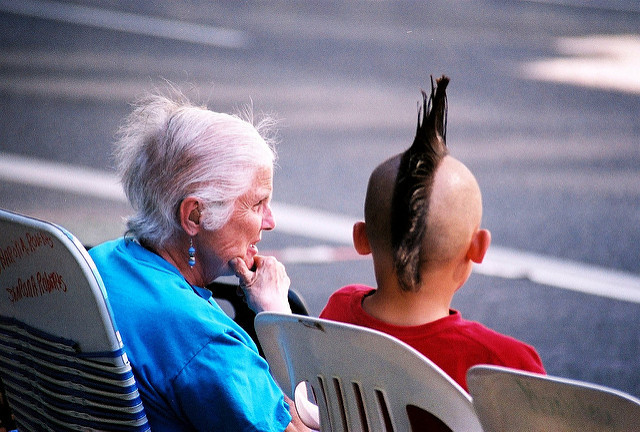
The gap between the old and the young people is called generation gap. Old people feel that lack of respect for the elders and disrespect to the existing system of the society will bring disaster for young generation. Young boys and girls, on the other hand, feel that ‘the old are fools’. The gap between the old and the new generations is widening owing to several reasons.
First, all young people feel that the present education has no relation with the realities of life. Secondly, the present life has become busy and fast. Thirdly, the young people are generally idealistic. When they find corruption in every sphere of life, they feel disgusted. Fourthly, to express their unhappiness with the existing state of affairs, young people take to violence or behave oddly.
In order to bridge the generation gap, elders should be sympathetic towards the young. They should realise the emotion, ambition and problems of the young. The young should realise that they have no experience in life.
So, they should value the advice of the elders. The general gap between the two groups of people is so wide in the western countries that they live separately. In India the traditional joint family system has slowed the growth of this gap. But now such a family also is breaking down.
The government constantly launches new programmes and schemes to support the citizens of India in the best way. But, every aspect has some negative relations to it. While bits of negativity can be ignored, the differences can’t be neglected when it starts shaping into a social issue. This article addresses the issue of Reservation- An Analysis as to how far is it beneficial to support the minorities via reservation quotas.
The agenda of the reservation for the backward class in the society is to provide them equal opportunities to showcase their talent and abilities. This initiative proves best when it gives a chance to the left-out people of the society to come up and earn for themselves a respectable and comfortable life.
The problem originated from the mindset of some sections of the society or some particular people who believe in supreme powers to be in the hands of only few, selected people belonging to particular religions or caste or place, etc. Clearly speaking, people who favour discrimination in the society. This leaves those people behind who are unaware of their rights and powers as a citizen of the country.
People who are in minority at a place are often in danger of being controlled by the dominant ones. This happened to be a serious problem.
Consequently, the govt. launched the mission for reservation in quotas for the poor and backward classes of the population. This has been an ever growing compulsion imposed to all institutions including the private sectors, to provide reserved seats to the disabled, poor,scheduled castes (SCs), scheduled tribes (STs), OBCs, EWS, and so on. The institutional bodies must reserve some seats/posts in their organisations for these people. To avoid fraud, people belonging to such categories are issued a certificate for the same after verification but frauds are committed even after it. It has become easy to get a certificate proving a general category person to be the one belonging to scheduled castes. What is more important to know is why do people try seizing rights of backward class that are granted to them by the govt. itself.
The reason is competition. The race is going so fast that everyone wants success, be it at others’ cost. The mindset is still. It is not changing. This is one side.
The other side says that the minority groups are being provided with a lot! Their recognition is increasing but in a negative way. Know how-
There are people belonging to backward classes also, who take advantage of situations. Such people get the reserved seats with the help of their certificates and owns the rest (this way, corruption originates from them too when they misuse their rights for self purpose…).
The reservations are provided with quotas to each backward section which they can avail without being in the competition or the race of success that everyone is running nowadays. This is the real advantage to them. They are given relaxation for marks in schools/college admissionsespecially in govt. institutions, for ranks in competitive exams, for eligibility of posts in govt. jobs, and so on. This has led to high disagreement among the ones belonging to the general category. Opportunities seem to be seized from the hands of the general people when the less competent fellows get higher positions in the work environment or even in the educational institutions.
Students work hard to reach a better place in life. Granting admissions to students with “certificates” even at lesser marks than the ones belonging to general category appears injustice. The reason is that the competitive exams are to test the abilities of the students which is examined on the basis of their scores. If the minorities are given admissions at very less scores than the others’, this should not be considered a competitive exam anymore!
These exams are the only way to earn recognition in the fast growing world since they form an important part in defining a person’s knowledge. Govt. jobs also require a ranking in their exams to consider an applicant for a post. This is a connected chain which is being misused when the deserving people are left out just to follow some norms. If the poor or other Reserved seat students are provided education at low costs in schools and in the same manner as others, then at-least there should be not such leverage in colleges or in the competitive exams. When the equality has been granted since the beginning, everyone is equal till the middle, then why again protect them. Having access to same knowledge as the general people, the minor section students too become capable of scoring high, making it a point of dissatisfaction to provide them support at every step of life even when they are better off.
This is a big discussion with many pros and cons but it is also a very serious matter to be addressed keeping in mind the welfare of each section of society. Everyone seeks protection in such matters since it is the question of future of the present and upcoming generation.
In a wide variety of contexts, we employ memes nowadays. They help us connect and feel we are part of, can be the beginning of a conversation, and even assist you to manage a problem or make an observation. Memes also allow us to relax while we surf and dwell in distressing news. They are free entertainment, a choice always even if you don’t have time to spend more time. It’s even easier to have them penetrate a large variety of specialist circles, being so great mixing cultures and touches of humor, to generate viral content.
The introduction of Meme Studies, an actual academic course on memes, at Northwestern University in the US state of Illinois in 2011 has long been cited as a barometer of the internet’s impact on society, from language to culture to beliefs.
Memes have a variety of goals and functions, but at their most basic level, they serve as a means of expressing people’s thoughts and feelings. Memes are created by appropriating sequences of words from television shows and films, which are then taken out of context, remixed with other content, and given new meanings in a humorous and relevant way. Meme content might range from whining about the difficulties of being a college student to expressing shame experienced during a daily encounter – something that everyone can relate to.
Memes, on the other hand, can have an impact on how we connect with others. Some aspects of meme culture have caused ripples in our social fields outside of the internet. After all, every meme has a creator who created it intending to spread a viral message, whether for enjoyment or to persuade others.
What exactly are memes? And how does it matter to our society?
Memes are statements that are clear, brief, and explicit, and this cultural paradigm reflects current society’s mentality – one that loves entertainment, celebrates materialism, and reinforces people’s need to stay relevant. Memes can be used as propaganda tactics because of their accessibility and capacity to reach a large audience in minutes (and become part of the online vernacular in days), which means they can readily instill and cement opinions that fast become popular among cybernauts (a habitual user of the internet).
The working of memes that make them interestingly catchy to the readers allows them to further cultivate their humor and let them become a new mark or a strong speaker of the society. As we know memes are not only for entertainment but also imprint a deep message for society.
Memes allow people to communicate with one another. Knowing the correct memes can assist you in joining a group. They give a sensation of belonging to a group. Memes are an excellent approach to get influence online because they are based on social media today. People can gain more followers by creating and reblogging popular memes, and these social ties can be used in both positive and negative ways.
Memes don’t merely bridge languages; their relatability fosters a sense of community among specific internet users of a certain age range. Memes are a simple and amusing way for youngsters to communicate with their pals, whether they’re used to express their opinions about certain socio-political concerns or to reinforce their fascination with famous people. Indeed, the process of spreading memes, sharing them on social media platforms, and tagging their friends within specific meme pages has improved global communication and made a significant contribution to globalization’s success.
But memes, just like many other parts of online culture, are easily misrepresented by those who aren’t familiar with them. Some people believe they are unimportant. Others believe memes are destructive and damaging to our communication, others in some sectors believe that memes, which have become the vernacular language of many a teen, have had a detrimental influence.
They suggest that memes obstruct communication in more ways than just reducing things to one-liners and visuals. They can be utilized to exacerbate hostile and discriminatory sentiments against various races, genders, religions, and sexualities, therefore expanding rather than closing the gap between people.
Memes, on the other hand, are a medium of communication that may be utilized for a variety of objectives. They can help to bring about constructive societal changes, but they can also be exploited to cause harm to others. It’s critical to establish a realistic understanding of memes’ potency as a communication medium, both today and in the future.
The weak sections of society are often repressed and exploited by society. To control such behavior and actions the government proposes some laws and bills to safeguard the rights of such weaker sections. But these laws are sometimes misused for the satisfaction of personal desires, and such actions need to be regulated.
An amendment bill was passed in March 2018 to restore the provisions of Scheduled castes and Scheduled Tribes (Prevention of Atrocities) Act 1989. According to the National Crime Records Bureau, under the initial provision, the conviction rate remained as low as just 15.4% in 2016. The amendment bill included three new clauses to the existing Act – for the registration of a First Information Report ( FIR ), against any person, a preliminary enquiry shall not be required; no approval would be required for the arrest of the accused under the Act; under this Act, Section 438 of the Code of Criminal Procedure, dealing with anticipatory bail shall not apply, allowing the accused to apply for anticipatory bail; the decision to arrest or not rests in the hands of the investing officer which cannot be taken away. The Supreme Court also issued guidelines to safeguard people against arbitrary arrest by making the arrest possible only after the written permission of the appointing authority for the public servants and Senior Superintendent of Police in the case of private-sector employees. The verdict for the restoration of the SC / ST Bill faced a widespread protest from the Dalits as according to them it dilutes the original nature of the provision. the Supreme Court took this decision considering the interests of the Scheduled Tribes / Scheduled Castes and as well as the arbitrary arrests taking place under the provision. The decision was made in regards –
• It was observed by the Supreme Court that the Scheduled Castes and Scheduled Tribes (Prevention of Atrocities) Act, 1989 was used negatively as a way to blackmail and harass the innocent common citizens as well as the public servants in many cases. • It was also observed that the Act was misused in many cases just to fulfill personal agendas by registering false complaints. • The main purpose of the Act which was to break the caste-based boundaries was diluting and rather becoming strong because of the false complaints filed for the satisfaction of personal interests. • The arbitrary arrest of the accused is tried to be put in control by making arrest possible on the written permission of the appointing authority in case of a public servant and written permission of the Superintendent of Police (SP) in case of a public servant.
The restoration was made keeping in mind the interests and safeguard of the marginalized without hampering the safeguard of the general public. Without going for a preliminary enquiry for a First Information Report (FIR) it ensured safeguard for the marginalized and by controlling the arbitrary arrests of the accused by making the arrest possible only after the written permission of the appointing authority and Superintendent of Police under this Act it safeguarded the general public.
The OBC Bill provides constitutional status to the National Commission for Backward Classes (NCBC), which was established under the National Commission for Backward Classes Act, 1993. The power of examining complaints regarding the inclusion or exclusion of individuals or groups in the list of backward classes. The 123rd constitutional bill finally got a nod from the Supreme Court in August 2018 after being not established as a law in 2017 due to lack of majority in the house and inserted a new Article 338B.
This new bill gives the commission to investigate and monitor for the safeguard of the socially and educationally backward classes with the powers of a civil court while investigating and also gives it the power to summon any person across the country and also enforce their presence. As of earlier the commission for SC / ST used to hear for the grievances of the OBCs. The new bill also provides for having a chairperson for the commission, a vice-chairperson, and three other members who will be appointed by the President. The tenure and working conditions for all the members will be decided by the President. BJP government also assured that the committee would include a woman member also. The NCBC will be working for the socio-economic upliftment of the OBCs.
Duties of the National Commission for Backward Classes (NCBC) are –
Investigation and Monitoring of the safety and provisions provided to the backward classes under the constitution and other implemented laws.
It can inquire about the violation of the rights-specific complaints.
Annual reports should be presented to the President, and to be tabled in Parliament and State Legislative Assemblies.
To give advice and make recommendations on the socio-economic development of the backward classes.
Reports suggest, that there is less than 15% reservation in the government sector jobs for the OBCs. According to the reports of the Department of Personnel and Training (DoPT) 8.4% grade A pots are occupied by OBCs, mentioned Ram Gopal Yadav, SP, Uttar Pradesh. He even said during the parliamentary debate on the OBC Bill that, there is no need for an OBC creamy layer, as raising the limit of the creamy layer won’t benefit anyone. And also, that, though there is a need to increase the reservation in jobs for the OBCs but getting jobs alone won’t help much. The mindset of people needs to change too. Parties like Biju Janata Dal and Dravida Munnetra Kazhagam party asked for the power to add or eliminate in the list of backward classes to be laid in the hands of the State and not Centre the state knows better about what kind of people belong in that particular State while Bahujan Samaj Party (BSP) asked for reservation for the OBCs even in the private sector. Some even asked for the filling of the reserved vacant seats and that the member of the committee should be chosen from the individuals belonging to the OBC category. However, article 342 A authorizes the President to specify for the socially and educationally backward classes in consultation with the Governors of the respective States. The present members to NCBC are Dr. Bhagwan Lal Sahni as the chairperson, Dr. Lokesh Kumar Prajapati as the Vice-Chairperson, Shri Ajoy Kumar as the Secretary, and the other three members are – Dr. Sudha Yadav, Shri Kaushalendra Singh Patel, and Shri Achary Thalloju.
The criminal justice system costs taxpayers about billions and billions per year, which is used to pay for municipal policing and the maintenance of state and local prisons. By better understanding of what causes crime and what effective policy responses should be implemented. Experimental criminology tries to minimize the financial burden that crimes impose on nations while also improving safety. Experimental criminology is a branch of criminology concerned with scientific knowledge of crime and its application to the criminal justice system. To put it another way, it employs a variety of scientific analysis to answer issues regarding the crime that occurred, including its prevention, punishment, and injury. These trials are mostly carried out in the actual world rather than in labs. It has a broad scope since it focuses on determining the true cause of the crime and preventing it. In the discipline of experimental criminology, there is a lengthy approach for conducting experiments that includes theoretical, sociological, and methodological stages. In order to completely comprehend crime and the criminal justice system, experimental criminology relies on the work of criminologists, statisticians, and other scientists. Experimental criminology research can use a variety of methods, including observational studies, case-control models, instrumental variables, and natural experiments. Experimental criminology is becoming a major part of the fast growing scientific research and evidence-based social policy movement. This approach is primarily concerned with the improvement and growth of society through the application of high-quality scientific evidence that will assist us in determining what will provide the best results. It includes the controlled investigation of cause and effect, and there are two types of studies: quasi-experimental and experimental. When subjects are chosen at random, research is experimental; however when people are chosen purposefully to explore the cause and effect of a crime, research is quasi-experimental. In experimental criminology, subjects are often divided into two groups and then observed to determine outcome measures that could be used as a deterrent to crime.
Although the state of experimental criminology is currently unknown, it is often regarded as the most effective method for determining the cause-effect relationship of crime and assisting in the development of preventive measures to aid the justice delivery system. However, when experimental criminology is done correctly, it causes fewer risks for society and reports a bigger number of cases that helps in analyzing the causes of crime. This strategy is used by both the police and the court system in India to streamline investigations and judgments. In India, experimental criminology is becoming more well-known. It has decreased the threat of causing harm in the modern era by developing more humane and effective alternatives to long term imprisonment. An observation produced using this method makes a clear point, which makes the evidence credible, and so serves the objective for which it was created.
Finally, the findings of this study showed that the conditions in a community can lead to a rise in both minor offenses and more major offenses. With this in mind, criminologists might advocate for the implementation of a greater number of community-based interventions that will, in return, reduce crime in these communities.
Gender equality – When the term is said, we immediately start thinking of men and women and the differences between them in our society. Do we think of other genders? Do we know how many genders are there apart from male and female? No or maybe few. But the actuality is there are different genders of people living all over the world. Without being aware of this, we just speak only about males and females or transgender at times. When we speak about the difficulties faced by them, are we also adding the opportunities and recognition they got along with this? No. It is our responsibility to give equal importance to the good and bad in our society. So, let’s try to understand the myths and facts about the some more commonly known genders – male, female and transgender.
MALE AND FEMALE
I would like to start with the good changes in society for women that are left unrecognized most of the time. Starting with the change in family backgrounds, we had certain roles and responsibilities to be played, as men should work in the outside world, and women were stereotyped to carry out household chores in the olden times. But now we live in the era where both men and women work in the corporate world and share the household responsibilities equally. So, no longer there exists a male chauvinistic society. Still, we talk about the olden scenario rather than the reality. Talking about social development is as important as raising a voice for the differences.
Moving on to the traditional differences, I already said women are stereotyped to play certain roles which are being criticized as a major difference. But the reality is women are said to carry out household chores as they are the physical exercises a woman can do. Those days there were no corporate jobs. All the men had to do physical work which women couldn’t carry out and she shouldn’t do as it affects her uterus. This was the scientific reason behind the traditional practices. And again, this is also misinterpreted as women are made to sit in their houses.
The next one is about male-dominant domains – Women emerge and maintain their place in every field making every domain equal for both genders. They work in prominent roles in the so-called male-dominant domains such as Army, Navy, Airforce, and many more. Still, certain fields come under the dominance of men even after women laid their step into it. For example, they have already started driving autos changing the tag “male dominant domains”. But we recognize this as their special talent than treating them equally. All men and women are equally bestowed by the lord and there is nothing special when a woman does the same a man does.
TRANSGENDERS
Coming to the transgenders, the myth is they are not given enough support and chances to prove themselves. But the fact is they are provided with opportunities to showcase their talents. The difference is between whether they utilize it effectively or not. They are persons like Kalki Subramaniam who changed her identity from transgender to an entrepreneur cum inspirational speaker and some individuals are asking alms from the people in public places instead of standing on their legs.
So, many such good things are happening around in our society. We should feel proud and accept the changes taking place rather than complaining blindly. NGOs are working for different genders other than the above-mentioned to grant the place they deserve in society. It all depends on how we perceive them. Let us look deep into them and together build a better society.
Cinema has been a part of our society right from the ages and we don’t have to explain it now as we are spending most of our free time watching movies in this quarantine. Cinema is said to influence the lives of people in many ways. It helps people to break themselves from the olden thoughts and culture. Movies are said to provide good pleasure and rejuvenate us. Even though it has many benefits, it also leaves a negative influence on people, especially on youth.
ADVANTAGES OF CINEMA
Cinema has a lot of advantages if we try to focus on the positive side. It is the reflection of society. It portrays the facts that common people are not aware of. Cinema has always been a platform to showcase the hidden vulnerabilities right from abuses to murders. We have many movies portraying the different aspects of society. The films related to society are taken with the motive to reach these messages to the public. We have movies depicting the difficulties faced by women to get their rights and recognition in society. These encourage every woman to stand and fight for themselves. Similarly, we have movies like Dangal which depicts the hard work, never give give-up attitude, and the father’s support for his daughters. Movies like Dear Comrade and Jersey showcase the difficulties to get selected for a sports team despite our talent and passion. They reveal the beast-side of the higher officials who take advantage of the helplessness of the talented people. All these have always been motivating for everyone and guides them to take each step carefully. It also characterizes the truth behind politics and social media. Moreover, it convinces people to accept different artforms and cultures. It depicts family values and relationships. The artists who act in films create an excellent impact on people’s thoughts. People get convinced easily about something they don’t agree with if actors keep them as a request to their fans. For example, we have many in our society who are not ready to get vaccinated. But they change their mind and become ready to get their jab if their favorite actor or actress does that and ask their fans to do the same. That shows how fans are influenced by their fav artists’ words and we have many more to cite as an example. Thus, it makes people learn and be aware of the things that are covered up in our society.
DISADVANTAGES OF CINEMA
Although there are many advantages, we have disadvantages too. Movies influence people badly at times and get addicted to them. They get deviated from their life and desperately wait for the first look, teaser, trailer, or movie release. They also became mad in the name of fans bathing the cutouts and posters with milk. Cinema showcases violence and vulgarity in action and other sequences. These influence kids in a very bad way that they start using unparliamentary language. Most of the time, romantic and other genres are just fantasy showing things that are quite impossible in actual life. On seeing these, people tend to believe that the same happens in reality. This increases their expectations and later everything will go in vain. For example, we have movies expressing college life as a carefree and most enjoyable life. But we get to know the fact only we step into our college life and get disappointed as we expected it to be the same as shown in the films. The sexual content shown in the cinema arouses the young to engage in eve-teasing and several cases of abuse that happen in our society.
On the whole, Cinema has its good and bad influence on people as well as society. So, it is our responsibility to take the good things and leave the bad things behind. Everyone can leave a happy and regret-free life if we always try to follow “Too much of anything is good for nothing”.
“There is nothing that can destroy a woman and her power.”
Women empowerment is explained as accepting women’s thoughts and helping them to take a stand for themselves. This has become a topic of concern in today’s society. But do we care about empowering women? The answer is probably no. We, as a part of our society, give many speeches on this. Do we indeed mean what we say? Do we follow the same with the women around us? Again, the answer will be no. Indian society is likely to appreciate empowerment when it is about others. When it comes to our own family, we start to think about society. The REAL empowerment starts when there is nothing to think about a woman taking a stand for herself.
Women empowerment should be focused on encouraging women to fight for their rights. Whatever a woman does should be done because it is her right and not because she is allowed to do it. No one has to let her do something that she wants. A woman can do whatever she wants without seeking any permission. A man does not ask for a woman’s permission to do something. Then why should a woman get her father’s or husband’s permission? Let me cite an example. We all have men in our family. Have we seen our father or brother asking for permission to do a job? No. But we would have seen our mother or sister seeking permission to take up her job or studies and also would have come across many ‘NO’s.
What is the need for somebody to allow us to do something when we have the right? First, women should understand this point. She must not get impressed by someone’s sympathy. From the ages, a women’s mindset is fixed that her work is to take care of the family, engage in daily chores and take care of children. We convince ourselves to do all these right from the beginning which should not be done. No woman should compromise their career, dreams in the name of family. The traditional mindset should be withdrawn from women’s minds first. She should believe that she can achieve things beyond family. She has her own identity and being one’s daughter or wife is not her true identity. We can expect the change from others, especially, men only if we become the change.
Women empowerment doesn’t mean that women should be given higher priority. Empowerment should work towards an equal status both for men and women. If a noble thing or achievement is done by a woman, we see it in the headlines of newspapers or magazines mentioning them as woman officer, woman pilot, female poet, or female artist. But we don’t identify any male artist, male poet, man officer, or man pilot. This describes how equal society is. Equality in society will be established when there is no particular mention given to either man or woman.
In addition, we must acknowledge that society is changing practically towards equality. We have started addressing the chairman as chairperson, man-made as artificial, and mankind as humanity. A six-year-old girl raising questions on the terms coined in the patriarchal society stands as proof that this is not going to last anymore. Her questions went viral and she was answered by some of the achievers. They explain to her about our old patriarchal society and the influence of patriarchy in language as well. The world needs to change and it is changing. We must agree that this little kid has already reached halfway to create an equal society.
Designation or Profession shouldn’t be linked with genders. It should be generic. Our work towards this would be supporting and standing for all those who are ready to take a stand for themselves. “Equality is the soul of liberty” should not be ignored at any cost.





 Eduindex
You must be logged in to post a comment.