Eduindex News is a news portal for publishing news related to education, colleges, universities, admissions and jobs. The correspondents from different universities and colleges join us to provide the news articles.
Eduindex News prefer to publish educational contents and news related to academics and education. We invite educational institutions to share the news updated through our portal. .
How to Get Associated with Eduindex News
Representatives from different educational institutions can contact us through mail to news@eduindex.org or editor@eduindexnews.com for more details.
We have made it very simple, you can send the news articles from your institutional mail id then it will be accepted on priority basis.
Benefits of Joining Eduindex News
We publish news and educational contents which will be useful to the readers and students of the educational institutions. We try to promote good education.
Can Students of the the Educational Institutions Join?
Yes, students from educational institutional can send us essays and campus news for publication on our portal.
Benefits to Students
You will gain name and fame through our portal and we will try to showcase your talent to the world.
Derek Chirnside – Communities of Practice, creative facilitation in a Web 2.0 worldSome wonderful insights into this phenomenon. A wonderful mix of multimedia to illustrate concepts and principles of what a community is and how to create it. A little bit of theory (situated cognition) and seeding some ideas e.g. identity…Material from Etienne Wenger and ideas for designing a structure for a community. The following question caught my attention: Does a community of practice need a place?Share tools and stories e.g. housewives who meet over coffee. Elements in design – connectivity, leadership, membership, events, artefacts, projects (p17 in handout).
Bounded learning communities in formal taught courses – goals, identity, collaboration, respectful inclusion, progressive discourse and knowledge building.
Facilitation ideas: liked the one about having a task which passes from one to another “you are it” idea.
Used an idea called organic metaphors.
Derek told the group a little about Web 2.0 tools. We discussed things such as: what makes a good blog? Think of an expert in our field who keeps a blog. For example, Derek Wenmouth – models putting yourself into it, weaving stories, keeping it up to date. Blogs can be Vblogs (video) audio blogs.
Podcasting: mentioned ipods and recording, Audacity. Could do 6 minute audio summary of lectures and post to blog. These resources can be a nuturing tool.
Tools serve the community. Think identity not technology.
What We 2.0 tools should we use for the community of practice.
CPSquare.com uses a content area (Moodle or Blackboard), blog, wiki, RSS feed, Flickr, Skype.
This was a good chance to pull together some different ideas around communities of practice and it was fun. Learned about Twitter….now off to find out more about it.
It has been most rightly remarked by the Supreme Court most recently on December 13, 2019 in a latest, landmark and extremely laudable judgment titled Suraj Jagannath Jadhav vs State of Maharashtra in Criminal Appeal No. 1885 of 2019 that, “Mere intoxication is not a mitigating factor factor when accused was not in a highly inebriated condition”. This was held so while clearly rejecting the contention of the accused that he was under the influence of liquor and threw matchstick on his deceased wife and set her ablaze and therefore his condition was such that he could not understand what he was doing! There can be no reason to justify an unlawful act and that too of such a horrifying nature as burning one’s own wife!
Apex Court Bench
To start with, this noteworthy judgment authored by Justice MR Shah for himself and Justice Ashok Bhushan set the ball rolling in para 1 wherein it was observed that, “Feeling aggrieved and dissatisfied with the impugned judgment and order dated 09.10.2018 passed by the High Court of Judicature at Bombay in Criminal Appeal No. 723 of 2013, by which the High Court has dismissed the said appeal preferred by the appellant herein-original accused and has confirmed the judgment and order of conviction passed by the learned Trial Court convicting the accused for the offence punishable under Section 302 of the IPC, the original accused has preferred the present appeal.
As it turned out, para 2 then states that, “At the outset, it is required to be noted that the only submission made by the learned counsel appearing on behalf of the appellant-original accused is that the death of the deceased can be said to be a culpable homicide not amounting to murder and the case would fall under Exception 4 to Section 300 IPC and therefore the case would be under Section 304 Part II IPC. Even this Court has issued the notice in the present appeal limited to the nature of offence.”
While elaborating further on this pale defence, para 3 then states that, “Shri Sushil Karanjkar, learned counsel appearing on behalf of the appellant-original accused has vehemently submitted that, as such, there was no intention on the part of the accused to kill his wife. It is submitted that at the time when the unfortunate incident had taken place, the accused was under the influence of liquor and therefore his condition was such that he could not understand what he was doing. It is further submitted by the learned counsel appearing on behalf of the appellant-original accused that even thereafter the appellant tried to save the deceased and poured water to save her and, while doing so, even the appellant-original accused also sustained the injuries. Therefore, relying upon the decision of this Court in the case of Kalu Ram v. State of Rajasthan (2000) 10 SCC 324, it is prayed to alter the conviction from Section 302 IPC to Section 304 Part II IPC.”
For the sake of brevity, let us now have a glimpse of the key findings of the Apex Court Bench. To start with, it is observed in para 5 that, “Heard the learned counsel appearing on behalf of the respective parties at length. As observed hereinabove, in the present appeal, the sole question which is posed for consideration of this Court is, whether, in the facts and circumstances of the case, the case would fall under Exception 4 to Section 300 IPC or Section 300 fourthly and, therefore, whether Section 302 IPC shall be attracted or the case may fall under Section 304 Part II IPC?”
More significantly, it is then disclosed in para 5.1 that, “It is the case on behalf of the appellant-original accused that as at the time when the incident took place, the accused was drunk and under the influence of liquor and he had no intention to cause death of the deceased-wife and that even subsequently the accused tried to save the deceased and poured the water on her and therefore the case would fall under Exception 4 to Section 300 IPC and, therefore the conviction is to be altered from Section 302 of the IPC to Section 304 Part II IPC, having relied upon the decision of this Court in the case of Kalu Ram (supra). However, it is required to be noted that, in the present case, the appellant-accused poured the kerosene on the deceased when she was trying to run out of the house to save herself and was trying to open the latch of the door of the house, the accused threw the match stick on her person and set her ablaze. Nothing is on record that the accused was in a highly inebriated stage. Even looking to the conversation which took place between the deceased and the accused, so stated in the dying declaration given by the deceased, it can safely be said that the accused was in very much conscious condition when the incident took place. He was very much in the senses and was conscious about what he was doing. Therefore, the accused was fully conscious of the fact that if kerosene is poured and matchstick is lit and put on the body, a person might die due to burns. Therefore, the case would fall under Section 300 fourthly and Exception 4 to Section 300 IPC shall not be applicable.”
Finally and most importantly, it is then held in para 7 that, “Applying the law laid down by this Court in the cases of Bhagwan (supra) and Santosh (supra) to the facts of the case on hand and the manner in which the accused poured the kerosene on the deceased and thereafter when she was trying to run away from the room to save her, the accused came from behind and threw a match-stick and set her ablaze, we are of the opinion that the death of the deceased was a culpable homicide amounting to murder and Section 300 fourthly shall be applicable and not Exception 4 to Section 300 IPC as submitted on behalf of the accused. We are in complete agreement with the view taken by the learned Trial Court as well as the High Court convicting the accused for the offence punishable under Section 302 of the IPC.” Lastly, it is then held in the last para 8 that, “In view of the above and for the reasons stated above, the present appeal fails and the same deserves to be dismissed and is accordingly dismissed.” Very rightly so!
In conclusion, the Apex Court Bench has very rightly convicted the accused as he was fully conscious of what he was doing while he threw a match-stick and set her wife ablaze. The intoxication was not so much that he could not understand what he was doing. So he was not given the benefit of doubt. Very rightly so!
It is good to learn that while unambiguously highlighting the inevitable and invaluable importance of efficient recording of witness testimonies in a criminal trial, the Delhi High Court most recently in a latest, landmark and extremely laudable judgment titled Court On Its Own Motion Vs State in Crl. Ref. 2/2019 delivered on February 28, 2020 has issued a series of directions for collecting the evidence given by victims/witnesses, who are foreign nationals, in cases of sexual assault. This was imperative also so that the matter was decided swiftly. If this was not done then the cases as usual would have continued inordinately and this would certainly hamper the speedy and swift delivery of justice!
Court-Judgment
To start with, this notable judgment authored by Justice Manmohan for himself and Justice Sangita Dhingra Sehgal first and foremost sets the ball rolling by pointing out in para 1 that, “The subject-matter of the present Criminal Reference is reproduced below:
“There is no law/guidelines by which the court can seek intervention/involvement of the MHA and/or concerned Embassy/High Commission/Consulate for making necessary arrangements for recording of testimony of the victims/witnesses who are foreign nationals in cases of sexual assault even when the victim is very much available and has offered to get her testimony recorded. There is an urgent need to redress the issue so that the case involving victims, who are foreign nationals, do not result in imminent acquittal for want of recording of testimony of the victim/witnesses and further that the case does not remain pending in the system inordinately.””
In hindsight, para 2 then puts forth that, “It was brought to our attention that on 11th February, 2009, the Ministry of Home Affairs (hereinafter referred to as ‘the MHA’) issued the ‘Comprehensive Guidelines Regarding service of summons/notices/judicial process on persons residing abroad’ (‘2009 Guidelines’) that laid down the procedure for the service of summons on witnesses residing abroad, for the purpose of recording their evidence. These guidelines of 2009 clarified that the MHA on behalf of the Central Government had entered into reciprocal arrangements with foreign governments for service of summons/warrants/judicial processes, as required under Section 105 of the Code of Criminal Procedure. The reciprocal arrangements were in the form of Mutual Legal Assistance Treaties (‘MLAT’) with other countries.”
As it turned out, para 3 then states that, “During the pendency of the present proceedings, the MHA revised and updated its 2009 Guidelines with a view to comprehensively codify guidelines covering a gamut of issues including issuance of Letters Rogatory, mutual legal assistance requests, service of summons, notices, judicial processes including request for video conferencing, protection and preservation of data and extradition requests.”
Needless to add, it is then pointed out in para 4 that, “The comprehensive and updated Guidelines on Mutual Legal Assistance in Criminal Matters (the ‘MHA Guidelines, 2019’) was approved by the Ministry of Home Affairs and have also been placed before this Court.”
To put things in perspective, it is then added in para 5 that, “Vide order dated 29th November, 2019, this Court took on record the detailed report handed over by the learned Amicus Curiae and extracted salient features of the said report. The Union of India and the Government of NCT of Delhi were directed to file a response to the report of the learned Amicus Curiae.”
As a corollary, it is then pointed out in para 6 that, “The Union of India (through the Ministry of Home Affairs) has filed its response on 17th January, 2020 endorsing the comments of the learned Amicus Curiae.”
Be it noted, it is then disclosed in para 7 that, “The Delhi Police has also filed a status report dated 11th February, 2020 through the learned Standing Counsel (Criminal). The Report submitted by the learned Amicus Curiae had recommended that the Investigating Officer should collect relevant personal information, including passport and visa details of the witness residing abroad so that the process is immediately commenced for the issuance of summons to such witness as per the MHA Guidelines, 2019 and trial is set into motion. In paragraph 4 of the status report filed by the Delhi Police, it is stated that instructions have been issued by the DCP, Legal Cell, Police Headquarters, Delhi, vide No. 762-90/Court Cell (DA-1)/PHQ dated 20th January, 2020 to all supervisory and Investigating Officers to ensure strict compliance with the suggestions of the learned Amicus Curiae, incorporated in the order of this Court dated 29th November, 2019.”
What follows next is narrated in para 8 that, “In response to the learned Amicus Curiae’s suggestion that necessary amendments be made to the Delhi Criminal Courts (Payments of Expenses to Complainant and Witnesses) Rules, 2015, to incorporate the costs and payments for transmission of summons, notices and judicial processes, payments to witnesses including expert witnesses etc., the Government of NCT of Delhi has placed on record a letter dated 23rd January, 2020 issued by the Principal Secretary (Law, Justice and LA). By way of this letter, it has been brought to this Court’s notice that since the Delhi Criminal Courts (Payments of Expenses to Complainant and Witnesses) Rules, 2015, have been notified on the basis of a set of rules forwarded by this Court vide letter 8256/Rules/DHC/2013 dated 18th March, 2013, this Court has been requested to take necessary action for amending the rules and to forward the recommendations/set of rules to the Department of Law, Justice and LA, for compliance.”
Directions to the Government of NCT of Delhi
To be sure, it is then enunciated in para 9 that, “The learned Amicus Curiae proposes that the following amendment be made to the Delhi Criminal Courts (Payment of Expenses to Complainant and Witnesses) Rules, 2015:-
“Chapter 5
Payment of expenses in cases of persons residing abroad
The expenses for service of summons, notices and judicial processes, on persons residing abroad, and for recording of statement or collecting of evidence through video-conferencing:-
The actual expenses for service of summons, notices and judicial processes, on persons residing abroad, expenses sufficient to defray the cost of travelling of the witness within the territory of the Requested Country to a point where evidence is to be recorded through video-conferencing, the cost of establishing the live video-conferencing link, the remuneration of interpreters/translators provided by the Requested Country, expenses of preparing soft copies, certified copies of the relevant evidence and documents by the Coordinator at the Requested Country to the Court, and such other ancillary expenses as may arise, shall be paid on receipt of such demand for payment from the Requested Country, as applicable under the provisions of the Mutual Legal Assistance Treaty, or any other bilateral or multilateral treaty, or any other international instrument existing between India and the Requested Country, as the case may be.””
While continuing in the same vein, it is then also added in para 10 that, “The above proposed amendment may be placed before the Rules Committee of this Court for consideration, and if approved, be forwarded to the Principal Secretary (Law, Justice & LA), Government of NCT of Delhi, for necessary compliance.”
Video-Conferencing Guidelines
To say the least, para 11 then makes it clear that, “This Court has also issued guidelines laying down the procedure to be followed for Video Conferencing titled as ‘Video Conferencing Guidelines Issued by the High Court of Delhi: Guidelines for the Conduct of Court Proceedings between Courts and Remote Sites’, which were subsequently incorporated as Annexure B to the Delhi High Court (Original Side) Rules, 2018, and are applicable to both civil and criminal cases.”
More significantly, para 12 then minces no words in saying in simple and straight language that, “Having gone through the Report of the learned Amicus Curiae, and the need to ensure that the Video-Conferencing Guidelines issued by this Court are in conformity with the MHA Guidelines, 2019, we deem it appropriate to issue the following directions:
Directions for the High Court of Delhi
Replace existing Rule 3.4(i) with the following:-
(i) Where the person to be examined is overseas, the Court may specify the coordinator out of the following:-
(a) the official of the Consulate/Embassy of India,
Notwithstanding the above, in criminal cases, the Coordinator at the remote point shall be appointed by the Competent Authority in the Requested Country in terms of paragraph 4.9 of the MHA Guidelines, 2019, and may be any of the following:
a) the Central Authority of Requested Country,
b) if the law of Requested Country permits, the official of Consulate/Embassy of India.
Incorporate the following as Rule 6.12:-
“6.12. In criminal cases, all relevant documents sought to be put to the witness by the Prosecution/Complainant and the Defence, must be scanned, identified and numbered, and translated into a language that the witness is familiar with (if required). The same should be sent to the Coordinator in the Requested Country prior to the hearing, under strict instructions of confidentiality.”
It would be instructive to note that para 13 then observes that, “The above proposed amendments may be placed before the Information Technology Committee of this Court, for consideration.”
Practice Directions for all Trial Courts
Most significantly, it is then elucidated in para 14 that, “This Court is of the view that certain practice directions may also be issued to all criminal courts in order to streamline the procedure for service of summons, notices, and judicial processes, on witnesses residing abroad, and for recording their evidence through video-conferencing.
For the purpose of service of summons/notices/judicial processes on persons residing abroad, the Trial Courts must follow the procedure as laid out in the MHA Guidelines, 2019. The designated Central Authority in India is the Ministry of Home Affairs, and not the Ministry of External Affairs or any Indian Embassy or Consulate abroad.
It is clarified, however, that the Ministry of Home Affairs does not facilitate the execution of non-bailable warrants of arrest on an individual residing abroad. Such requests are in the nature of extradition proceedings and ought to be forwarded to the Ministry of External Affairs, CPV Division, Patiala House Annexe, Tilak Marg, New Delhi – 110001. Reference may be made to Part VII of the MHA Guidelines, 2019.
For service of summons/notices/judicial processes on persons residing abroad, Trial Courts should ensure compliance of Figure 4.6 of the MHA Guidelines, 2019, under its sign and seal. Trial Courts should additionally comply with the requirements of the checklist contained in Figure 4.3.
At the time of issuance of summons on a person residing abroad, the order of the Trial Court should also indicate whether evidence is to be recorded through video-conferencing.
It must be borne in mind that the MHA requires a minimum of ten weeks for the purpose of transmission of summons/notices/judicial processes on persons residing abroad. The process of establishing video-conferencing links between the Court and the Requested Country can begin only after service is completed. Trial Courts should therefore fix date(s) for recording of evidence, at least 12-13 weeks after its order issuing summons to the said witness.
Trial Courts should separately fix an intermediate date between the date of issuance of summons and the date of recording of evidence, to seek confirmation from the prosecuting agency about the service of summons, and to additionally seek details/information regarding the technical coordinator in the Requested Country, along with the details of the technical link for conducting video conferencing on the date(s) fixed.
Based on the information received on the intermediate date, the Trial Court should direct its own Coordinator to forthwith establish contact with its counterpart in the Requested Country, conduct a mock test of the video-conferencing link prior to the date of recording of evidence, and submit a report in this regard at least three days prior to the date fixed for recording of evidence. On the receipt of the report from Court Coordinator, the documents relied upon by the prosecution and the Defence should be identified, scanned and numbered, and sent to the Coordinator in the Requested Country, under strict instructions of confidentiality. An identical set of the above documents should be made a part of the Court record.
Due to the time taken and the costs involved in summoning witnesses residing abroad and setting up video-conferencing facilities, besides the involvement of bilateral agencies in both countries, Trial Courts should ensure that the date(s) fixed for recording of evidence through video-conferencing are utilised productively. If for some reason the Presiding Judge is unable to hold Court on the date(s) fixed, s/he should ensure, as far as possible, that the evidence is recorded by the Link Judge.”
Directions to the Delhi Police
Be it noted, it is then envisaged in para 15 that, “We have also gone through the status report filed on behalf of the Delhi Police dated 11th February, 2020. In view of Paragraph 4 of the status report, no further order or directions are required to be issued to them with regard to collection of personal information of the witness residing abroad. However, the Investigating Officer of the case must ensure that information regarding service of summons and details pertaining to video-conferencing links are provided to the Trial Court after obtaining the same from the MHA.”
Directions for Training
Of course, it cannot be missed out that it is then held in para 16 that, “We are also of the view that training sessions for judicial officers, technical staff, and police officials must be conducted to familiarize them with the procedures contained in the MHA Guidelines, 2019, the Video-Conferencing Guidelines issued by the High Court of Delhi, and the Delhi Criminal Courts (Payment of Expenses to Complainant and Witnesses) Rules, 2015.”
Now coming to the concluding paras, it is held in para 17 that, “The learned Amicus Curiae has further submitted that a copy of the MHA Guidelines, 2019, must be uploaded on the websites of this Court as well as of the District Courts. We accordingly direct the same.” Para 18 then states that, “Registry is directed that a copy of this order and the earlier order dated 29th November, 2019, be circulated to the courts below.” Lastly, it is then held in para 19 that, “In view of the above, no further orders are called for in the present matter and the Registry is directed not to list the same any further.”
No doubt, it is an extremely commendable and well written judgment by a two Judge Bench of the Delhi High Court which must be implemented in totality. It will certainly go a long way in efficient recording of witnesses in a criminal trial in cases of sexual assault. There can be no denying ort disputing it!
To start with, it has to be remarked first and foremost that in the aftermath of the most unfortunate ugly violence that broke loose at Tis Hazari court on November 2 between lawyers and police which left many injured, the Delhi High Court without wasting any time on November 3 very rightly constituted a judicial committee to conduct an enquiry within six weeks into November 2 violence. Retired Justice SP Garg will be the head of this judicial committee. He will be assisted by Director (Intelligence Bureau), Director (Central Bureau of Investigation) and Director (Vigilance).
Court-Judgment
To say the least, the Delhi High Court while taking this ugly violence between lawyers and police most seriously wasted no time in directing the Delhi Police Commissioner to transfer two senior officers – Special Commissioner of Police (law and order) Sanjay Singh and Additional Deputy Commissioner of Police Harendra Kumar Singh for ordering the firing in which two lawyers got injured as they suffered bullet injury and for their alleged role in this incident. Just transferring these two senior police officers to some other place is not enough. They must be held accountable and punished adequately if they are really guilty of ordering firing on lawyers or in any other manner! Allowing police officers to escape lightly in such cases only serves to send a wrong message that police officers can get away even after indulging in wrong doing and this can never be approved of under any circumstances in a democratic country like India!
But most shamefully this is what we see happening in our country mostly. Police have no right to beat anyone on the slightest provocation and they too are bound by law just like lawyers! But what we see on ground is just the reverse!
What is worse is they are not given life term or death penalty for custodial deaths and are allowed to get away just by transfer or suspension for a brief time! Why violence by police is taken so casually in India? If lawyers resort to violence then a lot of brouhaha is made by media but when it comes to police the reaction is most lukewarm! This is what is most condemnable!
Taking suo motu cognisance of media reports, a Bench of Chief Justice DN Patel and Justice C Hari Shankar urgently held court on afternoon of November 3 while issuing notices to the authorities to be present for hearing at 3 pm. It must be mentioned here that a suo motu proceeding is initiated when the court deems some issue to be important that needs urgent hearing. The Delhi High Court Bench directed Delhi Police Commissioner Amulya Patnaik to suspend two Assistant Sub Inspectors who allegedly dragged an advocate inside the lock-up and beat him up and another for shooting at the lawyers.
How can advocates be dragged like hooligans? Are lawyers hooligans? How can the lawyers be fired upon as if they are criminals and terrorists? How can police ignore that even in case of criminals and terrorists, they don’t fire until and unless the criminals or terrorists don’t fire on them? How can police ruthless action be justified by any sane person under any circumstances?
We all saw lawyers loosing their cool and beating policemen. This is because of the way police treated lawyers that lawyers lost their calm which they normally don’t lose. Media only shows lawyers beating policemen but rarely shows policemen roughing up lawyers as if they were hooligans and firing at them without any just cause! This is where the real rub lies! This only serves to evoke too much sympathy for police and contempt for lawyers which cannot be justified under any circumstances.
How can lawyers retain their calm if police opens fire on lawyers? How can lawyers retain their calm if police misbehaves with lawyers as if they were criminals and terrorists? How can lawyers retain their calm when their fellow lawyers are brutally fired at and beaten by police?
How can lawyers retain their calm when police personnel lathi-charged lawyers as if they were some rogues and scoundrels? How can lawyers retain their calm when police personnel vandalized their chambers? How can lawyers retain their calm when police did not spare even women lawyers as is being alleged? Assam Bar Council member Khushboo Verma who was at the Tis Hazari court said that she too was attacked by policemen while protesting against the incident! Can this be also dismissed lightly?
It merits no reiteration that violence under no circumstances can ever be justified but if we have to take a holistic view of this entire episode then we must admit that it was police who first roughed up lawyers and even fired at lawyers! The details even we don’t know fully but it is being shown in all news channels that it was police who started the fight over parking and even fired at lawyers! This barbarism on the part of police is most condemnable!
It cannot be lost on us that this high handedness on the part of the police prompted the Delhi High Court Bench to suspend two Assistant Sub Inspectors who allegedly dragged an advocate inside the lock-up and beat him up and another for shooting at lawyers as mentioned above and also order an ex-gratia payment of Rs 50,000 to Vijay Verma, Rs 25,000 to Ranjit Malik and Rs 10,000 for Pawan Kumar Dubey as these three lawyers were badly injured during the police firing on November 2. It asked the Delhi government to provide all possible medical help to the injured lawyers.
How can lawyers be expected to be calm if police behaves in such a disgraceful manner and beat their fellow lawyers in front of them and even fire at them? Why do we forget that even lawyers are human beings and they have not descended from another planet that they will never lose their cool even if their fellow lawyers are brutally beaten up, locked up and fired upon by police without any cross firing? All of us must think on it with a dispassionate mind and the reason why lawyers lost their cool are not far to seek!
It must also be mentioned here that the Delhi High Court Bench said that there would be no coercive action against the lawyers in connection with the FIRs registered against them by the Delhi Police. The Chief Justice of Delhi High Court – DN Patel asked Delhi Police how many FIRs were registered, to which Rahul Mehra who appeared for the Delhi government and Delhi police said that four FIRs were registered and one will be registered today. He also said that an FSL team was at Tis Hazari court and that an SIT has been constituted under a DCP. He further said that the ASI who took the lawyer to the lock-up has been suspended and that the Special CP Vigilance is also conducting an independent internal departmental enquiry to take further action against any suspended police officers.
To put things in perspective, when the Chief Justice asked if any FIR was lodged at the behest of the injured advocates, police informed the court that statements of only some of them have been recorded and the rest would be recorded today. The Delhi High Court ordered the Delhi Police Commissioner to record statements of the injured advocates. It was also ordered that an FIR be registered immediately and copies supplied to the court.
Meanwhile, Delhi Chief Minister Arvind Kejriwal visited the injured lawyers at St Stephen’s Hospital. In a tweet, he said that, “Yesterday’s incident was unfortunate…the way lawyers were fired at, I condemn it. I met the two persons who were injured in firing, they are stable now. All of their medical expenses will be covered by Delhi government.” It is heartening to note that even Kejriwal has condemned the ruthless manner in which the police fired at lawyers. Were they criminals or terrorists? Even criminals are not fired upon in such a brazen manner when they don’t have weapons! Why is this not being discussed in media? Why only lawyers anger in beating policemen is repeatedly being showed in media? Media must show the full truth and not just the half truth with several twists and turns in it!
As it turned out, senior advocate Mohit Mathur who is President of Delhi High Court Bar Association told the court that, “By saying one person fired gunshot, they (police) are putting forward a scapegoat to protect their team.” Lawyers certainly don’t carry weapons in court. So where does the question of lawyers firing at police arise? Mohit Mathur also rightly said that police are not allowed to carry fully-loaded weapons to the court complex and claimed that many protocols were flouted. He said that, “Many women lawyers were attacked. One advocate was dragged by 14 police officers to the lock-up..we have been attacked at our workplace.”
What Mohit Mathur who happens to be none other than the President of the Delhi High Court Bar Association has disclosed is most shocking and one is aghast to learn all this! Why were women lawyers attacked by police? Were they also criminals? Does police have birth right to attack woman lawyers whenever they want, wherever they want and as they want?
Why media is totally silent on this? Why one advocate was being dragged by 14 police officers to the lock-up? Was he a terrorist or a dreaded criminal? No, he was an officer of the court yet he was treated like a notorious criminal by the police without assigning any reasons!
Even if the advocates car hit a police jail van, this alone cannot be a reason to take him to lockup and beat him badly. Tis Hazari Bar Association Secretary Jaiveer Singh Chauhan while speaking on this said that, “He was taken inside a lockup and beaten up badly. The SHO came but was not allowed inside. The District Judges of the Central and West District along with six other Judges went there but were unable to let the lawyer out.” Why did the police not listen to all these Judges who personally went there? Why when the Judges asked the policemen to allow them to speak with the advocate were they not entertained? Why was the advocate beaten up at the first place as if he was some wanted criminal and not an officer of the court? Will this enhance the reputation of courts and lawyers? If advocate beat police media is very quick to highlight it but when police beats lawyers then why media fails to highlight it? How can police brutal action be condoned on any ground?
Jaiveer Singh Chauhan disclosed that, “We will decide the further course of action after meeting representatives of bar associations. We are getting a lot of support from bar associations of the different states, including Rajasthan, Punjab and Chndigarh. All the lawyers would abstain from work. We are abstaining from work till the time action is taken against the culprits.” Even lawyers of West UP and lawyers of Lucknow went on token strike on November 4 in support and solidarity of lawyers of Tis Hazari who faced police ruthless action including lathis not sparing even women lawyers and bullets also! The Delhi Bar Association called for an indefinite strike and it was also made clear that the strike would spread across the country if no action is initiated against the alleged erring police personnel.
It cannot be lightly dismissed that even the Supreme Court Bar Association has termed the incident an assault on the judicial system and said the accused policemen should compensate for the destruction caused to the chamber of lawyers. Preeti Singh who is Secretary of Supreme Court Bar Association said that, “We would not abstain from work but to show our anguish and solidarity, we will hold a protest march from Supreme Court to India Gate. The lawyers will wear a white band on their arm as a mark of protest.” A representative of the Delhi High Court Bar Association while expressing no faith in Delhi Police said that, “We want some other police to come to the court premises. We don’t want to face Delhi Police.” Very rightly so!
As it turned out, Bar Council of India (BCI) Chairman Manan Kumar Mishra, co-chairman Ved Prakash Sharma also have expressed full solidarity with the lawyers of Tis Hazari. Mishra also requested the L-G and the city’s police commissioner to immediately lodge complaints against the guilty and have them arrested. KC Mittal who is Bar Council of Delhi Chairman told the court that, “The departmental enquiry being conducted by the Special CP is a complete farce.” Vinod Dua who is also a lawyer and has a chamber in Tis Hazari court premises said that he had to hide in one of the chambers. But his is never highlighted in media!
Ikrant Sharma who is senior Vice President of Tis Hazari Bar Association said that they are abstaining from work in all district courts. He urged that CCTV footage be examined to ascertain the role of the real miscreants. He said that, “I would urge that the CCTV footage be examined to see whether it was the lawyer or the police who started the scuffle.” Rahul Dev Sharma who is an advocate said that, “When the word spread, we asked the police to release him. When they refused, it led to a clash during which a policeman fired at us.”
There can be no gainsaying that truth must come out and all those who are guilty must be punished most strictly. Policemen had no business to fire on lawyers. They also had no business to lock up lawyer just because his vehicle hit a police jail van and most crucially when Judges also arrived there and requested them to meet them, they should have at least allowed this and ideally should have promptly released the lawyer also in this case!
All those responsible for the violence must be sternly dealt with. Burning of vehicles, firing at lawyers, lathicharging even woman lawyers among other shameful incidents cannot be condoned under any circumstances! Let’s wait and watch what is concluded by the Judicial Committee which has been set up exclusively for this purpose! One hopes earnestly that those who were behind this ugly brawl would be dealt with most strictly and not allowed to get away lightly under any circumstances!
Derek Chirnside – Communities of Practice, creative facilitation in a Web 2.0 worldSome wonderful insights into this phenomenon. A wonderful mix of multimedia to illustrate concepts and principles of what a community is and how to create it. A little bit of theory (situated cognition) and seeding some ideas e.g. identity…Material from Etienne Wenger and ideas for designing a structure for a community. The following question caught my attention: Does a community of practice need a place?Share tools and stories e.g. housewives who meet over coffee. Elements in design – connectivity, leadership, membership, events, artefacts, projects (p17 in handout).
Bounded learning communities in formal taught courses – goals, identity, collaboration, respectful inclusion, progressive discourse and knowledge building.
Facilitation ideas: liked the one about having a task which passes from one to another \”you are it\” idea.
Used an idea called organic metaphors.
Derek told the group a little about Web 2.0 tools. We discussed things such as: what makes a good blog? Think of an expert in our field who keeps a blog. For example, Derek Wenmouth – models putting yourself into it, weaving stories, keeping it up to date. Blogs can be Vblogs (video) audio blogs.
Podcasting: mentioned ipods and recording, Audacity. Could do 6 minute audio summary of lectures and post to blog. These resources can be a nuturing tool.
Tools serve the community. Think identity not technology.
What We 2.0 tools should we use for the community of practice.
CPSquare.com uses a content area (Moodle or Blackboard), blog, wiki, RSS feed, Flickr, Skype.
This was a good chance to pull together some different ideas around communities of practice and it was fun. Learned about Twitter….now off to find out more about it.
Exploiting Infographics follows on from 10 Lessons in Digital Literacy, which is a collection of lesson plans based around infographics, and looks in more depth at the genre and how infographics can be used as both sources of information and as creative learning tasks for students.
The tasks that accompany the infographics are intended to encourage students to think more critically about the information they are exposed to and to question the sources of information they find whilst browsing the internet.
Exploiting Infographics should help teachers to start creating their own tasks, activities and lesson plans for students and to integrate infographics in a way that will enhance students’ critical thinking, digital literacy, language and communication skills.
The series is intended to help teachers, teacher trainers, materials writers and course designers integrate digital technologies into their classroom practice in a pedagogically sound and impactful way.
I hope you enjoy these books and find them useful.
This book has been written and designed primarily with English language teachers in mind though the majority of the resources and tools contained in the book will have much wider use than just language teaching.
The book is available at the introductory price of £1.99 from:
The book contains more than 70 tools and resources and these have been hand picked because they represent a broad cross-section of what is at present available. The chapters of the book are divided into simple pedagogical tasks that most teachers need to carry out or help their students with and the descriptions of the resources are suitably concise to make the book easy for a stressed teacher to access and browse in a few spare moments between classes.
The sites, apps and resources within the book have been divided into the following chapters:
At present each chapter contains between 5 – 10 different sites that have been selected to help you make a quick choice of the tools you need.
All of the tools and resources selected for the book are either free or have a useable permanent freemium offering, so you will never be forced to pay for any of these resources in order to sustain the work you are doing with your students.
Over the coming years it is my intention to regularly review and expand on the contents of this book. If you would like to be involved and assist in this process you can do so by:
Suggesting tools to be included in future editions
Writing an entry about a tool you have used and found useful
Reporting a dead link or a tool or resource that has become commercially unviable for teachers
Reporting a typo or factual error.
Anyone who contributes in any of the ways above will get a brief mention in the next edition of the book along with a link to their own blog or website.
Although the use of internet and digital materials in the language classroom has come a long way over the last 20 years, still the vast majority of web based material that finds its way into the language classroom is used for information input or comprehension purposes. The students’ interaction with the materials is as such largely passive with the teacher controlling the suitability of the materials selected and deciding what information the students will extract from it.
In Thinking Critically through Digital Media I have tried to build on this model, but develop it and take it to deeper and more critical levels of analysis that go beyond the superficial linguistic level and help to develop students not only as English language speakers, but as capable information literate participants in the global knowledge economy.
The book uses as its basis the development of key digital literacies. These include the ability to understand visually presented data, the ability collect and analyse data using a range of techniques and survey tools and the ability to create and deliver a range of presentation types using digital media tools.
Whilst developing these digital literacies students are also encouraged to assess the validity, credibility and underlying bias of the information they study and are given a range of research tools and techniques for reassessing the information and evaluating how it fits within their personal framework of belief systems and values.
The book itself has four main chapters. The first three chapters contain a range of activities that teachers can use with students to develop their abilities to understand and create infographics, develop research polls and surveys and create and deliver presentations. These activities give students hands on exposure to a range of recommended tools and develop students as active creators of information whilst developing their abilities to work collaboratively in digital online environments.
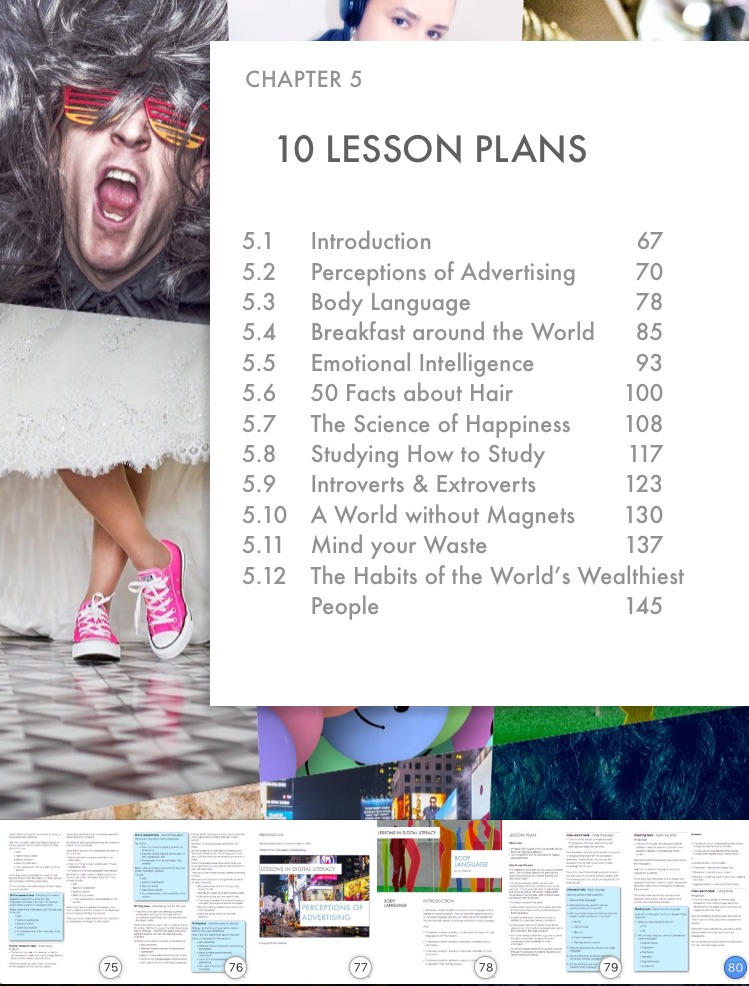
The fourth key chapter of the book is a collection of lesson plans that teachers can use to take students through a complete process from accessing their existing knowledge about a topic, understanding new input, examining how the information fits into their existing value scheme, checking the credibility and validity of the information, carrying out their own parallel research through social media to finally sharing and reevaluating what they have learned.
I believe that the skills and abilities teachers can help students develop through the use of these materials are ones that are sadly lacking, not only in the English language classroom but also in the general education of many students around the world. Through the use of these materials I hope teachers can develop more actively and intellectually critical students who approach digital media with the ability not only to comprehend and consume information but also understand the possible bias, motivation and underlying values of those creating the information. I believe these skills and abilities are key to creating a more tolerant, open-minded and critically aware global society.
There is an assumption that persists in the educational community that more mature teachers are much more difficult and reluctant to be trained on the effective use of educational technology. To some degree, I think this assumption has been built on by the digital native vs digital immigrant myth. But as someone who has trained teachers of all ages all over the world I would say that, from my own experience, this hasn’t been the case.
What I have found to be the case is that more mature teachers are:
Less likely to lured by the shiny hardware and the seemingly wonderful claims made to go along with it.
More critical and sceptical about the way technology is used in the classroom.
Less confident when using various apps and websites and less likely to explore the different features.
More easily discouraged by failures.
Less familiar with various tools, applications and services that have become part of every-day life for younger users.
More likely to be able to see through “technology for technology’s sake” classroom applications.
So how should trainers approach the challenges of working with these teachers? Here are a few tips from my own experience of training older teachers to use technology.
Be sure of your ground pedagogically
So many edtech trainers are great with technology, but much less versed in educational theory and pedagogy. More mature teachers are more likely to have a stronger theoretical understanding, so be prepared to back up your ideas with sound pedagogical insights and try to relate your training back to theories of learning and pedagogical approaches.
Make sure training is hands on
Running through a list of tools and ideas in a presentation may have some value, but it doesn’t come anywhere close to the impact of giving teachers hands-on experience and the chance to actually work with the tech to create something.
Being able to speak from experience about how you have used tech with your own students will have far more impact than theoretical applications of “You could do blah blah blah with your students.” Sharing anecdotes of how you have used technology in your own classes, the challenges you have faced and how you have overcome or even been overcome by them can really lend credibility to your training.
Manage expectations
A positive attitude is great, but be prepared to also point out weaknesses, potential pitfalls and talk about your own failures. This might help your trainees avoid the same mistakes and stop them from becoming disillusioned.
Make time to experiment and explore
Don’t be tempted to cram in as many tools, techniques and activities as possible. Incorporate project time into your training so that teachers have the chance to go away and explore the things that interest them most and get their own perspective on how they can use them with students.
Back up technical training
Learning to use new tools is getting easier all the time, especially on mobile, but it’s still quite easy for teachers to forget which button to press or which link to follow. So back up any demonstrations with either an illustrated step-by-step guide or a video tutorial that teachers can come back to later.
Make their lives easier
Using technologies that can make what they already do a bit easier or a bit quicker is a great way to start. For example, I have a link to a tool that really quickly creates a cloze test activity. Sharing tools like this that start from what teachers already do can really help to get them on your side.
Do things that can’t be done
One of the most common remarks made by more mature teachers about technology is: “Well that’s fine, but you can do that without tech by …” If you can show examples of technology use that go beyond what is already possible in the classroom, then you are much more likely to get capture their enthusiasm. One example of this is the use of collaborative writing tools like PrimaryPad and its ability to track, record and show how students constructed text.
Solve classroom problems
Being able to spot a genuine classroom problem and show how technology can solve it can be very persuasive. One example of this is gist reading which can be very challenging to teach because students tend to ignore time limits. I show how using a free digital cue prompter can give teachers control of the text and push students to gist read at the speed the teacher chooses. Problem solved.
Plan with long term and short term goals
However inspiring your training session is, and however short or long it is, you should make sure that teachers leave it with a plan. SMART plans are great if you have time to work on them with the teachers. If you don’t have time to get them to create individual SMART plans, at least get them to think about the first step or the first technology application they will try in their classroom and what they will do with it.
Tech can be implemented in CPD
One of the reasons many mature teachers feel less confident with tech is because they often only use it in the classroom. Showing how technology can become part of their own self-guided CPD and professional practice, and helping them to build their PLN can really help to energise their technology use and make their development much more autonomous and long lasting.
Make sure everything works
I can’t emphasise this enough. Make sure you have updated all your plugins, browser versions, etc,and check the network and connectivity and make sure everything runs smoothly. Nothing puts teachers off more quickly than seeing the trainer fail.
Having read this list of tips you are likely to be thinking: “But all technology training should be like that!” Yes, you are right it should, but the truth is we are more likely to be able to get away with lower standards when working with teachers who are already more enthusiastic about tech. So the next time you walk into a training room and see a number of older teachers there, don’t groan with disappointment, but welcome the opportunity to test your skills and understanding with the most critical audience. If you can send them away motivated to use technology then you know you are on the right track.
One of the true keys to learning and developing any ability is the willingness and capacity to reflect on what we have learned.
So how can we encourage our students to reflect on what they have learned? Generally we want them to reflect from a slightly more distant perspective of time rather than more immediately within the classroom and this is where Recap can really help.
Recap is a cross platform app that allows teachers to create classes and manage students and set them reflection questions that they can respond to using video on their laptop webcam or smart phone from their own home.
How does Recap work? To create a class and add your students just register on the site as a teacher.
Once you have registered you click on Add Class and complete the class details form. You can also decide at this point whether you want your students to register with a PIN or an email. Email is a better option for older learners, whereas a PIN is better for younger ones as this doesn’t require them to have an email, but you do have to add all of their names.
Once the class is created you get a link and a code that students can use to enter your class. I’ve set up a dummy EdTech class, so feel free to join and try it out as a student if you wish. Just use the code shown in the image below.
Once your class is ready you can add two types of tasks, a Recap or a Journey.
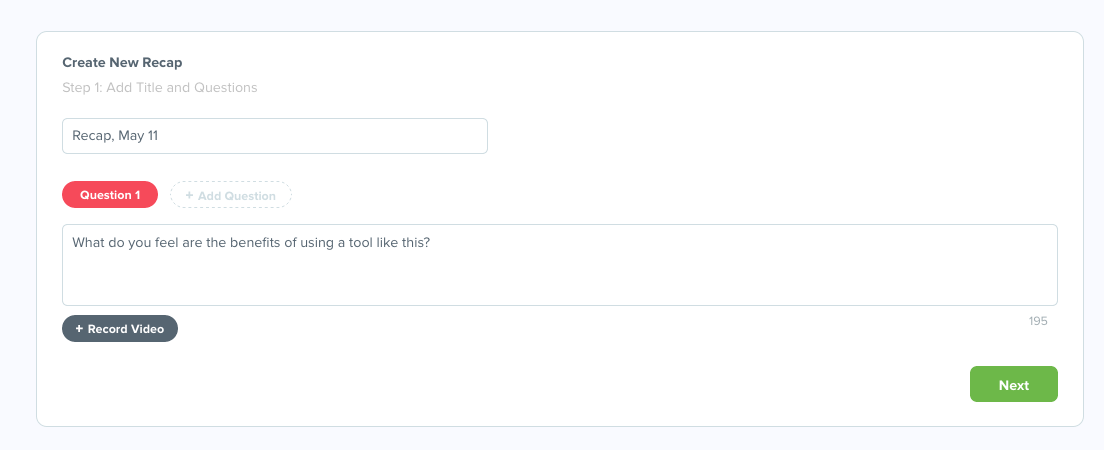
When you click on Add Recap you can type in and / or record your first question.
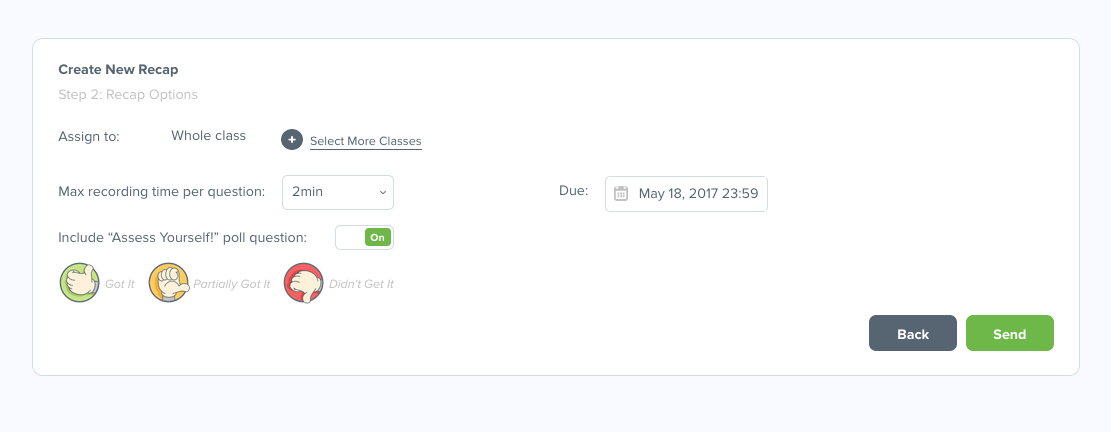
You can then click on ‘Next’ and set the length of recording for your students’ response and the due date for the assignment. You can also decide if it goes to the whole class or individual students and enable to do some self assessment of their recording.
Once you click send the task becomes available to the students. Once they have replied you can click on the student list and then select each student to see their responses.
You can also click on ‘Assess’ and access all the student responses and respond back to them or watch a ‘showreel’ compilation of their responses.
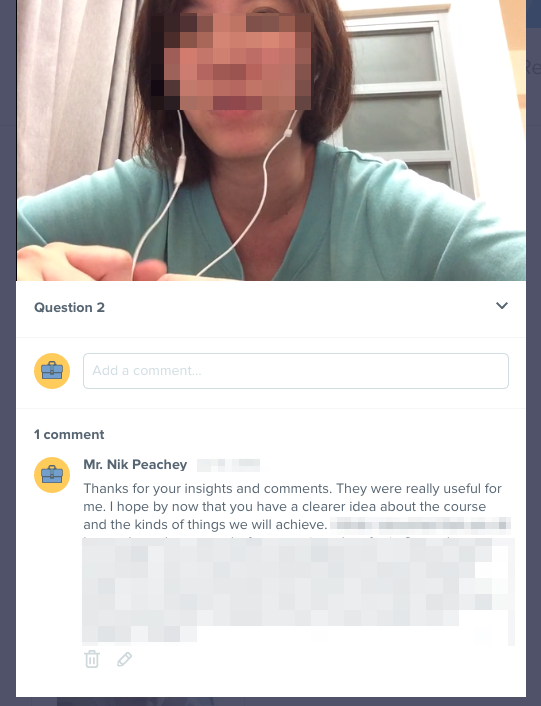
Once you have responded to their comments they can reply, so this can set up a kind of discussion chain.
The second type of task you can add to Recap is a Journey. This is a question based around a sequence of materials with links to different media and video stimulus that you can record on your webcam or phone to help engage with students.
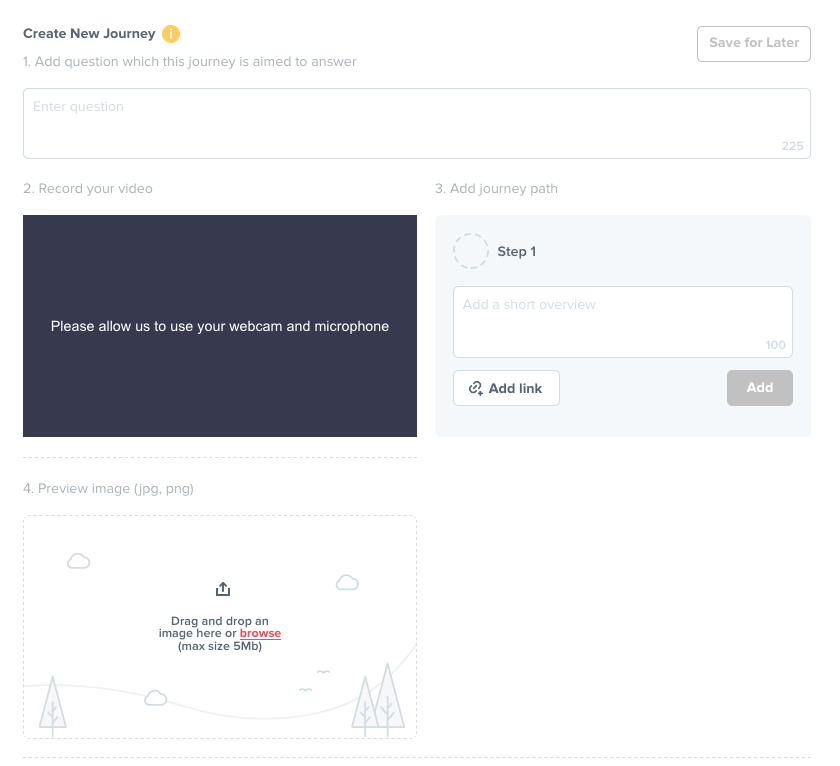
To do this just click on ‘Add Journey’, allow access to your webcam and microphone, record your video and then add steps and links to media you want your students to explore.
The video you record has to be very short so this isn’t a tool for delivering lectures, it’s more of a tool for setting students up to discover things for themselves.
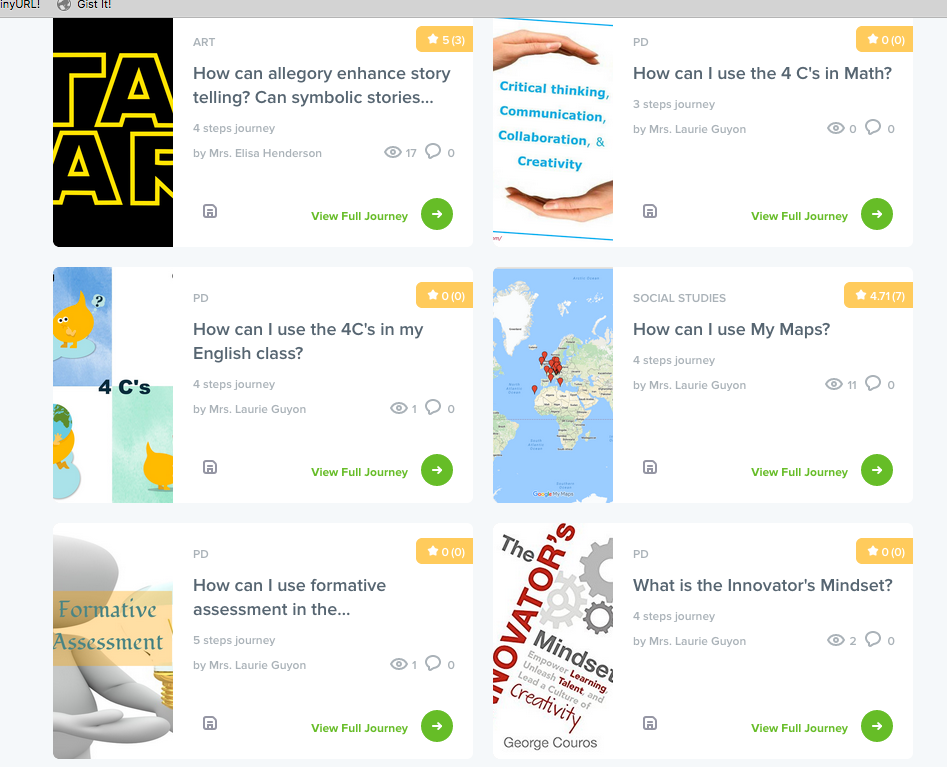
Once you have created your ‘Journey’ activity for your students you ca share it with them, but you can also add it to the Recap ‘Marketplace’ this allows you to share or sell your ‘Journey’ activity to other teachers, so this is a great way to potentially make a little money (the maximum sale price is $0.99).
You can also find ‘Journey’ tasks that you can use with your students there.
How to use Recap with students?
Set a Recap task each evening after class and use it as a form of learner diary.
Use Recaps for action research and get students to tell you how they feel about what and how they are learning.
Set Recaps as short pronunciation assessment activities by getting students to read short texts.
Use Recaps to build a more positive dynamic and get to know your students a bit better and discover their motivation and interests.
Set Recap tasks to check students remember the vocabulary they learned during previous lessons.
Create Journeys based around infographics to get them researching and reflecting on the information within the graphic.
Use Journeys to get students doing research before coming to class for debates or for information sharing in class.
Use Journeys to share SOLE type questions that students can research.
What I like about Recap
Students are often shy to speak and ask questions in class so this is a chance to get them talking just to you.
Actually having the opportunity to listen carefully to each student during the class can be difficult, so Recap can provide you with the ability to fairly assess your students speaking.
The video clips your students submit are stored on the site, so over time you can see how they are progressing.
It’s a safe and controlled way for students to communicate with you through video.
You can actually get to know your students a bit better and give them some one to one time.
It’s great to be able to give students speaking homework and for students to see themselves speaking and reflect on their own performance.
It’s free and works across platforms (there are apps for both Android and iOS).
It offers teachers the opportunity to make some money from their work.
I hope you find Recap useful to help develop your students’ ability to reflect and your own ability to develop a closer understanding of your students’ needs and abilities.
Winner of the 2016 British Council Award for Innovation in Teacher Resources
The ebooks come from chapter 9 of the manual which contains 12 more entries like these. As well as the explainer text, which shows you how to use the tools and gives suggestions for tasks you can do in your classroom, each ebook also has a video tutorial.
Each ebook is available either as PDF from Payhip or from the iBooks Store. I hope you enjoy these free ebooks and find them useful.
Digital Classrooms – TedEd
TED Ed is a great tool for creating online lessons around videos. It enables you to structure a sequence of interactive activities around the video clip that guides the viewer towards a deeper understanding of the content. It’s an ideal tool for building blended learning.
Digital Classrooms – MoveNote
MoveNote is a great tool for getting your presentations online. It enables you to add a talking head with voiceover to guide your students through the materials. These can be embedded into online courses or webpages. It’s ideal for creating flipped learning.
Digital Classrooms – MailVu
MailVu is a great tool for creating asynchronous interaction in either an online course or as part of a blended learning unit of work. It enables asynchronous interaction with just a web-browser and a webcam or there is a free mobile app that runs on most platforms.
Digital Classrooms – VideoNotes
VideoNot.es is a great tool for building your students’ digital literacies and their abilities to use video to study online. It enables students to take time stamped notes while they watch video content and save them alongside the video file.
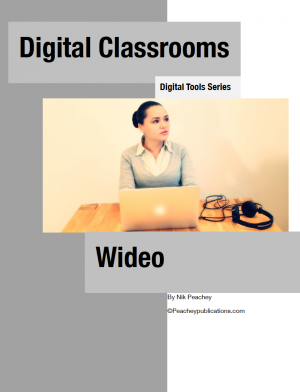
Digital Classrooms – Wideo
Wideo is a great tool for creating simple animated movies. It enables you to create a range of teaching materials that explain simple theories. It’s also easy enough to use to get students creating their own animations.
I hope you enjoy these ebooks and find them useful. If you like them then please check out more of my ebooks at: PeacheyPublications.com and sign up for my Edtech & ELT enewsletter to be kept up to date on all that\’s new in digital learning.
Over the last few months, I have been revising and redesigning the series of lesson plans I first published in 2016. These lesson plans help to develop students linguistic and digital skills as well as their critical thinking by introducing them to a range of topics and information-rich graphics.
Lessons in Digital Literacy
What\’s New about the Lessons in Digital Literacy?
I\’ve incorporated a number of new features into the redesigned lesson plans.
The biggest change is that I have created digital versions for both teachers and students.
These presentations have been created using a technology called html5 which means that they will work in the browser in pretty much any device, including mobile phones, iPads and other tablets.
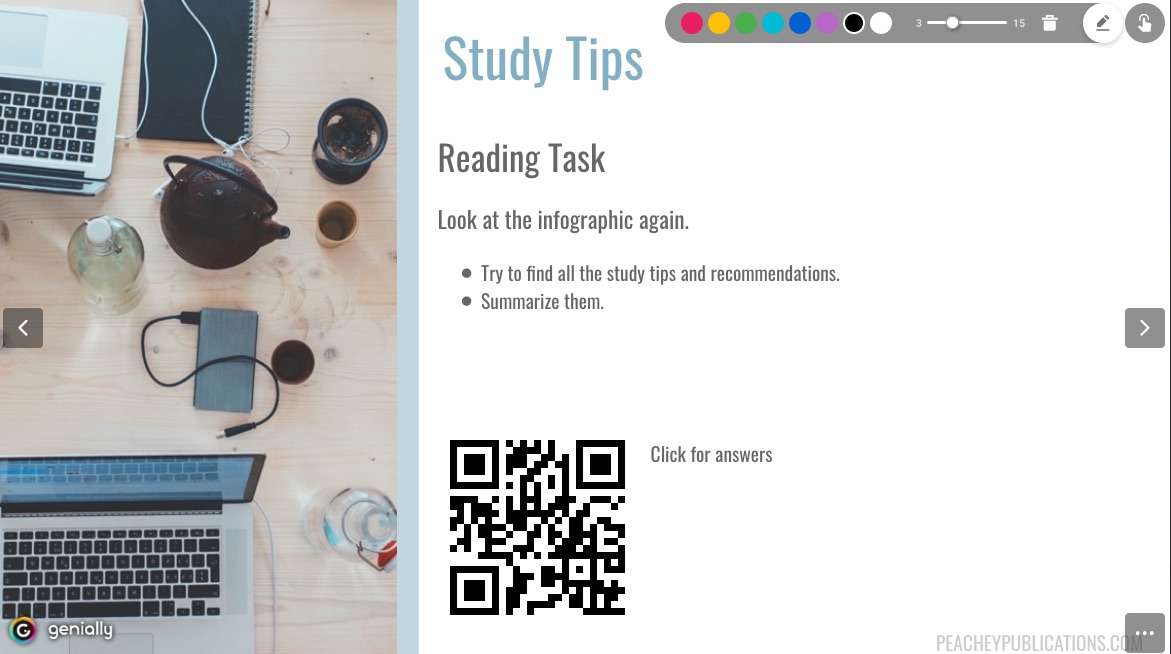
In order to make it easier for both teachers and students to access the infographic for the lesson, I\’ve added QR codes, so that students can either scan them onto a mobile phone from the teacher\’s copy or if they are using their own version of the student materials, they can just click on it and the infographic will open and they can scroll up and down it.
Another feature that these digital materials include is a marker for annotating over the presentation. This is easy to access on both the teacher and student copies and can be opened and closed along with the annotation.
Where writing activities are suggested I\’ve also created a link to an external notepad which students can use and then publish their work directly to the internet.
If your students don\’t have access to digital devices in the classroom you can still use these lessons as there is a PDF version of the students\’ version provided.
The underlying structure of each lesson looks a little like this.
As you can see I try to work from what students already know and believe, introduce new information to them, see how they respond to the information and then get them to examine and evaluate the information more deeply. The final part of each lesson helps students to synergise the information and incorporate it back into their belief system.
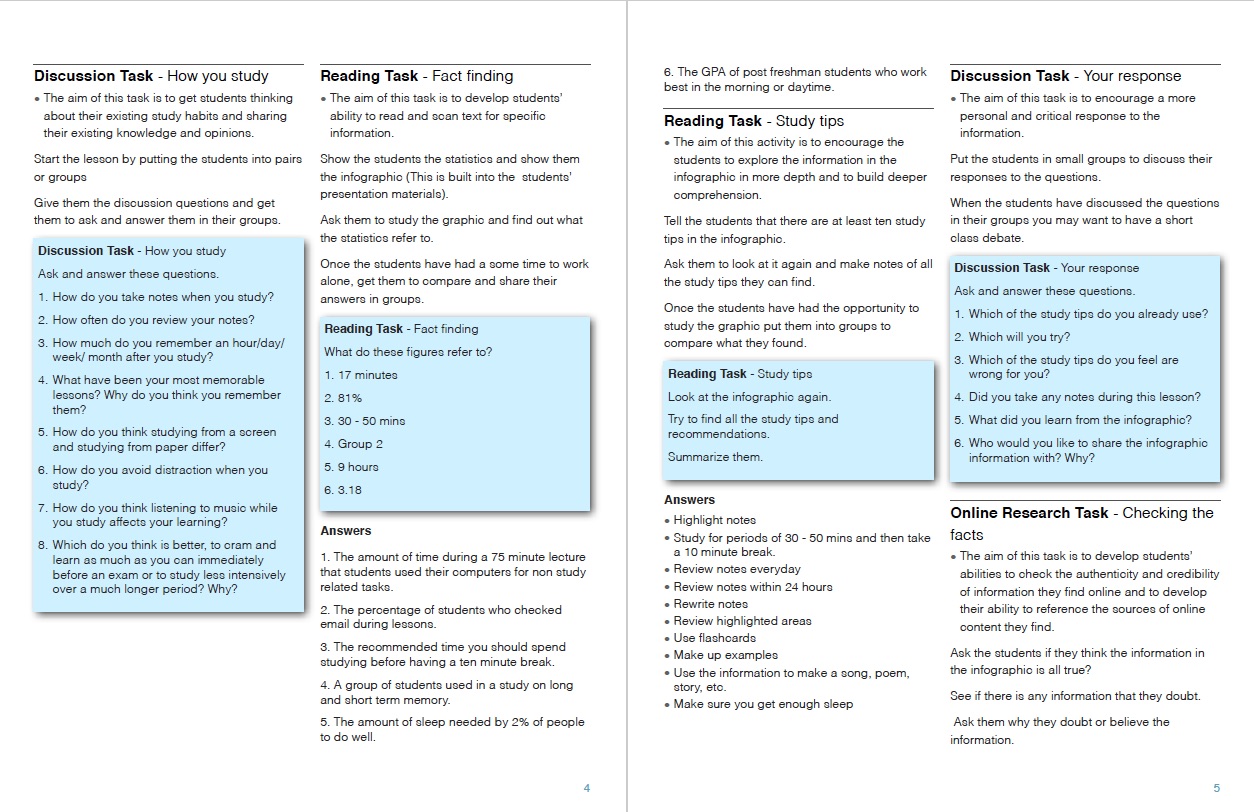
All of the lesson plans include detailed step by step instructions and guidance for teachers, as well as answer keys.
Although each plan contains eight to ten tasks and about 2 hours worth of material, they don\’t have to be completed in one lesson and some of the evaluation tasks used selectively.
You can download all of these lesson plans and materials from: PeacheyPublications
I hope you enjoy themand sign up to my customer list to be informated when new materials become available and to get customer disocunts.
Over the last few months, I have been revising and redesigning the series of lesson plans I first published in 2016. These lesson plans help to develop students linguistic and digital skills as well as their critical thinking by introducing them to a range of topics and information-rich graphics.
Lessons in Digital Literacy
What\’s New about the Lessons in Digital Literacy?
I\’ve incorporated a number of new features into the redesigned lesson plans.
The biggest change is that I have created digital versions for both teachers and students.
These presentations have been created using a technology called html5 which means that they will work in the browser in pretty much any device, including mobile phones, iPads and other tablets.
In order to make it easier for both teachers and students to access the infographic for the lesson, I\’ve added QR codes, so that students can either scan them onto a mobile phone from the teacher\’s copy or if they are using their own version of the student materials, they can just click on it and the infographic will open and they can scroll up and down it.
Another feature that these digital materials include is a marker for annotating over the presentation. This is easy to access on both the teacher and student copies and can be opened and closed along with the annotation.
Where writing activities are suggested I\’ve also created a link to an external notepad which students can use and then publish their work directly to the internet.
If your students don\’t have access to digital devices in the classroom you can still use these lessons as there is a PDF version of the students\’ version provided.
The underlying structure of each lesson looks a little like this.
As you can see I try to work from what students already know and believe, introduce new information to them, see how they respond to the information and then get them to examine and evaluate the information more deeply. The final part of each lesson helps students to synergise the information and incorporate it back into their belief system.
All of the lesson plans include detailed step by step instructions and guidance for teachers, as well as answer keys.
Although each plan contains eight to ten tasks and about 2 hours worth of material, they don\’t have to be completed in one lesson and some of the evaluation tasks used selectively.
You can download all of these lesson plans and materials from: PeacheyPublications
I hope you enjoy themand sign up to my customer list to be informated when new materials become available and to get customer disocunts.
Over the last few months, I have been revising and redesigning the series of lesson plans I first published in 2016. These lesson plans help to develop students linguistic and digital skills as well as their critical thinking by introducing them to a range of topics and information-rich graphics.
Lessons in Digital Literacy
What\’s New about the Lessons in Digital Literacy?
I\’ve incorporated a number of new features into the redesigned lesson plans.
The biggest change is that I have created digital versions for both teachers and students.
These presentations have been created using a technology called html5 which means that they will work in the browser in pretty much any device, including mobile phones, iPads and other tablets.
In order to make it easier for both teachers and students to access the infographic for the lesson, I\’ve added QR codes, so that students can either scan them onto a mobile phone from the teacher\’s copy or if they are using their own version of the student materials, they can just click on it and the infographic will open and they can scroll up and down it.
Another feature that these digital materials include is a marker for annotating over the presentation. This is easy to access on both the teacher and student copies and can be opened and closed along with the annotation.
Where writing activities are suggested I\’ve also created a link to an external notepad which students can use and then publish their work directly to the internet.
If your students don\’t have access to digital devices in the classroom you can still use these lessons as there is a PDF version of the students\’ version provided.
The underlying structure of each lesson looks a little like this.
As you can see I try to work from what students already know and believe, introduce new information to them, see how they respond to the information and then get them to examine and evaluate the information more deeply. The final part of each lesson helps students to synergise the information and incorporate it back into their belief system.
All of the lesson plans include detailed step by step instructions and guidance for teachers, as well as answer keys.
Although each plan contains eight to ten tasks and about 2 hours worth of material, they don\’t have to be completed in one lesson and some of the evaluation tasks used selectively.
You can download all of these lesson plans and materials from: PeacheyPublications
I hope you enjoy themand sign up to my customer list to be informated when new materials become available and to get customer disocunts.


















 I want this book











 Eduindex
You must be logged in to post a comment.