VAJRA (Visiting Advanced Joint Research) Faculty scheme

Hon’ble Prime Minister during the 14thPravasiBharatiya Divas Convention at Bengaluru on 8th January 2017 has announced the launching of VAJRA (Visiting Advanced Joint Research) Faculty scheme by the Department of Science and Technology which enables NRIs and overseas scientific community to participate and contribute to research and development in India. The Science and Engineering Research Board (SERB), a Statutory body of the Department will implement the Scheme.

VAJRA faculty will undertake research in S&T priority areas of nation wherein the capability and capacity are needed to be developed. The VAJRA faculty will engage in collaborative research in public funded institutions.

The residency period of the VAJRA Faculty in India would be for a minimum of 1 month and a maximum of 3 months a year.

The VAJRA Faculty is provided a lump-sum amount of US$ 15000 in the first month of residency in a year and US$ 10000 p.m. in the other two months to cover their travel and honorarium. While no separate support is provided for e.g. accommodation, medical / personal insurance etc. the host institute may consider providing additional support.

The Indian collaborator and the overseas faculty will jointly frame a research plan and the application duly endorsed by the Head of the Institution will be submitted online by the Indian collaborator.

A Selection Committee of eminent scientists will evaluate the applications. The Committee will meet twice a year in January and July and make recommendations. SERB will announce the results in the month of April and September.

Public funded academic institutions and national laboratories are eligible to host the VAJRA Faculty. These institutions should appoint them as Adjunct / Visiting Faculty and involve them in co-guiding and mentoring of students and developing collaborative programs. The Faculty can also be allowed to participate in other academic activities as agreed to by the host institution and the Faculty.

For details log on to www.vajra-india.in

Impacting Research Innovation and Technology (IMPRINT )

Introduction:

IMPacting Research INnovation and Technology (IMPRINT), the first-of-its-kind Pan-IIT and IISc joint initiative, is a Ministry of Human Resource Development (MHRD) initiative to address  major engineering challenges that the country must address and champion to enable, empower and embolden the nation for inclusive growth and self-reliance. Department of Science and Technology is partnering with  MHRD in implementing this program.

Selected Technology Domain:

In order to pursue the mandates of IMPRINT, ten technology domains as grand engineering challenges have been thought of. The ten domains that represent the most important areas for the country along with their coordinating institutes are given below:

  1. Healthcare Technology: IIT Kharagpur
  2. Computer Technology: IIT Kharagpur
  3. Advance Materials: IIT Kanpur
  4. Water Resources: IIT Kanpur
  5. Sustainable Habitat: IIT Roorkee
  6. Security and Defense: IIT Madras
  7. Manufacturing Technology: IIT Madras
  8. Nano-technology Hardware: IIT Bombay
  9. Environment and Climate: IISc, Bangalore
  10. Energy Security: IIT Bombay

The overall  National Coordinator is IIT, Kanpur. Each domain in IMPRINT is divided into themes, sub-themes, target and topics for educational orientation, research and innovation. For details, please visit http://imprint-india.org

Cognitive Science Research Initiative (CSRI)

Cognitive Science is the study of human mind and brain, focusing on how mind represents and manipulates knowledge and how mental representations and processes are realized in the brain. The field is highly transdisciplinary in nature, combining ideas, principles and methods of psychology, computer science, linguistics, philosophy, neuroscience etc. In Indian scenario which is full of diversity, it is important to foster scientific research in interdisciplinary field of Cognitive Science for better understanding of Indian mind sets, languages and cognitive disorders etc. With this aim, the Department of Science & Technology (DST) had initiated a highly focused programme “Cognitive Science Research Initiative (CSRI)” in 2008 during 11th Five year plan. The Cognitive Science Research Initiative facilitates a platform to scientific community to work for better solution of challenges related with cognitive disorders and social issues through various psychological tools & batteries, early diagnosis & better therapies, intervention technologies and rehabilitation programmes.

Objectives:

Cognitive Science Research Initiative is aimed to revolutionize research in various fields, such as:

  • Nature and origins of mental disorders, of physiological, social and neuro-chemical origins.
  • Design of better learning tools and educational paradigms.
  • Design of better software technologies and artificial intelligence devices.
  • Streamlining of social policy formulation and analysis.

Thrust Areas: Cognitive science has wide horizons which covers different aspects of cognition. DST has identified specific thrust areas in Cognitive Science which include Foundations of Cognition; Language and Cognition; Computational Intelligence; Cognitive Psychology and Cognitive Neuroscience etc.

Activities Supported under CSRI:

  1. Individual R&D Projects: Grant is available for R&D projects in any thrust areas identified. Support will be provided for Equipments, Manpower and other research grant.
  2. Multi-centric Mega Projects: Multi-centric projects are encouraged to provide better solution of issues related with social relevance, better understanding of neurodegenerative diseases and their therapeutics.
  3. Post Doctoral Fellowship:Two years ‘Post Doctoral Fellowship’ Programme is aimed to develop human resource in Cognitive Sciences. The Scheme provides Opportunities to Young Scientists (below 40 years) for pursuing innovative research in frontier areas of Cognitive Science.
  4. Support for Schools, Training, Workshops, Conferences etc: The CSRI programme extends partial support for organizing conference/seminar/symposia/training programmes/workshops/schools on a selective basis. The support is provided to Academic or Research Institutions, Universities and other Professional bodies to encourage young researchers and keep scientific community abreast of the latest developments in various areas of Cognitive Science.

Programme Schedule: Department invites Individual Project Proposals and application for Post Doctoral Fellowship once in a year through advertisement in all leading Newspapers and DST website. Mega projects for intensified research in particular area are supported under top-down approach in discussion with DST and stakeholders. Proposals for conducting Schools /Conferences are open throughout the year and considered on request.

Advertisement for submission of research proposal under Cognitive Science Research Initiative – Last Date – 31 July 2018 [PDF]392.12 KB


Sanctioned Projects  – 2015-16[PDF]101.34 KB

Sanctioned Projects  – 2016-17[PDF]117.5 KB

What SERB offers to Scientists?

What is SERB?

The Science and Engineering Research Board (SERB) is a statutory body established through an Act of Parliament. Supporting basic research in emerging areas of Science & Engineering are the primary and distinctive mandate of the Board. The Board structure, with both financial and administrative powers vested in the Board, would enable quicker decisions on research issues, greatly improving thereby our responsiveness to the genuine needs of the research scientists and the S&T system.

What SERB offers to Scientists?

SERB supports research in frontier areas of Science and Engineering. A regular faculty / researcher in an academic / research institution can seek research support to carry out his/her research. Board also gives special attention to young scientists below the age of 35 years (relaxable by 5 years in the case of SC/ST/OBC, woman and physically handicapped category) to undertake independent research in newly emerging and frontier areas of science and engineering. High priority areas are supported in through the “Intensification of Research in High Priority Area “(IRHPA) Program. The Board offers JC Bose National Fellowship to scientists and engineers for their outstanding performance and contributions and RAMANUJAN Fellowship for brilliant scientists and engineers from all over the world to take up scientific research positions in India, especially those scientists who want to return to India from abroad. Board also provides financial assistance for presenting research paper in international scientific event (conference/ seminar/ symposium/ workshop etc.) held abroad. SERB extends partial financial support, on selective basis, for organising scientific events (National as well as International) in the country.

National Science & Technology Management Information System

NSTMIS, DST is responsible for collection, collation, analysis and dissemination of information on resources devoted to S&T activities in the country.

The Scientific and Technological (S&T) activities play a vital role in the economic, social and physical development of a country. Scientific and technological research needs huge investments and calls for a judicious utilization of scarce resources like finance, trained manpower, raw materials etc. Data collection and analysis pertaining to resources, devoted to S&T, therefore, assumes significant importance. The growth of S&T, its performance and impact on society and economy are indicators to assess the effectiveness of planning and policy formulation.

The National Science and Technology Management Information System (NSTMIS), a division of Department of Science and Technology (DST) has been entrusted with the task of building the information base on a continuous basis on resources devoted to scientific and technological activities for policy planning in the country.

Activities

NSTMIS undertakes broadly two types of research activities:

  • In-house Research
  • Sponsored Research

In-house Research

  • National Survey on resources devoted to S&T activities in the country.
  • National Level database on Extramural (sponsored) R&D projects.

As an outcome of above in-house research, NSTMIS brings out the following publications

  • Research and Development Statistics
  • Research and Development in Industry
  • S&T Data Book
  • Directory of R&D Institutions
  • Directory of Extramural R&D Projects

Sponsored Research

While some of the valuable basic data on input resources into S&T activities were processed in -house, it was felt necessary to involve other interested individuals/organisations to take up studies in the sponsored project mode in order to convert this activity into a very comprehensive and cohesive plan programme to make available Science and Technology indicators. Keeping this in view, the divisional activities were further strengthened during Seventh Five Year Plan (1985-90) by enlarging the scope and including the following :

  • Creation, Updation and Dissemination of databases on R&D resources, projects, institutions, experts, equipments, other infrastructure facilities.
  • Development of S&T indicators.
  • Studying aspects related to R&D management and policy issues.
  • Estimation of short term and long term requirement of different categories of scientific manpower particularly in new emerging areas of S&T.
  • Studying the mismatch between employment and output of S&T personnel.
  • Supporting R&D projects on various S&T dimensions.

So far, more than 125 projects on the various facets of S&T have been sponsored to various organisations/ establishments and the results of 85 completed projects have already been published in the form of reports and disseminated to various researchers/users.

Call for Proposals (2017-18) – Centre for Human and Organisational Resource Development (CHORD Division)

New Initiatives

Innovation plays a vital role in nation’s prosperity. Recognizing the importance, the Indian Government has mounted a new initiative the Science, Technology, Innovation and Creation of Knowledge framework (STICK). The National Innovation Survey framework, evolved upon in-depth discussion with the national and international experts shall be used in the implementation of the STICK Programme.

For more information on STICK Programme National Innovation Survey

Linkages

NSTMIS division maintains a close liaison with UNESCO, NSF, OECD, etc. for matters relating to S&T statistics and indicators. NSTMIS officers are taken as resource persons by UNESCO for the various workshops conducted by them on standardisation of concepts and terminologies used in S&T statistics. NSTMIS expertise has also been shared with other developing nations like China and Trinidad and Tobago. Apart from this, NSTMIS continually interacts with various national organisations like Planning Commission, Institute of Applied Manpower Research, University Grants Commission, Confederation of Indian Industries and other scientific organisations for exchange of information and expertise related to Science Statistics and Indicators.

Project List Year Wise –


2004-05[PDF]10.96 KB 2005-06[PDF]9.75 KB 2006-07[PDF]15.43 KB 2007-08[PDF]20.99 KB 2008-09[PDF]21.5 KB
2009-10[PDF]9.01 KB 2010-11[PDF]9.65 KB 2011-12[PDF]10.13 KB 2012-13[PDF]7.93 KB 2013-14[PDF]14.79 KB
2014-15[PDF]137.39 KB 2015-16[PDF]15.09 KB 2016-17[PDF]233.86 KB 2017-18[PDF]247.83 KB 2018-19[PDF]240.6 KB

Swarnajayanti Fellowships Scheme

Govt. of India had instituted a scheme “The Swarnajayanti Fellowships” to commemorate India’s fiftieth year of Independence. Under this scheme a selected number of young scientists, with proven track record, are provided special assistance and support to enable them to pursue basic research in frontier areas of science and technology. The fellowships are scientist specific and not institution specific, very selective and have close academic monitoring..

Nature of Support:

The award consists of a Fellowship of Rs 25000/- per month in addition to the salary drawn from the parent Institute along with a Research Grant of Rs 5 lakh per annum by Department of Science and Technology for a period of 5 years, while the project submitted by the selected Fellows will be considered for funding by the Science & Engineering Research Board (SERB) as per SERB norms, for recurring and non-recurring heads. Scientists selected for the award will be allowed to pursue unfettered research with a freedom and flexibility in terms of expenditure as approved in the research plan. The project should contain innovative research idea and it should have a potential of making impact on R&D in the discipline.

Duration:

The duration of the fellowship will be for a period not exceeding five years.

The advertisement for  “Swarnajayanti Fellowships Scheme” for each year will appear on the DST website with all details.

Swarnajayanti Fellowships Awards

Project List Year Wise
1997-05 2005-06[PDF]28.02 KB 2006-07[PDF]26.44 KB 2007-08[PDF]16.86 KB 2008-09[PDF]22.37 KB 2009-10[PDF]14.59 KB 2010-11[PDF]46.39 KB 2011-12[PDF]82.02 KB 2012-13[PDF]102.55 KB 2013-2014[PDF]160.97 KB 2014-2015[PDF]29.24 KB 2015-2016[PDF]49.78 KB 2016-2017[PDF]65.09 KB 2017-2018[PDF]294.97 KB 2018-2019[PDF]255.81 KB

Advertisement

Advertisement for the “SwarnaJayanti Fellowships Scheme 2019-20”[PDF]0 bytes

Science Olympiad Programme

A National Science Olympiad Program covering Mathematics and Sciences including Astronomy is operational in the country.  These programs aim at promoting excellence in Science and Mathematics among pre-university students. While HomiBhaba Centre for Science Education (HBCSE), Mumbai is the nodal organization for selection, training of students through Indian Association of Physics Teachers (IAPT) for participation of students at various International Olympiads meet. The program is financially supported by Government of India, in particular Department of Science and Technology, Board of Nuclear Sciences (Department of Atomic Energy), Department of Space, Ministry of Human Resource Development and Ministry of Earth Sciences.

Except Mathematics Olympiad, HBCSE administered and coordinates various other Olympiads such as Astronomy (Junior & Senior), Biology, Chemistry, Earth Science, Physics and Junior Science through National Steering Committee (NSC) and the Department of Science and Technology (DST) is the member of NSC for implementation.

For more details please visit www.olympiads.hbcse.tifr.res.in

Kishore Vaigyanik Protsahan Yojana (KVPY)

Kishore VaigyanikProtsahanYojana (KVPY) is an on-going National Programme to provide Mentorship and Scholarship support to pursue study in Basic Sciences. While KVPY program is initiated and funded by the Department of Science and Technology, Government of India, it is administered and implemented by the Indian Institute of Science (IISc) Bangalore to attract exceptionally motivated students to study science and pursue careers in research.

The objectives of the program are to identify students with talent and aptitude for research, help them realize their potential in their studies, encourage them to take up research careers in science and ensure the growth of the best scientific minds for research and development in the country.

The KVPY Program enrolls students starting from Class XI standards (science subjects) and operates in 3 streams i.e. stream SA, Stream SX and Stream SB. Initiating with mentorship in initial 1-2 years through exposure in VIJOSHI Science Camp, it provides scholarship to KVPY students who joins in Science Courses (out 18 subjects) at the undergraduate (BSc, BS-MS or Integrated MS) level and continued upto post-graduate level.

The KVPY Programme announces every year sometime in May/June to conduct its selection process which is carried out in two stages: i) Aptitude Test (in November or so) and ii) Personal Interview. Each year nearly 2000 students are selected in 3 streams and approximately 1000 students received KVPY Scholarship every year.

For more information please visit website: www.kvpy.iisc.ernet.in

Science and Technology of Yoga and Meditation (SATYAM)

Department of Science and Technology (DST), in 2015, conceptualized a new research program- ‘Science and Technology of Yoga and Meditation’ (SATYAM)- under its Cognitive Science Research Initiative (CSRI). As Yoga and Meditation are interdisciplinary endeavors that interface with Neuroscience, Medicine, Psychology, Philosophy, and so on, therefore an interdisciplinary approach is needed to converge different & diverse disciplines as well as approaches & methods in the study of yoga and meditation. Thus comprehensive research on yoga and meditation is expected to address various challenges confronting physical and mental health. This new programme is aimed to foster scientific research on the effects of yoga and meditation on physical & mental health and on cognitive functioning in healthy people as well as in patients with disorders.

Themes: Basic themes being covered under SATYAM include, among others, (1) investigations on the effect of Yoga and Meditation on physical and mental health and well being, and (2) investigations on the effect of Yoga and Meditation on the body, brain, and mind in terms of basic processes and mechanisms.

Who can apply: Scientists/academicians with research background in ‘Yoga and Meditation’ and having regular position are invited to participate in this initiative. Practitioners actively involved in yoga and meditation practices are also encouraged to apply in collaboration with academic and research institutions of repute. Interested researchers are required to submit research proposals in their area of expertise along with Endorsement Certificate from the Head of the Institution and detailed bio-data of PI and Co-PIs.

Project duration: The project is tenable for a maximum period of three (3) years.


Last date for proposal submission under Science and Technology of Yoga and Meditation (SATYAM) and COVID-19 related SATYAM ‘Special Call’ has been extended till 31 May 2020)

Special Call under SATYAM to fight against COVID 19[PDF]0 bytes

Concept Note Format[PDF]517.48 KB

Advertisement for Science and Technology of Yoga and Meditation (SATYAM)- 2019-20[PDF]0 bytes

Format for Submission of Research Proposal Under Science and Technology of Yoga and Meditation (SATYAM)[PDF]580.33 KB 

Sanctioned Projects  – 2015-16[PDF]97.59 KB

Sanctioned Projects  – 2016-17[PDF]86.04 KB

Innovation in Science Pursuit for Inspired Research Programme

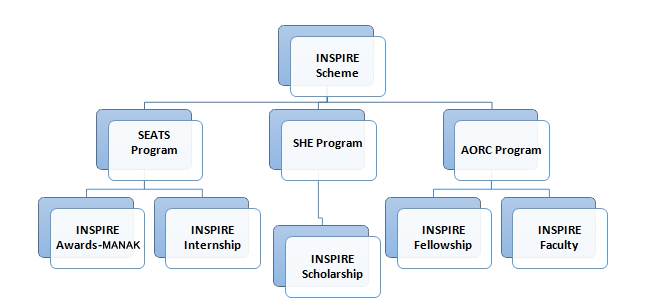
Innovation of Science Pursuit for Inspire Research (INSPIRE) is one such innovative scheme proposed by the Department of Science & Technology for attraction of talent to science. The basic objective of INSPIRE would be to communicate to the youth population of the country the excitements of creative pursuit of science and attract talent to the study of science at an early stage and build the required critical human resource pool for strengthening and expanding the Science & Technology system and R&D base.

INSPIRE Scheme has included three programs and five components. They are i) Scheme for Early Attraction of Talents for Science (SEATS), b) Scholarship for Higher Education (SHE) and c) Assured Opportunity for Research Careers (AORC).The schematic diagram of the programme is shown below

Government of India approved this Scheme in November 2008 at a total cost of Rs 1979.25 crores in the 11th Plan Period and Hon’ble Prime Minister launched the Program on 13th December 2008. The Scheme with all the components is continuing in 12th Plan (2012-2017) at a total allocation of Rs.2200 crores. The Scheme has achieved the desired targets of enrolment of students in all 5 components by FY 2013-14.

For details on i) INSPIRE-Awards-MANAK ,click here:

For ii) INSPIRE Programme (4 other Components) ,click here:

1. Results of Level-2 Evaluation in 9th Advertisement (Provisional to Final) of INSPIRE Fellowship have been declared. Out of total 370 Declared Results, Selected for Final Offer: 256, Rejected-114.This results is compiled of applications received with documents uploaded up to 8th December 2017.

2. Partial Results of Results of Level-2 Evaluation in 10th Advertisement of INSPIRE Fellowship have been declared. Out of total 397 applications accepted for Level-2 Evaluation, now released results for 254 applications (158 accepted for Final Offers and 96 rejected), the remaining applications results will be announced shortly.

Results – 9th & 10th advertisement of INSPIRE- Candidate Click Here to View Result

Announcement for INSPIRE Faculty Fellowship Scheme for 2019[PDF]0 bytes

Fellowship Opportunities for Researchers

1. Extra Mural Research Funding (Individual Centric)

Individual centric competitive mode of funding will be provided under the EMR funding schemes. SERB supports potential scientists for undertaking research in frontier areas of S&T in Life Sciences, Physical Sciences, Chemical Sciences, Engineering Sciences, Earth & Atmospheric Sciences & Mathematical Sciences.

Read More

2.Scheme for funding High Risk -High Reward Research

The Scheme for funding High Risk – High Reward Research aims at supporting proposals that are conceptually new and risky, and if successful, expected to have a paradigm shifting influence on the S&T. This may be in terms of formulating new hypothesis, or scientific breakthroughs which aid in emergence of new technologies.

Read More

3.Empowerment and Equity Opportunities for Excellence in Science

The scheme, Empowerment and Equity Opportunities for Excellence in Science (EMEQ) is aimed at providing research support to scientists belonging to the Scheduled Caste and Scheduled Tribe in undertaking research in newly emerging and frontier areas of science and engineering and thus to involve them in the National Science and Technology development process.

Read More

4.Start-Up Research Grant (Young Scientists)

Start-up grant for Young Scientists is restructured w.e.f. 1st September, 2015 into two new schemes:    Early Career Research Award (ECRA), National Post-Doctoral Fellowship (NPDF)

Read More

5. J C Bose National Fellowship

Nominations are invited for the J C Bose National Fellowships. The fellowship is meant to recognize active scientists and engineers for their outstanding performance and contributions. The fellowships are scientist-specific and very selective.

Read More

6. Ramanujan Fellowship

The fellowship is meant for brilliant scientists and engineers from all over the world to take up scientific research positions in India, i.e. for those scientists who want to return to India from abroad. The fellowships are scientist-specific and very selective. The Ramanujan Fellows could work in any of the scientific institutions and universities in the country and they would be eligible for receiving regular research grants through the extramural funding schemes of various S&T agencies of the Government of India.

Read More

7.National Post Doctoral Fellowship

The SERB-National Post Doctoral Fellowship ( N-PDF) is aimed to identify motivated young researchers and provide them support for doing research in frontier areas of science and engineering. The fellows will work under a mentor, and it is hoped that this training will provide them a platform to develop as an independent researcher

Read More

8.Early Career Research Award

Early Career Research Award scheme aims to provide quick research support to the young researchers who are in their early career for pursuing exciting and innovative research in frontier areas of science and engineering.

Read More

9.SERB Overseas Postdoctoral Fellowship

SERB Overseas Postdoctoral fellowship (SERB-OPDF) aims to build national capacity in frontier areas of Science and Engineering, which are of interest to India by providing postdoctoral fellowship for a period of one year extendable to one more year subject to good performance. The applicant should have completed PhD degree in science and engineering not earlier than the preceding two years from recognized institutions in India. For researchers who are in regular employment, the 2 years� period may be relaxed. The Program admits candidates in *identified areas and sends them to top institutions around the globe, other than USA and also to institutions where internationally acclaimed scientists are working. The applicant should himself/herself correspond with the proposed host institution abroad for their postdoctoral work. He/she is required to produce evidence, in the form of a letter of acceptance from the host institution along with merits/uniqueness of the host institute in the proposed area.

Read More

10.CSIR Young Scientists Awards

11. Scheme for Young Scientists & Technologist (SYST)

12. IYBA Innovative Young Biotechnologist Award

13. Sponsored Research (RESPOND)

The Indian Space Research Organisation (ISRO) has evolved a programme through which financial support is provided for conducting research and development activities related to Space Science, Space Technology and Space Application to academia in India. This programme of Research Sponsored by ISRO is called RESPOND. In special cases research and development projects proposed by non-academic R & D laboratories can also be supported through this programme. The aim of RESPOND is to encourage quality research in areas of relevance to the Indian space programme.

Read More

14. Research Programmes and Projects –  Ministry of Earth Sciences

Read More

15. Indo-U.S. Fellowship for Women in STEMM

Indo-U.S. Fellowship for Women in STEMM (Science, Technology, Engineering, Mathematics and Medicine) is aimed to provide opportunities to Indian Women Scientists, Engineers & Technologists to undertake international collaborative research in premier institutions in U.S.A, to enhance their research capacities and capabilities in global perspective. DST has launched the fellowship (WISTEMM)” jointly with Indo-U.S. Science and Technology Forum (IUSSTF).

Read more
16. 2019-2020 Fulbright-Kalam Climate Fellowship (Announcement[PDF]47.8 KB)

In a September 2014 Joint Statement, the President of the United States of America and the Prime Minister of the Republic of India launched U.S.-India Climate Fellowship Program to build long-term capacity to address climate change related issues in both countries.

In pursuance of the Joint Statement, the Government of the United States of America and the Government of the Republic of India – desiring to promote further mutual understanding between the two peoples by a wider exchange of knowledge and professional talents – intend to partner to build long-term capacity in the United States and India by engaging scientific and technical research scholars from both countries related to climate research and education through the Fulbright-Kalam Climate Fellowship.

The United States-India Educational Foundation (USIEF) administers the Fulbright-Kalam Climate Fellowship on behalf of both the governments.

Read more

Research Awards to promising “Young Scientist” by various Organisation Public and Private

The Scheme provides Opportunities to Young Scientists for pursuing exciting and innovative research in frontier areas. The scheme is focused on young scientists & technologist who have adequate background and training in fields of science and technology and show inclination to undertake socially relevant action research projects. This is also to encourage academic institutions, national labs and other S&T institutions.


Department of Science & Technology (DST)

Department of Science & Technology (DST) was established in May 1971, with the objective of promoting new areas of Science & Technology and to play the role of a nodal department for organising, coordinating and promoting S&T activities in the country. The Department has major responsibilities for specific projects and programmes as listed below:

  1. Formulation of policies relating to Science and Technology.
  2. Matters relating to the Scientific Advisory Committee of the Cabinet (SACC).
  3. Promotion of new areas of Science and Technology with special emphasis on emerging areas.
    1. Research and Development through its research institutions or laboratories for development of indigenous technologies concerning bio-fuel production, processing, standardization and applications, in co-ordination with the concerned Ministry or Department;
    2. Research and Development activities to promote utilization of by-products to development value added chemicals.
  4. Futurology.
  5. Coordination and integration of areas of Science & Technology having cross-sectoral linkages in which a number of institutions and departments have interest and capabilities.
  6. Undertaking or financially sponsoring scientific and technological surveys, research design and development, where necessary.
  7. Support and Grants-in-aid to Scientific Research Institutions, Scientific Associations and Bodies.
  8. All matters concerning:
    1. Science and Engineering Research Council;
    2. Technology Development Board and related Acts such as the Research and Development Cess Act,1986 (32 of 1986) and the Technology Development Board Act,1995 (44 of 1995);
    3. National Council for Science and Technology Communication;
    4. National Science and Technology Entrepreneurship Development Board;
    5. International Science and Technology Cooperation including appointment of scientific attaches abroad (These functions shall be exercised in close cooperation with the Ministry of External Affairs);
    6. Autonomous Science and Technology Institutions relating to the subject under the Department of Science and Technology including Institute of Astro-physics, and Institute of Geo-magnetism;
    7. Professional Science Academies promoted and funded by Department of Science and Technology;
    8. The Survey of India, and National Atlas and Thematic Mapping Organisation;
    9. National Spatial Data Infrastructure and promotion of G.I.S;
    10. The National Innovation Foundation, Ahmedabad.
  9. Matters commonly affecting Scientific and technological departments/organisations/ institutions e.g. financial, personnel, purchase and import policies and practices.
  10. Management Information Systems for Science and Technology and coordination thereof.
  11. Matters regarding Inter-Agency/Inter-Departmental coordination for evolving science and  technology missions.
  12. Matters concerning domestic technology particularly the promotion of ventures involving  the commercialization of such technology other than those under the Department of  Scientific and Industrial Research.
  13. All other measures needed for the promotion of science and technology and their  application to the development and security of the nation.
  14. Matters relating to institutional Science and Technology capacity building including setting  up of new institutions and institutional infrastructure.
  15. Promotion of Science and Technology at the State, District, and Village levels for grass- roots development through State Science and Technology Councils and other mechanisms.
  16. Application of Science and Technology for weaker sections, women and other disadvantaged sections of Society.

Government of India & AIIB sign agreement


The Government of India and the Asian Infrastructure Investment Bank (AIIB) signed a US$ 500 million “COVID-19 Emergency Response and Health Systems Preparedness Project” here today to help India to respond to the COVID-19 pandemic and strengthen its public health preparedness. This is the first ever health sector support from the Bank to India.

This new support will cover all States and Union Territories across India and address the needs of infected people, at-risk populations, medical and emergency personnel and service providers, medical and testing facilities, and national and animal health agencies.

The agreement was signed by Shri Sameer Kumar Khare, Additional Secretary, Department of Economic Affairs, Ministry of Finance, on behalf of the Government of India and Mr Rajat Misra, Director General (Acting) on behalf of the AIIB.

Shri Khare said that AIIB’s timely assistance will help Government in its efforts to respond to the threat posed by COVID-19 and strengthen the national health systems for preparedness in India. Responding to the urgency of the pandemic, this project was prepared in record time, underlying the efforts of the officials from the Finance and Health Ministries and the AIIB.

The project will enable the Government of India to slow and limit as much as possible the spread of COVID-19 in India by providing immediate support to enhance disease detection capacities by scaling up procurement of PPE, oxygen delivery systems, and medicines, build resilient health systems to provide core public health, prevention, and patient management functions to manage COVID-19 and future disease outbreaks, support research on COVID-19 by Indian and other global institutions working in collaboration with the Indian Council of Medical Research, address significant negative externalities expected in the event of a widespread COVID-19 outbreak and strengthen public structures for the coordination and management of the project.

The primary project beneficiaries will be infected people, at-risk populations, medical and emergency personnel, service providers at medical and testing facilities (both public and private), and public and animal health agencies engaged in India’s COVID-19 response.

Mr D.J. Pandian, AIIB vice-president (Investment Operations), said that building a resilient health system that can effectively treat COVID-19 patients and prevent its spread is the immediate priority. This funding will address this need and strengthen India’s capacity to effectively manage future disease outbreaks.

He further said that facing this unprecedented global challenge, AIIB will play its part and work closely with international financial institutions to help the Government of India with urgent financing they need to shore up their healthcare systems and help their economies recover as quickly as possible.

The project will also enhance the resilience of India’s health system to provide core public health prevention and patient care to better manage COVID-19 and future disease outbreaks. It will help strengthen India’s Integrated Disease Surveillance Program, revamp infectious disease hospitals, district, civil, general and medical college hospitals, and build a network of high containment Biosafety Level 3 laboratories.

Today, about 75 per cent of new infectious diseases begin with human-to-animal contact, including HIV/AIDS, Ebola, and SARS. The project will develop capacity and systems to detect existing and emerging zoonoses, support biomedical research on COVID-19 by Indian institutions, and upgrade viral research and diagnostic laboratories for testing and research.

It will also help address potential significant negative externalities in the event of a widespread COVID-19 outbreak, including comprehensive health awareness and behaviour change campaigns on hygiene practices, wearing masks, social distancing, and mental health and psychological services for vulnerable communities.

The project is being financed by the World Bank and AIIB in the amount of $1.5 billion, of which $1.0 billion will be provided by World Bank and $500 million will be provided by AIIB.

The project will be implemented by the National Health Mission (NHM), the National Center for Disease Control (NCDC) and the Indian Council of Medical Research (ICMR) under the Ministry of Health and Family Welfare.

Food and Public Distribution ensures to supply free food grains

The Government is making efforts to ensure that foodgrains are readily available for distribution in all the States for meeting their requirements under the “Pradhan Mantri Garib Kalyan Anna Yojana (PM-GKAY)”. The Union Minister for Consumer Affairs, Food and Public Distribution, Shri Ram Vilas Paswan said here today the FCI has already loaded a total number of 2641 rakes (including Wheat and Rice) towards this end and the approx quantity loaded is 73.95 LMT (55.38 LMT Rice and 18.57 LMT Wheat). This is an all time record as this heavy / huge movement of foodgrains was accomplished during the period from 24.03.2020 (the date on which lockdown was clamped across the country) to 08.05.2020.


He said 21 States/UT have completed more than 90% distribution for the month of April under PM-GKAY covering nearly 41.35 Crore beneficiaries in these States/UTs. Some States/UTs namely, Andaman Nicobar Island, D&NH and Daman & Diu, Madhya Pradesh, Odisha, Puducherry, Himachal Pradesh etc. are distributing foodgrains for two months in one go under PMGKAY.

The Minister said 6 Crore Special SMSs have also been sent by about 20 States/UTs to NFSA ration card holders for awareness generation about of additional benefit of free foodgrains under PM-GKAY.

PM-GKAY is aimed at ameliorating the hardships faced by the poor due to various economic disruptions caused by the COVID19 pandemic. Under the package the Government aims to ensure no poor vulnerable family/person suffers on account of non-availability of foodgrains due to disruptions in the next three months.

Accordingly, the Department of Food & Public Distribution has also announced the policy decision taken in this regard to distribute additional foodgrains to about  80 Crore NFSA beneficiaries under the PM-GKAY in all States/UTs for a period of three months April to June 2020, including the UTs which are on DBT Cash Transfer mode.


Pulses distribution under PM-GKAY

Besides the food grains, Shri Paswan said the Government is also distributing free one kg of pulses to about 19.50 crore households for three months in the country. He said, this is the first time that the Department of Consumer Affairs is carrying such a massive operation of pulses. Government has allowed use of its stocks lying in about 165 NAFED godowns across the country for this scheme. Over 100 dal mills across the country have been pressed into service by NAFED so far.

The Minister said, as on date, about 51,105 LMT of pluses have been distributed across 21 States and 5 UTs. He said the delay in supply and distribution of pulses is due to late intimation by States/UTs on their choice of particular pulses variety such as Tur Dal, Urad Whole, Moong Whole, Chana hole, Chana Dal and Masur Dal besides the logistics involved in transportation from different States during the lockdown. In many inaccessible locations, such as Vijayanagar in Arunachal Pradesh on the Myanmar border and Ladakh, pulses have been lifted by air route under extremely challenging conditions. Besides, some States like UP have decided to distribute pulses with food grains in order to minimize social contact leading to delayed distribution, he said.


17 States/UTs covered under ‘One Nation One Ration Card’


Shri Paswan said, under the “One Nation One Ration Card” plan,  5 more States/UT of Uttar Pradesh, Bihar, Punjab, Himachal Pradesh and Darda & Nagar Haveli and Daman & Diu, have been asked to integrate with the National Cluster. The cluster already has 12 States namely – Andhra Pradesh, Goa, Gujarat, Haryana, Jharkhand, Kerala, Karnataka Madhya Pradesh, Maharashtra, Rajasthan, Telangana and Tripura w.e.f. 1st January 2020. Now, with a total of 17 States/UTs integrated with the National Cluster, the facility of national/inter-State portability would be enabled for 60 Crore NFSA beneficiaries of 17 States/UTs to lift their entitled quota of foodgrains from any Fair Price Shop of their choice by using their same/existing ration card.


Food grains procurement by FCI on track


Shri Paswan assured sufficient food grains supply is available to meet the increased demands and the procurement process is also on track. As on 08.05.2020, cumulative Procurement of Wheat in Rabi Marketing Season (RMS) 2020-21 is 226.85 LMT whereas corresponding procurement during RMS 2019-20 was 277.83 LMT.  Therefore, procurement of Wheat in current season is less by 18.35% than the previous season in corresponding period, he said. Cumulative Procurement of Paddy, as on 06.05.2020, in terms of Rice in Kharif Marketing Season (KMS) 2019-20 is 439.02 LMT whereas corresponding procurement during KMS 2018-19 was 398.13 LMT. Therefore, procurement of rice in current season is more by 10.27%, he said.

The procurement of Wheat and Paddy / Rice during RMS 2020-21 normally commences on the 1st of April.  But due to COVID-19 situation, most of States could commence their procurement operations around 15th of April.

In view of the prevailing unprecedented situation, it has been decided that procurement of Wheat during the ensuing Rabi Marketing Season (RMS) 2020-21 and Procurement of Paddy / Rice of Rabi Crop in Kharif Marketing Season (KMS) 2019-20 may be carried out on provisional basis, while keeping the target / estimate of procurement the same as during previous RMS -2019-20 and KMS 2018-19 (Rabi crop) in case of wheat and Paddy / Rice, respectively.

States were advised to ensure that the procurement operations take place in a staggered manner so as to avoid congregation of large number of farmers at a time and some kind of token system should be put in place for this.  The number of procurement centres could also be increased to the extent possible so as to disperse the procurement operations for ensuring social distancing and maintaining hygiene at these centres.

Shri Paswan said the Department of Food & Public Distribution has constituted a Task Force to assess the situation arising out of shortage of jute bags / bales for packaging of foodgrains due to the COVID19 lockdown and also relaxed guidelines for packaging of foodgrains in used gunny bags and HDPE /PPE bags (commonly known as plastic bags for packaging of foodgrains, especially Wheat).

Indian Red Cross Society get centenary celebrations

The Union Minister for Health & Family Welfare Dr. Harsh Vardhan took part in centenary celebrations of Indian Red Cross Society(IRCS) in New Delhi today on the occasion of ‘World Red Cross Day’. Dr. Harsh Vardhan garlanded the bust of Mr. Henry Durant the founder of the International Red Crossand flagged off the vehicle carrying relief material to Haryana, consisting of PPEs, masks, wet wipes, body bags etc. to mark the occasion.

Photo by Sangeet Rao on Pexels.com

Addressing the limited gathering at the function as well as IRCS leadership and staff at various state branches across the country through Video Conferencing, he said “It’s an important day for Indian Red Cross Society, as it has not only completed 100 years of existence but has kept its motto of providing medical and humanitarian help while maintaining its prestige and commitment.” He thanked IRCS for providing relief and doing good work in India. He said “Its commendable that IRCS does not wait for orders from anyone but sue-moto acts and provides the relief work in any disaster or humanitarian crisis which requiresimmediate action.”

Dr. Harsh Vardhan lauded the Indian Red Cross Society for sending mobile blood collection vans to the premises of regular blood donors to facilitate them to come forward for blood donation at this point of time. He said, “IRCS is doing yeoman service to the mankind by providing the facility of mobile blood collection, pick & drop facility through mobile van etc. and setting a benchmark for other voluntary organisations by providing blood to terminally ill patients, thalassaemics as well as patients suffering from other blood disorders during these difficult times.”

He also appealed to voluntary organisations, NGOs and common people at large to come forward to promote voluntary blood donation to maintain ample blood stocks to meet any eventuality in the country. He further asked people to donate blood at least once in a year on their birthday or marriage anniversary to make the occasion special for not only themselves but for the people who need blood also.

He further asked IRCS to come forward to spread awareness amongst the masses to not to stigmatise patients and Corona Warriors including doctors, health workers, etc. and promote positive environment for them to work with great zeal.

“I really value Indian Red Cross fraternity having given a great contribution in our fight against COVID-19 too where they have provided equipment, sanitizers, food, PPE kits and N95 masks etc. to several hospitals in India”, he said.

The IRCS was founded in 1920, as a voluntary humanitarian organization. Today with a network of over 1,100 branches across the country, it provides relief in times of disasters/emergencies as well as promotes health and care of the vulnerable people and communities. It is a leading member of the largest independent humanitarian organization in the world, the International Red Cross & Red Crescent Movement.The Mission of the Indian Red Cross is to inspire, encourage and initiate, at all times, all forms of humanitarian activities so that human suffering can be minimized and even prevented and thus contribute to creating more congenial climate for peace.

Dr. Harsh Vardhan said, “Just like Red Cross, it should be our motto to inspire, encourage and initiate all forms of humanitarian activities so that human suffering can be minimized at all times to come.”

Outlining the silver lining in the crisis due to COVID-19, he said, “This situation has also given us good things. It’s an advent of a new era and world order. We are promoting personal hygiene like never before, attending meetings through Video Conferencing as well as using other digital technology to save on costs while taking full care of our families. It has highlighted the value of a clean and clear environment, earth, water and air; nature has taken over the planet world over, like never before.”

At the end, he thanked all those who attended the event. Mr. Udaya Regmi, Acting Head of Country Cluster Office, International Federation of Red Cross (IFRC), Mr. Yahia Alibi, Head of Regional Delegation, ICRC, Mr. R. K. Jain, Secretary General,and other senior officials from IRCS were also present on the occasion.IRCS,Chairmen and Secretaries of various IRCS state branches, IRCS staff and Volunteers across the country connected through Video Conferencing.