What to Expect After You Land Your First Nursing Job

We asked some of our recent nursing graduates for their tips on settling into your first job.

Your first year as a new nurse can be exciting and nerve-wracking at the same time. From dealing with patients to managing doctors, celebrating the good days and navigating the bad ones, we asked some of our recent nursing graduates for their tips on settling into your first job.

Here’s what they had to say:

1. Remember that you’re still learning

You won’t know everything when you’re first starting out, and your colleagues won’t expect you to. While your nursing program and clinical experience were good preparation for your first real nursing job, you will encounter situations that you’ve never dealt with before.

Rather than letting these moments discourage or intimidate you, use them as learning opportunities. If you make a mistake, try to understand where you went wrong and make an effort to do better the next time. Your colleagues and supervisors will recognize your efforts to improve, and they’ll be willing to help you learn, says Gary Rhinehart, a recent nursing graduate of Herzing University.

“The most important way you improve your confidence as a nurse is to get better at the things that you struggle with most,” he adds.

“If you continually practice the skill that makes you feel the least confident, I guarantee you’ll slowly get better at it. By practicing and honing your skills, you will gradually build confidence in yourself and your abilities.”

2. There’s no such thing as a stupid question

Even if you’re worried you’ll look stupid in front of your team, you’re better safe than sorry when it comes to asking questions. A simple mistake can quickly turn into a life-or-death situation, so if you’re not sure about what to do next, it’s better to ask.

“Know how to keep your patient safe and never assume anything,” says Herzing nursing graduate Shenese Stewart. “Always ask questions, especially if it’s something you need to know to stay safe.”

3. You might not find your specialty right away – and that’s okay

It might take you some time to figure out what kind of nurse you want to become. There are a lot of different career paths you can pursue, from the ER to oncology. If you find you chose the wrong position, don’t be afraid to look something that’s a better fit.

“I recently had a colleague say she felt like a failure because she did not like the hospital setting, and people were telling her that the hospital is ‘real nursing.’ That is simply not true. It’s important to find the path you love, or you will be miserable and ineffective,” Stewart advises.

4. Working on different units can help you gain experience

If you’re not sure whether you’re in the right role, take advantage of the opportunity to explore different nursing environments and specialties. You can accomplish this through job shadowing or volunteering for the hospital float pool.

“The point of the float pool is that whenever any floor needs an extra staff member, the shift is yours if you want it. This will automatically open so many doors for you because you will not be assigned to the same unit every week,” says Herzing nursing graduate Zahra Mohammed.

“You might find yourself working in ICU one night, the ER the next night, and so on. Working the float pool is one way that you can dip your toes into all specialties and see what you like. You will eventually find something you enjoy.”

5. Soft skills will be key to your success

From establishing a rapport with patients to working alongside doctors and other members of the healthcare team, communication, teamwork and critical thinking are essential skills for new nurses. Focus on developing these in addition to your nursing skills. Doing so will help you provide a better experience for your patients and will help you form strong relationships with your colleagues.

“Your attitude, work ethic and integrity will determine your success. Your ability to be flexible and adapt to a quickly changing environment will allow you to be effective in the workplace,” says Stewart.

6. Advancing your education can help you take advantage of new opportunities

As you gain experience in the nursing field, you might discover that you’re interested in advancing your career and pursuing specific specialties, such as nurse education or advanced practice nursing. Pursuing your MSN will allow you to take advantage of these opportunities.

“I graduated with my bachelor’s degree in nursing in 2017 and it wasn’t long before I started thinking about advancing my education with an MSN,” says Joleen Brewer, who is currently enrolled in Herzing’s Family Nurse Practitioner program. “I have a passion for teaching and I wanted to do more for my patients and help them learn how to lead healthier lives. Becoming a nurse practitioner seemed like the perfect next step for me.”

It’s normal to feel nervous about starting a new job, but hopefully those first few weeks will feel a little less intimidating thanks to these insider tips from your fellow nursing graduates. Remember, this is only the beginning of your nursing career journey! The best is yet to come.

social networking for leadership team

Planning for leadership team
Explain what a blog is and show the an example – terry to talk about his travel blogTalk about the idea of a diary or journal. Gareth Morgan’s blog.
Leigh will set up a blog for someone in leadership team. Leigh will have organised Phil & Robin re sending pics to Flickr etc. put them into blog.
Show Tony Heptinstall’s blog – students can see what the lecturer is interested in (professional), filtering the Internet. Show lots of examples – Leigh. OP examples – William LucasDave McQuillan, Wendy ritson-jones.
Show example of DFLP blog – migrating from primary focus of Blackboard to primary focus as the blog. Why is this better? Made an executive decision to make blog as the pivotal part of the course.
Blog helped them organise everything they were doing – thoughts, progress, reflection, questions, self-assessment, and make the assessments easier to mark.

Time may be an issue – how can wikis, blogs be more efficient for staff. Information overload. Show them an RSS feed ?

Social networking – definition and philosophy may come later. Culture change – move away from broadcast culture to participatory culture.
Demonstration of how to participate. Google search and Technorati search for blogs.
Harvard Law – taking next step.

General MBA vs. Specialized MBA. Which is Best for Me?

Many schools now offer specialized MBA concentrations so you can tailor your degree to your career, and there are also generalist MBA programs to consider.

Earning your MBA is a smart career move – one that could lead to a promotion and/or a higher salary down the road. Many schools now offer specialized MBA concentrations so you can tailor your degree to meet your career goals, and there are also generalist MBA programs to consider.

All these options can leave you with a lot of questions.

  • Should I go back to school for a specialized MBA or a general one?
  • Which MBA concentration is the best for me?
  • Should I pursue a dual-concentration?
  • Wait, what does dual-concentration even mean?

It’s easy to get overwhelmed. We’re here to help you determine which MBA program is right for you.

What is an MBA?

Master’s of Business Administration (MBA) program helps you develop the leadership, business and problem-solving skills that high-level management positions require. In general, MBA curriculums are designed to advance your critical-thinking skills and help you become more comfortable making strategic decisions. The ultimate goal is to make you a more knowledgeable and well-rounded leader.

How can an MBA help my career?

An MBA can help you advance your current career or gain the skills needed to break into a new field. According to a report from the Bureau of Labor Statistics (BLS), 18% of all jobs will require a master’s degree by 2022. Data from the BLS also shows that the median salary for full-time workers with a master’s degree was 19% higher than the median salary for workers with a bachelor’s degree in 2017. MBA & MBA Concentration Breakdowns: At Herzing, we offer six different MBA concentrations, a dual concentration option, and a general Master of Business Administration degree program. Let’s break down each option so you can find the program – or combination of programs – that works best for you.

1. MBA: General

The general MBA program is the basis of all MBA programs offered at Herzing. As a student, you’ll gain a solid foundation in core business and leadership concepts that extend to a variety of different industries, rather than just one in particular. If you are interested in high-level business leadership, this is a great option for you.

If there are specific industries that you would like to work in, you’ll want to consider an MBA concentration. Keep in mind that the following concentrations build off the general program, so there are a few similarities. The main difference is that you also gain specialized knowledge in addition to mastery of key business skills and concepts

2. MBA: Accounting & Finance

The accounting and finance MBA concentration prepare you for management positions in various areas of an organization, including finance and accounting departments, as well as sales, operations, and more. Many of your courses will focus on accounting skills and concepts, so you’ll be prepared to take the Certified Management Accountant (CMA) exam from the Institute of Management Accountants (IMA) upon graduation. This certification demonstrates your mastery of accounting principles and can help set you apart from other candidates for advanced positions.

3. MBA: Data Analytics

A concentration in data analytics can prepare you for strategic leadership roles, or allow you to gain new skills needed to succeed in an increasingly data-driven business environment. Through the program, you’ll gain experience working with analytics software and learn best practices for deriving actionable insights from data. You’ll also have a chance to practice and hone your presentation skills so that you can effectively communicate those insights to others.

Additionally, graduates of the MBA – Data Analytics program are prepared to earn their Associate Certified Analytics Professional (aCAP) certification, which can serve as an important differentiator in the workforce. If you have a passion for using data to inform better business decisions, this concentration is an excellent focus for you.

4. MBA: Healthcare Management

If you are a nurse or other healthcare professional looking to transition from clinical practice to management, consider an MBA concentration in healthcare management. You’ll gain an in-depth understanding of legal, ethical and compliance issues in healthcare, as well as modern healthcare issues, trends and tools. As a graduate, you’ll be prepared for leadership roles in healthcare administration, healthcare policy or health information management, and potentially even C-suite roles like Chief Operations Office or Chief Compliance Officer.

5. MBA: Human Resources

If you already have a background in HR, an MBA concentration in Human Resources can help you take the next step in your career. In addition to mastering core business principles and learning the fundamentals of leadership, you’ll learn how to develop HR strategies to improve an organization’s performance and increase employee satisfaction.

6. MBA: Project Management

An MBA in Project Management can help you learn how to better lead teams of people and handle cross-functional projects so that you can deliver better results. You will also have the opportunity to earn two industry-recognized certifications: Project Management Professional (PMP) and Professional in Business Analysis (PMI-PBA). Many hiring managers require these certifications, and they can help you gain a competitive edge in the market for high-level project management positions.

7. MBA: Technology Management

Contrary to how it sounds, this is not a master’s degree in IT. This is a degree concentration that can help further your technology career into management of IT teams and the business world they’re a part of. If you have a background in IT and are interested in an advanced position, such as IT manager, an MBA in Technology Management can help get you there. The curriculum blends a variety of technology courses, such as information security and systems analysis and design, with more business-oriented courses like human resources management and business and labor law.

8. MBA: Dual Concentration

A dual MBA concentration means that you’ve decided to choose not one, but two areas of specialization. For example, if you’re interested in technology management at a hospital, you could choose to concentrate in both Technology Management and Healthcare Management to have even more employment opportunities after graduation.

Pursuing additional specializations can help you gain a unique and competitive skill set that differentiates you from other candidates competing for the same leadership positions.

5 Things You Need to Know Before Taking the NCLEX

The NCLEX is very different from the other exams you will take as a nursing student, it is also important that you know what to expect on exam day.

Taking the NCLEX is one of the most important milestones you will reach as a nursing student, as it is the final step in obtaining your nursing licensure. Passing the NCLEX is not only a huge accomplishment, but it also means you are officially ready to begin your nursing career!

The NCLEX has been a rite of passage for nursing students for decades. It was originally known as “the boards,” or the State Board Test Pool Examination, until The National Council of Nurses took ownership of the exam in 1982 and renamed it the National Council Licensure Exam (NCLEX). Another significant change in the exam’s history was the switch to a computerized test format in 1994, which is how it is administered today.

The majority of first-time takers pass the NCLEX, but it takes a lot of preparation to be successful. Because the NCLEX is very different from the other exams you will take as a nursing student, it is also important that you know what to expect on exam day.

Here are five things you need to know before taking the NCLEX:

1) There are two different exam types

There are two versions of the NCLEX, and your nursing degree will determine which version you need to take. One is the NCLEX-PN, which is specific to LPNs or those who have obtained a diploma in practical or vocational nursing. The other is the NCLEX-RN, which is for registered nurses or those who hold an associate (ASN) or bachelor’s degree (BSN) in nursing.

2) You will need an authorization to take the exam

In order to take the NCLEX, you will need an Authorization To Test, also known as an ATT letter. To receive this authorization, you need to contact your nursing regulatory body (NRB) and apply. They will review your application an award you an ATT through your email. This authorization will expire after about 90 days; if you don’t take the test within that timeframe, you will have to reapply.

3) You have several hours to complete the exam

On test day, you will go to your designated testing center, where you will be assigned a computer. The test ranges from 75 to 265 questions, but the number of questions you are required to complete depends on how you answer each previous question. As a result, no two tests are exactly the same. Additionally, 15 questions are considered “trial questions” and will not be counted in your final score. You will have up to six hours to complete the RN exam and up to five hours to complete the PN exam, including two optional break periods.

4) The exam focuses on four key subject areas

The NCLEX is split up into four major subject areas. These areas include:

  • Safe and effective care management
  • Health promotion and maintenance
  • Psychological integrity
  • Physiological integrity (the largest section)

In 2016, questions pertaining to culture and spirituality were added to the exam and up-to-date study materials include this theme. You will need to be very knowledgeable in each of these areas to successfully complete the exam.

5) Expect a variety of question types

The NCLEX includes three different levels of questions, which are meant to challenge students and make them apply their critical thinking skills to nursing practice. The first are general knowledge questions, which are typically delivered in multiple-choice format. Then, there are a number of analysis and application questions, which may include charts, tables or graphic images. Level three questions are the most difficult and require students to apply facts, processes, and rules to find the answers. They are often delivered in an open-ended format. You can expect the majority of your questions to fall in categories two and three.

After successfully passing the exam, you will receive your nursing license, which is only valid only in the state you took the exam. If you happen to become employed in another state, there is a process by which you can transfer your license. Find more information on transferring your license here.

To register for the NCLEX and for more information about authorization, eligibility, and to find a testing center near you, visit https://portal.ncsbn.org/. You can also find more information on obtaining your ATT and get the testing process started.

Lastly, if you are planning on taking the NCLEX soon, be sure to check out these NCLEX study tips. We wish you the best of luck, and don’t worry – you’ve got this!

social networking for leadership team

Planning for leadership team
Explain what a blog is and show the an example – terry to talk about his travel blogTalk about the idea of a diary or journal. Gareth Morgan\’s blog.
Leigh will set up a blog for someone in leadership team. Leigh will have organised Phil & Robin re sending pics to Flickr etc. put them into blog.
Show Tony Heptinstall\’s blog – students can see what the lecturer is interested in (professional), filtering the Internet. Show lots of examples – Leigh. OP examples – William LucasDave McQuillan, Wendy ritson-jones.
Show example of DFLP blog – migrating from primary focus of Blackboard to primary focus as the blog. Why is this better? Made an executive decision to make blog as the pivotal part of the course.
Blog helped them organise everything they were doing – thoughts, progress, reflection, questions, self-assessment, and make the assessments easier to mark.

Time may be an issue – how can wikis, blogs be more efficient for staff. Information overload. Show them an RSS feed ?

Social networking – definition and philosophy may come later. Culture change – move away from broadcast culture to participatory culture.
Demonstration of how to participate. Google search and Technorati search for blogs.
Harvard Law – taking next step.

10 reasons why you should buy my book

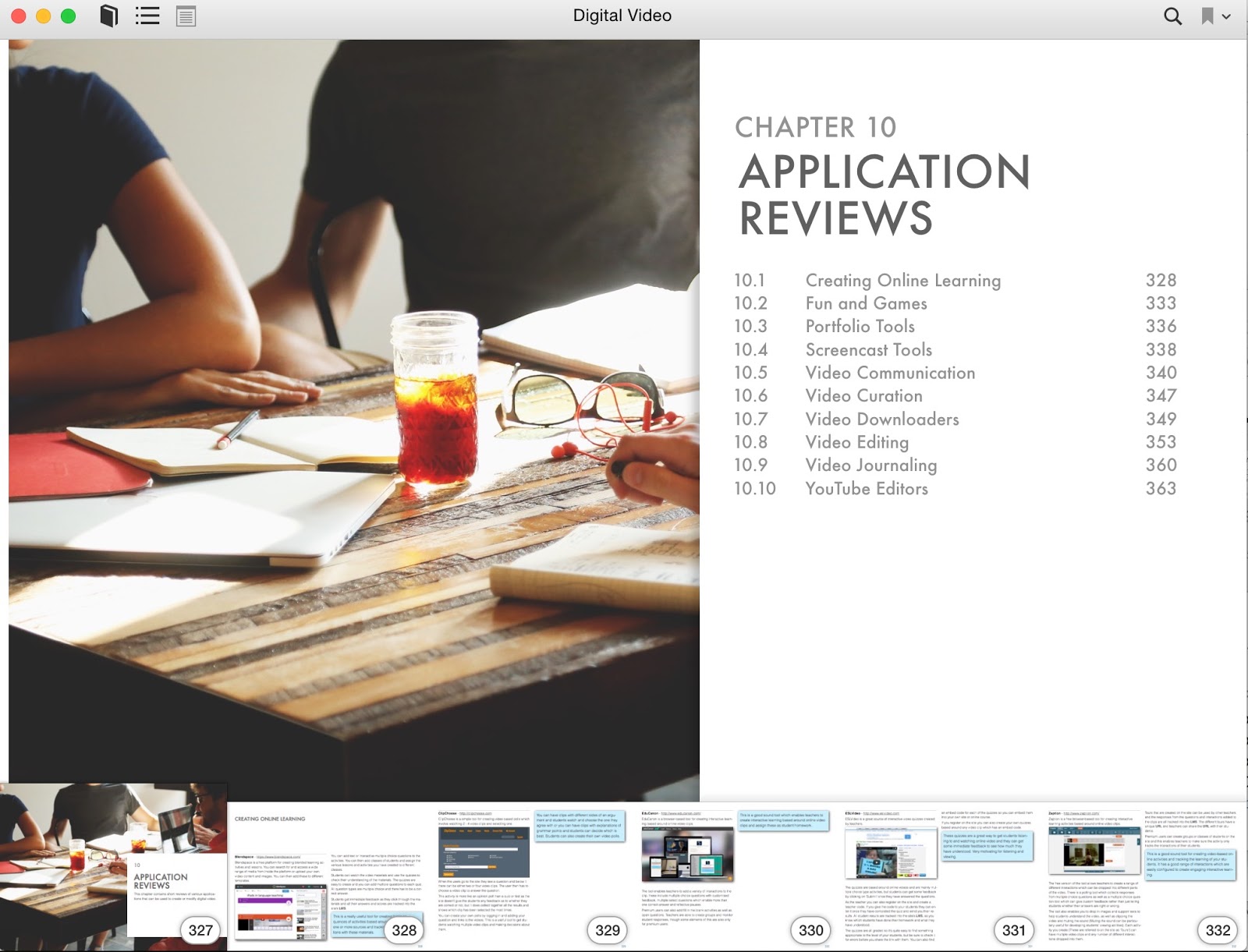
Over the last year I have been working on the first in what I hope will be a series of books to help teachers exploit new technologies in ways that will enhance their students learning. My first book – Digital Video – A manual for language teachers – was released in August 2015 and here just a few of the reasons why I think it\’s worth the price of a cup of coffee.

1. It’s a ground breaking ebook that combines text and images with 26 embedded video tutorials.

Here\’s an example:


2. It combines instruction on how to use the best in new technologies with creative practical classroom activities.

3.It gives an overview of how new technologies can be combined with existing methodological approaches such as TBL, CLIL and Flipped Learning to make students’ learning more engaging and effective.


4. It shows you how to build your own technical and pedagogical skills to enable them to create their own materials and activities for students.

5. It helps you to see beyond the concept of using video for comprehension and consumption and looks at ways you can exploit the amazing power of handheld devices to encourage students to use video creatively to develop their skills.

6. It includes annotated links to some of the best free video based apps and resources that are available online.


7. It shows you how to build the technical skills and confidence you need to gradually start introducing new technologies to your classroom.


8. It helps you to see how you can make the transition from classroom teaching to blended and online teaching.

9. It’s the cheapest good quality 400 page full colour multimedia ebook for teachers that you can buy online. (Price at present is below £1 / $1.99 so around the price of a cup of coffee)

10. The money raised from creating the sales of the book will help to ensure that I’m able to produce similar books like this at a comparable price.

You can buy the book from:

I really hope you enjoy the book and please do leave a review.

Related links:

Best