How to Become a better Communicator?

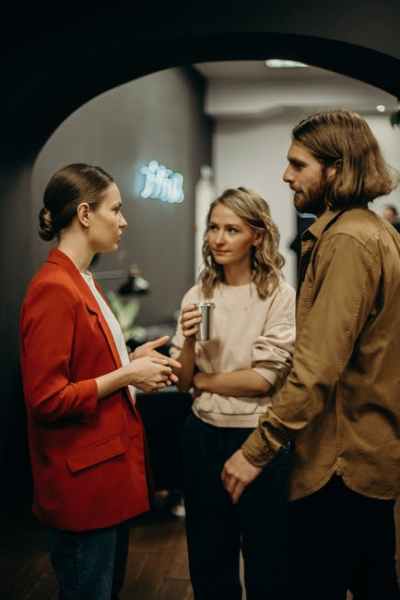
Although most of us take compulsory communication lessons in schools/colleges/coaching centres, many people still find it difficult to communicate with other people freely in order to express their point of views and needs. There have been several studies by psychologists who have come up with various reasons that cause these problems following with several tips that can be followed in order to improve communication skills. If you are one of them who finds it not-so-easy to communicate with other people, this article is for you!


1. Take Sufficient Time before Responding


A study shows people who face the difficulty to communicate often tend to make the mistake of not taking enough time before giving a reply. If you are one of them who has been making this mistake, try to stop. Take your time, think and then reply.

2. Be attentive!


If you start thinking of a reply as soon as the other person asks something, you are making a big mistake that is eventually causing misunderstanding in the conversation. Being attentive is a skill that everyone must acquire. Listen to the other person carefully, take your time to process what they are saying, think and then start replying. This will help you to become a better communicator.

3. Maintain Eye Contact.


Never forget to maintain eye contact while having a conversation for it enhances self-confidence and helps the conversation to be more engaging and intimate.

4. Maintain a flexible body language!


Do not make the mistake of standing like a statue while having a conversation. It makes you look static and rigid. For the betterment of the conversation, start loosening it a bit. Casual hand gestures and movements make it way easier and smoother. Try it!

5. Use simple words and phrases.


Do not make the mistake of using jargons and unnecessary complex phrases to create a cool intellectual image. It simply does not work. Use simple sentences to communicate. It makes the communication smoother and the other person finds it easily comfortable to have the conversation with you.

6. Ask questions.


Instead of being the one who is there only to reply/answer, start asking questions. The questions do not necessarily have to be intellectual or tricky, simple casual questions can make the conversation better. Do not forget you also have to get the other person engaged. So try being the listener sometime. It works!


7. Focus on earning respect

There is a misconception everywhere about the funniest person in the room to always be the smartest one. To some extent it needs to be rephrased. Being the comedian/memer who can make anyone laugh is someone who is humorous, yes. But, the smartest person in the room is always the one who manages to earn the most respect from anyone and everyone in the room. Try being that guy who everyone respects. It will help the other people to have more engaging conversations with you. Therefore, While having a conversation do not forget (timings are important) to mention the achievements that you are proud of.
If you are one of those people who finds it difficult to haqve good conversations, do follow these simple steps to see a rapid transformation in your communication skills.

– Suvasree Bandyopadhyay.

HEMATOLOGY

Hematology is a branch of medicine concerned with the cause, prognosis, treatment, and prevention of diseases related to blood. Some of the tests carried out in this section are PCV, CBC, ESR, ABO blood grouping, Antigen typing, Cross Matching etc..

MATERIALS USED IN HEMATOLOGY
Pipette, Haematocrit centrifuge machine for PCV, Haematocrit reader for PCV, Hematology analyzer for CBC, Microscope, Glass Slides, Electrophoresis Machine, Cover slips, Bunsen Burner, Capillary Tubes, Test Tubes, EDTA, Scissors, Normal Saline, Immersion Oil etc…

COMPLETE BLOOD COUNT (CBC) TEST
Complete Blood Count, CBC is a very common and easy test to determine the total number of different cells present in the patient’s blood. A doctor may order CBC as a normal routine test or if you have an unexplained symptoms of bleeding.
For the test, Blood Sample is collected in the EDTA bottle and is mixed properly with the anticoagulant.
The main equipment used for the CBC test is HEMATOLOGY ANALYZER. The EDTA bottles are put under the hematology analyzer sensitive probe so that the machine can analyze the samples and give the appropriate results.

PACKED VOLUME (PCV) TEST
It is also known as Hematocrit Test. PCV test is a measurement of percentage of blood that is made up of cells. The test value is expressed in percentage. For eg, if the PCV value comes out to be 30% then it means that there are 30ml of cells present in 100ml of blood. The doctor may order for the test if he finds the symptoms related to Anaemia, Polycythaemia or dehydration. The value of PCV rises when the number of RBCs increases or when the total blood volume is reduced.
Reference values:
Newborn infants – 50 – 70%,
Newborn at one week of age – 37 – 49%,
Infant at three month of age – 30 – 36%,
Infant at one year of age – 28 – 45%,
Child at ten years of age – 36 – 40%,
Adult female – 36 – 46%,
Adult male – 38 – 50%

ERYTHROCYTE SEDIMENTATION RATE (ESR)

It is a test that directly or indirectly tests the inflammation in the body. It also measures the rate at which erythrocytes present in the blood sediments. In the test, blood sample is collected by the patient in the EDTA tube and the rate at which RBCs settle down at bottom is measured.
The followings are considered normal ESR test results:
• Women under age 50 : >20mm/hr
• Men under age 50 : >15mm/hr
• Women over age 50 : >30mm/hr
• Men over age 50 : >20mm/hr
• Newborns : >2mm/hr

BLOOD GROUPING TEST
Blood Grouping, generally known as ABO Blood grouping is a test which can determine the patient’s blood group. The blood group of a patient may be A, B, O or AB type. Three different types of serum are used in this test i.e. Anti-A, Anti-B, Anti-D.
In the test, Blood samples are collected from the patient in the EDTA bottle. A sterile glass slide is taken and was labeled as A,B and D. Blood drops were put on the slide in the three different regions. Anti-A , Anti-B and Anti-D serums were added to the blood on the slide at the respective regions and mixed with a toothpick. Agglutination was observed after some time and results were recorded.

The Concept of Shivling

Since the time immemorial, the Shivlings are being worshipped in the Indian subcontinent.These days, several excavations, conducted by the archaeological department, unearthed the life-size Shivlings from various sites. Some of them are- 1. A 9th century Shivling from Vietnam. 2. A 5 feet tall Shivling from Ayodhya 3. A 4000 years old Shivling from Bhabhaniyav village near Varanasi 4. An 18 feet tall Shivling from Bhiraveswara Swamy Temple atop the Mopuru hillock in Kadapa district 5. An ancient Shivling from Faridpur village near Karnal 6. An ancient Shivling from Sinauli near Baghpat

With this link, I will today talk about Shivling and it’s concept in today’s era.

The Holiest Shivlings of India

There are 12 Jyotirlings and 5 Panchabhut-lings in India –

  • Jyotirlings:  Kedarnath, Kashi Vishwanath, Somnath, Baijnath, Rameswar, Ghrishneswar, Bhimshankar, Mahakaal, Mallikarjun, Amaleshwar, Nageshwar, and Trayambakeshwar
  • Panchbhuta-lings:Kalahastishwar, Jambukeshwar, Arunachaleshwar, Ekambareshwar of Kanjivaram, and Nataraja of Chidambaram
The Shivling of Kashi Vishwanath Temple (Varanasi, Uttar Pradesh)

Let us now figure out what a Shivling is and what are the concepts associated with it. A Shivling is an aniconic representation of Lord Shiva – the Destroyer. The term aniconic means a symbol that is associated with a deity. For example, the Dharmachakra is associated with the Budhdha. Similarly, it’s identifiable that Shivling is associated with Lord Shiva only.

History of Shivling

The Shiva Purana describes the origin of the Shivling, as cosmic pillar or a stambh of fire and the cause of all causes, neither having a beginning nor an end. However, few scholars have thrown ample amount of light on the fact that Shivling was referred to ‘Prayapas’ by the Romans who introduced the worship of Shivling in the European countries. The statutes of Shivling have been also found in the site of Babylon, a city of ancient Mesopotamia. Furthermore, the archeological findings in Harappan Civilisation, which yielded numerous Shivaling statutes, have disclosed the existence of a highly evolved culture existing before the immigration of the Aryans in the subcontinent.

https://www.speakingtree.in/allslides/little-known-facts-about-shivalinga

The symbolisms of Shivling

The concepts associated with Shivling

The Shivling represents the Brahmanda (the cosmic egg). It signifies that the creation is acquired by the union of the male (Purush) and the female (Prakriti) powers of nature. Scholars have identified the ling as a Phallic representation of Shiva, associated with fertility in some sense. Further, it has been analysed that Shivling has a scientific concept. The structure of the Shivling is extremely close to the construction of a nuclear reactor. It is composed of two parts :- the first part is a cylindrical structure, which is made of smooth black stone. The second part is the one that’s around the cylindrical structure.

The concept of Shivling and nuclear science- the above mentioned fact clearly highlights that the Shivling is actually the representation of a nuclear reactor.The Shivling has a pot of water hanging over the cylinder. It drips water upon the cylinder at a continuous pace. It flows out through the spout of the cylinder’s grooves.This water is not consumed as holy water in Shiva’s temple. The pot of water hanging above the cylinder is similar to the water that is needed to cool down a nuclear reactor.

This water is applied to the nuclear reactor as it heats up while generating energy.

The grooves around the cylinder of the Shivling signify the structures that are built to dispose of the polluted water from the nuclear reactor. Again, this water cannot be consumed, since it is polluted with nuclear waste and radiation.

The nuclear reactor

In this picture, it is crystal clear that the nuclear reactor depicts a Shivling-type structure. This also reflects the fact that perhaps the Shivlings were models of nuclear reactors, apart from having some religious, philosophical, metamorphical and aesthetic contexts, hence.

Why It’s Worth It To Pay The Costs of Being Yourself


Handel
inner circle
being yourself

“Being yourself” isn’t always easy. It means being honest about who you are – how you think, feel, and act – and sometimes that may turn people off.

In this way, being yourself comes with costs. People will see you. People will judge you. Some people will like you, some people will hate you, and plenty of people won’t even care about you. Ouch.

In the classic book On Becoming A Person: A Therapist’s View of Psychotherapy, psychologist Carl Rogers goes in-depth about the importance of being true and authentic to yourself, and why sometimes this isn’t always an easy and pleasant experience.


“In my relationships with persons I have found that it does not help, in the long run, to act as though I were something that I am not. It does not help to act calm and pleasant when I am actually angry and critical. It does not help to act as though I know the answers when I do not. It does not help to act as though I were a loving person if actually, at that moment, I am hostile. It does not help for me to act as though I were full of assurance, if I actually I am frightened and unsure. Even on a very simple level I have found that this statement seems to hold.”
Being open to others about who you are means being open about both the “good” and “controversial” aspects about yourself – which can be painful – but what’s most important is that people will know you and understand you better.

Thus, the people who like you will actually like you for who you really are, not what you pretend to be. And having one real relationship with someone who “gets you” is more fulfilling than a hundred fake relationships with people who like a “pretend you.”

In theory, most people agree that “being yourself” is a good thing. But what does it really mean? Is it even possible to be anything else?

Technically, you can never be anything but yourself. It’s whatever you are – right now – in this present moment. Yet that doesn’t stop people from struggling to “be themselves” on a daily basis.

What do people usually mean by that?

Many people walk through life feeling as though they are constantly “putting on an act” for others. Sometimes we put on masks for others and hide our true face. We try to meet countless expectations. And we hide the parts about ourselves that don’t seem favorable.

We do this mostly for the sake of social appearances and social reputation. It’s tremendously important to be accepted by others and to have strong relationships. So we think, “Why risk showing parts of myself, if that could mean threatening my relationships and losing people in my life?”

It’s a question we all ask ourselves in some way: “How much of myself should I really show this person? How much of myself should I really hide?”

You don’t need everyone to know your life story, but the deeper your relationships are, the more a person should know who you are.


We all struggle with dealing with superficial relationships. These are most common at work, school, and environments where we need to be professional and “down to business.”

However, we need realness too. We need people we can share our innermost thoughts and feelings with. And most importantly, we need to be real with ourselves.
On Becoming A Person is a classic book by humanistic psychologist Carl Rogers, the founder of “client-centered therapy.” It’s a highly influential work on the importance of being true and authentic to ourselves.

“Being yourself” and person-centered therapy


Carl Rogers is most well-known for starting the “person-centered therapy” movement.

According to this type of therapy, one of the most important things a therapist can provide is unconditional positive regard. Instead of judging the client, or trying to fix their problems, the goal of the therapist is to provide an avenue for the individual to express themselves in a free and unlimited way.

By exercising “unconditional positive regard” – accepting the person for who they are, without trying to change them – the person is given the opportunity to grow on their own terms and discover who they really are and what they want to be.

One of Carl Rogers most famous quotes is:

“The curious paradox is that when I accept myself just as I am, then I can change.”
The goal of person-centered therapy is to make this process easier for the client by providing them a space to explore themselves and discover more about themselves without judgment.

A good therapist must be accepting, empathetic, and able to listen to a client express their innermost thoughts and feelings without always needing to provide a solution or explanation.

Interestingly, this approach to therapy is very consistent with a theory in psychology known as common factors theory.

According to “common factors” theory, all specific therapies are equally effective (Cognitive-Behavioral Therapy, Psychodynamic Therapy, Dialectical Behavioral Therapy, etc.) and what matters most is the relationship between the client and the therapist.

Basically, it often doesn’t matter what type of therapy is being used as long as the therapist and client have a strong, trustworthy, and accepting relationship. That’s what’s most important.

“Being yourself” is a process of becoming

One of the keys to truthfully and authentically “being yourself” is recognizing that you’re a dynamic process – not a fixed thing.

Who you are today is probably different from who you were 10 years ago. And who you will be 10 years from now will likely be different than who you are today.

You are always changing. From moment-to-moment, day-to-day, month-to-month, and year-to-year.

So when you think about “being yourself” or “discovering yourself,” recognize that you aren’t searching for a fixed thing, but a process that is always changing and unfolding.

Here Carl Rogers reflects on this “process of becoming” as it relates to therapy:

“When he enters the therapeutic relationship, the client is likely to wish to achieve some fixed state: he wants to reach the point where his problems are solved, or where he is effective in his work, or where his marriage is satisfactory. He tends, in the freedom of the therapeutic relationship to drop such fixed goals, and to accept a more satisfying realization that he is not a fixed entity, but a process of becoming.”
This is one of the major themes throughout On Becoming A Person: it’s important to understand that you are a “process of becoming” and to recognize the changing nature of yourself.

Similarly, the therapist must also view their client as a “process of becoming.” And according to Rogers, this is why we must also be careful of using labels or diagnoses:

“If I accept the other person as something fixed, already diagnosed and classified, already shaped by his past, then I am doing my part to confirm this limited hypothesis. If I accept him as a process of becoming, then I am doing what I can to confirm or make real his potentialities”
It helps in all of your relationships – both with yourself and with others – that you recognizing the changing nature of people, and everyone’s ability to grow into a better person, especially yourself.

This attitude often helps us to maximize our relationships with others.

“Being yourself” and real relationships

Here are some final thoughts from Carl Rogers on the importance of “being yourself” and why it’s essential for keeping your relationships real:

“Being yourself doesn’t ‘solve problems.’ It simply opens up a new way of living in which there is more depth and more height in the experience of your feelings, more breadth and more range. You feel more unique and hence more alone, but you are so much more real that your relationships with others lose their artificial quality, become deeper, more satisfying, and draw more of the realness of the other person into the relationship.”
Like he says, sometimes being yourself can make you feel more unique and more alone.

When you are yourself truthfully, that may turn some people off who you are incompatible with. But that’s okay, because you’d rather have those few real relationships instead of a bunch of fake ones.

In this way, the rewards for “being yourself” far outweigh the costs.

Block chain Technology- Implementations

You must have heard a lot about the emergence of blockchain, isin’t? But here in this article, we will focus on the practical issues for blockchain implementation.

Introduction

In the tech world, blockchain technology is still the leading buzzword. Its ability to work in a distributed environment without getting tampered is the core source behind all the hypes.

As the technology is still in its developing phase, despite various possibilities in almost every sector, it will still take some course of time to get over all the challenges it is facing right now. Let’s explore what the practical blockchain implementation issues are.

As blockchain is revolutionizing rapidly, its scope and career opportunities are beyond imagination. If you are looking to start a profession in blockchain space and want to become a blockchain expert or a blockchain developer, favorable chances are on its way.

Practical Blockchain Implementation Issues

Blockchain technology is an algorithmic immutable ledger that presents a future-ready architecture for organizations to transact and exchange business-related information securely.

Does it mean it has no challenges? Of course not. There are various challenges associated when it comes to implementation. So let’s get started.

Lack of Internal Blockchain Knowledge

The first and foremost challenge while implementing blockchain is that most organizations have insufficient knowledge about technology. Companies do not have Blockchain experts and professionals who clearly understand the core concept of technology.

Thus organizations find it challenging to choose and adopt the best enterprise blockchain platform. Moreover, the companies are not aware of blockchain implementation steps that should guarantee the best outcome.

High Implementation Cost

Although popular enterprise blockchain platforms such as Hyperledger Fabric have made great strides in terms of the transaction speeds( just about twice the rate over VISA platform), most of the existing platforms such as Bitcoin(transacts 3 to 5 transactions per second ) and Ethereum (up to 15 transactions per second ) are inefficient in terms of speed of transactions and the energy consumption. Thus we can infer that the most convenient blockchain platforms come at a vast implementation and energy costs.

Backup and Recovery

Backup and recovery of data for blockchain networks are also one of the significant implementation issues. Although theoretically, creating a new node is easy, but it’s not practical spending several hours for a new node to sync with existing blockchain nodes and transfer configuration metadata. The recovery becomes even more critical when there is a requirement to migrate a node across datacenters.

Data privacy

Data privacy is a crucial bottleneck problem in blockchain as most enterprises do not appreciate the case where anyone can view their sensitive data, which might be delicate to their core business. Those who plan to share confidential business data are worried about confidentiality between several participants and shielding this data from access by other companions.

But, when blockchain nodes are run as a managed cloud service with users only able to access them through the APIs and event subscriptions, data privacy can be maintained to a great extend.

Blockchain Interoperability

Although they are various enterprise blockchain platforms, interoperability is a pertinent issue to which Blockchain developers are looking for mass adoption. The basic idea is to join one particular platform and to utilize the service on another enterprise platform if required without any severe compatibility problems.

Therefore, developers are finding a way through which users of different software can interact and conduct meaningful business.

Performance

In the blockchain network, the performance requirement is never the same. It varies from one scenario to the other. Like for example, the performance metrics include throughput and latency, and outcomes will vary in terms of network size and hardware configurations, and the tradeoffs between higher throughput versus lower latency.

Thus, based on the deep understanding of the business demands and platform architecture, a reasonable performance optimization solution needs to be adopted.

This is not the end of the list. Moreover, a lack of regulatory clarity is one of the significant implementation issues. Many governments are still unsure about how they consider this technology from a legal standpoint, and this leads to complexity.

Conclusion

Enterprise blockchain is gaining popularity and adoption in almost all sectors and for different use cases. Although blockchain might seem to be offering several advantages to the industries, it needs to be re-architected depending on various use cases for greater acceptance of enterprise blockchain in the mainstream.

The buzz around blockchain probably won’t subside, so hurry up and upgrade your skills now with the best online Blockchain certification courses.

To get instant updates about Blockchain Technology and to learn more about online blockchain certifications and become a blockchain expert, check the online opportunities which deals with all levels – beginner, intermediate and professional learning.

Corona how changed the system of Education

From pen paper to mobile and Tablet

The Education system has changed thouroghly through this pandemic situation. Before this crises also we were motivating the system to be worked with the help of digital world. But In today’s scenario this platform provides the strength of Education system. From the primary education to graduation level , it helps out students to keep them engaging and they also understand the things too.

The question arises after the Corona, are student go back to accept the offline medium. They definitely say yes, but although it makes them disturbing . So after this situation this system has to keep this platform on for the betterment of Education. Afterall Education is the most important thing for any individual.

But we dont had to forget that how much this platform is helpful also it is dangerous if they try to escape the steps , so under careful observation only, this platform helps out. For Exams, this platform may be a controversial issue, but through special apps ,we easily vigilance student and check their ability.

Overall we can say that in this pandemic situation of COVID 19, the use of digital platform provide the connection between teachers and students, which is vital for their Educational growth. So, through the effective use of digital platform , we are saving the world from illiteracy. And it also helps student to be updated about their Academics.

“Indians Against Racism, Brutality . The biggest Hypocrisy?”

Living in this 21st centuries, with believing in the disbelief of discrimination or any act which divides humanity and differentiate one human from other. We believe that talent,wisdom, knowledge and sense of responsibility and respect for others is far above any individuals background be it a colour or gender or caste or anything. This all brings out the feeling of togetherness around the globe”.

But there are various scenarios and situation we come across in our day to life which shows a strong reflection of these brutal act of racism and discrimination. The true difference between the earlier times and present scenario is that people come up for their friends or any person against whom such act has been done, which truely is an act of humanity and harmony. The present case of death of African American name “George Floyd” in America has again brought the sense of brotherhood and people are standing for him to gain justice of the brutal killing.

Indians not apart from Americans are also standing for George who lost his life in the police encounter. They are also appealing for justice for this man. This act has drawn the attention of people worldwide and people from different countries have been coming in support to stop racism.

But in case of India, where not only racism but also police brutality has been seen and is still active in today’s scenario. We in general hear , how police has been brutal hitting people, especially those in today scenario of pandemic. Various cases have been observed from number of cities india, that how police men are hitting daily wage worker, those having stalls of vegetables, and many other situations. Death of number of people has also been recorded as an encounter with police.

Also the cases of racism and discrimination based on caste and especially gender has been seen widely around the country. So the point of concern is “Why such kind of Hypocrisy”. Before pointing out anything wrong being conducted in any country, one should watch out what’s going around their own surrounding”. It’s easy to point out wrong things and do protest against these things, but the power and wish to do Right matters the most.

There have been various cases of brutal killing of common man by the police force, but no actions have been observed in such situations. We say it’s bad to discriminate people on the bases of colour, and we only buy those creams and powder to make our skin glow. It’s not about that police is wrong in every scenario, we know they are doing their duty and are concern for the law and order to maintain, but any act of brutality should not be taken easily and strict action must be taken against such acts.

So we have to come out of these hypocrisy and work together to get rid out of these brutal acts of killing of innocent people and discriminating any one on the bases of their caste, religion, gender or colour

“We all are humans and we should respect the fact that, out of all, Humanity is the biggest and the most important factor which will help us all to survive difficult situations be it any pandemic or natural calamities, but all we need to do is spread around peace, harmony and sense of brotherhood as this world is full of difficulties but once we stand against them with hand in hand and stand by each other, we will win over them”.

International Human Rights in Sports

Sports is about achieving excellence, about working individually and collectively as a team  to reach a common goal. The world of sports today is filled with thousands of enthusiastic people amongst whom a few stand out from the rest, but the challenge is to demonstrate how the world of sport can bring these benefits while preventing harms to people at every level. [1]Human rights refer to those rights that are inherent to the person and belong equally to all human beings regardless of their race, colour, sex, language, religion, political or other opinion, national or social origin, property, birth or other status. They deal with freedom from fear and want, and call for respect, protection, and fulfilment from duty-bearers. At the international level, human rights are laid down in numerous international treaties and declarations. There are some treaties, agreements and declarations that were signed and ratified by a great number of member countries of the UN, spread around the globe. The collection of such documents is called the Universal System of Human Rights Protection.

Sport is one of the best platforms to promote human rights and inclusion of all. Through sport, people learn values of co-existing with people of  cross gender, nationality, age or even physical condition. It is now the need of the hour to build stronger bridges to advocate for sport as a Human Right – to pledge, to defend and to promote it. Sports is closely connected to many human rights such as right to education, right to culture, right to health and wellbeing as well as the right to political participation. Sport is ought to be practiced without any kind of discrimination, such as race, colour, sex, sexual orientation, language, religion, political or other opinion, national or social origin, property, birth or other status.  Sports can easily inculcate many positive values, such as fairness, teambuilding, equality, discipline, inclusion, perseverance and respect, all of which can be found in the Olympic Charter, the Universal Declaration of Human Rights and the European Charter for Fundamental Rights.

[2]Despite this, many Human Rights violations occur in mega sporting events (MSE). The protection of various rights and freedoms have been affected during sporting events, an example of which, was the mass evictions of residents from the Rio favelas for the 2016 Olympic games. Other Human Rights violations range from labour rights, to migrants’ rights, children rights, and women rights in relation of Qatar Olympics 2022. Discriminatory policies are also introduced, against, for example, minorities, the freedom of press and the freedom of assembly in the case of the Russian-hosted FIFA World Cup 2018. Moreover, the rights of athletes are never a topic of discussion. There is still a major gap between the will to maximise results, and the dignity and the freedoms of athletes: freedom of movement, freedom of expression, religious freedoms, image rights, labour rights, right to privacy, etc. It is important that the fundamental rights of athletes are not based on a comparison between ‘the athletes’ and the ‘others’, and that their human dignity is protected. Several players across various sports have iconic moves that they perform after achieving a particular objective in the game. These players after a point in time are recognized by their celebratory moves by the common man and these particular celebratory moves are then associated with only that one person performing it. In today’s world of sports, the Ronaldo “SII” celebration is something that is largely associated with the Portuguese winger and nobody else.

Each time the celebration has been seen on television or elsewhere, the one person associated with it is Cristiano Ronaldo.[3] LeBron James is also associated with the “Silencer” celebration which has also been copied and followed by many other people across the sporting universe. Cristian Benteke, the Belgian footballer has gone on to use LeBron’s celebration during games.[4] The intent of protecting the celebrations of these persons is to maintain the originality of creator with the help of Copyright and Trademark to prevent others from taking wrongful advantages of the iconic posture or symbol that the creator of such posture or symbol uses.

The 2030 Agenda for Sustainable Development also points to sport as an important enabler of development and peace. At last December’s third annual Sporting Chance Forum, hosted in Paris at UNESCO, the stories of those who have faced sport-related human rights violations were heard first hand. They included stories of young athletes that experienced sexual abuse perpetrated by coaches or others in positions of authority; those forcibly displaced to make way for the infrastructure; workers building sporting facilities whose labour rights were violated during construction and fans and communities adversely impacted by harsh security and other public authority measures.

Yet despite these and many other attributes, the world of sport doesn’t always produce one’s wanted outcomes. All too often, sport is linked with harmful impacts on people—on athletes and communities, on workers at events or in supply chains, and on fans who cheer for their teams. The famous “You’ll never walk alone” chant that is constantly sung by Liverpool fans at Anfield, had originally been written Oscar Hammerstein and was then adopted by the English club and made the Liverpool Anthem.[5]The same anthem has also been adopted by clubs like Borussia Dortmund and Celtic. The fact that these clubs alter these songs and come up with entirely new compositions with their own artistic abilities, protection under Copyright must be granted. [6]Addressing these and other human rights challenges implies a major and important change within the world of sport itself. Fortunately, there are some positive signs that reforms are beginning to take place. Historic policy commitments to ensure respect for human rights have been made in recent years by some leading sport’s governing bodies (see for example, FIFA, the Commonwealth Games Federation, and UEFA), but many more have yet to acknowledge their responsibility to do no harm. Such commitments are only a first step, though a crucial one. They must lead to a larger effort to inculcate human rights due diligence into every aspect of sporting events, as well as spread rights awareness into regional and country-level activities and actors, and into the culture of sport at large.

To do so requires implementation of human rights standards and legal commitments into principles that can be readily understood by all involved in the sport industry, along with formal  steps for action. In practical terms, as a starting point, that means showing those involved how human rights have been impacted by sporting events or sport activity. Workshops and interactive sessions need to be organised to engage potentially affected groups, including those advocating for a range of fundamental rights such as decent working conditions, privacy rights, the rights of the LGBTQI+ community, persons with disabilities, and journalists, among others. These workshops should aim at generating practical recommendations that will shape how the organizers of a sporting event will seek to prevent and mitigate the risks identified, as well as establish effective grievance mechanisms.

Making long-term progress requires new levels of co-operation that can produce shared learning and collective action by the vast assembling of actors involved in sport. Sports bodies, intergovernmental organisations and representatives of governments, host actors, corporate sponsors, broadcasters, civil society, trade unions, employers and their associations, national human rights institutions, as well as athletes, all have important roles to play. We need institutions to help bring these actors together to generate the power of sport in ways that lead to greater realization of rights in practice. Over a passage of time, all involved in this process of generating power of sport have developed a strong sense of collective purpose. The challenge now moves towards converting the shared purpose and commitment into practical and effective action. We need to act now, as the structures as currently constituted aren’t sufficient. As per the current scenario, existing mechanisms for sport-related harms don’t address the particular needs of children or address risks to those that are without union representation, and don’t ensure protection of athletes with refugee status, among other gaps.

[7]The attempted forcible return of football player Hakeem al-Araibi to Bahrain despite his refugee status in Australia forced FIFA, the International Olympic Committee, human rights activists, governments and millions worldwide seeking to protect the rights of an athlete who is also a human rights defender. After imprisonment for over two months, Hakeem was returned home to Melbourne, thanks to the collective action and impact of the key actors involved who created leverage in public and behind the scenes. Given this and other cases often require urgent action, a key area of focus should be supporting improvement of credible and effective mechanisms to address accountability gaps and help create new structures where needed.

The sport and human rights movement is now actively mobilised. We have trusted spaces for constructive dialogue to address real-time challenges and dilemmas linked to sport. We  also have a growing body of knowledge and expertise that can be deployed to help build the capabilities of all actors involved in sport in order to prevent and remediate harms. Sport, because of global interest has the potential to create economic, social and political changes. From ancient times when the origin of sport were shaped at the foot of Mount Olympus in Greece, humanity is concerned with sport. Today, except from sporting events, there is no other event where representatives of different nations with conflicting interests interact with each other at this level, and this is a sign of the importance of sport in the stressful world today. [8]Firstly, the relationship between sports and human rights is extended, complex and evolving. Sports and human rights have developing interaction with each other as global phenomena. All sports and physical education are human rights. The second aspect, human rights relation with sport to protect the human rights of athletes at Sport arenas.

Today, sport organizations cannot be unrelated to international human rights. The needs for gender equality between male and female athletes, the need to anticipate the protective measures to children and create equal opportunities for disabled athletes are commitments of the sports institutions and agencies. Its third area, the relation of human rights with sport concerns the role of sport in maintaining and promoting human rights. Sport is of global interest and millions or even billions of spectators can serve human rights and transform the world to a better place to live accordingly. Sport can provide the context of a developed society by reducing costs related to health and non-communicable diseases such as cardiovascular disease.

In today’s world, the relationship between peace and human rights is undeniable. In this regard sport as a tool at the service of human rights can become a tool for creating and maintaining peace. The domestic and international disputes before the war, in a narrow sense, have brought challenge for humanity. Thus, sport can play a key role in peace building and protecting human rights at international stage.


[1] Adams, A, and Harris, K (2014). Making sense of the lack of evidence discourse, power and knowledge in the field of sport for development. International Journal of Public Sector Management. Vol 27 (2)

[2] Amnesty International November 2013 ‘TREAT US LIKE WE ARE HUMAN’ MIGRANT WORKERS IN QATAR

[3] Adnan Riaz, Cristiano Ronaldo Opens Up About His Trademark ‘Sii’ Celebration, SPORTS BIBLE, http://www.sportbible.com/football/news-cristiano-ronaldo-opens-up-about-his-Trademark-sii-celebration-20190805. 

[4] Ryan Bailey, Christian Benteke Does LeBron James’ ‘Silencer’ Celebration After Liverpool Goal, BLEACH REPORT (Dec. 26th, 2015), https://bleacherreport.com/articles/2602534-christian-benteke-does-lebron-james-silencer-celebration-after-liverpool-goal. 

[5] Oli Platt, YNWA: How you’ll never walk alone became a Liverpool FC anthem, Goal (Jul. 29th, 2019) https://www.goal.com/en-in/news/ynwa-how-youll-never-walk-alone-became-a-liverpool-fc-anthem/selbcrlre9lz1n9dat1b1e60q. 

[6] Alkemeyer, T. and Richartz, A (1993) The Olympics Games: From Ceremony to Show, The International Journal of Olympic Studies. Vol II, pp 79-89.

[7] Aljazeera (2014) Jerome Valcke: ‘FIFA is not the UN’, available at: http://www.aljazeera.com/programmes/talktojazeera/2014/04/jerome-valcke-fifa-not-un-201444155314260788.html. Accessed on 12 May 2014.

[8] Transnational Corporations and the Duty to Respect Basic Human Rights, Business Ethics Quarterly, 20, 3, pp. 371-399.Bairner, A. and Molnar, G. (2010)


Journey of the Technologies that shaped today’s world: IC Engine

Steam engines changed a lot. They revolutionized how things were carried around, how people moved around and how industries worked. However, steam engines worked on of course, steam, which is not easy to create. It cannot be stored easily. So, one needed water and coal. Coal needed to be burned, water would heat up and steam would build. To generate sufficient power, the entire setup needed to be significantly large. That meant its applications could not be ubiquitous.

Therefore, despite the efficiency, cost-effectiveness, and power of steam engine, it was not practical to be adopted in all the places. Especially for day to day activities, it was not sensible to use such bulky machinery. As a result, steam engine despite their success in industrial and large applications, did not change a lot of things for individuals. For personal usage, the machinery needed to be compact, portable, and most importantly safe. This was achieved when Internal Combustion engines arrived on the scene.

The first Internal Combustion Engine was created by Étienne Lenoir around 1860. However, the real popularity and application of Internal Combustion Engines came Nicolaus Otto created the modern IC engine in 1876. The IC Engine works on hydrocarbon fuels which are extracted from Petroleum- mostly Diesel, Petrol and Gas. These fuels have high calorific value and they are highly combustible. This makes these fuel very useful but also very dangerous. IC Engines used valves to control the flow of fuel and supply of air. The controlled combustion generates heat which makes the gases expand. As the space is confined with only piston movable. The piston moves and through crank-shaft mechanism the wheel moves.

The most popular IC engines are 4-stroke engines. 4-stroke means there are four steps in each cycle of the engine operation. These steps are-

  • Intake stroke
  • Compression stroke
  • Combustion stroke
  • Exhaust stroke

As the fuel has high calorific value, a very small engine can generate sufficient power to move a car or a truck or a bike. These can be very compact and highly portable. IC engines have revolutionized how people move individually. The first modern car was built by the German engineer by Karl Benz in 1885. In early 1900s, companies like Ford and General Motors took car-making to next level. Assembly line production made the car manufacturing and later the entire manufacturing industry very fast and highly efficient. In last 100 years, cars and bikes have taken over the roads. More and more people now have cars and bikes. Cars are still costly and remain a status symbol in the society.

The compactness of IC Engines also made it possible to design small but powerful machines. This independence made it possible to design machines that could fly or travel under water. While the independence of owning individual machines is exciting, but this also increases the pollution. The cars and motorbikes are one of the largest polluters across the world.

Our independence to move around is wonderful and precious but we also have to understand that the environment is priceless. We have only one earth. We got it from our forefathers, and we have to handover this to the next generation. We should use our bikes and cars sparingly and responsibly. Pool whenever possible, use public transport whenever possible. Let’s not turn the boons bestowed by the science into a curse.

THE WEIRDOS OF THE UNIVERSE

There’s no questioning the fact that the universe is weird. Just look outside and you’ll see all manner of strange, self-reproducing flora and fauna, crawling upon a blue ball of semimolten rock covered in a thin, hard shell and blanketed by a tenuous film of gases. Yet our own planet represents a tiny fraction of the peculiar phenomena that can be found lurking throughout the cosmos, and every day astronomers turn up new surprises. In this gallery, we take a look at some of the most outlandish objects in space.

Beauty of the universe
Is in the Nature’s serenity
Preserve it and protect it
For the everlasting eternity
The wrath and fury of Nature
As result of man’s arrogance
To win over the Planet
Has to be stopped immediate
So that we have our Mother Earth
Shining and saving us for
An assured future to find
For the benefit of mankind

Mysterious Radio Signals

Since 2007, researchers have been receiving ultrastrong, ultrabright radio signals lasting only a few milliseconds. These enigmatic flashes have been called fast radio bursts (FRBs), and they appear to be coming from billions of light-years away (they’re not aliens, it’s never aliens). Recently, scientists managed to capture a repeating FRB, which flashed six times in a row, the second such signal ever seen and one that could help them unravel this mystery.

Nuclear Pasta

The strongest substance in the universe forms from the leftovers of a dead star. According to simulations, protons and neutrons in a star’s shriveled husk can be subject to insane gravitational pressure, which squeezes them into linguini-like tangles of material that would snap — but only if you applied to them 10 billion times the force needed to shatter steel.

Haumea Has Rings

The dwarf planet Haumea, which orbits in the Kuiper Belt out beyond Neptune, is already unusual. It has a strange elongated shape, two moons and a day that lasts only 4 hours, making it the fastest-spinning large object in the solar system. But in 2017, Haumea got even weirder when astronomers watched it pass in front of a star and noticed extremely thin rings orbiting around it, likely the result of a collision sometime in the distant past.

A moon with a moon

What’s better than a moon? A moon orbiting a moon, which the internet has dubbed a moonmoon. Also known as submoons, moonitos, grandmoons, moonettes and moooons, moonmoons are still only theoretical, but recent calculations suggest that there’s nothing impossible about their formation. Perhaps astronomers may one day discover one.

Dark-Matter-Less Galaxy?

Dark matter — the unknown substance comprising 85 percent of all matter in the universe — is strange. But researchers are at least sure about one thing: Dark matter is everywhere. So team members were scratching their heads over a peculiar galaxy they spotted in March 2018 that seemed to contain hardly any dark matter. Subsequent work suggested that the celestial oddity did in fact contain dark matter, though the finding paradoxically lent credence to an alternative theory positing that dark matter doesn’t exist at all. Get it together, astronomers!

The Most Bizarre Star

When astronomer Tabetha Boyajian of Louisiana State University and her colleagues first saw the star known as KIC 846285, they were flummoxed. Nicknamed Tabby’s star, the object would dip in brightness at irregular intervals and for odd lengths of time, sometimes by as much as 22 percent. Different theories were invoked, including the possibility of an alien megastructure, but nowadays, most researchers believe the star to be surrounded by an abnormal ring of dust that’s causing the darkening.

Highly Electric Hyperion

The title of weirdest moon in the solar system could go to many celestial objects — Jupiter’s overly volcanic Io, Neptune’s geyser-spewing Triton. But one of the strangest looking is Saturn’s Hyperion, a pumice-stone-like irregular rock pockmarked with numerous craters. NASA’s Cassini spacecraft, which visited the Saturn system between 2004 and 2017, also found that Hyperion was charged with a “particle beam” of static electricity flowing out into space.

A Guiding Neutrino

The single, high-energy neutrino that struck Earth on Sept. 22, 2017, wasn’t, on its own, all that extraordinary. Physicists at the IceCube Neutrino Observatory in Antarctica see neutrinos of similar energy levels at least once a month. But this one was special because it was the first to arrive with enough information about its origin for astronomers to point telescopes in the direction it came from. They figured out that it had been flung at Earth 4 billion years ago by a flaring blazar, a supermassive black hole at the center of a galaxy that had been consuming surrounding material.

The Living Fossil Galaxy

DGSAT I is an ultradiffuse galaxy (UDG), meaning it is as big as a galaxy like the Milky Way but its stars are spread out so thinly that it is nearly invisible. But when scientists saw the ghostly DGSAT 1 in 2016, they noticed that it was sitting all alone, quite unlike other UDGs, which are typically found in clusters. Its characteristics suggest that the faint object formed during a very different era in the universe, back just 1 billion or so years after the Big Bang, making DGSAT 1 a living fossil.

Double Quasar Image

Massive objects curve light, enough so that they can distort the image of things behind them. When researchers used the Hubble Space Telescope to spot a quasar from the early universe, they used it to estimate the universe’s expansion rate and found that it is expanding faster today than it was back then — a finding that disagrees with other measurements. Now physicists need to figure out if their theories are wrong or if something else strange is going on.

Infrared Stream from Space

Neutron stars are extremely dense objects formed after the death of a regular star. Normally, they emit radio waves or higher-energy radiation such as X-rays, but in September 2018, astronomers found a long stream of infrared light coming from a neutron star 800 light-years away from Earth — something never before observed. The researchers proposed that a disk of dust surrounding the neutron star could be generating the signal, but the ultimate explanation has yet to be found.

Rogue Planet with Auroras

Drifting through the galaxy are rogue planets, which have been flung away from their parent star by gravitational forces. One particular peculiarity in this class is known as SIMP J01365663+0933473, a planet-size object 200 light-years away whose magnetic field is more than 200 times stronger than Jupiter’s. This is strong enough to generate flashing auroras in its atmosphere, which can be seen with radio telescopes.

The beauty of the sea!
The beauty of nature,
The beauty of the ocean,
The beauty of life,
The beauty of love,
The beauty of the sky! !
The beauty of the rainbow;
The colours of life,
The beauty of the colours on earth;
The beauty of mankind,
With the beauty of the minds when,
The right thing is done.
The beauty of the universe!
The beauty of every positive thing;
Praying always for the peace of the earth. My mind! !
I am who i am with my identity;
Born on earth to carry on peace to the world.
Trust!
The beauty of true love;
With servitude and attitude,
With the joy of the hearts,
Having positive morals! !
The beauty of righteous laws,
The beauty of righteous works,
Going along with my mind;
For peace and love,
To bring joy to all.

What makes someone to write something in a blog rather than writing somewhere¿?

Is Introduction compulsory in every introduction,Is it so¿?If so why did I undo it ¿?Is it to make my Blog writing to look unique¿? If not then why am I mentioning it as unique.Do people who are unique will try to prove them as unique in such an ordinary way¿?To answer such questions would it be necessary to give a glance to this post¿?

What makes someone to write something? Does this happen sometime? To answer this I am questioning myself. Before giving a glance to my writing, you too should pose this question to yourself if at all you have something to write up somewhere sometime or  the other time. People who have a thought of giving a thought about my thought should give a thought. People who wanna write a blog are categorized as follows:(I don’t know whether the blog could be also written in this way…I think the blogger have the rights to write the way he likes)

Type 1: people write about something they think they know(but actually not).They are in a urge to share the information (not the actual information but the information that they knew about something)that they had got it somewhere so that the other peers could know that this guy got something or this guy is something..The fact is that the guy is “SOMEONE who knew SOMETHING”, something only not the whole thing.

Type 2:People wanna write because people write. He writes because she does. This is true because people can’t take it the fact If he or she does why can’t I,Is it good. It is really good if someone tries to write something because of someone then it’s something.But we can’t neglect the fact that he only writes because he only wanted to write not because he wanted to write.They only write to write. Think about your category. If you not belong anywhere then you should  go somewhere because this isn’t your place.

Type 3:Why can’t people be calm about something they knew?If they knew then they better keep themselves rather than telling the whole world? Does this make something to them if someone gonna know that he or she knew something that no one around us never knew it’s existence. Being calm resists your knowledge to yourself so that no one will ever knew what I knew. Knowing the things and keeping it unknown will be known someday or the other. So they will try to take the knowing by revealing the things only in order to reveal and make sure that he had revealed. Telling the things that doesn’t really matter a much rather than telling the actual thing only in order to make us believe that they too had told. Isn’t it good to be jealous of knowledge?It’s good but not faking the knowledge and writing fake blogs to spread the non existence.

Type 4: They knew nothing and act like that the world is running because of them. It is easy to identify such people because their population is more (or) less more. They try to copy or modify the blog and they make us believe that the blog they copied from will become the copier.They think they are smart because they are only thinking to be smart rather than being smart.

        Leave a comment about my category. Do I belong to any of these.If so I may belong to any one of the category,then how could I know about the other categories. Do I belong NOWHERE or only for NOW-HERE?

Anatomy of Corruption and its Remedies

Corruption is known as a snake which is continually poisoning the human mind ever since they are interacting with each other and are striving to live a better life on earth. Widespread of corruption has caused disappointment and discontent among the community. The machinery of government gets rusted and ceases to work in the intended manner. Corruption decreases respect for law and sense of loyalty to the government. In a society governed by corrupt officials, the whole system of moral, ethical and religious values is impaired. The distinction between right and wrong disappears. Revolutions and military takeovers become common. Today every student of history knows that one of the causes of the downfall of nations has been corruption.

Causes of Corruption:

The causes of corruption are many and complex. Following are some of the causes of corruption.

The appearance of political privileged who believe in interest-oriented rather than nation-oriented programmes and policies.
Artificial scarcity created by the people with malevolent intentions wrecks the fabric of the economy.
The broad thinking of people towards corruption, complete lack of strong public protest against corruption and the lack of strong public forum to oppose corruption allows corruption to control over people.
Vast size of population coupled with widespread illiteracy and the poor economic infrastructure lead to endemic corruption in public life.
Complex laws and procedures alienate common people to ask for any help from government.
Remedies of Corruption

Is it possible to contain corruption in our society? Corruption is a cancer, which every Indian must strive to cure. Many leaders come with a power to declare their determination towards corruption but soon they themselves become corrupt and start amassing huge wealth.

Many People become materialistic and money oriented, there is no important of ethics and morals in business dealings. Many people thinking that money which coming to their pocket is good, same way many thinking that money which going out from their pocket is bad, but they don’t consider the way money traveling.

This is because these kinds of people have no moral accountability to anybody; and these kind have people have full trust on money, they strongly believing that money can hold big role in their life, they believing that money can solve their current and future problems, they believing that money can give them life without problems. Some of the remedies are given below:

GOD has given the wisdom to each and every human being, heart of everyone telling him/her that the way he/she following to get money is good/bad. The most important thing is person should listen and follow the good part of his heart.

Foolproof laws should be made so that there is no room for discretion for politicians and bureaucrats. The role of the politician should be minimized. The Application of the evolved policies should be missing in the hands of independent commission or power in each area of public interest. Decision of the commission or authority should be challengeable only in the courts.

Cooperation of the people has to be obtained for successfully containing corruption. The People should have a right to evoke the elected council if they see them becoming indifferent to the electorate.

Funding of elections is at the core of political corruption. Electoral reforms are crucial in this regard. Several reforms like: State funding of election expenses for candidates; strict enforcement of statutory requirements like holding in-party elections, making political parties get their accounts audited regularly and filing income-tax returns .Responsiveness, accountability and transparency are a must for a clean system. Bureaucracy, the backbone of good governance, should be made more citizens friendly, accountable, ethical and transparent.

The number of courts should be opened for speedy & inexpensive justice so that cases don’t stay remains in courts for years and justice is delivered on time. Local bodies, Independent of the government, like Lokpals, Lokadalats, CVCs and Vigilance Commissions should be formed to provide speedy justice with low expenses. A new Fundamental right is Right to Information should be introduced, which will empower the citizens to ask for the information they want. Barring some confidential information, which concerns national and international security, other information should be made available to general public as and when required. There are several actions against corrupt officials will definitely have a restriction impact.

CORRUPTION is the latest epidemic in the planet,
eating the people, Looting the Nation
no cure, no medicine, no special hospital,

Are we Indians coward,
Or are we shy..
Or we care somehow,
But we dont wanna try,

We have adjusted ourselves,
So well in this corrupted place,
Has it become our tradition ?
Or we lack the guts to face…

We say corruption chokes,
Then why we Indians breathe it ?,
We say corruption kills,
Then why we breed it ?,

The corruption helps,
To set the culprits free,
It blinds the law,
& still we shamely see,

It widens the gap,
Of poor and rich,
Then we continue the same,
Without any hitch… ?

Somehow i feel…

Our coward mind has,
Hurled down his brain,
Come what may,
Even let our money drain…

Has this become, Our way of life ?
To adjust with whatever it is…

And move on, Without a break to re-think, Re-construct, and reform our Corrugated minds…

Is it that no business runs without it ?,
Or is it that we dont wanna put an end to it..?
Are we not prepared for it.. ?
Or we really dont care ?

Many questions in these little brain, And almost all unanswered……

But atleast we can support those,
Who have atleast tried to stand for it,
Some greatones like Anna Hazare.

Conclusion

The cancer of India

Corruption is an intractable problem. It is like diabetes, can only be controlled, but not totally eliminated. It may not be possible to root out corruption completely at all levels but it is possible to contain it within tolerable limits. The dedicated persons in public life, control over electoral expenses could be the most important prescriptions to combat corruption. Corruption has a corrosive impact on our economy.

SELF IMPROVEMENT

What is Self-Improvement?
Let’s define self-improvement. The definition of self-improvement is pretty self-explanatory: Self-improvement is the improvement of one’s knowledge, status, or character by one’s own efforts. It’s the quest to make ourselves better in any and every facet of life.

Self-improvement usually starts with becoming more aware of ourselves, our behavior and our reactions. It requires that we earnestly desire to improve and transform ourselves, better our life, and build good relations with people.

Nowadays, there is a growing interest in self growth and self improvement techniques. There is a growing number of books, articles and websites dealing with these topics.

It seems that people are turning within them, to find the solution to their problems. They seek knowledge, techniques, workshops, lectures, and teachers, who can show them the way.

People are beginning to understand that self improvement and self growth can improve the quality of their lives.

The process of inner change requires inner work.

It is not enough to read articles and books. You also have to practice what you read. Inner change requires motivation, desire, ambition, perseverance and dedication.

When you starting with a self improvement program, it is common to encounter inner resistance that comes from your old habits and from your subconscious mind, and also resistance and opposition from the people around you.

The desire to change, build new habits, and to improve yourself must be strong enough to resist laziness, the tendency to give up, and the fear and ridicule of opposition from family, friends or colleagues.

A Simple Self Improvement Technique
Let me tell you something. I have been attracted to self improvement from an early age, and have regarded it as a source of inner strength and happiness, and as a way to a improve my life.

One of the most useful techniques I discovered and used, was a simple, but very effective technique. It consisted of watching how people behave and act in various situations, and then looking inside myself, to find out whether I behaved in the same way under the same conditions.

When I saw people with certain traits of character, or a certain kind of behavior that I did not like, I examined myself to find out whether I possessed those traits of character too.
If I did, I visualized in my mind a different sort of behavior. In my mind’s eye, I saw myself with the opposite traits of character. I visualized myself in various situations, in which I manifested the new behavior.
When I encountered traits of character or behavior, which I liked, I used to think about their advantages and benefits, and about their importance in my life. Here too, I used visualization and affirmations, and strived to enact them in my daily life.
In this way, I learned and benefited a lot from the behavior and actions of the people around me, at work, at home, on the street, and everywhere else.

This exercise was never for the purpose of judging other people or taking advantage of them, but for learning how to act, react and behave in a better way.

This process had another benefit. It increased my knowledge and understanding about how the mind and the emotions affect the behavior and the actions of people. It gave me more understanding of people and their behavior and how to get along better with them.

If you start using this self improvement techniques you will soon see positive changes in your life.

Tips for a Simple Self Improvement Technique

  1. Look around you

Look around you and watch how people behave in various circumstances. Watch the people you meet at home, work, at the supermarket, on the bus, train and on the street. You can also watch people being interviewed on TV and learn a great deal about them and about you.

  1. Watch the behavior of people

Watch how people talk, how they raise their voice or speak calmly. Watch the reactions of people. Look at how people walk, sit and carry their body. you can learn a great deal from watching their behavior.

  1. Watch how people treat other people

A certain kind of behavior creates certain reactions. Often, how we act and behave, determine how people treat us. Try to be aware of how people act, and how other people treat them. This can help you to determine what changed you need to make in your behavior.

  1. The effect of the voice

Pay attention to the way people use their voice and how they react to other people’s voices.

Watch how you feel and how you react when people shout, or speak softly.

Watch what happens when people get angry, restless and upset, and what happens to you and to others, when they are calm and relaxed.

  1. Pay attention to what you do not like

If you do not like what you see, analyze why you do not like it. Then, analyze your own behavior to find out, whether you behave in the same way. Be honest and impartial in your analysis.

  1. Avoid negative behavior

If you discover that you possess some of these undesirable traits of character and behavior that you do not like, affirm to yourself often that every time you catch yourself behaving in this way, you are going to be aware of them, and do your best to avoid them.

  1. Use your imagination to build new habits

Play in your mind a mental scene of how you would like to act and behave. Repeat this mental scene several times a day, every day.

What you imagine in your mind sinks into your subconscious mind and gradually, becomes a habit.

  1. Use your imagination to build good habits

When you detect in someone character traits or habits you like and desire to possess, try to act in a similar way. Here too, imagine several times each day a scene, where you act and behave in that different, better way.

  1. Use visualization often

Think and visualize over and again in your mind how you would like to act and behave.

  1. Remind yourself of the changes you want to make

Constantly, remind yourself of the changes you desire to make, and strive to act according to them. Every time that you find yourself acting according to your old habits, remember your decision to change and improve, and act accordingly.

Do not be disappointed or frustrated if you do not attain fast results. It does not matter how many times you fail or forget to behave as you desired. Persevere with your efforts and never give up, and you will begin to see how you and your life start changing for the better.

“You are essentially who you create yourself to be and all that occurs in your life is the result of your own making.”
– Stephen Richards

“Change is your friend not your foe; change is a brilliant opportunity to grow.”
– Simon T. Bailey

“Beginning today, set an intention and a relentless focus on living your life as the greatest person you can be, in all situations.”
– Brendon Burchard

Why You Should Consider a Degree in Human Resources

Most organizations need to have a human resources department because effectively managing employees is critical to their success.
Employees are not only a company’s most valuable asset, but they are also the most significant cost and liability. A human resources professional will know how to successfully create and implement programs that capitalize on human assets, minimize costs and address potential liabilities.

Administer salary and benefits:

Salary and benefit programs typically incur the most significant costs for an organization. However, this is also the area where human resources professionals can help an organization achieve a competitive advantage. A generous salary and benefits package will attract and retain well-qualified employees who bring considerable value to the organization.

Oversee recruitment and selection:

A human resources professional often plays a key role in developing an organization’s recruitment and selection strategy. In addition, integrating employee recognition programs, training and development strategies and promotion-from-within policies can bolster employee motivation, resulting in lower turn-over and higher retention.

Manage employee relations:

Another function of a human resources department is to identify and resolve workplace issues. Implementing a workplace investigation process and enforcing fair employment practices are two components of an employee relations program.

Direct employee training:

Human resources professionals are often responsible for creating training and development programs that prepare employees to take on greater responsibilities within the organization. Succession planning, internal promotion policies and performance management are all factors that help an organization cultivate and retain top talent.
Human resources professionals play a critical role in managing the successes and failures of an organization and its employees. However, to become a human resources professional, you’ll need to obtain your bachelor’s degree in human resources management. For more on Herzing University’s Human Resources Management degree, click here: https://www.herzing.edu/business/human-resource-management-degree
Jack McCallum has been with the online business department at Herzing University since 2011. When not teaching, she serves as the President/Principal Consultant for HR Balance LLC—a consulting company specializing in human resources management, organizational development, leadership coaching, and training/development. She started HR Balance LLC in 2003 after years of serving in a leadership capacity for a variety of for-profit and non-profit organizations. A keynote speaker and presenter, Jack has served as an industry expert for radio and print media.

IMPROVE YOUR FOCUS

In this fast-paced world we’ve created, we’re only going to feel more overwhelmed by the ever-increasing directions and distractions we feel pulled toward. With exponentially increasing demands on us in our work and personal lives, sustaining and improving focus on things which matter is getting tougher and tougher.
You’ll be pleasantly surprised to learn that keeping focused is no longer about trying to discover secret weapons of willpower or self-discipline. With these initial self-reflective exercises and different brain-training exercises, you’ll no longer be having arguments with yourself to get on with the job!
Here’re 7 ways on how to improve focus.
1. Have a Plan You Feel Clear AboutOne of the foremost common reasons we struggle to take care of focus is because we lack clarity about what we’d like to try to to next. The next best action step doesn’t feel clear to us.
If you are trying to lose weight but aren’t clear on exactly what activities you need to do, with what intensity, the food you need to eat and the timing of when all this needs to happen, you increase your chances of staggered progress.
If there are not enough parts early in the process to that feel clear for you to make the next step, these emotional obstacles will derail you.
You must also recognize the amount of detail in the steps you need to feel ready and confident to move forward — this will differ between you and the next person. You and another person are often given precisely the same instructions to find out a task. He/she might feel completely ready and confident to get to work. On the other hand, you hesitate.
Work on developing enough detail clarity until you are feeling you’ve got enough resources and know enough to require the steps.
2. Set Your Mood and Environment to maximise Your Capacity to FocusIt’s been argued that in slightly-above-ambient temperatures, you’ll be more creative. You feel more relaxed and your productivity increases. Conversely, lower temperatures have also been found to more positively influence decision-making ability and alertness.
Cornell University conducted a study of office administration workers whereby their productivity positively correlated with increased office temperatures.[1] At 25℃, the workers were typing with 90% accuracy. However, with a drop of 5℃, the typing rate nose-dived along side an increased error rate of 25%. The study also identified other factors which could greatly affect productivity and focus such as air quality and pollution.
It’s not just temperature you need to pay attention to. Good lighting is essential. The wavelength of blue light emitted from neon lights and most electronic devices generally ignites our serotonin levels and keeps us awake. Consider though that natural light is best where possible. When your body is truly getting tired, you can honor its natural rhythms and listen to its cues for rest.
Switch off communication applications (e.g. Facebook messenger, Slack, Yamma). Make it hard for yourself to access such applications and devices by physically putting them in places that are inconvenient for you to access (try the 20-second rule and make it take more time to access). If you have to go outside to the garden shed to retrieve your phone (and it’s cold and raining outside), you’re less likely to do it!
Maximize your exposure to visual messages which direct you to remain on task. Rather than have your eyes cast across post-it-note messages such as: “Don’t get distracted”, have messages of what you want to direct yourself to do: “Keep going. Stay focused.” Surround where you propose to execute most of your day’s work with deliberate messages that directly tell you to remain on target .
3. Create a Distraction Procrastination To-Do ListWhen you know you have to prepare a complex report or assignment, the temptation to be carried away with the social flittings of your friends on Facebook or your colleagues chatting nearby will likely be stronger than ever. That story you spin yourself that you’re only spending a smidgin’ of your time getting ‘up-to-date’ so it can’t really do any harm becomes the sole story you would like to believe.
Trying to resist the temptation completely can cost you valuable time and psychic energy . The guilt you harbor for contemplating digressing from your important activity inflicts an emotional cat-o-nine tails upon you. That doesn’t serve you either.
Submit half-way. Fully indulge at a designated time period to soak up that dopamine rush from scrolling through sporadic events and sponsored posts on your newsfeed or chat to whoever is online at the time. 
After pounding through a piece of labor , undergo that guilty pleasure. When you engage in it, do it fully. If you’ve been studying straight for three hours, it’s time to stand up, stretch and stroll to your favourite coffee shop and back. Go for a walk or swing on the swings in your closest public park.
If you work from home, bake a batch of scones, put on a face mask as you soak your feet in a foot spa. Or watch half of the football match you recorded but haven’t gotten ‘round to reviewing yet.
Cold-turkey abstinence is hardly ever effective. Not only are you wasting time and energy resisting the urge. You make the urge stronger by denying yourself! So, don’t deny yourself but manage it wisely.
4. Practice Meditation and MindfulnessIf you’re yet to be convinced of how meditation can help you improve focus, look no further than the declarations made by the American Psychological Society praising its benefits.More and more studies are demonstrating how meditation can reduce rumination, stress, anxiety and improve relationships, emotional stability, focus and working memory capacity.
If you’re not meditating, you are doing yourself a gross disservice. Meditating allows to practice regaining focus. As you practice, you learn and increase your skills to notice when your mind is wandering off track. You then practice bringing it back to what you ought to be directing your attention to.Include in your morning preparations for the day a gentle but directed review of what you need to devote your time to today. Throughout the day, consider that your attention span swings like a pendulum. Exercise it one direction and let it swing into a free-thought space for moments of reprieve.
The world, our bodies and our minds work in rhythms. Learn to exercise your mind and focus intrinsically . If you try to beat yourself cognitively into submission, you’re unlikely to win. You’ll be unnecessarily exhausting yourself in repeated attempts of trying.
Here’s a beginner guide for meditation: Meditation for Beginners: How to Meditate Deeply and Quickly
5. Schedule Planning, Review and Recognition Periods Throughout Your DayManagement consultant and best-selling author of 18 Minutes, Peter Bregman recommends a simple plan to help train your brain to remain focused and help you track your progress.
Before the computer goes on, the first 5 minutes of your day, you invest in planning and write out your ‘today’s activities’ list. Physically writing down your activity goals for the day (using paper and pen, not electronic word processing) engages more functions within your brain (e.g. the generation effect[3]) which train it to acknowledge these activities are highly important.
Bregman then recommends that for 1 minute at the end of each of the next 8 hours, you stop and recall what you have accomplished in that hour. You congratulate yourself for what you have achieved and regain focus, recalibrate expectations and take a pause. You slow down to speed up.
By reviewing what you’ve got accomplished, you attach a positive emotional experience to your work and progress. This action in itself will improve your focus as you fuel your motivation to stay the wheels of your momentum, rolling.
The final 5 minutes at the end of the day are spent in reviewing and planning the next day. Doing so makes it easy for you to sustain laser focus from at some point to subsequent , to subsequent .
These 18 minutes of planning serve as plain but powerful guard rails to keep you mentally on track.
6. Create Goals and Activities That Satisfy Your Highest Priorities and ValuesWhenever you’re resisting doing something, it’s highly likely because it’s not topping your desirability charts.
As a human being, you behave and act in ways which ultimately keep you feeling safe and comfortable. As long as we can see we will get to continue feeling safe and comfortable, it doesn’t matter what activity we’re asked to do.
However, the moment a notion arises of your needing to do something that feels unfamiliar (and hence, uncomfortable), you can guarantee you’ll feel a sting of resistance. It might be slight but it will be there. However, life doesn’t allow us to simply avoid whatever we please.
The key is to examine and reframe what you need to do in a way that does satisfy your highest values and priorities.
If you believe you know what your values and priorities are, take a look at the results you have against the goals you’ve set for yourself thus far.
For example, if you believe one of your highest priorities is to have a healthy bank balance yet your balance statement shows more outgoings than revenue, having a lot of money is actually not a high priority for you.
At now , you would like to explore the variability of activities that yield a healthy bank balance that you’re not currently exercising. Saving, reducing costs, modifying and monitoring spending habits, making wiser purchase choices and finding ways to extend your income are all activities you would like to explore. These things might sound dull and like diligence .
7. Transform Information to Make Things More InterestingAccording to neurobiologists’ findings, we learn better when we actively do different things with the information. Not only are our experiences of learning more enjoyable, we activate more parts of our brain. This serves lessons and memories to be more effectively encoded into LTM .
You need to become clever at delighting and regularly stimulating your senses through variety.
If you’re studying, engage a spread of the way to exercise using the knowledge and skills you want to develop. Discussion groups, creating informal quizzes, teaching someone the knowledge you would like to find out involves you exercising verbal communication skills where you want to both give and receive information. You must adapt to your audience.
Drawing pictures and diagrams, creating voice memos about what you’re learning, using colors and symbols again different activates different parts of the brain. More connections are developed in your neural circuitry to aid your recall.
Furthermore, you become more adaptable and adept at applying what you learn to different situations.
Creating your own personalized manuals and notes becomes a passion project which pushes the personal gratification scale higher and higher.
Before you know it, staying focused no longer feels like a chore