Architecture is a Living Tapestry

“And of everything We have created in pairs.”

-The Holy Quran [51:49]

“Glory to Allah, who created in pairs all things that the earth produces, as well as their own(human) kind and (other) things of which they have no knowledge.”

-The Holy Quran [36:36]


No element on the life sustaining earth exists without its complement. For example, the complement of zero is one; solids and voids; light and dark; if one did not exist, the other would lose its meaning.
This refers to both in terms of the one who sustains as well as the energies sustaining them. The balance among the elements of the entire universe is maintained through the various visible as well as invisible energies which in turn exist in pairs.
The energy could be classified as the ones within the human who sustain the energies of the earth and the other being the natural forces of the universe that aids the universal equilibrium which further keeps the physical and psychic activity in balance.
The harmony of the earth is controlled by the physical as well as the metaphysical energy forces of the cosmic energy. The energy takes part in influencing all the occurrences on the earth be it at architecturally large scale element like a city or a small scale architectural structure as a home. Both would be classified into the microcosmic level of the energy.

“Space is nothing, yet we have a kind of vague faith in it.”

-Robert Smithson


The existence of energy occurs in the place of nothingness. Voids hold the highest sources of energy. The architectural design is nothing but a technique of designing voids to show a flow of spaces making a way for the flow of energy among the various spatial arrangements. Most of the people in the Indian Society prefer Vastu Vidya to be incorporated while designing a space. The major reason being the energies that is considered to be flowing through the designed spaces and to create the balance between the concrete mass and the natural elements. Humans occupy the voids yet they fail to understand the meaning of the unseen energy forces that is felt through the experiences they encounter while inhabiting that particular personalized void that is the physical manifestation of the memories and imagination of their own. The metaphysical aspect of architecture lies within the fact that it influences the user experiences of their inhabited voids in the line of time. It connects the past to present and brings about a psychological and emotional connection.

An environology master, David Koh, stated, “When people built the house, the energy inside the house is static. Once the people live in, the energy inside the house is dynamic. People may affect the building, and the building may affect the people. And it’s not positive thinking that the people need, but it’s energy that makes people think positively.”
The energy flowing through the various spaces creates an imbalance due to the dynamism of the humans living in. This in turn, creates a flux within the dialects of energy within the physical, emotional and psychic connectivity of the people.
Architecture is a living tapestry and a constantly changing phenomena. The connection of the energy within the human body and outside, impacts not only buildings but other elements too that together builds the abstract and hypothetical whole.
The spatial fabrication of the concrete masses and the multiplicity of the same in diverse alignments as a whole builds the city fabric. A city is a spatial and temporal dimensions of architecture on a vast scale. The physicality that a city comprises is, districts, landmarks, streets, edges and nodes. The streets become the prominent defining thread of the city, connecting the different entities through its networks. They show a directional shift in motion of spaces with respect to different frames of reference exploring more than what is comprehended by the senses with the metaphysical lens to look behind the abstraction.

To represent the extraordinary within the ordinary, the light is put forth to a street in Kolkata, Topsia, recognized by the number ‘90’, has not yet been identified as one of the most alive streets of the city of joy yet they have the metaphysical fundamentalism. The street is particularly a connectivity to one of the Muslim populated locality of the place. The majority of the population living in the locality belongs to the middle class strata of society. They adapt themselves to the concept of ‘less is more’3 and seek the intangible aspects of the spaces that they use.
Considering the theories relating to the energy sources, streets becomes the most dynamic element that could be considered as the life of the whole city. They deal with more than the vehicular and pedestrian movement. The streets deal with the dialects of dynamics of metaphysical consequences.

Figure 1: Layout of Streets of Kolkata; source: author.

Within and outside the realms of architecture, streets pave the way at the microcosmic level for the energy distribution network similarly to the way it functions for the crowd and vehicular activity. The metaphysical lens from different frames of reference gives an opportunity to analyze the impact of the metaphysical link and how it is evoked with the crowd in context to the existing surrounding. Different users feel a variety of different emotions in consideration to one particular space.
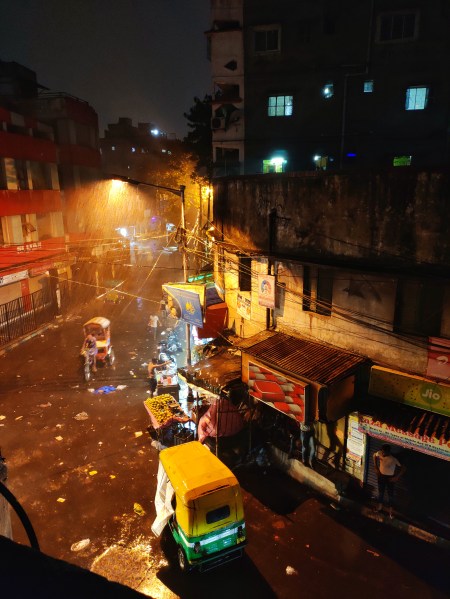
Figure 2: The Street ‘90’ on 12th June, 2019; source: author.


A resident of the place when asked about her experiences with the place said, “We have been staying here for about 15-18 years now. It has an essence of familiarity and home. The existing buildings, the shopkeepers, the vendors, and when I say vendors I really mean it. They are accurate with their location of stalls and wouldn’t trade it with anyone. Ive seen a lot of changes in the place. The building in red and white was built after demolition of an old 3-storey building for commercial purpose yet the upper floors still remain untouched after being built for so many years. The chaos is the essence of this place and without it, this street will lose its essence and identity.”

Considering the quantitative aspect of the street, it is about ten meters in width, with two meters of it occupied by the street vendors. An analysis of the street was done in three different phases of the day. When the morning struck, the silence is disturbed only by the daily activities of parents dropping off their half-dozed children to schools either by private or public convenience, which here is the auto rickshaws, who typically place themselves along the edge of the building as shown in Figure 2. Slowly and gradually as the time transcends the vegetable and fruit vendors take the edge of the street as their potential business spot. The traffic becomes evident by the noon with children coming back from school, having there go at the Sharbet waalas. As soon as the sun goes down, the street has an overwhelming response by the users creating itself in a chaotic mess of disoriented vehicles and people trying to make way to get out. Simultaneously, the sequence of functioning of the streets inflects thrrough its natural course. The female crowd encircles the ‘puchka waale bhaiya’, drooling over the smell of the tamarind water. A few steps towards the east would bring us to a smellscape of a multi-cuisine food corner with a large hot plate with parathas being fried, a traditional clay barbeque for the kebabs being cooked upon the coals, another man assorting the shelves with momos, fried crispy chicken and another struggling with delivering the order to the respective customers superimposing each other tones in a competitive streak to get their order first. The edges of the streets are defined by the utilities of all kind such as a pharmacy, general stores, grocery shops, food kiosks and corners, markets within a radius of a hundred meters, a shopping complex built few years back, occupied only the ground floor of the building structure. A fruit vendor defined the street as, “It is a metaphor of how our life is, always moving and moving in the forward direction. Despite the chaos we love our life so do we love this place.”
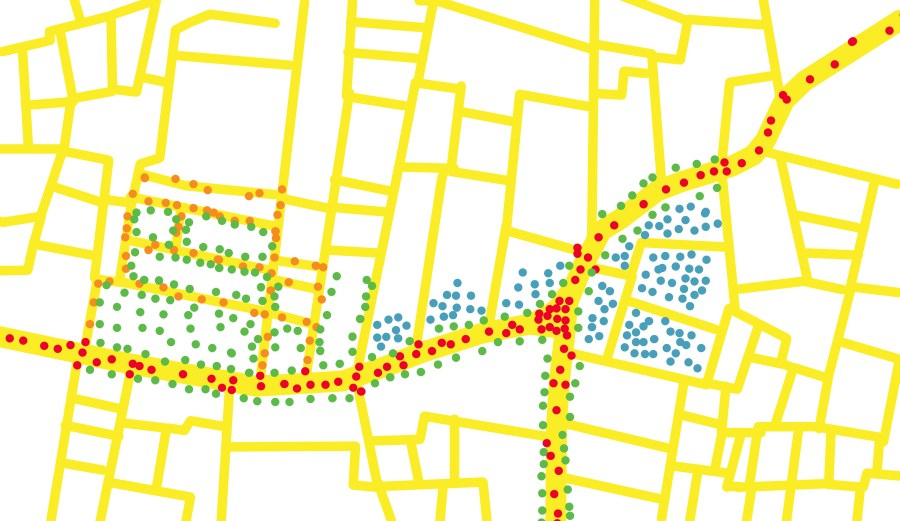
Figure 3: The Feeling Mapping of the Street (red-chaos, green- rejuvenation, orange-action, blue-contentment); source: author

The rhythm of the basic functioning of the street is inflected during the festivities, such as the two Eids and Muharram. The zeal within the crowd becomes evident and the streets stop serving as a vehicular access instead it becomes a hub of utilities as shown in Figure 4.
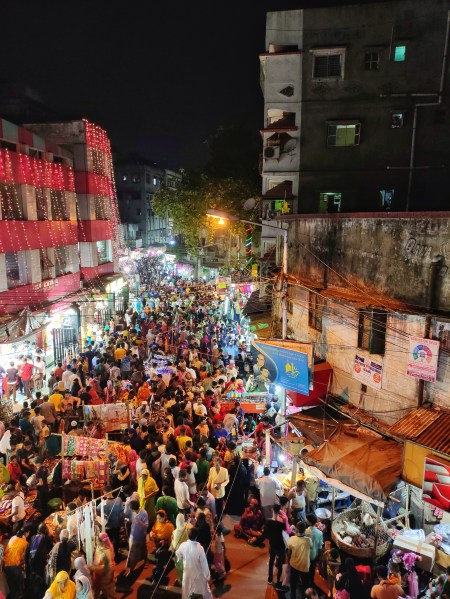
Figure 4: The Street ‘90’ on 4th June, 2019 (On the Eve of Eid); source: author


In terms of architectural analysis, the flaws couldn’t remain unseen, but what the architects couldn’t see is the intrinsic experiences that the users have with the place. The elegance of the street is a culture of contentment and containment. It depicts the unification of the users belonging to all strata of the society interacting with each other whatever the purpose may be. The dynamics of the streets and the humans represent a whole of the community be it the rich or the poor. In a simple world, the whole of the world can be explored. The local architectural vocabulary of the streets shows motions and emotions of all colours. It depicts joy as well as sorrow. The chaos and the peace, all the comedies and tragedies. The energy drained is rejuvenated with the constant flow of energy on the street. The essence of the chaos in itself shows the intrinsic connection between the built and the unbuilt. The street evokes the intangible aspects of the userrs. The user activity is the result of the concentrated energy source at the micro cosmic level connecting humans with the space at a deeper level. Configuration of the whole of the city is determined by the streets that becomes the highest sources of energy flowing throughout.
The built is to exist what the unbuilt is to life. The boundaries defined by the concrete is a personalized space to exist in harmony, but to co-exist, an undefined yet the key that holds the city together. A street has a potential to turn itself into anything it wants. The street is an induced public space. The street has evolved through the line of time of urbanization inflecting the course of its motion. Due to the increasing number of concrete massing, the spatial contraction of the streets are taking place in localities like Topsia in Kolkata whereas due to the urbanization, the expansion of streets also take place with putting an end to the life of the city creating it in a block of monotony and regularity only used as an access not as a space for creating an interaction between the built and the unbuilt, the known and the unknown. Spatial expansion and contraction taking place to accommodate structures. Street is one part to the whole that encapsulates the built and the user.
People have a tendency to experience voids hence, they hold human sentiments. We are dehumanizing the streets by making it lose its existence by the loss of depiction of culture and tradition. It is a lost element with the thoughts drowned in hues of grey unaware of how to survive in the chaos. The task of an architect is to blend imagination with practicality by balancing ideas and reviving the true nature of the streets in context to human activities.

REFERENCES

1. The Holy Quran

2. Mustofa, 2011. According to Dr. R Tatang Santanu Adikara, the Head of Bioenergy Research Centre in Surabaya, human gets energy from two sources: inside the human body and outside the human body.

3. Metaphysical Approach for Design Functionality in Malay-Islamic Architecture, article in procedia-social and behavioral sciences-aug 2015

4. Mies Van der Rohe

5. Lynch, Kevin. Image of the City.

How to grab internships?

My connections often ask me how to get an internship?What preparations do we need to do to get an internship? How you prepared that you got so much internships? So, i thought of publishing an article that might help you all in getting your answers.

A Guide to Starting Your Career Off Right

Consider Your Qualifications

One of the most common misconceptions that students have about how to get an internship is that they must apply to every position that catches their eye to increase their odds. But this is a sure-fire recipe for radio silence from recruiters and hiring managers. Instead, think about the skills and experience you currently possess, and which positions you might be a good fit for based on that information. A few ways to narrow down which internships are right for you:

Think about your degree

Look up common career fields and job titles for people with your major.Consider your experience: Think about your previous work experience, and which roles it might prepare you for. A student working at a campus newspaper might consider a journalism internship, while a student who tutors for a statistics class may want to look at data science internships.

Identify transferable skills

Skills that help you succeed in school or in the student organisations you participate in — such as organisation, critical thinking and time management — will all be useful in the working world. Some quick research should reveal which jobs require these skills.

Explore your interests

With how much time you spend at work, you want to make sure you enjoy it! Write down a few career fields that interest you, and search internships in those areas.

Start small

Don’t feel pressured to get your dream internships right away, especially if you have no prior work experience. Start by exploring small local organisations, groups affiliated with your school or volunteer work in order to bolster your resume.

Know Where to Look

Once you have a more concrete idea of which internships would be the right fit, it’s time to see what’s out there! Here’s how you can do that.

Visit Job Sites

 Websites like LinkedIn , Internshala have millions of job listings, so you’re bound to find something that’s right for you. You can search for the internship titles you’re interested in, and narrow results down by location, size, industry, company ratings and more.

Leverage Your Network

Getting a personal recommendation can make all the difference in your internship search, so make sure to reach out to friends, family, colleagues, classmates, professors and alumni to see if they know anyone hiring.

Prepare Your Application Materials

No matter what job you apply to, there are a few key materials you’re going to want to have on hand. Here are the most common ones, and how to perfect them before you apply.

Resume

Resumes are brief documents that showcase your skills, education and professional background. Typically, resumes will contain your name and contact info, education, professional summary, work experience, skills and additional experience.

Social Media Profiles

Many recruiters use social medias to recruit— some may even require a link to your social media profiles. So, if you haven’t already, you may want to create a professional social media profile, especially on a networking site like LinkedIn.

A few best practices to follow as you polish your social media presence:

Choose a professional headshot for your profile picture.

Add relevant work experience as applicable.

Keep it appropriate — delete any suggestive references or pictures.

Share and engage with relevant industry content.

Hope, this will help you all in getting your dream internship.

Govt approves lifting ban on export of anti-malarial drug hydroxychloroquine: Sadanand Gowda

Union Minister of Chemicals and Fertilizers D V Sadanand Gowda has said that the Department of Pharmaceuticals has approved the lifting of ban on the export of anti-malarial drug hydroxychloroquine API as well as its formulations.

In a tweet, Mr Gowda said that manufacturers except Special Economic Zone and Export Oriented Units  have to supply 20 per cent production in the domestic market. He said, Directorate General of Foreign Trade- DGFT has been asked to issue a formal notification in this regard.

Mr Gowda also said that he  held a detailed discussion with representatives of pharma companies and  association and stakeholder Ministries alongwith Union Ministers including Piyush Goyal and Hardeep Singh Puri on  entire gamut of challenges faced by the industry as well as strategies to boost pharma export.

Privacy Laws In India

Current laws and license agreements in India which allow for surveillance entail a significant potential for abuse, since the country lacks sufficient privacy safeguards . A privacy law is deemed necessary to ensure that data is not retained indefinitely, that data is not shared and disclosed to unauthorised third parties and that unauthorised parties do not have access to collected and intercepted data. In a democratic regime, surveillance should be targeted and carried out under a judicial warrant and the absence of privacy legislation deprives individuals from necessary safeguards. While the Information Technology Act and its Rules do entail some provisions for data protection and regulate certain types of surveillance, they appear to be inadequate. This is partly due to the fact that there is currently no law in India which establishes the right to privacy and as Security Practices and Procedures and Sensitive Personal Data or Information) Rules, 2011, represent a decisive step in creating a legal regime in India for data protection, but nonetheless appear inadequate in addressing issues relating to the collection of, access to, sharing of, disclosure and retention of data5 . Furthermore, they do not ensure the establishment of an independent body, such as a Privacy Commission, to oversee the handling of personal data and to address potential cases of breach.

Justice AP Shah Privacy Principles
The Planning Commission of the Government of India held meetings of the Group of Experts on Privacy Issues throughout 2012, which was chaired by Justice AP Shah, the former chief justice of the Delhi High Court . The CIS participated in these meetings and helped draft the Report of the Group of Experts on Privacy by the Justice AP Shah committee . This report entails a list of recommended national privacy principles, which should be followed in the creation of a privacy law. According to the report, the national privacy principles of India should be the following:


• Principle of Notice
• Principle of Choice and Consent
• Principle of Collection Limitation
• Principle of Purpose Limitation
• Principle of Access and Correction
• Principle of Security
• Principle of Openness
• Principle of Accountability


The first principle of notice states that the data collector should notify all individuals of its information practices, before any personal information is collected about them. Additionally, this principle also requires data controllers to notify individuals when their personal data has been breached, when such data has been legally accessed by third parties and when the data controller’s privacy policy changes. The second principle of choice and consent states that the data controller should provide individuals the choice to opt-in or opt-out with regards to the provision of their personal data, as well as that individual consent should only be taken by the data controller after providing. The third principle of collection limitation states that the data controller shall only collect personal information from data subjects as is necessary for the purposes identified for such collection, regarding which notice has been provided and consent from the individual taken. The fourth principle of purpose limitation states that personal data collected and processed by data collectors should be adequate and relevant to the purposes for which they are processed. In other words, a data controller should only collect, process, disclose, make available or otherwise use personal data for the purpose as stated in the notice after taking consent from individuals. The fifth principle of access and correction applies to individuals. In particular, this principle states that individuals should have the right to access their personal information which is being held by a data controller and to make corrections or to delete information when it is inaccurate .

The sixth principle of disclosure of information prohibits the data controller from disclosing personal data to third parties, unless informed consent has been provided by the individual for such disclosure. This principle also states that disclosure of information for law enforcement purposes must be in accordance with the laws in force. The seventh principle of security states that data controllers should be responsible for ensuring the security of all personal data that they have collected or which is in their custody.. The eighth principle of openness requires data controllers to take all necessary steps to implement practices, procedures, policies and systems in a manner proportional to the scale, scope and sensitivity to the data they collect, in order to ensure compliance with the privacy principles, information regarding which shall be made in an intelligible form, using clear and plain language, available to all individuals. Finally, the ninth principle of accountability states that the data controller should be accountable for complying with measures which give effect to the privacy principles.


Such measures should include mechanisms to implement privacy policies, including tools, training, education, as well as external and internal audits. In the report, the Group of Experts on Privacy recommended that such national privacy principles are applied to the cases of interception of communications, access to data and audio and video recording. In particular, it is emphasized that, with regards to the interception of communications and access to data in India, the principles of notice, choice and consent, and access and correction should be applied. With regards to audio and video recording in India, the application of the same principles, additionally including the principle of collection limitation, is recommended. Furthermore, the Group of Experts on Privacy also recommended the enactment of a privacy law in India which would include the establishment of Privacy Commissioners, as well as of self-regulating organisation (SROs) and co-regulation, which would supplement the role played by the Privacy Commissioners to ensure the implementation and enforcement of policies for a wide range of sectors and industries. Additionally, the Group of Experts recommended the establishment of a system of complaints which would include Alternative Dispute Resolution Mechanisms (ADRs), as well as the inclusion of offenses, penalties and remedies in the Privacy Act.

Child Labour-The loitering horror

It’s to remind us all of one of the painful horrors which still lurks in the world, it is observed all over the world (12 June) and is celebrated every year by UN is a sanctioned holiday by ILO (International Labour Organization).

Child labour is a horrific crime, many a times it’s forced upon naïve lives and children take up jobs at an early age so that they can also become a bread winner for their family due to financial woes. It’s a vile practice which still exists today in remote areas and many a times goes unnoticed.

Most of the third world countries have the largest number of child labourers’ eg.-South Africa, Afghanistan, Pakistan and Myanmar and also in many parts of India. It’s a phenomenon which most of us are aware about and many a time we try our best to contribute to eradicating this heinous practice from our world.

Economic factors is just one of the reasons which compels children to work, especially due to inflation, children tend to take up jobs at small hotels or shops where informal labour exists, due to this they can easily work around but are also misused by their superiors.

Due to child labour one’s freedom is curtailed along with the banishment of their own carrier and also they are unable to have access to many opportunities which life has to offer. One is unable to focus on self-growth and ones’ goals in life have to be forgotten. The child is put into a whirlpool of reeling pain and is trapped in the wrong sphere at such a young age and also exposes himself to other horrors.

In most of the third world countries family sizes can be huge and just one bread winner’s income won’t suffice the whole family, hence many children are encouraged by their parents to take up jobs in the informal sector and to earn money so that they can satisfy their basic needs. Many factories used to employ children between the age of eleven to thirteen as workers luckily this practice has almost vanished away due to child labour laws.

Many students in developing countries lose interest in studying it could be family problems, financial woes or lack of interest and take up trifling jobs so that they can start earning, this not only ruins their carrier but also can expose them to adverse snarls of the world at a young age.

One of the biggest reasons of child labour is financial problems, most of the children who commit themselves to working as a child labourer are people belonging to BPL (below poverty line), and one of the only ways to work out things in their life is by working and earning at a young age, it could be the nearest tea stall near your house where you see small boys lending their energy or even the newspaper delivery boy who comes on his worn out bicycle. Most of them even end up working as construction labourers, risking their innocent lives.

One of the other reasons for increase in child labour is improper enforcement of laws and irregular checks by the government. As citizens of this country and as humans of the world we can do our bit by educating ourselves on this trivial topics. To contact legislators if we come in contact and come across child labourers in our neighbourhood. Also to not shriek away from giving your domestic workers their fair share of income so that we can break the cycle of child labour. And to buy from local grocery stores and not bargain with small sellers are just a few of the things we can do to improve this disturbing situation.

Abdhi Upadyay

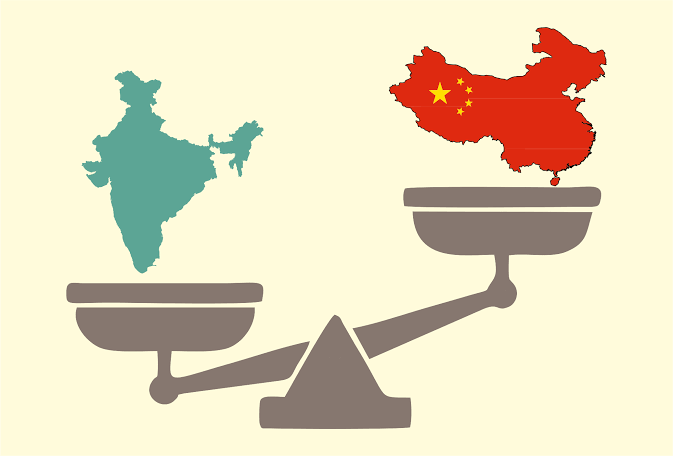
After Reported Thinning of Forces, China Says ‘Agreement’ With India Has Led to ‘Action’

New Delhi: After Chinese troops were observed to have “thinned” out in at least four stand-off points, China on Wednesday said that “actions” were being taken in line with an “agreement” reached with India

This was the first official statement from either country that there had been changes in the ground situation in eastern Ladakh following talks between the two sides. However, the Chinese side did not provide any detail on the “actions” at the border with India.

Military sources had earlier stated that the density of Chinese troops at Galwan and Hot Springs had come down from Monday, which was reciprocated by India. However, there had been no change in status at Pangong Tso, where Chinese troops are on India’s side of the Line of Actual Control (LAC). There had, however, been no official statement from India on these developments.

This was echoed by the Chinese foreign ministry spokesperson at her briefing on Monday. “Both sides agree to implement the important consensus of the two leaders, avoid escalation of differences into disputes, work together to uphold peace and tranquillity in the border area, and create favourable atmosphere for the sound and stable development of bilateral relations,” said Hua.

Several other rounds of talks among the militaries are expected to take place in the coming days at the border.

However, there are no signs that China is willing to retract its troops from the area until Finger 4 in Pangong Tso, which is well within the territory claimed by India. It was at Pangong Tso that Indian and Chinese soldiers had come to blows in early May, which was one of the early markers of the start of the stand-off between the two armies.

India has sought a restoration of the status quo ante before the first detection of Chinese troops at Galwan, with the vacation of soldiers from the finger region in Pangong Tso being a top priority.

Importance of INTERNSHIPS for college students!!!

In the world full of competitors to be successful student/businessman etc. should have a different approach. They need do things which have already less participants. It would be best if none of the competitors are present, it doesn’t mean you have to do very odd thing. Everyone needs a better lifestyle and a proper career so that they can live luxurious life with the family, for that we have to start at early as possible and gain the maximum experience. There are many of the websites nationally and internationally that provide work to college students as in the name of freelancers some of the popular sites are:

1- Internshala

2- LetsINTERN

3- LinkedIN

4- GlassDoor

5- Hello Intern

6- Twenty19

7- AngelList

8- Indian Internships

9- Oyster Connect

10- Interlelo

The above listed Internship site are the popular one yet there are many more to be listed.

  • Internships not only make a student financial independent at college life but it plays a very important role as while on last year of college it boost the CV and the chances of selection in your dream company gets increased by 10 folds.
  • Internship help a student start to build a professional network that can be a resource for the student.
  • Internship also help student to decide a second option of career and also can make it as a part-time works on his professional job.
  • Many companies are in search of students who have already completed an internship related to professional job which will also help student to do the work which is of his choice and already experienced on it.
  • Internships provide a great impact on confidence of the student which will help a lot in the actual job.
  • Students gain knowledge and get aware on how to talk with superior person, how to keep conversation on and most importantly how to influence anybody with the power of the words.
  • Students also get hands on to manage the task assigned. They also get to know to give a separate time table to each task and mange the workflow while studying.
  • They get the professional guidance even if they fail to mange the task as the internship provider cannot force any student and they encourage the student on compilation of task.


download

This are the most benifits of the Internship…Hope it will be helpful.

If you are in college and not having any internship, than go for it…It will prove helpful in the future.


LIVE in online sessions and LEAVE Recorded sessions

How interesting would it be to watch the highlights of a cricket match? Everyone will have a chance to have a choice and definitely will not prefer to watch an uninterested match or the match whose result has been known. In a similar way, people will not respond to recorded session unless it has a good response.” Viewers will hear in recorded sessions and listen in online sessions”.

Live sessions will have a life and makes the dead participants to be alive and make them to participate actively. Participants in live sessions will also have a choice to listen the video in recorded session but they prefer not to because they know the advantage of online sessions. People will not listen in order to listen because there is no way to forward it. The only way to end it is to end it. One can clarify the doubts in the live chat and will save the time rather than searching for the possibility of your doubt to appear in comments. Live sessions will increase the patience level in the participants. There is no need to concentrate on concentrating because you will be busy in concentrating.
Recorded sessions will not break the records. “Participants try to end the session in order to complete the session”.

The major disadvantage of recorded session is having a choice to forward it or to watch it in required speed. Viewers prefer to listen the video in low quality and high speed simultaneously reading the comments which makes them to concentrate more on more other things and make less available for the video. There will be too many things to handle at the same time and makes you to do nothing. Your intention to handle many things at a time doesn’t make you to handle at least one of the thing in because there will be more solution which in turn reduces concentration.

Advantage of live session is mainly due to the disadvantage of recorded session.” Leave the recorded session and Live in live session”. Experiencing the live will expertise your life. Watching recorded videos is like thinking about past. So, leave your past and live in present like experiencing the live sessions. Remember that recorded sessions should also be recorded in live.

Why We Say Sorry? Is it ok to say in any situation?

Saying you’re sorry is called apologizing. When we apologize, we’re telling someone that we’re sorry for the hurt you caused, even if we didn’t do it on purpose. People who are apologizing might also say that they will try to do better. They might promise to fix or replace what was broken or take back a mean thing they said. The apology comes to English from the Greek roots of apo– (“away from, off”) and logia (from logos, meaning “speech”).

The earliest published use of apology we have evidence of comes from the title of a work by Sir Thomas More, the Catholic humanist and social philosopher of Henry VIII’s court. The word appears in his 1533 work Apologye of Syr Thomas More, Knyght. However, the first published use of a word is not necessarily the same thing as the first actual use of it, and there has recently been discovered earlier, hand-written evidence of apology in correspondence between members of the British court; a letter addressed to Cardinal Thomas Wolsey in 1526 contains the line “Here are apologies made for the defense of the French King.

700820218-H

Nowadays, we use sorry more in our conversion while talking with office bosses, parents, relationship partners, and unknown people. However, When you say sorry, it is not because you are weak, you just show that you wont to calm down yourself and display self-ego is stronger than your ego. When we say sorry, it is not just for the mistakes which we have done, it is also for yourself to cultivate a healthier spirit, furthermore, when someone says sorry, it does not direct the mistake, which he/she did, but it may not mean that they have done wrong. You do it because, it is an important skill to learn in life, and you can only do so through deliberate practice.

Here is research regarding apologies, According to a 2015 poll from research firm YouGov, there are approximately 15 British “sorries” for every 10 American ones (for situations like if they sneezed, stood in someone’s way or corrected someone who is wrong). The survey, which polled 1,600 British people and 1,000 Americans, showed a few similarities: 73% of British people would apologize for interrupting someone, compared to the 71% of Americans. And when doing a favor for someone but getting it wrong, 60% of British people said they’d apologize, compared to the 58% of Americans.

Many famous and renowned people always told, Over-apologizing for things you have little control over can make people think less of you. A few examples of things you don’t need to apologize for include sneezing, standing in someone’s way, getting bumped into by someone else, being interrupted, and so on. whenever we say more sorry this thing happened with us lose respect for you, It lessens the impact of future apologies, and It can lower your self-esteem.

sometimes, by saying sorry does not fix everything like, a heartfelt “I’m sorry” fixes everything right away. Other times, it might take a while for someone to feel friendly after you apologize. You might need to give the other person some time. Even after you say you’re sorry, you might still feel bad about what you said or did, but you can feel good about apologizing and about making up your mind to do better.

Sometimes people don’t say sorry because,

  1. When you apologize, you admit that you may be wrong, which is a threat to our ego and our pride.
  2. Some people see an apology as a confirmation of guilt and, as a result, of responsibility for the conflict.
  3. The apology is viewed as a means to draw attention to the mistake.
  4. The person might see an apology as a way of dwelling on the past when they just want to move on.
  5. Some people assume that apologizing is a sign of weakness, but actually, it is a hallmark of strength.

By considering, all points which I narrated above we have to say sorry, whenever we need bet don’t be over-apologized.

thank you to read this post.


SWOT in Business

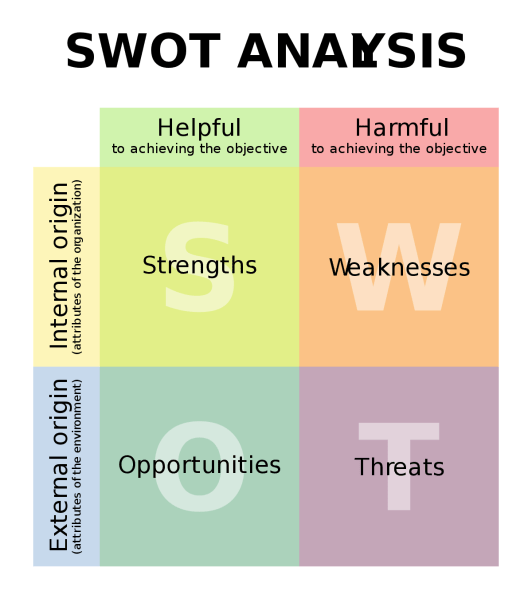
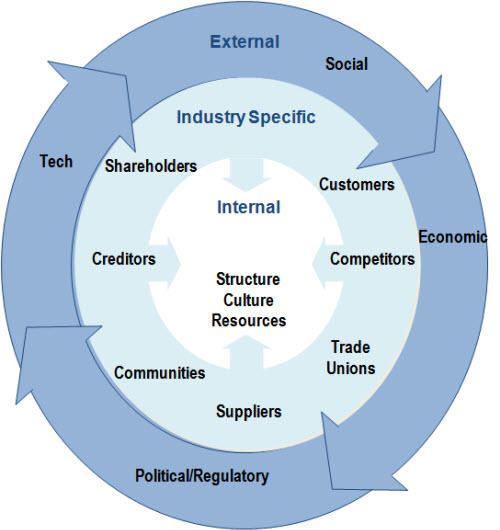
SWOT is an evaluation-process of external and internal factors through the process of communication which can also be termed as empirical Analysis. This analysis is based on observations and experiments which act as strategic management. SWOT in Business stands for:

             S- Strengths

             W- Weaknesses

             O- Opportunities

              T- Threats

Swot analysis is applied in laying down the policies of large organizations. An organization, based on SWOT  analysis, can make a relative/comparative study of its strengths, weakness, opportunities, and threads. On the basis of SWOT analysis, a business organization by exploiting its strengths and opportunities can achieve its multifaced goals, by overcoming its weaknesses and rendering its threads innocuous. SWOT analysis trains us in deriving the maximum benefit from the opportunities and the strengths, it is also identified with the term (WOTS-UP).

In other words, SWOT analysis is a technique that enables a business organization to make the best use of its strengths based on the opportunities and by doing so, an organization can keep the possible threads at bay by overcoming its vulnerable areas.

INTERNAL FACTORS

 1. STRENGTH

  Every individual and every organization possesses some strengths or characteristics or peculiarities. These peculiarities are known as positive points, such as the right pronunciation or right scent in communication, vocabulary, language, command and group discussion, etc., are the positive qualities which fascinate their audience and in course of discussion or debate, satisfying the audience with a clear and valid explanation to their queries, etc., are the major strengths. An effective personality becomes the strength in organizational communication. So strength is a very important factor for anyone.

2. WEAKENESSES

Like strengths and positive assets, there are certain weaknesses in every individual or an organization. Identifying weaknesses and marking them is an important factor. These shortcomings are known as ‘Negative Points” such as faculty and erroneous pronunciation, fast or impatient articulation, inability in drawing others attention and faculty or casual-listening as an audience, non-seriousness, or a casual approach towards communication in a business organization.

– From LEGO SWAT

EXTERNAL FACTORS

3. OPPORTUNITIES

In any business, it is essential to avail of opportunities. In the career of any business organization, professional or individual, there are a plethora of opportunities which can be transformed to destinations or in other words can be described as the gateway to one’s destination, for instance, some professionals by benefiting from e-commerce, have attained a global dimension in their business.

4. THREADS

 Society and the external environment give rise to threats. Every organization, business, profession, or an individual has to go through a rigmarole or a series of difficulties/challenges, on way to success. These threads give way to opportunities, such as the discovery of new means of communication e.g., internet, e-commerce, and e-banking, etc.,

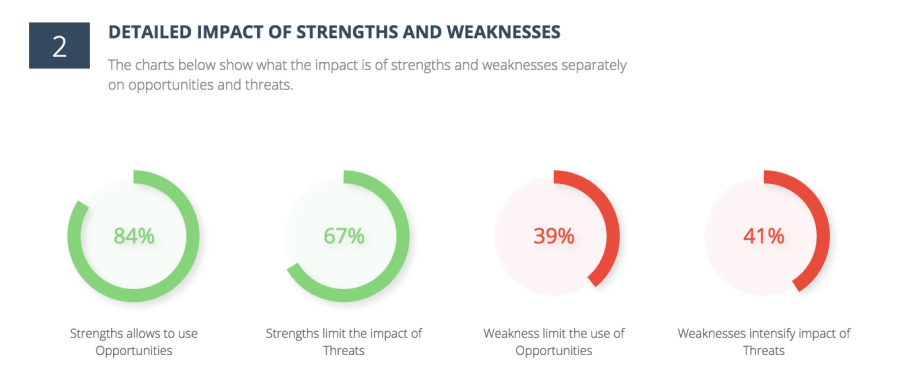
As there are always two sides to a coin, in every business or professional area, the strength and weaknesses march together. Each thread provides opportunities. In this analysis, threats, and opportunities (T-O) and weaknesses and strengths (W-S), through the equation, their interrelated analysis is done, which is also know as TOWS Analysis.

BiEnG a BoOkWoRm

Books- great friends of human-kind. They are the true companions of  man and play the role of awesome surroundings. We all, more or less, love reading. Some of us love seeing it arranged on the shelves of libraries, some of us prefer to buy famous, costly books just to make our collection rich enough. And the third one who are most fantastic, wonderful and above all real book lovers- it would not be wrong to call them book worms.

A bookworm generally reads loads of books and it actually makes them happy and keeps them refreshed. Not all of us appreciate bookworms that much, for they are pretty weird. Not weird, just not like the other people in the world. As they read a lot books, they know about lot things. They know human nature. They love to observe people. If you are a specific genre lover, like, you only love to read sci-fi series or ghost books or detective ones then knowingly or unknowingly you will start believing that you’re those cool fictitious characters and your role models will be those characters.

Now, parents. They are always on the opposite direction from us, aren’t they? Even though you are doing right, they will blindly believe that you are doing it pretty wrong. Well, I’m not against parents nor I’m criticizing them. But what I’m saying is correct and proven in hundreds of psychological theories. It’s very natural to have clashes with parents at the time of teenage. So, let’s not count that.

What I’m trying to say all these time is, being a bookie is not good thing but a VERY good thing! As much book you will read, as much true man you will become. Napoleon said once,

“Show me a family of readers, and I will show you the people who move the world.”

Books will not make you perfect, they will rather make you good. They will not help you to get good grades at exams but they will show you the right way. They will not help you to gain power but they will make you courageous enough to stand for what is right.

Books will help you to “know thyself”. So, let’s all read books. Trust me, this is cooler than social networking sites. It is more interesting to know what twist is coming at the next page than to check notifications on Facebook.

And now, they- who call themselves readers and roam around with some very high-thought books, just to get the surprising looks from friends, I don’t know what to say for them. Again, those people  who love showing attitudes and whenever they talk they love to recite lines of poems and stories from the books they have read, just to get clap and pats on their back, I don’t know what to say for them either. Maybe they should ask themselves, why they read book? For them or for others?

So, my dears, why don’t you grab a book right now and start with it? Why don’t you become Miss Marple, Mr. Holmes, Feluda or Topshe? Those very feelings, I’m asking you, does it ever gets old?

NOTE: Feluda and Topshe are characters from Bengali literature. Of  a detective series named “Feluda” written by Satyajit Ray.

5 Survival Tips for Nursing School

Have you ever wondered if you have what it takes to make it through nursing school? Some nurses will tell you that coursework and clinicals are difficult, which can be discouraging for many potential students. Just like any career, becoming a nurse takes a lot of hard work. Here are a few suggestions to help you rise to the challenge and make the most out of nursing school.
  1. Go to class. This sounds easy enough, right? Some students think it’s acceptable to skip class from time to time, but nursing classes move very quickly and your instructor will cover a lot of important information in each session. If you miss a class, you will quickly fall behind in your studies and you might not be prepared for your exams or clinicals. Plan your vacations and extra-curricular commitments around your course schedule and make sure to prioritize your schoolwork outside the classroom.
  2. Be on time. Each state requires that nursing students complete a certain amount of clinical hours. Sometimes, you might have to commute to your clinical site, which can be a hassle in bad weather or on days when you’re running late. But, if you miss a clinical session, you will have to make up those hours at the end of the semester. Trying to make up several clinical hours at the end of the term can be stressful and overwhelming, especially when you also have to study for final exams. It’s important that you complete all your hours on time and make an effort to attend every session. You can carpool with other students to hold yourself more accountable and cut down on transportation costs.
  3. Form study groups with your classmates. Studying in a group makes it easier to set aside time specifically for academics, even when you don’t have a particular exam coming up. Reviewing your notes regularly will make it easier to retain important information so that you can apply that knowledge to your work outside of the classroom. Your classmates will always be available to help you, and they might even become your friends and support system throughout your college career.
  4. Seek help from your instructors. Sometimes, you may need a refresher on the material before a big test. You should always talk to your instructors if you’re confused or struggling with course material. Your instructors are an invaluable resource—they had to survive nursing school, just like you. Above all, they want you to succeed and graduate, so don’t hesitate to ask them for help!
  5. Seek help from a tutor. All college students are expected to master basic math and writing skills, and these skills are especially important for nursing students. (For example, you have to know algebra in order to administer accurate doses of medication). Your college papers will likely require you to write in APA format. Even if you are confident in your writing, you should still ask that a peer or a tutor proofread your paper and double-check your formatting. Every student can benefit from a proofreader for papers—no one is a perfect writer! Plus, your tutor may be able to give you valuable feedback that will help you improve your writing in the future.
Of course, the best advice is to enjoy nursing school. Your years in school will go by fast, and you will learn a lot about yourself. Every student will have a different experience in school, but following these tips will help you make your experience as positive — and rewarding — as possible!
Interested in a nursing degree? Learn more here. Take our nursing personality quiz to discover the best degree options for you!
Michelle D. Metzger is a Registered Nurse who earned her Master of Science in Nursing Administration (MSN) and a Master of Business Administration (MBA) in 2013.  She has more than 20 years’ experience in healthcare starting as a Certified Nurses’ Assistant. Michelle is currently the Department Chair of Nursing at the Herzing University Kenosha Campus.  Also, she is currently pursuing her Doctorate in Nursing Practice in Education Leadership.  

An insight to Obesity and why is it a growing concern ?


Obesity is a medical condition where people have a BMI above 30. Often people get confused with the terms \’obesity\’ and \’overweight\’. There\’s a slight catch to it. If a person has a BMI between 25 to 30 he would be called overweight and the ones above 30 would be called obese.


Now, what is BMI? BMI is defined as the ratio between the weight of the body and the square of its height. The statistics show that 30% of people worldwide are obese. That\’s a whopping 2 billion people. India has around 5%, obese people. 

Obesity can be caused by a variety of factors. For instance, a normal person might be obese because of an excessive amount of food intake and a lack of physical activity. Though there are a few cases that have pointed out to genetic reasons for the case of obesity. 

Now, let\’s take a deep dive and discuss the various factors in detail. Common causes of obesity include: 

• Binge Eating: Irregular eating habit is a kind of eating disorder which may have an ill effect on the body. Eating disorders include excessive or insufficient intake of food, and in the long run, it can damage a person\’s state of health. The usual forms of eating disorders include Bulimia Nervosa, Anorexia Nervosa, and also binge eating disorder. One may not realize when he/she grew too close to eating hence it\’s important to keep a check on it right from the teens. Eat to fulfill your hunger and not your taste. Hence it\’s important to control yourself right from an early age. 

• Sedentary living style: This lifestyle can be defined as a type of lifestyle where an individual does not receive regular amounts of physical activity. Today, surprisingly most of us live a sedentary lifestyle. The person may not meet the standards as specified by the Center for Disease Control (CDC). A sedentary lifestyle is a major cause of the obesity epidemic. It has been found that living a sedentary lifestyle which includes sitting for longer than four hours per day, greatly increases the risk of cardiovascular disease. It\’s said that it can cause much greater damage than smoking itself. 

• Genetics: It\’s discovered that people whose parents are obese have an increased risk of being obese. However, there have been cases where people with obese parents are fit and healthy and may not show any signs of obesity even later in life. 

• Physiological influences: For some people, emotions influence eating habits. Many people eat not because they are always hungry but in response to social feelings like sadness or stress. There was even a popular show run on the discovery channel on TV by the name –\’ My 600lb Life\’, where they depict the real lives of obese people. But as the show progresses it\’s shown how they recover themselves after a long battle with obesity. But case studies show that almost every overweight guy or gal experience the same psychological disturbances just like any other person. 

• Weight history: A weight-history discussion is a full clinical and physical assessment to identify metabolic, genetic, and hormonal factors as well as medications that may be the reasons for weight gain. 

• Pregnancy: When a woman gives birth to a child, she may gain extra weight post-pregnancy. It\’s important to note that the extra weight gained during pregnancy is the result of feeding not yourself but your baby as well. It takes time for a woman\’s body to return to normal after pregnancy. The fact that it takes nine months for the uterus to expand to accommodate the baby, it\’s not surprising if it takes much time to return to normal. Hence, patience is a virtue, and it\’s quite beneficial for women trying to lose weight. 

• Drugs: Various drugs like steroid hormones and drugs used to treat psychiatric conditions can increase weight. For example drugs like Benadryl, Antidepressants, Beta Blockers, Prednisone, Seizure Drugs, Mood Stabilizers, Insulin & Other Diabetes Drugs.

Now the question comes if obesity can be controlled? Well with the advancements in science and increased awareness it can be controlled. All it takes is small and consistent efforts by your side. It would take a while but one can win. Before heading on to the various habits you can inculcate and various efforts you can put, it\’s important to bust up some myths floating around us. 

There are myths like : 

• People with poor self-control will remain obese throughout their life. 

• Your genes are entirely responsible for your obesity. 

• Lack of access to fresh fruits and vegetables is responsible for the obesity epidemic

• Quick weight losses are likely to be gained back. 

• Joining gym classes right from play an important role in the prevention of childhood obesity. It\’s important to distance yourself from these myths. 

Now the various ways to avoid obesity is : 

• You must say goodbye to your old lifestyle and start living an active lifestyle. Try to do simple chores like going out to buy some vegetables, using a staircase instead of an elevator. 

• You won\’t return to balanced health overnight. But putting up small efforts like these would catalyze the process. 

• Have a balanced eating diet in your schedule. The recommended daily intake of calories is 2000 for a healthy diet. Eat foods that contain fewer fats and more nutrients and avoid having high sugar content. Make sure you follow that religiously. Also, ensure that you eat only when you feel hungry. Filling your tummy unnecessarily will only put your efforts in vain. 

• Drink as much water as you can. This would clean and detoxify your body which is good in the long run. 

• Make sure that you keep junk food out of your house. It would take a while to control your love for junk food but if proper steps are taken you can surely avoid them. 

• It\’s very important to keep track of your progress and for that, you must keep an eye on your weight and get yourself a medical check-up regularly.

• And lastly do not forget to exercise regularly. Your consistent efforts would be the key to attain a healthy body.

Companies Are Turning to Digital Marketing to Survive COVID-19: Here’s Why

As we already know that Covid-19 has become a global pandemic and it is here to stay for quite a while. As this pandemic has caused a sense of chaos among the global companies and made them think and also change the ways on how they used to execute their business strategies.

Coming across the results, majority of the company owners have not succeeded in planning out some new strategy to balance out the chaos created by the pandemic.

It seems that that they are unable to the accept the fact that their previous strategies or the way they used to work may not work now. They will have to adapt to the current situation and make changes accordingly to survive this pandemic.

Some of the organizations which used to work hand in hand have now adopted Digital Marketing as a part of their survival plan.

Some of the company owners have not only embraced the pandemic but are willing to face the temporary economic downfall and then try to recover from it later on as quickly as possible.

Major impacts of Covid-19 on Business companies.

As we know that there’s no such business that’s not been affected by the corona virus but the companies that are suffering the most are the startups which do not have a large capital to keep their company alive and even the companies which highly rely on meeting and face to face interactions like hair salons, gyms, sporting complexes and clothing stores.

Some of the companies which usually had unbelievable amount of growth by the customer referrals are now experiencing such major revenue loss that their reaction to this problem is to cut the marketing costs instead of heading and thinking about the solution.

On the other hand the unusual reactions from the people have caused a lot of harm to the larger B2B companies that serve these smaller businesses.

Digital marketing can help all sorts of business ideas or strategies irrespective of the company’s net worth. The customers are still in need of the products that they used to purchase before the pandemic so the company just has to change the ways in which they reach their audience.

How to take your business online.

If we talk about the time when there was no corona virus, People knew where the best pizza was sold or the best quality beauty products.

But now as there is a complete shutdown and the companies are no where to be seen, People wonder which ones are still in business and where they can spend their money to buy the essentials.

It’s a great opportunity to the businesses which have been highly affected by the deadly virus. With the help of digital marketing they can get in touch with the customers and start boosting their brand on their website or social media platform.

Communicating with the customers.

The first step involves the interaction between the business and the customers. The companies which were never socially or digitally active will now have to change their ways and build strong connections online for the scope of their survival.

  • The companies which are affected by the corona virus should take the initiative and contact their customers via email or sms and explain them how the services have changed and how they can still avail the services.
  • Make an advertisement go viral on a newsletter on how the company have managed to keep up with the crisis and what are the necessary changes made which should be known by the people.
  • The power of social media cannot be neglected here, a simple public post on Facebook or Instagram can be used as a source to reach out the customers.

Charging up the company website.

It is a fine opportunity for the global companies to invest in longer term channels only if the marketing budget allows.

The world has become unstable and the people are not certain on what to do, here alot of external tactics can be used to for internal success as creating a blog for the company or enabling the sales of the materials.

Let’s look up to some of the examples :

Sharing vital information on the web site’s homepage regarding the business queries and letting the audience know that the business is still ongoing.

Updating the service pages with some catchy new photos and descriptions would do the job and if possible add certain discounts which would catch the eye of a lot of audience.

E-commerce system would help the company in taking online orders so it should be a top priority. Some of the platforms which can be uself for such agendas are Shopify or even Paypal.

Building the company’s social media presence.

With isolation and social distancing in hand people are spending most of their time online, this is a great opportunity to take your business on social media and start interacting with more and more people.

There is a huge increase in the time spent by the people of Italy on Facebook and when it comes to Instagram the people of USA are no further left behind they top the chart by 43.1% active users in isolation.

This is a one time opportunity for all the business leads to get on social media and set a goal to build a large set of online following.

Let’s see how the companies can do that –

Updating or sharing various sets of things such as contents or blogs related to the company or related to the social aspects.

Humor is something that is loved by the audience and the posts or videos regarding humor would catch a lot of audience.

Get in touch with an influenceer and start working with him as a lot of influencers are left set open due to the coronavirus outbreak and are available for a reasonable price.

By making these kind of certian and easy changes with less amount of money involved a company could benefit even after the lockdown is over and normalcy is availed.

Depression: Common Myths and Misconceptions

With the growing digital advancements of this virtual age, a sense of nothingness has taken over this generation in a huge way which eventually leads to mental illness in the form of anxiety disorders, personality disorders, psychotic disorders, eating disorders and needless to mention, depression. It is never easy to boil Depression down to a single definition/statement that covers all its aspects and symptoms at the same time. It is one of the major mental disorders that affect people irrespective of gender, age so on and the like.


However, even in this 21st century, many misconceptions seem to be there in the society. Many people seem to have adopted the notion of depression in such a prejudiced way that it automatically links their idea of it to a fragile and futile make-believe concept which is not only harmful for them but it also affects the people around them in the long run. This article aims at representing some of the common internalized misconceptions that seem to be wrongly associated with depression which go a long way towards causing further anxiety issues for people who suffer from depression.


1. It’s all in the head!

It is not. If you are one of those people who throw around this phrase in a casual manner whenever you hear someone talking about their fight with depression or other forms of mental disorders, it is high time you understand the repercussions associated with it. It may have a long lasting influence on that individual without you having a slightest idea about it.
It has been clinically proved to be one of the most damaging mental disorders that have the capability to break an individual inside out.

2. It is a way to seek attention.

People who happen to be clinically depressed for quite some time have a really hard time getting over it. There are various ways that they try to find their happiness in. some of them are vocal about it and many are not. However, stigmatizing, calling them names, terming them as mere attention seekers go on to make their journey way more difficult than it already is.
It takes a lot of courage and inner strength for people to come up and share their sufferings with other people. In no way do they seek attention nor do they want sympathy from anyone. In most cases, all they want is someone to listen, and understand what is going on in their mind when it is really difficult itself for them to understand it in the first place.

3. It’s genetic.


Statistics show that only around 15% of who suffer from depression has relatives who had depression in the past. Each person deals with it in a different way. The way it affects people is different. Even when it is genetic, two individuals may not show similar symptoms and the recovery time varies from one another.
Depression is just sadness!
Feeling sad temporarily and being depressed are two absolutely different things. Depression is a long term illness and is very different than being sad. It can be escalated from sadness, but it affects in a much wider way. Sadness is a temporary feeling which usually goes away on its own unlike depression. Depression comes along with a lot more other negative feelings including anxiety, unnecessary guilt feelings, overthinking, emptiness, nothingness and the like.

4. Only women get depressed.


There is this systematic internalized patriarchal fragile notion of being a Man present within us due to which in most of the cases, men choose to keep shut and do not express their emotions which eventually leads to unbearable pain and sufferings.
Women unlike men, are relatively more vocal about it and do not refrain themselves from talking about how they feel.

5. It’s just a weakness and never a big of a deal.


Due to the systematic stigmatization associated with depression, many people tend to think it is a mere temporary weakness or disability. No one chooses to be depressed and it has nothing to do with how strong they actually are.
Clinical depression is a big deal that needs regular psychological treatment in order for the patient’s recovery. Sometimes it even takes up to 8-10 years.

6. Only medication can treat depression.


Medication is one of the types by which patients are treated sometimes. It is not the only way. There are various other therapy sessions that include meditation/music therapy and other cognitive therapies that have been proved to be equally valid and helpful in treating depression.

7. Depression is always caused by trauma.


In many cases traumatic past incidents play a major role in triggering the sense of depression in people. Even people who have no such traumatizing past history can suffer from depression.

All cases are different and unique at the same time. Hence, any form of generalization or stigmatization can be way more harmful than we can even imagine. These kinds of insensitive judgmental concepts do not help, but they only contribute in making their struggle way harder than it already is. It is high time people understand to what extent these wrong judgmental thoughts and misinterpretations cause trouble for them who already are going through a lot. All we should do is to stop being judgmental and be kinder enough to help each other out in difficult situations that will eventually contribute to the process of making the world a better place, for all of us.

Suvasree Bandyopadhyay.