Topics for Writing Content for Internship

Daily writing prompt
If you could un-invent something, what would it be?

General Categories

AGeneral Economics and Teaching
BHistory of Economic Thought, Methodology, and Heterodox Approaches
CMathematical and Quantitative Methods
DMicroeconomics
EMacroeconomics and Monetary Economics
FInternational Economics
GFinancial Economics
HPublic Economics
IHealth, Education, and Welfare
JLabor and Demographic Economics
KLaw and Economics
LIndustrial Organization
MBusiness Administration and Business Economics • Marketing • Accounting • Personnel Economics
NEconomic History
OEconomic Development, Innovation, Technological Change, and Growth
PPolitical Economy and Comparative Economic Systems
QAgricultural and Natural Resource Economics • Environmental and Ecological Economics
RUrban, Rural, Regional, Real Estate, and Transportation Economics
YMiscellaneous Categories
ZOther Special Topics

A. General Economics and Teaching

 
A1General Economics
A10General
A11Role of Economics • Role of Economists • Market for Economists
A12Relation of Economics to Other Disciplines
A13Relation of Economics to Social Values
A14Sociology of Economics
A19Other
 
A2Economic Education and Teaching of Economics
A20General
A21Pre-college
A22Undergraduate
A23Graduate
A29Other
 
A3Collective Works
A30General
A31Collected Writings of Individuals
A32Collective Volumes
A33Handbooks
A39Other

B. History of Economic Thought, Methodology, and Heterodox Approaches

 
B00General
 
B1History of Economic Thought through 1925
B10General
B11Preclassical (Ancient, Medieval, Mercantilist, Physiocratic)
B12Classical (includes Adam Smith)
B13Neoclassical through 1925 (Austrian, Marshallian, Walrasian, Wicksellian)
B14Socialist • Marxist
B15Historical • Institutional • Evolutionary
B16Quantitative and Mathematical
B17International Trade and Finance
B19Other
 
B2History of Economic Thought since 1925
B20General
B21Microeconomics
B22Macroeconomics
B23Econometrics • Quantitative and Mathematical Studies
B24Socialist • Marxist • Sraffian
B25Historical • Institutional • Evolutionary • Austrian • Stockholm School
B26Financial Economics
B27International Trade and Finance
B29Other
 
B3History of Economic Thought: Individuals
B30General
B31Individuals
B32Obituaries
 
B4Economic Methodology
B40General
B41Economic Methodology
B49Other
 
B5Current Heterodox Approaches
B50General
B51Socialist • Marxian • Sraffian
B52Historical • Institutional • Evolutionary • Modern Monetary Theory
B53Austrian
B54Feminist Economics
B55Social Economics
B59Other

C. Mathematical and Quantitative Methods

 
C00General
C01Econometrics
C02Mathematical Methods
 
C1Econometric and Statistical Methods and Methodology: General
C10General
C11Bayesian Analysis: General
C12Hypothesis Testing: General
C13Estimation: General
C14Semiparametric and Nonparametric Methods: General
C15Statistical Simulation Methods: General
C18Methodological Issues: General
C19Other
 
C2Single Equation Models • Single Variables
C20General
C21Cross-Sectional Models • Spatial Models • Treatment Effect Models • Quantile Regressions
C22Time-Series Models • Dynamic Quantile Regressions • Dynamic Treatment Effect Models • Diffusion Processes
C23Panel Data Models • Spatio-temporal Models
C24Truncated and Censored Models • Switching Regression Models • Threshold Regression Models
C25Discrete Regression and Qualitative Choice Models • Discrete Regressors • Proportions • Probabilities
C26Instrumental Variables (IV) Estimation
C29Other
 
C3Multiple or Simultaneous Equation Models • Multiple Variables
C30General
C31Cross-Sectional Models • Spatial Models • Treatment Effect Models • Quantile Regressions • Social Interaction Models
C32Time-Series Models • Dynamic Quantile Regressions • Dynamic Treatment Effect Models • Diffusion Processes • State Space Models
C33Panel Data Models • Spatio-temporal Models
C34Truncated and Censored Models • Switching Regression Models
C35Discrete Regression and Qualitative Choice Models • Discrete Regressors • Proportions
C36Instrumental Variables (IV) Estimation
C38Classification Methods • Cluster Analysis • Principal Components • Factor Models
C39Other
 
C4Econometric and Statistical Methods: Special Topics
C40General
C41Duration Analysis • Optimal Timing Strategies
C43Index Numbers and Aggregation
C44Operations Research • Statistical Decision Theory
C45Neural Networks and Related Topics
C46Specific Distributions • Specific Statistics
C49Other
 
C5Econometric Modeling
C50General
C51Model Construction and Estimation
C52Model Evaluation, Validation, and Selection
C53Forecasting and Prediction Methods • Simulation Methods
C54Quantitative Policy Modeling
C55Large Data Sets: Modeling and Analysis
C57Econometrics of Games and Auctions
C58Financial Econometrics
C59Other
 
C6Mathematical Methods • Programming Models • Mathematical and Simulation Modeling
C60General
C61Optimization Techniques • Programming Models • Dynamic Analysis
C62Existence and Stability Conditions of Equilibrium
C63Computational Techniques • Simulation Modeling
C65Miscellaneous Mathematical Tools
C67Input–Output Models
C68Computable General Equilibrium Models
C69Other
 
C7Game Theory and Bargaining Theory
C70General
C71Cooperative Games
C72Noncooperative Games
C73Stochastic and Dynamic Games • Evolutionary Games • Repeated Games
C78Bargaining Theory • Matching Theory
C79Other
 
C8Data Collection and Data Estimation Methodology • Computer Programs
C80General
C81Methodology for Collecting, Estimating, and Organizing Microeconomic Data • Data Access
C82Methodology for Collecting, Estimating, and Organizing Macroeconomic Data • Data Access
C83Survey Methods • Sampling Methods
C87Econometric Software
C88Other Computer Software
C89Other
 
C9Design of Experiments
C90General
C91Laboratory, Individual Behavior
C92Laboratory, Group Behavior
C93Field Experiments
C99Other

D. Microeconomics

 
D00General
D01Microeconomic Behavior: Underlying Principles
D02Institutions: Design, Formation, Operations, and Impact
D04Microeconomic Policy: Formulation, Implementation, and Evaluation
 
D1Household Behavior and Family Economics
D10General
D11Consumer Economics: Theory
D12Consumer Economics: Empirical Analysis
D13Household Production and Intrahousehold Allocation
D14Household Saving • Personal Finance
D15Intertemporal Household Choice • Life Cycle Models and Saving
D16Collaborative Consumption
D18Consumer Protection
D19Other
 
D2Production and Organizations
D20General
D21Firm Behavior: Theory
D22Firm Behavior: Empirical Analysis
D23Organizational Behavior • Transaction Costs • Property Rights
D24Production • Cost • Capital • Capital, Total Factor, and Multifactor Productivity • Capacity
D25Intertemporal Firm Choice: Investment, Capacity, and Financing
D26Crowd-Based Firms
D29Other
 
D3Distribution
D30General
D31Personal Income, Wealth, and Their Distributions
D33Factor Income Distribution
D39Other
 
D4Market Structure, Pricing, and Design
D40General
D41Perfect Competition
D42Monopoly
D43Oligopoly and Other Forms of Market Imperfection
D44Auctions
D45Rationing • Licensing
D46Value Theory
D47Market Design
D49Other
 
D5General Equilibrium and Disequilibrium
D50General
D51Exchange and Production Economies
D52Incomplete Markets
D53Financial Markets
D57Input–Output Tables and Analysis
D58Computable and Other Applied General Equilibrium Models
D59Other
 
D6Welfare Economics
D60General
D61Allocative Efficiency • Cost–Benefit Analysis
D62Externalities
D63Equity, Justice, Inequality, and Other Normative Criteria and Measurement
D64Altruism • Philanthropy • Intergenerational Transfers
D69Other
 
D7Analysis of Collective Decision-Making
D70General
D71Social Choice • Clubs • Committees • Associations
D72Political Processes: Rent-Seeking, Lobbying, Elections, Legislatures, and Voting Behavior
D73Bureaucracy • Administrative Processes in Public Organizations • Corruption
D74Conflict • Conflict Resolution • Alliances • Revolutions
D78Positive Analysis of Policy Formulation and Implementation
D79Other
 
D8Information, Knowledge, and Uncertainty
D80General
D81Criteria for Decision-Making under Risk and Uncertainty
D82Asymmetric and Private Information • Mechanism Design
D83Search • Learning • Information and Knowledge • Communication • Belief • Unawareness
D84Expectations • Speculations
D85Network Formation and Analysis: Theory
D86Economics of Contract: Theory
D87Neuroeconomics
D89Other
 
D9Micro-Based Behavioral Economics
D90General
D91Role and Effects of Psychological, Emotional, Social, and Cognitive Factors on Decision Making

E. Macroeconomics and Monetary Economics

 
E00General
E01Measurement and Data on National Income and Product Accounts and Wealth • Environmental Accounts
E02Institutions and the Macroeconomy
 
E1General Aggregative Models
E10General
E11Marxian • Sraffian • Kaleckian
E12Keynes • Keynesian • Post-Keynesian • Modern Monetary Theory
E13Neoclassical
E14Austrian • Evolutionary • Institutional
E16Social Accounting Matrix
E17Forecasting and Simulation: Models and Applications
E19Other
 
E2Consumption, Saving, Production, Investment, Labor Markets, and Informal Economy
E20General
E21Consumption • Saving • Wealth
E22Investment • Capital • Intangible Capital • Capacity
E23Production
E24Employment • Unemployment • Wages • Intergenerational Income Distribution • Aggregate Human Capital • Aggregate Labor Productivity
E25Aggregate Factor Income Distribution
E26Informal Economy • Underground Economy
E27Forecasting and Simulation: Models and Applications
E29Other
 
E3Prices, Business Fluctuations, and Cycles
E30General
E31Price Level • Inflation • Deflation
E32Business Fluctuations • Cycles
E37Forecasting and Simulation: Models and Applications
E39Other
 
E4Money and Interest Rates
E40General
E41Demand for Money
E42Monetary Systems • Standards • Regimes • Government and the Monetary System • Payment Systems
E43Interest Rates: Determination, Term Structure, and Effects
E44Financial Markets and the Macroeconomy
E47Forecasting and Simulation: Models and Applications
E49Other
 
E5Monetary Policy, Central Banking, and the Supply of Money and Credit
E50General
E51Money Supply • Credit • Money Multipliers
E52Monetary Policy
E58Central Banks and Their Policies
E59Other
 
E6Macroeconomic Policy, Macroeconomic Aspects of Public Finance, and General Outlook
E60General
E61Policy Objectives • Policy Designs and Consistency • Policy Coordination
E62Fiscal Policy • Modern Monetary Theory
E63Comparative or Joint Analysis of Fiscal and Monetary Policy • Stabilization • Treasury Policy
E64Incomes Policy • Price Policy
E65Studies of Particular Policy Episodes
E66General Outlook and Conditions
E69Other
 
E7Macro-Based Behavioral Economics
E70General
E71Role and Effects of Psychological, Emotional, Social, and Cognitive Factors on the Macro Economy

F. International Economics

 
F00General
F01Global Outlook
F02International Economic Order and Integration
 
F1Trade
F10General
F11Neoclassical Models of Trade
F12Models of Trade with Imperfect Competition and Scale Economies • Fragmentation
F13Trade Policy • International Trade Organizations
F14Empirical Studies of Trade
F15Economic Integration
F16Trade and Labor Market Interactions
F17Trade Forecasting and Simulation
F18Trade and Environment
F19Other
 
F2International Factor Movements and International Business
F20General
F21International Investment • Long-Term Capital Movements
F22International Migration
F23Multinational Firms • International Business
F24Remittances
F29Other
 
F3International Finance
F30General
F31Foreign Exchange
F32Current Account Adjustment • Short-Term Capital Movements
F33International Monetary Arrangements and Institutions
F34International Lending and Debt Problems
F35Foreign Aid
F36Financial Aspects of Economic Integration
F37International Finance Forecasting and Simulation: Models and Applications
F38International Financial Policy: Financial Transactions Tax; Capital Controls
F39Other
 
F4Macroeconomic Aspects of International Trade and Finance
F40General
F41Open Economy Macroeconomics
F42International Policy Coordination and Transmission
F43Economic Growth of Open Economies
F44International Business Cycles
F45Macroeconomic Issues of Monetary Unions
F47Forecasting and Simulation: Models and Applications
F49Other
 
F5International Relations, National Security, and International Political Economy
F50General
F51International Conflicts • Negotiations • Sanctions
F52National Security • Economic Nationalism
F53International Agreements and Observance • International Organizations
F54Colonialism • Imperialism • Postcolonialism
F55International Institutional Arrangements
F59Other
 
F6Economic Impacts of Globalization
F60General
F61Microeconomic Impacts
F62Macroeconomic Impacts
F63Economic Development
F64Environment
F65Finance
F66Labor
F68Policy
F69Other

G. Financial Economics

 
G00General
G01Financial Crises
 
G1General Financial Markets
G10General
G11Portfolio Choice • Investment Decisions
G12Asset Pricing • Trading Volume • Bond Interest Rates
G13Contingent Pricing • Futures Pricing
G14Information and Market Efficiency • Event Studies • Insider Trading
G15International Financial Markets
G17Financial Forecasting and Simulation
G18Government Policy and Regulation
G19Other
 
G2Financial Institutions and Services
G20General
G21Banks • Depository Institutions • Micro Finance Institutions • Mortgages
G22Insurance • Insurance Companies • Actuarial Studies
G23Non-bank Financial Institutions • Financial Instruments • Institutional Investors
G24Investment Banking • Venture Capital • Brokerage • Ratings and Ratings Agencies
G28Government Policy and Regulation
G29Other
 
G3Corporate Finance and Governance
G30General
G31Capital Budgeting • Fixed Investment and Inventory Studies • Capacity
G32Financing Policy • Financial Risk and Risk Management • Capital and Ownership Structure • Value of Firms • Goodwill
G33Bankruptcy • Liquidation
G34Mergers • Acquisitions • Restructuring • Corporate Governance
G35Payout Policy
G38Government Policy and Regulation
G39Other
 
G4Behavioral Finance
G40General
G41Role and Effects of Psychological, Emotional, Social, and Cognitive Factors on Decision Making in Financial Markets
 
G5Household Finance
G50General
G51Household Saving, Borrowing, Debt, and Wealth
G52Insurance
G53Financial Literacy
G59Other

H. Public Economics

 
H00General
 
H1Structure and Scope of Government
H10General
H11Structure, Scope, and Performance of Government
H12Crisis Management
H13Economics of Eminent Domain • Expropriation • Nationalization
H19Other
 
H2Taxation, Subsidies, and Revenue
H20General
H21Efficiency • Optimal Taxation
H22Incidence
H23Externalities • Redistributive Effects • Environmental Taxes and Subsidies
H24Personal Income and Other Nonbusiness Taxes and Subsidies
H25Business Taxes and Subsidies
H26Tax Evasion and Avoidance
H27Other Sources of Revenue
H29Other
 
H3Fiscal Policies and Behavior of Economic Agents
H30General
H31Household
H32Firm
H39Other
 
H4Publicly Provided Goods
H40General
H41Public Goods
H42Publicly Provided Private Goods
H43Project Evaluation • Social Discount Rate
H44Publicly Provided Goods: Mixed Markets
H49Other
 
H5National Government Expenditures and Related Policies
H50General
H51Government Expenditures and Health
H52Government Expenditures and Education
H53Government Expenditures and Welfare Programs
H54Infrastructures • Other Public Investment and Capital Stock
H55Social Security and Public Pensions
H56National Security and War
H57Procurement
H59Other
 
H6National Budget, Deficit, and Debt
H60General
H61Budget • Budget Systems
H62Deficit • Surplus
H63Debt • Debt Management • Sovereign Debt
H68Forecasts of Budgets, Deficits, and Debt
H69Other
 
H7State and Local Government • Intergovernmental Relations
H70General
H71State and Local Taxation, Subsidies, and Revenue
H72State and Local Budget and Expenditures
H73Interjurisdictional Differentials and Their Effects
H74State and Local Borrowing
H75State and Local Government: Health • Education • Welfare • Public Pensions
H76State and Local Government: Other Expenditure Categories
H77Intergovernmental Relations • Federalism • Secession
H79Other
 
H8Miscellaneous Issues
H80General
H81Governmental Loans • Loan Guarantees • Credits • Grants • Bailouts
H82Governmental Property
H83Public Administration • Public Sector Accounting and Audits
H84Disaster Aid
H87International Fiscal Issues • International Public Goods
H89Other

I. Health, Education, and Welfare

 
I00General
 
I1Health
I10General
I11Analysis of Health Care Markets
I12Health Behavior
I13Health Insurance, Public and Private
I14Health and Inequality
I15Health and Economic Development
I18Government Policy • Regulation • Public Health
I19Other
 
I2Education and Research Institutions
I20General
I21Analysis of Education
I22Educational Finance • Financial Aid
I23Higher Education • Research Institutions
I24Education and Inequality
I25Education and Economic Development
I26Returns to Education
I28Government Policy
I29Other
 
I3Welfare, Well-Being, and Poverty
I30General
I31General Welfare, Well-Being
I32Measurement and Analysis of Poverty
I38Government Policy • Provision and Effects of Welfare Programs
I39Other

J. Labor and Demographic Economics

 
J00General
J01Labor Economics: General
J08Labor Economics Policies
 
J1Demographic Economics
J10General
J11Demographic Trends, Macroeconomic Effects, and Forecasts
J12Marriage • Marital Dissolution • Family Structure • Domestic Abuse
J13Fertility • Family Planning • Child Care • Children • Youth
J14Economics of the Elderly • Economics of Disability • Non-Labor Market Discrimination
J15Economics of Minorities, Races, Indigenous Peoples, and Immigrants • Non-labor Discrimination
J16Economics of Gender • Non-labor Discrimination
J17Value of Life • Forgone Income
J18Public Policy
J19Other
 
J2Demand and Supply of Labor
J20General
J21Labor Force and Employment, Size, and Structure
J22Time Allocation and Labor Supply
J23Labor Demand
J24Human Capital • Skills • Occupational Choice • Labor Productivity
J26Retirement • Retirement Policies
J28Safety • Job Satisfaction • Related Public Policy
J29Other
 
J3Wages, Compensation, and Labor Costs
J30General
J31Wage Level and Structure • Wage Differentials
J32Nonwage Labor Costs and Benefits • Retirement Plans • Private Pensions
J33Compensation Packages • Payment Methods
J38Public Policy
J39Other
 
J4Particular Labor Markets
J40General
J41Labor Contracts
J42Monopsony • Segmented Labor Markets
J43Agricultural Labor Markets
J44Professional Labor Markets • Occupational Licensing
J45Public Sector Labor Markets
J46Informal Labor Markets
J47Coercive Labor Markets
J48Public Policy
J49Other
 
J5Labor–Management Relations, Trade Unions, and Collective Bargaining
J50General
J51Trade Unions: Objectives, Structure, and Effects
J52Dispute Resolution: Strikes, Arbitration, and Mediation • Collective Bargaining
J53Labor–Management Relations • Industrial Jurisprudence
J54Producer Cooperatives • Labor Managed Firms • Employee Ownership
J58Public Policy
J59Other
 
J6Mobility, Unemployment, Vacancies, and Immigrant Workers
J60General
J61Geographic Labor Mobility • Immigrant Workers
J62Job, Occupational, and Intergenerational Mobility
J63Turnover • Vacancies • Layoffs
J64Unemployment: Models, Duration, Incidence, and Job Search
J65Unemployment Insurance • Severance Pay • Plant Closings
J68Public Policy
J69Other
 
J7Labor Discrimination
J70General
J71Discrimination
J78Public Policy
J79Other
 
J8Labor Standards: National and International
J80General
J81Working Conditions
J82Labor Force Composition
J83Workers’ Rights
J88Public Policy
J89Other

K. Law and Economics

 
K00General
 
K1Basic Areas of Law
K10General
K11Property Law
K12Contract Law
K13Tort Law and Product Liability • Forensic Economics
K14Criminal Law
K15Civil Law • Common Law
K16Election Law
K19Other
 
K2Regulation and Business Law
K20General
K21Antitrust Law
K22Business and Securities Law
K23Regulated Industries and Administrative Law
K24Cyber Law
K25Real Estate Law
K29Other
 
K3Other Substantive Areas of Law
K30General
K31Labor Law
K32Energy, Environmental, Health, and Safety Law
K33International Law
K34Tax Law
K35Personal Bankruptcy Law
K36Family and Personal Law
K37Immigration Law
K38Human Rights Law • Gender Law • Animal Rights Law
K39Other
 
K4Legal Procedure, the Legal System, and Illegal Behavior
K40General
K41Litigation Process
K42Illegal Behavior and the Enforcement of Law
K49Other

L. Industrial Organization

 
L00General
 
L1Market Structure, Firm Strategy, and Market Performance
L10General
L11Production, Pricing, and Market Structure • Size Distribution of Firms
L12Monopoly • Monopolization Strategies
L13Oligopoly and Other Imperfect Markets
L14Transactional Relationships • Contracts and Reputation • Networks
L15Information and Product Quality • Standardization and Compatibility
L16Industrial Organization and Macroeconomics: Industrial Structure and Structural Change • Industrial Price Indices
L17Open Source Products and Markets
L19Other
 
L2Firm Objectives, Organization, and Behavior
L20General
L21Business Objectives of the Firm
L22Firm Organization and Market Structure
L23Organization of Production
L24Contracting Out • Joint Ventures • Technology Licensing
L25Firm Performance: Size, Diversification, and Scope
L26Entrepreneurship
L29Other
 
L3Nonprofit Organizations and Public Enterprise
L30General
L31Nonprofit Institutions • NGOs • Social Entrepreneurship
L32Public Enterprises • Public-Private Enterprises
L33Comparison of Public and Private Enterprises and Nonprofit Institutions • Privatization • Contracting Out
L38Public Policy
L39Other
 
L4Antitrust Issues and Policies
L40General
L41Monopolization • Horizontal Anticompetitive Practices
L42Vertical Restraints • Resale Price Maintenance • Quantity Discounts
L43Legal Monopolies and Regulation or Deregulation
L44Antitrust Policy and Public Enterprises, Nonprofit Institutions, and Professional Organizations
L49Other
 
L5Regulation and Industrial Policy
L50General
L51Economics of Regulation
L52Industrial Policy • Sectoral Planning Methods
L53Enterprise Policy
L59Other
 
L6Industry Studies: Manufacturing
L60General
L61Metals and Metal Products • Cement • Glass • Ceramics
L62Automobiles • Other Transportation Equipment • Related Parts and Equipment
L63Microelectronics • Computers • Communications Equipment
L64Other Machinery • Business Equipment • Armaments
L65Chemicals • Rubber • Drugs • Biotechnology • Plastics
L66Food • Beverages • Cosmetics • Tobacco • Wine and Spirits
L67Other Consumer Nondurables: Clothing, Textiles, Shoes, and Leather Goods; Household Goods; Sports Equipment
L68Appliances • Furniture • Other Consumer Durables
L69Other
 
L7Industry Studies: Primary Products and Construction
L70General
L71Mining, Extraction, and Refining: Hydrocarbon Fuels
L72Mining, Extraction, and Refining: Other Nonrenewable Resources
L73Forest Products
L74Construction
L78Government Policy
L79Other
 
L8Industry Studies: Services
L80General
L81Retail and Wholesale Trade • e-Commerce
L82Entertainment • Media
L83Sports • Gambling • Restaurants • Recreation • Tourism
L84Personal, Professional, and Business Services
L85Real Estate Services
L86Information and Internet Services • Computer Software
L87Postal and Delivery Services
L88Government Policy
L89Other
 
L9Industry Studies: Transportation and Utilities
L90General
L91Transportation: General
L92Railroads and Other Surface Transportation
L93Air Transportation
L94Electric Utilities
L95Gas Utilities • Pipelines • Water Utilities
L96Telecommunications
L97Utilities: General
L98Government Policy
L99Other

M. Business Administration and Business Economics • Marketing • Accounting • Personnel Economics

 
M00General
 
M1Business Administration
M10General
M11Production Management
M12Personnel Management • Executives; Executive Compensation
M13New Firms • Startups
M14Corporate Culture • Diversity • Social Responsibility
M15IT Management
M16International Business Administration
M19Other
 
M2Business Economics
M20General
M21Business Economics
M29Other
 
M3Marketing and Advertising
M30General
M31Marketing
M37Advertising
M38Government Policy and Regulation
M39Other
 
M4Accounting and Auditing
M40General
M41Accounting
M42Auditing
M48Government Policy and Regulation
M49Other
 
M5Personnel Economics
M50General
M51Firm Employment Decisions • Promotions
M52Compensation and Compensation Methods and Their Effects
M53Training
M54Labor Management
M55Labor Contracting Devices
M59Other

N. Economic History

 
N00General
N01Development of the Discipline: Historiographical; Sources and Methods
 
N1Macroeconomics and Monetary Economics • Industrial Structure • Growth • Fluctuations
N10General, International, or Comparative
N11U.S. • Canada: Pre-1913
N12U.S. • Canada: 1913–
N13Europe: Pre-1913
N14Europe: 1913–
N15Asia including Middle East
N16Latin America • Caribbean
N17Africa • Oceania
 
N2Financial Markets and Institutions
N20General, International, or Comparative
N21U.S. • Canada: Pre-1913
N22U.S. • Canada: 1913–
N23Europe: Pre-1913
N24Europe: 1913–
N25Asia including Middle East
N26Latin America • Caribbean
N27Africa • Oceania
 
N3Labor and Consumers, Demography, Education, Health, Welfare, Income, Wealth, Religion, and Philanthropy
N30General, International, or Comparative
N31U.S. • Canada: Pre-1913
N32U.S. • Canada: 1913-
N33Europe: Pre-1913
N34Europe: 1913-
N35Asia including Middle East
N36Latin America • Caribbean
N37Africa • Oceania
 
N4Government, War, Law, International Relations, and Regulation
N40General, International, or Comparative
N41U.S. • Canada: Pre-1913
N42U.S. • Canada: 1913–
N43Europe: Pre-1913
N44Europe: 1913–
N45Asia including Middle East
N46Latin America • Caribbean
N47Africa • Oceania
 
N5Agriculture, Natural Resources, Environment, and Extractive Industries
N50General, International, or Comparative
N51U.S. • Canada: Pre-1913
N52U.S. • Canada: 1913–
N53Europe: Pre-1913
N54Europe: 1913–
N55Asia including Middle East
N56Latin America • Caribbean
N57Africa • Oceania
 
N6Manufacturing and Construction
N60General, International, or Comparative
N61U.S. • Canada: Pre-1913
N62U.S. • Canada: 1913–
N63Europe: Pre-1913
N64Europe: 1913–
N65Asia including Middle East
N66Latin America • Caribbean
N67Africa • Oceania
 
N7Transport, Trade, Energy, Technology, and Other Services
N70General, International, or Comparative
N71U.S. • Canada: Pre-1913
N72U.S. • Canada: 1913–
N73Europe: Pre-1913
N74Europe: 1913–
N75Asia including Middle East
N76Latin America • Caribbean
N77Africa • Oceania
 
N8Micro-Business History
N80General, International, or Comparative
N81U.S. • Canada: Pre-1913
N82U.S. • Canada: 1913–
N83Europe: Pre-1913
N84Europe: 1913–
N85Asia including Middle East
N86Latin America • Caribbean
N87Africa • Oceania
 
N9Regional and Urban History
N90General, International, or Comparative
N91U.S. • Canada: Pre-1913
N92U.S. • Canada: 1913–
N93Europe: Pre-1913
N94Europe: 1913–
N95Asia including Middle East
N96Latin America • Caribbean
N97Africa • Oceania

O. Economic Development, Innovation, Technological Change, and Growth

 
O1Economic Development
O10General
O11Macroeconomic Analyses of Economic Development
O12Microeconomic Analyses of Economic Development
O13Agriculture • Natural Resources • Energy • Environment • Other Primary Products
O14Industrialization • Manufacturing and Service Industries • Choice of Technology
O15Human Resources • Human Development • Income Distribution • Migration
O16Financial Markets • Saving and Capital Investment • Corporate Finance and Governance
O17Formal and Informal Sectors • Shadow Economy • Institutional Arrangements
O18Urban, Rural, Regional, and Transportation Analysis • Housing • Infrastructure
O19International Linkages to Development • Role of International Organizations
 
O2Development Planning and Policy
O20General
O21Planning Models • Planning Policy
O22Project Analysis
O23Fiscal and Monetary Policy in Development
O24Trade Policy • Factor Movement Policy • Foreign Exchange Policy
O25Industrial Policy
O29Other
 
O3Innovation • Research and Development • Technological Change • Intellectual Property Rights
O30General
O31Innovation and Invention: Processes and Incentives
O32Management of Technological Innovation and R&D
O33Technological Change: Choices and Consequences • Diffusion Processes
O34Intellectual Property and Intellectual Capital
O35Social Innovation
O36Open Innovation
O38Government Policy
O39Other
 
O4Economic Growth and Aggregate Productivity
O40General
O41One, Two, and Multisector Growth Models
O42Monetary Growth Models
O43Institutions and Growth
O44Environment and Growth
O47Empirical Studies of Economic Growth • Aggregate Productivity • Cross-Country Output Convergence
O49Other
 
O5Economywide Country Studies
O50General
O51U.S. • Canada
O52Europe
O53Asia including Middle East
O54Latin America • Caribbean
O55Africa
O56Oceania
O57Comparative Studies of Countries

P. Political Economy and Comparative Economic Systems

 
P00General
 
P1Capitalist Economies
P10General
P11Planning, Coordination, and Reform
P12Capitalist Enterprises
P13Cooperative Enterprises
P14Property Rights
P16Capitalist Institutions • Welfare State
P17Performance and Prospects
P18Energy • Environment
P19Other
 
P2Socialist and Transition Economies
P20General
P21Planning, Coordination, and Reform
P22Prices
P23Factor and Product Markets • Industry Studies • Population
P24National Income, Product, and Expenditure • Money • Inflation
P25Urban, Rural, and Regional Economics
P26Property Rights
P27Performance and Prospects
P28Natural Resources • Energy • Environment
P29Other
 
P3Socialist Institutions and Their Transitions
P30General
P31Socialist Enterprises and Their Transitions
P32Collectives • Communes • Agriculture
P33International Trade, Finance, Investment, Relations, and Aid
P34Financial Economics
P35Public Economics
P36Consumer Economics • Health • Education and Training • Welfare, Income, Wealth, and Poverty
P37Legal Institutions • Illegal Behavior
P39Other
 
P4Other Economic Systems
P40General
P41Planning, Coordination, and Reform
P42Productive Enterprises • Factor and Product Markets • Prices • Population
P43Public Economics • Financial Economics
P44National Income, Product, and Expenditure • Money • Inflation
P45International Trade, Finance, Investment, and Aid
P46Consumer Economics • Health • Education and Training • Welfare, Income, Wealth, and Poverty
P47Performance and Prospects
P48Legal Institutions • Property Rights • Natural Resources • Energy • Environment • Regional Studies
P49Other
 
P5Comparative Economic Systems
P50General
P51Comparative Analysis of Economic Systems
P52Comparative Studies of Particular Economies
P59Other

Q. Agricultural and Natural Resource Economics • Environmental and Ecological Economics

 
Q00General
Q01Sustainable Development
Q02Commodity Markets
 
Q1Agriculture
Q10General
Q11Aggregate Supply and Demand Analysis • Prices
Q12Micro Analysis of Farm Firms, Farm Households, and Farm Input Markets
Q13Agricultural Markets and Marketing • Cooperatives • Agribusiness
Q14Agricultural Finance
Q15Land Ownership and Tenure • Land Reform • Land Use • Irrigation • Agriculture and Environment
Q16R&D • Agricultural Technology • Biofuels • Agricultural Extension Services
Q17Agriculture in International Trade
Q18Agricultural Policy • Food Policy • Animal Welfare Policy
Q19Other
 
Q2Renewable Resources and Conservation
Q20General
Q21Demand and Supply • Prices
Q22Fishery • Aquaculture
Q23Forestry
Q24Land
Q25Water
Q26Recreational Aspects of Natural Resources
Q27Issues in International Trade
Q28Government Policy
Q29Other
 
Q3Nonrenewable Resources and Conservation
Q30General
Q31Demand and Supply • Prices
Q32Exhaustible Resources and Economic Development
Q33Resource Booms
Q34Natural Resources and Domestic and International Conflicts
Q35Hydrocarbon Resources
Q37Issues in International Trade
Q38Government Policy
Q39Other
 
Q4Energy
Q40General
Q41Demand and Supply • Prices
Q42Alternative Energy Sources
Q43Energy and the Macroeconomy
Q47Energy Forecasting
Q48Government Policy
Q49Other
 
Q5Environmental Economics
Q50General
Q51Valuation of Environmental Effects
Q52Pollution Control Adoption and Costs • Distributional Effects • Employment Effects
Q53Air Pollution • Water Pollution • Noise • Hazardous Waste • Solid Waste • Recycling
Q54Climate • Natural Disasters and Their Management • Global Warming
Q55Technological Innovation
Q56Environment and Development • Environment and Trade • Sustainability • Environmental Accounts and Accounting • Environmental Equity • Population Growth
Q57Ecological Economics: Ecosystem Services • Biodiversity Conservation • Bioeconomics • Industrial Ecology
Q58Government Policy
Q59Other

R. Urban, Rural, Regional, Real Estate, and Transportation Economics

 
R00General
 
R1General Regional Economics
R10General
R11Regional Economic Activity: Growth, Development, Environmental Issues, and Changes
R12Size and Spatial Distributions of Regional Economic Activity
R13General Equilibrium and Welfare Economic Analysis of Regional Economies
R14Land Use Patterns
R15Econometric and Input–Output Models • Other Models
R19Other
 
R2Household Analysis
R20General
R21Housing Demand
R22Other Demand
R23Regional Migration • Regional Labor Markets • Population • Neighborhood Characteristics
R28Government Policy
R29Other
 
R3Real Estate Markets, Spatial Production Analysis, and Firm Location
R30General
R31Housing Supply and Markets
R32Other Spatial Production and Pricing Analysis
R33Nonagricultural and Nonresidential Real Estate Markets
R38Government Policy
R39Other
 
R4Transportation Economics
R40General
R41Transportation: Demand, Supply, and Congestion • Travel Time • Safety and Accidents • Transportation Noise
R42Government and Private Investment Analysis • Road Maintenance • Transportation Planning
R48Government Pricing and Policy
R49Other
 
R5Regional Government Analysis
R50General
R51Finance in Urban and Rural Economies
R52Land Use and Other Regulations
R53Public Facility Location Analysis • Public Investment and Capital Stock
R58Regional Development Planning and Policy
R59Other

Y. Miscellaneous Categories

 
Y1Data: Tables and Charts
Y10Data: Tables and Charts
 
Y2Introductory Material
Y20Introductory Material
 
Y3Book Reviews (unclassified)
Y30Book Reviews (unclassified)
 
Y4Dissertations (unclassified)
Y40Dissertations (unclassified)
 
Y5Further Reading (unclassified)
Y50Further Reading (unclassified)
 
Y6Excerpts
Y60Excerpts
 
Y7No Author General Discussions
Y70No Author General Discussions
 
Y8Related Disciplines
Y80Related Disciplines
 
Y9Other
Y90Other
Y91Pictures and Maps
Y92Novels, Self-Help Books, etc.

Z. Other Special Topics

 
Z00General
 
Z1Cultural Economics • Economic Sociology • Economic Anthropology
Z10General
Z11Economics of the Arts and Literature
Z12Religion
Z13Economic Sociology • Economic Anthropology • Language • Social and Economic Stratification
Z18Public Policy
Z19Other
 
Z2Sports Economics
Z20General
Z21Industry Studies
Z22Labor Issues
Z23Finance
Z28Policy
Z29Other
 
Z3Tourism Economics
Z30General
Z31Industry Studies
Z32Tourism and Development
Z33Marketing and Finance
Z38Policy
Z39Other

One Nation One Subscription

Daily writing prompt
What makes a good leader?

India, a land of ancient knowledge and rich tradition, has always been a beacon of innovation and discovery. From pioneering advancements in mathematics and astronomy to groundbreaking contributions in various fields of science, the country’s legacy of intellectual achievement is unmatched. On August 15, 2022, Prime Minister Narendra Modi, from the ramparts of the Red Fort, reminded the nation of this proud legacy and the critical role that Research and Development (R&D) would play in shaping India’s future. As he addressed the nation, he emphasized the importance of nurturing R&D capabilities, particularly during Amrit Kaal, and called for a renewed focus on innovation with the inspiring slogan, “Jai Anusandhan.”

This call for a vibrant R&D ecosystem resonated with the goals outlined in the National Education Policy (NEP) 2020, which identifies research as a fundamental driver of educational excellence and national progress. The policy seeks to cultivate a robust research culture that not only enhances academic quality but also accelerates India’s growth on the global stage.

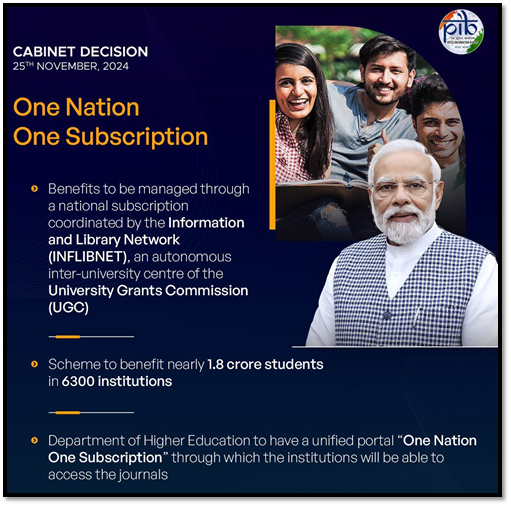
In alignment with this vision, Union Cabinet has approved the One Nation One Subscription (ONOS) scheme on 25th Nov 2024. This initiative seeks to break down barriers to knowledge by providing all students, faculty, researchers, and scientists across the nation’s government higher education institutions (HEIs) and central government R&D centres with access to international scholarly journals and articles. The goal is to ensure that India’s academic and research communities are equipped with the best global resources, fostering innovation and enhancing the quality of research across disciplines.

The ONOS scheme is a cornerstone of India’s ambition to become a self-reliant and developed nation by 2047. This initiative is a key component of the Viksitbharat@2047 vision. This roadmap envisions India’s emergence as a leading global power driven by cutting-edge research, technological advancement, and self-sustained progress. Through such initiatives, India is preparing to build on its rich legacy of knowledge, positioning itself at the forefront of global innovation and discovery.

ONOS Scheme Overview:

The scheme’s objective is to provide all eligible students, faculty, researchers, and scientists with access to top-tier international research articles and journals. It covers more than 6,300 government-managed higher education institutions and central government-managed research and development institutions across the country.

The scheme provides:

•           Access to more than 13,000 scholarly journals from 30 major international publishers.

•           Benefits about 1.8 crore students, faculty, and researchers across disciplines such as STEM (Science, Technology, Engineering, Mathematics), Medicine, Social Sciences, Finance & Accounts, etc.

•           Inclusive access to research for institutions in tier 2 and tier 3 cities, ensuring equitable access to knowledge.

Key Objectives and Goals:

  • Access to Scholarly Knowledge: The scheme provides access to high-quality scholarly journals and publications across various fields. This aims to democratise access to knowledge to enhance the research capabilities of students, faculty, and researchers.
  • Inclusion of Diverse Institutions: The scheme ensures that institutions, regardless of their geographic location—in urban centres or remote areas—have access to world-class research resources. This is crucial for advancing core and interdisciplinary research in the country.
  • Global Research Participation: It aligns with the goals of Viksitbharat@2047, helping India to emerge as a global leader in research and development by enabling its academic and research institutions to engage with international scholarly communities.

Implementation Details:

  • ImageNational Subscription via INFLIBNET: The entire subscription process will be centrally coordinated by INFLIBNET (Information and Library Network), an autonomous inter-university centre under the University Grants Commission (UGC). INFLIBNET will manage the distribution of digital access to these journals, ensuring a seamless experience for users.
  • Digital Access: Journals will be accessible entirely through a digital platform, ensuring convenience and ease for all users. This approach minimises administrative complexities and makes access available on-demand.
  • Government Allocation: A total of ₹6,000 crore has been allocated for the PM-ONOS initiative, covering three years—2025, 2026, and 2027. The funding will cover the subscription charges for all participating institutions across the three-year period. Further, ONOS will also provide central funding support of Rs. 150 Crore per year for beneficiary authors to publish in selected good quality Open Access (OA) journals.

Funding and Financial Strategy:

The ₹6,000 crore allocated for ONOS ensures smooth implementation of ONOS from 1st January 2025 to 31st December 2027

  • ONOS phase I, starting from 1 January 2025, will provide access to over 13,000 journals for more than 6,300 government academic and R&D institutes including central and state-govt universities and colleges. This translates to nearly 1.8 Crore students, faculty and researchers getting access to high quality research publications.
  • The subscription charges for journals from 30 publishers under ONOS Phase I will be centrally paid by INFLIBNET, covering payments from library consortia, HEIs, and R&D institutions under central ministries. Independent subscriptions will continue for resources not included in Phase I.
  • This phase will establish the program’s framework and ensure that key research resources are made available to a large number of institutions across India.
  • Payment of Article Processing Charges (APC) to publishers for selected high quality research publications of the researchers from these participating institutions have also been envisaged in this phase.
  • Experience of ONOS phase I will be used for designing subsequent phases of ONOS.

Further Enhancements and Features:

  • Synergy with Existing Initiatives: The ONOS scheme will complement the existing Anusandhan National Research Foundation (ANRF), which is designed to promote R&D activities across India. ONOS will facilitate easy access to international research materials, supporting the foundation’s goal of fostering research and innovation across government-managed institutions.
  • Discounts on Article Processing Charges (APCs): One of ONOS’s significant features is the discounts on Article Processing Charges (APCs). Journals typically levied these charges for publishing research articles. By negotiating lower APCs with publishers, the scheme will help Indian researchers publish their work in high-quality journals without incurring heavy financial costs.

Conclusion

The One Nation One Subscription initiative is a game-changing scheme for India’s research ecosystem. By providing digital access to over 13,000 journals from 30 international publishers, it will bridge gaps in research infrastructure across India. Through its phased implementation, the scheme will significantly contribute to enhancing India’s academic and research excellence, fostering innovation, and helping the country emerge as a global hub for scientific research. By leveraging existing consortia initiatives of 10 central government Ministries and Departments as well as initiatives of many government higher education institutions, an unifying approach through the one nation one subscription will democratise knowledge dissemination and empower a new generation of researchers and students, providing them with the resources they need to excel.

ONOS is a key part of a broader vision to transform access to knowledge in the country. As the first step in a multi-pronged approach, it expands access through the widely used subscription model. The other steps focus initially on promoting Indian journals and repositories and then introducing new research evaluation methods that consider both journal metrics and factors like innovation and entrepreneurship.

References:

Ministry of Education

Kindly find the pdf file 

****

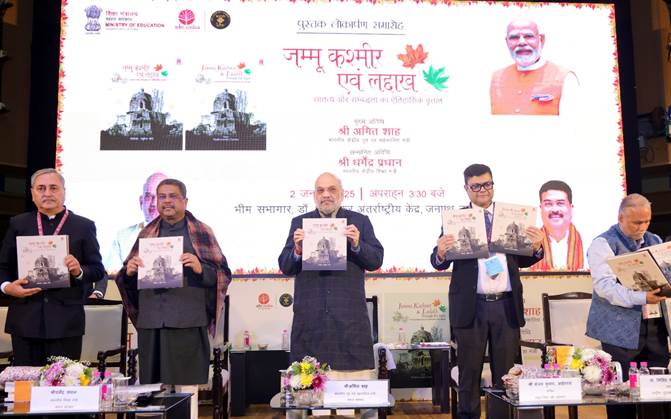
Shri Amit Shah to release a book, titled ‘Jammu Kashmir and Ladakh: Through the Ages’ in New Delhi

Daily writing prompt
Write about your first name: its meaning, significance, etymology, etc.

Union Minister for Home Affairs and Cooperation, Shri Amit Shah, will preside over a book release function on 2nd January 2025 in New Delhi as the Chief Guest. Union Minister for Education, Shri Dharmendra Pradhan will be the Guest of Honour. Eminent authors, academicians, officials of the Ministry and other dignitaries will also be present at the event

The book, titled ‘Jammu Kashmir and Ladakh: Through the Ages’ seeks to present the story of Jammu Kashmir and Ladakh. The title attempts to document the story of Jammu Kashmir and Ladakh from a perspective and format that enables an overview for both the subject specialist and those less conversant. It is presented in seven sections that cover over three thousand years of the region’s history. Each illustration selected for inclusion has been done with care, being representative of an age, its importance and contribution to the larger historical canvas of Indian history. Published in Hindi and English, this book is the result of collaborative efforts of the National Book Trust, India, and the Indian Council of Historical Research.

*****

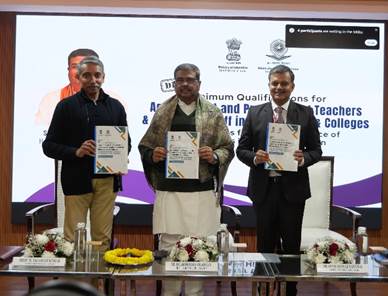
UGC (Minimum Qualifications for Appointment & Promotion of Teachers and Academic Staff in Universities and Colleges and Measures for Maintenance of Standards in Higher Education) Regulations, 2025

Daily writing prompt
What’s your dream job?

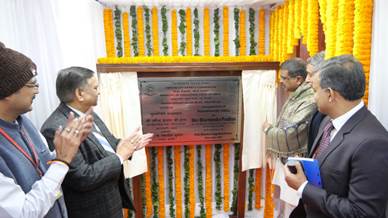
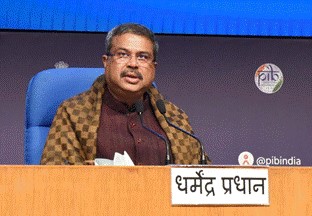
Union Minister for Education, Shri Dharmendra Pradhan, released the draft UGC (Minimum Qualifications for Appointment & Promotion of Teachers and Academic Staff in Universities and Colleges and Measures for the Maintenance of Standards in Higher Education) Regulations, 2025, today in New Delhi. He also inaugurated ‘Pushpagiri’, the new auditorium of UGC. Shri Sunil Kumar Barnwal, Additional Secretary, Ministry of Education; Prof. M. Jagadesh Kumar, Chairman, UGC; heads of the institutions, academicians, officials of the Ministry and other dignitaries were also present at the event.

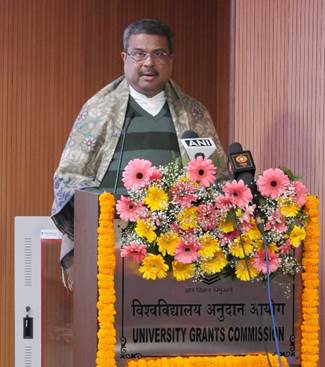
Shri Dharmendra Pradhan, while addressing the audiences said that these draft reforms and guidelines will infuse innovation, inclusivity, flexibility and dynamism in every aspect of higher education, empower teachers and academic staff, strengthen academic standards and pave the way for achieving educational excellence. He congratulated the team of UGC for their efforts in formulating the Draft Regulations and Guidelines in sync with the ethos of NEP 2020.

The Minister mentioned that the Draft Regulations, 2025, have been placed in the public domain for feedback, suggestions, and consultations. He expressed confidence that the UGC will soon publish the Draft Regulations, 2025, in their final form, driving transformations in the education system and propelling the country towards Viksit Bharat 2047 through quality education and research.

Shri Pradhan also complimented the UGC for honouring the unparalleled intellectual heritage of Odisha by naming their newly constructed auditorium ‘Pushpagiri.’ He noted that it is a matter of great pride and personal delight for him. He highlighted how Pushpagiri in Jajpur, Odisha, was a cradle of knowledge and a symbol of enlightenment. He commended the UGC for this laudable step in reappropriating Bharat’s intellectual heritage and values in the 21st century. Additionally, he expressed hope that this state-of-the-art auditorium would emerge as a hub for vibrant intellectual discourses, shaping bright futures.

Shri Sunil Kumar Barnwal, in his address, said that these regulations will significantly enhance the quality of teaching and learning in the higher education institutions. He also mentioned how the Ministry is committed to supporting their effective implementation across the country.

About the Regulations

The Draft UGC (Minimum Qualifications for Appointment & Promotion of Teachers and Academic Staff in Universities and Colleges and Measures for the Maintenance of Standards in Higher Education) Regulations, 2025 will give flexibility to universities in appointing & promoting teachers and academic staff in their institutions.

The draft regulations and guidelines are available for public consultation, inviting comments, suggestions and feedback from stakeholders at:

Draft Regulations: https://www.ugc.gov.in/pdfnews/3045759_Draft-Regulation-Minimum-Qualifications-for-Appointment-and-Promotion-of-Teachers-and-Academic-Staff-in-Universities-and-Colleges-and-Measures-for-the-Maintenance-of-Standards-in-HE-Regulations-2025.pdf

Key Highlights of the Regulations

•     Flexibility: Candidates can pursue teaching careers in subjects they qualify for with NET/SET, even if different from their previous degrees. Ph.D. specialisation will be prioritised.

•     Promoting Indian Languages: The draft Regulations encourage the use of Indian languages in academic publications and degree programmes.

•     Holistic Evaluation: It aims to eliminate score-based short-listing, focusing on a broader range of qualifications, including “Notable Contributions.”

•     Diverse Talent Pool: Creates dedicated recruitment pathways for experts in arts, sports, and traditional disciplines.

•     Inclusivity: Provides opportunities for accomplished sportspersons, including those with disabilities, to enter the teaching profession.

•     Enhanced Governance: Revises the selection process for Vice-Chancellors with expanded eligibility criteria with transparency.

•     Simplified Promotion Process: Streamlines the criteria for promotions, emphasising teaching, research output, and academic contributions.

•     Focus on Professional Development: Encourages continuous learning and skill enhancement for teachers through faculty development programs.

•     Enhanced Transparency and Accountability: Promotes transparent processes for recruitment, promotion, and addressing grievances.

*****

Department of School Education & Literacy

Daily writing prompt
What’s your dream job?
  1. SAMAGRA SHIKSHA

The Department of School Education and Literacy is implementing an integrated centrally sponsored scheme for School education – Samagra Shiksha. The scheme treats school education holistically, without segmentation from pre-primary to class XII and is in accordance with the Sustainable Development Goal for Education (SDG-4). The scheme provides support for the implementation of the RTE Act.

The Scheme has been aligned with the recommendations of the National Education Policy (NEP) 2020.

Under Samagra Shiksha, financial assistance is provided to States and UTs for undertaking various activities for Universalization of School Education including opening/strengthening of new schools up to senior secondary level, construction of school buildings and additional classrooms, development/strengthening of school infrastructure in northern border areas under Vibrant Village Programme, setting up, up-gradation and running of Kasturba Gandhi Balika Vidyalayas, construction of hostels for PVTGs under PM-JANMAN, setting up of Netaji Subhash Chandra Bose Avasiya Vidyalayas, construction of hostels under Dharti Aaba Janjatiya Gram Utkarsh Abhiyan for uncovered ST population, free uniforms to eligible children and free textbooks at elementary level, transport allowance, and undertaking enrolment and retention drives. Special training for age-appropriate admission of out-of-school children and residential as well as non-residential training for older children, seasonal hostels/residential camps, special training centres at worksites, transport/escort facility are also supported to bring out of school children to the formal schooling system including support to complete their education through NIOS/SIOS. Under the student-oriented component for the children with special needs, financial assistance is provided for identification and assessment of children with special needs, aids and appliances, braille kits and books, appropriate teaching learning material and stipend to girl students with disability etc.

Achievements of Samagra Shiksha

From 2018-19 to 2024-25

ActivitiesAchievement*(2018-19 to 2024-25)
Number of schools upgraded3656
New Residential schools/hostels242
Number of schools strengthen including additional classrooms80105
Schools covered under ICT & Digital initiatives including Smart Schools138802
Schools covered under Vocational Education9477
Number of KGBVs upgraded from class VIII to X313
Number of KGBVs upgraded from class VIII to XII2303
Construction of separate Girl’s toilets35457
*Works completed in the Financial Year 2018-2019 till 2024-2025 (till November)

Source: PRABANDH

  1. PM SCHOOLS FOR RISING INDIA (PM SHRI)

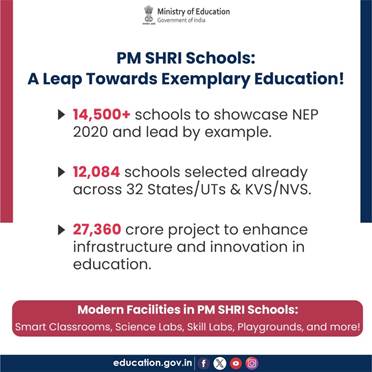
The centrally sponsored PM SHRI (PM ScHools for Rising India) scheme was approved by Cabinet on 7 September, 2022. Under the scheme there is provision of setting up of more than 14500 PM SHRI Schools by strengthening the existing schools from amongst schools managed by Central government/State/UT Government/local bodies. PM SHRI schools showcase the implementation of the National Education Policy 2020 and emerge as exemplar schools over a period of time, and also offer leadership to other schools in the neighbourhood. The total cost of the project will be Rs. 27360 crore spread over a period of 5 years which includes central share of Rs. 18128 crore.

A total of 33 States/UTs including KVS & NVS have signed the Memorandum of Understanding (MoU) with Ministry of Education for implementation of PM SHRI Scheme. Selection of PM SHRI schools is done through Challenge Mode wherein Schools compete for support to become exemplar schools.

A total of 12,084 schools have been selected from 32 States/UTs along with KVS/NVS in 1st, 2nd, 3rd & 4th phase of selection of PM SHRI Schools through the transparent challenge method out of which 1329 schools are Primary, 3340 schools are Elementary, 2907 schools are secondary and 4508 schools are senior secondary.

PM SHRI Scheme is being implemented by saturating all the components such as Bala feature and Jadui Pitara, Support at Pre-school Education, Child Friendly Furniture, Outdoor Play Materials etc. in Primary and Elementary Schools and Furniture, Fully equipped integrated Science Lab/Physics Lab/Chemistry Lab/ Biology Lab, Smart Classrooms, Computer Lab/ ICT Lab, Atal Tinkering Lab, Skill Lab, School Innovation Councils, Playground with well-equipped sports facilities etc. for secondary and senior secondary schools.

  1. PM POSHAN

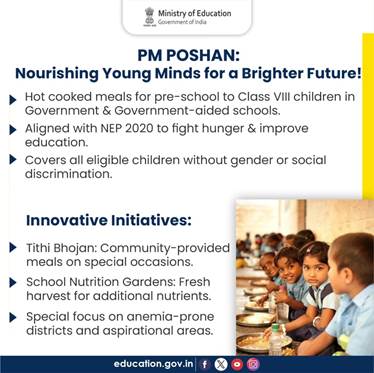
The Government has approved the Centrally Sponsored Scheme ‘Pradhan Mantri Poshan Shakti Nirman (PM POSHAN)’ for providing one hot cooked meal in Government and Government-aided Schools from 2021-22 to 2025-26. The Scheme is being implemented by the Ministry of Education. Under the Scheme, there is a provision of hot cooked meal to children of pre-schools or Bal Vatika (before class I) in primary schools also in addition to eligible children of classes I to VIII. The Scheme is implemented across the country covering all the eligible children without any discrimination of gender and social class. The main objectives of the PM POSHAN Scheme (earlier known as Mid-Day Meal Scheme) are to address two of the pressing problems for majority of children in India, viz. hunger and education by improving the nutritional status of eligible children in Government and Government-aided schools as well as encouraging poor children, belonging to disadvantaged sections, to attend school more regularly and help them concentrate on classroom activities.

The Scheme has been aligned with NEP 2020 in 2021 through:

a)         Tithi Bhojan – A community participation programme in which people provide special food to children on special occasions/festivals.

b)         Development of School Nutrition Gardens in schools to give children first-hand experience with nature and gardening. The harvest of these gardens is used in the scheme providing additional micro nutrients. iv.) Social Audit of the scheme is made mandatory in all the districts.

c)         Special provision is made for providing supplementary nutrition items to children in aspirational districts and districts with high prevalence of Anaemia.

d)         Encouraging cooking competitions to promote ethnic cuisine and innovative menus based on locally available ingredients and vegetables.

e)         Involvement of Farmers’ Producer Organizations (FPO) and Women Self Help Groups in the implementation of the scheme.

4.         ULLAS

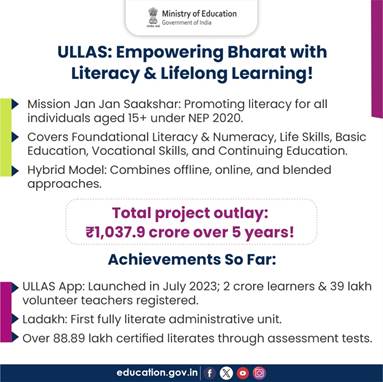
A Centrally Sponsored Scheme, ULLAS – Nav Bharat Saaksharta Karyakram, is an educational initiative implemented from FY 2022-23 to 2026-27. ULLAS, which stands for Understanding of Lifelong Learning for All in Society, aligns with the National Education Policy (NEP) 2020 and aims to provide educational opportunities to adults aged 15 and above who have missed formal schooling. The scheme is implemented in a hybrid mode, States/UTs have flexibility in offline, online, or combined approaches. The scheme has five components, namely: (i) Foundational Literacy and Numeracy, (ii) Critical Life Skills, (iii) Basic Education, (iv) Vocational Skills, and (v) Continuing Education.

ULLAS works under the inspiring vision of making Bharat ‘Jan Jan Saakshar’, driven by Kartavyabodh (a sense of duty), utilizing Singapore school platforms and community engagement through volunteerism. The scheme aims to achieve universal literacy by encouraging community participation, inclusivity, and leveraging technology, ultimately empowering every citizen with the ability to read, write, and engage meaningfully in society. The scheme has a total outlay of Rs. 1037.9 crore over the period of five years, out of which Central Share is Rs. 700 crore and State Share is Rs. 337.90 crore.

Major Achievements under ULLAS – Nav Bharat Saaksharta Karyakram:

•     ULLAS Mobile App launched on 29.7.2023 during Akhil Bhartiya Shiksha Samagam held at Bharat Mandapam, New Delhi.

•     More than 2 crore learners and 39 lakh volunteer teachers have been registered under ULLAS till now.

•     A total number of 1,11,03,397 learners have appeared in Foundational Literacy and Numeracy Assessment Test and a total number of 88,89,654 learners have been declared as certified literates through Foundational Literacy and Numeracy Assessment Test so far.

•     Ladakh has become the first administrative unit which is fully literate under ULLAS by the LG of Ladakh on 24.06.2024.

•     National Literacy Week was celebrated from September 1st to 8th, 2023, concluding on International Literacy Day, with approximately 3 crore participants. The 2024 National Literacy Week saw an even larger turnout, with over 4.8 crore participants. The literacy day was celebrated on 8th September 2024, with Vice President of India as the Chief Guest.

•     Institutions such as UGC, AICTE, and NCTE are actively engaging their resources in supporting the ULLAS scheme in a comprehensive manner. Directions have been issued to teachers and students for their robust involvement in the scheme.

•     Joint letter was issued by Secretary, DoSEL and Secretary, Skill Development & Entrepreneurship on 10 October 2023 for linking neo-literates to skill education through JSS.

•     To facilitate the accomplishments of selected neo-literates and volunteer teachers from States/UTs, the Department conducted two-day ULLAS Mela on 6th and 7th February, 2024 inaugurated by Union Minister for Education, Shri Dharmendra Pradhan.

•     Primers in 26 languages were released during the ULLAS Mela.

•     Various training programmes are being conducted continuously in various States/UTs.

•     Media and digital presence of ULLAS is expanding, with a focus on nationwide awareness and effective implementation strategies. Facebook page and You Tube Channel of ULLAS – Nav Bharat Saaksharta Karyakram have been created. Adult Learning lessons are being broadcasted on DTH Channel No. 14 in 29 official languages.

•     A total of Rs. 35.60 crore (Central Share) has been released to the States and UTs so far for the year 2024-25. A total of Rs. 159.67 crore has been released to State/UTs under the scheme so far.

5.   NATIONAL MEANS-CUM-MERIT SCHOLARSHIP SCHEME (NMMSS)

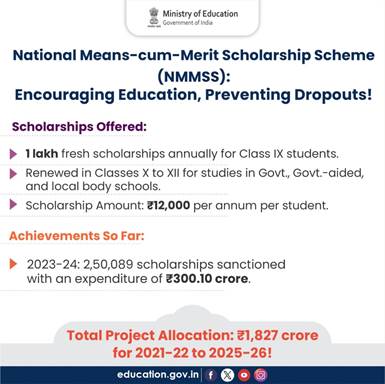
The Central Sector Scheme ‘National Means-cum-Merit Scholarship Scheme’ is being implemented with the objective to award scholarships to meritorious students of economically weaker sections to arrest their drop out at class VIII and encourage them to continue their education at secondary stage. One lakh fresh scholarships are awarded to selected students of class IX every year and their continuation/renewal in classes X to XII for study in State Government, Government-aided and Local body schools under the scheme. The amount of scholarship is Rs. 12000 per annum.

Government has approved continuing the Scheme from FY 2021-22 to 2025-26 with total allocation of Rs.1827 crore.

Achievements under the scheme

Under the scheme, 250089 scholarships have been sanctioned at an expenditure of Rs. 300.10 crore during the year 2023-24. During the current project year, i.e., 2024-25, NSP has been operational since 30.06.2024 and the last date for registration of scholarship applications was 15.11.2024. The last date for L1 or Level 1 verification (by Institute Nodal Officer) was 30.11.2024 and L2 or Level 2 verification (by District Nodal Officer or DNO) was 15.12.2024. Applications which are finally verified on NSP are considered for sanction of scholarship in a project year for the preceding academic year.

6.         PM-JANMAN

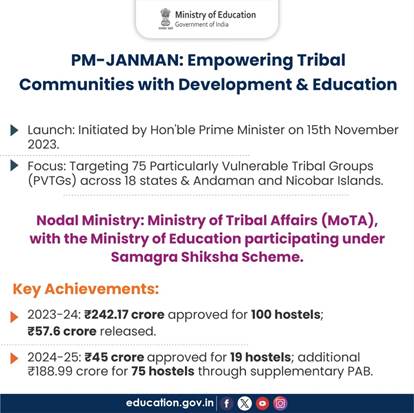
Pradhan Mantri Janjati Adivasi Nyaya Maha Abhiyan (PM- JANMAN) has been launched by Prime Minister Shri Narendra Modi on 15 November 2023. The Abhiyan targets development of 75 Particularly Vulnerable Tribal Groups (PVTGs) residing in 18 states and UT of Andaman and Nicobar Islands. The Abhiyan envisages saturation of basic facilities, including Education, in these villages by adopting whole of Government approach in convergence with line ministries. M/o Tribal Affairs (MoTA) is the nodal ministry for implementation of PM JANMAN. Ministry of Education is one of the participating Ministries in the Abhiyan and PM-JANMAN is being implemented in convergence with Samagra Shiksha Scheme of this Department.

•     For 2023-24 an amount of Rs. 24217 lakh have been approved for 100 hostels with the financial release of Rs. 57.6 crore.

•     For 2024-25 an amount of Rs. 4500 lakh have been approved for 19 hostels.

•     In 2024-25 a supplementary PAB was held under which 75 hostels were sanctioned with an amount of Rs. 18,899 lakh.

7.   DA JGUA

Dharti Aaba Janjatiya Gram Utkarsh Abhiyan (DA-JGUA) has been introduced to improve the socio-economic conditions of tribal communities through interventions in health, social infrastructure, livelihood and education. The scheme aims at holistic and sustainable development of tribal populations in villages through convergence of schemes. DA JGUA scheme has a run over period from 2024-25 to 2028-29, in education the schemes target construction of 1000 hostels under Samagra Shiksha during the period. For 2024-25, Rs. 1102.19 crore has been approved for 304 hostels.

8.   NATIONAL TEACHERS’ AWARDS (NAT)

National Teacher’s Award 2024 is conferred by President of India every year on 5th September. Each award carries a certificate of merit, a cash award of Rs. 50,000 and a silver medal. The purpose of the National Teachers’ Award is to celebrate the unique contribution of teachers in the country and to honour those teachers who, through their commitment and dedication, have not only improved the quality of education but also enriched the lives of their students.

The awardees are selected through a rigorous transparent and online three stages, i.e., District, State and National level selection process by the Department of School Education and Literacy.

The applicants are evaluated based on the evaluation matrix consisting of two types of criteria: Objective criteria and Criteria based on performance

These criteria includes initiatives to improve learning outcomes, innovative experiments undertaken, organisation of extra and co-curricular activities, use of Teaching Learning Material, social mobility, ensuring experiential learning, unique ways to ensure physical education for students, etc. The selection procedure for NAT-2024 involved a two-step process:

  • Evaluation by Preliminary Search-cum Screening Committee for initial shortlisting of nominees and
  • Committee of ‘Jury’ for selection of awardees from the shortlisted nominees.

Important initiatives of the Department for 2024

1.         Foundational Literacy and Numeracy

1.1       The National Education Policy 2020 has stipulated that attaining foundational literacy and numeracy for all children must become an immediate national mission. Toward this end, the Department of School Education & Literacy has launched a National Mission called “National Initiative for Proficiency in Reading with Understanding and Numeracy (NIPUN Bharat)” by the Government on 5th July 2021 to ensure that every child in the country necessarily attains foundational literacy and numeracy by the end of Grade 3 by 2026-27.

1.2       The Foundational Literacy and Numeracy Assessment Test (FLNAT) as part of the ULLAS – Nav Bharat Saaksharta Karyakram was on 17th March 2024, across 23 states. The assessment comprises three subjects: Reading, Writing, and Numeracy. This test is developed to evaluate the foundational literacy and numeracy skills of registered non-literate learners. A total of 1,11,03,397 learners have appeared in FLNAT out of which 88,89,654 learners have been declared as certified literates so far.

2.         PARAKH and PARAKH Rashtriya Sarvekshan

2.1       In pursuance of the recommendations of the National Education Policy (NEP) 2020, National Assessment Centre, PARAKH (Performance Assessment, Review, and Analysis of Knowledge for Holistic Development) has been setup by the Ministry of Education under the National Council of Educational Research and Training (NCERT) for establishing norms, standards, and guidelines for student assessment and evaluation across all school boards.

2.2       PARAKH has also been entrusted with the responsibility of carrying out the next round of PARAKH Rashtriya Sarvekshan 2024 (earlier known as NAS). The survey was held on 4th December 2024 across the country and will help to assess the competencies developed by students at the end of foundational, preparatory and middle stages (i.e., Students currently in 3rd, 6th and 9th Grades) and help to take remedial measures. Development, testing, finalization of the test items and survey tools have been developed by PARAKH, NCERT. The administration of the test in the sampled schools has been done by CBSE in collaboration with the respective States/UTs. Around 23 lakh students from approximately 88 thousand schools participated in the Sarvekshan.

2.3       A key initiative of PARAKH is the conceptualization of the Holistic Progress Card (HPC) for all four levels of school education. HPC is a comprehensive document of the learners’ progress captured across several curricular and co-curricular elements based on their performance on the competency-based and multidisciplinary activities.

2.4       PARAKH has developed HPC at the Foundational, Preparatory, Middle and Secondary stages to strengthen the implementation of a Competency Based Assessment Framework model.

3.         Multilingualism

3.1       National Education Policy (NEP) 2020 emphasizes the importance of languages (Mother tongue-based education and multilingualism) and a holistic approach to education that values and preserves the linguistic heritage of our country and fosters a sense of pride in its linguistic diversity. NEP 2020 recommends that wherever possible, the medium of instruction until at least Grade 5, but preferably till Grade 8 and beyond, will be the home language/mother tongue/local language/regional language. Thereafter, the home/local language shall continue to be taught as a language wherever possible.

3.2       National Curriculum Framework for Foundational Stage (NCF-FS) has emphasised the use of the child’s mother tongue, home language, local language, or regional language for teaching-learning at the foundational stage. It is important to provide children with comprehensive reading and writing skill, including both letter recognition and the ability to understand and interpret written text in their mother tongue, local language, or the language spoken at home. Keeping this in view, a total of 104 Primers in Indian Languages have been developed and released, out of which twenty-five new primers in various Indian languages were also released during Bharatiya Bhasa Utsav held on 11/12/2024.

4.         Textbooks

4.1       As a follow-up to the National Curriculum Framework for School Education introduced in August 2023 and under the guidance of National Syllabus and Teaching Learning Material Committee NCERT has developed Learning Teaching Material (LTM) for Balvatika (Jaadui Pitara), Grade 1 (Languages and Mathematics), Grade 2 (Languages and Mathematics), Grade 3 (Languages, Mathematics, The World Around US, Arts, Physical Education and Well-being) and Grade 6 (Languages, Mathematics, Science, Social Science, Skill Education, Arts, Physical Education and Well-being) in print and digital form. These textbooks are also available in three languages viz., Hindi, English and Urdu.

4.2       Textbooks of grades 4, 5, 7 & 8 are under development.

4.3       Textbooks of grades IX and XI will be developed during 2025-26 while Textbooks of grades X and XII will be developed during 2026-27.

4.4       Major features of textbook developed are competency-based and age-appropriate content; fostering critical thinking and problem solving; integration of interdisciplinary and multidisciplinary approaches; inclusion of digital resources; emphasis on cultural rootedness and Indian knowledge systems etc.

4.5       NCERT’s annual textbook printing has expanded from 5 crore to 15 crore books to meet demand.

4.6       Textbooks are being prepared in all scheduled Indian languages and made accessible via online platforms.

5.         Integrated Teacher Education Programme

5.1       The four-year Integrated Teacher Education Programme (ITEP) has been introduced in 64 multidisciplinary institutions as envisioned in the NEP 2020. ITEP is a 4-year integrated dual major bachelor degree in Education as well as a specialized subject in arts, science, physical education etc. The aim is to develop passionate, motivated, qualified, professionally trained, and well-prepared teachers.

5.2       Admission for the ITEP is carried out by the National Testing Agency (NTA) through the National Common Entrance Test (NCET) which was last held on 10th July 2024.

6.         NPST & NMM

6.1       The National Mission for Mentoring (NMM), as envisaged in Para 15.11 of NEP 2020, aims to create a large pool of outstanding professionals willing to provide mentoring to school teachers. These potential mentors, regardless of age or position, will contribute towards realizing the 21st-century developmental goals of our nation.

6.2       The Department launched the NMM – The Bluebook on 9th March 2024. The Braille Version and Audio version of NMM – The Bluebook were released on 29.07.2024 on the occasion of 4th anniversary of NEP, 2020.

6.3       The National Professional Standards for Teachers (NPST), as envisioned in Para 5.20 of the National Education Policy (NEP) 2020, aims to enhance the personal and professional development of teachers by providing clear expectations and guidelines for performance improvement.

6.4       The Department launched the NPST Guiding Document on 9th March 2024. The Braille Version and Audio version of NPST Guiding Document were released on 29.07.2024 on the occasion of 4th anniversary of NEP 2020.

Steps taken to improve learning outcomes in schools

National Assessment Centre, PARAKH (Performance Assessment, Review, and Analysis of Knowledge for Holistic Development), NCERT under the aegis of Ministry of Education, is implementing several strategic initiatives to enhance learning outcomes and competencies in schools across India in collaboration with the States and UTs.

A key initiative of PARAKH is the conceptualization of the Holistic Progress Card (HPC) for all the four levels of school education. HPC is an integrative and comprehensive document of the learners’ progress captured across several elements based on their performance on the competency-based assessment activities. PARAKH has developed the Holistic Progress Cards at the Foundational, Preparatory, Middle and Secondary stages to strengthen the implementation of a Competency Based Assessment Framework model.

Another core initiative of PARAKH has been the conduction of PARAKH Rashtriya Sarvekshan 2024 (earlier known as National Achievement Survey- NAS) on December 4, 2024 covering approximately 23 lakh students in 87,619 schools across the country. This nationwide survey will help assess the learning competencies at the end of the foundational, preparatory, and middle stages of schooling (i.e. students currently in Grades 3, 6, and 9).

The primary objective of this survey is to establish a baseline for the national benchmark of student competencies, allowing for a detailed understanding of learning levels across different states, regions, and socioeconomic backgrounds. By gathering sample data on student achievement, PARAKH can identify specific competencies where students may be struggling and design targeted interventions to support these learning needs. This approach enables the creation of focused action plans that can be tailored to address the diverse educational landscapes of India’s school system.

Post-assessment, PARAKH will collaborate with state and district-level educational authorities to implement targeted interventions based on the survey findings.

Teacher training is another significant aspect of the steps taken to improve learning competencies. By equipping teachers with effective tools and methodologies for competency-based education, PARAKH seeks to ensure that classroom instruction meets the evolving demands of 21st-century education.

Steps to improve percentage of CWSN children in Schools

Under Samagra Shiksha, there is a dedicated component for Inclusive Education (IE) for Children with Special Needs, to ensure full equity and inclusion such that all children with special needs are able to fully participate in regular schools. The scheme aims to look at education of CwSN in a continuum from pre-school to class XII. The scheme covers all CwSN with one or more disabilities as mentioned in the Schedule of disabilities of Rights of Persons with Disabilities (RPwD) Act, 2016.

Through the IE component, various provisions are made available for CwSN such as identification and assessment camps (at block level), student specific interventions @ Rs. 3,500 per CwSN per annum for support. In addition, to encourage girl children with disabilities to attend schools, stipend for girls with special needs @ Rs.200 per month for 10 months (Rs. 2,000 per annum) through Direct Benefit Transfer is provided. Further, individualized support is also provided through resource centres at block level to cater to the unique learning needs of CwSN.

For early screening and identification of CwSN, Prashast, a Disability Screening Checklist for Schools’ booklet and mobile app covering 21 disabilities, including the benchmark disabilities as per the RPwD Act 2016, facilitates early screening and identification of CwSN leading to their certification and provisions of IE interventions under Samagra Shiksha.

Schools are being made more disabled friendly by incorporating barrier free features in their designs. Another recent initiative of SS has been to provide disabled friendly toilets. So far, 58.5% government schools have been equipped with ramps and handrails and 31.1% schools have CwSN friendly toilets. The Accessibility Code for Educational Institutions in consultation with stakeholders and Office of Chief Commissioner for Persons with Disabilities was notified on January 10th, 2024.

The Department notified the Pupil Teacher Ratio (PTR) for special teachers in general schools vide Notification No. S.O. 4586 (E) dated 21.09.2022 (published on 29.09.2022).

NCERT textbooks have been converted into Indian Sign Language (ISL): Till date 4250 plus ISL videos related to curricular content for classes I to VII, glossary words in psychology, history, geography, Urdu, economics have been produced and are being continually disseminated through DIKSHA portal and PM eVidya (One Class, One Channel), DTH TV Channels, on regular basis to ensure coherent access of these e-Contents.

Central Board of Secondary Education (CBSE) being sensitive to the needs of CwSN students provides several exemptions/concessions as defined in The Rights of Persons with Disabilities Act – 2016 such as issuing authority of Medical Certificate, facility of Scribe and compensatory time, appointment of Scribe and related instructions, fee and special exemptions for class X like exemption from third language, flexibility in choosing subjects, alternate questions /Separate Question and special exemptions for class XII like flexibility in choosing subjects, separate question paper and questions in lieu of practical component.

Steps taken to bring equivalence amongst different State School Boards in curriculum & assessment

The Government of India endeavours to create a more equitable, standardized, and effective education system across the country, so that all students, regardless of their state or board, have access to similar assessment standards. The PARAKH has been set up as a constituent body under the NCERT for establishing norms, standards, and guidelines for student assessment and evaluation across all school boards to bring about equivalence in curriculum, assessment practices, and examination formats across the boards in the country. The PARAKH has taken following steps for promoting equivalence among school boards:

  1. National Consultative Meeting: The first national meeting with 26 school education boards from 30 States/UTs focused on school assessment practices and board equivalence.
  2. Regional Workshops: PARAKH conducted a series of five-day regional workshops across the country in the Western, Northern, Eastern, North-Eastern, and Southern regions. These workshops involved discussions on school assessments and ways to standardize practices between boards.
  3. Study of Question Papers: A study was conducted by the PARAKH on question papers from different boards to analyze their assessment patterns. Guidelines were then drafted to ensure better alignment and equivalence across boards.
  4. Workshops for Equivalence Finalization: Workshops were organized to finalize findings from the question paper study and discuss the report on equivalence. Several key boards participated to review and implement the final guidelines.
  • V.Sharing the Report on Equivalence: Workshops were held to share the findings of the equivalence study aiming for a more inclusive and comprehensive assessment framework.
  1. Standardization of Question Paper Templates: PARAKH initiated workshops on standardizing question paper templates across boards. The workshops focused on improving question paper design and assessment quality, aligning with the National Education Policy (NEP 2020). Special emphasis was placed on training master trainers from different states to further train teachers on effective question paper design.

APAAR ID – Status of Roll out in different States/UTs

APAAR empowers students to accumulate and store their academic accomplishments, facilitating seamless transitions between institutions for the pursuit of further education. The APAAR ID simplifies the processes of credit recognition and transfer right from the school level, thereby streamlining academic progression and recognition of prior learning.

APAAR Registration Process

  • Step 1: Verification: Visit the school to verify demographic details
  • Step 2: Parental Consent: Obtain parental consent if the student is a minor
  • Step 3: Authentication: Authenticate identity through the school
  • Step 4: ID Creation: Upon successful verification, the APAAR ID is created and added to DigiLocker for secure online access

As on 17 December 2024, more than 7 crore APAAR IDs have been generated and validated, ensuring unique tracking of student progress.

Building awareness amongst states on climate change & global warming via Eco Clubs for Mission LiFE

The National Education Policy (NEP) 2020 emphasizes the critical importance of integrating environmental awareness and sustainability principles into school curricula. The Policy aims to sensitize students to environmental / climate change concerns and inculcate among students the values, attitudes, behaviour and skills essential to address environmental challenges, thus preparing them to contribute to a sustainable future.

In alignment with this vision, Eco Clubs serve as a critical platform within schools, providing students with the opportunity to develop practical skills and knowledge for the responsible use of natural resources. Through participation in activities such as optimizing water usage, minimizing waste generation, recycling, and conducting plantation drives, students learn sustainable practices that they can implement both within and beyond the school environment. Eco Clubs empower students to act as environmental ambassadors, extending their impact to their families and communities by promoting sound environmental behaviour, such as reducing single-use plastics, conserving water, and participating in eco-friendly initiatives. Through these engagements, students gain a profound understanding of the shared responsibility to preserve and protect our planet, thereby advancing NEP 2020’s objective of nurturing environmentally conscious citizens for a sustainable India. Activities of Eco clubs for Mission LiFE are supported through Samagra Shiksha. A sum of Rs. 744 crore (approx.) has been allocated to the States / UTs under AWP&B for 2024-25.

The activities of Eco Clubs have been integrated with Mission LiFE, leading to their renaming as “Eco Clubs for Mission LiFE.” All the activities of Eco Clubs have been aligned with the seven themes of Mission LiFE (Save Energy, Save Water, Say No to Single Use Plastic, Adopt Sustainable Food Systems, Reduce Waste, Adopt Healthy Lifestyles and Reduce E-waste). As part of this initiative, summer camps were organized starting on June 5, 2024 (World Environment Day), in recognition of World Environment Day, covering seven core themes of Mission LiFE. These camps saw active participation from over 11 crore individuals, including students, teachers and community members. As a best practice, during the camps, school teachers, students and community members from states like Chhattisgarh, Kerala and Tamil Nadu engaged in seed ball preparation, later dispersing these seed balls over degraded lands during the monsoon season as a measure against desertification.

During Shiksha Saptah, observed from July 22 to 28, 2024 as a run up to the 4th anniversary of NEP 2020, one day was designated as “Eco Clubs for Mission LiFE” Day. As of November 11, 2024, notable achievements of Eco Clubs for Mission LiFE Day are the establishment of 1.46 lakh new Eco Clubs for Mission LiFE [part of the 100 Days’ Action Plan of Department of School Education & Literacy (DoSEL)], establishment of more than 1 lakh School Nutrition Gardens (also part of the 100 Days’ Action Plan of DoSEL), the planting of 5.18 crore saplings under the  initiative with a total participation of 6.75 crore individuals, encompassing students, teachers and community members. Schools conducted these tree plantation drives from 27.07.2024 to 30.09.2024 covering the monsoon season.

Increasing of material cost for procurement of ingredients under PM Poshan Scheme

On the basis of inflation index provided by the Labour Bureau, the material cost for procurement of ingredients (pulses, vegetables, oil, spices & condiments, fuel) for cooking meals for Bal Vatika and Primary classes under PM Poshan Scheme has been increased to Rs. 6.19 per child per day from Rs. 5.45 (increase of Rs. 0.74 per child) and to Rs. 9.29 per child per day from Rs. 8.17 (increase of Rs. 1.12 per child) for upper primary classes w.e.f. December 2024. These rates for material cost are the minimum mandatory rates. States/UTs are free to contribute more from their own resources.

Status of framing of Rules under the Right of Children to Free and Compulsory Education (Amendment) Act, 2019 [RTE (Amendment) Act, 2019]

The rules under the Right of Children to Free and Compulsory Education (Amendment) Act, 2019 has been amended vide Gazette notification G.S.R.777(E) dated 16th December, 2024 by providing for regular examination in the 5th & 8th class at the end of academic year. If a child fails to fulfil the promotion criteria, he/she shall be given additional instruction and opportunity for re-examination within a period of two months from the date of declaration of results. If the child appearing in the re-examination fails to fulfil the promotion criteria again, he shall be held back in fifth class or eight class, as the case may be.

Opening of new KVs & JNVs

The Cabinet Committee on Economic Affairs, chaired by the Prime Minister, on 4th December 2024, has approved the opening of 85 new Kendriya Vidyalayas (KVs) under Civil / Defence sector across the country and the expansion of one existing KV i.e., KV Shivamogga, District Shivamogga, Karnataka to facilitate increased number of Central Government employees by adding two additional Sections in all the classes under the Kendriya Vidyalaya Scheme (Central Sector Scheme).

The Cabinet Committee on Economic Affairs, chaired by the Prime Minister on 4th December 2024, has approved the setting up of 28 Navodaya Vidyalayas (NVs) in the uncovered districts of the country under the Navodaya Vidyalaya Scheme (Central Sector Scheme).

*****

Registration for 8th edition of Pariksha Pe Charcha Concludes with a Record-Breaking over 3.5 Crore Applications

Daily writing prompt
If you could un-invent something, what would it be?

Registration for the flagship initiative of Prime Minister Shri Narendra Modi, Pariksha Pe Charcha (PPC), concluded with a record-breaking over 3.5 crore participation from students, teachers and parents. This is a nationwide movement to transform exam-related stress into a festival of learning and celebration. The 8th edition of PPC 2025 has set an unprecedented milestone in terms of registrations from students, teachers, and parents across India and abroad. This remarkable response underscores the growing resonance of the program as a true Jan Andolan.

The online registration for PPC 2025 was hosted on the MyGov.in portal, from 14 December 2024 to 14 January 2025. The program’s immense popularity highlights its success in addressing the mental well-being of students and fostering a positive outlook towards examinations.

The interactive event, organized annually by the Department of School Education and Literacy under the Ministry of Education, has become a much-anticipated celebration of education. The 7th edition of PPC in 2024 was held at Bharat Mandapam, Pragati Maidan, New Delhi, in a town hall format and received widespread acclaim.

In line with the spirit of PPC, a series of engaging school-level activities commenced on 12 January 2025 (National Youth Day) and will continue till 23 January 2025 (Netaji Subhash Chandra Bose Jayanti). The activities aim to foster holistic development and inspire students to celebrate examinations as an Utsav. These activities include:

      •     Indigenous games sessions

      •     Marathon runs

      •     Meme competitions

      •     Nukkad Natak

      •     Yoga-cum-meditation sessions

      •     Poster-making competitions

      •     Inspirational film screenings

      •     Mental health workshops and counselling sessions

      •     Performances by CBSE, KVS, and NVS students

Through these activities, PPC 2025 reinforces its message of resilience, positivity, and joy in learning, ensuring that education is celebrated as a journey rather than a pressure-driven task.

*****

Registration Portal for Kashi Tamil Sangamam Phase 3

Daily writing prompt
If you could un-invent something, what would it be?

Union Minister for Education, Shri Dharmendra Pradhan, launched the registration portal for the 3rd edition of Kashi Tamil Sangamam (KTS). The Minister, while addressing a press conference, announced that KTS 3.0 will commence on 15th February 2025 in Varanasi, Uttar Pradesh. This 10-day-long event will conclude on 24th February 2025, he added. The portal, kashitamil.iitm.ac.in – hosted by IIT Madras, will accept registrations till 1st February 2025, he added.

2025-01-15 15:34:13.787000

Secretary, Ministry of Education, Shri Sanjay Kumar; Principal DG, PIB, Shri Dhirendra Ojha; Additional Secretary, Higher Education, Ministry of Education, Shri Sunil Kumar Barnwal; Chairman, Bhartiya Bhasha Samiti, Shri Chamu Krishna Shastry, and other officials also attended the Press Conference.

Shri Pradhan, while interacting with the media, said that the inseparable bonds between Tamil Nadu and Kashi are set to come alive through Kashi Tamil Sangamam 3.0.

The Minister highlighted that Kashi Tamil Sangamam, a brainchild of Prime Minister, Shri Narendra Modi, is an inspirational initiative to celebrate the timeless bonds between Tamil Nadu and Kashi, strengthen the civilisational links and further the spirit of Ek Bharat Shrestha Bharat.

Shri Pradhan said that Kashi Tamil Sangamam will be a celebration of one of India’s most revered sages—Maharishi Agasthyar. Maharishi Agasthyar’s legacy is deeply woven into India’s cultural and spiritual fabric, Shri Pradhan highlighted. His intellectual brilliance is the bedrock of Tamil language and literature as well as our shared values, knowledge traditions and heritage, he added.

2025-01-15 15:36:17.733000
2025-01-15 15:36:17.805000

Shri Pradhan said, that this year, Kashi Tamil Sangamam holds a special significance as it is coinciding with the Mahakumbh, and it is also the 1st Sangamam after the ‘Pran Pratishtha’ of Shri Ram Lalla in Ayodhya.

With Maharishi Agasthyar as the central theme and Mahakumbh and Shri Ayodhya Dham as the backdrop, Kashi Tamil Sangamam 3.0 will offer a divine experience and bring Tamil Nadu and Kashi—the two timeless centres of our civilisation and culture, more closer than ever, he said.

Shri Pradhan encouraged people of Tamil Nadu to participate in Kashi Tamil Sangamam 3.0 wholeheartedly.

An exhibition on the different facets of Sage Agasthyar and his contributions to world of Health, Philosophy, Science, Linguistics, Literature, Polity, Culture, Art, particularly to Tamil and Tamil Nadu, etc. and Seminars, workshops, book release, etc. will be organised at Kashi during KTS 3.0. Competitions and other awareness programs in Tamil Nadu prior to KTS 3.0 will be organised in a befitting manner in major cities of India and abroad where there is considerable Tamil diaspora.

This year, the government has decided to bring around 1000 delegates from Tamil Nadu under five categories/groups: (i) Students, Teachers, and Writers; (ii) Farmers and Artisans (Vishwakarma Categories); (iii) Professionals and Small Entrepreneurs; (iv) Women (SHG, Mudra Loan beneficiaries, DBHPS Pracharaks); and (v) Start-up, Innovation, Edu-Tech, Research. This year, an additional group of around 200 students of Tamil origin studying in various CUs will be a part of this event to enliven the bond between Kashi and Tamil Nadu. Participation of youth in all categories will be encouraged this year.

The duration of the tour will be 8 Days (4 for travel, 4 at site). The first group will leave Tamil Nadu on 13th February 2025 and the last group will return to Tamil Nadu on 26th February 2025.

The objective of the Kashi Tamil Sangamam is to rediscover, reaffirm, and celebrate the age-old links between Tamil Nadu and Kashi—two of the country’s most important and ancient seats of learning.

Kashi Tamil Sangamam is being organized by the Ministry of Education, Govt. of India in collaboration with other ministries including Culture, Textiles, Railways, Tourism, Food Processing, I&B etc. and the Govt. of UP. The programme aims to provide an opportunity for scholars, students, philosophers, traders, artisans, artists and people from other walks of life from the two regions to come together, share their knowledge, culture and best practices and learn from each other’s experience. It also aims to make the youth aware and experience cultural oneness. The endeavour is in sync with NEP 2020’s emphasis on integrating the wealth of Indian Knowledge Systems with modern systems of knowledge. IIT Madras and BHU are the two implementing agencies for the programme.

The Government has so far celebrated the Kashi Tamil Sangamam on two occasions earlier; i.e., for one month in 2022 and for a fortnight in 2023 and around 4000 delegates from Tamil Nadu have been a part of this event. In both the editions of KTS, there were overwhelming responses from people of Tamil Nadu and Uttar Pradesh. IIT Madras will be the sender institution and BHU the receiving institution, as in the earlier editions. IIT Madras will call for applications for participation through a portal, which was launched today.

KTS 2.0 was inaugurated by Prime Minister Shri Narendra Modi at Varanasi on 17th December, 2023, with the first-ever real-time, app-based translation of a part of the Prime Minister’s speech in Tamil for the benefit of visiting Tamil delegates.

*****

J&K’s Youth Icon Sahaj Sabharwal Invited to Viksit Bharat Youth Leaders Dialogue 2025

Daily writing prompt
In what ways do you communicate online?

Jammu, Jan 14, 2025: Sahaj Sabharwal, a celebrated author, social media influencer, and motivational speaker from Jammu, proudly represented Jammu and Kashmir at the prestigious Viksit Bharat Young Leaders Dialogue 2025, held at Bharat Mandapam, New Delhi, on January 10th, 11th, and 12th. The event, organized by the Ministry of Youth Affairs and Sports, featured the Hon’ble Prime Minister Shri Narendra Modi, who addressed 3,000 select youth leaders chosen from over 30 lakh participants nationwide.

Sahaj Sabharwal was invited as a Special Invitee – Youth Icon, providing him with a platform to share his valuable insights and inspire young leaders. The dialogue, centered around ten core themes for India’s progress, focused on the nation’s vision to become a Viksit Bharat by 2047. Sahaj’s participation served as a beacon of motivation for the emerging leaders, encouraging them to contribute innovative ideas for the nation’s development.

A multi-talented individual, Sahaj has authored three impactful books—Poems by Sahaj Sabharwal, Pedagogical Thoughts Made Facts, and Anecdote. As a content creator, singer, rapper, blogger, and vlogger, Sahaj has collaborated with over 150 brands and garnered widespread recognition for his contributions to literature, social work, and motivational speaking. His aim remains to make India proud through his work, while empowering youth to take active roles in society.

During the event, Sahaj had the privilege of interacting with key national figures such as Shri Mansukh Mandaviya, Minister of Labour and Employment, Minister of Youth Affairs and Sports Rakshatai Khadse, Ritesh Agarwal (CEO of OYO Rooms), international cricket coach Jonty Rhodes, and Prime Minister of India, Narendra Modi. These interactions enriched Sahaj’s experience, adding new perspectives and knowledge to the overall discourse.

The Viksit Bharat Young Leaders Dialogue serves as a crucial initiative to empower youth in shaping India’s future through leadership and civic engagement. With Sahaj Sabharwal representing Jammu and Kashmir, the region continues to showcase its rich talent and potential on the national stage.

Shaping the Future: Why a PhD at IIM Bodh Gaya Is a Game-Changer

Daily writing prompt
Describe an item you were incredibly attached to as a youth. What became of it?

India’s education sector is undergoing a transformation, with an urgent demand for skilled faculty and researchers. According to the HRD Ministry’s report, over 14,500 faculty positions remain unfilled across leading institutions, including IITs and IIMs. Addressing this gap, IIM Bodh Gaya invites applications for its PhD program starting July 2025, offering an unparalleled opportunity for aspiring scholars to lead in academia and industry.

Beyond Academia: The Real Power of a PhD

A PhD equips scholars with more than just academic credentials. Graduates often step into leadership roles in multinational corporations, government advisory boards, think tanks, and research organizations. The degree hones critical thinking, analytical rigor, and innovative problem-solving skills, making PhD holders indispensable in shaping sustainable business practices, public policy, and global strategies.

IIM Bodh Gaya’s PhD Program: Where Excellence Meets Opportunity

Launched in 2020, the PhD program at IIM Bodh Gaya provides world-class training in eight specializations:

  • Marketing
  • Economics
  • Finance and Accounting
  • Information Technology and Analytics
  • Operations Management and Quantitative Techniques
  • Human Resource Management and Organizational Behaviour
  • Business Communication
  • Strategy Management

The program is designed to foster cutting-edge research in a supportive environment, backed by a team of experienced faculty and state-of-the-art resources, including advanced analytics tools and well-stocked libraries.

Competitive Scholarships and Global Exposure

A key highlight of IIM Bodh Gaya’s PhD program is its financial support. Scholars receive a stipend starting at ₹50,000 per month, increasing to ₹60,000 post-comprehensive exams—one of the highest among IIMs. Additionally, the program ensures global exposure through specialized training at IIM Bangalore and collaboration opportunities with QS 200-ranked international universities.

Eligibility and Application Details

To be eligible, candidates must meet one of the following criteria:

  • A Master’s degree with 60% marks or equivalent.
  • Professional qualifications such as CA, ICWA, or CS with 60% marks or equivalent.
  • A Five-year Integrated Master’s degree program with 60% marks.
  • A Four-Year Bachelor’s degree in Engineering with 65% marks or equivalent.

Candidates should also have valid scores in CAT (2022/23/24), GRE, GMAT, GATE, JRF (UGC/CSIR), or the IIMB Test. Applications close on March 31, 2025.

Why Choose IIM Bodh Gaya?

Pursuing a PhD at IIM Bodh Gaya is more than an academic endeavor—it’s a gateway to global opportunities and impactful research. With exceptional financial aid, a nurturing research ecosystem, and unmatched international exposure, IIM Bodh Gaya empowers scholars to become changemakers in their fields.

If you’re ready to redefine your career and make a lasting impact, apply to IIM Bodh Gaya’s PhD program today. Visit their website for more details and take the first step toward unlocking a future of excellence.

Link to Apply Now

The application deadline is March 31, 2025. For more details, visit IIM Bodh Gaya’s PhD page.

Submit Journal Details for Indexing on Eduindex

Daily writing prompt
What is your mission?

Step 1: Visit the Eduindex Website

  • Navigate to Eduindex.org.
  • Look for the “Submit Journal for Indexing” or “Index Your Journal” section on the homepage or the navigation menu.

Step 2: Prepare the Required Details

Before submitting, ensure you have the following journal information ready:

1. Journal Information

  • Full Name of the Journal
  • ISSN (Print and/or Online)
  • Domain/Field of Study
  • Frequency of Publication (e.g., Monthly, Quarterly)
  • Year of Inception

2. Editorial Details

  • Name of the Publisher
  • Editorial Board Information (including Editor-in-Chief and team members)
  • Contact Information (email and phone number)

3. Publication Details

  • Number of Issues Published to Date
  • Average Number of Articles Published Per Issue
  • Open Access Status (Open Access or Subscription-Based)

4. Journal Website

  • URL of the journal’s official website
  • Direct links to archives, author guidelines, and policies

5. Indexing History

  • List of existing indexing platforms where the journal is already listed (if applicable)

6. Supporting Documents

  • Sample PDF of Published Articles
  • Scanned Certificate of ISSN Registration
  • Any other accreditation or recognition certificates

Step 3: Fill Out the Submission Form

  • Access the submission form on Eduindex.
  • Provide the requested details accurately and ensure all required fields are filled.

Step 4: Submit Supporting Documents

  • Upload the required documents, such as ISSN certificates or sample articles, to validate your journal’s authenticity.

Step 5: Pay Indexing Fees

  • Some indexing platforms may charge a fee for processing. Verify the fee structure on the Eduindex website and complete the payment if necessary. The payment link is given on the right sidebar on the top. Support Eduindex News.

Step 6: Review and Confirm Submission

  • Double-check all provided details before final submission.
  • Once verified, click on the “Submit” button.

Step 7: Wait for Approval

  • Eduindex will review your journal details and validate the information.
  • The review process may take several days to weeks, depending on the volume of submissions.

Step 8: Receive Confirmation

  • Once approved, you’ll receive a confirmation email with indexing details.
  • Your journal will then be listed on Eduindex’s platform, enhancing its visibility and credibility.

Benefits of Indexing with Eduindex

  • Increased Visibility: Your journal becomes discoverable by a broader academic audience.
  • Credibility Boost: Indexed journals are perceived as more reliable and reputable.
  • Citation Impact: Indexed articles often receive higher citations.
  • Global Reach: Expand your journal’s readership across the globe.

Start your submission today and elevate your journal’s standing in the academic community!

Instantly Answer Questions with Your Custom AI Chatbot

Daily writing prompt
What are your thoughts on the concept of living a very long life?

Chatwith.tools is a cutting-edge platform that enables businesses, educators, researchers, and individuals to build, deploy, and manage custom AI chatbots tailored to their specific needs. The platform leverages advanced AI technologies to deliver instant, accurate, and context-aware responses, enhancing user engagement, productivity, and overall experience.


Key Features

1. Customizable Chatbots

  • Design your chatbot to align with your specific domain or industry needs.
  • Integrate specialized knowledge bases or datasets to make the chatbot an expert in your chosen area.
  • Personalize chatbot behavior, tone, and branding to maintain consistency with your organizational identity.

2. Instant Answers

  • Provides instant, accurate responses to user queries.
  • Reduces the time spent on repetitive questions, allowing you to focus on more complex tasks.
  • Powered by advanced AI models for context-aware and natural language processing.

3. User-Friendly Interface

  • Easy-to-navigate dashboard for creating and managing chatbots.
  • No coding skills required – the platform offers a drag-and-drop or simple configuration setup.
  • Suitable for both beginners and advanced users.
4. Integration Capabilities

  • Seamless integration with popular platforms like websites, apps, and messaging services (e.g., WhatsApp, Messenger, Slack).
  • API support for custom integrations into existing software or systems.
  • Compatible with CRMs, eCommerce platforms, and learning management systems (LMS).

5. Advanced AI and Machine Learning

  • Built on state-of-the-art natural language understanding (NLU) technologies.
  • Learns and adapts over time to improve response accuracy.
  • Supports multiple languages, making it ideal for global applications.

6. Analytics and Reporting

  • Access detailed analytics on chatbot performance, user interactions, and frequently asked questions.
  • Insights help improve chatbot efficiency and user satisfaction.
  • Real-time feedback and monitoring to ensure optimal operation.

7. Affordable and Scalable

  • Flexible pricing plans to suit different needs – from startups to large enterprises.
  • Scalable architecture to handle growing user interactions without performance issues.

Use Cases

1. Customer Support

  • Automate responses to FAQs.
  • Provide 24/7 support, ensuring customer queries are resolved promptly.
  • Free up human agents for more complex or sensitive issues.

2. Education and E-Learning

  • Enable interactive learning experiences by answering student questions instantly.
  • Assist with course navigation, resource recommendations, and academic inquiries.
  • Support remote learning programs with multilingual chat capabilities.

3. E-Commerce

  • Improve user experience by guiding customers through product catalogs.
  • Handle queries about shipping, returns, and payments.
  • Recommend products based on user preferences and past behavior.

4. Healthcare

  • Provide preliminary medical advice or information on symptoms.
  • Guide patients to appropriate services or specialists.
  • Share appointment schedules or reminders.

5. Research and Academia

  • Help researchers navigate vast knowledge bases.
  • Answer specific technical or scholarly questions with precision.
  • Facilitate collaboration by summarizing complex topics in real-time.

How to Get Started

  1. Sign Up: Create an account on https://chatwith.tools/.
  2. Build Your Bot: Use the platform’s intuitive interface to design and train your chatbot.
  3. Integrate: Deploy the chatbot on your website, app, or preferred messaging platform.
  4. Optimize: Monitor performance using analytics and make iterative improvements.

Why Choose Chatwith.tools?

  • Time-Saving: Automates repetitive tasks and ensures instant responses.
  • Cost-Effective: Reduces operational costs by minimizing human intervention.
  • Enhanced Engagement: Creates personalized user experiences, increasing satisfaction.
  • Future-Ready: Keeps your organization ahead in the AI-driven digital landscape.

Experience the power of tailored AI solutions with Chatwith.tools. Build your custom chatbot today and transform how you interact with your audience.

Socio-Cultural Factors and Attitudes Affecting the Health Status of Rural Communities

Daily writing prompt
What could you do differently?

By Eduindex News

Socio-Cultural Factors and Attitudes Affecting the Health Status of Rural Communities

Health is a multidimensional concept influenced by biological, environmental, and socio-cultural factors. Among rural communities, socio-cultural factors and attitudes often play a crucial role in determining health outcomes. These factors are deeply embedded in the social fabric and cultural norms of rural societies, influencing health behaviors, access to healthcare, and overall well-being. Understanding these influences is critical for designing effective health interventions and policies tailored to rural populations.


1. Socio-Cultural Factors Influencing Health

1.1 Traditional Beliefs and Practices

Many rural communities rely on traditional health practices and remedies passed down through generations. While some of these practices may be beneficial, others can hinder timely medical intervention. For instance:

  • Faith in Folk Healers: Many rural residents consult local healers or shamans before seeking formal medical care, delaying diagnosis and treatment.
  • Herbal Remedies: Although some herbal remedies are effective, unregulated use can lead to complications or interfere with prescribed treatments.

1.2 Gender Norms and Roles

Gender dynamics significantly affect health outcomes in rural areas:

  • Maternal Health Neglect: Women’s health, particularly during pregnancy and childbirth, is often deprioritized due to traditional gender roles.
  • Limited Autonomy: In patriarchal rural settings, women may lack the authority to seek healthcare independently, exacerbating health issues.
  • Preference for Male Children: This can lead to neglect of the nutritional and healthcare needs of female children, affecting their long-term health.

1.3 Literacy and Education

Low literacy rates and lack of health education are major barriers to improving rural health:

  • Limited Awareness: Poor understanding of hygiene, nutrition, and disease prevention leads to high incidences of preventable illnesses.
  • Misinformation: Superstitions and myths about diseases like tuberculosis or HIV/AIDS further stigmatize affected individuals and impede treatment.

1.4 Social Hierarchies and Caste

Caste-based discrimination and social hierarchies can restrict access to healthcare for marginalized groups:

  • Healthcare Disparities: Lower-caste individuals may face discrimination at healthcare facilities or hesitate to seek care due to perceived inferiority.
  • Social Exclusion: Fear of ostracism often discourages marginalized communities from addressing sensitive health issues.

2. Attitudes Toward Health and Healthcare

2.1 Perceptions of Illness

Cultural perceptions of illness influence how rural communities respond to health problems:

  • Fatalistic Attitudes: Many believe illnesses are a result of fate, divine punishment, or witchcraft, leading to resignation and inaction.
  • Stigma: Diseases like leprosy, mental illness, and sexually transmitted infections are often stigmatized, preventing individuals from seeking treatment.

2.2 Preference for Traditional Over Modern Medicine

Resistance to modern medicine is prevalent due to:

  • Mistrust of Modern Healthcare: Skepticism toward doctors and hospitals arises from lack of familiarity, previous negative experiences, or perceived high costs.
  • Accessibility Issues: Long distances to healthcare facilities and inadequate transportation reinforce dependence on local remedies.

2.3 Attitudes Toward Preventive Care

Preventive healthcare is often undervalued in rural communities:

  • Low Vaccination Rates: Misinformation and fear of side effects reduce vaccine uptake.
  • Neglect of Routine Checkups: Seeking healthcare is often reserved for emergencies, neglecting preventive measures like regular screenings.

3. Structural Challenges and Their Socio-Cultural Impact

3.1 Limited Healthcare Infrastructure

Inadequate healthcare facilities and professionals in rural areas amplify the socio-cultural barriers to health:

  • Scarcity of Female Healthcare Workers: Cultural norms may prevent women from consulting male doctors, reducing access to maternal and reproductive healthcare.
  • Overburdened Systems: Overcrowded and understaffed facilities lead to long wait times, further discouraging rural residents from seeking care.

3.2 Poverty and Economic Constraints

Economic hardship intensifies socio-cultural barriers:

  • Healthcare Costs: The high cost of modern medical treatments often drives rural residents toward cheaper, traditional alternatives.
  • Opportunity Costs: Rural families may prioritize daily wage labor over addressing health issues, leading to delayed care.

3.3 Government and NGO Interventions

While initiatives like mobile health clinics and telemedicine aim to bridge gaps, their effectiveness is often limited by:

  • Cultural Mismatch: Programs not tailored to local beliefs and practices face resistance.
  • Lack of Community Involvement: Exclusion of local leaders and influencers from planning processes reduces program acceptance.

4. Strategies to Improve Rural Health Outcomes

4.1 Promoting Health Education

  • Awareness Campaigns: Using local languages and traditional media to disseminate health information can improve understanding and acceptance.
  • School-Based Programs: Introducing health education in rural schools ensures early exposure to preventive healthcare practices.

4.2 Culturally Sensitive Interventions

  • Engaging Local Leaders: Collaboration with community elders and religious leaders can build trust and ensure program success.
  • Integrating Traditional and Modern Medicine: Recognizing the value of certain traditional practices while promoting evidence-based modern treatments can foster acceptance.

4.3 Empowering Women

  • Self-Help Groups: Encouraging women’s groups to discuss health issues and pool resources for medical care can enhance access and awareness.
  • Training Female Healthcare Workers: Employing and training women from local communities to provide healthcare can overcome gender-related barriers.

4.4 Strengthening Healthcare Infrastructure

  • Decentralized Services: Establishing more primary health centers and mobile clinics can improve accessibility.
  • Subsidized Healthcare: Government subsidies for healthcare services and medicines can alleviate financial barriers.

Conclusion

The health status of rural communities is intricately linked to socio-cultural factors and attitudes that influence healthcare behaviors and access. Addressing these challenges requires a holistic approach that combines culturally sensitive health interventions, robust infrastructure, and community empowerment. Policymakers, healthcare providers, and NGOs must work collaboratively to bridge the gap between traditional beliefs and modern healthcare, ensuring equitable and effective health services for rural populations. Only through such inclusive efforts can we hope to achieve sustainable improvements in rural health outcomes.

References

Abdullah, M. A. (1993). Traditional practices and other socio-cultural factors affecting the health of children in Saudi Arabia. Annals of tropical paediatrics13(3), 227-232.

Amadi, L., Wordu, S., & Ogbanga, M. (2015). Sustainable Development in Crisis? A Post Development Perspective. Journal of Sustainable Development in Africa17(1), 140-163.

Chelogoi, D. N., Jonyo, F. O., & Amadi, H. (2020). The influence of socio-cultural factors in access to healthcare in Kenya: A case of Nairobi County, Kenya. Journal of Social and Political Sciences3(3).

Ogbanga, M. M. (2024). Oil, Gender and Unemployment: Social Issues in the Niger. Eduindex.

Riemenschneider, H., Balázs, P., Balogh, E., Bartels, A., Bergmann, A., Cseh, K., … & Voigt, K. (2016). Do socio-cultural factors influence medical students’ health status and health-promoting behaviors? A cross-sectional multicenter study in Germany and Hungary. BMC Public Health16, 1-10.

Uzobo, E., Ogbanga, M. M., & Jackson, J. T. C. B. (2014). Socio-cultural factors and attitudes affecting the health status of rural communities: a study of Danmusa, Katsina State, Nigeria. Int J Sci Res3(3), 837-844.

Discover Cities

Daily writing prompt
Do you spend more time thinking about the future or the past? Why?

Aims and scope

Discover Cities is a fully open access, peer-reviewed journal that supports multidisciplinary research and policy developments across the field of urban science. The journal aims to be a resource for researchers, policy makers and the general public for recent advances in urban research, and the range of interdisciplinary studies that focus on cities and urban life. As a fully open access journal, we ensure that our research is highly discoverable and instantly available globally to everyone. The journal particularly welcomes work that aims to address the United Nations Sustainable Development Goals, especially Sustainable Cities and Communities; Industry, Innovation and Infrastructure; and Responsible Consumption and Production.

Topics

Topics welcomed at Discover Cities include but are not limited to the following:

Smart Cities:

  • Big data processing and analytics
  • Machine learning, and artificial intelligence applications
  • Mobile and wireless sensor networks; location-based services
  • Internet of Things (IoT); 5G and satellite-based communications
  • Cloud and edge computing; smart city governance
  • Digital twin of urban areas and systems

Urban Energy and Sustainability:

  • Renewable energy sources; energy consumption and carbon emissions
  • Smart grids and energy management; urban heat island mitigation
  • Energy transition and decentralization
  • Energy storage; water-energy nexus; energy communities; zero-energy building (nZEB) 

Urban Planning, Design and Transport:

  • Urban design, development, regeneration and revitalization
  • Public transportation; pedestrian infrastructure; cycling infrastructure; shared mobility services
  • Urban public transportation and traffic management

Urban Constructions:

  • Assessment and retrofitting of existing constructions
  • Sustainable constructions
  • Innovative construction materials and techniques
  • Lifecycle assessment of buildings and building stocks

Urban Climate and Impacts:

  • Impact of climate on safety and life quality in cities
  • Extreme climatic events and effects
  • Effects of climate changes on the urban environment; adaption and mitigation

Built Environment:

  • Green architecture and building design; urban infrastructure;
  • Indoor environment
  • Building information modeling (BIM)

Urban Water:

  • Urban water infrastructure and management
  • Urban drainage; urban catchment hydrology and modeling
  • Urban water storage and contamination
  • Urban wastewater collection, treatment and recycling

Urban Agriculture and Forestry:

  • Urban farming; community gardens; rooftop farms
  • Vertical farming
  • Planting, maintaining, protecting of urban trees

Urban Economics & Policy:

  • Urban infrastructure investment and financing; Incentives for renewable energy adoption; energy-efficient building codes; urban housing markets and affordability
  • Urban poverty, inequality, and social welfare policy
  • Urban tourism

Urban Health and Well-being:

  • Healthcare services and facilities in urban areas
  • Urban health disparities and inequities
  • Urban environment and its effects on public health

Content types
Discover Cities welcomes a variety of article types – please see our submission guidelines for details. The journal also publishes guest-edited Topical Collections of relevance to all aspects of urban science. For more information, please follow up with our journal publishing contact.

Success Story of UPI – Crossed 10 Billion Transactions

Daily writing prompt
What is the greatest gift someone could give you?

By Shashikant Nishant Sharma

The Unified Payments Interface (UPI) has emerged as a game-changer in India’s financial landscape, revolutionizing digital transactions. This critical essay assesses UPI’s evolution, highlighting its undeniable success in fostering financial inclusion and empowering users. UPI’s exponential growth, from millions to billions of transactions, underscores its widespread acceptance. UPI faces significant challenges. Security concerns and frauds pose threats, highlighting the need for robust cybersecurity measures. The digital divide and accessibility issues persist, raising questions about equitable access. Transaction costs burden small businesses, hindering widespread adoption. Regulatory complexities and concerns about market dominance call for a more transparent and equitable ecosystem. Additionally, privacy concerns surround the vast amount of transaction data generated. UPI’s impact on India’s financial landscape is undeniable, but it is essential to address its challenges. Balancing convenience, security, and affordability while ensuring accessibility for all, alongside robust regulations and privacy protection, will be crucial for UPI’s continued success.

The Unified Payments Interface (UPI) has emerged as a transformative force in the Indian financial landscape, revolutionizing the way people conduct transactions. Since its inception in 2016, UPI has garnered immense popularity and is hailed as one of India’s most successful fintech innovations. While UPI’s growth and impact on financial inclusion are commendable, it is crucial to critically examine its various facets to understand both its strengths and limitations.

The Rise of UPI

UPI’s success is indisputable. Its user-friendly interface and bank interoperability have made it accessible to millions of Indians. The rapid adoption of UPI can be attributed to its simplicity and convenience, enabling users to send and receive money seamlessly. Its growth from a mere 0.2 million transactions in August 2016 to over 10 billion transactions in August 2023 is a testament to its widespread acceptance.

Financial Inclusion: UPI’s Greatest Triumph

One of the most significant achievements of UPI is its role in furthering financial inclusion. It has allowed people in remote areas to access banking services, make digital payments, and participate in the formal financial system (Daya & Madar, 2018). The Jan Dhan Yojana and Aadhar integration have played pivotal roles in enabling this, but UPI has acted as the vehicle for reaching the underserved.

Security Concerns and Frauds

While UPI offers numerous benefits, it has its share of challenges. Security concerns and frauds have been a growing issue. Despite stringent regulations and guidelines, instances of phishing, social engineering, and unauthorized access have been reported. The ease of transferring funds via UPI has made it an attractive target for cybercriminals (Jajodia & Krishnaswamy, 2017).

Digital Divide and Accessibility

Another critical issue is the digital divide in India. While UPI has made banking services more accessible, it has also left behind a significant portion of the population that lacks access to smartphones, the internet, or digital literacy. The government must address these disparities to ensure that the benefits of UPI reach every citizen.

Transaction Costs and Merchant Concerns

For businesses, minimal vendors, UPI has been a double-edged sword. While it provides a platform for digital payments, the associated transaction fees can be burdensome, particularly for those operating on slim profit margins. This cost factor has led to a reluctance to adopt UPI, which is a concern for the broader goal of a cashless economy.

Regulatory Challenges

The regulatory framework governing UPI needs continuous refinement. Disputes over revenue sharing between various stakeholders and concerns about monopolistic behavior by certain players like Google Pay and PhonePe have highlighted the need for stricter regulation. An equitable and transparent ecosystem is essential to maintain UPI’s integrity.

Privacy Concerns

UPI transactions generate a significant amount of data, which raises concerns about user privacy. The potential misuse of transaction data for profiling or targeted advertising requires robust data protection regulations and practices.

Concluding Remarks

UPI’s emergence in India has undoubtedly transformed the country’s payment landscape and has contributed to greater financial inclusion. However, it is essential to critically assess its impact and address the challenges it faces. Striking the right balance between convenience, security, and affordability, while ensuring accessibility for all, is crucial for the continued success of UPI. Additionally, regulatory and privacy concerns must be addressed to safeguard users’ interests and maintain trust in this revolutionary payment system.

References

  1. Daya, H., & Mader, P. (2018). Did demonetisation accelerate financial inclusion. Economic & Political Weekly, 53(45), 17-20.
  2. Jajodia, N., & Krishnaswamy, A. (2017). A Cashless Society, Cyber Security and the Aam Aadmi. Economic and Political Weekly, 35-38.
  3. Shree, S. (2023). India’s fintech industry and the G20 summit. Economic and Political Weekly, 58(2). https://www.epw.in/journal/2023/2/letters/indias-fintech-industry%C2%A0and-g20-summit.html
  4. Singh, S. K., Singh, S. S., & Singh, V. L. (2022). The adoption of Unified Payments Interface in India. Economic and Political Weekly, 57 (48). https://www.epw.in/journal/2022/48/commentary/adoption-unified-payments-interface-india.html

UNESCO World Heritage and India

Daily writing prompt
What is the greatest gift someone could give you?

UNESCO World Heritage is a program that was created by the United Nations Educational, Scientific and Cultural Organization (UNESCO) in 1972. Its aim is to identify and preserve important cultural and natural sites around the world that are considered to be of outstanding universal value.

The program is based on the belief that these sites represent the collective heritage of all people, and that they should be protected and preserved for future generations. UNESCO World Heritage sites can include anything from ancient ruins and historical buildings to natural wonders like mountains and forests.

Currently, there are over 1,100 sites that have been designated as UNESCO World Heritage sites in over 167 countries. These sites are selected based on their cultural or natural significance, and must meet a set of strict criteria to be considered for inclusion on the list.

The designation of a site as a UNESCO World Heritage site brings international recognition and protection to that site, as well as increased tourism and economic benefits to the surrounding area. However, it also comes with a responsibility to ensure that the site is properly maintained and preserved for future generations.

India has a rich cultural and natural heritage, and it is home to a total of 38 UNESCO World Heritage sites. These sites are recognized for their outstanding universal value and are protected and preserved by the Indian government. Here is a list of some of the most famous UNESCO World Heritage sites in India:

  1. Taj Mahal, Agra
  2. Agra Fort, Agra
  3. Fatehpur Sikri, Uttar Pradesh
  4. Ajanta Caves, Maharashtra
  5. Ellora Caves, Maharashtra
  6. Sun Temple, Konark, Odisha
  7. Group of Monuments at Hampi, Karnataka
  8. Khajuraho Group of Monuments, Madhya Pradesh
  9. Mahabodhi Temple Complex, Bodh Gaya, Bihar
  10. Group of Monuments at Pattadakal, Karnataka
  11. Great Living Chola Temples, Tamil Nadu
  12. Mountain Railways of India (Darjeeling, Nilgiri, Kalka-Shimla), West Bengal, Tamil Nadu, Himachal Pradesh
  13. Qutub Minar and its Monuments, Delhi
  14. Red Fort Complex, Delhi
  15. Humayun’s Tomb, Delhi
  16. Elephanta Caves, Maharashtra
  17. Western Ghats, Karnataka, Kerala, Tamil Nadu, Maharashtra, Goa, Gujarat
  18. Chhatrapati Shivaji Terminus (formerly Victoria Terminus), Mumbai, Maharashtra

These sites are a testament to India’s rich cultural and natural heritage and attract millions of tourists from around the world every year.