I received an email from a classmate of mine, who is now the CFO of a large Indian company. It was such a lovely story that I asked for his permission to publish it in my blog. It is contextually, very Indian and the specifics may be unfamiliar to an overseas reader, but the overall story can easily be appreciated.
Here is the message from my classmate.
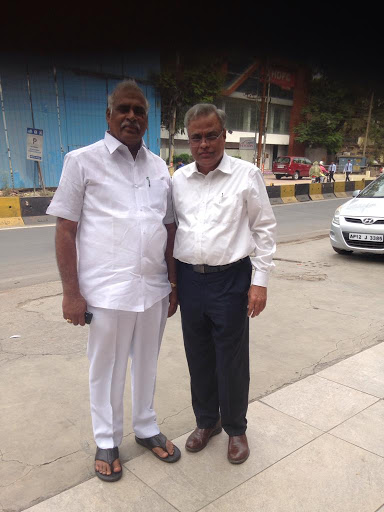
(On the left is Mr Konnappa, the MLA who is the subject of this post)
PART 1
The person with me is Konnappa, MLA (equivalent to a Congressman in a state in the US) from the north west part of Telangana adjoining Maharashtra. I happened to meet him while pursuing some factory location.
He was originally elected on a BSP ticket – only one of two MLAs of BSP (Mayawati). But then seeing his good work, the Chief Minister asked him not to waste his time, join the ruling party and continue his work. So they merged. His constituency is in the vicinity of Ramagondam, Sirpur, and Singareni coal mines.
Recently the area has seen some factories shut down and many workers in the streets. He is working hard to bring some industries into the area or revive the shut ones.
We learnt about some of the good work that he has been doing. This based on my colleagues’ personal visit to the area and my interaction with him.
The closure of factories has thrown some 2400 children potentially out of school – due to loss of jobs of parents. He has supported the children attending school by paying their fees – some Rs 34 lacs ($ 50K) per annum. “Children cant afford to lose their precious years of schooling” is his logic. “Whats the source of funds – Personal?” I quizzed. “No sir I am not that wealthy. I ask some money from Chief Minister, some other like minded MLAs, I asked some theatre owners, shop keepers and some industries who support such efforts. I only make up the balance. Its more of a co-ordination exercise” said he.
Konappa is providing one meal a day for some 1500 poor children in his area. “Half my salary and allowances goes in this”. He had invited one of my colleagues during an earlier visit to eat with them and said “your colleagues was very pleased to do that.”
Recently some potential investors were visiting a factory closed for last 3-4 years. “To make it presentable, I worked alongside the workers to clean it and make it as good as the … he showed the table top of our lunch table in Bikanerwala restaurant. If you start any industry here, I will work one day in the factory free to see that everything goes smooth for you. “
“When your colleague had visited my town, I made him talk to the workers of a closed factory to pep up their mood. They were all happy and appreciative.”
“From last 6-7 months back, I have started a scheme for pregnant women. Tribal women suffer blood deficiency. This causes several deaths of the mother during child birth or poor health of children. I have started giving them 2 kgs Gude (Jaggery) +some other thing he said which he claimed is good for blood generation + 2 Kgs of Ragi which he claimed he ensures that only the pregnant get to eat’ (may be thru social policing). The deaths have started coming down. Now the state has witnessed it and wants to roll it statewide’ he said with a pride in his voice.
I did not get the impression that his claims were unjustified. He seemed utterly sincere; guileless for a MLA. Moreover when the Deputy Chief Minister introduced him to us said, “he is firstly a social worker; incidentally he happens to be a politician. Ask him for whatever help you need “
PART 2
It was supposed to be the final meeting to say Yes or No as to whether we would take over the closed factory and revive it. The MLA had done stupendous work in the last 4-6 weeks which would have taken 6-8 months for us.
It was in relation to takeover and restarting a sick mill. At stake was the livelihood of 2000 odd workers and their families, the children’s education, daughters’ marriage, etc. And a passionate MLA who felt the weight heavily on his shoulder.
The Secretary to the government informed us of the decisions of his govt on various help, assurances and policy incentives and assured supply of feedstock etc, we had sought. It fell short of what we wanted. The MLA , Konappa, and the Government had gone a great distance; yet it was below our threshold.
My colleague and myself had a quick discussion and said that in the interest of moving forward we will take it. We said so to the Secretary and requested him not to completely shut the door on the others requests. We thanked him and got up to go. The Secretary must have sensed our discomfort. and said ‘If there are some difficulties later, you can always come back. It is also our interest that you keep things going’
We came out. In the corridor, I congratulated the MLA for his efforts. Even while shaking his hands I found his eyes getting wet. I am yet to learn how to handle such situations. My colleague, senior in age, sympathised, and consoled the now visibly shaken man. He told him he can’t be seen by others in that state and that we should get into some room and we moved into one.
Konappa said “Sir, for the first 61 years of my life, I did not have any BP or sugar. Last 3 -4 years, I have developed both. Loss of livelihood, children’s education, the future, no growth in my constituency… have all affected me. Today I see some hope return”.
“This is the first time I have stayed in Hyderabad, the state capital for 9 days continuously. To go from one person to person to plead for a solution in the best interest of the workers and their families “
“When the factory closes and there is no one to care, people start looting. I closed the scrap shop nearby 3-4 years ago and warned other dealers within the vicinity against dealing in any material from the factory or they will close down for ever. I told the workers some day or the other someone will come and not even a single bolt should be missing. I know the pains and delays such things can cause for I have been a daily labour in the very same factory several years ago”
“Sir, please don’t worry. It is my personal responsibility that you people will face no difficulties. “
He seemed much more in control by now. and we told him it was time for us to leave. He walked us down. “These are the times that give me satisfaction. Far more than seeing Rs 2-3 lacs in my bank account (I thought their unit of thought will be in crores rather than lakhs, but this man seems stuck in a time warp of his own). That’s when I feel … this earth (pointing downwards) which has to bear my weight. I feel I am repaying a part of the debt I owe to it, when I see some poor people appreciate it”
He was composed by now, with some pride and a smile on his face. But I was shaken. My mouth was quivering. In full public view at the entrance to the car park.
Some politician this. Some human being. Hope I can work with him some day. Imitation is the best form of flattery they say. I hope I will be able to imitate him … one day… some day.




You must be logged in to post a comment.