Union Home Minister Shri Amit Shah hails passage of two crucial Bills on agricultural

Union Home Minister Shri Amit Shah has hailed the passage of two crucial Bills on agricultural reforms by Parliament today. Expressing gratitude to Prime Minister, Shri Narendra Modi, Shri Amit Shah, in a series of tweets, said, “The passage of these bills reflects PM Modi ji’s unwavering resolve towards the overall development of our farmers and strengthening of the agriculture sector. This is the beginning of an unprecedented era of development in India’s agriculture sector.”

Shri Amit Shah said, “People who kept farmers in darkness and poverty for decades by indulging in vote bank politics are today again trying to provoke & mislead them by opposing this historic decision, which is taken by Modi govt in the interest of the farmers. I want to assure my farmer brothers that if anyone thinks of their best interest then it is Prime Minister Narendra Modi ji.”

The Union Home Minister said, “These agriculture reforms of the Modi govt will liberate our farmer brothers from the clutches of middlemen who have deprived them of their dues.”

“Through these agriculture reforms, farmers will be able to fetch the right price for their produce by selling it anywhere they want, this will lead to an increase in their income,” said Shri Amit Shah.

“Even after this decision, the system of MSP will remain in place and government procurement will also continue,” he added.

The Rajya Sabha passed The Farmers’ Produce Trade and Commerce (Promotion and Facilitation) Bill, 2020 and The Farmers (Empowerment and Protection) Agreement of Price Assurance and Farm Services Bill, 2020 today. Both Bills had already been passed by the Lok Sabha.

The Farmers’ Produce Trade and Commerce (Promotion and Facilitation) Bill, 2020 seeks to provide for the creation of an ecosystem where the farmers and traders enjoy the freedom of choice relating to sale and purchase of farmers’ produce which facilitates remunerative prices through competitive alternative trading channels to promote efficient, transparent and barrier-free inter-State and intra-State trade.

The Farmers (Empowerment and Protection) Agreement of Price Assurance and Farm Services Bill, 2020 seeks to provide for a national framework on farming agreements that protects and empowers farmers to engage with agri-business firms, processors, wholesalers, exporters or large retailers for farm services and sale of future farming produce at a mutually agreed remunerative price framework in a fair and transparent manner and for matters connected therewith or incidental thereto.

Medical waste management during COVID-19 pandemic

As informed by Central Pollution Control Board (CPCB), disposal of bio-medical waste including Personal Protective Equipment (PPE) kit worn by healthcare professionals as well as general public became a challenge during the on-going Corona Virus Disease of 2019 (COVID-19) pandemic.        

Public Health’ being a State subject, information relating to increase in COVID-19 cases among individuals employed in garbage collection and disposal, due to mismanagement in disposal of bio-medical waste including PPE kit etc., is not centrally maintained.

As per Bio-medical Waste Management (BMWM) Rule, 2016, waste generated from Healthcare Facilities is required to be treated and disposed as per provisions under said Rules. CPCB has also prepared guidelines, which gives guidance on Handling, Treatment & Disposal of bio-medical waste in line with provisions under BMWM Rules, 2016.          

Further, CPCB issued separate guidelines for ‘Handling, Treatment & Disposal of bio-medical waste generated during Treatment/Diagnosis/Quarantine of COVID-19 patients’ which gives guidance on management of COVID-19 related bio-medical waste including used masks and gloves. These guidelines were initially issued on 19.03.2019 and later revised on 17.07.2020.

As per CPCB Guidelines, used PPEs like face shields, goggles, hazmat suit, plastic coverall, used masks, head cover, shoe cover etc. generated from COVID-19 isolation wards at Healthcare Facilities shall be segregated and
sent to Common Facilities for
disposal as per Bio-medical
Waste Management Rules, 2016 (BMWM Rules). However, used PPEs like masks and gloves generated in Common Households, Commercial Establishments, Institutions, etc., are required to store separately for minimum 72 hours for disposal along with solid waste after cutting or shredding. Such shredded used masks from household can be collected as dry solid waste by Urban Local Bodies (ULBs).

Guidelines issued by CPCB have been circulated to all stakeholders and specific Directions were also issued by CPCB to all State Pollution Control Boards (SPCBs)/ Pollution Control Committees (PCCs) to ensure compliance.

The following additional measures have been taken by CPCB for improvement of management of bio-medical waste during COVID-19 pandemic:

  1. In order to monitor COVID-19 related bio-medical waste, CPCB developed COVID-19 waste tracking App named “COVID19BWM”. Both Android Mobile and Web versions of software application were designed for waste generators, CBWTF Operators, SPCBs/PCCs and Urban Local Bodies (ULBs). 1st version of the App. has been introduced and a demonstration was given to SPCBs/PCCs and other stakeholders in May, 2020. SPCBs and CBWTFs were directed to ensure usage of Tracking App. CPCB vide it’s letter dated 21.07.2020 issued Show Cause Notice to 106 CBWTFs for not using the COVID19BWM tracking App.
  2. Directions under section 5 of Environment (Protection) Act were issued in July, 2020 to all the SPCBs/PCCs to ensure compliance to CPCB guidelines for effective management of bio-medical waste. However, CPCB has also created separate page on its website for dissemination of awareness on management of COVID-19 related waste, including safe disposal of masks and PPEs by general public.

The Minister of State (Health and Family Welfare), Sh Ashwini Kumar Choubey stated this in a written reply in the Rajya Sabha here today.

Treatment Facilities for other illness in COVID-19 hospitals

For appropriate management of COVID-19 cases, Government of India has advised State governments to setup a three-tier arrangement of health facilities exclusively for COVID.

These are-

(i) COVID Care Center with isolation beds for mild or pre-symptomatic cases;

(ii) Dedicated COVID Health Centre (DCHC) with oxygen supported isolation beds for moderate cases and

(iii) Dedicated COVID Hospital (DCH) with ICU beds for severe cases.

In order to prevent cross infection from COVID cases to those being admitted for non-COVID illness, these beds shall not be put to use for treatment of patients other than COVID.

Ministry of Health and Family Welfare (MoHFW), Government of India followed a graded approach and has guided states for accordingly expanding COVID-19 dedicated hospital infrastructure. The states were advised to plan for the requisite number of isolation, oxygen supported and ICU beds, based on the prevalent and expected case growth rate.

As per the information provided by the States/ UTs on the Covid-19 Portal, State-wise details of Hospitals, beds in COVID dedicated facilities (Government and Private both) as on 18th September 2020 is given at Annexure. However, as the situation is dynamic, the bed utilization position changes day-to-day.

HIV/AIDS Patients in India

As per the latest HIV estimates report (2019) of the Government, India is estimated to have around 23.49 lakh people living with HIV/AIDS (PLHIV) in 2019. The HIV epidemic has an overall decreasing trend in country with estimated annual New HIV infections declining by 37% between 2010 and 2019.

HIV infection in India is mainly caused by engagement in high risk behaviours. The main high-risk behaviours identified for HIV infection in India includes unprotected heterosexual behaviour, unprotected homosexual behaviour, and unsafe injecting drug use behaviour.

There are no dedicated hospitals for the treatment of HIV/AIDS patients. However, under the National AIDS Control Programme (NACP) of the Government, as on July 2020, there are 570 Anti-retroviral treatment (ART) Centers and 1264 Link ART Centers.

State/UT-wise details of people living with HIV/AIDS in 2018 and 2019 as per the latest HIV estimates report (2019) is at Annexure.

Steps taken for Documentation of various art forms

Sangeet Natak Akademi, New Delhi has a scheme Survey, Research, Documentation, Dissemination & Publication which has the objective of preserving recordings of different arts forms, for the purpose of research and dissemination. Under the said scheme, Akademi provides grant to individuals and arts and cultural institutions for research work and documentation of various dance forms of the country.

Sangeet Natak Akademi, New Delhi organized Festivals all over the country, gives grants-in-aid for research, documentation, and publishing in the performing arts; organizes and subsidizes seminars and conferences of subject specialists; documents and records the performing arts for its audio-visual archive.

The scheme “Festival, Workshop & Exhibition” is designed to support festivals both at the regional and national levels to present classical, traditional, tribal and other forms of Indian performing arts under the aegis of the Akademi, in order to preserving art tradition in live practice,and for developing technique and creative process through performance and workshop, by holding and supporting music festivals, Seminars & Workshops &Exhibitions etc. The Akademi has brought into limelight unknown and rare art forms and many artistes who are performers of outstanding merit, as also younger generation of performing artists. The opportunities and scope for in-depth documentation of various arts and artistes brought together on the occasion of the above events are utilized for optimum artistic results.

This information was given by the Minister of State (I/c) of Culture and Tourism, Shri Prahlad Singh Patel in a written reply in the Rajya Sabha today.

Curtain Raiser

The Election Commission of India is going to organize  an International Webinar on 21st September 2020, on the Theme ‘‘Issues, Challenges and Protocols for Conducting  Elections during COVID-19 : Sharing Country Experiences’ on its completion of one year of Chairmanship of the Association of World Election Bodies (A-WEB).

2. The Association of World Election Bodies (A-WEB) is largest association of Election Management Bodies (EMBs) worldwide. At present A-WEB has 115  EMBs as Members & 16 Regional Associations/Organisations as Associate Members.  ECI has been very closely associated with the process of formation of A-WEB since 2011-1    ECI hosted   the 4th General Assembly of A-WEB on 03 Sep 2019 at Bengaluru and took  over as Chair of A-WEB for 2019-2021 term. 

3. In accordance with the decision taken at the Extraordinary meeting of the A-WEB Executive Board held at Bengaluru on 02 Sep 2019,  an India A-WEB Centre  has been established at New Delhi,  for world class documentation, research and training for sharing the best practices and capacity building of officials of A-WEB members.     ECI has provided all the resources for this Centre.  A number of initiatives, led by  Shri Sunil Arora, Hon’ble Chief Election Commissioner of India and Chairperson, A-WEB are being taken under the aegis of India A-WEB Centre.

4. This is the first Webinar being held by the India A-WEB Centre.   Over 120 delegates from 45 countries across the world (viz.   Angola, Argentina, Australia, Bangladesh, Bhutan, Bosnia & Herzegovina, Botswana, Brazil, Cambodia, Cameroon, Colombia, Democratic Republic of  Congo, Dominica, El Salvador, Ethiopia, Fiji, Georgia, Indonesia, Jordan, Kazakhstan, Republic of Korea, Kyrgyz Republic,  Liberia, Malawi, Maldives, Moldova, Mongolia, Mozambique, Nigeria, Palestine, Philippines, Romania, Russia, Sao Tome and Principe, Solomon Islands, Sierra Leone, South Africa, Sri Lanka, Suriname, Sweden, Taiwan, Tonga, Turkey, Uzbekistan and Zambia) and 4 international organizations (viz. International IDEA,  International Foundation of Electoral Systems (IFES), Association of World Election Bodies (A-WEB) and European Centre for Elections)   are going to participate in the Webinar.   

5. The India A-WEB Centre   has, in a very short period of its existence,  come out with two very useful publications viz. ‘Brief Profiles of the Countries, member EMBs and Partner Organisations of A-WEB’  and ‘COVID 19 and International Election Experience’ which will be released at the Webinar for the benefit of the entire A-WEB community.   The Centre is going to bring out a number of publications and documents, including a world class quarterly ‘A-WEB India Journal of Elections’.  A brochure on the Journal is  also being released at the Webinar.       

6. At the Webinar, presentations will be made by participating EMBs and organisations.  Session I which will be chaired by Shri Sushil Chandra, Hon’ble Election Commissioner will include presentations by Fiji, Republic of Korea, Mongolia and Taiwan  as well as International IDEA and A-WEB  where these EMBs and organisations are going to   share the   challenges faced as well as their experiences  and perspectives for  holding elections during COVID 19.   Session II, which will be chaired by Shri Rajiv Kumar, Hon’ble Election Commissioner will have presentations from  South Africa, Indonesia, Bangladesh, India, Malawi and IFES.

7. It is hoped that interactions and discussions at the International Webinar on 21 Sep 2020 will provide a good opportunity to all the participants to exchange ideas and learn from each others’ experience of holding and managing elections in challenging times of COVID 19 pandemic to ensure free, fair, transparent as well as safe elections. 

ONLINE LEARNING IN THE PANDEMIC: GOOD OR BAD?

Source: Google images

Covid-19 struck us without a warning and left all educational institutions scrambling to respond to its urgencies. It has also created a need to creatively deal with such unforeseen and once-in-a-century catastrophic event that is being called the ‘new normal’.
When the lockdown was announced in the last week of March after which the country came to a sudden halt. Everything was announced to be stopped for 21days, only essentials were allowed to be sold. Under this circumstance all educational institutions had to close their campuses, students living in the hostels were sent back home if possible. Nobody had imagined that it will eventually take more than 6 months (and still counting) for the situation to normalize.
Now the education system is lagging behind its schedule, but to make the situation sufferable online classes have been started by institutions. Which can result in keeping up with the schedule of the education system, but with every new change comes both, good and bad. Today we will discuss the about the impact of these online classes extensively.

The negative impact

Source: Google images


With the online classes, neither the teacher nor the student feel the same kind of energy as in face to face learning, so it may result in less enthusiasm from both the sides which will hamper the student-teacher relation.
Students who live in villages or places where the internet connection is not good or with great speed are unable to attend the online classes. This proves to be disadvantageous because the online classes are for students which if they wont be able to attend then what’s the point in conducting them?
Many institutions have decided to take online examinations too, now what will happen to the students who have poor internet connection during the exam time. They will fail because they will not be able to connect or reconnect due to bad internet connection.
Most of India’s population belongs to lower-middle class family, they don’t earn enough money to buy their children smartphones and gadgets, as a result many of the students do not have devices, smartphones and laptops or money to keep the internet connection while also paying the school fees.
Some teachers also struggle to get to know the technology. They are expected to make PowerPoint Presentations (PPTs), record the video lectures, and take online classes through different apps and online platforms, which not all of them are able to do properly. This is more common among the teachers because most of them didn’t had to that their whole life, and to learn something that is this vast, takes plenty of time.
A major problem has emerged for the teachers who often complain about some Students doing mischievous activities for entertainment. They share links of online classes that are sent to them by their teachers. They also tend to create Zoom IDs in random, unidentifiable names and troll teachers. Some switch off their camera and call teachers by their names from these IDs, some use them to send memes to teachers.
Teachers also have to face common issues like, Bullying by students, argumentative parents who often peep into classes, and distracted children and a story that I personally heard was about a student’s relative used the link to log into the class and “see what the teacher looks like, what she teaches and how she speaks”, and I am sure many others also must have experienced something like this.

The positive impact

Source: Google images

There is an abundance of benefits that students and teachers will get from online learning as well few of them could be:
Online learning can be done from the comfort of one’s home, especially during COVID-19 outbreak, which definitely does not mean that you can lay down on your bed and attend your classes, what it means is that it is easier for you to stay at home safely and attend classes.

Different student has different level of understanding some can learn something new easier than the other whereas some may take some time, with the online learning you can learn the lesson on your pace, you just have to record the lectures, the PowerPoint presentations are uploaded for you by the teachers.

Unlike the classroom learning, here the lessons can be constantly updated and uploaded so that students can continue on if they have finished the previous lessons.

Many students in traditional classroom environments don’t feel comfortable speaking in front of everyone but In an online environment, it can be much easier to share thoughts with others. According to the National Institute of Mental Health, 74% of people suffer from speech anxiety, online classes will help them to improve and build their confidence.

Even if the exams are conducted online there is no harm in it on the plus side you will get your results instantly without having to wait for a long period of time.

Most importantly this swift shift to online mode of learning has resulted in less use of paper throughout the world as teachers and students both use technology to write notes or create presentations, thus protecting our environment.

Conclusion

As we saw above, that online learning has it’s good and bad aspects, so at least for now in this case of emergency, the online mode somewhat works for the students but still the government needs to come out with alternatives for the students with no gadgets or no internet connection or both.
For the future, that is after the pandemic is over online learning and the face to face traditional learning has to co-exist, because we can’t be fully dependent upon the virtual learning. Yes it does make the learning process easier but it still has to improve alot and also has to inculcate the values that the students learn while in the traditional learning system, and also has to eliminate the barriers in online learning so that no one is disadvantaged from this system.

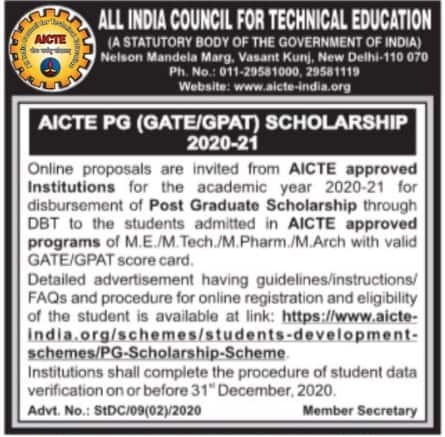
AICTE announces scholarship for PG 2020-21

The All India Council For Technical Education (AICTE) has announced the scholarship programme for the post graduate (PG) students for the year 2020-21. The candidates of ME, MTech, MPharm, MArch with valid Graduate Aptitude Test in Engineering (GATE) or Graduate Pharmacy Aptitude Test (GPAT) score can apply for the scholarship. The eligible candidates can apply through the website- aicte-india.org.

“AICTE in order to ensure development of technical education in India awards Post Graduate Scholarship of Rs. 12,400/- per month to full-time GATE/GPAT qualified students admitted to AICTE approved post graduate programs in AICTE approved Institutions/ University Departments,” reads the official notice.

AICTE offers scholarship of Rs 12400 per month to PG students. This facility is offered to full time GATE / GPAT qualified students.

A total of 24 months scholarship is awarded during the two-year PG course. Scholarships are awarded from the month of classes commencing to the month when classes are closed.

AICTE-Scholarsip

To receive the scholarship, candidates have to validate their students ID and proceed with filling the GATE PG scholarship form. All the details like Bank account number, institute permanent ID, students ID and date of birth have to filled correctly, failing which the disbursal of scholarship will be affected. After filling the form, institutes have to verify and submit the data of all candidates admitted in M.Tech/M.E./M.Arch through GATE for the academic years 2020-21.

The last date for institutes to verify and submit students data to AICTE is December 31. The scholarship will be provided from the date of commencement of classes/date of admission whichever is earlier. Students will receive the GATE scholarship 2020 amount directly in their bank account.

To receive the GATE scholarship 2020, candidates need to have a savings account in their name, same as furnished in GATE/institute admission. Candidates belonging to OBC-Creamy layer who have qualified GATE under OBC category will not be eligible for the scholarship. Candidates who qualified GATE under any reserved category (SC/ST/PwD/OBC-NCL) must have a valid category certificate without which they will not be considered for the scholarship.

Candidates who have qualified under the OBC (Creamy Layer) category are not eligible for the scholarship. However, OBC (Non-Creamy Layer) candidates will be required to submit certificates which are not more than one year old to process their applications for the programme.

History of the Dauphine Orleans Hotel.

The Dauphine Orleans Hotel is a notoriously haunted location that sits only a stone’s throw away from Bourbon Street. Located in the center of the French Quarter, this hotel has over a hundred rooms where guests regularly report ghost sightings, disembodied voices and more. But why is this location so infested with spirits?

In the late eighteenth century, a man named Don Andres Almonester y Roxas owned the Dauphine Orleans Hotel’s plot of land. He also owned most of the surrounding real estate as well, and eventually donated part of the hotel’s land to the local Charity Hospital. For a time, the land was used to treat the various ill citizens of the city.

But it wasn’t until 1857 that the building’s use took a darker turn.

It was in 1857 that May Baily’s Place opened. Technically referred to as a “sporting house,” May Baily’s was a brothel. This business was a brothel, which was a location where people of ill-repute would often gather and participate in illicit activities. May Baily opened this establishment after her father died during the yellow fever epidemic, hoping to strike rich during hard times. With the help of a family friend, the business soon opened its doors. Luckily for Baily, she also received a license from the city deeming all activities within as legal.

While May Baily ran this fine establishment, her younger sister Millie allegedly hated everything that the fine brothel stood for: subjugation to a life with little choice.

Millie wanted nothing to do with the red-light district. As the story goes, Millie got her chance to escape the sordid life she’d always known in 1861, when she met a nice Confederate soldier. Against all the odds stacked against the couple, they fell in love and Millie’s beau proposed.

Her happiness was short-lived.

On the very day of the wedding, Millie’s betrothed was shot dead. Gambling was the cause; the brawl that took her young soldier’s life, the end result. Her wedding dress that she had sewn so meticulously, caressed so lovingly, never made it to the altar, although Millie apparently took the opportunity to wear it around the sporting house whenever she could.

Guests have spotted Millie’s ghost in her lace wedding gown standing forlornly near May Baily’s, as if still half-hoping that her loved one might return for her.

Guests have reported seeing the spirit of a man dressed in dark Confederate uniform—is it too much to ask that it might be poor Millie’s long lost love?

Many of the people who have witnessed ghosts claim that some are simply patrons from the past. Men visiting their favorite brothel, even after death. There are also reports of the ghosts of prostitutes, still roaming the old building in search of their next customer

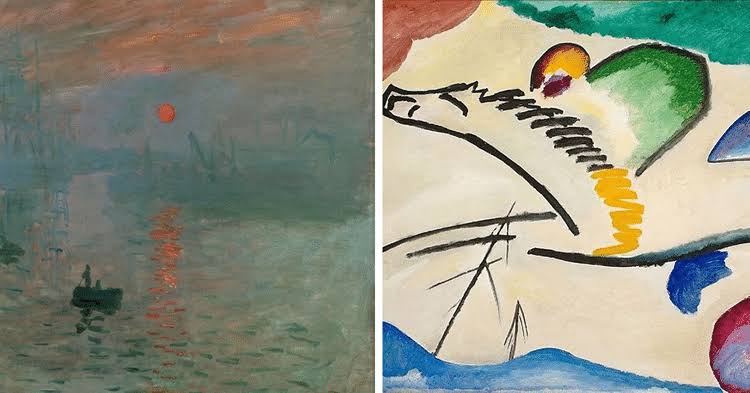
Art is Art.

“We are made to create. We feel useful when we create. We release our ‘stuckness’ when we create. We reinvent our lives, tell new stories, and rebuild communities when we create. We reclaim our esteem, our muse, and our hope when we create.”

There is no one universal definition of visual art though there is a general consensus that art is the conscious creation of something beautiful or meaningful using skill and imagination. The definition and perceived value of works of art have changed throughout history and in different cultures.

Expression became important during the Romantic movement with artwork expressing a definite feeling, as in the sublime or dramatic. Audience response was important, for the artwork was intended to evoke an emotional response. This definition holds true today, as artists look to connect with and evoke responses from their viewers.

Immanuel Kant was one of the most influential of the early theorists toward the end of the 18th century. He believed that art should not have a concept but should be judged only on its formal qualities because the content of a work of art is not of aesthetic interest.

There are as many ways to define art as there are people in the universe, and each definition is influenced by the unique perspective of that person, as well as by their own personality and character.

Stop judging your work. Nothing kills creativity faster than comparing your work to someone else’s. Your job is not to judge your work. Your job is to put it out there. To see what will become of it. Give your creativity every chance of survival.

Don’t fuss over details as you move forward. What matters is that you get something done. Every day if you have to.

The real world doesn’t reward perfectionists. It rewards people who get things done. Give yourself time in your life to wonder what’s possible and to make even the slightest moves in that direction.

You will screw up in the process but it’s okay. Don’t beat yourself up for making a mistake or making a wrong choice. It will only lead to self destructive behavior.

Lower your expectations of yourself and your work. Realize that you don’t have to create a masterpiece every time you enter the studio. If you go in and fingerpaint and it feels good, you learn something, you stretch yourself, and enjoy the process, that is a success.

You don’t have to say something huge with every artwork that you make. Take the pressure off and you will enjoy yourself along the way.

Art, like life, is messy. The process is the exciting part and one that others love to take part in. Remind yourself that by showing your process you have one more opportunity to connect with other people about the chances you are taking, the details you see, and the messiness of it all.

It also helps people understand your final work. Showing works as they progress can be great teaching moments for people who weren’t trained as artists in seeing just how much work and skill go into a piece.

Even if you draw a stick figure, it is art. Don’t let other people’s definition ruin the meaning of art to you.

Union Minister Dr. Jitendra Singh reviews COVID-19 situation in J&K

Expressing concern over Jammu having earned the dubious distinction of recording one of the lowest COVID recovery rate of 43% in the country, Union minister Dr Jitendra Singh announced today that Centre will monitor Jammu COVID situation on daily basis and the Central team of experts will remain in touch with medical professionals in Jammu on day-to-day basis, apart from providing regular tele-consultation facility from All India Institute of Medical Sciences (AIIMS), New Delhi, till such time as the pandemic situation improves in the region.

During a meeting convened to review the alarming COVID situation in Jammu region, Dr Jitendra Singh received inputs from the Central team led by Dr S K Singh and Dr Vijay Handa, who are currently on a visit to Jammu. The meeting was attended, among others, by Union Health Secretary Rajesh Bhushan, Addl Health Secretary Kiran Ahuja while the Union Territory was represented by Advisor Health Rajiv Bhatnagar, Financial Secretary (Health) Atal Dullu, Divisional Commissioner Jammu Sanjeev Verma, Senior faculty members of Government Medical College Jammu and Deputy Commissioners of different districts of the Jammu Division.

Dr Jitendra Singh said that instructions have been issued to the health authorities in Jammu region to provide Oximeters and Oxygen Concentrate for Home Quarantine patients.

Dr Jitendra Singh assured the people of Jammu and Kashmir that the rising cases of COVID-19 in the UT would be tackled effectively through better hospital management and containment strategy. He said that issues like shortage of oxygen cylinders, medical staff in hospitals would be resolved at the earliest.

The Union Minister appreciated the Central Ministries of Health and Home Affairs for promptly responding to his request and sending a Central Medical Team at a short notice led by Dr.Sudhir Kumar Singh to assess the ground situation in Jammu and adjoining districts. The Central Team will remain in touch with the Medics in Jammu Division for continuous support and guidance on daily basis, apart from the Tele Consultation with AIIMS twice a week, till the pandemic situation improves, he added.

Dr. Jitendra Singh said, all necessary measures would be taken on an emergency basis to reverse the trend. He also asked the hospital providers to follow the Union Health Ministry SOP judiciously to avoid infection among themselves and create awareness about the same in public. He also advised the Financial Secretary (Health) Atal Dullo to hold regular meetings with Civil Society, Eminent Persons and Religious Leaders for educating the common man about the pandemic and for taking preventive measures attached to them. He also called for a designated Helpline and Control Room for COVID care and added that they should remain in functioning mode.

Dr Jitendra Singh underlined that non-COVID patients should get all the facilities and care they need and instructed the State Health Authorities to take necessary steps in this regard. Expressing his deep concern for high rates of infection and death in Jammu Division, Dr Jitendra Singh gave directions for Aggressive and Focussed testing, Contact Tracing and isolation and delineation of Red Zones in a scientific manner.

The Minister said that all the three main issues of Oxygen cylinders, Medical Staff and Containment flagged by the Central Team would be dealt with on priority basis. He, however, expressed satisfaction that the process of hiring the nurses, para-medics and doctors on contractual basis to overcome the shortage has begun and will soon yield the results. The Union Minister also called for long term measures like dedicated infectious medical facilities and more oxygen plants in medical colleges and hospitals in due course.

Banking facilities in rural areas

To ensure availability of banking outlet (Bank branch/Business Correspondent (BC), within 5 kilometers of all inhabited villages the Government has launched a Geographic Information System (GIS) based app., namely, Jan Dhan Darshak app (JDD app) developed by National Informatics Centre (NIC). This was stated by Shri Anurag Singh Thakur, Union Minister of State for Finance & Corporate Affairs in a written reply to a question in Lok Sabha today.

Banks have been provided login credentials to upload the GIS location of their branches, Business Correspondents and ATMs on the app. As per JDD app, there are 1.66 lakh branches, 4.35 lakh BCs and 2.07 lakhs ATMs mapped by the banks. Further, as per data uploaded by the banks on JDD app, out of the 5.53 lakh mapped villages on the app, 5.52 lakh (99.8%) villages are having branch or BC within 5 kilometers distance, the Minister said in a written reply.

Giving more details, Shri Thakur said that as per extant guidelines dated 18.5.2017 on rationalisation of Branch Authorisation Policy, Reserve Bank of India (RBI) has granted general permission to domestic Scheduled Commercial Banks (excluding Regional Rural Banks), to open banking outlets at any place in the country, without seeking prior approval of RBI in each case, subject to at least 25 percent of the total number of banking outlets opened during a financial year being in unbanked rural centres i.e. centres having population less than 10,000 (Tier 5 and Tier 6 centres). Further, 10 Small Finance banks and six Payment Banks have been licensed by RBI for providing banking services across the country including the rural centres.

The Minister said that under Pradhan Mantri Jan-Dhan Yojana (PMJDY), all villages were mapped by banks into 1.59 lakh Sub-Service Areas (SSAs) with one SSA catering to 1,000 to 1,500 households. While 0.33 lakh SSAs have been covered with bank branches, 1.26 lakh SSAs, have been covered by deployment of interoperable Business Correspondents (BCs).

In pursuance of RBI guidelines, rolling out of banking outlets in uncovered areas is a continuous process and looked after by State Level Banker’s Committee (SLBC), in consultation with the concerned State Government, member banks and other stakeholders. Banks, inter-alia, consider proposals for opening banking outlets in the light of RBI’s instructions, their business plans and their commercial viability. To further assess the viability for opening a banking outlet, banks carry out survey as required.

As informed by SLBC, Haryana and SLBC Bihar, all the Gram Panchayats and Blocks in these States are covered with banking services by bank branches/ Business Correspondents, the Minster stated.

Banking facilities in rural areas

To ensure availability of banking outlet (Bank branch/Business Correspondent (BC), within 5 kilometers of all inhabited villages the Government has launched a Geographic Information System (GIS) based app., namely, Jan Dhan Darshak app (JDD app) developed by National Informatics Centre (NIC). This was stated by Shri Anurag Singh Thakur, Union Minister of State for Finance & Corporate Affairs in a written reply to a question in Lok Sabha today.

Banks have been provided login credentials to upload the GIS location of their branches, Business Correspondents and ATMs on the app. As per JDD app, there are 1.66 lakh branches, 4.35 lakh BCs and 2.07 lakhs ATMs mapped by the banks. Further, as per data uploaded by the banks on JDD app, out of the 5.53 lakh mapped villages on the app, 5.52 lakh (99.8%) villages are having branch or BC within 5 kilometers distance, the Minister said in a written reply.

Giving more details, Shri Thakur said that as per extant guidelines dated 18.5.2017 on rationalisation of Branch Authorisation Policy, Reserve Bank of India (RBI) has granted general permission to domestic Scheduled Commercial Banks (excluding Regional Rural Banks), to open banking outlets at any place in the country, without seeking prior approval of RBI in each case, subject to at least 25 percent of the total number of banking outlets opened during a financial year being in unbanked rural centres i.e. centres having population less than 10,000 (Tier 5 and Tier 6 centres). Further, 10 Small Finance banks and six Payment Banks have been licensed by RBI for providing banking services across the country including the rural centres.

The Minister said that under Pradhan Mantri Jan-Dhan Yojana (PMJDY), all villages were mapped by banks into 1.59 lakh Sub-Service Areas (SSAs) with one SSA catering to 1,000 to 1,500 households. While 0.33 lakh SSAs have been covered with bank branches, 1.26 lakh SSAs, have been covered by deployment of interoperable Business Correspondents (BCs).

In pursuance of RBI guidelines, rolling out of banking outlets in uncovered areas is a continuous process and looked after by State Level Banker’s Committee (SLBC), in consultation with the concerned State Government, member banks and other stakeholders. Banks, inter-alia, consider proposals for opening banking outlets in the light of RBI’s instructions, their business plans and their commercial viability. To further assess the viability for opening a banking outlet, banks carry out survey as required.

As informed by SLBC, Haryana and SLBC Bihar, all the Gram Panchayats and Blocks in these States are covered with banking services by bank branches/ Business Correspondents, the Minster stated.

Performance of NCLTs

As on 31st July, 2020, total 19,844 cases were pending before National Company Law Tribunal (NCLT), including 12,438 cases under Insolvency and Bankruptcy Code (IBC). This was stated by Shri Anurag Singh Thakur, Union Minister of State for Finance & Corporate Affairs in a written reply to a question in Lok Sabha today.

Giving more details about regular staffing positions in NCLTs, Shri Thakur said that total 320 posts of officers/staff have been created in NCLT. Recruitment Rules (RRs) for these posts have been notified on 21.01.2020 and NCLT has initiated action to appoint employees on these posts on regular basis. Presently, 40 posts are filled on regular basis.

The Minister said that e-court project is being implemented in all 16 benches of NCLT. So far, e-filing has been started in 9 benches and it will be extended to remaining benches also. During COVID-19 pandemic, all benches are hearing cases through Video Conferencing.

SPICe+ Portal deployed by MCA

The Ministry of Corporate Affairs (MCA) has notified and deployed a web-form namely ‘SPICe+’ (pronounced SPICe Plus) vide notification no. GSR 128 dated 18.02.2020 (effective from 23.02.2020) as a part of Government of India’s Ease of Doing Business (EODB) initiatives.  This was stated by Shri Anurag Singh Thakur, Union Minister of State for Finance & Corporate Affairs in a written reply to a question in Lok Sabha today.

Giving more details, Shri Thakur said that the said web-form offers 10 services by three Central Government Ministries and Departments (Ministry of Corporate Affairs, Ministry of Labour & Department of Revenue in the Ministry of Finance), one State Government (Maharashtra) and various Banks, thereby saving procedures, time and cost for Starting a Business in India.

These 10 services are:-

  1. Name reservation
  2. Incorporation
  3. DIN allotment
  4. Mandatory issue of PAN
  5. Mandatory issue of TAN
  6. Mandatory issue of EPFO registration
  7. Mandatory issue of ESIC registration
  8. Mandatory issue of Profession Tax registration (Maharashtra)
  9. Mandatory Opening of Bank Account for the Company and
  10. Allotment of GSTIN (if so applied for). 

Users may either choose to submit Part-A for reserving a name first and thereafter submit Part B for incorporation & other registrations or file Part A and B together at one go for incorporating a new company and availing the bouquet of registrations as above. The new web form facilitates On-screen filing and real time data validation for seamless incorporation of companies.

Mentioning the benefits, the Minister stated in the written replt that after introduction of the aforesaid new Web Form, the number of procedures has been reduced to 3 as against 10 earlier and time has also been reduced to 4 days as against 18 days earlier for starting a Business in the Country.

Further, vide notification no. 180(E) dated 06.03.2019 effective from 18.03.2019, this Ministry has amended the Companies (Incorporation) Rules, 2014 whereby zero fee is being charged for incorporation of all companies with authorized capital upto Rs. 15 lakh or upto 20 members where no share capital is applicable, the Minister stated.