Cabinet approves asset monetization of subsidiaries of Power Grid Corporation of India limited through infrastructure investment trust

The Cabinet Committee on Economic Affairs, chaired by Prime Minister Shri Narendra Modi, in a path breaking reform, has approved monetisation of assets of POWERGRID, a  Public Sector Undertaking (PSU) under Ministry of Power, through Infrastructure Investment Trust (InvIT) model. This is the first time any PSU in Power Sector will undertake asset recycling by monetising its assets through theInvITmodel and using the proceeds to fund the new and under-construction capital projects.

This approval would help POWERGRID to monetise in the first lot, assets with gross block value of more than 7000 crore. These assets, which are mainly High Voltage Transmission lines and substations, are held by POWERGRID in form of Special Purpose Vehicles (SPVs). The proceeds from the asset monetization would be deployedby POWERGRID in their new and under-construction projects.

Background

POWERGRID, a public limited company under the administrative control of the Ministry of Power, Government of India, started its commercial operation in the year 1992-93 and is today, a Maharatna company, engaged in the business of power transmission. The Company, along with its wholly owned subsidiaries acquired through the Tariff Based Competitive Bidding (TBCB)process,owns and operates a pan India transmission network. The Company meets its fund requirement for its Capital Expenditure (CAPEX) through its internal accruals and debt.

The Budget 2019-20 emphasized investment led growth and indicated that new and innovative financial instruments including Infrastructure Investment Trusts (lnvITs), have been launched as part of the brown field asset monetization strategy for augmenting infrastructure investment.

The Cabinet Committee on Economic Affairs has accorded approval to the POWERGRID to monetise transmission assets held in SPVs through InvIT model. The asset monetisation through InvIT by POWERGRID is a first for the Power Sector PSU.The proceeds from the asset monetization would be utilized by POWERGRID for its CAPEX and the premium generated would augment the net worth of POWERGRID.

In the first block, POWERGRID would monetize assets with gross block of more than Rs7000 crore. Based on the experience gained, further monetization shall be carried out in future.

Asset recycling is a key strategy of the Government of India to release the capital invested in operational assets and the proposed InvIT of POWERGRID would attract both domestic as well as global investors including Sovereign Wealth Funds. Sale of assets to InvITs is a way of accessing long term, relatively cheap finance required to fund infrastructure projects in Transmission Sector. The CAPEX plan of POWERGRID for next two years (2020-21 and 2021-22) is Rs. 20,500 cr. The Government of India has enacted an enabling regulatory and taxation framework for InvITs and the proposed InvIT by POWERGRID would deepen this market.

The InvIT would provide an opportunity to the general public and institutional investors such as Pension Funds, Mutual Funds, to benefit from this investment opportunity and participate in the growth of Indian Infrastructure Sector.

Technology holds the key to scale up the use of solar energy- PM’s message at First World Solar Technology Summit

Prime Minister Shri Narendra Modi in a message at the inaugural session of First World Solar Technology Summit read out by Shri R.K. Singh, the President, International Solar Alliance (ISA) Assembly and Minister of State (I/C) for Power and New & Renewable Energy, said, today, that technology holds the key to scale up the use of solar energy. Technological achievements have already brought about a significant reduction in the price of solar power. A further reduction in the cost will provide a major boost to the use and expansion of renewable energy. He expressed confidence that the summit will help in help in developing new technologies and ensure that they become available to all.

World Solar Technology Summit (WSTS) organised by ISA and FICCI today aims to bring together key stakeholders – leading academic scientists, technology developers, researchers and innovators to present and discuss the recent highlights of solar technologies, cost-wise; technology-wise, technology transfers, challenges and concerns in the field. The main objective of WSTS is to showcase to member countries the state of the art and next-generation solar technologies worldwide and to give an opportunity to decision-makers and stakeholders to meet, and discuss their own priorities and strategic agenda towards a larger integration.

Prime Minister re-iterated that Five years ago, world leaders had taken a pledge to restrict the rise in global temperature through a gradual reduction in the dependence on fossil fuels. Underlining India’s commitment lowering carbon footprints, he stressed that India has lowest per-capita carbon emissions in the world but we have still pressed ahead with deployment of renewable energy at a frenetic pace.”

Speaking on fast growth of Renewables in India, he further informed that India has enhanced its installed renewable capacity by 2.5 times and increased our solar installed capacity by more than 13 times. “Globally India now ranks 4th in terms of Renewable power,” Shri Modi said.

Prime Minister also informed that we have scaled our non-fossil fuel-based power generations to 134GW, which is about 35 % of our total power generation. We are confident of increasing it to 220 GW by 2022. “We want to take renewable energy to every village of our country. Our government has implemented a scheme named KUSUM that aims to replace the use of diesel in our farm sector with solar energy. Under this scheme, we have targeted the solarisation of 2.8 million irrigation pumps. Such schemes will not only benefit the environment, but also increase the income of our farmers.” he said.

Referring to India’s support to ISA member countries the Prime Minister said ”India is providing capacity building support to ISA member countries through its ITEC training programme. We have also set up a Project Preparation Facility to develop bankable Solar Energy projects in ISA member countries with the help of EXIM Bank of India.” He said that in 2018, our Government had announced about US $1.4 Billion worth of lines of credit (LOCs) for covering 27 solar projects across 15 countries. These projects are in various stages of implementation.

The Prime Minister also said, “The ISA is a part of “One Word One Sun One Grid” project, I firmly believe that this project can bring transformational benefits for the entire humanity.

Ministers from several of ISA’s member countries will be joined by high-Level dignitaries, National Focal Points and senior government functionaries; Representatives of  diplomatic missions, ISA Partners, business and industry leaders, solar project developers, solar manufacturers, R&D institutions, academia and think tanks, civil society, international organizations and donors, representatives of non-governmental and community-based organizations, academics, research and training institutes, international media, multilateral and bilateral agencies.

Nobel Laureate, Dr M Stanley Whittingham, winner of the Nobel Prize in Chemistry (jointly with John B Goodenough & Akira Yoshino) in 2019 for the revolutionizing discovery of the lithium ion batteries and Mr Bernard Piccard, Founder and Chairman of Solar Impulse Foundation, Switzerland also joined the summit virtually.

India’s Minister for Petroleum and Natural Gas, Mr Dharmendra Pradhan also addressed the inaugural.Shri Pradhan announced that five Public Sector Undertakings (PSUs) under Petroleum & Natural Gas Ministry will be joining International Solar Alliance (ISA)’s Coalition for Sustainable Climate Action (ISA-CSCA) as Corporate Partners. He said that Oil and Natural Gas Corporation Limited (ONGC), Indian Oil Corporation Limited (IOCL), Bharat Petroleum Corporation Limited (BPCL), Hindustan Petroleum Corporation Limited (HPCL) and GAIL (India) Limited will be contributing to ISA’s Corpus Fund.

Lauding the role of the ISA for making rapid strides since its launch at the UN Climate Change Conference in Paris on 30 November 2015 by Hon’ble Prime Minister Narendra Modi and the then French President, Shri Pradhan said that as the latest inter-governmental international organization with its headquarters in India, ISA is not only a testament to India’s unwavering faith in multilateralism but also a commitment to a better, sustainable and greener future. He said that the Alliance reflects the vision and the firm belief that the beneficence of the Sun could be used to bring together the peoples of this planet for a shared solution to our energy needs.

The International Solar Alliance (ISA) is a treaty-based international intergovernmental organization. ISA was jointly launched by India and France in the presence of Secretary General of the UN during CoP21. The Paris Declaration establishes ISA as an alliance dedicated to the promotion of solar energy among its Member Countries. The major objectives of the organization include deployment of 1000 GW of solar capacity and mobilization of US$ 1000 billion of investment in solar energy sector by 2030. As an action-oriented organization, ISA intends to bring together member countries to aggregate demand and realise economies of scale, resulting in reduction of costs of solar applications, facilitating deployment of existing solar technologies at scale, and promoting collaborative solar R&D and capacity. As on June 26 2020, the ISA Framework Agreement has been signed by 86 countries, with 68 having also deposited instruments of ratification. The ISA is headquartered at Gurugram in Haryana, India. Mr. UpendraTripathy is the Director General.


Mesa Community College

success
is our number one priority

Pursuing an education can change a student’s life in ways they could never imagine. In addition to obtaining a certificate or degree, our MCC students gain the knowledge and skills needed to enter the workforce or transfer to a college or university. Our faculty instruct students in a way that allows them to learn how to learn, engage in critical thinking, and teach content students need to succeed. By coming to MCC students are investing in their future, and we are dedicated to helping them on their journey.


achievements
throughout the years

Since MCC\’s establishment we have focused on continually innovating and enhancing our instruction and services. Whether it’s revising our student service processes, developing and offering accredited online degrees and certificates, or renovating buildings with the latest technology, our first goal is student success. To facilitate this success our objective is to continue improving so we can better assist students in reaching their goals. Click below to see some of the highlights of our achievements over the years.


1965

The MCCCD Governing Board changed the college’s name from Mesa Extension to Mesa Community College.

1966

The Southern and Dobson campus opened.

1967

MCC received institutional accreditation.

1974

The athletic mascot changed from Hokam to the Thunderbird.

1986

The first Career Fair was held, helping to connect students with employment options.

1987

Jinnett B. Kirk, the first Dean of Students, was awarded the Don Carlos Humanitarian Award.

1990

The construction on the Alumni Clock Tower was finished.

1997

The Rose Garden was finished and remains the largest public rose garden in the Southwest to this day.

2001

The Red Mountain campus opened for enrollment.

2004

President George W. Bush visited MCC to discuss a proposal for a federal grant for training programs.

2007

The Council for Higher Education Accreditation (CHEA) awarded MCC the CHEA Award for Institutional Progress in Student Learning Outcomes.

2014

The Performing Arts Center and improved Kirk Student Center opened.

1965


2014

administration
leading the way to success in our local and global community

MCC is the largest of the ten colleges in the Maricopa County Community College District (MCCCD). While each college has a unique and recognizable role within its own community, the ten colleges also have a shared foundation in the vision and mission of the District.
Learn More

progress
on construction of our new buildings

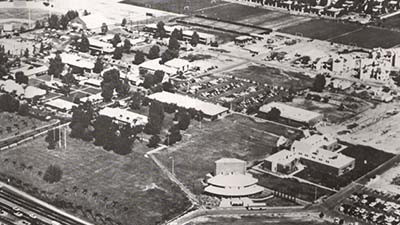
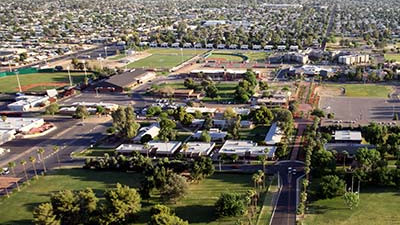
It has been over 50 years since MCC first opened with three buildings and two houses on ¾ of an acre surrounded by the expanse of undeveloped Mesa. Today MCC has two campuses and multiple locations and we continue to strive to improve, making our campuses more inviting, updating technology, and providing top-notch facilities. Click one of the tabs below to view some of our most recent improvements to our campuses.

Performing Arts Center
Art Gallery
Enrollment Center
Kirk Student Center

MCC Performing Arts Center

The Performing Arts Center is a multi-purpose facility designed to accommodate the wide range of performances of MCC’s talented music, dance, and theatre programs. Re-imagined to fit the needs of MCC, the large theatre holds 462 seats, performance classrooms, music practice rooms, faculty offices, and the scene shop.
Learn More

resources
to enhance communication and organizational success

Institutional Advancement

The Office of Institutional Advancement – or IA, as we call ourselves – promotes educational opportunities at MCC, enhances the image of the college, and connects us to our communities through communication. In other words, we’re the official voice and face of MCC.
Quick Links

Get the Word Out
Forms, Logos, & Maps
Brand Standards
Experts List
Staff & Contacts

Institutional Effectiveness

The Office of Institutional Effectiveness enhances student success by analyzing gathered institutional research and using it to benefit the college and its students. Such research allows us to make well-informed decisions to ensure MCC continues to improve upon and provide efficient, quality education.
Quick Links

Fast Facts
College Planning
College Statistics
Resources
Student Assessment

Maricopa Community Colleges

 Maricopa Community Colleges’ nationally recognized programs help more than 200,000 students each year achieve their goals. Our 10 accredited colleges offer a diverse range of programs at convenient locations across the Valley, but our goal is the same – your success.

Grand Canyon University

The Beginning as Grand Canyon College

Grand Canyon College was chartered on Aug. 1, 1949, with 16 faculty and approximately 100 students in Prescott, AZ. In 1951, the college relocated to a 90-acre tract in West Phoenix and was fully accredited in 1968 by the Commission on Institutions of Higher Education. Established as a Baptist-affiliated institution with an emphasis on religious studies, the school initially offered bachelor’s programs in education. Programs expanded to include the sciences, nursing, business, music and fine arts. It was during this time when the college started to develop a reputation for producing effective teachers, nurses and health care professionals in the Southwest.
Becoming Grand Canyon University

While planning to change in institutional organization and status to Grand Canyon University, Grand Canyon College identified several landmark events during this transition: organizing programs and departments into colleges, offering graduate degree programs, establishing the Grand Canyon University Foundation and the generosity of those who pledged or gave unrestricted gifts valued at $1 million dollars or more. In May of 1984, college trustees voted to prepare for transition to university status on the school’s 40th anniversary. Then GCU moved from being owned and operated by the Arizona Southern Baptist Convention to being self-owned by the Board of Trustees.

New Mission and Vision

By the early 2000s, GCU struggled with maintaining its operations in light of dwindling financial support. The university faced a critical juncture in September 2003, teetering on the verge of insolvency and facing the prospect of bankruptcy. A small group of investors acquired the university and refocused on online education for working adults. With an improving financial structure, the university recruited a new leadership team in 2008 to envision a future that centered around a hybrid campus strategy—combining traditional students with nontraditional students (primarily working adults studying at the graduate level). The university completed an initial public offering in 2008 to generate the capital necessary to improve its online infrastructure and expand its campus.

University Transformation and Investment

The university grew its campus student body from fewer than 1,000 students in 2009 to over 19,000 ground students in fall 2017, where the incoming student GPA was 3.5. By 2016, more than 75% of the university’s traditional students study in rigorous STEM and business programs. GCU’s nontraditional student body increased from approximately 22,000 students at the start of 2009 to over 60,000 online students currently. Over 47% of GCU\’s online student body is studying at the graduate level and that percentage is growing.

In total since 2009, the university had invested over $1 billion dollars—and today, continues to invest in full-time faculty, improved technology infrastructure, new facilities and programmatic expansion in high-growth, high-demand areas such as engineering, computer science and IT. The university has been able to self-fund these investments with only nominal increases in tuition for nontraditional students, while freezing tuition for traditional students for 10 straight years.

Back to Non-Profit Roots

In 2018, GCU transitioned back to a non-profit institution, which provided faculty and students with equitable opportunities to:
Participate in academic and co-curricular opportunities with peer institutions
Operate a philanthropic foundation
Provide grant writing and research opportunities for faculty and students
Invest in educational infrastructure
Allow the university to continue offering tuition at levels that make private higher education affordable to all Americans despite socio-economic class
Provide employment and career growth opportunities for faculty and staff
Continue to invest in the communities where the university serves
Permit student athletes to participate in governance opportunities afforded by the NCAA


1 / 7

University Development

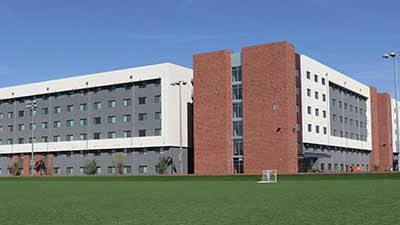
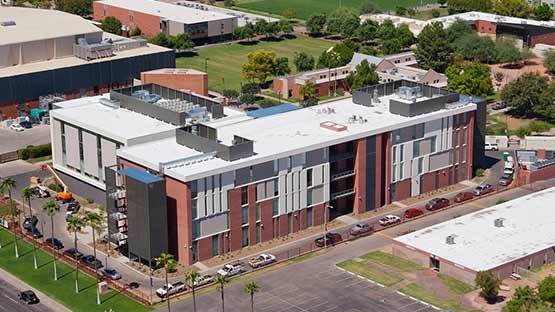
GCU\’s campus continues to grow to meet the needs of students and cultivate world-class learning experiences. Here\’s a snapshot of the campus today – a home away from home for our Lopes:
State-of-the-art GCU Stadium and GCU Arena
Contemporary residence halls and apartments with resort-style swimming pools
Recreation and fitness centers
Student Union and popular eateries along Lopes Way
Two new engineering classroom buildings dedicated to cutting-edge STEM learning
The Grove – a community of four suite-style residence halls exclusively for freshmen
Division I athletics, club sports teams, intramural sports teams
Academic, professional, social and recreational clubs
Academic and student support resources

State-of-the-art STEM building opened in fall 2015

Community Transformation

West Phoenix is where GCU calls home. That\’s why GCU stands committed to transforming the surrounding neighborhoods into a safe, thriving place for those in the community to live with hope and better futures. Along with providing academic excellence and a vibrant campus life, GCU believes its purpose is to partner together to implement initiatives in the area that open educational opportunities for all, create jobs, restore housing and reduce crime. GCU calls this United by Purpose.

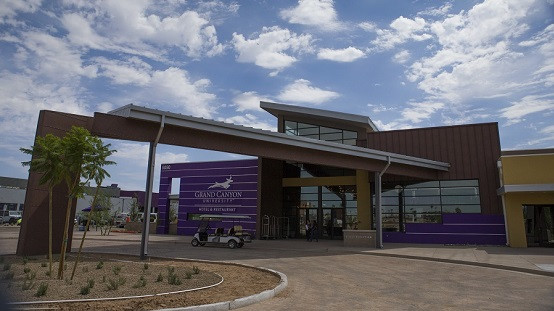
One aspect of this transformative endeavor starts with the new development project at 27th Avenue and Camelback Road that\’s changing the face of the Canyon Corridor. Developed to be the gateway into West Phoenix, this new development will serve as a commercial hub featuring:
A four-story office complex
Renovated GCU Hotel, resort-style pool and fitness center
Canyon 49 Grill and Grand Canyon Beverage Co. coffee shop
Building that will be home to a future business, economic and education innovation center

This development is only the beginning for reshaping West Phoenix into a destination of economic, tourism, business, employment and educational growth. Our new enterprises (GCU Golf Course, GCU Hotel, Canyon 49 Grill, Grand Canyon Beverage Co.) also play a role in reviving the local community.

Tremendous transformation is happening now, and the future looks even brighter.

Manifest your dreams.

A law is something that works whether you believe in it or not, like the law of gravity, which does not rely on your beliefs to function. Like gravity and the other laws of physics, the Laws of Attraction don’t require you to believe in them to work. So feel free to remain skeptical. As you start to apply the Laws of Attraction to your life, you can simply observe what happens.

Basically, the Law of Attraction works like this: you create your own reality. What you focus on, what you emote about, is what you draw into your life. What you believe will happen in your life is what does happen.

This isn’t as simple as it seems, however, or everyone would have the lives that they want naturally. For example, people who are in debt and continually tell themselves, “I need more money,” don’t find more money, they continue to attract “need more money” because that is the reality that they create.

We can’t always control our circumstances, but we can control our responses to them. In this vein, the Law of Attraction can provide the optimism and proactive attitude that’s associated with resilience in difficult situations, but must not be used as a tool of self-blame.


Our responses to the challenges we face can make us stronger in the end, and the Law of Attraction can be used for that end, but should not be applied negatively, or it can be more destructive than helpful.

The Law of Attraction is just one of the laws that govern our universe. There are others, like the law of gravity, for example. You can’t defy the other laws of the universe, so don’t expect to. In that way, no, you can’t make just anything happen.

1.A clear path
Manifesting destiny relies on you first identifying what you want, setting out a clear plan to get there, and thinking positively about the outcome.
Recognizing that you want to try something new and different is the first step. Figuring out where you’ve gone wrong is the next step. Recognizing the negative places in your life, and the mistakes you’ve made are important next steps towards using positive approach to manifest your destiny. And finally, focus on intentions and behaviors that are positive and geared for your successes. For example, if you are looking for a job, don’t just sit back expecting law to work. Put out efforts.

2.Like attracts like
Think about two droplets of water that are slowly moving towards each other. What happens as they get closer? They eventually get close enough that they attract each other and become one droplet of water instead of two separate ones.
This occurs because they are of like vibration. Now, think about the same phenomena with a droplet of water and a droplet of oil. No matter how close you put them together they will not become one with each other. This is because their vibrations are too different from one another.

This is the idea that the Law of Attraction is based on. If you want to bring about something in your life, regardless of what it is, begin vibrating at a level that is congruent with your desired reality.

3. Write down your goals and connect to your “why.”
Writing down a list of your goals will help you get clear and take more inspired action. Be sure that when you do, you connect to your “why”—the feeling that you hope will come when you achieve this goal.

4. Visualize what it will look like when you achieve your dreams.
Once you’ve written down your goals and connected with your why, read from the list first thing in the morning and right before bed every day. Take a few minutes to visualize and connect with the feeling of achieving your dreams.

5. Feel like you already have what you want.
Feeling is believing. Let these visualizations transport you to a world in which everything has gone your way. Pay attention to the details: What this world looks like, feels like, and sounds like. Doing so will help generate more excitement and positivity, and encourage you to continue taking inspired action towards your dreams.

Generation Gap.

From “Meri sapno ki raani kab aayegi tu” to “Akela hai mister khiladi, miss khiladi chahiye” and then stopping at “chale jab tu latak matak, londo ke dill patak patak” we all felt the gap between these trends. This is what a generation gap is. It is an ongoing topic, like when there’s nothing to talk about, you start taking about the difference between you and your father’s generation have. And also it’s a story of every house. Both the generation are only good in there own explanation but neither of them can console each other. So, let us try to understand them first.

Every generation has got it’s particular name according to the year they were born such as Boomers or Gen X, Millennials or Gen Y and Gen z. But, let’s talk practically, the only difference between these generation are of perception and there mentality.

Since, the Gen X or the generation our parents belong to, was a complicated generation. Gen X includes post independence period which was developing period for india. For them, all that matters was to prove yourself and also about the upbringing which should be strong both physically, mentally and financially. They belongs to an era of freedom fighters, not of fairytale stories. There strugglers were real. They were the official “work hard, not smarter” type of generation. They use to get inspired or judged by the image of  freedom fighters, that’s why there was no chance of understanding among them. So, depression and mental breakdown were not for them to be understood, and also we can’t just blame them for this because for a generation, it’s type of  environment matters a lot. They were the one who were introduced by the indian culture and also wasn’t allowed to have discussion on it. So, are they Worthy for our hate?

Now, let’s talk about Mellennials or Gen Y, which belongs to your older brothe, rs and sisters. The one who is actually working in the society. This generation was blamed to be the destroyer of our culture or “Sanskriti”. But, what they actually did was, they brought change in the society. Like, this generation has only heard about the freedom fighters, but, was not inspired by them. They had there own sight, a sight of a better place. We can’t say that their struggles were not real, but they also didn’t have to start anything. All they have to do was to show a better way of development. They changed the society thinking about the third gender, regarding LGBTQ+ community, Racism, environmental crisis, crimes against womens, etc.. Actually, this generation has not destroy the following culture but it has improvised it for the betterment of the society and also made each other aware about the physical and mental health. It is only because of this generation the coming generation will be seeing an ongoing development throughout there life, but, also has introduced many types of problem to the society. As every work has it’s side effects. So, what’s wrong with that??

Now, we will talk about Gen Z or our generation. This generation is very much aware about the past and the present condition and also has habit of changing everything. Till now this generation has also done some kind of development in making things easy and handy to the society. And also working on bringing equality in the society. This generation is the most developed one’s among others with morden gadgets and a lot more. But, still there’s a lot left to prove for this generation infront of there fellow generation, which they are already dreaming of. For that we also can’t blame this to them cause they are the ones who is going through the climatic problem and scarcity of resources. So, they don’t only have to overcome it but also come up with a long lasting solution. Let’s hope and leave the rest on them.

Since, we have already discussed about all the three types of generation which is presently existing in this society.  So, whom do you think has won? Boomers or Mellennials. Actually, we don’t know because even if Mellennials won today, someday Gen Z will prove them wrong and Boomers are already an outdated version in the society. That’s why I said it’s always an ongoing topic because the debate will continue in every generation. And one more thing is clear that every generation has it’s own struggle to overcome and we shall not compare them.

At last always remember that:
“There’s no generation
     actually happy for or from
             upcoming generation”

So, drop down your views on this topic and Let’s discuss more about it. Man! It’s a long debate.
See yaa.

MUMBAI UNIVERSITY FINAL EXAMS, 1HOUR 50 MARKS

Photo credit: Google images

Mumbai University has decided to conduct all the final year UG and PG exams for 50 marks and the duration of the exams will be 1 hour. The decision was reached after a series of meetings conducted on Saturday.

The duration of each exam will be an hour and will carry 50 marks. The paper will be in Multiple Choice Questions (MCQs) format. The practical and viva exams will be conducted online by the colleges and all the exams can be given by the students from their home.

Apart from MU, other universities in the state are inclining to follow the lead. All the exams will be Multiple-Choice Question based. The theory exams will be conducted from October 1 to October 17.

While some autonomous colleges are talking to third party service providers, many are considering using Google forms to deliver the test. The university, though, is silent on providing technology centrally. Academicians, meanwhile, have questioned the viability of using objective-based online tests to evaluate students in a certifying exam.

“This will apply to all undergraduate and postgraduate courses that follow the 40:60 pattern. The exams will be of 50 marks, and the university is keen on administering multiple choice questionnaires. The departments, though, are waiting for a circular to appoint a panel for conducting exams and start preparations for formulating question papers,” said a member of the academic council.

Minister of Higher and Technical Education department Uday Samant had earlier said that the universities have been asked to submit their action plan on conducting exams to the government by September 7.

1.33 crore COVID tests conducted in the last 2 weeks

India is one of the few countries that have reported very high numbers of daily testing. The daily testing capacity has crossed 11.70 lakh.

India’s cumulative tests are nearly 5 crore (4,95,51,507) as on date. 7,20,362 tests were conducted in the last 24 hours.

As a result of the country-wide ramped up testing, 1,33,33,904 tests were conducted in the last two weeks alone.

The Centre’s policies are continuously evolving in the larger global context. Following on the heels of several measures to facilitate wider testing by the people, recently the Union Government has issued the revised and updated Advisory which provides for the first time ‘Testing on Demand”. The States/UTs have also been given wider flexibilities to simplify modalities to enable higher levels of testing.

The daily testing average had been on a continuous upward incline from around 7 lakh tests being conducted per day in the 3rd week of August to 10 lakh tests per day in the 1st week of September.

Higher testing enables early identification of confirmed cases, which in turn leads to timely initiation of effective treatment in supervised home/facility isolation or in hospitals.  These measures aid faster and higher numbers of recovery, lower fatality and saving of more lives.

For all authentic & updated information on COVID-19 related technical issues, guidelines &advisories please regularly visit: https://www.mohfw.gov.in/ and @MoHFW_INDIA.

Technical queries related to COVID-19 may be sent to technicalquery.covid19@gov.in and other queries on ncov2019@gov.in and @CovidIndiaSeva .

In case of any queries on COVID-19, please call at the Ministry of Health & Family Welfare helpline no.: +91-11-23978046 or 1075 (Toll-free). List of helpline numbers of States/UTs on COVID-19 

The country as a whole has so far received 7 percent excess rainfall

“The plentiful and spread of southwest monsoon this year should help farmers and the output must be very good. It will also help Indian economy, though exact quantification cannot be made at this moment. We don’t have an assessment as to how it will impact the economy.” The country as a whole has so far received 7 percent excess rainfall.

This was stated by Dr. M Rajeevan, Secretary, Ministry of Earth Sciences.

Dr. M. Mohapatra, Director General of the IMD, said that the country is likely to see normal to above normal rainfall in September, though in the second week of September, monsoon rain is likely to be deficient in most parts of the country, including northwest and central India. But it is likely to resume after September 17, he added. The usual date for monsoon to begin withdrawing is September 17.

Dr. M. Rajeevan and Dr. Mohapatra were addressing a virtual press conference here today.

 Dr M Mohapatra pointed out that the IMD in its weekly weather update mentioned that withdrawal of monsoon may begin from western parts of Rajasthan in the week ending September 18. But we are also expecting a low-pressure area to develop over west central Bay of Bengal around that time. He said, adding that while withdrawal of monsoon may begin, but we are still studying as to when it’s likely to completely withdraw. We are expecting normal to above normal rain in Kerala, Karnataka and coastal areas of Maharashtra around and after September 17, he said. In other words, though the rainfall activity has declined in September as compared to August and is now below normal, rains will revive in the next few days as fresh weather systems are developing, he said.

Dr. Mohapatra elaborated that variability of monsoon rain this season was higher this year, with excess rain in June, a deficit in July and again excessive rainfall in August.  He said active Madden–Julian oscillation (MJO), the largest element of the intraseasonal (30- to 90-day) variability in the tropical atmosphere, and cold El Nino neutral conditions also favoured good rain in August.

He noted that the IMD’s accuracy in forecasting heavy rainfall has improved to over 80 %. Both Dr. Rajeevan and Dr. Mohapatra also pointed out that the IMD has very accurately predicted the behaviour of Super Cyclone Amphan well in advance and helped save human lives and property. However, they admitted that East and West coast cyclones are different weather patterns and tracking them minutely sometimes differ from the forecast. Though the cyclone Nisarga was also well tracked and predicted from a low pressure area to its peak, there was some difference about its landfall.

Dr. Mohapatra pointed out that among some new initiatives by the IMD also include its “Weekly Video weather forecast” (In English and Hindi) and weather apps– *Mausam App*, *Meghdoot App*and *Damini App*, which he said are very useful for people.

On the impact of climate change on the behaviour of Indian monsoon, Dr. Rajeevan said that it does have its affect and the IMD has done a lot of work on it. But these impacts vary from time to time and there is no uniformity about it, he said.

The Secretary, MoES also gave details about IMD’s efforts in installation of new and more radars across the country to gather more data and be able to make forecasts on various weather phenomena in near future.

Union Minister Dr. Jitendra Singh says, Indian Merchants’ Chamber (IMC) role is crucial to post-COVID economy

Union Minister Dr Jitendra Singh said today that Indian Merchants’ Chamber (IMC) role is crucial to post-COVID economy and for realising the Atma Nirbhar Bharat Mission of Prime Minister Narendra Modi.

Addressing, online, the 114th Foundation Day ceremony of IMC Chamber of Commerce of Industry as chief guest, Dr Jitendra Singh recalled his long association with the Indian Merchants’ Chamber and his frequent visits to their Head Office at Churchgate, Mumbai. He said, being the oldest Chamber of Commerce in the country, of which Mahatma Gandhi was also a member, IMC has a glorious past and a great legacy, with equally high expectations from it for the future.

Dr Jitendra Singh said, self-reliant India is key to the concept of Atma Nirbhar Bharat and reputed business organizations like the IMC are expected to take a call. He said, in the post-COVID scenario, when the whole world is trying to rise to the occasion, for India it is both a challenge as well as an opportunity. Esteem of using what is available locally and the urge to create or produce what is not available locally, is the essence of “Local for Vocal”, said Dr Jitendra Singh.

President Ramnath Kovind inaugurates Conference of Governors on ‘Role of National Education Policy 2020 in Transforming Higher Education’

The President of India Shri Ram Nath Kovind inaugurated a virtual Conference of Governors on ‘Role of National Education Policy 2020 in Transforming Higher Education’ in New Delhi today.The Prime Minister Shri Narendra Modi addressed the inaugural session of the  conference, which was attended by Union Education Minister Shri Ramesh Pokhriyal ‘Nishank’, MoS for Education Shri Sanjay Dhotre, Governors, Lieutenant Governors/ Administrators of states and also some Sate Chief Ministers and Education Ministers .

Addressing the Conference, the President of India, Shri Ram Nath Kovind said that National Education Policy (NEP) will take the country, especially the youth forward in accordance with the needs and aspirations of the twenty-first century. Congratulating the Prime Minister for his visionary leadership and inspiring role in shaping this historical document, he also appreciated Dr. Kasturirangan and Ministers as well as the officials of Education Ministry for giving shape to National Education Policy through an elaborate process which took into consideration more than two lakh suggestions received from 2.5 lakh gram panchayats, more than 12,500 local bodies and about 675 districts. If changes are effectively brought about, India will emerge as an education superpower, he added.

Arjuna Awardee Madhurika Patkar appeals to all to participate in the Fit India Freedom Run

The Sports Authority of India regional center in Mumbai organised an online interaction with Table Tennis player Madhurika Patkar on Monday. The paddler, who won the Arjuna Awards in 2020, at the virtual National Sports Awards last month, spoke on the importance of the ongoing Fit India Freedom Run.

Organised by the Sports Ministry, it is the largest country-wideRun that was launched on August 14 by the Union Minister of Sports & Youth Affairs Shri Kiren Rijiju. The run, to go on till October 2, has been lapped up by sportspersons and non-sportspersons from all spheres and seen major reception.

“This is a step towards making our country fitter. We all can participate to make India a fit country. We all have been confined to our home during the lockdown but now that we can step out gradually, it’s a great time to get connected with running. It is a basic exercise. I thank the Sports Ministry, and especially our Hon’ble Sports Minister Kiren Rijiju for starting the Fit India Freedom Run during this period. I want to appeal to everyone to participate in the Fit India Freedom Run,” Madhurika said.

The 33-year-old also added that running in a group brings great benefits. “When I go outdoors for runs, I feel attuned to nature and it is a very enriching experience for me. First, we need to begin with ourselves and then we can inspire others to get involved. We have to invite our friends even if they are reluctant. Once one starts running, they will start loving it. When we have a group, the exercise feels more enjoyable,” she added.

Susmita R Jyotsi, the Regional Director of SAI center in Mumbai, lauded the fitness mantra given by Madhurika and mentioned we should always motivate others four-fold.

“Madhurika, your words are very motivating. Looking at you, many will get inspired. In this current scenario, fitness is the only way to stay fit and fight the pandemic. Athletes are our national icons and each should motivate four others to join this unique run. That will be a great achievement. If 100 people are inspired, they should inspire 400 more,” said RD, SAI Mumbai.