The Ministry Of Utmost Happiness – Arundhathi Roy

The ministry of utmost happiness is written by one of the India’s celebrated authors Arundhathi Roy, who is also the author if several other best selling novels like ‘The God of Small things’, ‘Broken Republic’ and ‘The Algebra of infinite Justice ‘.

The ministry of utmost happiness revolves around the life if little Aftab who unlike the kids of his age aspires to be a woman. It all started when he saw a gorgeously dressed, transgender walking freely in the ‘biased’ streets of Old Delhi, not giving a care about the opinion of the society. He later follows her into what was known as “Khwabhag” – the house if dreams, where the refused became refugees. He loves his home much to the anguish of his mother and shifts into the Khwabhag and becomes Arjum.

A lot of changes happen in Anjum’s life as well as her body. She looses her beautiful bove and a strange turn of events introduces Zainab in to her life who was an abandoned baby that she decides to raise. Meanwhile the author directs the attention of the reader bro the political scenario of the country at the time. A chain of events leads to a religious outbreak and Anjum finds herself caught amidst thus chaos. What happens there changes her life forever, she leaves her family of Khwabhag to live in a graveyard instead.

She meets Saddam Hussain, s charm who later lives with her in the makeshift room she builds in the graveyard – ‘Jannath’ paradise. Slowly with the passing of time, she opens up to to her friends and family in an attempt to heal the wounds of the past. Many years later, they are joined by Tilottama where story is described vividly by the author.

S. Tillottama Naga, Musa and “Gaston Hobart” are college friend who take part in a play. Each of these Charecters is described in great details and the story shifts to a couple of years later, when all if them busy with their own lives meet one another by the path of their own lives meet one another by the path if their destinies. Musa, the most silent one grew up to fight for the freedom of his motherland Kashmir by joining the miliant side. Naga a smart, aggressive young journalist take to fame due to his sparking ideologies. Tilottama – Tilo, who works in an office and Garson a part of the beaurocratic department. They cross each others paths mostly because if their infatuation with Tilo.

The author lucidly and diplomatically captures the struggles of Kashmiris and their conquest for “Azadi” through the perspectives of the militants and military, Kashmiris and non-Kashmiris and the undead and the dead (martyrs). The novel finishes with the picture of the happy, smiling faces of Anjum’m and her friends who live in the ‘Jannath’ – a word of their own amidst the world of the rest. Why is the book worth reading?

Arundhathi Roy has used s perpecuous style of narration to capture the beauty of the old streets of Delhi and it’s enchanting charm. She very diplomatically writes about the intricate relationship between the Hindus and Muslims and the delicate string of balance between the two religions.

This book is an eye opener to the life and struggles of the people of the “other” community whose very existence is a sin to the society. The author also attempts to describe the life if the untouchable community and sheds light into their misery.

The heart wrenching story of Kashmir is told explicitly where from time to time normally is declared this book can be best described as a stinging satire on the ironies of the society and democratic system and ur s great feast for someone who’s looking for realisation.

University of Arkansas at Little Rock


About UA Little Rock

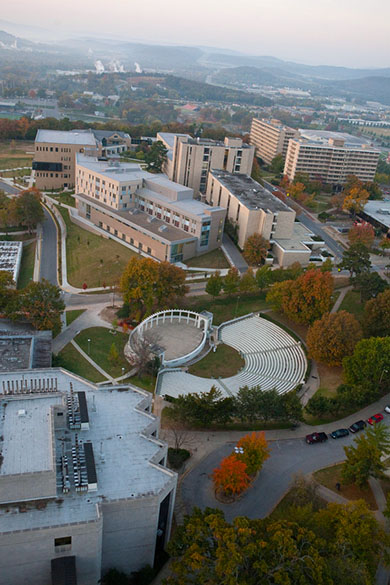
The University of Arkansas at Little Rock is a metropolitan research university that provides an accessible, quality education through flexible learning and unparalleled internship opportunities. At UA Little Rock, we prepare our more than 11,000 students to be innovators and responsible leaders in their fields. Committed to its metropolitan research university mission, UA Little Rock is a driving force in Little Rock’s thriving cultural community and a major component of the city and state’s growing profile as a regional leader in research, technology transfer, economic development, and job creation.

Academics

Nursing studentsUA Little Rock students get to learn from the best professors around in classes that are as engaging as they are rigorous. Coursework blends critical thinking with real-world experience, providing a springboard for internships and later careers in such in-demand fields as nursing, engineering, data quality, criminal justice, and education. The university offers more than 60 undergraduate programs and more than 40 graduate programs.

U.S. News and World Report has recognized the William H. Bowen School of Law’s legal writing program as one of the nation’s Top 10, the College of Business among the top tier business schools in the country, and the George W. Donaghey College of Science, Technology, Engineering and Math’s systems engineering program as one of the best in the South.

UA Little Rock nursing students have the advantage of one of the country’s top state-of-the-art simulation hospital, known as SimCare. It’s a 22-bed, high fidelity hospital, training students in all areas of care as they work with interactive manikins that simulate a variety of medical-surgical scenarios.

Applied Design, a UA Little Rock program to study contemporary studio craft such as ceramics, metalsmithing and jewelry, and furniture design and woodworking is the only degree program of its kind in the state and one of a very few accredited programs in this specialty.

The UA Little Rock Department of Criminal Justice houses the largest criminal justice program in the state and offers the only Ph.D. criminal justice program in Arkansas. The department’s Senior Justice Center is one of only a few student intern programs in the country that directly addresses crime against the elderly.

Research

ResearchWhether it’s building a better tomato or looking into cancer treatments, students get an opportunity to work alongside faculty, putting their knowledge to use in UA Little Rock’s state-of-the-art research facilities. Additionally, they are tackling big data for businesses and curating historical collections for the world to see.

UA Little Rock is a regional leader in using and teaching advanced technology in areas such as nanotechnology, information quality, and emerging analytics.

UA Little Rock is a leader in the preservation and dissemination of Arkansas history through the alignment of the Department of History, the Master of Arts in public history program, and the Center for Arkansas History and Culture. Collections 88,000 archival papers, images, and books, including those of five Arkansas governors, provide a wealth of research opportunities.

Campus

Campus campaignThe UA Little Rock community embodies the Trojan spirit, which can be seen in the numerous acts of giving and outreach that take place on campus and beyond.

UA Little Rock reached a milestone two years ago during its first comprehensive fundraising campaign when an overwhelming number of businesses and individuals from central Arkansas and beyond raised more than $100 million.

UA Little Rock was the first Arkansas university recognized by the Carnegie Foundation for the Advancement of Teaching for the elective classification as a Community Engaged institution.

University of Arkansas


ABOUT

The University of Arkansas is one of the nation’s top public research universities. Our ideas, solutions and collaborations make communities and economies stronger. The opportunities and skills we provide make lives better. We envision a better world and we’re determined to build it.

THE U OF A

That \’students-first\’ philosophy is a big reason why the U of A is consistently ranked among the nation\’s top public research universities and best values. We work hard to ensure a low student-to-faculty ratio that promotes plenty of personal attention and mentoring opportunities. The Carnegie Foundation classifies the university as having \”the highest possible level of research,\” placing us among the top 3 percent of colleges and universities nationwide.

Founded in 1871 as a land-grant institution, the University of Arkansas is the flagship of the University of Arkansas System. Our 27,000 students represent all 50 states and more than 120 countries. The U of A has 10 colleges and schools offering more than 210 academic programs. The University of Arkansas is accredited by the Higher Learning Commission.

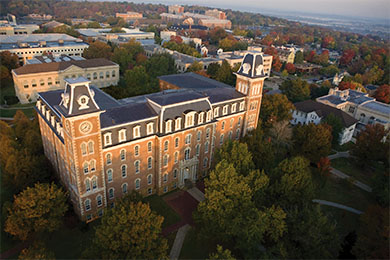
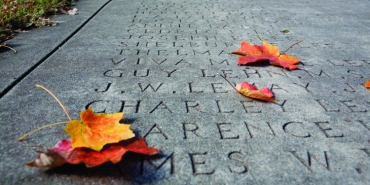
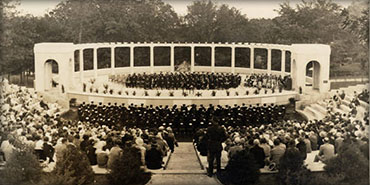
Our picturesque campus is located in Fayetteville in the hilly northwest corner of Arkansas and includes two arboreta overlooking the Ozark Mountains. Some of the nation’s best outdoor amenities and most spectacular hiking trails are within a short drive of campus. Fayetteville is routinely considered among the country’s finest college towns, and the surrounding Northwest Arkansas region is regularly ranked one of the best places to live in the U.S.

Old Main

Visitors Guide

VISITORS GUIDE

Welcome! This handy guide provides information about the campus and community including what to see and where to eat in one of the nation’s best places to live.

Quick Facts

QUICK FACTS

Key facts, figures, and some interesting trivia. For instance, did you know Bill and Hillary Clinton began their careers by teaching law at the U of A?

History

HISTORY

Learn more about the university as we approach the 150th anniversary of its founding in 2021.

OUR MISSION

The University of Arkansas is determined to build a better world by providing transformational opportunities and skills, promoting an inclusive and diverse culture, nurturing creativity, and solving problems through research and discovery, all in service to Arkansas.

Since 1871, our fundamental purpose as a land-grant institution and state flagship remains unchanged — to serve the state of Arkansas as a partner, resource and catalyst by:

  • Providing access to a comprehensive and internationally competitive public education, and fostering student success across a wide spectrum of disciplines.
  • Utilizing research, discovery and creative activity to improve the quality of life, develop solutions to the challenges we face and drive the state\’s economy.
  • Contributing service and expertise through outreach, engagement and collaboration.

Our mission provides a broad outline of the work required to achieve our vision – that the University of Arkansas represents the best of public higher education, advancing Arkansas while building a better world.

A campus-wide, collaborative effort led by Chancellor Joe Steinmetz resulted in eight Guiding Priorities and measurable goals that provide direction for the university’s Strategic Plan. This roadmap for our future is articulated through unifying themes that describe who we are, what we do and why it matters.

OUR VALUES

We are guided by our mission to advance Arkansas while building a better world. Our core values help frame a desired culture that best supports that mission. We value:

Curiosity

Curiosity drives progress – the need to know more, understand better, ask questions and find answers. We embrace the challenges that come with exploring the unknown and seeking solutions to problems shared by all. This intellectual curiosity feeds our determination to improve lives through discovery, innovation and the expansion of knowledge.

Creativity

We are inspired by the art, music, literature, architecture and other creative works that enrich our lives. But creativity is not limited to the arts and humanities; it is no less important to the sciences, driving innovation and new technologies. A creative environment stimulates original thought, varied perspectives and new ways of looking at things. Creative people and approaches lead to new ideas, improved outcomes and other valuable contributions that make our lives better.

Character

We value personal integrity and the related behaviors that make us better people, collectively strengthening our community and society. We strive to be trustworthy, to lead by example, to get better every day and to have a positive impact on others. We cultivate a culture of honesty, fairness, respect and understanding. We are accountable to ourselves, each other and the publics we serve.

Our Shared Humanity

We care about the safety, health and well-being of those around us. We support an open exchange of ideas and respect the unique perspectives and contributions that each of us provides. As a community of individuals, our diversity is our strength. We help nourish an inclusive environment where equity, opportunity, representation and civility are valued. Respecting our differences creates better understanding of our shared humanity, the foundation of our mission to build a better world.

COLLEGES & SCHOOLS

Colleges and Schools

Dale Bumpers College of Agricultural, Food and Life Sciences
The Bumpers College prepares leaders for careers that matter – in areas of food, family and the environment. The business of foods, healthy families, quality of life, the stewardship of our environment, the impact of foods on health and a positive self-image affect everyone. The School of Human Environmental Sciences is a part of Bumpers College. 

Fay Jones School of Architecture and Design
The Fay Jones School of Architecture and Design offers architecture, landscape architecture and interior design education, with the architecture program ranked among the nation\’s top 10. The renovation of our historic home and the addition of a modern design center provide an opportunity for collaboration in a world-class facility.

J. William Fulbright College of Arts and Sciences
Fulbright College is the largest and most diverse academic unit on campus with 19 departments and more than 30 academic programs and research centers. The college provides the core curriculum for all  University of Arkansas students and is named for J. William Fulbright, former university president and longtime U.S. senator. The School of Social Work, The School of Art, and the School of Journalism and Strategic Media are all a part of Fulbright College.

Sam M. Walton College of Business
Founded in 1926, the Sam M. Walton College of Business currently ranks among the top business schools in the nation. The Walton College combines outstanding academic programs in a number of disciplines with a wide range of experiential learning to help students connect world-class scholarship with real-world business practice.

College of Education and Health Professions
The College of Education and Health Professions focuses on two very important areas – education and health – with disciplines as diverse as teaching, nursing, community health promotion, human resource development, kinesiology, recreation and sport management, and communication disorders. Students gain hands-on experience and work with faculty on research in these fields. The college includes the Eleanor Mann School of Nursing.

College of Engineering
The most comprehensive engineering program in Arkansas, the College of Engineering offers ABET-accredited bachelor\’s degrees, plus master\’s degrees and doctorates. With over 100 labs and a dedicated, supportive faculty, the College of Engineering provides an environment of exploration and innovation.

Honors College
Our endowed Honors College unites the university\’s top undergraduate students and professors from all disciplines in a learning environment characterized by discovery, creativity and service. Honors students enjoy small, in-depth classes, priority registration, special housing and enhanced opportunities for hands-on research and study abroad.

Global Campus
The Global Campus supports the development and delivery of online, distance and professional education offerings. The University of Arkansas ONLINE is your portal for online and distance education programs and courses. High-quality teaching combined with technology gives students flexible, robust academic options, backed by the university\’s strong student support system.

Graduate School and International Education
The Graduate School and International Education is the home for all graduate students and all international students, both graduate and undergraduate, and all students seeking an educational experience abroad. Our vision, mission and goals encompass our dedication to the recruitment, admission, retention and graduation of students from Arkansas and across the U.S. and the world, as well as our service to the University of Arkansas.

School of Law
The School of Law, a National Jurist top 15 value in legal education and among U.S. News and World Report\’s top 36 public law schools, prepares students for success. The law school offers challenging courses taught by outstanding faculty, unique service opportunities and a community that puts law students first.

ADMINISTRATION

Office of the Chancellor
Joseph E. Steinmetz became the sixth chancellor of the University of Arkansas on January 1, 2016. Find out more about Chancellor Steinmetz, his administration and staff, and other key communications from this office.

Academic Affairs
The Division of Academic Affairs works to enhance the university\’s excellence in instruction; research; outreach and public service; and student affairs; and is responsible for academic planning and budgeting, faculty development and promotion, and academic initiatives.

Enrollment Services
Enrollment Services seeks to enroll and graduate a diverse group of capable students who will engage fully in academic and service programs, develop intellectually and personally, and contribute to the campus, the state, and the global community. To assist students in achieving their academic and career goals, the Enrollment Services Division offers support in academic success, admissions and orientation, financial aid and scholarships, nationally competitive awards, registrar, and UAConnect.

Finance and Administration
The Division of Finance and Administration provides services that enable the university to support its learning mission. Services provided include maintenance of facilities, information technology systems, financial services, purchasing, budgeting, financial reporting, operation of business services, protection offered by the University Police, and human resources.

Student Affairs
Ensuring every student\’s success is the focus of the Division of Student Affairs. Students benefit from multiple support services, programs and initiatives focused on community engagement, activities and entertainment, standards and conduct, Greek life, student media, housing, dining, mental and physical health, and career development.

University Advancement
The Division of University Advancement builds understanding and support for higher education in three key ways: enhancing the university\’s image by communicating the accomplishments of our outstanding students and faculty while highlighting special points of pride; involving alumni and other constituencies in proactive functions and raising private gift support. The division includes the Arkansas Alumni Association, and the offices of University Development, University Relations, Donor Relations and Special Events, and Central Arkansas Regional Advancement.

Governmental Relations
Coordinating university activities related to government and community organizations on a local, state and federal level is the focus of the Governmental Relations office. Locally, the office works with Chambers of Commerce and other community groups. At the state level, the office handles legislative issues and assists faculty and staff with issues involving state agencies and offices. The office also works with our congressional delegation on the university\’s priorities for federal initiatives.

Diversity and Inclusion
The Office for Diversity and Inclusion is responsible for enriching campus diversity and inclusion, one of the university’s top priorities. More inclusive and diverse learning environments yield better learning and productivity outcomes for all students, staff, faculty and even our community. To help the university develop and sustain a more diverse, inclusive environment, the office provides guidance, support and leadership for initiatives, policies and programming and other strategic efforts designed to support the university’s academic mission. The office collaborates with units across campus as well as external stakeholders to achieve this important work.

Economic Development
The Office of Economic Development directs and coordinates the university’s campuswide efforts to expand economic opportunities and improve quality of life in Arkansas and beyond. The office is responsible for assessing, increasing and communicating the university’s economic and social impacts. The office collaborates with colleges, schools and administrative units across campus to maximize the university’s influence on quality of place, economy and social betterment.

Research and Innovation
The Carnegie Foundation for the Advancement of Teaching classifies the University of Arkansas among those with the “highest research activity.” The Office of Research and Innovation is responsible for growing the university’s research program, developing and improving research infrastructure and capacity, and energizing innovation. The office also oversees research administration and compliance, optimization of research space and equipment, interdisciplinary research centers, undergraduate research and the University of Arkansas Press.

See our complete organizational structure.

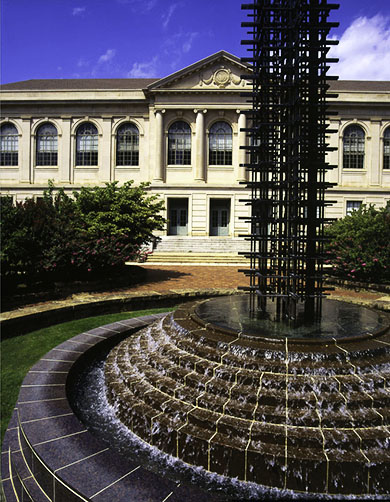
Fulbright Fountain

University of Central Arkansas

 Welcome to the University of Central Arkansas, located in the heart of the state. Here at UCA, students can experience city life while enjoying the quaint downtown feel of home. We\’re currently in front of Old Main, a beloved landmark in the heart of campus that houses classrooms and Ida Waldran Auditorium. Old Main has been host to many significant people and events, including a vocal concert by President Harry Truman\’s daughter, Margaret, and presentations by President Gerald Ford and President Bill Clinton. It is the oldest building on campus and has been a vital part of UCA since it was built in 1919. Before we get started, let me explain the many ways in which you can explore our beautiful campus: – You can click on the front facing arrow to start walking around our campus – You can jump to the next stop by clicking on the \”Next\” button – Now, if you already know where you want to go, you can select any location by using the list or by clicking directly on the map – Lastly, remember that you can explore any particular location in more detail by clicking on the 360, photos, or video icons.

You are now on the 3rd point on the Welcome Old Main trail coming from Old Main on your way to Reynolds Performance Hall.You are now on the 5th point on the Welcome Old Main trail coming from Old Main on your way to Reynolds Performance Hall.You are now on the 7th point on the Welcome Old Main trail coming from Old Main on your way to Reynolds Performance Hall.You are now on the 9th point on the Welcome Old Main trail coming from Old Main on your way to Reynolds Performance Hall.You are now on the 11th point on the Welcome Old Main trail coming from Old Main on your way to Reynolds Performance Hall.

Books on Indian History which You Must Read

Indian History has been the theme for many books. Whether its fiction or non-fiction, there are plenty of books which deserve to be on the list of must-read books written on the topic of history. These books give one a detailed understanding of India’s history.

Be it comprehensive historical books or fictional accounts of a historical incident, there are many options for you to choose from. If you are a person who loves both reading and history then the following 5 books are just the right choice for you.

The Argumentative Indian by Amartya Sen

Amartya Sen is an Indian Economist and writer who had won the Nobel Prize in 1998. This book is a collection of essays and it will help one understand the Indian polity. It focusses on the importance of public debate, argument and intellectual diversity in the Indian civilization of the past. Sen writes about his view on how and what will lead to the success of democracy in India.

India After Gandhi by Ramachandra Guha

Ramachandra Guha is an Indian writer and researcher whose areas of interest include society, politics and history. India After Gandhi is a book describing the journey of modern India, from post-independence from the British in 1947 until the 1990s. The book will provide one with a thorough understanding of India’s social and economic spheres. It covers the country’s political history over the later part of the 20th century.

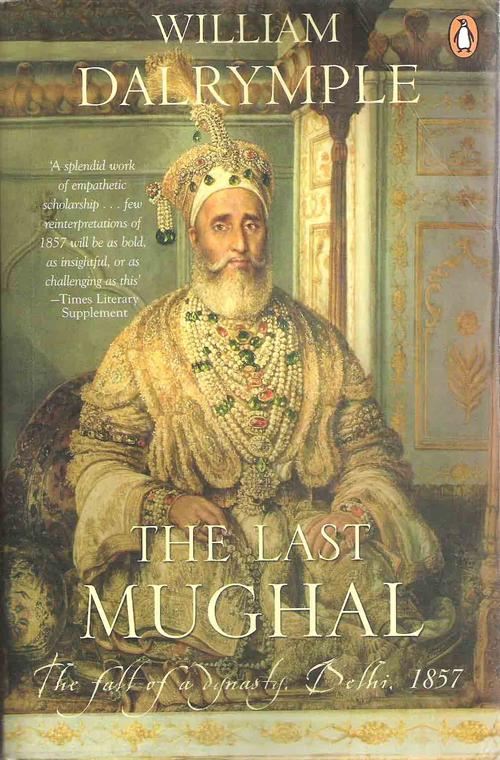
The Last Mughal by William Dalrymple

William Dalrymple is a Scottish historian, writer, critic, art historian and curator. He has won several awards and prizes for his writings. The book is a comprehensive description of the time period when the Mughal empire started declining in India. It will be a treat for people who love reading history. It is about the last Mughal ruler, Bahadur Shah Zafar II, and it provides an account of 19th century India with the tale of the emergence of the British Raj. Another famous book by him is White Mughals which is his fifth major book, it tells the story of the love affair between James Achilles Kirkpatrick and Khair-un-Nissa Begum at the backdrop of nineteenth century Hyderabad.

The Discovery of India by Jawaharlal Nehru

Jawaharlal Nehru was India’s first prime minister and he wrote this from 1942 – 1946. This book was written by Nehru when he was imprisoned by the British. It is a tribute to the rich cultural heritage and legacy of the country. It provides an account of all major developments in the subcontinent from the period of Indus Valley Civilization to the last years of the British rule.

The Palace of Illusions by Chitra Banerjee Divakaruni

Chitra Banerjee Divakaruni is an award-winning writer, novelist and poet. The book is about the tale of the epic Mahabharata, written from the perspective of Draupadi (Panchaali). It tells the story of the woman who fights, endures a lot living in a patriarchal world. It is a historical fiction which traces the historical tale and the life of Panchaali.

Orissa HC Bats For No Tolerance Approach In NDPS Cases

In a recent, remarkable and righteous decision titled Bikash Duria vs State of Orissa in Case No. – BLAPL No. 2464 of 2020 delivered on August 20, 2020, the Orissa High Court minced no words to state in simple, straight and suave language that, “Instances of drug abuse is required to be dealt with a strict ‘hard on Crime’ attitude.” It was made clear that the NDPS cases should always be dealt with stricter approach of ‘No Tolerance’! Justice SK Panigrahi of Orissa High Court who delivered this noteworthy judgment observed that despite strict provisions, the recorded crime rate under the NDPS Act has increased in the country more during the last ten years! 

                                         To start with, the ball is set rolling by first and foremost after noting at the outset that, “In view of extraordinary situation arose out of COVID-19 lockdown, the matter is taken up through video conferencing” and then observing in para 1 that, “ ‘Drug addiction is like a curse and until it is broken, its victim will perpetually remain in the shackles of bondage’ aptly put by Oche Otorkpa while articulating the danger of the issue at hand and its ripple effect. The furtive smuggling and trafficking of drugs linked it to a host of social ills, including involvement in crime, destabilization and decline in family relationship, kinship, neighbourhoods etc. More importantly, it has resulted in rampant substance abuse by the youth. The Parliament has passed the NDPS Act with an objective to arrest the menace by making the deterrent effect more stringent so that the guilty is appropriately punished. The said Act seeks to control both the demand and supply of drugs by criminalizing production, trafficking and use. It prohibits the manufacture, production, possession, consumption, sale, purchase, trade, use, import and export of narcotic drugs and psychotropic substances, except for medical or scientific purposes. The Judiciary is also saddled with the responsibility of strictly adhering to the law so that the traffickers of drugs do not go unpunished and the growth boom of trafficking is checked. The trafficking and smuggling have flared sporadically in the recent years transcending the geographical boundaries. The case in hand typifies this alarming trend. The petitioner herein has filed the instant application under Section 439 of Cr.P.C seeking bail in connection with Bolangir Sadar P.S. Case No. 24 of 2020 corresponding to Special G.R. Code No. 10 of 2020 pending in the court of the learned Sessions Judge-cum-Special Judge, Bolangir. The petitioner herein is the accused in connection with alleged commission of offences punishable under Sections 21(c) and 29 of the NDPS Act.”  

                                       While dwelling on the facts of the case, it is then stated in para 2 that, “The case of the prosecution presents a distinct case of transportation of drugs under the guise of medicinal products. In fact, the renewed focus on narcotis by the enforcement authorities has resulted in shifting of the focus by the traffickers towards Pharmaceutical drugs like the present one. On 17.01.2020, Jhasketan Bhoi, S.I. of Police, Sadar P.S., Bolangir detained two vehicles bearing Registration Nos. OD-03-P-2651 and OD-26-C-9693 occupied by five persons loaded with huge quantity of cough syrup. Ashok Leyland Pick Up and Mahindra TUV 300 plus were carrying 3840 and 1120 bottles of sealed Eskul Cough Syrup. A total of 5920 bottles containing 1 kg 184 gms of Codeine Phosphate which is more than the commercial quantity were recovered. The occupants of the vehicles failed to produce any invoice, license or authority in support of possession of Cough Syrup bottles. The police further submitted that the accused confessed of not carrying any drug license and the cough syrups were sold to different customers for the purpose of intoxication rather than for therapeutic use which leads to apparent fillip in the drug trade.”

                                     To put things in perspective, it is then pointed out in para 4 while dwelling on the ill effects of drug addiction that, “Drug addiction is a complex illness with far reaching consequences for those who know, work with, and support the drug-addicted individual. Families suffer due to cultural and social factors of drug behavior, including their own understanding of the disease process and the addict’s behavior due to drug abuse; draining of family resources, shrinking from responsibilities, sickness, and dysfunctional relationships, distortion of interpersonal family relationships, violence and death faced or a consequence of drug abuse. The cost of drug abuse is enormous and multifaceted which poses severe threat to the social fabric of the country. Ergo, instances of drug abuse is required to be dealt with a strict ‘hard on Crime’ attitude. Realising the danger of the present menace, the Apex Court has iterated that taking a liberal approach is uncalled for while exercising the power to grant bail in cases under the Narcotics Drugs and Psychotropic Substances Act (NDPS Act). The plea for bail under Section 439 of CrPC should be read with Section 37 of the NDPS Act. Section 37(1)(b)(ii) provides that where the Public Prosecutor opposes the application, the court should grant bail only when it is satisfied that there are reasonable grounds for believing that the accused is not guilty of such offence and that he is not likely to commit any offence while on bail.”

                                 To put it succinctly, it is then further pointed out in this same para 4 that, “As iterated in the recent case of State of Kerala and Ors. vs Rajesh and Ors. AIR 2020 SC 721:

“20. The scheme of Section 37 reveals that the exercise of power to grant bail is not only subject to the limitations contained under Section 439 of the Code of Criminal Procedure, but is also subject to the limitation placed by Section 37 which commences with non-obstante clause. The operative part of the said Section is in the negative form prescribing the enlargement of bail to any person accused of commission of an offence under the Act, unless twin conditions are satisfied. The first condition is that the prosecution must be given an opportunity to oppose the application; and the second, is that the Court must be satisfied that there are reasonable grounds for believing that he is not guilty of such offence. If either of these twin conditions is not satisfied, the ban for granting bail operates.  

21. The expression “reasonable grounds” means something more than prima facie grounds. It contemplates substantial probable causes for believing that the Accused is not guilty of the alleged offence. The reasonable belief contemplated in the provision requires existence of such facts and circumstances as are sufficient in themselves to justify satisfaction that the Accused is not guilty of the alleged offence. In the case on hand, the High Court seems to have completely overlooked the underlying object of Section 37 that in addition to the limitations provided under the Code of Criminal Procedure, or any other law for the time being in force, regulating the grant of bail, its liberal approach in the matter of bail under the NDPS Act is indeed uncalled for.”” 

                                 While citing the relevant case law to underscore the seriousness of the drugs crime, it is then pointed out in para 5 that, “The Supreme Court in the case of Union of India v. Ram Samujh and Ors. 1999 (9) SCC 429 outlines some grave reasons while rejecting a bail application in connection to an offence committed under the NDPS Act:

“7. It is to be borne in mind that the aforesaid legislative mandate is required to be adhered to and followed. It should be borne in mind that in a murder case, the accused commits murder of one or two persons, while those persons who are dealing in narcotic drugs are instrumental in causing death or in inflicting death blow to a number of innocent young victims, who are vulnerable; it causes deleterious effects and a deadly impact on the society; they are a hazard to the society; even if they are released temporarily, in all probability, they would continue their nefarious activities of trafficking and/or dealing in intoxicants clandestinely. Reason may be large stake and illegal profit involved.”

The rigour of section 37(1)(b)(ii) of the NDPS Act in regards to the rejection of bail in the matters where the transportation of drugs was of commercial quantity has been provided in plethora of cases by the Supreme Court, especially, in Union of India Vs. Ram Samujh and others (1999) 9 SCC 429 and Union of India Vs. Shri Shiv Shankar Kesari (2007) 7 SCC 798.”    

                                           Be it noted, it is then enunciated in para 6 that, “Adverting to the facts involved in the present case, Codeine as previously categorised under Schedule H of Drugs and Cosmetics Act which is considered to be extremely harmful and addictive to the human body. It is a derivative of opium and is considered less potent in terms of analgesia and sedative effects than opium. However, over-the-counter (OTC) opioid counter (OTC) opioid abuse, including codeine, has been a growing problem across India. Although the majority of the abusers use it for recreational purposes, many become dependent on it after having used it as medication for pain or cough. Unfortunately, some people choose to misuse codeine to get feelings of elation and euphoria. Possible long-term consequences of codeine abuse include frequent over sedation, a risk of overdose, chronic constipation, sexual dysfunction, low sex drive, and disrupted menstrual cycles. When someone becomes addicted to the drug, it can have serious consequences on his health, finances and relationships. Codeine abuse has markedly been on rise in the state and significantly large number of commercial quantity cases entering the criminal justice system.” 

                                Briefly stated, the key point that para 7 states is that it points out that, “The law laid down by the4 Hon’ble Apex Court in Mohd. Sahabuddin & Anr Vs. State of Assam 2012 (10) SCALE 77 (supra) has been very categorical about the stricter approach by the Court while granting bail in the cases of substance abuse, whereby recovery of cough syrup containing Codeine Phosphate in bail matter was found to be sufficient ground to reject the bail application.”

                                  Needless to say, it is further pointed out in this same para 7 that, “The said precedence has been followed by several High Courts including Rajasthan High Court in the case of Gavranjeet Singh alias Gavrana vs State Criminal Misc. Bail No. 3790/2017 wherein it was iterated that merely because the recovery is of small quantity, as defined in the Schedule, the benefit of bail cannot be granted to the present petitioners.”

                          More significantly, it is then acknowledged in para 8 that, “While strict liability provisions of the NDPS Act are considered deterrent, application of these provisions has not resulted in high punishment. Despite strict provisions, the recorded crime rate under the NDPS Act has increased in the country more during the last ten years. It is also equally disturbing to note that there is a disparate sentence in such kind of cases which is quite contrary to the notion of graded punishment prescribed under the law, as similar drug quantities witness varying degree of sentences. The lack of uniform sampling procedures adds to the overall inconsistency in sentencing for drug cases, more especially in pharmaceutical drugs like of cough syrup containing Codeine Phosphate. This kind of ambiguity in the application of the law with regard to most drug abuse cases in the country still persists. As a negatively defined category, intermediate quantity cases receive disparate sentences, due to the wide range of punishments available to a judge together with a lack of sentencing guidelines. This sort of inconsistencies problematises and affects the conviction rate in such crimes. But this case presents a clear picture of recovery of commercial quantity.”

                              Finally and far most importantly, we then see that without mincing any words it is then observed in para 9 that, “However, on the basis of doctrine of parity, wherein  a co-accused, who was charged under similar offences, has been granted bail by the Court, the other co-accused shall also be entitled to bail. The Allahabad High Court in Yunis And Anr. vs. State of U.P. (1999 CriLJ 4094) while relying on Nanha v. State of U.P. (1993 CriLJ 938) held that:

“5. …….. where the case of co-accused is identically similar and another co-accused has been granted bail by the Court, the said co-accused is entitled to be released on bail on account of desirability of consistency and equity. As regards the principle of parity in matter of rejection of bail application, it may be observed that law of parity is a desirable rule.”

In the said case the bail was granted merely for the sake of judicial consistency and propriety. Nonetheless, this court wishes to clarify that the NDPS cases should always be dealt with stricter approach of ‘No Tolerance’. In the instant case, this Court is painstakingly deviating from its “No-tolerance approach” because of the fact that the co-accused who was placed quite worse than the present Petitioner has been enlarged on bail. Thus, the present bail application is allowed solely on the basis of parity.”

                                  In essence, the long and short of this latest, landmark and laudable judgment is that there has to be zero tolerance approach for drug cases. We have seen why in this case the Orissa High Court was compelled to give bail to the petitioner on the ground of parity. Justice SK Panigrahi could not hide his deep anguish while granting bail in this case! There can be no denying or disputing that to effectively check and combat drug related crimes, there has to be zero tolerance for all such crimes and no bail should be given in such cases! 

Sanjeev Sirohi, Advocate,

s/o Col BPS Sirohi,

A 82, Defence Enclave,

Sardhana Road, Kankerkhera,

Meerut – 250001, Uttar Pradesh

Life And Education

Life is too beautiful dear friends, life is the biggest university and we have to educate ourselves from it. Life teaches us tiny minute things which Eben education doesn’t teach us. But we cannot ignore education. Life without education is like a life without Charecter. Education brings meaning to life.

A person’s perspective towards life is motivated through education which he or she gains over a period of time. Education has always been a key in bringing a change in one’s life. Education should be for enlightenment of life to make it more perspective and meaningful.

Likewise, Education plays s great role in life. Getting education is very necessary to get great success and happy life. It’s just like food is necessary for healthy body. It’s very important to live a luxurious and better life. Education develops the personality of peoplez provides physical and mental standards and promoted people’s living status. It promotes social well-being for a better life.

The more knowledge we get, we grow and develop in life. Being well educated does not mean for certificate and for s good salary, education should be fired life. Education makes us good thinkers and decision makers but life teaches us to handle the situation. Education Judy gives us knowledge: life gives us a practical knowledge. Life teaches beautiful lessons in each situation. Education should not be making money instead should be man making.

Nature is a good teacher. Education is a never ending process. Learning process continues throughout our life. For s better life we have to get good education. Not only what we learn in school that matters because we have many examples who are not educated from great university have got biggest success in life. It might be Bill Gates or Steve Jobs etc,. As Einstein says, “Not that everything counts can be counted and not everything that counted truly counts….. I retreat.”

To lead a great and successful life let us enjoy each and every situation of life. See friends, when you are educated you can educate others which is as good as giving life to others. Education always guides a person to face day-to-day challenges. It’s only asset which cannot be stolen by others. So let us start to learn from small-small things in life.

There are people who made life out of education there are others who have made their life as material for education. So life and education go together hand-in-hand. The journey by the way, birth and death is called life. Ironically we know something about birth and death, from education we are failing to understand what is life. That’s why few question keep coming like is this life? This is how we should live?

Some say life is like a river. If that is so education should be the rain. So the river of life can flow only when there is rain of education or the life may dry up soon.

At last, “Ano bhadraha krutavoyantu vishwataha” which means let all good thought and deeds come to us from every nook and corner of the world.

Let us get education and lead a good life….

SCHEMES IN CHATTISGARH ON RAJIV GANDHI’s BIRTHDAY

RAJIV GANDHI KISAN NYAY YOJANA

  • SECOND INSTALLMENT OF RS.1500 CRORES THROUGH DBT IN TO THE ACCOUNTS OF FARMERS .
  • 19 LAKH FARMERS OF CHATTISGARH TO BE BENIFITTED FROM PADDY , MAIZE AND SUGARCANE.
  • SUM OF 5750 CRORES TO BE TRANSFERRED IN TO THEIR ACCOUNTS .
  • ON 21st MAY 2020 , THE FIRST INSTALLMENT OF RS1500 CRORES TRANSFERRED IN TO THE ACCOUNTS .

GODHAN NYAY YOJANA

  • IN THE SECOND INSTALLMENT , PAYMENT OF RS 4.5 CRORES
  • THERE IS PURCHASE OF COW DUNG FROM 4341 GOTHANS , STATE HAS REGISTERED 101919 CATTLE REARERS AND 76426 BENIFICIARIES .
  • FROM 20th JULY TO 15th AUGUST , 3 LAKH QUINTALS DUNG WAS PURCHASED
  • CHATTISGARH IS THE ONLY STATE IN THE COUNTRY WHO IS MONETIZING COW DUNG .
  • THE SALE OF VERMICPOST TO THE FARMERS FOR THE GOOD QUALITY MANURE TO THE FARMERS AT RS 8/KG.
  • THE MAIN FOCUS IS ON GENERATING EMPLOYMENT OPPORTUNITIES AND BOOSTING THE RURAL ECONOMY .

INCENTIVE REMUNERATION FOR TENDUPATTA COLLECTORS

  • THIS SCHEME INVOLVES DISBURSEMENT OF 233 CRORES TO 1146626 TENDUPATTA COLLECTORS .
  • THE COLLECTION HAS INCREASED IN STANDARD BAG OF THIS SCHEME FROM RS 2500 TO RS 4000 PER STANDARD BAG .
  • MOREOVER , IT IS GOOD TO SEE THAT THE NUMBER OF ” MINORFOREST PRODUCE ” PURCHASED AT THE SUPPORT PRICE WHUCH HAS INCREASED FROM RS 7 TO RS 31 .

THEESE SCHEMES ARE RIPENING THE AGRICULTURAL SECTOR INCREASING THE YEILD WHICH IS CONTRIBUTING IN GROWTH AND DEVOLOPMENT IN OUR COUNTRY . THE NEW POLICIES ARE COMING WITH ORGANIC METHODS WHICH IS MAKING IT SELF RELIANT .

ONLINE CLASSES : ONLY CONS

Those were the days when we all used to go to the college or schools through metro and bus , tasting every corner of the life . That happiness of chasing the bus just because we are getting late for the classes , still get late in the class . The adventure of travelling with sudden jolts in the bus has another important role in our journey . we used to go to college , meet and greet with our friends , enjoy and work on ourselves by participating in diffrent societies , physically . A wonderfull journey , it is . But , this covid -19 has ruined all the plans and everything has transformed from offline mode to online mode . At first , we all were excited to study through online classes as we are relieved from our hectic schedule and can do work just by sitting at home . But , it is not like that , rather it has increased more stress and anxiety in us , which is not good for our health.

The online mode is making us sit in front of our phone and laptop early in the morning as everything is work from home. Anxiety has increased among the people of every age and we have become lazy , a bad news it is . It is impacting on our eyes and causing us headache . We have to bow down in front of this situation as its about our life . It is giving us back aches . In my opinion , yes it is a smart move in this time but a reliable move .

The work is easy for teachers as they teach us using PPT’s and our doubts remained uncleared . Earlier , teachers were not used to put efforts and take the classes regularly , but , now classes are also happening regularly as it is really easy for them , not much efforts required for them to put in . The classes are not fruitful for us , as it is creating blur in our minds for most of the topics . On the other hand , the situation demands this kind of studying , at least we are studying.

I pray for the situation to get normal as soon as possible so that we can study they way we used to , with much more clarity.

Manufacturing in India

As India aims to become a top manufacturing hub, Indian is on the threshold of major reform. India is poised to rank among the tip three manufacturing locations by 2020. In light of India’s launch of the Make in India initiative (MIII) aimed at transforming the country into a global manufacturing hub. India is a vast country in South Asia in terms of population and geographical area – the second most populated country, after China, with an area about one-Third that of China. However, it’s per-capita income is about one-fifth of China’s, ensuring a good supply of low-cost labor for it’s manufacturing sector over the medium to long term. Labor supply know India is abundant in major manufacturing states. A booming Indian economy has helped create a strong demand for labor, with growing job opportunities in first – and second tier Indian cities including persistent rural-to-urban and inter-state migration. In India, lots of manufacturing occurs in the informal sector, which typically covers cottage household and village industries in areas such as handlooms, handcrafts and agriculture. In compassion, manufacturing in a factory setting and employing more than 10 people pertains to the organized employment sector, which I’d governed by the minimum wage law. Minimum wage standards in India are complex.

During the past decade, the Indian economy focused on services rather than manufacturing India is focusing on the development of its infrastructure, increasing and/or tailoring it’s talent pool to the needs of the manufacturing industry, attacking investment through aggressive foreign direct investment initiatived and increasing the ease of doing business through legal and tax reform.

Below is a brief description of the major manufacturing hubs in India. Although all of the areas discussed below need significant infrastructure, including roads, rail, airports I and power and water improvements, most are already attracting significant investment, which will increase their manufacturing power and capacity.

Greater Noida (Uttar Pradesh) is India’s best auto manufacturing hub. It’s location and Connectivity, on the outskirts of New Delhi and consistent supply of resources have attracted big international companies such as Yamaha, Honda Del cars and LG Electronics India.

Nashik (Mumbai) located approximately three (driving) hours northeast of Mumbai, has electrical engineering and auto components industries. This location is well connected to two roads and airstrips but no airport.

Manesar, Haryana (Chandigarh) located about an hour (driving) southwest of New Delhi, is another favoured auto manufacturing hub. It is well connected to roads and railway. Infrastructure reform us underway to increase it’s manufacturing power and capacity.

Hospet (Bangalore) located in South central India approximately five hrs north of Bangalore, is a major steel and iron manufacturing hub. Hospet has recently attracted huge investment that will continue to grow it’s manufacturing power and capacity. Apple recently announced it’s descision to set up a manufacturing plant in Banglore.

The Make in India campaign means the Indian government is putting a high priority and lots of attention on the manufacturing industry, including significant investment and development. This will make an India an even more attractive manufacturing choice. The Indian commercial law system is based on British common law, which is most similar to the US legal system. Although there are some regulatory hurdles, a similar system makes it easier to understand for people from other common law countries. Manufacturing labor is very cheap in India, even compared to China. In 2014 the average cost of manufacturing labor per hour was $92 in India and $3.52 in China. While this cost seems much lower, you have to take into account the extra costs you will incur due to India’s significantly worse and more expensive transportation, power and water costs. India has a huge labour force (nearly 500 million people), which included unskilled workers as well as researchers and engineers, capable of lending cost-effective research and development support to manufacturing operations.

Chosing where to manufacture is an important business decision that requires significant research and consideration.

Dr. Harsh Vardhan inaugurates a 10- Bedded Hospital at NDRF 8th Battalion Centre, Ghaziabad

A modern, durable, portable, fast installable, safe and varying weather compatible 10- Bedded Make-Shift Hospital was inaugurated by Dr. Harsh Vardhan, Minister (S&T, ES and H&FW) at NDRF 8th Battalion Centre, Ghaziabad. The make-shift hospital has been set up by CSIR constituent laboratory, namely, CSIR-Central Building Research Institute, Roorkee in collaboration with National Disaster Response Force (NDRF), Ministry of Home Affairs for demonstration purpose as well as use of NDRF. It would serve the purpose for disaster recovery stage including for use in long pandemic or emergency situation. Dr Shekhar Mande, DG, CSIR; Shri S.N. Pradhan, DG, NDRF ; Dr Gopalakrishnan, Director CSIR-CBRI were among the dignitaries present on the occasion.

Dr. Harsh Vardhan visited various units of the Make-shift hospital, interacted with hospital staff and witnessed Exhibition and Photo Gallery and also the Demonstration on Collapsed Structure Search & Rescue.  Later, he planted a sapling on the occasion as well.

PM greets people on Nuakhai Juhar

The Prime Minister, Shri Narendra Modi has greeted the people on the auspicious occasion of Nuakhai Juhar.

In a tweet, the Prime Minister said, “The special occasion of Nuakhai is about celebrating the hardwork of our farmers. It is due to their efforts that our nation is fed. 

May this auspicious day bring prosperity and good health for everyone. 

Nuakhai Juhar!”

Vice President calls for a national movement to empower women

The Vice President, Shri M Venkaiah Naidu today called for a national movement for women’s empowerment and to ensure that no girl child is left out of school.

While observing that the flagship scheme ‘Beti Bachao, Beti Padhao’ has undoubtedly created a positive impact, Shri Naidu said that much more needs to be done to change the societal mindset.

In a Facebook Post titled “End Discrimination, Empower Women”, Shri Naidu pointed out that with women constituting about 50 percent of India’s population, progress cannot be achieved unless they are given equal opportunities in all spheres, including the political arena. “We need to show in action and in deeds that gender discrimination no longer exists—that should be our goal”, he stressed.

Urging all political parties to arrive at a consensus at the earliest on the long-pending proposal to provide adequate reservation to women in parliament and state legislatures at the earliest, Shri Naidu also emphasized the need for giving equal property rights to women for their economic emancipation.

The Vice President recently released a report- ‘Status of Sex Ratio at Birth in India’ which mentioned that there has not been any change in the sex ratio at birth in India from 2001-2017–the number of girl children born is much less than what is the general or natural norm. It was brought out by the Indian Association of Parliamentarians for Population and Development (IAPPD).

Referring to the report, he said it is an alarming issue that needs to be addressed on a war footing by all the stakeholders—from the society at large to parliamentarians, government, policy makers, opinion leaders, media organizations and various organizations working to empower women.

Urging elected representatives at all levels to draw the attention of people in their respective areas to the alarming aspect of skewed sex ratio, Shri Naidu called upon every citizen to act as a warrior in completely eradicating social evils like dowry system and in eliminating ‘son preference’ mindset.

Stressing the need for rigorous implementation of Pre-conception & Pre-natal Diagnostics Techniques (PC & PNDT) law to bring about a balance in the sex ratio, the Vice President said there should be zero tolerance towards any kind of discrimination or violence against girls and women.

Calling upon the people to collectively declare a war on poverty, illiteracy and other social hurdles coming in the way of building a New India, Shri Naidu wanted every Indian citizen, particularly the youth to join in the Yagna of building a prosperous and happy India where there will be no discrimination of any kind.

Army Sports Institute, Pune awarded with Rashtriya Khel Protsahan Puraskar 2020

Army Sports Institute, Pune was raised as part of Indian Army’s “Mission Olympics” programme on 01 Jul 2001. The aim was to train the vast reservoir of talent in the Army in selected seven disciplines to include Archery, Athletics, Boxing, Diving, Fencing, Weightlifting and Wrestling with an ultimate aim of winningmedals at Olympics. The institute draws its sportsmen from the Army as well as from young raw and proven talent in ‘Boys Sports Companies’ (8-14 years age).

These sportsmen are supported by a team of Foreign, Indian coaches, physical conditioners, specialists in Sports Medicine, Physiology, Psychology, Biomechanics, Statistics and Nutrition.

In Army Sports Institute the sportsmen have been the ‘Centre of Gravity’ and ‘Team ASI’ is constantly inspired by these human bodies endowed with discipline, dedication, determination and devotion. The Institute has made spectacular progress and given an inspired performance in International competitions to include Olympics, Asian Games, Commonwealth Games and World Championships.

Shri Gadkari to lay foundation Stone and inaugurate 35 highway projects worth over Rs 9400 crore in Madhya Pradesh

Union Minister for Road Transport, Highways and MSMEs Shri Nitin Gadkari will lay foundation stone of and inaugurate 35 highway projects in Madhya Pradesh on Tuesday, the 25th of August, 2020. Chief Minister Shri Shivraj Singh Chauhan will preside over the virtual function, to be attended by Union Ministers Shri ThavarchandGehlot and Shri Narendra Singh Tomar, MoSs Shri Prahlad Singh Patel, Shri Faggan Singh Kulaste and Gen (Dr) V K Singh(Rtd), Ministers from the State, several MPs, MLAs and senior officers from the Centre and the State.

These projects for inauguration and foundation laying carry a Road length of 1139 kilometers, involving construction value of over Rs 9400 crore. Paving the way for development of MP, these roads will enhance better connectivity, convenience and economic growth in the State.