INFLATION SHOOTS UP !

I WAS DRINKING COFFE IN THE MORNING WHILE GOING THROUGH THE NEWSPAPER WITH A PLEASANT WEATHER AROUND. BUT , THE NEWS INSIDE IT WAS NOT AT ALL PLEASANT , WE ARE WELL AWARE OF THE ECONOMIC DOWNTURN ,WE ARE FACING. THE SCHOLARS HAVE ALEARDY PREDICTED , IT’S GONNA BE WORSE FOR THE WHOLE WORLD ESPECIALLY FOR INDIA ; AS SHE IS GOING TO FACE THE WORST OF WORST SCENARIOS , GDP IS GOING TO BE AT THE LOWEST , MORE THAN THE YEAR 1947. IT WAS WRITTEN IN THE HEADLINE ‘ INFLATION ACCELARATES TO 6.93% DIMMING CHANCES OF A RATE CUT ‘ , WE HAVE WITNESSED THE VARIATIONS IN THE INFLATION THIS YEAR , HOW IT HAS BECOME AN ICEBERG IN OUR PATH ! . THE INTREST RATES CAN’T BE FURTHER REDUCED AS SAID BY THE RESERVE BANK OF INDIA , THERE IS A LIMMIT TO CUT THE INTRESTS RATES , WE CAN’T MOVE BEYOND THAT LINE.

INDIA ‘s RETAIL INFLATION HAS SHOOT TO THE HUGE PERCENTAGE OF 6.93% , WHICH IS MAJIORILY DUE TO THE RISE IN THE PRICES OF FOOD , WHICH IS TERMED AS FOOD INFLATION . THIS MONSTER HAS GONE BEYOND THE MEDIUM TARGET OF RESERVE BANK OF INDIA FOR THE TENTH MONTH , UPSETTING IT IS . THE FIGURE IN THE JULY WAS 6.15% , BUT , IT IS BEING SAID THAT IT IS HIGHER , ACORDING TO THE FORECASTS IN THE REUTERS POLL OF ANALYSTS . IT WAS RECORDED 6.23% IN THE MONTH OF JUNE . THE FOOD PRICES HAVE CLIMBED UP , DUE TO SUPPLY SIDE DISRUPTIONS. A HIGH JUMP OF 9.62% COMPARED TO THAT OF 8.72% IN JUNE . RESERVE BANK OF INDIA LAST WEEK ANNOUNCED FEW CHANGES IN THE POLICY , UNCHANGING THE INTREST RATES AND CUT DOWN THE REPO RATE BY 115 BASIS POINTS . THE MEDIUM TERM SET BY THE RESERVE BANK OF INDIA FOR INFLATION IS 4% ABOUT WHICH I MENTIONED ABOVE.

INDIA HAS EXPECTATIONS ABOUT THE CONTRACTION OF THE ECONOMY MORE THEN 4.5% IN THIS CURRENT FISCAL YEAR . CORE INFLATION HAS BEEN IN BETWEEN 5.8% AND 5.9%. BUT THE GOOD NEWS IS WE ARE EXPIRIENCING BEAUTIFULL MONSOON THEESE DAYS AND DUE TO THE MONSOON RAINS , AWAITING THE AVERAGE OF 104% FOR LONG TERM IN THE MONTHS OF AUGUST AND SEPTEMBER. THIS IS A SIGN DESIGNATING THE HEAVY AND RICH HARVESTS , ADDING TO OVERCOME THE DAMAGES INCURRED DUE TO THE NOVEL CORONAVIRUS PANDEMIC.

I FEAR FOR THE BALLOON HEADING FOR A BURST !

Rajasthan Assembly Session begins, Ashok Gehlot-led govt to move vote of confidence today

A key session of the Rajasthan Assembly began today. The motion for vote of confidence was presented in the Legislative Assembly on behalf of the State Government, which is being debated in the house. Legislative Affairs Minister Shanti Dhariwal introduced the motion for vote of confidence in the house.
 
Starting the debate, Mr Dhariwal said that today the issue has attracted attention of people of entire state and the country. Speaker Dr C. P. Joshi said that the discussion would be concluded within three hours. It is believed that voting will be take place on the confidence motion by this evening.
 
The house assembled at 11 a.m. and paid tributes to Lalji Tondon, Ajit Jogi and other leaders who recently passed away. After the obituary remarks, the Speaker adjourned the house till 1 P.M. Special seating arrangements were made in the house to maintain social distancing in view of the Corona pandemic.

COVID-19 recovery rate improves to over 71 per cent in country

Total recoveries from COVID-19 in the country today inched closer to touch the two million mark. A total of 17 lakh 51 thousand 555 people have recovered in the country so far. Fifty five thousand 573 recoveries were reported during the last 24 hours. With this, the recovery rate improved to 71.17 per cent in the country. The case fatality rate stands at 1.95 per cent.
 
The Health Ministry said, 64 thousand 553 new cases of COVID-19 have been registered in the country in the last 24 hours taking the total number of cases to 24 lakh 61 thousand 191. Presently, the total number of active cases in the country is six lakh 61 thousand 595. In a single day, one thousand seven deaths were also reported taking the toll to 48 thousand 40.

Country registers record high testing of more than 8 lakh samples for Covid-19 for 2nd consecutive day

India registered a record high testing of more than eight lakh COVID-19 samples consecutively for the second day. The Health Ministry said, India recorded its highest COVID testing figure of eight lakh 48 thousand 728 samples during the last 24 hours. It said, the remarkable feat has been achieved by rigorously following the ‘Test, Track and Treat’ strategy and the country is geared up to reach the testing capacity of 10 lakh tests per day.
 
The Health Ministry said that the strong resolve and determination of the Union Government along with the States and Union Territories to follow aggressive testing as the first important step in the early detection and isolation of COVID-19 cases has resulted in rapidly increasing the number of tests done per day. The week-wise average daily tests conducted has witnessed a sharp increase from around 2.3 lakh in the first week of July 2020 to around seven lakh in the current week.
 
The cumulative testing done so far in the country now stands at two crore 76 lakhs 94 thousand 416 tests. The Tests done per million of the population in the country has also seen a sharp increase to reach nearly 20 thousand.
 
Government said that the strong determinant of this milestone has been a sustained expansion of testing labs across the country. From merely one lab in January this year, the country today has one thousand 451 labs. Out of these, 958 are government labs while the remaining 493 are private labs.

President Ram Nath Kovind to address the Nation on the eve of 74th Independence Day today

President Ram Nath Kovind will address the nation on the eve of the 74th Independence Day today. The address will be broadcast from 7 PM onwards on the entire national network of All India Radio and telecast over all channels of Doordarshan in Hindi followed by the English version.
 
All India Radio will broadcast regional language versions of the President’s Address from 9.30 PM on its respective regional networks. Broadcast of the address in Hindi and English on Doordarshan will be followed by broadcast in regional languages by regional channels of Doordarshan. 

Cashless Economy – Boon and Bane ?

What is a Cashless Economy ?

In a cashless economy most of the transaction will be done by digital means like e banking, debit and credit cards, PoS (point of sales) machines, digital wallets etc. In simpler words no liquid money or paper currency will be used by the people in a given country. In a cashless economy the third party will be in possession of your money. He will allow you to transact that money whenever it is needed. If it is not needed then the third party can use that money. Third party can be a government or any other public or private sector bank.

Positive Impact on Society

We are seeing the impact of cashless economy on the society when it comes to crime rates. According to Union defense minister after demonetization the crime rates in Mumbai has dropped to half. Not just Mumbai but Delhi is seeing a substantial decline in crimes related to financial motive. Bank robbery, burglary, extortion etc are declining because of demonetization.

Attack on Parallel Economy

This is one of the most important reasons why a cashless society is must. People who hoard money under their bed (also known as black money), people who launder money bypassing banking channels, terrorist who need money to finance their terror etc will run out of business now. Size of Parallel economy will reduce substantially.

Financial Inclusion

Digital economy will help to enhance our current banking system. There will be increased access to credit for people who did not fall in any banking network. Financial inclusion will automatically reduce poverty.

Increase the Tax Net

All the transactions that are done can be monitored and traced back to a given individual. If officials from tax department smell something fishy then they can trace the money transaction back to the individual. Hence it will be really difficult for someone to evade tax. Increasing tax net is very important for any government.

Boost in Consumption

There would be no incentive for people keeping money in the bank. So they would love to spend on things that they like. It will help to boost consumption that is really good for any economy. More jobs will be created and income level of people will rise.

Security and Convenience

Last but not the least is security and convenience. You don’t have to carry a wallet with money in it. You just use your mobile phone or credit card for transaction. It is very hassle free and already going on in urban areas of the country.

Security – Cyber Attack, Fraud and Power Outages

Cashless economy can be a nightmare when it comes to security. All your transactions will be done digitally. You will be prone to cyber attacks like hacking. Hackers can hack your sensitive information like password, credit card number etc and leave your account with no money. Even your personal computer is compromised. You can save yourself from fraud but it is very difficult to save from a cyber attack. Finally if there is a power outage especially in India which is very regular then entire system will be affected for long time.

Have to Trust Government or Third party

As I said earlier there is no money in your hand. All the money is digital so either they are in control of banks or government or any other third party. You have to trust government or bank blindly because everything is under their possession. This is could be scary because if tomorrow something happens you will be left with no hard cash.

Reduced Liquidity means Bad for Certain Sectors

There are certain sectors which depend upon high level of transaction. Sectors like Real Estate, jewelry, retail industry, restaurants and eating joints, cement and other SME will be affected badly because of cashless society. It means a lot people who are employed by these sectors are also going to be affected.

Really Bad for Poor

This is the real point and will be debating this in great details in following paragraph. Here I just want to say cashless economy is really going to hurt poor.

Money is probably the most significant invention in the history of economics which has now by and large fully replaced the barter system of trade across the world. However, nowadays, many developed societies in the world have now moved a step further by moving on to the cashless economy. In the developing countries like India, the cashless system has started making the inroads but it is far less in use than that of the developed counterparts.

During the pre-demonetization, the cash to GDP ratio in the country was between 12-13% of the GDP which fell to 7.3% during the demonetization. It was less than that of US where cash GDP ratio is at 7.8%. Though Reserve Bank of India (RBI) has started replenishing the cash into the economy but many experts believe that cash-GDP will not raise to the pre-demonetization level as government is giving a push to the cashless economy.

As India moves towards a cashless economy, following advantages are expected to accrue :

  • The electronic payment will help the entrepreneur to increase their customer base and breach the geographical limitations.
  • It is not necessary to be physically present to conduct cashless transaction. There is also no limitation on timing of transaction as it can be done at any time and from anywhere.
  • Carrying high amount of cash is always a security hazard. For other modes like credit/ debit cards, in the event of loss or robbery, one can block the card. It may also reduce pick pocketing and highway robbery.
  • Increasing share of cashless will improve government revenue as online transaction lead a trail of events which can be traced to find out tax evasion if any.
  • Since the cashless transactions are more visible, it will help in curbing the clack money.
  • If subsidy or wages for the welfare schemes like MNREGA are paid online through bank transfer instead of cash, it would also help in plugging the leakages and help in ensuring that subsidies are better targeted.
  • As the people increasingly started using cashless transactions, it will help in increasing the tax base. It will be easy for the public as well to explain the tax authorities their past expenditure.
  • Being cashless also inculcates budget discipline.
  • It will also be easy to ward off the borrowers if you are cashless.
  • Cashless transactions do away with the need of change. One can pay in exact amount even in fraction of rupee or paisa through card payment or online transaction.
  • Problem of counterfeit currency will also be reduced in online transactions.
  • One can also trace the funding of terror activities as online transactions leave a trail.
  • There is high cost of printing currency notes. Switching to cashless transactions will decrease this cost.

However, being cashless has its share of disadvantages too :

  • The biggest fear is the risk of identity theft. One can also become a victim of phishing trap.
  • In case of loss or theft of card, getting another card is time consuming process.
  • Since mobile phone had become an important element of cashless economy, loss of phone may become a double whammy as many financial details can be retrieved from it.
  • If we take into account the proportion of non-tech-savvy population, the practical implementation of cashless economy will take enormous efforts.

Despite its drawbacks, the cashless system is indeed an improvement over the traditional cash based system. However, none of the advanced economy has fully replaced the cash as it is practically not possible but reducing the amount of cash and increasing the cashless transactions will definitely improve the transparency in business transactions and therefore is good for the country and economy.

The future of Indian consumer market

Consumption kept the Indian economy going long after investment slowed, but over the past year, even this narrative has started to fray at the edges.

Will consumer spending in India shake off its sluggishness and go back to growing at a fast clip and in turn drive economic growth ?

The short-term answer of the next two years is that –

(1) the richer parts of it will step up spending in the next year and be the vanguard of growth, and since they account for at least 40% of all spending and over half of income, this is good news, and

(2) however, we must be careful not to fall into our oft-repeated trap – assuming that the yo-yo upward growth that we are about to see as a result of release in pent-up demand is the right growth number to project for the future.

The medium-term answer of the next five years is that –

(3) the third decade of liberalization and the third trillion dollars of gross domestic product (GDP) will result in a very different spending pattern of consumers from the second decade and the second trillion dollars – in fact, discretionary income will shrink for a large section of Indian households as subsidies get withdrawn and income growth is lower, and inflation and interest rates are higher (remember the golden years of 2003-10 ? ).

The long-term answer of the next 10 years is that we must urgently accept that the India consumption story has some big problems on the fundamentals that we must try and change or accept and factor into our expectations and our business strategies. Consumer India is not anywhere near what we believe it to be – a healthy, young fruit tree, growing in an environment that has all the natural ingredients needed for it to flourish and yield an ever-increasing crop year after year nearly as if on “auto pilot” and almost forever.

On the contrary, it is like the demographic dividend – it has lots of potential, but miles to go before it gets fulfilled. Consumer India comprises lots of people, but no regular income or formal jobs or decent living conditions, no social security either; perforce settling for micro-entrepreneurship livelihoods to compensate for no formal jobs, but with so little financial inclusion to enable them to grow to generate reasonable and stable incomes. If India doesn’t earn regularly and properly, if it has no social security, how can the spending engine be regular and confident?

The only thing that remains constant in the world is change. Since independence Indian consumer market has been changing under the impact of various forces. These forces on the Indian consumer market have brought in a lot of divides. The prominent ones are the divide between the rich and the poor, rural populace and the urban populace as well as the divide between the English speaking and non-English speaking population. India after a tumultuous period of more than forty years opened its economy in 1991. Government of India ushered in the LPG reforms that is liberalization, privatization and globalization in 1991 resulting in high economic growth. The era of Hindu rate of growth was over.   

This new growth coupled with improvement in information technology gave rise to a new consuming middle class. These consumers believed in spending on discretionary shopping goods, were influenced by the work culture of MNC’s in sectors like IT, ITES, banking, telecom among others. Even local businessmen were benefitted by the impact of high economic growth and therefore they also joined the spending spree.  

This continued in the new millennium. As FDI inflows increased, more international brands were available. Even because of low interest rates in USA, liquidity flows increased resulting in lower interest rates in India.   

Home loans and other types of credit off take jumped resulting in multiplier effect on consumption. The party continued until 2008, when the world was hit by the financial crisis resulting in a slowdown in India. Since then, there has been a tapering of consumption pattern. Sentiments and the fundamentals are not to be very happy about. In fighting with the slowdown the government has increased its expenditure and thereby increasing the fiscal deficit. The current level of fiscal deficit which is hovering around 5 percent of GDP is unsustainable.    

It is partly responsible for high inflation. Other factors responsible for high inflation are policy paralysis in areas of agriculture, banking among others. High inflation has resulted in lower disposable incomes. Discretionary spending has come down resulting in slow consumption growth. The hoopla and excitement of 2003-07 will come back or not depends upon a lot of factors. Yes in the long run, the consumption story looks bright. According to McKinsey reports, over 291 million people will move from desperate poverty to a more sustainable life, and India’s middle class will swell by more than ten times from its current size of 50 million to 583 million people.  

By 2025 over 23 million Indians—more than the population of Australia today – will number among the country’s wealthiest citizens. The medium term and short term prospects of Indian consumer market rests on the growth in personal incomes of the people and low inflation. Both can only be achieved with proactive intervention of the central government as well as the various state governments.  

Till the general elections of 2014, the sentiments will not be euphoric as far as the consumption story is concerned. Beyond that, the new government has to improve the governance by leaps and bounds to revive the economic growth and thereby increasing the personal incomes.   

The government has to bring a lot of reforms like amendment in APMC act so that the aggregate food supply and its efficient distribution can improve resulting in lower food inflation and higher discretionary spending. So in the short to medium term, the consumption story of Indian market rests on the new government and its policies. Things like hoarding, black-marketing has to come down. So, it will be interesting to see who comes to power in 2014 because even the prospects of Indian consumer market and our affluent lifestyle expectations rest on the quality of the new government.

History of Chocolate

The first thing which comes to our mind when we hear the word chocolate is a candy or a dessert which tastes sweet. At present, Chocolate is one of the most famous food items in the world. It is consumed worldwide in different forms and is loved by foodies. At first thought we think of it as something to eat and not drink. Chocolate has a very different history and the story behind its popularity is quite an interesting one. The history of Chocolate dates back to about 450 B.C. when it was originally consumed as a bitter drink mixed with spices or corn puree. It originated in Mesoamerica where the Aztecs believed that the cocoa or cacao seeds were the gifts of the God of wisdom. It was used as an aphrodisiac which gave the drinker strength. The sweet pulp of the cacao fruit surrounding the beans, was also fermented into an alcoholic beverage at that time. Today local folks of South Mexico are still known to make such drinks.

Photo by Pixabay on Pexels.com


The word chocolate came from the Aztec word “xocoatl” meaning a bitter drink brewed from cacao beans. The cacao tree has a Latin name “Theobroma cacao” meaning Food of the Gods. In pre-modern Latin America, the cacao seeds were considered so valuable that it was used as a currency. It was one of the essential items in rations of the United States soldiers during war. According to a 16th century Aztec document 100 cacao beans could be exchanged for a good turkey hen.  

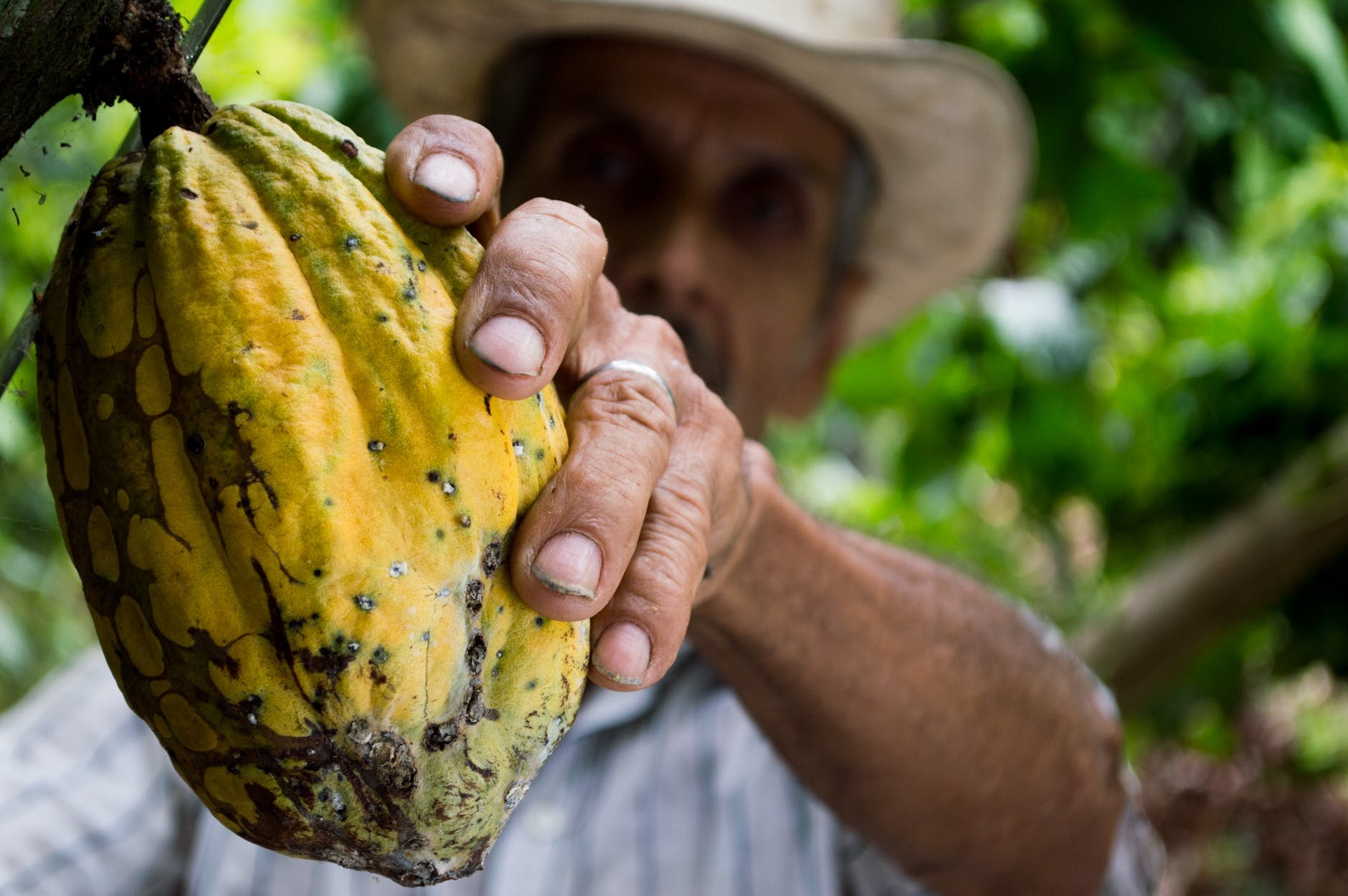
The cacao tree is native to Mesoamerica where its cultivation, consumption and cultural use began. When pollinated, the seeds of the cacao tree form a sheath, within which 30 to 40 brownish-red almond shaped beans are embedded in a sweet viscous pulp. The beans are bitter but the pulp is sweet which may have been consumed by humans at first. The cacao pods grow in a wide range of colors, like pale yellow, bright green, purple and crimson. The texture may vary from sculpted to completely smooth. The plantation of the cocoa trees is a tough process. When in natural environment, the trees can grow up to 60 feet tall but in plantations they grow only up to 20 feet.  

Photo by Sheena Wood on Pexels.com

Chocolate was prepared as a sweet by the European people when it arrived there. It got popularized among the rich people and eventually among the common. Christopher Columbus first came across cacao on his fourth mission to America, when he and his crew seized a canoe full of native goods for trade. He took the beans back to Spain. After it got imported to Europe, it was used as a medicine for treating abdominal diseases because of its bitter taste. After getting sweetened with the addition of sugar or honey, it became a court favorite and chocolate established a foothold in Europe within hundred years.  

In 1828, a Dutch chemist found a way to make powdered chocolate and this product became known as the Dutch cocoa. This led to the creation of solid chocolate. The first modern chocolate bar was made by Joseph Fry in 1847 by making a moldable chocolate paste. By 1868, a small company called Cadbury was making chocolate candies in England. A few years later milk chocolate was made by Nestle. In the 20th century the word chocolate includes a variety of sweet treats. Modern day chocolate is made from the hardiest but least flavorful cocoa beans and it is often said that it has more sugar and additives than actual cocoa.  

Jobs in India are attracting Foreign Resumes.

In the tough time due to Covid-19 pandemic the jobs all around the world are worst affected.Many top companies have removed their employees for the cost cutting approach.So,in this case many are jobless and for many employees in different companies are working with a hefty pay-cut due to this.As everywhere everything is started to lease slowly and steadily we can see again the job openings by different companies have started and that’s a good sign for everybody else out there who want jobs.

When Teamlease Services just posted about their job openings in the field of Marketing,the company was surprised and shocked to see that resumes are coming from foreign countries such as US.As due to this situation there is wide spread of opportunities open for each and every candidate around the world to apply.Now in this case companies have also got the potential to hire the best candidate and having ample of opportunities to hire according to their criteria.

It will not be a kind of one way system but there is same kind of opportunities open for Indian candidates to apply for foreign roles said hiring firms.Hiring firms are keen to hire candidates on the roles for R&D,processing and design,in addition technology.Randstadd India head Sanjay Shetty says “Some Global CEOs we are looking at India for its quality talent.This could be another wave of jobs being outsourced to India in a big way. A number of high-end jobs — which were hitherto kept close to the mothership of an MNC, especially in FMCG (fast-moving consumer goods), FMCD (consumer durables), banking and liquor industries — are expected to relocate to India. Some of these companies had earlier shied away from doing so, for various reasons”.

Key reasons for this transition is because as Indian companies has gone into Work From Home as they business continuity.In this new trend all the companies are gone into strengthening cyber security systems.As in this period company wants mind workers rather than hand workers.Some companies also said that the person who is an individual coder can work from anywhere just he needs only laptop.In this the company mentioned that people who have been living far from their hometown have reached to their hometown.So they will have good quality time spend with family,a well cooked home food and environment with their loved ones.

So in this case the companies are getting foreign resumes because working from any corner of the world is possible just by having a good connectivity and a laptop.

Positive Attitude.

Surround yourself with positive people. Find people who challenge you, believe in you to make this world better place to live for everyone.

When you are positive you see good in everything. When you are negative, you find something bad in almost everything. You almost find something to blame someone for, something bad, something to criticise, something to boil over shout at, if you are looking for all that. Though life is both positive and negative, it is seen that negatives come naturally to us. But the change from negative to positive I’d quite easy. To convert negative to positive, we have to fight our natural instincts also, which are mostly negative. For example when situation get hot, we easily give in to negativity, irritation, impatience or blame game: though everyone knows that by cultivating non-confrontation abilities, we can achieve very good positive outcome which can bring us peace, harmony and happiness.

For positive outcome in life we have to cultivate positive attitude and make a habit of it. It is up to you to chose your course, an easy path through an angry egoistic reaction which may lead to the loss of opportunity later or it could be a well considered response which would surely result in being benificial to all – to you and in turn, to your family, friends and society.

Human being are unique, intelligent and with a discerning mind, and the only species on this planet who know the difference between right and wrong. Then, why do we let ourselves be taken over by cross negative forces, by being reactive and lose a sea of opportunities waiting for us when we can adopt a positive attitude that makes us happy, energised, blissful and joyful?

The question is why don’t we do that more often to change the course of our life from negative to positive!? Why do we get lured by negative and easier rays which inhibit our true progress and growth??

India is full of Natural Resources but are we conscious of this fact ?

A country’s economy largely depends on the amount and preciousness of the natural resources it possesses. Yes, industries and agricultural factors do contribute the economy, but these are all secondary factors. If we concentrate on India particularly, we will see that the main economy of India heavily depends on these natural resources. The cultivable land in India almost comprises 57 percent of the whole land area. The water resources are plenty, having several major rivers crisscrossing across the country. However though these are important natural resources for any country, let us concentrate on the mineral resources which are abundantly found in India.  

Here’s a list of some of the mineral resources that are abundantly found in India and their use :  

• Coal (India is the fourth largest producer of industrial and domestic coal) – Mainly used in the power generation sector.  

• Bauxite – Aluminium, whose usage ranges from making planes to utensils, is extracted from this ore.  

• Manganese – This is mainly used in the manufacture of ferromanganese and steel.  

• Titanium ore – Used in the steel industry, among others.  

• Petroleum – Mainly used as a fuel for running vehicles.  

• Limestone – Used in the cement industry.  

• Thorium (the Kerala beaches account for the world’s largest thorium deposits) – Used as a fuel in nuclear power plants  

• Iron ore – Used for manufacturing raw iron which is used for making heavy machines for industries.  

• Mica – Used in condensers, transformers, electronic tubes, and radio or radar circuits.  

• Chromite – Used in the manufacture of stainless steel.  

• Natural gas – Used a fuel for vehicles.  

• Diamonds – Their main usage is for making jewelleries and cutting glass.  

Coal :  

India has the fourth largest coal reserves in the world. The total amount of coal reserves in India is expected to be around 267 billion tons. It is also one of the top nations in the world when it comes to the usage of energy derived from coal in heavy industries. The notable areas in India where coal is found and, as a result mined are – Orissa, Chhattisgarh, Jharia, Nagpur and Chandrapur, Raniganj, Jharkhand, Neyveli, Singrauli and Umaria coalfields. The coal found in India has high ash contents and low calorific coal. However these are combustion friendly and needless to say this is the reason behind the underground fires which occur in a few mining districts. Almost 94 percent of the coal produces is from the Government sector companies. In the 2011-12 period the total production has been reported to be around 680million tons, while the demand was 731million tons.  

This vast use of this singular reserve has led to its depletion in recent years, and it has been predicted that India will run out of its coal reserves within 2040. This stresses the need to employ new mining technologies and the use of alternative fuels to run the heavy industries.   

Petroleum :  

India ranks next to China in terms of its oil reserves in the Asia-Pacific region, china being the leading producer. Most of these reserves are located along the western coast of India, namely Mumbai High and the north-east region of the country. Though underdeveloped, some reserves have been recently found in the Bay of Bengal along the eastern coast of India and in Rajasthan. The sector is dominated by the state-owned enterprises, namely Oil and Natural Gas Corporation.   

The usage is much more than the production, and this result in India having to import oil from foreign nations to meet its rising consumption levels. Statistics show that India is a net importer of oil, as 70percent of its oil needs is imported from countries like Saudi Arabia and Iran. The rest 30percent is produced within the country. This is because the demand for oil is somewhere around 3million barrels per day, whereas the production is only a meagre 500 thousand.   

Natural Gas :  

As of April 2010, India has an approximately 1437 cubic metres of natural gas. Of this a huge percentage comes from the Mumbai High reserves. Assam, Andhra Pradesh and Gujarat also have reserves which produce considerable amount of natural gas. In terms of production volume, ONGC is the leading producer of natural gas in India. Among the private enterprises, Reliance Industries play a big role in this sector due to the large reserve found in the Krishna Godavari basin. India has to import small amounts from Qatar and likewise nations. At this level of production and consumption, the reserves are predicted to last for around 29 years.  

Iron ore :  

Possessing one of the richest reserves of iron ore in the world, India holds a leading position in the world in terms of its iron ore production. The haematite deposits found in India are spread throughout the country, though the huge deposits are concentrated in a few regions like Chikkamagaluru, Singhbhum etc. Many iron and steel industries are located near these mines. The nearness of the industries not only reduces transportation costs but also reduces the times taken to produce the final products. The ores found in Goa are mainly shipped to Japan. Export of iron is mainly done from the ports of Vishakhapatnam, Marma Goa, Paradip and Kolkata. At present the deposits are quite vast, but some calculations indicate that the exponential rise in consumption in coming years may make these reserves seem finite in the near future.   

Bauxite :  

India is one of the leading producers of bauxite in the world. The reserves account for 7.5 percent of the world’s total deposits; however the aluminium output is only 3 percent. This indicates the lack of infrastructure which dominates the Indian market. The state-owned NALCO is the largest company dealing with bauxite ores. The acquiring of INDAL by Hindalco Industries accounted for a steep rise in the aluminium production of the country in the last year.   The extensive deposits will take a long, long time to get replenished. 

Business of Subsidies in India

Introduction

A subsidy, often viewed as the converse of a tax, is an instrument of fiscal policy. Derived from the Latin word ‘subsidium’, a subsidy literally implies coming to assistance from behind. However, their beneficial potential is at its best when they are transparent, well targeted, and suitably designed for practical implementation. Subsidies are helpful for both economy and people as well. Subsidies have a long-term impact on the economy; the Green Revolution being one example. Farmers were given good quality grain for subsidised prices. Likewise, we can see that how the government of India is trying to reduce air pollution to subsidies LPG.

Like indirect taxes, they can alter relative prices and budget constraints and thereby affect decisions concerning production, consumption and allocation of resources. Subsidies in areas such as education, health and environment at times merit justification on grounds that their benefits are spread well beyond the immediate recipients, and are shared by the population at large, present and future. For many other subsidies, however the case is not so clear-cut. Arising due to extensive governmental participation in a variety of economic activities, there are many subsidies that shelter inefficiencies or are of doubtful distributional credentials. Subsidies that are ineffective need to be weaned out, for an undiscerning, uncontrolled and opaque growth of subsidies can be deleterious for a country’s public finances.

Although the term “subsidy” is widely used in economics, it is rarely defined. Often it is used as an antonym to a tax. While tax is transfer of money from a private entity to government, vice versa is subsidy. It can be defined as a sum of money granted from public funds to help an industry, business or individual keep the price of a commodity or service low.     

Subsidies are often criticized for intervening into the market mechanism by altering the price and thus consumption of the object. However, many times, their necessity is felt to provide the safety net to the vulnerable and downtrodden of the society. Since in India, more than one third of the population is living below poverty line (BPL), subsidy cannot be criticized on social grounds but it is criticized on economic grounds.  

According to the Budget proposals, the central government’s subsidy bill on food, petroleum and fertilizers is estimated at Rs 1, 79,554 crore for the 2012-13. The oil subsidy, which is given to state-run oil marketing firms, such as Indian Oil Corp, BPCL and HPCL, for selling diesel, domestic LPG to households and kerosene through the PDS system, below cost, is estimated lower at Rs 43,580 crore in the fiscal year 2012-13.  

The government’s food subsidy given to run the public distribution system is estimated to be Rs 75,000 crore. Food subsidy is provided to meet the difference between the economic cost of food grains and their sales realization at the Central Issue Price fixed under the public distribution system (PDS) and other welfare schemes.  

The fertilizer subsidy is also pegged lower at Rs 60,974 crore. Under the fertilizer subsidy, the government would provide Rs 13,398 crore for imported urea, Rs 19,000 crore for indigenous (urea) fertilizers, and Rs 28,576 crore for the sale of decontrolled fertilizers (DAP, MOP and complexes) at a subsidized rate to farmers.   

At the start of current fiscal year, subsidy burden was estimated to be 2.5percent of GDP and the Central Government’s target is to trim the subsidies upto 2 percent this fiscal. Current economic prospects of the country are bleak marred by rising fiscal deficit, mounting inflation, reducing Foreign Direct Investment (FDI), policy paralysis, downfall in international rating, all culminating into a growth fatigue. In order to realign the country’s economy with the high growth path, major reforms are to be undertaken in all the sectors including the subsidy budget. As already stated, ensuring employment, food, sanitation, potable water etc are tasks entrusted to the government; subsidy for such activities should not and must not be denied. However, the motive of subsidies is not just to provide food, water and sanitation etc at subsidized prices but a little more holistic.  

Subsidies must be designed in such a manner that they help in the strengthening the manpower and human resources of the country. Government has been providing subsides for the last sixty years since independence but dependency on subsidies has not been reduced which meant subsidy tool is not been effectively used in India. Need of hour is not to eliminate the subsidies but to better target the subsidies. In India, cost of an LPG cylinder which is sold at subsidized prices is same for CEO of a Fortune 500 company as well as for BPL family. Petrol prices are same for driving scooter as well as BMW etc. Moreover, the subsidies which are targeted for poor only are don’t reach the designated person and even if reaches, it is hardly 10 percent of the initial amount.  

Therefore, in order to assure the effectiveness of subsidies, an effective monitoring mechanism is needed. Subsidies granted because of purely political motivations must be withdrawn. For example, free electricity is provided to the farmers in Punjab which not only causes the wastage of electricity but also resulted in over exploitation of ground water further negatively effecting the environment. Socio-economic conditions of the country don’t call for withdrawal of subsidies but reform of subsidies.   

In Public Distribution System (PDS), huge subsidies are provided to feed the poorest sections of the population but entire PDS is marred by pilferage and rampant corruption. Here, a monetary transfer in the form of coupons can reduce the corruption as with those coupons, poor can buy food grains from open market.  Similarly MNREGA, the flagship programme of UPA government is also witnessing corruption and is enriching the bank accounts of few influential persons only. A compulsory social audit every quarterly of half yearly can make a dent on the corruption.   Currently, Indian economy is derailed from its track of high growth path and in order to grow at 9 percent per annum sustainably, it is important to assure that fiscal deficit doesn’t become unsustainable. Unsustainable, increasing and ill-targeted subsidies are bound to increase fiscal deficit and thereby strengthen the inflationary tendencies.   

Country needs a second generation of reforms which must be holistic in nature and starting these reforms from subsidy is not a bad idea as this will benefit those who are in dire need of benefits.


Over One Lakh loans sanctioned under PM SVANIDHI scheme

The number of applications received under PM Street Vendor’s Atmanirbhar Nidhi (PM SVANidhi) scheme has crossed the five lakh mark within 41 days of commencement of lending process. The number of loans sanctioned under the scheme has crossed one lakh.

The PM SVANidhi scheme has generated considerable enthusiasm among the street vendors, who have been looking for access to affordable working capital credit for re-starting their businesses post COVID-19 lockdown.

The scheme was launched by the Ministry of Housing and Urban Affairs under the ambit of ‘Atmanirbhar Bharat Abhiyan’. It aims at facilitating collateral free working capital loans upto 10 thousand rupees of one year tenure, to about 50 lakh street vendors in the urban areas, including those from the surrounding peri-urban/ rural areas.

Incentives in the form of interest subsidy at seven per cent per annum on regular repayment of loan, cashback upto 1,200 rupees per annum on undertaking prescribed digital transactions and eligibility for enhanced next tranche of loan have also been provided.

PM SVANidhi Scheme envisages bringing Banks at the door steps of these nano-entrepreneurs by engaging the Non-Banking Financial Companies (NBFCs) and the Micro-Finance Institutions (MFIs) as lending institutions. This is in addition to Scheduled Commercial Banks – Public and Private, Regional Rural Banks, Cooperative Banks, and SHG Banks.

The onboarding of the vendors on digital payment platforms is a very important component to build the credit profile of the vendors to help them become part of the formal urban economy.

Assam govt to roll out Arunodoi scheme to provide financial assistance to around 17 lakh families from Oct 2

With an aim to provide financial assistance to around 17 lakh families, the Assam government is all set to roll out Arunodoi scheme in the state from 2nd of October. Talking to newspersons in Guwahati yesterday, Finance minister Himanta Biswa Sarma said that under this scheme an amount of 830 rupees will be given to eligible families per month to buy essential food items. He said, this will be the largest Direct Benefit Transfer scheme in Assam.

The Minister said that 15 to 17 thousand families would be benefited per Assembly constituency by this scheme. Mr. Sarma said that the Assam government will bear 210 crore rupees per month for the Arunodoi scheme.

Electric mobility gets a boost; Govt allows registration of electric vehicles without pre-fitted batteries

The Road Transport and Highways Ministry has allowed registration of electric vehicles without pre-fitted batteries. In a letter to transport Secretaries of all the States and Union Territories, the Ministry has clarified that vehicles without batteries can be sold and registered based on the type approval certificate issued by the Test Agency. It said, there is no need to specify the Make/Type or any other details of the Battery for the purpose of Registration.

The Government is striving to create an ecosystem to accelerate the uptake of electric mobility in the country. The Ministry said, it is time to come together to work Jointly to achieve the broader national agenda to reduce vehicular pollution and oil import bill.