Dealing Effectively with a Temp Agency – and What to Expect

Image result for temp hiring“A temp agency – are you kidding me?”  That’s the understandable reaction of many upcoming or new BAs when someone suggests  going to see a temp agency.  But for upcoming graduates or unemployed recent graduates, it may be one of a number of options to consider, especially if some of this applies to you…
  • You are very unclear about the career path you want to pursue, or even the employment sector that most interests you – government? non-profits? private sector? start your own enterprise?
  • You worked your way through school in a retail job, nannying, etc. – and this limited your opportunities to do internships.
  • You are facing financial pressures and need to start earning money asap, but working in a hardware store is not an appealing career path.
“Temp-to-Perm” Positions.  Try to focus on agencies that emphasize temp positions that could convert into longer-term jobs.  Here are a few possibilities in DC:
How to Present Yourself to Temp Agencies
  • Put a bulleted “Administrative Skills Profile” at the top of your resume, listing the number of words per minute you can type, your software skills, and any experience you have with data entry, other digital filing, physical filing, mailrooms, doing inventory. (BTW, there’s lots of typing-test freeware available on the web.)
  • Be upbeat & energetic in your demeanor (!) – because the temp agency staffer interviewing you is trying to determine whether their client will like you.
  • Be ready to answer interview questions without hesitation; e.g., Are you restricting yourself to Metro-accessible employers? (probably say “yes”); Can you work weekends or evenings if needed? (say yes, but probably won’t be necessary); When can you start?
  • Be ready to prove yourself with the temp agency; i.e. be willing to take an initial offer that is not temp-to-perm, but which will build your credibility with the agency when the employer gives them a glowing report about this. Such initial offers could be a month long or as short as a few days.
  • Remember – you are not the agency’s client; the employer is.
Finally, applying to temp agencies is just one strategy.  You also should be applying for jobs in the normal way, via job boards and contacts; you should be networking you should and trying to get informational interviews.  And see your AU career advisor!

NSM Students, Alumni, & Friends Come Together for Networking @ Nite!

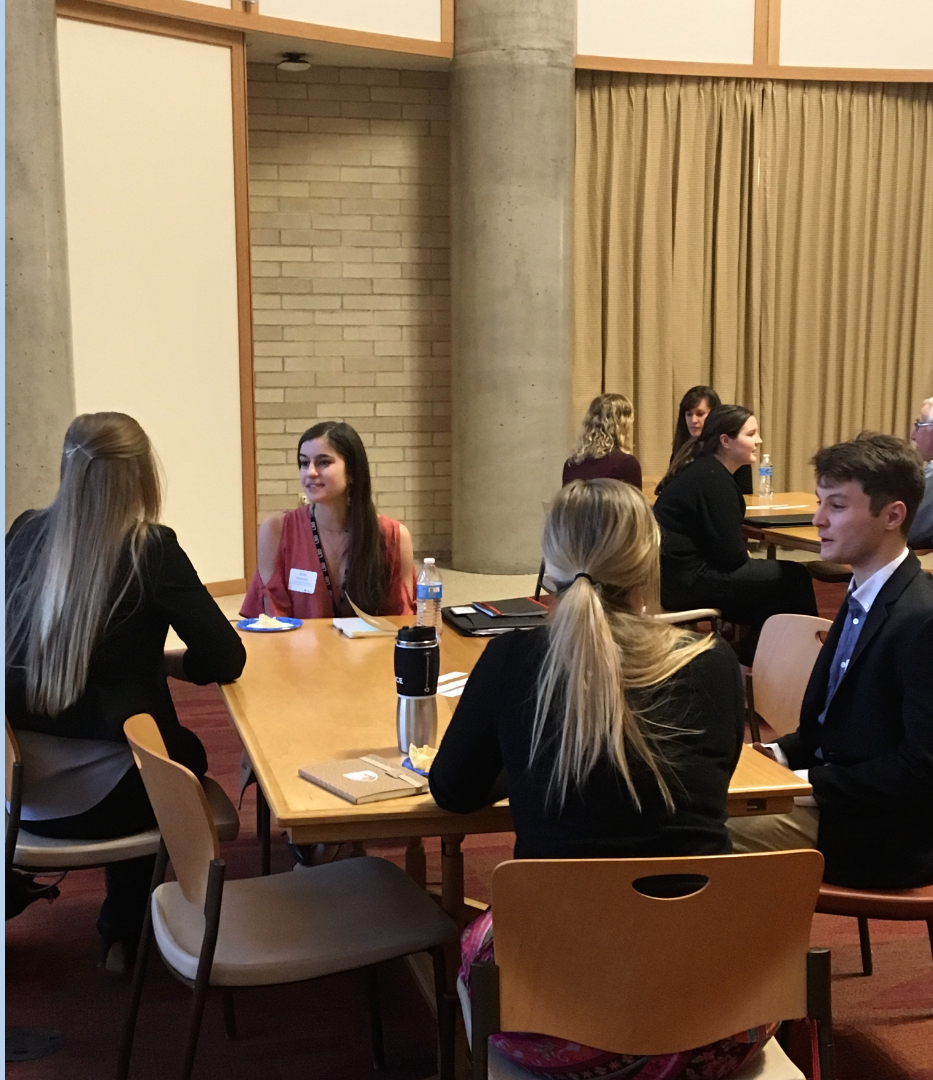
On February 28th, students, alumni, and friends of NSM came together on the 5th floor of ECS to chat about their career goals and interests across the sciences.

Photo by Kellan Barr, Communications Manager, NSM
Alumni from a number of disciplines, including Biology, Chemistry, Environmental Science, Mathematics, and Physics came back to campus for this exciting event. They represented an array of industries across the Denver area, from water treatment and analysis, to healthcare, and on to sustainability. The students who joined us also came from a number of majors across NSM, and they had the opportunity to network with each of our twelve volunteers for five minutes before moving on to another table. Open networking was offered for the final half hour, and it was fun to watch the participants come back together to excitedly continue conversations where they left off.
For the first hour of the night, students visited our alumni and friends both individually and in small groups. The students’ smiles as they left one table and joined another were so wonderful to see! It was a great evening that incorporated all of the fun and socialization of a networking event without the formal, frenetic energy of a career fair. Nervous energy quickly melted away as genuine connections were forged, and business cards were quickly exchanged before the end of the evening. Our alumni and friends were incredibly impressed with our NSM students’ professionalism, insightful questions, and career goals.

Photo by Kellan Barr, Communications Manager, NSM
Thank you so much to everyone – students, alumni, friends of DU, staff, and faculty – who made this event possible. We hope to bring more of our amazing, talented alumni back to DU so if you are a NSM undergraduate and you have suggestions on who you might want to meet, please share them with our office!

5 transferable skills interns can learn working in the insurance industry

The modern workplace requires skills that are not always taught in a formal education.  Many millennials find they have to develop these skills on the job or during an internship.  Some of these skills are industry specific, but many are tried and true skills that have been relevant for decades.  Some necessary skills include showing up on time, dressing appropriately, looking someone in the eye, and speaking clearly and concisely are still very important in the business world.  These skills are having to adapt to technology and the millennials who adapt the most effectively will have the most success throughout their career.  Here are four skills that interns and recent graduates can develop that will set them up for success in whatever field they go in to after their college career.
How can millennials develop transferable skills that can be used in the modern workplace.
Interpersonal Communication
One of the most important skills any college student can develop is the ability to effectively communicate a message and get a desired result.  Many people call this interpersonal communication while other people call it persuasion.  No matter what term you use to define this skill it is important to your career no matter what industry you go in to.  The ability to read something, interpret it and express your interpretation to another person is crucial to success in both life and in business.
Because of technology, it is easier than ever to communicate.  That does not mean people are better at communicating in the past.  It just means they are communicating more frequently.  Perfecting how you communicate in person, over the phone and in written form are skills you will learn and perfect interning in the insurance industry.  On average an insurance agent speaks with at least 20 clients or potential clients per day.  That is about 3 per hour over the course of a normal 8-hour day.  Each interaction with a client may involve receiving an email or a quote via electronic correspondence to a farmer in Iowa. The next conversation may be over the phone selling workers compensation insurance in Texas to the owner of an oil company.
Making a phone call to confirm some details and finally a follow up email when you are finished helping the client with their problem.  In another role in the insurance industry you may be responding to a negative review on yelp or a comment on the businesses Facebook page.  All of these different ways in which you might interact with a customer will prepare an intern to successfully interact with clients in many different forms.
Critical Thinking SkillsCritical-Thinking
Critical-thinking skills are crucial in the insurance industry and they will be important in the professional world no matter what industry a student eventually chooses. Being able to quickly interact with a co-worker, a vendor or a customer is extremely important.  In the insurance industry it is important to be able to determine what is most important to the other party and quickly determine several ways to solve the problem for the other person within an interaction. It is also becoming important to deliver that message in the form (email, text, phone call, etc.) the receiver wants to receive it.
On a typical day at an insurance agency, most agents interact with around 20 customers throughout the day.  Some of these customers just want whatever transaction they have to be done as quickly as possible.  They want this because they would like to get back to their daily lives. Other customers do not mind spending half a day to save an additional 5% on premium. A successful insurance professional has to determine what is important to the customer, deliver it to them the way they want to receive the message and make sure the customer is properly insured for the risks their business faces.
Risk Management
Risk management is in essence what the insurance industry is.  The simplest explanation of how a company in the insurance industry makes money is by collecting more in premium than they pay out in claims.  You will be a part of processing and analyzing risk constantly if you choose to intern or work in the insurance industry.  Every transaction in this industry deals with the ability to help your company offer as much coverage as possible while still managing a comfortable level of risk. These skills can transfer into a role as a mortgage broker, a risk management consultant, a manager of a retail store or a restaurateur. All of these roles require a professional to quickly assess the risks of a business and come up with adequate ideas to deal with those risks.
Professionalism in email communication
Email communication is an art all to itself.  It may seem obvious to the lay person how to communicate properly via email, but email communication is one skill many young professionals lack.  Many younger professionals do not differentiate between an email and a text message.  Most millennials are very comfortable using their mobile device.  Just because they are proficient at sending a message via their device does not mean they are proficient at representing themselves in a professional manner.  How much time someone spends on an email is usually obvious to the receiver of that message.  It is obvious when someone sits down and puts some thought in to their response and it is equally obvious when someone responds with a four-word answer while waiting in line at the local coffee shop.  When a millennial works or interns in the insurance industry, they frequently respond to clients about their child’s health insurance or about the specific of their small businesses workers compensation insurance policy.  These types of issues cannot be dealt with in a 4-word text message.  Dealing with these interactions will help a millennial quickly learn how to present themselves professionally both over the phone and via email.  Development of this skill will be crucial for success in any industry you work in moving forward.
Bio
Mitchell Sharp is a Marketing Associate for Workers Compensation Shop.com.  Mitchell has extensive knowledge of workers’ compensation and cyber liability insurance.  His passion is in using his expertise in commercial insurance and digital marketing to benefit the small business community.

Job & Internship Search Boot Camp

Job-Search-Boot-Camp-newsfeed-image
Still looking to nail that job or internship?  What are you waiting for? The summer is almost here!
For many people, job hunting can be a painful process so they avoid it. Their focus is on luck and tired old methods that rarely produce a rewarding job. But what if you could make it fun, exciting and rewarding? You can with the right tools and a proven method.
In this popular seminar, attorney and DU parent, Paul Jorgensen, gives you seven key tools and a very simple, practical method to take control of your next job hunt.
Through entertaining experiences, Paul will help you see how the job hunt itself can be gratifying and even magical. Once you learn this method, you will never search for a job the old way again. Don’t leave success in your next job hunt to your resume, timing and luck. Whether you are searching for your first job or your tenth job, this seminar is for you.

Passion. Holy Cannoli! What is this thing called passion!?

Recently, I was making a 17-mile trek across Arvada when our guide brought us to a halt, stretched out his hand and presented us with a brown paper bag. Within this seemingly innocuous container was a collection of several pieces of paper each adorned with familiar type-written words; we were instructed to blindly choose one.
Heeding the instruction, I reached into the bag to extract my choice, held my breath the way one might do when cracking open a fortune cookie to reveal their future, and peered down at this small strip of paper imprinted with seven black letters.
It read, Passion.
Immediately, I felt my internal processes begin to kick and scream. I felt agitation percolating through my veins as the resistance around this very loaded word became activated. Here I was in a group of strangers, walking long-distance in 93 degree heat that practically had me hallucinating from dehydration and now we were being asked to self-reflect and share with a partner something very personal. On one hand, I appreciated the opportunity to be introspective and for intentional human connection. But, this word, Passion, was triggering me in an unexpected way, and with the oppressive heat, I wasn’t in the mood to illuminate what it meant to me.
But, I thought: What. Is. Passion?
Frankly, this word has always intimidated and frustrated me, because I have never been able to answer this question; well, maybe not until this brown bag exercise. Until then, this inability to articulate a response had made me feel inept, or as if I’m doomed to live a life of mediocrity devoid of purpose, meaning or aliveness. The opportunity to contemplate how I define Passion in my life became a gift when the guide, who is also my friend, mirrored back to me the possibility that passion doesn’t have to be something related to your calling, let alone a career path for which you’re passionate. Instead, he explained that for me, passion is embodied in the way I show up with deep curiosity for the human experience and the way I fill with enthusiasm and joy when bearing witness to the ever-unfolding beauty of life; the butterflies, the power and symbolism of the river, the old couple holding hands sitting shoulder-to-shoulder. I had never considered these aspects of my being to represent this nebulous term, and thus, something in me softened around this word and I was able to see myself in a new light.
We think passion has to be this fiery, intense response to something, whether a person, thing or idea; perhaps a cause that ignites us and motivates us to action; or that passion is what’s experienced when released through heated words when a boundary has been crossed; or that it’s a deep seeded interest that courses through our veins desperately in search of some outlet; or it’s simply being drawn to something with a one-pointed focus that is wildly intense and life affirming.  
Whatever it is and however it’s defined, somehow, we’re acutely aware of its void and the nagging voice in our head that implores us to go out in mad pursuit of this passion until we find it; as if we’re not worth anything, or wasting precious time if we haven’t found, or aren’t living, our passions.
That’s quite a bit of pressure on the psyche!
So, what to do?
Well, it ain’t gonna just bop you on the head and say, here I am; I’m passion!
You’ve got to become an Observer of your World, an Observer of Yourself; you’ve got to start paying attention.
Take Note.
What is it that lights you up? Truly. What is it you’re doing when you feel joy? And, consider this question: what was it you most loved to do when you were a kid? Embedded in the answer is a clue to what may light you up now.
Here’s your Assignment:
  • For the next 2-4 weeks, make a commitment to start tuning in to whatever it is that captures your attention, provokes a powerful, positive response, or brings you to a state of flow; that space where you are totally present, where you lose track of time and feel in the zone.
  • Grab a pen, a notebook, or the notes section of your phone and start to jot those observations down! It’s time to become the anthropologist of your own life.
  • And, if it helps, you can rally the troops and ask your friends, family or co-workers to reflect back what they observe in you; specifically, to identify what you’re doing when you are radiating joy, lighting up, or experiencing intense focus, or complete engagement with something.
  • After you’ve collected some data on yourself, go back and take stock of any patterns, or themes you notice.
Let the answers be your guide in discovering and unearthing the parts of you that make your heart beat faster, the moments when you become laser-focused and totally engaged and engrossed with an experience.
What does this information tell you? How could you be integrating more of these things into your daily life that bring you joy?
  • Are these passions needing outlet in a job, a hobby, or activity, or perhaps some other aspect of your life?
  • Whatever the answer, find a way to get intentional about integrating these things into your daily, or weekly schedule.
  • Are there people doing the very thing that brings you joy that you could possibly align with, or seek out as a mentor, or for an informational interview?
  • As my awareness around my own passions increases, I am now carving out more time for connection to nature, gardening, and creativity.

And, in the words of Howard Thurman:
“Don’t ask what the world needs. Ask what makes you come alive, and go do it. Because what the world needs is people who have come alive.”

How to Get the Job You Really Want

How to Get the Job You Really Want
When it comes to looking for a job, identifying the type of job you want is the single most important thing you can do. This will make it easier to be effective in your job search while also ensuring that you’re focusing on roles that match your interests and your skill set.
Here’s what you need to know about landing the job you really want.

1. Identify your career goals

Although it may seem a bit intimidating to outline your five-year plan when you’re just starting out, setting career goals is a great way to ensure that you’re focusing on the big picture and looking for roles that fit with your long-term plans. The best way to do this is by determining a specific career goal and outlining the steps you’ll need to take in order to get there. With this goal in place, you’ll be able to create a clear path for yourself and increase your chances of landing your dream job.
Pro Tip: If you want to outline more than one goal that’s okay too, but be sure that at least one of your goals is something you can achieve within the next one to two years. Short-term goals are great for maintaining focus in general and when you’re just starting out, having achievable goals is even more important.

2. Develop the right skills

Once you’ve identified your career goals, it’s time to take stock of your skills and identify opportunities for learning and improvement. This will help you determine where to focus your energies and also give you a better idea of how to showcase your current skills in an impressive way.
Pro tip: Don’t panic if you don’t have all the skills you need for a specific job. Instead, look for ways to develop those skills by taking classes or taking on projects. Hiring managers are always impressed by candidates who take a proactive approach to learning and building your skill set in this way will show them that you’re a self-starter who is motivated to learn and grow.

3. Have a great resume

Although having a strong skill set is important, those skills aren’t enough without a great resume to showcase them. When writing your resume, be sure to focus on your key achievements in each previous role (including internships and part-time jobs) and to use numbers to quantify those achievements.
Pro Tip: Your resume should represent not only your accomplishments, but also the fact that you’re a well-rounded person, so don’t be afraid to include skills and achievements from extracurricular activities or individual projects.

4. Network effectively

Networking is a key component of professional success and it’s especially important if you’re just starting out in a particular industry (or when you’re looking to change industries). The best way to go about it is by reaching out to people in your alumni and social networks and staying in touch with co-workers and managers from your previous jobs. This is a great way to ensure that you’ll hear about new opportunities directly from people in your network and that you’ll already be on their radar when they’re looking to recruit for that the role that might just be your dream job.
Pro Tip: If you don’t have any contacts in your particular industry, don’t be afraid to send a cold email to someone you admire asking them to grab a cup of coffee or have a 15-minute phone chat. Chances are, they’ll say yes and you’ll have the opportunity to connect with someone who can help you understand the ins and outs of the industry.

5. Nail the interview

The final step to landing the perfect job is nailing the interview and this comes down to doing your research and being prepared. We recommend the R.E.A.F. approach — doing your research, being enthusiastic, asking questions and following up. Once you know who you’ll be interviewing with, take the time to research them and their role at the company. This will give you a sense of how your role will interact with theirs and help you understand their specific expectations for that position. Another great thing to do is to practice answers to commonly asked interview questions like, “Tell me about yourself,” and “What are you passionate about?” so that you can answer them confidently and present yourself in the best possible light.
Pro Tip: If you’re feeling nervous about the interview, try practicing with a friend. Ask them to quiz you on specific questions and to give you feedback on your answers. This is a great way to get a confidence boost and will also help you realize that the interview is really just a conversation.
Having a plan of attack is the first step to landing the job you want. By following these tips, you’ll be well on your way to getting there.
Next, get more career tips for internships and entry-level jobs such as 6 Things to Do in Your First Week at a New Job and find answers to common interview questions such as What’s Your Dream Job?

A Pursuit to Help Vulnerable Communities

UVM senior Ian McHale’s first exposure to lack of public health access was while setting up mobile clinics in remote villages in Peru, where there was no medicine or clean water. The biology and international development major credits that first trip to Peru as a life-changing experience.
We talked to Ian, president of UVM MEDVIDA and a student in the UVM Accelerated Master of Public Health Program, about his pursuit to become a doctor and his passion for helping vulnerable communities.

When you first traveled to Peru during your first year at UVM, what were you surprised to find from a public health perspective?

During my time in Peru, there was an indefinite strike of health care workers due lack of proper wages. I visited a remote clinic where there were no doctors, nurses, or anyone to run it, and women were giving birth in unsanitary conditions with no medical help. That experience affected me deeply. Far from any large city or hospital, these women and their children would die if there were any complications during or after childbirth. It was shocking and upsetting to me to see what a lack of public health infrastructure could lead to. Witnessing the lack of medical care in the clinic caused me to want to not only continue with my goal of becoming a doctor, but sparked my interest in public health.

How did your trip to Peru shape your career plans?

I was able to connect my passions in what I was learning in school. I was also able to put what I was learning to the test while implementing community development projects, setting up community meetings, attending patient follow ups, and leading mobile clinics. I made a lasting and meaningful connection with the community members we worked with, and I was able to understand the issues that affected these communities in Peru. These experiences will always be with me and will always have an impact on the decisions I make in my life.

MEDVIDA is the UVM’s official chapter of the national MEDLIFE organization and serves as a student hub for community service and social activism both internationally and in the local community. What do you enjoy most about your involvement with MEDVIDA?

I enjoy the amount of community volunteering and global health education we have in our chapter. At every meeting we are discussing and critically thinking about global health issues. Our chapter volunteers abroad and in our local community, where we make meals for a homeless shelter downtown and serve as mentors in our local community.

You want to work in pediatrics, and have spent time volunteering to help children. Can you talk about your volunteer work both locally and abroad?

I have volunteered on the pediatrics floor at UVM Medical Center for the past two years. I am also a DREAM mentor for two children. DREAM is a mentorship program where college students are paired with children from low-income community housing, fostering strong relationships not only with the children but the community we work in. Both of these experiences have helped shape what I want to do in my future career, hopefully one day becoming a pediatric doctor.
Over the summer, I was a volunteer affairs intern with MEDLIFE in Lima, Peru. I have also volunteered with MEDLIFE during my freshman and sophomore summer for one week in mobile clinics in Cuzco, Peru and Esmeralda, Ecuador. At these mobile clinics, we bring local doctors, nurses, dentist gynecologists, and pharmacists to communities that lack access to healthcare. We also work with the local leaders and community members on development projects such building stairs, bathrooms, and schools.

Why did you decide to enroll in the accelerated MPH program?

I want to learn more about disease prevention and management, how to identify and assess population needs, and implement population interventions. I want to use this knowledge from the program to better understand the healthcare system that I will one day work in. It will allow me to help others because I’ll have an in-depth understanding of public health policy and the local and global healthcare systems. I have learned first-hand what the lack of a public health infrastructure leads to and how to implement public health initiatives.

What is the best part about being a student at UVM?

The best part about being a student at UVM are the range of opportunities that are available. With the UVM Medical Center and Robert Larner, MD College of Medicine on the heart of our campus, we are given opportunities for research, jobs, volunteering, internships, and amazing experiences. My freshman year I was hired at the Vaccine Testing Center and I have been able to work with them ever since. I was able to join MEDLIFE, which has changed my life in such a great way. I have also been able to have internship experiences, such as my current internship with the Office of the Chief Medical Examiner.

You recently saw Paul Farmer recently speak at UVM. What was the most inspiring thing you learned from Dr. Farmer?

The most inspiring thing I learned from Paul Farmer was that rather than focus on cultural competency, we should be focusing on cultural humility to allow us to better understand the people we’re working with and trying to help

Pride of Place: LGBTQ Inclusion in Medical Education and Patient Care

By Carolyn Shapiro
During a first-year course on human reproduction at the UVM College of Medicine, medical student Matthew Shear was startled to see lecture notes referring to a person with ambiguous genitalia as “hermaphroditic.” Shear, a member of the Class of ’17, wasn’t the only UVM medical student who noticed the outdated language, he says. He decided to email the instructor to propose a change in the text to today’s preferred term “intersex.”
The suggestion was welcomed, he says. His instructor invited Shear to talk, thanked him for his help, and told him, “I never know how to brush up on this. It’s really important that I use the right words.”
LGBTQ-inclusion

Student Matthew Shear
For Shear, the experience was another validation of the College of Medicine’s progressive approach to handling LGBTQ health topics — those related to the lesbian, gay, bisexual, transgender, queer, questioning, gender-neutral and gender nonconforming communities.
“That’s absolutely the place UVM is,” Shear says. “And there are dozens of little stories like that, proving to me that I got the correct read on this place when I interviewed.” At UVM, Shear says, he has found a pervasive openness to heightened understanding of LGBTQ issues — always with a goal to provide better care for patients. “That’s what we’re trying to create — a culture where those learning opportunities are so mainstream that everybody’s interested, everybody sees the value of being competent in that area.”
As the country progresses on LGBTQ rights, so does medical education and patient care. The College of Medicine is at the forefront of this change.

A Foundation for LGBTQ Inclusion and Educational Initiatives

Recent events in the media spotlight — the gender transformation of Caitlyn Jenner and the US Supreme Court decision on the right of same-sex couples to marry — have thrust sexual and gender identity diversity into nearly every avenue of discussion. At this point in social evolution, it has become clearly necessary for future physicians to be sensitive to, inclusive of, and informed about LGBTQ health concerns.
“We’re in a different era, because the bridge has been crossed already regarding the legitimacy of the material and the need for the material,” says A. Evan Eyler, MD, MPH, a UVM associate professor of psychiatry and family medicine and co-editor of Gay, Lesbian, Bisexual and Transgender Aging: Challenges in Research, Practice and Policy. “So now we’re looking at how best to do it, the same as you would women’s health or cancer care.”
The College began addressing that issue a dozen years ago — long before Jenner and the LGBTQ moniker became entrenched in the cultural lexicon. Around 2003, Professor of Pediatrics Paula Duncan, MD, laid the foundation for the first LGBTQ educational initiatives at the College. Since then, UVM has steadily moved to the forefront of LGBTQ medical education.
“We know that culturally, in the state of Vermont, we are on the leading edge of advocating for equality and the civil and health care rights of this population,” says William Jeffries, PhD, senior associate dean for medical education and an administrative champion of the College’s LGBTQ efforts. “It’s a natural extension that we should be leading the way in developing a cutting-edge health care approach to ensure that the needs of the LGBTQ community are met.”
In a survey of curriculum last year, the Association of American Medical Colleges (AAMC) recognized UVM as exemplary in its incorporation of LGBTQ health issues into curriculum. Jeffries’ colleagues at other schools, including members of the LGBTQ community, tell him that UVM is ideally situated — on a progressive campus and in a forward-thinking state — to take a pioneering role in LGBTQ healthcare education, he says.
“I like to build on strengths, and I view this as a strength,” Jeffries says. “Our job is to make this the best medical school it can be. That means our education program needs to be recognized as a leader in areas where we are innovating.”

A Cultural Climate to Emphasize the Importance of LGBTQ Health

In November 2014, the AAMC released new competencies in LGBTQ healthcare required for medical students at its member schools. The goal is to train doctors to address patients’ specific health needs no matter their sexual or gender identity, says Kristen Eckstrand, MD, PhD, founding chair of the AAMC Advisory Committee on Sexual Orientation, Gender Identity and Sex Development and a psychiatrist at the University of Pittsburgh Medical Center.
“A lot of people are well-intentioned, and they want this area to be addressed,” Eckstrand says. “The challenge is you don’t know what you don’t know.”
LGBTQ-inclusionUVM has distinguished itself by building the institutional support and cultural climate to emphasize the importance of LGBTQ health, Eckstrand says. “It has a unique combination of very dedicated students and very dedicated faculty members, which is a catalyst for change in this area,” she says of UVM. “And that’s where a lot of medical schools fall apart.”
Across the country, medical schools are grappling with ways to build LGBTQ content into their curriculum. Some have added distinct courses focused on LGBTQ topics or spend a few hours or a day on LGBTQ health. Others simply pledge support for “gay-friendly” initiatives or rely on nondiscrimination clauses in their policies, Eckstrand says.
“When I speak to colleagues nationally, the approach that some institutions take is at the early stage,” says Catherine Nicholas, EdD, assistant professor of family medicine education and operations director of the College’s simulation laboratory, and director of the standardized patient program. “They create one LGBTQ+ standardized patient case.”
UVM’s structure is different, she adds. “It’s not an LGBTQ course. It’s integrated. It’s part of the fabric of what we do. Incorporating LGBTQ scenarios in standardized patient instructional cases is crucial, Nicholas says. Who you are as a patient matters, because we teach a very patient-centered approach. So who you are, your age, who you live with, what you do for work, how you look at health and illness, is all important.”

An Approach that Involves Academics and Attitude

The College of Medicine has taken a broad, all-encompassing approach along three primary directions: increasing LGBTQ representation among students and faculty; weaving LGBTQ subject matter into every category of content and teaching; and developing students’ communication skills and compassion in working with LGBTQ patients.
The third piece is perhaps the most important, fundamental to the humanistic elements of doctoring. It’s more about attitude than academics.
It’s an ability to respond with respect and the right questions when a patient comes out as LGBTQ during an exam. It’s an expression of support and interest when a colleague or student mentions a family with a same-sex partner. It’s the willingness to throw away traditional assumptions about gender and identity.
“Affirming who the person is and encouraging it is part of the delight in the work,” says Michael Upton, MD, ’94, clinical assistant professor of psychiatry and co-advisor to the College’s Gender and Sexuality Alliance, an advocacy group of medical students. “As physicians, we have the capacity to transmit an appreciation and a caring for the richness of the individual person who has come to see us.”
LGBTQ-inclusion

Michael Upton, MD
Upton draws much of his approach to care from his own experiences as a gay man and physician. LGBTQ doctors and faculty serve as mentors for LGBTQ students and help all of those in medical training learn how to navigate difficult topics.
“It’s not pleasant to come out to a doctor and then have them have to look at the floor because they’re so uncomfortable,” Upton says. “That’s why we need an inclusive environment, because we need students and residents, and all physicians to get this exposure, so they don’t have to look at the floor.”
Certainly, a competent physician must know when a transgender man needs a pap smear because he still has a cervix or a lesbian needs birth control because she occasionally has sex with men. The more nuanced lessons in an LGBTQ-progressive medical school, though, guide doctors on gleaning the most crucial elements of their patients’ care, the aspects of their lives that influence their well-being.
“It starts with the basic content side of things, medical students understanding that gender is not binary and what that means from a biological standpoint,” says Eileen CichoskiKelly, PhD, a UVM associate professor of family medicine, who serves on the AAMC committee on Sexual Orientation, Gender Identity and Sex Development. “Having the ability to understand that we’re not going to put people in boxes is a primary concept,” she says. “As the care provider, you don’t have to have all the answers, but you do have to at least have an understanding and be able to be accepting.” She continues, “The reality is you’re going to have a range of patients like this; so we want to prepare our students for the universe of the patients that they’re going to be encountering.”
With these changes, the College has come a long way, Dr. Eyler says. At first, more than ten years ago, student evaluations of his courses in transgender health would include blunt expressions of disgust and questions about the need to endure such discussion, he says. “And I don’t get those anymore, teaching the same material.”
Eyler sees two reasons for that: “One is that our medical school has made tremendous progress in this area in a decade,” he says. “And the other is that so has the country.”

College of Medicine Sees Number of LGBTQ-identified Students Increase

To bring in more LGBTQ students — who ultimately will add to the number of LGBTQ doctors — Jeffries adjusted the admissions process last year to ensure that LGBTQ candidates are well represented in the admissions pool. That was tricky, because years of discrimination have encouraged many to remain closeted.
UVM’s voluntary process allows applicants to self-identify, making it one of the first two medical schools in the country to take this step, Jeffries says. “We’re giving students the assurance that we believe this is important,” he says. “We’re not asking this to be discriminatory. We’re asking to ensure that an integral portion of our community is represented.”
LGBTQ-inclusionIn the most recent admissions cycle, Jeffries says, the College saw the number of LGBTQ-identified students increase — along with those of all underrepresented minorities, which grew from 7 percent of the entering class in 2013 to 12 percent this year.
Matthew Shear, who is openly gay and moved with his partner for medical school, says he recognized the difference at UVM during his admissions interviews. He asked schools about their LGBTQ student populations, their support and funding of advocacy groups, their hospitals’ policies on dealing with transgender patients and the option for patients to specify a pronoun in their medical records.
“Some people just glazed over, like, ‘I have no idea what you’re talking about,’ ” Shear says. “At UVM, they’re like, ‘Oh, yeah, we’re working on it.’ And as a Michael Upton, MD, ’94 student, you can pick your own pronoun with the registrar.”
He also gauged interviewers’ reactions when he came out to them and discussed his undergraduate LGBTQ activities. Some responded with “complete dismissal” and treated “those components of my application as if they were unrelated to medicine.”
When the subject arose at UVM, the representative spent about a third of the interview talking about it, which sealed the deal for Shear.
“I definitely made it a priority,” he says, “to be someplace where I was going to be embraced and welcomed to be out while training as a physician.”


Dealing Effectively with a Temp Agency – and What to Expect

Image result for temp hiring“A temp agency – are you kidding me?”  That’s the understandable reaction of many upcoming or new BAs when someone suggests  going to see a temp agency.  But for upcoming graduates or unemployed recent graduates, it may be one of a number of options to consider, especially if some of this applies to you…
  • You are very unclear about the career path you want to pursue, or even the employment sector that most interests you – government? non-profits? private sector? start your own enterprise?
  • You worked your way through school in a retail job, nannying, etc. – and this limited your opportunities to do internships.
  • You are facing financial pressures and need to start earning money asap, but working in a hardware store is not an appealing career path.
“Temp-to-Perm” Positions.  Try to focus on agencies that emphasize temp positions that could convert into longer-term jobs.  Here are a few possibilities in DC:
How to Present Yourself to Temp Agencies
  • Put a bulleted “Administrative Skills Profile” at the top of your resume, listing the number of words per minute you can type, your software skills, and any experience you have with data entry, other digital filing, physical filing, mailrooms, doing inventory. (BTW, there’s lots of typing-test freeware available on the web.)
  • Be upbeat & energetic in your demeanor (!) – because the temp agency staffer interviewing you is trying to determine whether their client will like you.
  • Be ready to answer interview questions without hesitation; e.g., Are you restricting yourself to Metro-accessible employers? (probably say “yes”); Can you work weekends or evenings if needed? (say yes, but probably won’t be necessary); When can you start?
  • Be ready to prove yourself with the temp agency; i.e. be willing to take an initial offer that is not temp-to-perm, but which will build your credibility with the agency when the employer gives them a glowing report about this. Such initial offers could be a month long or as short as a few days.
  • Remember – you are not the agency’s client; the employer is.
Finally, applying to temp agencies is just one strategy.  You also should be applying for jobs in the normal way, via job boards and contacts; you should be networking you should and trying to get informational interviews.  And see your AU career advisor!

Ben & Jerry’s Social Mission Leader Teaches UVM Students of the Breakthrough Leaders Program About Creating Consensus

How do stakeholders find common ground when they share the same goals but hold vastly different opinions?
Simone Washington, the social mission strategy and policy manager at Ben & Jerry’s Homemade, shared a pragmatic and productive approach to building consensus in her 2018 workshop, “How to Become Allies Fighting the Same System, Role Play, Power Analytics, Conflict and Resolution Techniques.” Her session was presented to students in the UVM Breakthrough Leaders for Sustainable Food Systems Program last June.
This year Washington is teaching a variety of workshops including What is Social Equity Work and How to Lead It? during the 2019 program.
Photo Credit Ben & Jerry\'s 1978Photo Credit: Ben & Jerry’s

Washington is responsible for helping Ben & Jerry’s translate its three-part mission, progressive values, and linked prosperity framework into innovative, inspirational internal programs and initiatives, and external partnerships and projects. A dedicated social justice advocate and self-professed “innovation junkie,” Washington has over 16 years of experience challenging conventional thought and practices in the nonprofit and philanthropic sectors. Her work is focused on creating progressive structural change using a racial equity lens with an emphasis on systems thinking and design.
We talked to Washington, an instructor for UVM’s Breakthrough Leaders program, about the art of building consensus. 

How do stakeholders find common ground when there are very different points of view?

We are quick to position ourselves as adversaries, as opposed to positioning ourselves as people with needs to be met. Often when people have divergent perspectives and identities, it’s hard for them to find commonalities on which to build trust, and to use those differences to work toward building creative solutions.
For Breakthrough Leaders students, I focus on how to build consensus with large multi-stakeholder groups who share a common goal or set of goals but have a difference in opinion on how to achieve them. Participants develop an understanding of how power dynamics and cultural differences can affect a situation, and how to apply an equity lens when addressing complex conflict.
We use Ben & Jerry’s negotiation process with Migrant Justice to implement Milk with Dignity, a worker-driven social responsibility model, into its existing dairy supply chain. Participants in the Breakthrough Leaders program hear accounts of the process from actual stakeholders, and engage in a role play scenario where they engage in their own negotiations process.

What will students will take away from this exercise?

It’s my hope that this type of exercise will help the participants develop a pragmatic approach to engaging with stakeholders who hold different opinions, identities—such as racial, cultural, gender, socio-economic status—that will equip them with the skills to actively listen to one another, isolate the people from the problems or issue, and identify the unique attributes and resources that each party brings to the table that can be useful in addressing the problems. Additionally, participants gain practice in being self-aware when working with diverse groups and learn to take on the hard conversations that lead to building relationships across differences.

Do you include lessons that Ben & Jerry’s learned from working with Migrant Justice?

Yes, we invited Rob Michalak, director of social impact, and Cheryl Pinto, global values-led sourcing manager, both of whom led the negotiations for Ben & Jerry’s to talk to the group. They provide insight into what we felt worked, what we would do differently, and how this experience transformed the company. For example, because of this process, we recognized that we needed to overhaul our dairy sourcing model. The new model has been evolving to truly embody our Linked Prosperity model.
Milk with Dignity is an apt illustration of how we are working diligently to lift the voices and meet the needs of the “invisible” stakeholders in our value chain. This process will potentially change how we approach business from hiring to how we support systemic change in communities, globally. This marks a new era in how we will show up in the world as a social justice company and carry forward the vision of our co-founders.

Can you share examples of any other socially-driven projects Ben & Jerry’s is working on?

The company made a commitment to embedding racial and economic equity into its policies, practices, and programs. We have partnered with Race Forward and Frontline Solutions to conduct our first-ever racial equity assessment. This will help the company to identify ways that we can actively create inclusion and access through our Linked Prosperity philosophy for historically marginalized and underrepresented communities touched by our value chain.

How long has Ben & Jerry’s had a social mission?

The social mission has always been at the heart of the company. The co-founders were committed to finding a new way to do business. Their vision was realized in 1988 when they developed the Linked Prosperity Model which states all three parts of our mission— product, economic, and social—must thrive equally in a manner that commands deep respect for individuals in and outside of the company and support the communities of which they are a part

Hard Cider Production on the Rise, But Challenges Remain

By Terry Bradshaw
Hard cider production in the U.S. has increased an average of 73 percent annually since 2008. That’s a lot of apples, and Vermont fruit growers and cideries (businesses that make hard cider) are capitalizing on this market expansion. Sales of cider nationally topped 54 million gallons in 2014, which required 18 million bushels of fruit, or the equivalent of 7 percent. of the nation’s total apple production.
However, the supply of fruit available to cideries is getting tight.
Growers in Vermont have traditionally sold their apples to the fresh market, where prices are significantly greater than for cider apples. This has created a disconnect between the cider and apple industries in terms of fruit supply, and has opened up an exciting field of research and outreach.
The timing of this expansion of the cider industry is serendipitous. After the retirement of Dr. Lorraine Berkett, who led the UVM Apple Research Program for 32 years, I assumed leadership of the program in 2014 as a faculty research associate in plant and soil science, where I have been a research specialist since 1999. I have been an “advanced amateur” cider maker for over 20 years, and research in this unique niche in the apple and value-added industries will be a major focus of our work for the foreseeable future.

Hard Cider Production in Relation to Pomology

For the past century, pomologists and growers have been working to avoid production of cider apples by developing production systems that focus on production of large, blemish-free fruit. Therefore, research on cider apple production is at the ground level, and evaluation of economic characteristics of cider apple production is just as important as assessment of horticultural conditions.
Together with Community Development and Applied Economics Agricultural Economist David Conner, I was awarded in 2014 a Vermont Working Lands Enterprise Fund grant to study economic and horticultural constraints and opportunities for apple growers and cideries in the state. Surveys conducted by CDAE research specialist, Florence Becot, were sent to growers and cideries last summer to assess characteristics of each industry.
The survey generated several findings:
  • Vermont continues to have a robust apple production industry. Growers report yields in line with published averages for the state and most anticipate increased production in the future. Growers were more likely to sell to local markets than the state as a whole. They see opportunity in the growth in popularity of hard cider, but receiving adequate prices is a perceived threat.
  • Cideries are also growing, with all of the survey respondents anticipating increasing production in the future. These cideries see opportunities in the growth of the hard cider’s popularity, and a corresponding increase in cider quality. Adequate fruit supply was identified as a major risk to their operations. Presently, cideries pay an average price above the growers’ mean target price for specialty cider apples, but lower than the growers’ target price for dessert apples.
  • Cideries and apple growers have both expressed interest in dual purpose varieties for cider-making that may also be sold to the fresh market. Apple growers have expressed limited interest in growing specialty varieties suited only to cider-making, while cider makers have expressed strong interest in purchasing them. Planting new specialty apple varieties is a long-term investment and commitment that growers most likely will not do unless they have the assurance that cideries will buy the apples when the trees start producing. This might imply entering into more formal agreements than just handshake agreements, which are currently the norm.
The survey results have generated more questions than answers.
Growers and cideries both question what apple varieties are best-suited for making high-quality commercial ciders, while providing adequate and sustainable crop yield that make their production economically feasible.
Orchard planting, training systems, and pest management programs for cider apples need to be evaluated. Business structures, price points, contracts, and other arrangements between orchards and cideries must be investigated to ensure profitability for both parties.
Fermentation practices that improve and maintain cider quality need to be researched and the results extended to the industry.
These questions demand a long-term research and outreach program that I am building at UVM. In addition, we are working with like-minded collaborators at other institutions, including Washington State University, Virginia Tech, Michigan State University, and Cornell University to coordinate projects and share knowledge across regions.
This is an exciting time to be working on hard cider projects that focus on the ‘apple to glass’ production chain, and I look forward to presenting results from this research for many years to come.
Terry Bradshaw is a Tree Fruit & Viticulture Specialist at UVM, and director of the UVM Horticulture Research and Education Center

Top 5 Tips to Keep in Mind When You’re Ready to Interview for Your Dream Job

You’ve been invited to interview for your dream job, what could go wrong?  After all, you are just talking about yourself, what could be so difficult?  Interviewing has plenty of pitfalls if you are not prepared.  Invest the time necessary to present your best, most genuine self and make the most of your opportunity to prove you are the right person for the job.
Research:
  • The interviewer will gauge your interest by learning what you know about their organization.  Visit the organization’s website, news feeds and talk to alumni or others who work at the organization.
  • Dissect the job description review the job responsibilities and qualifications as they are clues to possible interview questions.
  • Know what’s happening in the industry and be up-to-date on the latest trends.
Practice Common Interview Questions:
  • Begin by knowing yourself and what you have to offer the employer.  Be ready to discuss what skills and strengths you have that relates to the position.
  • A very common opening question is in the form of “Tell me about yourself.” Don’t repeat your resume, but rather talk about what motivates you, how you became interested in the field, what you bring and why you are excited about the position.
  • Find out more in How to Answer the 31 Most Common Interview Questions
Prepare for Behavior-Based Interview Questions (past behaviors predict future behaviors):
  • These questions ask for very specific examples that demonstrate particular skills or behaviors. To respond to these questions, use the STAR format:
    • S/T Describe the situation or the task
    • A Tell about the action you took
    • R Explain the result or outcome quantifying when possible
  • Practice with the Top 10 Behavior Based Interview Questions.
Prepare Questions for the Interviewer:
  • An interview is a 2-way conversation where both you and the employer are trying to determine if this is the right match. When it’s your chance to interview the interviewer, prepare and bring with you several questions such as 51 Great Questions to Ask In an Interview.
 Follow up after the interview:
  • The interview is not over once you walk out the door or hang up the phone. Send an email to your interviewer(s) within 24 hours of your interview, preferably as soon as possible. Personalize your email by noting 1-2 pieces of new information that reinforces your interest in the position.  If you don’t have contact information for all of your interviewers, ask the person who scheduled your interview for assistance. What else can you do? Read How to Properly Follow Up After a Job Interview.
View every interview as a learning experience by reflecting on what went well, what challenged you and how you can better prepare for the next interview or next round of interviews to land that dream job!

The Benefits of Resume Review

Constructing a resume can be difficult. Well, scratch that, constructing a resume IS difficult. To articulate your accomplishments and professional identity in a way that is positive, clear, and concise is no small feat. The good news is there are people out there who can help you! Getting your resume reviewed by career advisors, industry professionals or even family and friends can really make a world of difference. Here a few ways that a resume review can help you.
1.) How Easy is it to Find Important Information? Is it easy to find your education section and what degrees you’ve earned (or are earning)? Is your Skills section buried at the bottom of your resume? It’s important to ensure that your resume is easy to scan, because employers likely won’t spend time reading every word. According to Dr. John Sullivan of ERE Recruiting, Recruiters will only look at a resume for an average of 5-7 seconds.
2.) Spelling, Grammar & Formatting: Avoiding spelling and grammatical errors in your resume is of tremendous importance since your resume is a professional document. As many times as you read through it, it can be easy to overlook small spelling and grammatical errors. New perspectives and fresh sets of eyes can help to identify errors you’ve simply missed. A resume review can also help with formatting. You might not realize that there are inconsistencies in your resume like different styles or alignments of bullet points or spacing issues between sections. Getting someone to review your resume can help identify issues like these.
3.) You Don’t Know What You Don’t Know: Did you know that you can put your LinkedIn URL on your resume? What about languages you speak or awards you’ve won? Often times you may not be aware of certain content that is appropriate to add to your resume and a review, especially by someone you know well, can help to identify those missing details.
4.) Affirmation and Positive Feedback: Sometimes it’s just good to be reminded that you’ve done a good job and that your professional and academic accomplishments are remarkable. Certainly, critical feedback is also important, but given the time and energy that’s often invested in writing a resume, it can be just as helpful to receive some well-deserved affirmation.
To have your resume reviewed by a Career Advisor here at DU you can make an appointment in Pioneer Careers. If searching for an internship, you may want to bring your resume to Internshipalooza on January 31st to have it reviewed by DU Career Staff, or you can bring it to the Driscoll Bridge on February 7th to get feedback from employers and industry professionals for Resume Review Days! For more information on both events and to register, see the Events section in Pioneer Careers. We hope to see you there!

Does salary matter? Building a fulfilling career

Life is a matter of choices. Some choices do not require much thought and reflection, while others merit rigorous deliberation. Career is one aspect of life that is replete with difficult choices. Choosing a career is one of the most crucial decisions in life as it can either make or mar personal happiness for many years to come. There is a plethora of literature on careers, but not enough attention has been devoted to the actual process of selecting a career.
Many factors contribute to a fulfilling career. A career should necessarily be in sync with one’s personality type. Every person is either an introvert or an extrovert and each career is either more suitable for extroverted or introverted personality types. For example, an extrovert is likely to be more comfortable in people-oriented careers such as marketing and should, therefore, choose a career that fits into his persona. A good career match can potentially catapult a person to new highs, whereas a wrong move can drag a person down the road to mediocrity and disillusionment.
All careers call for adequate preparation in terms of knowledge and skills, whether you are aiming to become a banker or a blog writer. A person aspiring for success in a particular field should keep himself abreast with the latest technological developments and industry trends. There is a misconception that professional training begins only after college. For the uninitiated, college life is a good time to experiment with different types of jobs and decide on the most suitable career. On the other hand, a person who has already made up his mind can utilize the college vacations to augment skills and acquire experience pertaining to long-term career goals. In fact, the student years are an opportune time to acquire knowledge and develop skills in varying walks of life as companies increasingly prefer employees that have proven abilities to work in diverse settings.
A person has to decide on factors that are most important in a job and choose the option that best addresses these aspects. Every decision involves a rational and emotional component; a person would be genuinely happy if he succeeds in aligning the mind and the heart. A good decision has to be an informed decision. A person should gather maximum information about various job options before finalizing his choice as job satisfaction would ultimately depend on the nature and demands of the job. Money alone would not matter unless the work is satisfying. The values of the organization, what it stands for and how it approaches the business environment and employees and social responsibilities are also important determinants in opting for a particular company. Job seekers should also pay close attention to company culture. Since a considerable amount of life is spent at the place of work, a company that facilitates a healthy physical environment, and encourages personal growth in areas such as higher education and work-life balance should be on the radar of prospective employees.
At the end of the day, a career that matters is one that aligns personal vision, professional goals, and societal well-being.

Skill Series #3: Written Communication

Why is it important to write well? What does ‘writing well’ mean, anyway? Every day I read resumes, cover letters, personal statements, essays and email and text messages. So do you.
Have you ever gotten a text that made no sense? Was the verb or subject missing? Maybe you thought that you knew what the person meant to say, but you had to guess.
Let’s start with some examples….
  • My courses in History and Philosophy taught me strong critical thinking skills.
Your courses taught you? YOU had nothing to do with amassing these skills? Don’t you think that YOU learned or developed critical thinking skills by taking courses in History and Philosophy?
  • Other responsibilities include progress toward degree meetings every semester.
What does this mean? Who made progress? And, what did this person do to advance the progress of these meetings?
  • I have developed a valuable database of employer relationships that get results.
Have you known databases that get results? I have not. I thought that people used databases and the information in databases to get results.
  • My educational experiences and my work experience have allowed me to develop exceptional interpersonal, clerical, analytical and leadership skills.
Your educational and work experiences gave you the opportunity to develop interpersonal skills – how did that work? Would it be accurate to say that while you pursued your education and gained work experience, YOU strengthened your interpersonal…..skills?
  • I am the daily liaison between coaches and instructor’s.
Your turn….what is the issue?
  • Young Democrats of UtahSalt Lake City, Utah May, – June 2006
               Volunteer Champagne Manager
 Have you spotted the typos?
  • I am interested in applying for the position of with you organization.
Did this person read the sentence out loud? How many problems do you see?
  • One who will make a positive contribution to your college.
Is this a sentence? Does it include a complete thought OR do you feel something is missing?
  • All of these experiences have shown that children and animals are forever bonded and the stories arising from that relationship inform us how to approach and respect
Be clear about what and who you are referencing. WHAT RELATIONSHIP is this person talking about? And WHO exactly are we approaching?
Whether you are writing a resume, an email or an academic essay, writing skills are critical.
Here are some tips for writing as clearly as possible to convey what you mean to say:
  • Use active tense: Experiences do not teach you. YOU learn skills by engaging in experiences and completing projects.
  • Be specific and include details: As a senior majoring in Anthropology, with a minor in History, I have traveled to WWI battlefields in Belgium and worked with forensic anthropologists to uncover the remains of soldiers who died in the trenches.
  • Use a font that is large enough to see. No one will read your work, no matter how excellent it is, if the person can’t see the text!
  • ALWAYS read what you have written out loud to yourself. That is the only way you will notice if you have left out a word or used the wrong phrase.
Resources in the Career Center Library:
Eats, Shoots & Leaves: The zero tolerance approach to puncuation, by  Lynne Truss
On writing well: an informal guide to writing nonfiction, by William Zinsser
Get to the Point!  by Elizabeth Danziger
Writing That Works, by Kenneth Roman and Joel Raphaelson