Text of PM’s address at joint session of Parliament on 70th Constitution Day

महामहिम राष्ट्रपति जी, आदरणीय उपराष्ट्रपति जी आदरणीय स्पीकर महोदय, श्रीमान प्रहलाद जी और सभी आदरणीय जनप्रतिनिधिगण।

कुछ दिन और कुछ अवसर ऐसे होते हैं जो अतीत के साथ हमारे संबंधों को मजबूती देते हैं। हमें बेहतर भविष्य में और उस दिशा में काम करने के लिए प्रेरित करते हैं। आज यह 26 नवंबर का दिवस ऐतिहासिक दिवस है। 70 साल पहले हमने विधिवत रूप से एक नए रंग-रूप के साथ संविधान को अंगीकार किया था, लेकिन साथ-साथ आज 26 नवंबर दर्द भी पहुंचाता है जब भारत की महान उच्च परम्‍पराएं, हजारों साल की सांस्कृतिक विरासत, वसुधैव कुटुम्बकम के विचार को लेकर के जीने वाली इस महान परंपरा उसे आज ही के 26 नवंबर के दिन मुंबई में आतंकवादी मंसूबो ने छलनी करने का प्रयास किया था। मैं आज उन सभी हुत आत्माओं को नमन करता हूं। सात दशक पहले इसी सेंट्रल हॉल में इतनी ही पवित्र आवाजों की गूंज थी, संविधान के एक-एक अनुच्छेद पर बारीकी से गहन चर्चा हुई। तर्क आए, तथ्य आए, विचार आए, आस्था की चर्चा हुई, विश्वास की चर्चा हुई, सपनों की चर्चा हुई, संकल्पों की चर्चा हुई। एक प्रकार से यह सदन, यह जगह ज्ञान का महाकुंभ था और जहां पर भारत के हर कोने की सपनों को शब्दों में मढ़ने का एक भरपूर प्रयास हुआ था। डॉ राजेंद्र प्रसाद, डॉ भीमराव बाबा साहेब अंबेडकर, सरदार वल्लभ भाई पटेल, पंडित नेहरू, आचार्य सुकराणी जी, मौलाना आजाद, पुरूषोत्तम दास टंडन, सुचेता कृपलानी, हंसा मेहता, एलडी कृष्णस्वामी अय्यर, एन. गोपालास्वामी एंगर, जॉन मथाई अनगिनत ऐसे महापुरूष जिन्होंने प्रत्यक्ष और अप्रत्यक्ष योगदान देकर के हमें इस महान विरासत हमारे हाथों में सुपुर्द की है। आज के इस अवसर पर मैं उन सभी महान विभूतियों को स्मरण करता हूं और उनका आदरपूर्वक नमन करता हूं।

आज अपनी बात की शुरुआत मैं आप सभी को बाबा साहेब अंबेडकर ने 25 नवंबर 1949, संविधान अंगीकार करने के एक दिन पूर्व अपने आखिरी भाषण में जो बातें कही थी उसका जरूर उल्‍लेख करना चाहूंगा। बाबा साहेब ने देश को याद दिलाया था कि भारत पहली बार 1947 में आजाद हुआ है या फिर 26 जनवरी 1950 को गणतंत्र बना, ऐसा नहीं है। भारत पहले भी आजाद था और हमारे यहां अनेक Republic भी थे, और उन्होंने आगे व्यथा व्यक्त की थी लेकिन अपनी ही गलतियों से हमने अतीत में आजादी भी खोई है और Republic character भी गंवाया है। ऐसे में बाबा साहेब ने देश को चेताते हुए पूछा था कि हमें आजादी भी मिल गई, गणतंत्र भी हो गए, लेकिन क्या हम इसको बनाए रख सकते हैं। क्या अतीत से हम सबक ले सकते हैं। आज अगर बाबा साहेब होते तो उनसे अधिक प्रसन्नता शायद ही किसी को होती। क्योंकि भारत ने इतने वर्षों में ना केवल उनके सवालों का उत्तर दिया है बल्कि अपनी आजादी को लोकतंत्र को और समृद्ध और सशक्त किया है और इसलिए आज के इस अवसर पर मैं आप सभी को बीते सात दशक में संविधान की भावना को अक्षुण्‍ण रखने वाली विधायिका, कार्यपालिका और न्यायपालिका के सभी साथियों को गौरवपूर्वक स्मरण करता हूं, नमन करता हूं। मैं विशेष तौर पर 130 करोड़ भारतवासियों के सामने नतमस्तक हूं। जिन्होने भारत के लोकतंत्र के प्रति आस्था को कभी कम नहीं होने दिया। हमारे संविधान को हमेशा एक पवित्र ग्रंथ माना, गाइडिंग लाइट माना।

संविधान के 70 वर्ष हमारे लिए हर्ष, उत्कर्ष और निष्कर्ष का मिला-जुला भाव लेकर के आए हैं। हर्ष ये है कि संविधान की भावना अटल और अडिग रही है। अगर कभी कुछ इस तरह के प्रयास हुए भी हैं तो देशवासियों ने मिलकर के उनको असफल किया है। संविधान पर आंच नहीं आने दी है। उत्कर्ष इस बात को हम जरूर registered करते है कि हमारे संविधान की मजबूती के कारण ही एक भारत श्रेष्ठ भारत की तरफ हम आगे बढ़ पाए हैं। हमने तमाम सुधार मिल-जुलकर के संविधान के दायरे में रहकर के किए हैं और निष्कर्ष ये है कि ये विशाल और विविध भरा भारत प्रगति के लिए, सुनहरे भविष्य के लिए नए भारत के लिए भी हमारे सामने सिर्फ और सिर्फ संविधान, संविधान की मर्यादाएं, संविधान की भावना यही एकमात्र रास्ता है एषपंथा। हमारा संविधान हमारे लिए सबसे बड़ा और पवित्र ग्रंथ है। एक ऐसा ग्रंथ जिसमें हमारे जीवन की, हमारे समाज की, हमारी परंपराओं, हमारी मान्यताओं, हमारे व्यवहार, हमारे आचार उन सबके साथ का समावेश है। साथ-साथ अनेक चुनौतियों का समाधान भी है। हमारा संविधान इतना व्यापक इसलिए है क्योंकि इसमें हमें बाहरी प्रकाश के लिए अपनी खिड़कियां खोल रखी है। और उसके साथ-साथ भीतर का जो प्रकाश है उसको भी और अधिक प्रज्वलित करने का अवसर भी दिया है।

आज इस अवसर पर जब हम कहेंगे तो मैं एक बात 2014 में लाल किले के प्राचीर से जो मैने कही थी उसको दोहराऊंगा, संविधान को अगर दो सरल शब्दों में कहना है सरल भाषा में कहना है तो कहूंगा डिगनीटि फॉर इंडियन एंड यूनिटी फॉर इंडिया। इन्ही दो मंत्रों को हमारे संविधान ने साकार किया है, नागरिक की डिगनीटि को सर्वोच्च रखा है और संपूर्ण भारत की एकता और अंखडता को अक्षुण रखा है। हमारा संविधान वैश्विक लोकतंत्र की सर्वोकृष्ठ उपलब्धि है। यह ना केवल अधिकारों के प्रति सजग है बल्कि हमारे कर्त्तव्यों के प्रति जागरूक भी बनाता है। एक दृष्टि से हमारा संविधान दुनिया में सबसे अधिक पंथनिरपेक्ष है। हमें क्या करना है, कितने बड़े सपने देखने है और कहां तक पहुंचना है इसके के लिए किसी भी प्रकार की बंदिश नहीं है। संविधान में ही अधिकार की बात है और संविधान में ही कर्त्तव्यों के पालन की अपेक्षा है। क्या हम एक व्यक्ति के तौर पर, एक परिवार के तौर पर, एक समाज के तौर पर अपने कर्त्तव्यों को लेकर उतने ही गंभीर है जितना की हमारा संविधान, हमारा देश, हमारे देशवासियों के सपने हमसे अपेक्षा करते हैं। जैसा कि राजेंद्र बाबू जी ने कहा था कि जो कॉन्सटिट्यूशन में लिखा नहीं है उसको हमें कन्वेन्शन से स्थापित करना होगा और यही भारत की विशेषता भी है। बीते दशकों में हमने अपने अधिकारों पर बल दिया और वो आवश्यक भी था और ठीक भी था। क्योंकि समाज में ऐसी व्यवस्थाएं बन गई हैं जिनके चलते एक बड़े वर्ग को अधिकारों से वंचित रखा गया था। बिना अधिकारों से परिचय कराए इस बड़े वर्ग को समानता, समता और न्याय का अहसास दिला पाना संभव नहीं था। लेकिन आज समय की मांग है कि जब हमें अधिकारों के साथ ही एक नागरिक के तौर पर अपने कर्त्तव्यों, अपने दायित्व पर मंथन करना ही होगा। क्योंकि दायित्व को निभाए बिना हम अपने अधिकारों को सुरक्षित नहीं रख सकते हैं।

अधिकारों और कर्त्तव्यों के बीच का एक अटूट रिश्ता है और इस रिश्ते को महात्मा गांधी जी ने बहुत ही विशेष रूप से बखूबी समझाया था। आज जब देश पूज्य बापू की 150वीं जयंती का पर्व मना रहा है तो उनकी बाते बहुत प्रासंगिक हो जाती हैं। वो कहते थे right is duty well performed उन्होने एक जगह लिखा भी था कि मैने अपनी अनपढ़ लेकिन समझदार मां से सीखा है कि सभी अधिकार आपके द्वारा सच्ची निष्ठा से निभाए गए अपने कर्त्तव्यों से ही आते हैं। पिछली शताब्दी के शुरूआती दशकों में जब पूरी दुनिया अधिकार के बारे में बात कर रही थी तब गांधी जी ने एक कदम आगे बढ़ते हुए कहा था आइए हम लोग नागरिकों के कर्तव्य यानि duties of citizens के बारे में बात करते हैं। 1947 में यूनेस्को के महानिदेशक डॉ जूलियन हसक्ले ने विश्व के 60 बड़े महानुभावों को, बड़ी हस्तियों को एक पत्र लिखा था और उनसे मार्गदर्शन मांगा था और उन्होने पत्र में पूछा था कि world charter of human  rights ये बनाना है तो उसका आधार क्या होगा। और इस बारे में उन्होने दुनिया के महानुभावों से अपनी राय मांगी थी, महात्मा गांधी से भी मांगी थी। लेकिन दुनिया के हर किसी ने जो अभिप्राय दिया महात्मा गांधी का कुछ अलग था, महात्मा जी ने कहा था उन्होने जवाब दिया था कि हम अपने जीवन के अधिकार तभी अर्जित कर सकते हैं जब नागरिक के तौर पर अपने कर्तव्यों को पूरी तरह से निभाए। यानि एक प्रकार से कर्तव्यों में ही अधिकारों की रक्षा है इसकी वकालत महात्मा गांधी ने उस समय भी की थी जब हम दायित्व की बात करते हैं, कर्तव्य की बात करते हैं तो यह बहुत ही सामान्य जिम्मेदारियां है जिनको निभाने से एक राष्ट्र के रूप में हमारे संकल्प सिद्ध होते हैं। और हमें ये भी बहुत स्पष्ट ध्यान देना होगा कि कर्तव्य और सेवा कभी-कभी हम सेवा को ही कर्तव्य मान लेते हैं, सेवा भाव, संस्कार हर समाज के लिए बहुत अहमियत रखते हैं। लेकिन सेवा भाव से भी कर्तव्य कुछ और हैं और उस पर कभी-कभी हमारा ध्यान नहीं जाता है। आप सड़क पर चल रहे किसी व्यक्ति को कहीं कोई मदद की जरूरत है आप करते हैं वो एक प्रकार से सेवा भाव है। ये सेवा भाव किसी भी समाज को, मानवता को बहुत सशक्त करता है। लेकिन कर्तव्य भाव इससे थोड़ा अलग है। रोड पर किसी को तकलीफ हुई आपने मदद की अच्छी बात है लेकिन अगर मैनें ट्रैफिक नियमों का पालन किया है और कभी किसी को तकलीफ ना हो ऐसी व्यवस्था का मैं हिस्सा बना यह मेरा कर्तव्य है। आप जो कुछ भी कर रहे हो उसके साथ एक सवाल जोड़कर अगर हम देखते है कि मैं जो कुछ भी कर रहा हूं क्या उससे मेरा देश मजबूत होता है कि नही। परिवार के सदस्य के नाते हम हर चीज वो करते है जिससे हमारे परिवार की शक्ति बढ़े। उसी प्रकार से नागरिक के नाते हम वो करें जिससे हमारे देश की ताकत बढ़े, हमारा राष्ट्र शक्तिशाली हो।

एक नागरिक जब अपने बच्चे को स्कूल भेजता है तो मां-बाप अपना कर्तव्य निभाते हैं लेकिन वे मां बाप जागरूकता पूर्वक अपने बच्चे को मातृभाषा सीखने का आग्रह रखते है तो वे एक नागरिक का कर्तव्य निभाते हैं। देश सेवा का कर्तव्य निभाते है। और इसलिए एक व्यक्ति छोटी-छोटी चीजे होती हैं अगर बूंद-बूंद पानी बचाता है वो अपना नागरिक कर्तव्य भी निभाता है। अगर टीकाकरण सामने से जाकर के टीकाकरण का काम पूरा कर लेता है किसी को घर आकर याद नही कराना पड़ता वो अपना कर्तव्य निभाता है। वोट देने के लिए समझाना ना पड़े वोट देने के लिए जाता है वो अपना कर्तव्य निभाता है। समय पर टैक्स देना है देता है वो अपना कर्तव्य निभाता है। ऐसे कई दायित्व होते है जो एक नागरिक के रूप में सहज व्यवस्था के रूप में हम विकसित करे, संस्कार के रूप में हम विकसित करें तो हमें देश को आगे ले जाने में बहुत बड़ी सुविधा बढ़ती है। ये सवाल जब तक देश के प्रत्येक नागरिक के चित्त में, उसकी चेतना में सर्वोपरि नहीं होंगे हमारे नागरिक कर्तव्य कहीं ना कहीं कमजोर होते चले जाएंगे और वो किसी ना किसी रूप में किसी दूसरे के अधिकार को हानि पहुंचाते है और इसलिए औरों के अधिकारों की चिंता के लिए भी अपने कर्तव्यों पर बल देना हम लोगों का दायित्व बनता है। और जन प्रतिनिधि के नाते हमारी जिम्मेवारी कुछ और अधिक होती है, दोहरी होती है। हमारे सामने constitutional values को मजबूत करने के साथ-साथ खुद को भी एक आदर्श के रूप में प्रस्तुत करना है। यह हमारा दायित्व बन जाता है और हमें समाज में सार्थक बदलाव लाने के लिए इस कर्तव्य को भी निभाना ही होगा, हमारी कोशिश होनी चाहिए कि अपने हर कार्यक्रम में, हर बातचीत में हम duties पर focus करें। जनता के साथ संवाद करते समय duties की बात करना हम ना भूले। हमारा संविधान हम भारत के लोग से शुरू होता है we the people of India हम भारत के लोग ही इसकी ताकत है, हम ही इसकी प्रेरणा है और हम ही इसका उद्देश्य है।

मैं जो कुछ हूं – वो समाज के लिए हूं,  देश के लिए हूं,  यही कर्तव्य भाव हमारी प्रेरणा का स्त्रोत है। मैं आप सभी का आह्वान करता हूं कि हम सब इस संकल्प शक्ति के साथ मिलकर भारत के एक जिम्मेदार नागरिक के तौर पर अपने कर्तव्यों का पालन करे। आइए अपने गणतंत्र को हम कर्तव्यों से ओत-प्रोत नई संस्कृति की तरफ लेकर के जाएं। आइए हम सब देश के नवनागरिक बने, नेक नागरिक बने। मैं कामना करता हूं कि ये संविधान दिवस हमारे संविधान के आदर्शों को कायम रखें और राष्‍ट्र निर्माण में योगदान देने की हमारी प्रतिबद्धता को बल दें। हमारे संविधान निर्माताओं ने जो सपना देखा था उसे पूरा करने की हमें शक्ति दे। और ये पवित्र धरती है जहां ये मंथन हुआ था यहां पर उसकी गूंज है। यह गूंज हमें अवश्य आशीर्वाद देगी, यह गूंज हमें अवश्य प्रेरणा देगी, यह गूंज हमें अवश्य शक्ति देगी, यह गूंज हमें अवश्य दिशा देगी। इसी एक भावना के साथ मैं फिर एक बार आज संविधान दिवस के पवित्र मौके पर पूज्य बाबा साहेब अंबेडकर को प्रणाम करता हूं, संविधान निर्माताओं को प्रणाम करता हूं और देशवासियों को बहुत-बहुत शुभकामनाएं देता हूं।

धन्यवाद।

*****

7 Ways to Retain Optimism (Even If You Work In Improving Elementary Education!)

Got you, didn\’t it! Sooner or later, you hit a wall. There\’s a feeling that nothing works. That the system is so overwhelming that hardly anything can be done. Eventually, if you\’re someone trying to improve elementary education – whether as a teacher or resource person or administrator – you find yourself unwillingly accepting that the poor quality of education will continue to prevail in hundreds of thousands of classrooms.
Ok, so that\’s stated a little too strongly. But there is grain of truth there! Which is why, in the interest of millions of children, we need to look at how to retain the enthusiasm and optimism we started out with. So here are some ways to preserve your cheer, mental health and youthful looks despite the years you\’ve put in.
1. Think \’how\’, not \’should\’
Much too often we find ourselves talking about what \’should\’ be happening. Slowly the discussion slides into a list of things we are dissatisfied with – teachers not working, infrastructure remaining poor, lack of leadership, absence of commitment…. You can hear the pitch rising, can\’t you? Keep the pitch raised and you\’re bound to have a stressed heart!
To retain your desire to make things better (and keep your heart healthy), it would be so much better to talk of the how. What ordinary things can a teacher do? E.g. smile at children, read the textbook before the class, solve a puzzle herself to find out how much fun it is, read aloud a book to children once in a while – nothing that requires an \’order\’ or funding or special mandate or skill or training. Similarly, what can a head teacher do, burdened as she is with administrative tasks made difficult by lack of support? Share and delegate (e.g. make it fun for other teachers to participate and work as a group), discuss some of the records maintained in the school (e.g. connect children\’s attendance rates and test performance), and so on.
As you can see, you would have something doable to share. Chances are, some of the ideas might actually get picked up – in which case don\’t forget to really appreciate the person implementing them.
2. Focus on outcomes, not inputs
This is much more if you\’re a planner, administrator, supervisor, programme leader. Very often we\’re so focused on the inputs flowing from our side that we ignore what these are for. Thus it seems important to see whether material is supplied or not, the number of days of in-service training covered, physical targets fulfilled – and then one day it suddenly turns out that all this has not had much impact. We\’re left feeling that all our effort didn\’t amount to much, and a sinking feeling starts to grow. Of course we don\’t tell anyone else about it but we\’re aware it\’s there, isn\’t it?
How to overcome this situation? After all, inputs have to be provided. Sure they have – but for a purpose. It might be more useful to take a look at what all this is meant to bring about. For instance, the issue is not whether material is supplied or not but whether it is used as intended by children. This suddenly makes us see that we need to focus on training, incorporate this into the monitoring and academic support, share examples with teachers, encourage children and parents to lose inhibitions and start using material in school and at home… All of which, if done even on a small scale and only partially successful, has the wonderful effect of making you feel giddy with success. Pessimism – gone!
3. Be incremental
This point is so commonsensical and obvious that it gets ignored. Don\’t try to do everything or too much in one go (especially if you are at the district / sub-district level). For instance, for any teacher to make a real change in the classroom processes, some 40 different practices are likely to change. Try doing a full \’training\’ and expect all these changes – there\’s only chaos. Teachers do try but fail – no one\’s sure what to start with, the sequence in which to implement these changes, the steps to be taken. All it takes is one or two failures for teachers and schools to feel that nothing much can be done, that it\’s all too difficult, and doesn\’t work and is therefore not worth the effort. Soon, you begin to feel the same and are a pale shadow of the enthusiastic person who set out on a journey of change.
To get back on track on this journey, scale things down a little. Expect only a few changes at a time. E.g.
  • Give teachers a list of 6-8 possible changes (ranging from calling each child by the name, to making use of activities given in the textbooks to encouraging children to ask questions).
  • Ask them to select only 3-4 from this list (making a choice generates ownership and commitment); discuss the steps they need to take in order to bring about these changes.
  • Encourage them to make a 2-3 month implementation plan around these steps and help them monitor themselves and each other to see if the changes are actually happening.
  • Extend this cycle at the end of each 2-3 month period. Over a year or two, a dramatic change would occur – only it would have been less noticed as it happened, more successful, and breeding optimism rather than pessimism.

For those in the know, this is precisely what ADEPTS is all about and has made a positive change happen in over 22,000 (that\’s right, 22 thousand) schools in Gujarat.
4. Enter with questions, leave with (people\’s) ideas
Trainers, facilitators and academics trying to communicate with teachers end up being frustrated very soon – \’they don\’t pay any attention to whatever we say\’ is a common complaint. To which the reply is – why should they? The days are over when someone followed your ideas / views / instructions simply because you came from a so-called \’superior\’ level such as a university or senior position in the hierarchy. No, people will do things differently only if they are convinced and feel like doing it from inside. Our role is to touch people\’s hearts and minds rather than trying to shape them or fill them with our views.
How can one do this? It\’s so simple that I\’m almost ashamed to mention it! Don\’t enter a training session or a meeting with a list of things to tell. Instead, concentrate on a few key questions to ask. Questions that will generate response, reflection, and provoke people into coming out with their own views and ideas. For instance, ask questions such as:
  • If material is so easy to generate, why should we supply anything? What do you think?
  • Suggest ways in which you can use a library along with the textbook?
  • Shouldn\’t we trust children and get them to mark their own attendance instead of the teacher spending time on it?
  • When children don\’t understand decimals, exactly where do you think the problem lies?

Don\’t believe me, try it out and see what happens. At any rate, the tired old complaint will not be heard any more.


5. Don\’t see people as they are but as they\’re going to be…
Anyone who\’s responsible for helping people be different usually ends up using phrases such as \’dog\’s tail that can never be straightened\’. But that\’s because they see people as they actually are rather than what they can be like. Try this out the next time you\’re in such a situation – 
  • Look at your students / participants / team members and visualise them as being different. 
  • What qualities can you visualise them as having? 
  • What ways do you seem them adopting to make good use of the capabilities they already have? 
  • And what do you see yourself learning from them?

Gives you a different perspective, doesn\’t it? Every time I\’ve worked with a group that has been called \’difficult\’, this is what has helped me make good friends with the participants and support them in changing themselves. Not exactly rocket science, and works very well too. End result? You can imagine…
6. The system is people too
When you work on an impersonal, solid thing called a \’system\’, it\’s hard to see it changing. Indeed, it has an inertia of its own because it has usually arrived at some degree of stability over the years – and here you are, trying to destabilise it for reasons of your own! Why on earth would it meekly go along?
But if you look upon a system as a number of people bound in a set of relationships, you have several entry points where there didn\’t seem to be any in the beginning. There are bound to be persons in the system trying to make good things happen (if nothing else, just the law of averages determines that there have to be at least a few of these). Can you locate such persons? Is there a way of interacting with them, perhaps even bringing together a few of them? Can you change a few persons at a time? Is there an activity that would support or recognize their efforts, and given them the feeling that they\’re not alone? And when success (even small success) happens and is recognized, the circle of those willing to engage and dialogue, grows. With it grows the possibility of real change happening, thus reducing the chances of your growing old before your time out of sheer frustration and pessimism.
7. This is where I need your help
Please be so kind as to let me know the 7th (and 8th, and 9th) way…

In defence of TPP – Environment and Intellectual property

In this post I\’ll tackle the  issues raised against the TPP in the areas of environment and intellectual property.
The opposition to the TPP from environmental activists comes from two contradictory positions – one is that any promotion of trade and economic activity leads to degradation of the environment and therefore must be stopped. The second argument is that the TPP does not go far enough to make environmental and climate change issues at the heart of any trade deal.
The first argument is not worth debating, for it is a loony left idea that deserves contempt. Denying the opportunity of economic advancement to the world\’s poor should be treated as a crime; for that is what it is. It would be far better if these activists were to specify how growth can happen with minimum effects on the environment (for eg what energy sources could be acceptable) and what the trade offs and choices should be. This they do not do and simply oppose everything. Such a position is not worth a shouting match.
The second argument is worth serious consideration. The US over many bilateral trade agreements has been pushing the following principles
* A binding agreement that countries would not lower their environmental standards in order to attract investment
* That their obligations under other multilateral climate control agreements would override any provisions of the Free Trade Agreement
* A long list of prohibited activities – like logging, deforestation, trade in wildlife, etc
In the TPP negotiations, the US is actually on the defensive as internally the Republicans will block any deal that contains significant provisions on climate change. Countries like New Zealand and Australia which are far more advanced on climate change issues are pushing for tighter provisions. These will have to be negotiated through, but given that the US is such an important player, it is unlikely that they would be able to do much progress. The activists are right to push for greater environmental standards. But the TPP is the wrong place to fight this. They should force the US, which single handedly screwed up the Kyoto Protocol, to come with an alternative.
I approach the second issue of intellectual property rights with some trepidation as that would mean arguing with Medicines Sans Frontiers (MSF) , a saintly organisation, which I am neither competent nor entitled to do. The issue is primarily of patent protection to pharmaceuticals. The US would like patent protection similar to what it has inside its own country. This would mean high prices for drugs for a long time in other countries and inhibition of development of far cheaper generic drugs. As this would disproportionately hurt the poor, MSF has been objecting to patent advancement through Free Trade Agreements. It is a difficult and thorny issue on which there are no easy answers . I am ducking this issue as this is not a big issue with the opposition to the TPP in the US, which is the prime theme of this series of posts. To its credit, the US negotiating team is trying to promote the principle  of \”active window\” – a period of time which would be longer for developed countries and shorter for developing countries when patent protection would exist and after that the country would be free to promote generics. That might be the best compromise.
This is probably an easy post – neither of these issues are ones on which US politicians should  kill the TPP. Despite the lunacy of a not insubstantial number of US politicians, this is unlikely to happen.
Tomorrow I will conclude this series with examining the secrecy surrounding the negotiations which is common cause made both by my good friend and Elizabeth Warren !!

Xi who must be obeyed (with apologies to The Economist)

The title of this post is directly stolen from The Economist which ran a cover story by this name a year or so ago. They themselves were punning the quote from here.

The much awaited China\’s People Congress ended today with the expected climax – the unveiling of the new Politburo Standing Committee ; the men who will run China for the next five years. More of this in just a little while. This ended a week of speechifying and staged events.

First, the two things that stood out during the days preceding the event today.  Xi Jinping opened the Congress with a speech lasting an incredible three and a half hours, reaching new heights of torture and boredom. It was a hugely self confident China strutting about as a world power, with Xi vigorously patting his own back. He outlined some of the directions for the next five years which were typically broad motherhoods, but gave some clues on where they are heading.

The most important outcome was the enshrining of \”Xi Jinping Thought\” in the Communist Party\’s Constitution. This is a peculiarly Chinese obsession. Their infatuation with obscure theories and doctrines knows no boundaries. \”Mao Zedong Thought\” was supposed to be the guiding doctrine of the Party – never mind that it is rubbish, the Party has long ditched many of that nonsense, etc etc. Then Deng Xiaoping \”Practice\” was enshrined into the Constitution after his death. At the end of their terms Jiang Zemin and Hu Jintao\’s \”theories\” were also included, but their names were not mentioned (such semantics are very important in China with those two acknowledging that they are a step behind the two taller and earlier leaders). Xi hasn\’t bothered with any such finesse. Halfway into his term he has enshrined his name and \”Thought\” – the implication being he is Mao\’s equivalent and even above Deng. A dangerous move almost Trumpesque is self aggrandisation. His \”Thought\” is mostly bland with lots of garbage , but who cares. These are political moves cloaked in ideology.

And then today, came the line of seven men who walked in, and that was how the world got to know about the new Standing Committee. Readers of this blog may recall that this blogger made a prediction in this post a month or so ago. I got one thing wrong – that Li Keqiang the Premier would be dropped and that Wang Qishan, Xi\’s right hand man would stay on beyond retirement age and would become the Premier. That didn\’t happen. The powerful Wang retired and Li has stayed on as the Premier. I predicted a 5 man Standing Committee reduced from 7 (that didn\’t happen) but also named the potential seven man Committee if it stayed at that number. I got that dead right, including the order of seniority – after Xi and Li came Li Zhanshu, Wang Yang, Wang Huning, Zhao Leji & Hang Zheng. I got real lucky !

Here is my take on the implications of what happened over the last week

– Xi is all powerful. That we knew of course.
– Xi has decided to not break all traditions and to preserve some of the norms and continuity. Hence the  retirement of Wang Qishan and the continuance of Li Keqiang.
– No successor to Xi has been named, as expected. This leaves Xi\’s options open. He can stay on as a power centre either formally or informally after his term ends in 5 years.
– The two possible successors Hu Chunhua and Chen Min\’er are on trial. They have to earn the right to succeed over the next 5 years. But even after, they will probably have to be subservient to Xi.
– The Party is going to tighten the hold on China even more. Forget any liberalism, tolerance and such other \”esoteric\” concepts.
– China will be aggressive in world politics. The world simply has to learnt to adjust to that. America will be the county most affected. It will be on the losing end more often than not.
– Zhao Leji will be the new Wang Qishan. He will continue the anti corruption drive and Xi\’s political opponents will continue to be targeted.
– China is entering into dangerous territory of authoritarianism.  Chinese history shows  how much the entire country loses when such autocratic tyrants take charge – recent examples of Ci Xi and Mao are enough to illustrate this danger. There is every risk of Xi going the same way – generating sycophants, staying on too long, getting drunk on power and doing stupid things.
– The Deng Xiaoping era is finally over (that it lasted 25 years after his death is amazing by itself). Most of the safeguards he tried to institutionalize are slipping. The wisdom of Deng is being frittered away. In many ways, he is the loser from what has happened. China will learn to its cost, the implications of ignoring its wisest man in recent history.

Life returns back to normal in China. This blogger will not blog about Chinese politics for the foreseeable future. A parting thought however – watch out for Hu Chunhua, Chen Min\’er, Zhao Leji, and of course, above all, Xi.

Insanity in Property


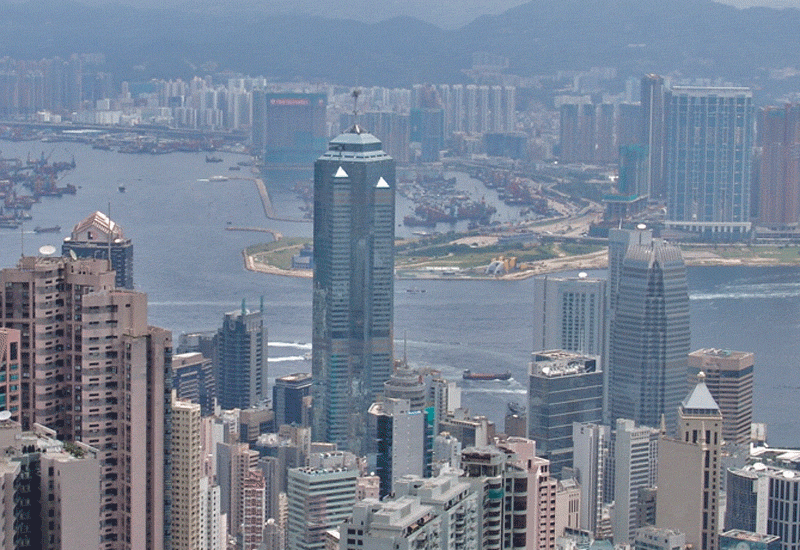
                                                                      (Photo : Google Maps)


The world\’s costliest building it has become. Yesterday, \”The Center\” in Hong Kong – a 73 storey landmark was sold for $ 5bn. Yes, FIVE BILLION US DOLLARS. For a single building. No you are not hallucinating. It really did happen.
The Centre was a jewel in the portfolio of Li Ka-Shing. If you don\’t know who he is, well, he was, and probably is, Mr Hong Kong.  One of the richest men in the world. For long he has symbolised money, power and all the glamour of Hong Kong.
This post is not about the old man. It\’s about insanity in property valuations. Yes land is scarce (anybody who has been to Hong Kong knows how scarce). And yes, it is demand and supply that sets prices.  And yes, it is a free market – nobody is compelled to buy or sell at any price. But even then, it is only right to pause and reflect on what such insane property valuations mean.
It means, most of the world\’s population cannot afford a house. Full stop.  This is one of the biggest problems in the developed world (ask any Brit how bad it is), and increasingly in the developing world. It simply drives up the cost of doing anything . In India for example, the tuition fees in a school are not for teachers – it is really to pay for the property. Ditto hospital costs. It is also the reason why you will never see a typical supermarket in the city of Mumbai .
Such ridiculous property valuations are one of the greatest causes of wealth inequality. The very few, who for historical reasons happened to inherit land, or buy property make wild fortunes at the expense of the large majority. After all any pricing is simply the value that society collectively places on  any dimension of life . Is anybody in the world seriously going to argue that property must be placed on a far higher pedestal than virtually anything else in life ?
Back to the $5 bn building. In case you have some difficulty comprehending what $5 bn is,  it will pay for 12 years of Honk Kong\’s spend on Child and Family Services or  6 years of the spending on the elderly, or 7 years of spending the on the disabled or 20 years of spending on youth or 2 years of the entire police budget or 4 years of the health budget …… Shall I go on ?
Readers must know that this blogger is taking a grave risk by putting up this post. A reader, who is a dear friend has castigated me for becoming a raving loony leftist and has threatened to personally come and clobber me if I write one more example of becoming a \”commie\” in old age ! I will have to take precautions for my safety tomorrow !!

Five Ideas for Teachers\’ Day

Teachers\’ Day is round the corner. Once again, we\’ll have the same old speeches, boring comments and everyone showing so-called \’respect\’ for teachers for one day – then it will all be forgotten till the next year comes around again! 
For those of us who feel we need to go beyond the usual platitudes, here are a few straightforward suggestions. As always, your responses and further suggestions would be very welcome indeed!

1. Prepare a \’Teacher Strength Chart\’
On a chart, put a photo of the teacher (could even be children\’s drawing) and write down 5 things that you like about the teacher or 5 good qualities the teacher has. (Every teacher has these, just that some of them may not know they have them.) Who should do this? Students / SMC or parents / CRCC or fellow teachers. Keep the chart up for as long as you want.
2. Invite the teachers\’ families and honour them
Host a function where teachers\’ parents / spouses / children are invited and honour them along with the teacher. Why? Firstly because if a teacher teaches well, gives a lot of time, and lives up to professional standards, the family has to support the teacher and sometimes even make sacrifices. On the other hand if a teacher doesn\’t live up to professional standards, the family will… you get the picture! The SMC or the CRCC would obviously have to take the lead in organizing this, with students\’ help.
3. A special \’sports\’ session for teachers
Teachers have to be so responsible that they sometimes forget what it is to be a teacher. So how about something that helps them recall the time when they themselves were young. So you could organise a kabaddi or cricket match for teachers, or even races. Other possibilities include a Talent Show (whether teachers get to display their skills such as singing or mimicry) or even a picnic. Once again, the SMC with the students\’ help and the CRCC\’s support can easily organize this.
4. Stock the school library with books bought especially for teachers
Ask the teachers what they would like to read – and buy as many of those books for your school library as the budget permits. The CRCC would need to take active lead in this, with guidance from BRC and DIETs/
5. Launch a year-long \’Search for Greatness\’
This is a difficult idea, so read carefully! Every teacher and every school can improve and reach a level far better than what it is today. In honour of teachers on Teachers\’ Day, the SMC and students as well as the CRCC can get together, promise their support and work out how they will improve the school in the year ahead. Together they will discuss what it means for their school to be \’great\’ (and will not focus on infrastructure but learning processes), identify concrete steps to attain this greatness (see suggestions separately in my blog), and work out a phased implementation plan (see ADEPTS). Teachers will naturally be part of this discussion.

You can build on the School Development Plan and dedicate the effort to teachers (of course, they too would take active part in implementing the plan). Inform the teachers that the successes will be because of them, and shortcomings because they would not have got enough support from us (that is our Teachers\’ Day gift to teachers). So this would be a year long effort to show our respect to teachers while also working with them to bring about actual improvement. Neat, no?

Five Ideas for Teachers\’ Day

Teachers\’ Day is round the corner. Once again, we\’ll have the same old speeches, boring comments and everyone showing so-called \’respect\’ for teachers for one day – then it will all be forgotten till the next year comes around again! 
For those of us who feel we need to go beyond the usual platitudes, here are a few straightforward suggestions. As always, your responses and further suggestions would be very welcome indeed!

1. Prepare a \’Teacher Strength Chart\’
On a chart, put a photo of the teacher (could even be children\’s drawing) and write down 5 things that you like about the teacher or 5 good qualities the teacher has. (Every teacher has these, just that some of them may not know they have them.) Who should do this? Students / SMC or parents / CRCC or fellow teachers. Keep the chart up for as long as you want.
2. Invite the teachers\’ families and honour them
Host a function where teachers\’ parents / spouses / children are invited and honour them along with the teacher. Why? Firstly because if a teacher teaches well, gives a lot of time, and lives up to professional standards, the family has to support the teacher and sometimes even make sacrifices. On the other hand if a teacher doesn\’t live up to professional standards, the family will… you get the picture! The SMC or the CRCC would obviously have to take the lead in organizing this, with students\’ help.
3. A special \’sports\’ session for teachers
Teachers have to be so responsible that they sometimes forget what it is to be a teacher. So how about something that helps them recall the time when they themselves were young. So you could organise a kabaddi or cricket match for teachers, or even races. Other possibilities include a Talent Show (whether teachers get to display their skills such as singing or mimicry) or even a picnic. Once again, the SMC with the students\’ help and the CRCC\’s support can easily organize this.
4. Stock the school library with books bought especially for teachers
Ask the teachers what they would like to read – and buy as many of those books for your school library as the budget permits. The CRCC would need to take active lead in this, with guidance from BRC and DIETs/
5. Launch a year-long \’Search for Greatness\’
This is a difficult idea, so read carefully! Every teacher and every school can improve and reach a level far better than what it is today. In honour of teachers on Teachers\’ Day, the SMC and students as well as the CRCC can get together, promise their support and work out how they will improve the school in the year ahead. Together they will discuss what it means for their school to be \’great\’ (and will not focus on infrastructure but learning processes), identify concrete steps to attain this greatness (see suggestions separately in my blog), and work out a phased implementation plan (see ADEPTS). Teachers will naturally be part of this discussion.

You can build on the School Development Plan and dedicate the effort to teachers (of course, they too would take active part in implementing the plan). Inform the teachers that the successes will be because of them, and shortcomings because they would not have got enough support from us (that is our Teachers\’ Day gift to teachers). So this would be a year long effort to show our respect to teachers while also working with them to bring about actual improvement. Neat, no?

Five Ideas for Teachers\’ Day

Teachers\’ Day is round the corner. Once again, we\’ll have the same old speeches, boring comments and everyone showing so-called \’respect\’ for teachers for one day – then it will all be forgotten till the next year comes around again! 
For those of us who feel we need to go beyond the usual platitudes, here are a few straightforward suggestions. As always, your responses and further suggestions would be very welcome indeed!

1. Prepare a \’Teacher Strength Chart\’
On a chart, put a photo of the teacher (could even be children\’s drawing) and write down 5 things that you like about the teacher or 5 good qualities the teacher has. (Every teacher has these, just that some of them may not know they have them.) Who should do this? Students / SMC or parents / CRCC or fellow teachers. Keep the chart up for as long as you want.
2. Invite the teachers\’ families and honour them
Host a function where teachers\’ parents / spouses / children are invited and honour them along with the teacher. Why? Firstly because if a teacher teaches well, gives a lot of time, and lives up to professional standards, the family has to support the teacher and sometimes even make sacrifices. On the other hand if a teacher doesn\’t live up to professional standards, the family will… you get the picture! The SMC or the CRCC would obviously have to take the lead in organizing this, with students\’ help.
3. A special \’sports\’ session for teachers
Teachers have to be so responsible that they sometimes forget what it is to be a teacher. So how about something that helps them recall the time when they themselves were young. So you could organise a kabaddi or cricket match for teachers, or even races. Other possibilities include a Talent Show (whether teachers get to display their skills such as singing or mimicry) or even a picnic. Once again, the SMC with the students\’ help and the CRCC\’s support can easily organize this.
4. Stock the school library with books bought especially for teachers
Ask the teachers what they would like to read – and buy as many of those books for your school library as the budget permits. The CRCC would need to take active lead in this, with guidance from BRC and DIETs/
5. Launch a year-long \’Search for Greatness\’
This is a difficult idea, so read carefully! Every teacher and every school can improve and reach a level far better than what it is today. In honour of teachers on Teachers\’ Day, the SMC and students as well as the CRCC can get together, promise their support and work out how they will improve the school in the year ahead. Together they will discuss what it means for their school to be \’great\’ (and will not focus on infrastructure but learning processes), identify concrete steps to attain this greatness (see suggestions separately in my blog), and work out a phased implementation plan (see ADEPTS). Teachers will naturally be part of this discussion.

You can build on the School Development Plan and dedicate the effort to teachers (of course, they too would take active part in implementing the plan). Inform the teachers that the successes will be because of them, and shortcomings because they would not have got enough support from us (that is our Teachers\’ Day gift to teachers). So this would be a year long effort to show our respect to teachers while also working with them to bring about actual improvement. Neat, no?

Constitution Day (National Law Day): A Glimpse

Indians celebrate many days and dates of national and international importance but few of us celebrate or even talk about 26 November, which is an important date for all as on 26 November 1949 the Constitution of India was passed and adopted by the Constituent Assembly. The Government of India declared 26 November as Constitution Day on 19 November 2015 through gazette notification. This Day is also known as National Law Day/ Samvidhan Divas. The logic is that in 2015 with full gaiety, 125 birth anniversary of Dr B.R. Ambedkar saheb was celebrated and in commemoration of his contribution towards the framing of our Constitution (as he had chaired the drafting committee of the Constituent Assembly and played a pivotal role in the drafting the Constitution), the Day (26 November) is celebrated as Constitution day.

In this context, few lines from the Press Information Bureau, Ministry of Social Justice & Empowerment, and Government of India’s notification dated 23 November 2015 may be quoted “The Government has decided to observe 26th November as ‘Constitution Day’. On the day in 1949, the constitution was adopted which came into force on January 26, 1950 marking the beginning of a new era in the history of India.  This year, the country is celebrating 125th birth Anniversary of Dr. B. R. Ambedkar. The ‘Constitution Day’ will be a part of these year-long nationwide celebrations. This will be a tribute to Dr. Ambedkar, who played a seminal role in the framing of the Indian Constitution as the Chairman of the Drafting Committee of Constituent Assembly Ministry of Social Justice and Empowerment is the Nodal Ministry for celebration of Constitution Day. A number of activities will be taken up by other Ministries/Departments which include:-

  • Department of School Education and Literacy, Ministry of Human Resource Development has informed that following activities are proposed to be undertaken by all schools under the CBSE, Kendriya Vidyalaya Sangathan, Navodaya Vidyalaya Samiti (NVS), Central Tibetan School Administration (CTSA), and Council for the Indian School Certificate Examination (CISCE) and those under the State Governments and UTs on the occasion of the first ‘Constitution Day’-
  1. Preamble to the Constitution (as it exists on date) to be read out in

school assembly on 26th November 2015 by all students.

  1. One period to be devoted on 26th November, 2015 for a talk on the salient features of the Constitution of India and its making, by a guest speaker or one of the teachers.

iii. Essay competitions and quizzes to be organized on the theme of the Constitution.

  1. An online Essay competition to be also organized on the theme of the Constitution by all CBSE affiliated schools”.

The judiciary is the final intermediary of the Constitution. Its duty is to act as a watchdog, preventing any legislative or executive act from overstepping constitutional limits.  The judiciary protects the fundamental rights of the people.

Mr. Granville Seward Austin (1927 –2014) an American historian who thoroughly studied  Indian Constitution was awarded Padma Shri award as he is the author of two seminal political histories of the Constitution of India, “The Indian Constitution: Cornerstone of a Nation” and “Working a Democratic Constitution: The Indian Experience”. According to him, “The Indian constitution is first and foremost a social document, and is aided by its Parts III & IV (Fundamental Rights & Directive Principles of State Policy, respectively) acting together, as its chief instruments and its conscience, in realising the goals set by it for all the people.” It has to be admitted that we have got an ideal Constitution.

Before winding up, few points from Kesavananda Bharati vs. State of Kerala, case may be referred. The Supreme Court ruled that an amendment cannot destroy what it seeks to modify; it cannot tamper with the Constitution’s basic structure or framework, which are unchallengeable. The Kesavananda Bharati v. State of Kerala decision laid down the Constitution’s basic structure:

  • Supremacy of the constitution
  • Republican, democratic form of government
  • Its secular nature
  • Separation of powers
  • Its federal character

It is evident that Parliament can only amend the Constitution to the limit of its basic structure. The Supreme Court or a high court may declare the amendment null and void if this is violated, after a judicial review.

Dr Shankar Chatterjee
Former Professor & Head (CPME),NIRD & PR ( Govt. of India), Hyderabad,  India
Former Associate Professor, Eritrea

Former Assistant Prof, Govt. Degree College, Tripura, India
Former Senior Planning Officer, Govt of Assam, India 

Address by the Hon’ble President of India Shri Ram Nath Kovind at the inaugural Function of ‘Constitution Day

  1.  convey my warm greetings on the occasion of 70th anniversary of the adoption of the ‘Constitution of India’, to all of you, and to all our fellow citizens in India and abroad.


  1. It was 70 years ago, on this very day, that in this Central Hall itself, through the members of the Constituent Assembly, we the people of India adopted, enacted and gave to ourselves this constitution.


  1. It was in 2015, the 125th birth anniversary year of Babasaheb Dr. Bhimrao Ambedkar that the Government of India decided to celebrate November 26, as ‘Constitution Day’ every year. This is a commendable initiative to reiterate our gratitude to the chief architect of our Constitution. This is, for the first time that we are celebrating the ‘Constitution Day’ in the Central Hall, with the participation of members of both Houses of Parliament. It is a privilege for all of us to witness and participate in this historic event.


  1. By their sheer wisdom, prudence, foresight and diligence, the makers of our Constitution, prepared a futuristic and vibrant document that reflects our ideals and aspirations on the one hand, and protects the future of all Indians on the other. The ‘Constitution of India’ lies at the foundation of the world’s largest democracy. This is the supreme law in the country’s democratic framework and it continuously guides us in our endeavors. The Constitution is also the fountainhead of our democratic system of governance and our guiding light.


  1. We Indians have had a tradition of maintaining our Indian identity while also welcoming noble ideas emanating from all the sources. This cultural ethos also finds its reflection in the making of our Constitution. We have adopted the best practices from several other Constitutions of other countries. In addition, the imprint of our age-old values​​ and the ideals from our freedom struggle can also be seen in our Constitution. Our Constitution is of the people of India, by the people of India, and for the people of India. It is a national document whose different facets also reflect the democratic systems prevalent in our ancient Assemblies and Sabhas, Lichchhavis and other ancient Indian republics and the Buddhist Sanghas.


  1. Under the extraordinary chairmanship of Dr. Rajendra Prasad, the constituent assembly accomplished the exceptional feat of blending and balancing different ideas and ideologies. The drafting committee of the Constituent Assembly, under the chairmanship of Dr. Bhimrao Ambedkar, displayed unparalleled prudence, honesty, grit and diligence and gave final shape to the Constitution. Our democracy finds its resonance in our Constitution. To ensure that the Constitution remains relevant over time, the makers of the Constitution also incorporated provisions allowing future generations to make necessary amendments as may be deemed necessary.


  1. Indian democracy is duly regarded and respected all over the world. This year, the people of India, participated in the 17th General Election and accomplished the largest democratic exercise in the world. Over 610 million people cast their vote in this election. The participation of women voters was almost equal to that of men. The election of 78 women members to 17th Lok Sabha, being the highest number of women members ever elected to this house, is a glorious achievement for our democracy. Today, all the members of the Standing Committee of Parliament on Empowerment of Women are women. This signifies an important social and political change reflective of a bright future.


  1. The people of our country deserve to be complimented for the value and respect that the Indian Constitution has earned over the last 70 years. Likewise, the three organs of the Union and State Governments, i.e., the legislature, the executive and the judiciary deserve to be complimented for the same. Strengthening the relationship and synergy between the Union and States, our journey towards ‘Co-operative Federalism’ is a living example of the dynamism of our Constitution.


  1. While delivering his last speech in the Constituent Assembly on November 25, 1949, Dr. Ambedkar had said that the success of the Constitution would depend upon the conduct of the people of India and the political parties. The illustrious makers of our Constitution had with complete devotion and honesty, envisioned to serve and work conscientiously while remaining free from fear or favour, affection or ill-will and bias. They would have been confident that their future generations, that is, all of us, will adopt these values ​​with the same spontaneity and integrity, as they, themselves, did. I think, in the present times, we all need to introspect and reflect upon this.


Honorable members of Parliament,

  1. In one of his speeches to the Constituent Assembly, Dr. Ambedkar while underlining the importance of ‘Constitutional Morality’ emphasised that the essence of ‘Constitutional Morality’ was to regard the Constitution as supreme and to follow the constitutionally mandated procedures regardless of any ideological differences. All the three organs of the State, persons gracing the constitutional posts, members of the civil society and common citizens of India are expected to abide by ‘Constitutional Morality’.


  1. According to our Constitution, it is the duty of every citizen to abide by the Constitution and respect its ideals and institutions; to cherish and follow the noble ideals of our freedom struggle; to renounce practices derogatory to the dignity of women; and to value and preserve the rich heritage of our culture. The Constitution also mentions other duties of citizens.


  1. Mahatma Gandhi, while speaking about rights and duties of people, had said (AND I QUOTE) “The true source of rights is duty. If we all discharge our duties, right will not be far to seek. If leaving duties unperformed we run after rights, they escape us like a will-o’-the-wisp.” (UNQUOTE)


  1. By incorporating the provisions relating to Fundamental Duties into our Constitution, our Parliament has made it abundantly clear that while being alert about their rights, citizens should also be conscious of their duties. ‘Fundamental duties’ also remind the people of their moral responsibilities. It can be said that the soul of the Constitution lies in its Preamble, and in the parts pertaining to Fundamental Rights, Directive Principles and Fundamental Duties.


  1. Rights and duties are two sides of the same coin. Our Constitution provides the fundamental right to ‘freedom of speech and expression’ and it also enjoins upon citizens the duty to safeguard public property and to abjure violence. Therefore, if someone misconstrues the meaning of the freedom of speech and expression and is about to damage some public property, then another, who prevents him from indulging in such an act of violence and anarchy will be seen as a dutiful citizen.  Therefore, we need to perform our duties and thereby create circumstances which would ensure effective protection of rights.


  1. Developing the spirit of humanism is also a fundamental duty of citizens. To serve with compassion towards all, is also inherent in this duty. I would like to mention one Smt. Muktaben Dagli of Gujarat, on whom I had the honour of conferring ‘Padmashri’ at Rashtrapati Bhavan, this very year. Despite losing her eyesight in her childhood, she devoted her whole life to the welfare of others. She has brightened the lives of many visually impaired girls. Through her organization, she has been instilling the light of hope in the lives of numerous blind women from many states of India. Citizens like her truly uphold the ideals of our Constitution. They deserve to be called nation-builders.


  1. As Members of Parliament, you have taken an oath to bear true faith and allegiance to the Constitution of India as by law established and to uphold the sovereignty and integrity of India. As the President of India, I too have taken an oath to preserve, protect and defend the Constitution and the law to the best of my ability and devote myself to the service and well-being of the people of India. We all need to be always mindful of our oath and affirmation.


  1. Citizens and voters of India expect their representatives to work to solve issues related to their welfare. Most people never get to meet their own Members of Parliament. But they regard you as the guardians of their hopes and aspirations. In deference to this trust and faith, serving the people should be our foremost priority.  It is indeed a great fortune to enter this holy temple of democracy and get an opportunity to serve the people of India.


  1. The most important objective and ideal presented to us by the Constitution is – to secure to all its citizens: JUSTICE, social, economic and political and EQUALITY of status and of opportunity. It is only because the Constitution makers ensured equality of opportunity that I have this opportunity to address this historic sitting of Parliament as the President of India.


  1. Our Constitution enshrines the ideal of building an inclusive society and also contains provisions for realizing it. Today is a great opportunity to convey our gratitude to the makers of our Constitution who gave us a system to bring about revolutionary changes peacefully by way of constitutional amendments. All Members of Parliament deserve appreciation for the several constitutional amendments passed during the last few years.


  1. In our country, constitutional avenues are available to address all kinds of situations that we may face. Therefore, whatever we do, we must first ponder whether our action is in conformity with constitutional boundaries, dignity and morality? I am sure that, being mindful of this constitutional touchstone and consistent with our constitutional ideals, we will earn for India its rightful place in the world as an ideal democracy. Let us resolve that we, the people of India, will continuously strive to achieve the ideals of our Constitution and realize the dreams of millions of our fellow citizens.


Thank you,

Jai Hind!

*****


Work Smart, Not Hard!

Whenever teachers are being trained, they are bombarded with the same tired old phrases. \’You are the future of the country,\’ they are told. \’There\’s a great responsibility on your shoulders; you must work very hard to fulfil this responsibility.\’ This is what we hear every time, isn\’t it? And aren\’t you fed up of listening to this over the years?
     The problem is that this is such a naive notion. As if working hard makes everything OK. No, you have to use your head! Even those whose work is seen as involving nothing but hard work, they too can do their work well only if they use their head. For instance, the labourers who unload a truck, the farmer working in the field, those who dig pits or carry head loads of debris… If they do their work without thinking and being alert, they can get hurt, face a loss, be shouted at or even fired. In the case of a teacher, therefore, this is bound to be even more crucial!
     A thinking teacher – i.e. a smart teacher – is one who greatly increases children\’s role in the classroom. And not just in keeping things clean and organized, but in the in the learning process itself. For instance, the class 4 teacher said to the children: \’You know, in this story, when the lion woke up one morning, he found that he had no hair on his head! His mane – totally gone! So guess what he did in order to get it back? Well, read the story and find out!\’
     When children started to read the story, the teacher went and sat with those who were in danger of falling behind others. After a little while she said: \’If there are any words you\’re not able to understand, circle them with your pencil. Then ask the children around you if they know.\’ When everyone had finished this, she asked groups of children to look at each other\’s circled words and see if they could find out the meaning. \’If there are still some words that you don\’t know, I\’ll tell you the meaning,\’ she said.
     You can guess what this smart teacher did next. For the entire duration that she was in her class, each child was engaged in work, was learning and helping others learn too. All this while she herself was totally relaxed!


So what are the ways in which we too can be a little more lazy, and a little smarter?

In defence of TPP – Secrecy in Negotiations

One of the biggest criticisms of the TPP in the US has been that the negotiations with other countries have been carried on in secrecy by the US government. US politicians have been falling over to yell themselves hoarse against this. When Wikileaks published confidential negotiation documents in their expose, there was much ballyhoo of how evil the government was.
Stuff and Nonsense. (The Queen would appreciate this remark !!)
I have not read Wikileaks and the very fact that I, an outsider sitting a million miles away with no access to any negotiating document, is able to write this series should be ample evidence that there is no Fort Knox secrecy. The principles with which the US (and every other country) are negotiating are well known and have been well known for years. None of the contentious issues are any different from what the US has been stating and signing in bilateral agreements for the last 20 years. Neither is any of this different from the positions the countries took in the Doha round of  the WTO. The arbitration clause I referred to three posts ago has been touted as a major googly being slipped in secretly through the back door. Bullshit. It has been there in every US bilateral agreement for years. The principles and the US stand have all been open and perfectly well known. You may agree or disagree with them, but you can\’t say they are secret.
What has certainly been kept secret are the details, the fine print and the negotiating documents. Yes, I know, the devil is in the details. In fact there is an unprecedented levels of security including telling pompous US Senators that they can\’t take notes – a tactic designed to exploit their infantile memory. You can disagree with this level of secrecy, but it is at least understandable. Negotiations involve give and take and involve messy compromises. When they are made in the glare of publicity, no agreement can be reached at all. Nobody negotiates under the glare of television cameras. Single issue activists and voluble gassy politicians (you know who I am referring to) will pump money lobbying and make so much noise that no agreement is ever possible.  For example the US is currently leaning towards accepting agricultural tariffs being retained in Japan with a quid pro quo that tariffs on Japanese automobiles will also remain in the US. This is an ugly compromise, but there is no way any deal is possible without bowing at the sacred altar of Japanese rice. As it stands the American sugar producers are vigorously lobbying for TPP (since it will protect their domestic subsidies), while the US Chamber of Commerce is furiously lobbying against and are being egged on by Australian sugar exporters. This is just on one minor item – sugar. Imagine the chaos and cacophony if every lobby group were to be shouting at 10000 decibels on Clause 4a, subsection ii of a negotiating document. We might as well not attempt any agreement at all. Anybody who wants negotiations in the full glare of publicity is either a cynical manipulator with a huge self interest or has never done a negotiation in her life (notice the gender).
The second big  controversy is the granting of fast track authority to the President to negotiate trade deals. Fast track gives authority to the President to negotiate a trade deal which Congress cannot subsequently amend or filibuster – they can either approve in toto or reject in toto. Predictably, the biggest noise on this is coming from the good lady. Of all the self serving and pompous stands, this takes the cake.
Firstly the fast track procedure is nothing new. It has been in existence since 1975. Successive Republican and Democrat presidents have been granted this power. This is not some Obama evil invention.
Secondly how, and with who, does any other country negotiate with the US ? You only negotiate with somebody who has the power to negotiate. Who is that person in the US ? What is the use of spending 3 years negotiating with the President when after a deal has been reached, 100 Senators and 435 Representatives can then amend at their will. This is the US Congress which can attach completely unrelated amendments to any bill – they of the crowning glory of killing a human trafficking bill by attaching a clause on abortion. So if the President cannot make a commitment on behalf of the US, then who can ? Does Japan have to negotiate with 535 Congressmen ? Or with a committee of Congressmen ? – imagine negotiating with an American team comprising of Elizabeth Warren, Ted Cruz,  Bernie Sanders and Eric Cantor !!!!!! There is no greater laughable concept than that.
I will conclude this series with an appeal to the Americans I know. You have elected a President. Give him some credit – he is not a traitor selling off Mom and Apple Pie. Sure, disagree with any policy, but be prepared to negotiate and make compromises with the rest of the world . Do not listen to Elizabeth Warren and Ted Cruz – both the loony left and the rabid right will lead you to a hell hole. Not only are they unhinged, they act with zero responsibility. Weigh the pros and cons of any policy in total – there are always positives and negatives. It is easy to throw out any initiative simply because you strongly disagree to a single clause.
The TPP may not be the best deal ever. It is however not a bad deal. It is to America\’s benefit. You have been the champion of free trade in the world. Your own prosperity arose because of your commitment to enterprise and trade. The world has grown following your footsteps. Do not kill your greatest strength.

    INDIAN LANGUAGES AND LITERATURE-II

    Richness of any culture can been seen and appreciated but when it comes to language and literature it is to be read and heard. We have to appreciate and take pride in this particular aspect of our culture. We must make it a point to read as many books writen during those times as it will help us to understand so many things that happened in those times. It will help us to read more books and become familiar with so many things that our happening around us today. In this lesson we will learn about the development of modern Indian languages and their literature. We will also read about the role played by the Christian missionaries in producing the earliest dictionaries and grammar of modern Indian languages and the manner in which these have helped in the growth of modern Indian literature. Besides these, we shall also get to know the role of the Bhakti movement and nationalism in the development of modern Indian literature. OBJECTIVES After reading this lesson you will be able to:  trace the development of modern Indian languages;  examine the relationship between socio-cultural changes in the Indian society and the literature in different Indian languages;  illustrate the unity and the underlying diversity in the Indian languages and their literature; and  examine the contribution of Indian languages and their literature in the renaissance of Indian society. Indian Languages and Literature-II Notes Indian Culture and Heritage Secondary Course 97 MODULE – III Languages and Literature 7.1 NORTHERN INDIAN LANGUAGES & LITERATURE We have already seen how languages evolved in India right upto the early medieval period. The old apabhramsha had taken new forms in some areas or was in the process of evolving into other forms. These languages were evolving at two levels: the spoken and the written language. The old Brahmi script of the Ashoka days had undergone a great change. The alphabets during Ashoka’s period were uneven in size but by the time of Harsha, the letters had become of the same size and were regular, presenting the picture of a cultivated hand. The studies have indicated that all the scripts of present northern Indian languages, except that of Urdu, have had their origin in old Brahmi. A long and slow process had given them this shape. If we compare the scripts of Gujarati, Hindi and Punjabi, we can easily understand this change. As for the spoken word, there are over 200 languages or dialects spoken in India at present. Some are widely used while others are limited to a particular area. Out of all these, only twenty-two have found their way into our Constitution. A large number of people speak Hindi in its different forms that include Braj Bhasha, and Avadhi (spoken in Oudh region), Bhojpuri, Magadhi, and Maithili (spoken around Mithila), and Rajasthani and Khadi Boli (spoken around Delhi). Rajasthani is another variant or dialect of Hindi. This classification has been made on the basis of literature produced by great poets over a length of time. Thus, the language used by Surdas and Bihari has been given the name of Braj Bhasha; that used by Tulsidas in the Ramacharitamanasa is called Avadhi and the one used by Vidyapati has been termed as Maithili. But Hindi, as we know it today is the one called Khadi Boli. Though Khusrau has used Khadi Boli in his compositions in the thirteenth century its extensive use in literature began only in the nineteenth century. It even shows some influence of Urdu. 7.2 PERSIAN AND URDU Urdu emerged as an independent langauge towards the end of the 4th century AD. Arabic and Persian were introduced in India with the coming of the Turks and the Mongols. Persian remained the court langage for many centuries. Urdu as a language was born out of the interaction between Hindi and Persian. After the conquest of Delhi (1192), the Turkish people settled in this region. Urdu was born out of the interaction of these settlers and soldiers in the barracks with the common people. Originally it was a dialect but slowly it acquired all the features of a formal language when the authors started using Persian script. It was further given an impetus by its use in Bahamani states of Ahmadnagar, Golkunda, Bijapur and Berar. Here it was even called dakshini or daccani (southern). As time passed, it became popular with the masses of Delhi. Indian Languages and Literature-II Notes 98 Indian Culture and Heritage Secondary Course MODULE – III Languages and Literature Urdu became more popular in the early eighteenth century. People even wrote accounts of later Mughals in Urdu. Gradually it achieved a status where literature-both poetry and prose-started being composed in it. The last Mughal Emperor Bahadur Shah Zafar wrote poetry in it. Some of his couplets have become quite well known in the Hindi and Urdu speaking areas. Urdu was given its pride of place by a large number of poets who have left inimitable poetry for posterity. The earliest Urdu poet is supposed to be Khusrau (1253-1325). He started writing as a poet in the reign of Sultan Balban and was a follower of Nizam ud-din Auliya. He is said to have composed ninty-nine works on separate themes and numerous verses of poetry. Among the important works composed by him are Laila Majnun and Ayina-I-Sikandari dedicated to Alau-din-Khalji. Among other well-known poets are Ghalib, Zauq, and Iqbal. Iqbal’s Urdu poetry is available in his collection called Bang- i – dara. His Sarejahan se achcha Hindostan hamara is sung and played at many of the national celebrations in India. No army parade is considered complete without the army band playing this tune. In big Indian cities like Delhi these are many programmes in which famous singers are invited to sing nazams or Ghazals written by famous poets like Ghalib, Maum, Bulley Shah, Waris Shah besides many others. So you can imagine how rich our language and literary culture must have been to continue till today. It has enriched our lives and is central to people meeting and intermingling with each other. Among the best prose writers were people like Pandit Ratan Nath Sarshar, who wrote the famous Fasanah- i-Azad. Even in the early days, Munshi Prem Chand, who is supposed to be a doyen of Hindi literature, wrote in Urdu. Urdu has given us a new form of poem that is called a nazm. Urdu was patronised by the Nawabs of Lucknow, who held symposiums in this language. Slowly it became quite popular. Pakistan has adopted Urdu as the state language. Development of Literature during the Mughal Period There was a tremendous development in the field of literature during the Mughal times. Babar and Humauan were lovers of literature. Baber was himself a great scholar of Persian. He wrote a book known as Tuzek-e-Babari which is highly esteemed by the Turkish Literature. Humayun got the treatise translated into Arabic. He too was a lover of learning and had establihsed a big Library. Humayun Nama, tops the books written in his times. Akbar was very fond of leaning. ‘Akbar Nama’, Sur Sagar, Ram Charitamanas are prominent among the books written during his time. Malik Muhammad Jayasis Padmavat and Keshav’s Ram Chandrika were also written during the same period. Jahangir greatly patronized literature. Many scholars adorned his court. He too was a scholar of a high caliber and wrote his life story. During Shah Jahan’s time there was a well known scholar named Abdul Hameed Lahori. He wrote Badshah Nama. The literary activities suffered during Aurangzeb’s time. Indian Languages and Literature-II Notes Indian Culture and Heritage Secondary Course 99 MODULE – III Languages and Literature Urdu literature started developing during the last days of the Mughal emperor. This credit goes to Sir Sayyid Ahmed Khan and Mirza Galib. The language of Sir Sayyid Ahmed Khan was very simple and impressive. His compositions inspired the other urdu writer Mirza Galib, who was a famous poet of his time. He made an important contribution to uplift Urdu poetry. There were some other writers also who took interest in Urdu poetry and enriched the Urdu literature. Maulvi Altab Hussain Ali, Akbar Allahabadi and Dr. Mohammed Iqbal are some famous names. As Persian was the language of the court, much of the literature produced in this period was written in Persian. Amir Khusrau and Amir Hasan Dehelvi wrote superb poetry in Persian. Historians like Minhas-us-Siraj and Zia Barani and Ibn Batuta who came to India during those days wrote accounts of rulers, important political events and incidents in this language. In the medieval period, Persian was adopted as the court language. Several historical accounts, administrative manuals and allied literature in this language have come down to us. The mughal rulers were great patrons of leaning and literature. Babar wrote his tuzuk (autobiography) in Turkish language, but his grandson Akbar got it translated into Persian. Akbar patronized many scholars. He got Mahabharata translated into Persian. Jahangir’s autobiography (Tuzuk-i-Jahangiri) is in Persian and is a unique piece of literature. It is said that Noorjahan was an accomplished Persian poetess. Quite a fair amount of Persian literature has been produced by the courtiers of the Mughals. Abul Fazl’s Akbarnamah and Ain-e-Akbari is a fine piece of literature. From there we get a good deal of information about Akbar and his times. Faizi wrote beautiful Persian poetry. Several collections of letters of the Mughal period (insha) have come down to us. Besides shedding light on Mughal history, they indicate different styles of letter writing. Another name in prose and history writing is that of Chandra Bhan, a writer of Shahjahan’s days. Similarly, we have a work named Tabqat-i-Alamgïri, shedding light on Aurangzeb. Badauni was another writer who belonged during Akbar’s time. In the twentieth century, Iqbal wrote good Persian poetry. All this has now become a part of Indian heritage and culture. Among the noted Hindu poets of this period were Kabir, Tulsidas, Surdas and Rahim. Kabirs dohas are still so popular today while Tulsidas’s Ramcharitmanas has become the most sacred book of the Hindus. Behari’s Satsai written during Akbar’s reign is very famous. Alankarashekhara by Keshav Mishra was produced in Akbar’s court. It was a great Sanskrit work on the styles of writing. Akbar also got many Sanskrit books like Bhagwad Gita and Upanishads translated into Persian. INTEXT QUESTIONS 7.1 1. What are the various forms of Hindi language? _______________________________________________________________ Indian Languages and Literature-II Notes 100 Indian Culture and Heritage Secondary Course MODULE – III Languages and Literature 2. Which language is used by Tulsidas for Ramcharitmanas? _______________________________________________________________ 3. How did Urdu language came into use in India? _______________________________________________________________ 4. Which coutry has Urdu as a state language? _______________________________________________________________ 5. What is Urdu langage called in Deccan? _______________________________________________________________ 7.3 HINDI LITERATURE These was a tremendous growth of regional languages like Hindi, Bengali, Assamese, Oriya, Marathi and Gujarati during this time. In the South, Malayalam emerged as an independent language in the 14th century The emergence of all these languages resulted in the decline of Sanskrit as they came to be used as the medium through which the administrative machinery functioned. The rise of the Bhakti movement and the use of these regional langages by the various saints helped in their growth and development. We have already noted the various dialects that developed in northern and western India. Prithviraj Raso is supposed to be the first book in the Hindi language. It is an account of exploits of Prithviraj Chauhan. In its imitation several other rasos were written. The language went on changing as the area where it was used expanded. New words to express new situations were either coined or taken from areas coming under its influence. Hindi literature looked to Sanskrit classics for guidance and Bharata’s Natyashastra was kept in mind by Hindi writers. During the twelfth and thirteenth centuries there started a movement in southern India that was called the Bhakti movement. As its influence reached the north, it started affecting the prose and poetry that were being composed in Hindi. Poetry now became largely devotional in nature. Some of the poets like Tuisidas wrote poetry in a language which was of that region only, while others like Kabir, who moved from place to place added Persian and Urdu words as well. Though it is said that Tuisidas wrote Ramcharit Manas based on Valmiki’s Ramayana, he also alters situations and adds quite a few new scenes and situations based on folklore. For example, Sita’s exile is mentioned in Valmiki’s version but it is not mentioned in Tulsidas’s account. Tuisidas has deified his hero while the hero of Valmiki is a human being. Hindi evolved during the Apabhramsa stage between the 7th and 8th centuries A.D. and the 14th C. It was characterized as Veergatha Kala i.e. the age of heroic poetry or the Adi Kala (early period). It was patronised by the Rajput rulers as it glorified chiralry and poetry. The most famous figures from this period were Kabir and Tulsidas. In modern Indian Languages and Literature-II Notes Indian Culture and Heritage Secondary Course 101 MODULE – III Languages and Literature times, the Khadi dialect became more prominent and a variety of literature was produced in Sanskrit. Similarly, Surdas wrote his Sur Sagar in which he talks of Krishna as an infant, a young lad indulging in pranks and a young man engaged in dalliance with the gopis. These poets made a deep impression on the minds of the listeners. If the festivals associated with Rama and Krishna have become so very popular, the credit goes to these poets. Their versions became the source of inspiration not only for other poets but also for painters in the medieval ages. They inspired Mirabai, who sang in Rajasthani language, and Raskhan, who, though a Muslim, sang in praise of Krishna. Nandadasa was an important Bhakti poet. Rahim and Bhushan were a class apart. Their subject was not devotion, but spiritual. Bihari wrote his Satsai in the seventeenth century; it gives us a glimpse of shringar(love) and other rasas. All the above mentioned Hindi poets, except Kabir, expressed their sentiments essentially to satisfy their own devotional instincts. Kabir did not believe in institutionalised religion. He was a devotee of a formless God. Chanting His name was the be-all and end-all for him. All these poets influenced the north Indian society in a manner that had never happened earlier. As it is easier to remember poetry than prose, they became immensely popular. During the last 150 years, many writers have contributed to the development of modern India literature, written in a number of regional languages as well as in English. One of the greatest Bengali writers, Rabindranath Tagore became the first Indian to win the Nobel Prize for literature (Geetanjali) in 1913. However, it is only with the beginning of nineteenth century that-Hindi prose came into its own. Bharatendu Harishchandra was one of the earliest to produce dramas in Hindi which were basically translations of texts written in Sanskrit and other languages. But he set the trend. Mahavir Prasad Dwivedi was another author who wrote translations or made adaptations from Sanskrit. Bankim Chandra Chatterji (l 838-94) wrote novels originally in Bangla. They came to be translated into Hindi and became very popular. Vande Mataram, our national song, is an excerpt from his novel, Anand Math. Swami Dayanand’s contribution to Hindi cannot be ignored. Originally a Gujarati and a scholar of Sanskrit, he advocated Hindi as a common language for the whole of India. He started writing in Hindi and contributed articles to journals essentially engaged in religious and social reforms. SatyarthaPrakash was his most important work in Hindi. Among other names who have enriched Hindi literature, is that of Munshi Prem Chand, who switched over from Urdu to Hindi. Surya Kant Tripathi, ‘Nirala’, achieves recognition because he questioned the orthodoxies in society. Mahadevi Verma is the first woman writer in Hindi to highlight issues related to women. Maithili Sharan Gupt is another important name. Jaishankar Prasad wrote beautiful dramas. Indian Languages and Literature-II Notes 102 Indian Culture and Heritage Secondary Course MODULE – III Languages and Literature Hindi Language Makes Progress in Modern Period Hindi Language: The development of modern language started at the end of the 18th century. The main writers of this period were Sadasukh Lal and Enshallah Khan. Bhartendu Harishchandra also strengthened Hindi language. Similarly Raja Lakshman Singh translated Shakuntala into Hindi. Hindi continued to develop in adverse circumstances as the office work was done in Urdu. Hindi Literature: Bhartendu Harish Chandra, Mahavira Prasad Dwivedi, Ramchandra Shukla and Shyam Sunder Das were the main among the prose writers of Hindi literature. Jai Shanker Prasad, Maithalisharan Gupta, Sumitranandan Pant, Suryakant Tripathi ‘Nirala’, Mahadevi Verma, Ramdhari Singh ‘Dinkar’ and Haribans Rai ‘Bacchan’ made great contribution to the development of Hindi poetry. Similarly Prem Chand, Vrindavan lal Verma and Ellachandra Joshi wrote novels and enriched Hindi literature. If we look at the above writers, we find that they all wrote with a purpose. Swami Dayanand wrote in order to reform the Hindu society and rid it of false beliefs and social evils. Munshi Prem Chand tried to draw the attention of the society to the miserable existence of the poor and Mahadevi Verma recipient of Padma Vibhushan, the second highest civilian award highlighted the conditions of women in the society. ‘Nirala’ became the pioneer of awakening of Modern India. INTEXT QUESTIONS 7.2 1. Who is the author of Natya Shashtra? _______________________________________________________________ 2. What is the difference between the character of Rama in Valmikhi and Tulsidas? _______________________________________________________________ 3. How was Krishna’s role in Sur Sagar different? _______________________________________________________________ 4. Our national song Vandemataram is taken from which book? _______________________________________________________________ 5. Why do we feel that Hindi writers wrote with a purpose? _______________________________________________________________ 7.4 BENGALI, ASSAMESE AND ORTYA LITERATURE After Hindi, the next significant literature was the one that developed in Bengal. The Baptist Mission Press was established in Serampore near Calcutta in 1800. East India Company Indian Languages and Literature-II Notes Indian Culture and Heritage Secondary Course 103 MODULE – III Languages and Literature founded the Fort William College in the same year. It provided training to civil servants of the Company in law, customs, religions, languages and literatures of India to enable them to work more efficiently. The growth of the Bhakti movement and the compositon of various hymns associated with Chaitanya provided a stimulus to the development and growth of Bengali. Narrative poems called the Mangal Kavyas also grew popular during this period. They propatated the worship of local deities like Chandi and transformed Puranic Gods like Siva and Vishnu into household deities. In this regard, a very important landmark was achieved by William Carey, who wrote a grammar of Bengali and published an English-Bengali dictionary and also wrote books on dialogues and stories. It may be noted that the grammar and dictionaries are important in the development of a literature. They guide the writers as to the correctness of a sentence and also help them in finding suitable words for a particular situation and idea. Although the aim of the press run by the missionaries was mainly to propagate Christian faith but other presses run by local people helped in the flourishing of non-Christian literature. Scores of pamphlets, small and big books and journals were produced. In the meantime education spread, although at a very slow pace. But after 1835, when Macaulay won the battle against Orientalists, it spread at a faster pace. In 1854 came Sir Charles Wood’s Despatch and in 1857 the three universities of Calcutta, Madras and Bombay were established. Besides textbooks for schools and colleges, other literature were also produced. However it was Raja Ram Mohan Roy who wrote in Bengali besides English that gave impetus to Bengali literature. Ishwar Chandra Vidyasagar (1820-91) and Akshay Kumar Dutta (1820- 86) were two other writers of this early period. In addition to these, Bankim Chandra Chatterji (l834-94), Sharat Chandra Chatterji (l876-1938), and R.C. Dutta, a noted historian and a prose writer, all contributed to the making of Bengali literature. But the most important name that influenced the whole of India was that of Rabindra Nath Tagore (1861-1941). Novels, dramas, short stories, criticism, music and essays, all flowed from his pen. He won the Nobel Prize for literature in 1913 for his Geetanjali. However, a few things need to be noted about the influence of Western ideas which permeated Bengal and later on other parts of India. Upto 1800, most of the literature produced was limited to religion or courtly literature. The Western influence brought the writers closer to the man in the street. The subjects were mundane. Some religious literature was also produced but it hardly said anything new. The final years of the nineteenth century and the first half of the twentieth century saw a new subject, nationalism, being taken up. Two things were seen in this new trend. The first was the love for old history and culture and an awareness of the facts of British exploitation. The second was a clarion call for arousing the Indians to drive out the foreigners, both by persuasion and force. This new trend was expressed by Subrahmanyam Bharti in Tamil and Qazi Nazrul Islam in Bengali. The contributions of these two writers in arousing the Indian Languages and Literature-II Notes 104 Indian Culture and Heritage Secondary Course MODULE – III Languages and Literature nationalistic sentiments in the readers was tremendous. Their poetry was translated into other Indian languages. Assamese – Like Bengali, Assamese also developed in response to the Bhakti movement. Shankardeva who introduced Vaishnavism in Assam helped in the growth of Assamese poetry. Even the Puranas were translated in Assamese. The earliest Assamese literature consisted of buranjis (court chronicles). Shankardev has left several devotional poems, which people song with rapturous pleasure, but it was only after 1827 that more interest was shown in producing Assamese literature. Two names, Lakshmi Nath Bezbarua and Padmanaba Gohain Barua cannot be forgotten. From Orissa, a couple of names are worth mentioning and these are Fakirmohan Senapati and Radha Nath Ray, whose writings deserve considerable attention in the history of Oriya literature. The works of Upendra Bhanja (1670 – 1720) were important as they ushered a new period of Oriya literature. In Orissa the works of Saraladasa are regarded as the first works of Oriya literature. INTEXT QUESTIONS 7.3 1. When and were was Baptist Presss established? _______________________________________________________________ 2. When did Wood’s Derpatch come to India? _______________________________________________________________ 3. When and where were three universities opened? _______________________________________________________________ 4. Which work of Sh. R.N. Tagore won him Noble Prize in 1913? _______________________________________________________________ 5. How did Shan Karadwa help in the growth of Assamese poetry.? _______________________________________________________________ 7.5 PUNJABI AND RAJASTHANI LITERATURE Punjabi is a language with several shades. It is being written in two scripts, Gurmukhi and Persian. The Gurmukhi script till the end of the nineteenth century was almost limited to the Adi Granth, the holy book of the Sikhs. Only a small number of people tried to learn the script except the granthis, who recited the holy Granth in the gurdwaras. However, the Indian Languages and Literature-II Notes Indian Culture and Heritage Secondary Course 105 MODULE – III Languages and Literature language did not lack literature. Guru Nanak was the first poet in Punjabi. Some other contemporary poets, mostly Sufi saints, used to sing in this language. These Sufis or their followers used the Persian script if they wanted to commit their poetry to writing. In this list, the first name is that of Farid. His poetry has found a place in the Adi Granth. The Adi Granth also contains poetry of the next four gurus. All this literature belongs to the fifteenth and sixteenth centuries. Amongst the later gurus, the poetry of the ninth guru, Guru Tegh Bahadur has also contributed to the Adi Granth. Guru Gobind Singh, the tenth guru, was educated in Patna (Bihar), where he learnt Persian and Sanskrit. He has composed two savaiyyas in Punjabi but these are not a part of the Adi Granth. But it was the love stories of Heer and Ranjha, Sasi and Punnu and Sohni and Mahiwal, which gave this language its theme in the early days. Even the story of Puran Bhagat found favour with some poets. Beautiful poems written by some known and some unknown poets have come down to us. These are being sung by local singers for the last two or three hundred years. There are several other poetic stories which have been composed by the locals. This folklore has been preserved. The most important of these is Heer of Waris Shah. It is the most popular of the early works. It is a landmark in Punjabi poetry. Similar is the popularity of Bulley Shah who was a Sufi saint. He has left a large number of songs. One of his popular forms of compositions was called kafi; it was sung in a classical musical form. Kafis are sung by people with great fervour. In the twentieth century, Punjabi had come into its own. Bhai Vir Singh composed an epic, named Rana Surat Singh. Puran Singh and Dr. Mohan Singh are among the best known writers. Essays, short stories, poetry, novels, criticism and all other forms of writing have adorned the Punjabi literary scene. Rajasthani, a dialect of Hindi, had its own part to play. The bards (itinerant singers) moved from place to place, providing entertainment and keeping the stories of heroes alive. It was from these ballads that Colonel Todd collected the heroic stories of Rajasthan and put them in the Annals and Antiquities of Rajasthan. But the devotional songs of Mira Bai have a place of pride in the history of language as well as devotional music. Mira Bai’s love for her lord (Lord Krishna) is sometimes so intense that it transcends this mundane world and transports one to the land of this singer. The development of the Bhakti movement led to the rise of the different regional languages like Hindi, Gujarati, Marathi, Punjabi, Kannada, Tamil and Telugu. 7.6 GUJARATI LITERATURE Early Gujarati literature is available in the form of Bhakti songs of the fourteenth and fifteenth centuries. It still follows the old tradition which is popular in Gujarat. Narsi Mehta’s name is the foremost in this respect. The people of Gujarat wove these devotional songs in their folk dances and their religious forms often find expressions in their celebrations. Indian Languages and Literature-II Notes 106 Indian Culture and Heritage Secondary Course MODULE – III Languages and Literature Narmad’s poetry gave a fillip to the Gujarati literature. Saraswati Chandra, a novel by Govardhan Ram, has become a classic and has given great impetus to other writers. But probably a name that cannot be forgotten is that of Dr. K.M. Munshi. He was a novelist, an essayist and a historian, and has left a plethora of historical novels. In these books he exhibits his ability to mix fact with fiction. Prithvi Vallabha is one of his finest novels. A special mention must be made of Narsi Mehta whose songs in praise of Krishna not only made him a very popular figure but also made Gujarati language popular. 7.7 SINDHI LITERATURE Sindh was one of the important centres of Sufis, who established khanqahs at various places. The Sufi singers with their devotional music made the language popular. The credit for creating literature in Sindhi goes to Mirza Kalish Beg and Dewan Kauramal 7.8 MARATHI LITERATURE Maharashtra is situated on a plateau where a large number of local dialects were in use. Marathi grew out of these these local dialects. The Portuguese missionaries started using Marathi for preaching their gospel. The earliest Marathi poetry and prose is by Saint Jnaneshwar (Gyaneshwar) who lived in the thirteenth century. He wrote a long commentary on the Bhagavad Gita. He was the one who started the kirtan tradition in Maharashtra. He was followed by Namdev (l 270- 1350), Gora, Sena and Janabai. All these sang and popularised the Marathi language. Their songs are sung even today by the Verkari pilgrirns on their way to Pandharpur pilgrimage. Almost two centuries later, Eknath (l 533-99) came on the scene. He wrote the commentaries on the Ramayana and the Bhagawat Purana. His songs are very popular all over Maharashtra. Then came Tukarama (1598-1650). He is supposed to be the greatest Bhakti poet of them all. Ramdas (1608-81), who was the guru of Shivaji, is the last of these hymn writers. He was the devotee of Rama. He inspired Shivaji. The closing years of the nineteenth century saw an upsurge in the Marathi literature. It was a nationalist movement that made Marathi prose popular and prominent. Bal Gangadhar Tilak (l 857-1920) started his Journal Kesari in Marathi. This helped the growth of Marathi literature. But the role of Keshav Sut and V.S. Chiplunkar was no less. Hari Narayan Apte and Agarkar wrote novels which became very popular. All these prose writers made great contribution to the development of Marathi literature. The name of H.G Salgaokar is remembered for writing inspirational poetry. Besides, the names of M.G. Ranade, K.T. Telang, G.T. Madholkar (poet and novelist) are no less important. 7.9 KASHMIRI LITERATURE Kashmir shot into literary prominence, when Kalhana wrote Rajatarangini in Sanskrit But this was in the language of the elite. For locals, Kashmiri was the popular dialect. Here Indian Languages and Literature-II Notes Indian Culture and Heritage Secondary Course 107 MODULE – III Languages and Literature also the Bhakti movement played its role. One Lal Ded, who lived in the fourteenth century, was probably the first to sing in the Kashmiri language. She was a Shaivite mystic. After Islam spread in this area, the Sufi influence also came to be visible. Haba Khatoon, Mahjoor, Zinda Kaul, Noor Din also known as Nund Rishi, Akhtar Mohiuddin, Sufi Ghulam Mohammad and Dina Nath Nadim wrote devotional poetry in Kashmiri. These people contributed to the growth of Kashmiri literature. The Western influence did not reach Kashmir till the end of the nineteenth century. In 1846, after the first Sikh War, the Dogras of Jammu became the rulers there. The Dogras were more interested in Dogri language than in Kashmiri. There were hardly any schools or education. There was widespread poverty and economic backwardness. All these led to a lack of good literature in Kashmir. Though the list of Modern Indian languages can have many languages, the constitution of India has originally about 15 languages as national languages i.e. Assamese, Bengali, Gujarati, Hindi, Kashmiri, Marathi, Oriya, Punjabi, Sanskrit, Sindhi, Urdu, Tamil, Telugu, Kannada, Malayalam. Three more langauges i.e. Nepali, Manipuri and Konkani have been added now to the list. INTEXT QUESTIONS 7.4 1. Which Indian language was written in two scripts Gurumukhi and Persian? _______________________________________________________________ 2. Name at least two love stories of Punjab? _______________________________________________________________ 3. Which was the popular forms of compositions of Bulley Shah? _______________________________________________________________ 4. Name the novel of Govardhan Ram? _______________________________________________________________ 5. Who started Kirtan tradition in Maharashtra in the 13th century AD? _______________________________________________________________ 6. What reasons led to a lack of good literature in Kashmiri? _______________________________________________________________ Indian Languages and Literature-II Notes 108 Indian Culture and Heritage Secondary Course MODULE – III Languages and Literature 7.10 ROLE OF CHRISTIAN MISSIONARIES With the coming of the Europeans to India various foreign languages like English, French, Dutch and Portuguese were introduced here which greatly enriched Indian langauges as they added many new words to their vocabulary. The contribution of the Christian missionaries in the development of Indian literature was no less significant. First of all, they published dictionaries and grammar in several local languages. The books written by them were meant for the newly arrived clergymen from Europe. These books helped these missionaries as much as they helped the writers in the local languages. They could easily turn to the dictionaries to find a suitable word or see if the word was grammatically correct. The second fact is the role of lithographic printing press, which was introduced in India in the beginning of the nineteenth century. The foreigners had established these presses for printing literature in local languages for the benefit of the new, or would-be converts. Therefore, the role of printing press in the development of literature cannot be ignored. The third important fact is the establishment of schools and colleges by the missionaries. Here, besides English, the missionaries also taught the local languages. Perhaps their aim was to spread Christianity but they also produced a newly educated class, who had a desire to read their literature. Thus, the role of missionaries cannot be ignored while writing the history of Indian languages and literature. Main Writers of English Literature in India In India there were many writers of the English literature. The Indians started writing work in English after 1835, when English was made the medium of instruction. Many Indian writers composd their literature in English. Some of them showed their interest in the field of poetry, while some others showed their keen interest in prose writing. Michael Madhu Sudan Dutta, Taradutta, Sarojini Naidu and Ravindranath Tagore made important contribution in the field of English Poetry. Surendra Nath Banerjee, Firoze Shah Mehta and Jawahar Lal Nehru showed interest in English prose. WHAT YOU HAVE LEARNT  Hindi was spoken by a large number of people.  Urdu and Persian became popular in the Mughal era. Urdu was born out of the interaction between Turkish settlers and the local people. Abul Fazl, Chandra Bhan and Badayuni were famous writers of the Mughal era.  Hindi literature looked to Sanskrit classics for guidance. Bhakti poetry is a milestone in Hindi literature. Kabir, Tulsidas and Surdas were the guiding light of Hindi literature. Indian Languages and Literature-II Notes Indian Culture and Heritage Secondary Course 109 MODULE – III Languages and Literature  In the beginning of the nineteenth century Hindi prose came into existence.  Next to Hindi, the richest literature is that of Bengali. Rabindranath Tagore, Bankim Chandra Chatterji and Sharat Chandra Chatterji contributed to the making of Bengali literature. Assamese literature consisted of buranjis. Similar is the case with Oriya.  Till the end of the nineteenth century, Gurmukhi was limited to Adi Granth; it was the love stories of Heer Ranjha which gave this language a theme. The devotional song of Meera Bai gave a place of honour to Rajasthani language and literature.  Gujarati, Sindhi, Marathi and Kashmiri also developed their literature in due course of time.  Many Indian writers compsoed their writings in English. TERMINAL EXERCISE 1. What was the role of the Christian missionaries in India? 2. Briefly describe the development of Hindi language? 3. Explain the role of Persian langauge in medieval India? 4. Identify the contributions of Indian languages and literature in shaping of Indian society? ANSWERS TO INTEXT QUESTIONS 7.1 I. 1. Braj Bhasha, Avadhi, Bhojpuri, Magadhi, Rajasthani, Khadi Boli. 2. Avadhi 3. Urdu langauge was born out of the interaction of Turkish settler with locals. 4. Pakistan 5. Dakshini or Daccani (southern) 7.2 I. 1. Bharata 2. Tulsidas’ Rama is portrait as God while in Valimikhi’s He is portrait as Human being. 3. Krishna as a young lad indulging in pranks and a young man engaged in delliance with the goppies. Indian Languages and Literature-II Notes 110 Indian Culture and Heritage Secondary Course MODULE – III Languages and Literature 4. Anand Math 5. Swami Dayanand wrote in order to reform Hindu society. Munshi Premchand wrote about the miserable existance of the poor. Mahadevi Verma wrote about the plight of women. 7.3 I. 1. In 1800 at Seerampur near Calcutta. 2. 1854 3. In 1857, Calcutta, Madras, Bombay 4. Geetanjali 5. He introduced Vaishnavism in Assam. 7.4 I. 1. Punjabi 2. Heer/Ranjha, Sohni/Mahiwal, Sasi/Punnu 3. Kafi 4. Saraswati Chandra 5. Saint Jnaneshwar 6. Poverty, economic backwardness and the use of Dogri