Constitution is the Holy Book Which Provides Dignity to the Citizen and Upholds Unity of the Country

Prime Minister Narendra Modi today highlighted the strength of inclusivity in our Constitution and said that this has made us face of our challenges while upholding the integrity of the nation.

He was today addressing a joint sitting of the both the houses to mark the 70th Year of Constitution in the Central Hall of Parliament.

Referring to the Constitution day, the Prime Minister said, “ There are a few occasions and a few days that strengthen our relation with the past. They motivate us to works towards a better future. Today the 26th of November is a historical day. 70 years ago, we duly adopted our great Constitution. “

Prime Minister described the Constitution as a product of several debates and deliberations of the Constituent Assembly. He paid tributes to all those who put in their effort in providing the country with its Constitution.

“7 decades ago in this Central hall, every clause of Constitution was discussed, debated on our dreams, challenges and prospects. Dr Rajendra Prasad, Dr Bhim Rao Ambedkar, Sardar Vallabhbhai Patel, Pandit Nehru, Acharya Kriplani, Maulana Abul Kalam Azad and several other senior leaders debated, discussed and gave us this heritage. I pay my tributes to all those who were responsible for giving us this constitution. “

“The dreams of the members of the Constituent Assembly took shape in the form of the words and values enshrined in our Constitution.”, he said.

Prime Minister said that Babasaheb Bhimrao Ambedkarji, in his last discourse on the Constitution on the 25th of November 1949 reminded the people that in the past “we have lost both our freedom and the republic nature of the country owing to our own mistakes”.

Prime Minister said, “Ambedkar Ji warned the people and asked them if the country can now uphold its freedom and its democracy”

Prime Minister said, “Had Babasaheb Ambedkar been alive today, he would have probably been the happiest. Not only India upheld its virtues but strengthened its democracy and freedom. “

“And that is why I bow to the Legislature, Executive and Judicial wings of the Constitution which helped in preserving the values and ideals enshrined in it.”

Prime Minister said he would also bow to the entire country for striving to uphold the constitution.

“I humbly bow to the 130 Crore Indians whose faith in India’s democracy never diminished and who always revered the constitution as a holy book and a guiding light.

The 70 years of our constitution brings us a feeling of happiness, supremacy and a sense of conclusion.

The happiness is due to resolute sense of belongingness to the virtues and essence of the constitution. People of this country have rejected any attempt to the contrary.”

He said, “The sense of supremacy is due to the ideals of the constitution that we could move towards Ek Bharat Shresth Bharat.

The essence we arrive at is that Constitution is the only means through which this vast and diverse country can achieve its aspirations, dreams and progress.”

Prime Minister Narendra Modi described the Constitution as our holy book.

“Our Constitution is the most holy book for us which is a conglomeration of our life, our society, our traditions, our values and also a solution to all our challenges.”

He said Constitution is based on the twin philosophy of dignity and unity. “Two mantras of Constitution are ‘dignity for Indians’ and ‘unity for India’ It held supreme the dignity of our citizens while keeping the Unity of India intact.”

Prime Minister termed the Constitution as the best express of global democracy and that it keeps us aware not only of our rights but also of our duties.

“The Constitution of India highlights both rights and duties of citizens. This is a special aspect of our Constitution. The relation and balance between the rights and duties were very well understood by the Father of our Nation Mahatma Gandhi ji. “

He urged the people to develop the spirit to adhere to the Sense of duty enshrined in the constitution.

“Let us think about how we can fulfil the duties enshrined in our Constitution.

We should differentiate between service and duty. While Service is voluntary, that is you may help a needy on the street, but if you follow traffic rules rigorously while driving then you are fulfilling your duty.

It should be our effort to emphasise on duties in our interactions with people.

As proud citizens of India, let us think about how our actions will make our nation even stronger.”

He said, “Our Constitution begins with “We the People of India”. Let us realise that We the People are its strength, its inspiration and its purpose”

The Prime Minister also recalled this day as the day in which several people were killed in a terror attack in Mumbai in 2008 and paid tributes to those departed on that gruesome day.

“But today also is a day that causes pain when on 26th November in Mumbai terrorists have tried to destroy the thousands of years of rich philosophy of Vasudaiva Kutumbakam (One World One Family). I pay my respects to the departed souls.”


Narendra Modi

@narendramodi

Speaking in Parliament on . Watch https://www.pscp.tv/w/cKyzWjMyMjExNTJ8MU93eFdkRU1SbndLUcgLmuwPvCozJ-DbB2Uq4QwGA5BNtnQoQ-jLEOMxjD5y 

Narendra Modi @narendramodi

Speaking in Parliament on #ConstitutionDay. Watch

pscp.tv

4,672 people are talking about this

https://www.pscp.tv/w/1OwxWdEMRnwKQ

********
 

Contesting Cribbing

If you\’re a person working to improve the educational system in a country like ours, here\’s something you\’ll recognize: whether it\’s journalists or academics, colleagues from NGOs or \’well-wishers\’ of children, everyone is pretty good at \’problem pointing\’. They\’re really good at telling us exactly how BAD things are. Numerous articles, speeches, social media entries, research pieces, presentations, and even protests, copiously crib about a range of ills affecting education : how the system is dysfunctional, teachers are absent, accountability is missing, children aren\’t learning, process is dated, children are oppressed, administration is rigid, policies are rich but unimplemented, how the disadvantaged continue to get a raw deal right through… Recognize it? I do, for some of this is what I do as well!


But here\’s the rub – all this elaboration on what is wrong (some of it is serious research that is credible as well), how far has it helped find exactly what to do. That is, what to do which would help us get rid of the problems being pointed out. Don\’t get me wrong, I\’m all for the growing numbers of those who are able to detail their dissatisfaction at the continued limitations of our education system. It\’s just that I\’m unable to learn enough from it to know what needs to be done.


Because when one gets down to the doing, a whole lot of other things unfold that you were not quite prepared for. Turns out dealing with diversity is not exactly easy, and most of the pat suggestions don\’t really hold in face of the actual ground realities. Turns out that poor (or even exploitative) governance is such an all-pervading reality that what we can do in / through education just pales in front of it (try sitting in a district education office for a day if you don\’t believe me). Turns out that our \’log frames\’, strategies, plans and spreadsheets capture something in our mind but all of it simply crumbles when the actual implementation takes place. It\’s often noticed that some of the best experts, especially those from the universities, are usually eager to help in the planning and the evaluation – but not the part that comes in between, i.e. the implementation!


So I\’ve come to the unfortunate conclusion that a great proportion of those involved tend to complain mainly because it is the easiest thing to do. Just like many newspaper sections talk of potholes on the roads, delayed or poor services, or lack of facilities (usually in a self-righteous tone that includes phrases such as \’even 60 years after independence\’ – you get the picture). All this in the hope that saying what is wrong will somehow make it go away. As if it really does! 


Where does all this leave us? To my mind, it leaves us with a lot of cribbing all around us. Every day we continue to read, hear, powerpoint and wordprocess an overdose of shortcomings. Such solutions as are offered are usually: 

  • trite (\’there should be accountability\’ – which is easy to say, of course) or 
  • platitudinous  (\’teachers should be dedicated to their vocation\’) or 
  • superficial (\’implement play way method!\’ – makes one\’s skin crawl) or 
  • autocratic (\’strictly monitor these damned teachers, don\’t let them get away\’ ) or 
  • misguided (\’pay teachers more / less if their students learn more / less\’ – you can see how this will favour the already advantaged, isn\’t it) or 
  • even desperate and daft (\’put a web cam in every class\’).


I\’m doing the same, of course, cribbing. But let me try to redeem myself by making a few (hopefully) concrete suggestions:

  • The first thing is to recognize the huge potential of all this cribbing. It represents an enormous and growing \’cognitive surplus\’ that can be put to better use to further what the \’cribber\’ is interested in – actual improvement.
  • Along the lines of wikipedia, bring out a collective, well-organised and evolving situational analysis to which people can keep contributing. This will help generate a more structured, well-rounded understanding that might increase the likelihood of finding effective strategies.This should include a critique of the kind of superficial solutions mentioned earlier, with case studies of the difficulties they landed in or the actual improvement they brought about. An analysis of serious efforts and the difficulties faced would help bring about a nuanced problematization.
  • Those involved in change efforts could find ways of identifying any \’cribber\’ who shows potential, and involve her/him in actual improvement processes – either the process would improve or the cribbing would be contained.
  • Publicize and set standards for the kind of writing that is deemed as being helpful. This is not easy at all – but the degree to which the social discourse on education is getting overwhelmed by this collective bemoaning (and the resultant diversion from / inability to actually address the issues) is now making it imperative that we find a way out. Any news channel / newspaper could initiate this by developing a policy paper on how to cover the social sector and then actually following it. Once an example is set, others would follow suit (simply because the initiating body would come out looking better, and therefore be likely to grab a bigger share of sensible eyeballs). 

You might feel that I\’ve totally mis-read the situation, that we need more people to actually be pointing out what is going wrong. Well, point away – but that\’s no guarantee it will make the problem go away!

In defence of TPP – the arbitration clause

One of the big issues in a trade relationship involving multiple countries is what happens if a country unilaterally decides to ban a product, or raise import duties astronomically, or take a similar form of unilateral action that dramatically affects the viability of a foreign investor\’s project. This might go against something that the government itself contractually agreed with the investor. What does the investor do.
The investor can take the government of that country to court, but in many countries of the world  there is no hope of winning, or it would take years in court. After all a government can simply change laws retrospectively (as India often does) and the courts can do little else but enforce them. It is precisely for this reason that the United States for many years has been insisting on independent forums for resolving Investor-State Disputes (ISDs). The US position has been that the legal system of every country outside the US cannot be trusted and therefore there must be an independent mechanism for resolving disputes. In current bilateral trade agreements with 5 of the 12 countries in TPP, the US already has ISD clauses.  In recent years the US has an ISD mechanism in every trade agreement it has signed, bar the US-Australia one. In fact the biggest opponent of the ISD clause has been Australia, rather than the US. In a blatant double facedness, Australia has ISD clauses in trade agreements with developing countries, but refuses with developed countries.
The principle is not new either in the commercial arena or in governmental ones. Every commercial contract has arbitration clauses – parties submit to the jurisdiction of arbitrators rather than courts. This is both cost effective as well as time saving and is universally used in commercial contracts. There are well established global rules governing arbitration – the \”capitals\” of arbitration being London, New York and Singapore. If each commercial dispute came to the courts, the judicial system in every country in the world will come to a grinding halt – it is partly for this reason that courts themselves encourage arbitration.
It is therefore rich for US politicians, and especially Elizabeth Warren to argue against the ISD clause on grounds of loss of sovereignty. Firstly it is the US itself over successive Republican and Democrat administrations that has championed this principle. Secondly it the US which is usually the gainer in such matters – for example it prevents countries from outrightly nationalising companies and industries, as say for example, Argentina is wont to do. 
Two cases are often used to illustrate how \”greedy companies are milking countries\” – the Veolia Egypt case and the Philip Morris Uruguay case.
Veolia , a French firm was executing a project to reduce greenhouse gases in Alexandria in Egypt. The firm executed a contract with the government whereby the government would compensate the company for cost increases because of governmental action. Egypt then raised the minimum wages in the country and Veolia then took the Alexandria authorities to arbitration for compensation for rising costs. The matter is in dispute and has not yet been decided. This is a contractual matter and the spin that Warren & Co are mouthing that this is a corporation suppressing minimum wages in a poor country is pure balderdash.
The Philip Morris case is more nuanced. Uruguay passed laws requiring that 80% of the pack contain graphic images and the risks of smoking. It raised taxes, banned advertising, and sponsorships. Philip Morris took this to arbitration on the grounds that this makes it virtually impossible to do business. The matter is yet to be decided. Uruguay is a signatory to an ISD arbitration and hence this came up before the arbitration panel rather than the courts in Uruguay. There  is no evidence that just because it has gone to arbitration  the ruling would be \”unfair\” or \”unjust\”.
As a consequence of this case, in the TPP negotiations, the US has sought to prevent misuse of the arbitration clause by recognizing each country’s “inherent right” to regulate for health and safety. This will probably get incorporated into the final deal so that unilateral action by governments on grounds of health or safety  cannot be legally challenged.
As far as the US is concerned, the TPP provisions are no different from the existing situation it already has in some 50 odd agreements.  So why all this noise from Warren ? The noise is not because she has a better mechanism for dealing with an investor government dispute. It is in reality because she is against globalisation & trade. That is a different argument and battle.

Ramamritham falls in love

Who is the person I hate the most ? No; not that one, whom I frankly don\’t care about . He is half the planet away and troubling other folks; not me. My visceral hate is reserved for somebody much closer home. The \”dotard\” called Ramamritham. Allow me an unhinged rant please; I badly need it !
You see, the problem is that Ramamritham has fallen head over heels in insane love. We all know how crazy he is even when supposedly normal. Now that his brain circuits have been singed with love, he has become a monster. The delectable damsel who has swept this idiot off his rockers is called Aadhaar.
For the benefit of the one American reader who claims to be ignorant about India (no; not the lady – she is an expert !), Aadhaar is the national ID that every resident of India is supposed to get.
The government introduced Aadhaar some 5 years ago ostensibly as a way to identify individuals to whom subsidies could be paid directly and thereby minimise leakages.  The government gave pious assurances (including to the Supreme Court) that Aadhaar was not compulsory or mandatory and it would never make it so.
I think the government framed this with good intentions, but had not factored that the old toothless fart, Ramamritham, would fall in love with this.  They say love makes you irrational, and if anybody needed any further proof of this, look at what this apology to the human race is doing.
He first made Aadhaar mandatory for buying gas cylinders. Then he made it mandatory to operate any bank account. Then he made it mandatory to file a  tax return.  But where he has gone completely bonkers is that he has now made it mandatory for a mobile connection !! And where it truly descends into madness is that its not just an Aadhaar number that this clown wants. He wants a fingerprint match for every mobile owner !! No; I am not joking. He wants to fingerprint you before you have a mobile phone.
Consider the logistics. There are 1.2 billion people in India. Perhaps some 800 million own a mobile phone. And we being the argumentative Indians we are,  don\’t possess just one connection . Almost everybody has two SIM cards. And this is what Ramamritham wants us to do.
1. Go physically to a store of the mobile company (they usually have one store for a million users)
2. Stand in a queue ; you can imagine the length of the queue yourself
3. Give your mobile number and Aadhaar number to whoever is behind the counter
4. You will get a one time password on your phone
5. Give this number to the flunkey
6. He will enter some 10 fields into a computer system that has been ordained by Ramamritham.
7. You then place your thumb on a fingerprint reader
8. If it goes through (and that\’s a big IF – see below), then the flunkey does some more fiddling with the system
9. You then place your thumb a second time (Ramamritham wants to make absolutely sure)
10. If it again goes through, then say four different prayers and then go home
11. You\’ll get a SMS saying that your request has been registered and that you will get a confirmation in 24/48 hours
12. If you get a SMS after 24/48 hours, you should follow the instructions there and type Y or N or don\’t do anything
13. If you fail in any of these steps, go to Step 1
Note : The big IF arises because , this being India, any sensible store has bought a cheap Chinese fingerprint reader and it is impregnated with the smudges of the half a million people who have tried to bestow their affections on it.  Therefore your fingerprint is rarely read on the first attempt. If you fail in three attempts, your Aadhaar gets locked and if you want to unlock it then you have to undergo some contortions not dissimilar to what a certain Mr Scaramucci suggested a Mr Bannon was in the habit of doing.
800 million Indians have to do this twice ( not just once, for you see everyone has two SIM cards). If you are stretcher bound, you still have to do this. Nobody else can do it for you because you have to press your damn thumb on that damn machine in the store. If you don\’t do this by February, be prepared to just not have a mobile phone. Cost estimates for the whole nation to cater to Ramamritham\’s love affair have been pegged at Rs 1000 crores.
I have lived in the most obsessed country in the world which wants to control every single bit of information you have access to – China. This is the country that has blocked Twitter, Facebook, YouTube, WhatsApp, ………… This is the country that employs a million people to read every tweet and delete those that it doesn\’t like. Even in that country, buying a SIM card was as simple as going to a corner shop and just buying it. No paper, no forms, no crap. It takes all of 2 minutes. And I am now supposed to be living in a liberal democracy called India. And I have to do all of what I have outlined in this post, simply to have the privilege of talking to a friend.
Unfortunately this is not the worst of it. The other day, I had to receive a payment from some company. They demanded my Aadhaar. Very soon, if I have to pee, I am sure I will have to validate my Aadhaar.
Readers are invited to design the most creative torture that can be inflicted on Ramamritham. And to the good American referred to earlier in the post. Let\’s do an exchange. I\’ll gladly take your dear leader in exchange for Ramamritham !!

Wooing HQ2 ? Yuk !

If you are an American, here’s a a nice issue to distract you from your fixation about you know who and direct your attention to a different issue you can get all worked up about.
Witness each city falling over each other and doing the most stupid of things to land HQ2. Tucson Arizona, where one of the readers of this blog lives ,  uprooted a 21ft cactus and tried to deliver it to HQ1. The mayor of Kansas City actually bought one thousand items from the company in HQ1 and wrote a review of each one of them. Mayors of cities are looking silly in videos that they have made asking Alexa where HQ2 is going to come up and Alexa answering of course, the city they are mayors of. Shall I go on ?
If you are wondering what all this hullaballoo is  about, this is all to do with attracting Amazon’s second head office. Amazon is based in Seattle (this is HQ1). They want to create a HQ2 somewhere else. And why are cities willing to stand in a line and kiss Bezos’ ass (cue the nod to the awful American version of the Queen’s English !). Because he is promising to invest $5 bn and create 50,000 jobs. How did they come to this magic figure of investment ? Because he says the average salary of the jobs created would be $100,000. 
The antics of Tucson and Kansas City are harmless on their own. HQ2 won’t come there anyway. The real danger is the big cities offering tax breaks to Amazon. Without a doubt this will happen.
This is a terrible idea. Cities and states that do sweetheart deals to tempt businesses into moving are doing an appalling act of profligacy.  This is worse than a bribe.  Think about it – this is a perfect way of taking money from the poor (remember indirect taxes are not progressive and a fair amount of the state revenues in the US come from indirect taxes) and giving it to somebody who does not deserve or need the money. One city does this , and the next city will do the same for another company.  And before you say Bingo, everybody has been given a dole.
The right way to attract companies is to do the boring things – create infrastructure, make a talent pool available by vigorous education and training, attract outsiders by making it a great place to come and live, have a favourable business atmosphere in the form of ease of doing business and reasonable tax rates.  That is when companies will come and stay on. That’s why New York in Finance and the West Coast Cities in technology are what they are.  Not because they gave tax breaks.
If you are an American, you should vigorously protest against your city doing a sweetheart deal with Amazon.  
For Indians, who can look at all this with an amused smile; we have of course been long guilty of doing such deals with companies. But I want you to get agitated in a different angle. The capital of the IT industry in the country did all the right things 30 years back – great place to live in, pleasant weather, abundance of talent, a cosmopolitan place for people to come, etc etc. It did not give a tax break. And yet every IT company worth it’s salt came.
And then this city let it all go to seed and become the appalling wreck of a city that it is today.  This is the best way to drive every company out. No member of the Homo Sapiens species will ever come to this place again. Instead the entire population has mutated into Pithecanthropus Erectus, which being extinct, is delighted to be able to come back into existence even if condemned to living in a hellhole ! How does this blogger know of such a mutation ? Because he has mutated himself !

Anna\’s is NOT a movement for change

Let\’s imagine for a moment that corruption vanishes – no one takes bribes any more. Which of the following do you think would now happen as a result?

  • Dalits will not face discrimination anywhere; people will stop believing in caste and elections will be around issues, not social groups. Unborn girls will not be killed, dowry will go, sexual harassment will vanish, the notion of \’minority\’ will not need to be discussed, equality and equity will be established.
  • People will start working harder, with greater commitment, be much more innovative, and therefore the economy will shoot up. Private enterprise will no more be required to shore up government efforts.
  • We will stop exploiting environmental resources in a dangerous manner, all power and energy related problems will be solved, petrol will become cheaper, our sources of water will not be polluted any more and global warming will come to a halt (at least in India).
  • All children will start attending school and learning well; teachers will transform into good teachers, all government schools will become great schools, and India\’s learning standards will be among the highest in the world. In sports too we will emerge as a world power.
  • Inflation will not affect us any more, the price of food and other essentials will come down, no matter what happens elsewhere in the world.
  • Health and nutrition levels will go up greatly, diseases of the poor (water-borne ones or those caused by malnutrition, for instance) will be vanquished.
  • Poor governance will vanish – in the absence of bribes, officials will become competent, start taking good decisions, stop representing power groups, start listening to people and actually working for their betterment.

I hope you were able to tick off quite a few!


Oscar Wild said: \’Stupidity is the only sin.\’ And in that sense, Anna&Co are great sinners. Unfortunately, those who continue to believe they\’re helping destroy the roots of our problems and bringing about real change – are even more so.

Anna\’s is NOT a movement for change

Let\’s imagine for a moment that corruption vanishes – no one takes bribes any more. Which of the following do you think would now happen as a result?

  • Dalits will not face discrimination anywhere; people will stop believing in caste and elections will be around issues, not social groups. Unborn girls will not be killed, dowry will go, sexual harassment will vanish, the notion of \’minority\’ will not need to be discussed, equality and equity will be established.
  • People will start working harder, with greater commitment, be much more innovative, and therefore the economy will shoot up. Private enterprise will no more be required to shore up government efforts.
  • We will stop exploiting environmental resources in a dangerous manner, all power and energy related problems will be solved, petrol will become cheaper, our sources of water will not be polluted any more and global warming will come to a halt (at least in India).
  • All children will start attending school and learning well; teachers will transform into good teachers, all government schools will become great schools, and India\’s learning standards will be among the highest in the world. In sports too we will emerge as a world power.
  • Inflation will not affect us any more, the price of food and other essentials will come down, no matter what happens elsewhere in the world.
  • Health and nutrition levels will go up greatly, diseases of the poor (water-borne ones or those caused by malnutrition, for instance) will be vanquished.
  • Poor governance will vanish – in the absence of bribes, officials will become competent, start taking good decisions, stop representing power groups, start listening to people and actually working for their betterment.

I hope you were able to tick off quite a few!


Oscar Wild said: \’Stupidity is the only sin.\’ And in that sense, Anna&Co are great sinners. Unfortunately, those who continue to believe they\’re helping destroy the roots of our problems and bringing about real change – are even more so.

Anna\’s is NOT a movement for change

Let\’s imagine for a moment that corruption vanishes – no one takes bribes any more. Which of the following do you think would now happen as a result?

  • Dalits will not face discrimination anywhere; people will stop believing in caste and elections will be around issues, not social groups. Unborn girls will not be killed, dowry will go, sexual harassment will vanish, the notion of \’minority\’ will not need to be discussed, equality and equity will be established.
  • People will start working harder, with greater commitment, be much more innovative, and therefore the economy will shoot up. Private enterprise will no more be required to shore up government efforts.
  • We will stop exploiting environmental resources in a dangerous manner, all power and energy related problems will be solved, petrol will become cheaper, our sources of water will not be polluted any more and global warming will come to a halt (at least in India).
  • All children will start attending school and learning well; teachers will transform into good teachers, all government schools will become great schools, and India\’s learning standards will be among the highest in the world. In sports too we will emerge as a world power.
  • Inflation will not affect us any more, the price of food and other essentials will come down, no matter what happens elsewhere in the world.
  • Health and nutrition levels will go up greatly, diseases of the poor (water-borne ones or those caused by malnutrition, for instance) will be vanquished.
  • Poor governance will vanish – in the absence of bribes, officials will become competent, start taking good decisions, stop representing power groups, start listening to people and actually working for their betterment.

I hope you were able to tick off quite a few!


Oscar Wild said: \’Stupidity is the only sin.\’ And in that sense, Anna&Co are great sinners. Unfortunately, those who continue to believe they\’re helping destroy the roots of our problems and bringing about real change – are even more so.

When nation is first, country takes big decision: PM

Prime Minister Shri Narendra Modi delivered keynote address in Republic Summit here today. Theme of this year’s summit is “India’s Moment Nation First”.

Speaking on the occasion PM said that From Nation wants to know India has transformed to Nation First. He also said that things which were not solved for decades have been solved now. This happened due to two reasons – 130 Crore people’s thinking that India’s Moment and Nation First.

On the abrogation of Article 370 in Kashmir, PM said that India eliminated big reason behind terrorism. He added that Article 370 that gave special status to Jammu and Kashmir was a temporary provision in the Constitution but due to “some families”, it was considered as permanent.

He emphasized that when nation is first, country takes big decision. And when country accepts that decision nation moves forward. He also said that people went to the Supreme Court so that Aadhaar could not get legal recognition. These people put all their strength to malign Aadhaar. But Aadhaar helped a lot in revealing their truth. It has saved about Rs 1.5 lakh crores from falling into the wrong hands. He added that every year, almost the same amount was falling into the wrong hands and there was no one to stop it. We did the work to stop this huge leakage of the system, because India is first for us.

Prime Minister said that GST could never have been implemented in the country earlier. Today, 99 percent of the things related to ordinary citizens are being taxed on an average of half as compared to before. There was a time when refrigerators – mixers, juicers, vacuum cleaners, geysers, mobile phones, washing machines, watches, all taxed more than 31 percent. Today, tax on all these things has been reduced to about 10 to 12 percent.

On regularization of illegal colonies in Delhi, he said that for decades, there was a lot of uncertainty in the lives of millions of families. People used to buy houses here with their hard-earned money, but they could not completely own them. These problems remained always. Our government has decided to end it and now more than 50 lakh Delhiites have got the certainty/hope/confidence of their home and a better life. Certainly it will benefit our middle class and help in getting their dream home, he added.

Prime Minister emphasized that the speed and Scale that is being worked on in India today is unprecedented. Toilet facilities to be provided to nearly 60 crore Indians in 60 months. These types of plans and programs can be planned and executed only when Nation is first.

He added that when you get out of selfishness, make everyone’s support – everyone’s development and everyone’s trust the basis of policy and politics. This thinking has left us behind in the race for development, learning how to work with new approaches on 112 aspirational districts of the country.

PM said that it was the spirit of Nation First that opened more than 37 crore bank accounts to connect the poor with the banking system. It was this thinking of Nation First that started the water life mission. In the coming time, about Rs.3.5 lakh crore will be spent on this mission, so that people in remote areas of the country can get clean drinking water, water can reach every house.

Prime Minister added that with the intention of increasing their income, the country has set a target of making the country’s economy $ 5 trillion. He said that he believed that working with the spirit of Nation First, we will get the proper result of every decision and the country will achieve every goal. He hoped that in this spirit, there will be a detailed discussion on the new possibilities, new opportunities of new India.

***

Has Anyone Asked Teachers This Yet?

Over the last two decades, as the number of teachers has grown, so too has a certain attitude towards them. This comes up in different ways in the various interactions we have – during school visits, meetings at cluster or block level, workshops and training programmes for different groups of personnel, and informal interaction at all levels. Somehow, the discussion ends up at the teacher\’s door. And the following statement springs forth: \’Teacher is at the heart of the matter sir; only when teacher improves can anything improve.\’
This is then followed by a long list of what teachers are not good at, including examples such as (this is a mild list!):
  • Teachers don\’t practice Quality Teaching
  • Are not able to \’go according to the level of children\’
  • Don\’t make use of psychology (I assume this means something called \’child psychology\’)
  • Application is missing – teachers are not linking concepts to practical life.
  • They show a lack of Social Awareness
  • Don\’t go for innovative activities
  • Don\’t do voluntary service
  • Don’t give examples while teaching
  • Don\’t pin accountability for the task given (i.e. don\’t take responsibility themselves)
  • Fail to develop or revive the interest to teach
  • Are not flexible to change their mentality
  • Don\’t give individual attention to children
  • Are not patient
  • Don’t make use of case study
  • Don\’t take a friendly approach
  • Are poor listeners
  • Have no tolerance
  • Are partial
  • Reluctant
  • Lazy
  • Lack in adaptation, and don\’t update their knowledge
  • Are in a hurry to get the product rather than being bothered about the process
  • Expect more with little effort!

Believe it or not, this is an actual list produced by participants in a workshop (which also included teachers!) and is also typical of most parts of the country.
But when asked to name any strengths that teachers have, what you usually get are blank stares or a scrawny, reluctant list of maybe four points, such as:
  • Covers syllabus in time
  • Preparing children for getting marks.
  • Good in lecturing (encouraging rote learning)
  • Conducting special coaching for those falling behind

As you can see, no shortage of left-handed compliments here!
Typically, when asked if they\’ve actually asked teachers what they\’re good at, or what they feel they\’re not good at, the people who make the above statements tend to draw a blank! However, when teachers themselves are asked what they\’re not good at, their statements include points such as these:
  • In trying to address the average student, I\’m unable to take care of those who are falling behind
  • I find it difficult to make the subject interesting for some students
  • If parents can\’t help children with their homework, I find it difficult to help the child in class

Clearly, there\’s a perception mismatch between teachers and those tasked with appointing, deploying, orienting, developing, mentoring and monitoring teachers. It might be a little too much to ask, but the following seem clearly required;
  • There\’s a need to listen to teachers before coming to the kind of conclusions we have come to
  • In order to go beyond impressions, systematic observation and research are required
  • How about finding out the strengths teachers have and how to build on them
  • Finally, what is the system doing to make some of its own dire predictions about teachers become true?

Time, it seems, to make a course correction here.

In defence of TPP – the loss of jobs

The opposition from labour unions in the US ( and labour activists everywhere in the world) to the TPP is that it will lead to the loss manufacturing jobs (read in the US) and therefore it is anti labour. I have some sympathy for the view of the labour unions in the US, but absolutely no sympathy for the \”global labour activists\”.
In every change of  the status quo, including opening up of trade, there will be winners and losers. When international trade is made more easy, by whatever means, the risk of American manufacturing jobs being lost is real. Labour intensive activity will migrate from higher cost locations to lower cost locations – that\’s an indisputable fact of economics. Therefore there has to be some sympathy for the US unions\’ opposition to every trade deal with a foreign country.
The balance sheet of wins and losses for the US looks like this. Jobs will be lost, especially in manufacturing. US consumers win in terms of lower costs of products. If international trade were to be substantially reduced, inflation will soar in the US. Prices of all goods will rise to levels which will put them out of reach of many people making it hard for even the poor in the US to enjoy the quality of life they currently have. Increased economic activity leads to rise in taxes for the US government – don\’t believe all that spin about evil corporations hiding their money overseas ; this is a point I am happy to debate separately. The increased economic activity does create more jobs, but not enough to compensate for the loss of jobs and in any case it is mismatched in terms of skill levels. So the only constituency that has some case for objecting to the TPP ( and every trade deal) is the US labour unions.
The group that deserves utter contempt are the international \”labour activists\” who are protesting against the TPP.  As we have seen, jobs will be lost in the US, but they will migrate to lower cost, and poorer countries . These are the societies that desperately need economic betterment through jobs.  Secondly, by lowering the cost of labour, there is a defence against machines taking over these jobs. That is why iPhones are still assembled by hand in China and clothes stitched by hand in Bangladesh. In sum total, there are more jobs created and preserved in the world than it would have been if manufacturing were to be done in high costs countries. You would have thought this is in net good for the world.
It is also an indisputable fact that labour is exploited in poor countries.The US, to its credit, through various trade agreements and via the TPP, is trying to minimise this. In particular, US negotiators want TPP members to implement and enforce the 1998 Declaration on Fundamental Principles and Rights at Work of the ILO. This includes the freedom of association, right to collective bargaining, a ban on forced or compulsory labor, the abolition of child labor, and a ban on discrimination in employment. The US also wants countries not to exempt their special economic zones from the labour laws of the rest of their country. These are all sticking points in the negotiations, but this is what the US has been strongly negotiating for.  If there were no TPP, it would be laissez faire for labour exploitation in each country. The TPP at least attempts to get some common protection for labour in every country. And the \”international activists\” are opposing this.
So yes, international trade will hurt US jobs. It has been doing so for many decades. But if you see it from a global perspective, the world would be a better place with the TPP, than without it. Having said that, I have sympathy for, and would not argue against the opposition of the US trade unions.

Wooing HQ2 ? Yuk !

If you are an American, here\’s a a nice issue to distract you from your fixation about you know who and direct your attention to a different issue you can get all worked up about.
Witness each city falling over each other and doing the most stupid of things to land HQ2. Tucson Arizona, where one of the readers of this blog lives ,  uprooted a 21ft cactus and tried to deliver it to HQ1. The mayor of Kansas City actually bought one thousand items from the company in HQ1 and wrote a review of each one of them. Mayors of cities are looking silly in videos that they have made asking Alexa where HQ2 is going to come up and Alexa answering of course, the city they are mayors of. Shall I go on ?
If you are wondering what all this hullaballoo is  about, this is all to do with attracting Amazon\’s second head office. Amazon is based in Seattle (this is HQ1). They want to create a HQ2 somewhere else. And why are cities willing to stand in a line and kiss Bezos\’ ass (cue the nod to the awful American version of the Queen\’s English !). Because he is promising to invest $5 bn and create 50,000 jobs. How did they come to this magic figure of investment ? Because he says the average salary of the jobs created would be $100,000. 
The antics of Tucson and Kansas City are harmless on their own. HQ2 won\’t come there anyway. The real danger is the big cities offering tax breaks to Amazon. Without a doubt this will happen.
This is a terrible idea. Cities and states that do sweetheart deals to tempt businesses into moving are doing an appalling act of profligacy.  This is worse than a bribe.  Think about it – this is a perfect way of taking money from the poor (remember indirect taxes are not progressive and a fair amount of the state revenues in the US come from indirect taxes) and giving it to somebody who does not deserve or need the money. One city does this , and the next city will do the same for another company.  And before you say Bingo, everybody has been given a dole.
The right way to attract companies is to do the boring things – create infrastructure, make a talent pool available by vigorous education and training, attract outsiders by making it a great place to come and live, have a favourable business atmosphere in the form of ease of doing business and reasonable tax rates.  That is when companies will come and stay on. That\’s why New York in Finance and the West Coast Cities in technology are what they are.  Not because they gave tax breaks.
If you are an American, you should vigorously protest against your city doing a sweetheart deal with Amazon.  
For Indians, who can look at all this with an amused smile; we have of course been long guilty of doing such deals with companies. But I want you to get agitated in a different angle. The capital of the IT industry in the country did all the right things 30 years back – great place to live in, pleasant weather, abundance of talent, a cosmopolitan place for people to come, etc etc. It did not give a tax break. And yet every IT company worth it\’s salt came.
And then this city let it all go to seed and become the appalling wreck of a city that it is today.  This is the best way to drive every company out. No member of the Homo Sapiens species will ever come to this place again. Instead the entire population has mutated into Pithecanthropus Erectus, which being extinct, is delighted to be able to come back into existence even if condemned to living in a hellhole ! How does this blogger know of such a mutation ? Because he has mutated himself !

Why Corruption Is An Easy Issue To Raise

It\’s interesting to observe why the issue of \’corruption\’ seems to attract attention. Right now, across the country (and the world), a huge majority of people are oppressed by the accepted notion that it is OK for some to be considered \’above\’ others. That is why it is OK for some of \’us\’ 
  • to go to high fee private schools (we have \’earned\’ it), 
  • to sit in AC coaches in the train (we paid for it after all, never mind that the others\’ capacity to pay for the same is hampered by systemic and systematic obstacles), 
  • to feel that we belong to \’big\’ or \’important\’ families… 
Such societal hierarchies have a far greater impact and preserve disadvantage.
Isn\’t it corruption too to believe that one belongs to a \’better\’ or \’purer\’ religion / caste / class / background / family than others. Yet Anna and co don\’t raise issues of social fracture (conveniently forgetting that Gandhi spent far more of his life on these issues, and regarded true independence as one from social oppression too). It\’s worth thinking on why the issue of corruption really suits the middle class – it\’s so neutral and harmless, and avoids the really frightening ones. It\’s also something where you can blame \’others\’ without feeling that you are part of the problem…
As an educator, therefore, if I had to teach children any value, it would not be an ordinary thing like \’do not be corrupt\’ but the more difficult concept of \’though you are unique and deserve the best, do not think you are more important than others or have a birthright to more than they do\’.

Xi who must be obeyed (with apologies to The Economist)

The title of this post is directly stolen from The Economist which ran a cover story by this name a year or so ago. They themselves were punning the quote from here.

The much awaited China’s People Congress ended today with the expected climax – the unveiling of the new Politburo Standing Committee ; the men who will run China for the next five years. More of this in just a little while. This ended a week of speechifying and staged events.

First, the two things that stood out during the days preceding the event today.  Xi Jinping opened the Congress with a speech lasting an incredible three and a half hours, reaching new heights of torture and boredom. It was a hugely self confident China strutting about as a world power, with Xi vigorously patting his own back. He outlined some of the directions for the next five years which were typically broad motherhoods, but gave some clues on where they are heading.

The most important outcome was the enshrining of “Xi Jinping Thought” in the Communist Party’s Constitution. This is a peculiarly Chinese obsession. Their infatuation with obscure theories and doctrines knows no boundaries. “Mao Zedong Thought” was supposed to be the guiding doctrine of the Party – never mind that it is rubbish, the Party has long ditched many of that nonsense, etc etc. Then Deng Xiaoping “Practice” was enshrined into the Constitution after his death. At the end of their terms Jiang Zemin and Hu Jintao’s “theories” were also included, but their names were not mentioned (such semantics are very important in China with those two acknowledging that they are a step behind the two taller and earlier leaders). Xi hasn’t bothered with any such finesse. Halfway into his term he has enshrined his name and “Thought” – the implication being he is Mao’s equivalent and even above Deng. A dangerous move almost Trumpesque is self aggrandisation. His “Thought” is mostly bland with lots of garbage , but who cares. These are political moves cloaked in ideology.

And then today, came the line of seven men who walked in, and that was how the world got to know about the new Standing Committee. Readers of this blog may recall that this blogger made a prediction in this post a month or so ago. I got one thing wrong – that Li Keqiang the Premier would be dropped and that Wang Qishan, Xi’s right hand man would stay on beyond retirement age and would become the Premier. That didn’t happen. The powerful Wang retired and Li has stayed on as the Premier. I predicted a 5 man Standing Committee reduced from 7 (that didn’t happen) but also named the potential seven man Committee if it stayed at that number. I got that dead right, including the order of seniority – after Xi and Li came Li Zhanshu, Wang Yang, Wang Huning, Zhao Leji & Hang Zheng. I got real lucky !

Here is my take on the implications of what happened over the last week

– Xi is all powerful. That we knew of course.
– Xi has decided to not break all traditions and to preserve some of the norms and continuity. Hence the  retirement of Wang Qishan and the continuance of Li Keqiang.
– No successor to Xi has been named, as expected. This leaves Xi’s options open. He can stay on as a power centre either formally or informally after his term ends in 5 years.
– The two possible successors Hu Chunhua and Chen Min’er are on trial. They have to earn the right to succeed over the next 5 years. But even after, they will probably have to be subservient to Xi.
– The Party is going to tighten the hold on China even more. Forget any liberalism, tolerance and such other “esoteric” concepts.
– China will be aggressive in world politics. The world simply has to learnt to adjust to that. America will be the county most affected. It will be on the losing end more often than not.
– Zhao Leji will be the new Wang Qishan. He will continue the anti corruption drive and Xi’s political opponents will continue to be targeted.
– China is entering into dangerous territory of authoritarianism.  Chinese history shows  how much the entire country loses when such autocratic tyrants take charge – recent examples of Ci Xi and Mao are enough to illustrate this danger. There is every risk of Xi going the same way – generating sycophants, staying on too long, getting drunk on power and doing stupid things.
– The Deng Xiaoping era is finally over (that it lasted 25 years after his death is amazing by itself). Most of the safeguards he tried to institutionalize are slipping. The wisdom of Deng is being frittered away. In many ways, he is the loser from what has happened. China will learn to its cost, the implications of ignoring its wisest man in recent history.

Life returns back to normal in China. This blogger will not blog about Chinese politics for the foreseeable future. A parting thought however – watch out for Hu Chunhua, Chen Min’er, Zhao Leji, and of course, above all, Xi.

Insanity in Property


                                                                      (Photo : Google Maps)


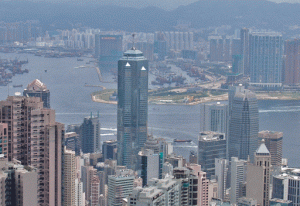
The world’s costliest building it has become. Yesterday, “The Center” in Hong Kong – a 73 storey landmark was sold for $ 5bn. Yes, FIVE BILLION US DOLLARS. For a single building. No you are not hallucinating. It really did happen.
The Centre was a jewel in the portfolio of Li Ka-Shing. If you don’t know who he is, well, he was, and probably is, Mr Hong Kong.  One of the richest men in the world. For long he has symbolised money, power and all the glamour of Hong Kong.
This post is not about the old man. It’s about insanity in property valuations. Yes land is scarce (anybody who has been to Hong Kong knows how scarce). And yes, it is demand and supply that sets prices.  And yes, it is a free market – nobody is compelled to buy or sell at any price. But even then, it is only right to pause and reflect on what such insane property valuations mean.
It means, most of the world’s population cannot afford a house. Full stop.  This is one of the biggest problems in the developed world (ask any Brit how bad it is), and increasingly in the developing world. It simply drives up the cost of doing anything . In India for example, the tuition fees in a school are not for teachers – it is really to pay for the property. Ditto hospital costs. It is also the reason why you will never see a typical supermarket in the city of Mumbai .
Such ridiculous property valuations are one of the greatest causes of wealth inequality. The very few, who for historical reasons happened to inherit land, or buy property make wild fortunes at the expense of the large majority. After all any pricing is simply the value that society collectively places on  any dimension of life . Is anybody in the world seriously going to argue that property must be placed on a far higher pedestal than virtually anything else in life ?
Back to the $5 bn building. In case you have some difficulty comprehending what $5 bn is,  it will pay for 12 years of Honk Kong’s spend on Child and Family Services or  6 years of the spending on the elderly, or 7 years of spending the on the disabled or 20 years of spending on youth or 2 years of the entire police budget or 4 years of the health budget …… Shall I go on ?
Readers must know that this blogger is taking a grave risk by putting up this post. A reader, who is a dear friend has castigated me for becoming a raving loony leftist and has threatened to personally come and clobber me if I write one more example of becoming a “commie” in old age ! I will have to take precautions for my safety tomorrow !!