Have you ever thought about Factors affecting launching of a Business Unit?

i) Business Unit, also referred to as a department, division, or functional area is a part of a company or an organization that represents a specific business function and is a part of firm’s value chain of activities like accounting, human resources, marketing, sales, purchasing and manufacturing.

ii) Establishment is a business location of a company that is engaged in a single activity. It’s a place where the business is conducted with the objective of getting paid for selling goods or services

Choosing the Best Location for Your Business | AllBusiness.com

iii) Plant Location refers to the choice of the region where men, materials, money, machinery and equipment are brought together for setting up a business or factory. A plant is a place where the cost of the product is kept to low in order to maximize gains.

iv) Plant Layout is a plan for effective utilization of facilities for the purpose of manufacturing of products, involving most efficient and economical arrangement of machines, materials, personnel, storage space and all supporting services, within available floor space.

v) Feasibility studies are the researches and studies that determine whether to go ahead with the business plan or any other idea and plan should be adopted.

Franchise Feasibility check

Want to know about Business Risk?

Business risk is defined as the possibility of occurrence of any unfavorable event that has the potential to minimize gains and maximize loss of a business. In simple words, business risks are those factors that increase the chances of losses in a business and reduce opportunities of profit.

Characteristics of Business Risk

1. Business risk arises due to uncertainties. Uncertainty is when it is not known what is going to happen in future. Examples of uncertainties that affect a business are change in government policy, change in demand, change in technology, etc.

2. Risk is an essential part of the business. Risk involved plays a crucial role in business operations. The risk involved in can be reduced to some extent but it cannot be completely eliminated.

3. Every business has risk which varies in severity based on the type of business. For example a large Corporation or business will carry more risk as compared to small scale businesses.

4. Businesses take risk with the motive or expectation of earning profit because it is considered more the risk higher is the amount of profits from operations.

The art of predicting business risks: Why non-experts do it better | Fortune

Causes of Business Risk

 1. Natural Causes:- Natural causes are the causes those which arise due to interference of nature. Humans and businesses do not have a control over the natural causes. These include natural calamities like earthquake, tsunami, tornado, famine, floods and drought, etc. Humans and businesses do not have a control over the natural causes

2. Human Causes:- The human causes of business risk arise due to the loss of business that arises from changes in customer preferences, employee mindset, agitation by workers, negligence by employees, strikes and lockouts.

3. Economic Causes:- Economic causes of business risk arise from changes in the different economic factors such as increasing competition, changing market conditions, increase in price of raw materials, production cost.

Three types of competition and how to tackle control them with examples

WHY PUBLIC ENTERPRISES ARE IMPORTANT

Public Enterprise is an autonomous or semi-autonomous corporation that is controlled by the State or National Government. These enterprises came into existence to help people of the state in their commercial and industrial activities and usually focuses on areas of development and areas of public interest demanding a huge amount of capital.

Objectives of Establishing a Public Enterprise

i) Development of backward Areas

ii) Employment Generation

iii) Economic Surplus

iv) Consumer Welfare

v) Public utilities

Forms of Public Enterprise

Private Public And Global Enterprises, Revision Notes: Karnataka Class  11-commerce BUSINESS STUDIES, Business Studies Puc I - Meritnation

Departmental Undertaking

This is the oldest form of Public Sector Enterprises. The Departmental Undertaking is considered as one of the departments of government. It has no separate existence than the Government. It functions under the overall control of one Ministry or Department of Government.

Statutory Corporation

A Statutory Corporation is a body corporate formed by a special Act of Parliament or by the Central or State Legislature. It is fully financed by the Government. Its powers, objects, limitations etc. are also decided by the Act of the Legislature.

Government Company

The company in which a majority of Paid-up Share Capital is held by the Central or State Government or partly by Central or State Government is called Government Company. The public may or may not be allowed to invest in these companies.

FUNCTIONAL ASPECTS OF BUSINESS

Marketing

Marketing is a broad term. It is the activity, set of instructions and processes for creating, communicating, delivering, and exchanging offerings that have value for customers, clients, partners, and society at large.

In Management, there are 2 types of Strategies that are Push Strategy and Pull Strategy. In early times, even today at some extent it is believed that a person/individual or a company that can sale anything is a good at marketing. But it is not truth.

Do you know why?

Marketing is based on the concept of Pull Strategy and not Push Strategy. Pull Strategy focuses on understanding the demand and requirements of customer, manufacturing or innovating a commodity so that customer receives a product which adds to the value of customer. This helps in creating a strong a loyal customer base. Its not that the customer is compelled to purchase a commodity, not considering whether the customer requires that product or not. (Push Strategy) in which the customer will buy the product once but will not show any demand in future.

Human Resource (HR)

Human Resources (HR) is the division of a business that is charged with finding, screening, recruiting, and training job applicants, and administering employee-benefit programs. Human resources responsibilities also include compensation and benefits, recruitment, firing, and keeping up to date with any laws that may affect the company and its employees.

Many companies have moved away from traditional in-house human resources (HR) administrative duties and outsourced tasks like payroll and benefits to outside vendors.

Topic 1: Introduction to Human Resources Management | The Borgen Project

Finance

“Finance” is a broad term that describes activities associated with banking, leverage or debt, credit, capital markets, money, and investments.

Basically, finance represents money management and the process of acquiring needed funds. Finance also encompasses the oversight, creation, and study of money, banking, credit, investments, assets, and liabilities that make up financial systems

Thinking to Start a Business? Here are some manners in which you can invest

SOLE PROPRIETORSHIP

A Sole Proprietorship also referred to as a Sole Trader, is an unincorporated business that has just one owner who pays Personal Income Tax on profits earned from the business

It is the easiest type of business to establish or take apart, due to less restrictions. As such, these types of businesses are very popular among Sole Owners of Businesses, Self-Contractors and Consultants.

Sole Proprietorship Registration in Chennai | Udyog Aadhar MSME  Registration in Chennai

Partnership

A Partnership is an arrangement between two or more people to oversee business operations and share its profits and liabilities. In a general partnership company, all members share both profits and liabilities.

There may be tax benefits to a partnership compared to a corporation. Usually, Professionals like doctors and lawyers form a limited liability Partnership

Multi National Corporation (MNC)

A Multi National Corporation (MNC) is usually a large corporation incorporated in one country which produces or sells goods or services in various countries. These corporations are large in size and all their worldwide activities are centrally controlled by the parent companies

Major Tasks performed by an MNC

i) Importing and exporting goods and services

ii) Making significant investments in a foreign country

iii) Buying and selling licenses in foreign markets

iv) Engaging in contract manufacturing that is permitting a local manufacturer in a foreign country to produce its products

v) Opening manufacturing facilities or assembly operations in foreign countries

Multinational Corporation (MNC) - Overview, Characteristics, Advantages

STARTUP: TYPES OF STARTUPS AND WHAT MAKES THEM SUCCESSFUL

Types of Startup

There are 2 types of Startup

. Bootstrap:- This type of investment comes from self or family funds and investments. Their main objective is to earn profits and account for only 10% of overall startups in India.


. Investor Funded:- Investor funded startup companies run with investor funds. Their main objective is growth irrespective of profit or loss and account for nearly 90% of overall startup stories in India.

The sectors that had the maximum registered startups are food processing, product development, application development, IT consulting and business support services. Photo: iStock

Essentials for Success of Startup

. Initiative:- A successful startup is one that helps in the ground level problem-solving rather than profit-making. It should help in giving a solution that is yet to be discovered.


. Socially Impactful:- It should have a social impact as well, catering to the larger masses of the society.


. Employment Creation:- A startup that have a potential to become successful is more committed towards economic growth employment growth as compared to making profits.

Discover 8 outstanding success stories | Erasmus+

HAVE YOU EVER THOUGHT WHAT MAKES A COMPANY SUCCESSFUL? HERE IS THE ANSWER

What makes a company Successful

i) Dedicated and Committed Employees having a feeling of belongingness towards the organisation

ii) Clear Vision and well designed plans and strategies for an efficient and effective working.

iii) Managers possessing Leadership skills who works for his/her employees.

iv) Fulfilling the commitments and promises made to customers, shareholders, employees and other users.

v) Assuring that the quality standards match the expectations of its customers

Are you an effective leader? Here's how to tell | HRD America

How it helps in making a company Successful

i) Enriches faith and belief on decisions that acts fruitful in improving performance and output of an individual and organisation.

ii) Employees act as a precious asset that plays tremendous role in growth of organisation.

iii) Makes everything possible

iv) Challenges look like opportunities.

Customer Organisation | Le Blog Customer Success

EMI: HOW TO CALCULATE EMI

An Equated Monthly Installment (EMI) is a fixed payment amount made by a borrower to a lender at a specified date each calendar month. EMI depends upon the tenure for which a loan is taken. EMI is high for a tenure of short period of time as compared to long period.

Equated monthly Installments are used to pay off both interest and Principal each month so that over a specified number of years, the loan is paid off in full. If a person pays only the interest component each month, then it is not the EMI amount as the Principal amount stands unpaid.

EMI Moratorium: Opting for it now means paying more later

Want to understand using a hypothetical situation?

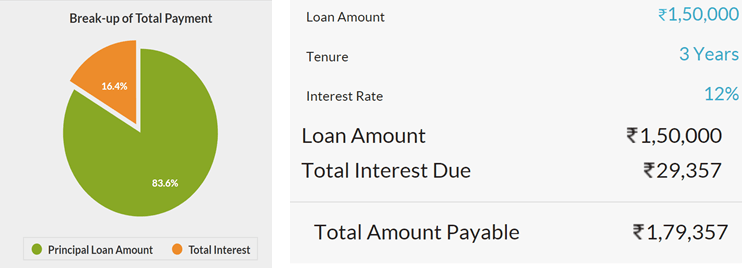
A person was planning to buy a new motorcycle and has managed to save Rupees 75,000 for the cause and decides to take a loan for the balance amount. He approached a showroom and decides to buy a latest motorcycle worth Rupees 2,50,000. He visits a bank on the next day and was able to fetch a motor loan of  Rupees 1,50,000 only. He agreed to pay back the amount with an interest of 12% within a tenure of 3 years. He worked overtime and was able to manage the balance of rupees 25,000 rupees.

The person on taking a loan of Rupees 1,50,000 has to pay a sum of Rupees 1,79,357 including an interest of Rupees 29,357 i.e. 16.4% of total payable amount  within a tenure of 3 years at an interest rate of 12% Per Annum

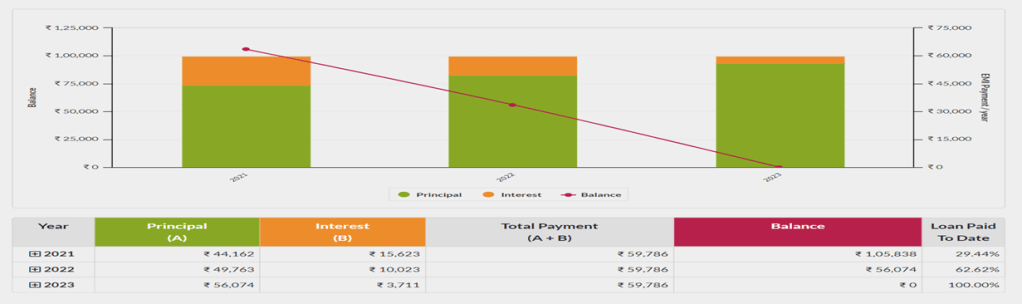
In first year, he needs to clear a debt of 29.44% of total debt of rupees 1,79,357 i.e. 59,786 including a Principal Amount of Rupees 44,162 and an Interest of Rupees 15,623

In Second year, he needs to pays rupees 59,786 clearing 62.62% of the total debt including a Principal Amount of Rupees 49,763 and an Interest of Rupees 10,023

In third year he needs to make a final installment of rupees 59,786 to clear all his debts. The installment includes a Principal Amount of Rupees 56,074 and an Interest of Rupees 3,711.

LOAN: TYPES OF PERSONAL LOAN

Personal Loan are the loans that are given for personal use. They are usually secured loans as the commodity purchased using the loan act as a collateral.

7 Tips to Avail a Personal Loan at a Lower Interest Rate - Oneindia News

Types of Personal Loan

Motor Loan– A secured loan granted for the purpose of purchasing a vehicle like car, motor cycle is called a motor loan.

Gold Loan– A secured loan granted for the purpose of purchasing Gold is called a gold loan.

Education Loan– A loan granted for educational purpose is called Education Loan. It can be either Secured or Insecure depending upon the educational Institution for which the loan is granted.

What Are The Challenges With Traditional Education Loans? - EarlySalary

Home Loan– A loan granted for house is called a Home loan.

Types of Home Loan

1.Basic Home Loan

2.Home Construction Loan

3.Home Extension/ Improvement Loan

4.Home Loan Balance Transfer

Tips to get another home loan if you already have one - News Chant

LOAN: TYPES OF LOAN

Loan

A loan is a form of debt incurred by an individual or other entity.

The lender, usually a corporation, financial institution, or government advances a sum of money to the borrower.

In return, the borrower agrees to a certain set of terms including any finance charges, interest, repayment date, and other conditions.

How to Avail Tax Benefits On a Personal Loan (3 Possible Ways)

Types of Loan

i) Collateral Loans

These are  secured loans as the commodity kept as a security can be sold by bank to recover the debt, if the borrower fails to pay back the loan.

A guarantor can also act as a Collateral for a loan if he/she promises to pay the loan with interest if the borrower fails to do so.

ii) Non- Collateral Loans

These loans are not secured as nothing is kept as a security that can be sold by the bank to recover the debt, if the borrower fails to pay back the loan.

WANT TO BUILD INTEGRITY? 7 EASY STEPS

Step 1:Fulfill Your Promises

The first step towards building the integrity is to keep the promises that a person has made. If a person is not sure that he will be able to meet his promise, then he/she should not affirm to it.

For Example, If a person has promised to attend an organisational event, then he/she should definitely attend that event without any fail. This will depict that he/she is a person of words, who keep all his promises which will help in achieving a high respect in the organisation.

8 Daily Promises Uncommonly Successful People Make | Inc.com

Step 2:Keep your Appointments

The second step towards the evolution is to be on time in all meetings as it describes punctuality and responsiveness of a person.

For Example, If a person has a meeting scheduled at 6 PM, then he should be present there by 5:50 so that there is no delay in meeting due to that person. Reaching a meeting after the scheduled time of commencing, act as a barrier in the process of building high integrity and results in bad image with other members present in that meeting.

Step 3:Get Comfortable With Saying “No”

The next step towards building integrity is that a person should have guts to say that he will not be able to do a work. If he will keep on saying ‘yes’ to all the work, then he will face a pressure of doing all the tasks and will not be able to perform any of that task properly.

For Example, if a person knows that a task already given to him will consume a day and need to be submitted the next day , in this situation if  he is asked to do some work of his team member also, then he should not agree to do it, telling that he already has some work pilled up .

How to say no, without saying no. - Project Management Articles, Webinars,  Templates and Jobs

Step 4:Examine Your Reaction In Tough Situations

This step depicts that a person should record that how he reacts in different situations and should analyse the reason for that reaction. This will help him to analyse that how he can deal with the matter in a better manner.

For Example, If a person feel panic with deadline coming closer, he should take a note of it and should work in finding a solution of solving this problem. He should analyse that how he could have handled the situation in a  better manner.

Step 5:Your Attitude towards Money

This step deals with analyzing that what is the worth of money in the actions of a person.

For Example if a person is doing a work for sole purpose of earn money, then the person is said to be of low integrity but if he values his goals more than money, then he is said to be a person of high integrity.

Step 6:Define Your Values And Vision

This step depicts that a person need to have a clarity about individual goals and values and should analysing that how a company and that person can play a crucial role in achieving the goals and vision of each other. This will bring a confidence in the person that the organisation will bring him close to his goals which will motivate him to perform better.

For Example, if a person is not clear with his goals, he will doubt his decision and will not be able to perform well. He will have a low will to perform and will not be able to perform with his full callable  which  is a barrier in effectively and efficiently achieving the goals of that organisation.

Step 7:Stay Committed

The last step towards building a high integrity is that the person need to have faith in himself and his decisions. He should not get demotivated from the challenges and should keep on giving his best and he will surely be able to achieve his goals.

For Example, An employee can’t fulfill all his goals on the first day of his job. There is a requirement of firm determination and devotion of that employee towards work which makes it possible that he the vision with which he has joined that organisation.


HAVE YOU EVER THOUGHT THAT A MOVIE CAN ALSO TEACH A LEADERSHIP LESSON? HERE IS ONE

Breif About Movie

Lakshya is a patriotic movie launched in 2004. The movie showcase how an aimless person who under the influence of his friend joined Army Academy. He ran away due to the frequent punishments he received there but returned with an aim of joining army. Due to his efforts in the Academy he joined the army where he led a team of 12 army officers and soldiers to a successful clash to defeat the Infiltrators and re acquire the territory occupied by them.

Goal Orientation

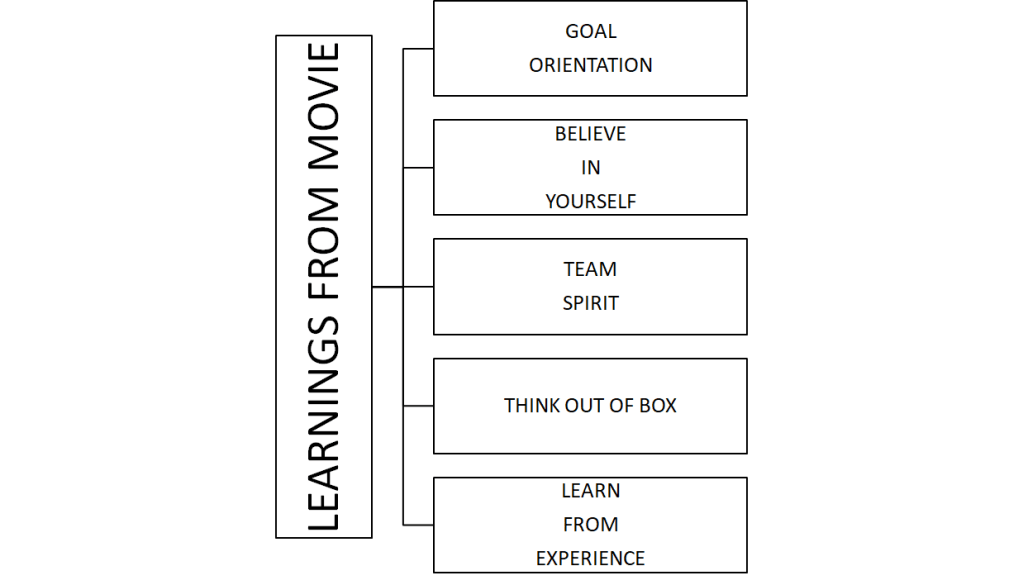
“Lakshya” as the name of the movie suggests the movie revolves around the value of having a goal in the life. Whether it be an individual, group, organisation all requires an aim to work upon. The protagonist of this film (Karan) was a lazy and aimless young man who has no goals for his future. He joined a Military Academy under the influence of his friend and as a result he ran away from the academy due to the punishments he had to face due to his undisciplined and lazy attitude. But after he firmly decided to join the army  he returns, takes his punishment, becomes a disciplined and focused officer cadet and eventually commissions into the Army. 

Believe in Yourself

To achieve a goal a person, need to have faith in himself/herself that  he/she can achieve the goal and is ready to face all the challenges and hurdles that act as a barrier in the same. The person should follow the policy that “ I can, and I will.”

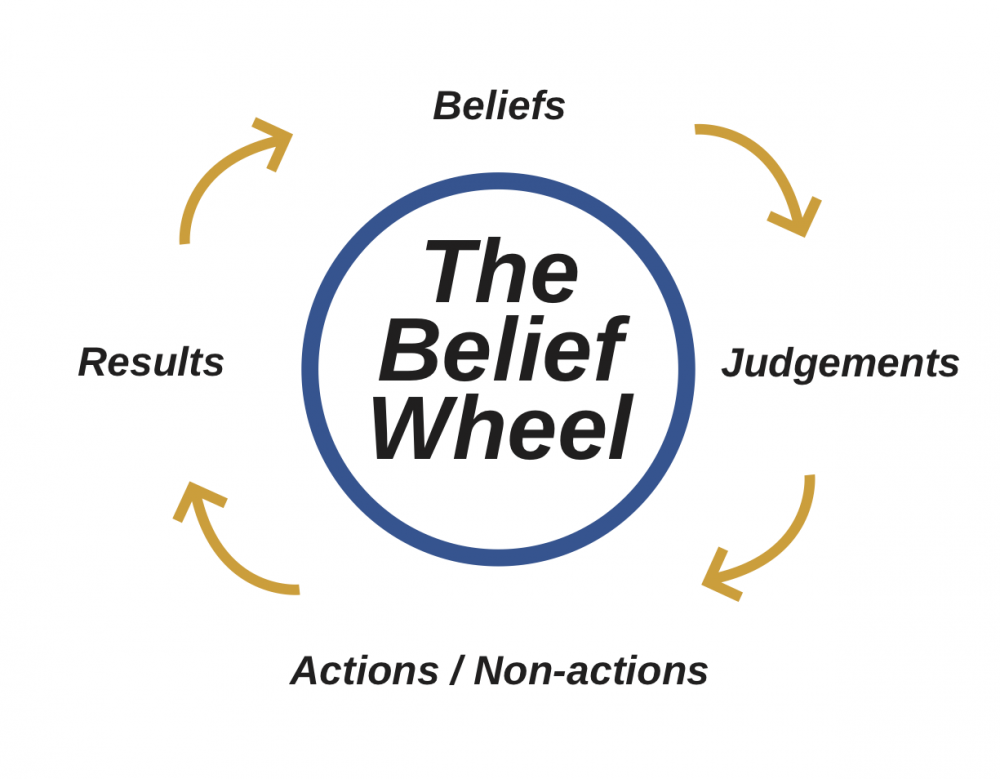
When a person builds a believe in himself/herself then this believe acts as a self motivation which plays a crucial role in achieving the individual goals and the goals of the organisation with whom he/she is associated.

 In the movie the proctor along with other team members were able to climb a 1000-foot-high rock cliff of the mountain because of the determination and the self believe they proved that nothing is impossible.

The Belief Wheel – IABC Central Oklahoma

Team Spirit

A single person can’t achieve an organisational goal on his own. He requires the support , unity and co-ordination of all his team members whether it be his senior or sub-ordinates. All the efforts are worthless if the aim is not achieved. A single person can never be expert in all the fields and requires the knowledge and experience of other members to achieve the goal. This team spirit helps to raise new and innovative ideas to make the path of achieving goal effective and efficient. It also helps to improve the interpersonal relationships between the employees of an organisation which is crucial for best output from an employee.

Henri Fayol in one of his Principles Of Management i.e. in the Principle of “Esprit De Corps” defines  that an organization must make every effort to maintain group cohesion i.e. a feeling of unity in the organization. He adds that a conflict in the team member and division of team due to conflict is a serious issue and needs to be resolved at priority to achieve the objective of an organization. 

In the movie a team of 12 army officers and soldiers had a faith in each other and had a feeling of unity which helped them to defeat the infiltrators

WANT TO KNOW HOW TO NEGOTIATE EFFICIENTLY?

1.Put Yourself in Their Shoe:-

It’s not wrong to stick to your ground but the negotiator should try to keep himself/herself in the place of other parties involved in negotiation. He/she should visualize the situation from another’s perspective and should understand that the other parties also have some restrictions that are acting as a barrier in making the deal successful.

Empathy Marketing: Connecting With Customers By Providing Value | CleverTap

2.Justify Your Position:-

The Negotiator should not just walk into negotiation. He/she should have full knowledge that depicts that the negotiator has researched and is committed to the deal. This helps the negotiator to justify his/her position that provides an upper edge for the negotiator to make the deal in his/her favor.

3.Know Their Interest:-

The negotiator should try to analyse what is compelling the party to make that deal and how he/she can be convinced to conclude the deal in favor of the negotiator.

4.Remove the Emotions:-

One should ensure that the emotions don’t act as a barrier for the deal. It may negatively affect the negotiation. Negotiator may get caught up and be swayed by his/her personal feelings ending up the deal in favor of the other party.

Emotion and Web Design: The Keys to an Affective Ecommerce Websites –  Digital Agency Sydney | TWMG Blog

5.Know when to Stop:-

The negotiator should know beforehand when he/she will walk away. There is no use trying to get the other party to see where the negotiator stands if the talks aren’t moving forward.

How to Politely Leave a Meeting Room Before the Meeting Ends – D-Organice  Function Room | Seminar Room | Event Place

WANT TO KNOW HOW BILL GATES NEGOTIATES ?

1. Be Less Emotional:-

Once Gates told he is successful in negotiations when the other party is emotional because he is “kind of less emotional.” The fact that Gates said he is less emotional rather than unemotional reveals an important distinction. “He obviously knows that feelings are important when dealing with other people, especially in a negotiation

How to Improve Your Emotional Intelligence for Business

2. Listen, then give your  perspective:-

Gates is known for his negotiation skills , which years ago he showed off during a tense encounter with Apple Founder Steve Jobs. Just before launching Windows, Jobs and Gates were butting heads. Jobs claimed Windows was a copy of Apple’s operating system. The wrinkle though was that Apple had “liberally borrowed” programming from Xerox.

The two founders needed to come to an understanding about the provenance of their competing operating systems. Gates went to Apple’s headquarters and Jobs lambasted him in front of Apple executives. In one of his infamous emotional outbursts, Jobs yelled, “You’re ripping us off. I trusted you, and now you’re stealing from us!”

That’s when Gates grabbed the upper hand. Instead of screaming back at Jobs, Gates gave his perspective in a tranquil manner: “I think it’s more like we both had this rich neighbor named Xerox, and I broke into his house to steal the TV set and found out you had already stolen it,” he said.

Gates tapped into a key tenet of emotional intelligence: He stayed poised in a high pressure situation. His calm demeanour helped to placate Jobs, and the two men hashed things out.

NEGOTIATION SKILL: IS THERE ANY NEED TO POSSES ?

Need to invoke Negotiation Skills

Negotiation skills are not born with a child. These skills need to be developed and enhanced.

Negotiation skills teaches a person/child to be patient and understand the needs and opinions of others while giving importance to the requirements of all and finding a solution that is beneficial and acceptable to all the parties.

Negotiation skills are crucial and play an essential role in effective teamwork, decision making and managing differences and conflicts.

Thus, negotiation skills should be developed to improve the quality of communication and decisions.

Importance of Negotiation Skills

· Helps the negotiator to understand why the other party wants to make the deal.

· This understanding will help him/her to convince the party to agree with the results desired by the negotiator.

·Helps to detect the weak areas of the party and will use these areas to make the result of negotiation in favor of the negotiator.

· Enrich the presence of mind of a person.

· Makes the person analyse and reason himself/herself that why he/she is compromising for successful conduct of a deal and whether it is really beneficial to compromise for that deal or not.