Social psychology

There is one thing that, more than any other, throws people absolutely off their balance — the thought that you are dependent upon them. This is sure to produce an insolent and domineering manner towards you. There are some people, indeed, who become rude if you enter into any kind of relation with them; for instance, if you have occasion to converse with them frequently upon confidential matters, they soon come to fancy that they can take liberties with you, and so they try and transgress the laws of politeness. This is why there are so few with whom you care to become more intimate, and why you should avoid familiarity with vulgar people. If a man comes to think that I am more dependent upon him than he is upon me, he at once feels as though I had stolen something from him; and his endeavor will be to have his vengeance and get it back. The only way to attain superiority in dealing with men, is to let it be seen that you are independent of them.

Social psychology is the scientific study of how people’s thoughts, feelings, beliefs, intentions and goals are are constructed within a social context by the actual or imagined interactions with others.

It therefore looks at human behavior as influenced by other people and the social context in which this occurs.

The voices in my head are extremely loud. I feel so insane because I can hardly make a sound. Thoughts of being crazy, possibly headed to the asylum now. These voices won’t shut up. I get stuck up. I go from 0 to 100, it gets up. Not purposely. I may be bipolar but I could care less, you see. Its up to me to control my mind. But if you think it’s that easy, you’ve been wasting time. Thinking you’re perfect? Thinking psychology ain’t worth it? I lucked out, timed out, and found out…
We all need help!

Social psychologists, therefore, deal with the factors that lead us to behave in a given way in the presence of others, and look at the conditions under which certain behavior/actions and feelings occur.
Topics examined in social psychology include: the self concept, social cognition, attribution theory, social influence, group processes, prejudice and discrimination, interpersonal processes, aggression, attitudes and stereotypes.

Topics examined in social psychology include: the self concept, social cognition, attribution theory, social influence, group processes, prejudice and discrimination, interpersonal processes, aggression, attitudes and stereotypes.

History of Social Psychology
Early Influences
Aristotle believed that humans were naturally sociable, a necessity which allows us to live together (an individual centered approach), whilst Plato felt that the state controlled the individual and encouraged social responsibility through social context (a socio-centered approach).

Lazarus & Steinthal wrote about Anglo-European influences in 1860. “Volkerpsychologie” emerged, which focused on the idea of a collective mind. It emphasized the notion that personality develops because of cultural and community influences, especially through language, which is both a social product of the community as well as a means of encouraging particular social thought in the individual. Therefore Wundt (1900–1920) encouraged the methodological study of language and its influence on the social being.

Social Psychology Key Figures
Allport (1920) – Social Facilitation
Allport introduced the notion that the presence of others (the social group) can facilitate certain behavior.

It was found that an audience would improve an actors’ performance in well learned/easy tasks, but leads to a decrease in performance on newly learned/difficult tasks due to social inhibition.

Bandura (1963) Social Learning Theory
Bandura introduced the notion that behavior in the social world could be modeled. Three groups of children watched a video where an adult was aggressive towards a ‘bobo doll’, and the adult was either just seen to be doing this, was rewarded by another adult for their behavior or were punished for it.
Children who had seen the adult rewarded were found to be more likely to copy such behavior.

Festinger (1950) – Cognitive Dissonance
Festinger, Schacter and Black brought the idea that when we hold beliefs, attitudes or cognitions which are different, then we experience dissonance – this is an inconsistency that causes discomfort.
We are motivated to reduce this by either changing one of our thoughts, beliefs or attitudes or selectively attending to information which supports one of our beliefs and ignores the other (selective exposure hypothesis).

Dissonance occurs when there are difficult choices or decisions, or when people participate in behavior that is contrary to their attitude. Dissonance is thus brought about by effort justification (when aiming to reach a modest goal), induced compliance (when people are forced to comply contrary to their attitude) and free choice (when weighing up decisions).

Tajfel (1971) – Social Identity Theory
When divided into artificial (minimal) groups, prejudice results simply from the awareness that there is an “out-group” (the other group).
When the boys were asked to allocate points to others (which might be converted into rewards) who were either part of their own group or the out-group, they displayed a strong in-group preference. That is, they allocated more points on the set task to boys who they believed to be in the same group as themselves.

This can be accounted for by Tajfel & Turner’s social identity theory, which states that individuals need to maintain a positive sense of personal and social identity: this is partly achieved by emphasizing the desirability of one’s own group, focusing on distinctions between other “lesser” groups.

Weiner (1986) – Attribution Theory
Weiner was interested in the attributions made for experiences of success and failure and introduced the idea that we look for explanations of behavior in the social world.
He believed that these were made based on three areas: locus, which could be internal or external; stability, which is whether the cause is stable or changes over time: and controllability.

Milgram (1963) – Shock Experiment
Participants were told that they were taking part in a study on learning, but always acted as the teacher when they were then responsible for going over paired associate learning tasks.
When the learner (a stooge) got the answer wrong, they were told by a scientist that they had to deliver an electric shock. This did not actually happen, although the participant was unaware of this as they had themselves a sample (real!) shock at the start of the experiment.

They were encouraged to increase the voltage given after each incorrect answer up to a maximum voltage, and it was found that all participants gave shocks up to 300v, with 65 percent reaching the highest level of 450v.

It seems that obedience is most likely to occur in an unfamiliar environment and in the presence of an authority figure, especially when covert pressure is put upon people to obey. It is also possible that it occurs because the participant felt that someone other than themselves was responsible for their actions.

Haney, Banks, Zimbardo (1973) – Stanford Prison Experiment
Volunteers took part in a simulation where they were randomly assigned the role of a prisoner or guard and taken to a converted university basement resembling a prison environment. There was some basic loss of rights for the prisoners, who were unexpectedly arrested, given a uniform and an identification number (they were therefore deindividuated).
The study showed that conformity to social roles occurred as part of the social interaction, as both groups displayed more negative emotions and hostility and dehumanization became apparent. Prisoners became passive, whilst the guards assumed an active, brutal and dominant role. Although normative and informational social influence had a role to play here, deindividuation/the loss of a sense of identity seemed most likely to lead to conformity.

Both this and Milgram’s study introduced the notion of social influence, and the ways in which this could be observed/tested.

Strengths
Social psychology provides clear predictions. This means that explanations can be scientifically tested and support with evidence.
Emphasizes objective measurement
Many experiments to support theories

Limitations
Underestimates individual differences
Ignores biology (e.g. testosterone)
Provides only ‘superficial snapshots of social processes’ (Hayes, 1995)

What is it that shapes our attitudes? Why are some people such great leaders? How does prejudice develop, and how can we overcome it? These are just a few of the big questions of interest in the field of social psychology. Social psychologists tackle issues that can have a significant impact on individual health and well-being, from understanding why bullying behavior and aggression take place to analyze why people sometimes fail to help individuals in need.

You probably already realize that other people can have a dramatic influence on the way you act and the choices you make. Consider how you might behave in a situation if you were all alone versus if there were other people in the room. The decisions you make and the behaviors you exhibit might depend on not only how many people are present but exactly who you are around. For example, you are likely to behave much differently when you are around a group of close friends than you would around a group of colleagues or supervisors from work.

Social psychology looks at a wide range of social topics, including:

Group behavior
Social perception
Leadership
Nonverbal behavior
Conformity
Aggression
Prejudice
It is important to note that social psychology is not just about looking at social influences. Social perception and social interaction are also vital to understanding social behavior. The way that we see other people (and the way we think they see us) can play a powerful role in a wide variety of actions and decisions. Just think for a moment about how you sometimes act differently in a public setting than you might if you were at home by yourself. At home, you might be loud and rambunctious, while in public you might be much more subdued and reserved.

Why is this? Because the people around us shape our thoughts, feelings, moods, attitudes, and perceptions. The presence of other people can make a difference in the choices we make and the actions we take.

While social psychology tends to be an academic field, the research that social psychologists perform can and does have a powerful influence on our understanding of various aspects of mental health and wellbeing. For example, research on conformity has contributed to our understanding of why teenagers sometimes go to such great lengths to fit in with their social group—sometimes to the detriment of their own health and wellness.As a result, psychologists are able to develop public health programs and treatment approaches aimed at helping teenagers resist potentially harmful behaviors such as smoking, drinking, and substance use.

How Did People Become Interested in Social Psychology?
While Plato referred to the idea of the “crowd mind,” and concepts such as social loafing and social facilitation were introduced in the late 1800s, it wasn’t until after World War II that research on social psychology began in earnest.

The horrors of the Holocaust led researchers to study the effects of social influence, conformity, and obedience. What could explain why so many people participated in such terrible and evil actions, social psychologists wondered? Were people only following orders and bowing to social pressure, or were there some other forces at work that led people to engage in such devastating actions? By investigating these questions, social psychologists were able to gain a greater understanding of the power of societal forces such as authority, compliance, and obedience.4

Social psychologist Stanley Milgram, for example, was able to demonstrate just how far people are willing to go to obey authority figures. In a series of now infamous experiments, Milgram and his colleagues ordered study participants to deliver what they believed was a potentially dangerous shock to another person. In reality, the shocks were not real and the other individual was only pretending to be hurt by the electrical pulses—but a whopping 65 percent of those who took part in the study delivered the maximum level of shock simply because an authority figure told them to do so.5

Social psychology has continued to grow throughout the twentieth century, inspiring research that has contributed to our understanding of social experience and behavior. Our social world makes up such a tremendous part of our lives, so it is no wonder that this topic is so fascinating to many.

It is important to differentiate social psychology from a few similar and related subjects. Social psychology is often confused with folk wisdom, personality psychology, and sociology. What makes social psychology different? Unlike folk wisdom, which relies on anecdotal observations and subjective interpretation, social psychology employs scientific methods and the empirical study of social phenomena. Researchers do not just make guesses or assumptions about how people behave; they devise and carry out experiments that help point out relationships between different variables.

While personality psychology focuses on individual traits, characteristics, and thoughts, social psychology is focused on situations. Social psychologists are interested in the impact that the social environment and group interactions have on attitudes and behaviors.

Finally, it is important to distinguish between social psychology and sociology. While there are many similarities between the two, sociology tends to look at social behavior and influences at a very broad-based level. Sociologists are interested in the institutions and cultures that influence how people behave. Psychologists instead focus on situational variables that affect social behavior. While psychology and sociology both study similar topics, they are looking at these questions from different perspectives.

What makes social psychology such an important topic? A quick glimpse at the daily news shows just how profoundly social problems can impact people’s lives. By better understanding these issues, psychologists can look for ways to prevent, identify, and remedy such problems. Social psychologists focus on societal concerns that have a powerful influence on individual wellbeing as well as the health of society as a whole, including problems such as substance use, crime, prejudice, domestic abuse, public health, bullying, and aggression.

.
RHONDA BYRNE’S THE SECRET : A BOOK REVIEW

Rhonda Byrne is an Australian writer. Before becoming an author, she began her career as a radio producer and then a television produce. She was extremely close to her father and after the death of her father at 2004, Byrne had gone into depression. Her daughter helped her to come out of the depression and with her influence Byrne read The Science of Getting Rich by Wallace D. Wattles, and regained positivity in life. She then uncovered the law of attraction and understood how to find success in life. After that she started her research about the law of attractions and thus, she delivered THE SECRET in 2006.

The book has the ability to change a life in a positive way. It is a psychological and philosophical book. The Secret became a turning point in Byrne’s life.  Her book became so popular that it became the worldwide best seller book. The book is available in 50 languages and has 34 million copies in print. The book is a compilation of laws and secrets that Byrne researched about and applied in her own life to achieve health, success and positivity. It is really commendable how masterfully she brought all her life changing experiences in this book. Byrne got to understand the great secret and by writing this book she tried to help the world to experience it.

The book is comprised of Laws of Attraction and the great mysteries of the universe which can be found in fragments in literatures, religions and oral traditions. Byrne collected all those pieces and wrote this life transforming book.  The book comprises of some life lessons and wisdoms which successful people have used in their lives to achieve health, wealth, positivity, healthy relationships and how they have eradicated diseases and obstacles from their lives. This book brings into light the untapped secrets of the universe which helps the readers to discover the inner power within them. The book is written in a very interesting format with so many illustrations which makes it different from others.

The book is all about The Law of Attraction. Law of Attraction is a process, by using this method, you can achieve anything you want in life. All you need to do is just constantly think about it. There are total three processes in this Law of Attraction, mentioned in this book. The first one is, ASK. You have to ask yourself what you actually want and then you just have to continuously thinking about it. The second step is BELIEVE. You have to believe that you are going to get what you want. You need to act like you have already received what you want or what are the things you are going to do after receiving what you want. The third and the last step is RECEIVE. In this step you have to only stay positive and feel good about what you are asking for, as if you are receiving it just now. You just need to be happy and grateful about it. These are the only things this book talks about with plethora of examples of great and ordinary people, who have already applied it in their lives and got successful.

There are mixed reviews about this book. Many people think the book to be a life transforming one and some think that it is a time waste to read this book. This book requires your patience to read and understand it. Many thinks that “if you want anything from your heart, the universe will conspire in helping you to achieve it”, is a myth. This book proves them wrong by giving the scientific logic behind it. The book is also made into a film in 2007. After the success of this book Byrne wrote few sequels of it like, The Power, The Magic and The Hero. These were also best sellers and got tremendous success.

New Door opened

Online learning is making waves across the country and around the world in a way that transcends traditional education. Today’s youth style is all about doing it online. Then their education is not available online. We are going through the most important time in which we can divide the stage of growth of the world into two. There is no doubt that the post-Coronal world will certainly be different in some areas than the existing world. The best example of this is our education. We all know what the education sector’s shift from traditional learning methods to modern technology has been in the past. But the last one has seen the field of education over the last couple of months. This can be understood by looking at a study report before Corona.

A study by Google and leading audit firm KPMG reveals that the country’s online education industry will be worth $ 2 billion ($ 12,800 crore) by 2021-22. According to the study, the number of online paid online educators is currently growing from 16 lakhs to six million by 2021. Reduced data costs, the proliferation of smart phones, and customized content in local languages ​​are the reasons for online education becoming more widespread. Online inquiries about education have doubled in the last few years. Mobile is three times as much. 44% of these inquiries come from Tier Two and Three cities. According to the study, YouTube’s use of educational data has increased manifold in the past year. Now, let’s take a look at our education sector at this time of the spread of the Covid-19 virus. The amount of changes that have taken place is incredible. Despite the huge impact Corona has put on the country, the big positives of the lockdown in the country’s education sector have led to a new revolution.

There have been many changes in the way education has been around for ages. It is reserved for the time being. The world has seen a lot of changes in the way education and infrastructure work. If so, what does future education look like? Will education evolve to another level? Looking back at the evolutionary period of the study, we can find some answers. Everything from hieroglyphics to letters, from sign language to pronunciation, from textboard to electronic style, from gurus to online learning. Today, online learning continues to dominate everyone. With the advent of technology, learning has become easier for many. Geographical and physical boundaries were changed and education became available to all. Technology to online education has evolved from teacher to student to teacher and class. The classrooms are irrelevant when we can sit and study any subject at any time of our choosing. Millions of students today use online educational technologies, not just in cities but also in villages.

If our traditional educational institutions continue to have old classrooms, chalkboards, text books, notebooks, question papers, answer paper bundles and assessment camps, they will not go much farther. The four-wall study in schools and colleges is likely to serve as a proof of competency. Today society recognizes that they have no other benefits. A recent study suggests that these walls may be out. The study will suit you and your choice. It will break all geographical and linguistic fences

Guide to live a Happy Life !

–You’re going to realise it one day-
That happiness was never about your job, or you degree, or being in a relationship. Happiness was never about following  the footsteps of all of those who came before you, it was never about being like others.
One day you are going to see  it – that happiness was all about the discovery, the hope, the listening to your heart and following or wherever it chose to go. Happiness was always about being kinder to yourself, it was always about embracing the person you are becoming. One day you will understand that happiness was all about learning how to live with yourself, that it was never in the hands of other people. It was about you , It is about you and It will always be about you–

Since long time, I’ve been exploring the best ways that people can live happily. And over the last year.
Outsmart Your Smartphone,Conscious Tech Habits for Finding Happiness, Balance, and Connection IRL. Even though there are tons of things you can do to live a happier life, I’ve narrowed our focus down to the 10 skills you can build that I believe are the most important to increase happiness. By building these skills, you can start to live a happy life.

1. Live a happy life by creating a plan for your happiness.

You wouldn’t bake a cake without a recipe. You wouldn’t go to a place you’ve never been without a map. And you shouldn’t try to build happiness without a plan either. Creating a good happiness plan is what takes you from where you are now to the happy life you envision.

2. Develop yourself to live a happy life.

Remember when something you wanted to do seemed impossible? Maybe it was that first time you rode a bike, or drove a car, or asked someone out on a date. Then you did it and realized you had it in you all along. Creating a happy life is the same way — the first step is believing in yourself and your ability to live happily. Then you’ll see that you had it in you all along. This is why engaging in personal development is key to living a happy life.

3. Think positive to create a happy life. 

We all know someone who will find the one bad thing in every situation. Maybe this person is us. If we learn to think positive instead, we can make even the most obnoxious situations more enjoyable, creating a happier life from the one we have now. Every moment of every day is a little better, because we can find the silver linings. This is why positive thinking is key to a happier life.

4. Boost your self-confidence to create a happy life.

If we don’t have self-confidence, it’s easy to think that there’s something fundamentally wrong with us — that there’s nothing we can do to change ourselves and create the happy life we desire. But self-confidence is actually a skill. When we learn how to think, feel, and act in ways that make us a person we really love, we can be more self-confident and, as a result, live happily more easily.

5. Create work-life balance for a happy life. 

Are you exhausted, demotivated, and in desperate need of a break? By learning how to create better work-life balance, you can make better use of the limited time you do have in your life. As a result, you end up enjoying all parts of your life a bit more.

6. Build resilience for a happier life. 

Sometimes life knocks you down — there is no getting around that. What really matters for creating a happy life is how easy it is for you to get back up. Developing emotional resilience keeps those challenges and hardships from overwhelming you. You recover more quickly from difficulties, and as a result, you’ll live happily more days each month and year.

7. Be more mindful to create a happy life. 

Now that we live in a high-tech world, we go through much of our lives on autopilot. As a result, we miss out on the best parts of being alive — positive experiences, connections with others, and even having fun. So maybe we already have a happy life . . . and we just don’t see it. When you become more mindful and self-aware, you stop feeling so numb and are able to better enjoy everything your life has to offer.

8. Find your life purpose for a happy life. 

We all want our lives to feel like they matter. It can be tricky, though, to figure out what matters to us. Each person’s life purpose is different, and learning to notice when you’ve found your purpose is a skill. By building this skill, your life becomes more meaningful and more satisfying, so you can live happily more easily.

9. Practice kindness to live a happier life.

We’re often so focused on boosting our own happiness that we ignore how we affect others. This is a huge mistake, because kindness is, counterintuitively, one of the best ways to create a happy life. Acts of kindness fuel a longer-lasting, more enduring type of happiness. So when you build this skill, you live more of your days happily.

10. Build healthy relationships for a happy life.

So often we think that a happy life is something we must build on our own. But long-term happiness actually comes from the relationships that we build with others. In fact, healthy relationships are the most important factor in both our health and our happiness. This is why learning how to develop better relationships helps you live happily for life.

Here are some steps which will help to boost the above skills :

~ Clarify why you want a happy life.
~ Clarify when you’ll build the skills that lead to a happy life.
~ Decide which happiness skills to build.
~ Decide in what order you will build the skills that lead to a happy life.
~ Commit to your goal to create a happier life.
~ Develop a growth mindset that focuses on           your belief in your ability to create a happy life.
~ Identify your values.
~ Define a happy life in your own words.
~ Record your progress towards personal development.
~ Get some help developing yourself to build a happy life.
~ Help your brain get used to thinking positive.
~ Start your day by imagining the way it looks in your happy life.
~ Savor positive moments.
~ Capitalize on positive moments.
~ Pay attention to the positive things.
~ Create a collection of positive images or positive quotes.
~ Think positive, but think negative when you need to​.
~ Practice gratitude​.
~ Stop minimizing your successes​.
~ Practice self-compassion.
~  Imagine your best self.
~ Know your strengths.
~ Celebrate your successes.
~ Practice mindful acceptance.
~ Observe your situation to increase your awareness​.
~ Find the positives in negative situations​.
~ Create a collection of images or quotes that inspire you to live happily.
~ Understand the benefits of negative emotions.
~ Beef up your coping skills.
~ Stop your negative thought cycles.
~ Be more present in the moment.
~ Take breaks from technology.
~ Pay more attention to find the meaning in your life.
~ Spend more time uninterrupted
~ Identify your values.
~ Find out what drives you.

Of course, building all of these skills takes time. If you need help, get support to walk you through the steps and guide you on your journey to living a happier life

How Social Media fits into Digital Marketing.

Social media is one of the most important platform for digital marketing as the presence on social media helps to reach out a number of audience which later turn into their customers.

Digital marketing uses the social media platform to promote their business ideas, products or services. It is the best way to engage traffic to their sites and attract large amount of audience. The main aim of digital marketing is to reach the target audience and social media helps it to reach millions of people around the world in just few minutes.

Benefits of Digital marketing on Social media.

Improved marketing strategies.

As social media allows people to connect with each other and it also allows the marketers to observe the user data and the day to day activities of the people or customers and get to learn their intrests and dislikes and then take further steps on a regular basis to plan their marketing strategies accordingly, this leads to an improved and stable marketing business.

Improvement and increase in sales.

As social media allows the customers to view your products and order online they take the opportunity and avail the offer or services as soon as possible. As the customers reach out to your products and make a purchase, you can get the credentials which are required to contact them later on for further more advertisements. Moreover if they tend to like the product, chances are that they could become your regular customer and the reviews they leave online and the people they meet and let them know about your business will also help in the publicity of your company.

Improved customer satisfaction.

The most important aspect of Social media in terms of digital marketing is that it helps the customers to keep their word, send their feedback and ask their questions or queries regarding the products or the brand. Social media allows you to quickly review their feedback and quickly resolve their queries, this way the customers have no doubts and this operation leads to satisfied customers and what do satisfied customers do? That’s right they are your lead and will help you in boosting your business.

Improved Brand awareness.

Having a strong brand name on social media is very important as majority of the customers before buying any of their desired products go through online websites and social media. A strong. Brand name could attract them to your product and make them your customer. You can take your brand on Facebook and Instagram for better results, as by publishing Facebook ads, it could lead to get you a lot of customers.

Improved SEO rankings.

As the audience from social media carry a lot of traffic to your website, it makes you stand out from your competition due to the social signals received by your website. As a result search engines are more likely to rank your site higher in terms of relevant search results.

Improved and increased web traffic.

As you promote quality and informative content on your social media profiles, it will give rise to the toll of followers and customers to your website and will eventually lead to a lot of sales.

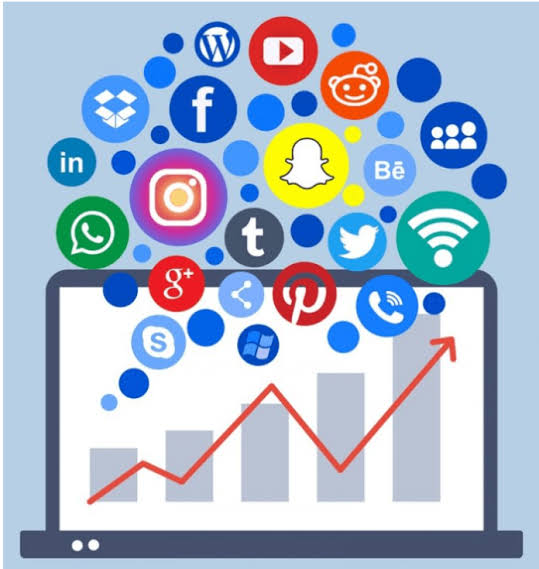
As we know that social media is the latest addition to the digital marketing world as it promotes all kinds of messages and brands on top quality social media apps like Facebook, LinkedIn, Pinterest, Instagram, Twitter, Google+, Snapchat and Tumblr which obviously catches the eye of alot of audience and leads to the promotion of the brand.

The technique of social media is really simple, create the content and use the social media platform to promote it and gain audience and hence social media marketing has become a part of digital marketing.

The major advantage of social media is that it is completely free to use and promote your stuff without even spending a single penny unlike some of the digital marketing tools. You can make daily progress and updates without worrying about the money.

Conclusion

There is no scope for loss when you take your business on social media, there is only one way and that is the route to progress and success. If you have your business online but not on social media it is like owning a business and not letting anyone know about it.Last but not the least social media gives you the valueable opportunity to gain new insights into your customers,it leads you to the customers who believed your business did not exist.

HOW TO STUDY PROPERLY

Studying for long hours is only beneficial if done in the proper way. If you are not studying in the right manner, it is a certainty that all those hours would not lead to desired results. By tweaking your studying techniques backed by research project you’ll improve the standard of the content learnt and may also retain it for a extended time. 

1. Focused and diffused learningUse both focused and diffuse modes of learning. Focused mode is when you focus attentively on a topic and study it with no distraction. After doing this for some time (can follow the Pomodoro technique), you can switch over to some other tasks. In this time period, the brain works on the material learnt, processing and understanding it. This is a reason why if you can’t understand something, you’ll grasp it easily once you visit it later. 

2. Play hard, study smartInclude activities like exercising, walking, playing any sport in your daily timetable. These physical activities assist your brain in understanding unfamiliar topics and ideas . Do not think of them as just another pastime. It is not smart to only study for the whole day with zero physical activity. 

3. Sleep!Sleeping is very crucial to your learning. Waking up the night before the exam and cramming the entire night can help in the short term but it is not at all helpful when it comes to longer retention span. Sleeping helps in clearing the toxins produced in the brain during the day and consolidates the material learnt.

4. Spaced studyingMake sure that your learning is spaced over a period of days. Learn every day, this gives the time to make the previous concepts stronger and understand the new things in a better way. It is not smart to study a lot one day and then not studying anything for the next five days.

5. Apply what you have learntPractice what you have learnt. If you cannot solve a problem, do not see the solution immediately. Try using the concepts that you have learnt and if you are still stuck use hints if available. After exhausting all paths, you can check the solution but make sure to actually work it out. Just reading the solution is not enough. 

6. Mixing up thingsAfter mastering one topic do not stick to it, move to newer concepts. This might seem difficult and it is quite likely that you would end up procrastinating, but start anyhow. Reading the same concepts might give you the sense of progress but you should be real to yourself. 

7. Learning from basicsWhen learning a new concept, approach it right from the basics and then explain it to yourself in simpler terms. This is also known as Feynman’s technique and it is very effective when dealing with difficult and layered topics.

8. Watch out for new ideasBe open to new ideas and techniques when solving problems. If you are acquainted with a method, you might often feel that it is the most effective approach. This can block you from knowing and trying better techniques that exist. So be receptive to learning new things.

9. Consistent learningLearning compounds with consistency. Even if you’ve got started late, do a daily portion everyday. An essential aspect of smart study is to spot the facility of normal learning. Throughout human history, there are many samples of people that have started late and achieved mastery in their field.

How to use Facebook Ads to Boost your Real Estate Business.

Facebook is one of the biggest platform to podcast your ads and boost your real estate business. With a huge number of audience present at one platform,thus you are able to reach billions of customers at just one go. Audience of all sorts of age range can be found on this platform.

How Facebook can be crucial for real estate advertising.

As we know billions of people who use the internet are on Facebook.People tend to use the internet for all sort of little things. As compared to the old times people don’t tend to find their homes through their relatives or friends, now everything’s online as with just one click people tend to find their dream home. By advertising on Facebook it makes you reach a lot of potential customers.

How to setup a real estate ad.

First you need to set certain goals and organize a campaign level as to what type of ad you would want to run and the sort of public engagement you expect. Facebook allows you to set the audience who can view your ads and who don’t. So it’s best for you to choose the homeowners and deny the local realtors. You can add text, images, videos, buttons and actions in your ad.

Benefits of using Facebook to boost your real estate business.

Traffic ads.

Traffic ads allows you to showcase the ads to the people who certainly click on the ads. These types of ads work best when you are trying to drive traffic to your page and the audience will give it a lead.

Engagement ads.

These types of ads will be shown to the people who always like, share and comment. This ad works best when you are trying to make a name for your real estate business in the community.

Retargeting ads.

These are the ads which are designed by Facebook and are viewed by the audience who already know your business this will help you to stay on top of their heads.

This is why Facebook is the best platform for advertising your business as it reaches out to all the potential customers by sending the right ad to the right person at the very right time.

Targeting the audience.

There are several ways in which you can target the desired audience.

By Demographic

It is the study of population based on the factors of age, race and sex. By this you can target various types of people such as homeowners, First time home buyers, new parents, adult parents etc.

By Geography

You can target people living in the same neighborhood, same city or same country by the use of zip codes and also with the help of Facebook to mark a radius around a particular address.

Allow your ad on Facebook for a short period of time as when the clicks on the ad goes down your ad cost goes up. So the shorter the better.

Tips

Tips to use the Facebook ads.

Always add a link to your ad as many people don’t know where to click while seeing an ad but always will know that the link will lead them to the right place.

At the end of your ad always add some catchy advertising lines such as “call us anytime” or “We are always available for you” .

As Facebook is obviously a part of social media and social media has all sorts of emojis and people tend to like seeing some sort of expressions with the text they are viewing, so we highly recommend you to use them as a part of your ad.

Use good images and videos, this will catch the eye of the customer as they like the image attached to your ad they will very well view your add and also might click the link in the description and lead to the official site.

Do not provide all the information on your ad, it’s just supposed to be a teaser so that they can click and hop onto your ad for all the required information. That way they get to know you and you get to know them.

Stay consistent as Facebook Ads also takes time to catch the eye of an audience and by repetive availability of the ad on the screen the audience recognizes and remembers the ad or brand.

The power of Facebook Pixel.

If one wishes to carry out a retargeting ad he must have access to Facebook Pixel. The app tracks the leads of the audience so Facebook knows if someone has visited your site before. The power of Facebook Pixel acts in a way that after the ad is published the Pixel enters the learning mode and learns about the type of people that have visited the ads and once it understands the algorithm of the situation, it will show your ads to the similar audience.

The audience should be able to contact you easily so make sure to put your contact information on every page of your website.

Conclusion.

Real estate business requires alot of leads to promote and settle and that’s where Facebook Ads are used to boost those leads. It is the most effective way to generate leads cheaply and quickly.

Sugar and its impact on health

We always carve to eat something sweet especially after meal or maybe every day. It is common to have sugar carving all day. But do we ever think of the reason behind it. Sugar, is soluble carbohydrate which we all carve for. Reason can be many. But according few health experts sugar cravings may be the result of an essential nutrient deficiency. it is important to notice the psychological and biological reasons that are motivating your sweet tooth for a healthy life style. Sugar sucrose, a disaccharide, made up of two sugars (glucose and fructose) bound together.

Sugar is a base ingredient for centuries and enhancing flavors in many foods we take. It is important ingredient of any baking good or candy, cookies and any kind of dessert we carve for. Sugar magic flavors make food tastier so that we keep coming back and buying more. It is also referred as the bliss point in food industry that means a perfect amount of added sugar to increase the sweetness of a product to just the right level, where it isn’t too sweet but is just sweet enough that we’ll keep coming back for more, is known as the “bliss point” in the food industry.

When people consume sugar, it lite up the mood and activates pleasure center in the brain that makes us feel good. In scientific term a chemical called dopamine gets released, and because of that experience this pleasurable sensation. And that is why we enjoy this feeling to have more and more sugar and seek more sugary items. So, basically it is control of the brain that makes sugar so addictive and hard to give up or in other word one can say that it is brain’s reward.

Sugar is so addictive that many people even after consciously trying to quit sugar have failed and could not leave it. And as wise saying that, excess of everything is bad, Sugar being one the major component of our daily intakes brings a lot of health issues with it. There is a term called hidden sugar that goes for ketchups, BBQ sauces, salad dressings and various other condiments. If taken a closer look at the ingredients of many food item when you shop, like Jam, canned food item, juice, milk products, chocolates and many more are packed with high amount of sugar content in it. A lot of canned vegetables like beans, peas, or tomatoes contain added sugar which sometimes goes unnoticed and can bring many health hazards to person taking them frequently. Also som4 of the vegetables item like organic vegetables doesn’t always mean sugar-free! Some countries even advice eating less amount of sugar and keep the sugar doses at low to avoid health risk. So next time before picking an item from shopping mart ckeck the ingredients and sugar level in to keep check on your health.  

Reduction in syllabus and instructional hours

Union Minister of Human Resource Development Mr. Ramesh Pokhriyal ‘Nishank’ said in a tweet that the centre is planning to contemplate the option of reduction in syllabus and instructional hours for the coming academic session. The ministry also appealed teachers, academicians, and educationalists to share their point of view on the sudden crisis. COVID-19 has shaken the grounds of existing procedures in the country in the area of academics and education. Universities and schools across the country have been closed since March 16, when the Central Government announced a nation-wide lockdown as a measure to reduce and limit the growth of COVID-19 in the country. The running CBSE class10 &12 was also halted as an emergency measure. Any sudden and unplanned change in the academic schedule has the potential to create chaos and commotion. Hence Manoj Ahuja recently stated that ”We cannot bring sudden changes in the education system and create confusion and uncertainty. The curriculum reforms are going to be in sync with the learning outcomes”. To make up for the loss caused by the pandemic the ministry thus, plans in reduction of the academic syllabus. This was brought in light after a day after Manish Sisodia, deputy chief minister and education minister of Delhi, requested him to reduce the syllabus by 30%. It is a well known fact that online classes can never be seen as a replacement of learning on campus or in school. ”First of all, we need to assure every child irrespective of age and social class that they are important to us and all of them have equal right to the physical and intellectual space of their schools. The notion of online teaching or older children coming to school first and not the youngest ones should be put to rest”, said Mr. Sisodia.

Online classes

The trend of online classes flourished in the wake of the pandemic. Slowly but constantly schools and colleges started conducting classes online. Despite being a substitute and seemingly fulfilling the purpose, online classes does very little to online education. There are various reasons for the incompetency of online classes, the very first being Internet connectivity. The Indian internet penetration rate in the country stood at around 50% IN 2020. Recently, a girl from Kerala committed suicide due to lack of resources in accessing online classes. This case highlights the inadequacy of online educational infrastructure in the nation. Reasons like slow internet connection adds more to the perils. Apart from this basic deficiency, online classes cannot compensate for the lack of school education especially for kids because of potential dangers of internet exposure. Conducting a fair and systematic exams online will moreover become a herculean task for the academic institutions. Lack of accreditation and low quality also makes certain online courses less reliable and authentic. Online education creates a monologue and not a real dialogue between the instructor and the student and the monologue lacks in a personalised conversation leading to lack of interest. Online education also leads to increase in screen time which carries along numerous health issues from eyes to the spinal cord. It requires an increased requirement of self-direction too. Despite the potential pitfalls, online education has become popular because of the flexibility it offers and especially because of non-availability of traditional and conventional methods of teaching.

Management During Pandemic.

As the spread and far-reaching impacts of Covid-19 dominate the world news, we have all been witnessing and experiencing the parallel spread of worry, anxiety, and instability. Indeed, in a crisis, our mental state often seems only to exacerbate an already extremely challenging situation, becoming a major obstacle in itself. Why is this and how can we change it? As the CEO of a firm that brings mindfulness to companies to unlock new ways of thinking and working, let me share a bit about how the mind responds to crises, like the threat of a pandemic.

Even without a constant barrage of bad or worrisome news, your mind’s natural tendency is to get distracted. Our most recent study found that 58% of employees reported an inability to regulate their attention at work. As the mind wanders, research has shown that it easily gets trapped into patterns and negative thinking. During times of crisis — such as those we are living through now — this tendency is exacerbated, and the mind can become even more hooked by obsessive thinking, as well as feelings of fear and helplessness. It’s why we find ourselves reading story after horrible story of quarantined passengers on a cruise ship, even though we’ve never stepped foot on a cruise ship, nor do we plan to.

When your mind gets stuck in this state, a chain reaction begins. Fear begins to narrow your field of vision, and it becomes harder to see the bigger picture and the positive, creative possibilities in front of you.  As perspective shrinks, so too does our tendency to connect with others. Right now, the realities of how the coronavirus spreads can play into our worst fears about others and increase our feelings of isolation, which only adds fuel to our worries.

Watching the past month’s turmoil unfold, I have been reminded of the old Buddhist parable of the second arrow. The Buddha once asked a student: “If a person is struck by an arrow, is it painful? If the person is struck by a second arrow, is it even more painful?” He then went on to explain, “In life, we cannot always control the first arrow. However, the second arrow is our reaction to the first. And with this second arrow comes the possibility of choice.”

We are all experiencing the first arrow of the coronavirus these days. We are impacted by travel restrictions, plummeting stock prices, supply shortages etc. But the second arrow — anxiety about getting the virus ourselves, worry that our loved ones will get it, worries about financial implications and all the other dark scenarios flooding the news and social media — is to a large extent of our own making. In short, the first arrow causes unavoidable pain, and our resistance to it creates fertile ground for all the second arrows.

It’s important to remember that these second arrows — our emotional and psychological response to crises — are natural and very human. But the truth is they often bring us more suffering by narrowing and cluttering our mind and keeping us from seeing clearly the best course of action.

The way to overcome this natural tendency is to build our mental resilience through mindfulness. Mental resilience, especially in challenging times like the present, means managing our minds in a way that increases our ability to face the first arrow and to break the second before it strikes us. Resilience is the skill of noticing our own thoughts, unhooking from the non-constructive ones, and rebalancing quickly. This skill can be nurtured and trained. Here are three effective strategies:

First, calm the mind.

When you focus on calming and clearing your mind, you can pay attention to what is really going on around you and what is coming up within you.  You can observe and manage your thoughts and catch them when they start to run away towards doomsday scenarios. You can hold your focus on what you choose versus what pulls at you with each ping of a breaking news notification.

This calm and present state is crucial. Right away, it helps keep the mind from wandering and getting hooked, and it reduces the pits of stress and worry that we can easily get stuck in. Even more importantly, the continued practice of unhooking and focusing our minds builds a muscle of resilience that will serve us time and time again. When we practice bringing ourselves back to the present moment, we deepen our capacity to cope and weather all sorts of crises, whether global or personal.

Look out the window.

Despair and fear can lead to overreactions. Often, it feels better to be doing something … anything … rather than sitting with uncomfortable emotions. In the past few weeks, I have felt disappointment and frustration with important business initiatives that have been adversely impacted by Covid-19. But I have been trying to meet this frustration with reflection versus immediate reaction. I know my mind has needed space to unhook from the swirl of bad news and to settle into a more stable position from which good planning and leadership can emerge. So, I have been trying to work less and to spend more time looking out my window and reflecting. In doing so, I have been able to find clearer answers about how best to move forward, both personally and as a leader.

Connect with others through compassion.

Unfortunately, many of the circles of community that provide support in times of stress are now closed off to us as cities and governments work to contain the spread of the virus. Schools are shut down, events are cancelled, and businesses have enacted work-from-home policies and travel bans. The natural byproduct of this is a growing sense of isolation and separation from the people and groups who can best quell our fears and anxieties.

The present climate of fear can also create stigmas and judgments about who is to blame and who is to be avoided, along with a dark, survivalist “every person for him/herself” mindset and behaviors.  We can easily forget our shared vulnerability and interdependence.

But meaningful connection can occur even from the recommended six feet of social distance between you and your neighbor — and it begins with compassion. Compassion is the intention to be of benefit to others and it starts in the mind.  Practically speaking, compassion starts by asking yourself one question as you go about your day and connect — virtually and in person — with others: How can I help this person to have a better day?

With that simple question, amazing things begin to happen. The mind expands, the eyes open to who and what is really in front of us, and we see possibilities for ourselves and others that are rich with hope and ripe with opportunity.

Environmental Pollution

Today, Environmental pollution is occurring on a vast and unprecedented scale around the globe. People are becoming increasingly aware of the threat posed by environmental pollution and government are enacting legislation to protect the environment.

Environment pollution is the introduction of pollutants into the natural environment, and causes adverse effects to the ecosystem. Today’s pollution is integrally related to economic production, modern technology, life-styles, the sizes of human and animal populations, and a host of other factors. This is the result of increased production of waste products, rapid urbanization, over consumption and over exploitation of natural resources, unplanned sewage and waste disposal from industries and cities etc.

Environmental Pollution may be of the following types : Air pollution , Noise pollution , Water pollution , Soil pollution , Thermal pollution and Radiation pollution. These affect both the living and non-living components of the environment bringing about drastic changes to the physical environment causing community wide problems by polluting the air, water, land , adversely affecting the health of human and animals and damaging plants and property.

Environmental stress on the human body increases with many medical experts fearing a terminal increase in infectious disorders because viruses and other organisms may increase through food processing plants or water treatment as the quality of water and food at the intake deteriorates. Also pollution has caused the deterioration of structural materials like marble and limestone along with having adverse effects on the atmospheric conditions as it is contributes to the depletion of the ozone layer, global warming, acid rain etc.

Factors affecting environmental pollution include:

1.Growing and releasing large number of certain chemicals principally from burning fossil fuels that are now significantly altering the natural systems on a global scale.

2. Population growth is one of the prominent factors that affects the degradation of the environment. This is because as the people multiply and the space available to each individual becomes smaller day by day, so does the demand per person increases day by day along with the increase in amount of waste we throw away leading to an over consumption and over utilization of resources and hence posing a grave threat to the environment.

3.Steady increase in the use and release of toxic substances to the environment. Over the past couple of decades, many national and international projects and programs on river water quality management and assessment on the perspective of conservation were conducted as many lakes and rivers were found to highly polluted with fertilizers, organic wastes, radioactive substances and other chemicals.

Careless management of natural resources is disrupting the ecological process so much that the earth’s life supporting capacity is substantially threatened. Hence , a combined effort to control pollution has to be made by all government agencies, industrialists, agriculturalists, scientists and by every single individual. To address the serious pollution challenges of decades ahead, several large-scale social and technological transitions are needed. These transitions include shifting away from fossil fuels and waste-intensive technologies, bringing our most sophisticated science to bear, altering prices and other economic incentives and progressing to a stable world population.

Xaireaphobia – I am

Xaireaphobia – rare word but a very common issue, the fear of saying goodbyes.
That’s me I hate saying goodbyes.
saying goodbye that is so hard. You know why because it’s the emptiness that stays after you say goodbye. There are goodbyes that leave behind emptiness that will be so hard to fill. Maybe you will never feel it again. It so hard to leave and face the unknown leave your comfort zone, and end something because it is so hard to realize you have to start another start of fresh.
Starting afresh is so not appealing have you ever been in the terror of shifting house like moving your entire home and room and everything and shift to a new one . Even if the new house in the locality and your new home which you are moving to is much much better than it was in the previous one.
That is what xaireaphobia is,the fear of saying goodbye in the fear that you have to get into a new one and start all over again and start from scratch.This is a real common thing like in above as you shifted your house now and then you got to go to a new school and make new friends all over again we have got to wave goodbye to all friends and make new ones all over again all over from the scratch.
we face the fear of saying goodbye because always humans do is search for acceptance all we ever wanted acceptance like if your parents praise you for a certain thing we become happy why because they are giving your acceptance.
that’s what is Xaireaphobia. It exists because the people around the world aren’t very accepting. If acceptance flows in the fear of goodbyes won’t pertain.
And yes,
Fun fact I am a Xaireaphobic.

How to deal with a break-up.

1. Say yes to every social invitation.
the experience of accepting those invitations will not allow you to create new friendships but also remind yourself that you can be single without being alone.

2. Rebuild your self esteem.
after breakup, it is very very common to start making a party of physical appearance and personality traits, common to start having second thoughts about the self esteem about yourself, question in what areas you are like in that cause the breakup. Instead focus on what really value in yourself and what qualities you brought to the relationship.

3.Let go of the idea of closure.
one thing you need to understand is that underneath the desperate need foreclosure is a desired to get back together. If the other person isn’t able to tell you why they no longer want to be with you tell yourself that the fact that your former partner couldn’t commit, or didn’t love you enough, is all the explanation you need to properly closed that chapter.

4.Avoid having a rebound.
when you make impulse decisions, like jumping head first into another relationship. It means you are trying to find a way to avoid feeling hurt.Instead, let yourself acknowledge the pain and understand that being a responsible person means dealing with it. Be willing to get into the pain.

5. Try new places.
once a week find a coffee shop or restaurant you ever been to and invite at least one friend to go with you. Because I am speaking this from my own perspective family places bring back memories. Though do the person I am with right now gives only the best memories of my life for now but 8 this will help to break up your usual routine and get away from the places that you would always go to with your former partner.

I want save these were the things that I took to get out of that face because what happened with me was very different with what should happen to you everyone’s experience differs so I won’t say this was what I went to understood what I did but this is a very general idea that what a person should do to you know this get out of that phase. But what I did back when will be a story for a different time but for now I am really really happy with the person I am with.
So that’s it for this.
Ciao for now.

Ranveer Singh

Ranveer Singh is one of the greatest actors in the bollywood. He was born on 6th july, 1985. He is a recipient of many awards including the Filmfare Award. He is amongst the highest paid actors in the bollywood cinema and has featured in Forbes India’s Celebrity 100 since 2012.

He was born in Mumbai, Maharashtra. His full name is Ranveer Singh Bhavnani. His mother’s and father’s name is Anju and Jagjit Singh Bhavnani respectively. His grandparents moved to Bombay from Karachi, Sindh, in present-day Pakistan, during the Partition of India. He has an elder sister named Ritika Bhavnani. Singh is the maternal third cousin of Sonam Kapoor, daughter of actor Anil Kapoor and wife Sunita Kapoor (née Bhavnani).Singh explains that he dropped his surname Bhavnani, since he felt that the name would have been “too long, too many syllables”, thus downplaying his brand as a “saleable commodity”.

In January 2010, Singh was called for an audition by Shanoo Sharma, the head of the casting division for Yash Raj Films. They informed him that it was for a lead role in their film titled Band Baja Baaraat a romantic comedy set in the world of wedding planning. Aditya Chopra, the vice president of the company, later saw the audition tapes on video and was impressed by Singh’s acting, and decided that he fit the part of Bittoo Sharma, the hero of the film. However, writer-director Maneesh Sharma needed some more convincing and he was called for a few more auditions over the next two weeks until the three were completely convinced of his caliber. After the two weeks of testing, Singh was confirmed for the role of Bittoo, with Anushka Sharma playing the female lead.

He did a number of films, for example, Gully Boy(2019), Padmaavat(2018), Simmba(2018), Befikre(2016), Bajirao Mastani(2015), Dil Dhadakane Do(2015), Gunday(2014), Kill Dil(2014), Lootera(2013), Ram-Leela(2013), Ladies vs Ricky Bahl(2011), Band Baja Baaraat(2010) and many more.

In the year 2018, he married his girlfriend Deepika Padukone, she is also one of the best and finest actress in the world of bollywood. They dated each other for about 6 years and finally in 2018, they got married at Lake Como.

HONOR KILLINGS -not so honorable!

For ages the Indian society has been embroiled down by many social evils and many of them were pertaining to woman. Women have always been on the target ranging from female infanticide, dowry, domestic violence, prostitution, rape  etc. although with changing times people have been educated and changed their perception and these practices have been reduced in some places but till date there are certain social evils  prevalent in not only our country but many other countries , one such act is of HONOR KILLING.

According to a survey there are more than 300 cases of honor killing in last 3 years in India. It is one of the most tenacious forms of gender violence – and also the least acknowledged.

In India, women are not considered individual entity  with lives and choices of their own. Instead, they are seen as the torchbearers of family ‘honor’. The “honor (ijjat)” of a family,society or the community is so called the ‘purity of women. Hence, instead of being considered as independent individuals with their own choices, women’s lives are controlled by an honor code.

Human Rights Watch defines “honor killings” as, Honor crimes are acts of violence, usually murder, committed by male members of family against females of the family who are seemed to have brought dishonor upon the family. The mere perception that a woman has acted in a manner to bring “dishonor” to the family is enough to trigger an attack. Sometimes men can also be the victims of honor killings by members of the family of a woman with whom they are considered to have an inappropriate relationship, or by partaking in homosexual activities.

Honor killings are often a result of strongly misogynistic views towards women, and also  the position of women in society. In these traditionally patriarchal  societies women are dependent first on their father and then on their husband, whom they are expected to obey. Women are contemplated  as property and not as individuals with their own agency. Violence is seen as a way of ensuring compliance and to avert the rebellion.

The concept of ownership has turned women into a commodity that can be exchanged, bought and sold”.In such cultures, women are restricted to take control over their bodies and sexuality: these are the properties of the males of the family, the father (and other male relatives) who must ensure virginity until marriage; and then the husband to whom his wife’s sexuality is subordinated—a woman must not sabotage the ownership rights of her guardian by engaging in premarital sex or adultery.

The occurrences of honor killings are extremely  difficult to determine and estimates vary widely. In most countries data on honor killings isn’t collected systematically, and most of those killings are reported by the families as suicides or accidents.  Murder is not the only form of honor crime, other crimes such as acid attacks, abduction, mutilations, and domestic violence occur too.  The cultures in which honor killings take place are usually considered “collectivist cultures”, where the family’s pride is more important than the individuals life.

LETS TAKE FEW RECENT EXAMPLES OF THESE HIDEOUS KILLINGS IN INDIA

Couple killed in Tamil Nadu

25-year-old Nandhish from the Dalit community fell in love with Swathi, an upper caste woman. The couple got married and lived together for a few months before they were both murdered by the couple’s father. Swathi’s father has confessed to murdering them and throwing the bodies into a river in Tamil Nadu’s Krishnagiri district.

Honour killing caught on CCTV

Amrutha, who belongs to a wealthy upper caste family, fell in love with Pranay from the Dalit community and the couple got married. In September 2018, while returning after a medical check-up, Pranay was hacked to death in broad daylight in front of his pregnant wife. The gruesome murder that shook south India was caught on CCTV. Amrutha’s father confessed to have plotted the murder as he did not approve of Pranay’s caste and lack of wealth.

Minor killed allegedly by father 

In Chandigarh, a 16-year-old girl was found dead in mysterious circumstances in October. Why ??? only because The girl was reported to be in love with a 19-year-old from her village. The girl’s parents had earlier filed a rape case against him.

And recently on 6 may 2020 in Hisar, a woman died at a village near Uklana town of Hisar district on Monday. Her live in partner alleged an honour killing. The Village sarpanch said she died of electric shocks sustained while ironing clothes, in his police complaint, The man had an affair with the deceased for last 3years and said that her family was against their marriage.

Although honor killings are often linked with the Asian continent, especially the middle east  and South Asia. In 2000, the United Nations estimated that 5,000 women were victims of honor killings each year . The existence of ‘honor killings’ all over the world puts universal human rights under severe threat . It puts the agency of “individualism” and “choice” against the notion of collective social agency and strict norms. The right to marry comes under “right to life” enshrined by Article 21 of the Constitution of India. However, In India, the concept of free will in exercising the right to marry is considered more as a duty or social in nature, rather than an individual choice or opinion.


The term “honor” crime is somewhat misleading because it implicit that such crimes are “honorable”. These acts of violence, attack something more than women’s bodies: they additionally strike their challenge to oppressive patriarchy. By adding the word “honor” to killing, we use the language of those who rationalize  this loathsome crime on the basis of “honorable” motives. We use the language of their excuse. We must stop doing this. The term “honor killing” not only gives too much power to the culprit, but is offensive to survivors and women. Instead, we need to see the crime through the eyes of those assaulted.

It is true that these culprits invariably invoke their slighted “honor”. But there is a further common feature: this violence seeks to punish women for seeking to exercise independent choice, and to flout not only the wishes of their families and societal  expectation – for daring to be free. That’s the heart of the matter, and that’s the right lens to view the problem through.