Over some articles in past few days, we have discussed about the problem cinema has across the country. We are learning though, but we are still taking baby steps towards this movement. Alternatively, cinema around the world has gone through same but they are gradually learning and are ending this at much faster rates then us. There have been some examples where this issue has been busted very well. Hollywood has become progressively aware of situations and social implications of movies. They have corrected themselves exponentially in addressing such issues in mean time.
Industry comparison
But that’s not limited to the Hollywood, but one part of India has shown same level of sense. Often, we quote them as south cinema, but they are actually the Malayali cinema that has implicated the breakthrough. This industry has literally shocked everyone and has emerged in terms of defining the beauty standards. It has actually worked on the qualification one need to be feature in a movie in spite of being just fair in skin tone. They have really changed the perception and glorified the cinema that makes all proudly utter that we are the consumer of such cinema.
We might not have seen much of this thing as they so generous that they don’t even feel to go Gaga over their achievement. This is the quality a real cinema is all about because we are doing good, but it is not a miracle to cheer upon it. On the other hand, our industry is still at making, because even if we get successful like this, we will definitely be preachy about this and loads of award will be showered like a god has done some special just for our country.
If you just compare the advertisement of both industry, you will find the controversies around fair and lovely brand that makes fairness creams and showcases the same old mentality while Malayali ad of same product will just mesmerize you with their vision and justification of cream and advertisement.
Contrary we are addicted to justify that you might be darker in tone but we still feel good for you where it should have been just that we feel good about you irrespective of colour. Not to make one feel about their complexion and then showing our great mentality.
Revolution
But the fresh breeze has come ultimately with people not just dismissing the concept of such thing, we actually are taking dig to it and continuously objecting such vision of faulty measures. Earlier this was the condition that anything with some glossy and grandeur setup will be accepted but this has completely changed by now.
Due to unending debate of outsiders vs insiders, audience has now started understanding the purpose of cinema and Importance of content including such great thoughts of modernisation that ends these racism and colour discrimination problems. Cinema has power of uniting the whole world on one stand just like music does. Movies and films have language, but cinema and content does not rely on the language only.
Instead, such cinema which is positively uniting and providing a real thought that might change the world is getting appreciated. You may take example of Money heist and Parasite for both yet separate scenario of good content and good ideology. The reach of good cinema has increased exponentially in lockdown as audience is realising the worth of cinema and how easily it can put a very debatable topics be it community, racism, Colour discrimination, Religion and human behaviour at most of everything.
Poverty is a state of living in which an individual does not have sufficient financial resources to maintain a minimum standard of living. A poor person is one who lacks essential assets to meet their basic human needs such as clean water, sufficient food, education, proper sanitation, et cetera. A threshold has been set which acts as a divider between people who are considered poor and the ones who are not, this threshold is known as the poverty line. In India, poverty can not be understood in isolation, it must be seen from a socio-cultural lens. Caste, which has been the basis of Indian society, plays an integral role in the distribution and perpetuation of poverty.
The caste hierarchy divides society, as well as its resources. Over the years, the upper three varnas have successfully monopolised the community resources, marginalising the fourth Varna and the Dalits. The exclusion of education is probably the most devastating disability that is attached to the Dalit identity, one which leaves no room for socio-economic upliftment. A paper by the World Inequality Database claimed that Indian upper-caste households earn 47% more than the average national income. Furthermore, inequality within castes makes it difficult for the benefits of reservation to filter uniformly.
Post-independence India viewed the future optimistically, armed with political will and constitutional provisions aimed at eradicating caste-based inequalities. Now that we are in the seventh decade of independence, the prospect of an equal and caste-less society seems bleak. Discrimination against Bahujans persists, evolving into covert forms in some aspects while remaining blatantly overt in others. The gradual decline in rights as we go down the caste hierarchy leaves very little at the bottom, where Dalits reside.
Historically, the growth of a feudal society in medieval times is often associated with the emergence of the land-poor, which is a term used to refer to peasants that are landless and rely on zamindars. While the upper castes consolidated their wealth by acquiring land and attaining education, lower castes and Dalits remained landless. With the advent of colonialism in India, upper castes monopolised modern education, and as a result, all the jobs in a colonial economy. Dalits were forced to rely on wage labour in the absence of capital assets and were thus pushed to minimum wage jobs that did not guarantee permanent employment.
Endogamy, which refers to the practice of intra-caste marriages, further solidifies caste and income distinctions. With arranged marriages as the norm, a deeply segmented society continues to pass on its tainted legacy to newer generations. Upper castes employ gatekeepers to maintain an exclusive club of elites that retaliate against any attempt of Dalits to elevate themselves to a better socio-economic position. Due to the work of oppressive forces that are keen on maintaining a regressive social order over centuries, the class has become synonymous with caste, which is an observation by the Mandal Commission. A vitriolic discourse aimed at dismantling the reservation system, a system that ensures representation at multiple levels of education and employment, is pedalled by privileged upper castes to reverse the gains of Dalits. It must be combated with a sustainable movement that emerges from upper castes whose primary aim is to share the platform and privilege in order to build an equal society.
Has it ever happened to you, that when you are speaking about some problem, you have been told, “People have it worse”, “Look at the bright side…” or, “This shall too pass” ? What did it make you feel? Or, is it something you tell yourself? So, why is it something which is not very helpful sometimes. The simple reason, positivity is an emotion, and emotions cannot be forced.
Positivity and optimism are essentials for a satisfying and peaceful life. To be bitter and negative about things, and life in general, not only slowly burn out one from inside, but also have unfavourable effects on their social life and relations. But being over-positive doesn’t always help too. Life has its own share of ups and downs. And it’s not always possible to see the good side, because sometimes, there aren’t any.
According to California based psychiatrist Gayani DeSilva, toxic positivity is “ insincere positivity that leads to harm, needless suffering, or misunderstanding”. Positivity is a healthy practice to have. It can help to sort the thoughts, plan well, and give the energy to face the world with a smile. But bad days are also a part of life. Somedays, it is just too overwhelming to keep a smile on the face, or a bright thought in the mind. Toxic positivity is, when someone fails, or refuses, to acknowledge this. Cheering up a friend? Not listening to what they are actually saying and rather encouraging them to forget it or pointing out the silver linings will not help much in the long run. It will only serve to discourage them to not share their actual, authentic emotions regarding incidents.
When faced with toxic positives on a personal level, people often tend to feel guilty about ‘feeling down’ or not being ‘upbeat’. This happens so, because they get conditioned to believe that the negative feelings are inherently bad. This avoidance and guilt, itself, takes a toll on the mind. That beats the ultimate goal of being positive, to be at peace and happy.
Also, it gets harmful when optimism and positivity shrouds over reality. Positivity should help us grow, rather than giving an illusion that everything is as good as it can be, thus stagnating the personal growth. Constructive criticism, from the inner self and from the well wishers, are not perceived as negative or jealousy. Things and works are not always perfect, and if that can be made better, then it should be tried to make that better. Hence, it won’t do anyone any harm listening to someone pointing out a problem, which can be overcomed.
Acceptance should be within oneself, be it for our own experiences or for someone’s narration of ordeal. Dismissing or downplaying someone’s experience, even unconsciously, in the favour of looking only to the positive outcomes, doesn’t do justice to that person. Instead, the attitude should be listening. Whatever it is. Because they have lived that, and they know what they are speaking of. The essence of sharing should be to let go of the emotional burden, instead of hiding the worse parts out of the fear and shame of judgement.
Even when living it through. The acceptance of the negative parts of an emotional journey helps us to emerge stronger, wiser and more experienced. Positivity can only hold its true meaning when we allow ourselves to be vulnerable to feel down. It’s the same as how we appreciate the beauty of the sun rays after spending a night devoid of it. That is the beauty of emotions, to be able to feel.
Anger is a common, normally healthy, human emotion. But if it goes out of control and becomes destructive, then it can lead to problems—dilemmas at work, in your relations, and the overall state of your life.
Anger is “an irrational state that varies in intensity from mild irritation to intense fury and rage,” according to Charles Spielberger, Ph.D., a psychologist who specializes in the study of anger. Like other emotions, it is accompanied by physiological and biological changes; when you get angry, your heart rate and blood pressure go up, as do the levels of your energy hormones, adrenaline, and noradrenaline.
Anger can be induced by both external and internal events. You could be annoyed at a specific person or event, or your anger could be caused by agonizing or thinking about your difficulties. Thoughts of traumatic or infuriating situations can also trigger hostile reactions. Failing to control your temper can begin to a variety of difficulties like stating things you lament, shouting at your kids, abusing your co-workers, posting rash emails, growing health problems, or even resorting to material violence. But not all anger problems are that severe. Instead, your rage might mean losing time pondering about bothering matters, becoming frustrated in traffic.
Controlling your anger doesn’t signify getting annoyed. Instead, it means discovering how to identify, cope with, and display your rage in healthful and productive ways. Anger control is a skill that everyone can acquire. Even if you believe you hold your temper under check, there’s always scope for progression. Wrath is an emotion that can vary from mild exasperation to extreme fury. While numerous people classify violence as a completely “negative emotion,” it can be positive. Resentful reactions may push you to reach up for someone or they may lead you to build convivial change.
Although when left unchecked, hostile reactions can direct to destructive behavior, like shouting at someone or damaging goods. Bitter emotions also may make you retreat from society and transform your rage within, which can affect your energy and welfare. Anger can become unsettled if it’s felt frequently or too deeply or when it’s displayed in harmful forms, which can take a toll physically, psychologically, and ethically. For this purpose, anger control tactics can be useful and can aid you to explore fine means to display your emotions.
Concentrate on the bodily responses of rage: While it may appear unreasonable, harmonizing in the way your body responds while you’re annoyed usually reduces the fiery force of your rage.
Get running: A quick walk or run nearby the block is a fabulous opinion. Physical movement discharges repressed energy so you can approach the circumstances with a calmer front.
Apply your feelings: You can use vision, olfaction, sound, touching, and taste to instantly reduce tension and calm down. You can try hearing your favorite music, relishing a mug of beverage.
Stretch areas of tautness: Rotate your arms if you are tensing them, for instance, or lightly rub your nape and scalp.
Steadily count till ten: Concentrate on the counting to make your rational mind make up with your emotions. If you still feel out of control by the time you reach ten, start counting again.
Acquire adequate sleep: Deprivation of sleep can intensify cynical thoughts and leave you seeming disturbed and gruff. Try to take seven to nine hours of good quality slumber.
Workout frequently: It’s an efficient method to burn-off anxiety and relieves tension, and it can leave you sensing more comfortable and positive during the day. Try to spend at least 30 minutes every day.
Be clever regarding booze and narcotics. Even consuming too much caffeine can make you more irritable and prone to anger.
Despite all your attempts, something will occur that will provoke your fury; and seldom it will be defensible anger. Life will be filled with disappointment, grief, failure, and the random activities of others. You can’t correct that, however, you can improve the approach you let such issues concern you. Managing your hostile acknowledgments can prevent them from causing you even more miserable.
If we look more closely at the word suicide, we can really turn it around to read it as u decide. But have most of us stopped to think the same with our lives too. Whenever faced with an issue we all decide to reach to a very extreme solution, that is ending our lives. No matter how small or big the problem is suicide seems like an easy way out sometimes.
There is always a solution, a answer or a way out to all the problems we face. All we need to do is to look at it clearly but sometimes what happens is that we forget to do it. It is advisable to consult someone and talk about your problems. Just like the saying goes sharing is caring. Sharing our problems can lower the burden sometimes. But most of don’t like sharing our thoughts especially because of the stigma attached towards it by the society. People are scared that they might not fit into society’s perception of a perfect human being, that they are ready to risk their mental health too.
Mental illness is the illness of the brain which an result in the change in the behavior and thinking of a person. It is also just like any other disease that affects our body which can be cured with the proper medicine. One of the most common mental health issues found among people are anxiety disorders and mood disorders. Mental health is a primary component of a human being. And it is high time that we give certain importance to it too, after all we need healthy and sound people as our work force rather than people whos minds are not at the right places
Recently people are coming out of their holes in admitting that they have mental health issues too. Many celebrities have also taken up the issue of addressing the need for wiping out any kinds of stigma around mental health. Lets talk is a frontline campaign for the mental health movement where people are encouraging others to talk about their mental illness and any kinds of problems they face.
Sometimes it becomes so hard to reach out to people because we believe that they cannot help us. But what we think about certain things might not always be true. There is always two sides to a coin. We have to all make sure to have empathy to people rather then being sympathetic. We cannot always find someone willing to talk to. And sometimes we simply cannot tell the difference between a person not suffering from mental illness and one who is suffering from mental illness. Like other diseases its not a visible one under an eye. It is something that can only be cured with a proper approach towards the patient.
Bhagat Singh was an Indian socialist activist who at 23 years of age made him a hero of the Indian independence movement by two acts of dramatic violence against British citizens in India and his executions.
In December of 1928, a UK police officer, John Saunders, shot fatally with Bhagat Singh, and an association, Shivaram Rajguru, in Lahore, British India, a 21-year-old and mistaken Saunders on probation to assassinate James Scott, British police Superintendent. They thought that Scott had caused the death of the famous Indian nationalist leader Lala Lajpat Rai, who ordered the lathi charge in which Rai was wounded, and who had died of a heart attack two weeks later. A shot from Rajguru, a trademarkman, fell to Saunders. Singh was shot several times, revealing eight bullet wounds in the aftermortem study. Chandra Shekhar Azad, another associate of Singh, shot dead a policeman from India, Chanan Singh who tried to persecute Singh and Rajguru while fleeing.
After fleeing, with pseudonyms, Singh and his associates publicly belonged to the death of Lajpat Rai and had made ready posters, but they had changed them in order to make Saunders their intended goals. Singh was continuing for several months longer, and at the time there were no convictions. About the central legislative Assembly in Delhi, Batukeshwar Dutt, which surface again in April 1929, detonated two homemade explosives. You displayed the pamphlets of the gallery below, yelled slogans, and allowed the authorities to arrest them. In the case of John Saunders, the arrest and the consequent attention brought to light Singh’s complicity. After joining defending colleague Jatin Das in a hunger strike, he was forcing better terms for Indian prisoners in prison and resulting in his death from famine in September 1929. Singh received a lot of public sympathy during his awaiting trial. In March 1931, at the age of 23, Singh was convicted and hanged.
After his death, Bhagat Singh became a folk hero. “Bhagat Singh did not become famous through his act of terrorism but because, for now, he appeared to vindicate Lala Lajpat Rai ‘s honour; he had become symbolic, the act was forgotten, the symbol was left, and within a couple of months each town and village of Punjab, in a minor measure in northern India, was reverberated in the rest. Jawaharlal Nehru has written about him” Still later in life, Singh, an atheist and socialist, won admirers from the Indian range, both Communist and right-wing nationalists. While many of Singh’s associates, along with many Indian anti-colonial revolutionaries, also took part in daring actions and violent deaths were either carried out or died, few were lionised as Singh in the popular art and literature.
Bhagat Singh, born in 1907 in Chak No. 105 GB, in the village of Banga, in the Lyallpur district of British India’s Punjab province of present day Pakistan. Benjamb Singh was born in 1907. He was born when his father and two oncles, Ajit Singh and Swaran Singh, were released from prison. Hirs and Sikhs were members of his families; some of them were involved in the movement of Indian independence, and some in the army of Maharaja Ranjit Singh. His ancient village was in the Punjab district of Khatkar Kalan near Banga, India.
His family was heavily involved politically. His grandfather Arjun Singh, who had an important influence on Bhagat, was followed by Swami Dayananda Saraswati, the Hindu reformist movement of Arya Samaj. The Ghadar Party led by Kartar Singh, Sarabha, and Har Dayal was its father and its uncles. Ajit Singh was forced into exile because of pending court proceedings against him while in Lahore in 1910, Swaran Singh died after he had been released from prison. Singh did not attend Khalsa High School in Lahore, unlike many Sikhs of his generation. He did not accept the allegiance of his grandfather to the UK government by the school officials. Instead, he was enrolled in Arya Samaj institution Dayanand Anglo-Vedic High School. During his lifetime the Arya Samaj philosophy had a great influence on him.
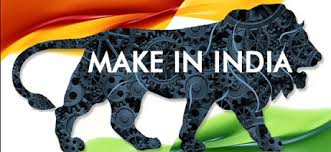
“MAKE IN INDIA” an initiative taken by the Prime Minister of India on 25th of September in 2014. It was launched with an idea to attract investors from all over the world to invest their money in India. In order to accelerate the growth of the Indian Economy and to enhance the credit cycle this stands to be one of the best initiative one can take. The logo of the Make in India movement has a lion with many wheels. his indicates peaceful progress and way to the vibrant future of the country. A giant walking lion with many wheels represents courage, strength, tenacity, and wisdom.
The movement will help to improve the infrastructure of the economy. It is very effective to establish a global network and a global business . The increase in the competition lets the existing businessmen to enhance their skills and grow their business with innovation and other effective measures. The movement helps in increasing employment and creating jobs. The importance of growing production along with an increase in productivity is major for an economy and with this movement the production and productivity both can be increased thus encouraging Exports that further helps to maintain a Balance of trade.
The movement increases employment oppurtunities and also encourages the youth to encourage their skills.
It will help the country to become self reliant and also the “vocal for local” can be achieved by Make in India movement.
It will help the companies to Improve its brand value and also stand as global competitor worldwide.
It will contribute positively to the growth of Indian GDP and enhance the credit cycle too.
It reduces the Brain drain , that is, if the Indian investors are planning to move out of the country it will discourage them and encourage them to invest in their own country.
This will benefit 25 sectors of the economy including automobiles, pharmacy, hospitality, tourism,IT, textiles, port etc .
Reduction in Imports, since the greater production of goods with better quality will soon replace the foreign products and hence would out-turn in the reduction in imports.
Cost effective , as the production will now be on a large scale and thus there will be Economies of scale thus leading to reduced cost.
With the improvement of technology on such a dynamic basis , Make in India helps to upgrade the technology.
Hence, for reducing unemployment and developing the Indian Economy as a whole it is important to take such decision and also to implement it in the most effective manner. The country would reach heights and this movement can bring laurels for the economy of India.
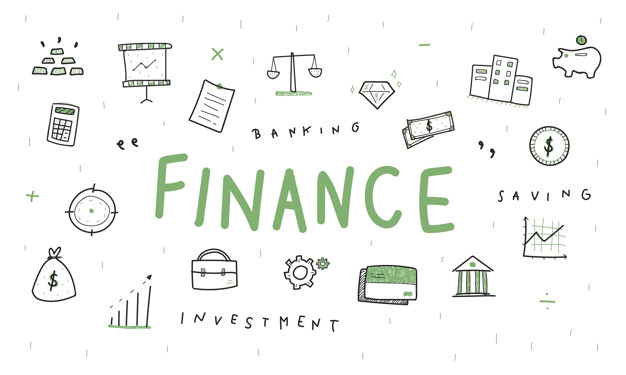
Financial Modeling deals with the analysis of a company’s performance on applicable financial factors. The certification course of Financial Modeling mostly comes along with MS Excel training. It helps professionals to handle finance models applying Microsoft Excel. MBA students, Risk Analysts, Credit Analysts, professionals of project finance, business analysts, investment bankers and IT professionals are the ones who are eligible for this course.
Financial Modeling is widely used in investment banking, corporate banking, risk departments, etc. There is a wide range of opportunities and roles available after the completion of this course.
– Financial Analyst – Financial Manager – Business Analyst – Market Research Analyst
Why is excel modeling so important?
As a manager, a substantial portion of any MBA graduate’s role is decision – making. Managers are expected to understand complex business processes and provide inputs to the senior management to aid in the process of decision making. While studying these business aspects, managers face numerous challenges on how the different aspects of business are interacting with each other. If these interactions are organized in a structured manner, process understanding is simplified, leading to faster decisions.
Spreadsheet modeling helps in transforming the business decision making process into an organized structure. There are multiple variables that impact any business. Each variable can be individually introduced into the model and the impact of the variable in the overall decision making can be studied.
A financial model is simply a tool (generally built in Excel) to forecast a business’s financial future. It serves as one of the critical inputs for financial analysis and valuation. Knowing how to build an integrated 3-statement financial model and Discounted Cash Flow (DCF) model is a must-have skill for professions like equity research, investment banking and private equity.
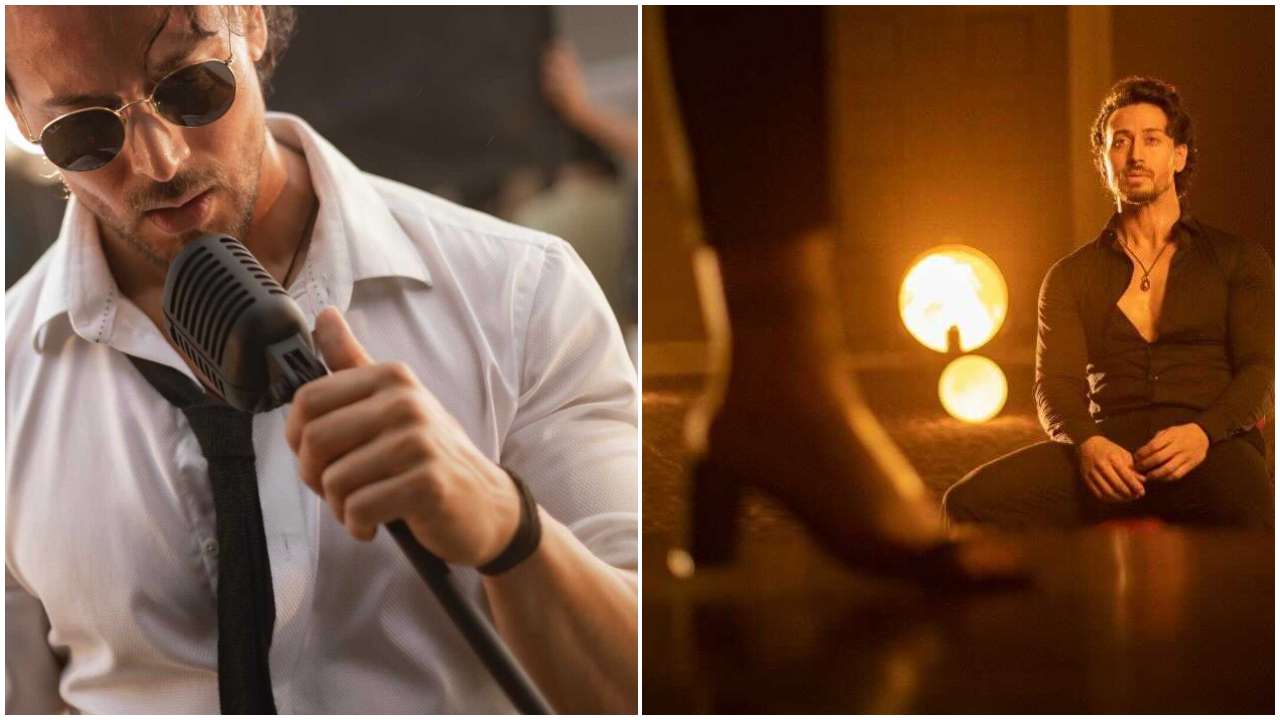
The Tiger Shroff song “Unbelievable” is out, and it has literally nothing new to offer. The romantic track has been sung by Shroff, with music and lyrics by Avitesh Shrivastava and DG Mayne, respectively. The music video has been helmed by Punit Malhotra, who had also directed Shroff in Student Of The Year 2.
The video sees Shroff trying to romance a woman, who ultimately falls for him. During this whole act, we also see the actor showing off some of his dance moves, which only slightly elevates the track from what it actually is — a mediocre piece of work.
Nothing about “Unbelievable” is novel. Tiger Shroff’s voice has been heavily auto-tuned, and the video has been partially shot in black-and-white for no good reason. There is no story, the music is derivative and the ‘Hinglish’ lyrics, even more so. The music video of “Unbelievable” has been produced by Big Bang Music and Dharma 2.0.
So I just got off reading this book & I can surely say, I’ve missed out a lot in my childhood, I guess. There’s this girl called Penny Porter, who I can much relate with. Quite of a private kind, 16-year-old schoolgirl, from Brighton, UK. A girl with fair skin, freckles on cheeks & frizzy auburn curls, which according to her were quite disliking features in her appearance. Her hobbies include photography & secretly crushing over the school’s heartthrob “Ollie”.
She’s kind of not-the-very-girly girl, has certain appearance insecurities, but on the contrary, prefers outfits of comfy & chill kinds. I would lie if I say I don’t love her. But most of all the part I could relate is she wrote blogs. Like a blog about herself, like a diary entry kinda stuff. Especially the kinds when she’s stuck in situations or facing a tough time to deal with. Gradually she had gained enough followers online, who she believed would help her cope with the situation.
One who believed herself to be a total walking disaster to perfect moments, and her fate or she, were no behind to prove it right. Her life in the very initial half was full of guilts and embarrassment. But one thing, that stayed constant was her fire brigade to all the wildfires in her life was her BFF “Elliot”.
Yet another lesson she learns in this journey is how to outgrow her childhood school best friend “Megan.” It’s sometimes okay to feel irritated & not the same way once you used to feel in the past. If smth or someone tends to hurt you, or cause you to disrupt your mental stability, or affects you in any way. It’s normal to leave that person. For, every one of us, is a subject to change in some or other phase of life & once or more. Each one of us is evolving in our best forms possible, to support ourselves for betterment. It may or may not bring out a positive effect on everyone out there. But, that’s ok sometimes. It doesn’t matter!
All of us make a circle of friends in this journey, of life. Some might dive thru you, even after all phases of changes you face & others might lose you in this ocean as you continuously hit a string of waves. Some might stay as per your expectations, others might leave out of the blue. I hope you just learn to stay contended with what & whom, you have beside you & cherish them moreover. Because life is too short my friend, don’t forget to appreciate all you are blessed with.
Back to the point now! And of course, at last, “Noah.” Penny’s ‘inciting incident’ right from New York, USA! Who happens to be a YouTube sensation too. A hopeless romantic & genuine guy, who leaves no stones unturned. Taking every opportunity he can, to make her feel special. And for very certain reasons, she has to look the best. All those dark-messy hair, chiseled cheekbones, fair, dark-eyed & all flattering ROCK-GOD-tastic features. A guy with a gloomy past, who finally finds his escape in her. And on the contrary, who makes Penny realize the concept of ‘self – love’ & most importantly makes her accept the way she is.
Moreover, who’s also in a relationship with “Leah Brown”, a chart-topper artist which she realizes later. This turns to call for a lot of turbulence in both their lives. But as we all know of romantic drama novels, will this will settle down too? Or will they break apart because of a couple of misunderstandings?
Another thing that grabbed my emotions was the part that, no matter what she always has her family’s back. Of course, the family is highly supportive unlike reality, like w most of us proly, but the thing is what really matters is how one reacts to a certain situation. And most definitely, I’m very impressed by the whole of her family. Not that I’m comparing, but I like the plot, whole of it.
This was yet another teenage romance novels, but TBH it was my first from a foreign author. Or moreover, I might say an English vlogger. For long I’ve been sticking to Indian authors only. Not that am a bookworm or so. But it’s just that I read very occasionally & of very cliché romantic kinds.
This might not be a perfect book review, but I just highlighted my moments of interest here. To me, books are a source of improving my vocab. & at times escape from the real world. But this particular novel, that I’ve been reading past a week now. The story happens to be so engrossing & mesmerizing, it happened to hover on my mind throughout the day. I absolutely loved it, except for the cliché ending. But that’s ok! What’s a romance novel without cliché terminations, right?
I could relate myself to the protagonist up to most extents.Another thing that I love about Penny, was her optimistic thoughts even when she was buried deep under troubles. Would like to highlight a certain part here. On her very last blog she says, ” Do smth that adds happiness to the world, & if you think it doesn’t, just quit performing it.” So my fellow mates, the next time you do something, I will be glad to know if you did this too & so will I. ‘Cause you never know what battles people are fighting through every day, adding pain to them & sins in your bucket does no good to either. So let’s focus on making this world a better place by sharing happiness.
So this was my blog about ‘Girl Online‘. If you did like this review & felt amused as much as I did while framing this review out, don’t forget to check out this spectacular novel ‘Girl Online‘ by Zoe Sugg in that case. I can guarantee you will be amazed by the twists & the hint of humour if you are bored this lockdown.
Automation is the technology by which a process or procedure is performed with minimal human assistance. Automation or automatic control is the use of various control systems for operating equipment such as machinery, processes in factories, boilers and heat treating ovens, switching on telephone networks, steering and stabilization of ships, aircraft and other applications and vehicles with minimal or reduced human intervention.
Network automation is the process of automating the configuring, managing, testing, deploying, and operating of physical and virtual devices within a network. With everyday network tasks and functions automated and repetitive processes controlled and managed automatically, network service availability improves. It is the process of using software to automate network and security provisioning and management in order to continuously maximize network efficiency and functionality.
Automation is still green, but when it begins to mature, network admins and engineers will not even need to log into any router or firewall equipment. Of course, automation will not replace human intelligence (our jobs). With the proper automation tool, we will be able to do thousands of tasks per day, something that probably took months before. Automation will give us more time to think about network architecture, design, and plan for its capacity.
Best Network Automation Tools and Software of 2020:
Here are some of the best network automation tools, some are free, and others are paid :
Solarwinds Network Automation Manager(NAM) –
Solarwinds Network Automation Manager (NAM) is an integrated network automation tool designed for highly scalable or enterprise networks. It provides full automation and management from a unified web-based console. (NAM) includes components of various network automation tools and operations management software for all your network deployments.
It includes some features of the Network Performance Monitor (NPM), Netflow Traffic Analyzer (NTA), User Device Tracker (UDT), Network Configuration Manager (NCM), IP Address Manager (IPAM), VoIP & Network Quality Manager (VNQM), and SolarWinds High Availability. The network engineer can configure certain network automation functions on NAM and let the tool monitor the availability, faults, and performance for all nodes and paths in your network.
Its key features include : analysing traffic and bandwidth and find hogs, monitoring and backing-up network devices automatically, deploying network configurations in bulk, automatic subnet discovery and IP scanning and monitoring network performance.
ManageEngine Network Configuration Manager (NCM) by ManageEngine is one of the most comprehensive software for network configuration, change, and compliance management. It supports multi-vendor networks with products from Cisco, NetGear, Fortinet, Juniper, HP, and more.
NCM can help you automate the management of the entire lifecycle of network device configurations. You can automate daily monotonous configuration tasks in bulk. Instead of going one by one, which generally would take a long time, you can apply a new configuration or changes to multiple devices. You can also schedule automatic configuration backups that might be useful in case of rollbacks.
Its key features include : automating new or edit configuration in bulk, network automation using Configlets, configuration backups, configuration change notifications and rollback actions.
Ansible (Tower) –
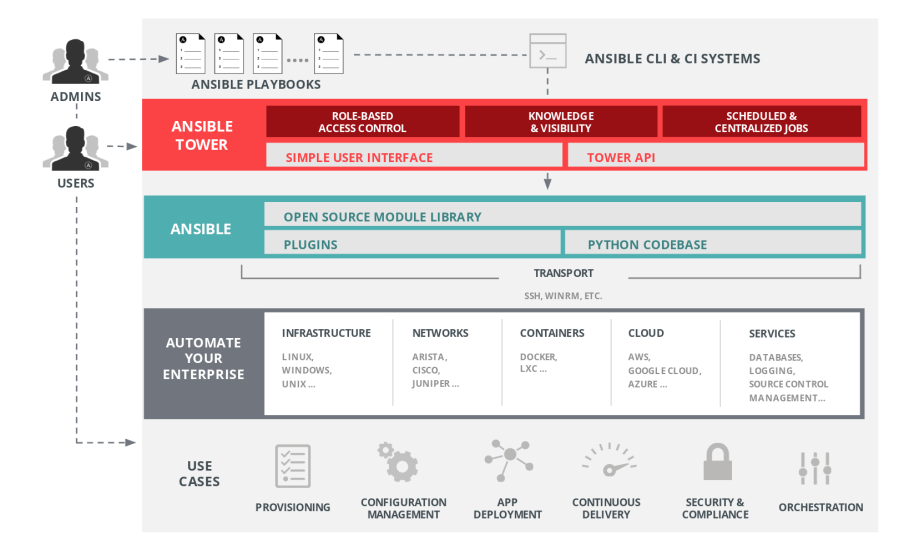
Ansible by RedHat, the simple automation framework, is definitely at the core of a lot of new networking DevOp solutions. It automates the configuration of servers and provides native support for legacy and open network infrastructure. Ansible is an open-source project built by the community. It is available for Linux/Unix-like OS and Windows.
To automatically configure servers, Ansible uses playbooks, which are ordered units of scripts (written in YAML) that define how a server should work and behave through the Ansible automation tool.
Ansible Tower is the enterprise web-based GUI tool that makes Ansible easy to use. The software is designed to be the central platform for all automation tasks. Ansible Tower helps network teams manage complex deployments.
Its key features include : leveraging the current network CLI commands to automate over 45 different networking vendors, between switches, routers, load balancers, and firewalls, provide automation for software-based controllers (SDN), automate interconnection of hybrid and multi-clouds.
Netmiko –
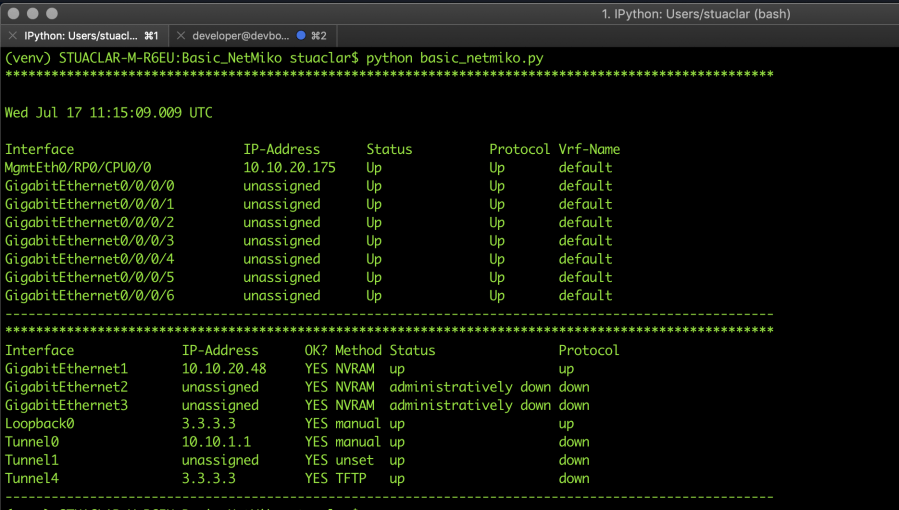
Netmiko is an open-source Python library based on the Paramiko SSH library. It allows easier management and connection of network devices through SSH. Netmiko improves the library of Paramiko by including support to a wide range of networking vendors and platforms, such as Arista EOS, Cisco ASA, HP Comware7, Juniper Junos, Linux, and more. The tool simplifies and automates the logging to a network device through SSH and executes commands.
Its key features include : establishing an SSH connection to network devices, execute “show” commands and retrieve the results, execute configuration commands, it supports a wide range of vendors and platforms.
NAPALM–
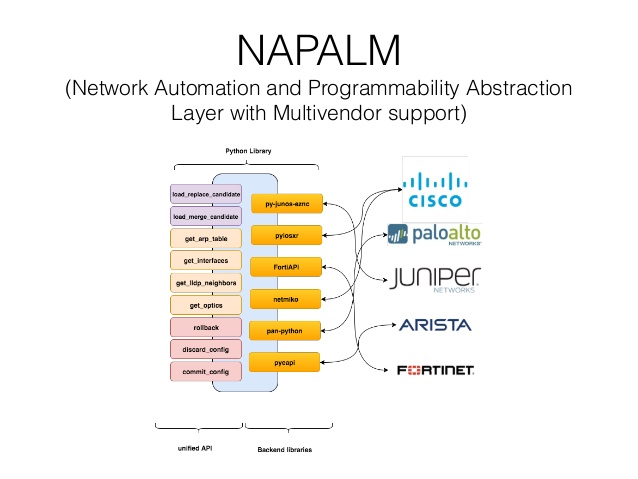
NAPALM (Network Automation and Programmability Abstraction Layer with Multivendor support) is a Python library that can interact with different network devices via a unified API. The software is cross-platform and open-source. It uses different technologies to connect to the network devices, execute configurations, and retrieves the output data. It can support different networking operating systems such as Arista EOS, Cisco IOS, Cisco IOS-XR, Cisco NX-OS, and Juniper JunOS.
Its key features include : connecting to single or multiple devices, executing commands automatically, replace, merge, and compare configurations, discarding or rollbacks configuration, retrieving and audit information.
Truesight Network Automation –
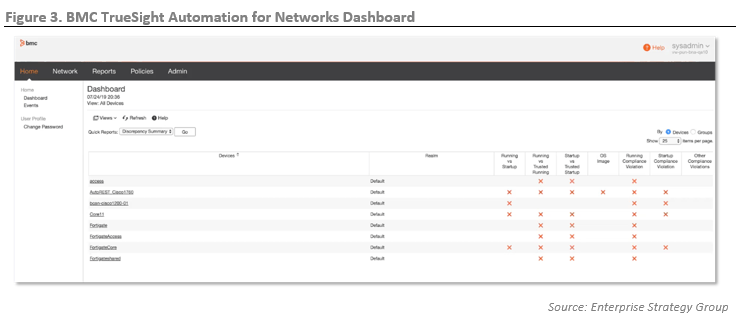
Truesight formerly known as BladeLogic, is now part of the BMC product portfolio. Truesight is an APM with AIOps (Artificial Intelligence Operations) capabilities. It is designed to improve the performance and security of hybrid-cloud environments at a cost-efficient price. TrueSight provides scalable and automated network configuration management capabilities. The software gives full control of the entire configuration across the network, from systems, routers, and firewalls. It can also be programmed to automatically keep track of changes in configuration and apply rollback in case of failure.
Its key features include : service-aware analytics, auto-scans and auto-backups, automatic audits and security compliance checks, patch and image update automation, capacity optimization.
Apstra OS–
Apstra OS (AOS) is referred to as a self-operating network, which automates the lifecycle of leaf-spine network switching. AOS supports multiple switches hardware vendors (Cisco, Juniper, Arista, and more) and operating systems (EOS, Junos, NX-OS, and more).
Apstra comes with a single console to automate your network. It decouples the network (software) from the underlying physical and virtual infrastructure. It works at the management plan to control switches or other devices through their open APIs.
ApstraOS ensures that network elements such as protocols, design, cabling, etc. work continuously. With AOS, you can create, edit, or remove leaf-spine devices, instantly across different network vendors. AOS also comes with closed-loop real-time validation and advanced data analytics.
Its key features include : automated L3 design and deployment with intra-rack virtual networks, operational analytics. Intent-Based Analytics (IBA), built-in Telemetry, NSX-T and vSphere Integration.
NetBrain Automation–
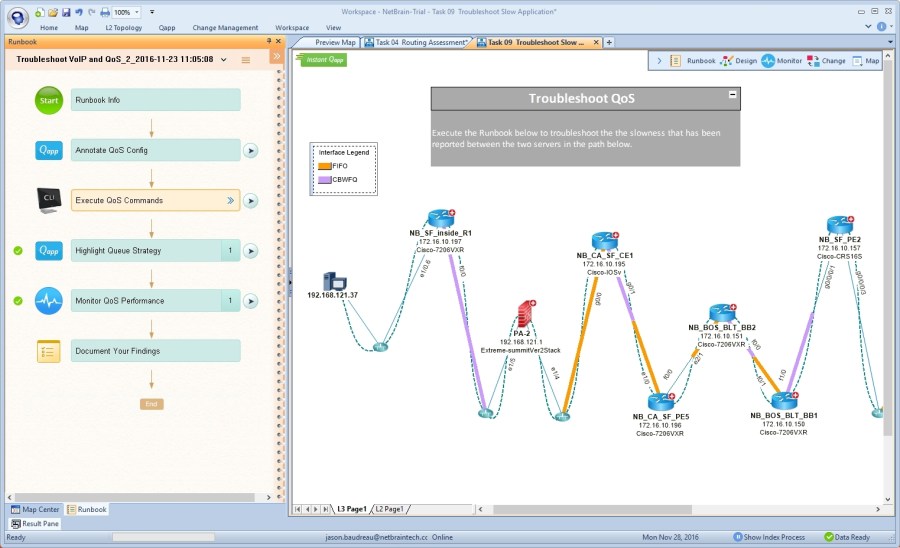
NetBrain is an adaptive network automation platform. It uses a single-pane-of-glass that shows all network data through mapping and visualization. The software also comes with a powerful search engine that allows you to look through all your network elements.
NetBrain performs an in-depth automatic network discovery to collect data from all network devices. It decodes multi-vendor networks and builds a digital representation of the network. The software creates a dynamic map to be used as a UI to all devices and to configure automation tasks. The software improves the device map experience by adding CLI automation and data from third-party network vendors through API.
Its key features include : automaticing network device inventorying, single-pane-of-glass and dynamic maps, viewing device’s CLI at the map-level, automating workflows with Executable Runbooks.
We all,at some point of our life may have experienced nightmares. But what exactly is the sole cause of nightmares…..?
Nightmares are usually disturbing, scary and are remembered unlike the normal dreams we have. Nightmares are even more common in children. But many adults experience nightmares as well. They are vividly realistic. And what do I mean by ‘vivid’ ? Something which is actually entwined with your thoughts,or any past occurrences experienced before.
Photo by Craig Adderley
When can one possibly get nightmares?
Nightmares are usually experienced by one during a period of something called the REM sleep. Humans are the only animals or mammals which are able to sleep on their back.Also,we humans have the ability to sleep in complete unconsciousness. Meaning we can sleep without any further complications. Mind you not every animal has the ability to do that .In fact the phenomenon is quite rare. Now,the REM sleep. REM basically means Rapid Eye Movement. It is the one of the 4 stages of sleeping. This is usually the period when we get our dreams. So if you sleep,suppose at 10:00 pm,then the REM sleep ,i.e your dreams are experienced around 3 to 5 am. So…why don’t we move during our sleep? Actually we do. We do move during our sleep, but when your sleep period enters the REM sleeps, two enzymes or chemicals,namely GABA, and glycine make our body ‘slow down’. And what am I implying by this term? Basically,when you sleep,your body is not particularly working,and even if it did,it would be due to your dreams. To save this energy,rather than wasting them on just some stupid movements,your body makes the organs to slow down a bit. Including your muscles, respiration etc. One can also say that your body is ‘temporarily’ paralysed. But this can also be traumatic because then,one might experience something called ‘sleep paralysis’. What is sleep paralysis? It is a condition where your brain or your eyes are conscious, but your body is still in the stage of REM sleep. And why should this be a problem? People who have experienced sleep paralysis describe it with something like, ‘ A person sitting on your chest and clamping your mouth with the worst nightmares in front of you’. What does the above statement mean? You see,suppose you are in the period of REM sleep,your body paralysed,which also includes your lungs,i.e your breathing levels are a bit slower and steadier than usual. In fact,there is a disorder,where people tend to forget breathing in their sleep,resulting in choking and even death in some cases. Anyways,now that you are conscious,your breathing still continues to have the result of the REM sleep. Which makes you feel like you are choking. People recommend that curling your toes has visibly lessened the discomfort,but that only limits till the first or the second stage of sleep paralysis. Sleep paralysis can last as short as 10 minutes and as long as 2 hours as well. This often results in post traumatic conditions and one may even develop a fear to sleep.
Okay,back to our concept of nightmares. Nightmares are a consequence of higher levels of metabolism. 1.Metabolism(metabolism is basically a process where your food is converted into energy (ATP). What may be the possible reason for this to happen? Well, remember the times when you have a craving for some night snacks? That may be one of the most common reasons for metabolism levels to be higher. When this happens,your brain waves get triggered and ultimately resulting in nightmares.
2.One of the reasons for nightmares can also be extreme stress and depression. 3.Intake of certain supplements could also be the reason for such circumstances. For example, medications of poor pressure, antidepressants etc.
Photo by Pedro Figueras
4. Nightmares can also be a result of certain sleep disorders like insomnia(inability to sleep,often resulting in dozing in some embarrassing positions..)
5. Anxiety can also be the cause of nightmare
6. People with trauma may also find themselves in similar situations.
7. Nightmares often include your worst fears,like falling of the cliff being the most common.
These can be some of the reasons which may cause nightmares. Again,not the word ‘may’. These are some of the known reasons but they mostly depend upon our bodily conditions and our brain cells.Nightmares can usually be prevented or avoided by planning a committed and efficient diet plan also keeping in mind to not eat snacks constantly. Because this might not turn out to be that good for your liver which has to metabolize the food constantly. Also,try to keep yourself in a calm state. Oh yes,it’s not gonna be as easy as it sounds. But let’s just give it a try? Please?
In Hindu tradition Triveni Sangam is the “confluence” of three rivers (Ganga, Yamuna and Sarasvati). The point of confluence is a sacred place for Hindus, with a bath here said to flush away all of one’s sins and free one from the cycle of rebirth.
Triveni Sangam in Prayagraj (Prayag), has the confluence of three rivers — the Ganges , the Yamuna and the Sarasvati (it is invisible, because according to Hindu mythology it flows underground). The two rivers maintain their visible identity and can be identified by their different colours. The water of the Ganges is clear, while that of the Yamuna is greenish in colour.
A place of religious importance and the site for historic Kumbh Mela held every 12 years, over the years it has also been the site of immersion of ashes of several national leaders, including Mahatma Gandhi in 1948.
The auspiciousness of the confluence of two rivers is referred to in the Rigveda, which says, “Those who bathe at the place where the two rivers flow together, rise up to heaven”.
Ganges River
The Ganges or Ganga, is a trans-boundary river of Asia which flows through India and Bangladesh. The 2,704 km river originates from the Gangotri Glacier of western Himalayas in the Indian state of Uttarakhand, and flows south and east through the Gangetic Plain of India and Bangladesh, eventually emptying into the Bay of Bengal.The Ganges is a lifeline to millions who live along its course. It is a sacred river and worshipped as the goddess Ganga in Hinduism. It has been important historically; many former provincial or imperial capitals (such as Prayagraj, Dhaka, Baharampur, Bikrampur, Kampilya, Kannauj, Kara, Kashi, Kolkata, Murshidabad, Munger, Patliputra, and Sonargaon) have been located on its banks.
The Ganges is threatened by severe pollution. This poses a danger not only to humans but also to animals; the Ganges is home to approximately 140 species of fish and 90 species of amphibians. The river also contains reptiles and mammals, including critically endangered species such as the Gharial and South Asian river dolphin. The levels of fecal coliform bacteria from human waste in the river near Varanasi are more than a hundred times the Indian government’s official limit. The Ganga Action Plan, an environmental initiative to clean up the river, has been considered a failure which is variously attributed to corruption, a lack of will in the government, poor technical expertise, environmental planning and a lack of support from the native religious authorities.
Yamuna River
The Yamuna, is the second-largest tributary river of the Ganga and the longest tributary in India. Originating from the Yamunotri Glacier at a height of 6,387 metres on the southwestern slopes of Banderpooch peaks of the Lower Himalaya in Uttarakhand, it travels a total length of 1,376 kilometres and has a drainage system of 366,223 square kilometres, 40.2% of the entire Ganga Basin. It merges with the Ganga at Triveni Sangam, Prayagraj, which is a site of the Kumbh Mela, a Hindu festival held every 12 years.
It crosses several states: Haryana and Uttar Pradesh, passing by Uttarakhand and later Delhi, and meeting its tributaries on the way, including Tons, Chambal, its longest tributary which has its own large basin, followed by Sindh, the Betwa, and Ken. From Uttarakhand, the river flows into the state of Himachal Pradesh. After passing Paonta Sahib, Yamuna flows along the boundary of Haryana and Uttar Pradesh and after exiting Haryana it continues to flow till it merges with the river Ganga at Sangam or Prayag in Allahbad (Uttar Pradesh). It helps create the highly fertile alluvial Yamuna-Ganga Doab region between itself and the Ganga in the Indo-Gangetic plain. Nearly 57 million people depend on the Yamuna’s waters. With an annual flow of about 10,000 cubic billion metres (cbm; 8.1 billion acre⋅ft) and usage of 4,400 cbm (of which irrigation constitutes 96 percent), the river accounts for more than 70 percent of Delhi’s water supply. Like the Ganga, the Yamuna is highly venerated in Hinduism and worshipped as the goddess Yamuna. In Hindu mythology she is the daughter of the Sun Deva, Surya, and the sister of Yama, the Deva of Death, hence also known as Yami. According to popular legends, bathing in its sacred waters frees one from the torments of death.
Sarasvati River
The Sarasvati River is one of the rivers mentioned in the Rig Veda and later Vedic and post-Vedic texts. It plays an important role in the Vedic religion, appearing in all but the fourth book of the Rigveda. The goddess Sarasvati was originally a personification of this river, but later developed an independent identity. The Sarasvati is also considered by Hindus to exist in a metaphysical form, in which it formed a confluence with the sacred rivers Ganges and Yamuna, at the Triveni Sangam.According to Michael Witzel, superimposed on the Vedic Sarasvati river is the heavenly river Milky Way, which is seen as “a road to immortality and heavenly after-life.” Rigvedic and later Vedic texts have been used to propose identification with present-day rivers, or ancient riverbeds. The Nadistuti hymn in the Rigveda (10.75) mentions the Sarasvati between the Yamuna in the east and the Sutlej in the west. Later Vedic texts like the Tandya and Jaiminiya Brahmanas, as well as the Mahabharata, mention that the Sarasvati dried up in a desert.
Since the late 19th-century, scholars have identified the Vedic Saraswati river as the Ghaggar-Hakra River system, which flows through northwestern India and eastern Pakistan, between the Yamuna and the Sutlej. Satellite images have pointed to the more significant river once following the course of the present day Ghaggar River. Scholars have observed that major Indus Valley Civilization sites at Kalibangan (Rajasthan), Banawali and Rakhigarhi (Haryana), Dholavira and Lothal (Gujarat) also lay along this course. However, identification of the Vedic Sarasvati with the Ghaggar-Hakra system is problematic, since the Sarasvati is not only mentioned separately in the Rig Veda, but is described as having dried up by the time of the composition of the later Vedas and Hindu epics. In the words of Annette Wilke, the Sarasvati had been reduced to a “small, sorry trickle in the desert”, by the time that the Vedic people migrated into north-west India.
Intern at Hariyali Foundation In Collaboration with Educational News
The basic life skills like speaking and writing are told to a kid by the parents and the school too so that the student should not get into any type of difficulty in Academics in future. Not all but only few kids get it wholly along with a blend of etiquettes, manners and healthy interpersonal skills.
Even at present not only teenagers and youngsters, some middle aged people too don’t really know whether they are really educated or not. Those who are just knowledgeable might be getting confused in these words. Let’s make it more clear and simple.
Knowledge is simply the process of acquiring facts and information through a teacher in a school or a tuition teacher and learning skills along with the information written in books. By Going to a school a kid can become a knowledgeable person in future but he cannot become an educated man.
Oops, getting heavier and blur to understand! Let’s now remove the curtain from what does it mean by education and being educated.
Education is a wider concept; it’s like an enlightening experience in a person’s life. Some children are blessed to have parents and teachers too who educate them by telling them the basic values to be followed in life. The way how to talk an elder person, how to speak in such way that the elder person’s respect must not reduces, how to behave with friends and family socially, what to say to a boy or girl, why to share things, how to help the needy people how to understand someone else’s feelings, how to empathize with people and many more things are covered under this single word ‘education’
A person can be illiterate but he or she can be educated whereas a knowledgeable person, who is a post graduate from a reputed institute, doesn’t mean that he or she is educated in true sense. People from a very long time have been using the words knowledge and education together but there’s a big hidden difference in both of these words. In these evolving times, human values and etiquettes are actually lost somewhere in between the figures showing growth, GDP, profits, revenue, etc. Children, when they grow up, mistreat their parents and elders and send them to old aged homes. A brother kills the other brother just because of a piece of land or some countable notes. A student misbehaves with a teacher who implants all the knowledge and facts in his brain. A boy speaks ill words to a girl and throws acid on her face to destroy her beauty who simply just not accepted his proposal. A group of young lads troubles the old man who carries his household stuff purchased from his limited pension. A person steals a scooter standing with a key in market. A son who not at all replies to his parent’s questions. A daughter who thinks her mother is so old fashioned to be taken to a party nearby.
Actually, the basic problem is how the child grows up. What is being told him, what is the environment he encounters, when he is appreciated, for what he is appreciated and a lot more incidents and people shape a person into a well developed human being with good etiquettes, habits and hence good demeanor.
Therefore, it is equally important for the parents, schools and people who are around a child.
Getting him learn how to respect others, how to appreciate others, how to talk to people, how to behave in public is all that is needed for a better world with good sensible souls. If parents and people ignore the importance of inculcation of good habits in the children, then not only the children’s’ life get hampered but an individual raised differently will also became for the society and his family too.
That is why it was rightly mentioned on a page named ‘kalam_se_kaleje_tak’ on Instagram that – “You can be very knowledgeable but that doesn’t mean you are educated in true sense”.
Water is a priceless gift of nature. Water is essential for survival. Without food, we can stay hungry for many days, but it is impossible to survive without water. Water is the need of every living being. Not only humans, plants, animals, and birds also cannot survive without water. Without water, the entire vegetation will disappear. What would happen if there was no water? Without water, there would be no crops, no fruits, no vegetables, no weeds, nothing. What happens around? nothing, No creature survives.
Earth does not produce grains, animals do not provide milk without mother-in-law, we do not get milk to drink. Water is of two types – one saline and the other sweet. Drinking water is sweet. The seawater is salty and salty. That water does not work for drinking. The water that keeps flowing gets rotten, it stinks. Many types of insects in that water? The pandemic spreads due to the mosquitoes and mosquitoes. We also should not let water stand around our homes. This will keep our neighborhood clean and we will be healthy.
We should save water. Water should not be wasted. Water should be used sparingly. The water tap should not be allowed to run in vain. Summer requires more water. Do not wash your vehicles with water and clean them with a soaked cloth. Water should not be used casually. Due to the increasing population, water usage has also started increasing. To build houses, to drink. For bathing. dresses. Water is needed to wash dishes, so we should save water.
Water should be boiled and drunk during rainy days. Boiling water and drinking it kills the germs present in it. In this way, stomach diseases can be avoided. Lack of water on the earth. is. The earth is warming day by day. The glaciers are melting, due to which there is a scarcity of water in the rivers as the Ganges originates from the Gangotri glacier. It is melting due to strong sunlight and heat. The day is not far when the river Ganges will dry up. The North and South Pole ice is melting. Due to this, the water of the sea will increase and the cities around it will be burnt in the sea. Water has many benefits.
Water not only quenches our thirst, but electricity is also produced from it. Large dams are being stopped on the rivers to prevent water from which electricity is produced. That water is used for cultivation by canals. The stagnant water behind the dam is being converted into lakes in which fish are reared. If we consume water today only then our future will be safe. By saving water in the present, we can secure our future. We have to save every drop of water for the well being of the country, only then our future will be safe.
Oceans are found on 78% of the earth, which contains salty water but it is not fit to drink. Potable water is called sweet water or sweet water. Out of the total water present on earth, only 2.7 percent of water is potable.
Water is very important for humans. A man can live for 7 days without eating, but without drinking water, he will die in 3 days. We all feel thirsty and use water to quench thirst. To stay healthy a person should consume at least 2 to 3 liters of water per day. When there is no water when you are thirsty, you feel great discomfort. This shows the importance of water.











 Eduindex
You must be logged in to post a comment.