Animals

Since the time Earth developed the quality of sustaining life, life has always gone under the process of evolution. Life started from single celled organisms and developed stage by stage. One organism extinct to develop into its better developed species or even at times it happens that some animals get erased from the surface of the earth due to extreme environmental condition.

EXTINCT ANIMALS: Species of animals which existed in the surface of the earth once upon a time but has no current existence, this may have been a result of extreme environmental condition or some other condition for existence. For example, we have dinosaurs, Dodo.

ENDANGERED ANIMALS: The species of animals which have only a few animals left on the surface of the earth and are in the mouth of being extinct are known as endangered, currently this is a result of poaching i.e., unethical killing of wild animals with purpose or change in the climate due to pollution and other factors. For example, we have the Royal Bengal Tiger.

We cannot do anything for the species which are extinct but we can definitely take steps and save our endangered species. Poaching laws should be made stricter and it should be taken care that people follow them.

Different types of animals :
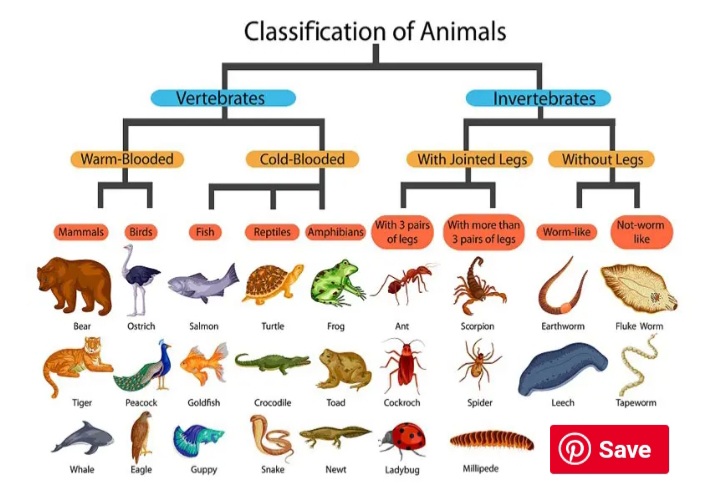
Scientists sort the different types of animals in the world into categories based on certain characteristics. Animals are generally grouped into six types of aninals. The system for animal classifications is called taxonomy.

The Animal Kingdom :

All animals belong to a biological kingdom called kingdom Animalia. This kingdom is then broken down into over 30 groups. About 75% of all species on earth are aninals. Animals are then broken down into two types : vertebrates and invertebrates.
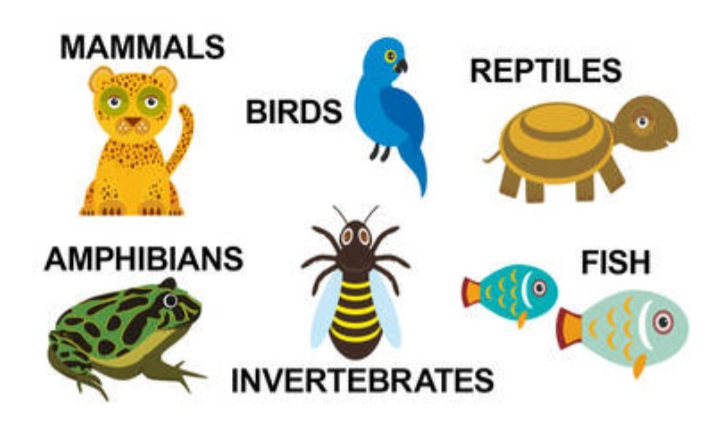
* Animals with a backbone are vertebrates.

* vertebrates belong to the phylum called phylum chordata.

* vertebrates are classified into five classes. They are amphibians, birds, fish,mammals, and reptiles.

* Animals without a backbone are invertebrates.

* Most invertebrates are in the phylum Arthropoda.

1. Amphibians :

All amphibians are vertebrates, and they need moist environment or water to survive.

* They are cold- blooded.

* They absorb water and breathe through their thin skin

* They have at least one special king gland used for defense.

* Most follow the life cycle of egg-larva- adult.

* examples : frog , newts, salamanders, toads.

2. Birds
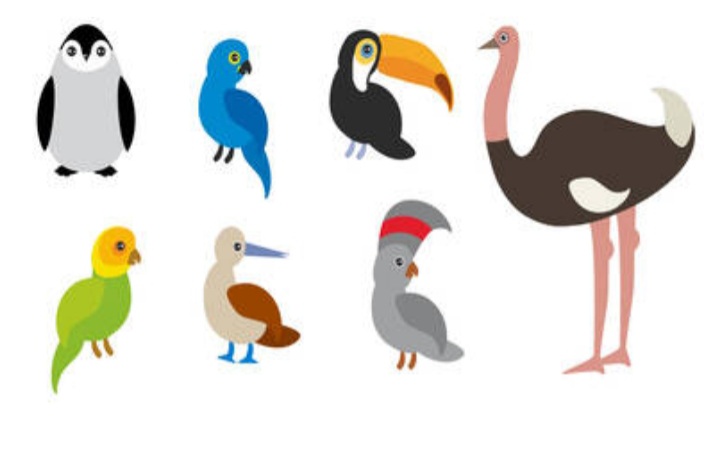
Birds are a type of warm- blooded vertebrate that are adapted to fly.

* Not all birds can fly, but they do all have wings.

* Birds have beaks that help them catch and swallow food.

* The digestive system of a bird allows it to eat whenever it can and digest that food later.

* Birds lay egg to reproduce.

* They are endothermic, mening they maintain their own constant body temperature.

* They are bipedal, which means they have two legs.

* They have hollow bones and their bodies are covered in feathers.

* Birds belong to the class called Aves.

* Examples : albatrosses, chickens, hummin birds, falcons, falmingoes, ostriches, owls, parrot, penguins, pigeons.

3. Fish :

Fish are also vertebrates, and they are considered the oldest-known vertebrates.

* They are ectothermic, or cold- blooded, which means they rely on their surroundings to regulate their body temperature.

* Fish have funs.

* Most, but not all, fish have bodies covered in scales and breathe through gills.

* Fish live under water.

* Examples : eels, hangfish, lampreys, minnows, rays, salmon, seahorses, sharks.

4. Mammals :

Mammals are another type of vertebrate that belongs to the class Mammalia.

* young mammals get nourishment from milk produced by their mothers.

* Most mammals have hair.

* Their jaw is hinged directly to their skull unlike all other vertebrates.

* Almost aĺl mammals give birth to live bsbies.

* They are endothermic, or warm- blooded.

* Examples : there are over 5500 living species of mammals all over the world. Aardvarks, bats, elephants, hamsters, human, rabbits, rhinoceroses, whales.

5. Reptiles :
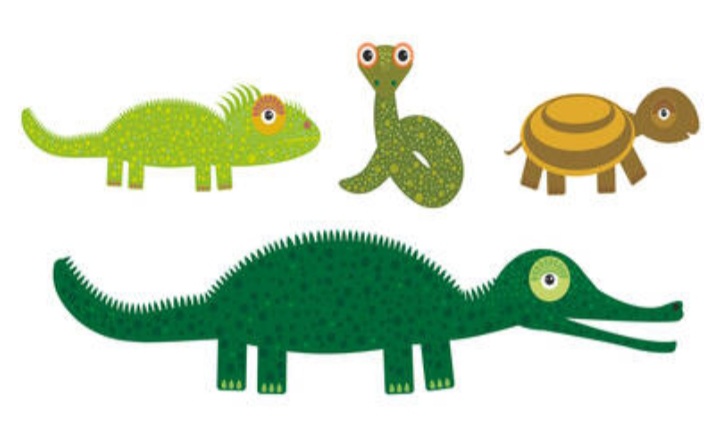
Reptiles are thought to be the first vertebrates to live completely on land. But, not all reptiles live only on land today.

* They are cold- blodded, or ectothermic

* They lay eggs to reproduce.

* They have four legs or descended from animals with four legs.

* They breathe through lungs

* Their bodies are covered in scales or scutes.

* Examples : crocodiles, geckos, lizards, sea turtles, snakes, tortoises.

Invertebrates :

Approximately 95% of all animals are invertebrates. Invertebrates do not have a backbone. There are different types of invertebrates, but they all share a few characteristics.

• They are made up of many cells that work together, or multicellular.

• Most, but not all have tissues, cells that work together in a more complex way.

• Most, but not all, can move.

• There are over 35 phyla of invertebrates.

• They generally have soft babies.

Types of Invertebrates :

There are eight phyla of invertebrayes that are alive today.

* Annelida – have a segmented body and primitive brain

* Arthropoda – have jointed appendages and an exoskeleton.

* Cnidaria – have tissues and an incomplete digestive system

* echinodermata – have some type of spiny structure on their bodies

* Mollusca – generally have sofy bodies and a hard exoskeleton.

* Nematoda – unsegmented with worm- shaped bodies

* platyhelminthes – have soft, ribbon- like worms with no respiratory system.

* porifera – multicellular organisms living in water with no organs or tissues.

Examples : anemone( cnidaria) , clams ( mollusca), coral,
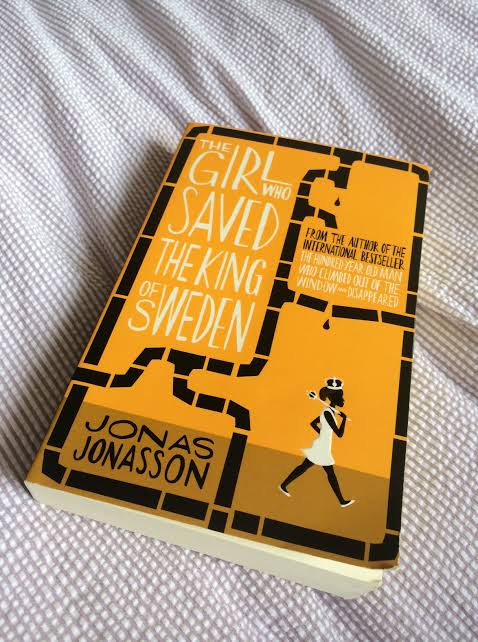
Book Review: The Girl Who Saved the King of Sweden

The Girl who saved the king of Sweden is written by Jonas Jonasson. His best-selling novel is the hundred years old man who climbed out of the window and disappeared.

Book plot:

Nombeko Mayeki is born a poor black girl in Soweto. She leaves the slums and in a twist of fate. She ran over a car but survives. this puts her into the employ of the engineer who ran her over, as a cleaner in South Africa’s secret nuclear weapons facility.
Nombeko is smart, brilliant and a fast learner. Even during her childhood, she is surrounded by uneducated people, still, she managed to teach herself how to read write, and calculate arithmetics. She even tells the answers of long multiplications within seconds. She learned English and poetry from a scholar who has 32 diamonds in his teeth. He is irresponsible about his life, but he is good at poetry and reading. First, he wanted to seduce Nombeko but, she stabbed his leg with her scissors and made him use a crane for more than several months. After that incident she always had her scissors wherever she goes, one night she came to know that person is dead and went to his home and grabbed all his diamonds then in the morning she left her native place.
In the custody of the engineer, she taught herself engineering arithmetics and science as well as learned Chinese from the other servent sisters. After fate made her escape from there. She went to Sweden but… Instead of antelope meat, one of the atomic bombs ended up inside her luggage.
Nombeko’s Ultimate wish is to live a normal and happy life with her own family and children. How does she gets rid of that nuclear weapon, what happened to her diamonds? how she lives her life normally and how she saves the king of Sweden- as it is said in the title of the book is the main plot of this book.

About the book:

This is one of the books that you never feel pathetic whenever a character dies. Cause, the whole book is written in a comical manner, and the author used a lot of anectode and funny incidents to make the book more alive.

Some facts about Jonas Jonasson’s books:

  • His storylines will be simple and understanding. Whatever the plot might be, it will have the question mark of what is going to happen at every end of the chapters in our minds.
  • Jonas Jonasson’s book themes will be similar to his other works. The cover itself tells you that the appearance of the books is similar to one and another.
  • Jonas Jonasson is a comedy writer. Who writes with a lot of anectodes and comical scenes. He is one of the authors who has the ability to make the funeral into a theatre.

Book Quotes:

It sure was an unjust world when certain people received an excess of certain things, while others got nothing.

The more I see of men, the more I like my dog.

The difference between stupidity and genius is that genius has its limits.

Draupadi by Mahasweta Devi

Photo by Jairo David Arboleda on Pexels.com

Mahasweta Devi is a Bengali writer and activist who is known for her strikingly social and poignant stories. She wrote several works ranging from novels and plays to essays and short stories. Her most notable works include Hajar Churashir Maa, Rudali, Aranyer Adhikar etc. She has received highest literary merits in India like Jnanpith Award and Padma Vibhushan. As an activist, she has also worked towards the empowerment and rights of tribal people from West Bengal, Bihar, Madhya Pradesh, and Chhattisgarh.

Draupadi is a thought-provoking short story that deals with the underlying caste system and tribal subjugation in India. Originally written in Bengali, it follows a raw narrative that depicts the struggles of the subaltern in a vastly power-imbalanced society. Draupadi narrates the story of Dopdi Mejhen, a woman belonging to the Santal tribe in West Bengal. Dopdi and her husband Dulna are wanted by the Indian Special Forces as they were the chief instigators in the murder of Surja Sahu, an upper caste man who selfishly drew all source of water to his own wells and tube-wells even during the drought. Their bravery in questioning the authority of the upper caste is seen as a threat and battalions of officers are deployed to capture this ‘untouchable’ couple. Senanayak, the appointed head of the task force, uses the power of knowledge, tactics and violence to capture them. He is pragmatic with his ideology that ‘In order to destroy the enemy, become one.’ He is ruthless and tries everything in his power to achieve this, even going as far as to bait Dopdi with her own husband’s corpse. After her capture, his command allows multiple officers to rape her to extract information. Capturing and torturing them for information becomes a pleasurable game to Senanayak. Where the fugitives struggle for their lives, he takes joy in decoding their language and ‘countering’ them.

Draupadi in this narrative is an implicit reversal of the mythical character Draupadi from the Mahabharatha Mythology. Where the young princess is married off to five princes and leads the life as a fugitive who finally gets back their kingdom, this Dopdi does not grow up in the luxury. She has always been considered an outcast by her country for her identity and she is always on the run. Despite being nearly raped to death, she fearlessly walks out naked and confronts Senanayak, demanding him to ‘Counter’ her.

The people in power always reinforce their power by asserting dominance and by manipulating the internalised stigma against the people born in lower castes. Mahasweta Devi narrates this story of oppression without overtly emotionalising it and yet, it affects the readers in such a way that it provokes these emotions within us. To bring out maximum impact, she portrays reality as it is in all of its rawness which makes us question the power play prevalent in the society. The gradual shift of power in the end can be seen as her way of hinting at a hopeful future.

THE BOOK THIEF BY MARKUS ZUSAK

ABOUT THE BOOK:

The Book Thief is an historical novel by Australian author Markus Zusak. This book is published in 2005 and is one of the international best sellers. The book was also adapted into a movie with the same name.

THE PLOT:

The narrator of the book thief is death. The death introduce himself and visits a small girl Leisel meminger. The story follows the small girl Leisel meminger, after she attains the age in Nazi Germany during World war II. After her brother’s death her mother deciding to give away her.  There she was exposed as a book thief when she was mourning near her brother’s grave she encountered a gravedigger missing his diary in the ground. Without missing the moment she looted the diary without the man’s knowledge. After She has been adopted by her foster parents Hans and Rosa Hubermann. She started to get along with the boy named Rudy Steiner. Leisel starts to like the place and the people.Even though the Nazi regime horrors her at some times. Hans Huberman taught Leisel to read and write first in her bedroom and then in the basement. Because he wants her daughter to share her powerful thoughts through words. Beginning to steal books, now she started to write her own story. When she started helping her foster mother by collecting laundry, she developed a friendship with mayor’s wife Ilsa Hermann, who allows her to read books  in her library and later started to steal them.

Then the Hubermann family get visited by a Jewish man named Max Vandenberg. With him Leisel get close by sharing her language and words which she was taught by her father. But few days later max decided to leave Hubermann’s house. He afraid that Hubermann’s activities will draw suspicion. Eventually as a punishment Hans application for to join National Socialist German workers party is approved. A while later Leisel see Max among the Jewish prisoners in the street, she joins him and get kicked away by the soldier.

After Hans returns home, bomb falls on Leisel street in Mulching. Leisel at that  time working on her manuscript was the only survivor. She was rescued by the the workers and collected the ashes of her manuscript. She is taken by Mayor and his wife Ilsa Hermann. A while later she walks into the river where her friend Rudy saved a book that they theft together but dies without saying a good bye. In 1945, Leisel works in the tailor shop owned by Rudy’s father when max invites her and have an emotional reunion.

Many years later, Leisel died of aging in Sydney, Australia. She was happily married and has three children. She has never forgotten Hans, Rosa, Rudy and her brother. The narrator of the book, death collects her soul and gives her the manuscript. She asks the death to read the book, but death is unable to understand. He cant understand the duality of human beings. The final words by death is “I am haunted by humans”.

MY FAVOURITE QUOTES FROM THE BOOK:

“The only thing worse than a boy who hates you: a boy that loves you.”

“Even death has a heart.”

“It kills me sometimes, how people die.”

PERSONAL THOUGHTS:

The Book Thief was my first favourite book since i started reading books. The ending of the book have left me pain and empathy. It hardly take me two days to think other than the book. I was so hard whether to feel happy for Leisel like how she  atleast had Max in her life and her children whom was there for her when she dies or to feel sorrow for her, how traumatic was her childhood. When she was young and fragile she lost her only brother and her mother left her. Still she had her foster parents and Rudy but the chaos happened in her nation had left her alone. Not as a girl in her teen but as a human in that very young age she lost the persons with whom she can call family and felt happiness . I sometimes use to think that how i wold have handled all this pain and loss of my loved ones. The thought itself breaks me. Even though it is a fiction its hard to convince myself. Atleast death itself was with her till her death. Even death has some humanity.

Two must-read books of Paulo Coelho

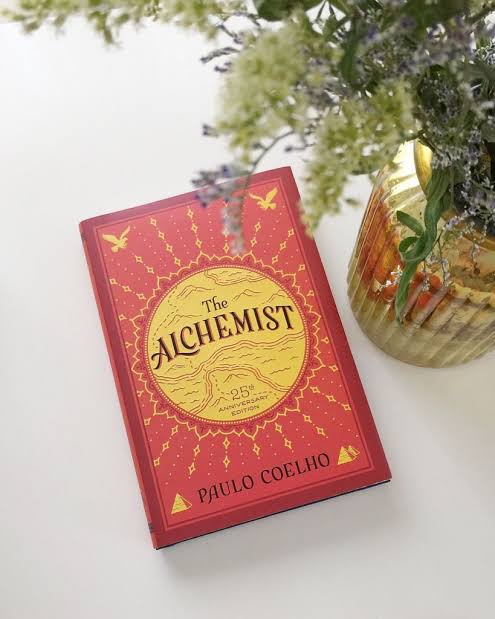
Book: The Alchemist

Book Plot:

A Sheppard boy who wandered most of the places in Andalusia with his flock of sheep. Once he was sleeping in an abandoned church, he dreamed of going to the pyramid. He already had that dream once before. So in a place Tarifa he accidentally met a gypsy lady and she told that there in Egypt he will find his treasure. The followed story is about the adventure taken by the Sheppard boy to reach his Destiny.

About the Book:

  • Through this book, the author motivates us to listen to our hearts while we pursue our dreams. a philosophical fiction and Paulo Coelho gave him at best.
  • The Sheppard boy’s name is Santiago. But, the author never mentions his name except in the first line of the story. We must learn that trick from Paulo Coelho.
  • Paulo Coelho always concentrates on his story. No puns, no scribbles, no long narrations, no heroic entries, and especially no circumlocution. Just a plot and beautiful words to make it a novel. That’s why he is one of my favorite authors.

Quotes:

It is not what enters men’s evil mouths that’s evil… It is what comes out of their mouth that is.

There is only one thing that makes a dream impossible to achieve: the fear of failure.

There is only one thing that makes a dream impossible to achieve: the fear of failure.

when you want something, all the universe conspires in helping you to achieve it.

Tell your heart that the fear of suffering is worse than the suffering itself

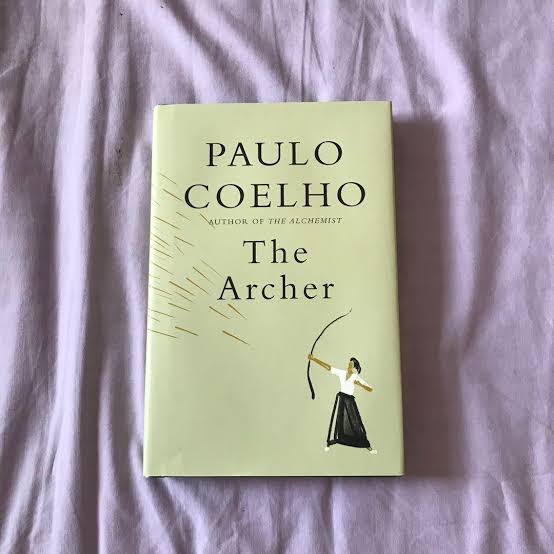
Book: The Archer

Book Plot:

Tetsuya, a man once famous for his prodigious gift with a bow and arrow but retired from public life. The boy who comes searching for him wants him to teach the way of the bow, and the archer illustrates the way of the bow and the tenets of life.

Quotes:

What is a master? I would say that he is not someone who teaches something, but someone who inspires the student to do his best to discover the knowledge he already has in his soul.

The bow is life: the source of all energy. The arrow will leave one day. The target is a long way off. But the bow will stay with you, and you must know how to look after it.

Elegance is not the most comfortable of postures, but it is the best posture if the shot is to be perfect.

Why you must read these books:

  • Paulo Coelho is an inspirational person who never disappoints us through his books, he suffered a lot and searched the way out of his hell through philosophy, religion, and faith.
  • I don’t know why Paulo Coelho’s books come under the genre of fiction? For real, it is a self-motivational book. His words are simple his books are the only books that I read in a single sitting.
  • If you are a person who fears failure, rejection, and humiliation… You must read these books. After reading these books you will do something you love to do or you will at least think about what do you love to do.

Book Review: 1984 by George Orwell

Book Plot:

Winston Smith is a low-ranking member of the party. In his country Oceania, everything was controlled by the head of the party who is known as “Big Brother”. There will be cameras fixed everywhere like public places, apartments and even in our own houses including our bedrooms. We will be watching 24×7. The party controlled and monitored every people of the country, they decided everything of what must people talk, write even they controlled people from thinking about something which will be lead the party down. (Thoughtcrime) they say that and punish the people in secret ways. Sometimes people suddenly vaporize from society due to the crimes they commit. These all things made Winston depressed and he wanted to rebel against the party with his lover Julia. They both wanted to rebel against the current party that is ruling the country Oceania. How did they start their plan? With whom did they join to abolish the party? Who helped them? Who was against their ideas? And did they uprooted the party? Are questions will occupy our minds until the end of the book.

About the book:

This book is completely a dystopian novel by George Orwell who is famous for his dystopian and unique novels. Through this book, Orwell beautifully illustrated how it must be to be in the future.
This book was written in 1948 itself. And also adapted as a movie. If you don’t have time to read this full novel you can watch it virtually.
If you think “this plot reminds me of your school history subject” I say No… it’s beyond history. Orwell made a timeless satirical attack on the social and political structures of the world.
People in a higher position will create rules and make us obey them. If we don’t, They will give us what we need most and convince us to obey them. Or They will give pain or fear and persuade us to obey them.
Even though it’s a classic novel. The words are not that difficult. so, if you hate classic books due to their language. You can try this one. You don’t find it hard to follow it.
Why you must read this book?
George Orwell is a genius. Who is loot us from our reality? And left us alone in the place which is created by him. That is none other than his works. So, if you want to escape reality and get yourself into some unbearable works. You must try this one.
If you are a classic lover you can read it and would eventually start to love Orwell’s works.
If you are a literature student. This book and George Orwell’s “Animal Farm” book will help you with major paper and their background studies.

Quotes from this book:

Who controls the past controls the future.Who controls the present controls the past.

If you want to keep a secret, you must also hide it from yourself.

If you loved someone, you loved him, and when you had nothing else to give, you still gave him love.

Power is in tearing human minds to pieces and putting them together again in new shapes of your choosing.

Book Review-The diary of a young girl Anne Frank

Anne Frank (born June 12, 1929, Frankfurt am Main, Germany—died February/March 1945, Bergen-Belsen concentration camp, near Hannover), Jewish girl whose diary of her family’s two years in hiding during the German occupation of the Netherlands became a war classic.

Photo by Ava Sol on Pexels.com

Anne’s father, Otto Frank (1889–1980), a German businessman, moved his wife and two daughters to Amsterdam early in Adolf Hitler’s Nazi government. After German forces conquered the Netherlands in 1941, Anne was forced to switch from a public to a Jewish school. She was given a red-and-white plaid diary for her 13th birthday on June 12, 1942. She started writing in the book that day.

“I hope I will be able to confide in you about anything, as I have never been able to confide in anybody before, and I hope you will be a wonderful source of comfort and support.”

The Franks went into hiding in the backdoor office and warehouse of Otto Frank’s food-products firm on July 6, 1942, when Anne’s sister, Margot, was facing deportation (allegedly to a forced-labor camp).

The Frank family and four other Jews—Hermann and Auguste van Pels and their son, Peter, and Fritz Pfeffer—were confined to the “hidden annex” with the help of a few non-Jewish friends, including Miep Gies, who brought in food and other supplies. During this period, Anne kept a diary, documenting day-to-day life in hiding, from little irritations to the terror of being discovered.

She talked about usual adolescent concerns as well as her future ambitions, which included becoming a journalist or writer. On August 1, 1944, Anne wrote her final diary entry. The annex was discovered three days later by the Gestapo, who were acting on a tip from Dutch informers.

On September 3, 1944, the Frank family was taken to Westerbork, a transit camp in the Netherlands, and then to Auschwitz, a concentration camp in German-occupied Poland, on the last train to leave Westerbork for Auschwitz. The following month, Anne and Margot were moved to Bergen-Belsen.

Anne’s mother died in early January, only days before Auschwitz was liberated on January 18, 1945. The Dutch government determined that Anne and Margot perished in a typhus outbreak in March 1945, just weeks before Bergen-Belsen was liberated, however experts disclosed new evidence in 2015, including examination of archival data and first-hand reports, showing that the sisters might have perished in February 1945.

When Soviet troops seized Auschwitz on January 27, 1945, they discovered Otto Frank sick there.

The papers left behind by the Gestapo were eventually given to Otto Frank by friends who examined the hiding site after the family was apprehended. He discovered Anne’s diary among them, which was later published as Anne Frank: The Diary of a Young Girl (originally in Dutch, 1947).

It follows her emotional evolution in the face of adversity and is precocious in style and insight. “I still think, despite everything, that humans are truly wonderful at heart,” she wrote. The Holocaust Diary, which has been translated into over 65 languages, is the most widely read Holocaust diary, and Anne Frank is undoubtedly the most well-known Holocaust victim.

The Diary was also adapted into a play, which premiered on Broadway in October 1955 and won the Tony Award for Best Play as well as the Pulitzer Prize for Best Drama in 1956. In 1959, George Stevens directed a film adaptation of the book.

The play was controversial: screenwriter Meyer Levin criticised Otto Frank and his chosen screenwriters, Frances Goodrich and Albert Hackett, for sanitising and de-Judaizing the storey in an early version of the play (later realised as a 35-minute radio play) and accused them of sanitising and de-Judaizing the storey.

The drama was revived (with additions) on Broadway in 1997–98 after being played in high schools all around the world.

Photo by Pixabay on Pexels.com

The revised English translation of the Diary, published in 1995, includes material that was cut out of the first version, making it nearly one-third longer than the first. The Frank family’s hideaway on Amsterdam’s Prinsengracht canal has since become a museum that is consistently among the city’s most popular tourist attractions.

ANNE FRANK’S QUOTES

“How wonderful it is that nobody need wait a single moment before starting to improve the world.”

“I know what I want, I have a goal, an opinion, I have a religion and love. Let me be myself and then I am satisfied. I know that I’m a woman, a woman with inward strength and plenty of courage.”

“Everyone has inside of him a piece of good news. The good news is that you don’t know how great you can be! How much you can love! What you can accomplish! And what your potential is!”

“What is done cannot be undone, but one can prevent it happening again.”

“I don’t think of all the misery but of the beauty that still remains.”

General knowledge

General knowledge is very important in everyone’s life. The person without the knowledge is like the bird without the wings. It is very important to know what is happening across the world. So, it is very important to attain the general knowledge. To grab general knowlede, an individual must follow some of the techniques like reading books, articles, magazines, newspapers etc.

The newspaper consists of all the important things like the business purposes, sports, entertainment, some interesting puzzles, Hindi habits, food recipes, Current affairs etc.

Reading newspaper is an important thing because whenever an individual comes across a motivational thing, he or she will be motivated and focuses on the particular aspect. The individual will get to know the current affairs. The person will get a good grip on the general knowledge. solving puzzles improves the skills of the person. Reading about the healthy habits in the newspaper makes the individual to go for good and healthier meals.

Reading newspaper is very important because gives the chance to know what is happening around us. Early in the morning or evening whatever the time maybe, sparing at least 10 to 15 minutes of time on newspaper is a very good habit that an individual can develop.

The newspaper consists of all the important things like the business purposes, sports, entertainment, some interesting puzzles, Hindi habits, food recipes, Current affairs etc.

In one of the other way the individual develops good habits and focuses more on what they are trying to do.

Individual Differences :

Intelligence :

High scores on tests of general knowledge tend to also score highly on intelligence tests. IQ has been found to robustly predict general knowledge scores even after accounting for difference in age, and five factor model personality tarits. However, many general knowledge tests are designed to create a normal distribution of answers, creating a bell shaped curve.

General knowledge is also moderately associated with verbal ability, though only weakly or not at all with numerical and spatial ability. As with crystallized intelligence, general knowledge has been found to increase with age.

Long term semantic memory :

General knowledge is stored as semantic memory. Most semantic memory is preserved through old age, though there are deficts in retrieval of certain specific words correlated with aging. In addition, stress or various emotional levels can negatively affect semantic nemory retrieval.

Personality :

People high in general knowledge tend to highly open to new experiences and in typical intellectual engagement. The relationship between openness to experieñce and general knowledge remains robust even when IQ is taken into account. People high in openness may be more motivated to engage in intellectual pursuits that increase their knowledge. Relationships between general knowledge and other five factor model traits tend to be weak and inconsistent. Though one study found that extraversion and neutroticism were negatively correlated with general knowledge, others found that they were unrelated.

Predictor of achievement :

A number of studies have assesses whether performance on a general knowledge test can predict achievement in particular areas, namely in academics, proofreading and creativity.

Academic achievement :

General knowledge has been found to predict exam results in a study of Britush schoolchildren. The study examined congnitive ability and personality predictors of exam performance and found that general knowledge was positively correlated with GCSE english, mathematics, and overall exam results. General knowledge test scores presicted exam results, even after controlling for IQ, five factor model personality traits, and learning styles.

Proofreading :

General knowledge has been found to robustly predict proofreading skills in univeristy students. A study found that proofreading had a larger correlation with general knowledge than with general intelligence, verbal reasoning, or openness to experience. In a multiple regression analysis using general knowledge, general intelligence, verbal reasoning, five factor personality traits, amd learning styles as predictors, only general knowledge was a significant predictor.

Creativity

General knowledge has been found to have weak associations with measures of creativity. In a study examining contributions of personality and intelligence to creativity, general knowledge was positively correlated with tests of divergent thinking, but was unrelated to a bigraphical measure of creative achievemnet, self- rated creativity, or a composite measure of creativity. The realtionship between general knowledge and divergent thinking became non- significant when controlling for fluid intelleigence.

Game shows and Quizzes :

Many game shows use general knowledge questions for entertainment purpose. Game shows such as who wants to be a Millionarie? and fiteen to one centre their questions on general knowledge, while other shows focus questions more on specific subjects. Some show ask questions both on specific subjects and on general knowledge .

“A Clergyman” by Max Beerbohm: Critical appreciation

This essay is written by Max Beerbohm, in the year 1918. The essay is influenced or derived from James Boswell’s record of Johnson’s life probably from the biography “Life of Samuel Johnson”,  which he published in 1971. In this famous biography of Samuel Johnson, Boswell presents him, mostly as an intellectual person, who engages in many table-talks. One such episode is being highlighted in this essay by Beerbohm in which Johnson and Boswell engages in an intellectual meeting “at Streatham, in the well-appointed house of Mr. Thrale” on April 7th, 1778. Henry Thrale, was a British politician who sat in the House of Commons from 1765 to 1780. He was also a close friend of Samuel Johnson. This meeting was also joined by Sir John Pringle, (“father of military medicine”) and they were discussing about the sermons and the peculiarities of some sermon writers.

               Max Beerbohm, uses this incident to paint the imagined past that he recreates in this essay. He introduces the passive yet the main focus, the Clergyman into this actual incident so as to give his imaginary character a sense of reality. He verbally caricatures this passive character who “cuts in” their conversation as a “man with a high, thin voice, and without power to impress anyone with a sense of his importance, a man so null in effect that even the retentive mind of Boswell did not retain his very name, would assuredly not be a self-confident man. He sat forgotten, overlooked; so that his self-assertion startled everyone just as on Boswell’s page it startles us”. Beerbohm gives the details of this meeting as if he were among the intellectuals who actually participated in the meeting. The Clergyman, as Beerbohm presents him is a young man who is “unregarded, shy” and with a nice persons’ thin voice. His shyness and thin voice enhance his passiveness. On the contrary Johnson is presented as the centre of this intellectual meeting, and this eager clergyman waits for him to notice him. He musters up all his courage to ask a question to Johnson, but he dismisses him with his disdainful remark.

 “A CLERGYMAN, whose name I do not recollect: Were not Dodd’s sermons addressed to the passions? JOHNSON: They were nothing, Sir, be they addressed to what they may.’”

              The clergyman is portrayed as a nonentity or an unwelcomed intrusion in the so-called intellectual gathering and Max Beerbohm gives us a number of possibilities as of why he remained largely unnoticed. The essayist opines that it could be because of his thin voice , or could be because he was not properly dressed, or could be because the others in the gathering outshined him. He also presents the possibility that the Johnson, as he was a deaf “old lion” by then, was never aware that he was actually, permanently damaging the clergyman with his “force of paw and claws” which were not the less lethal. The social courage that had been sapped in him, was destroyed, by this experience.

It could be interpreted that Johnson could have dismissed the clergyman’s question because he mentioned William Dodd, whom “Johnson had befriended in adversity”. William Dodd, was an English Anglican clergyman and a man of letters, he was also a controversial topic, for he was caught and punished for forgery. It was said that he had received the assistance of Samuel Johnson. Thus, when the Clergyman mentioned this person, Johnson was caught off-guard and that is why he might have shunned him with his disdainful remark.

The writer also draws parallels between two ages; one, that of Johnson’s, in which sermons were given ore importance and the other, probably the Victorian age, in which novels replaced the sermons. He says that after some time in the future the intellectuals will start discussing about the novels, not the sermons. He comments that by following the trends of the age, people are being capricious and as the Clergyman is being neglected now, people will neglect the sermons for the novels. This, he presents through the conversation between a Pundit and his disciples on many novel writers and their significance. With this conversation he also draws parallels to the characters of the passive clergyman and the “poor nameless wretch” and Johnson to the Pundit.

              He concludes the essay, suggesting that hopefully theses nameless and passive people might get the attention they required. It seems impossible. “But we must remember that things are not always what they seem”. On a philosophical note, “Every man illustrious in his day, however much he may be gratified by his fame, looks with an eager eye to posterity for a continuance of past favors, and would even live the remainder of his life in obscurity if by so doing he could ensure that future generations would preserve a correct attitude towards him forever”. He wishes that the clergyman hadn’t been there at that meeting so that he would not have been nipped in the bud and so, would have saved his face for posterity. Thus, the writer does not fully convey his opinions for the neglect of the clergyman. He just gives his opinions as possibilities. At the end, he suggests that for delicate people like the clergyman, such experiencing might have a long-term effect and the damaged caused could not be reversed. “He sank into a rapid decline”. He also hopes that this person might have died “forgiving Dr. Johnson”.

The Little Prince and why all love him

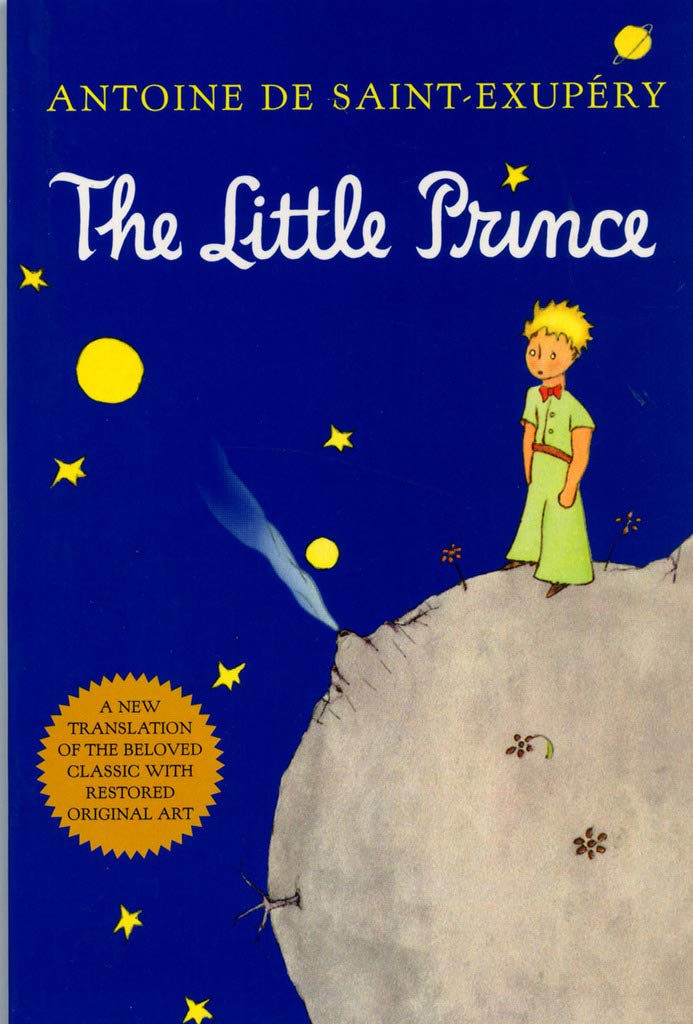
The Little Prince by Antoine de Saint-Exupery is a all time classic in children’s literature. And yet, after reading it, a part of me felt that there could seldom be books as beautiful as this one for any age group. It starts with the buildup of a character of a narrator who loves childhood and treats their intellect superior to those of adult. From the very first page, a reader will laugh with the author and commend him for his though process. And suddenly switches to the backdrop of a war – the second world war to be specific. There he meets a young boy – a boy not more than 12 and clad in his own idiosyncratic behaviour – childish behaviour. This boy is our little prince.

The story deals with love, life, friendship, knowledge, curiosity and death – all as the prince sees them. And it is exactly this part of the story where the reader is lost with the author. Admiration, adoration, love and tears – all move with the prince, a character so beautiful that he cannot die in the heart if the one who has read that that book.

It is a small book and in that small novella is a plethora of beautiful and innocent lines that are bound to steal your heart away or to quote the book,

“What makes the desert beautiful,’ said the little prince, ‘is that somewhere it hides a well…”

Make friends with the little prince and whenever you shall see a star, that one meaningless star will have a laugh or a smile for you each time.

Amazon.com: The Little Prince (8580001044842): Antoine de Saint-Exupéry,  Richard Howard: Books

Remains of the day

Introduction: In this article, I’ll be examining the ideas of dignity, loyalty and nobility that the novel explores.


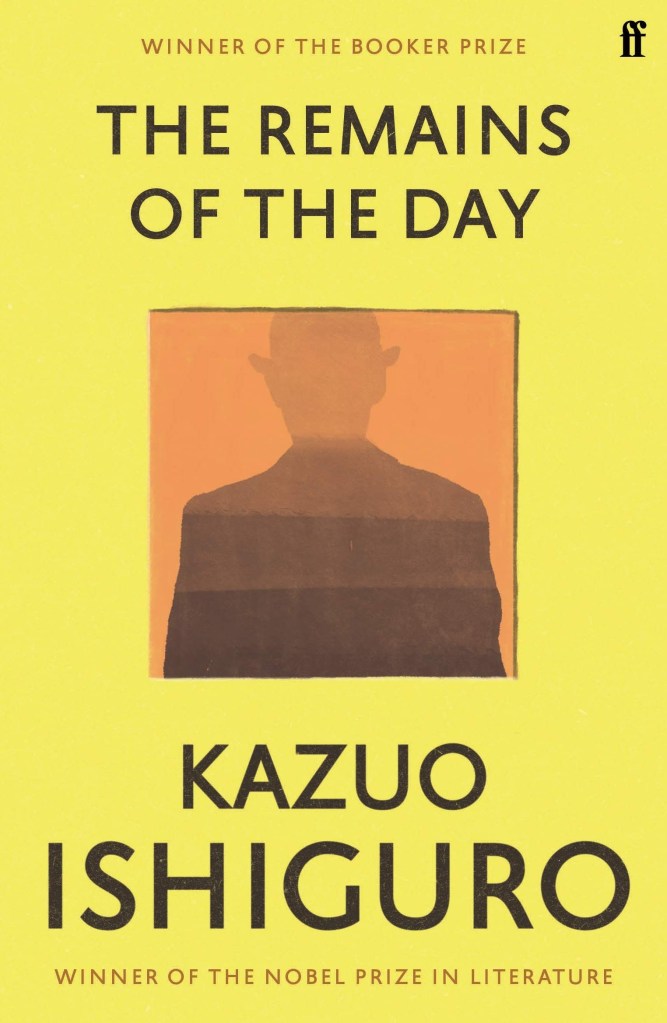
The novel Remains of the Day by Kazuo Ishiguro is a reflective novel. It explores many themes but the one I am going to elaborate about is the theme of dignity, loyalty and nobility. In this novel, the tone is controlled, the language is carefully crafted, and the themes revolve around the position of the individual within a society. The story takes place in July 1956, the same month and year as the Suez Crisis. The novel portrays the decline of the aristocracy and of the practice of keeping a large staff of house servants on English estates. It is staged alongside the histories of Great Britain and Europe in the years preceding and following World War II.
In the novel, the first person narrator, Stevens is a butler on the verge of retirement who takes on a journey to meet his former coworker, Miss Kenton. He also tries to come into terms with his past by remembering the time he spent in Darlington hall.

Idea of dignity:
Stevens’s Idea of dignity is one of the central themes of the novel. Stevens’s definition of dignity is quite different from that of the usual meaning. On one hand where dignity is referred to as being honourable and worthy, Stevens Idea is to completely suppress his emotions which leads to him losing Miss Kenton forever. To him, this kind of ‘dignity’ is the highest Ideal. He believes to be a great butler, one needs to have dignity which one can strive for throughout their career. He believes in professionalism which cannot be compromised at any cost and that’s what makes a great butler, but also adds that the ‘lesser butlers’ who don’t understand dignity will be swayed by the luxuries and etc and forget their professionalism. The fact that his idea of dignity is so misguided is sad because we are aware that he has always wanted great things from life but fails to take the right path in order to achieve his goals.
Stevens Idea of dignity is to follow all orders even if one doesn’t agree with it. For instance, Lord Darlington had ordered all the Jews to be stripped from their post and even though Stevens felt that it was an atrocious step to take, he still believed that following that order would be the right thing to do as he is a dignified professional. He knew that it was wrong and yet carried out because of blind loyalty.

Theme of loyalty:
We can see the theme of loyalty in Stevens by witnessing the way he always followed his employers orders even though he knew some were wrong. Mr. Stevens is so ingrained in his job to please his employer he almost becomes detached from his own self and becomes an extension of Lord Darlington. People always mentioned that his blind loyalty was like being a slave to Lord Darlington but he refused to believe all of it as he thought he was just being loyal to his employer. Stevens makes great sacrifices to dedicate his life to his understanding of dignity and professionalism. We can also see how his choice to blindly be loyal to Lord Darlington takes a toll on him and he breaks down in front of a stranger as he cannot even state that the mistakes were his but he is aware that it’s his employers which makes him a bit sad. It was clear that Lord Darlington sympathised with the Nazis and was Hitler’s pawn in a diplomatic game to influence the British government. Even after being aware of this fact, Stevens remained loyal and stated that Lord Darlington was not a bad man but was just a victim to politics.
Stevens says that Lord Darlington was a courageous man. He chose a path in his life which he thought was right and even though it was a misguided one, he chose it for himself. He says, that’s something he can never say about himself. He always followed orders and did what was expected of him and due to that his personal life was lost. The blind loyalty makes him wonder about his life choices.

Theme of nobility:
We can also see the theme of nobility in the novel. His role as a servant is fixed within the hierarchy of social classes left over from the Victorian and Edwardian eras. As a butler, his duty demands to be loyal to Lord Darlington. He followed his fathers footsteps who was also a butler as it was a tradition of service without families. His position and duties as a butler are defined by the rules and customs that bind the servant class. The class conditions under which Stevens serve are rigid. It says that marriage interferes with service and If one is interested in marriage, they have to first quit the job and Stevens always strives to meet these standards. Later in life he realises that it was a grave mistake and he should’ve just followed his heart.

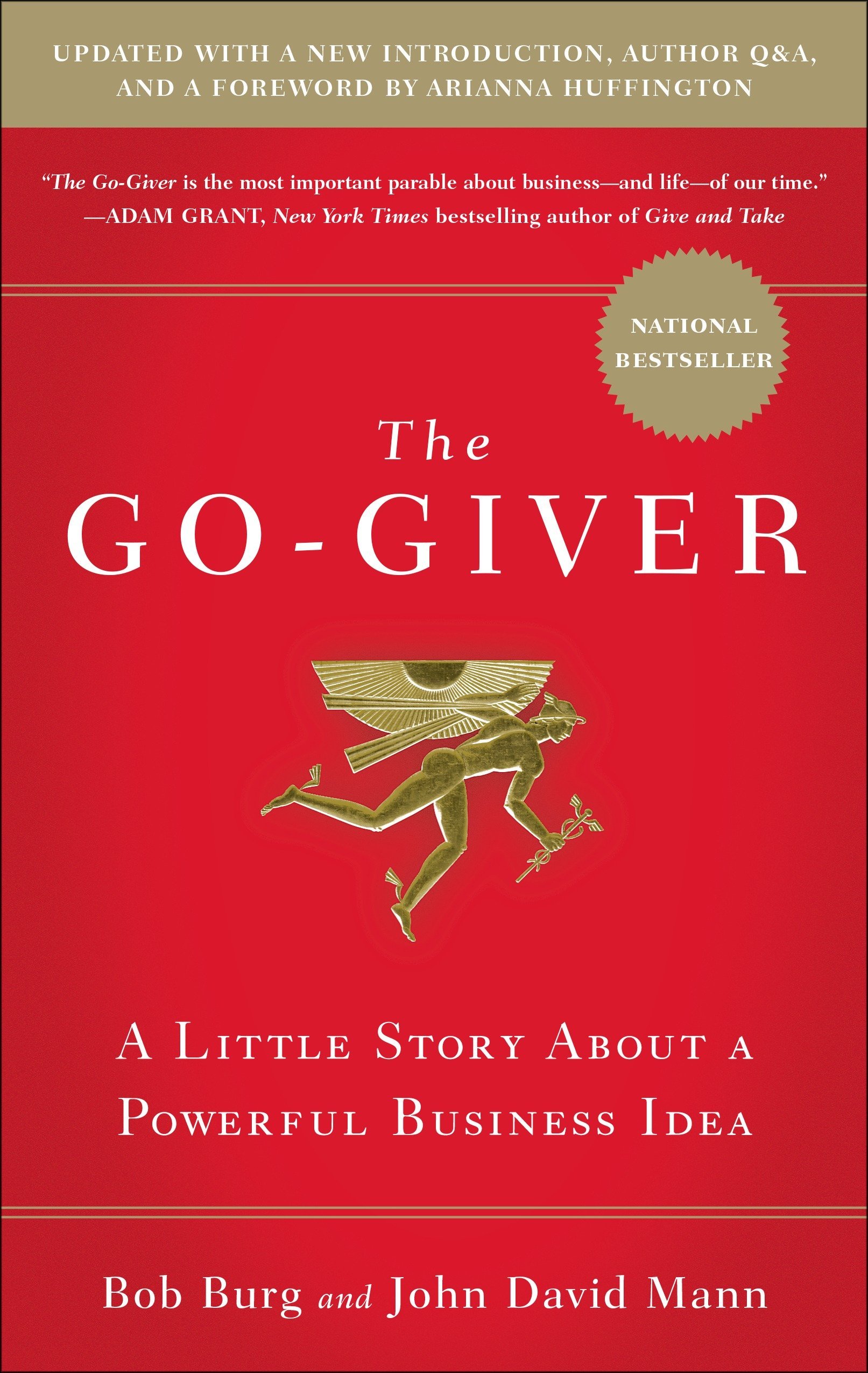
LEARNING LESSONS FROM THE BOOK- GO GIVER

1. Your income is determined by how many people you serve and how well you serve them.

2. The only winning proposition is one hundred percent. Forget win-win , focus on the other persons win. Because your influence is determined by how abundantly you place other peoples interest first.

3. As long as you are trying to be someone else or putting on some act or behaviour someone else taught you, you have no possibility of truly reaching people. The most valuable thing you have to give people is yourself.

4. All the giving in the world wont bring success, unless you also make yourself willing and able to receive in like measure. Thus, the key to effective giving is to stay open to receiving.

5. Your true worth is determined by how much more you give in value than you take in payment.

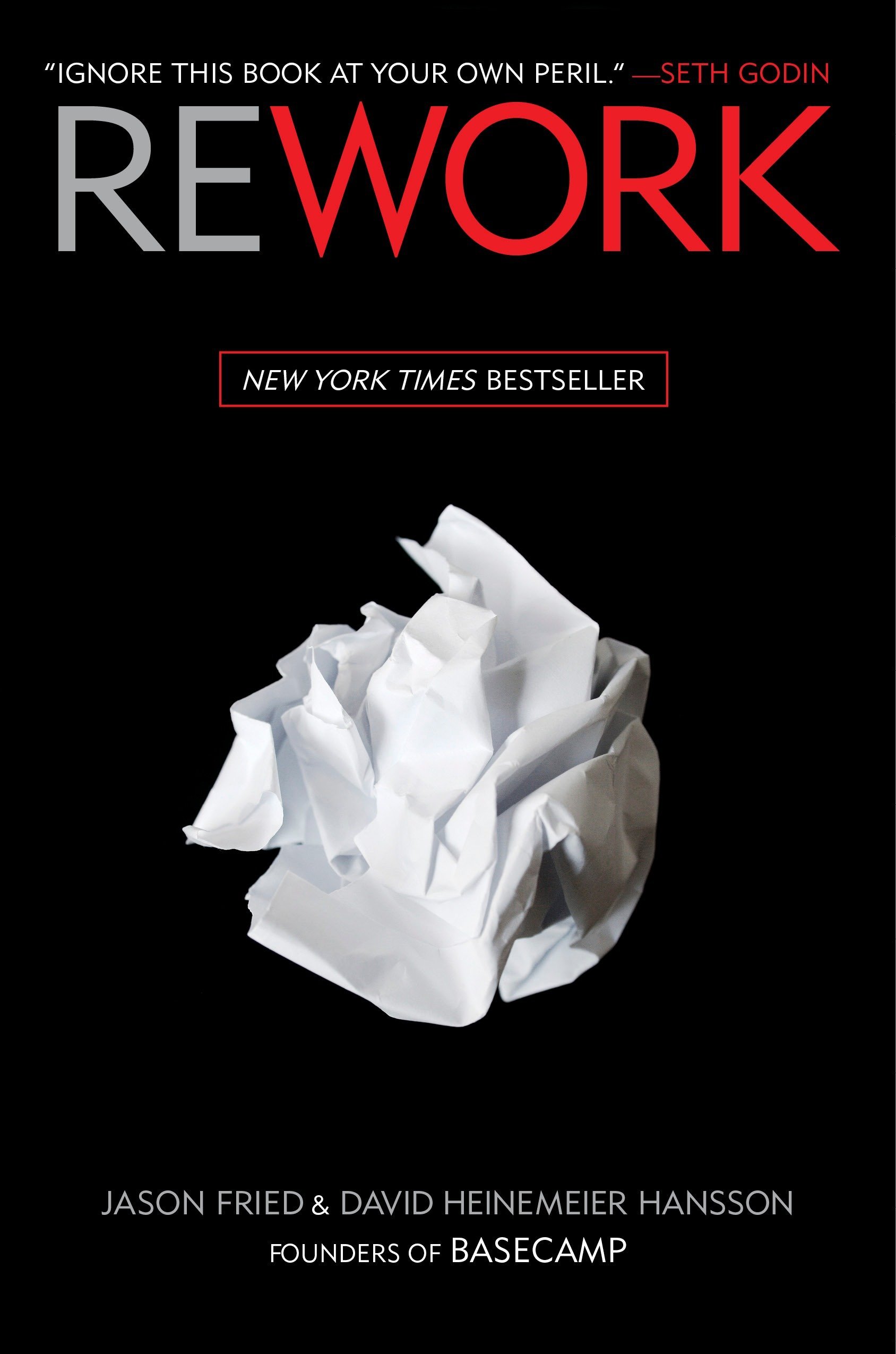
LEARNING LESSONS FROM THE BOOK ‘REWORK’

1. BE A CURATOR

What makes a great product is not the things or features in it but the things which are removed, yes its true! Because people like it simple and easy to use so don’t make it complex, be like a good curator always look for removing things.

2. UNDERGO YOUR COMPETITION

In business most people focus on becoming better than competition than making a better product . But the best way is to do less than your competitor to beat them.

Solve the simple problem and leave the hairy, difficult, nasty problems to the competition. Instead of one upping, try one-downing .

3.WELCOME OBSCURITY

If you are unknown, you company is unknown then its just fine because this is the real time when you have full freedom to make a lot of mistake and no one will blame you because no one knows you, but once you get bigger you become too conservative and you don’t take risk, so enjoy this beauty.

4. PLANNING IS GUESSING

Your plans are not plans they are just guesses so if certain plan doesn’t got executed well, then don’t take it seriously, because they are just mere guesses and every time guessing cant be right. So stop worrying about it.

How to Download Windows 11 on Your PC:

How to Download Windows 11 on Your PC: Follow These Steps

Windows 11 is arriving to deliver you the best experience that Microsoft has designed this year. The new operating system is promised to start rolling out as a free upgrade to Windows 10 users later this year. But if you can’t wait and are looking for a way to download Windows 11 right away, you can certainly take a short route and download the Insider Preview build of the latest operating system on your system today. This will let you experience Windows 11 ahead of its public debut.

Microsoft has not given any exact timeline on when we will get Windows 11 as an upgrade on our Windows 10 machines. Nonetheless, the Redmond, Washington-based company is expected to roll it out by as early as October. This means that you would be able to get the new Windows version on your machine sometime later this year — or next year — depending on the rollout process.

How to download Windows 11 on your PC

Before beginning with the steps on how you can download Windows 11 Insider Preview on your PC, it is important to note that Insider Preview builds are specifically designed for testing purposes and are not meant to be installed on your primary PC. You would also experience some bugs and errors, and some of the features that Microsoft showcased last month are not a part of the Insider build. Still eager to get started?

You can follow the steps below.

  1. Sign up for the Windows Insider Program by going to Settings > Update & Security > Windows Insider Program. And then, press Register and Sign Up. If you’re already a part of the Windows Insider community, you can sign in to your account and click Start flighting.
  2. Review the Privacy Statement and terms appearing on your screen and click Submit.
  3. Select Dev Channel from the Insider settings to download and install the current Windows 11 build meant for Windows Insider Preview and hit the Confirm button.
  4. Your machine will now ask you to Read the Microsoft Insider Privacy Statement and Agreement. Once you have reviewed the statement and terms, click on Confirm.
  5. Now, press Restart Now to restart your machine to get the Insider Preview build.
  6. After restarting, make sure you are connected to an active Internet connection. You can then go to Settings > Update & Security > Windows Update and click the Check for updates button.
  7. Your PC will start downloading the latest build from a Microsoft server.

Notably, Windows 11 has certain minimum hardware requirements that must be met to download the Insider Preview build. You can check out those requirements from the Microsoft website.

BOOKISH TERMS

Don’t judge a book by its cover. But, who can ignore if the books come with eye-grabbing front covers and alluring editions? Book readers have a lot of Idioms and Phrases and especially things names to convey their ideas among themselves. But, not everyone knows the difference between the books and those names. Thus, we are going to look at those bookish terms (Especially about book editions) and their meaning and I will include some pics in each section so that you will get a clear idea about all of them. Book editions have a great part in the lifespan of the books. If the quality of the book is promising, they can live until your grand grandchildren age. So, choosing a book is not merely choosing the title or the plot of the book. But, it’s an investment to pass knowledge through generations.

Paperbacks

Paperbacks are common books that we see and buy day to daily life. Paperback editions are based on thin front binding and are most fragile. Paperback always has good designs on its front cover. And easy to read, lightweight and comfortable. Paperbacks are pocket and travel-friendly editions. If you are a person who would like to read while traveling, paperbacks are an adequate option.

Hardcovers

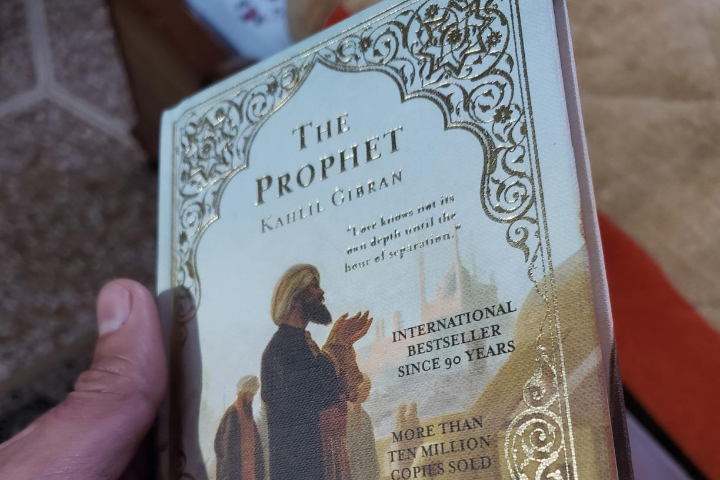
Hardcovers are the most expensive editions in books categories. They will have thick hard binding rather than a thin paper front cover. And to the bonus, they will have a highly decorated protective cover. Which helps the hardcover to remain dust-free. (To be honest, the binding of the book will be hard and plain but the protective sleeves will be decorative. thus, we will take care of the sleeves as much as we care about the book.) Some hardcovers come with designs even in the binding part. Those are called as special editions. Hardcovers are heavyweight and double in price range comparing to paperbacks. But, still, they are the real shelf slayers. If you want to collect books. Hardcover can give a dramatic image to your shelves.

Hardbound


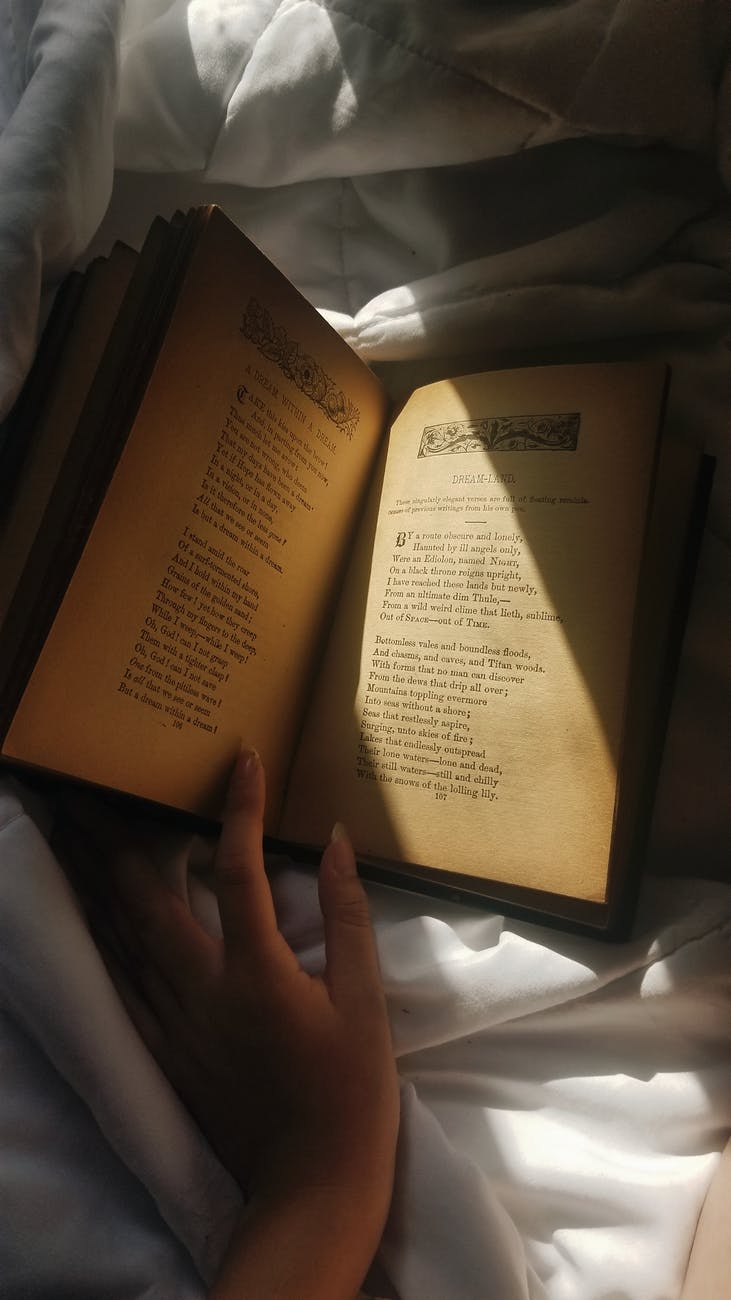
Hardbound books are nearly hardcovers but don’t have protective sleeves. They have a hard binding with attractive designs on them. But, without protective sleeves. Some hard bounds come with gold dust paper edges which is an alluring part of these books. These kinds of editions are also heavily weighed some short stories and novels contain lesser pages have no effect of hand pain while reading. Hardbound gives an aesthetic, classy, and breathtaking vintage look to your collections. The idea of hardbound books is to giving us some vintage and classical themes while reading.

Pirated Books


Pirated books are cheap books but which are illegally printed. Some publishing houses print them without the author and the authorization’s/copyright’s permission. And those books are highly cheap compared to any other editions. They will have tons of errors and misprints. So, even though if you don’t want to have that book you can’t even sell them at half rate. Because the lifespan of Pirated books are less than 30 years. And no one will love to buy misprinted and ink-spilled books. So, whenever you are going for a sale if the books are cheap flip those books 1000 times and make sure it is not misprinted, ink spilled, cross alignment, missing pages or black pages in between the chapters. And one more thing to add, Pirated books are unauthorized copies. Thus, it won’t give any profits to the Authors. As readers and book admire we should support them will all our efforts. So, spending a little more on good books is not spending it’s an investment for the future.