POTTERY ART AND CULTURE

Pottery is our oldest handicraft. In prehistoric times, most likely water was carried in woven baskets lined with river clay. After the water was poured out of the container the layer of clay dried. The loss of moisture caused the shape to shrink and separate from the sides of the basket. When the clay, now shaped like a pot, was removed, and dried in the sun on hot sand, it retained the basket pattern. Early men and women then discovered that they could harden the molded pottery in hot ashes and make sturdy containers to transport and store food. From these would have been extended the pots formed by hand and decorated with crude tools.
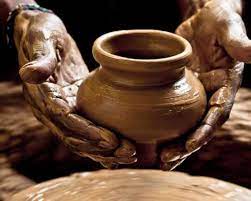
From a very early date in history, some say at least 400 B. C., earthenware pottery was produced on a mass scale by a potter’s wheel in many parts of the world.

THE EGYPTIANS :

The Egyptians made kilns to place their clay pots in for firing. The kiln was lined with a kind of insulation brick that was made from a mixture of straw and clay which had been dried in the sun. Later, the ancient Egyptians used a finer clay with a high quartz content for their delicate pottery. They rubbed the pieces with a smooth stone to give the a dull sheen or coated them with a fine layer of another color of clay.

Further experimentation lead the Egyptians to coat their clay objects with a bluish-green substance to make them non-porous. This was a glaze composed of quartz, soda, and a mineral containing copper which when fired covered the clay bowls and vases with a glass-like surface.
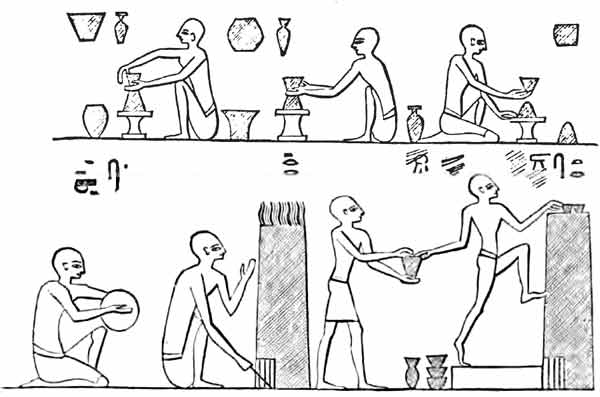
Egyptian pottery making illustration

ANCIENT GREEK :

Ancient greek vases are highly valued for form and decoration. The graceful lines an perfect balance speak to our desire for beauty. The pottery was decorated with pictures of the daily lives of the people and stories of their gods, goddesses and heroes. On the red figure vases the background was painted black and the figures were left the natural red color of the clay. The color was reversed on the black-figured vases.

Ancient Greek pottery

Medieval period :

In Medieval times sand was mixed with clay to make cooking pots strong enough to be placed over an open fire. Today, for the same reason, casseroles used for baking are made from clay mixed with grog which is a ground-up fired pottery. The openness of grog clay allows water to evaporate more evenly as it dries and prevents cracking and warping during the firing. Grog clay eases the problem of heat expansion which can cause large thick pieces of pottery or sculpture to blow up in the kiln.

medieval times cooking pots

German potters :

Around the middle of the thirteenth century German Potters started to produce stoneware. This pottery was made form finer clays and fired at a higher temperature than earthenware. Stoneware was tan or gray in color, strong and naturally non-porous.

Light, transparent porcelain was first produced in China. Porcelain was made from a very plastic and pure clay called kaolin mixed with felspar. The colorful decoration of the porcelain was accomplished by firing each color individually after it was applied. These delicate china dishes and figurines were in demand all over Europe. In their efforts to unravel the secret of the composition of the Chinese porcelain, European and other Asian potters developed many variations in their glazing techniques.

Rakuware is another type of pottery of special interest. The crackled glaze of raku originated in Japan where tea bowls were modeled by hand from a very coarse clay (Hanson, 1970).Late in the sixteenth century, a trade route through Manila, brought pottery from China to Acapulco to Vera Cruz, Mexico to Europe.
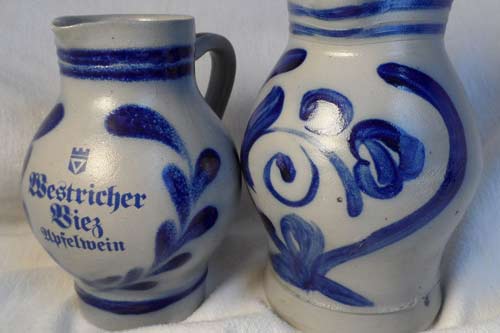
German pottery
Isaac Button, Soil Hill Pottery near Halifax, England

Every village of almost every state of India has a potter (Khumbar or Kumhar) who ‘wheels’ out an amazing variety of household utensils and other objects of utility. They sit outside their huts, spinning their wheels, creating bowls, mugs, plates, urns, for storing and carrying water, flowerpots, foot-scrubbers, small pots and a myriad other articles required by an Indian household. With the spread of urbanization, the potter settlements have now mushroomed on the outskirts of big cities and towns.

Pottery Across the States:

KASHMIR :

Moving straight onto Kashmir , one can find earthenware of ordinary clay, but with a glaze-like surface, which has gained popularity. Kangra in himachal Pradesh is rich in its clayware.Pottery products made in Kangra is as similar to other clay crafts made by other Potters in India. The only difference is style and the personal touch of the craftsmen. The products are marketed in Kangra, Palampur, Dharamsala, and Meleodganj. 
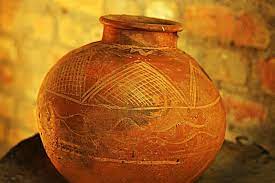
DELHI :

Delhi is famous for its characteristic ‘Blue’ pottery. It has a very old tradition, which is very distinctive. This particular art form has been named as blue pottery because the eye-catching Persian blue dye is used to color the clay. Blue pottery is glazed and high-fired which makes it tougher than most of the others.Delhi pottery Known as the “lyric of handicrafts”, pottery has always supplied writers and poets with the metaphors they have needed.It was probably the Pathan potters from Afghanistan who introduced the glazing techniques to the Mughal court in India.Today, Khurja, an old town about 80 kilometers from Delhi, is full of Muslim potters, engaged in this ancient craft. They use inky blue color known as Jaipur blue as background for floral designs. They also make tiles and do pottery cutwork.
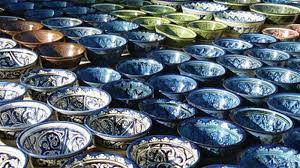
WEST BENGAL :

Mansa pottery of west bengal represents the snake goddess and is a quaint, double curved pot with a face painted on it. Similarly, the Dakshinirai pots, found in the Sunderbans area, are round pots with an edging running along the mouth signifying a crown and worshipped as the god who protects people against tigers. Such articles are of interest to the tourist and though not readily available outside Bengal, one finds stray pieces at the emporia in the major cities of India.
UTTAR PRADESH :

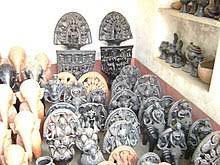
Uttar Pradesh produces some of the finest and most decorative Chunar, symbolized by its fine black clay pottery. This is inlaid with silver paint in intricate designs. The art perfected in Nizamabad, is highly glossy and has luster. Luster is derived from a powder called kabiz made from the mud of rice fields. Its formula is a closely guarded secret.

Khurja , in Uttar Pradesh, a three hours drive from Delhi, is also well known for its cheap but tough tableware. A specialty of Khurja is a type of pitcher like a pilgrim’s bottle. Meerut, Hapur, Chinhat and Mansalia are important centers of this state where ordinary domestic articles and glazed items, mostly tableware are made. Produced on a mass scale, fired at high temperatures, these pottery items retain their mud colour and are in popular demand.
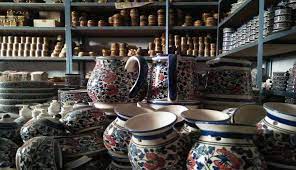
Khurja Pottery Bolloming In Rio Olympics - खुर्जा की पॉटरी रियो ओलंपिक में  लगा रही चार चांद - Amar Ujala Hindi News Live

RAJASTHAN :

Rajasthan pottery has certain distinct characteristics. The mouths of water pots are small, probably to prevent spilling when water is being carried, a natural precaution in a place where water is so precious. Alwar is noted for its paper-thin pottery, known as kagzi (paper) pottery. Molela in Rajasthan is a village, which specializes in producing reliefs of gods and goddesses, mainly Ganesh, the elephant god. These reliefs are painted in vibrant reds, yellows and pinks and the figure is fired.

Jaipur Pottery , made out of Egyptian paste, is thrown on the wheel and fired in wood-kilns, usually at very low temperatures. This naturally makes it fragile though few can resist the charm of the delicate white and blue floral motif, which is painted onto the body after firing. The range of items is primarily decorative such as ashtrays, vases, coasters, small bowls and boxes for trinkets. In the Pokhran pottery, pieces in different shapes are made for varied uses. The important thing here is that the shape is dictated by the function. The best known is the water bottle used during long journeys.

Alwar Shopping | Alwar Market | Shopping places in Alwar

GUJARAT :

In Gujarat , a mixture of white and black clay is used in pottery making. After they are sun-dried, the clay articles are painted. Only earth pigments, ground and mixed with water are used. The object is first coated with a uniform base color and the patterns are then painted in various colors. A vast repertoire of motifs is spontaneously rendered by craftswomen. Designs are made of dots, zigzag stripes and diagonals. Floral and animal patterns are only occasionally used. Kutch and Saurashtra in Gujarat are noted for their beautiful earthenware.Goa’s earthenware has a charm of its own. A wide range of figures and panels, apart from attractive water and flowerpots, are made.

THE SOUTHERN POTTERY :

The south has several centers of noted glazed pottery. Vellore has black and red wares. Usilampatti in Madurai district has black pottery.Karigari pottery in South Arcot . of Tamil Nadu is most famous. Intricate items are made in parts and then joined. Highly artistic shapes are skillfully created. The chillum (clay pipe) is made into a noteworthy item both through its elegant shape and deep blue or green glaze. Khanapur in Belgaum district of Karnataka is known for its large sized containers and jars for storage and preservation.

THANK YOU !
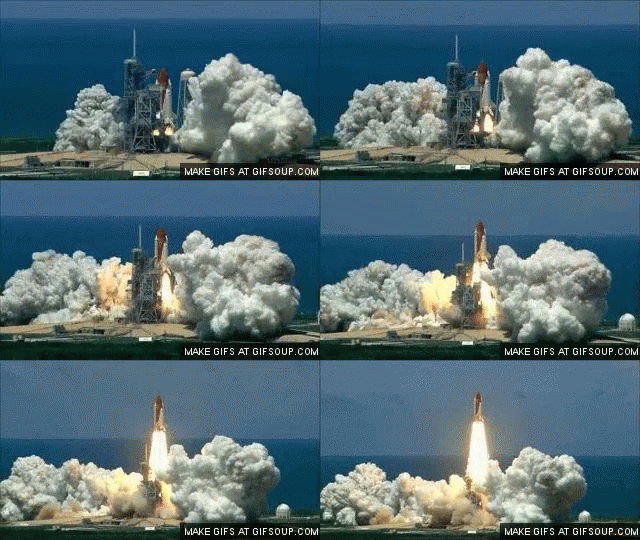
Virgin Galactic’s SpaceShipTwo Unity 22 launch with Richard Branson: Here’s when to watch and what to know.

On July 11, Virgin Galactic will make a giant leap toward commercial suborbital spaceflight. The company will launch its first fully crewed flight of its SpaceShipTwo space plane Unity with a special passenger on board: the company’s billionaire founder Richard Branson

Branson, three crewmates and two pilots will launch on the historic flight after being carried into launch position by Virgin Galactic’s carrier plane VMS Eve. They will take off from the company’s homeport of Spaceport America in New Mexico, with a live webcast chronicling the flight. Here’s everything you need to know about the mission, which Virgin Galactic has dubbed Unity 22.

Related: How to watch Virgin Galactic launch Richard Branson to space
More: How Virgin Galactic’s SpaceShipTwo works (infographic)

WHAT TIME IS VIRGIN’S GALACTIC LAUNCH & AND CAN I WATCH?

Virgin Galactic has not released a specific time for the actual Unity 22 launch, but the company has announced it will begin webcasting the mission at 9 a.m. EDT (1300 GMT). And it looks like it’s going to be fun. The crew will walk out to the ship about an hour earlier.

Stephen Colbert, host of The Late Show on CBS, will host the webcast along with singer Khalid (who will debut a new single during the launch), former Canadian Space Agency astronaut Chris Hadfield and future Virgin Galactic astronaut Kellie Gerardi, who will launch on a research flight in 2022.

The webcast will begin with the Unity spacecraft and its carrier plane taking off from its runway at Spaceport America, which is located 55 miles (88 kilometers) north of Las Cruces, New Mexico. 

Branson has stated that the entire flight will take about 90 minutes, including the ascent up to launch position, release, flight to space and glide back to Earth for a runway landing at Spaceport America.

Virgin Galactic will launch six people on the Unity 22 flight, although the spacecraft is designed to carry up to eight people (two pilots and six passengers).

Unity 22’s crew includes four mission specialists:

  • Sirisha Bandla, Vice President of Government Affairs and Research Operations at Virgin Galactic. She will evaluate the human-tended research experience via an experiment from the University of Florida that requires several handheld fixation tubes to be activated at various points in the flight profile.
  • Colin Bennett, Lead Operations Engineer at Virgin Galactic. He will evaluate cabin equipment, procedures and the experience during the boost phase and weightless environment inside Unity.
  • Sir Richard Branson, founder of Virgin Galactic. Branson will evaluate the private astronaut experience. He will receive the same training, preparation and flight as Virgin Galactic’s future ticket-buying astronauts and use the flight to fine ways to enhance the experience for customers.
  • Beth Moses, Chief Astronaut Instructor at Virgin Galactic. She will serve as cabin lead and test director in space. Her tasks include overseeing the safe execution of the test flight objectives. Moses has launched on Unity before.

Two veteran Virgin Galactic pilots will be at the helm of Unity during the launch. They  have both launched to space on Unity before and are: 

  • Dave Mackay: Mackay is Virgin Galactic’s chief pilot and grew up in the highlands of Scotland. He is a former Royal Air Force pilot and flew for Branson’s airline company Virgin Atlantic before joining Virgin Galactic. 
  • Michael Masucci: Michael “Sooch” Masucci is a retired U.S. Air Force colonel who joined Virgin Galactic in 2013 who racked up over 9,000 flying hours in 70 different types of airplanes and gliders during more than 30 years of civilian and military flight. 

Two other pilots will fly the VMS EVE carrier plane that will carry SpaceShipTwo into launch altitude. They are: 

  • Frederick “CJ” Sturckow: A former NASA space shuttle commander who joined Virgin Galactic in 2013 with Masucci. A retired Marine Corps colonel, he was the first NASA astronaut to join the company and flew four space shuttle missions.
  • Kelly Latimer: Latimer is a test pilot and retired lieutenant colonel in the U.S. Air Force who joined Virgin Galactic’s pilot corps in 2015. She was the first female research test pilot to join what is now NASA’s Armstrong Flight Research Centre.

The primary objective for Unity 22 is to serve as a test flight for future passenger flights by Virgin Galactic. As its number suggests, this will be the 22nd flight of Unity, but only its fourth launch to space. 

The four mission specialists will each evaluate different experiences that Virgin Galactic has promised its future customers, many of whom have already reserved trips to space with the company at $250,000 a seat. 

Bandla, for example, will test the experience of performing experiments aboard Unity during different phases of the flight, including the weightless period. Branson will take note of the flight as a paying passenger to look for ways to enhance the trip for ticket holders looking for the experience of a lifetime. 

Related: The long road to spaceflight for Virgin Galactic and Blue Origin

Moses is Virgin Galactic’s Chief Astronaut Trainer and will ensure everyone is safe in their tests while Bennet will examine Unity’s cabin performance to look for potential enhancements. 

This mission is a critical flight or Virgin Galactic, which Branson founded in 2004. VSS Unity is the company’s second SpaceShipTwo after the first, VSS Enterprise, broke apart during a 2014 test flight, killing one pilot and seriously injuring another. Virgin Galactic has made numerous safety upgrades to prevent such an accident from happening again.

The mission will begin with takeoff from Spaceport America, where Virgin Galactic has built its “Gateway to Space” terminal to serve its future customers. The crews of Unity and Eve will walk out to their vehicles at about 8 a.m. EDT (6 a.m. local time, 1200 GMT). They’ll be wearing custom Under Armour flight suits made for Virgin Galactic.

After takeoff, the carrier plane VMS EVE will haul the SpaceShipTwo VSS Unity (short for Virgin Space Ship) to an altitude of about 50,000 feet (15,000 meters), when it will drop the the spacecraft.

In Photos: Virgin Galactic’s Sleek Under Armour Spacesuits for Space TouristsAdvertisement

Virgin Galactic's first test passenger Beth Moses looks out the window of the VSS Unity during a test flight with pilots Dave Mackay and Michael "Sooch" Masucci, on Feb. 22, 2018.
Virgin Galactic’s first test passenger Beth Moses looks out the window of the VSS Unity during a test flight with pilots Dave Mackay and Michael “Sooch” Masucci, on Feb. 22, 2018. (Image credit: Virgin Galactic)

After separation, Unity will ignite its hybrid rocket motor, which uses a mixture of solid and liquid propellant, to begin the boost phase. This will carry Unity to its target altitude above 50 miles (80 kilometers), where the pilots and crew can expect up to 4 minutes of weightlessness. They will exist their seats and enjoy sweeping views of the Earth below through the many round windows that dot the space plane’s fuselage.

After that short encounter with weightlessness, the crew will climb back into their seats as Unity prepares to return to Earth. Pilots Mackay and Masucci will have “feathered” the spacectraft’s twin tail booms to provide stability during atmospheric reentry.

The feathered tail will then be locked back into place for the glide back to Earth, which will end with a runway landing at Spaceport America. The entire flight, from takeoff to landing, should last about 90 minutes, Branson has said.

WILL VIRGIN GALACTIC REALLY REACH SPACE WITH UNITY 22?

Virgin Galactic's VSS Unity spaceliner captured this view of Earth during the vehicle's first trip to space, on Dec. 13, 2018.
Virgin Galactic’s VSS Unity spaceliner captured this view of Earth during the vehicle’s first trip to space, on Dec. 13, 2018. (Image credit: Virgin Galactic)

Virgin Galactic will launch Unity to an altitude above 50 miles (80 km), which NASA, the Federal Aviation Administration and the U.S. military classify as space. They will earn astronaut wings for reaching that height.

Another widely recognized boundary of space, the Kármán line, is at an altitude at 62 miles (100 km) above Earth. The SpaceShipTwo VSS Unity won’t reach this milestone, which has led Virgin Galactic’s competitor Blue Origin (which does fly higher than 62 miles) to call out Virgin Galactic for missing that mark. 

Richard Branson has downplayed that criticism and saying that “the actual difference in experience is going to be almost non-existent,” in an interview with NPR’s Leila Fadel.

WHERE DOES VIRGIN GALACTIC LAUNCH SPACESHIPTWO FROM?

Click here for more Space.com videos…Sorry, the video player failed to load.(Error Code: 101102)Advertisementhttps://e42edf55977935dba9fbedb9fb4dde49.safeframe.googlesyndication.com/safeframe/1-0-38/html/container.html

Virgin Galactic initially launched SpaceShipTwo test flights from the company’s facilities at Mojave Air and Space Port in California. However, in 2020 the company moved Unity and its carrier craft to its permanent home at Spaceport America, where it plans to fly regular passenger flights beginning in 2022. 

Spaceport America is located near Las Cruces, New Mexico and is home to Virgin Galactic’s “Gateway to Space” terminal, a welcome center and waiting room for ticketed passengers preparing for trips to space. It also sports a large hangar designed to fit multiple SpaceShipTwo spaceplanes and the VMS Eve. Virgin Galactic has also built a new vehicle, the SpaceShip III VSS Imagine

WHEN COULD I LAUNCH TO SPACE WITH VIRGIN GALACTIC?

Click here for more Space.com videos…Sorry, the video player failed to load.(Error Code: 101102)

If you booked a trip with Virgin Galactic early and have one of the first reservations, you may get your chance to fly in space as early as 2022. If not, there’s a long wait ahead. And that’s assuming you can afford the $250,000 ticket price. 

Virgin Galactic has said it plans to begin passenger launches in 2022 after a series of final test flights in 2021. The company does have hundreds of reservations for customer flights in backlog from eager would-be astronauts that have been waiting for over 17 years (since Richard Branson first announced Virgin Galactic in 2004) for the SpaceShipTwo to finally fly. The company paused taking new reservations after the 2014 accident.

Virgin Galactic is expected to resume taking reservations for “a limited number of tickets for future spaceflights” sometime this year, according to its website.


Alpha Centauri, Star System Closest To Our Sun

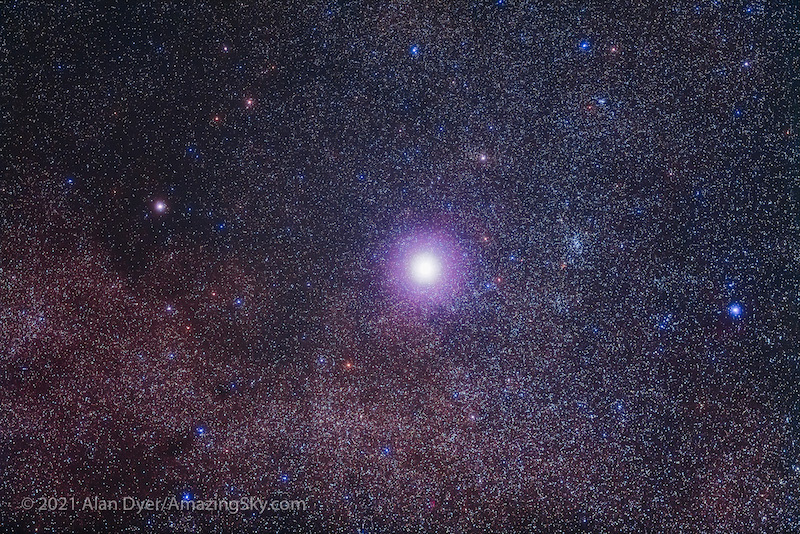
Star Alpha Centauri very bright against a backdrop of extremely dense field of fainter stars and dust clouds.
Alpha Centauri is the third-brightest star in our night sky – a famous southern star – and the nearest star system to our sun. Through a small telescope, the single star we see as Alpha Centauri resolves into a double star. This pair is just 4.37 light-years away from us. In orbit around them is Proxima Centauri, too faint to be visible to the unaided eye. At a distance of 4.25 light years, Proxima is the closest-known star to our solar system.
Science of the Alpha Centauri system. The two stars that make up Alpha Centauri, Rigil Kentaurus and Toliman, are quite similar to our sun. Rigil Kentaurus, also known as Alpha Centauri A, is a yellowish star, slightly more massive than the sun and about 1.5 times brighter. Toliman, or Alpha Centauri B, has an orangish hue; it’s a bit less massive and half as bright as the sun. Studies of their mass and spectroscopic features indicate that both these stars are about 5 to 6 billion years old, slightly older than our sun.

Alpha Centauri A and B are gravitationally bound together, orbiting about a common center of mass every 79.9 years at a relatively close proximity, between 40 to 47 astronomical units (that is, 40 to 47 times the distance between the Earth and our sun).Must Watch Sky Events in 2021

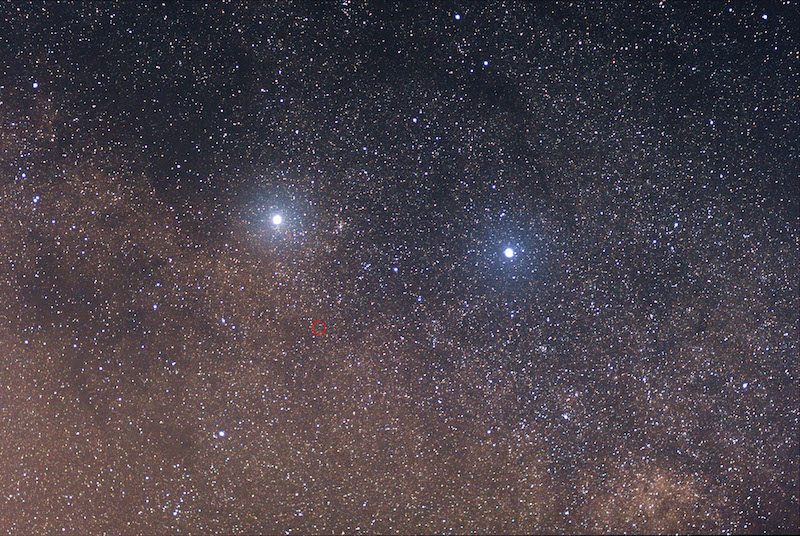
In comparison, Proxima Centauri is a bit of an outlier. This dim reddish star, weighing in at just 12 percent of the sun’s mass, is currently about 13,000 astronomical units from Alpha Centauri A and B. Recent analysis of ground- and space-based data, published in 2017, has shown that Proxima is gravitationally bound to its bright companions, with a 550,000-year-long orbital period.

Proxima Centauri belongs to a class of low mass stars with cooler surface temperatures, known as red dwarfs. It’s also what’s know as a flare star, where it randomly displays sudden bursts of brightness due to strong magnetic activity.

In the past decade, astronomers have been searching for planets around the Alpha Centauri stars; they are, after all, the closest stars to us so the odds of detecting planets, if any existed, would be higher. So far, two planets have been found orbiting Proxima Centauri, one in 2016 and another in 2019. A paper published in February 2021 reported tantalizing evidence of a Neptune-sized planet around Alpha Centauri A, but so far, it has not been definitively confirmed.

Large-appearing bright star with 4 lens-effect bright spikes coming out from it.
Extremely dense star field with 2 brights stars and a small red circle around a much smaller one.

How to see Alpha Centauri. Unluckily for many of us in the Northern Hemisphere, Alpha Centauri is located too far to the south on the sky’s dome. Most North Americans never see it; the cut-off latitude is about 29° north, and anyone north of that is out of luck. In the U.S. that latitudinal line passes near Houston and Orlando, but even from the Florida Keys, the star never rises more than a few degrees above the southern horizon. Things are a little better in Hawaii and Puerto Rico, where it can get 10° or 11° high.

But for observers located far enough south in the Northern Hemisphere, Alpha Centauri may be visible at roughly 1 a.m. (local daylight saving time) in early May. That is when the star is highest above the southern horizon. By early July, it reaches its highest point to the south at nightfall. Even so, from these vantage points, there are no good pointer stars to Alpha Centauri. For those south of 29° N. latitude, when the bright star Arcturus is high overhead, look to the extreme south for a glimpse of Alpha Centauri.

Star chart with stars in black on white, of Centaurus with Southern Cross constellation.
The southern constellation Centaurus. Image via Wikimedia/ International Astronomical Union/ SkyandTelescope.com.

Observers in the tropical and subtropical regions of the Northern Hemisphere can find Alpha Centauri by first identifying the distinctive Southern Cross. A short line drawn through the crossbar (Delta and Beta Crucis) eastward first comes to Hadar (Beta Centauri), then Alpha Centauri. Meanwhile, in Australia and much of the Southern Hemisphere, Alpha Centauri is circumpolar, meaning that it never sets.

A telescope dome at in the foreground with Milky Way and bright stars in the sky.
In this image taken at the European Southern Observatory’s La Silla Observatory in Chile, the Southern Cross is clearly visible, with the yellowish star, closest to the dome, marking the top of the cross. Drawing a line downward through the crossbar stars takes you to the bluish star, Beta Centauri, and then to the yellowish Alpha Centauri. Image via ESO / Wikimedia Commons.

Alpha Centauri in mythology. Alpha Centauri has played a prominent role in the mythology of cultures across the Southern Hemisphere. For the Ngarrindjeri indigenous people of South Australia, Alpha and Beta Centauri were two sharks pursuing a sting ray represented by stars of the Southern Cross. Some Australian aboriginal cultures also associated stars with family relationships and marriage traditions; for instance, two stars of the Southern Cross were through to be the parents of Alpha Centauri.

Astronomy and navigation were deeply intertwined in the lives of ancient seafaring Polynesians as they sailed between islands in the vast expanse of the South Pacific. These ancient mariners navigated using the stars, with cues from nature such as bird movements, waves, and wind direction. Alpha Centauri and nearby Beta Centauri, known as Kamailehope and Kamailemua, respectively, were important signposts used for orientation in the open ocean.

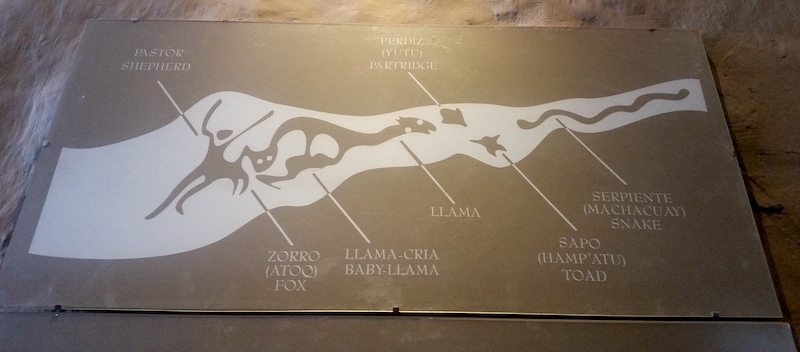
For ancient Incas, a llama graced the sky, traced out by stars and dark dust lanes in the Milky Way from Scorpius to the Southern Cross, with Alpha Centauri and Beta Centauri representing its eyes.

Dark-on-light shepherd, mother llama with baby, partridge, toad, and snake.
A plaque at the Coricancha museum showing Inca constellations. Coricancha, located in Cusco, Peru, was perhaps the most important temple of the Inca empire. Image via Pi3.124 / Wikimedia Commons.

Ancient Egyptians revered Alpha Centauri, and may have built temples aligned to its rising point. In southern China, it was part of a star group known as the South Gate.

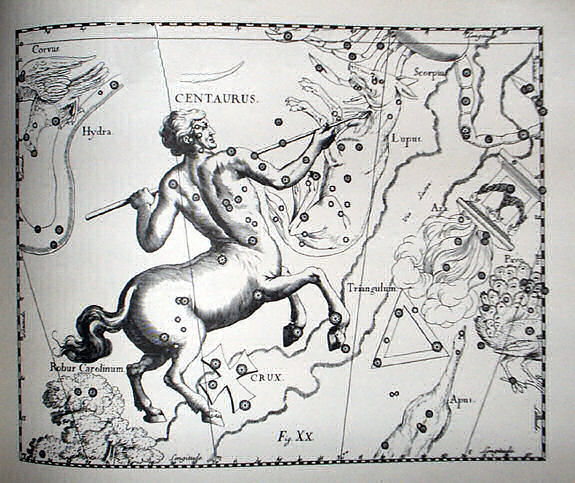
Alpha Centauri is the brightest star in the constellation Centaurus, named after the mythical half human, half horse creature. It was thought to represent an uncharacteristically wise centaur that figured in the mythology of Heracles and Jason. The centaur was accidentally wounded by Heracles, and placed into the sky after death by Zeus. Alpha Centauri marked the right front hoof of the centaur, although little is known of its mythological significance, if any.

Antique etching of half-man-half-horse in field of stars in black on white.
A depiction of the Centaur by Polish astronomer Johannes Hevelius in his atlas of constellations, Firmamentum Sobiescianum, sive Uranographia. Image via Wikimedia Commons.

Alpha Centauri’s position is RA: 14h 39m 36s, Dec: -60° 50′ 02″

Bottom line: Alpha Centauri is actually two binary stars that are quite similar to our sun. A third star that’s gravitationally bound to them is Proxima Centauri, the closest star to our sun.

Most Controversial Figure : Vinayak Damodar Savarkar

Vinayak Damodar Savarkar commonly known as Swatanryaveer or simply Veer Savarkar was born on 28 May, 1883 and died on 26th February 1966. He was an Indian independence activist, historian , poet, novelist , politician who formed the Hindu Nationalist philosophy of Hindutva. He was a leading personality in Hindu Mahasabha

Vinayak Savarkar is highly controversial figure in India because of his mercy petition he wrote to British Government when he was imprisoned in Andaman and Nicobar. But what many fails to understand is the mentality behind the mercy petition. Prisoners in Kaala Paani ( Andaman and Nicobar) were treated horribly and brutally. They were tortured to death . They were neither given good food nor good living condition. To save himself from such inhumane torture Vinayak Savarkar appealed for mercy. He was barrister and he knew his rights well. He knew sitting inside jail he will not be able to serve his country and so tried to get out by writing mercy petition.

But before judging and throwing him into the light of black or white , it is important to know why some hate him and others remark him as a patriot

Why he is loved :

1) He went to Gray’s Inn Law college in London and stayed at famous India House. At that time , India House was a hub of student politics . Savarkar founded the Free India Society to mobilise youth against the colonial rule in India

2) He burnt all foreign goods and propagated the idea of ‘Swadeshi’

3) He plotted armed revolt against the Morley- Minto reform but was arrested for it

4) He established a temple called ‘ Patit Pawan Mandir’ in Maharashtra , where people from every caste were welcomed

5) His book ‘The Indian war of Indian Independence 1857’ inspired many freedom fighters like Bhagat Singh , Chandra Shekhar Azad , Subash Chandra Bose .

6) Savarkar was one of the first writers to call for India’s first war for Independence against British. He asked for poorna swaraj ( Total independence) when people were settling for less

7) After his release from jail , he worked on the abolishment of untouchability in Ratnagiri

8) He wrote mercy petitions not only for himself but for other prisoners too.

Why He is Hated:

1) When Savarkar was 12 years old , he lead a march with his schoolmates to vandalise a mosque in order to take revenge against atrocities committed against Hindus by Muslims.

2) He was fierce critic of Indian National Congress and Mahatma Gandhi.

3) He opposed the ‘Quit India Movement and later objected to INC’s acceptance to the Indian partition

4) For his mercy petition written to British Government.

Over the years many facts have beem destroyed and twisted, so no one can ever say if Vinayak was a hero or villain. It is well known fact that there is no person with zero flaws. There is some good in evil and some evil in good.

MOTHER TERESA- THE INSPIRATIONAL WOMAN WE KNOW TODAY

Mother Teresa- the famous founder of order of the missionaries of charity devoted her life helping the poor and the needy people. It is quite inspirational to know how this little girl who lost her father at a very young age, grew to become such a powerful and influential woman known across the world.

‘Mary Teresa Bojaxhiu’ was born with the name ‘Agnes Gonxha Bojaxhiu’ on August 26,1910 in Skopje Yugoslavia to Nicola and Johanna Bojaxhiu. She was baptized(given a nickname) a day after her birth. Teresa later considered August 27, the she was baptized as her true birthday. She would later adopt the name Mother Teresa where she was honored as Saint Teresa of Calcutta in the Roman Catholic Church. Her father Nicola was a politician and also a successful construction business worker. He was able to cater for his family with all the necessities and hence Teresa did not lack anything as a child. However nothing much was known about her early childhood experience. Teresa was the youngest of her parents three children. Her family was rich enough and was able to conveniently afford to have two houses. When Teresa was about eight years old, she lost her father. Her father’s sudden death left the family in slight financial straits. However, Teresa’s mother started a textile business which helped her to properly take care of the family. All through her childhood Teresa was influenced by her family to get involved with the Church. It was reported that Teresa completed both her elementary and high school education in Church Schools, though some believed she went to a state-run secondary school. She was an active member of the choir, literacy session and the drama session.

Teresa generally loved reading, especially articles about missionary service and life in India. This later influenced her decision to become a missionary nun. Teresa was then encouraged by her mother to help those in need and care about her religion. Teresa’s mother offered clothes, food and other necessary items to the needy people at the church. Such were her contributions that eventually people would say this about Teresa’s family- “Bojaxhiu family had long been known in Skopje for their generosity towards the town’s poor and downtrodden”. When Teresa was 12 years old during one of the annual pilgrimages to the Church of the Black Madonna in Legnica she first experienced a call to the religious life. By 1928, when Teresa was 18 years old, she was moved by a desire to become a missionary and so she joined the Institute of the Blessed Virgin Mary(sisters of Loreto) in Ireland where the name sister Mary Teresa was given to her. Later that year Teresa departed for India and arrived in Calcutta in January 1929. In 1931 she made her first Profession of Vows(promise made to God) and used to teach at St. Mary’s School for girls. She made her final Profession of Vows in May 1937 which supposedly made her the ‘spouse of Jesus’ for ‘all eternity’. Since then her public name changed from Agnes Gonxha Bojaxhiu to Mother Teresa. Teresa continued as a teacher at St. Mary’s School for girls and soon became the Principal of the school in 1944. Teresa was a woman of profound prayer and showed immense love for her students and religious sisters. Teresa spent 20 years in Loreto which was filled with intense happiness. She was noted for her courage, unselfishness, charity, hard work and natural talent for organizing.

NASA’s Kepler Mission Discovers Bigger, Older Cousin to Earth

Kepler-452b and Earth

NASA’s Kepler mission has confirmed the first near-Earth-size planet in the “habitable zone” around a sun-like star. This discovery and the introduction of 11 other new small habitable zone candidate planets mark another milestone in the journey to finding another “Earth.” 

The newly discovered Kepler-452b is the smallest planet to date discovered orbiting in the habitable zone — the area around a star where liquid water could pool on the surface of an orbiting planet — of a G2-type star, like our sun. The confirmation of Kepler-452b brings the total number of confirmed planets to 1,030.

“On the 20th anniversary year of the discovery that proved other suns host planets, the Kepler exoplanet explorer has discovered a planet and star which most closely resemble the Earth and our Sun,” said John Grunsfeld, associate administrator of NASA’s Science Mission Directorate at the agency’s headquarters in Washington. “This exciting result brings us one step closer to finding an Earth 2.0.”

Kepler-452b is 60 percent larger in diameter than Earth and is considered a super-Earth-size planet. While its mass and composition are not yet determined, previous research suggests that planets the size of Kepler-452b have a good chance of being rocky.

Twelve New Kepler HZ Candidates

Highlighted are 12 new planet candidates from the seventh Kepler planet candidate catalog that are less than twice the size of Earth and orbit in the stars’ habitable zoneCredits: NASA Ames/W. StenzelTwelve New Small Kepler Habitable Zone Candidates

Kepler Planet Candidates July 2015

There are 4,696 planet candidates now known with the release of the seventh Kepler planet candidate catalog – an increase of 521 since the release of the previous catalog in January 2015.Credits: NASA/W. StenzelRead more…

While Kepler-452b is larger than Earth, its 385-day orbit is only 5 percent longer. The planet is 5 percent farther from its parent star Kepler-452 than Earth is from the Sun. Kepler-452 is 6 billion years old, 1.5 billion years older than our sun, has the same temperature, and is 20 percent brighter and has a diameter 10 percent larger.

“We can think of Kepler-452b as an older, bigger cousin to Earth, providing an opportunity to understand and reflect upon Earth’s evolving environment,” said Jon Jenkins, Kepler data analysis lead at NASA’s Ames Research Center in Moffett Field, California, who led the team that discovered Kepler-452b. “It’s awe-inspiring to consider that this planet has spent 6 billion years in the habitable zone of its star; longer than Earth. That’s substantial opportunity for life to arise, should all the necessary ingredients and conditions for life exist on this planet.”

To help confirm the finding and better determine the properties of the Kepler-452 system, the team conducted ground-based observations at the University of Texas at Austin’s McDonald Observatory, the Fred Lawrence Whipple Observatory on Mt. Hopkins, Arizona, and the W. M. Keck Observatory atop Mauna Kea in Hawaii. These measurements were key for the researchers to confirm the planetary nature of Kepler-452b, to refine the size and brightness of its host star and to better pin down the size of the planet and its orbit.

The Kepler-452 system is located 1,400 light-years away in the constellation Cygnus. The research paper reporting this finding has been accepted for publication in The Astronomical Journal.

In addition to confirming Kepler-452b, the Kepler team has increased the number of new exoplanet candidates by 521 from their analysis of observations conducted from May 2009 to May 2013, raising the number of planet candidates detected by the Kepler mission to 4,696. Candidates require follow-up observations and analysis to verify they are actual planets.

Twelve of the new planet candidates have diameters between one to two times that of Earth, and orbit in their star’s habitable zone. Of these, nine orbit stars that are similar to our sun in size and temperature.

“We’ve been able to fully automate our process of identifying planet candidates, which means we can finally assess every transit signal in the entire Kepler dataset quickly and uniformly,” said Jeff Coughlin, Kepler scientist at the SETI Institute in Mountain View, California, who led the analysis of a new candidate catalog. “This gives astronomers a statistically sound population of planet candidates to accurately determine the number of small, possibly rocky planets like Earth in our Milky Way galaxy.”

These findings, presented in the seventh Kepler Candidate Catalog, will be submitted for publication in the Astrophysical Journal. These findings are derived from data publicly available on the NASA Exoplanet Archive.

Scientists now are producing the last catalog based on the original Kepler mission’s four-year data set. The final analysis will be conducted using sophisticated software that is increasingly sensitive to the tiny telltale signatures of Earth-size planets.

Ames manages the Kepler and K2 missions for NASA’s Science Mission Directorate. NASA’s Jet Propulsion Laboratory in Pasadena, California, managed Kepler mission development. Ball Aerospace & Technologies Corporation operates the flight system with support from the Laboratory for Atmospheric and Space Physics at the University of Colorado in Boulder.

For more information about the Kepler mission, visit:

http://www.nasa.gov/kepler

Yes, our connection with “Memes” is significant.

“If you got exceptional humor be my friend”

In a wide variety of contexts, we employ memes nowadays.
They help us connect and feel we are part of, can be the beginning of a conversation, and even assist you to manage a problem or make an observation.
Memes also allow us to relax while we surf and dwell in distressing news. They are free entertainment, a choice always even if you don’t have time to spend more time. It’s even easier to have them penetrate a large variety of specialist circles, being so great mixing cultures and touches of humor, to generate viral content.

The introduction of Meme Studies, an actual academic course on memes, at Northwestern University in the US state of Illinois in 2011 has long been cited as a barometer of the internet’s impact on society, from language to culture to beliefs.

Memes have a variety of goals and functions, but at their most basic level, they serve as a means of expressing people’s thoughts and feelings. Memes are created by appropriating sequences of words from television shows and films, which are then taken out of context, remixed with other content, and given new meanings in a humorous and relevant way. Meme content might range from whining about the difficulties of being a college student to expressing shame experienced during a daily encounter – something that everyone can relate to.

Memes, on the other hand, can have an impact on how we connect with others. Some aspects of meme culture have caused ripples in our social fields outside of the internet. After all, every meme has a creator who created it intending to spread a viral message, whether for enjoyment or to persuade others.

What exactly are memes? And how does it matter to our society?

Memes are statements that are clear, brief, and explicit, and this cultural paradigm reflects current society’s mentality – one that loves entertainment, celebrates materialism, and reinforces people’s need to stay relevant.
Memes can be used as propaganda tactics because of their accessibility and capacity to reach a large audience in minutes (and become part of the online vernacular in days), which means they can readily instill and cement opinions that fast become popular among cybernauts (a habitual user of the internet).

The working of memes that make them interestingly catchy to the readers allows them to further cultivate their humor and let them become a new mark or a strong speaker of the society. As we know memes are not only for entertainment but also imprint a deep message for society.

Memes allow people to communicate with one another. Knowing the correct memes can assist you in joining a group. They give a sensation of belonging to a group.
Memes are an excellent approach to get influence online because they are based on social media today. People can gain more followers by creating and reblogging popular memes, and these social ties can be used in both positive and negative ways.

Memes don’t merely bridge languages; their relatability fosters a sense of community among specific internet users of a certain age range. Memes are a simple and amusing way for youngsters to communicate with their pals, whether they’re used to express their opinions about certain socio-political concerns or to reinforce their fascination with famous people. Indeed, the process of spreading memes, sharing them on social media platforms, and tagging their friends within specific meme pages has improved global communication and made a significant contribution to globalization’s success.

But memes, just like many other parts of online culture, are easily misrepresented by those who aren’t familiar with them. Some people believe they are unimportant. Others believe memes are destructive and damaging to our communication, others in some sectors believe that memes, which have become the vernacular language of many a teen, have had a detrimental influence.

They suggest that memes obstruct communication in more ways than just reducing things to one-liners and visuals. They can be utilized to exacerbate hostile and discriminatory sentiments against various races, genders, religions, and sexualities, therefore expanding rather than closing the gap between people.

Memes, on the other hand, are a medium of communication that may be utilized for a variety of objectives. They can help to bring about constructive societal changes, but they can also be exploited to cause harm to others. It’s critical to establish a realistic understanding of memes’ potency as a communication medium, both today and in the future.

Environment Protection Act -1986

The constitution of India clearly states that it is the duty of the state to “protect & improve the environment and to safeguard the forests & wildlife of the country”. The department of environment was established in India in 1980. this later became the Ministry of environment & forests in 1985. The EPA (Environment Protection Act), 1986 came into force soon after the Bhopal gas tragedy & is considered an umbrella legislation as it fills many gaps in the existing laws. Thereafter a large number of laws came into existence as the problems began arising, or example, handling and management of hazardous waste rule in 1989.

An Act to provide for the protection and improvement of Environment. Whereas the decisions were taken at the United Nations Conference on the Human Environment held at Stockholm in June, 1972, in which India participated, to take appropriate steps for the protection & improvement of human environment.

Objective

  • Providing for the protection & improvement of the environment.
  • Preventing environmental pollution in all its forms.
  • To tackle specific environmental problems that are peculiar to different parts of the country.
  • To co- ordinate the activities of the various regulatory agencies already in existence.
  • To appoint environment officers to check environmental pollution.
  • To improve the quality of life by protection of environment.
  • Establishing environmental laboratories. To protect the forests & wildlife in the country.

SCHEME OF THE ACT

The Environment (Protection) Act, 1986 has 26 Sections & it has been divided into four chapters relating to, 1.Preliminary 2.General Powers of the central Government. 3.Prevention, Control, & Abatement of Environmental Pollution. 4.Miscellaneous.

PRELIMINARY : •Short Title, Extended & Commencement. •Definitions

Short Title, Extended & Commencement

The environmental protection act (1986) enacted under article 253 of the Indian constitution. To protect & improve environmental quality, control & reduce pollution from all sources. 1.This act may be called the Environmental (Protection) Act, 1986. 2.It extends to the whole of India.

IMPORTATNT DEFINATIONS

  1. Environment
  2. Environmental Pollutant
  3. Environmental Pollution
  4. Handling
  5. Hazardous Substance
  6. Occupier

GENERAL POWERS OF THE CENTRAL GOVERNMENT

  • Planning and execution of a nation-wide program for the prevention, control and abatement of environmental pollution.
  • Restriction of areas in which any industries, operations or processes or class of industries, operations or processes shall not be carried out or shall be carried out subject to certain safeguards.
  • Laying down procedures and safeguards for the handling of hazardous substances
  • Examination of such manufacturing processes, materials and substances as are likely to cause environmental pollution.
  • Carrying out and sponsoring investigations and research relating to problems of environmental pollution.
  • Establishment or recognition of environmental laboratories and institutes to carry out the functions entrusted to such environmental laboratories and institutes under this Act.

RULES TO REGULATE ENVIRONMENTAL POLLUTION

  1. The standards of quality of air, water or soil for various areas and purposes
  2. The maximum allowable limits of concentration of various environmental pollutants (including noise) for different areas
  3. The procedures and safeguards for the handling of hazardous substances
  4. The prohibition and restrictions on the handling of hazardous substances in different areas
  5. The prohibition and restriction on the location of industries and the carrying on process and operations in different areas
  6. The procedures and safeguards for the prevention of accidents which may •cause environmental pollution and for providing for remedial measures for •such accidents.

PREVENTION, CONTROL, AND ABATEMENT OF ENVIRONMENTAL POLLUTION

  • Persons carrying on industry operation, etc., not to allow emission or discharge of environmental pollutants in excess of the standards.
  • Persons handling hazardous substances to comply with procedural safeguards
  • Furnishing of information to authorities and agencies in certain cases
  • Powers of entry and inspection
  • Power to take sample and procedure

PUNISHMENTS

One of the objective of EPA is provide for deterrent punishment to those who endanger human environment safety & health. Section 15 of EPA provides that any person who fails to comply or contrivance any provision or rule or act he shall be punishable. With a fine  of 1 lakh. with imprisonment for term for 5 years. or both

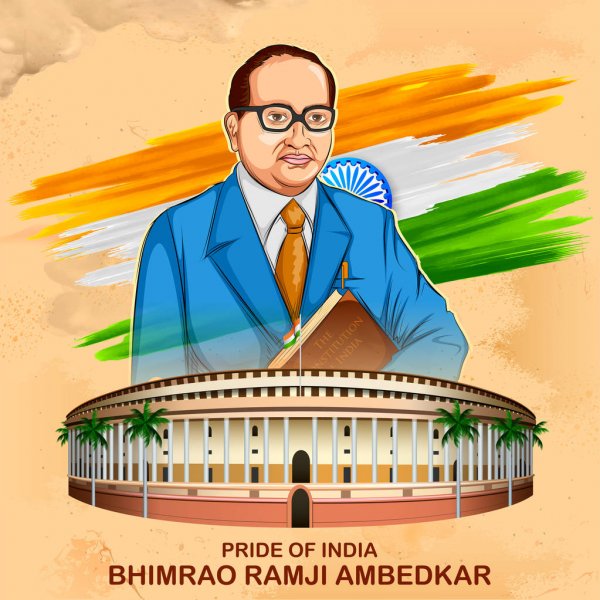
DR B R AMBEDKAR- FATHER OF THE INDIAN CONSTITUTION

Dr. Babasaheb Ambedkar was born on April 14, 1891 in Mhow, Madhya Pradesh. His childhood name was Bhimrao. His fathers’ name was Ramji Sakpal and his mothers’ name was Bhimabai Sakpal. His father was a Subhedar in the British Army. In those days the government ensured that all the Army Personel and their children were educated and they ran special schools for this purpose. Born in a Dalit family in those times, when the Dalits were considered to be the “untouchables” and were denied from almost everything, Dr. B R Ambedkar was lucky to get good education from the Army Personel Schools.

After his retirement, Bhimrao’s father settled in Satara, Maharashtra where Bhimrao was enrolled in a local school. He was an intelligent and hardworking student but there he had to face a lot of caste discrimination because he was born as “Shudras” meaning “untouchables”. In school he had to sit on the floor in one corner of the classroom. He was always made fun of by his classmates and even discriminated by his teachers who would not touch his notebooks. Upper caste students would not talk, study or even play with him. He was not even allowed to drink water from the vessel used by the upper caste students. Despite all the humiliations and difficulties he faced, young Bhimrao never lost his faith. By the quality of his hard work, determination and commitment he earned several scholarships to support his education. His teachers gave him the surname “Ambedkar” in school records.

In 1906, when he was just 15 years old got married to Ramabai who was just 9 years old at that time. Bhimrao continued his studies and passed his matriculation exam from Bombay University with flying colors in 1908. He joined the Elphistone College for further education. In 1912, he graduated in Political Science and Economics from Bombay University and got a job in Baroda. During a public ceremony, Dada Keluskar gifted him Biography of Buddha. In 1913, Bhimrao Ambedkar lost his father. In the same year Maharaja of Baroda awarded him a scholarship and sent him to America for his further studies. Bhimrao reached New York in July 1913. For the first time in his life, Bhimrao was not demeaned for being a Mahar. This kept him motivated to bring a change in the society for the way Dalits were being treated and so he immersed himself in studies and received a degree in Master of Arts and a Doctorate in Philosophy from Columbia University in 1916 for his thesis “National Dividend for India: A Historical and Analytical study”. On his returning back to India, The Maharaja of Baroda appointed Dr. Ambedkar as his political secretary. Unfortunately, no one took orders from him because he was a Mahar, saying that a lower caste person cannot give orders to the upper caste ones. Bhimrao Ambedkar returned to Bombay in November 1917. With the help of Shahu Maharaj of Kolhapur he started a fortnightly newspaper- The “MOOKNAYAK” on January 31,1920. The Maharaja also organized many meetings and conferences of the “untouchables” which was addressed by Bhimrao.

In September 1920, after accumulating sufficient funds Ambedkar went back to London to complete his studies. He became a Barrister and got a Doctorate in science while practicing law in the Bombay High court he tried to promote education to “untouchables” and uplift them. In 1927, Babasaheb Ambedkar decided to launch active movements against untouchability- to open up public drinking water resources, that led to a Satyagrah in Mahad. He attended all the three round table conferences in London and argued for the welfare of the “untouchables”. In 1937, Dr. Ambedkar introduced a bill to abolish the “KHOTI” system of land tenure in Konkan region and the Mahar “WATAN” system of working for the government as slaves. In 1947, when India became independent the first Prime Minister Pandit Jawaharlal Nehru invited him, as he had been elected as a member of the Constituent Assembly from Bengal to join his Cabinet as a Law Minister. He was appointed as the chairman of the constitution drafting committee.

GLOWING REASONS BEHIND INDIAN WEDDINGS

1 ) MEHANDI APPILICATION :

HOW : An Indian Bride apply Mehendi Designs on her both hands.

GLOW: Henna has Antiseptic properties and cooling effect helps bride to relieve from Stress, Body pain and even Fever.

MEHANDI

2)TURMERIC APPLICATION:

HOW: Turmeric paste is appilied on bride and groom faces, hands and legs.

GLOW: Turmeric paste helps to bring natural shine to face and also through its medicinal properties keeps bacteria at bay from skin.

HALDI

3)WEARING BANGLES:

HOW: More number of bangles are worn by Bride on Wrists.

GLOW: It gives hand an Astonishing look and also the Acupressure points pressed by bangles Improves Blood circulation.

BANGLES

4) WEARING TOE RINGS:

HOW: Silver Toe Rings are weared on the second toe of married bride.

GLOW: Toe rings connects Heart passing through Uterus stronger and regulates the menstrual cycle.

TOE RINGS

The Amazon

The forest is a peculiar organism of unlimited kindness and benevolence that makes no demands for its sustenance and extends generously the products of its life activity; it affords protection to all beings, offering shade even to the axe-man who destroys it.

– Gautama Buddha

Today , let’s feel the presence of fresh air , waterfall , trees , flora and fauna . Being a citizen of a country , which is well known for its resources , different species, mixed economy and different cultures. It is important for us to see the world of flora and fauna.

Well you get to know by the heading , today we are gonna talk about THE AMAZON’S which is well known for its vast species .

Introduction .


The Amazon jungle or Amazonia, is a moist broadleaf tropical rainforest in the Amazon biome that covers most of the Amazon basin of South America. This basin encompasses 7,000,000 km2 (2,700,000 sq mi), of which 5,500,000 km2 (2,100,000 sq mi) are covered by the rainforest. This region includes territory belonging to nine nations and 3,344 formally acknowledged indigenous territories.

The majority of the forest is contained within Brazil, with 60% of the rainforest, followed by Peru with 13%, Colombia with 10%, and with minor amounts in Bolivia, Ecuador, French Guiana, Guyana, Suriname, and Venezuela. Four nations have “Amazonas” as the name of one of their first-level administrative regions, and France uses the name “Guiana Amazonian Park” for its rainforest protected area. The Amazon represents over half of the planet’s remaining rainforests, and comprises the largest and most biodiverse tract of tropical rainforest in the world, with an estimated 390 billion individual trees divided into 16,000 species.

The name Amazon is said to arise from a war Francisco de Orellana fought with the Tapuyas and other tribes. The women of the tribe fought alongside the men, as was their custom. Orellana derived the name Amazonas from the Amazons of Greek mythology, described by Herodotus and Diodorus.

Flora and Fauna.

Wet tropical forests are the most species-rich biome, and tropical forests in the Americas are consistently more species rich than the wet forests in Africa and Asia.

This constitutes the largest collection of living plants and animal species in the world.

The region is home to about 2.5 million insect species, tens of thousands of plants, and some 2,000 birds and mammals. To date, at least 40,000 plant species, 2,200 fishes, 1,294 birds, 427 mammals, 428 amphibians, and 378 reptiles have been scientifically classified in the region.

The biodiversity of plant species is the highest on Earth with one 2001 study finding a quarter square kilometer (62 acres) of Ecuadorian rainforest supports more than 1,100 tree species.

Human impact on Amazon jungle.

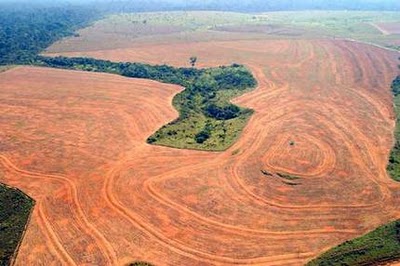
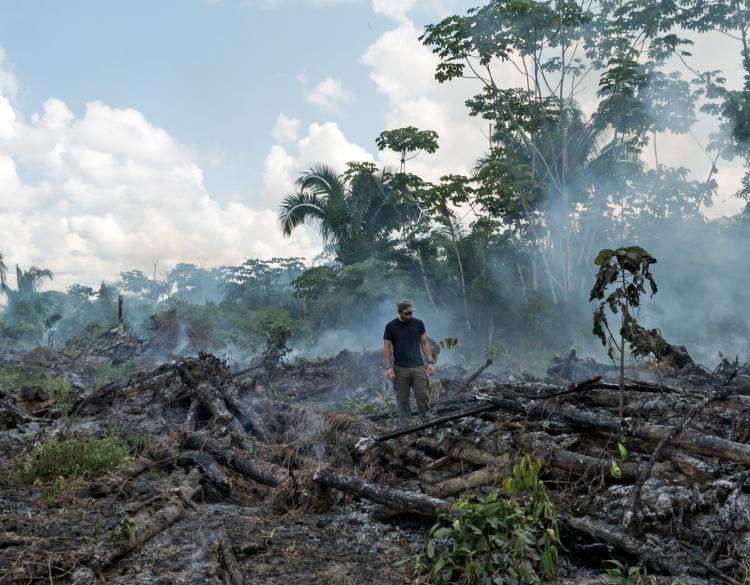
The human impact on the Amazon rainforest has been grossly underestimated according to an international team of researchers. … They found that selective logging and surface wildfires can result in an annual loss of 54 billion tonnes of carbon from the Brazilian Amazon, increasing greenhouse gas emissions.

Lead researcher Dr Erika Berenguer from Lancaster University said: “The impacts of fire and logging in tropical forests have always been largely overlooked by both the scientific community and policy makers who are primarily concerned with deforestation. Yet our results show how these disturbances can severely degrade the forest, with huge amounts of carbon being transferred from plant matter straight into the atmosphere.”

The second author, Dr Joice Ferreira from Embrapa in Brazil, said: “Our findings also draw attention to the necessity for Brazil to implement more effective policies for reducing the use of fire in agriculture, as fires can both devastate private property, and escape into surrounding forests causing widespread degradation. Bringing fire and illegal logging under control is key to reaching our national commitment to reducing carbon emissions.”

The forest is not a resource for us, it is life itself. It is the only place for us to live.

-Evaristo Nugkuag Ikanan

Link

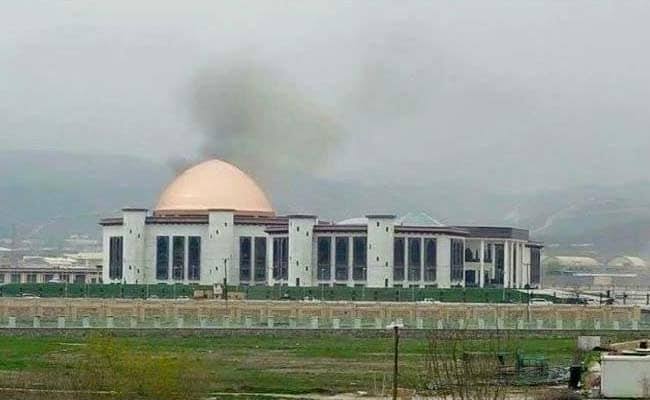
Afghanistan- A war-torn nation

With Al-Qaeda militants carrying out coordinated attacks on American soil,also known as 9/11 Attacks and Taliban government refusing to hand over the main culprit behind these attacks ‘Osama Bin Laden’. A war was declared by US and it’s allies against terrorism and Afghanistan was invaded in 2001.

US tried it’s best to avoid the mistakes done by British & Russia (then USSR),it gained some success by driving out the Taliban government and killing the Terrorists. This whole operation have costed US more than $800 billions and more than 2300 soldiers lives. While on the other side, Afghan civilians had been caught in between this war and have suffered at the hands of both US & Terrorists (Al-Qaeda & Taliban) .

There is a popular saying about Afghanistan – ‘The Graveyard Of Empires’ for those who have tried to conquer it. Afghanistan is tough to rule, not only because of its terrain but also of the hostilities between the different tribes present there.

US Navy seals carried out a mission code-named ‘Operation Neptune Spear’ and killed Laden on 2nd May 2011 in Pakistan. US thought that by killing Laden they had achieved their goal but they were mistaken.

India aided in the overthrow of the Taliban-led government and has been the largest regional provider of humanitarian and reconstruction aid in the country. India have provided over $3 billion in assistance and every year it continues to do so.

Challenges ahead for Afghanistan and it’s neighbours

Taliban is slowly gaining pace and have formed alliance with other terror outfits to overthrow the present government. Civil war is not far, after US withdrawal. Fight is going on between Afghan security forces supported by civilians against the Taliban.

There’s little hope that Taliban will agree on the terms mentioned in peace talks . War-torn Afghanistan is now at the same stage before US invasion and onus now is on China,india,pakistan,Iran to maintain peace and provide stability in the Afghanistan.

Does Art Really Matter in Our Daily Lives?

Art is known to surround life, every individual in different locations, without us being aware of it fully.  Since time has been immemorial, art has existed as long as man has and has exited ever since. It is an integral part of our culture, which contributes in shaping our ideas, and vice versa, and it provides us with a deeper understanding of our emotions, increases our self-awareness, and more. To conclude that art is only confined to the artist or the painter, the dancer, the sculptor, the musician or the singer or other craftsman is to look at a needlessly rigid and a restricted view of life. Life itself is known to be art and though poets and artists may seem visionaries, they have a specific and distinct role to play in our being. Almost every individual has some form of art in their house—a hanging painting, framed photographs on walls, a decorative table center piece and even the main layout and design of a house is and can be considered as a form of art.  Art is not restricted purely for looking at it and admiring, a lot of it is functional too which we often don’t realize, especially when it comes to our living spaces and our daily lives.

Image of World Collaboration Limited edition Art Print (6 artists  collaboration) | Art, Drawings, Art drawings

Everything from a delightfully patterned cushion cover on the pillow or even a decorative plate and intricate designed teacups can be considered as a form of art.  Our brain is mostly conditioned to think that these type of items or things are not a form of art when it’s only for decoration. Another important element of form of art that adds value in our daily lives is Music, it is similar as art, and is considered to be a universal language and it holds importance in our daily lives which is indisputable. Subconsciously, when we hear music through various forms like on shows, commercials, radio and through other forms of media. Sounds, songs, instruments and music can make life extremely joyful and it can contribute heavily in lifting our spirits up and also till some extent improve our mental health and wellbeing. People think that technology and science are considered to be superior to art or any form of art.

Brain research shows the arts promote mental health

But art makes life worthwhile. It may not be as vital to fulfil our basic wants or necessities, but it does add value into our lives and brings colours in it as well. As we proceed our journey of a fast-paced life with quick decisions, moments, time and with many fragmented thoughts, art allows us to learn from every moment and to enjoy each moment and to make it memorable. Understanding our true emotions can help us heal from pain, grow and improve ourselves to become better humans. It helps in increasing our self-awareness and through that it can lead to more success professionally and personally. Through any form of art, we gain a better understanding of history, culture and tradition. It helps people in the present to build a better life for themselves.

The Journalism and mass media

The Journalism and mass media is the  graduates work nationwide and worldwide at newspapers and magazines and in advertising, branding, broadcast news, social media, marketing, media research, photojournalism, publication design, public relations, radio, and other areas.

The Journalism is the activity of gathering, assessing, creating, and presenting news and information. It is also the product of these activities. Journalism can be distinguished from other activities and products by certain identifiable characteristics and practices.

There are five types,

  • investigative,
  • news,
  • reviews,
  • columns,
  • feature-writing.

The Rules Of Journalism

: Ask questions.

The  journalist’s greatest assets is their natural curiosity. Start with the famed five W’s (and one H), then ask some more. Asking “why?” is what gets you the good stuff.

: Dig for the story.

If you think you’ve got the whole story, dig around some more. The most fascinating parts of the story are often just under the surface.

: Master the language.

As a journalist, language is your main tool. Read as much as you can and as often as you can, research odd words and archaic sayings, look at what’s behind etymology. Learn the patterns behind language and how to use them.

: Spelling matters.

Double-check if you aren’t sure about spelling or style (especially in the case of names), and read through messages and articles thoroughly before sending either.

#5: Know thy publication.

Before you pitch, know a publication’s style, editorial staff and content. Publications are usually more than happy to provide back-issues. If you can’t find writer’s guidelines, send a short introductory email requesting them.

#6: Contacts are your career.

Contacts (and your reputation with said contacts) are your entire career. Editors, sources and interviewees are all vital parts of the journalistic process. Without them, you’d be screwed.

#7: Once it’s off the record, keep it that way.

Trusted sources will tell you all sorts of juicy, fascinating, scandalous and personal things in your career as a journalist, often off the record. Shut up about it.

#8: Three is a golden number.

Mind the rule of threes: Have at least three reliable, corroborating sources for every fact; three interviewees for every article; and read through a piece at least three times before you sit down to change a comma – that’s at least.

#9: Rejection is opportunity.

Getting a story rejected means you’ve just opened up a line of communication with a new editor – congratulations. Pitch again. Rejection also gives you a chance to sell the story elsewhere: Sometimes rejection just means it’s not right for them

#10: Editors are teachers.

You can learn a hell of a lot from the experience of your editors, and when given the chance you should. They braved the journalistic battlefield before you, so you can trust their edits and advice. Usually, they’re right.

: Mind the word count.

Yes, you can do that in the assigned word count, and the editor will either make you add or cut if you don’t. Here, they always know better. (Remember this piece of key-advice from The Elements of Style and repeat it as your daily editing mantra: Omit unnecessary words.)

: Deadlines are holy.

Deadlines exist for a reason: Never skip out on a deadline unless you are incapacitated or dead. If you have to, let your editor know beforehand and have a damn good reason. Then, don’t do it again. Compare deadlines to menstrual cycles: If you skip one, you might just be stressed. If you skip several, you’re in trouble.

#13: Know the law.

Journalism can take you to some strange places. Make sure you know the law and what side of it you’re standing on at all times.

#14: Always do your research.

Make sure that your research is flawless and that you can always match which source gave which fact. Cross-reference, find first-hand information and do your background research before requesting, planning or conducting an interview.

#15: Have it outlined.

Have the skeleton of your idea outlined and ready by the time you pitch the idea. That way you have all the information ready, and it makes your job – and theirs – easier. Your outline should include the article’s proposed headline, the article’s sub-headers and sections (you can write down facts as key-words here) and who you will interview.

#16: Keep and file everything.

Keep prior notes, interviews, sources, tapes, the lot: You never know when you’ll need it, and you probably will.

#17: Guard your vices.

Many great journalists have been crippled or completely destroyed by their vices – and it can be almost anything: Overworking, coffee, manic exercising, painkillers or heavier drugs. Whatever yours is, keep it in check or risk your job.

#18: Burnout is a rabid, fanged monkey.

Burnout is a myth, until you’re there. It’s a mental and physical size of your writing engine, and if you don’t find your way to unwind you’ll get there a lot quicker.

The Mass media refers to a diverse array of media technologies that reach a large audience via mass communication. … Broadcast media transmit information electronically via media such as films, radio, recorded music, or television.

The types of mass media include Newspapers, Radio, Television, Internet, Magazines and more,

  • What is Mass Media?
  • Journalism.
  • Social Media.
  • Films.
  • Television.
  • Radio.
  • Advertising.
  • Public Relations.
  • Books, Magazines, Newspapers and Journals.

RULES OF MASS MEDIA

  • The Privacy Act works to guarantee privacy to individuals and controls how personal information is used. Defamation in the written form (libel) or the spoken form (slander) is illegal in the United States.
  • Section 315 (Equal Time Rule) ensures that broadcast media cannot favor any one candidate over another by granting one more time than another. The Fairness Doctrine ensured that radio stations offered equal time to opposing viewpoints.
  • The Freedom of Information Act grants the public, including the news media, access to many government documents. The Digital Millennium Copyright Act, established in 1998, extended existing copyright laws to encompass and protect information online.

Spiti Valley

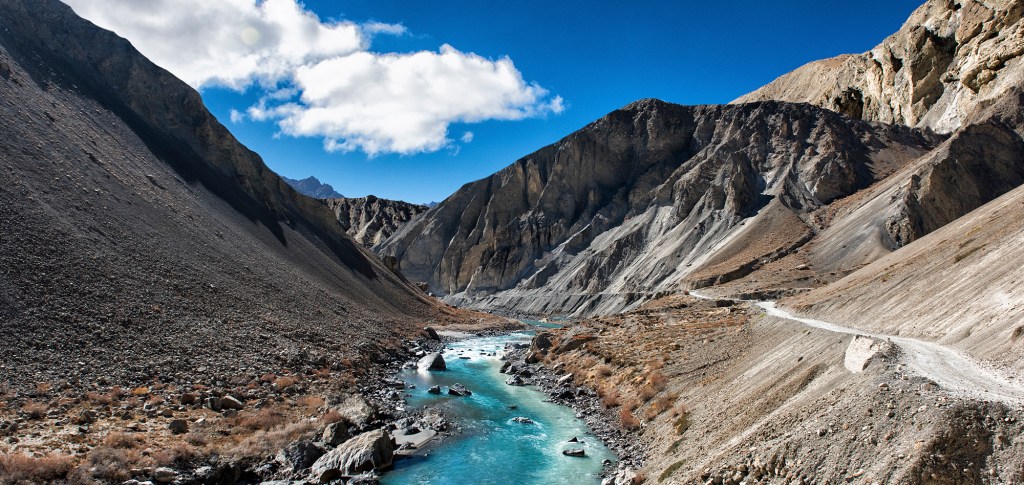
Spiti Valley is a cold desert mountain valley located high in the Himalayas in the north-eastern part of the Northern Indian State of Himachal Pradesh namely the state of Lahaul & Spiti. The name “Spiti” means “The middle land”, i.e. the land between Tibet(Xizang) and India. Spiti is sometimes considered as an extension of Ladakh as both regions share similar geography, cultures and even the ruling Royal Family.

The local population follow Vajrayana Buddhism similar to that found in the nearby Tibet and Ladakh. It is different from Therawada Buddhism found in many South East Asian countries. The valley and surrounding region is one of the least populated regions in the country and is the gateway to the northernmost reaches of the nation. Along the northern route through Manali or Keylong via the Rohtang Pass or Kunzum Pass respectively. The state’s capital is Kaza, which is situated along the Spiti river.

The Lahaul and Spiti district is surrounded by high mountain ranges. The Rohtang Pass, at 13,054 feet (3,979 m), separates Lahul and Spiti from the Kullu Valley Kunzum Pass cuts of Lahaul and Spiti from each other. There is a road that connects the two divisions, but is cut off frequently in winter and spring due to heavy snowfall in the area. The Whole state is difficult to access throughout Winter, so the ideal months to visit are summer and monsoon although the road through Kinnaur is open throughout most of the year.

Chandtratal Lake

Culture

Spiti valley is a research and cultural center for Buddhists. Highlights include the majestic Key Monastery and Tabo Monastery which is one of the oldest monasteries in the world and a favorite of the Dalai Lama. The Pin Valley is also home to other different Buddhism sect.

Places to See

Key Monastery

The include:

  • Dhankar Lake
  • Hikkim Village which has the highest altitude post office in the world.
  • Kaza
  • Kibber
  • Pin Valley National Park
  • Nako
  • Tabo
  • Chandratal Lake
  • Langza village
  • Komik village
  • Mud Village
  • Gue Village