

Internet vs Books
Internet and books are two very comparable terms as both provide valuable information, but vastly differ when we compare the time taken to provide the information by the two. Before the internet was available to us books were the only source we turned to for any bit of information, we used to flock to the library and searched for the book that contained relevant information. It is now thing of past to go to library as the whole library is now at our finger tips in the form of internet. One marvels at the amount of information and speed with which one can get information regarding anything. Both internet and books are two very different sources but earlier generation still prefer to read books and like to collect them as souvenir.
Internet
Internet changed the way we looked at the books as it provided all from history to literature, education to entertainment all at one click. Internet is now considered to be the most powerful tool of information that is available to mankind and this tool has still got immense potential and is growing big with every passing day. Internet is provided to the surfers through servers that are located all over the world and one can go to any website of his liking to find the relevant information. Internet has revolutionized every field of the world and we cannot think of world without internet.
Books
Books have been there since ancient times and before the paper was available to the scholars they use rocks, leaves and cloth to put down their findings for future generations. But when paper was invented books became a popular source of information and entertainment. Books were earlier used for education only but when paper was invented books were written for everyone and for every purpose. Books were read for studying a subject for entertainment or to know about history. Books were read by kids for fables and by grownups as novels and literature. Books were made available to readers by the publishers by printing them in presses.
Category: Economy
HISTORY OF AUTOMOBILE
HISTORY OF AUTOMOBILE
The automobile was first invented and perfected in Germany and France in the late 1800s, though Americans quickly came to dominate the automotive industry in the first half of the twentieth century. Henry Ford innovated mass-production techniques that became standard, and Ford, General Motors and Chrysler emerged as the “Big Three” auto companies by the 1920s. Manufacturers funneled their resources to the military during World War II, and afterward automobile production in Europe and Japan soared to meet growing demand. Once vital to the expansion of American urban centers, the industry had become a shared global enterprise with the rise of Japan as the leading automaker by 1980.
Although the automobile was to have its greatest social and economic impact in the United States, it was initially perfected in Germany and France toward the end of the nineteenth century by such men as Gottlieb Daimler, Karl Benz, Nicolaus Otto and Emile Levassor.
When Were Cars Invented?
The 1901 Mercedes, designed by Wilhelm Maybach for Daimler Motoren Gesellschaft, deserves credit for being the first modern motorcar in all essentials.
Its thirty-five-horsepower engine weighed only fourteen pounds per horsepower, and it achieved a top speed of fifty-three miles per hour. By 1909, with the most integrated automobile factory in Europe, Daimler employed some seventeen hundred workers to produce fewer than a thousand cars per year.
Nothing illustrates the superiority of European design better than the sharp contrast between this first Mercedes model and Ransom E. Olds‘ 1901-1906 one-cylinder, three-horsepower, tiller-steered, curved-dash Oldsmobile, which was merely a motorized horse buggy. But the Olds sold for only $650, putting it within reach of middle-class Americans, and the 1904 Olds output of 5,508 units surpassed any car production previously accomplished.
The central problem of automotive technology over the first decade of the twentieth century would be reconciling the advanced design of the 1901 Mercedes with the moderate price and low operating expenses of the Olds. This would be overwhelmingly an American achievement.
Henry Ford and William Durant
Bicycle mechanics J. Frank and Charles Duryea of Springfield, Massachusetts, had designed the first successful American gasoline automobile in 1893, then won the first American race in 1895, and went on to make the first sale of an American-made gasoline car the next year.
Thirty American manufacturers produced 2,500 motor vehicles in 1899, and some 485 companies entered the business in the next decade. In 1908 Henry Ford introduced the Model T and William Durant founded General Motors.
he new firms operated in an unprecedented seller’s market for an expensive consumer goods item. With its vast land area and a hinterland of scattered and isolated settlements, the United States had a far greater need for automotive transportation than the nations of Europe. Great demand was ensured, too, by a significantly higher per capita income and more equitable income distribution than European countries.https://25a941a279cf15106d294a760a0ab9f6.safeframe.googlesyndication.com/safeframe/1-0-38/html/container.html
Model T
Given the American manufacturing tradition, it was also inevitable that cars would be produced in larger volume at lower prices than in Europe. The absence of tariff barriers between the states encouraged sales over a wide geographic area. Cheap raw materials and a chronic shortage of skilled labor early encouraged the mechanization of industrial processes in the United States.
This in turn required the standardization of products and resulted in the volume production of such commodities as firearms, sewing machines, bicycles, and many other items. In 1913, the United States produced some 485,000 of the world total of 606,124 motor vehicles.
The Ford Motor Company greatly outpaced its competitors in reconciling state-of-the-art design with moderate price. Cycle and Automobile Trade Journal called the four-cylinder, fifteen-horsepower, $600 Ford Model N (1906-1907) “the very first instance of a low-cost motorcar driven by a gas engine having cylinders enough to give the shaft a turning impulse in each shaft turn which is well built and offered in large numbers.” Deluged with orders, Ford installed improved production equipment and after 1906 was able to make deliveries of a hundred cars a day.
Encouraged by the success of the Model N, Henry Ford was determined to build an even better “car for the great multitude.” The four-cylinder, twenty-horsepower Model T, first offered in October 1908, sold for $825. Its two-speed planetary transmission made it easy to drive, and features such as its detachable cylinder head made it easy to repair. Its high chassis was designed to clear the bumps in rural roads. Vanadium steel made the Model T a lighter and tougher car, and new methods of casting parts (especially block casting of the engine) helped keep the price down.
Committed to large-volume production of the Model T, Ford innovated modern mass production techniques at his new Highland Park, Michigan, plant, which opened in 1910 (although he did not introduce the moving assembly line until 1913-1914). The Model T runabout sold for $575 in 1912, less than the average annual wage in the United States.
By the time the Model T was withdrawn from production in 1927, its price had been reduced to $290 for the coupe, 15 million units had been sold, and mass personal “automobility” had become a reality.
Automotive Industry Growing Pains
Ford’s mass production techniques were quickly adopted by other American automobile manufacturers. (European automakers did not begin to use them until the 1930s.) The heavier outlays of capital and larger volume of sales that this necessitated ended the era of easy entry and free-wheeling competition among many small producers in the American industry.
The number of active automobile manufacturers dropped from 253 in 1908 to only 44 in 1929, with about 80 percent of the industry’s output accounted for by Ford, General Motors, and Chrysler, formed from Maxwell in 1925 by Walter P. Chrysler.
Most of the remaining independents were wiped out in the Great Depression, with Nash, Hudson, Studebaker, and Packard hanging on only to collapse in the post-World War II period.
The Model T was intended to be “a farmer’s car” that served the transportation needs of a nation of farmers. Its popularity was bound to wane as the country urbanized and as rural regions got out of the mud with passage of the 1916 Federal Aid Road Act and the 1921 Federal Highway Act.
Moreover, the Model T remained basically unchanged long after it was technologically obsolete. Model T owners began to trade up to larger, faster, smoother riding, more stylish cars. The demand for basic transportation the Model T had met tended increasingly in the 1920s to be filled from the backlog of used cars piling up in dealers’ lots as the market became saturated.
Car Sales Stall
By 1927 replacement demand for new cars was exceeding demand from first-time owners and multiple-car purchasers combined. Given the incomes of the day, automakers could no longer count on an expanding market. Installment sales had been initiated by the makers of moderately priced cars in 1916 to compete with the Model T, and by 1925 about three-quarters of all new cars were bought “on time” through credit.
Although a few expensive items, such as pianos and sewing machines, had been sold on time before 1920, it was installment sales of automobiles during the twenties that established the purchasing of expensive consumer goods on credit as a middle-class habit and a mainstay of the American economy.
GM Introduces ‘Planned Obsolescence’
Market saturation coincided with technological stagnation: In both product and production technology, innovation was becoming incremental rather than dramatic. The basic differences that distinguish post-World War II models from the Model T were in place by the late 1920s—the self-starter, the closed all-steel body, the high-compression engine, hydraulic brakes, syncromesh transmission and low-pressure balloon tires.
The remaining innovations—the automatic transmission and drop-frame construction—came in the 1930s. Moreover, with some exceptions, cars were made much the same way in the early 1950s as they had been in the 1920s.
To meet the challenges of market saturation and technological stagnation, General Motors under the leadership of Alfred P. Sloan, Jr., in the 1920s and 1930s innovated planned obsolescence of product and put a new emphasis on styling, exemplified in the largely cosmetic annual model change—a planned triennial major restyling to coincide with the economics of die life and with annual minor face-liftings in between.
The goal was to make consumers dissatisfied enough to trade in and presumably up to a more expensive new model long before the useful life of their present cars had ended. Sloan’s philosophy was that “the primary object of the corporation … was to make money, not just to make motorcars.” He believed that it was necessary only that GM’s cars be “equal in design to the best of our competitors … it was not necessary to lead in design or to run the risk of untried experiments.”
Thus engineering was subordinated to the dictates of stylists and cost-cutting accountants. General Motors became the archetype of a rational corporation run by a technostructure.
As Sloanism replaced Fordism as the predominant market strategy in the industry, Ford lost the sales lead in the lucrative low-priced field to Chevrolet in 1927 and 1928. By 1936 GM claimed 43 percent of the U.S. market; Ford with 22 percent had fallen to third place behind Chrysler with 25 percent.
Although automobile sales collapsed during the Great Depression, Sloan could boast of GM that “in no year did the corporation fail to earn a profit.” (GM retained industry leadership until 1986 when Ford surpassed it in profits.)
World War II and the Auto Industry
The automobile industry had played a critical role in producing military vehicles and war matériel in the First World War. During World War II, in addition to turning out several million military vehicles, American automobile manufacturers made some seventy-five essential military items, most of them unrelated to the motor vehicle. These materials had a total value of $29 billion, one-fifth of the nation’s war production.
Because the manufacture of vehicles for the civilian market ceased in 1942 and tires and gasoline were severely rationed, motor vehicle travel fell dramatically during the war years. Cars that had been nursed through the Depression long after they were ready to be junked were patched up further, ensuring great pent-up demand for new cars at the war’s end.
Detroit’s Big Three carried Sloanism to its illogical conclusion in the postwar period. Models and options proliferated, and every year cars became longer and heavier, more powerful, more gadget-bedecked, more expensive to purchase and to operate, following the truism that large cars are more profitable to sell than small ones.
Rise of Japanese Automakers
Engineering in the postwar era was subordinated to the questionable aesthetics of nonfunctional styling at the expense of economy and safety. And quality deteriorated to the point that by the mid-1960s American-made cars were being delivered to retail buyers with an average of twenty-four defects a unit, many of them safety-related. Moreover, the higher unit profits that Detroit made on gas-guzzling “road cruisers” were made at the social costs of increased air pollution and a drain on dwindling world oil reserves.
The era of the annually restyled road cruiser ended with the imposition of federal standards of automotive safety (1966), emission of pollutants (1965 and 1970), and energy consumption (1975); with escalating gasoline prices following the oil shocks of 1973 and 1979; and especially with the mounting penetration of both the U.S. and world markets first by the German Volkswagen “Bug” (a modern Model T) and then by Japanese fuel-efficient, functionally designed, well-built small cars.
After peaking at a record 12.87 million units in 1978, sales of American-made cars fell to 6.95 million in 1982, as imports increased their share of the U.S. market from 17.7 percent to 27.9 percent. In 1980 Japan became the world’s leading auto producer, a position it continues to hold.
U.S. Carmakers Retool
In response, the American automobile industry in the 1980s underwent a massive organizational restructuring and technological renaissance. Managerial revolutions and cutbacks in plant capacity and personnel at GM, Ford and Chrysler resulted in leaner, tougher firms with lower break-even points, enabling them to maintain profits with lower volumes in increasingly saturated, competitive markets.
Manufacturing quality and programs of employee motivation and involvement were given high priority. The industry in 1980 undertook a five-year, $80 billion program of plant modernization and retooling. Functional aerodynamic design replaced styling in Detroit studios, as the annual cosmetic change was abandoned.
Cars became smaller, more fuel-efficient, less polluting and much safer. Product and production were being increasingly rationalized in a process of integrating computer-aided design, engineering and manufacturing.
Legacy of the U.S. Auto Industry
The automobile has been a key force for change in twentieth-century America. During the 1920s the industry became the backbone of a new consumer goods-oriented society. By the mid-1920s it ranked first in value of product, and in 1982 it provided one out of every six jobs in the United States.
In the 1920s the automobile became the lifeblood of the petroleum industry, one of the chief customers of the steel industry, and the biggest consumer of many other industrial products. The technologies of these ancillary industries, particularly steel and petroleum, were revolutionized by its demands.
The automobile stimulated participation in outdoor recreation and spurred the growth of tourism and tourism-related industries, such as service stations, roadside restaurants and motels. The construction of streets and highways, one of the largest items of government expenditure, peaked when the Interstate Highway Act of 1956 inaugurated the largest public works program in history.
The automobile ended rural isolation and brought urban amenities—most important, better medical care and schools—to rural America (while paradoxically the farm tractor made the traditional family farm obsolete). The modern city with its surrounding industrial and residential suburbs is a product of the automobile and trucking.
The automobile changed the architecture of the typical American dwelling, altered the conception and composition of the urban neighborhood, and freed homemakers from the narrow confines of the home. No other historical force has so revolutionized the way Americans work, live, and play.
In 1980, 87.2 percent of American households owned one or more motor vehicles, 51.5 percent owned more than one, and fully 95 percent of domestic car sales were for replacement. Americans have become truly auto-dependent.
VALUE OF TIME
VALUE OF TIME
It is always better to respect and follow the valuable time instead of regretting later as the time we have spent is never coming back. We all know about the proverb “Time and Tide wait for none,” It is apt for our life.
We all should think that the time we get is an opportunity to grab for a well-built future. We should teach our younger ones also about the value of time. Utilizing time for our loved ones also helps us and the society to grow towards a superior one .
The best and most effective ways of utilizing time are setting goals, making work lists, prioritizing tasks, having a good sleep, etc. We must set long and short term goals for the best utilization of time. These long and short term goals will help us to save time and be productive.
Goals and work lists help us as a driving force to keep us always motivated. When we start a new work, and then we start to do it regularly, firstly it will look a very uninteresting one. But, later, we will understand that this is increasing our productivity. Finally, these driving forces help us to achieve our goals.
Prioritizing tasks for our daily routines is a very effective way to manage time because we get to understand the importance of various tasks and jobs in our lives. Moreover, if we do similar works unitedly then, it also increases our productivity.
But, we should remember one thing that being productive doesn’t mean that we have to be involved in multiple works every time. Taking a sufficient amount of sleep and exercising are also parts of being healthy as well as productive. Exercising and sleeping maintain the right balance between our bodies and minds, which is essential for success in life.
There are few things related to time which we should always keep in our minds. They are punctuality, the importance of time management, courtesy, unpredictable future, etc.
To lead a better life, we all have to be punctual in every case in our daily life. People who treat time as an essential factor for a better life are always punctual and thus successful in life
Another important factor for leading a successful life is the management of time. You have to be regularly involved in work to find a good result and complete without facing any problem.
None of us can predict our future. That’s why we should work hard from now and complete all our tasks on time to make our future bright. If we finish our work on time, we won’t have many works left to do at a time.
The proverb “killing time is not murder; it’s a suicide’ is applicable for those who don’t understand the value of time and don’t respect it. There are people too who give excuses for not completing work like they don’t have time for that. It’s not like they don’t have time; they don’t know how to manage time
HOW TO OVERCOME FROM CORRUPTION ?
HOW TO OVERCOME FROM CORRUPTION ?
Corruption is a social malice that can be seen anywhere and is like an ailing tumour in public life. It is so common that people are in a state of living with it. The existence of corruption can be traced back to the ancient and medieval times. The advent of British rule in India gave new wings to this social evil, especially with the establishment of British East India Company.
Expositions of Corruption
Exploitation, scams, bribes, unethical malpractices are all expositions of corruption. Corruption’s one of the adverse effect is the generation or flow of black money in the economy. The crux is that nobody is free from corruption, not even the poor man, he wants it or not he is compelled to be a part of the system, he is forced to give bribes at every step, or else he would be stuck in cues for the rest of all his life. Misuse of power and authority, exploitation of public property for personal gains lead to corruption. Like charity, corruption too begins at home. Parents bait their children to get things done, corruption is not only limited to politics, but in every field. IPL’s spot fixing and betting is a recent example of corruption in cricket.
Corruption is directly proportional to greed, greed for power, money, etc. Greed corrupts our values and ethics. Tolerance of people towards corruption, lack of powerful outcry against it further paves way for corruption. During elections, big business tycoons fund and sponsor the politicians to meet campaigning expenditures so that their personal favours are met.
Adverse Effect of Corruption
Due to corruption, deserving candidates don’t get jobs, old retired people face harassments for pensions, undeserving students get highest of educational degrees, and many more. Recently, we can see the Bihar student, whose father by bribing managed to top his daughter, who while investigations could not even name her subjects. Many doctors have been caught in the past who have faked their degrees.
How to Prevent Corruption ?
It is useless to write about a number of steps Govt should take up to fight corruption, as Govt itself is filled with corruption so deep that it has reached its roots. Corruption cannot be dealt with unless and until there is a moral awakening among people. People have to understand the serious consequences of this evil and feel how common people and poor people fall prey to it. Big industrialists should stop being greedy and stop misusing their wealth and authority and act on fair and rational basis. Only improving country’s economic condition is not enough to combat corruption as rich people are more corrupt than the mediocre. Common people who try to fight corruption either face transfers or lose their precious lives. There is an urgent need to inculcate in every individual, the sense of responsibility to stop engaging in any unfair and corrupt practices.
Government officials should give the power to the public to report immediate corruptions they face in their daily lives and act on it within days. Ending corruption would lead to equal distribution of wealth and resources among all and lead to a healthy society to live in.
SHARE MARKET
SHARE MARKET
If the thought of investing in the stock market scares you, you are not alone. Individuals with very limited experience in stock investing are either terrified by horror stories of the average investor losing 50% of their portfolio value—for example, in the two bear markets that have already occurred in this millennium —or are beguiled by “hot tips” that bear the promise of huge rewards but seldom pay off. It is not surprising, then, that the pendulum of investment sentiment is said to swing between fear and greed.
The reality is that investing in the stock market carries risk, but when approached in a disciplined manner, it is one of the most efficient ways to build up one’s net worth.2 While the value of one’s home typically accounts for most of the net worth of the average individual, most of the affluent and very rich generally have the majority of their wealth invested in stocks.3 In order to understand the mechanics of the stock market, let’s begin by delving into the definition of a stock and its different types
Definition of ‘Stock’
A stock or share (also known as a company’s “equity”) is a financial instrument that represents ownership in a company or corporation and represents a proportionate claim on its assets (what it owns) and earnings (what it generates in profits).
Stock ownership implies that the shareholder owns a slice of the company equal to the number of shares held as a proportion of the company’s total outstanding shares. For instance, an individual or entity that owns 100,000 shares of a company with one million outstanding shares would have a 10% ownership stake in it. Most companies have outstanding shares that run into the millions or billions.
Common and Preferred Stock
While there are two main types of stock—common and preferred—the term “equities” is synonymous with common shares, as their combined market value and trading volumes are many magnitudes larger than that of preferred shares.
The main distinction between the two is that common shares usually carry voting rights that enable the common shareholder to have a say in corporate meetings (like the annual general meeting or AGM)—where matters such as election to the board of directors or appointment of auditors are voted upon—while preferred shares generally do not have voting rights. Preferred shares are so named because they have preference over the common shares in a company to receive dividends as well as assets in the event of a liquidation.
Common stock can be further classified in terms of their voting rights. While the basic premise of common shares is that they should have equal voting rights—one vote per share held—some companies have dual or multiple classes of stock with different voting rights attached to each class. In such a dual-class structure, Class A share , for example, may have 10 votes per share, while the Class B “subordinate voting” shares may only have one vote per share. Dual- or multiple-class share structures are designed to enable the founders of a company to control its fortunes, strategic direction and ability to innovate.
Why a Company Issues Shares
Today’s corporate giant likely had its start as a small private entity launched by a visionary founder a few decades ago. Think of Jack Ma incubating Alibaba Group Holding Limited (BABA) from his apartment in Hangzhou, China, in 1999, or Mark Zuckerberg founding the earliest version of Facebook, Inc. (FB) from his Harvard University dorm room in 2004. Technology giants like these have become among the biggest companies in the world within a couple of decades.
However, growing at such a frenetic pace requires access to a massive amount of capital. In order to make the transition from an idea germinating in an entrepreneur’s brain to an operating company, they need to lease an office or factory, hire employees, buy equipment and raw materials, and put in place a sales and distribution network, among other things. These resources require significant amounts of capital, depending on the scale and scope of the business startup.
Raising Capital
A startup can raise such capital either by selling shares (equity financing) or borrowing money (debt financing). Debt financing can be a problem for a startup because it may have few assets to pledge for a loan—especially in sectors such as technology or biotechnology, where a firm has few tangible assets—plus the interest on the loan would impose a financial burden in the early days, when the company may have no revenues or earnings.
Equity financing, therefore, is the preferred route for most startups that need capital. The entrepreneur may initially source funds from personal savings, as well as friends and family, to get the business off the ground. As the business expands and capital requirements become more substantial, the entrepreneur may turn to angel investors and venture capital firms.
Listing Shares
When a company establishes itself, it may need access to much larger amounts of capital than it can get from ongoing operations or a traditional bank loan. It can do so by selling shares to the public through an initial public offering (IPO). This changes the status of the company from a private firm whose shares are held by a few shareholders to a publicly traded company whose shares will be held by numerous members of the general public. The IPO also offers early investors in the company an opportunity to cash out part of their stake, often reaping very handsome rewards in the process.
Once the company’s shares are listed on a stock exchange and trading in it commences, the price of these shares will fluctuate as investors and traders assess and reassess their intrinsic value. There are many different ratios and metrics that can be used to value stocks, of which the single-most popular measure is probably the Price/Earnings (or PE) ratio. The stock analysis also tends to fall into one of two camps—fundamental analysis, or technical analysis.
What is a Stock Exchange?
Stock exchanges are secondary markets, where existing owners of shares can transact with potential buyers. It is important to understand that the corporations listed on stock markets do not buy and sell their own shares on a regular basis (companies may engage in stock buybacks or issue new shares, but these are not day-to-day operations and often occur outside of the framework of an exchange). So when you buy a share of stock on the stock market, you are not buying it from the company, you are buying it from some other existing shareholder. Likewise, when you sell your shares, you do not sell them back to the company—rather you sell them to some other investor.
The first stock markets appeared in Europe in the 16th and 17th centuries, mainly in port cities or trading hubs such as Antwerp, Amsterdam, and London. These early stock exchanges, however, were more akin to bond exchanges as the small number of companies did not issue equity. In fact, most early corporations were considered semi-public organizations since they had to be chartered by their government in order to conduct business.
In the late 18th century, stock markets began appearing in America, notably the New York Stock Exchange (NYSE), which allowed for equity shares to trade. The honor of the first stock exchange in America goes to the Philadelphia Stock Exchange (PHLX), which still exists today. The NYSE was founded in 1792 with the signing of the Buttonwood Agreement by 24 New York City stockbrokers and merchants. Prior to this official incorporation, traders and brokers would meet unofficially under a buttonwood tree on Wall Street to buy and sell shares.
The advent of modern stock markets ushered in an age of regulation and professionalization that now ensures buyers and sellers of shares can trust that their transactions will go through at fair prices and within a reasonable period of time. Today, there are many stock exchanges in the U.S. and throughout the world, many of which are linked together electronically. This in turn means markets are more efficient and more liquid.
There also exists a number of loosely regulated over-the-counter exchanges, sometimes known as bulletin boards, that go by the acronym OTCBB. OTCBB shares tend to be more risky since they list companies that fail to meet the more strict listing criteria of bigger exchanges. For example, larger exchanges may require that a company has been in operation for a certain amount of time before being listed, and that it meets certain conditions regarding company value and profitability.14 In most developed countries, stock exchanges are self-regulatory organizations (SROs), non-governmental organizations that have the power to create and enforce industry regulations and standards.15 The priority for stock exchanges is to protect investors through the establishment of rules that promote ethics and equality. Examples of such SRO’s in the U.S. include individual stock exchanges, as well as the National Association of Securities Dealers (NASD) and the Financial Industry Regulatory Authority (FINRA).
How Share Prices Are Set
The prices of shares on a stock market can be set in a number of ways, but most the most common way is through an auction process where buyers and sellers place bids and offers to buy or sell. A bid is the price at which somebody wishes to buy, and an offer (or ask) is the price at which somebody wishes to sell. When the bid and ask coincide, a trade is made.
The overall market is made up of millions of investors and traders, who may have differing ideas about the value of a specific stock and thus the price at which they are willing to buy or sell it. The thousands of transactions that occur as these investors and traders convert their intentions to actions by buying and/or selling a stock cause minute-by-minute gyrations in it over the course of a trading day. A stock exchange provides a platform where such trading can be easily conducted by matching buyers and sellers of stocks. For the average person to get access to these exchanges, they would need a stockbroker. This stockbroker acts as the middleman between the buyer and the seller. Getting a stockbroker is most commonly accomplished by creating an account with a well established retail broker.
Stock Market Supply and Demand
The stock market also offers a fascinating example of the laws of supply and demand at work in real time. For every stock transaction, there must be a buyer and a seller. Because of the immutable laws of supply and demand, if there are more buyers for a specific stock than there are sellers of it, the stock price will trend up. Conversely, if there are more sellers of the stock than buyers, the price will trend down.
The bid-ask or bid-offer spread—the difference between the bid price for a stock and its ask or offer price—represents the difference between the highest price that a buyer is willing to pay or bid for a stock and the lowest price at which a seller is offering the stock. A trade transaction occurs either when a buyer accepts the ask price or a seller takes the bid price. If buyers outnumber sellers, they may be willing to raise their bids in order to acquire the stock; sellers will, therefore, ask higher prices for it, ratcheting the price up. If sellers outnumber buyers, they may be willing to accept lower offers for the stock, while buyers will also lower their bids, effectively forcing the price down.
Matching Buyers to Sellers
Some stock markets rely on professional traders to maintain continuous bids and offers since a motivated buyer or seller may not find each other at any given moment. These are known as specialists or market makers. A two-sided market consists of the bid and the offer, and the spread is the difference in price between the bid and the offer. The more narrow the price spread and the larger size of the bids and offers (the amount of shares on each side), the greater the liquidity of the stock. Moreover, if there are many buyers and sellers at sequentially higher and lower prices, the market is said to have good depth. Stock markets of high quality generally tend to have small bid-ask spreads, high liquidity, and good depth. Likewise, individual stocks of high quality, large companies tend to have the same characteristics.
Matching buyers and sellers of stocks on an exchange was initially done manually, but it is now increasingly carried out through computerized trading systems. The manual method of trading was based on a system known as “open outcry,” in which traders used verbal and hand signal communications to buy and sell large blocks of stocks in the “trading pit” or the floor of an exchange.
However, the open outcry system has been superseded by electronic trading systems at most exchanges. These systems can match buyers and sellers far more efficiently and rapidly than humans can, resulting in significant benefits such as lower trading costs and faster trade execution.
Benefits of Stock Exchange Listing
Until recently, the ultimate goal for an entrepreneur was to get his or her company listed on a reputed stock exchange such as the New York Stock Exchange (NYSE) or Nasdaq, because of the obvious benefits, which include:
An exchange listing means ready liquidity for shares held by the company’s shareholders.
It enables the company to raise additional funds by issuing more shares.
Having publicly traded shares makes it easier to set up stock options plans that are necessary to attract talented employees.
Listed companies have greater visibility in the marketplace; analyst coverage and demand from institutional investors can drive up the share price.
Listed shares can be used as currency by the company to make acquisitions in which part or all of the consideration is paid in stock.
These benefits mean that most large companies are public rather than private; very large private companies such as food and agriculture giant Cargill, industrial conglomerate Koch Industries, and DIY furniture retailer Ikea are among the world’s most valuable private companies, and they are the exception rather than the norm.
Problems of Stock Exchange Listing
But there are some drawbacks to being listed on a stock exchange, such as:
Significant costs associated with listing on an exchange, such as listing fees and higher costs associated with compliance and reporting.
Burdensome regulations, which may constrict a company’s ability to do business.
The short-term focus of most investors, which forces companies to try and beat their quarterly earnings estimates rather than taking a long-term approach to their corporate strategy.
Many giant startups (also known as “unicorns” because startups valued at greater than $1 billion used to be exceedingly rare) are choosing to get listed on an exchange at a much later stage than startups from a decade or two ago.17 While this delayed listing may partly be attributable to the drawbacks listed above, the main reason could be that well-managed startups with a compelling business proposition have access to unprecedented amounts of capital from sovereign wealth funds, private equity, and venture capitalists. Such access to seemingly unlimited amounts of capital would make an IPO and exchange listing much less of a pressing issue for a startup.
The number of publicly traded companies in the U.S. is also shrinking—from more than 8,000 in 1996 to around to between 4,100 and 4,400 in 2017.18
Investing in Stocks
Numerous studies have shown that, over long periods of time, stocks generate investment returns that are superior to those from every other asset class. Stock returns arise from capital gains and dividends. A capital gain occurs when you sell a stock at a higher price than the price at which you purchased it. A dividend is the share of profit that a company distributes to its shareholders. Dividends are an important component of stock returns—since 1956, dividends have contributed nearly one-third of total equity return, while capital gains have contributed two-thirds.19
While the allure of buying a stock similar to one of the fabled FAANG quintet—Facebook, Apple Inc. (AAPL), Amazon.com Inc. (AMZN), Netflix Inc. (NFLX), and Google parent Alphabet Inc. (GOOGL)—at a very early stage is one of the more tantalizing prospects of stock investing, in reality, such home runs are few and far between. Investors who want to swing for the fences with the stocks in their portfolios should have a higher tolerance for risk; such investors will be keen to generate most of their returns from capital gains rather than dividends. On the other hand, investors who are conservative and need the income from their portfolios may opt for stocks that have a long history of paying substantial dividends.
Market Cap and Sector
While stocks can be classified in a number of ways, two of the most common are by market capitalization and by sector.
Market capitalization refers to the total market value of a company’s outstanding shares and is calculated by multiplying these shares by the current market price of one share. While the exact definition may vary depending on the market, large-cap companies are generally regarded as those with a market capitalization of $10 billion or more, while mid-cap companies are those with a market capitalization of between $2 billion and $10 billion, and small-cap companies fall between $300 million and $2 billion.
The industry standard for stock classification by sector is the Global Industry Classification Standard (GICS), which was developed by MSCI and S&P Dow Jones Indices in 1999 as an efficient tool to capture the breadth, depth, and evolution of industry sectors. GICS is a four-tiered industry classification system that consists of 11 sectors and 24 industry groups. The 11 sectors are:
Energy
Materials
Industrials
Consumer Discretionary
Consumer Staples
Health Care
Financials
Information Technology
Communication Services
Utilities
Real Estate
This sector classification makes it easy for investors to tailor their portfolios according to their risk tolerance and investment preference. For example, conservative investors with income needs may weight their portfolios toward sectors whose constituent stocks have better price stability and offer attractive dividends – so-called “defensive” sectors such as consumer staples, health care, and utilities. Aggressive investors may prefer more volatile sectors such as information technology, financials, and energy.
Stock Market Indices
In addition to individual stocks, many investors are concerned with stock indices (also called indexes). Indices represent aggregated prices of a number of different stocks, and the movement of an index is the net effect of the movements of each individual component. When people talk about the stock market, they often are actually referring to one of the major indices such as the Dow Jones Industrial Average (DJIA) or the S&P 500.
The DJIA is a price-weighted index of 30 large American corporations. Because of its weighting scheme and that it only consists of 30 stocks—when there are many thousand to choose from—it is not really a good indicator of how the stock market is doing. The S&P 500 is a market cap-weighted index of the 500 largest companies in the U.S., and is a much more valid indicator. Indices can be broad such as the Dow Jones or S&P 500, or they can be specific to a certain industry or market sector. Investors can trade indices indirectly via futures markets, or via exchange traded funds (ETFs), which trade like stocks on stock exchanges.
A market index is a popular measure of stock market performance. Most market indices are market-cap weighted—which means that the weight of each index constituent is proportional to its market capitalization—although a few like the Dow Jones Industrial Average (DJIA) are price-weighted. In addition to the DJIA, other widely watched indices in the U.S. and internationally include:
S&P 500
Nasdaq Composite
Russell Indices (Russell 1000, Russell 2000)
TSX Composite (Canada)
FTSE Index (UK)
Nikkei 225 (Japan)
Dax Index (Germany)
CAC 40 Index (France)
CSI 300 Index (China)
Sensex (India)
Largest Stock Exchanges
Stock exchanges have been around for more than two centuries. The venerable NYSE traces its roots back to 1792 when two dozen brokers met in Lower Manhattan and signed an agreement to trade securities on commission; in 1817, New York stockbrokers operating under the agreement made some key changes and reorganized as the New York Stock and Exchange Board.
How The Stock Market Works
The NYSE and Nasdaq are the two largest exchanges in the world, based on the total market capitalization of all the companies listed on the exchange. The number of U.S. stock exchanges registered with the Securities and Exchange Commission has reached nearly two dozen, though most of these are owned by either CBOE, Nasdaq or NYSE.23 The table below displays the 20 biggest exchanges globally, ranked by total market capitalization of their listed companies.
Domestic Market Capitalization (USD millions)
Exchange Location Market Cap.*
NYSE U.S. 22,987,587
Nasdaq U.S. 13,286,825
Japan Exchange Group Japan 6,000,171
Shanghai Stock Exchange China 5,037,349
Euronext France 4,821,103
Hong Kong Exchanges and Clearing Hong Kong 4,595,366
LSE Group U.K. 4,024,164
Shenzhen Stock Exchange China 3,454,965
TMX Group Canada 2,386,066
Saudi Stock Exchange (Tadawul) Saudi Arabia 2,333,838
BSE India Limited India 2,181,351
National Stock Exchange of India Limited India 2,162,693
Deutsche Boerse AG Germany 2,020,041
SIX Swiss Exchange Switzerland 1,775,268
Nasdaq Nordic and Baltics Sweden 1,594,481
Australian Securities Exchange Australia 1,497,599
Korea Exchange South Korea 1,402,716
Taiwan Stock Exchange Taiwan 1,143,210
B3 – Brasil Bolsa Balcão Brazil 1,118,281
Moscow Exchange Moscow 772,189
- as of January 2020
IS UNEMPLOYMENT GOING FROM BAD TO WORSE?

“An unemployed existence is the worst existence of life than the death itself”
Unemployment is a very serious issue not only in India but in the whole world. Many people do not have employment. The problems of unemployment are severe in India due to population growth. It is not a problem to be neglected but a problem to which a solution is a must. If this problem is neglected, it turns down to be the doom of the nation.
In a population of 1.32 billion, it is really hard to make everyone employed. From a survey of unemployment-employment based on expenditure which was carried out in July 2011-June 2012, the employment rate was 2.7%. But a survey based on educational levels for July 2017-June 2018 reported the rate as 6.1%. This reveals a crisis of quality jobs among the educated youth. The unemployment rate among people of 15-29 stood at 27.2% for women, 18.7% for men in urban areas, and 13.6% for women, 17.4% for men in rural areas in 2017-2018. This shows a genuine increase in the unemployment rate. As the education levels are rising, the aspirations are also rising. The categorization is that one with a job is considered employed and the one without a job and trying to find a job is considered unemployed.
THE PROBLEM
Unemployment emerges as a major problem because we are more concerned about our status in society than grabbing the opportunities. If everyone tries to opt for a white-collar job, that particular field will be crowded and the remaining left empty. Unemployment is first and foremost an economic and social problem as it brings about money for the unemployed as well as for the nation. It can be sorted out by entrepreneurship and by focusing on agriculture. There are many causes for unemployment but a few among them share a larger part. The caste discriminations fail to treat every individual equally. As a result, low caste people remain unemployed on a large scale than the high caste people. Another cause is our education system. The education should be technical and practical but we are guided theory-oriented. The education we gain must be job-oriented to overcome unemployment. The rising population creates unemployment and this, in turn, will create a serious impact. Awareness about the increasing population alone cannot help, implementation could only help.
As unemployment touches its peak, poverty also starts to touch its peak. This unemployed condition paves the way for an individual to choose the illegal way to get money. They tend to take alcohol, drugs or at last commit suicide out of stress. Unemployment increases crimes and also it affects physical and mental health.
THE SOLUTION
These problems could be solved by improving the education system as said earlier. Developing the rural areas could stop the migration of people to urban areas thereby reducing the population in urban areas. Government should encourage and develop agriculture-based industries in rural areas. More opportunities can be created if we allow foreign companies to start their unit in India. On the whole, we must follow the saying, “United we live divided we fall” to bring all these into action.
Music: what’s your thing?

Music is the art of arranging sounds in time to produce a composition through the elements of melody, harmony, rhythm, and timbre. It is one of the universal cultural aspects of all human societies. General definitions of music include common elements such as pitch (which governs melody and harmony), rhythm (and its associated concepts tempo, meter, and articulation), dynamics (loudness and softness), and the sonic qualities of timbre and texture (which are sometimes termed the “color” of a musical sound). Different styles or types of music may emphasize, de-emphasize or omit some of these elements.
Okay! So in simple words music gives us a thrilling experience, it lowers down our stress and gives us a reliefable experience. Many of us might have different-different artists. Different types, different tastes, but I love all the types of music. Depending upon the mood but you know we all have a phase where we do need a motivational song, Which motivates us, which gives us a idea that where we are and where do we have to go. Sometimes we need a song which make us feel good after a breakthrough it might be when you fought with your best friend may be your partner may be your siblings your parents, from those who mean alot to you.
And there are a lot of types of music it may be:
1. EDMs.
2. Motivational songs.
3. Romantic songs.
4. A breakthrough song.
5. Rock music.
6. A whole mood song. Which gives you a thrill and makes your legs move. That song will let you dance. It happened with me I was once travelling in the metro and I was using my earbuds and suddenly that song came and I was like ‘yea it’s a whole vibe’.
And etc etc there are many types of songs but yes for sure it depends upon our mood
So my moto to write an article on this topic was that if you’re angry sit alone listen to music if you’re happy listen to the music if you can’t handle things listen to the music if you’re in a phase you can’t tell anyone please listen to the music. It just lower down the stress and music is the only thing you’ll listen to at that time this is my experience.
A poison called poverty
“Anyone who has struggled with poverty knows how extremely expensive it is to be poor” – James Baldwin
Poverty is a condition where people face actual shortage of resources required for living. Poverty is usually described in economics terms but in reality it is much more than that. It is not merely lack of necessities but it also extends to issues pertaining to deprivation, discrimination and social disadvantage. It can also relate to unequal distribution of wealth in a society.
‘The cycle of poverty’ as they say, explains why poverty continues amongst the same sections of society. Starting with lack of resources, poor people live a life poverty wherein they cannot get proper education. This leads to unemployment and further poverty. Thus it is evident that poverty begets poverty.
Poverty is often associated with deprivation. Here a person feels he/she is not getting what he/she deserves.
Poverty and deprivation have their own impacts on individuals. Poor people have low motivation and low aspirations. They believe in fate or luck and tend to have low self esteem. It’s not an individual way, but a belief system which is formed by their experiences in a life filled with poverty. This is called the ‘culture of poverty’ and it serves as both cause and effect of poverty. It convinces poor people that they will remain poor and this belief is carried over from one generation to the next.
Poverty and deprivation are also linked to social disadvantage. It is very true that certain sections of the society enjoy more privilege than others. As for poor people, they are not allowed to enjoy the same privileges as the rest of the society. Prolonged deprivation effects individuals espacially children. The environment in which a child grows significantly affects his/her development and it is reflected in their task performance. It has been observed that intellectual functioning and task performance of deprived people are lower than those of who are not deprived.
Social disadvantage and discrimination go hand in hand. Once you are a part of disadvantaged section, you are bound to face discrimination at some point of time. Discrimination refers to behaviours or practices that make distinction between rich and poor. Obviously the rich are favoured over poor and disadvantaged.
This discrimination is quite visible in matters of education, employment, social interaction etc. Even if children of poor people have skills and capabilities, they fail to pursue their dreams because they cannot avail the opportunities rest of the society can. Social disadvantage and discrimination together contribute towards preventing the poor people from improving their economic condition. It can be seen that discrimination is the cause and effect of poverty as well.
Some people say that poor people are themselves responsible for poverty and that they lack motivation or abilities to utilise the opportunities that they are given. This view however, is very negative and does not help in making them any better. The economic system is made in such a way that it doesn’t do any good to poor people either. It is therefore safe to say that poverty is like poison and once it enters the lives of the people, it continuously deteriorates them.
Race: today’s generation!

As I’m going to start this blog I would love to say everyone is perfect in their own personality, in their own perspective, in their own decisions. So it’s been a long time I had passed my school and now persuing my passion (not a course) ‘my passion’ so let me tell what is the main topic I’m talking about but firstly I’ll tell you a story which is real, so I was studying in 10th and one of my closest friend I can’t revel his name but his intrest was in painting and then he was confused that ‘bro what should I take as a stream in 11th’ so I told him what you love or in which you have your interest, but he said my father is telling me to take PCM (science, math) and he wants to take humanity but he was confused because his dad said if you’ll took humanity then there’s no future! And his dad told him take science-maths and then you cout prepare for IIT and he took science-math and just because he want to become a engineer and want to earn money! And he wasn’t happy as he wasn’t able to paint because of his studies and he wasn’t that good in studies so he was trying very hard but I said why I mean if you love to paint and you wanted to take humanity as your stream then did you took science and math just for the sake of money and even you don’t have intrest in science maths then why and he said because of my father. And this is my experience ladies and gentlemen he took science and maths he studied very hard and gave the exam for jee and he failed because he wasn’t having that intrest in PCM. And on the other hand he haven’t painted for more than a year and when he gave his exam and came back home he took his brush and painted and I’ll that art was one of the best of my friend as he hasn’t painted for a while which is more than a year but,
As i said ‘IF YOU HAVE INTREST IN A PARTICULAR FIELD, YOU’LL DEFINITELY WIN’ but if you don’t have intrest in that particular field you’ll definitely lose doesn’t matter who much you work upon it ‘HAVING INTREST IS THE TOP FACTOR’
For example, if you don’t love to cook and your mom said son just cook tonight’s dinner and you know how to cook but you hate it than Tonight’s dinner would be for the dustbin. I’m damn sure! I don’t love to paint and if you’ll say please make my sketch. Then I don’t know what I’ll make but after making that Sketch you’ll disown me I know.
But why you guys just want yurselves to put yur souls, your hard-work, your precious time and obviously money, in those things where you don’t have any Intrest in. My today’s generation just want to become a engineer, doctor, or a IAS.
Okay so, let’s take an assumption, if my friend was passed in that jee exam and he was selected in a college and becomes an engineer and was doing his job properly but what do you think he used to be happy and prosperous okay if you was at his place were you used to feel good and happy. Guys invest yourselves in those materials where you’re good at and where you’ll love your thing. Its not about that we should not listen to our parents but sometimes we should listen to ourselves too.
Son of the soil
I think the farmer plays the same role for our country as the backbone for the human body.The problem is our farmers are suffering from many problems.Sometimes, many of them cannot even eat two times food a day, despite all the difficulties that they face, they play an important role accordingly. They are the country’s food producers.
Before the 1970s, India was not able to produce enough food to meet its needs.In other words, India was not self-sufficient in terms of food grains.We imported large quantities of food grains from overseas (mainly from the United States).This went well for some time but later USA started blackmailing us on business also threatened to completely stop the supply of food grains.Then Prime Minister Lal Bahadur Shastri accepted the challenge and gave the slogan “Jai Jawan, Jai Kisan” and took some drastic measures, which resulted in Green Revolution.Due to this we became self-reliant in the matter of food and even started as well.India has never looked back since then our farmers have never disappointed us, even though they are facing many problems.They are able to meet the demand of the growing population.
One of the biggest contributors to the Indian economy: Farmers contribute about 17% to the Indian economy.Even after that, they lived a life of poverty.If we are able to overcome various obstacles, there is a good chance that this percentage will improve.All farmers are self-servants, they are not dependent on any other source for employment.
We have come a long way since independence but there is still much to be done.I am sure, if we work honestly, we will be able to overcome the problems we are facing today and God will become as beautiful and prosperous to prepare our villages as Bollywood films.
UNEMPLOYMENT- AFFECTS PEOPLE AND ECONOMY
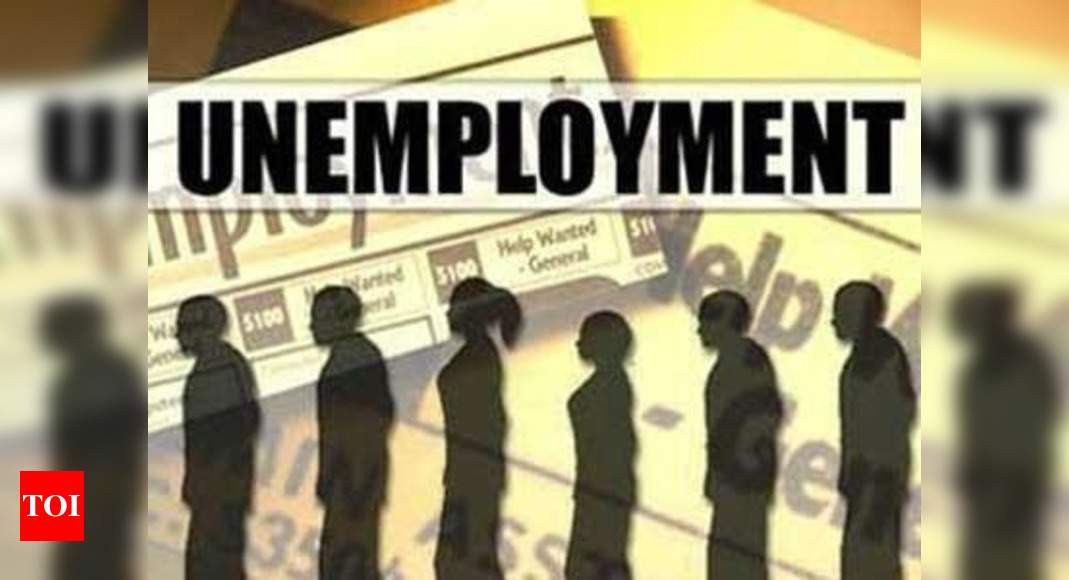
Employment is the state of having paid for the work you do after a certain period of time. Unemployment is a state where a person is willing to be employed but is unable to find a job. Furthermore, it is those people in the workforce or pool of people who are available for work but do not have an appropriate job. The employment rate stood at 39.4% in 2019-2020 in India, simultaneously the unemployment rate in 2019-2020 was 3.4%. Although the rate of employment is a little higher than the rate of unemployment, yet unemployment is a major problem in the Country. Every other person here is facing unemployment.
Unemployment is nothing but a stage where a person willing and available for work doesn’t get a job that he/she requires after a certain point in time.
Unemployment directly influences the labor market which in turn influences economic activities. The labor market in India continues to be under stress primarily because of the fall in the employment rate in rural India and the continued low employment rate in urban India, the Centre for Monitoring Indian Economy said, suggesting an urgent need to create more jobs. “The falling employment rate in rural India and the continued low employment rate in urban India are the weaknesses in India’s labor market recovery process,” CMIE said in its weekly analysis. According to the Centre for Monitoring Indian Economy (CMIE), an economics and business think-tank, as of 2018, unemployment in India had risen to 31 million individuals looking for jobs. The lowest unemployment rate in India was 3.4% (July 2017) but has now risen to 7.1%.

In India, it is a complex problem with numerous overlapping and intertwined causes; however, it is possible to identify several key causes. The following are listed as identified causes:- Caste System- it is a major factor in generating unemployment. In some areas, certain kinds of work are prohibited for members of particular castes; Increased Population Growth- As the country’s population is increasing substantially, the country’s economic growth cannot keep up with the population growth, this leads to a larger share of society being unemployed; Slow Economic Growth Because the Indian economy is relatively underdeveloped, economic growth is considerably slower than it might otherwise be. This means that as the population increases, the economy cannot keep up with demands for employment and an increasing share of people are unable to find work. The result is insufficient levels of employment nationwide; Loss of Small-Scale/Cottage Industries- Industrial development has made cottage and small-scale industries considerably less economically attractive. The result is that the cottage and small-scale industries have significantly declined, and artisans have become unemployed as a result; These may be identified causes of Unemployment in India.
The maximum amount of unemployment lies in the rural areas, as people there are not that educated and they get difficulty in finding a job. Although the Government has launched some of the schemes to provide employment to all there was not much difference. The programs launched by Government for providing more employment opportunities to rural areas are listed below-
1. Mahatma Gandhi National Rural Employment Guarantee Act 2005 (MNREGA)- It provides 100-day employment to an unemployed person in a year.
2. Sampoorna Rojgar Yojana- The primary objective of the scheme is to provide killed and local employment and thereby improve skill levels in all rural and urban areas.
3. Aajeevika- National Rural Livelihood Programme- It was launched by the Ministry of Rural Development (MoRD). NRLM has set out with an agenda to cover 7 crore households, across 600 districts, 6000 blocks, 2.5 lakh Gram Panchayats and 6 lakh villages in the country through Self Help Groups (SHGs).
These programs were helpful to some extent only. We need some more powerful policies and jobs that can improve this scenario and eliminate unemployment in the country.
Why learning a new skill is important in today’s world
Well, learning different skills become very important in today’s world. Because there is huge competition in every field. If you want to compete in this world and achieve the success you have to surely learn some skills that is the only way to achieve victory.
Everything is changed nowadays like working pattern, selection strategy and also priorities, so if you want to compete with this new era you also have to change and explore some new skills that will help you to achieve success. At this time the pattern of work will change that does not mean the previous pattern is wrong but that pattern will not suit today’s life.
Some points will explain to you about the importance of skills, that how they are important in your life.
1) In today’s world the pattern of work will change. Since 4- 5 years ago, there will demand higher education, academic degree but now there is a demand for skills and the companies also want that their employees have skills, and they will increase the profit of the company.so if you have less Academic qualification this deficiency will be adjusted. But when you have fewer skills this will not a good for you so try to learn more skills.
2) Before 4-5 years, if you are not highly qualified you are not able to find out a good job or work somewhere. But now there is no problem of higher education if you are graduate or not graduate but you have some skills so this will not hamper your life.
3) if you are passionate about something you will earn a good amount of money from your passion. but for that, you have to learn some skills that are highly in demand or there is a requirement of that particular skill in the future. and you have to change yourself like a smartphone, update yourself with the demand.
4) sometimes ago, we see that people always complaints that they don’t want to continue further studies but they have to continue because there was no future without a degree but now time change if you are not interested in further studies you have the option to stop it and And start your career in whatever field where you have an interest, but you have to develop some skills so you will survive in that career because it is huge demand of skill and you have to develop that skills.
5) if you have time you can easily learn more than one skill and those skills will help you to uplift your financial conditions. you can easily handle one or two projects. And in this work, there is no burden because you can learn those skills in which you not only complete the work but also enjoy it. So in this way, you can also enjoy your life while doing work. you can easily understand the situation. And try to develop and evolve skills with time, so you can easily find out the demanding work.
6) The best thing about skills is that first, you have choices that you will learn this thing or not, and when you decide you can learn without any limitations, and if you have some skill that will increase the profit of the company you also have a choice regarding what you will charge for your services. If you are really good at that particular skill, customers have to pay according to the skill, so there is not any loss in learn some skills.
Developed more skills and become creative, there is the era of quality, not quantity because the machine is also doing work, so ask one question to yourself if the machine can do the same work that you will do then, why the companies will hire you .
Best Strategy for Long-Term Mutual Funds Investments


Mutual funds really help us to achieve our long-term goals. Everyone says that mutual fund investments are better when done over a longer period of time. But the question is: how long does the long run last? In this article today, we’re going to discuss the long-term strategy. Fixed Term Mutual Fund Investments: Mutual funds operate on the compound effect principle, which means that money generates money and it usually does so over a period of time. The longer you keep your money invested, the more benefits you can expect. Well, we think it not only takes time, but also a little homework and a good strategy.
What do we mean by “long-term”?
The word long term refers to something that lasts longer, but nobody tells us how long long term is. According to investors, investors generally refer to any investment of more than 3 to 5 years as long-term. However, this can vary as a person who is now in their thirties wants to keep their money invested for the next 30 years until retirement. Annuals to take advantage of this investment as you will be making money with the money. If you give your investment time, your wealth will be valued and grow over time.
Why are long-term mutual fund investments better?
Let’s take a quick example: A mutual fund that has a historic 10-year return of 12%. A person who invested 10,000 in this mutual fund ten years ago now has 22,000 (which is more than double) as a return on investment. To say about past accomplishments we should get carried away with it as the future cannot be predicted, but at the same time history gives us a clear idea of what the future holds. So the math here shows us why long-term mutual fund investing is good.
Strategy for Building a Long Term Portfolio
DEFINE YOUR LONG TERM PERIOD
The first and foremost strategy is to set your goal. Mutual funds work best for you when you decide on a goal that you want to achieve. There may be a different portfolio for a different need, and you can use several of them depending on what you want from your investments. For example, if you want to create a pension corpus. It depends on how many years there are until retirement. You can also create a separate portfolio for your children’s education that will help you streamline your investments and strategically build a secure future, say 15 years later. Investing in long-term mutual funds can be a great option.
FIND YOUR INVESTMENT OPPORTUNITIES
Not only can we invest in long-term mutual funds, we also need to research which investment best suits our needs. When it comes to mutual funds, we have several categories like equity, debt, etc. We all know that equity funds are riskier than debt funds, but there are more than 10 different funds that fall under the top fund category. With equity funds, for example, small-cap funds are riskier. as a large-cap fund. Similarly, when it comes to bond funds, credit risk funds are riskier than most other fund categories.



‘Climate change and Corporate responsibility’


“We don’t inherit the earth from our ancestors, we borrow it from our children”
According to united nations framework convention on climate change “Climate change means a change of climate which is attributed directly or indirectly to human activity that alters the composition of the global atmosphere and which is in addition to natural climate variability observed over comparable time periods”.
Climate is determined by many factors influencing energy flows the most important being greenhouse gases. Sun’s energy influences climate on earth. The amount of heat radiations which the earth receives depends on how far the sun is from the earth and the sun’s emission power. The sunlight received by earth, a part of it is reflected back to space by the atmosphere, clouds, land, water surface and ice. Aerosols tiny particles in the atmosphere can increase the reflection of sunlight. This solar energy absorbed by earth is returned to space as infrared (heat) radiations. Not all gases interact with infrared radiations. Some gases like water vapor, methane and carbon-dioxide absorb infrared radiation flowing upwards from earth’s surface and re-radiate it in all directions. They thus impede outward flow of infrared energy from earth to space. This is called ‘greenhouse effect and the gases that cause it are called greenhouse gases.
Climate change is a phenomenon which mainly occurs through natural or anthropogenic factors. Latitude, ocean currents, wind and air masses, elevation, relief and nearness to water are some important natural factors that affect climate change. Anthropogenic factors affecting climate change include air pollution from vehicles, crackers and industrial activity, overuse and exploitation of natural resources like fossil fuels and infrastructure activities lay roadway to development but at the same time affects climate severely.
Reducing climate change involves reducing the factors that affect it like greenhouse gases. We as citizens can reduce the human interference with climate change by lowering our fuel consumption which in turn is possible by using cycles instead of two or four wheelers, by using community vehicles more often, by walking to nearby areas instead of using vehicles, switching off power plugs when not needed, saving water by not wasting it while we bath, brush or clean things. United nations framework convention on climate change (UNFCCC) is an international environmental treaty addressing climate change, negotiated and signed by 154 states at the united nations conference on environment and development informally called the earth summit. UNFCCC has its main objective to stabilize greenhouse gas concentrations in the atmosphere. Today it has 197 member countries which ultimately works to prevent dangerous human interference with the climate system. Under this framework the industrialized countries have to report regularly on their climate change policies and measures, including issues governed by Kyoto protocol. They must also submit an annual inventory of their GHG emissions.
Kyoto protocol is an international treaty which extends the 1992 UNFCCC. Under this 192 nations committed to reduce their emissions by an average of 5.2% by 2012 which would be 29% of world’s total emissions.
In 2019 a report published by the United Nations said that to limit the temperature rise to 2 degree Celsius, the world will need to cut emissions by 2.7 % each year from 2020 to 2030, and triple the climate targets. Even if all the Paris agreement pledges as they are in 2019, are fulfilled the temperature will rise by 3.2 degrees this century.
“Corporate social responsibility is a concept whereby companies integrate social and environmental concerns in their business operations and in their interaction with their stakeholders on a voluntary basis.”
CSR is termed as “triple-bottom-approach” which helps the companies in promoting itself as well as in fulfilling its responsibility that it hold towards the society at large. According to United Nations Industrial Development Organisation, CSR based on triple bottom line approach can help countries in the developing bracket to accelerate their socio-economic growth and help them become more competitive. Companies can fulfill their responsibilities through various activities like pollution control mechanisms, waste reduction or by contributing in educational and social programs. CSR is said to improve brand image of a company and increase its goodwill.
There are three basic principles that comprise CSR-
Sustainability- If resources of an organization are utilized efficiently then they will be available for the future generations too after satisfying needs of present generations. As the availability of resources is limited and non-renewable resources like oil, natural gas, minerals which are used in abundance are regenerated after long spans of years resources must be used optimally.
Accountability- The main aim of a business organization is to maximise its profits. But apart from making profits a company should be accountable to its employees and community members. A satisfied and motivated workforce will work more productively than exploited workers.
Transparency – From government’s point of view transparency is very essential for an organization. All its activities must be transparent so that if any organization tries to hide anything about the conduct of its activities it can be easily located.
Any actions that the organization undertakes has an effect on its external environment in which it resides whether it be social, legal, cultural or economic environment. An organization can have very significant effect on its external environment and can actually change that environment through its activities. Organizational activities can affect utilisation of natural resources, competition between various firms, land transformation or degradation dur to raw material extraction, distribution of wealth among owners and workers of the firm and the greatest of all affected is climate change due to greenhouse gas emissions.
The most recent concern that every organization faces is effect of its activities on climate. Companies act, 2013 has formulated section 135, companies (corporate social responsibility) rules, 2014 and schedule VII which prescribes mandatory provisions for the companies to fulfill their CSR. A company or subsidiary of the company having net worth of Rs. 500 crore or more or turnover of Rs 1000 crore or more, or net profit of Rs. 5 crore or more during the immediately preceding financial year must undertake CSR activity. A foreign company having its branch office or project office in India, which fulfills the above criteria is applicable for CSR. However, if a company ceases to meet the above criteria for 3 consecutive financial years then it is not required to comply with CSR provisions till such time it meets the specified criteria.
Every company on which CSR is applicable is required to constitute a CSR committee with directors on its board.
Functions of CSR committee-
Formulate and recommend to the board a CSR policy which shall indicate all the activities to be undertaken by the company Recommend the expenditure required on the above mentioned activities.
Monitor the CSR policy from time to time.
Institute a transparent monitoring mechanism for implementing the CSR projects or programs undertaken by the company. The board of directors shall disclose contents of CSR policy in its report and the same shall be displayed on the company’s website.
Schedule 7 of the act states the activities that the companies can undertake under CSR-
Eradicating hunger, poverty and malnutrition, promoting health care including preventive health care and sanitation.
Rural development projects.
Slum area development.
Promoting education, including special education and employment enhancing vocation skills.
Promoting gender equality, empowering women, setting up homes and hostels for woman and orphans, setting up old age homes, day care centers etc.
About 20 most influential companies contribute one-third of all the greenhouse gas emissions that we have presently. Companies can reduce their greenhouse gas emissions as a part of social obligation, by following stringent guidelines. Smart thermostats and motion-activated lights can be used to avoid wasting energy, reducing GHG emissions. Companies can measure and analyse GHG emissions and accordingly reduce its energy consumption. They can use renewable energy sources, can use environment-friendly infrastructure and transport, promote environment-friendly ways of working and most important of all it can spread awareness among its employees and various stakeholders.
Companies take actions to reduce GHG emissions in the environment. Microsoft has pledged to reduce operational emissions by 75% by 2030, but has been operating as 100% carbon neutral since 2012. Tata chemicals spent the highest on CSR in 2019, although its prescribed CSR budget for 2019-2020 was 21.39 Crores, the company spent 37.81 Crores on community development projects. Tata chemicals as a part of its CSR responsibility established Tata chemicals society for rural development in 1980 as a society and trust.
Since the lockdown began TCSRD has been actively supporting government by distributing disinfectants, stitching masks, ensuring food security and providing medical help. Infosys Ltd. Spent 2% of its profit towards various schemes of corporate social responsibility. BHEL a government company as a part of its corporate social responsibility for COVID-19 relief , organized ‘Swachhata Pakhwada 2020’ from July 1 to 15, 2020. Mahindra and Mahindra ltd company spent 93.50 Crores out of which 8.36 Crore was spent on project Nanhi kali which provides educational support to underprivileged girls in India through an afterschool support programme.
‘THE LIPSTICK EFFECT’


As Covid-19 streaked the globe in March, many businesses soared or plummeted as the pandemic wrought sudden sweeping change on the market environment. While some businesses like medical suppliers, drugs and chemists, small scale mask manufacturers, online education platforms, digital gadget markets soared high while many other businesses like restaurants, bars, hotels, malls etc were forced to shut down. Imposing lockdowns led to panic buying wherein consumers started buying essential goods like monthly groceries and hoarding them. Some switched to selective and cheaper buying. Unemployment soared and consumer spending fell causing major global economies to slide into recession.
This shift in consumption pattern created an altogether different trend where less costly consumer goods dominated purchases. The stock market reached its highest level with Nifty crossing 15000 mark and Sensex soaring as high as 35000. All this seems contradictory to what the situation validates.
Economists accredit these gains to ” The Lipstick effect “.
What is ‘The lipstick effect’
The lipstick effect is a theory in economics propounded in 2001 by ‘Leonard A Lauder’ chairman of a cosmetic company ‘Estee Lauder’. It states that at times of economic crisis or in periods of recession consumers demand shifts from costly and expensive luxury goods to less costly luxury goods. Consumers buy luxury goods even if there is crisis. During times of such economic distress consumers confidence in economy falls and their demand shifts to such goods that doesn’t affect their income much. In other markets besides the cosmetic industry For eg: instead of going on a tour to some country or buying expensive fur coat or jacket consumers prefer to go to cinemas, restaurants or simply buy less costly gadgets.
During the great depression American economy saw 25% increase in cosmetic sales, while in 2008 when economies were under recession cosmetic company L’Oreal saw 5.3% increase in sale of its products. In 2001 during 9/11 attacks when the US economy was under pressure Lauder saw a significant increase in sale of lipsticks in his company. He, thus appraised that there was a negative effect between economic condition and lipstick sales. This is how ‘The lipstick effect’ came into existence. However, all these examples majorly focus on lipstick but the word ‘lipstick’ is used in generalized sense and includes all other luxury goods that consumers purchase even at the time of crisis.
Pandemic has impinged economy leading to tremendous fall in GDP, employment, Investment and most important of all consumer’s demand. The lockdown and the period afterwards saw a mixed bag of varied demand patterns. Broadly three different demand patterns were working simultaneously – normal demand, pent-up demand and inventory build-up. In August 2020 Boston consulting group reported that while there has been a rise in consumption of essential goods like health products, and home entertainment, positive sentiments ware also noticed around other essential items like personal care products, packaged foods and discretionary segment like apparel, cosmetics, consumer electronics. In September 2020, Shopper stops reported 33% increase in eye-makeup sales. In quarter two of 2020-21, Godrej consumers’ business saw 5% increase in its sales. Share prices of many such brand rose for eg: share price of Cinthol soap rose to 36% from 33% before the pandemic.
The lipstick effect offers an interesting insight that even during slump, trusted brands find a place in consumer’s wallet and are purchased as usual. However, this can be observed only in the case of less expensive goods and doesn’t apply to all the categories. Ceding many of their activities and expenditures including eating out due to growing fear consumers seem reluctant to spend at costly restaurants. Due to travelling restrictions their outing trips have reduced leading them to save more money for their future expenditure. Apart from saving for future, consumers have adapted themselves to this new normal and started spending on things like refurbishing their homes, decorating rooms with less costly luxury goods maybe a vase or pot that they always wanted to spend on, buying things for their new hobbies and all those small acts that cheer and give hope to them. A new car purchase might have been postponed, or a foreign tour has been cancelled but small pleasures every now and then have taken a toll over other spending. by small acts that keep them happy just like purchasing a lipstick is.
Signing off
Janhavi Thakre
What the lipstick effect has to say in Indian context ?
Is the lipstick effect glimmer of hope for the brands in the new normal ?
As J.K Rowling has rightly said “Happiness can be found even in the darkest of times; if only one remembers to turn on the light”. Even after the fatality of the pandemic demand by consumers will still be exceptionally characterized by irrationality and altogether opposite behavior. But what brings light to the overall situation is how well these branded businesses grab this opportunity and contribute their parts in comforting this economic crisis. Advertising can rekindle this hope. Using creative themes like togetherness, warmth, joy can help. Be kind, hopeful, positive and get the consumer to see more of your brand as a friend, supporter and a well-wisher.
Signing off
Janhavi Thakre
 Eduindex
You must be logged in to post a comment.