A Guide For Building Sustainable Smart Cities

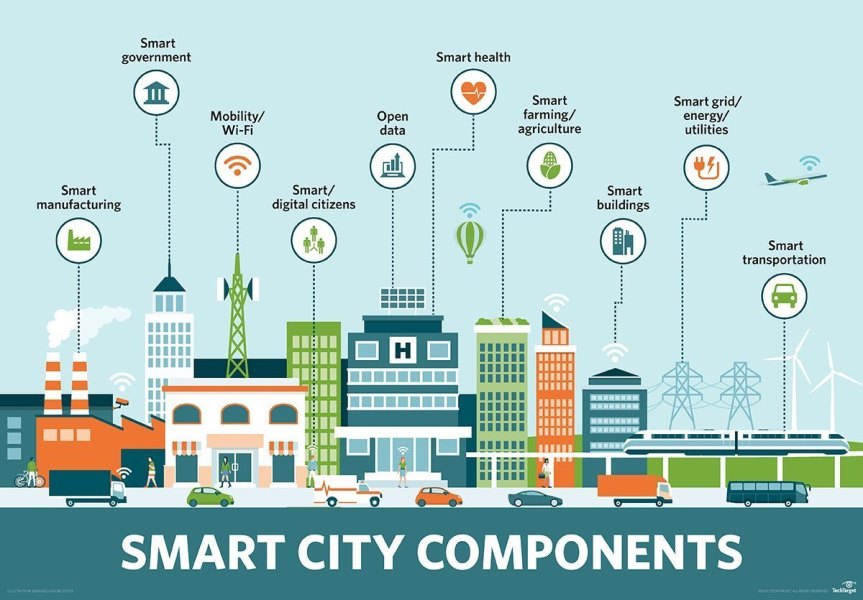
Smart cities must fulfil the need for sufficient fresh water, universal access to cleaner energy, ability to travel efficiently from one point to another, sense of safety and security, among others. Smart cities need to be able to efficiently combine a smart physical layer (ability to use sensors to connect physical assets like buildings, public transportation, energy grid, etc) with a smart digital layer (increasingly mixing capabilities like Big Data, AI, the IoT and the like) to crunch data collected and turn it into actionable decisions on the field, in a cost-efficient way.
Smart cities help create an urban environment for adapting to the needs of the population in the most environment-friendly, economically and socially-conscious way. These cities use data from people, vehicles, buildings and things to improve citizens’ life and minimise the environmental impact of the cities. These are continuously monitored through the Internet of Things (IoT) to maximise efficiency. Smart cities operate as one big data-driven ecosystem to avoid accidents, emissions and congestion. These employ a combination of low-power sensors, wireless networks, and Web and mobile-based applications, and use technology and data purposefully to make better decisions and deliver a better living experience.
Smart cities are collaborative projects that bring together technology, industry and governments. Technologies used for smart cities should be able to share data in an efficient, secure and open manner. Successful smart-city projects collect, manage and use data to improve living and workplace standards. Application-driven data is used by both humans and artificial intelligence (AI) to deliver back innovation and efficiencies to the cities.

Why a city needs to be smart

Cities are a pillar of our economic growth. But these can have several inefficiencies with the growing population due to migrators from less-developed cities and villages. Cities can be called developed when there is availability of good education, healthcare facilities, job opportunities, transport facilities, sanitation facilities, and good law and order practises to provide safe and secure places to live.Making a city smart means utilising digital technology and data to solve such problems as traffic management, waste management, monitoring available parking spaces, controlling humidity and temperature levels in the environment, maintaining quality of tap water, waste-water management, sound monitoring and so on.
Cities can be smart but still not livable. Hence, the aim of making smart cities should be to use technology as a tool to deliver sustainable solutions. Technologies like the Internet, the IoT, smartphones, smart meters, smart plugs, smart taps or showers, and other networks of sensors can be used to develop such cities.

What makes a city smart

Smart cities must include infrastructure that helps provide a better quality of life for its citizens. Adapted smart solutions should create a cleaner and more sustainable environment. Data helps in accessing patterns or inefficiencies to improve living standards for the citizens. The same data can be used to better plan the cities in the future and create a framework for smart cities that constantly get more efficient over time.
Smartphones help provide instant information about transit, traffic, health services, safety alerts, community news and everything else needed to know about the cities, in real time. These provide notifications about the best times to travel, personalised energy usage, tips for improving eating habits, etc.
Stephane Dejean, chief marketing officer, Kerlink, says, “From rural towns to bustling metropolises, municipal officials around the world are facing increasing challenges raised by climate change, population growth, appropriate infrastructure development and access to basic sanitation. Leveraging IoT networks, authorities can streamline the use of city infrastructure and deliver tailored services to citizens, while monitoring critical indicators.
“Cities now have the opportunity to easily, flexibly and cost-efficiently deploy, operate and monetise carrier-grade IoT connectivity on their own. These networks turn out to be key assets that cities want to control, financially and/or operationally, and that can be combined to power a growing diversity of use cases. Considering their budget challenges, cities are also looking for a better trade-off between financial sources and possible business models over time. Opting for a relevant alternative like low-power wide-area networks (LPWAN) and selecting a partner that can quickly and easily adapt to evolving collaboration models enable cities to address both their technical needs and financial challenges.”

Developing a sustainable city

To build future-ready smart cities, there are a few fundamental things that are required to establish a stable and adaptable framework.

Smart infrastructure

This is required to establish a foundation for digital economic development. Heating, energy usage, lighting and ventilation in buildings are managed and optimised by technology. Water-leakage detection and water potability monitoring are integrated into smart buildings. Rooftop gardens or side vegetations are integrated into building designs to produce oxygen and absorb carbon-dioxide.
Smart infrastructure also includes city-wide Wi-Fi for public use to provide real-time information on traffic congestion, parking spaces and other amenities. The aim of smart parking is to reduce both car emissions and traffic.
Smart roads are prepared for autonomous vehicles and self-driving car traffic system integration. With smart drainage systems and filtration, cities could drastically improve local living conditions. Smart lighting control systems reduce energy consumption, carbon emissions and maintenance costs, while providing a safe environment.

Security

Creating cities that are affordable and safe should be the priorities. This ensures secure and efficient operation of critical applications developed for the smart cities, which rely on constant connectivity to volumes of data from stationary and moving sensors, which is transformed into useful information through data analytics to provide a better quality of life. Failure to secure this data can cause extreme damage.
Be it a residential complex, market, school, hospital, district centre or public transport, sustenance of any urban setup is impossible without robust security measures. But with the advent of AI, the concept of a smart city is viable as well as feasible. AI has empowered security to automatically learn and detect crimes.

Sustainable energy

Solar panels are integrated into building design, replacing traditional materials. Solar and wind energy can be collected throughout the day by fully integrating these into roads, buildings and residential areas. Smart grids are used for energy consumption monitoring and management. These conserve energy in places that might not need power and then send it to areas that may need even more power.
A building can become entirely self-sufficient by using technology like solar windows. Unused energy generated can be offered to vehicles in the local area. By 2060, cargo will travel through hyperloop and will be moved rapidly around the world in smart containers that know their contents and their destination. Ports themselves will be automated, running on renewable energy and having zero carbon emissions.
Development of smart cities will require more energy, so the focus should be on sustainable energy sources. For example, cities can pave the roads with some kind of material that converts solar energy into electricity. Automobiles can be equipped with solar panels on roofs. Autonomous, environment-friendly, efficient transport can save time and money, too.

Digitalisation and automation

Smart cities use IoT devices and sensors to gather and analyse information across the infrastructure. This helps city authorities to intelligently manage their assets, increase efficiency, revolutionise transport, reduce costs and enhance the overall quality of life for residents.

Management

This is the last but the most important stage of building a smart city. It requires a platform that features AI and machine learning to monitor and improve smart city projects.

Initiatives for making smart cities

A prime example here is managing energy use in buildings—heating, air-conditioning and lighting—while maintaining comfortable room temperatures, monitoring facility status like occupancy and availability. These end-to-end solutions offer user-friendly apps on officials’ smartphones and provide programmed, automatic rule-based responses to changing environmental or weather conditions. Monitoring and counting the movements and whereabouts of building occupants or citizens in public areas also bring an effective smart-city application. The same way, LoRaWAN’s native geolocation capability also enables cities to track their assets.
Sustainability is a critical aspect of smart-city networks. Outdoors, cities can leverage low-power wide-area (LPWA) sensors and networks for traffic monitoring, streetlighting, parking availability, waste collection in addition to noise detection, like gunshots, and environment sensing.
In Kakinada, India, Kerlink’s Wirnet TM stations are powering a comprehensive, ambient air-quality monitoring system designed by Oizom that monitors air and noise pollutions and other environmental hazards.
Chengyang is a smart city project established by Huawei. It converts a wasteland into arable land capable of growing seawater rice using a combination of sensors, wireless and deep learning technologies. It feeds 80 million people using previously unusable land. This innovation is now being applied in other parts of the world.
India Maven, a smart-city solution provider from Pune, provides smart solutions in the fields of water and energy metering, lighting, agriculture, ambulance tracking, medical wearables, firefighting, city-pollution monitoring, smart parking, renewable energy management system and intelligent traffic management.
Dejean adds, “With increasing vital IoT deployments for cities, utilities, airports, harbours, farms, manufacturing plants and other sectors, we have LoRaWAN IoT connectivity building block. We also have industrial-grade network infrastructure—indoor and outdoor carrier-grade range of LoRaWAN gateways—with a full suite of user-centric value-added services that empower cities of any size to efficiently manage their IoT connectivity. The Wanesy Management Center, Kerlink’s Wanesy Geolocation and Wanesy Device Management solution value-added services can help cities not only manage/locate their assets and remote sensors, but also help them improve the services they grant to their citizens, like traffic information, parking availability, weather forecast, public-building attendance and public-private partnerships (PPP).”
Smart City Expo World Congress is looking to establish frameworks that will shape the collaborative approach to establish smart cities of the future. Its theme for 2018 was to determine how to structure smart cities in a future-proof and innovative manner.
International Electrotechnical Commission (IEC) Market Strategy Board brings together chief technology officers of leading companies to guide city planners and regulators, and develop standards in an effort to move cities to greater smartness.
Many places have a number of projects implemented on the ground, but these do not scale up because there are no steps taken at the national level or by individual government bodies. As more and more people are migrating towards cities, it is essential to develop a sustainable environment to make these places worth living. Human behaviour as a city dweller is changing, so everything has to be taken into account, including building material, climate, technology and so on while designing and building the cities of tomorrow.

Conclusion

Smart cities must fulfil the need for sufficient fresh water, universal access to cleaner energy, ability to travel efficiently from one point to another, sense of safety and security, among others. Smart cities need to efficiently combine a smart physical layer (ability to use sensors to connect physical assets like buildings, public transportation, energy grid, etc) with a smart digital layer (increasingly mixing capabilities like Big Data, AI, the IoT and the like) to crunch data collected and turn it into actionable decisions on the field, in a cost-efficient way. These cities need to meet the needs of current and future generations, and to maximise benefits while minimising the negative aspects of their daily living.
Land Pooling : A transformative step for Urbanisation

Shri
Hardeep S Puri, Minister of State (I/C) for Housing & Urban Affairs
has stated that the land pooling policy based on public private
partnership in land assembly in urban development represents a
paradigmatic shift, wherein land is being pooled and is to be developed
by private landowners. He further informed that the owners/group of
owners can pool land parcels of any size for development as per
prescribed norms and guidelines based on sectors as delineated in ZDPs.
“The Policy mandates that each sector will have a 60:40 ratio with 60%
of the land to be developed by Land owners/consortium for residential,
commercial, partly Public Semi Public (PSP) land uses and 40% of the
land to be used for various city level infrastructure requirements
including roads, greens, PSP facilities, development of utilities i.e.
water, sewerage, electricity etc. with involvement of private sector”,
he added.  He was speaking at a Conference on ‘Land Pooling : Building
India Capital – Opportunities in Real Estate and Infrastructure
organized by Delhi Development Authority(DDA) in association with the
Federation of Indian Chambers of Commerce & Industry(FICCI), here
today.   Shri Anil Baijal, Lieutenant Governor of Delhi, Shri Tarun
Kapoor, Vice Chairman, DDA besides land developers, stakeholders and
urban planners were also present at the Conference.
Land Pooling :  A transformative step for Urbanisation

Dwelling
on DDA’s commitment towards operationalization of the policy on fast
track mode, the Housing Minister said that DDA had launched portal for
inviting Expression of Willingness for participation earlier
this year wherein any landowner of contiguous land parcel of any size
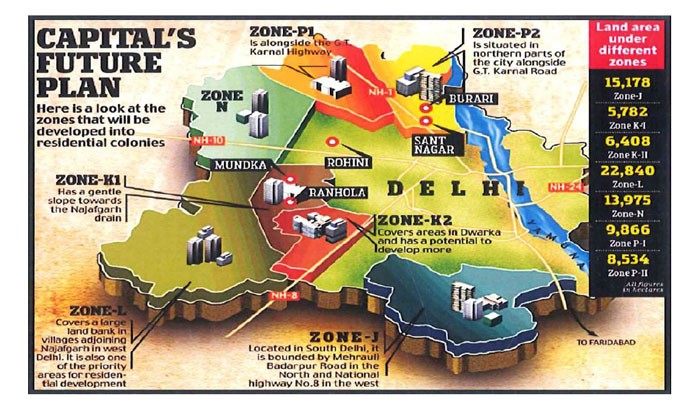
falling in 95 villages of Planning Zones K-1, L, N and P-II could come
forward to register on the website. DDA conducted an extensive public
outreach program to raise awareness about the policy and educate the
citizens of Delhi on its benefits. This outreach program has paid
dividends – as on 06.09.2019, a total of over 6000 hectares (approx) of
land has been registered under the portal expressing their willingness
for participation with maximum registrations in Planning Zone N.
The
Land Pooling Policy augurs well for shaping Delhi’s urban landscape,
bolstering economic growth and improving living standards. DDA proposes
to take up planning of the sectors which are likely to achieve the
minimum threshold of 70% as Model Sectors on priority to generate
momentum in real estate and infrastructure sector. Under the policy,
every 1000 hectares of pooled land will accommodate about 3,85,000
persons in approx. 85,000 Dwelling Units. About 17 lakhs Dwelling Units
are expected to be constructed  of which approx. 5 lakhs will be
available under EWS category. The housing generated under the Land
Pooling Policy will be a key input in economic, social, and civic
development of the city. Simultaneously, development of the trunk
infrastructure i.e. roads, water supply, electricity supply, etc. will
be taken up by DDA in coordination with the service providing agencies.
Shri
Anil Baijal, LG of Delhi during his address stated that the success of
the policy largely depends on the provision of fast, time bound planning
and development of city level infrastructure and infusion of capital
which will act as a catalyst for integrated development of the sectors
and zones. “While, DDA in close coordination with service providing
agencies such as Transco, DJB, local bodies etc will work towards it,
the participation of the private sector is equally important.  The
required capital investment for development of smart infrastructure,
housing, schools, medical facilities etc. requires deliberation on
collaborative models between DDA, Service providing Agencies, landowners
with investors/real estate segment. This conference is a step towards
this effort to partner and get on board Investors, Real Estate
Developers, Banking sector and experts for making this policy a
success.   Delhi is at the cusp of urban innovation and presents an
untapped opportunity for Real Estate and Infrastructure Development. It
is envisaged that Smart city solutions deployed in 109 land pooling
sectors will turn these new urban centres in ‘smart neighbourhoods’. The
envisioned city level development under the Policy will provide the
high speed transport system, world class infrastructure facilities i.e.
24 hours water supply, power, pipe gas connectivity, health and
education facilities in these green field areas. Therefore, it is
anticipated that significant yields for both land owners and investors
will be garnered with the implementation of the Policy”, he added.
Shri
Tarun Kapoor, VC, DDA expressed hope that this Conference will provide
an opportunity to deliberate key issues pertaining to development of
Delhi.  The industry perspective was provided by Mr.Sanjay Dutt,
Chairman, FICCI Real Estate Committee & Managing Director and Chief
Executive Officer, Tata Realty and Infrastructure Ltd.

Scholastic Journalism

Student journalists request brilliance
in training from their news coverage counselors and projects. They
request educating in media law and morals, mindful announcing, and
successful journalistic practices. They gain best from counsels who have
been prepared in expert gauges. Journalists teach people in general
about occasions and issues and how they influence their lives. 
They
invest quite a bit of their energy talking with master sources, looking
open records and different hotspots for data, and in some cases visiting
the scene where a wrongdoing or other newsworthy event occurred


Gender Equality

Gender equality is the condition of equivalent straightforward entry to
assets and openings paying little respect to gender. Gender equity is
accomplished when ladies and men appreciate similar rights and openings
over all divisions of society, including monetary interest and basic
leadership, and when the diverse practices, yearnings and requirements
of ladies and men are similarly esteemed and supported. 
The world is
gaining ground on propelling gender orientation uniformity. In any case,
there is still no place on earth where ladies are equivalent to men.
Ladies and young ladies overall face boundaries to accomplishing their
potential just due to their gender. These boundaries show from numerous
points of view and appear to be unique for some ladies. Gender equality
is the objective, while impartiality and sex value are practices and
mindsets that assistance in accomplishing the objective. Gender equity
is more than equivalent portrayal; it is firmly attached to ladies’
rights, and regularly requires strategy changes.

Art and Science of Teaching

Abstract

Teachers are the flag bearers of humanity. They spend their entire
lives making next-generation wiser and more productive to society. Demands from
the roles of teachers have been increasing with the growing vastness of the
subjects. Mere knowledge is not sufficient to be a good teacher. It is an art
to make the subjects lucid and interesting enough to get through the restless
younger generations; it is a science to keep the learning process more
objective and accurate. Teaching is perhaps the most perfect example of the
amalgamation of science and art into one.


Introduction

Our ability to think and process
information is what sets us apart from the monkeys. Humans are the only species
who have benefited from the number of years of their existence because they
accumulate knowledge and pass on to fellow human beings. We do not need to take
pain of learning to light fire or make wheels, because our forefathers did it
for us thousands of years back! And some of them took the responsibility of
teaching this skill to their next generation and the same has been being passed
on ever since. Unless there were responsible teachers in each generation, this
power of humanity would vanish.

Role of a Teacher

A teacher is the most important person
in our lives after our parents who kindles the life of others with his
knowledge and make them humane and productive. One cannot really learn things
without having a teacher in his life- formal or informal, but a teacher is must
to learn anything. Scriptures across the world sing of the praises of teachers.
In fact one Hindi proverb even goes to say that the teacher is even more
respectable than God himself.
Of course, the subjects to learn
have gotten more and more complicated over time. Early teachers like Aristotle and
Chanakya could have afforded to teach all the subjects ranging from political
science to philosophy to mathematics to science to economics. But now the
subjects have become much more complex. One person may really need to spend his
entire life to understand probably just one concept of one subject! Therefore,
the job and qualifications demanded of a teacher has become more complex.
A good teacher needs to have
sufficient professional or specialized knowledge in a particular subject. As Brad
Henry once said “A good teacher can inspire hope, ignite the imagination, and
instill a love of learning.

T
eachers need to accumulate knowledge and invest this in their students to
pave path of a good future to them with widen up thinking and absorbing ability
giving sense about the truth of life, and thus making them a more productive
member of society.
The teacher has to act as a
mediator between books and students and try to make ease their way of
understanding subjects.  He has to
encourage and build a friendly environment to facilitate learning, encourage
Q&A. He builds up a student confident enough to face the society, confident
enough to put their knowledge to test in the real world.
Therefore, behavioral training is
also a part of teaching that grows reciprocity and cooperation among students. The
teacher has to teach moral and ethical values to students.

Is teaching a science or an art?

Good teaching has
to blend emotions and feelings with objectivity of observations, measurements
and the precision of language. To make learning effective, the process has
to be interactive and objective. Without the use of the scientific method, the
learning may not have necessary impact. Therefore, it is essential to
scientifically proven processes like- discussions, active learning, distance
learning, and case studies, to facilitate learning.
But identifying
the correct set of tools to facilitate learning and perfect delivery of the
tool is actually an art. Creating a healthy environment is important for having
the desired impact of these techniques.
 Therefore good teaching is the perfect blend
for art and science.

Microphone and their types

INTRO

Communication is part and partial of human and animal life
since existence.  Every living thing on
the earth has its way to communicate. But we as humans have advanced in terms
of communication with all great inventions. These technical instruments have made
our life easy enhancing communication in our day to day life. These devices are
designed for a purpose and they are serving it well. It has connected human
beings from one place to another very conveniently making the world a better
place to live.   
 One of those devices
is microphone that converts sound vibration into electronic signals inscribe to
a recording medium. It is a very useful device as it enables many types of
electronic function that is audio recording, and communications of many kinds.  Another main function of microphone is playing
music and speech recording.   They are very beneficial when it comes to
music recording from instruments like guitars, drums vocals and other acoustic
instruments in studio. It provides the best possible sound that a musician
desires when he plays his instruments. 
But to listen a great sound whether its music or an interview, all one
needs is a selection of good quality of microphone. There are many types of
microphone available in the market. One cannot use same type and quality of microphone
for multiple purposes. Different types of microphone have different functioning
to perform. Here is its brief:

Early microphones

Carbon microphones are the oldest among microphones that
were used in telephones. It was used for over one hundred years. The devices
used the electrical resistance and variable of carbon.  Metal plates translate air born sound waves
into an electrical signal under pressure. Not able to produce a clear sound,
early microphone was tough to use.
The liquid-based mechanism was used to operate these first-ever
electronic microphones.

Different types of microphones

There are many types of microphone but basis two is the
Condenser microphone and the Dynamic Microphone. These two microphones are used
by professionals in any music studio or professional recording environment.
There is a third type called a Ribbon Microphone too, but these are less common
and usually used by professionals only.

Dynamic Microphones

The unique quality of these microphones is it doesn’t need a
power supply and people can move freely from one place to another with
microphone in hand.  This instrument
helps in stage performances and live show where anchor has to move randomly in
different directions. Another is its fairly low price in comparison to another
microphone. In short, it can be called as an all-rounder microphone which
performs all task including recording and vocals.
The technology behind this microphone is a use of a moving
coil magnetic diagram tp produce the audio signal that can tackle high Sound
Pressure Levels (SPL).  The most common
example of these types of the microphone is  Shure SM57 and the Shure SM58

Condenser Microphones

These are the sensitive microphone that can even capture
subtle noise like breathing. Mostly used by musician for recording in studio to
get the surround effect of the sound. It is preferred for soft music recording
as they use a conductive diaphragm that vibrates along with the sound that
exerts pressure and uses capacitance to create the audio signal. Because of its
sensitive nature so not ideal for recording guitar amps up close.

Ribbon Microphones

These microphones are quite expensive in general and are
perfect recording device for multiple instruments in a closed room. They easily
can catch even slightest sound coming as of its extremely sensitive nature.
Considered great for capturing vocals, strings, and woodwind
A ribbon microphone is the most favorite and best suited for
the recording specialist. It is designed for recording to those who want an antiquated
sounding and feeling to their music as it beautifully records higher notes
associated with music instruments.  These
many features of these microphones make them very popular and are a favorite of
a music lover.
There are numerous different microphones available in market
and one has to choose wisely according to its need.

 Conclusion

When it comes to music then all people want it to come clear
to ear so that it can touch the soul. And this can only be possible if a
musician chooses its instrument and recording device carefully.  Well there are no tough rules when it comes
to recording but knowing about the and recording techniques can provide soulful
music to the ear.

Media and Artificial Intelligence

The improvement of new Artificial Intelligence-based apparatuses has
opened the way to new media classifying, use, and adaptation potential
outcomes.  AI guarantees to change the media and stimulation business
affecting everything from substance creation to the purchaser
experience. AI will impact all pieces of the media esteem chain, helping
content makers to be progressively innovative, helping content editors
to be increasingly profitable, and helping content customers to locate
the substance that coordinates their interests and current circumstance.
AI controlled psychometric profiling is utilized to extricate
information from internet based life profiles, and utilize this data to
indicate potential voters a particular subset of focused phony news or
political promotions. 
The thought is to control data to a degree where
people can’t comprehend what’s actual and what’s not any longer. The
fundamental zones of utilization of AI are indexing and metadata
recognition, computerized because of these apparatuses. The measure of
time required for substance recording is decreased to nearly continuous
on account of AI, which connected to everyday work at an ordinary TV
station can make ground-breaking examination devices that can even be
utilized for news and live generation. Be that as it may, the advantages
of AI are not selective to the age of data straightforwardly from the
media. The exactness, speed and measure of data produced with AI
apparatuses open the way to numerous different applications in other
industry territories.

Guidelines for Recruitment of Faculty in Universities

The University Grants Commission (UGC) has asked all the
 Universities and educational  to fill up unfilled teaching posts within time
frame of  six months . According to the
new set Guidelines for recruitment of faculty in Universities, Colleges and
Institutions Deemed to be Universities that is  released by UGC on
June 4, all higher educational Universities have been asked to initiate and
complete the selection process of teachers within a time frame of 6 months.
It is aiming to
promote quality education to emphasizes excellence in research and
for the promotion and coordination of
university education. University grant commission
purposing
to promote quality to emphasize excellence in research.
It also aimed at the determination
and maintenance of standards of teaching, examination, and research in
Universities, Colleges, and Institutions. Directors of Physical Education and
Sports for maintenance of standards in higher education and revision of pay
scales.

So, these are the guidelines that need to followed to fil
the vacant seat  with appropriately
eligible and competent candidates.
Selection Procedure
·        
The higher education institute  is required to follow the selection process as
per their Acts, Statutes or constituent documents and in accordance with the
University Grants Commission with (Minimum Qualifications for Appointment of
Teachers and other Academic Staff in Universities and Colleges and other
Measures for the Maintenance of Standards in Higher Education) Regulations,
2018.
·        
The monitoring of the filling up of the posts
would be done by the MHRD and UGC through their  this portal.
·        
The higher education institute  should initiate and complete the selection
process within a period of 6 months in terms of the schedule given below.
·        
The higher education institute  should, however, ensure that all the vacant
posts, along with the reservations details, are uploaded on the online portal .
The UGC Regulations will be applicable for direct selection
of Teachers, in case the concerned Statutory Practiced Councils/Bodies have not
placed down the standards so far with the disorder that in such cases, the
norms of the Statutory Professional Councils//Bodies shall be appropriate from
the date they are notified by the worried Councils/Bodies.
  In the topics in which NET/SET/SLET is
conducted by UGC/CSIR or any other body credited by UGC, NET/SET/SLET shall be
an extra requirement for selection to the post of Assistant Professor and
equivalent positions as per the clause.

Media and Film Studies

Film studies are a scholarly control that manages different
hypothetical, authentic, and basic ways to deal with movies. It is now
and then subsumed inside media examines and is frequently contrasted
with TV contemplates. Film studies is less worried about propelling
capability in film generation than it is with investigating the account,
aesthetic, social, monetary, and political ramifications of the cinema.
In hunting down these social-ideological qualities, film ponders adopts
a progression of basic strategies for the examination of creation,
hypothetical system, setting, and creation. In this sense the film
studies exists as one in which the instructor does not generally accept
the essential teacher job; the highlighted film itself serves that work.
Likewise, in considering film, conceivable professions incorporate
faultfinder or creation. 
Film studies regularly incorporates the
investigation of contentions between the style of visual Hollywood and
the literary examination of screenplay. Generally the investigation of
film keeps on developing, as does the business on which it centers. Film
Studies urges us to move past such professes to ask how and for what
valid reason films make us feel the manner in which that they do, and
why we think a few movies are superior to other people.  Since the
cutting edge movie turned into a development and industry just in the
late nineteenth century, an age of movie makers and executives existed
fundamentally before the scholastic investigation that followed in later
ages.

Women and Media

Women who are involved in media are people who take an interest in
media. Media are the aggregate correspondence outlets or devices used to
store and convey data or data. The job of women in media develops
around media opportunity, media pluralism, media freedom, and media
safety. Women in media face indistinguishable challenges and dangers
from men, yet in addition experience sexual orientation disparities,
safety issues. Safety of journalists is the capacity for writers and
media experts to get produce and offer data without confronting physical
or moral dangers. Women journalists, face dangers of physical ambush,
inappropriate behavior, assault and considerably murder. Women
journalists are helpless against assaults not just from those
endeavoring to quietness their inclusion, yet additionally from sources,
associates and others. 
Mass media play a special and vital job in the
molding of a general public where people appreciate equivalent rights.
Raising ladies’ lawful mindfulness is imperative for the production of a
populist society.  The job of media is essential for being effective in
all the referenced circles. The media can advance and accelerate the
changes in advancement, or, unexpectedly, it can hamper their execution.
Notwithstanding common imbalance, common society keeps on being a power
for advancement. Different associations are attempting to push for more
noteworthy portrayal and key standard-setting bodies, for example, the
Gender and Internet Governance trade, started by the Association for
Progressive Communications, which means to change the hole in support by
ladies’ and sexual rights’ activists in web administration approach
forms.

Skills to be a Good Learner

Introduction

 The ability to learn is possessed by humans,
animals, and some machines, and there is also evidence for some kind of
learning in some plants. Some learning is quick and is induced by a single
event but much skill and knowledge accumulate from repeated involvements. The
changes induced by learning often last a lifetime. It is hard to distinguish
learned material that seems to be missing from that which cannot be retrieved.

Obtaining new skills or adapting ideas and
knowledge, preference, behavior, and valuable skills are the learning process.   Learning can be of different types as it encourages
much skill and knowledge to accumulate from repeated experiences. To keep growing
intellectually is what one wishes for.


Leaving school or college doesn’t mean one
should stop learning. Limited learning means limited knowledge of things around
you as no educative process is the end. Learning is the process of inquiring
new or modifying existing knowledge, behaviors, skills, values, or preferences.


Why one need to learn a language

Strong learning skills are an asset that
will promote a lifetime of effective communication. Our language is the most
important part of our being. I think it is important to learn other languages,
other forms of communication besides our own because it helps us to learn about
other peoples and cultures
a)     
Learning helps one
develop a knowledge base and improve for the better.
b)     
Learning is
experimenting with something new which helps gets us access and to find new and
diverse chances and to try new experiences that might be the best ones.
c)     
Hypothetically it
helps rejuvenate one’s life a new and appropriate skill or by developing work
to do.
d)     
 It is essential to learn for staying up to
date in life. This is an ever-changing world where one needs to keep
self-updated and can never stop learning.
e)     
Want to earn
prestige and self-esteem that language is important to you. Learning new things
especially language can stimulate your brain and let it function well. It keeps
brain cell activity and allows people to be in confidence.


What will happen if we stop learning the language?


It’s the
nature of human soul to learn. Learning things especially language makes you go
upward and achieve new heights.  The one
who stops learning can stagnate and actually move backward.  Especially in professional world it is
important to learn. One cannot be linked with the world if learning is
stopped.  Learning across our lives is
essential for staying up to date in an ever-changing world. If we stop learning
things, we can stagnate and actually move backward, especially in our
professional lives. Learning language is beginning of your development and a
result-oriented.  What happens to you as
a result of your reaction and make a man that is base of your development. This
is also a key to your happiness as knowing more is showing what one has
achieved to more.


Road ahead

A language
programmer has a good future and can also earn good. It is becoming a career-oriented
skill as many companies give placement to these candidates. And who doesn’t
love to learn new words and language that makes you smart enough to face the
competitive and challenging world? But making a most of it is where smartness
lies. Language and learning are complementary to each other and are absolutely
central to your development. Without knowledge one cannot make sense and have
understanding of subject.  One needs to
develop language skills and is specifically most effective and central to
development. One needs to develop a specialized language and terminology that
is subjecting relevant and enhance personality. It helps in interpreting and
selecting relevant and appropriate material needed for response.  It is required to work productively with
others and helps to prepare assignments coherently. One who has good knowledge
of subjects can avoid jargon and plagiarism related mistakes in whatever
project they are assigned to.  There are
many institutes that provide a training program that helps to gain a piece of
good knowledge in writing and learning language. This is because language
learning is a skill in development. A language programmer has good future and
can also earn good. It is becoming a career-oriented skill as many companies
give placement to these candidates.


Dr. Sarvepalli Radhakrishnan: Pronam to the Legendry personality on occasion of Teacher’s Day

Since 1962, 5 September is celebrated in India as Teacher’s Day as on this day in 1888 a great scholar, philosopher, erudite person and statesman Sir Sarvepalli Radhakrishnan was born at Thiruttani, Madras Presidency of India. His many activities and assignments are too small to mention here as for this volumes are required. Even then few lines are mentioned on occasion of his birth anniversary. Among his many extensive works in the form of publications, one is Sir highlighted basic tenets and philosophy of Hinduism as well as he had copious knowledge of the Western philosophy and literatures for which many consider him a bridge-builder between India and the West.
At the very young age (33 years) in 1921, he was selected for the prestigious George V Chair in Philosophy at Calcutta University where he had proved his erudite skill. While, he was in Calcutta (now Kolkata) two volumes of Indian Philosophy were published – one in 1923 and the second was four years later. The Philosophy of Rabindranath Tagore written by Sarvepalli Radhakrishnan was also an excellent publication for which he should be applauded. 
Throughout the 1920s, Sir Radhakrishnan’s reputation as a scholar continued to grow both in India and abroad. He was invited to Oxford to give the 1926 Upton Lectures, published in 1927 as The Hindu View of Life, and in 1929 Radhakrishnan delivered the Hibbert Lectures, later published under the title An Idealist View of Life. Also he wrote commentaries on the Prasthanatraya (main primary texts of Vedanta), the Upanisads (1953), Brahma Sutra (1959) and the Bhagavadgita (1948). Dr. Radhakrishnan was awarded several top awards inter alia of which are knighthood in 1931, the Bharat Ratna, the highest civilian award in 1954 etc. He was awarded honorary membership of the British Royal Order of Merit in 1963. He was also one of the founders of Helpage India, a non-profit organisation for elderly underprivileged in India.
Dr Shankar Chatterjee
Former Professor & Head (CPME),NIRD & PR ( Govt. of India), Hyderabad,  India
Former Associate Professor, Eritrea

Former Assistant Prof, Govt. Degree College, Tripura, India
Former Senior Planning Officer, Govt of Assam, India 
PRESENT ADDRESS
Prof. Shankar Chatterjee 
Lidom Villa, No.13
Peranchuru, Bandlaguda(Jagir), Hyderabad-5000091

The future prospect of English as a language

Introduction –

 Human civilization
has expanded due to communication. It is communication that gave birth to
culture, ethos, art and social values in which human prevails. Language is
elementary to communication and a skill that allows a person to improve his
personality.  Apart from being a basic
necessity, good language skills can overcome many personal and professional barriers.  Language being central and basic to learning
and lack of language can create miscommunication. Language and its development
are important for a person who desires to exchange information meaningfully to
the person and places required.

English language and its importance –

One of the most important languages is English which is
essential to build personality and the carrier these days. It has the most
effective use in business world and develops the special charisma relevant for
the carrier. Lack of command in language can lower and darken up future that
can cause frustration to a person.  A
piece of good knowledge in English can provide utter confidence that can boost
up the future and opens many scopes for a perspective future. It doesn’t matter
what profession one chooses, good learning to English is a treasured talent. They
are more sought than any other employees as they are well-groomed to
communicate globally.

Few uses of English as a language

English Opens New Career Breaks: if someone is looking for a
good career break globally than English is a must.  It’s an only global language that is spoken
in almost sixty percent countries of the world. Having a good knowledge of the
language can elevate once career for good.

English Tests to get in prominent college and school

If you wish to study at a famous reputed college in the
world than English is for you.   A global
test termed as Tofel  (Test of English as
a Foreign Language)is an English proficiency test conducted globally that is
required to determine the eligibility to study abroad in a prestigious college
of globe like Cambridge and oxford university.  Without this exam no college gives you
admission to their college as all prestigious college demands the candidate to
pass this TOFEL test.

The first language of the internet –

It is a common and foremost language of the internet with
near about 1 billion users chatting and typing in this language. There are many
apps on internet that are useful but are restricted to be used in English language.  It makes people capable to enjoy many more
resources online without hesitation. Many have also faced difficulties while
using these apps due to lack of proficiency in the language. One can found too many
materials on internet in English than any other language of world.

English Makes Life More enjoyable

English gives many options in both the entertainment and infotainment
industry. Understanding English means you’ll get to relish abundant Hollywood
blockbusters and foreign-language movies that provide sub-title.  Many famous novels are available in this
language. Many videos come with cooperative captions that are also in English. It
enjoys a multinational touch that no other languages have gained. Only a good
knowledge in English can help you get an instant definition and pronunciation
of games language.  Learning this
language can avail many types of entertainment to people.

Conclusion

Undoubtedly, learning English will open up many scopes and
enhances pathways to many experiences, which is helpful to learn new things and
make feel smarter. This language builds personality enhancing social status of
a person.  In a country like India, both
public and private sector function in English language.  Though (Hindi) being first language is
restricted to public sector and the companies but private sector has almost
refrained from use of other languages than English.  Learning English has many benefits and it but
shouldn’t be done in cost of giving once very own language.  It’s good to learn and adopt a global
language but one should respect its native language as well. Researchers have
also proved that being bilingual can make a brain more strongly than others. So
it’s better to learn two or more language and if it is English, it is way
better.    

Most likable language in the world

Introduction
  Knowledge and grasping a language has always
been more diverse and accurate and is also attractive by nature as language learning
polishes your brain. The best we have been able to do is to narrow down the
timeline for origin of language and studying human phycology to know when we developed
mid-brain for language. Magpie is the name given to English language as it has
a mix of many languages that picks up word from all other language. Some
language has understandably widened vocabulary of English than others. Modern
English dictionaries contain more of a geographical melting pot than ever
before.
There are many languages that are spoken in many parts of
the world. The world top languages, a global list that are famous worldwide are
listed down. There are some seventy thousand languages in world that are famous
worldwide also English has borrowed language from these different
languages.  Here goes the list of six
such important languages that are spoken worldwide in large number.
CHINESE: 1197 million native speakers
 Chinese is a
linguistic that is also referred as macro language that comprises many forms to
derive a different form and dialects that together have of 1.2 billion native
speakers. So far it is the widely spoken language in the world. According to
the Oxford English Dictionary, Chinese words have been recorded in English
since the mid-16th century, with the earliest examples including the likes of
tai chi (1736), ginseng (1634), yin and yang (1671), kumquat (1699) and fang
shui (1797). One of the earliest of all is lychee (1588).
2. SPANISH: 399 million
Almost a quarter of Spanish speaker out of the total number
leaves in Mexico.  Other part of the
world where this language is spoken as a major language is Colombia (41
million) Argentina (38.8 million), and Venezuela (26.3 million). They are many
native speakers in the United States of America. In English, Spanish loanwords
like weaponry and military in termed as guerrilla, flotilla, armada,
machetealso the animals name are as follow like chinchilla, alligator,
cockroach, iguana.
3. ENGLISH: 335 million
As per Ethnologies the English language has some 335 million
native speakers, that incudes2 55 million in United States itself, 55 million
in the United Kingdom and 19 million in Canada. Few other main countries have also
15 million in Australia and 5 million in New Zealand. Though English is spoken
in almost every Asian countries of the world and is most wide spread it is
recorded to be spoken in 101 different countries and territories worldwide.
Additionally, the number of people that has opted English as
a second linguistic Franca included, the total no of speaker could rise
globally to one billion.
HINDI: 260 million
Hindi is native language of the world’s 260 million speakers
that are mainly found in India and Nepal. Although some 120 million projected
people in India uses Hindi as a second language.  Also it is spoken in many part of the world such
as in Mauritius, Fiji, Suriname, Guyana, Trinidad & Tobago and Nepal. Hindi
is declared to be official language of the union. The Indian constitution in
1950 declared the Devanagari script and made it an official one. However,
Parliament decided the use of English for an official purpose was announced
fifteen years after the constitution came into effect, i.e. on 26 January 1965.
 PORTUGUESE: 203
million
The population of Portugal is around 12 million but
Portuguese is enjoyed and spoken in large belt and it has 187 million native
speakers. Though it has its similarity with Spanish and is often tricky to
differentiate.
Conclusion
Every language has its importance and linguistic like Urdu
Italian and Arabian are also enjoyed in many region. Though, few are the
languages that have conquered many parts of the world. Many of this language are
expanded due to colonial expansion of territories.  People in many of these countries adopted these
languages mainly forcibly and many took it over their own language.  Adopting these languages made it spread too
many other communities in a country. And that is why language like English and
other are being spoken in many parts of the world and has become global
language.

Biodiversity and its Conservation

Introduction
Our
civilization has witnessed many evolution happening around the world. Many
things that have developed with passing time have helped man growing even
better. One of such development is communication through roadways, waterways
and airways. Among them the very common and chief source of communication is
roadways.  Roadways are the strip of the
lands where road passes or specifically intersects with each other.  And it main purpose is to connect human of
one places to another place.  But ever
since the development and commercialization of all natural sources has taken a
toll to the environment and its surroundings.
 In recent years, as part of a move to empower the communities
many resources has either vanished or are about to extinction. There is a need
to have serious efforts to delegate resource management and that can only be
the way to conserve the society and natural things around.

Impact of
industrialization
Soon after
World War 2, many of the western countries witnessed industrialization and
economic boom.  Henceforth, new product
merchandise is all we saw all around buy soon after that these companies
started witnessing economic stagnation in the late1970s. This is due to the
fact that product manufacturing is much greater than product consumption and
that leads to unemployment with inflammation in market and around.  In emerging republics, there was a weakening
in financial growth in the 1970s and 1980s partially as a consequence of a mix
of state-led economy, patriotism, dishonesty, politics, and populism. The inflation
enforced numerous states to look for novel financial systems. The neoliberalism
and other associated frugally liberal policies arose as a answer to the problematic
and brushed all over the world.
Chronic
exposure to air pollution and loud traffic has created a chaotic condition to
loud traffic and ill effect of noise pollution in many countries are second
only to those from dull air. According to World Health Organization (WHO) that
the ill-effects of noise pollution in such countries are second only to those
from dirty air and Long-term exposure can cause hormonal imbalances as well as
mental-health problems.
Need of
Biodiversity Conservation
The main
components that are responsible for production and altercation of the
environment are mainly carbon flora and fauna, countryside aesthetics and genetic
possessions and related information, and ecosystem services.
There have
been main policy leaflets secondary this method. The economics of ecosystems
and biodiversity and towards a green economy and the main commodities for
production and exchange there which have been major policy documents supporting
this approach. These documents among others, includes the economics of
ecosystems and biodiversity and towards a green economy.
Much
ecological impairment has been produced by the people behave selfishly. And
there is greater way of changing our financial replicas from being part of
these biodiversity endanger components.
Need to
protect bio diversity
Bio
diversity is inimitable but the loss and degradation of its quality has
fast-tracked to an exceptional level in much part of the worldwide. It has been
projected that the existing international extermination rate is numerous times
higher than the ordinary rate. In some parts of the world almost 40% mammals
are endangered and together 20% of birds and 45% of butterflies and reptiles
are on verge of extinction. There are many of the species and birds that have
either lost their lives or are about to die.  The Arctic fox and the red squirrel are all
under serious threat. Dealing with biodiversity loss makes economic sense and
Nature and biodiversity are important for our health and well-being.
How can people help in protecting bio
diversity conservation?
Need to
identify locations of critical wildlife habitat that are on risk and their life
is under threat. Need to maintain cleanliness and hygiene for better and
healthy environment. Save the air quality by keeping vehicles stop while not in
use. This will help to avoid air pollution and sound pollution. Leave native
plants undisturbed, and landscape using native trees and vegetation. Say no to
plastic as much as possible. Stop using packaged water drinking and many
aerated packing. Provide Wildlife Corridors and Connections Between Green
Spaces. Use organic material that can cut urea and use of excess chemical based
fertilizers that has its adverse effect on health and environment birth. Try
planting more herbs and eco-friendly shrubs in home and kitchen garden.