

Netaji Subhash Chandra Bose a true patriotic personality who fought for his motherland during the time of Independence. He was born on 23rd January 1897, in Odisha. His father was Jankinath Bose and his mother was Prabhabati. He belonged to an affluent family and his parents were quite inspired by English education.
During school times, Bose was very inspired by the teachings of Swami Vivekananda and Ramkrishna. His feeling of true patriotism came into action after an incident in his college where a British professor misbehaved with an Indian student and stated anti-India comments. When Bose stood up and raised his voice against this situation, he was expelled from the college. He disliked the way the Britishers treated Indians. That is when he decided to fight for the Independence of India. He went to London to study for Indian Civil Services. In 1920 he realized that even after ICS, he would be working beneath British officials so he resigned and came back to India. 1n 1921, he joined the Swaraj party and started several protests. He even went to jail several times but never backed off. He became the General Secretary of the Indian National Congress in 1927. In 1928, he presented himself as a “General Officer Commanding Congress Volunteer Corps” in the annual meeting of the Indian National Congress.
He supported Mahatma Gandhi and was inspired by him but did not support the philosophy of “Non-Violence”. He believed that freedom is not given and people need to fight for it. He even organized a mass civil disobedience protest. In 1941 he ghosted from India in the disguise of a Pathan. He went to Germany and trained more than 3000 Indian prisoners for war after which people started calling him “Netaji” out of respect. He flew to Japan after that and formed Azad Hind Fauj. He even formed an all-women regiment in the Indian National Army, which was called as “Rani Jhansi Regiment”. Netaji’s famous slogan was “Tum Mujhe Khoon Do, main Tumhe Aazadi Dunga”. Slowly with the support of several other countries, Azad Hind Fauj started to fight the British army making them weak. It is said that after these fights and attacks the Britishers started to plan the freedom of India. Netaji is just not a name but an institution.
“Give Me Blood And I Will Give You Freedom”
– Netaji Subhas Chandra Bose
Category: Education
Man behind Constitution
Dr. B.R. Ambedkar, the father of the Indian Constitution. Dr. Bhim Rao Ambedkar was born on 14th April 1891 in Mhow, Madhya Pradesh. The place is now known as Ambedkar Nagar. He was the son of Ramji Maloji Sakpal, who held the rank of a Subedar in the British Army. Back in those days, people were judged and treated based on their caste. Since Dr. Ambedkar came from a backward caste, he had to face a lot of discrimination in his life. He was even stopped from studying but one of the teachers in his school encouraged him to continue his studies and even gave him his surname.
He completed his higher education in 2-4 years and studied for 21 hours a day. He is the only person from India who received the title of Dr. of All Science from London University. Not only did he continue studying law once he came back to India but he also got associated with many social causes like women empowerment and caste upliftment. People used to call him “Baba Sahib” out of sheer respect. In 1936 he created his political party and started preparing for elections.
Dr. B.R. Ambedkar was the first Indian to complete his Ph.D. in Economics from abroad. He knew 64 subjects and 9 languages. He was the first Indian law minister and was also responsible for forming the Constitution of free India. He received a Bharat Ratan Award in 1990 for all his hard work and achievements. Not only this, there are a lot of universities and colleges named after him. The Statue of Equality is a monument under-construction in Mumbai dedicated to Dr. Ambedkar, the father of the Indian Constitution.
Father of the nation – Mahatma Gandhi
Throughout history, we have read about great warriors who fought with weapons and ammunition to save the glory of their country. But among all, there is one great leader who choose to fight without any weapon and to follow the path of non-violence. He followed the path of Ahimsa for Indian Independence. He was Mohandas Karamchand Gandhi, also well-known by Mahatma Gandhi. He was born on 2nd of October in Gujarat, Porbandar. His father’s name was Karamchand Gandhi and mother’s name was Putli Bai.
Our Father of Nation was adored by his mother as a child and his nickname was Monya. Once he watched a drama “Raja Harishchandra” which happened to be the turning point of his life. He learnt the value of truth and honesty from the drama and followed that throughout his life. But did you know once Gandhi ji stole gold from his own house? He was under debt when he decided to steal gold. But amidst that he felt so guilty that he wrote a confession letter and gave it to his father. After reading the letter, Gandhiji’s father neither shouted nor beat him up but just tore the letter apart.
Gandhiji got married to Kasturba Bai and went to England for further studies. He started living in South Africa once he became a Barrister. In South Africa when he was travelling in a first-class coach which was filled with British officials, he was forced to get down of the train because of his nationality and skin color. That’s when he decided to fight for all the Indians who lived in South-Africa and launched the Satyagraha movement. He lived there for 21 years. Infact the station where he was forced to get down, now have his statue.
When he came back to India, he built an ashram near Sabarmati river, named Satyagraha Ashram. Not only did he fight for Indian independence but as a true Indian, he also spoke against many other social evils like untouchability, poverty, illiteracy, etc. Some of Gandhi’s famous movements are: Civil Disobedience Movement, Hind Swaraj, Dandi March, Swadeshi Movement, Satyagraha, etc. He always showed the path of truth and goodwill to his countrymen.
And how can we forget the three famous monkeys of Gandhiji? These there monkeys depicts life lessons to us. The first says ” See no evil!”, the second says, “Say no evil!”, and the third says, “Listen no evil!” These ideologies were always followed by Baapu. He was admired because of his strong principles and anyone following his path of non-violence and honesty will be admired too.
Undoubtedly, Mahatma Gandhi is the greatest and famous Indian personality and for his contributions in Indian independence struggle, he earned the title of “Father of the nation”.
Father of Economics – Adam Smith
Adam Smith was a Scottish economist and philosopher. He has become famous by his influential book The Wealth of Nations (1776). Smith was the son of the comptroller of the customs at Kirkcaldy, Fife, Scotland. The exact date of his birth is unknown. However, he was baptized at Kirkcaldy on June 5, 1723, his father having died some six months previously.
At the age of about fifteen, Smith proceeded to Glasgow university, studying moral philosophy under “the never-to-be-forgotten” Francis Hutcheson (as Smith called him). In 1740 he entered Balliol college, Oxford, but as William Robert Scott has said, “the Oxford of his time gave little if any help towards what was to be his lifework,” and he relinquished his exhibition in 1746. In 1748 he began delivering public lectures in Edinburgh under the patronage of Lord Kames. Some of these dealt with rhetoric and belles-lettres, but later he took up the subject of “the progress of opulence,” and it was then, in his middle or late 20s, that he first expounded the economic philosophy of “the obvious and simple system of natural liberty” which he was later to proclaim to the world in his Inquiry into the Nature and Causes of the Wealth of Nations. About 1750 he met David Hume, who became one of the closest of his many friends.
In 1751 Smith was appointed professor of logic at Glasgow university, transferring in 1752 to the chair of moral philosophy. His lectures covered the field of ethics, rhetoric, jurisprudence and political economy, or “police and revenue.” In 1759 he published his Theory of Moral Sentiments, embodying some of his Glasgow lectures. This work, which established Smith’s reputation in his own day, is concerned with the explanation of moral approval and disapproval. His capacity for fluent, persuasive, if rather rhetorical argument is much in evidence. He bases his explanation, not as the third Lord Shaftesbury and Hutcheson had done, on a special “moral sense,”nor, like Hume, to any decisive extent on utility,but on sympathy. There has been considerable controversy as how far there is contradiction or contrast between Smith’s emphasis in the Moral Sentiments on sympathy as a fundamental human motive, and, on the other hand, the key role of self-interest in the The Wealth of Nations. In the former he seems to put more emphasis on the general harmony of human motives and activities under a beneficent Providence, while in the latter, in spite of the general theme of “the invisible hand” promoting the harmony of interests, Smith finds many more occasions for pointing out cases of conflict and of the narrow selfishness of human motives.
Smith now began to give more attention to jurisprudence and political economy in his lecture and less to his theories of morals. An impression can be obtained as to the development of his ideas on political economy from the notes of his lectures taken down by a student in about 1763 which were later edited by E. Cannan (Lectures on Justice, Police, Revenue and Arms,1896), and from what Scott, its discoverer and publisher, describes as “An Early Draft of Part of The Wealth of Nations, which he dates about 1763.
At the end of 1763 Smith obtained a lucrative post as tutor to the young duke of Buccleuch and resigned his professorship. From 1764-66 he traveled with his pupil, mostly in France, where he came to know such intellectual leaders as Turgot, D’Alembert, AndréMorellet, Helvétius and, in particular, Francois Quesnay, the head of the Physiocratic school whose work he much respected. On returning home to Kirkcaldy he devoted much of the next ten years to his magnum opus, which appeared in 1776. In 1778 he was appointed to a comfortable post as commissioner of customs in Scotland and went to live with his mother in Edinburgh. He died there on July 17, 1790, after a painfull illness. He had apparently devoted a considerable part of his income to numerous secret acts of charity.
Shortly before his death Smith had nearly all his manuscripts destroyed. In his last years he seems to have been planning two major treatises, one on the theory and history of law and one on the sciences and arts. The posthumously published Essays on Philosophical Subjects (1795) probably contain parts of what would have been the latter treatise.
The Wealth of Nations has become so influential since it did so much to create the subject of political economy and develop it into an autonomous systematic discipline. In the western world, it is the most influential book on the subject ever published. When the book, which has become a classic manifesto against mercantalism, appeared in 1776, there was a strong sentiment for free trade in both Britain and America. This new feeling had been born out of the economic hardships and poverty caused by the war. However, at the time of publication, not everybody was convinced of the advantages of free trade right away: the British public and Parliament still clung to mercantilism for many years to come (Tindall and Shi). However, controversial views have been expressed as to the extent of Smith’s originality in The Wealth of Nations. Smith has been blamed for relying too much on the ideas of great thinkers such as David Hume and Montesquieu. Nevertheless, The Wealth of Nations was the first and remains the most important book on the subject of political ecomomy until this present day.
3D PRINTING
3D printing, also called additive manufacturing, is often defined as the construction of a three-dimensional object from a CAD model or a digital 3D model. The term “3D printing” is often explained as a spread of processes during which materials are deposited, solidified with computer control to present a three-dimensional object, with more material being added together typically layer by layer.
Looking at current scenarios 3D printing or additive manufacturing has been used widely for manufacturing, medical, industry etc. which facilitate 3D printing to become successful economical technology. The earliest application of 3D printing was on the toolroom end of the manufacturing spectrum.
HOW IT WORKS:
3D printers are available and are a neighborhood of the additive manufacturing family and use familiar methods to a standard inkjet printer- albeit in 3D. It takes a mixture of top-of-the-line software, powder-like materials and precision tools to make a three-dimensional object from scratch.
The various steps include :
3D Modeling Software:Modeling helps printers to form the merchandise come right down to the tiniest detail. The 3D modeling software ensures precision designs is why 3D printing is being hailed as a real and important changer in many industries.
Slicing the Model: Engineers are required to slice the model into layers to assist the printer to make the ultimate product. Slicing software takes scans of every layer of a model and can tell the printer the way to move so as to recreate that layer.
The 3D Printing Process: The printer acts an equivalent as a standard inkjet printer within the 3D printing , where a nozzle moves back-and-forth while dispensing a wax or plastic-like polymer layer-by-layer, expecting that layer to dry, then adding a subsequent level.
There are various types of 3D printing depending on size, shape and also time consumed in making one depends on these factors.
ADVANTAGES :
- Fast Design and Production, helps design and print faster also production rate saves time.
- Minimises Waste, little wastage compared to traditional methods.
- Cost Effective, requires lesser products, machine cost can be saved by outsourcing the project.
- Easy To Use, easily accessible by everyone.
- Environmental Friendly, Fuel efficient and less wastage.
- Flexible Design, helps design and print complex designs.
SCOPE :
In the construction world , 3D printing is used to create construction components or to print even entire buildings. Construction is well-accustomed to 3D printing as much of the information necessary to create an product will exist as a result of the design process, and the industry is already experienced in computer aided manufacturing.3d printing is not a new technology, followed since the 1980s. Making a three-dimensional model, or prototype, from a computer made design by adding successive layers of material is now standard practice in many industries, ranging from aerospace and architecture to medicine and high-end manufacturing.
3D printing encompasses many sorts of technologies and materials as 3D printing is getting used in most industries you’ll consider . It’s important to ascertain it as a cluster of diverse industries with a myriad of various applications.
A few examples:
– consumer products (eyewear, footwear, design, furniture)
– industrial products (manufacturing tools, prototypes, functional end-use parts)
– dental products
– prosthetics
– architectural scale models & maquettes
– reconstructing fossils
– replicating ancient artefacts
– reconstructing evidence in forensic pathology
– movie props
Monsoon!

Yeah! Its a season of joy, enjoyment, happiness, and we should enjoy it at the best.
A monsoon is traditionally a seasonal reversing wind accompanied by corresponding changes in precipitation, but is now used to describe seasonal changes in atmospheric circulation and precipitation associated with annual latitudinal oscillation of the Intertropical Convergence Zone between its limits to the north and south of the equator. Usually, the term monsoon is used to refer to the rainy phase of a seasonally changing pattern, although technically there is also a dry phase. The term is sometimes incorrectly[according to whom?] used for locally heavy but short-term rains.
The major monsoon systems of the world consist of the West African and Asia–Australian monsoons. The inclusion of the North American Monsoon and South American monsoon with incomplete wind reversal has been debated.
The term was first used in English in British India and neighbouring countries to refer to the big seasonal winds blowing from the Bay of Bengal and Arabian Sea in the southwest bringing heavy rainfall to the area.
So we should definitely enjoy this season!
Competitive Programming
“I think everybody in this country should learn how to program a computer, should learn a computer language, because it teaches you how to think.” – Steve Jobs
If you are a programmer, you may understand the deep meaning of these words quoted by Steve Jobs, and you may also have this experience even if you turn off the computer, you continue to think about the programming or code you use in it. The project has been written. In programming, you just don’t learn programming, you also learn the “art of thinking“, the method is to break the code into smaller parts, and then use creative, logic-based thinking to solve problems from different angles. Programming is very interesting and it is like brain training. Programming is an intellectual sport. When this sport is practiced by sports programmers on the Internet, it is called competitive programming.
Coding contests or competitions usually require the host to have a series of logical or mathematical questions for the contestants, also called puzzles (ranging from ten to one thousand) problems. Scoring is mainly based on the count of problems solved and the time required to write a successful solution, but other factors (quality of results obtained, execution time, program size, etc.) also do count.
The goal of competitive programming is to write source code for computer programs that can solve specific problems. Most of the problems encountered in the programming Olympics are essentially mathematical or logical problems. Typical problems fall into one of the following categories: combinatorics, number theory, graph theory, algorithm game theory, computational geometry, string analysis, and data structure. Challenges related to deadlines and artificial intelligence are also popular in certain competitions.
These coding contests provides young and talented coders with the opportunity to measure their skills and compare them with other programmers around the world. Some of them are listed as-
1) The ACM-ICPC International Collegiate Programming Contest
2) Google’s Coding Competitions
3) The ICFP Programming Contest
4) BME International 24-hours Programming Contest
5) Microsoft Imagine Cup
6) Facebook Hacker Cup
Elements of perfect Headline
The headline is the type of text indicates the nature of the article. the headline purpose is to quickly draw attention of a reader towards the story. It is written by a copy editor, but can also be written by the writer of the article, the page layout designer, or could be by other editors.
Headline is also known as soul of the content or hook of content.
In other word we can say that headline line workout as compass.
Things to keep in mind while writing headline are as follows:
1. Understand the target audience:
While writing a headline we have keep in mind whom we are writing for. we have to know exactly who we are talking to and trying to attract our reader with the help of our headline, so our headline should be effective. We should start headline writing process by keeping in mind who our audience is example for political news we should use diplomatic headline.
2. Show the Benefit of Reading:
While writing headline, we should think about the reader, we should try to put ourselves into their shoes, and should begin writing headlines that could directly connect them with their wants and needs. Should Use our knowledge about the reader to write a headline that gives them a reason to read. Show them how they could benefit by this:
• Solves their problem
• Answers their question
• Makes their life easier
• Leads them to a positive outcome
3. Use the Simple but impressive Language:
The language we choose should naturally impacts the worthiness of your headline. while using words that are bland, uninspiring, or unknown by most, your target readers may go to be turned off.
Instead stick with language that is simple, but powerful. For example, address the reader as “you”, and use the words like “try” or “should”.
4. Headline must Appropriate to the Story:
A humorous headline may work with a soft news, but it most definitely wouldn’t be appropriate for an article about someone being murdered or hard news. The tone of the headline must match the tone of the story.
Example: a man brutally killed his wife for money.
5. Use of the Active Voice
Use the subject-verb-object formula for news writing. That’s also the best model for headlines. Start with subject, write in the active voice, and your headline will convey more information using fewer words. Active voice tells who did what. Where as passive voice tells what happen which hides who.
6. Use of Present Tense
It makes the reader fells more connected towards the story. Even if the news story is written in the past tense, headlines must almost always use the present tense. So that reader could get attracted towards the article.
Example – Liverpool wins first premier league title
Neymar injury hit PSG hopes
7. Must know where to Capitalize
Always capitalize the first word of the headline as should all the proper nouns in the headline. Don’t capitalize every word in headline unless that is the style of your particular publication.
Example: Blackpink’s Lisa showing love to fans
8. Be Direct
Headlines aren’t the place to be obscure; a direct, straightforward headline gets your attention towards it more effectively than something overly creative.
Example- Maggie – 30% off today only
9. Avoid names
It is always better to avoid names while writing headline. But if in case it’s a popular well know name then name should be use because that particular name could attract the readers to read whole news.
Example – if the news is about famous celebrity like Justin Bieber, Drake, BTS. people want to read about them, then it’s worth to use their name.
10. Using of articles in headline
Avoid using of a, an, the in the headline. So that reader could get more connected with the article through headline.
Example- Man releases rabid dog on street (A man released a rabid dog on a street)
These were the few things we have to keep in mind while writing headline. A good headline catches reader attention first, then actual content on it. But then condition is headline should connect to content not any irrelevant information.
SNDT WOMEN’S UNIVERSITY’S MEDIA MANTRA ROPES IN HIGHLY ANTICIPATED GUESTS FOR TWO QUIRKY PANELS. SNEAK-PEAK INSIDE!
This year marks 15th edition of SNDTWU’s Media Mantra. Education panel aims to gain perspective of edu-systems on how pandemic acted as catalyst in enhancing learning process with virtual shift. It reflects upon how lockdown fueled India’s EdTech platforms. The panel revolves around key game-changers like learning solutions, impact of technology, chance to upskill and institution’s crisis-response methods.
SNDTWU Extension & communication head of department Dr Mira K Desai spoke at length, upon asking how did students cope up with online education, she stated “It was challenging mainly in context of gender division of labor. Many of our students found it challenging to cope with new reality of studying with limited connectivity and manage studies while working from home.”
Media Mantra themed around ‘Unlocking Digital’, a flagship event organized by postgraduate students, since it is held virtually for the first time, Mira shared insights on her experience, “Media Mantra helps students explore their own potential and help them connect with industry. This is the first time that we have Online Media Mantra and it has gone National with panels and activities.”
Virtual event’s education panel will also comprise ‘National Survey’. On Challenges of online lectures, Mira K Desai commented,” You can join our panel to know what happened across the country.” A Voluntary Group of eleven media teachers from nine geographical locations across India got together in 2020 and decided to take up a study to understand impact of teaching-learning in online environment. Main objectives were understanding issues of reach and access of online technologies for online teaching/learning and examinations amongst students and teachers involved in media education.
Mira further added about supposed changes, “While all other processes remained unchanged, Media Mantra is an organically generated event for, of and by students. This year it’s different in terms of being online and also being ‘national’.”
She concluded what brand value Media Mantra holds, “We would like to believe that SNDTWU Media Mantra is a brand. It was launched in the year 2000 and is growing. This edition is 15th and we have 15 logos, taglines, guest lineup and reflection of Media of that time as perceived by our students.”
Influencer-based viral panel will give warm welcome to a string of millennial influencers who have carved a niche on social media platforms. Shradha Vyas, Fever FM RJ and host will overwhelm the audiences acting as moderator. List of content influencers include popular actor and digital creator Adil Feroz Khan, travel blogger Archana Singh, digital artist Diksha Rai, MTV’s former editor and video creator Nikhil Sidhwani. The edu-based panel will welcome guests such as Dr Akhil Shahani, MD of The Shahani Group and Rishabh Khanna, Cognitive Scientist and founder of the EdTech firm Suraasa which is a Teacher Education and lifestyle management portal. Dr Uma Shankar Pandey, IAMCR India Ambassador. Media mantra will be held on 26th June, courtesy of Nazrana Creation.
INDIA’S ECONOMIC EXPLOITATION UNDER BRITISH RULE
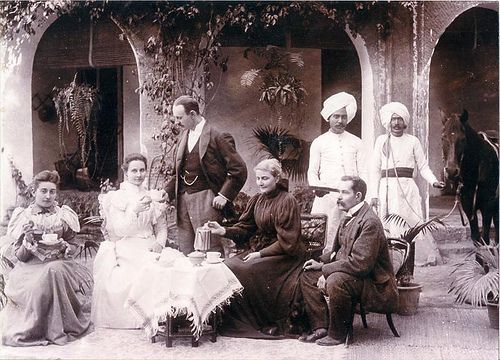
The very first Hindi word to be added in the English dictionary was “loot” which refers to the spoils of war pillaged from an enemy. This first addition was made when the British ruled India and filled their bags with Indian riches.
Before the British established their stronghold in India, our country was known all around the world as “Golden Bird” or “Sone ki Chidiya”.
The disintegration of the Mughal Empire in the 18th CE brought both political and economic fragmentation of the country. It was during this time that the British made their cunning move and eventually began to colonize the country. It was this colonial rule that not only devastated the political and social fabric but also drew out the riches.
A company’s official John Sullivan observed in 1840,
‘Englishmen flourishes, acts like a sponge, drawing up riches from the banks of Ganges and squeezing them down upon the banks of Thames’.
Before the British came, India’s share of the world’s GDP was very significant.
Angus Maddison, a British economic historian observes that the contribution of India to world GDP declined from 24.4% to just 4.2% between 1700-1950. This is really a very dwindling figure.

It was not that the Indians during the colonial times did not understand it. It was apparent to everyone. The greatest contribution in making the common people realize the economic exploitation goes to Dadabhai Naoroji. He put forward the “Drain of Wealth” theory.
He described the drain of wealth as the major cause of Indian poverty. He said that the British were “bleeding India White”.
“By the end of the nineteenth century, India was Britain’s biggest source of revenue, the world’s biggest purchaser of British exports, and the source of highly paid employment for British civil servants and soldiers all at India’s own expense. Indians literally paid for their own oppression.”
― Shashi Tharoor, Inglorious Empire: What the British Did to India
And now the figures of how much the British drained our country would certainly blow everyone’s mind.
Writing in 1859, George Wingate estimated the drain at £4 million per annum for 17 years between 1835-1851.
V.I. Pavlov, professor of Economics at Moscow State University, estimated that in the 1930’s the British squeezed India of £130 million- £140 million in pure tribute.
He remarks that -“With this amount, India could annually construct 3 plants of Bhilai type each of which would exceed in capacity the country’s iron and steel industry in British period”.
Thus, it can be concluded that the exploitation of Britishers is beyond reparation. The Englishmen understood that India was the bird that could lay golden eggs for them. So, they drained our country so excessively that when they left in 1947, they left behind an economically impoverished country, suffering for centuries from poverty and exploitation.
A career in law
When we talk about the law, it has been so important from the primitive time and its importance will never decrease as the world needs to run peacefully and smoothly. Law as a career is a wonderful profession that can give you a plethora of career Ventures. It is the best way to conquer and explore for the students who are good in communication and are also confident about logical reasoning and can easily imbibe into the legal sphere. This is the right and apt place to develop your skills moreover it is in great demand in today’s world.

Career as a lawyer
Lawyers have always been respected and we always need lawyers to interpret law properly. The students can specialize in various areas like a:
Litigation
Corporate Council
Judicial Clerkship
Judiciary and civil service
Media and Publication
Legal process outsourcing
Academia
Social work etc.
Looking into so many streams of specialization a student may get confused but just in case you are confused it is always good to take advice, and research a little bit to the various pros and cons of every stream.
In this topic, we will be analyzing and understanding the career of a lawyer who has taken the stream of litigation as his future career.
About a career as a litigation lawyer
Litigation is a very intellectual and challenging stream as the legal practitioners provide the services by presenting their clients in the Court. a litigation lawyer is also called an attorney. One has to research the legal issues and present his case in front of the judge. He has to draft his legal documents, and there would be a lot of courtroom appearances. Litigation lawyers should have the complete information of the courtroom with the in-depth knowledge of his case.

Eligibility for a career as a litigation lawyer
To be eligible and practice in the court as a litigation lawyer one has to:
Complete the LLB 5 years or LLB 3 year’s course
A student who has completed his LLM is also is eligible
One cannot practice if you have done a diploma or a certificate course.
Other basic requirements are:
The student has to be good with communication skills, logical reasoning, full research in legal concepts, detailed knowledge, patience, troubleshooting, critical thinking, confidence, etc.
Few years of experience through internships in law firms will give necessary skill sets to be a professional litigation lawyer.
Pay structure of a litigation lawyer
A lawyer who is practicing in the court his pay scale differs greatly from organization and experience. Sometimes due to the intellectual capability and skill set a litigation lawyer may become very expensive due to the accurate knowledge and Court deliverance. Reputation also is a Core factor that will differ from person to person. in general, a litigation lawyer on an entry-level will draw 1,80,000 per annum and an average litigation lawyer will earn somewhere around 4,99,000 whereas a senior lawyer’s salary will be somewhere around 7 to 8 lacs per annum.

This job is highly rewarding and also has job satisfaction. It helps you to reach Heights which are unimaginable and you can also develop your skill sets and work experience within no time. The job of a litigation lawyer has new challenges daily and is exciting as law keeps changing, hence one has to always keep updating himself. This profession is a discovery of new knowledge and learning and also gets a lot of financial rewards and sometimes even gives a sense of happiness when a genuine client gets justice because of your effort.
Journey Of Feather 🪶
Being a feather I was expecting that I will have numerous adventure filled with fantasies and daring. But It was not like that I was thinking about. In today’s world there are no scarcity of creative people. A feather is now not only meant to drift through wind but it is also now a major part of creativity.
DIY or we can say do it yourself is one of the popular and viral things that people are adopting it now. So instead of that flying in the sky, I would share my feather experience as a craft material.
So after watching youtube videos or 5 minutes crafts. Kid caught me from the playground and took me to their working table. I was there with a huge bottle of fevicol and a scissors. The kid came and put the fevicol on me. The moment when he put that fevicol the vanes of it got sticked to each other. I was feeling so sticky and heavy at that time . After that he pasted me on a mask which he made by himself. He took scissors and trimmed my vanes to get me a finished look . He looked at me as he has achieved anything. He ran to his parents and show them up this masterpiece I was admired by everyone. The next day the kid took me to school to show off their friends. One of his friends got jealous of him. He came and snatch the mask from him. Now the mask was between the hands of two kids and I was waiting for someone to come and stop this fight. But no one came. The mask was now in 2 pieces but I was in the hand of the kid who made the mask. I was thankful But just few moments later he found another feather on the ground in his school and that was beautiful than me. He threw me and ran to that feather. I was alone and thinking that now I will be burned with the heap of dry leaves by the gardener. Suddenly A girl stepped on me, She realized that and took me up, and now I will be going to a part of a new craft of that girl.
With this, I would like to rest my journey as a feather.
Why is SQL important? What problem is it solving?
Database administration or data management is incomplete without the SQL. For comfortable use of SQL as part of your administration or development requires that you understand the basics of SQL, which will take you a long way in your career.
Before we start with the introduction to the SQL itself, and then, understand the important features of SQL Server. It will take you through a demonstration of the internal workings of SQL, starting from SQL standards, evolution, and progresses to creating tables, understanding and defining relationships, writing Transact‑SQL commands, and so on.
You will also understand that SQL is a special-purpose programming language; special-purpose, as in, it is different from the general-purpose programming languages such as C, C++, Java/JavaScript, etc., meaning, it has a very particular purpose: manipulation of datasets. And this manipulation happens using what is known as Relational Calculus.
But isn’t studying SQL alone, restrictive? Turns out, it isn’t. Of course, we can use SQL on any kind of database or data source, but even if we cannot directly use SQL, most query languages of today have some relationship to SQL. In general, once you know SQL, you can effortlessly pick up other query languages too.
Standards are vital because every relational database must build its framework around this framework in order to ensure compatibility. This means that the learning curve is greatly reduced. SQL is ANSI as well as ISO-compliant, along with other standards, which emphasizes the fact that you have to learn the concept only once.
CYBERSECURITY – AN OVERVIEW

WHAT IS CYBERSECURITY?
Cyber Security is defined as the measures taken to safeguard the connected networks and the data related to them from any attack, damage, or unauthorized access. Every organization like educational, medical, or financial organizations store a large number of user data or many confidential data which needs to be protected from outside access. These data if not protected keeps the company’s reputation at stake. The company needs to cover up data just like we hide our personal information in our online life. Healthcare organizations have their patients’ medical reports along with some personal info. Educational institutions will have the students’ and teacher’s personal as well as academic details. Corporate companies save their employee’s private details including their pay structure and banking details.
Nowadays, we have highly privileged data such as intellectual property, patents, copyrights, etc… which have to be maintained as a secret from other competitive organizations. Losing this kind of information will affect the organization’s future on a large scale. With the advent Internet of Things (IoT), we have a lot more data to be managed and secured as we have widened the storage services through cloud and virtualization. This has given rise to a new stream called Big Data, which covers large volumes of data related to business and technology.
WHY IT IS NEEDED?
All these details are confidential and need to be covered up from the external world so that no one could take easy advantage of them. Whenever we engage in any websites that have access to our data like name, age, or photos, the information will also be saved in the website’s server which allows the hackers to access the data. When the hackers see something beneficial in you, they use this data to threaten you to get something like ransom in return. Some steal this info to use your identity faking as their own. This may harm an individual or a whole company very badly. This summarizes the need for cybersecurity and the increase in scope for the field.
CIA TRIAD
- CONFIDENTIALITY – Also known as privacy, this deals with restricting unknown access by using authentication encryption. Various methods used here are data encryption, two-factor authentication, biometrics and Username, ID, and password.
- INTEGRITY – This ensures accuracy and consistency even after unauthorized access. It is done by bringing in file permissions, version history, and backups. Checksum uses hashing algorithms to compare the hash value before and after any changes in data. If the data remains the same, the hash value returned is also the same. But even if a minute change is done in the data, the hash value returned will not be the same. By comparing the hash values, we can ensure integrity.
- AVAILABILITY – Making the data available only to the authorized users and performing hardware repairs, software updates, and backups on a timely basis. Avoiding attacks by using security software that doesn’t allow malicious attacks.
TYPES OF ATTACKERS
- AMATEURS – Sometimes called script kiddies, these people are the ones with zero or low knowledge of hacking. They just follow the instructions found on the internet out of curiosity or just try their skills out. Still the results can be highly serious.
- HACKERS – This group of people tries to get access to computer networks. They are further classified into three.
- WHITE HAT HACKERS – These people break into computers to find out the flaws and fix them with the prior permission of the organization.
- BLACK HAT HACKERS – These people break into computers with malicious intent and without permission. They try to take advantage of the company’s weaknesses.
- GREY HAT HACKERS – These people fall somewhere between white and black hat hackers. They engage in unethical things but not with the intention of harmful attacks like the black hat hackers.
- ORGANIZED HACKERS – This category includes cybercriminals, hacktivists, terrorists, and state-sponsored attackers.
CONSEQUENCES OF HACKING
The seriousness of the consequences differs with the scenario. But on the whole, the company or the victim is the one who faces the aftermath. For example, the attacker might use phishing techniques to hack your details. There might be some attachments in the mail that seems to be genuine and on clicking that it may look legitimate and ask for your details but actually, it might be a trap of the hackers which may cost you. Another example may be Denial of Service (DoS). We often come across website traffic because a lot of users try to access it. But the overloading may be done by the attackers to shut the website down. Again, this leads to unimaginable consequences. There are many more techniques and examples to cite.
AWARENESS
Awareness leads to prevention. We can be more cautious when we give our private information like DOB, Banking details, ID proofs on any site. We should also be aware that all our picture uploads and other things are stored in the servers which might cause some problems similar to those we come across in our day-to-day life. It is always suggested to stay intact and stealthy when it comes to our social-media life.
Yoga!
Yoga Sanskrit: योग; Sanskrit for “yoking” or “union”, is a group of physical, mental, and spiritual practices or disciplines that originated in ancient India. Yoga is one of the six orthodox philosophical schools of Hinduism. There are a broad variety of yoga schools, practices, and goals in Hinduism, Buddhism, and Jainism and there are four paths or types of yoga: Karma yoga, Kriya yoga, Bhakti yoga, and Jnana yoga. Research studies have shown that traditional yoga systems that include breathing exercises and asanas or postures, chants, and meditation can reduce stress and improve immunity and lung functions. Traditional forms and modern methods of yoga are practiced worldwide.
The practice of yoga has been thought to date back to pre-vedic Indian traditions, possibly in the Indus valley civilization around 3000 BCE. Yoga is mentioned in the Rigveda, and also referenced in the Upanishads, though it most likely developed as a systematic study around the 5th and 6th centuries BCE, in ancient India’s ascetic and Śramaṇa movements.
The chronology of earliest texts describing yoga practices is unclear, varyingly credited to the Upanishads. The Yoga Sutras of Patanjali date from the 2nd century BCE, and gained prominence in the West in the 20th century after being first introduced by Swami Vivekananda. Hatha yoga texts began to emerge sometime between the 9th and 11th century with origins in tantra.
Yoga gurus from India introduced yoga to the West following the success of Vivekananda’s adaptation of yoga without asanas in the late 19th and early 20th centuries. The term “yoga” in the Western world often denotes a modern form of hatha yoga and yoga as exercise, consisting largely of the asanas. Outside India, it has developed into a posture-based physical fitness, stress-relief and relaxation technique. Traditional yoga, however, includes physical exercise, meditation, and spirituality. Yoga has its own epistemological method, which assumes the ontology and metaphysics of the closely correlated Samkhya darsana.
In this today’s world it’s so difficult to spend our time and go to gym and take a diet and etc etc. But yoga is formed to pe in a peace of mind where we are not just physically but we are mentally fit too.
 Eduindex
You must be logged in to post a comment.