Difference between click wrap, shrink wrap and browse wrap contracts

Introduction:

Have you ever wondered how you could have signed a deal with a corporation as large as Amazon while sitting in your recliner? Have you ever agreed to the terms and conditions of an app before using it? Have you clicked “I accept” without understanding what the contract entails? During this time, the pandemic has spurred innovation and the development of new business models. Everything is now available with a single click, whether you want to purchase meals from Zomato, electronics from Amazon, or groceries from Grofers. Have you ever been curious about how they sign contracts with you? Contract signing is also a click away these days.

What are e-contracts?

Contracts that went overseas and returned with new electronics and a fancy name are referred to as e-contracts. Electronic contracts are contracts that exist in a digital format and are in high demand these days. E-contracts are quite similar to normal contracts; the only difference is that they take place through an online digital means of communication. E-contracts have eliminated the need for middlemen, and merchants may now reach out to buyers directly. The computer programmes that link the vendor with an electronic agent, i.e. the app, and the buyer with an electronic agent are now the middlemen. Essentially, it provides a venue for the buyer and vendor to meet.

Are e-contracts binding and valid?

In India, the Indian Contract Act, 1872, Section 10 states that “All agreements are contracts if they are made by the free consent of parties competent to contract, for a lawful consideration and with a lawful object, and are not hereby expressly declared to be void.” 

Also, Section 10(A) of The Information Technology Act 2000 states that “Where in a contract formation, the communication of proposals, the acceptance of proposals, the revocation of proposals and acceptances, as the case may be, are expressed in electronic form or by means of an electronic record, that such contract shall not be deemed to be unenforceable solely on the ground that such electronic form or means was used for that purpose.”

Electronic signatures are also considered as proof of signing under the Indian Evidence Act of 1882, and Digital Signature Certificates are created when a document is electronically signed, and this certificate is also legally valid and binding under the IT Act of 2000.

Contracts in India are governed by The Indian Contract Act, 1872, and electronic contracts must be legitimate within the law’s interpretation. The following are the fundamentals of electronic contracts:

  1. Offer,
  2. Acceptance,
  3. Lawful consideration,
  4. Lawful object,
  5. Competent parties to contract,
  6. Free consent,
  7. Certainty of terms.

E-contracts are favoured over time-consuming paper documents since they are less expensive and more efficient. Electronic contracts, on the other hand, are more efficient to utilize and have a lot faster response time than long paper works. In reality, e-signatures save a significant amount of time and work. As a result, even if they are digitally signed and executed, e-contracts are legally binding and enforceable. However, this is not the case with click-wrap contracts.

Types of e-contracts:

To mention a few, there are shrink-wrap contracts, click-wrap contracts, browse-wrap contracts, source-code escrow contracts, software development and licence agreements, and many more. The following are three distinct types of contracts:

1. Shrink wrap contracts:-

The name of this contract was inspired by the shrink wrap packaging of CD-ROMs, which were used to deliver software. The licence agreements for various software are known as shrink-wrap contracts. These contacts are the licencing agreements, boilerplate, or terms & conditions that come with the product. When a consumer utilises the goods, he has agreed to the terms of the contract. Shrink wrap is the plastic wrapping that is done on the product’s cover. IT businesses are the most likely to utilise shrink wrap. The most intriguing aspect of this contract is that acceptance may be revoked by returning the merchandise. Furthermore, these days, licencing agreements are not supplied with the product, but rather shown before installing the software.

2. Click wrap contracts:-

Have you ever seen the lengthy paragraphs with comprehensive terms and conditions for utilising an app or programme that no one reads? Those are the Click wrap contracts, to be sure. The party is only a click away from signing this contract, as the name implies. To accept the contract, they only need to click a button or check a box. Essentially, the user is compelled to sign the contract or else he would be unable to progress, and therefore they are not negotiable at all. There are certain legal problems that will be addressed later.

3. Browse wrap contract:-

Have you ever seen a sentence that says something like, “By continuing to use these services, you agree to the terms and conditions” or “By signing up, I agree to the terms of usage”?

Browse wrap contracts may be found at the bottom of the page, and acceptance is presumed if the client uses the application. These contracts are often seen on websites, as well as in various mobile apps and software programmes. They can also be accessed via a hyperlink.

Critical analysis:-

Click wrap contracts and shrink wrap contracts are unilateral and presented as fixed contracts, but browse wrap contracts are significantly different in that they do not compel the customer to accept the contract, but rather presume approval when browsing the website.

Contracts such as click wrap and browse wrap are commonly employed by websites that wish to force their customers to adhere to their terms and conditions. The only difference between the two is how they are mandated. While browse wrap does not need consent, click wrap requires customers to click the “I agree” button.

Contracts with customers can be entered into through browse wrap, click wrap, and shrink wrap. Because it was basic and included all of the necessary information, browse wrap is the earliest and typical form of agreement. Shrink wrap was only discovered in the software business, although in a different form.

The agreement is contained inside the packaging of the shrink wrap contract, and the consumer’s approval of the same is indicated by the opening of the package. The terms and conditions and privacy policy for browse wrap contracts are posted on the website and indicated with a link. By default, the customer has consented to this contract. And, in most cases, the phrase reads something like, “Your use of our site implies your acceptance of our Terms of Use and your commitment to be bound by them.” So, if you disagree with the terms and conditions, simply do not use the website.

A click wrap contract, on the other hand, has more criteria than a shrink wrap or browse wrap contract. The two main components that make a significant difference are that, first and foremost, click wrap contracts include a link, but they also include a notice that summarises all of the legal terms and conditions. Second, they request actionable consent via a pop-up window, such as a “I agree” button or a check box. If a website or app employs this contract, it implies that they demand the consumer’s affirmative consent before proceeding. The consumer can also reject the terms and conditions by clicking on a “Cancel” button.

Conclusion:

The Indian Contract Act, 1872 controls all contracts in India, whereas the Information Technology Act, 2000 governs all electronic transactions. The majority of electronic contracts are provided to customers in the form of click wrap and browse wrap. The term wrap is originated from shrink wrap contracts, in which the terms and conditions were shrunk and wrapped in the product packaging. However, click wrap and browse wrap are only employed in digital form. Shrink wrap may be utilized for both digital and physical applications.

Previously, the owner of a website could choose between click wrap and browse wrap, and both were regarded equally legally, such as privacy policies and terms and conditions, but things have changed.

Finally, I’d like to emphasise that while a browser wrap contract can be used for terms and conditions, legal documents such as privacy policies must be accompanied by a click wrap contract to ensure affirmative permission.


Why is water important?

This material accounts for the majority of your body weight and plays a role in a variety of critical functions, including:

removing waste from the body

controlling body temperature and assisting brain function


The majority of your daily water intake comes from liquids, but food also provides a minor quantity.

Photo by Andre Moura on Pexels.com

It helps create saliva

Saliva contains a lot of water. Saliva also contains electrolytes, mucous, and enzymes in minute amounts. It’s necessary for breaking down solid foods and maintaining oral health.

When you drink enough water, your body generates adequate saliva. However, as you become older or take certain medications or therapies, your saliva production may decrease.

If your mouth is drier than usual and increasing your water intake isn’t helping, see your doctor.

It regulates your body temperature

Maintaining your body temperature requires staying hydrated. During physical exercise and in heated situations, your body loses water through sweat.

Sweat keeps your body cool, but if you don’t replace the water you lose, your body temperature will rise. That’s because when you’re dehydrated, your body loses electrolytes and plasma.

If you’re sweating more than normal, make sure you’re getting plenty of rest.

It protects your tissues, spinal cord, and joints

Water keeps your joints, spinal cord, and tissues lubricated and cushioned. This will allow you to enjoy physical exercise while also reducing the agony caused by ailments such as arthritis.

It helps excrete waste through perspiration, urination, and defecation

Water is used by the body to sweat, pee, and pass bowel movements.

Sweat helps to keep your body temperature in check whether you’re exercising or in hot weather. Water is required to replace the fluids lost via sweating.

To have good faeces and avoid constipation, you also need enough water in your system.

Your kidneys are also responsible for removing waste from your body through urination. Adequate hydration is beneficial.

Photo by Daria Shevtsova on Pexels.com

It helps maximize physical performance

Your strength, power, and endurance are all affected by hydration.

If you engage in endurance training or high-intensity sports like basketball, you may be more susceptible to the consequences of dehydration.

Exercise in the heat without adequate hydration can result in dangerous medical issues such as low blood pressure and hyperthermia. Seizures can be caused by severe dehydration.

It aids in digestion

Experts affirm that drinking water before, during, and after a meal will assist your body break down the food you eat more easily, contrary to popular belief. This will aid in your digestion and allow you to get the most out of your meals.

The body adjusts to variations in the composition of food and stomach contents, whether they are more solid or liquid, according to a reliable source.

It helps with nutrient absorption

Water not only aids in the digestion of food, but it also aids in the dissolution of vitamins, minerals, and other nutrients. The vitamin components are subsequently delivered to the remainder of your body for usage.

Reference

http://www.healthline.com

Panchayats

Part IX of the Constitution craves a three-fold system of Panchayats namely (a) The village level; (b) The District Panchayats; (c) The intermediate Panchayats which stands between the village and district in the states where the population is above 20lakhs.

Composition:- All the seats in a panchayat shall be filled by a person chosen by direct election from territorial constituencies in the Panchayat area. The electorate has been named ‘gram sabha’ consisting of a person registered in the electoral rolls relating to a village comprised within the area of a Panchayat.

Duration of Panchayat:- Every Panchayat shall continue for five years from the date of its first meeting. But it can be dissolved earlier by the procedure prescribed by the State law. In case it is dissolved earlier, then the elections must be held within 6months of its dissolution.

Qualifications for Membership:- Article 243 F provides that all persons who are qualified to be chosen to the State Legislature shall be qualified to be chosen as a member of a Panchayat. The only difference is that a person who has attained the age of 21 years will be eligible to be a member.

Powers authority and responsibilities of Panchayats:- State Legislatures have the legislative powers to confer on the Panchayats such as powers and authority as may be necessary to enable them to function as institutions of self-government [Article 243G- 243H]. They are being authorized with the responsibility of (a) preparation of economic development and social justice plans and implementation of schemes for the same, (b) regarding matters listed in the 11th Schedule. The list contains 29 issues including land improvement, minor irrigation, animal husbandry, fisheries, education, women and child development, etc. The 11th Schedule distributes powers between the State Legislature and the Panchayat.

Powers to impose taxes and Financial resources:- Any State by law may authorize a Panchayat to impose, collect, and appropriate taxes, duties tolls, etc. The law may enact the procedure to be fulfilled as well as the limits of these exactions. It can also appoint to a panchayat various taxes and duties etc. collected by the State Government.

Panchayat Finance Commission:- The date on which the Constitution’s 73rd Amendment came into force and afterward every five years the State Government shall appoint a Finance Commission to review the financial position of the Panchayats and to make recommendations to —

(a) the distribution between the State and the Panchayat of the net proceeds of taxes, duties, tolls, and fees leviable by the State which may be divided between them and how the allocation would be made among various levels of Panchayats.

(b) what taxes, duties, tolls, and fees may be assigned to the Panchayats.

(c) grant-in-aid to the Panchayats.

The report of the Commission, together with a memorandum of action taken on it, shall be laid down before the State Legislature. These provisions are modeled on Article 280 which contains provisions regarding appointment of a Finance Commission for the distribution of finances between the Union and the States.

Bar to interference by Courts in Electoral matters:- As under Article 329, Courts shall have no jurisdiction to examine the validity of a law, relating to the delimitation of constituencies or the allotments of seats, made under Article 243K.

All about Horoscope

A horoscope (also known as a natal chart, astrological chart, astro-chart, celestial map, sky-map, star-chart, cosmogram, vitasphere, radical chart, radix, chart wheel, or simply chart) is an astrological chart or diagram that depicts the positions of the Sun, Moon, planets, astrological aspects, and sensitive angles at the time of an event, such as a birth.

Photo by RODNAE Productions on Pexels.com

Horoscope comes from the Greek words ra and scopos, which mean “time” and “observer” (horoskopos, pl. horoskopoi, or “hour marker(s)”). It is utilised as a means of divination for occurrences related to the time period it symbolises, and it is the foundation of astrology’s horoscopic traditions.

The horoscope depicts the skies as a stylised map over a certain area at a specific time. In most cases, the viewpoint is geocentric (heliocentric astrology being one exception).

The chart includes the positions of the actual planets (including the Sun and Moon), as well as entirely calculated features such the lunar nodes, house cusps (including the midheaven and ascendant), zodiac signs, fixed stars, and the lots.

Aspects are angular relationships between planets and other points that are commonly determined. 

The vernal point (the first day of spring in the northern hemisphere) is defined by the tropical zodiac as the first degree of Aries, although the sidereal zodiac permits it to process.

Many individuals are perplexed by the distinction between the sidereal and tropical zodiac signs.

t is worth pointing out that the sidereal signs and the tropical signs are both geometrical conventions of 30° each, whereas the zodiacal constellations are pictorial representations of mythological figures projected onto the celestial sphere based on patterns of visible star groupings, none of which occupy precisely 30° of the ecliptic.

So constellations and signs are not the same, although for historical reasons they might have the same names

An astrologer must first determine the exact time and location of the subject’s birth, or the start of an event, in order to generate a horoscope.

At the same time, the local standard time (adjusted for daylight saving time or wartime) is transformed into Greenwich Mean Time or Universal Time. To be able to calculate, the astrologer must translate this to the local sidereal time at birth.

Photo by RODNAE Productions on Pexels.com

The astrologer will then examine an ephemeris, a set of tables that displays the positions of the Sun, Moon, and planets for a given year, date, and sidereal time in relation to the northern hemisphere vernal equinox or fixed stars for a given year, date, and sidereal time (depending on which astrological system is being used).

The horoscope is divided into 12 sectors that circle the ecliptic, beginning with the ascendant or rising sign on the eastern horizon.

The houses are the 12 sectors, and there are several techniques for computing these divisions. Since the 19th century, tables of dwellings have been issued to make this otherwise difficult work easier.

Horoscopes and the zodiac sign have always been popular, and they continue to be so today. From celebrities to the ordinary population, there are a large number of devoted fans.

It can be tough to accept that astrology is not based on scientific facts and is a pseudoscience when there are so many believers and perhaps a personal connection to the horoscope or the zodiac.

Reference

http://www.wikipedia.com

http://www.timesofindia.com

http://www.elle.com

The State Executive

Our Constitution provides for a federal Government, having separate systems for administration, the Union, and the States. The Constitution comprises provisions for the governance of both. It provides a uniform structure for the state Government, in Part VI of the Constitution, which applies to all the states including the erstwhile State of Jammu and Kashmir.

The Governor:- At the head of the executive of a State stands the Governor. The executive powers of the state are vested in the Governor. Generally, there shall be a Governor for every state, but an amendment of 1956 makes it possible for the appointment of some person as the Governor for two or more States[Article 153].

Appointment and term of Office of the Governor:- The Governor of a State is not elected but is appointed by the President and holds his office at the pleasure of the President. Any citizen of India who has completed the age of 35 years is eligible for the office, but he must not hold any other office of profit, and should not be a member of the Legislature of the Union of any State [Article 158]. There is no bar for the selection of a Governor amongst the members of a Legislature, but if a Member of any Legislature is appointed as Governor, he should cease the position of member immediately after such appointment.

The normal term of a Governor’s Office shall be five years, but he can be terminated for the following reasons—

(i) Dismissal by the President, at whose pleasure he holds office [Article 158].

(ii) Resignation [Article156 (2)].

The President’s power can be used only in cases of gross delinquency, such as bribery, corruption, reason, and violation of any provision of the Constitution. There is no bar to a person begin appointed as Governor more than once.

Powers of the Governor:- The Governor has no diplomatic or military powers like the President, but he possesses executive, legislative, and judicial powers similar to those of the President.

(1) Executive Powers– The Governor has the power to appoint his Council of Ministers, the Advocate General, and the members of the State Public Service Commission and holds office during his pleasure. But the members of the State Public Service Commission cannot be removed by him [Article 317]. The Governor has no power to appoint the Judges of High Court he is entitled to consult the President in the matter [Article 217(1)]. He can also nominate 1/6th part of the total members of the Legislative Council.

(2) Legislative Power:- The Governor has a right to addressing and sending messages and summoning, prorogue, and dissolving, in association with the State Legislature, just like the President.

(3) Judicial Powers- The Governor has the power to grant pardon, reprieve, respite, or remission of punishment or to suspend, remit, or commute the sentence of any person convicted of any offense against any law relating to a matter to which executive power of the State extends [Article 161]. The Chief Justice and the Judges of the High Court of the State are appointed with the consultation of the Governor by the President.

(4) Emergency Powers- The Governor has no Emergency powers to perform.

Andhra Pradesh college gets permission to offer engineering in Telugu

The All India Council for Technical Education (AICTE) gave its consent for the NRI Institute of Technology, a private autonomous engineering college in Krishna district, to introduce the programme in Telugu.

It is the only institution in Andhra Pradesh and Telangana to get the permission for BTech Telugu medium with a 60-student intake into the computer science engineering stream.

In all, the AICTE allowed 14 engineering colleges across the country to offer the engineering programmes in Hindi, Tamil, Telugu and other native languages from the 2021-22 academic year.

The move is expected to provide a level playing field for the students, particularly from the rural and tribal areas who have studied in their native languages since childhood.

One of the major recommendations of the National Education Policy 2020 is to promote regional languages in education.

While the NEET exam is currently being conducted in 11 languages, the Union Ministry of Education is holding the JEE (Main) in 13 languages.

Speaking to TOI, principal, NRI Institute of Technology, Dr C Naga Bhaskar, said that the AICTE has chosen the 14 autonomous and NAAC- and NBA-accredited colleges to give permission to offer engineering courses in native languages.

Students to have option of Telugu, Eng for exams

“The move would definitely improve the grasp, creativity, and comprehension levels of the students. Several advanced countries like Japan, Germany and China impart education in their mother tongue. Students would be given the option of writing exams in Telugu or English. The Board of Studies of our college will finalise the syllabus and other components of the programme,” said Dr Bhaskar.

Dr Bhaskar said that it is generally believed that the English medium students would be in an advantageous position compared to their Telugu counterparts. “But, several exams like NEET, JEE and UPSP are currently being conducted in various regional languages. It may be further extended to exams like the engineering services examination in the coming years. This would give an impetus to professional education in local languages,” said Dr Bhaskar.

In a recent Facebook post titled ‘Engineering courses in mother language – A step in the right direction’, posted in 11 Indian languages Vice-President M Venkaiah Naidu lauded the move of 14 engineering colleges across eight states to offer engineering courses in regional language. “It is my desire to see the day when all vocational and professional courses like engineering, medicine and law are taught in mother languages,” said the Vice-President in the post.

Rules of Happiness

Be silent in the heat of Anger.

As we all do, In anger we never think twice before saying anything and this is the main reason behind the poor relationship. We cause harm to both others and us both.

Avoid caring what people think.

Before doing anything we always think to much about others think if I do that. And this leads to unhappiness and doubt on ourselves.

Don’t waste time in explanation.

There is no need to explain yourself always. Sometimes we have to believe on our own capabilities and prove others that what I did is right decision for me.Time reveals Everything.

Privacy is Everything.

Never tell everyone, everything. Everyone is not happy with your success. Don’t reveal your path to anyone before you achieve something.

Don’t screw your present, thinking of past.

Start working for your success now. Past has gone it never come back but why we waste our present and future by thinking of past. We design our future by make use of present.You are responsible for everything that you do. So start working for your future.

Stop overthinking, Sometimes it’s okay to not know answers.

We just ruin our life by overthinking. What we overthink is never going to happen. So just relax and enjoy your life without thinking anything.

It’s okay to not be okay.

Everyone’s mental state is not same. And sometimes It’s okay to feel low. It’s okay to be sad. We just have to believe on ourselves. And do what we want. Its okay, everything will be alright soon…

Don’t compare own life with others.

Everyone is different. And if we compare ourselves with other then we just ignore our own capabilities. So believe in yourself,your capabilities.

Don’t let others to disrupt your inner peace.

Sometimes, some people come in our life just to pull us down. But we have to focus on our goals. If we disrupt our inner peace then they will succeed in their intentions. We have to focus more whenever we meet any problems in between our goals.

We are always unattractive in the eyes of society.

No matter what we do, society will never going to appreciate us. So don’t worry about the society and do whatever you want. We always worry about “Chaar log” but no one ever saw them.

Take a charge of your own happiness, we are only responsible for ours not others.

3D PRINTING – AN OVERVIEW

3D printing, also called Digital fabrication technology or Additive manufacturing is the process of making 3-dimensional solid structures or models from the geometric representation by successive addition of materials. The layers of the printed object are a thinly sliced cross-section of the object. 3D printing is an emerging technology that enables us to produce objects with fewer materials than traditional manufacturing methods. 

The process of 3D printing involves 3 major steps.

  • MODELING AND SLICING

It is the first step in the process of 3D printing. Here, even the tiniest detail of the objects is given. The geometric representation of the object is created using software tools called slicing software. The process of building the structure using this software is called slicing as it slices the object to create many layers. The work of this software is to convert the geometry of the object into instructions for the 3D printer. It will tell the printer how to create the layers of the object. In addition, the instructions can also be provided through STL files. STL is a simple, portable object file that is used for designing computer-aided design CAD systems to model the solid geometry of the objects. These STL files are used as the input information for the 3D printers to produce the object. The object is produced by forming layers of the printing material as per the geometric measurements provided. The materials used differ for different technologies.

  • PRINTING

When the modeling and slicing get over, the 3D printer starts its work. Assuming that there is no error in the model, the printer begins to print. It dispenses the material layer-by-layer waiting for one layer to get dried so that it could add the next layers. The bottom-most layer is formed first followed by the next highest layers. The model is printed by adding hundreds and thousands of 2D prints on top of one another to make a 3D model. Although many materials are used for 3D printing, thermoplastic is the most widely used one. 

  • FINISHING

This is the final and post-printing step in manufacturing a 3D object or model. Once the object is printed and dried completely, a finishing touch is given to remove small damages that occur during the printing and refine the parts. It is done to give a smooth surface finish to the object. Solvents are added to remove the superficial imperfections in the model. There are various methods followed in finishing such as polishing, sanding, etc.

The time taken to complete printing may depend on the size, details, and quality of the object created as higher quality objects take more time comparatively. 3D printing can take some minutes or hours or weeks or even more. For example, it takes almost a few hours to create a simple model like boxes and balls and takes weeks to produce more large and complex structures with more details like buildings and houses. The larger the size and geometry of the object, the longer will be the time spent to create the object. So, 3D printing is useful at the same time, it is a time-consuming process.

The Transgender Rights.

Transsexual individuals come from varying backgrounds, and HRC Foundation has assessed that there are multiple million of us across the United States. We are guardians, kin, and children. We are your collaborators, your neighbors, and your companions. We are 7-year-old children and 70-year-old grandparents. We are a different local area, addressing all racial and ethnic foundations, just as all confidence customs.

“Transsexual” – or trans – is an umbrella term for individuals whose sexual orientation character is not quite the same as the sex allocated to us upon entering the world. Albeit “transsexual” and our cutting edge meaning of it just came into utilization in the late twentieth century, individuals who might fit under this definition have existed in each culture all through written history.

Close by the expanded perceivability of trans big names like Laverne Cox, Jazz Jennings or the stars of the hit Netflix series “Posture,” three out of each ten grown-ups in the U.S. actually knows somebody who is trans. As trans individuals become more noticeable, we mean to expand comprehension of our local area among our companions, families, and society.

What’s the significance here to be trans?

The trans local area is staggeringly different. Some trans individuals distinguish as trans men or trans women, while others might depict themselves as non-twofold, genderqueer, sexual orientation non-adjusting, agender, bigender or different characters that mirror their own insight. A few of us take chemicals or have a medical procedure as a feature of our progress, while others might change our pronouns or appearance. About 3/4 of trans youth that reacted to a HRC Foundation and University of Connecticut overview related to terms other than stringently “kid” or “young lady.” This recommends that a bigger segment of this present age’s childhood are recognizing some place on the expansive trans range.

What difficulties do trans individuals confront?

While trans individuals are progressively apparent in both mainstream society and in every day life, we actually face serious segregation, shame and fundamental imbalance. A portion of the particular issues confronting the trans local area are:

Absence of lawful assurance Trans individuals face a general set of laws that regularly doesn’t shield us from separation dependent on our sexual orientation character. Regardless of a new U.S. High Court Decision that clarifies that trans individuals are lawfully shielded from segregation in the working environment, there is still no complete government non-separation law that incorporates sex character – which implies trans individuals might in any case need response on the off chance that we face separation when we’re looking for lodging or eating in an eatery. Besides, state assemblies the nation over are discussing – and sometimes passing – enactment explicitly intended to deny trans individuals from getting to public restrooms that compare with our sexual orientation personality, or making exclusions dependent on strict convictions that would permit oppression LGBTQ individuals.

Destitution Trans individuals live in neediness at raised rates, and for trans minorities, these rates are much higher. Around 29% of trans grown-ups live in destitution, also 39% of Black trans grown-ups, 48% of Latinx trans grown-ups and 35% of Alaska Native, Asian, Native Americans and Native Hawaiian or Pacific Islander trans grown-ups.

Shame, Harassment and Discrimination – About a large portion of 10 years prior, just one-fourth of individuals in the United States upheld trans rights, and backing expanded to 62% continuously 2019. Regardless of this advancement, the trans local area actually faces extensive shame due to over a hundred years of being described as mentally sick, socially degenerate and physically savage. While these bigoted perspectives have blurred lately for lesbians and gay men, trans individuals are regularly still criticized by a general public that doesn’t get us. This disgrace works out in an assortment of settings – from administrators who influence hostile to trans shame to score modest political focuses; to family, companions or associates who reject trans individuals after finding out about our trans characters; and to individuals who pester, menace and submit genuine brutality against trans individuals. This incorporates disgrace that keeps them from getting to fundamental administrations for their endurance and prosperity. Just 30% of women’s havens will house trans women. While ongoing lawful advancement has been made, 27% of trans individuals have been terminated, not recruited or denied an advancement because of their trans personality. Time after time, harassment has driven trans individuals to try not to practice their most essential rights to cast a ballot. HRC Foundation’s exploration shows that 49% of trans grown-ups, and 55% of trans grown-ups of shading said they couldn’t cast a ballot in something like one political decision in their life due to dread of or encountering separation at the surveys.

Savagery Against Trans People–Trans individuals experience viciousness at rates far more noteworthy than the normal individual. More than a larger part (54%) of trans individuals have encountered some type of cozy accomplice brutality, 47% have been physically attacked in the course of their life and almost one of every ten were actually attacked in the middle 2014 and 2015. This sort of viciousness can be lethal. No less than 27 trans and sexual orientation non-adjusting individuals have been viciously killed in 2020 hitherto, similar number of fatalities saw in 2019.

The Right To Education.

The Right of Children to Free and Compulsory Education Act or Right to Education Act (RTE), is an Act of the Parliament of India authorized on 4 August 2009, which portrays the modalities of the significance of free and obligatory schooling for children somewhere in the range of 6 and 14 in India under Article 21a of the Indian Constitution. India became one of 135 nations to make training a fundamental right of each child when the Act came into power on 1 April 2010.

The Act makes instruction a fundamental right of each child between the ages of 6 and 14 and determines least standards in elementary schools. It requires all non-public schools to save 25% of seats to children (to be repaid by the state as a component of the public-private organization plan). Children are conceded in to tuition based schools dependent on monetary status or rank based reservations. It likewise restricts all unnoticed schools from training, and makes arrangements for no gift or capitation expenses and no meeting of the child or parent for affirmation. The Act likewise gives that no child will be kept down, removed, or needed to breeze through a board assessment until the culmination of elementary schooling. There is likewise an arrangement for uncommon preparing of school quitters to carry them acceptable with understudies of a similar age.

The RTE Act requires overviews that will screen all areas, distinguish children requiring instruction, and set up offices for giving it. The World Bank instruction expert for India, Sam Carlson, has noticed: “The RTE Act is the principal enactment on the planet that puts the obligation of guaranteeing enrolment, participation and fruition on the Government. It is the guardians’ duty to send the children to schools in the US and different nations.”

The Right to Education of people with handicaps until 18 years old is set down under a different enactment – the Persons with Disabilities Act. Various different arrangements with respect to improvement of school framework, instructor understudy proportion and personnel are made in the Act.

Training in the Indian constitution is a simultaneous issue and both focus and states can administer on the issue. The Act sets down explicit obligations regarding the middle, state and neighborhood bodies for its implementation. The states have been clamoring that they need monetary ability to convey instruction of suitable norm in all the schools required for all inclusive training. In this manner plainly the focal government (which gathers the greater part of the income) will be needed to sponsor the states.

A board set up to contemplate the assets requirement and subsidizing at first assessed that INR 1710 billion or 1.71 trillion (US$38.2 billion) across five years was needed to implement the Act, and in April 2010 the focal government consented to sharing the financing for implementing the law in the proportion of 65 to 35 between the middle and the states, and a proportion of 90 to 10 for the north-eastern states. Be that as it may, in mid 2010, this figure was moved up to INR 2310 billion, and the middle consented to raise its offer to 68%. There is some disarray on this, with different media reports expressing that the a lot of the implementation costs would now be 70%. At that rate, most states should not have to expand their schooling financial plans generously.

A basic development in 2011 has been the choice taken on a basic level to stretch out the right to schooling till Class X (age 16) and into the preschool age range. The CABE board is currently investigating the ramifications of rolling out these improvements.

The Ministry of HRD set up an undeniable level, 14-part National Advisory Council (NAC) for implementation of the Act. The individuals included Kiran Karnik, previous leader of NASSCOM; Krishna Kumar, previous overseer of the NCERT; Mrinal Miri, previous bad habit chancellor of North-East Hill University; Yogendra Yadav – social researcher. India

Sajit Krishnan Kutty, Secretary of The Educators Assisting Children’s Hopes (TEACH) India; Annie Namala, an extremist and head of Center for Social Equity and Inclusion; and Aboobacker Ahmad, VP of Muslim Education Society, Kerala.

A report on the situation with implementation of the Act was delivered by the Ministry of Human Resource Development on the one year commemoration of the Act. The report concedes that 8.1 million children in the age bunch six-14 stay out of school and there’s a deficiency of 508,000 instructors country-wide. A shadow report by the RTE Forum addressing the main schooling networks in the nation, nonetheless, testing the discoveries bringing up that few key lawful commitments are falling behind the timetable. The Supreme Court of India has likewise mediated to request implementation of the Act in the Northeast. It has likewise given the lawful premise to guaranteeing pay equality between educators in government and government helped schools. Haryana Government has relegated the obligations and duties to Block Elementary Education Officers–cum–Block Resource Coordinators (BEEOs-cum-BRCs) for viable implementation and persistent checking of implementation of Right to Education Act in the State.

It has been called attention to that the RTE act isn’t new. Widespread grown-up establishment in the demonstration was gone against since the majority of the populace was unskilled. Article 45 in the Constitution of India was set up as a demonstration: The State will attempt to give, inside a time of a long time from the commencement of this Constitution, free of charge and necessary schooling for all children until they complete the age of fourteen years.

As that cutoff time was going to be passed numerous many years prior, the instruction serve at that point, MC Chagla, notably said: “Our Constitution fathers didn’t mean that we just set up cabins, put understudies there, give undeveloped instructors, give them terrible course readings, no jungle gyms, and say, we have consented to Article 45 and essential training is growing… They implied that genuine training ought to be given to our children between the ages of 6 and 14” – (MC Chagla, 1964).

During the 1990s, the World Bank subsidized various measures to set up schools inside simple reach of provincial ommunities. This work was solidified in the Sarva Shiksha Abhiyan model during the 1990s. RTE takes the interaction further, and makes the enrolment of children in schools a state right.

THE JOURNEY OF PURI TOWARDS FIRST CITY TO PROVIDE 24 X 7 CLEAN WATER

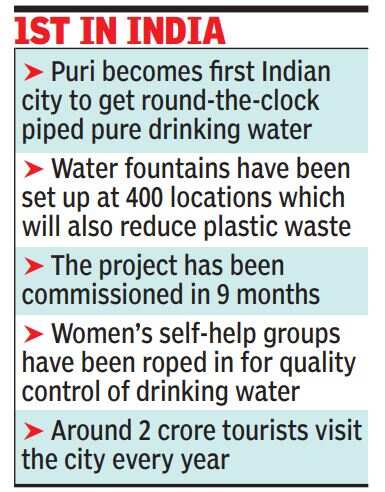
Puri is one of the major heritage cities of the country and every year more than 2 crore tourists visit every year. And this month the city earned an unique distinction of becoming the first Indian city to provide 24X7 pure drinking water. This is the landmark achievement for the city and state and is one of the major contributors for enhancing the status of sanitation and hygiene in Puri, Odisha. The city has become the first city to offer safe drinking water directly from taps to the residents and the tourists visiting the city every year and now has joined the group of global metropolitans like London and New York for providing safe drinking water.

The government launches “Sujal: Drink from Tap Mission” which has the goal of providing all time safe drinking water to all the residents and people visiting the cities directly through taps. The city has fulfilled and achieved the credentials of the ambitious mission and has achieved the goal of the mission. The 24 hour drink from tap facility provides water which can be used directly without filtration for different purposes such as drinking, cooking etc. This move is beneficial for the 2.5 lakh people residing in the city and the 2 crore tourists visiting the city every year. And the people don’t need to carry water bottles with them and can directly rely on the taps. This type of facility is present in very limited number of cities globally and Puri has established its place. Furthermore, the state government had installed 400 water fountains in different locations of the city with the aim of reducing the reliance and usage of plastic bottles in Puri. This will eventually reduce the amount of plastic wastes being can be reduced.

The government uses 5T initiative for increasing the efficiency and effectivity of the services being delivered across the city. The Chief Minister of the state emphasized on the linkage between safe drinking water with health, living standards and the economy, thereby, urging the people not to waste or pollute water. Transparency, teamwork, technology, time-frame and transformation form the 5Ts which has been adopted by the government for improving its governance. The budget for drinking water has been doubled in 5 years from Rs 200 crore to Rs 4000 crore thereby making the city the first heritage town in the country to get this facility. It is expected that the initiative will have great contribution in reducing the amount of plastic wastes generated. It is estimated that the amount of plastic waste being generated by the city will reduce by 400 tonne per annum. 1100 Stand posts were already present in the city and the state government has established additional 110 modern public stand posts along the Grand Road (Badadanda) and nine by the sea beach area have been installed. Old stand posts are being replaced with steel pipes and taps and at present 36 MLD clean water is being supplied everyday in the city. About 135 – 140 liters of drinking water per head per day is being provided to the residents everyday.

Cancer

Cancer is one of the most haunting diseases, squandering lives since ages. It occurs due to abnormal cell growth due to genetic mutations from environmental and lifestyle factors. Major of these factors are smoking, obesity, infections. There are also some certain chemicals known as carcinogens. Tobacco smoke causes almost 90% of the lung cancer. Physical inactivity and obesity also causes about 30-35% of cancer deaths.Not only cancer physical inactivity also hampers endocrine and immune system.

There are various types of cancer:

LEAUKEMIA : Commonly known as blood cancer,leukaemia affects the tissues of the bone marrow which is responsible for blood production. It is caused by abnormal production of white blood cells.

Myeloma: It targets plasma cells of our immune system. These cells divide in the bone marrow causing multiple tumours in the bones 

LYMPHOMA: It affects the lymphocytes in the lymph nodes, which are a part of the immune system.

CNS CANCER: CNS (Central Nervous System) cancers originate from the brain and the spinal cord. Gliomas, vestibular schwannomas, meningiomas, primary CNS lymphomas, pituitary adenomas are few CNS cancers.

Melanoma: It is a form of skin cancer that targets melanin – the pigment responsible for skin colour. In this form of cancer, the melanocytes are affected resulting in the abnormal formation of melanin. It may also affect other tissues that are pigmented, such as the eyes.

Symptoms

There are various symptoms through which cancer can be detected such as irregular loss weight, fatigue, continuous pain, fever or any irregular changes in skin.

Causes

Cancer can be caused by innumerous factors such as genetical factors, tobacco, alcohol, obesity, unhealthy environment, exposure to unnatural radiations etc.

Treatment

With the advancement of science many cures have been found for the treatment of cancer. The process of treatment depends on the type and stages of cancer. Some of the common treatment includes surgery, chemotherapy, hormonal therapy, immunotherapy, and radiation therapy.

Freedom of Speech

The right to speak freely of discourse is the option to say whatever you like about whatever you like, at whatever point you like, correct? Wrong. The right to speak freely of discourse is the option to look for, get and grant data and thoughts, everything being equal, using any and all means.’
The right to speak freely of discourse and the right to opportunity of articulation applies to thoughts of various sorts including those that might be profoundly hostile. In any case, it accompanies duties and we trust it tends to be genuinely limited.
At the point when the right to speak freely of discourse can be limited You probably won’t anticipate that we should say this, however in specific conditions free discourse and opportunity of articulation can be limited.

Governments have a commitment to preclude disdain discourse and incitement. Furthermore, limitations can likewise be legitimized in the event that they ensure explicit public interest or the rights and notorieties of others.

Any limitations on the right to speak freely of discourse and opportunity of articulation should be set out parents in law that must thus be clear and compact so everybody can get them. Individuals forcing the limitations (regardless of whether they are governments, managers or any other person) should have the option to show the requirement for them, and they should be proportionate. The entirety of this must be upheld by protections to stop the maltreatment of these limitations and consolidate an appropriate offers measure….also, when it can’t

Limitations that don’t follow this load of conditions disregard opportunity of articulation. We consider individuals put in jail exclusively for practicing their right to free discourse to be detainees of soul. Jabbar Savalan was detained subsequent to calling for challenges the government on Facebook. We thought of him as a detainee of still, small voice and lobbied for his delivery. Peruse Jabbar’s story

Governing rules

Any limitation ought to be just about as explicit as could be expected. It is inappropriate to boycott a whole site in view of an issue with one page.

Public safety and public request
These terms should be definitely characterized in law to forestall them being blamed for over the top limitations.

Ethics
This is an extremely abstract region, yet any limitations should not be founded on a solitary custom or religion and should not oppress anybody living in a specific country.

Rights and notorieties of others
Public authorities ought to endure more analysis than private people. So slander laws that stop real analysis of a government or public authority, disregard the right to free discourse.

Impiety
Securing theoretical ideas, strict convictions or different convictions or the sensibilities of individuals that trust them isn’t justification for limiting ability to speak freely.

Media and writers
Writers and bloggers face specific dangers in view of the work they do. Nations thusly have a duty to secure their right to the right to speak freely of discourse. Limitations on Newspapers, TV stations, and so forth can influence everybody’s more right than wrong to opportunity of articulation.

Informants
Government ought to never bring criminal procedures against any individual who uncovers data about denials of basic liberties.

Rights and duties
Free discourse is one of our most significant rights and quite possibly the most misjudged. Utilize your ability to speak freely to stand up for those that are denied theirs. Be that as it may, use it capably: it is something incredible.

How to Increase Productivity? (For Students)

“The key is not to prioritize what’s on your schedule, but to schedule your priorities.”

– Stephen Covey

Introduction

Productivity isn’t only for working people, it is equally if not more important for students. As a student you are learning a lot of new things at the same time, it might even become overwhelming. You can be in school or college, you will still need productivity and organization. It is important to stay on track, achieve your goals, be it short-term or long-term. Life as a student can be very distracting, there are too many things begging for attention, such as sports, friends, a social life, partying. At the same time, you are absorbing a lot of new information from everywhere, and to be on top of all your work will help in not feeling overwhelmed. This article aims to discuss how to increase productivity as a student.

Make a To-Do List

Now, this might sound a little stupid but To-Do Lists help a lot, speaking from personal experience. It will be ideal to make the list before sleeping, that way you will not have to waste some time of the day in making the list, and it will also help you in understanding how much you need to get done and you will wake up prepared for it. The very basic way is to just list down the tasks you have for the day but if you want to go a level up, you can schedule your tasks by the hour, that is make a timetable for the day which will include your daily activities as well. For Example:

7:30 – Wake up

8:00 – Attend Family Law Class

10:40 – Have breakfast

11:15 – Do research for Memo

1:00 – Have lunch

Understand Your Learning Style

Everyone has a different style of learning:

Visual learning – learning things by looking at things like graphs, charts, and infographics. Learning things by looking at them.

Kinesthetic learning – learning things through a practical approach like experiments.

Auditory learning – learning things by hearing them said aloud.

Reading and Writing Learner – learning things by writing them and then revising from them.

Once you figure out your learning style, you should try to follow it as that is the best-suited one for you and will help you in understanding better and quicker.

Take Breaks

Studies show that your productivity stays intact when you take short breaks after studying for some time. This gives your brain time to stay focused and motivated. If you keep pushing your brain beyond its capability, you are creating stress and you start getting tired.

Reduce Social Media time

It is a well-known fact that social media is the biggest distraction for everyone. Asking to quit also may sound absurd but all of it depends on your self-control. Personally, I am good at staying away from it when needed so I have never had to quit it temporarily, but if you know you do not have good self-control, you should try to quit it for some time. If that sounds like too much to you, you can try to set time slots when you get to check social media and keep it away when doing a task. Remember that developing self-control is very important.

Reward Yourself

It is important to understand that the practice of rewarding yourself will only work if you have a good sense of self-control. Once you achieve your goal, you can reward yourself with little things like watching a movie, an episode of your favourite series or going out with your friend. This way you have something to look forward to after finishing your work.

Conclusion

Productivity is best accompanied by time management, they both go hand-in-hand. You can only become more productive if you have learnt to manage your time properly. These tips should help with increasing productivity but you should take efforts to increase your self-control as it is a huge part of everything in our life.

References

Biography- Sri Ramakrishna Paramhansa

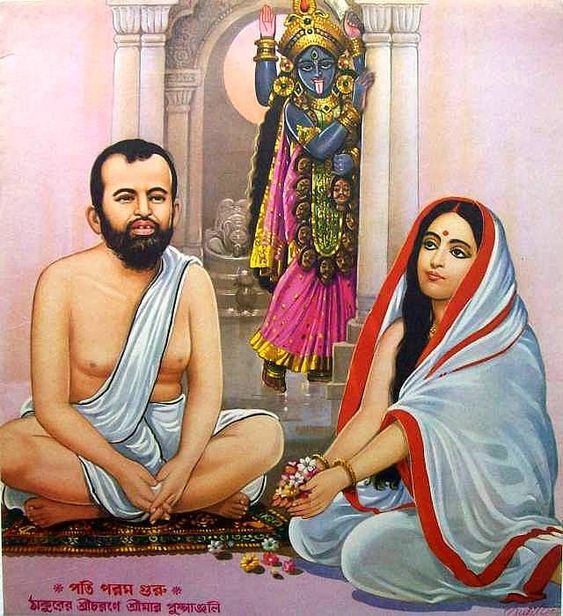
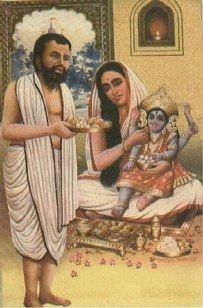
Sri Ramakrishna, the God-man of modern India, was born on 18 February 1836 at Kamarpukur in the Hooghly district in India. His parents Khudiram and Srimati Chandramoni were exceptionally devoted persons and earned the love and respect of the villagers for their charity, truthfulness and kindness. Sri Ramakrishna’s early name was Gadadhar Chattopadhyaya or Gadai and later known as Ramakrishna Paramhansa.  Paramhansa is a title of honor applied to Hindu spiritual teachers who have become enlightened. He learnt some lessons in the village pathshala but he was not very much interested in it. Sri Ramakrishna experienced spiritual ecstasies from a young age and was influenced by several religious traditions, including devotion toward the Goddess Kali, Tantra, Bhakti and Advaita Vedanta. Gadadhar was seven years old when his father died. At the age of sixteen, Gadadhar came to Calcutta (now Kolkata) with his elder brother Ramkumar, who wished his assistance in his priestly duties. At that time a rich widow named Rani Rasmani built a temple for the goddess Kali on the eastern bank of the Ganga at Dakshineswar. Being invited by Rasmani, Ramkumar with his brother Gadadhar came to the sacred temple garden and Gadadhar found greater opportunities to pursue his spiritual practices. In 1855 Ramakrishna was appointed as the priest of Dakshineswar Kali Temple, built by Rani Rashmoni. To Sri Ramakrishna, the image of Kali was not an inert stone, but the Mother herself. Rani Rashmani was greatly attracted to Sri Ramakrishna, for she felt that his strange behaviour was for the fullness of devotion to goddess Kali. Sri Ramakrishna had a catholic spirit from the very beginning and he made no distinction between one form of God in Hinduism to another in Islam or Christianity. Rumours spread to Kamarpukur that Ramakrishna had become unstable as a result of his spiritual practices at Dakshineswar. Ramakrishna’s mother and his elder brother Rameswar decided to get Ramakrishna married, thinking that marriage would be a good steadying influence upon him—by forcing him to accept responsibility and to keep his attention on normal affairs rather than his spiritual practices and visions. Ramakrishna himself mentioned that they could find the bride at the house of Ramchandra Mukherjee in Jayrambati, three miles to the northwest of Kamarpukur. The five-year-old bride, Saradamani Mukhopadhyay (later known as Sarada Devi; she is also considered as an avatar) was found, and the marriage was duly solemnised in 1859. Ramakrishna was twenty-three at this point, but this age difference for marriage was typical for nineteenth-century rural Bengal. They later spent three months together in Kamarpukur. Sarada Devi was fourteen, while Ramakrishna was thirty-two. Ramakrishna became a very influential figure in Sarada’s life, and she became a strong follower of his teachings. After the marriage, Sarada stayed at Jayrambati and joined Ramakrishna in Dakshineswar at the age of eighteen.

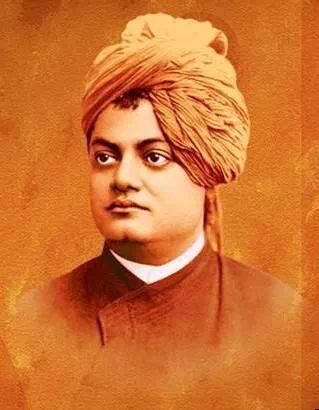
To spread his message to the world around Sri Ramakrishna needs a strong instrument. And such an instrument was found in Narendranath Dutta, his beloved Naren, later known to the world as Swami Vivekananda.

The last days of Sri Ramkrishna were with his devoted disciples. Ramakrishna’s condition gradually worsened, and he died in the early morning hours of 16 August 1886 at the Cossipore garden house. According to his disciples, this was mahasamadhi. After the death of their master, the monastic disciples led by Vivekananda formed a fellowship at a half-ruined house at Baranagar near the river Ganges, with the financial assistance of the householder disciples. This became the first Math or monastery of the disciples who constituted the first Ramakrishna Order.