Financing sources for Start-ups

Presently, there are various schemes and financing options available to new businesses as it becomes easier to procure funds for new businesses with time. In fact, entrepreneurs can actually choose the source that is the most convenient and suitable according to the nature of their business and the amount they need. Let’s take a look at some of the most commonly used sources-

a) CROWDFUNDING

Crowdfunding is that the use of small amounts of capital from an outsized number of people to finance a new business venture. Crowdfunding makes use of the straightforward accessibility of vast networks of individuals through social media and crowdfunding websites to bring investors and entrepreneurs together, with the potential to extend entrepreneurship by expanding the pool of investors beyond the normal circle of householders or relatives

Advantages-

  • Reduced financial risk– Crowdfunding enables small businesses to test the viability of their business ideas before making huge investments. With crowdfunding, you can test the market and get some feedback before spending heavily.
  • Safe for investors– Investors are always searching for opportunities with big benefits and low risks. As such, investors find this option a good choice, considering it is an independent sector that is not linked to other financial markets. It remains stable even during times of economic instability.
  • Tax-free– Crowdfunding decreases the investor’s tax burden as they don’t have to pay tax on these investments.

Disadvantages-

  • Time and effort– Successful campaigns require a lot of personal devotion, in terms of time, effort, and money. You will spend a lot of time and money creating prototypes, convincing videos, and persuasive content to sell your idea.
  • Theft of idea– Unless your crowdfunding idea is patented and you have all the copyrights and trademarks in place, someone could steal it. Some individuals could steal your idea and build a better version (or just market it more successfully).

b) ANGEL INVESTORS

An angel investor is a high net-worth person who provides capital for small start-ups or entrepreneurs, usually in exchange for equity in the company. The financial backing, they provide may only be a one-time investment, or it could be ongoing financial support to help the new company in its early stages. Angel investors are often looking for a higher return on their money than they would get if they were to invest in the stock market. However, their interest in start-ups usually goes beyond just monetary return. They may be interested in working within a particular industry, mentoring a new generation of entrepreneurs or making use of their skills and experience in a new way.

Advantages-

  • Flexible & Less Risk– Unlike loans, there isn’t a need to pay back the funding from an angel investor because they receive equity in exchange for financing. When compared with others, Angel investors are usually negotiable, since they invest it from their own pocket. In most of the cases, many angels are successful entrepreneurs who have cashed out and understand the amount of risk involved with establishing a business.
  • Offer valuable knowledge– Since most of the angels are season investors, they can provide contacts, expert support, and guidance that can support the business grow swiftly. Their insight and resources can be of tremendous value for the company’s growth.

Disadvantages-

  • Loss of control– After investing the money in a start-up, most angel investors take a hands-on approach to the business and thus the founder and the company might lose control.
  • Expectations of Angel investors– They may expect a substantial return on their investment, sometimes equal to 10 times their original investment within the first five to seven years. This can create additional pressure. Therefore, before accepting funding, it should be evaluated whether the business can grow at the rate that an investor would expect, and establish expectations for growth.

c) Venture Capitalists

A venture capitalist (VC) is a private equity investor that provides capital to companies exhibiting high growth potential in exchange for an equity stake. This could be funding start-up ventures or supporting small companies that wish to expand but do not have access to equities market. Venture capitalists are willing to risk investing in such companies because they can earn a massive return on their investments if these companies are a success. VCs experience high rates of failure due to the uncertainty that is involved with new and unproven companies.

Advantages-

  • Business expertise– Aside from the financial backing, obtaining venture capital financing can provide a start-up or young business with a valuable source of guidance and consultation. This can help with a variety of business decisions, including financial management and human resource management. Making better decisions in these key areas can be vitally important as your business grows.
  • Additional resources– In a number of critical areas, including legal, tax and personnel matters, a VC firm can provide active support, all the more important at a key stage in the growth of a young company. Faster growth and greater success are two potential key benefits.
  • Connections- Venture capitalists are typically well connected in the business community. Tapping into these connections could have tremendous benefits.

Disadvantages-

  • Loss of control– The drawbacks associated with equity financing in general can be compounded with venture capital financing. You could think of it as equity financing on steroids. With a large injection of cash and professional – and possibly aggressive – investors, it is likely that your VC partners will want to be involved. The size of their stake could determine how much say they have in shaping your company’s direction.
  • Minority ownership status– Depending on the size of the VC firm’s stake in your company, which could be more than 50%, you could lose management control. Essentially, you could be giving up ownership of your own business.

Keeping in mind the pros and cons of various options available, an entrepreneur can choose the option that is easily available and suitable for their new business.

Keynesian Economics

Keynesian Economics is a macroeconomic theory that came into existence after the fall of Classical Economics. It was given by John Maynard Keynes in order to understand the Great Depression of the 1930s. His theory focussed on aggregate demand and aggregate supply. This theory was the refutation to the classical economics.
Keynes theory of employment was based on the principle of effective demand. According to this, the level of employment in a capitalist economy depends on the effective demand. Unemployment is the result of deficiency of effective demand.
Keynes used the term aggregate demand price and aggregate supply price to explain effective demand.
Aggregate demand price refers to the amount of money which entrepreneurs expect to get by selling the output. It is basically the expected revenue from the sale of outputs at a certain level of employment.
Aggregate supply price on the other hand refers to the proceeds necessary for the sale of output at a particular level of employment. Basically each level of employment is related to a particular aggregate supply price.
The determination of effective demand is done by using aggregate demand price and aggregate supply price. The level of employment is determined when aggregate demand price is equal to the aggregate supply price. This level of employment is also the point of effective demand and here entrepreneurs earn normal profits.

Keynes also criticized the idea of excessive saving, unless it was for a specific purpose such as retirement or education. He saw it as dangerous for the economy because the more money sitting stagnant, the less money in the economy stimulating growth. Instead, he focussed more on investment and highlighted it’s role in determining the level of employment in the economy. According to him, aggregate demand function depends on the consumption function and investment function. A fall in any of these two functions result in unemployment. Thus it is the aggregate demand function which is the effective element in the principle of effective demand.
Keynesian economics focuses on demand-side solutions to recessionary periods. The intervention of government in economic processes is an important part of it. Keynesian theorists argue that economies do not stabilize themselves very quickly and require active intervention that boosts short-term demand in the economy.

https://www.investopedia.com/terms/k/keynesianeconomics.asp

Keynes also reformulated the Quantity Theory of Money. He criticised the classical idea of money being neutral. According to him money is the link between the present and the future. The Keynesian theory emphasises that the price level is in fact a consequence of aggregate demand or expenditure relative to aggregate supply rather than of quantity of money.


https://www.yourarticlelibrary.com/economics/money/keynesian-monetary-theory-money-income-and-prices-with-diagrams/37961


The multiplier effect was developed by Keynes’s student Richar Kahn. According to Keynes’s theory of fiscal stimulus, an injection of government spending eventually leads to added business activity and even more spending. This theory proposes that spending boosts aggregate output and generates more income. The magnitude of the Keynesian multiplier is directly related to the marginal propensity to consume. Keynes and his followers believed individuals should save less and spend more, raising their marginal propensity to consume

Use of MS Excel in today’s world.

Excel is typically used to organize data and perform financial analysis. It is used across all business functions and at companies from small to large. The main uses of Excel include: Data entry.

Excel is a software program created by Microsoft that uses spreadsheets to organize numbers and data with formulas and functions. Excel analysis is ubiquitous around the world and used by businesses of all sizes to perform financial analysis.

The main uses of Excel include:

1 Data entry
2 Data management
3 Accounting
4 Financial analysis
5 Charting and graphing
6 Programming
7 Time management
8 Task management
9 Financial modeling
10 Customer relationship management (CRM)
** Almost anything that needs to be organized!

Excel is used extensively in finance and accounting functions. In fact, many organizations run their entire budgeting, forecasting, and accounting functions entirely out of Excel spreadsheets.

While Excel is defined as a “data” management tool, the data that is most commonly managed is financial. At CFI, we would define Excel as the ultimate financial software. While there are other pieces of financial software that are tailored toward performing specific tasks, the strongest point about Excel is its robustness and openness. Excel models are as powerful as the analyst wishes them to be.

Accountants, investment bankers, analysts, and people in all types of financial career paths rely on excel to perform their daily job functions.

And one should know how to use MS Excel. Its on of the most important skill in today’s corporate world.

Digital marketing

INTRODUCTION:-

Any marketing that uses electronic devices to convey promotional messaging and measure its impact. In practice, digital marketing typically refers to marketing campaigns that appear on a computer, phone, tablet, or other device. It can take many forms, including online video, display ads, and social media posts. Digital marketing is often compared to “traditional marketing” such as magazine ads, billboards, and direct mail. Oddly, television is usually lumped in with traditional marketing.
Did you know that more than 3 quarters of Americans go online on a daily basis? Not only that, but 43% go on more than once a day and 26% are online “almost constantly.” These figures are even higher among mobile internet users. 89% of Americans go online at least daily, and 31% are online almost constantly. As a marketer, it’s important to take advantage of the digital world with an online advertising presence, by building a brand, providing a great customer experience that also brings more potential customers and more, with a digital strategy

What is digital marketing?

Digital marketing, also called online marketing, is the promotion of brands to connect with potential customers using the internet and other forms of digital communication. This includes not only email, social media, and web-based advertising, but also text and multimedia messages as a marketing channel.
Essentially, if a marketing campaign involves digital communication, it’s digital marketing.

Inbound marketing versus digital marketing:-

Digital marketing and inbound marketing are easily confused, and for good reason. Digital marketing uses many of the same tools as inbound marketing—email and online content, to name a few. Both exist to capture the attention of prospects through the buyer’s journey and turn them into customers. But the 2 approaches take different views of the relationship between the tool and the goal.
Digital marketing considers how each individual tool can convert prospects. A brand’s digital marketing strategy may use multiple platforms or focus all of its efforts on 1 platform.
Inbound marketing is a holistic concept. It considers the goal first, then looks at the available tools to determine which will effectively reach target customers, and then at which stage of the sales funnel that should happen.
The most important thing to remember about digital marketing and inbound marketing is that as a marketing professional, you don’t have to choose between the 2. In fact, they work best together. Inbound marketing provides structure and purpose for effective digital marketing to digital marketing efforts, making sure that each digital marketing channel works toward a goal.

B2B versus B2C digital marketing:-

Digital marketing works for B2B as well as B2C companies, but best practices differ significantly between the 2.

  • B2B clients tend to have longer decision-making processes, and thus longer sales funnels. Relationship-building strategies work better for these clients, whereas B2C customers tend to respond better to short-term offers and messages.
  • B2B transactions are usually based on logic and evidence, which is what skilled B2B digital marketers present. B2C content is more likely to be emotionally-based, focusing on making the customer feel good about a purchase.
  • B2B decisions tend to need more than 1 person’s input. The marketing materials that best drive these decisions tend to be shareable and downloadable. B2C customers, on the other hand, favor one-on-one connections with a brand.
Of course, there are exceptions to every rule. A B2C company with a high-ticket product, such as a car or computer, might offer more informative and serious content. Your strategy always needs to be geared toward your own customer base, whether you’re B2B or B2C.

Types of digital marketing:-

What is Digital Marketing & Types of Digital Marketing (2021)

The 7 Types of Digital Marketing:-

INTRODUCTION:-

A group of men and women sitting around a conference room table working in their role as digital marketers.
Digital marketing can be broadly broken into 7 main categories including: Search Engine Optimization, Pay-per-Click, Social Media Marketing, Content Marketing, Email Marketing, Mobile Marketing, Marketing Analytics.
In the past decade, digital marketing has become a vital component in organizations’ overall marketing strategy. It allows companies to tailor messages to reach a specific audience, making it possible to market directly to people who are likely to be interested in their product. Digital marketing encompasses a wide variety of marketing tactics and technologies used to reach consumers online. Two academic team members from Southern New Hampshire University (SNHU) spoke about how digital marketing aligns with traditional tactics and shared information on some of the types of digital marketing in practice now.
A senior associate dean of business programs, Dr. Mark Hobson, said although digital marketing seems like a new world, in fact it is based in many of the principles familiar to traditional marketers and requires both foundational marketing knowledge and technical know-how.
Dr. Jessica Rogers, associate dean of marketing programs, said the two disciplines serve to connect with distinct groups of consumers. “… Traditional media is a great way to reach a broad consumer base, whereas digital media has the ability to reach very specific audiences,” she said “A key point is that depending on the target audience, some channels are more effective than others.”

Types of Digital Marketing:-

Rogers talked about some of the most popular types of digital marketing, providing a brief overview of each

1. Search Engine Optimization (SEO):-

The goal of SEO is to get a business to rank higher in Google search results, ultimately increasing search engine traffic to the business’s website. To accomplish this, SEO marketers research words and phrases consumers are using to search for information online, and use those terms in their own content. According to leading SEO software company Moz’s “Beginners Guide to SEO,” SEO encompasses many elements, from the words on your web pages to the way other sites link to you on the web to how your website is structured. An SEO specialist can make around $59,000, according to Salary.com.
So, what are some things that can improve a site’s SEO? It’s important to understand that one of the things that makes SEO challenging is that the answer to this question always depends on Google and its most current algorithm. Keeping that in mind, here are a few of the most important things for SEO strategists and marketers in general to understand about how SEO works today, from Moz’s Beginners Guide to SEO:
  • Content indexing – It is important to allow search engines to clearly “read” what your site content is, by doing things like adding alt text for images and text transcripts for video and audio content.
  • Good link structure – It is important that search engines can “crawl” your site structure to easily find all the content on your site. There are many things that an SEO specialist can do to properly format links, URLs, and sitemaps to make them most accessible to site crawlers.
  • Keywords and keyword targeting – Properly deploying your keywords – i.e. the search terms you want your site to be found for—in your content and headers is one of the fundamental building blocks of SEO. It is no longer good practice to “stuff” your content with as many keywords and keyword variations as possible. Writing high-quality content that uses keywords in the headers and a few times in the crawl-able page content is now considered better practice, and will make pages rank better in search results.

2. Pay-per-Click (PPC):-

A laptop screen showing the analytics behind a pay-per-click digital marketing campaign.

Pay-per-click refers to paid advertisements and promoted search engine results. This is a short-term form of digital marketing, meaning that once you are no longer paying, the ad no longer exists. Like SEO, PPC is a way to increase search traffic to a business online.
Pay-per-click can refer to the advertisements you see at the top and sides of a page of search results, the ads you see while browsing the web, ads before YouTube videos and in ads in mobile apps.
One of the other things that differentiates pay-per-click from SEO is that you only pay for the results. In a typical PPC model like a Google AdWords campaign, you will pay only when someone clicks on your ad and lands on your website. You can spend just about any amount of money on pay-per-click advertising. Some companies may see results from investing just a few hundred dollars, but plenty of large companies spend tens of thousands a month on pay-per-click.
How much it costs to run an ad or promote your search results will depend primarily on how much competition there is for your keywords. High competition keywords (i.e. keywords that many people are searching for and that many sites are trying to be found for) will be more expensive and lower competition terms will likely cost less.
When you set up a pay-per-click campaign, you will also be able to choose whether you want your ad or promoted results to be shown to users all over the world, or only within a specific geographic area. If you are marketing a brick-and-mortar business, this ability to tailor by location helps you not waste ad dollars serving ads to users who don’t live anywhere near your business, according to Google.

3. Social Media Marketing:-

A woman using her cell phone to track the results of a social media marketing campaign.

This includes everything a business does via social media channels. Just about everyone is familiar with social media, but marketers must approach social with an integrated and strategic approach. Social media marketing goes far beyond simply creating posts for social channels and responding to comments.
To be effective, efforts must be coordinated and consistent rather than an afterthought. To help keep posts consistent, there are many online tools available to automate and schedule social media posts, although marketers only should use automation as a tool, not a “set it and forget it” solution. Users will figure it out quickly if there is no real person behind the posts.
Social media marketers should not be in a silo separate from other marketing functions. Social marketers need to work with the company’s wider marketing team to coordinate their message across all platforms, online and off, so that every part of the brand is telling the same story.
A crucial part of social media marketing is analytics: Social media marketers must also be savvy at analyzing the performance of their posts, and creating strategies based on that data. Another reason for marketers to be consistently measuring and tracking their campaigns is that this data allows marketers to demonstrate to business leadership that their efforts are driving users to engage with the brand and eventually converting users into customers, therefore providing value to the company, according to Forbes contributor Jayson DeMers.
In other words, social media marketing is a lot more complicated than managing your personal Facebook or Twitter profile. It requires a blend of creative thinking and objective, data-driven strategy, and may be a great fit for professionals who enjoy blending these two disciplines. A social media analyst with a bachelor’s degree can earn about $63,841, according to Salary.com.

4. Content Marketing:-

A digital marketer working on a content marketing article on his laptop.

Content marketing uses storytelling and information sharing to increase brand awareness. Ultimately, the goal is to have the reader take an action towards becoming a customer, such as requesting more information, signing up for an email list, or making a purchase. “Content” can mean blog posts, resources like white papers and e-books, digital video, podcasts, and much more. In general, it should first and foremost provide value to the consumer, not just advertise the brand or try to make a sale. Content marketing is about building a sustainable, trusting relationship with your customers that can potentially lead to many sales over time, not just making a single transaction.
Content marketing works in symbiosis with other types of digital marketing: It is a way to incorporate SEO search terms into fresh website content, and the content created can be shared as social media posts and in email marketing publications. Looking at the analytics for your content marketing can tell you a lot about your customers: what are they looking for when they land on your site? What kinds of content make them stay on the site longer and keep looking around? What kinds make them lose interest and navigate away?
Unlike a method such as PPC, content marketing is a long-term strategy. Over time, marketers build up a library of content (text, video, podcasts etc.) that will continue to bring users to the site via search engines, according to Marketo, a marketing automation company. This content library also helps promote knowledge of your brand and increases your profile as a resource for information. And, if users are visiting your site for information, ideally they will remember you as an authority when it’s time to make a purchase.
Content marketing is a great avenue for people who enjoy writing and/or video and audio production. But as with digital marketing in general, it also calls for strong strategic and analytic skills.

5. Email Marketing:-

A cell phone displaying bar graphs associated with an email marketing campaign.

Even with the emergence of social media, mobile applications and other channels, email is still one of the most effective marketing techniques, Rogers said. It can be part of a content marketing strategy, providing value to consumers and over time convert an audience into customers. Email marketing pros not only know how to create compelling campaigns, they also understand optimal audience outreach and are skilled at analyzing customer interactions and data, and making strategic decisions based on that data, according to the American Marketing Association. 
Email marketing software can offer many different analytical measures, but two that marketers are always striving to improve are the open rate –the percentage of recipients who opened the email – and the click through rate – the number of recipients who opened the email and clicked on a link in the email. According to leading email marketing software company Constant Contact, there are many things marketers can do to make their emails more appealing to users and more likely to be opened. These include:
  • Create a Sense of Urgency – Writing email copy that lets your recipients know that time is running out to get a special deal or that there are only a limited number of the offer available, can increase the number of people clicking through to your website.
  • Personalize Your Email – Setting your emails and subject lines up to incorporate the recipient’s name is a proven way to increase open and click through rates. (A sample subject line: “Katie, a special offer just for you.”)
  • Let Recipients Set Their Preferences – Allowing users to specify how often they want to hear from you can help keep some of your email subscribers subscribed to your list and clicking on your emails.

6. Mobile Marketing:-

A group of digital marketer looking at a tablet displaying the results of a mobile marketing campaign.

This digital marketing type is this focused on reaching your target audience on their smart phone or tablet. Mobile marketing reaches people through text messages, social media, websites, email and mobile applications. Marketers can tailor offers or special content to a geographic location or time, such as when a customer walks into a store or enters an event.
ccording to a recent TechCrunch article, consumers in the United States now spend five hours a day on their phones. This represents a 20% increase from the fourth quarter of 2015. Users are also spending much more of their time in apps rather than on mobile browsers. In 2017, users are spending much more time with apps than watching television. 15% of that app time is spent with entertainment apps like Netflix and Hulu, 19% of it is spent on Facebook’s mobile app, 12% on other social and messaging apps, and 11% in gaming apps, according to the TechCrunch article.
Retail Dive reports that 45% of all shopping always or frequently involves a mobile device in some way, whether it’s used to do research, compare prices or make a purchase. For a majority of Millennials (defined the Pew Research Center as people born between 1981 and 1997), that number is 57%.
Marketers know that you need to take your message to where you customers are, and in 2019 it is very clear: your potential customers are on their phones.

7. Digital Marketing Skills:-

A laptop screen showing the analytics behind a digital marketing campaign.

Digital marketers support the wider marketing team and the strategic goals of the whole company by rolling out marketing strategies in the online environment, Hobson said. Digital marketers strive to be a voice for the customer and how they want to interact with a brand digitally, Rogers said. “(Marketers) strategically approach the brand’s channels to maximize investments, drive traffic and conversions, as well as manage integrated digital content,” she said.
The need to be where the customers are at all times means that digital marketers have a significant responsibility to be attuned to changes in technology, social media and software.
Technology changes quickly; the hot social media app of today may be all but abandoned by next year, but many of the foundational principles of marketing remain the same.
Today, many employers are requiring experience in Google Analytics, Google and Facebook Ads, HubSpot and Hootsuite, according to Rogers. In a master’s in digital marketing program, you’ll learn the foundations of tools such as these, exploring and applying them through coursework. They are also looking for candidates who are proficient in Adobe Creative Suites and have a working knowledge of SEO and keyword research.
However, some important pieces of the marketing puzzle have not changed since the days when companies primarily advertised in print, radio and TV. All marketers need strong communication skills and a strong basis in marketing principles.
Employers include these soft skills with the technology-related proficiencies in job posting requirements, according to Rogers. 
“A basic tenant of marketing is communicating a marketing message to a target audience,” she said. “… Not only must we communicate with our teammates, but we must be able to communicate to customers, executives and more. These folks are our target audience and without strong communication skills, messages will not be received in the way in which we intended.”
Since digital marketing is a rapidly changing space and it is imperative for companies to stay up to date on new and emerging strategies, Hobson said. There are many ways that companies do this, some of which are the responsibility of digital marketers and some of which is done by other departments.
“Staying ahead of the competition has never been more important,” Rogers said. “The landscape for businesses is changing so rapidly, that is has become a key strategy to include looking to the competition to help inform your own digital strategy.”

Reference Links:-

https://mailchimp.com/marketing-glossary/digital-marketing/

https://www.snhu.edu/about-us/newsroom/2017/11/types-of-digital-marketing

The Conspiracy of “Bulbs”

Do you know for how long a light bulb can last? 1000 hours, 1500 hours, 3000 hours? What if I say there is an light bulb lasted for more than 120 year and still counting, you will definitely say are you kidding me?, mine doesn’t last for more than 1000 hours. Or you may ask which machine has manufactured it? But what if I say it is hand made. Read on full article to know why life span of light bulbs are made to decrease by some giant light bulb manufacturers…

In Livermore Fire station 6 there is a light bulb active from more than 120 years hand made. The light doesn’t have a switch but it has battery back an a power generator. The bulb is never switched off as by cooling and heating up again there act stress on filament which decreases the life span of bulb.

When everyone is trying to make a filament they failed the filament burned with contact of oxygen, so in 1840s Warren De La Rue told to put the filament in vacuum so if there is no contact of oxygen and no burn. In 1879 Thomas Edison invented a perfect light bulb by making filament of carbon, from then onwards everyone tried different filament to increase the life span and then come up with tungsten. And in 1920s the life of bulbs were at peak lasting from 2000 hours to 2500 hours normally.

But at these time the sales were at least for the bulb manufacturers for example OSRAM sold 63 million bulbs in 1923, and in 1924 only 28 million. So the giant manufacturers of that come with a meeting. In 1924 at Geneva, Switzerland before christmas the giants Philips, International General Electric, Tokyo Electric, OSRAM from Germany, UK Associated Electric(AEI) formed a cartel named Phoebus Cartel after the name of Greek God of light.

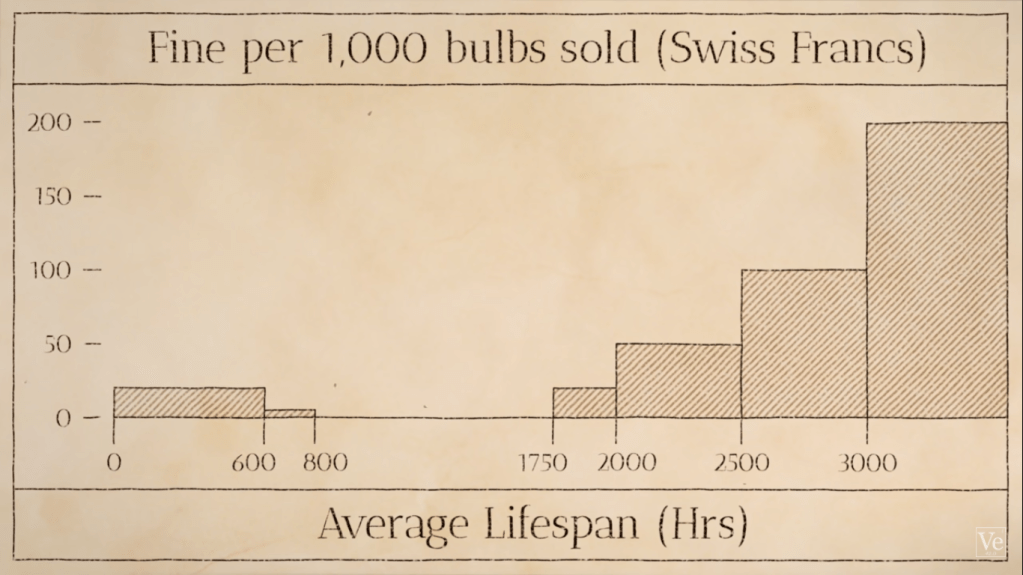
They agreed to decrease the life of bulbs to 1000 hours, the same way engineer discovered to increase, they told their engineers to decrease the life of bulbs. But, due to lack of trust they agreed to send bulbs from every factory to a lab for test. If the bulb lasts for 1000 hours is fine, but if it lasts more than 3000 hours then there is a fine of 200 Swiss Francs for every 1000 bulbs sold.

There again one question of will every manufacturer will follow or not? So they divided the area of sales. They were successful in there plan. The life of light bulbs decreased and there increased tremendously. They sold with same price to increase the profit.

-Sales – life of bubs

The cartel was made to last till 1955 but it ended in 1930s. However there were allegations on cartel, but they said that cartel in established for improvements in the bulb. The screw thread in bulbs are introduced by them.

The light bulb of Livermore is made before the formation of cartel that’s why it is there.

These is not the end of this case as there is still this type of work is going on.

In 2003 the video of Casey Neistat was gone viral as he tried to protest against apple. Apple launched IPod having non removable memory which lasts only for 18 months, and after that you have to give 250$ to refurbish it. So there was a case in court against this which Apple settled outside court.

Leonardo Da Vinci’s Human Powered Helicopter Becomes Reality

Leonardo Da Vinci's Aerial Screw

It would be hard to call Leonardo Da Vinci anything other than a man ahead of his time.  Between 1452 and 1519, Leonardo did just about everything. He is most famous today for his skills as a painter, where he painted some small works- like the Mona Lisa and The Last Supper. His sketches of man were the most anatomically correct to date (The Vitruvian Man). He was also a famed sculptor, musician, architect, anatomist, geologist, cartographer, botanist, writer mathematician, engineer and inventor. He conceptualized things far beyond his time, including concentrated solar power, a calculator, the double hull for ships, a tank and, most interesting to those of us in the aviation industry, a helicopter.

Over 420 years before the first helicopter was built, Leonardo Da Vinci sketched out what he called the Aerial Screw. This aerial screw was a man powered helicopter that required four men to spin cranks fast enough to generate enough lift to get off the ground.

Now, fast forward to 1980, 461 years after Leonardo passed away.  The American Helicopter Society sought to finally see the first human powered helicopter take flight. To win the prize money, which started at $10,000, the helicopter needed to reach at least 3 meters in the air (9.8 feet) for 60 seconds while being stable enough to have the center of the helicopter stay within a 10 x 10 meter box (32.8 x 32.8 feet). It would take 9 years from then before the first human powered helicopter even got off the ground when students at Cal Poly San Luis Obispo got their human powered helicopter 8 inches off the ground for all of 7.1 seconds. In the next 20 years, not much progress would be made so the Sikorsky Aircraft Corporation pledged additional prize money to try to see if that would inspire more innovation.

Sure enough, it did. Two teams, one from the University of Maryland and the other AeroVelo, were locked in a tight race to win. The university of Maryland got their man powered helicopter to fly for 65 seconds but it only reached 8 ft (about 1.8 feet short of where they needed to be) in August of 2012.

Finally, this July in Toronto, Aerovelo took the $250,000 in prize money with this flight:

While we don’t expect to see these Atlas human-powered helicopter’s flying around a city near you soon, this was a remarkable achievement. Congratulations to the Aerovelo team! And, over 480 years later, Leonardo Da Vinci’s vision of a human powered helicopter came to fruition.

INTERNSHIPS

The internship is the main source for a college student to improve and prove his/her knowledge.

Every college student has composed placements and off compose placements.

At the time of placements in a different company, we have to submit our Resume. That resume gives our real appearance to interview. If we have done any internships and any skill development that will help for our desired company placements.

Lets more about internships

Internships is the training and real-time project to the confidence of our skills for real-world understanding

 The internship is an opportunity offered by an employer to potential employees, as an intern, to work at a firm for a fixed period of time. Interns are usually likes undergraduates or students, and most internships period last between a month and three months. … An internship can be either paid or voluntary.

Which internships we have done?

Internships are based on your desired knowledge, department and day by day improved courses

Things to consider when choosing an internship

  • Which sector are you interested? …
  • What will be your responsibilities? …
  • What will you will get ? …
  • Where you have to do? …
  • What’s the environment like is it comfortable ? …
  • Will you get the opportunity to more network? …
  • What are the skills will you learn? …
  • What are your qualifications for ?

Let specific directions for your internships

There are some websites for internships that may have offline and online internships :

  • Linkedin
  • Glassdoor
  • Google
  • Internshala
  • Internship.com
  • Internmatch.com
  • Youturn
  • Idealist
  • Global Experience
  • Coolworks

Go for these websites you will find “updated(your name) version.0”

Budding entrepreneurship amidst the youth

For many the word entrepreneurship sounds like an intricate term, which we think that are associated only with people doing large businesses, world wide. But it is the concept of developing, managing and promoting a business platform which could be relevant to the field of interest that one has in line to gain profit. There is a major misconception that a business investment deals with more money. But the young entrepreneurs come up with impalpable investments which can remarkably attribute to the growth of a business like innovation, skills, creative thinking, time management, energy and of course monetary sources also take an integral part but not a major part. Especially in this pandemic many of the young people have made their venture into businesses through the digital platform which turned into a good of source of income for many. Youth entrepreneurship has a huge impact on the social and economic progress of the society. It is regarded as a promising alternative and help sustain growing economies and lead to a viable development. At one point, every individual after the completion of their studies would be striving hard discovering for opportunities to get a job in the government or a corporate sector thinking that their life would be settled and if they don’t acquire so, they would be distressed about their career. So one of the major challenges faced by most of the countries is unemployment. But now the tables have turned and individuals pursuing their studies on one hand have also started framing opportunities for themselves in accordance with the field that fascinates them, which could be on a small scale. Working towards Youth Entrepreneurship programs can aid solving problems that are currently challenged by the countries and could pave way for a better future.

In the mean time the hobbies have evolved into professions. For instance if a person is good at artistic works and drawing portraits he gets into the sphere of vending personalized gifts through online platform. The teenage girls who have been doing henna designs for their set of family for various get togethers are now online providing their work for many brides out for marriages. There are many blooming fashion designers who have been just designing costumes for themselves before, but then through the help of digital platforms and social media have started their own clothing line. Blogging, publishing own books, teaching online courses, launching podcasts, handmade goods, thrift stores, freelancing, web development, baking & selling pastry items and we can just bundle up examples about the several establishments of the budding young entrepreneurs.

Inspiration has nothing to do with the age factor. People who do quality and consistent work can inspire many and here are such inspirational young entrepreneurs who have given rise to very successful and engrossing start ups .

Ritesh Agarwal is a smart young man behind the OYO rooms and he is the founder and the CEO of the same. He is the world’s second youngest billionaire in 2021.

Sreelakshmi Suresh is a web designer holding the titles of World’s Youngest CEO and World’s youngest web designer. She started meddling with computers at the age of 3, started designing at 4, and came up with her first website at the age of 6.

Tilak Mehta , a 15 year old boy founder of Paper n Parcel is the World’s Youngest entrepreneur who made Digital Courier company with the help of ‘Mumbai Dabbawala’ and he was awarded Global Child Prodigy 2020.

Trishneet Arora is the founder and CEO of TAC security, a cyber security company. He has written books on cyber security, ethical hacking and web defence. He started his own company at the age of 19.

Akhilendra Sahu is a young serial entrepreneur form India. He is the founder and CEO of ASTNT technologies Pvt Ltd., He was 17 years old when he started his career as a freelancer. He ranked on India’s top 10 young Indian entrepreneur $ top 10 young digital influencers.

Aditi Gupta is an Indian author and co-founder of Menstrupedia Comic. Menstrupedia provides a user-friendly guide to menstruation, hygiene and puberty and break myths associated to them.

Entrepreneurs are the cluster of individuals who are reluctant to be one among all and frames out some innovative roadmaps to stand out form others, who defy to stick to the conservative thinking and wants to be out of the box. The three important keys that a budding entrepreneur should know are, PROMOTE NEW IDEAS, ACCELERATE ENTREPRENEURSHIP AND INVEST IN STARTUPS USING YOUR INGENUITY. Technology has enabled progress in all fields. The digital platform plays a very pivotal role in the upliftment of the young entrepreneurs and boosts the inner entrepreneurship in us. The world is been swamped with countless possibilities and opportunities. When you become certain about what you need you get a step closer to success and cling on to both hard work and smart work. To become a successful entrepreneur be hungry and ambitious on your goals. To persist in the same domain willpower, assertiveness and perseverance are very vital because every field is indulged with risks. Never halt in the career with the same mindset you started with, evolve with time. Aspire to inspire people!!!

Bear Market

What Is a Bear Market?

A bear market is when a market experiences prolonged price declines. It typically describes a condition in which securities prices fall 20% or more from recent highs amid widespread pessimism and negative investor sentiment.

Bear markets are often associated with declines in an overall market,  but individual securities or commodities can also be considered to be in a bear market if they experience a decline of 20% or more over a sustained period of time—typically two months or more. Bear markets also may accompany general economic downturns such as a recession. Bear markets may be contrasted with upward-trending bull markets.

Understanding Bear Markets

Stock prices generally reflect future expectations of cash flows and profits from companies. As growth prospects wane, and expectations are dashed, prices of stocks can decline. Herd behavior, fear, and a rush to protect downside losses can lead to prolonged periods of depressed asset prices.

One definition of a bear market says markets are in bear territory when stocks, on average, fall at least 20% off their high. But 20% is an arbitrary number, just as a 10% decline is an arbitrary benchmark for a correction. Another definition of a bear market is when investors are more risk-averse than risk-seeking. This kind of bear market can last for months or years as investors shun speculation in favor of boring, sure bets.

The causes of a bear market often vary, but in general, a weak or slowing or sluggish economy will bring with it a bear market. The signs of a weak or slowing economy are typically low employment, low disposable income, weak productivity, and a drop in business profits. In addition, any intervention by the government in the economy can also trigger a bear market.

For example, changes in the tax rate or in the federal funds rate can lead to a bear market. Similarly, a drop in investor confidence may also signal the onset of a bear market. When investors believe something is about to happen, they will take action—in this case, selling off shares to avoid losses. 

Bear markets can last for multiple years or just several weeks. A secular bear market can last anywhere from 10 to 20 years and is characterized by below-average returns on a sustained basis. There may be rallies within secular bear markets where stocks or indexes rally for a period, but the gains are not sustained, and prices revert to lower levels. A cyclical bear market, on the other hand, can last anywhere from a few weeks to several months.

The U.S. major market indexes were close to bear market territory on December 24, 2018, falling just shy of a 20% drawdown. More recently, major indexes including the S&P 500 and Dow Jones Industrial Average fell sharply into bear market territory between March 11 and March 12, 2020. Prior to that, the last prolonged bear market in the United States occurred between 2007 and 2009 during the Financial crisis and lasted for roughly 17 months. The S&P 500 lost 50% of its value during that time.

In February 2020, global stocks entered a sudden bear market in the wake of the global coronavirus pandemic, sending the DJIA down 38% from its all-time high on February 12 (29,568.77) to a low on March 23 (18,213.65) in just over one month. However, both the S&P 500 and the Nasdaq 100 made new highs by August 2020.

Bull Market

What is a Bull Market?

A bull market is the condition of a financial market in which prices are rising or are expected to rise. The term “bull market” is most often used to refer to the stock market but can be applied to anything that is traded, such as bonds, real estate, currencies, and commodities.

Because prices of securities rise and fall essentially continuously during trading, the term “bull market” is typically reserved for extended periods in which a large portion of security prices are rising. Bull markets tend to last for months or even years.

Understanding Bull Markets

Bull markets are characterized by optimism, investor confidence, and expectations that strong results should continue for an extended period of time. It is difficult to predict consistently when the trends in the market might change. Part of the difficulty is that psychological effects and speculation may sometimes play a large role in the markets.

There is no specific and universal metric used to identify a bull market. Nonetheless, perhaps the most common definition of a bull market is a situation in which stock prices rise by 20%, usually after a drop of 20% and before a second 20% decline. Since bull markets are difficult to predict, analysts can typically only recognize this phenomenon after it has happened. A notable bull market in recent history was the period between 2003 and 2007. During this time, the S&P 500 increased by a significant margin after a previous decline; as the 2008 financial crisis took effect, major declines occurred again after the bull market run.

Characteristics of a Bull Market

Bull markets generally take place when the economy is strengthening or when it is already strong. They tend to happen in line with strong Gross Domestic Product (GDP),and a drop in unemployment and will often coincide with a rise in corporate profits. Investor confidence will also tend to climb throughout a bull market period. The overall demand for stocks will be positive, along with the overall tone of the market. In addition, there will be a general increase in the amount of IPO activity during bull markets.

Notably, some of the factors above are more easily quantifiable than others. While corporate profits and unemployment are quantifiable, it can be more difficult to gauge the general tone of market commentary, for instance. Supply and demand for securities will seesaw: supply will be weak while demand will be strong. Investors will be eager to buy securities, while few will be willing to sell. In a bull market, investors are more willing to take part in the (stock) market in order to gain profits.

Bull vs. Bear Markets

The opposite of a bull market is a bear market, which is characterized by falling prices and typically shrouded in pessimism. The commonly held belief about the origin of these terms suggests that the use of “bull” and “bear” to describe markets comes from the way the animals attack their opponents. A bull thrusts its horns up into the air, while a bear swipes its paws downward. These actions are metaphors for the movement of a market. If the trend is up, it’s a bull market. If the trend is down, it’s a bear market.

Bull and bear markets often coincide with the economic cycle, which consists of four phases: expansion, peak, contraction, and trough. he onset of a bull market is often a leading indicator of economic expansion. Because public sentiment about future economic conditions drives stock prices, the market frequently rises even before broader economic measures, such as gross domestic product (GDP) growth, begin to tick up. Likewise, bear markets usually set in before economic contraction takes hold. A look back at a typical U.S. recession reveals a falling stock market several months ahead of GDP decline.

How to Take Advantage of a Bull Market

Investors who want to benefit from a bull market should buy early in order to take advantage of rising prices and sell them when they’ve reached their peak. Although it is hard to determine when the bottom and peak will take place, most losses will be minimal and are usually temporary. Below, we’ll explore several prominent strategies investors utilize during bull market periods. However, because it is difficult to assess the state of the market as it exists currently, these strategies involve at least some degree of risk as well.

Buy and Hold

One of the most basic strategies in investing is the process of buying a particular security and holding onto it, potentially to sell it at a later date. This strategy necessarily involves confidence on the part of the investor: why hold onto a security unless you expect its price to rise? For this reason, the optimism that comes along with bull markets helps to fuel the buy and hold approach.

Increased Buy and Hold

Increased buy and hold is a variation on the straightforward buy and hold strategy, and it involves additional risk. The premise behind the increased buy and hold approach is that an investor will continue to add to his or her holdings in a particular security so long as it continues to increase in price. One common method for increasing holdings suggests that an investor will buy an additional fixed quantity of shares for every increase in stock price of a pre-set amount.

Retracement Additions

A retracement is a brief period in which the general trend in a security’s price is reversed. Even during a bull market, it’s unlikely that stock prices will only ascend. Rather, there are likely to be shorter periods of time in which small dips occur as well, even as the general trend continues upward. Some investors watch for retracements within a bull market and move to buy during these periods. The thinking behind this strategy is that, presuming that the bull market continues, the price of the security in question will quickly move back up, retroactively providing the investor with a discounted purchase price.

Full Swing Trading

Perhaps the most aggressive way of attempting to capitalize on a bull market is the process known as full swing trading. Investors utilizing this strategy will take very active roles, using short-selling and other techniques to attempt to squeeze out maximum gains as shifts occur within the context of a larger bull market.

Monetary and Fiscal Policy

Monetary and fiscal policy refer to the policies of the government aimed to solve the economic problems in a country.
A monetary policy is a credit control measure adopted by the central bank of an economy. It deals with the demand and supply of money.
Fiscal policy refers to the use of taxation and public expenditure by the government to stabilise the economy.
A monetary policy aims at achieving full employment. Unemployment leads to wastage of potential and resources. Price stability is another goal of monetary policy. Changes in price levels lead to uncertainty in the economy. Achieving economic growth and maintaining a favourable balance of payments are some of the objectives of this policy.
A fiscal policy aims at achieving full employment, stabilizing the price levels and growth rate of the economy, maintaining equilibrium in the balance of payments. It uses taxation to affect national income, output, prices etc.
Monetary policy uses various instruments to achieve it’s goals. Open market operations, bank rate policy, selective credit controls, changes in reserve ratios are some of the instruments of monetary policy. Open Market Operations refers to sale and purchase of securities in money market by the central bank. Bank rate is the minimum lending rate of the central bank. When there is rise in prices, the central bank raises the bank rate and vice versa. Selective Credit Controls are used to influence specific types of credit for specific purposes.
A monetary policy can be classified as an expansionary or a contractionary policy. In the former case, monetary policy is used to overcome a recession or deflationary gap. It generally happens when there is a reduction in demand for consumer goods or investment goods. To control this central bank starts an expansionary monetary policy that reduces credit market conditions and leads to upward shift in demand. In the later case, monetary policy is used to curtail aggregate demand. When the economy faces inflationary gap due to rise in demand for consumer goods and increase in business investment, the central bank increases the cost of bank credit. This is often done by selling government securities, rising discount rate etc.
Similarly, fiscal policy can be classified as neutral, expansionary and contractionary. Neutral policy is usually undertaken when an economy is in equilibrium. In this instance, government spending is fully funded by tax revenue, which has a neutral effect on the level of economic activity. Expansionary policy is usually undertaken during recessions to increase the level of economic activity. In this instance, the government spends more money than it collects in taxes. Contractionary type of policy is undertaken to pay down government debt and to cap inflation. In this case, government spending is lower than tax revenue.
Monetary and Fiscal policy both have their own advantages and disadvantages. Fiscal policy may sometimes result in a domino effect causing one problem to make another and repeat. Fiscal policy can also have issues with time lags. Although monetary policy is not very effective in a recession, it is flexible and works well to slow down the economy. Most people however, prefer fiscal over monetary because its brings low taxes and low interest rates.
https://www.ukessays.com/essays/economics/fiscal-and-monetary-policy-economics-essay.php


https://courses.lumenlearning.com/boundless-economics/chapter/introduction-to-fiscal-policy/

Bandwagon Effect

What Is the Bandwagon Effect?

The bandwagon effect is a psychological phenomenon in which people do something primarily because other people are doing it, regardless of their own beliefs, which they may ignore or override. This tendency of people to align their beliefs and behaviors with those of a group is also called a herd mentality. The term “bandwagon effect” originates from politics but has wide implications commonly seen in consumer behavior and investment activities. This phenomenon can be seen during bull markets and the growth of asset bubbles.

Understanding the Bandwagon Effect

The bandwagon effect arises from psychological, sociological, and, to some extent, economic factors. People like to be on the winning team and they like to signal their social identity. Economically, some amount of bandwagon effect can make sense, in that it allows people to economize on the costs of gathering information by relying on the knowledge and opinions of others. The bandwagon effect permeates many aspects of life, from stock markets to clothing trends to sports fandom.

Politics

In politics, the bandwagon effect might cause citizens to vote for the person who appears to have more popular support because they want to belong to the majority. The term “bandwagon” refers to a wagon that carries a band through a parade. During the 19th century, an entertainer named Dan Rice traveled the country campaigning for President Zachary Taylor. Rice’s bandwagon was the centerpiece of his campaign events, and he encouraged those in the crowd to “jump on the bandwagon” and support Taylor. By the early 20th century, bandwagons were commonplace in political campaigns, and “jump on the bandwagon” had become a derogatory term used to describe the social phenomenon of wanting to be part of the majority, even when it means going against one’s principles or beliefs.

Consumer Behavior

Consumers often economize on the cost of gathering information and evaluating the quality of consumer goods by relying on the opinions and purchasing behavior of other consumers. To some extent, this is a beneficial and useful tendency; if other people’s preferences are similar, their consumption decisions are rational, and they have accurate information about the relative quality of available consumer goods, then it makes perfect sense to follow their lead and effectively outsource the cost of gathering information to someone else.

However, this kind of bandwagon effect can create a problem in that it gives every consumer an incentive to free ride on the information and preferences of other consumers. To the extent that it leads to a situation where information regarding consumer products might be underproduced, or produced solely or mostly by marketers, it can be criticized. For example, people might buy a new electronic item because of its popularity, regardless of whether they need it, can afford it, or even really want it.

Bandwagon effects in consumption can also be related to conspicuous consumption, where consumers buy expensive products as a signal of economic status. 

Investment and Finance

Investing and financial markets can be especially vulnerable to bandwagon effects because not only will the same kind of social, psychological, and information-economizing factors occur, but additionally the prices of assets tend to rise as more people jump on the bandwagon. This can create a positive feedback loop of rising prices and increased demand for an asset, related to George Soros’ concept of reflexivity.

For example, during the dotcom bubble of the late 1990s, dozens of tech startups emerged that had no viable business plans, no products or services ready to bring to market, and in many cases, nothing more than a name (usually something tech-sounding with “.com” or “.net” as a suffix). Despite lacking in vision and scope, these companies attracted millions of investment dollars in large part due to the bandwagon effect.

Getting a Job in Google.

Year after year, Google has been ranked as one of the top companies to work for, so it’s no surprise that the tech giant receives roughly three million applications per year. With an acceptance rate of 0.2%, you’d have a better chance of getting into Harvard.

It is difficult to get a job at Google because of their quality standards and the high number of applications they receive per year. For example, INC reported that Google receives 2 million job applications per year, which means it’s more competitive to get into than Harvard University.

Google is an employer of choice for the world’s top talent, typically receiving hundreds of resumes for every opening, which allows them to be extremely selective in their hiring.The hardest part is getting an interview. If you attend a university, go through campus recruiting.

According to the Pascale, The lowest paid Google employees are Entry Levels at $51,000.Google says there is no degree or prior experience required. In fact, 61% of learners enrolled do not hold a four-year degree. This certificate could be a perfect launchpad to a career in IT.

So if you have a keen interest in working at Google California or at any other branches of Google work hard my friend. More than studies work on yourselves, on your IQ level the interviewees are not going to ask you a question from your syllabus.

Trade Cycle

Trade cycle or business cycle refers to cyclical fluctuations in economic activities like employment, income, prices etc. It is a characteristic feature of capitalist system. In a trade cycle, there are alternating waves of expansion and contraction. These waves recur frequently and in similar patterns. It comprises of a period of good trade wherein the prices are high and unemployment is low and a period of bad trade wherein the prices are low and unemployment is high.
A business cycle usually consists of four phases. These phases do not have a definite time intervals or periodicity. The four phases are: recovery, prosperity, recession and depression.
Recovery is the first phase in the trade cycle. It is the revival period. Here entrepreneurs increase the level of investment. This in turn leads to increased employment and income. A increased income level means more purchasing power in the hands of people which leads to more demand for consumer goods. This leads to increase in prices for commodities and eventually leads to profit generation Business expectations improve and optimism prevails.
Prosperity is the second phase in the trade cycle. In this stage, demand, output, employment and income are at the peak levels. Increased profits lead to increased stock market values. There is expansion in economic activities. Demand and prices go up. The production level is very high and known as boom. The economy surpasses the level of full employment to reach the level of over full employment. This leads to inflation and is a sign of end of prosperity.
Recession is the third phase of the trade cycle. It starts when there is a downward descend from the peak. The level of investment declines and consequently the demand for raw materials decline as well. Liquidity preference rises in the economy. The margin of profit declines and a wave of pessimism spreads in the business. Recession can be mild or severe.

Depression is the fourth phase of the trade cycle. It’s characteristic feature is the general fall in all economic activities. Production, employment, income decline. This general decline in economic activities lead to fall in bank deposits. Credit creation declines and bank rate falls. Distribution of national income change and margin of profit declines.

https://www.yourarticlelibrary.com/trade-2/trade-cycle-4-phases-of-trade-cycle-discussed/23414


There are several factors responsible for the existence of fluctuations and trade cycles. External factors like political events, growth rate of population, migrations, discoveries, innovations etc are responsible for the cyclical fluctuations in the economy. As far as internal factors are concerned, mechanisms within the economy give rise to repetitive fluctuations. Over investment is one such factor. It is the credit availability by the banks which leads to over investment in capital goods rather than consumer goods. This eventually brings depression in the economy. Competition may be another reason for fluctuations. The profit motive causes firms to anticipate demand and subsequently do excess production. For this, firms hire more workforce and cost of production increases. This raises the prices of the commodities and decline in the demand for them. This ultimately leads to depression.

https://www.investopedia.com/terms/b/businesscycle.asp

Minimalism

What is Minimalism?

Minimalism is defined as a design or style in which the simplest and fewest elements are used to create the maximum effect. Minimalism had its origins in the arts—with the artwork featuring simple lines, only a few colors, and careful placement of those lines and colors. More recently, it has become representative of a lifestyle that aims to remove clutter from all facets of life. 

Minimalism is all about owning only what adds value and meaning to your life (as well as the lives of the people you care about) and removing the rest. It’s about removing the clutter and using your time and energy for the things that remain. We only have a certain amount of energy, time, and space in our lives. In order to make the most of it, we must be intentional about how we’re living each day.

There are many different approaches to minimalism, but it’s really just a tool to help you prioritize what’s important in your life.

Joshua Becker of Becoming Minimalist offers this definition: “Minimalism is the intentional promotion of the things that bring you joy and the removal of those that do not.” It might be called simple living, tiny living, intentional living, and a myriad of other things—but there is at least one common thread: the idea of curating the things we own to best reflect our priorities and vision for our lives.

If the idea of minimalism sounds intimidating to you or if you’ve seen some images and thought, “that’s a nice idea, but I’d never want to live like that,” don’t worry. You can benefit from applying minimalism in your life whether you live in a tiny home, suburban house, or a mansion. You can use minimalism as a guiding philosophy and customize based on what works best for you.

Common Misconceptions of Minimalism

Contrary to what some people think, there aren’t any actual rules to minimalism. There’s no official board of minimalism to determine whether or not you’re doing minimalism right. Minimalism truly looks different for everyone.

You don’t have to own below a certain number of items. You can still have nice things, and no, you don’t need to get rid of your favorite collection—whether it’s books, shoes, or music. Minimalism doesn’t have to look like white-walled, modern and sparse homes you’ve probably seen in magazines and videos, a common minimalism mistake. Minimalism is also not a one and done project. It is a a continual practice to ensure everything in our lives is working for us in our vision, not against us. Its used over the years to make substantial changes in our careers, home, lifestyle, buying behaviors, etc.

Everyone can benefit from applying the principles of minimalism to their lives. It’s a process of removing distractions and things that no longer add value to our lives.

Why Minimalism Is An Effective Tool For Living An Intentional Life?

In the end, minimalism is less about owning fewer items and more about actively making choices on what kind of things truly matter to you.

We exist in a society that creates false value on owning more stuff and having no time to use them much. The constant pursuit of bigger and better is an endless cycle. There will always be a nicer car to buy, a bigger boat, a larger home, and or a faster private jet. Did you know that there’s a website for billionaires to shop? Yeah. It never ends.

It may seem like an overwhelming challenge at first, but as you untangle the life you built around owning more things, you’ll find the stress disappearing and the world starting to slow down. Those choices you make will begin to build a muscle that will fundamentally change the way you live your life.