Instagram reels: good alternative to Tiktok. Check here how to use it.

Instagram’s new feature Reels were in testing for some time now and now as the TikTok took an exit from India, Facebook-owned Instagram has rolled out their new Reels feature which allows user to shoot 15-second videos. The feature now arrives in India. This is good opportunity for reels to attract short video lovers as its demand has grown in the country.

many short video apps such as Roposo, Mitron, Chingari, Sharechat, and others are becoming more popular among users and seeing millions of downloads every day.Facebook is also all set to use this opportunity to attract 200 million TikTok users to Reels.

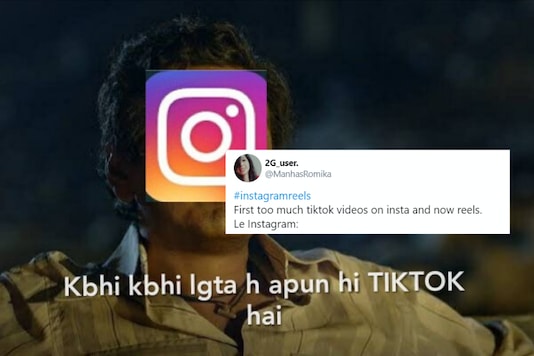
Reels is just a new feature on Instagram and users in India are loving this new feature which is just like TikTok.

Image credits: Twitter.
Memers doing memes on instagram reels against tiktok

How to use Instagram Reels?

Step 1: Update your Instagram on Google Play

Step 2: Open the Instagram Camera

Step 3: Reels option is available next to boomerang, Superzoom, hands-free, and layout.

Step 4: Click on Reels and select audio from the Instagram Music library.

Step 5: Reels also come with an option to record original voice besides lip-syncing.

Step 6: Reels also let users add AR effects and provide options like Timer, Speed to edit videos as required before sharing. Reels also let users re-record a video and even delete it if needed.

Step 7: After creating their Reel, users can choose to share it with either their followers or everyone on Instagram. Reels can be shared to Feed as well as Explore so everyone on Instagram can view it.

Instagram Reels Is Now Available in India, but Can It Replace TikTok?

Reels also feature several AR effects allowing users to add a custom touch to their videos. To put AR effects in their videos, users can open Reels camera and go to effects and then AR effects.

Users will also be able to record multiple 15 seconds Reels – it can also be recorded at once and the different effects can be added to each clip post the shoot. The Reels can also be reviewed, deleted, and re-recorded.

Asia cup 2020 officially postponed,ACC hoping to conduct it in coming june 2021.

Asia Cup 2020 officially postponed, ACC hopeful of hosting it in June 2021.The Asian Cricket Council on Thursday announced that the 2020 Asia Cup has been postponed. ACC stated that it is hopeful to conduct and schedule tournament on June 2021.

In the press release, ACC stated that the travel restrictions, different quarantine rules of countries, health risks and social distancing norms have posed as challenges to the conduct of the Asia Cup.The Asian Cricket Council on Thursday announced that the 2020 Asia Cup has been postponed. ACC stated that it will try to secure the window of June 2021 to schedule the tournament.

Right from the beginning the board was to organise the tournament as per the original schedule.However, travel restrictions, country-specific quarantine requirements, fundamental health risks and social distancing norms have posed as substantial challenges to the holding of the Asia Cup. Above all, the risks related to health and safety of participating players, support staff, commercial partners, fans and the cricketing community were deemed to be significant,” ACC quoted in the release.

The ACC is hopeful to schedule the Asia Cup in 2021 are looking for the June window to host the tournament.

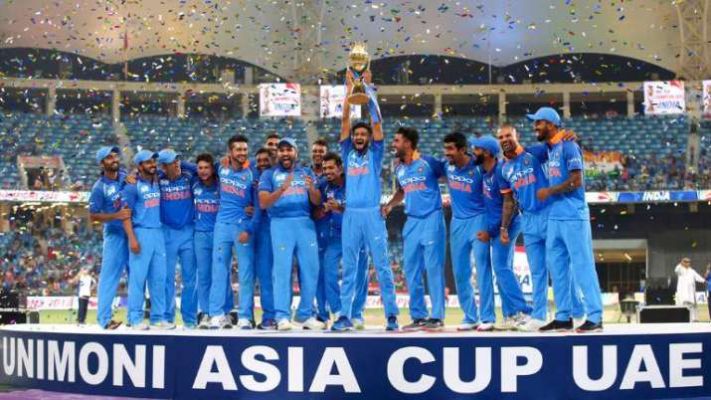
Captains posing with the Asia Cup in 2018.

” The Board, after careful consideration of all the above factors, has confirmed that the Asia Cup 2020 be postponed. Conducting the event with all due safety is major responsibility of ACC and the Board is hopeful that the tournament will be held in 2021. The ACC is currently working towards securing June 2021 as a option for the same,” quoted ACC.

ACC also cleared the air on the hosting nation of the next Asia Cup as it said the Pakistan Cricket Board has exchanged hosting rights with Sri Lanka Cricket Board.

“It can be possible that Sri Lanka hosts for the Asia Cup 2020, Pakistan Cricket Board (PCB), has exchanged hosting rights for the tournament with Sri Lanka Cricket (SLC). Through this arrangement, the SLC will now host the rescheduled Asia Cup expected in June 2021 while the PCB will host the Asia Cup 2022,” the ACC press release stated.

Breaking news Vikas Dubey killed in encounter.Doctors in Kanpur Hallet hospital confirmed death.

Vikas Dubey, dreaded gangster, wanted in killing of 8 policemen, has been killed in an encounter.

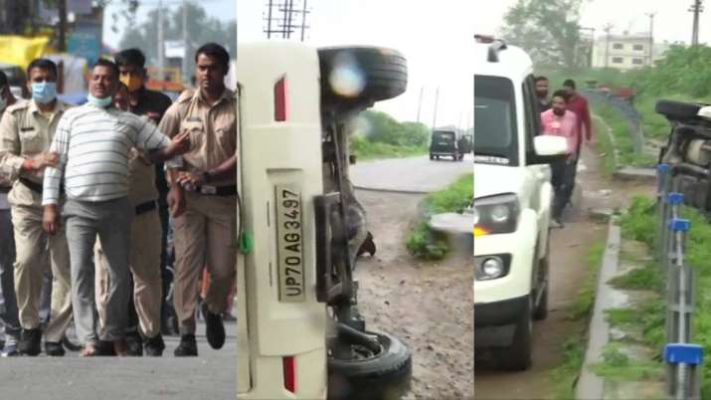
Vikas Dubey, dreaded gangster and prime accused in the killing of 8 police personnel in the Kanpur encounter case, has been killed in an encounter after UP STF’s car carrying the criminal overturned when it was returning from Madhya Pradesh’s Ujjain to Kanpur today amid heavy rainfall.

The incident was reported after Uttar Pradesh police entered the state limits with gangster Vikas Dubey. Doctors in the hospital where Vikas Dubey was rushed after he got injured have pronounced him dead. Meanwhile, information on the injured police personnel and other details are still awaited.

He was brought to Kanpur’s Hallet hospital with bullet wounds. Doctors pronounced him dead.
Police say Vikas Dubey tried to escape after the UP STF car carrying him overturned.
Vikas Dubey attempted to flee by snatching pistol of the injured policemen after car overturned.
Police said that they tried to stop him and surrender, But he fired at the policemen. Vikas was injured in retaliatory firing by police. He was later taken to the hospital, SP Kanpur West said.

#BoycottChina, A Tough Terrain to India’s Self Dependency

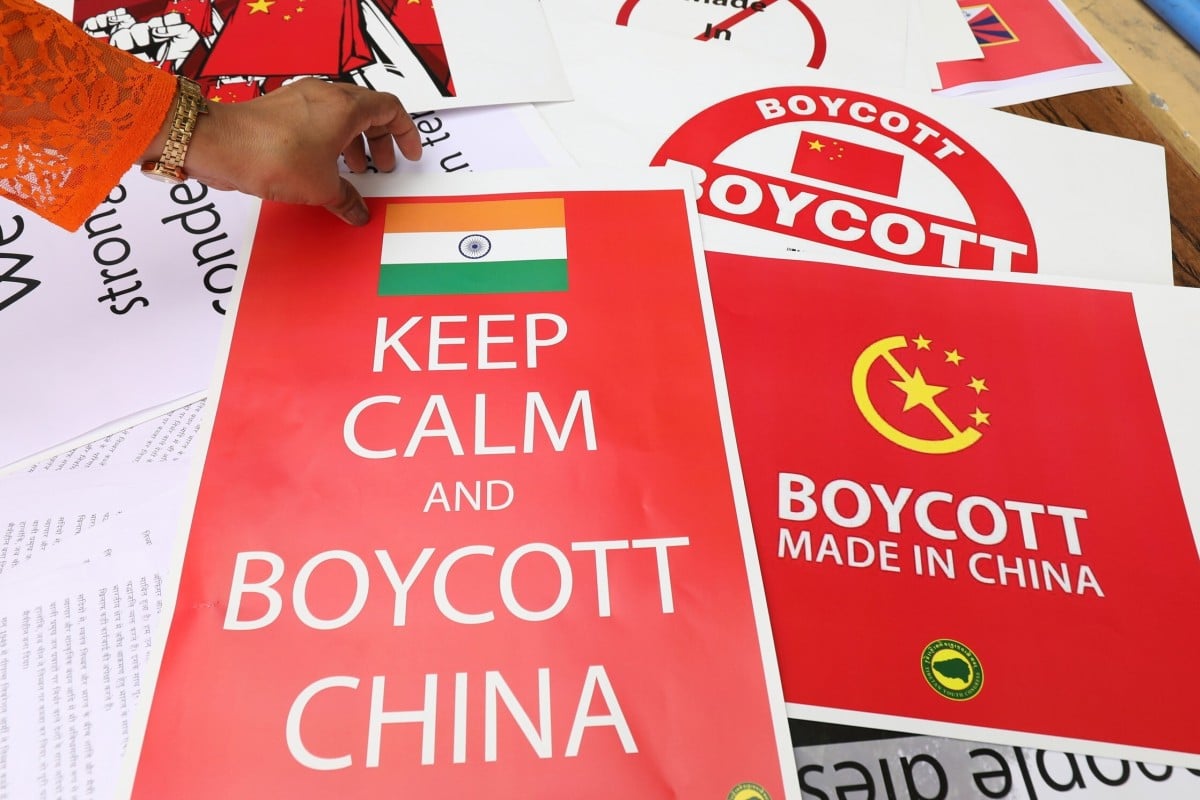
Posters of Boycott China Campaign

What happened at Galwan valley of Indian Ladakh had raised tensions between India and China to all time high. The clash between Indian and Chinese forces led to nationwide outburst against China.

Fuelling this, there had been a sudden disagreement for buying any Chinese product or services. This is to make sure that Chinese economy doesn’t receive a single penny from India and its citizens, making it obvious after China bearing malice towards its neighbours, specifically India. The initiative has greatly boosted with GOI’s (Government of India) decision of banning 59 Chinese applications in India and by increasing the import taxes on Chinese goods or services. The Indian armed forces had already been deployed at disputed regions of border and are ready for any surprise from counter side.

With Governments and Armed forces holding tight on attempts to self-reliant India, the dice of responsibility falls our side too. By us I mean, all the common or less common citizens of India whose decision of just boycotting Chinese products could shatter its trade. Already many huge economies of the world have turned against China, amid Corona virus outbreak and deaths of 600,000 (still rising) innocent people.

Boycotting Chinese items won’t be that easy as it sounds, one has to spend a little more of their money while switching to non-chinese brands, as the only PSP (product selling protocol) of Chinese products is its cheap pricing. This pricing gets balanced with its poor quality and doesn’t last any longer. Yet, Chinese products have kept its dominance in certain sectors of Indian market.

The mobile phone sector

India had imported mobile phones worth $11.3 billion from China in 2016-17, and that was about 68 per cent of all mobile phones (both push-button feature phones and smart devices) imports into the nation that year. In 2017-18, even as the duties were imposed, the value of mobile phone imports from China climbed to $15.6 billion, or 71 per cent of the mobile phones imported. As the tax measure began to hurt and local manufacturing of mobile phones gathered momentum, imports of these devices from China halved to $7.4 billion and about 41 per cent of all mobile phone imports in 2018-19. Imports of phones, by value, from China declined further in 2019-20 but not the share, which remains at 40 per cent. If we just speak of alternatives, we have few options of some Korean, Taiwanese, American and just few Indian tech companies. These options are:

  • LG
  • Samsung
  • Nokia
  • Apple
  • Asus

The drop in electronic imports gradually implemented by the GOI in recent years but this won’t be enough and buyers need to push their expenses to continue supporting the campaign of #boycottchina.

Other imports from China include toys, gift items, fabrics and garments, and thousands of small value items that are popular with consumers. CAIT (Confederation of All India Traders) estimates that there are some 3,000 items that can be easily substituted with India-made products in the first phase of the boycott of Chinese goods campaign. The list of China-made items popular with consumers includes fairy lights with tiny LED bulbs that are used to decorate homes during festivals, idols of deities, home decors, kite strings and even incense sticks (agarbattis). It is estimated that about 80 per cent of the incense sticks sold in India are imported from China.

For all of it to happen, for this campaign to succeed we all should hold our horses and should maintain an adequate transition of market into indigenous domain. This would be the only secure and once for all time solution to problems India facing with the dragon as war could never be a solution. It would just tear up economies at both ends and loss of Brave Indian soldiers shouldn’t happen any further.

Indian option of CamScanner launched with name BharatScanner.

The BharatScanner mobile app, an Indian alternative to cam scanners, has been launched. In this app, users have got the facility from scanning documents to creating PDFs. The special thing is that this app is completely free and users will not have to pay a separate charge to use any feature.

Rating of 4.4 points found on Google Play Store

Bharat Scanner app is available on Google Play Store for users. This app has downloaded more than 10 thousand users so far and it has got a rating of 4.4 points on the Google Play-Store. At the same time, this app size is 36 MB. .

Features of BharatScanner .

Some current features of BharatScanner are as follows: .

  • Users can scan documents easily.
  • Filters have been supported in this app.
  • Users can keep their documents as PDF.
  • Users have got the facility to share documents in this app on mail and Whatsapp.

Indian government imposes ban on Chinese mobile app .

Under Section 69A of the Information Technology Act, the Government of India decided to block 59 apps as these apps were a threat to India’s sovereignty and integrity, defense of India, security of the state and public order. The government had received many complaints about these apps from various sources, including about the misuse of many mobile apps. These apps were stealing data from both iPhone and Android users.

  • लॉन्च हुआ CamScanner का भारतीय विकल्प Bharat Scanner, जानें इसकी खासियतें

Ban on these Chinese apps

Tiktok, CamScanner, Shareit, Kwai, UC Browser, Baidu Map, Shein, Clash of Kings, DU Battery Saver, Helo, Likee, YouCam makeup, Mi Community, CM Browers, Virus Cleaner, APUS Browser, ROMWE, Club Factory, Newsdog these 59 apps are banned, including BeutryPlus, WeChat, UC News, QQ Mail.

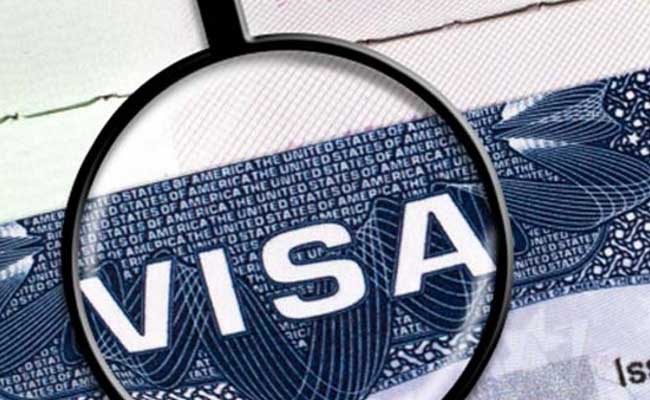
Government concerned over return of large number of Indian students from US due F1 visa issues.

The US order of July 7 stating that F1 visas will not be renewed for students if they are attending only online- lectures in the US is a concerning mater for India since the highest number of foreign students in the US are from India. The US government has announced those F-1 and M-1 (non-academic and vocational students) visa holders attending only online classes will not be allowed to remain in the US.

US Noted India's Concerns Regarding F-1 Visa Issue: Centre

India on Thursday said it has reported its concerns to the US govt about the new rule on F1 visa and urged to keep in mind the role education have played in the developing relationship between the two countries.

The concerns were expressed during the virtual foreign office consultations between Foreign Secretary Harsh Vardhan Shringla and US political affairs secretary David Hale on Tuesday. Ministry of External Affairs’ spokesperson Anurag Srivastava said that the US government has looked into the concern regarding the new rule.

During virtual meeting, Srivastava said that India is concerned about the possibility of the return of a large number of Indian students studying in the US due to new rules in visa.

The Immigration and Customs Enforcement (ICE), an agency of the US Department of Homeland Security (DHS) on Monday said that the foreign students pursuing courses in the US must return to their country if their institutes are conducting only online course due to covid-19 pandemic.

A Safe Guide to Abortions

“Why is abortion abnormal, but police brutality, hate crime, suicide abetment just the way of life? I choose not to bring a life into this world, that I am not ready to care for. I am protecting my unborn by keeping it away from this patriarchal world.”

Anonymous

What is ABORTION?

Abortion refers to the termination of pregnancy by the removal or expulsion of an embryo or fetus. It is also referred to as termination of pregnancy.

Why is it Important to Have a Safe and Informed Abortion?

Each year 6.4 million fetuses are aborted, 3.4 million of which are unsafely performed using unsanitary methods. Each day, approximately 13 women die as a result and thousands more suffer severe reproductive health issues. 

Unsafe Abortions are the 3rd most leading cause of mortality amongst women. 

Further, a huge chunk of our population are unaware of the legality of abortions and opt for unsanitary alternatives. 

Not every General Practitioner, Gynaecologist, nor Obstetrician is legally allowed to carry out abortions nor prescribe medications.

Safe abortions don’t limit to just the procedure. Abortions have a huge impact on a woman’s body and frequent check-us are vital. Carrying out proper treatment is the only way to avoid other medical conditions. 

Reasons for Abortion:

There are multiple reasons why women might want to abort. A few reasons include:

  • When the parent(s) is financially unprepared
  • Unplanned/Accidental
  • Bad/Abusive Partner
  • Conception by Rape, Incest, or any other sexual assault 
  • Teen/Early Pregnancy
  • Health Issues
  • Dependent and/or Unprepared
  • Addiction
  • No longer want kids
  • Delaying Parenthood
  • Unwilling to be a parent
  • Not ready to have a kid
  • Pregnancy interfering with Education, Work, Promotion.
  • Any other unique reason a woman wants to terminate her pregnancy.

When is a Pregnancy Unsafe?

There are many situations where medical complications harm or might harm the mother and baby. Some situations might end in abortion because of unsafe pregnancies.

It is important to routinely have check-ups, take prenatal vitamins and other prescribed medications, and avoid taking any stress or straining yourself physically.

A few warning signs and complications of unsafe pregnancy: 

(NOTE: these warning signs don’t always lead to abortion, but please contact your doctor immediately)

  • Heavy bleeding and abdominal pain
  • Severe Nausea
    • Nausea is common in pregnancy, many women have morning sickness. 
    • Uncontrollable vomiting and not eating and drinking properly can make you dehydrated and harm you and the baby
  • Significant Decline in Baby’s activity
  • Contractions early in the 3rd trimester
  • When your water breaks early
  • Gestational Diabetes
  • Macrosomia
    • The baby is much larger than normal
    • When the mother’s blood had too much glucose, the pancreas of the fetus converts the extra glucose into fat
  • Flu-Like symptoms
  • Amniotic Fluid Complications
    • Too much or too little amniotic fluid in the sac
    • Difficulty in breathing 
    • Prenatal diabetes
  • Ectopic Pregnancy
    • The development of the fetus outside of the uterus. 
  • Placental Complications
    • Placental Abruption – detached placenta from the uterine wall
    • Placental Previa – the condition in which the placenta is attached too close to the cervix. 
  • Preeclampsia or Eclampsia
    • Pregnancy-induced high blood pressure
    • Can lead to seizures, coma, and death

Who is Allowed to get an Abortion in India?

Medical Termination of Pregnancy (MTP) Act legalized the termination of pregnancy (still not using the word abortion) with several conditions up to 20 weeks (from the first day of the last menstrual period). The conditions are:

  • “When continuation of pregnancy is a risk to the life of a pregnant woman or could cause grave injury to her physical or mental health;
  • When there is substantial risk that the child, if born or dead would be seriously handicapped due to physical or mental abnormalities;
  • When pregnancy is caused due to rape (presumed to cause grave injury to the mental health of the woman);
  • When pregnancy is caused due to failure of contraceptives used by a married woman or her husband (presumed to constitute grave injury to mental health of the woman).”

The Indian Abortion Laws are not liberal and do not permit women to terminate a pregnancy because they are not ready or unprepared. More information on the legal details of abortion in India can be found here.

Who is allowed to Perform an Abortion in India?

The MTP Act also specifies who is legally allowed to terminated a pregnancy, a practitioner who 

  • “has a recognized medical qualification under the Indian Medical Council Act, 
  • whose name is entered in the State Medical Register, and 
  • who has experience or training in gynecology and obstetrics.”

Not every Gynaecologist and/or Obstetrician is legally allowed to perform abortions. Be sure to check their license and get a safe and secure abortion if and when needed.

Consent for Abortion?

In India, an adult woman does not need consent from her husband, father nor the father of her unborn child until 20 weeks of gestation. Minors, however, require a legal adult’s consent. 

Once the pregnancy crosses 20 weeks, a woman needs special permission from the courts and two other people’s consent to be able to terminate her pregnancy.

To get an abortion, there are a legal-forms one needs to fill and sign. It is important to be aware of what documents you are signing and the terms you are agreeing to. 

The Price for abortions is fixed, a first-trimester abortion is approximately, Rs.500-1000 while a second-trimester abortion cost around, Rs.2000-3000. 

It is important to know your rights and pay only the correct rate. If a doctor charges more, you are entitled to report them. 

Many doctors are known to charge Rs,10,000, and more.

Procedural Blueprint:

Courtesy of Vardaan Hospital, Delhi.

There is a procedure that mot doctors follow. You are entitled to find out the procedure before-hand and report anyone for misbehavior.

There are two methods, oral and surgical. 

Oral Method Procedure:

If the pregnancy is less than 6 weeks, a mother can opt for the oral method

  • Ultrasound – to check for the duration of pregnancy or to see if it is a tubal pregnancy
  • Medication is prescribed 
  • Blood tests are done
  • 2 doses are given 48hrs apart.

Surgical Method Procedure:

  • Ultrasounds and Blood tests
  • Depending on the duration of the pregnancy, medication is prescribed to dilute the uterus.

One of the below

  • Vacuum Aspiration.
  • Dilation and Evacuation.
  • Dilation and Curettage.
  • Suction evacuation.

Follow Up:

Courtesy of Vardaan Hospital, Delhi.

Oral Method:

  • Bleeding is common in the 24-48 hours whole taking the dose and lasts for a week
  • Tissue might retain in some cases which leads to incomplete abortion. Suctional evacuation is important.
  • Confirmation of a complete abortion is done by another ultrasound.

Surgical Method:

  • The pain during and after the process varies for each woman.

General:

  • Maintain a proper diet
  • Take proper medications on time
  • Avoid exercising and moving around a lot
  • Counseling is important to recover
  • Avoid tampons during the menstrual cycle
  • No sexual contact for at least a month.

When is Abortion not Safe?

Abortion is unsafe if a woman:

  • Is more than 70 days pregnant (counted from the first day of the last menstrual period)
  • Has bleeding problems or is taking blood-thinning medication
  • Has chronic adrenal failure or is taking certain steroid medications
  • Cannot attend the medical visits necessary to ensure the abortion is completed
  • Does not have access to emergency care
  • Has uncontrolled seizure disorder (for misoprostol)
  • Has acute inflammatory bowel disease (for misoprostol)

Risks of Abortions:

Abortion has serious effects on a woman’s body. The following are a few risks associated with abortion:

  • Heavy bleeding
  • Infections
  • Incomplete abortions
  • Damage to the cervix
  • Scarring of the uterine lining 
  • Perforation of the uterus
  • Damage to internal organs
  • Miscarriages in future pregnancies
  • Death
  • Eating Disorders
  • Suicidal thoughts
  • Guilt
  • Relationship problems
  • Depression
  • Sexual dysfunction
  • Prone to addiction

When to Call your Doctor?

It is normal to contact your doctor after an abortion with any queries. 

These are the signs of complications where calling your doctor is important:

  • Excessive Bleeding
    • Bleeding is normal, but excessive bleeding is not.
  • No bleeding in the first 24 hours.
  • Signs of infection
    • Headache
    • Muscle aches
    • Dizziness
    • Fever
  • Severe abdominal pain
  • Fever that lasts for more than 4 hours
  • Vomiting for more than 4-6hours
  • Sudden belly swelling
  • Rapid heart rate
  • Smelly vaginal discharge
  • Pain, redness, and swelling in the genital area
  • Any other unexplainable symptoms

After a surgical abortion, follow up with one or more of these medical exams:

  • A physical exam of the cervix and uterus
  • A lab test to check your hCG levels
  • Blood test for anemia

Timeline of India’s Prime Minister’s

Prime Minister of India is the head of the government. He is appointed by the Indian President after the political party wins a general election and nominates a candidate for the post. The leader of that political party is thereafter appointed as the Prime Minister of India.

Jawaharlal Nehru (15 August 1947 – 27 May 1964)

Jawaharlal Nehru referred as the Constructor of Modern India. He was the Longest serving prime minister of India (17 Years) and also he was the first prime minister to died in office. 

Gulzarilal Nanda (Acting) (27 May 1964 – 9 June 1964)

Gulzarilal Nanda is the First Acting Prime Minister of India. He was the shortest serving Prime Minister of India. 

Lal Bahudur Sastri (9 June 1964 – 11 January 1966)

Lal Bahadur Sastri was PM after sudden death of the Jawaharlal Nehru. He was given the famous slogan Called “Jai Jawan Jai Kisan”. He was the only Prime minister to die in abroad.

Gulzarilal Nanda (Acting) (11 January 1966 – 24 January 1966)

Gulzarilal Nanda is second Acting Prime Minister too of India.

Indira Gandhi (24 January 1966 – 24 March 1977)

Smt Indira Gandhi was the first female Prime Minister of the India. She was famous for her remarkable financial and foreign inclusions like Nationalization of Banks and divide East and West Pakistan in 1971 War.

Morarji Desai (24 March 1977 – 28 July 1979)

Morarji Desai was the Oldest Prime Minister of India. He was also first Prime Minister to resign from Office. He was the only the Prime Minister to celebrate his birthday for every 5 years since his birthday is on 29 February.

Charan Singh (28 July 1979 – 14 January 1980)

He was the first Prime Minister Who did not attend the single session of parliament. He was well known for his remarkable steps towards welfare of the Farmers.

Indira Gandhi (14 January 1980 – 31 October 1984)

Indira Gandhi was the First Prime to get assassinated and First Prime Minister to lost her seat in a General Elections. 

Rajiv Gandhi (31 October 1984 – 2 December 1989)

Rajiv Gandhi was the Youngest prime minister of the India. In his reign Anti-Defection was proposed and came into existence. 

V.P Singh (2 December 1989 – 10 November 1990) 

His full name is Viswanath pratap Singh. He was referred as the pioneer of the Reservation System for Employment and Education system in India.

Chandra Shekhar (10 November 1990 – 21 June 1991)

He was the Second least serving Prime Minister of India after the Charan Singh.

P.V Narasimha Rao (21 June 1991 – 16 May 1996)

P.V Narasimha Rao was referred as the father of Modern Economic Reforms. He was well known for his tax system in India with help of his Cabinet Finance Minister Dr Manmohan Singh. He was the first Prime minister from southern India.

Atal Bihari Vajpayee (16 May 1996 – 1 June 1996)

Atal Bihari Vajpayee was the 14 days Primebecause his government was collapsed the after Jayalalitha Led AIADMK withdrawn its support from coalition. 

H.D Deve Gowda (1 June 1996 – 21 April 1997)

Before becoming a Prime minister of India he was the Chief Minister of Karnataka.

I.K Gujral (21 April 1997 – 19 March 1998)

Inder Kumar Gujral was the one of the well educated Prime Ministers of India. He was served as Cabinet Minister for different portfolios like Ministry of Planning, Tele-communications, Minister of Information and Technology.

Atal Bihari Vajpayee (19 March 1998 – 22 May 2004)

This was the Second term for him as the Prime Minister. He was well known for his remarkable achievements in Nuclear Tests. 

Manmohan Singh (22 May 2004 – 26 May 2014)

Manmohan singh was the first Sikh PrimeMinister. He was worked as both FinanceMinister, RBI Governor. He was the FinanceMinister one who introduced the Service Taxsystem In India in 1993-94 Budget session. 

Narendra Modi (26 May 2014- Till date)

His full name is Narendra Damodar Das Modi. In his reign BJP Could get the full majority both in 2014 and 2019 General Election (Loksabha Elections) to form the Government without help of the other Parties. He was the most influent Prime Minister in India. He known as tough guy who takes tough decisions like demonetization, Gst, etc.

How India’s Oldest Civilisations Taught The New India

India is the earth’s most advanced, biggest and oldest civilisation and if we do not consider the 19th and 20th centuries, the wealthiest civilisation too. The influence of ancient Indian history on the modern world is due to the many manifestations of Indian genius and the fact that the language people used was so logical that it nourished critical thinking on the fundamental unity underlying mankind’s diversity.

Up to the 17th century, the wealth in India was more than twice that of the rest of the world combined. So many of the foundations of modern society be it science, medicine, mathematics, metaphysics, religion and astronomy — originated in India. We can call India the cradle of human civilization, the birthplace of speech, the mother of history and numerous languages, the grandmother of legends and traditions.

The Harappa Civilizations

One of the most fascinating yet mysterious cultures of the ancient world is the Harappan civilization. This culture existed along the Indus River in present day Pakistan. It was named after the city of Harappa which it was centred around. Harappa and the city of Mohenjo-Daro were the greatest achievements of the Indus valley civilization. These cities are well known for their impressive, organized and regular layout. They have well laid our plumbing and drainage system, including indoor toilets. Over one hundred other towns and villages also existed in this region. The Harappan people were literate and used the Dravidian language. Only part of this language has been deciphered today, leaving numerous questions about this civilization unanswered.

Artefacts and clues discovered at Mohenjo-Daro have allowed archaeologists to reconstruct this civilization. The similarities in plan and construction between Mohenjo-Daro and Harappa indicate that they were part of a unified government with extreme organization. Both cities were constructed of the same type and shape of bricks. The two cities may have existed simultaneously and their sizes suggest that they served as capitals of their provinces. In contrast to other civilizations, burials found from these cities are not magnificent; they are more simplistic and contain few material goods. This evidence suggests that this civilization did not have social classes. Remains of palaces or temples in the cities have not been found. No hard evidence exists indicating military activity; it is likely that the Harappans were a peaceful civilization. The cities did contain fortifications and the people used copper and bronze knives, spears, and arrowheads.

The Harappan civilization was mainly urban and mercantile. Inhabitants of the Indus valley traded with Mesopotamia, southern India, Afghanistan, and Persia for gold, silver, copper, and turquoise. The Mesopotamian model of irrigated agriculture was used to take advantage of the fertile grounds along the Indus River. EarthLink’s were built to control the river’s annual flooding. Crops that were grown included wheat, barley, peas, melons, and sesame. This civilization was the first to cultivate cotton for the production of cloth. Several animals were domesticated including the elephant which was used for its ivory.

Mathematics

Indians invented zero and the number system, one of the greatest innovations in history. The decimal system, the value of pi, algebra, trigonometry, calculus and many mathematical concepts were all born in India. The largest number Greeks and Romans used was 10 to the power of 6; well before 5000 B.C., Indians used numbers as big as 10 to the power of 53.

Albert Einstein was once quoted: “We owe a lot to the Indians, who taught us how to count, without which no worthwhile scientific discoveries could have been made.”

Medicine

Sushruta was the father of medicine — the first to invent the art of performing surgery with anaesthesia. The first school of medicine, Ayurveda, was based on a systematic knowledge of plant-derived medicines and is practiced effectively even today. Detailed knowledge of anatomy, embryology, digestion, metabolism, physiology, genetics, immunity, psychology and ethology can be found in many ancient Indian texts.

Astronomy

Some of Europe’s greatest discoveries were first made in India thousands of years earlier, before Europe even existed. Gravity for example, It was not Isaac Newton, but an Indian named Brahmagupta, who explained gravity, 1,000 years before the British Empire emerged. Ancient Indians had a profound knowledge of the origin and age of the universe and Earth, the circumference of the Earth and other planets. Mathematician Bhaskaracharya accurately calculated the time it takes our planet to orbit the sun to be 365.258756484 days, well before Western astronomers. 

The Indian system of astronomy is by far the oldest. It was the source from which the Egyptians, Greeks, Romans and Jews derived their knowledge. The motion of the stars on the tables of Giovanni Cassini and Tobias Mayer, used in the 19th century, do not vary by even a minute from Indian calculations made 4,500 years before. Indian tables give the same annual variation of the moon as discovered by Tyco Brahe — a variation unknown to the schools of Alexandria and the Arabs.

Religion

Four of the world’s major religions — Hinduism, Sikhism, Buddhism and Jainism — originated in India. India’s literary, artistic and philosophical contributions to the world are far greater than those of any other civilization in history.

Almost all religious, philosophical and mathematical theories taught by the Pythagoreans were known in India in the sixth century B.C. Indian sages of philosophy were the prototypes of Greece — to whose works Plato, Thales and Pythagoras were disciples. The priests of Egypt and the sages of Greece drew directly from India. Nearly 2,500 years ago, Pythagoras went from Samos to the Indian Ganges to learn geometry.

Indians also invented yoga, the art of unifying the mind and body. Today, it is practiced for its health benefits all over the world. The Chinese learned yoga, martial arts and Buddhism from India. Chess, snakes and ladders, buttons, high-grade steel manufacturing, the art of navigation, playing cards, the gymnasium, the university, rocket artillery, almost every geometrical instrument, the cultivation of cotton and jute, mining, the concept of gross domestic product — all have roots in India.

If there is one place where all of humanity’s dreams have found a home from the very earliest days of existence, it is India. Modern Indians should understand the original scientific culture their ancestors developed, make use of modern technology to demonstrate their in-born abilities, and strive for breakthroughs that will help all of society. And modern writers may need to rewrite the scientific history books after consulting Indian experts.


ICSE, ISC exam result 2020 to be announced tomorrow at 3 PM. All you need to know

ICSE, ISC Exam 2020 Result to be Declared Tomorrow at 3 PM | All You Need to Know

ICSE, ISC Exam 2020 Result: The Council for the Indian School Certificate Examination (CISCE) on Thursday said that ICSE (class 10) and ICS (class 12) exams results will be declared tomorrow at 3 PM, on the official website ‘cisce.org’ and ‘results.cisce.org. All students who have appeared for the exams are advised to keep an eye on the website and check their results.

To check the results once they are out, follow this steps:

step 1-Visit the official website at https://www.cisce.org/

step 2-Go on the ‘Careers’ portal on the homepage.

Step 3: Now, click on the relevent exam link.

Step 4: Enter all the details asked including your roll number, click submit

Step 5: You result will now appear on the screen.

Step 6: Download and take a print-out for a future reference.

Icse result 2020, icse board result 2020, isc result 2020, isc board result 2020

To get results on SMS, students can send their Unique id to 09248082883 in this format: ‘ICSE/ISC (Unique ID)’.

Earlier in the day, the CISCE board reduced 25 per cent syllabus from this year’s curriculum in view of the coronavirus pandemic.

According to the latest notification issued by the ICSE Board, the decision to reduce the syllabi will be applicable for Class 9 to Class 12 students and has been taken to reduce the burden amid limited teaching via online classes. The CISCE stated that the reduced syllabus aims to cope with the loss of instructional hours due to the difficulties faced in the academia in the lockdown situation.

WORLD CHESS DAY: Move in silence, only speak when its time to checkmate

Move in Silence only speak when it's time to say checkmate

Every year on July 20, International Chess Day is celebrated to honour the founding of the Federation Internationale des Echecs, also known as FIDES, in the year 1924. Since ancient times Chess has been a popular game and has been played around the world. ‘With the time Chess game and its rules are evolving. As per reports, Chess became a game of class and only upper class were able to afford this game in a long way. However, the merchandise class later went on to introduce this game to the rest of the people while travelling around the world.

World Chess Day history:

In the fifth century, chess was invented in India. It was called “Chaturanga” at the time. Chess is one of the most ancient games of the period. This game was then spread to Persia. When the Arabs invaded Persia, Chess became an important part of the Muslim population’s life and from there it spread to Southern Europe. Chess evolved in its current form in Europe during the 15th century. And by the late 15th century, it took the shape of a modern game. And beginning on July 20, 1966, the International Chess Day began to celebrate FIDE’s establishment.

CELEBRATION:

World Chess Day, celebrated around the world, is now also recognised by the United Nations. According to reports, UNESCO proposed the idea to celebrate this day as the International Chess Day, and it has been marked as such since 1966 after it was established by FIDE. However, plenty of professional chess players around the world already celebrate the day. A survey published on FIDE reveals that a surprisingly stable 70% of the adult population has played chess at some point during their lives. In countries as diverse as the US, UK, Germany, Russia and India, this number holds approximately the same amount.

CHESS RULES:

The ultimate aim in the chess game is to deliver a checkmate – trapping your opponent´s king. The term checkmate is an alteration of the Persian phrase “Shah Mat”, meaning literally, “the King is ambushed”, and not “the King is dead”, that is a common misconception.

The chessboard is made up of eight rows and eight columns for a total of 64 squares of alternating colors. Each square of the chessboard is identified with a unique pair of a letter and a number. The vertical files are labeled a through h, from White´s left (i.e. the queen side) to White´s right. Similarly, the horizontal ranks are numbered from 1 to 8, starting from the one nearest White´s side of the board. Each square of the board, then, is uniquely identified by its file letter and rank number. In the initial position setup, the light queen is positioned on a light square and the dark queen is situated on a dark square. The diagram below shows how the pieces should be initially situated.

chess rules clip
Chess moves:
  • King can move exactly one square horizontally, vertically, or diagonally. At most once in every game, each king is allowed to make a special move, known as castling.
  • Queen can move any number of vacant squares diagonally, horizontally, or vertically.
  • Rook can move any number of vacant squares vertically or horizontally. It also is moved while castling.
  • Bishop can move any number of vacant squares in any diagonal direction.
  • Knight can move one square along any rank or file and then at an angle. The knight´s movement can also be viewed as an “L” or “7″ laid out at any horizontal or vertical angle.
  • Pawns can move forward one square, if that square is unoccupied. If it has not yet moved, the pawn has the option of moving two squares forward provided both squares in front of the pawn are unoccupied. A pawn cannot move backward. Pawns are the only pieces that capture differently from how they move. They can capture an enemy piece on either of the two spaces adjacent to the space in front of them (i.e., the two squares diagonally in front of them) but cannot move to these spaces if they are vacant. The pawn is also involved in the two special moves en passant and promotion.
Castling:

Castling is the only time in the chess game when more than one piece moves during a turn. This chess move has been invented in the 1500´s to help speeding up the game and improving balance of the offense and defense. During the castling, the king moves two squares towards the rook he intends to castle with, and the rook moves to the square through which the king passed.

Castling is only permissible if all of the following conditions hold:

  • Neither king nor rook involved in castling may have moved from the original position
  • There must be no pieces between the king and the rook

The king may not currently be in check, nor may the king pass through or end up in a square that is under attack by an enemy piece (though the rook is permitted to be under attack and to pass over an attacked square)

En Passant:

En Passant may only occur when a pawn is moved two squares on its initial movement. When this happens, the opposing player has the option to take the moved pawn “en passant” as if it had only moved one square. This option, though, only stays open for one move. The En Passant move was developed after pawns were allowed to move more than one square on their initial move. The idea behind this rule was to retain restrictions imposed by slow movement, while at the same time speeding up the game.

Pawn promotion:

If a pawn reaches the opponent´s edge of the table, it will be promoted – the pawn may be converted to a queen, rook, bishop or knight, as the player desires. The choice is not limited to previously captured pieces. Thus its´ theoretically possible having up to nine queens or up to ten rooks, bishops, or knights if all pawns are promoted.

First of all, One of the oldest games that is still in existence and is very popular so it tells how humans used to think back then and what’s the difference now.Earlier it was used to make war strategies . Now it enhances your problem solving capabilities. Nowadays whatever we do, whatever place we work in, the most important thing required to grow is the problem solving skills.

Chess improves the logical part of the brain. Every time you learn a new move, a new neuron is developed in your brain, which increases the size and capability of your brain’s neural network thus making your brain fast. So, in simple terms a person playing chess from his childhood will be grown up into a smarted person who will be good with logic, remembering stuffs and numbers.

Role of science in making india

In the last few years, science has helped a lot in the development of India. Science has contributed to all the sectors. Science has improved the global economy, increased employment opportunities, saved millions of lives and has played a major role in a lot of industries. Science is very important for the growth and development of India. It even plays a key role in our daily lives. Every country should invest as much as possible in research and development for scientific technologies. In this essay on the role of science in making India we will see how science has helped India to grow in different sectors.

How Indian Scientists have Helped India Grow?

When it comes to Indian Scientists, the first name comes to my mind is CV Raman. CV Raman was the first Asian who won the Nobel Prize. His work was related to light and sound. He investigated that when light passes through a transparent material, some of the deflected light waves see the change in its amplitude and wavelength.

APJ Abdul Kalam is the second name that comes in my mind in Indian Scientists. APJ Abdul Kalam worked as an Aerospace engineer with ISRO and DRDO. He was also president of India from 2002 to 2007. Abdul Kalam contributed a lot to Aerospace. One of the contributions is deploying Rohini Satellite near Earth’s orbit. A few more names are Homi Bhabha, Visvesvaraya, V Radhakrishnan, Satyendra Nath Bose and many more… 

How has Science Increased Employment Opportunities?

Whenever any new technology is discovered it leads to new industries. For example, if any new scientific device is invented it will require eligible professionals to control the device. Such inventions help in increasing employment opportunities. This also helps in growth in many businesses which in turn develops the Indian economy.

Curing Diseases and Saving Lives

In the last few years, medical science has evolved so much and saved billions of lives. New technologies like wireless brain sensors, artificial organs, smart inhalers, robotic surgery, virtual reality are making work easier for thousands of doctors around the world. And also these technologies are saving millions of lives and curing diseases. 

Role in Agriculture Sector

Science has played a very major role in the Agriculture sector. Food is one of the basic needs of our lives. And science has now invented so many new agriculture techniques which have increased production drastically. The old mundane techniques farmers used to follow was very slow, expensive, and required too much effort. Science has made everything a lot easier for farmers. Improved facilities in irrigation, modern fertilizers, advanced equipment, and pesticides are all helping farmers to work faster, and save more money. 

Science has helped us a lot in many ways and it will keep helping. Everyone should not only invest as much as possible in science and technology but also should stay aware of all new technologies developed around the world. 

Malabar Rebellion: Looking 100 years back

2020 has been driving at the highest paces as every person in the country is finding themselves locked more often than not. Amidst all the negativity, India has specifically positive things to look forward as it celebrates the 100th-year anniversary of the Malabar uprising next year i.e in the year 2021.

The Rebellion is not much talked about except locally. The Malabar rebellion, is also commonly known as the Moplah rebellion. This rebellion by the Mappila Muslims of Kerala was one of a kind as it was an armed revolt staged against their Hindu landlords and the British authorities in 1921. The duration of the revolt says a lot of their efforts and neglect as India pauses to salute the six-month long movement. Despite being one of the first cases of nationalist uprisings in Southern India, it was actually occurred within the broader spectrum of the Non-cooperation movement led by Mahatma Gandhi, which is also popularly called as the Khilafat movement.

Moplahs or the so called Mappilas were of two known cultures. One being the Muslim tenants also called as Kanamdars and the other were the cultivators, locally called as Verumpattamdars. These two cultures resided in the Malabar region, a place where most of the landlords were upper caste Hindus. The majority having a say is particularly evident today as well as which gives us the idea on how the dominance could have been unprecedented then and totally shrilling. The Moplahs however, had gained some prominence when Hyder Ali and Tipu Sultan invaded Mysore. But the domination of the Hindu landlords was re-established soon following the 3rd Anglo-Mysore war, also around time after British occupation of Malabar in 1792. And in no time, the Mappilas found themselves at the mercy and under the shackles of their Hindu landlords who ultimately served as British agents and were sustained by them.

The history of feudal conflicts in the Malabar region was nothing but the years of pressured ostracizing as it particularly stands as one of the causes of the revolt. The tenant-landlord relations were historically strained. A total 32 uprisings between 1836 and 1919 were evidently organized by the Moplahs against their high caste Hindu landlords, the relatives of the landlords and also against the assistants of British officials.

The economic condition of Mappila tenants had deteriorated overtime which brought in Agrarian discontent among them. It was caused by the oppressions on them by the draconian British policies which had increased taxation, unsecured their tenancy, racked the renting, forced numerous evictions etc. This had also given rise to anti-feudal and anti-British sentiments among the Moplahs.

The Congress, specifically Gandhi, had tried to reached out to the Mappila cultivators to mobilize support and encourage them for independence through the non-cooperation movement. This led to the formation of Khilafat in Malabar in June 1920, which with time became increasingly active. Consequently, in August 1920, Gandhi along with Shaukat Ali, the leader of the Khilafat movement in India, visited Calicut with an aim to spread the idea of Khilafat and message of non-cooperation among the residents of Malabar. By January of 1921, the Mappilas under the shed of Mahadum Tanga, their religious head, had pledged to support the proposed movement.

But it was only under the leadership of Variyamkunnath Kunjahammed Haji that the Mappilas took up arms in August 1921 after the arrest of their Khilafat leader Ali Musaliyar. The immediate cause was led by a widespread rumour that the prominent mosque in Thirurangadi was raided.

The course of the rebellion largely took the shape of guerrilla-type attacks on the police, troops and janmis.  The symbols of the colonial state including the stations, telegraph lines, courts, offices etc. alongwith the houses of the landlords were attacked.

The rebellion spread across the Malabar district so much that the British officers and the local police officers had to escape leaving the huge territory under the control of the rebels.

The territory was then declared an ‘independent state’ under the ruling of Haji in August 1921. The territory headquartered in Nilambur and also had its own separate currency, system of taxation and passport for nearly six months. The Khilafat regime was run parallelly along with the state affairs. The local tenants were granted the power over their lands in which they cultivated and grew along with tax incentives.

Although the movement started off explicitly as a protest against British authorities, it had acquired the sights of communal implications that later culminated into communal violence. The independency did not last long as the British suppressions of the revolt led to the British government responding largely to the movement with much more aggression. They returned to bring in Gurkha regiment with the aim to suppress it. They succeeded and had imposed martial law.

Approximately 60 Mappila residents were sent on their way to a prison and suffocated to death in a closed railway goods wagon from which the movement is also referred to have given birth to the ‘Wagon Tragedy’. By January 1922, the British had taken back all the areas which were held by the rebels by capturing all the key Mappilan leaders. In this process, Haji was also arrested to be sentenced to death.

The ending in this particular rebellion is not celebratory but the struggles of the ancestors have certainly been. The courage, the revolts and the first uprisings which eventually led to India’s Independency is undoubtedly the kind of happy forward motivation the residents need as we are fighting the small little struggles of our own against as deadly a pandemic as Covid-19.  So, with open arms, the 100th year of Malabar Rebellion is all welcome!

Children In Need Of Care and Protection


It is pertinent to note that the Parliament in the year 1986 took a bold step towards the welfare of neglected juveniles by passing the Juvenile Justice Act, the main purpose of which was to provide for the care, protection, treatment, development and rehabilitation of neglected or delinquent juveniles. However, the Juvenile Justice Act, 1986 has now been repealed by the passing of Juvenile Justice (Care and Protection of Children Act), 2000. The term neglected juvenile’ as used in the Act of 1986 has now been charged to ‘child In need of care and protection’ in the Juvenile Justice (Care and Protection of children Act), 2000.4 The definition of ‘child in need of care and protection is so wide as· to include hatred number of children. It is seen that the definition of ‘child in need of care and protection under the Act includes children who are found begging without having any home and any ostensible means of subsistence and is a destitute. These destitute children live and grow in a society where they are neglected and deprived of not only food,. clothing and shelter but also education. They also lack affection, care and guidance from adults. These street children not only live but also work and struggle in situations and circumstances that are not conducive for their growth and development. Since a majority of these children come from poor families who are migrants ·and live in slums or squatter dwellings, therefore, they do not have an equal sharing of socio – cultural and eonomic opportunities for care, protection and socialization. Poverty may be submitted as the primary as the primary cause of growing problem of street children in India. Poverty exposes these children to innumerable problems and as a result the child remains poor throughout the life. These children are not deprived of their rights but are also denied access to education and adequate health care.
UNICEF has defined ‘street children’ as children who live on the streets alone or with -their families, or children who spend· most of their times on the streets to fend themselves return home on -a regular basis). It is stated that while there are no recently published statistics, UNICEF reported that the number of street children in India was as high as 18 million in 2006.


These are the children who are more vulnerable in term of the harm/danger/risk to their right to survival/ development/ participation.

  1. Homeless children (pavement dwellers, displaced/evicted, etc.)
  2. Refugee and migrant children
  3. Orphaned or abandoned and destitute children
  4. Children whose parents cannot or are not able to take care of them
  5. Street and working children
  6. Child beggars
  7. Victims of child marriage
  8. Trafficked children
  9. Child prostitutes
  10. Children of prisoners
  11. Children affected by conflict/civil strife
  12. Children affected by disasters both natural and manmade
  13. Children affected by substance abuse, HIV/AIDS and other terminal diseases
  14. Disabled children
  15. Children belonging to ethnic, religious minorities and other marginalized groups
  16. The girl child
  17. The unborn child
  18. Children in conflict with law (those who commit crime)
  19. Children who are victims of crime.

Generally, children who are abused, neglected, abandoned and maltreated end up living in the streets. They do not have any other alternative and as such are faced to live their life in the streets. Mostly these children resort to varied odd jobs like rag pickers, shoe shine boys, washing utensils or serving ttea in dhabas or working as fitters etc on workshops or small mechanic shops. These children generally live in groups at construction sites without any habitation facilities. It is unfortunate that inspite of the various constitutional provisions for protecting the tender and young age of children, they continue to live in such deplorable conditions. Therefore, it is submitted that the poverty into which these children are born characteristics child labour.


• Child labour is undoubtedly the worst form of social evil existing in our Indian Society because children are required to work beyond their physical capacity and the number of hours they have to work interferes with their education, recreation and rest. Apart from this the wages that they get are not commensurate with the amount of work done. A major factor leading to child labour is poverty but at the same time equally important is the system that exploits the children and allows them to work. Child labour in India is said to be a product of socio – economic and cultural condition. Anti constitutional polices, inadequate legislative measures and lack of political will have also been considered as important factors responsible for the persistence of this unlawful social evil. In majority of the cases the attitude of parents and their inability to appreciate the Childs educational capabilities and intelligence have been taken as the root cause behind child labour.


• Further, in many cases the poor parents with bad habits and criminal tendencies win the confidence ·of the· child in convincing the child that education could not solve their problems and therefore the child is encouraged to work very early in life. As a result the child is not in a position to enjoy the benefit of state policy for free education to children only by the simple reason that the child cannot afford to miss the wages by going to school for education.
Therefore, as has already mentioned in the previous chapter the parliament enacted the Child labour (Prohibition and Regulation) Act, 1986 as a step towards concretizing the labour conditions of the child workforce. Next, the definition of ‘child in need of care and protection also includes a child who is being or is likely to be abused, tortured or exploited for the purpose of sexual abuse or illegal acts. It is unfortunate that not only in India but throughout the world children are being exploited and abused. It is said that though we are fortunate to live in a century which recognises the existence of children as being in their own right and not as objects to be treated at will, yet child abuse is rampant.

• Parents and guardians are generally assumed and expected to naturally act in the best interest of the child but it is seen that this is not always so. Since children have no political power and their opinions are not given due weight they are dependent upon the adults and state to protect their rights but when this does not happen there is every possibility of these children being victims of sexual abuse and exploitation. As a result the sexual abuse of children is increasing by the day in every society. Internet has also contributed towards the increase in instances of sexual abuse of children because child sex has turned into global business through internet. It is submitted that the use of children in pornographic literature is also increasing. Newspapers expose only the tip of the ice berg, because the victims and their guardians refrain from reporting cases of sexual abuse because of the shame and guilt associated with it Sexual abuse of children is not only one of the worst forms of exploitation of children but also amounts to the violation of the basic human rights of the child Many other factors are also responsible for the heinous crime of sexual abuse of children. Moral values of men are degrading ‘by the clay because man has become materialistic specially with industrialization and growth of metropolitan cities. As a result incidence of sexual abuse is on the rise. But it is submitted that when the society was a rural one and joint family system existed in majority in every society, incidents of sexual abuse specially rape were negligible.


However, with the decline in the joint family system moral and spiritual values have degraded and the desire for material wealth and enjoyment of life have become the major concern for men. Unimaginable levels of corruption is present in the society. Man wants to have maximum enjoyment at the cost of others. This tendency is said to breed promiscuity and vulgarity, and therefore, in relation to the opposite sex man has become unhealthy and sick.
However, with the decline of moral values in society, and specially in metropolitan cities, females belonging to middle class families come in contact with the upper strata of the society and they desire for material comforts and luxuries beyond their reach.

Consequently, to fulfill such desire they willingly practice prostitution. Also, many a times young girls run away from home either because of poverty or abuse at the hands of the parents only to be abused again in the outside world. Some of these girls also leave home with the hope of making it big in the glamour industry but when they realize it is not possible they are forced to take up prostitution. Therefore, it would not be fair to only blame men for the sexual abuse of children.


Another factor for the ever growing problem of sexual abuse is poverty. Poverty makes children come to big cities from rural area in search of all kinds of odd jobs like domestic servants, servants in hotels, dhabas, offices etc. but in reality what they get is torture, sexual abuse and forced entry into prostitution. However, sexual abuse of children is not only limited at the· hands of the strangers. Nowadays, children are not safe in the hands of their own family members. Many a times children suffer sexual abuse at the hands of family members. As a result of which the child suffers not only physically but psychologically as well. This effects the emotional state of a child because in many cases the child is not able to disclose this to anybody out of fear and also because most of the time the parents would not believe the child. Once child marriages were common in society.
In India the Constitutional provisions contained in Articles 21, 23, 24, 39 (e) promote and protect the interest of children. Apart from the Constitutional Provisions the Immoral Traffic Prevention Act, 1956 lays down provisions for the purpose of dealing with the problem of prostitution. The Indian penal Code, 1860 has also rriade certain acts committed against children as offences punishable in accordance with law.

Addressing the lack of safe shelters for children in conflict with the law, the court urged every state to evaluate the condition of their Child Care Institutions as well as to provide education, healthcare, and proper nutrition to its residents. The court reiterated that government registration in accordance with the provisions of the Juvenile Justice Act was compulsory for child care institutions run by individuals or NGOs to avoid incidents of trafficking or child sexual abuse.

Juvenile Justice Board


In pursuance of Section-4 of the Juvenile Justice (Care and Protection of
Children) Act, 2015 read with rule-3 of the Juvenile Justice (Care & Protection of Children) Model Rules, 2016, the State Government constitutes Juvenile Justice Boards in the districts time to time, for exercising the powers & to discharge duties, conferred on such Boards in relation to Children in Conflict with Law under this Act and Rule.

As per section-8 of the Juvenile Justice (Care & Protection of Children) Act, the Board shall, notwithstanding anything contained in any other law for the time being in force but save as otherwise expressly provided in this Act, have power to deal exclusively with all proceedings under this Act, relating to children in conflict with law. The powers conferred on the Board by or under this Act may also be exercised by the High Court and the Children’s Court, when the proceedings comes before them in appeal, revision or otherwise.
As per Sub-section 3 of Section-8 of the Juvenile Justice (Care &
Protection of Children) Act, the Board shall perform the following functions, namely:-


a. ensuring the informed participation of the child and the parent or guardian, in every step of the process;
b. ensuring that the child’s rights are protected throughout the process of apprehending the child, inquiry, aftercare and rehabilitation;
c. ensuring availability of legal aid for the child through the legal services institutions;
d. directing the Probation Officer, or in case a Probation Officer is not available to the Child Welfare Officer or a social worker, to undertake a social investigation into the case and submit a social investigation report within a period of fifteen days from the date of first production before the Board to ascertain the circumstances in which the alleged offence was committed;
e. adjudicate and dispose of cases of children in conflict with law in accordance with the process of inquiry specified in section 14;
f. transferring to the Committee, matters concerning the child alleged to be in conflict with law, stated to be in need of care and protection at any stage, thereby recognising that a child in conflict with law can also be a child in need of care simultaneously and there is a need for the Committee and the Board to be both involved;
g. disposing of the matter and passing a final order that includes an individual care plan for the child’s rehabilitation, including follow up by the Probation Officer or the District Child Protection Unit or a member of a non-governmental organisation, as may be required;
h. conducting inquiry for declaring fit persons regarding care of children in conflict with law;
i. conducting at least one inspection visit every month of residential facilities for children in conflict with law and recommend action for improvement in quality of services to the District Child Protection Unit and the State Government;
j. order the police for registration of first information report for offences committed against any child in conflict with law, under this Act or any other law for the time being in force, on a complaint made in this regard;
k. order the police for registration of first information report for offences committed against any child in need of care and protection, under this Act or any other law for the time being in force, on a written complaint by a Committee in this regard;
l. conducting regular inspection of jails meant for adults to check if any child is lodged in such jails and take immediate measures for transfer of such a child to the observation home; and
m. any other function as may be prescribed.

Ineffective working of Juvenile Justice Board:

There are many instances which might contribute to the concluding of the fact that the juvenile justice board is currently crumpling with insufficient funds,distorted infrastructure and lacking facilities to carry out its functions that it ought to carry out with full diligence. One of such instance is that the escape of 34 juveniles from Chennai’s Kellys juvenile home in 2016. Those who have been brought back confessed that they did such an act to escape from the torture in the home. There are several haunting truths inside juvenile homes that prove that the juvenile justice board is incapable of controlling even the basic functions that has been endowed to them. The current vocational training programmes that are being provided to the juveniles are of cooking, tailoring and hair cut. As per today’s times, such vocational training programmes stand outdated and cannot comply with the new existing market and practices that are followed and thus the juveniles don’t take interest in learning out of the courses. Even when the training/learning of computer science was introduced, most of the inmates created a ruckus by breaking. Several studies have been made that reflected the haunting episodes which are uncontrolled and not monitored by the juvenile justice board. There are number of complaints and cases where a juvenile is beaten up by the police authorities as soon as he is brought in an observation home and later by the senior inmates. They are forced to accept their involvement in criminal cases.

Many observers have documented the tendency of police to arrest and detain children in inhuman condition without good reason. In an incident, a 14-yearold juvenile from Jamnagar was sodomised allegedly by the four boys at the observation home on Gondal Road, Rajkot. They allegedly also beat four inmates with polymer pipes and two of the accused forced others to perform oral sex. They also filmed the victims naked. The peon who was on duty when the incident took place at the observation home, did not made any attempt to stop this incident or to report this incident. It has been found that in many cases the perpetrators are staff members including caretakers, security guards, etc in the observation homes. As per the report of Careshare India, it was even called as ‘pillai jail’ because of the overburdening of inmates. Scare hygiene, insufficient nutrition, lack of space, lack of drainage systems, water shortage-all this makes the children prone to contagious diseases and low hygiene levels in the homes.

All these indicate the lack of effective working of the juvenile justice board. There are several reasons for such incongruous nature of boards such as overcrowding, lack of community support etc. There are several problems that a juvenile justice board has to encounter with which they are not looking into. In such condition, empowering them with the discretion of deciding the fate of many juveniles is a threat to justice.

Measures should be been taken by the board instead of depriving the juveniles of rehabilitative scope. Instead of imposing the threat of punishments, law could have made arrangements that would help the juveniles reintegrate into the society.