SUICIDE NOTE: FROM THE PAVEMENT OF ABETMENT TO THREAT

Suicide note is a document, not a mere goodbye or a mode of remembering, but one which has the potential to give access to the person’s inner thoughts and feelings even after they are long gone.  From people who want their story to be told, often the person lives behind mentioning different people who might have affected their lives. Though the reasons can never be brought into a particular set but it can bring two sorts of people into the picture. One in a positive light and the other completely opposite. Most of the lost hopes varies from reacting to the feeling of burden on the relatives or close ones to giving up on repetitive trauma from a set of people or any one person specifically. Both the scenarios, however, bring in questions. The controversies regarding discourse on suicides in India is huge. The judicial system scrutinizes the action and grasps every loophole that could have had led the suicide. As suppose, could have abetted the suicide.

Abetment to suicide is a crime. Not namesake but one of the legal provisions as well. Section 306 of the Indian Penal Code criminalizes the offence. A person is considered guilty of abetment upon three instances. If he instigates the person, if he has been a part of the conspiracy behind it or if he has intentionally helped the victim to commit the act. And importantly, direct evidence is required against the accused to show the alleged crime. It definitely looks a two-way pavement until here but what lies beneath the surface are the eyes of the world around the suspect. The one in the middle of a mere mentioned name and a criminal- the one in middle of the trial.

A name mentioned in a suicide note includes the person as an accused under a non bailable offence where the person receives a summon or notice from the local police station. The investigation goes on and a charge sheet gets filed against the mentioned name. Post all of these, a trial stands before the court. This is a tedious and defaming process for any prudent person. And thus, gets abused more often than not. The process gets tamed every hour in India when a person uses different phrases as to ‘cut nerves’, ‘kill themselves’, ‘the police will take you’, ‘it will be your fault’, ‘you will be guilty forever’, in order to get something to which the other silently agrees because what lies on the other hand is unknown.

However, one does not need to worry about the process at any point of time if they are not guilty. Truth has prevailed for the entire history of manhood and if put forth in the investigation process shall as well help gain way out from the difficult times as such.

It is important to notice that most threats usually come to partners who look to end a relationship to which the co-partner cannot come to terms with. There stands no-win situation in a case like this. The level of uncertainty is huge and the loss could be unbearable.

The thin line between the law for actual abetment to the abuse of the law is not foreseeable. A person at the edge for the same should not misjudge the actual cry for help to the attention seekers. However, for a person who knew about the suicide and decided to not help the cause or did not make attempts to stop or discontinued the cause could become more than just regretful. They are probable criminals in the eyes of law.

 It is true that once the threat turns the other way, there’s no turning back. However, one should always keep a few points in mind. First of all, a compassionate behavior with a person who we are no longer in terms with can go a long way. Next, professional advice should always be taken. One as it could save the person in question and also give you the green card of innocence even if mentioned in the note for any cause. It also gets very important to understand the habitual offenders and to take them seriously. The ridiculing of it being an everyday affair is not a healthy mentality. The repeated threats often bring in personal derangement which increases the risks. While one might consider obliging to all the demands put forward during such a crisis, it gets very important to involve very close and dear ones and let them to know about the threat.

The above-mentioned points are not just mere suggestions but also points out as “duty” in the law. The principle is evidentially prevalent in both civil and criminal matters. However, duty differs in different cases. From the perspective of duty in threatened suicide, if a help is promised in the form of care or companionship, it gets binding since there is an established duty of care. But the duty of care also depends on the type of relationship with the person at stake.

Summing up, the best way to get out of a situation is truth and actions which would leave no room for regret in the future. It is worth keeping in mind that, ‘to save another life, you must safeguard yours first’.

Movies on OTT Platforms, a welcome?

Everyone is well aware of the situation the world is in right now. Things haven’t been pleasant since mid-march. But with almost four months in lockdown, people are bored and sick of staying indoors. No social gatherings, movies, restaurants, long drives and so on has made many restless and agitated.

The go out entertainment apart from social media and online games is the online streaming platforms like Netflix, Disney+Hotstar and Amazon Prime. But a period of four months is long enough to finish watching all the interesting television series and movies, especially when one has no other form of entertainment.

Like many other industries and sectors, this pandemic has affected the entertainment industry also. With shootings been suspended indefinitely and all the pending work like the post-production and dubbing have also come to a standstill.

Some films which have successfully completed the post-production and waiting for theatre release were sitting on the idea of releasing the movie directly to the OTT platforms. Bollywood movie, GULABO SITABO, starring the superstar Amitabh Bachchan and Ayshmann Khurrana was the first to release directly in Amazon Prime. The theatre owners did not support this as they claimed they will suffer huge losses. But despite facing some flak and opposition the movie managed to release and garnered attention. This was a big-budget movie with certain expectations.

After the release of GULABO SITABO, other directors and producers also started thinking of following the same pattern and releasing their movie directly to OTT platforms. This was because the movie was welcomed and received well. So now we have a wide range of movies getting ready for release directly to OTT. The most anticipated ones are Akshay Kumar and Kiara Advani’s ‘Laxmi Bomb’; Ajay Devgn, Sonakshi Sinha and Sanjay Dutt’s ‘Bhuj: The Pride of India’; late actor Sushant Singh Rajput and Sanjana Sanghi and Saif Ali Khan’s  ‘Dil Bechara’; Alia Bhatt, Aditya Roy Kapur, Sanjay Dutt and Pooja Bhatt’s ‘Sadak2’; Abhishek Bachchan’s ‘The Big Bull’; Kunal Khemu and Rashika Dugal’s ‘Lootcase’ and Vidyut Jammval’s ‘Khuda Haafiz’ among others. The OTT platform Disney+Hotstar is releasing these 7 big-ticket films starting from July 24.

Though the theatre owners will suffer quite a huge loss, releasing films online will help in entertaining the masses during these tough times. Also watching good movies at the comfort of one’s home with family is a good change. Though the theatre experience cannot be matched but this is the most we can wish for now.

There is an endless amount of problems around the globe now and taking some time off and just relaxing and sharing a good laugh with family while watching some good content will help keep us a little energetic and will definitely help in overcoming these unprecedented circumstances.

Aaaa aa a a an a an aa a a a

Top 10 Places You Shouldn’t Miss To Visit In India, After The Pandemic.

1) Goa

Goa Beach

A small state situated in the western region of India with coastlines stretching along the Arabian Sea. Its lively nightlife, sandy beaches and world heritage architectural spots attract over 2 million international and domestic tourists every year. Its the only state in India that officially owns motorcycle taxis making the state rushed with two wheeler taxis where tourists can be worry free while asking a lift and actually paying a charge. Tourists can explore length and breadth of state without actually spending much into fuel and travel charges. Some of the oldest rocks in India are found in Goa between Molem and Anmod. Classified as Trondjemeitic Gneiss these rocks are over 3,600 million years old. Dudhsagar Falls which has a height of 310 m is one of the highest falls of India, is a place one must visit in a lifetime.

2) Leh-Ladakh

Pangong Tso

Geographically surrounded by Tibet Border in North to South east and Pakistan border in North west and Kashmir valley in the west section of Leh. Down south section of Ladakh called Zanskar range which is the North section of Himachal Pradesh. Connected by air from Delhi to Leh regular flights and national highway from Manali to Leh and Srinagar to Leh. A Biker’s paradise, Leh-Ladakh is a must visit place resembling heaven on earth.

3) Mahabalipuram

Krishna’s Butterball in Mahabalipuram, Tamil Nadu

Mahabalipuram, also known as Mamallapuram, is a town in Chengalpattu district in the southeastern Indian state of Tamil Nadu, best known for the UNESCO World Heritage Site of 7th- and 8th-century Hindu Group of Monuments at Mahabalipuram. [SOURCE WIKIPEDIA]

  • Monuments at Mahabalipuram
  • Shore Temple
  • Pancha Rathas
  • Arjuna’s Penance
  • Krishna’s Butter Ball

Are some of the places that shows marvellous architectural and construction technology of 7th Century India.

4) Jaisalmer

The Jaisalmer Fort

 Jaisalmer, a City in the heart of the Thar Desert also known as the “Golden City,” is distinguished by its yellow sandstone architecture. Dominating the skyline is The Jaisalmer Fort, a sprawling hilltop citadel buttressed by 99 bastions. Behind its massive walls stand the ornate Maharaja’s Palace and intricately carved Jain temples.

If geology interests you, then Jaisalmer is where you need to journey. The Wood Fossil Park or Aakal is located about 15 kilometres away from the city. Here, one can discover and trace geologic tragedies that occurred in the Thar Desert 180 million years ago.

Akal Wood Fossil Park, Jaisalmer, Rajasthan, India

The city of Jaisalmer also acts as the guard to western Rajasthan (and India’s) frontier. This ‘Golden City’ is located close to the Pakistan border and in close proximity to the Thar Desert. The city’s most prominent landmark is the Jaisalmer Fort, also called Sonar Qila (Golden Fort). Unlike most other forts in India, Jaisalmer Fort is not just a tourist attraction. It houses shops, hotels and ancient havelis (homes) where generations continue to live.

5) Mathura

Mathura Prem Mandir

Located in the western part of Uttar Pradesh, Mathura is a jumble of never-ending lanes teeming with folks, rickshaws and glittering shops. The city is dotted with magnificent temples, most of them dedicated to Lord Krishna, the city’s presiding deity and its first citizen. These temples depict various phases of Lord Krishna’s life, taking the devotees back to the divine era. Mathura is an important pilgrimage destination of the Hindus and is one of the seven sacred cities of India. Lord Krishna was born around 5000 years ago on this land as an 8th child to Mata Devaki and Vasudeva in the prison cell of the tyrant Kansa, Lord Krishna’s maternal uncle. The land is daubed with an enchanting culture, which is enough to capture your heart and touch your soul. Vrindavan is a holy town in Mathura and is the most significant pilgrimage site in Braj region, attracting around 500000 pilgrims every year. It is believed that Lord Krishna spent his childhood here. Even the dust of this holy place is said to be sacred and devotees are often seen smearing it on their forehead. It is believed that Vrindavan was lost over time, until the 16th century, when it was rediscovered by the saint from Nabadwip, Chaitanya, Mahaprabhu, who travelled to Vrindavan in 1515.

MAJOR ATTRACTIONS

  • Shri Krishna Janam Bhoomi Temple
  • Geeta Mandir
  • Shri Rangji Temple
  • Cheer Ghat
  • Dwarkadhish Temple
  • Goverdhan
  • Kansa Qila
  • Iskcon Temple
  • Prem Mandir

After the pandemic, it is a good to go place for relaxing your mind and to gain some spiritual calmness.

6) McLeodGanj

McLeod Ganj

Located in the Kangra district and at the suburbs of the town of Dharamshala, Mcleodganj, Himachal Pradesh is one of the most favourited tourist destinations of recent times. Mcleodganj is also sometimes referred to as the Little Lhasa because of being occupied by a lot of Tibetans who moved here after China’s invasion of their own homeland.It is also noteworthy that the exiled government of Tibet is also based in Mcleodganj.

Speaking of Mcleodganj tourism, this quaint little town is some 3 km away from Dharamshala and is visited by thousands of tourists every year. People come here for various reasons like spirituality, volunteer programs, Himalayan experiences and adventures, and for much other sightseeing, photo and excursion opportunities in this religious small town cum hill station in the Himalayas.

This town is majorly famous for spiritual getaway and pilgrimage of Buddhists from around the globe. The 14th Dalai Lama of the Buddhists, Lama Tenzin Gyatso after his exile from tibet in 1960, settled in this town and formed government of tibet (in exile) into this beautiful town.

Apart from this, Mcleodganj is considered by many to be an adventurous hub, especially in terms of trekking in Mcleodganj. Home to one of the most beautiful, scenic and exciting treks of the country, the Triund Trek, Mcleodganj is the base camp for reaching the summit of the famous hill. Starting from Dharamkot in Mcleodganj, the 9 km trek leads the trekker through forests of Oak, Deodar, and Rhododendron before opening up to one of the best sceneries that you will find in the Himalayas.

7) Amritsar

Golden Temple, Amritsar, Punjab, India.

Sri Harmandir Sahib, also referred  as  Sri Darbar Sahib or Golden Temple located in Amritsar (Punjab), is the most sacred temple for Sikhs. This temple spreads Sikhism’s message of tolerance and acceptance through its architecture that has incorporated symbols from other religions.

Another mind soothing place to cure your post pandemic trauma and obtain some peace of mind. This temple is a marvellous combination of arts and faith with its beautiful architectural design.

8) Andaman & Nicobar

With a close to 5 Hour journey via Delhi to Andaman through air, travelling a distance of 2,481 Km, you are now at India’s Island paradise Andaman & Nicobar.

Long fabled among travellers for its mesmerising beaches, deep water wonders and primeval location in the middle of nowhere, the Andaman and Nicobar Islands are still the ideal place to get away from it all. The archipelago has around 572 islands of which only 36 are open to the tourists. The island population is an interesting mix of south Indian and Southeast Asian settlers, as well as Negrito ethnic groups on some islands whose arrival here still has anthropologists baffled.

The island houses some rare creatures to its ecosystem– Spectacular Coral Reefs, The Biggest Crabs, Largest Turtles, the most vibrant fishes and butterflies.

Island’s Drone Photograph

The names Andaman and Nicobar are taken from Malay Language. As the great Tanjore inscription of AD 1050, the name Andaman is derived from Lord Hanuman’s name which pronouced in Malay as Handuman and the name nicobar seems to be an erroneous alternation of south Indian term ‘Nakkavaram’ (Land of the Naked).

The most widely spoken language on the islands is Bengali followed by Hindi, Tamil, Telugu and Malayalam. If you’re aware of any of these languages it might turn into your favour, while exploring the 36 of 572 islands.

9) Hampi

stone crafted chariot at Hampi

Listed under UNESCO’s recognised world heritage sites, Hampi is now ruins of the Mighty Vijaynagara Empire. A place generally less visited by tourists is unknown to many. Should we blame at governments for not uplifting this traditional stone crafted city owning royal residences, temples, towers, roads, and statues, all spread over a massive area.

Another marvellous example of ‘How advanced were India’s ancestors’, from us! they were more technologically sound and had some genius geologists, engineers, architectures, meteorologists, physicists astronomers and many more.

musical pillars at Hampi

Here you’ll find an extraordinary architectural marvel having 56 melodic columns or the musical pillars amongst the most appealing structures of the Vittala Temple. These pillars create melodic sounds when tapped delicately. The most intriguing thing is that the columns are constructed using stones. The melodic mainstays of Vittala Temple are also called SAREGAMA pillars.

There is a typical misguided judgment that Hampi was built up by the Vijayanagara Empire. Nonetheless, the primary historical record of settlement in Hampi goes back to 1st Century. Evidence shows that the district of Hampi was under the governor of Ashokan Kingdom amid the third century BC. Therefore it is so hard to even imagine that how and with what sort of advanced technology this empire was built in the 1st century.

10) Pondicherry Auravilla

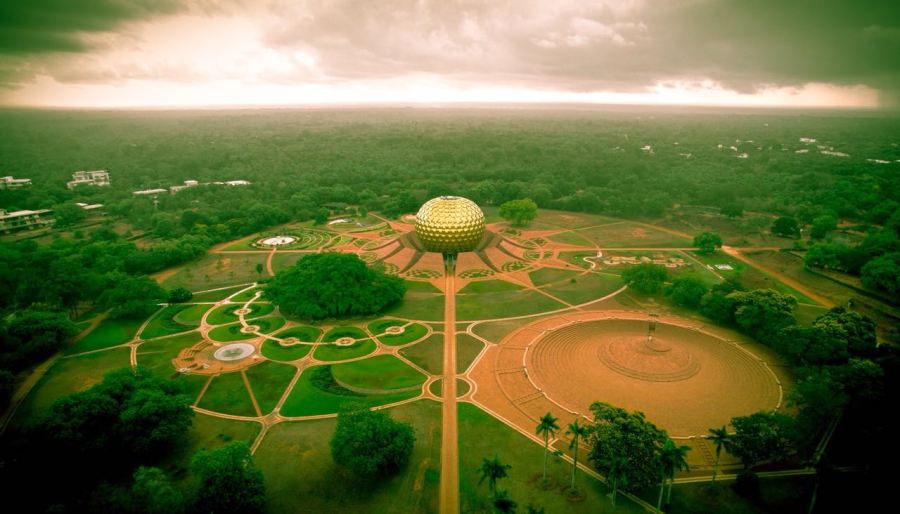
Auravilla, Pondicherry

Did you ever knew, there existed an entire universal town that has its own set of rules and it belongs to nobody but the humanity as a whole. An experimental town in viluppuram district mostly in Tamil Nadu and some parts in Puducherry. It was founded in 1968 by Mirra Alfassa (known as “the Mother”) and designed by architect Roger Anger.

The purpose of Auroville is to realise human unity. It wants to be a universal town where men and women of all countries are able to live in peace and progressive harmony above all creeds, all politics and all nationalities, Mirra Alfassa had said. The town has a total population of 3000 people from over 58 nations from worldwide.

The whole idea to build an ideal society, an ideal city where differences among humans are diminished close to zero. How much does it cost to stay at a guest house in Auroville? On average, a guest house in Auroville costs $19 (₹1400) per night (based on Booking.com prices).

Marital Rape:Culture or Consent?

Patriarchy, often perceived as a “culture” by the Indian society, strives to be protected at all costs, even if that means to strip off the “vulnerable”, of their basic human rights. All concepts that threaten this so-called culture, are categorised as “western concepts”, and are further refused to be acknowledged. Living in denial and refusing to acknowledge the problems, does not mean that they don’t prevail in the Indian Society. In fact, this means that a significant chunk of the society is not ready for the particular problem, but, that does not in any way, give them the right to disregard other people’s safety and security, just because their’s is intact.
One such controversial concept is ‘Marital rape’, often perceived as an oxymoron. Although, ‘rape’ has been clearly defined by most of the criminal codes of almost every country recognised by the United Nations, yet the understanding is rather subjective varying on the culture and relationship of the accused and the victim.  As Estelle B. Freedman points out in Redefining Rape,”At its core, rape a legal term that encompasses a malleable and culturally determined perception of the act…The meaning of rape is thus fluid”. One such factor is ‘marriage’, which supposedly rules out the possibility of forceful sexual conduct upon a wife, since a wedlock provides  immunity to the husband, sociologically as well as on legal grounds in 10 nations of the world.
Well, one of the most difficult challenge faced by people opposing marital rape, is the lack of acknowledgment of this sin. The surprising fact is that this is probably the only crime , where the victim does not recognise her violation of the rights, because control of a woman’s body is foundational to patriarchy. As British jurist, Lord Mathew Hale, states that,”The husband cannot be guilty of rape committed by himself upon his lawful wife, for by their mutual consent and contract the wife hath given up herself in this kind unto her husband, which she cannot retract.” This orthodox thinking is deep rooted in our society and is a shame to our so-called judicial progress, because if we see the section 375 of the Indian Penal Code,1872, although it defines rape, yet there is an exception in the statute which states, that, ’Sexual intercourse by a man with his own wife, the wife not being under fifteen years of age, is not rape.’

Arguments generally used to justify the non existence of this crime in the IPC, are that there are other sections like domestic violence and cruelty that protect the wives from the oppression and dominance.“there are other provisions that safeguards the rights of a wife, like domestic violence which covers cruelty, so why do we need another law? So greedy, these ‘feminists’ have become!”. This shows us the biggest problem in not recognising marital rape as a form of rape ,that is, the society is ready to accept the husband as an offender of  domestic violence, since the ‘anger issues’ are just unstoppable and ‘he is a man’, but are not ready to accuse the husband of rape of his own wife.Such beliefs are imbedded in notions such as the idea that a woman’s sexuality is a commodity that can be owned by her father or husband, the belief that what happens between husband and wife in the bedroom is a private matter, that a man is entitled to sexual relations with his wife, and that a wife should consensually engage in sex with her husband, thus making rape “unnecessary.” 

The ways in which marital rape is condoned varies cross-culturally. In India, Supreme court ruled in February 2015, that marital rape is not a crime.A government minister then told the parliament, that it could not be criminalised in India, since “marriages are sacrosanct”.(BBC News,2015). Like, in United States of America, although it is a criminal offence, yet a significant amount of attitudinal surveys show that Americans regard the rape of a wife far less than a similar assault by an acquaintance or a stranger. “Marital rape is a western concept, it is not possible in the Indian Society”, as stated by Maneka Gandhi, minister of women and child development, Ironical? It’s a crying shame, that people still have to be convinced, that there is ‘no difference’ between rape and marital rape. A wedlock, does not take away the bodily rights of a woman, she is still an individual and her rights must be protected. This mindset cannot be changed solely by judicial activism, but by educating men and women, and making them sensitive towards each others sentiments.

One of the ignored reason of the exclusion of this crime, is the anthropological aspect of research. As Gabriella Torres points out in her book, ’Marital Rape: Consent, Marriage, and Social Change in Global Context’, that first and foremost, this issue is not been given the level of public importance that it deserves. The  arguments for keeping the exemption have included, first,  keeping the marital relationship private,  second,  protecting husbands from vindictive wives, third, because it is nearly impossible to prove, and fourthly because a charge of rape would discourage reconciliation between husband and wife.

The reason for the less public attention given by the people to this inhuman and heinous act is that, the society is so blinded with culture and customs, that now the customs are not according to the behaviour of the people, but the behaviour is according to the culture and customs. This is where anthropologists come into power, since the society has nicely, adapted the crime to the custom, it’s important to understand what the culture or customary practice originally stated.There can be two possible scenarios, that is, one, culture does not state to violate any right, then society’s mindset can be changed with the right information regarding their culture  and second possible scenario is, if the culture succumbs to the violent and dominant ideology and even after reading the accounts of the victim, the dominance of the culture has a possibility, then it is high time we make a choice between ‘Culture or Consent’.

E-commerce

Information Technology has been playing a vital role in the future development of financial sectors and the way of doing business in an emerging economy like India, Bangladesh etc. Increased use of smart mobile services and internet as a new distribution channel for business transactions and international trading requires more attention towards e-commerce security for reducing the fraudulent activities. The advancement of Information and Communication technology has brought a lot of changes in all spheres of daily life of human being. E-commerce has a lot of benefits and many acts which hurts the small businesses or business aspects. This study predicts some challenges in an emerging economy.

What is E-Commerce ?

E-commerce means buying and selling of goods over electronic and digital platforms. Thete have been many allegations that big e-commerce are responsible to harm healthy competition in the market. Economies of scale and advancement of logistical companies has helped e-commerce companies to ship goods to anywhere.

Why E-commerce?

With the increasing diffusion of ICTs, more specifically the Internet, the global business community is rapidly moving towards Business-to Business (B2B) e-Commerce. The buyers gain a clear advantage when the Internet gives them access to the global market, by which they can compare prices across regions, find out whether prices vary by order fragmentation and get awareness about substitute products. Due to transparency of the market, customer can compare the services of various e-commerce sites easily. For instant, in case of e-commerce the competitors are one click away from customer. If clients are not happy with the products, prices or services offered by a particular e-commerce site, they are able to change much more easily than in the physical. From the Sellers’ point of view, they don’t need to have physical existence of shop.

E-commerce Hegemony ?

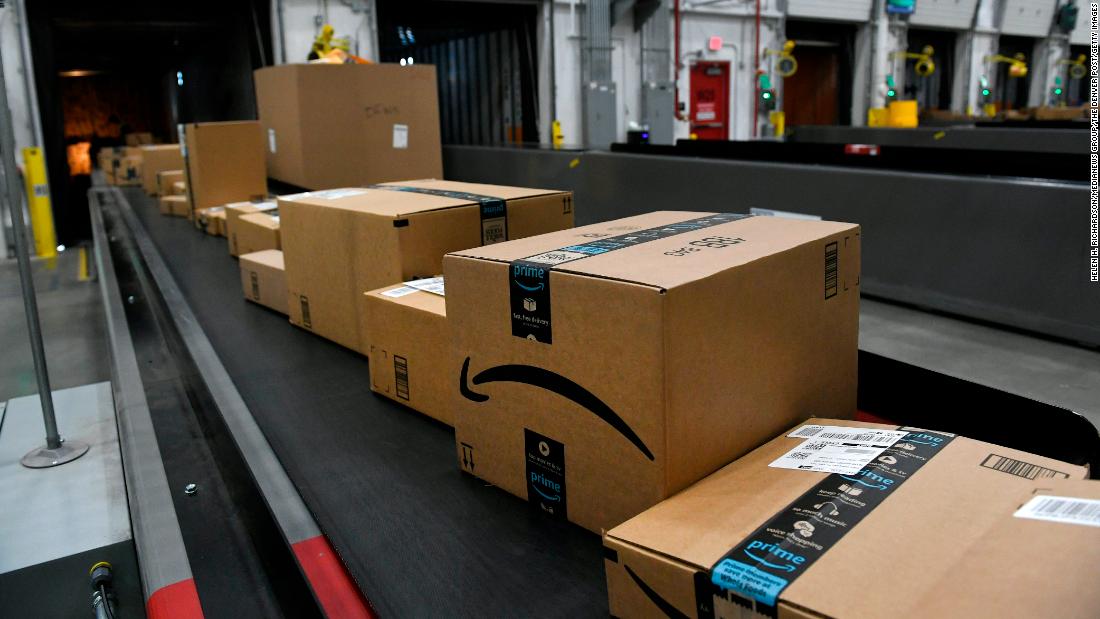
Recently The competition commission of India ordered a probe into alleged competition law violations by Flipkart Amazon over allegations that the e-commerce major promoted and gave discounts to preferred sellers, entered into exclusive partnerships with smartphone brands and abused their dominant position.

Flipkart Amazon is good provider by online marketplace for selling goods in India. Flipkart and Amazon is a wholesaler which is in the business of seeking the good to reseller.

Section 4 of the competition act 2002 is very important as we know completion act is not against possessing dominant position in the market but is objects abusing such dominant position. Section 4 of this act deals with abuse of dominant position.

Dominant position in a market means positions of strength enjoyed by any enterprise in relevant market. Like any enterprise operate independently of competitive forces prevailing in the relevant market Affects it’s competitors or consumers or relevant market in its favor. Recent example of abuse of power should be Amazon Flipkart how they give heavy discounts to customer directly pick-up the good from company that hits the shopkeeper or small enterprises.

Conclusion

As e-commerce industry is emerging sector with high potential of growth govt has to introduce some policies to promote healthy competition in this industry. Govt has to anticipate current loophole in regulations and amend it is such a way that instead of harming msme sector. The e-commerce industry will be a leader with popularity in electronic business world in the upcoming years. The e-commerce revolution has fundamentally changed the business of transaction by giving new opportunities and breaking borders easily. In India, it has strongly impacted the traditional business system and changing the life of people by making it easier. While it gives benefits to customer and seller, e-commerce gives challenges to traditional business for competitive position. Developing countries face many obstacles that affect the successful implementation of e-commerce with the help of comparing with developed country. When the internet cost will be low then the e-commerce will flourish easily and will make many of traditional business to run out of their business. Convenience is one of the benefits that customer gets from the e-commerce and thus increasing customer satisfaction. This is due to customer can place a purchase an order from anywhere with internet connection. E-commerce business provider should give importance on every customer by giving smooth service and many options for payment and have more functions available online. Other benefits are expanded product offerings and expanded geographic reach. But e-commerce business faces a lot of challenges in flourishing their business.

Police Brutality: a socially accepted crime?

A “JUSTIFIED” CRIME :

Police brutality is depicted as a method promoting the idea of “instant justice”. However, the concept of Quo Warranto (latin maxim for “by what authority”) comes into picture, considering the fact that it oversteps on the fundamental roles of courts or quite literally known as the “justice system” of the country. Although, the latter doesn’t seem to be doing its duty quite efficiently as we are very well aware of the great history of the piled up cases and the never ending loopholes that sort of comes complimentary to any Government organisation. However, this in no way justifies the inhumane culture of police brutality, that has been so widely accepted by the people that it seems as an alternative dispute resolution to the long lasting court trials.

HYPOCRITICAL APPROACH:

There have been various protests against this rising injustice, especially during the worldwide lockdown period. However, I do feel there is some sense of hypocrisy attached to the opinions of the so called “woke” people who tend to have a different opinion when it comes to raising their voice on social media and a completely different reaction when the same concept is showcased and applauded in the entertainment sector, for example, in Bollywood movies like Singham, Simba, Dabbang etc. When the same concept is portrayed in an entertaining way, it is well praised. The protagonists of these movies are idealised and followed, since the encounters or torture that they succumb, is towards the “guilty”. But again, the police is not the deciding authority.

CONCEPT OF FAIR TRIAL:

There is a reason why, “statements given by the accused while under police custody are inadmissible in the court of law”. One of the principles of natural justice,” Audi Alteram Partem” which states that, no one should be condemned unheard. Irrespective of how strong evidence is there, against the accused, each party deserves a fair and formal trial with a proper legal representation. For example all the police encounters that take place may appear to be fair prima facie, however, these cannot only be used as a tool for “instant justice” but also for instant promotions or sudden increase in the credibility of the police department. We all lashed out at George Floyd’s case, but what about the recent Hyderabad rape case of Priyanka Reddy where the accused were shot dead in a “police encounter”. Most of us felt relieved saying “inke saath toh yeh hi hona chahiye”. Although, the “accused” were unarmed in that case, there was no threat to the police, so what was the need to kill them? The rage in a heinous crime like rape is justified, however, we forget the fact that they were the “accused” and not the “convicts”, again the basic principle of law saying “innocent until proven guilty”.

CONCLUSION:

The Priyanka Reddy rape case (encounter) is one such example, there are hundreds of such cases that occur every day. Fake encounter, torture while in custody ( Jairaj and fenix) or oppression based on race ( George Floyd) are daily occurring and only few make it to the limelight. One of the basic steps that has to be taken by us is to sensitise people about the lawlessness of this act and how power does not give you the right to misuse it and exploit the vulnerable. Stop promoting this inhumane behaviour by being aware of your rights and calling out these personnels on such acts.The essence of our constitution and the judiciary is “May the 100 guilty be free but one innocent should not be convicted or punished“.

Internet Theft: Can the government be considered as a white collar criminal?

With the constant rise in digitalization, the computer stores information in binary data form and deeply on the data form which is a way that the device tracks a lot of information in an effective way. Subsequently, with the invention of personal computers and microprocessors the idea of using computers for exclusive use of an individual rose. The process was not only affordable but also made management and storage of information easier. But this evolution has also led to increased interactions and sharing of private data using computer, ultimately leading to illegal activities known as cybercrimes. Identity theft is one such crime. Identity theft refers to a crime when a person fraudulently obtains information of another person and later uses it for economic or personal gain.  The theft happens in a two-step process. Firstly, the personal information gets stolen. Later, the information gets used to impersonate the victim and commit the fraud.  Identity theft has already made its place among the fastest growing sector in not only the developed countries but also the developing countries. The primary reason for US being affected stands firm to the fact that all the personal information is linked to a single social security number. The number allows an individual to avail all government schemes and records related to the individual whose social security number it is. This allows very little safeguarding to the individuals whose number gets leaked. Landing on Indian records, there has been an 11% increase in identity theft and ransom ware, followed by phishing attacks increase to 9%.  India also been ranked amongst top 5 countries to be affected by cybercrimes in 2013.  Problematically, there is a very low conviction rate despite the high levels of cybercrime.

There are provisions in Indian Penal Code, 1860 which governed the crimes of forgery and fraud but it was later amended by the Information technology Act, 2008 as it also included the electronic record, ultimately widening the ambit of such computer data related crimes. Provisions such as section 464 criminalizing forgery, Section 465 criminalizing making of false documents, section 468 criminalizing forgery for purpose of cheating, Section 469 criminalizing forgery for purpose of harming reputation, Section 469 criminalizing the use of a genuine document as forged and section 474 of having possession of a document with intention of using the genuine document as forged were coupled with IT Act. Section 420 could be used in circumstances when the Act requires including unique identification information of any individual. 

In the present scenario, the IT Act, 2000 is the main legislation governing cybercrimes in India. The objective of the Act, however, was to mainly recognize e-commerce and that’s why it did not define cybercrime. Before the 2008 amendment, the Act could impose civil liability for unauthorized access to computer or network which would have facilitated an illegal act under section 43 by way of compensation under the pecuniary limit of one crore. Also, Section 66 criminalized hacking which would result to destruction, deletion or alteration of any resource in the computer. 

The Amendment of 2008 introduced the term ‘Identity Theft’.  Section 66C of the Act governs the crime and provides punishment for the same.

The ‘sensitive personal data’ however required stronger laws to be formulated which could ensure the protection of private data. The ambit of the term has been defined by IT rules, 2011. It involves the data related to one’s password, financial information, sexual orientation, biometric information, medical records. Such a clause would be exceptional to the State or central government for monitoring, surveillance or interception. The same was provided under Section 69 of the Act. 


Data Protection Bill 2019 and Cyber-Crime are often used together these days. Not scholarly but indeed since the bill does come with serious implications for all technological and digital service provider companies and has already generated controversies. Despite India’s attempts to create a complex legal framework with the objective of protecting data but it comes with shortcomings which are inevitable. On a bare reading, there are three serious flaws with the current draft.

Firstly, the section of data localization requires data fiduciaries to store atleast one copy of personal data on a data centre or server which is located in India. However, the centre holds the upper hand to exempt categories falling under the personal data. Also the centre can declare certain datas as critical and require them to be stored in India. In the present, this would allow all the social sites also known as foreign internet services to physically able a user data in the country. This would allow law enforcement easy access to this data, which brings to the second issue.

The law enforcement access to data section would allow processing of data considered personal by an individual in the hands of centre and in the interest of security and public welfare, the state can utilize the information which would not be illegal as it would be according to procedure established by law. Now, this access stands as a threat to the right to privacy that exists in India. If combined with the section of data localization, the government shall have access to information about users in social media.

However, this legal framework for surveillance by the government is governed by the judgment in PUCL v Union of India in which the Apex Court stated rules to concentrate the power to order and review surveillance in the executive body which doesnot require court orders or supposedly, any third party review. The measure intended to act as a stopgap measure by the SC and if any subject falls short of international human rights then there will be very little to safeguard the citizens.

The last section is about the regulatory structure created. The Centre has control significantly over the controls. The bill further gives powers to data protection authority to appoint its members by merely the recommendation of an outside committee. For a person to be an effective regulator of an institution, one must have sufficient time to learn and the bill providing only five years of term seems ineffective.


The term white collar crime has grown to define the fraudulent crimes of business and government professionals over time. The characterization of such a crime is violation of trust, concealment of information, deceit through information and categorically not dependent on any kind of force or violence imposed. White collar crimes end up having huge impacts on the society. There have been various scams in the country like the Havala scam, 2g scam, fodder scam, banking scam and many more. This does not necessarily indicate towards the entire involvement to be criminal but it merely requires one financial fraud in greed of money or power to commit such an act. Cybercrime stands as one of the biggest causes to these types of crime in the country. It is the information that single handedly threatens a person’s security and financial status.

Since the actions of Government have direct impact on the society, it is easily identifiable that when a white-collar group is discussed, the Government is a part of it.

Now, bringing the recent proposed bill and the white-collar crime concept together, the question stands whether the bill in the name of data protection is actually for protection or is merely a tool of mass surveillance by the Government.

The SC in its judgment of right to privacy in K.S Puttuswamy case declared the right as a part of Article 21 guaranteed under the Constitution. The judgment clearly stated that the right is a natural right and is a measure to protect an individual from the scrutiny of the State. Thus, any action by the State would undoubtedly result in violation of such a right and would be subject to judicial review. But the right clarified to have reasonable restrictions which empower the State to impose restrictions in accordance with a law in the interest of State’s need and also the means should be in proportion to the objectives of law.

Even if not called the worst but if the bill is passed, it would bring in major implications especially in areas of national security, foreign investment as well as international trade.


SHOR IN THE CEREBRAL CORTEX

The Krakatoa volcanic eruption in Indonesia created the loudest sound ever reported at 180 dB in the year 1883. Do you know what’s louder than that? My mind thinking, producing thoughts faster than the blink of an eye. ‘Writer must be some mad scientist solving scientific equations in her brain’, one might think. On the contrary, the equations my brain analyses are the thousand possibilities of one single situation.

Everyone is looking at me. They are talking about me. Is it my hair? Is it the shirt I’m wearing? I think the world knows about that one time when I mispronounced the word ‘laminate’ as ‘lemonade’ in 6th grade. This is it. Life gave me lemons and the lemonade I made is SOUR.

An organ made of soft tissues and approximately two clenched fists in size has the power to make and break one’s life is a big accusation on our Brains. But who is to be blamed then?

I would like to someday adopt a Fish and a Cat and a Dog. But what if the cat eats the fish and the dog chases the cat and then they all flee my house and I’m left alone with my thoughts again. You would call it unnecessary paranoia and you would be right. I don’t really reside in my body; I’m simply paying rent to it. This rented house of mine has two windows, I call them my eyes. I guess my mind is the prison and I’m never going to get out of it.

I’m a visitor inside my brain and now my thoughts have chained me to my bed and I’m stuck. Hello, is anybody there, you got keys to my cell?

Wait a minute there is nobody here miles and miles away then who really locked the cell from outside? I give it one small push and it opens with a creak. The door to my prison was never locked? I was staying there voluntarily!

The Brain is powerful. How many doors in your life, you think are locked but aren’t? How many times have you been stuck in the mental prison of overthinking? Something that really had a simple solution. There is an old African line that says, ‘When there is no enemy within, the enemy outside can do us no harm.’ Cerebral Cortex is that part of the brain which produces thoughts, the capability of imagining things beyond reality. It is the strongest force in your life. It will force its opinions on you – ‘you are not good enough’, ‘you cannot do it’, ‘what will they say about you?’,’ stop, you are not made for this.’

Dear Mind of mine, thank you for your opinions but every overthinking thought you produce is equivalent to nothing. We bring it to life with the attention we give it. Stressful thoughts knock on our doors and we tell them ‘STAY OUT’. But that makes them knock louder.

BUT HOW DO I CONTROL AND DESTROY THOSE THOUGHTS?

The secret is – don’t mind the mind. This is the natural state of existence. This is the law of universe. In Science, the first law of Thermodynamics states that, ‘You cannot create or destroy energy but you can transfer it from one thing to another.’ Thoughts will arise and yes you will fill them but you don’t have to fight, control or defeat you mind. Just stay neutral in between those thoughts and it will dissolve into silence. A peaceful state of mind.

Or we can order a pizza and transfer the energy we spend on overthinking into the process of eating this slice of cheesy heaven. But why does the circle pizza come in a square box? And why is a slice of pizza triangle? Did mathematicians invent the pizza? Is pizza the SYMBOL OF ILLUMINATI?! WHAT IF…..and just like that the writer fell into her rabbit hole of overthinking and the Shor (noise) in her Cerebral Cortex was louder than the Shor in her city.

Sanitary Napkins – Problems Of Usage In India

“Menstrual blood is the only source of blood that is not traumatically induced. Yet in modern society, this is the most hidden blood, the one so rarely spoken of and almost never seen, except privately by women.”

– Judy Grahn

Throughout our society there is a common lack of knowledge about menstruation. There are also a lack of resources needed for proper hygiene during times of menstruation. These factors lead to a lack of understanding about what the menstruation process actually is. Fear is developed over the topic of menstruation because of the various misconceptions that surround it. Advertisements and commercials are greatly impacted by the high levels of fear and stigma attached to the menstruation. This causes them to lack anything relevant to real life experiences and often encourage secrecy around menstruating. Ways this is conveyed include, emphasizing no leakage and using liquids that aren’t red to display blood. With all these social media influences, there is a consistent level of menstruation taboo because people are being exposed and primed to think that menstruation should be kept secret and they are often led to believe the opposite of what real life women experience during menstruation. The taboo around menstruation continues due to the absense of education, realistic promotion and resources.

Research indicates that these menstrual taboos have negative effects on women, specifically their likelihood to self-objectify. One article looked into the menstrual knowledge and taboo advertisements and their effects on self-objectification. The researchers found that the lower level of menstrual knowledge a woman had the more likely they were to self objectify. They also found that women with negative attitudes toward menstruation were more likely to self objectify than those with positive attitudes.

Menstrual hygiene still continues to be amongst the most challenging developmental issues that women face today, especially in the developing countries like India, the mindsets, customs and institutional biases prevent women from getting the menstrual health care they need.

Let us have a look on the problems of using sanitary napkins in general :

Physical aspect

  1. The pads are scented which can cause infections in vagina.
  2. The skin around the vagina is thin with numerous blood vessels and chemicals can directly enter the bloodstream from the
  3. Prolonged contact with SAPs has been also linked with skin reactions such as rashes.
  4. Synthetic and plastic restricts air flow and traps heat and dampness, causing yeast and bacteria growth in the vaginal area.

The environmental aspect

According to Solid Waste Management(SWM) rules, sanitary pads waste comes under the category of Domestic Hazardous Waste.

As the use of sanitary pads increases, so does the amount of sanitary waste generated. The primary concern, for now, is how these pads are disposed of and their impact on the environment.

According to a joint report by Water Aid India and the Menstrual Hygiene Alliance of India, depending on the materials used in the manufacture of the sanitary pads, it could take up to 800 years to decompose a single sanitary napkin.

Right now there is no separate way prescribed to dispose of them. So, out it goes with all the household garbage. This causes serious health issues for the waste pickers when they segregate the waste; exposing them to infection-causing microbes, leading to diseases like Hepatitis, E.coli infection, Salmonella infection, Typhoid, etc. Recently, the Red Dot Campaign was launched in Pune which encouraged women to throw sanitary pads in a ‘red dot marked’ packet, so that they could be easily identified and segregated.

The used pads are then finally moved to landfills on the outskirts of the city, where they stay for hundreds of years. SAPs are petroleum-based materials that do not degrade easily. Let’s just say, a pad used by a woman will not be decomposed in her lifetime or her kids or their kids. Now, imagine the extent of plastic pollution we are creating/have created, especially when one pad is said to be equivalent to 4 plastic bags. Every sanitary napkin carries two grams of non-biodegradable plastic. Multiply that with an average of 8-10 pads per menstruating women every month and let that sink in.

According to the National Family Health Survey (NFHS) 2015-16 report, around 48% rural women use sanitary napkin while in urban areas the percentage is around 77%. Recent data provided by Menstrual Health Alliance India states that menstrual waste collected across the country, primarily consisting of sanitary napkins which is disposed of as routine waste along with other household garbage, is 45%.

According to the Municipal Solid Waste (Management and Handling) Rules, 2,000 soiled napkins and blood-soaked cotton are disposed of after segregation into biodegradable and non-biodegradable components. However, the Bio-Medical Waste (Management and Handling) Rules, 1998, says that items contaminated with blood and body fluids, including cotton, dressings, soiled plaster casts, lines and bedding, are bio-medical waste and should be incinerated, autoclaved or microwaved to destroy pathogens. The longer used pads are kept in the open and kept in contact with air, the more they are prone towards becoming pathogenic.

Now, throwing light on the problems of using sanitary napkins specifically in India :

Genital hygiene

The study found an urgent need for intensive health education on genital hygiene. According to the Census of India 2011, more than 41% of the households do not have bathrooms and of those that do, 16% of the rooms did not have a roof.

Because of the poor conditions of the bathroom or lack of proper toilet facilities, women in rural areas do not have the privacy to wash their genitals.

Poor genital hygiene has been found to be an important factor for the development of dysplasia and cervical cancer, and the use of pads made from reused cloth increases that risk, studies have shown.

Poverty reasons

Many people below the poverty line cannot afford the sanitary napkins. Homeless people, mendicants are deprived of the facility of using sanitary napkins. Though many government schemes are introduced to give free supply of sanitary pads in rural areas. Still there are people who use piece of cloth, rags, ash, or husk.

Lack of Sanitary Napkins and Adequate Facilities

In a city, availing a sanitary napkin for a woman aware of menstrual hygiene is a normalised process. Not only are sanitary napkins available in pharmacies and grocery stores in cities, they are commercialised via advertisements so that they are treated as any other product. In rural areas, sanitary napkins are found with difficulty. Most girls rely on home-grown or other readily available material, the latter often being unhygienic and unsanitary. Only 2 to 3 per cent women in rural India are estimated to use sanitary napkins. The lack of demand results in storekeepers not stocking up on sanitary pads. This results in women resorting to unhygienic practices during their menstrual cycle, such as filling up old socks with sand and tying them around waists to absorb menstrual blood, or taking up old pieces of cloth and using them to absorb blood. Such methods increase chances of infection and hinder the day-to-day task of a woman on her period.

Superstitions & Lack of Awareness

Lack of awareness makes for a major problem in India’s menstrual hygiene scenario. Indian Council for Medical Research’s 2011-12 report stated that only 38 per cent menstruating girls in India spoke to their mothers about menstruation. Many mothers were themselves

unaware what menstruation was, how it was to be explained to a teenager and what practices could be considered as menstrual hygiene management. Schools were not very helpful either as schools in rural areas refrained from discussing menstrual hygiene. A 2015 survey by the Ministry of Education found that in 63% schools in villages, teachers never discussed menstruation and how to deal with it in a hygienic manner.

There are also many superstitions regarding menstruation which stops woman from using sanitary napkins.

Lack of penetration & poor quality

India has one of the lowest levels of penetration of sanitary pad usage in the world. At 20%, India lags behind Thailand, Indonesia and China, all of which have over 50% usage. Social norms, cultural taboos and superstitions associated with menstruation have meant that Indian women continue to rely on unhygienic practices.

The quality of napkins used in a government scheme which was to promote menstrual hygiene was poor in Odisha, Rajasthan and Kerala. This means that they had a low absorption rate or inadequate dimensions that increased the likelihood of leakage. Sanitary napkins reportedly ran out of stock in Arunachal Pradesh, Bihar, Jammu and Kashmir, and Maharashtra. However, a satisfactory uptake of sanitary napkins was noted in Bihar, Jharkhand, Odisha, Jammu and Kashmir, Andhra Pradesh, Maharashtra and Gujarat, according to the 10th common review mission (CRM), an annual progress report published by the National Health Mission (NHM) in 2016.

The uptake of sanitary napkins under the scheme was low in Himachal Pradesh and Odisha due to mediocre quality. Delhi was reported to have faced an irregular supply of sanitary napkins, as per the ninth CRM report in 2015. Moreover, no sanitary napkins were distributed in Chhattisgarh in that particular period, revealed a 2015 Comptroller Auditor General (CAG).

From a ban on advertisements on sanitary napkins in 1990, to a full-fledged feature film, PadMan, on a low-cost sanitary napkin entrepreneur in 2018, India has indeed come a long way. It was eight years back in 2010, when the Ministry of Health and Family Welfare launched the Freeday Pad Scheme, a pilot project to provide sanitary napkins at subsidised rates for rural girls. The scheme was launched in 152 districts across 20 states and sanitary napkins were sold to adolescent girls at the rate of Rs. 6 per pack of six napkins by Accredited Social Health Activists (ASHAs). The estimated cost for the entire scheme was Rs 70 crore.

A year later, the Union government launched the SABLA scheme across 2015 districts in the country. The scheme aimed at improving health conditions for adolescent girls with menstrual hygiene as an important component. Two years later, under the then ongoing Nirmal Bharat Abhiyan, focus on menstrual hygiene was added as a key component of the sanitation mission. In 2014, the Union government launched the Rashtriya Kishor Swashthya Karyakram, aimed at improving the health and hygiene of an estimated 243 million adolescents. Menstrual hygiene was also included as an integral part of the programme.

Under the ongoing Swachh Bharat Abhiyan, menstrual hygiene has been given high importance. The Swachh Bharat (Gramin) guidelines explicitly state that funds allocated for information, education and communication (IEC) maybe spent on bettering awareness on menstrual hygiene in villages. Adequate knowledge of menstrual hygiene and development of local sanitary napkin manufacturing units is encouraged by Swachh Bharat Mission (rural) and self-help groups are to help in propagating such efforts.

Many Government schemes are introducing, which each passing day people are becoming more conscious about the menstrual hygiene. We can now see a ray of hope.

India’s Kashmir Conflict

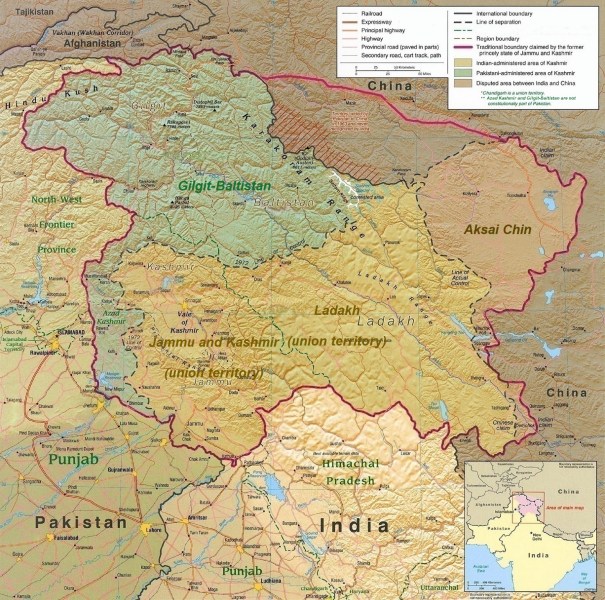
The Conflicted Map Of J&K with Ladakh

With over seven decades crossed since 1947 followed a continuous stretch of never-ending bloodsheds in the Kashmir valley or for the reason of it.  Just in past 27 years, around 41,000 lives have been lost due to this Indo-Pak dispute. The Indian army had lost many of its brave soldiers who sacrificed themselves for the safety and security of people in the valley and rest of India. With more than 950,000 soldiers deployed in Kashmir, making it world’s most strongly guarded place, shows the threat level in the valley. The current Kashmir when compared to the Maharaja Hari Singh’s Kashmir is divided into 3 major parts. Two pieces of territory are illegally occupied by the Pakistan (30%) and China (15%). The regions under Pakistan are Gilgilt, Baltistan and the Pakistan occupied Kashmir (POK) and the region under China is Aksai-Chin which is vastly inhabited by humanity.

The Indian controlled Kashmir (55%) owns 60 per cent of the population of Kashmir in total. The Jammu and Kashmir initially under the Sikh Empire of Maharaja Ranjit Singh, saw a shift in powers with arrival of east India company and british. The empire then switched into the Dogra Empire which was overtaken by Maharaja Gulab Singh and this continued until the independence of India in the year 1947. It was this time, when the britishers before leaving Indian territory kept an opportunity for all the 565 princely states of Indian peninsula to either join an Islamic state named Pakistan or a democratic republic of India. This stretched the long run tensions between the communities of muslims (in favour of an Islamic state) and the rest of people into a massacre of centuries. A bloodshed that no one in the world saw before, it is estimated that up to one million people were killed during the violence in 1947, and around 50,000 women were abducted. Some 12 million people were displaced from their homes in the divided province of Punjab alone, and up to 20 million in the subcontinent as a whole. Few princely states opt to merge with Islamic state of Pakistan and majority of them joined the republic of India. Kashmir on the other side chose to remain an independent state under Maharaja Hari Singh. He decided to stay independent because he expected that the State’s Muslims would be unhappy with accession to India, and the Hindus and Sikhs would become vulnerable if he joined Pakistan. On 11 August 1947, the Maharaja dismissed his prime minister Ram Chandra Kak, who had advocated independence. Observers and scholars interpret this action as a tilt towards accession to India. Pakistanis decided to pre-empt this possibility by wresting Kashmir by force if necessary. Pakistan made various efforts to persuade the Maharaja of Kashmir to join Pakistan. In July 1947, Mohammad Ali Jinnah is believed to have written to the Maharaja promising “every sort of favourable treatment,” followed by the lobbying of the State’s Prime Minister by leaders of Jinnah’s Muslim League party. Faced with the Maharaja’s indecision on accession, the Muslim League agents clandestinely worked in Poonch (west territory of Kashmir) to encourage the local Muslims to an armed revolt, exploiting an internal unrest regarding economic grievances. The authorities in Pakistani Punjab waged a ‘private war’ by obstructing supplies of fuel and essential commodities to the State. Later in September, Muslim League officials in the Northwest Frontier Province, including the Chief Minister Abdul Qayyum Khan, assisted and possibly organized a large-scale invasion of Kashmir by Pathan tribesmen. Several sources indicate that the plans were finalised on 12 September by the Prime Minister Liaquat Ali Khan, based on proposals prepared by Colonel Akbar Khan and Sardar Shaukat Hayat Khan. One plan called for organising an armed insurgency in the western districts of the state and the other for organising a Pushtoon tribal invasion. Both were set in motion.

With Pakistan’s tribesmen invasion, the Kashmir was set on fire, loot, and atrocities to Kashmiris by the Pathan’s were so grieve that it could be hardly penned down. The pathan’s did whatever they could to terrorize Kashmiri’s, they abducted, raped and murdered thousands of girls and women of all ages. This was being done to scare Kashmir and its ruler for their indecision for accession into Islamic state of Pakistan. The Pakistan’s muslim league and its military knew this for sure, that newly formed independent nation of Jammu & Kashmir is heavily outnumbered with its line of defence and weapons. The Maharaja made an urgent plea to Delhi for military assistance. Upon the Governor General Lord Mountbatten’s insistence, India required the Maharaja to accede before it could send troops. Accordingly, the Maharaja signed an instrument of accession on 26 October 1947, which was accepted by the Governor General the next day.

While the Government of India accepted the accession, it added the proviso that it would be submitted to a “reference to the people” after the state is cleared of the invaders, since “only the people, not the Maharaja, could decide where Kashmiris wanted to live.”; it was a provisional accession. The largest political party, National Conference, headed by Sheikh Abdullah, endorsed the accession. In the words of the National Conference leader Syed Mir Qasim, India had the “legal” as well as “moral” justification to send in the army through the Maharaja’s accession and the people’s support of it. The Indian troops, which were airlifted in the early hours of 27 October, secured the Srinagar airport. The visiting journalist at Srinagar city witnessed an incredible sight where volunteers of National Conference (Local political party of Kashmir) was patrolling the city from tribal Pakistani invaders and Minority Hindus, Sikhs were moving freely among Kashmiri Muslims. This was a true example of community harmony in Kashmir.

After securing Sri Nagar, the Indian army troops were set to retrieve other portions of Kashmir, captured by the Pakistani tribesmen and military. Yet, in the meantime the then prime minister of India, Mr J. L. Nehru made an announcement over all India radio, that India would seek United Nation’s (UN) mediation into this matter. This was greatly opposed by the then home minister of India, Sardar Vallabhbhai Patel. Later, with intervention of United Nations group under Sir Owen Dixon (UN mediator) who came up with a plan of seizing the military conflict by mapping a stamp on territories already under control. This led regions already secured by the two countries under their jurisdictions and UN formed a Line of Control between the western and Eastern parts of Kashmir. To this day, India claims the entire region of Kashmir as per the legal instrument of accession signed by the Maharaja of Kashmir, making the whole of Kashmir an integral part of Republic Of India.

Later in the year of 1962, another war broke but this time it was between India and China. The war zone was the regions of Ladakh province to the east of Kashmir. After this Indo-China war of ’62, China captured another part of Maharaja Hari singh territory, the Aksai-Chin. India to this date demands both of its territories and had raised its voice into United Nations Security Council from time to time in the recent past. Whatever is good for Kashmir and safe for Kashmiri dreams should be implemented, to make sure that no more innocent lives are lost, no more brave soldiers are sacrificed for the love of their motherland.

Ragging – A punishable offence

Ragging is a disturbing reality in the higher education system of our country. Despite the fact that over the years ragging has claimed hundreds of innocent lives and has ruined careers of thousands of bright students, the practice is still perceived by many as a way of ‘familiarization’ and an ‘initiation into the real world’ for young college-going students.

Meaning and definition of ragging
The Supreme Court defined ragging in the Vishwa Jagriti matter (1999) as, “Any disorderly conduct whether by words spoken or written or by an act which has the effect of teasing, treating or handling with rudeness any other student, indulging in rowdy or undisciplined activities which causes or is likely to cause annoyance, hardship or psychological harm or to raise fear or apprehension thereof in a fresher or a junior student or asking the students to do any act or per form something which such student will not in the ordinary course and which has the effect of causing or generating a sense of shame or embarrassment so as to adversely affect the physique or psyche of a fresher or a junior student.” ( Raghavan Committee Report, 2007)
Other organisations/bodies working in this field have also attempted to define ragging, the variety of definitions being reflective of differences in perspective and interpretation. In 2007, the Committee of Consultants to Raghavan Committee considered ragging “neither a means of familiarization nor an introduction with freshers, but a form of psychopathic behaviour and a reflection of deviant personalities. Further, ragging reproduces the entrenched power configurations prevalent in civil society.”
According to the UGC Regulation on Curbing the Menace of Ragging in Higher Institutions, 2009, ragging constitutes one or more of any of the following acts:


• Any conduct by any student or students whether by words spoken or written or by an act which has the effect of teasing, treating or handling with rudeness a fresher or any other student.
• Indulging in rowdy or undisciplined activities by any student or students which causes or is likely to cause annoyance, hardship, physical or psychological harm or to raise fear or apprehension thereof in any fresher or any other student.
• Asking any student to do any act which such student will not in the ordinary course do and which has the effect of causing or generating a sense of shame, or torment or embarrassment so as to adversely affect the physique or psyche of such fresher or any other student.
• Any act by a senior student that prevents, disrupts or disturbs the regular academic activity of any other student or a fresher.
• Exploiting the services of a fresher or any other student for completing the academic tasks assigned to an individual or a group of students.
• Any act of financial extortion or forceful expenditure burden put on a fresher or any other student by students
• Any act of physical abuse including all variants of it: sexual abuse, homosexual assaults, stripping, forcing obscene and lewd acts, gestures, causing bodily harm or any other danger to health or person;
• Any act or abuse by spoken words, emails, post, public insults which would also include deriving perverted pleasure, vicarious or sadistic thrill from actively or passively participating in the discomfiture to fresher or any other student.
• Any act of physical or mental abuse (including bullying and exclusion) targeted at another student (fresher or otherwise) on the ground of colour, race, religion, caste, ethnicity, gender (including transgender), sexual orientation, appearance, nationality, regional origins, linguistic identity, place of birth, place of residence or economic background.
Government steps against ragging

The anti-ragging campaign got an impetus in 1999 when the Hon’ble Supreme Court, in response to a PIL filed by the Vishwa Jagriti Mission, asked the University Grants Commission (UGC) to issue guidelines to universities to curb ragging. The UGC formed a four member committee under Prof K.P.S. Unny, Registrar of Jawaharlal Nehru University, New Delhi, to examine and submit a report on ragging. In their recommendations, the Unny Committee put forward a Prohibition, Prevention and Punishment proposal i.e. prohibition by law, prevention by guidelines and punishment if the prohibition and punishment do not work. They recommended that central and state governments should enact laws against ragging. They suggested punishments ranging from cancellation of admission to a monetary fine of up to Rs. 25,000 and rigorous imprisonment of up to three years. The Committee also recommended various measures to be undertaken for sensitisation against ragging and highlighted the need for incentivizing wardens and students for their good conduct and anti-ragging activities. It was also suggested that institutions failing to curb ragging should be disaffiliated.


In 2006, the issue of ragging was once again brought to the forefront when the Supreme Court expressed its disappointment in the implementation of its previous guidelines and constituted another committee under Dr. R K Raghavan, Director CBI, to suggest means and methods to prevent ragging; to suggest possible action that can be taken against persons indulging in ragging; and to suggest possible action against institutions that fail to curb ragging. The committee made several important observations. It noted that ragging has many aspects, including psychological, social, political, economic and cultural, and that it adversely impacts the standards of higher education. It considered ragging as our failure to inculcate human values from the schooling stage. The Committee made some strong recommendations to curb ragging.

UGC Regulation on Curbing the Menace of Ragging in Higher Educational Institutions, 2009
In order to address the issue of increase in ragging cases in campuses, the University Grants Commission (UGC) has brought out the UGC Regulations on Curbing the Menace of Ragging in Higher Educational Institutions, 2009. These regulations are to be followed mandatorily by all Higher Educational Institutions. UGC has established an Anti-Ragging toll free “helpline” 1800-180-5522 in 12 languages for helping victims of ragging. The UGC has developed an Anti-Ragging Website – http://www.antiragging.in. The Portal contains the record of registered complaints received and the status of the action taken thereon.

Punishments accorded


According to the UGC Regulation on Curbing the Menace of Ragging in Higher Educational Institutions, 2009, depending on the nature and gravity of the guilt established by the Anti-Ragging Squad, those found guilty may be awarded one or more of the following punishments, namely;
• Suspension from attending classes and academic privileges.
• Withholding/ withdrawing scholarship/ fellowship and other benefits.
• Debarring from appearing in any test/ examination or other evaluation process.
• Withholding results.
• Debarring from representing the institution in any regional, national or international meet, tournament, youth festival, etc.
• Suspension/ expulsion from the hostel.
• Cancellation of admission.
• Rustication from the institution for period ranging from one to four semesters.
• Expulsion from the institution and consequent debarring from admission to any other institution for a specified period

D. Punishments under Indian Penal Code against acts of Ragging
• Every single incident of ragging or abetting in ragging puts an obligation on the institution to get the FIR registered. There are provisions in the IPC, which can be used by a student to register an FIR in the nearest Police Station. These provisions are:
• 294 – Obscene acts and songs
323 – punishment for voluntarily causing hurt
324 – voluntarily causing hurt by dangerous weapon or means
325 – punishment for voluntarily causing grievous hurt
326 – voluntarily causing grievous hurt by dangerous weapon
339 – Wrongful Restraint
340 – Wrongful Confinement
341 – Punishment for Wrongful Restraint
342 – Punishment for Wrongful Confinement
506 – Punishment for culpable homicide not amounting to murder

Publishing ragging is banned : The institutions are required to publish that the ragging is totally banned in the institution and anyone found doing/abetting ragging would be suitably punished.
Brochures/Application Form/Enrollment Form :The college brochures are required to mention these guidelines in full. The prospectus would include all directions of Supreme Court/Central and State Government as applicable. The application/enrollment form for admission will have an undertaking in English and Hindi and preferably one in regional language to be signed by parent/guardian. The school-leaving certificate should reflect the behavioral pattern of the student.
Affidavit of Student : A student during the admission process has to file an affidavit along with his parents/guardian’s signature, stating that he will not be ragging other students directly or indirectly.
Anti-Ragging Committee : Every institution shall constitute a committee to be known as the Anti-Ragging Committee. To be nominated and headed by the Head of the institution, and consisting of representatives of civil and police administration, local media, Non-Government Organizations involved in youth activities, representatives of faculty members, representatives of parents, representatives of students belonging to the freshers category as well as senior students, non-teaching staff; and shall have a diverse mix of membership in terms of levels as well as gender.


Contact detail of Anti Ragging Helpline/Anti Ragging Committee/Anti Ragging Squad : Every fresh student admitted to the institution shall be given a printed leaflet detailing to whom he/she has to turn to for help and guidance for various purposes including addresses and telephone numbers, so as to enable the student to contact the concerned person at any time. Identity of informants of ragging incidents is fully protected.
Anti ragging squad : Anti ragging committee would also monitor and oversee the performance of the Anti-Ragging Squad. It shall be the duty of the Anti-Ragging Squad to make surprise raids on hostels, and other places vulnerable to incidents of, and having the potential of, ragging.

Ragging is a problem of the students and by the students; and therefore, the solution to it also lies with the students. With ragging becoming rampant in colleges, it is about time that the the student community awakens its conscience to this inhuman practice before more and more innocent students become victims of it and before more and more educational institutes are degraded by it.

“CANCELLING EXAMS”; PROBLEMATIC SOLUTION/REALITY

In the beginning of this pandemic, we didn’t have even the slightest idea of its severity. But as days turned to weeks and weeks to months we came to realise how life-threatening and brutal it has been since. Lockdown after lockdown, so much confusion, the world economy changing dramatically, countries blaming each other, war threats and many more, we saw it all.

But what is bothering the student community is how they can move forward from this situation and work towards their career and education without losing out on much. Schools and colleges took to online platforms to continue the syllabus. They tried their best to switch over from the traditional classroom method. Online classes and assignments were one thing. But online exams are completely unconventional, especially to the Indian education system.


Practically right from class 10th  board exams to the various competitive exam like (JEE /NEET /CLAT) everything came to a standstill.

 Soon the college sector started thinking of ways to conduct exams online. The main focus was on the final year students who had to be taken care of first and sent into the ‘real world’.

The Indian government along with the respective authority bodies like the CBSE Board, the UGC, BCI, etc. took decisions on the various sects of students, i.e., middle school, high school, college, etc.

For college students, except the final years, were considered to be promoted to the next semester based on their internal marks. Authority bodies like the UGC and BCI issued guidelines to the colleges on the same. For final year students online exams were conducted by outsourcing resources for optimum results.

The issue however lies in the fact that this scheme of promoting students based on their previous records is not favourable and fair to all students. Also there is confusion on whether the online exams will take place or not, because every day contradicting statements and ideas come out. This takes a toll on students as well as the parents who are anxious about the course of their future. Even if the previous records are considered and taken as a base to promote students to the next semester, will it have repercussions in the future is also a serious aspect that is bothering the students and parents likewise.

The pattern for online exams is mostly MCQ (multiple choice questions), which not exactly helps in assessing the in depth knowledge of the students.However, promoting students without a proper examination can prove to be dangerous especially for professional courses like medicine, law, engineering etc. Even majorly qualifying exams like NEET, CLAT, GATE, JEE etc. have been postponed.

In these trying times, essentials like education should not take a back seat as it is something that will shape the future of the country. The uncertainty linked with the current situation and delayed exams are terrifying as it hinders the progress of millions of students who are pursuing their higher education. This not only affects the student community, but also impacts on the growth of our economy. Recently the state governments of Karnataka and Delhi decided to cancel exams. Even the CBSE board decided on reducing 30% syllabus for classes 9 to 12 for the academic year 2020-2021 only. The Council for the Indian Certificate Examinations CISCE reduced 25% for classes 10 and 12 for the year 2021 because of the disruption caused by the Covid-19 pandemic. Are these good decisions or not, we can’t exactly say now. We can just hope for the best.

Child Labour Prohibition and Regulation Act – A great step to eradicate child labour

Children are one of the vulnerable groups in the society. Child labour is socio-economic phenomenon. This phenomenon is trapped in vicious circle by poverty, illiteracy, unemployment, demographic expansion, deep social prejudices and above all the government interest are commonly consider as the most prominent causative factors for large scale employment children.

As per the Child and Adolescent Labour (Prohibition and Regulation) Act, 1986, amended in 2016 (“CLPR Act”), a “Child” is defined as any person below the age of 14, and the CLPR Act prohibits employment of a Child in any employment including as a domestic help. It is a cognizable criminal offence to employ a Child for any work. Children between age of 14 and 18 are defined as “Adolescent” and the law allows Adolescent to be employed except in the listed hazardous occupation and processes which include mining, inflammable substance and explosives related work and any other hazardous process as per the Factories Act, 1948.

Indian constitution provides many provisions to the child, prohibited child labour and it also mention the rights of the child. They are,

The Article 15 : The state shall not discriminate against any citizen on grounds only of race, religion, caste, sex and place of birth.


Article 23: prohibition of employment children from factories


Article 39: certain principles of policy to be followed by state that are referring to the secure of children that the health and strength of workers, men and women and the tender age of age children are not abused and that citizens are not forced by economic necessity to enter evacuation and unsuited their age and strength.


Article 45: provision for early childhood care and education to the children below the age of six years.


Article 21-A: right education the state shall provide free and compulsory education to all children age of six to 14 year.


Article 24 of Indian Constitution says Prohibition of employment of children in factories, etc. which means child below the age fourteen years should not be employed in work in any factory or mine or engaged in any other hazardous employment.

Child Labour Technical Advisory Committee


The Central Government may, if it thinks it to be necessary can constitute an advisory committee i.e. the Child Labour Technical Advisory Committee by giving notification about it in the Official Gazette. It is the duty of the Committee to advise the Central Government if there’s a need to add occupations or processes to the Schedule. The Central Government appoints the members of the Committee but the Committee should not exceed more than 10 members. The Committee shall also consist of a Chairman. There isn’t any limitation on the number of meetings Committee shall have. The Committee shall meet whenever they feel necessary and the meetings shall be regulated according to the procedure which shall be decided by them.
The Committee may itself constitute one or more sub-committees if they feel a need to do so.
The Chairman and other members of the Committee are entitled to an allowance.

THE CHILD LABOUR (PROHIBITION AND REGULATION)AMENDMENT ACT, 2016

Objectives of the Act

Prohibit the engagement of children in all occupations and to prohibit the engagement of adolescents in hazardous occupations and processes and thematters connected therewith or incidental thereto

Under the Child Labour (Prohibition and Regulation) Amendment Act, 2016, children younger than 14 years can now work in family enterprises and farms after school hours and during holidays. Children working as artists in the audio-visual entertainment industry, including advertisement, films, television serials or any such other entertainment or sports activities, except the circus, have also been granted exemption, provided the work does not affect their school education.
Besides, the Act provides banning employment of children between 15-18 years in hazardous works, in sync with the Right to Children to Free and Compulsory Education Act 2009.

The Bill enhances the punishment for employing any child in an occupation. It also includes penalty for employing an adolescent in a hazardous occupation.

The penalty for employing a child was increased to imprisonment between 6 months and two years (from 3 months-one year) or a fine of Rs 20,000 to Rs 50,000 (from Rs 10,000-20,000) or both.


The penalty for employing an adolescent in hazardous occupation is imprisonment between 6 months and two years or a fine of Rs 20,000 to Rs 50,000 or both.
anyone repeats offences like employing child or employing adolescents in hazardous occupations mentions in this act under section 3A, they shall be punishable with imprisonment for a term which shall not be less than one year but which may extend to three years.

[section 2] of The Child Labour (Prohibition & Regulation) Act, 1986 defines, ‘child’ means a person who has not completed his 14 years of age.

[section 2 (i)]
(i ) “adolescent” means a person who has completed his fourteenth year of age but has not completed his eighteenth year;

[section 3] No child shall be employed or permitted to work
in any occupation or process (The Child Labour (Prohibition and
Regulation) Amendment Bill, 2012 ) under this section, no child shall be employed are permitted to work in any establishment, occupation or process. Which means child should not be employed are permitted to work anywhere. but according to the [section 3 (2)] child is permitted to work at their own family business and audio & visual industry. provided that such work should not hamper or effect School education of a child.

[section 3 (2)]
According to the new amendment, child is allowed to work at certain places mentioned below.
(a) helps his family or family enterprise, which is other than any hazardous occupations or processes set forth in the Schedule, after his school hours or during vacations;

(b) works as an artist in an audio-visual entertainment industry, including advertisement, films, television serials or any such other entertainment or sports activities except the circus, subject to such conditions and safety measures, as may be prescribed: Provided that no such work under this clause shall effect the school education of the child.

Explanation.—
For the purposes of this section, the expression,

(a) ‘‘family’’ in relation to a child, means his mother, father, brother,sister and father’s sister and brother and mother’s sister and brother;
(b) ‘‘family enterprise’’ means any work, profession, manufacture or business which is performed by the members of the family with the engagement of other persons;

(c) ‘‘artist’’ means a child who performs or practices any work as a hobby or profession directly involving him as an actor, singer, sports person or in such other activity as may be prescribed relating to the entertainment or sports activities falling under clause (b) of sub-section
(2).section 3A] No adolescent shall be employed or permitted to work in any of the hazardous occupations or processes set forth in the Schedule:

THE SCHEDULE

(1) Mines.
(2) Inflammable substances or explosives.
(3) Hazardous process.

Explanation.—
For the purposes of this Schedule, “hazardous process” has the meaning assigned to it in clause (cb) of the Factories Act, 1948.’
(cb) “hazardous process” means any process or activity in relation to an industry specified in the First Schedule where, unless special care is taken, raw materials used therein or the intermediate or finished products, bye-products, wastes, or effluents thereof would-
(i) cause material impairment to the health of the persons engaged in or connected therewith, or
(ii) result in the pollution of the general environment:

[section 7] Hours and period of work (adolescent only)

(1) No adolescent shall be required or permitted to work in any establishment in excess of such number of hours, as may be prescribed for such establishment or class of establishments.

(2) The period of work on each day shall be so fixed that no period shall exceed three hours and that no adolescent shall work for more than three hours before he has had an interval for rest for at least one hour.

(3) The period of work of a adolescent shall be so arranged that inclusive of his interval for rest, under sub-section (2), it shall not be spread over more than six hours, including the time spent in waiting for work on any day.

(4) No adolescent shall be permitted or required to work between 7 p.m. and 8 a.m.

(5) No adolescent shall be required or permitted to work overtime.

(6) No adolescent shall be required or permitted to work in, any establishment on any day on which he has already been working in another establishment.

[section 8] Weekly holidays (adolescent only)
Every adolescent employed in establishment should be allowed to have a holiday for a whole day once in a week.

[section 9] Notice to Inspector
Every employer who employed adolescent at his establishment should intimate to the inspector appointed by the government within 30 days from date of employment of child.

[Section 10]. DISPUTES AS TO AGE. (adolescent) –
If any question arises between an Inspector and an occupier as to the age of any adolescent who is employed or is permitted to work by him in an establishment, the question shall, in the absence of a certificate as to the age of such child granted by the prescribed medical authority, be referred by the Inspector for decision to the prescribed medical authority.

[section 11] Maintenance of register any establishment where adolescent is employed or permitted to work, a register should be maintained by the owner of establishment and should be made available all the times during working hours for inspection by Inspector appointed by the government for this purpose. The register should contain following details

  1. Name of the child
  2. date of birth of the child
  3. number of working hours and internal for rest to child
  4. nature of work dealing child
  5. any other particulars
  6. Section 13 ] Healthy and Safety (adolescent )

Appropriate government is having power make rules on the following matters for the health and safety of the children employed or permitted to work in any establishment or class of establishments.

(a) cleanliness in the place of work and its freedom from nuisance;
(b) disposal of wastes and effluents;
(c) ventilation and temperature;
(d) dust and fume;
(e) artificial humidification;
(f) lighting;

  1. (g) drinking water;
    (h) latrine and urinals;
    (i) spittoons;
    (j) fencing of machinery;
    (k) work at or near machinery in motion;
    (l) employment of children on dangerous machines;
    (m) instructions, training and supervision in relation to employment of children on dangerous machines;
    (n) device for cutting off power;
    (o) self-acting machines;
    (p) easing of new machinery;
    (q) floor, stairs and means of access;
    (r) pits, sumps, openings in floors, etc.;
    (s) excessive weights;
    (t) protection of eyes;
    (u) explosive or inflammable dust, gas, etc.;
    (v) precautions in case of fire;
    (w) maintenance of buildings; and
    (x) safety of buildings and machinery

Constitution of Child and Adolescent Labour Rehabilitation Fund

Section 14B. (1) The appropriate Government shall constitute a Fund in every district or for two or more districts to be called the Child and Adolescent Labour
Rehabilitation Fund to which the amount of the fine realized from the employer of the child and adolescent, within the jurisdiction of such district or districts, shall be credited.

(2) The appropriate Government shall credit an amount of Rs. 15000/- to the Fund for each child or adolescent for whom the fine amount has been credited under sub-section
(1).

(3) The amount credited to the Fund under sub-sections (1) and (2) shall be deposited in such banks or invested in such manner, as the appropriate Government may decide.

(4) The amount deposited or invested, as the case may be under sub-section (3), and the interest accrued on it, shall be paid to the child or adolescent in whose favour such amount is credited, in such manner as may be prescribed.

Explanation:—


For the purposes of appropriate Government, the Central Government shall include the Administrator or the Lieutenant Governor of a Union territory under article 239A of the Constitution.

Rehabilitation of child or adolescent
14C. The child or adolescent, who is employed in contravention of the provisions of this Act and rescued, shall be rehabilitated in accordance with the laws for the time being in force.

Fails to pay


Section 14D (2) If the accused fails to pay such amount for composition of the offence, then, the proceedings shall be continued against such person in accordance with the provisions of this Act.

Inspite of all the measures taken by the government, child labour still prevails in the society. Let us hope for a better future where child labour will be eradicated completely.


Graduates of WhatsApp University


My phone chimes with a notification sound, while the birds from the trees and skies chirp outside, my phone twitters me awake at 5:30 in the morning. My alarm is yet to wake me up but I turn it off nevertheless and reach for my device or ‘WhatsApp’ to be specific. It is now 5:45am, the Sun is not out yet but my mobile screen is brighter than ever. The world has entered my room bombarding me with wisdom and a flower wishing me good morning. It is demanding my attention, comments, jokes, wits, opinions and some fun emojis.

Continue reading “Graduates of WhatsApp University”

Who delivers the Amazon cardboard boxes???

Cardboard boxes that have been used for generations and thrived in the age of e-commerce continue to flourish or could the cardboard box be facing a new challenger? Cardboard boxes are a very big deal within the U.S. The United States is the Saudi Arabia of trees. Someone’s going to make the first box and that’s almost inevitably a mill generally in the Southeast United States. China certainly doesn’t have trees and India the extent they do have trees they’re not necessarily the right types of trees and shouldn’t be dedicated towards making boxes for us. The box business grew rapidly up through 1999 when the U.S. coordinated box market had its peak shipment. Starting in the early 2000s the U.S. corrugated box market faced multiple economic obstacles.

The great recession dragged on box demand and even after the recession demand continued to slow for commodity like soda and for the boxes that transport them. The move to digital devices also coincided with a drop in demand for copy paper and newsprint. But box makers found a grace in e-commerce sales and Amazon sale specifically which were growing at mostly integer rates within the recession and post-recession years. Those e-commerce sales have become a significant market for the containerboard industry. In 2018 told a U.S. e-commerce sales were estimated to be $512 billion almost 50 percent higher than in 2015. Amazon captured 48 percent of those sales. Most estimates are that e-commerce accounts for about 10 percent of the U.S. box market. Amazon accounts for close to 5 percent of U.S. box demand. By our estimates they are clearly the single largest box user in the US. International Paper with a third of the market I think does closer to 50 percent of all the amazon boxes evidently they got a bit more share than perhaps some of the smaller players.

Amazon's incredible, vanishing cardboard box - CNN

Amazon said they deal with most of the big box makers across the U.S. according to analysts. Those manufacturers include International Paper, WestRock, Packaging Corporation of America and Georgia-Pacific. Some investors were turning to these companies as a way to invest in the e-commerce giant without having to purchase Amazon’s pricey stock. People didn’t really start talking about buying International Paper or WestRock as a secondary investment in Amazon till about the last five years. Despite the boost from e-commerce sales the box business still isn’t growing all that much. And since 2018 their stocks have mostly underperformed the S&P 500. In 2018, 69 percent of International Papers total revenue came from the box business and that sales volume has been mostly flat for the past five years. Although the big producers sold less boxes in 2018 than in 2000, industry consolidation has dramatically narrowed the fields.

The handful of big players remaining are based in Memphis, Tennessee, Atlanta, Georgia and Lake Forest, Illinois. Analysts have told CNBC that substantial industry mergers have made it easier to collectively hike prices and those price increases have helped drive revenue. There are portions of the business that are in indisputable secular decline but if you’re in the brown part of the business, making these boxes, that’s been some very welcome growth. But those extra boxes piling up on people’s doorsteps have led to a backlash from disgruntled customers who are sick of receiving golf ball sized products in supersized boxes. It used to be that you’d order a toothbrush and it would come in three giant boxes and you’d say to yourself, what is this? Well, Amazon is trying to rectify that by using fewer boxes and using other types of packaging where appropriate. With e-commerce packaging underfire Amazon decided to change the way they do shipping. In 2008, Amazon introduced the Frustration Free Packaging program. It aims to reduce the extra packaging created when retail packaged products are placed inside Amazon boxes to be shipped. Instead, products certified in the program that are roughly the size of a blender or larger need to be packaged in their own ready to ship boxes. And those boxes also need to be made of 100 percent recyclable materials. For customers that means that the packaging is easy to recycle and the box is easy to open without all the excess packaging materials.

Use That Pile of Empty Amazon Boxes to Do Something Wonderful ...

Amazon offered vendors an incentive of a dollar per shipment to modify their packaging. And starting August 1st 2019 Amazon is charging a $1.99 penalty for each product shipped that needs to be reboxed. And basically the point of this deadline is for Amazon to get out of the business of packaging. They want their vendors to send them boxes that Amazon doesn’t have to touch or rebox. Over the last two years we have invented two different kinds of flexible mailers. One is the blue and white all plastic mailer. We’ve recently launched in the last six, eight months a paper padded mailer that’s actually fully recyclable with the paper stream. Amazon said they made about 10 million shipments using the paper padded mailer and depending on the month the plastic mailer is used about 20 to 30 percent of the time. So really when we come down to deciding if the product is of the size it can go on a mailer, it’s not likely to be damaged by going in the mailer, the mailer is always the better fitting option and frankly is easier for the customer to choose to recycle than breaking down a corrugate box. We’re driving in that direction for many different reasons. But those plastic mailers generally are not accepted in municipal recycling programs and you’ll need to bring them to a store that accepts plastic bags. The latest stats from the EPA show that corrugated boxes were recycled at a rate of 92 percent in 2015 while plastic bags, sacks and wraps were recycled at a rate of 13 percent in 2015.

AMAZON E-COMMERCE SELLERS, IT'S TIME TO REVIEW YOUR ADVERTISING ...

When you think about what is the greatest pain point for the consumer after having it get there safely arrive on time people are concerned about receiving something that is plastic or made a poly because of the environmental concerns. Some waste management companies say plastic packaging also causes problems for the recycling systems. Plastic mailers get caught in the recycling machinery slowing down the process and raising the costs for recyclers and sometimes contaminating entire bundles. Until Scotty on the Enterprise can beam the products from the warehouse to your living room I think Amazon’s going to be good for the corrugated business. I think there’s going to be noise I think you’re going to have challenges from time to time where people say, “Should we try and the plastic pouch?”, in the long run plastic is going to be on the wrong side of history. Because Amazon is a market leader in the U.S. e-commerce sector any move away from cardboard to plastic mailers could signal a shift for the entire industry. The corrugated box could be about to undergo a major facelift. We’re seeing some major trends among consumers and what they’re expecting from e-commerce and the first one is actually this desire for increased engagement with the package. In 2015, Amazon partnered with Universal Pictures and Illumination Entertainment to ship orders in bright yellow delivery boxes featuring cartoon characters from the movie Minions. The boxes promoting the movie and a special Amazon U.R.L. dedicated to shopping for merchandise from the film.