PhD Guidance Service

Eduindex News: Your Trusted Partner for Comprehensive PhD Guidance Services

Embarking on a PhD journey is an intellectually rewarding but highly challenging endeavor. It requires not only academic excellence but also meticulous planning, rigorous research, and a disciplined approach. Recognizing the unique challenges faced by scholars, Eduindex News offers a comprehensive range of PhD guidance services designed to make this journey smoother and more successful.

Whether you’re just beginning to conceptualize your research topic or preparing for your thesis defense, Eduindex News provides end-to-end support to help scholars achieve their academic goals. Here’s a detailed overview of how their services can transform your PhD journey.

1. Assistance in Research Topic Selection

Choosing the right research topic is one of the most critical steps in a PhD journey. Eduindex News offers:

Expert Consultation: Guidance from experienced academicians and subject-matter experts to help you identify a unique and impactful research topic.

Trend Analysis: Insights into emerging trends and gaps in your field to ensure your research adds value.

Feasibility Assessment: Evaluating the practicality and scope of your chosen topic based on available resources and time constraints.

2. Proposal Writing Support

A well-crafted research proposal lays the foundation for your PhD. Eduindex News helps scholars in:

Drafting Proposals: Structuring your proposal with clear objectives, methodologies, and expected outcomes.

Formatting and Compliance: Ensuring the proposal aligns with your university’s guidelines and academic standards.

Review and Refinement: Providing feedback to make your proposal concise, compelling, and research-worthy.

3. Thesis Writing and Structuring

Writing a PhD thesis is a time-consuming and labor-intensive task. Eduindex News offers:

Chapter-Wise Guidance: Detailed support for each chapter, including literature review, methodology, results, and discussion.

Content Development: Assisting in framing arguments, presenting data, and drawing meaningful conclusions.

Editing and Proofreading: Ensuring your thesis is free from grammatical errors, redundancies, and formatting issues.

4. Research and Data Analysis

Analyzing data and presenting it effectively is crucial for a successful PhD. Eduindex News provides:

Quantitative and Qualitative Analysis: Assistance in analyzing data using statistical tools such as SPSS, R, and Python.

Survey Design and Execution: Guidance on designing surveys and collecting data effectively.

Interpretation of Results: Helping scholars draw accurate conclusions and present their findings coherently.

5. Journal Publication Assistance

Publishing research papers in reputed journals is a key requirement for many PhD scholars. Eduindex News supports you in:

Journal Selection: Identifying the most suitable journals in your field of study.

Manuscript Preparation: Formatting and editing manuscripts to meet journal standards.

Submission Support: Managing the submission process and addressing reviewer comments.

6. Preparing for Viva Voce

The thesis defense is often a nerve-wracking experience for scholars. Eduindex News helps you prepare through:

Mock Viva Sessions: Conducting practice sessions to boost your confidence and refine your presentation skills.

Question Preparation: Anticipating potential questions and helping you craft convincing answers.

Presentation Design: Creating professional slides to effectively showcase your research work.

7. Ethical and Plagiarism Compliance

Maintaining academic integrity is paramount in PhD research. Eduindex News ensures:

Plagiarism Checks: Utilizing advanced software to ensure originality.

Ethical Compliance: Guiding you on ethical research practices and ensuring adherence to institutional norms.

Citations and Referencing: Providing support in accurate citation and bibliography creation using tools like EndNote and Zotero.

8. Transforming Thesis into Books

For scholars who wish to share their research with a broader audience, Eduindex News offers:

Content Refinement: Adapting your thesis into a publishable book format.

Publishing Support: Guiding you through the book publishing process, including ISBN allocation and distribution.

Marketing Assistance: Promoting your book to reach a wider academic and general audience.

Why Choose Eduindex News for PhD Guidance?

Eduindex News stands out as a trusted partner for PhD scholars due to its:

Experienced Team: A panel of academicians, editors, and research experts with vast experience in various domains.

Customized Services: Tailored solutions to meet the specific needs of each scholar.

Global Reach: Supporting scholars across diverse fields and institutions worldwide.

Timely Delivery: Commitment to meeting deadlines without compromising on quality.

Affordable Pricing: Competitive rates to make high-quality guidance accessible to all scholars.

Conclusion

Completing a PhD is no small feat, and having the right guidance can make a world of difference. Eduindex News offers a holistic suite of services that cover every aspect of your PhD journey—from selecting a topic to publishing your work. With their expert support, you can overcome challenges, meet academic standards, and achieve your scholarly aspirations with confidence.

Let Eduindex News be your partner in academic success and unlock the full potential of your PhD journey!

Writing a Good Case Study: A Comprehensive Guide

Case studies are powerful tools used across various fields to provide real-world examples, demonstrate the application of theories, or offer detailed insights into specific scenarios. A well-written case study can inform, persuade, and educate its audience effectively. This article outlines the essential steps and tips for crafting an engaging and informative case study.

What is a Case Study?

A case study is an in-depth analysis of a particular situation, event, or individual. It often focuses on solving a problem, exploring an idea, or showcasing success stories. Case studies are widely used in academia, business, medicine, social sciences, and other fields to provide detailed insights that might not be evident through general research.

Key Elements of a Good Case Study

1. Clear Objectives
Define the purpose of your case study. Are you aiming to educate, persuade, or analyze? A clear objective ensures the case study remains focused and relevant.

2. Relevant Subject Matter
Choose a topic or case that resonates with your target audience and aligns with your objectives. For businesses, this could mean selecting a client or project that showcases your strengths.

3. Well-Defined Problem
Clearly articulate the problem or challenge faced by the subject of the case study. This creates context and sets the stage for your analysis.

4. Evidence-Based Analysis
Use reliable data, research, and testimonials to back up your claims. The evidence should be presented in a logical manner to support your conclusions.

5. Structured Format
A well-organized case study is easy to read and understand. The typical structure includes:

Introduction: Overview of the case and objectives.

Background: Context and setting.

Problem Statement: Clear identification of the issue.

Solution: Detailed explanation of the approach taken.

Results: Outcomes supported by data or testimonials.

Conclusion: Summary and key takeaways.

6. Engaging Narrative
Tell a compelling story. A case study should not only inform but also engage the reader. Use a narrative style that connects with the audience emotionally and intellectually.

Steps to Write a Good Case Study

1. Research and Preparation

Identify the subject or case.

Gather all relevant information, including data, interviews, and documents.

Understand the audience and tailor the content to their needs.

2. Define the Core Message

Focus on the main takeaway you want the readers to have. This will guide the narrative and ensure the case study is cohesive.

3. Create an Outline

Plan the structure of your case study. An outline helps organize thoughts and ensures all critical elements are included.

4. Write the Draft

Start with a compelling introduction to grab attention.

Provide sufficient background information for context.

Clearly define the problem.

Explain the solution in detail, highlighting its unique aspects.

Present the results with supporting evidence, such as charts, quotes, or before-and-after comparisons.

5. Edit and Refine

Review for clarity, accuracy, and coherence.

Remove unnecessary details and jargon.

Proofread for grammatical errors and typos.

6. Add Visuals

Incorporate images, graphs, and infographics to enhance understanding and break up the text.

7. Finalize and Format

Use headings, subheadings, and bullet points for readability.

Ensure the formatting aligns with your branding or style guidelines.

Tips for Writing an Impactful Case Study

1. Use Real Data: Authentic data builds credibility and reinforces the case study’s effectiveness.

2. Focus on Results: Highlight measurable outcomes to demonstrate the success of the solution.

3. Be Concise: Avoid unnecessary details that may overwhelm the reader.

4. Include Quotes and Testimonials: Real voices add authenticity and depth.

5. Use a Conversational Tone: Engage the reader with a friendly yet professional tone.

Examples of Good Case Studies

1. Business Case Study
How a small business increased revenue by 50% using a specific marketing strategy.
Focus on the challenges, strategic steps, and results.

2. Medical Case Study
A unique diagnosis and treatment plan for a rare condition.
Include patient history, diagnostic process, treatment, and outcomes.

3. Academic Case Study
Analyzing the impact of a policy change in a community.
Provide a balanced view with supporting research.

Conclusion

Writing a good case study requires a balance of storytelling, analytical thinking, and clarity. By focusing on the problem, solution, and results while maintaining a structured and engaging narrative, you can create a case study that educates, persuades, and leaves a lasting impression on your audience. Whether for academic purposes or professional use, the principles outlined in this guide will help you craft a compelling case study that stands out.

General issues on Environmental ecology

The environment plays a significant role to support life on earth. But there are some issues that are causing damages to life and the ecosystem of the earth. It is related to the not only environment but with everyone that lives on the planet. Besides, its main source is pollution, global warming, greenhouse gas, and many others. The everyday activities of human are constantly degrading the quality of the environment which ultimately results in the loss of survival condition from the earth.There are hundreds of issue that causing damage to the environment. But in this, we are going to discuss the main causes of environmental issues because they are very dangerous to life and the ecosystem.

Pollution – It is one of the main causes of an environmental issue because it poisons the air, water, soil, and noise. As we know that in the past few decades the numbers of industries have rapidly increased. Moreover, these industries discharge their untreated waste into the water bodies, on soil, and in air. Most of these wastes contain harmful and poisonous materials that spread very easily because of the movement of water bodies and wind. Greenhouse Gases – These are the gases which are responsible for the increase in the temperature of the earth surface. This gases directly relates to air pollution because of the pollution produced by the vehicle and factories which contains a toxic chemical that harms the life and environment of earth. Climate Changes – Due to environmental issue the climate is changing rapidly and things like smog, acid rains are getting common. Also, the number of natural calamities is also increasing and almost every year there is flood, famine, drought, landslides, earthquakes, and many more calamities are increasing.

Development recognises that social, economic and environmental issues are interconnected, and that decisions must incorporate each of these aspects if there are to be good decisions in the longer term.For sustainable development, accurate environment forecasts and warnings with effective information on pollution which are essential for planning and for ensuring safe and environmentally sound socio-economic activities should be made known.


THE EARTH IS WHAT WE
ALL HAVE IN COMMAN

History of India & Indian National Movement.

Early times the Indian subcontinent appears to have provided an attractive habitat for human occupation. Toward the south it is effectively sheltered by wide expanses of ocean, which tended to isolate it culturally in ancient times, while to the north it is protected by the massive ranges of the Himalayas, which also sheltered it from the Arctic winds and the air currents of Central Asia. Only in the northwest and northeast is there easier access by land, and it was through those two sectors that most of the early contacts with the outside world took place.

Within the framework of hills and mountains represented by the Indo-Iranian borderlands on the west, the Indo-Myanmar borderlands in the east, and the Himalayas to the north, the subcontinent may in broadest terms be divided into two major divisions: in the north, the basins of the Indus and Ganges (Ganga) rivers (the Indo-Gangetic Plain) and, to the south, the block of Archean rocks that forms the Deccan plateau region. The expansive alluvial plain of the river basins provided the environment and focus for the rise of two great phases of city life: the civilization of the Indus valley, known as the Indus civilization, during the 3rd millennium BCE; and, during the 1st millennium BCE, that of the Ganges. To the south of this zone, and separating it from the peninsula proper, is a belt of hills and forests, running generally from west to east and to this day largely inhabited by tribal people. This belt has played mainly a negative role throughout Indian history in that it remained relatively thinly populated and did not form the focal point of any of the principal regional cultural developments of South Asia. However, it is traversed by various routes linking the more-attractive areas north and south of it. The Narmada (Narbada) River flows through this belt toward the west, mostly along the Vindhya Range, which has long been regarded as the symbolic boundary between northern and southern India.

India’s movement for Independence occurred in stages elicit by the inflexibility of the Britishers and in various instances, their violent responses to non-violent protests. It was understood that the British were controlling the resources of India and the lives of its people, and as far as this control was ended India could not be for Indians.

On 28 December 1885 Indian National Congress (INC) was founded on the premises of Gokuldas Tejpal Sanskrit School at Bombay. It was presided over by W.C Banerjee and attended by 72 delegates. A.O Hume played an instrumental role in the foundation of INC with an aim to provide Safety Valve to the British Government.
A.O Hume served as the first General Secretary of INC.
The real Aim of Congress is to train the Indian youth in political agitation and to organise or to create public opinion in the country. For this, they use the method of an annual session where they discuss the problem and passed the resolution.
The first or early phase of Indian Nationalism is also termed as Moderate Phase (1885-1905). Moderate leaders were W.C Banerjee, Gopal Krishna Gokhale, R.C Dutt, Ferozeshah Mehta, George Yule, etc.
Moderates have full faith in British Government and adopted the PPP path i.e. Protest, Prayer, and Petition.
Due to disillusionment from Moderates’ methods of work, extremism began to develop within the congress after 1892. The Extremist leaders were Lala Lajpat Rai, Bal Gangadhar Tilak, Bipin Chandra Pal, and Aurobindo Ghosh. Instead of the PPP path, they emphasise on self-reliance, constructive work, and swadeshi.
With the announcement of the Partition of Bengal (1905) by Lord Curzon for administrative convenience, Swadeshi and Boycott resolution was passed in 1905.


ONE INDIVIDUAL MAY DIE; BUT THAT IDEA WILL, AFTER HIS DEATH, INCARNATE ITSELF IN A THOUSAND LIVES.

-Netaji Subhash Chandra Bose

Internet Protocol

What is an IP address?

An IP address abbreviation of Internet Protocol address, it is an address that is provided by the Internet Service Provider to the user, it is just like a postal address code that is pin code to find the location or place where to send the message.  An IP address is a unique group of number what are separated by the period (.), it varies from 0 to 255, and   every device has a separate and unique IP address that is assigned by the specific Internet Service Provider (ISP) to identify which particular device is communicating with them and accessing the internet from there.

If you want to access internet from you device which may be your Android, I phone, Computer the service provider assigned them a particular, unique  address  that is help them to communicate send, receive information from the right person without any misunderstanding, mistake the message is pass to the authentic person to whom it has to send.  This problem is solved by the IP address, in olden days; we have postal address to send the message/letter to the person, the message that has to be sent with the help of the address which may be his house number, city, town, postal code.  The sender will write the address on the top of the letter envelope so that it will be delivery to the right person.  If the person connected his device to internet provide by the hotel, the hotel‘s Internet Service Provider will assign an IP address to the device.

Types of IP addresses

There are different types of IP based on different categories, types.

Consumer IP addresses

A Consumer IP addresses is the individual IP addresses of a customer who connects his/her  device to a public or private  network.  A consumer connects his device through internet from his Internet Service Provider, or from the Wi-Fi.  In these days the Consumer has many electronic gadgets which he connects to his router that transfer the data from the Internet Service Provider.

Private IP addresses

A  Private IP addresses are a secure one that is connected Private Network and every devices that is connected to this Private Network is assigned a unique IP address that is assigned by the Internet Service Provider.  All Mobile devices, Computer, and Internet of Things that are connected to this private network are assigned a unique string number to the devices.

Public IP addresses

A Public IP addresses is the main address that is related to your network, as stated above that the IP address are assigned by the Internet Service Provider, the Public IP address is also assigned by the Internet Service Provider, The Internet Service Provider has a large amount of IP addresses that are stored and assigned to the customer. The public IP address is the address that  devices that are outside the network use to identify the network.

The Public IP addresses are further classified into two types they are:

  1. Dynamic
  2. Static

Dynamic IP addresses

                The Dynamic  IP address  are the IP address that changes very frequently, so the Internet  Service Providers  purchase a very huge amount of IP addresses , they assign it mechanically to the customer . This frequently changing the IP address helps the customer not to make the security actions. The frequently changing IP address won’t let the hacks to track or pool your data.

 Static IP addresses

The Static IP addresses is the contradictory to the Dynamic IP address, it remain fixed. The IP address remains fixed when it is assigned by the Internet Service Provider.  The mostly many person and business man don’t   choose static because it is risk of getting easily track, but most business which are trying host her own website server choose Static IP address so it will easier  for the customer to find them.

                The IP address can be protect by 2 ways that are using proxy and the other one is use of Virtual Private Network.   A proxy server acts as a intermediary between the internet server and your internet service providers, when you visit any website it will show the proxy IP address not yours. 

Where to find IP address is Device?

                The IP address set up in every device that is connected to the Internet, but the steps or direction is different in different devices. Some of device direction is given below:

In Window or any other Personal Computer

  1. Go to the Start Menu
  2. Type  ‘Run’ in the Search bar
  3. A Run Tab pops up
  4. Type  ‘cmd’
  5. A black screen pops up
  6. Type ‘ipconfig’
  7. Your  IP address is found.

In Android Mobile

  1. Go to the Settings
  2. Tap on Network and Internet
  3. Tap on Wi-Fi, it will show the IP address

IJR – Research Journal

International Journal of Research (IJR) is an Open Acess, peer reviewed, international online publishing journal, which aims to provide a platform for the exchange of information covering all aspects of science, technology, and public policy including technicism, appropriate technology, microbiology, environmental studies, materials science and so on. Articles presenting original research in the field are expected for publishing in this journal. 

Photo by Startup Stock Photos on Pexels.com

IJR provides a forum for sharing timely and up-to-date publication of scientific research and review articles. The journal publishes original full-length research papers in all areas related to corporate governance, human resource management, strategic management, entrepreneurship, marketing, e-business, services, information technology management, production & operations management, financial management, decision analysis, management research methods and managerial economics, etc. SJBM aims to enhance the dissemination of knowledge across the business and management community. 

Send papers for publication to ijr@ijrjournal.com

IJR Journal – Research Publication

International Journal of Research (IJR) publishes articles in the disciplines of sustainable management and information technologies based on scientific and technological researches, as well as its methodology, concepts, function and principles and interaction among both disciplines. It aims to publish the advances and trends, and to collaborate in the dissemination of knowledge and show advances derived from researches conducted internationally. 

Photo by Andrea Piacquadio on Pexels.com

IJR is an international, professional, and peer reviewed journal, it offers opportunities for the exchange of research results, experience and insights, and provides a forum for ongoing discussion between experts in any field of business and economic development. This journal focuses on marketing, management, finance, accounting, decision sciences, operations research and economics. The submission of manuscripts that meet the general criteria of significance and scientific excellence are encouraged.

Send papers for publication to ijr@ijrjournal.com

New NASA Earth System Observatory to Help Address, Mitigate Climate Change

May 24, 2021

NASA will design a new set of Earth-focused missions to provide key information to guide efforts related to climate change, disaster mitigation, fighting forest fires, and improving real-time agricultural processes. With the Earth System Observatory, each satellite will be uniquely designed to complement the others, working in tandem to create a 3D, holistic view of Earth, from bedrock to atmosphere.


“I’ve seen firsthand the impact of hurricanes made more intense and destructive by climate change, like Maria and Irma. The Biden-Harris Administration’s response to climate change matches the magnitude of the threat: a whole of government, all hands-on-deck approach to meet this moment,” said NASA Administrator Sen. Bill Nelson. “Over the past three decades, much of what we’ve learned about the Earth’s changing climate is built on NASA satellite observations and research. NASA’s new Earth System Observatory will expand that work, providing the world with an unprecedented understanding of our Earth’s climate system, arming us with next-generation data critical to mitigating climate change, and protecting our communities in the face of natural disasters

Top 5 books to read at least once in your life. 

This is an image of Top 5 books to read at least once in your life.
Photo by rikka ameboshi on Pexels.com

Reading is an immersive experience that often rewards you with a great story and good vocabulary. There are books across several genres one can choose from to indulge in a wonderful reading experience. But there are some books that fall under the category of ‘classics’ as their themes, characters, and plot lines become relevant for ages to come. These are written by some of the brilliant literary minds that became popular and they went on to influence many modern works of literature. 

Animal Farm- a satirical allegory

This is an image of Animal Farm
Photo by Amelie Lachapelle on Pexels.com

The story begins with a typical farm being run by a human with a variety of animals living in it. The farm animals are often mistreated, overworked and ignored by the human which agitates them. Hoping to overthrow the human race and reaping all the benefits of their work, they drive the human out of the farm. What follows is a satirical allegory to the events that happened during and after the Russian Revolution of 1917. 

Although the story revolves around farm animals, its  themes of corruption, slavery, dicatorship, class distinction, and characters, makes the readers draw parallels with the current political scenario. It is a must-read for a better understanding of the Russian revolution and an engaging experience. 

The Great Gatsby- The Jazz age novel

The Great Gatsby is a 1925 novel written by F. Scott Fitzgerald. It follows the life of a self-made millionaire named Jay Gatsby who is in pursuit of his long lost lover named Daisy Buchanan. The novel however, has little scope for romance and represents America in the 1920s. It highlights the era of unrivalled wealth and materialistic access. 

The novel upon its release didn’t gain commercial success. Critics believed that it did not amount to Fitzgerald’s earlier novels. However, it began to gain popularity during World War II as free copies were distributed among American soldiers who were serving overseas. The Great Gatsby went on to become an important part of America’s educational curriculum and pop culture. 

The novel continues to attract scholarly attention and is a contender for the title of ‘The Great American Novel’. 

Harry Potter and the Philosopher’s stone- You Know Who

This is an image of Harry Potter and the Philosopher's stone
Photo by Dzenina Lukac on Pexels.com

This book can be considered as J.K Rowlings’ stepping stone to success. After being rejected by 11 publications and finally being published by Bloomsbury publication, upon the request of the chief executive’s 8 year old daughter. Harry Potter and the Philosopher’s stone went on to be translated into 73 languages and sold 120 million copies. Becoming the second best-selling novel of all time. 

The story follows Harry Potter and the readers’ introduction to the world of magic, following Harry’s discovery of his magical heritage and acceptance into the Hogwarts School of Witchcraft and Wizardry. As the readers alongside Harry manage to grasp the  revelation of a whole new world of possibilities, worthy opponents and dangers show up on whom magic must be used to defeat and protect. 

The Book Thief- Narrated by death.

Photo by Ingo Joseph on Pexels.com

Reading is an immersive experience that often rewards you with a great story and good vocabulary. There are books across several genres one can choose from to indulge in a wonderful reading experience. But there are some books that fall under the category of ‘classics’ as their themes, characters, and plot lines become relevant for ages to come. These are written by some of the brilliant literary minds that became popular and they went on to influence many modern works of literature. 

The book thief is a 21st century novel that uses the Nazi regime in Germany as its background. Although it has its fair share of horror and despair. The Book Thief delivers hope to its readers through love and tranquility among family and friends. 

The novel follows the life of Liesel, who moves into her new foster parents’ home following her brother’s death. As she goes on to witness the dangers posed by the Nazi regime, Liesel adopts her newly found passion for reading by stealing books from the rubbles and also the Mayor’s house. One of the pivotal characters in the novel is death itself as it narrates the entire story. 

The Lion, The Witch, and The Wardrobe- A world of fantasy

This is an image of The Lion, The  Witch and The Wardrobe
Photo by Pixabay on Pexels.com

Open the book to a whole new world of fantasy, mythical creatures and magic. When 4 siblings are relocated to a large house in the countryside due to wartime evacuation. They discover a wardrobe in the house which had more than just clothes hanging inside. The 4 siblings venture into the world of dreams upon entering the wardrobe. They go on to encounter the witch and the lion, and participate in an impending war to end the evil’s oppression over the good. 

This fantasy novel was the first to be published among the 7 volumes known as The Chronicles of Narnia. C.S Lewis wrote this novel as a dedication to his goddaughter named Lucy Barfield. 

Here are some of the classic novels from the 20th century across different genres to enhance your reading pleasure. 

Happy Reading.

Buy books on Amazon

References

Anna Chui, 26th  January 2021, lifehack.org

goodreads.com

wikipedia.org

Dubal Collaboration Plans To Build ‘Food Secure Future’ Centers Around India


Food secure future is a significant issue for the United Arab Emirates (UAE) yet in addition for India. Worldwide Food Policy Research Institute (IFPRI), truth be told, cautions that evolving environment, developing worldwide populace, rising food costs and natural stressors will uncertainly affect food security in the coming many years. Notwithstanding, industry specialists and strategy creators accept that the UAE and India can up their synergistic endeavors to handle food security issues towards accomplishing food independence.


This is because the United Arab Emirates is India’s third largest trading partner with the bilateral trade of US$ 59.1 billion in 2019-20. Furthermore, it is a well-known fact that India wants to work very closely with the UAE as a reliable partner in food security. India’s food corridor is slated to attract investments to the tune of US$ 7 billion. Dubai can be a gateway for Indian companies in agriculture and food processing sector to take their products and services globally. This is the opinion of Dr Aman Puri council general of India.

According to him the UA should not be looked at as just a market of 10 million consumers rather it is is beneficial to the entire middle East and North African region. It is considered food secure due to its ability to import food from international markets.


The food technology valley aims at promoting innovation in agriculture to achieve food security from sustainable sources. Dubai is already adopting the new age farming technologies, vertical farming, smart farming, aeroponics, hydroponics, LOT and other new technologies have resulted in a 53% increase in output in agriculture.

The capital intensive nature of the Emirates aptly suits India which needs funding infusions for infrastructure creation. All the sovereign wealth funds have an investor bill capacity of around US$ 1.2 trillion which is growing at a rate of 18 % per annum.


India is on the threshold of a landmark change in the nature of food processing it is now moving towards value-added process and ready to eat foods. Thus, there has never been a better time for the Indian companies to tap the opportunities that the UAE and Dubai throw up. With the peceeding opportunities, both UAE and India face a common challengeas well, in the creation of value chain perspective, that is, end-to-end, farm-to-fork. So, moving forward, the two countries can deepen their collaboration and help each other in achieving this goal.

-Ananya Kaushal

Things to know before taking up Mass Media and Communication courses.

Photo by Caleb Oquendo on Pexels.com

Let’s begin by knowing what Mass Media or Mass Communication is. Mass media refers to the media technologies such as movies, songs, news, podcasts, advertisements and photos, that are utilized to carry information to the masses. 

Importance of Mass Media

This blog you are reading is helping you gain knowledge about Mass Media and communication. Hence this blog becomes a media technology and educating you in the field of Mass Media defines its importance. From applying for a job to reaching out to a friend on your phone, everything becomes a portion of Mass Media as they help users pass on information from one place to another or one person to another. 

Here are some advantages of Mass Media to highlight its importance. 

  • It becomes a voice for the voiceless: Mass Media provides every individual with an opportunity to practice their freedom of speech and spread their ideas among the world. YouTube is a great example of Mass Media. As a platform in this 21st century it helps both small and large creators publish their videos for everybody to watch. 
  • Enables widespread communication: Today, the world is often referred to as a global village. This is made possible due to several types of mass media technologies such as social media, internet, and other digital content. It helps governments, businesses and organizations to communicate with each other and stay connected. 
  • Diversifying culture: Mass Media helps in diversifying languages and cultures beyond its place of origin. A good internet connection and a mobile phone or a computer is all you need to learn a new language or gain knowledge about a new culture. You can even take a peek around the world without leaving your home. 

The Evolution of Mass Media

Mass Media can be traced back to the 800 AD which consisted of prehistoric arts, writings and some basic printing technology. The introduction of Gutenberg’s printing press in the 1450s helped art and literature gain a wider reach among the people.The year 1605 witnessed the publishing of the first weekly newspaper in Antwerp, known as ‘Relation’. This was followed by the inventions of radio and television in 1895 and 1925 respectively. Finally in 1990, the world wide web was introduced by Tim Berners Lee. 

The number of people benefiting from these media technologies witnessed a steady growth from a handful, to thousands, and millions with the introduction of newspapers, radios and televisions. Today, due to the internet, these numbers are reaching billions. In 2018, the number of  World Wide Web’s users was estimated to be 4 billion. 

The 21st century has introduced the ability for even individuals to broadcast a customised message for thousands across the globe. You no longer need to be a part of some huge networking channel to do so. A good internet connection and a hand held device can do the job. 

The functions of Mass Media

Mass Media, in the form of writing, podcasting, and publishing, has a significant effect on the masses. Commercials on television, billboards and social media influence the audience into buying a product or availing a service. Hence companies across the world look for suitable mediums such as social media, blogs, forums, or video streaming platforms to convey their messages based on their businesses. Once they find the right mass media technology, they conduct campaigns to communicate their ideas. 

Majority of the companies today create and maintain their social media pages, maintain blog posts on their websites, and run advertisements on video streaming platforms to educate viewers about their products or to entertain them. These define the functionality of Mass Media. 

Courses in the field of Mass Media and communication

Photo by Redrecords u00a9ufe0f on Pexels.com

After addressing the ‘Wh’ questions of Mass Media, let us dive into the courses one can opt for in the field of Mass Media and communication. There are three kinds of courses available for aspiring students in the field of Mass Media and communication. Courses at undergraduate, postgraduate and diploma levels.

Both the course levels familiarise students both practically and theoretically in the field of Mass Media and Communication. 

Eligibility for courses in Mass Media and communication (UG PG) 

A student aspiring to seek admission in a Bachelor of Arts in Mass Communication course, he or she must fulfil some eligibility criterias. 

  • The applicant should have completed senior secondary schooling (10+2) from a recognized university. 
  • The applicant must have scored a minimum of 50% from the aggregate in their senior secondary schooling. 

Similarly, students aspiring for seeking admission in the Master of Arts in Mass Communication course must fulfil the following eligibility criterias. 

  • The applicant must have a Bachelor’s degree in any stream from a recognized university. 
  • The applicant must have scored a minimum of 50% from the aggregates in their Bachelor’s degree. 

Institutes may also require you to give an entrance exam to fulfil the admission process.

Here’s what you will learn from Mass Media and Communication courses

Courses in Mass Media helps you get acquainted with subjects such as Public Relations, Design and Graphics, Digital Media, Reporting and Editing for Print Media, Data Journalism, Photojournalism, Event Management, and Media Law and Ethics. The courses are inclusive of Computer based learning, Guest Lectures, Seminars, Workshops, Massive Open Online Courses, Individual and Group projects, and community based projects. 

Scope for Mass Media courses under employment prospect.

Photo by Pixabay on Pexels.com

With an increase in media technologies following new inventions and establishments such as Television Channels, Radio Stations, Advertising Agencies, PR Agencies, etc. Scope in this field is also parallely increasing. Here are some of the job profiles candidates can look out for upon completion of the course. 

  • Journalism
  • Public Relations
  • Advertising
  • Media Planner
  • Broadcasting and Production
  • Event Manager

Conclusion

Mass Media and Communication as a field in academics has a great scope in India and overseas. Freshers with expertise in specific areas and sufficient experience will be hired by prominent media companies for different job profiles. Individuals with good communication skills, writing proficiency, and passion for learning can pursue an undergraduate or a postgraduate course in Mass Media and Communication. 

References

Ritika Shrivastava, May 17, 2021 09:36 IST, shiksha.com

Akanksha Sirohi, July 15 2020, collegedekho.com

https://www.careers360.com/courses/mass-communication-course

CYBER CRIME CASE STUDY IN INDIA

Computer Crime Cyber crime encompasses any criminal act dealing with computers and networks (called hacking).Additionally, cyber crime also includes traditional crimes conducted through the internet. For example; The computer may be used as a tool in the following kinds of activity- financial crimes, sale of illegal articles, pornography, online gambling, intellectual property crime, e-mail spoofing, forgery, cyber defamation, cyber stalking.The computer may however be target for unlawful acts in the following cases- unauthorized access to computer/ computer system/ computer networks, theft of information contained in the electronic form, e-mail bombing, Trojan attacks, internet time thefts, theft of computer system, physically damaging the computer system

Cyber Law is the law governing cyberspace. Cyberspace is a wide term and includes computers, networks,software, data storage devices (such as hard disks, USB disks), the Internet, websites, emails and even electronic devices such as cell phones, ATM machines etc.

Computer crimes encompass a broad range of potentially illegal activities. Generally, however, it may be divided into one of two types of categories

(1) Crimes that target computer networks or devices directly; Examples – Malware and malicious code, Denial-of-service attacks and Computing viruses.

(2) Crimes facilitated by computer networks or devices, the primary target of which is independent of the computer network or device. Examples – Cyber stalking, Fraud and identity theft, Phishing scams and Information warfare.

CASE STUDIES

Case no:1 Hosting Obscene Profiles (Tamil Nadu)

The case is about the hosting obscene profiles. This case has solved by the investigation team in Tamil Nadu. The complainant was a girl and the suspect was her college mate. In this case the suspect will create some fake profile of the complainant and put in some dating website. He did this as a revenge for not accepting his marriage proposal. So this is the background of the case.

Investigation Process

Let’s get into the investigation process. As per the complaint of the girls the investigators started investigation and analyze the webpage where her profile and details. And they log in to that fake profile by determining its credentials, and they find out from where these profiles were created by using access log. They identified 2 IP addresses, and also identified the ISP. From that ISP detail they determine that those details are uploaded from a café. So the investigators went to that café and from the register and determine suspect name. Then he got arrested and examining his SIM the investigators found number of the complainant.

Conclusion

The suspect was convicted of the crime, and he sentenced to two years of imprisonment as well as fine.

Case no:2 Illegal money transfer (Maharashtra)

ThIS case is about an illegal money transfer. This case is happened in Maharashtra. The accused in this case is a person who is worked in a BPO. He is handling the business of a multinational bank. So, he had used some confidential information of the banks customers and transferred huge sum of money from the accounts.

Investigation Process

Let’s see the investigation process of the case. As per the complaint received from the frim they analysed and studied the systems of the firm to determine the source of data theft. During the investigation the system server logs of BPO were collected, and they find that the illegal transfer were made by tracing the IP address to the internet service provider and it is ultimately through cyber café and they also found that they made illegal transfer by using swift codes. Almost has been  The registers made in cyber café assisted in identifying the accused in the case. Almost 17 accused were arrested.

Conclusion

Trail for this case is not completed, its pending trial in the court.

Case no:3 Creating Fake Profile (Andhra Pradesh)

The next case is of creating fake profile. This case is happened in Andhra Pradesh. The complainant received obscene email from unknown email IDs. The suspect also noticed that obscene profiles and pictures are posted in matrimonial sites.

Investigation Process

The investigators collect the original email of the suspect and determine its IP address. From the IP address he could confirm the internet service provider, and its leads the investigating officer to the accused house. Then they search the accused house and seized a desktop computer and a handicam. By analysing and examining the desktop computer and handicam they find the obscene email and they find an identical copy of the uploaded photos from the handicam. The accused was the divorced husband of the suspect.

Conclusion

Based on the evidence collected from the handicam and desktop computer charge sheet has been filed against accused and case is currently pending trial.

Hacking is a widespread crime nowadays due to the rapid development of the computer technologies. In order to protect from hacking there are numerous brand new technologies which are updated every day, but very often it is difficult to stand the hacker’s attack effectively. With some of these case studies, one is expected to learn about the cause and effect of hacking and then evaluate the whole impact of the hacker on the individual or the organization.

NOSTALGIC CHILDHOOD MEMORIES involves cartoons that today’s kids will never know

As we grow older, we sometimes forget about how much fun we had as children and how much we use to love waking up on Saturday morning and after returning from school to watch cartoons. Now that we are all grown up, it is easy to get lost in our long lists of things-to-do and forget to appreciate the little things.

The mind is a complicated thing, and although we have pushed back many of our childhood memories, it still harbours every theme song, character and saying that we use to live by. So, all it would take is for someone to hum a certain tune, and once recognized, you would probably be able to sing it out — word by word.

If you recently happened to flip through the channels, you might have caught a glimpse of today’s cartoons and been slightly disappointed at what you saw. Times are changing and with that the quality of TV shows are rapidly disintegrating. So be happy that you were born when you were and make sure to take a trip down memory lane every once in a while.

SOME MOST APPRECIATED AND ENJOYED CARTOON DURING MY TIME

  • BOB THE BUILDER

Bob the builder is one of my favorite cartoon show and I thoroughly enjoyed watching it as a kid. And the title track of this cartoon is super iconic, it just freshes up all the beautiful memories of my childhood. The show focused on Bob a building contractor who solves all the problems with a positive attitude along with his vehicles who can actually talk.

  • THE POWERPUFF GIRLS

Whenever I think of  Cartoons, the first thing that pops into my head is “Powerpuff Girls”. The Powerpuff Girls – Blossom, Bubbles, and Buttercup were created by Professor Utonium in an attempt to create the “perfect little girl” using a mixture of “sugar, spice, and everything nice”. However, he accidentally spilled a mysterious substance called “Chemical X” into the mixture, creating three girls and granting all three superpowers including flight, superhuman strength, superhuman speed, superhuman senses, nigh-invulnerability, x-ray vision, red heat vision, energy projection, space survivability, and thermal resistance. Despite being the main characters of the show, the villain of the show was most popular character i.e. MOJO JOJO and his popularity was so high that you could do a freaking show on Mojo JoJo alone!

  •  Ed, Edd n Eddy

The show is based on three adolescent boys, Ed, Edd n’ Eddy. They hang around their suburban neighborhood of Peach Creek Estates, coming up with scams to con their peers for cash, so they can buy themselves a handful of their favorite treat, jawbreakers. Their plans normally fail though, leaving them in predicaments and situations that always go hay-wire. The characters almost never leave the neighborhood, and adults are nowhere to be seen, as well as any other kids.  The characters are funny and the jokes are creative. Most of the episodes are funny with the Ed’s and my favorite one is Ed because he is stupid in a funny way and comes up with the most things he says. My least favorite characters are the Kanger Sisters, Kevin, Sarah, and Jimmy.

  • JOHNNY BRAVO

This is a show I grew up with. And probably the only show on this list that I’ve watched on and off for over a decade. Regardless of what age I was at,  “Johnny Bravo” has *always* made me laugh! And it made me laugh *a lot*! As you probably already know, Johnny is a 20 age something egotistical super-star wannabe.   What makes “Johnny Bravo” such a great show isn’t just the settings. It’s purely the main character! Constant Banters between Johnny and his mother were the most hilarious one of all things.

  • RECESS

Recess is an American animated show that revolves around 6 brave elementary school kids. This cartoon show was best, it used to come on Disney channel. Almost every 90s kid has grown up watching recess in their childhood. It was just great watching recess after coming from school, this cartoon show holds so many beautiful childhood memories. This was the time where these idiotic storyline made me to cause ruckus in my own school and get punished very tough and fun time that was.

  • COURAGE THE COWARDLY DOG

“Courage the Cowardly Dog”   I Watched “Courage” when I was 10 years old it was one of the 1st times I remember feeling… genuinely disturbed while watching a cartoon. There was a real sense of atmosphere in these settings. The colors were this strange contrast of bleak, yet alien. It really added to the sense of mystery in the show. All with alien, curses , psychopaths follows the dogs like a bad mojo and add to it the hilarious abuse he get from his male owner. I watched it both in English and Hindi, I seriously found it more hilarious in Hindi dude that psycho barber episode really give me goosebumps.

  • DEXTER’s LABORATORY 

 It mentions a scientific genius who conducts countless experiments in his secret laboratory while always keeping his eyes on his elder sister Dee Dee. This boy even has to use both his teeth and fingernail to prevent her from invading his lab. 

  • POWER RANGERS FRANCHISE

Power ranger was one of the most enjoyed show of all times especially in my time, kids were hooked on the special postures and tag lines to transform in the super gears. Popularity of power ranger over the kids was equally in both gender despite having some violent fight sequence it didn’t affected its popularity.  Each series revolves around a team of youths recruited and trained by a mentor to morph into the eponymous Power Rangers, able to use special powers and pilot immense assault machines, called Zords, to overcome the periodic antagonists.

These were some of my favourite show which was cherished and enjoyed not only by me but all from my age and still do.

DEEP LEARNING SERIES- PART 10

This is the last article in this series. This article is about another pre-trained CNN known as the ResNet along with an output visualization parameter known as the confusion matrix.

ResNet

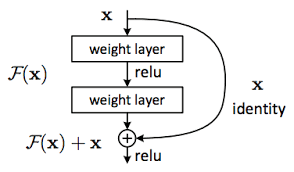
This is also known as a residual network. It has three variations 51,101,151. They used a simple technique to achieve this high number of layers.

Credit – Xiaozhu0429/ Wikimedia Commons / CC-BY-SA-4.0

The problem in using many layers is that the input information gets changed in accordance with each layer and subsequently, the information will become completely morphed. So to prevent this, the input information is sent in again like a recurrent for every two steps so that the layers don’t forget the original information. Using this simple technique they achieved about 100+ layers.

ResNet these are the three fundamentals used throughout the network.

  (conv1): Conv2d (3, 64, kernel_size= (7, 7), stride= (2, 2), padding= (3, 3))

  (relu): ReLU

  (maxpool): MaxPool2d(kernel_size=3, stride=2, padding=1)

These are the layers found within a single bottleneck of the ResNet.

    (0): Bottleneck

  1    (conv1): Conv2d(64, 64, kernel_size=(1, 1), stride=(1, 1))

  2    (conv2): Conv2d(64, 64, kernel_size=(3, 3), stride=(1, 1), padding=(1, 1))     

  3    (conv3): Conv2d(64, 256, kernel_size=(1, 1), stride=(1, 1))    

      (relu): ReLU(inplace=True)

   Down sampling   

   Conv2d(64, 256, kernel_size=(1, 1), stride=(1, 1))

    (1): Bottleneck

  4    (conv1): Conv2d(256, 64, kernel_size=(1, 1), stride=(1, 1))

  5    (conv2): Conv2d(64, 64, kernel_size=(3, 3), stride=(1, 1), padding=(1, 1))     

  6   (conv3): Conv2d(64, 256, kernel_size=(1, 1), stride=(1, 1))     

      (relu): ReLU(inplace=True)

    )

    (2): Bottleneck

  7    (conv1): Conv2d(256, 64, kernel_size=(1, 1), stride=(1, 1))

  8    (conv2): Conv2d(64, 64, kernel_size=(3, 3), stride=(1, 1), padding=(1, 1))

  9   (conv3): Conv2d(64, 256, kernel_size=(1, 1), stride=(1, 1))

   (relu): ReLU

There are many bottlenecks like these throughout the network. Hence by this, the ResNet is able to perform well and produce good accuracy. As a matter of fact, the ResNet is the model which won the ImageNet task competition.

There are 4 layers in this architecture. Each layer has a bottleneck which comprises convolution followed by relu activation function. There are 46 convolutions, 2 pooling, 2 FC layers.

TypeNo of layers
7*7 convolution1
1*1, k=64 + 3*3, k=64+1*1, k=256 convolution9
1*1, k=128+ 3*3, k=128+1*1, k=512  convolution10
1*1, k=256+ 3*3, k=256 + 1*1, k=1024 convolution16
1 * 1, k=512+3 * 3, k=512+1 * 1, k=2048 convolution9
Pooling and FC4
Total50

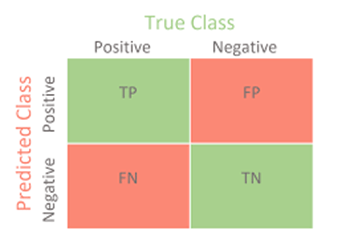
There is a particular aspect apart from the accuracy which is used to evaluate the model, especially in research papers. That method is known as the confusion matrix. It is seen in a lot of places and in the medical field it can be seen in test results. The terms used in the confusion matrix have become popularized in the anti-PCR test for COVID.

The four terms used in a confusion matrix are True Positive, True Negative, and False positive, and false negative. This is known as the confusion matrix.

True positive- both the truth and prediction are positive

True negative- both the truth and prediction are negative

False-positive- the truth is negative but the prediction is positive

False-negative- the truth is positive but the prediction is false

Out of these the false positive is dangerous and has to be ensured that this value is minimal.

We have now come to the end of the series. Hope that you have got some knowledge in this field of science. Deep learning is a very interesting field since we can do a variety of projects using the artificial brain which we have with ourselves. Also, the technology present nowadays makes these implementations so easy. So I recommend all to study and do projects using these concepts. Till then,

HAPPY LEARNING!!!

DEEP LEARNING SERIES- PART 9

This article is about one of the pre-trained CNN models known as the VGG-16. The process of using a pretrained CNN is known as transfer learning. In this case, we need not build a CNN instead we can use this with a modification. The modifications are:-

  • Removing the top (input) and bottom (output) layers
  • Adding input layer with size equal to the dimension of the image
  • Adding output layer with size equal to number of classes
  • Adding additional layers (if needed)

The pre-trained model explained in this article is called the VGGNet. This model was developed by the Oxford University researchers as a solution to the ImageNet task. The ImageNet data consists of 10 classes with 1000 images each leading to 10000 images in total.

VGGNet

I/p 1     2   3     4     5        6       7         8      9          10     11            12       13   o/p

Credit: – Nshafiei neural network in Machine learning  Creative Commons Attribution-ShareAlike 4.0 License.

This is the architecture for VGGNet. This has been found for the CIFAR-10 dataset, a standard dataset containing 1000 classes. This was used for multiclass classification. Some modifications are made before using it for detecting OA. The output dimension is changed into 1*1*2 and the given images must be reshaped to 224*224 since this dimension is compatible with VGGNet. The dimensions and other terms like padding, stride, number of filters, dimension of filter are chosen by researchers and found optimal. In general, any number can be used in this place.

The numbers given below the figure correspond to the layer number. So the VGGNet is 13 layered and is CNN till layer 10 and the rest are FNN.

Colour indexName
GreyConvolution
RedPooling
BlueFFN

Computations and parameters for each layer

Input

224*224 images are converted into a vector whose dimension is 224*224*3 based on the RGB value.

Layer 1-C1

This is the first convolutional layer. Here 64 filters are used.

Wi =224, P=1, S=1, K=64, f=3*3

Wo =224 (this is the input Wi for the next layer)

Dim= 224*224*64

Parameter= 64*3*3= 576

Layer 2-P1

This is the first pooling layer

 Wi =224, S=2, P=1, f=3

Wo=112 (this is the input Wi for the next layer)

Dim= 112*112*3

Parameter= 0

Layer 3-C2C3

Here two convolutions are applied. 128 filters are used.

Wi =112, P=1, S=1, K=64, f=3

Wo=112 (this is the input Wi for the next layer)

Dim= 112*112*128

Parameter= 128*3*3=1152

Layer 4- P2

Second pooling layer

Wi =112, P=1, S=2, f=3*3

Wo =56 (this is the input Wi for the next layer)

Dim= 56*56*3

Parameter= 0

Layer 5- C4C5C6

Combination of three convolutions

Wi =56, P=1, S=1, K=256, f=3*3

Wo = 56 (this is the input Wi for the next layer)

Dim= 224*224*64

Parameter= 64*3*3= 576

Layer 6-P3

Third pooling layer

Wi =56, P=1, S=2, f=3*3

Wo =28 (this is the input Wi for the next layer)

Dim= 28*28*3

Parameter= 0

Layer 7-C7C8C9

Combination of three convolutions

Wi =28, P=1, S=1, K=512, f=3*3

Wo =28 (this is the input Wi for the next layer)

Dim= 28*28*512

Parameter= 512*3*3= 4608

Layer 8-P4

Fourth pooling layer

Wi =28, P=1, S=2, f=3*3

Wo =14 (this is the input Wi for the next layer)

Dim= 14*14*3

Parameter= 0

Layer 9-C10C11C12

Last convolution layer, Combination of three convolutions

Wi =14, P=1, S=1, K=512, f=3*3

Wo =14 (this is the input Wi for the next layer)

Dim= 14*14*512

Parameter= 512*3*3= 4608

Layer 10-P5

Last pooling layer and last layer in CNN

Wi =14, P=1, S=2, f=3*3

Wo =7 (this is the input Wi for the next layer)

Dim= 7*7*3

Parameter= 512*3*3= 4608

With here the CNN gets over. So a complex 224*224*3 boil down to 7*7*3

Trends in CNN

As the layer number increases,

  1. The dimension decreases.
  2. The filter number increases.
  3. Filter dimension is constant.

In convolution

Padding of 1 and stride of 1 to transfer original dimensions to output

In pooling

Padding of 1 and stride of 2 are used in order to half the dimensions.

Layer 11- FF1

4096 neurons

Parameter= 512*7*7*4096=102M

Wo= 4096

Layer 12- FF2

4096 neurons

Wo= 4096

Parameter= 4096*4096= 16M

Output layer

2 classes

  • non-osteoarthritic
  • osteoarthritic

Parameter= 4096*2= 8192

Parameters

LayerValue of parameters
Convolution16M
FF1102M
FF216M
Total134M

It takes a very large amount of time nearly hours for a machine on CPU to learn all the parameters. Hence they came with speed enhancers like faster processors known as GPU Graphic Processing Unit which may finish the work up to 85% faster than CPU.

HAPPY LEARNING!!