Uranus- The Planet on its Sides

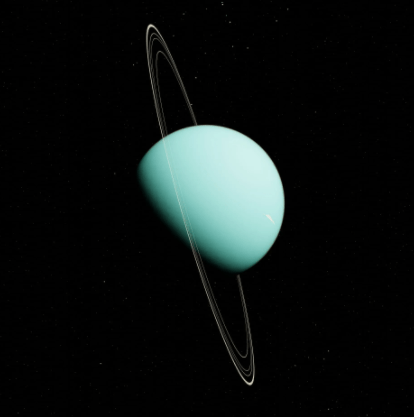
Uranus is the seventh planet from the Sun. Its name is a reference to the Greek god of the sky, Uranus, who, according to Greek mythology, was the great-grandfather of Ares (Mars), grandfather of Zeus (Jupiter) and father of Cronus (Saturn). It has the third-largest planetary radius and fourth-largest planetary mass in the Solar System. Uranus is similar in composition to Neptune, and both have bulk chemical compositions which differ from that of the larger gas giants Jupiter and Saturn. For this reason, scientists often classify Uranus and Neptune as “ice giants” to distinguish them from the other giant planets. 

Some facts about Uranus

Diameter-  51,118 km

Orbital period-   84yrs

Length of a Day-   17hrs

Axis tilt- 97.7 degrees

Distance from the Sun- 19.2 AU

Moons- 27

Special features

Uranus was discovered by William Herschel in 1781. Like the other giant planets, Uranus has a ring system, a magnetosphere, and numerous moons. The Uranian system has a unique configuration because its axis of rotation is tilted sideways, nearly into the plane of its solar orbit. Its north and south poles, therefore, lie where most other planets have their equators. In 1986, images from Voyager 2 showed Uranus as an almost featureless planet in visible light, without the cloud bands or storms associated with the other giant planets. Voyager 2 remains the only spacecraft to visit the planet. Observations from Earth have shown seasonal change and increased weather activity as Uranus approached its equinox in 2007. Wind speeds can reach 250 metres per second (900 km/h; 560 mph).

Natural satellites and Rings

Uranus has 27 known natural satellites. The names of these satellites are chosen from characters in the works of Shakespeare and Alexander Pope. The five main satellites are Miranda, Ariel, Umbriel, Titania, and Oberon. The Uranian satellite system is the least massive among those of the giant planets. The largest of Uranus’s satellites, Titania, has a radius of only 788.9 km (490.2 mi), or less than half that of the Moon, but slightly more than Rhea, the second-largest satellite of Saturn, making Titania the eighth-largest moon in the Solar System. Uranus’s satellites have relatively low albedos; ranging from 0.20 for Umbriel to 0.35 for Ariel (in green light). They are ice–rock conglomerates composed of roughly 50% ice and 50% rock.

The Uranian rings are composed of extremely dark particles, which vary in size from micrometres to a fraction of a metre. Thirteen distinct rings are presently known, the brightest being the ε ring. All except two rings of Uranus are extremely narrow – they are usually a few kilometres wide. The rings are probably quite young; the dynamics considerations indicate that they did not form with Uranus. The matter in the rings may once have been part of a moon (or moons) that was shattered by high-speed impacts. From numerous pieces of debris that formed as a result of those impacts, only a few particles survived, in stable zones corresponding to the locations of the present rings.

Image result for uranus structure

Structure and Atmosphere

Uranus’s atmosphere is similar to Jupiter’s and Saturn’s in its primary composition of hydrogen and helium, but it contains more “ices” such as water, ammonia, and methane, along with traces of other hydrocarbons. It has the coldest planetary atmosphere in the Solar System, with a minimum temperature of 49 K (−224 °C; −371 °F), and has a complex, layered cloud structure with water thought to make up the lowest clouds and methane the uppermost layer of clouds.

The standard model of Uranus’s structure is that it consists of three layers: a rocky (silicate/iron–nickel) core in the centre, an icy mantle in the middle and an outer gaseous hydrogen/helium envelope. The core is relatively small, with a mass of only 0.55 Earth masses and a radius less than 20% of Uranus’; the mantle comprises its bulk, with around 13.4 Earth masses, and the upper atmosphere is relatively insubstantial, weighing about 0.5 Earth masses and extending for the last 20% of Uranus’s radius. Uranus’s core density is around 9 g/cm3, with a pressure in the centre of 8 million bars (800 GPa) and a temperature of about 5000 K.The ice mantle is not in fact composed of ice in the conventional sense, but of a hot and dense fluid consisting of water, ammonia and other volatiles. This fluid, which has a high electrical conductivity, is sometimes called a water–ammonia ocean.

Exploration

In 1986, NASA’s Voyager 2 interplanetary probe encountered Uranus. This flyby remains the only investigation of Uranus carried out from a short distance and no other visits are planned. Launched in 1977, Voyager 2 made its closest approach to Uranus on 24 January 1986, coming within 81,500 km (50,600 mi) of the cloud tops, before continuing its journey to Neptune. The spacecraft studied the structure and chemical composition of Uranus’s atmosphere, including its unique weather, caused by its axial tilt of 97.77°.The possibility of sending the Cassini spacecraft from Saturn to Uranus was evaluated during a mission extension planning phase in 2009, but was ultimately rejected in favour of destroying it in the Saturnian atmosphere.It would have taken about twenty years to get to the Uranian system after departing Saturn.


Uranus – Wikipedia
https://www.universetoday.com/18883/diameter-of uranus/#:~:text=The%20diameter%20of%20Uranus%20is%2051%2C118%20km.%20Just,across.%20Things%20get%20a%20little%20more%20complicated%2C%20however.

Flavors of Unix

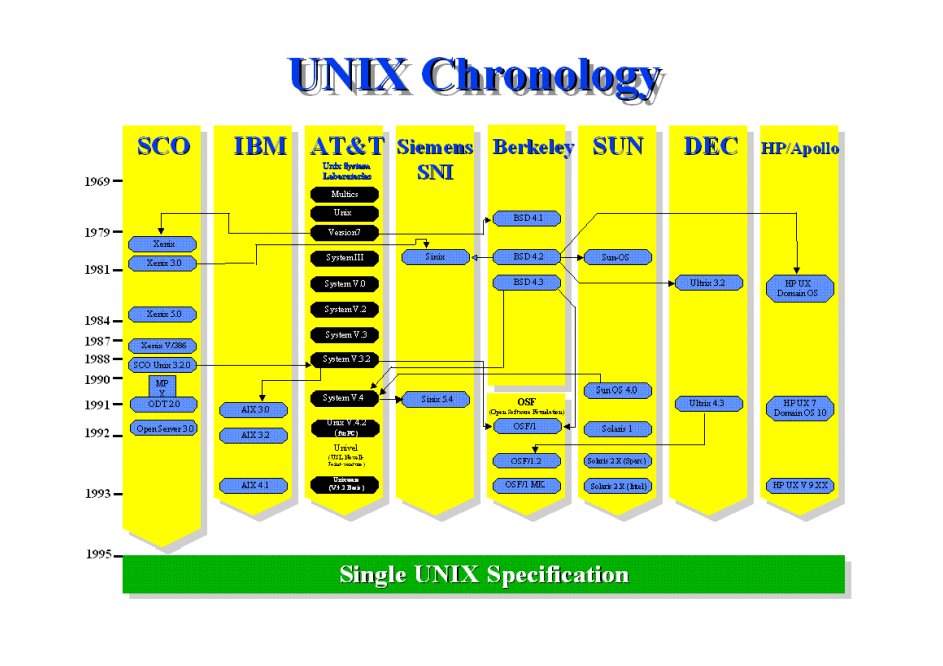
Unix is not a single operating system. It is in fact a general name given to dozens of o.s. by different companies, organizations or groups of individuals. These variants of unix are referred to as flavors. Although based on the same core set of unix commands, different flavors can have their own unique commands and features, and are designed to work with different types of h/w. Linux is often considered a unix flavor.

Among the ways in which the various flavors of UNIX differ are (1) fundamental design, (2) commands and features, (3) the hardware platform(s) (i.e., processors) for which they are intended and (4) whether they are proprietary software (i.e., commercial software) or free software (i.e., software that anyone can obtain at no cost and use for any desired
purpose).

Linux :
The most popular and fastest growing of all the Unix-like operating systems. It is developed by Linus Torvalds, Linux is a product that mimics the form and function of a UNIX system, but is not derived from licensed source code. Rather, it was developed independently; by a group of developers in an informal alliance on the net. A major benefit is that the source code is freely available (under the GNU copyleft), enabling the technically astute to alter and amend the system; it also means that there are many, freely available, utilities and specialist drivers available on the net. Linux is a registered trademark of Linus Torvalds. Recent versions of Glibc include much functionality from the Single UNIX Specification, Version 2 (for UNIX 98) and later.

FreeBSD :
The most popular of the BSD systems (all of which are direct descendants of BSD UNIX, which was developed at the University of California at Berkeley). BSDI is an independent company that markets products derived from the Berkeley Systems Distribution (BSD), developed at the University of California at Berkeley in the 60’s and 70’s. It is the operating
system of choice for many Internet service providers. It is, as with Linux, not a registered. UNIX system, though in this case there is a common code heritage if one looks far enough back in history.

IBM :
IBM has been quietly working on its mainframe operating system (formerly MVS) to add open interfaces for some years. In September 1996, The Open Group announced that OS/390 had been awarded the X/Open UNIX brand, enabling IBM to identify its premier operating system to be marked UNIX 95. This is a significant event as OS/390 is the first product to guarantee conformance to the Single UNIX Specification, and therefore to carry the label UNIX 95, that is not derived from the AT&T/ SCO source code.

NetBSD :
NetBSD is a free, fast, secure, and highly portable Unix-like Open Source operating system. It is available for a wide range of platforms, from large-scale servers and powerful desktop systems to handheld and embedded devices. Features the ability to run on more than 50 platforms, ranging from acorn26 to x68k

OpenBSD :
The OpenBSD project produces a FREE, multi-platform 4.4BSD-based UNIX-like operating system. Our efforts emphasize portability, standardization, correctness, proactive security and integrated cryptography. As an example of the effect
OpenBSD has, the popular OpenSSH software comes from OpenBSD. It May have already attained its goal of becoming the most secure of all computer operating systems.

Darwin :
Darwin is an open-source Unix-like operating system first released by Apple Inc. in 2000. It is composed of code developed by Apple, as well as code derived from NeXTSTEP, BSD, Mach, and other free software projects The new version of BSD that serves as the core for the Mac OS X

Many of the proprietary flavors have been designed to run only (or mainly) on proprietary hardware sold by the same company that has developed them. Examples include:

  • AIX – developed by IBM for use on its mainframe computers
  • BSD/OS – a commercial version of BSD developed by Wind River for Intel processors
  • HP-UX – developed by Hewlett-Packard for its HP 9000 series of business servers
  • IRIX – developed by SGI for applications that use 3-D visualization and virtual reality
  • QNX – a real time operating system developed by QNX Software Systems primarily for use in embedded systems
  • Solaris – developed by Sun Microsystems for the SPARC platform and the most widely used proprietary flavor for web servers
  • Tru64 – developed by Compaq for the Alpha processor

How to do reforestation

the process of replanting trees as a recovery process of deforestation is known as reforestation. Reforestation has very large importance to recover for the harm of deforestation. It is important to decrease the pollution, specifically air pollution and also helps to fight climate change.

Every person asks to plant trees and has a list of reasons to do so. But nobody told about the right way to do reforestation. Is it ok to go on planting any species thinking every plant gives oxygen, what is the difference. Along with reforestation, protecting our biodiversity is also crucial. Just planting same species to an entire area is just like agriculture. It will never contribute more than oxygen and never helps to address other co-existing problems.

Conducting right reforestation programs will help to restore habitats. A large number of animal species are facing the fear of extinction because of deforestation. They just not need any tree to survive, Their survival depends on the biodiversity as well. Forests take part in ecological changes. Forests maintain soil quality. Planting a single species will surely not helps to restore the soil quality and also maintaining humidity and temperature.

HOW TO SELECT SUITABLE SPECIES

Go for the study of the site or place where you are planning to do reforestation. Study the soil composition and derive conclusions based on that. See whether the place has the capacity to grow the species you are selecting. Look for the plants that have naturally regenerated in that place. That will give you an idea about the verities that originally belong to that place. Study about the historical vegetation that is try to get knowledge about the vegetation present there before deforestation. This can be done by looking for old forest department records. After you decide for the species that to be planted collect information about the growth of each type. Look for requirements of water and sunlight and other necessary things and whether they are now available at that site.

HOW YOU PLANT WILL ALSO MATTER

There are two methods in regeneration: 1. Natural regeneration in which includes natural seeding techniques, stump sprouting and root suckering. 2. Artificial regeneration method which involves machine planting, hand planting, aerial and ground seeding methods. Choose whatever works for you.

Choose the plants samplings from the local source. This will help in effective reforestation. Go for mixing of species, both naturally occurring and planted and maintain diversity. In the area with management problems go for long-lived species. Use species which is appropriate for the site.

Promote natural appearing style rather than planting in rows and columns. Leave enough space between the samplings and allow for establishment of other species. consider other soil management techniques like scarifying and irrigation if needed. Protect the surrounding natural habitats like lakes and ponds. Provide debris to the plants. And also increasing complexities may increase the cost of reforestation. Always manage the budget.

Kwimba Reforestation project of Tanzania is an example for successful reforestation project. This project was commenced in 1990 funded by World land trust. The main purpose of the project was to restore the biodiversity of the Usambara mountains. Now species like ficus, mahogany cedar, plum tree, apple trees are the part of that biodiversity and world needs to be inspired by such stories.

The Truth About Crop Circles

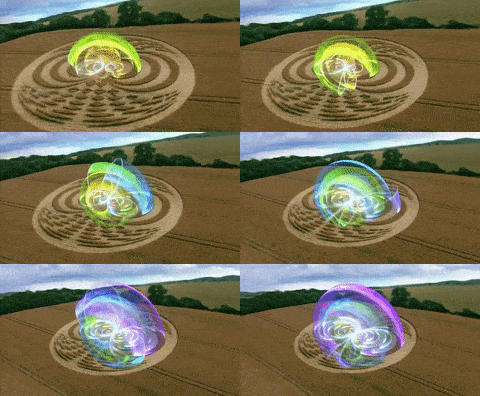
Garden-variety crop circle.

Crop circles have been appearing in grain fields all over the earth during the last few decades. They appear suddenly, usually at night. At first they were simple circles of bent-over grain stalks. Soon a new crop of more elaborate designs evolved—geometric forms reminiscent of profound mathematical theorems.

Some cerealogists (people who study crop circles) say that these diagrams must be created by intelligent alien beings from elsewhere. Even though these diagrams must be constructed in a very short timespan, the genuine crop circles never show any serious mistakes or blunders of execution. Cerealogists see this as evidence that the aliens must be very intelligent and much more advanced than we are. That’s mere speculation, of course. Others say the real reason is that there’s a worldwide conspiracy to hide the fact that the aliens sometimes do make mistakes. This coverup is carried out by people who want to preserve the myth that the aliens are a perfect race. The fact that you’ve never heard of such crop circle blunders just shows how effective this coverup is, they say. Mistakes are repaired at the site, or sometimes photographs of the circles are retouched. This has about as much to recommend it as any of the other conspiracy theories accepted and believed by simple-minded people.

Let’s look at more plausible explanations. Actually, a few designs do seem at first to have apparent irregularities or flaws. Some of these are surely caused by wind or rain, careless hoaxers or the trampling feet of crop circle buffs. But let’s set those aside and look only at those that are genuine and undisturbed. What appear at first to be iregularities or errors, may only be perfection of a higher and subtler kind, that we do not as yet understand.

Crop circles made by aliens?

Why should supposedly intelligent aliens travel huge cosmic distances across the galaxy just to doodle in our grain fields? What an absurd idea! [1] No one has ever seen them doing it, have they? Usually there aren’t even any ufo sightings associated with the circles, except for those reported after the fact by people with overactive imaginations. Surely intelligent aliens have better things to do. The true origin of crop circle designs may be nearer to home.

The whole thing begins to make sense once we realize that the earth is flat. We live on the backside of a huge flat blackboard (whiteboard, scratch paper, or whatever) used by aliens in their schools and universities. There are many of these in the universe. The flat disk of the earth is thin enough that student doodles made in alien art and math classes “bleed through” to our side. This happens because their writing instruments emit mitogenetic radiation (M-rays) that are well known to affect some living plants, especially wheat, barley, oats and corn. [2] M-rays weaken the stalk structure near the ground, and the stalks bend over gently to lie flat on the ground, showing no evidence of forceful breaking. So the crop circles in grain fields are nothing more than the reverse pattern of alien students’ diagrams made in geometry class.

Look carefully at photos of crop circles in books and on the internet, and a striking fact emerges. Crop circle designs are constructed from circular arcs and straight lines. Even the more complex crop circles, including those made to look like Mandelbrot sets, or the head of Mickey Mouse ©, conform to this rule. All crop circles can be constructed using the standard methods of Euclidean geometry. This should tell us something. The aliens making these drawings must be using ungraduated rulers and compases. [3] Has anyone ever seen a crop circle based on the form of a pentagon?

It’s true that a few designs have straight lines and curves that seem at first to be more complex than circles. But we must remember that straight lines are simply circles of infinite radius. Any complex curves can be constructed approximately from circular arc segments of different radius.

Did they use a ruler?

There’s good evidence that aliens have been defacing the earth’s surface with geological grafitti for a very long time. The curious lines and drawings on the Nazca plain in Peru likely have the same cause. At that earlier time in history the aliens had only primitive writing instruments. They were still using “pens” made of inorganic material, that emit E-rays (Earth rays). These only affect non-living things. Sand on flat ground is easily moved around with very little energy. The sandy surface of the Nazca plain acted like a giant Etch-A-Sketch ®. No advanced mathematical figures are found at Nazca, only long straight lines, pictures and geometric doodles. Obviously the aliens weren’t as scientifically advanced then. Then why are the lines so perfect, and the straight lines so straight? The reason is quite simple: on their side of the blackboard the aliens used rulers.

School kid’s prank?

A number of commentators claim to have proven to their own satisfaction that the Ancient Egyptians didn’t have the resources or technology to build the pyramids. Could it be that the pyramids of Egypt were built by alien kids, who, in a playful mood, pushed their play blocks into their blackboard, all the way through, coming up point first on our side? Following this line of reasoning, perhaps Stonehenge and similar structures are the result of an alien children’s game in which stone pegs are pushed into a geometric array of holes

Minimalism

What is Minimalism?

Minimalism is defined as a design or style in which the simplest and fewest elements are used to create the maximum effect. Minimalism had its origins in the arts—with the artwork featuring simple lines, only a few colors, and careful placement of those lines and colors. More recently, it has become representative of a lifestyle that aims to remove clutter from all facets of life. 

Minimalism is all about owning only what adds value and meaning to your life (as well as the lives of the people you care about) and removing the rest. It’s about removing the clutter and using your time and energy for the things that remain. We only have a certain amount of energy, time, and space in our lives. In order to make the most of it, we must be intentional about how we’re living each day.

There are many different approaches to minimalism, but it’s really just a tool to help you prioritize what’s important in your life.

Joshua Becker of Becoming Minimalist offers this definition: “Minimalism is the intentional promotion of the things that bring you joy and the removal of those that do not.” It might be called simple living, tiny living, intentional living, and a myriad of other things—but there is at least one common thread: the idea of curating the things we own to best reflect our priorities and vision for our lives.

If the idea of minimalism sounds intimidating to you or if you’ve seen some images and thought, “that’s a nice idea, but I’d never want to live like that,” don’t worry. You can benefit from applying minimalism in your life whether you live in a tiny home, suburban house, or a mansion. You can use minimalism as a guiding philosophy and customize based on what works best for you.

Common Misconceptions of Minimalism

Contrary to what some people think, there aren’t any actual rules to minimalism. There’s no official board of minimalism to determine whether or not you’re doing minimalism right. Minimalism truly looks different for everyone.

You don’t have to own below a certain number of items. You can still have nice things, and no, you don’t need to get rid of your favorite collection—whether it’s books, shoes, or music. Minimalism doesn’t have to look like white-walled, modern and sparse homes you’ve probably seen in magazines and videos, a common minimalism mistake. Minimalism is also not a one and done project. It is a a continual practice to ensure everything in our lives is working for us in our vision, not against us. Its used over the years to make substantial changes in our careers, home, lifestyle, buying behaviors, etc.

Everyone can benefit from applying the principles of minimalism to their lives. It’s a process of removing distractions and things that no longer add value to our lives.

Why Minimalism Is An Effective Tool For Living An Intentional Life?

In the end, minimalism is less about owning fewer items and more about actively making choices on what kind of things truly matter to you.

We exist in a society that creates false value on owning more stuff and having no time to use them much. The constant pursuit of bigger and better is an endless cycle. There will always be a nicer car to buy, a bigger boat, a larger home, and or a faster private jet. Did you know that there’s a website for billionaires to shop? Yeah. It never ends.

It may seem like an overwhelming challenge at first, but as you untangle the life you built around owning more things, you’ll find the stress disappearing and the world starting to slow down. Those choices you make will begin to build a muscle that will fundamentally change the way you live your life.

Why do Indians eat with hands?

Eating with bare hand is a traditional Indian culture, which people still follow. Eating is a mindful process since the sensory organs like touch and taste are involved. Fingertips are used to feel the temperature and texture of our food. Nerves at our fingertips send a signal to our brain, and the brain activates the human body’s digestive system and further improves the digestion process. In practice, Indians sit down on the floor in comfortable clothes and eat in a big banana leaf or Saili leaf. This process activates your senses and makes you enjoy your meal.

Eating with hand is a mindful eating…

But, is it good or bad to use hands?

Stay till the end…

Imagine eating roti with a spoon and dosa with a fork. Sounds weird right? Oh well, it is!

Traditional Indian foods are made to eat with hand. We use hands to eat foods like rice, chappati, vada, dosa, chicken, fish, papad, Pongal, and many more. While eating, curry is mixed with rice or stuffed in a roti that gives a flavor of multiple spices added while preparing the dish.

Here raises a question…

Is eating with your hand “unhygienic”?

Washing hands before eating is a habit of everybody. Indian tradition follows hygiene and cleanliness during dining. The hand once used by a person to consume their food is not used to serve or to share because that is treated as ‘jootha’ meaning contamination and treated as an unhygienic way of eating. People are supposed to wash their own dishes after eating which reduces the intermixing of saliva of two individuals as a concern of one’s health.

Significance of eating with hands:

According to the ancient theory, all five fingers of our hand has its own spiritual significance and it symbolizes the 5 elements of nature. 

  1. Thumb finger- Fire
  2. Index finger- Air
  3. Middle finger- Space
  4. Ring finger- Earth
  5. Little finger- Water

Apart from those theories, it was proved that using hand while eating improves the healthy digestion of food. Our palms and fingers are protected by a bacteria called Normal Flora. Normal Flora protects our skin from harmful microbes. Hence your hand is safe to use.

Is India the only country where people eat with their hands? 

Obviously Not!! 

India is not the only country where people follow the tradition of eating with hands. People from large swaths like the Middle East, Africa, South Asia, South America follow the norm of using their hands to eat. Tribes in Nigeria, Amazighs (Berbers) in North Africa, Black Africa, the Arabs of the Middle East also follow this tradition.

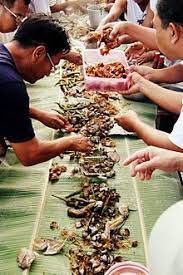
‘Kamayan‘ meaning “with hands.” Kamayan is an ancient tradition traditional Filipino practice of eating with the hands. They believe that eating with hands has its own significance than eating with fork and knife. It is also referred to specific type of Filipino feast known as the “boodle fight”.

Ethopian eating culture

Conclusion

Remember, it’s your culture and there is nothing to be ashamed of using your hand. Every culture in this world deserves respect. This article is all about bringing out the importance of Indian culture and not to dishonor western dining etiquette. Nowadays, restaurants and cafes are all westernized. As the customs and lifestyle changes it is our responsibility to hold and accept our own culture first. 

Creating an awareness among the people about the science behind our culture is the main motive of this article!!

References:

https://en.wikipedia.org/wiki/Customs_and_etiquette_in_Indian_dining

https://www.indiatoday.in/fyi/story/eat-hands-indians-357398-2016-12-14

http://www.timotis.com/news-1/eat-with-your-hands

credits to the right owner of the images used.

The Black Hole

“Black Hole” almost everyone has heard this term but, what exactly it is? How it is formed? Is a black hole is danger? what if we pass near to black hole?

The idea of a body so massive that even light cannot escape was given by astronomical pioneer John Michell in a letter published by him in november 1784. And since after this an excitement was filled between astronomers and physicists about a body which is invisible. And in December 1967 in a lecture of John Wheeler one of his student reportedly suggested phrase ‘Black Hole’, which Wheeler adopted for his brevity.

Black hole was first spotted in 1971. But after 235 when it was first mentioned by John Michell in 2019, the Event Horizon Telescope(EHT) saw and captured an image of black hole in center of Galaxy M87 53.49 million light years away from earth. The images before this are just art work based imagination and properties of black hole done by astronomers and physicists to define black hole.

Black hole image
Image of black hole captured by Event Horizon Telescope in 2019

How Black Hole is formed? Let us first understand how a star is made. From cloud from Nebula(made of hydrogen and 25% helium) due to density compresses together and forms a shape some what circular, and this object after many million years becomes star one of like sun. The core of star burns hydrogen to be active, when after million years the fuel of star burns out then due to its own gravity and density it starts to compress itself. And if that star is bigger than our sun than it may form a neutron star or the star makes a negative gravity and starts to pull every mass near it. If we compress a massive body bigger than our sun into a size of a city say Mumbai, then it will become black hole. The gravity of this black hole so much increases that even light cannot escape from its horizon making it invisible.

A black can also be size of our sun but its gravity is 1 crore times more than sun. Albert Einstein in his theory of special relativity said that near the black hole the time will run slow. When a star becomes black hole it makes changes in fabric of space-time. And the movement will happen in only linear direction for a person inside it.

What if s person goes inside Black Hole? If a person goes near black hole than time will run slow for him compared to a person on earth. And as a person goes inside the black hole than he will feel so much gravity i.e. gravity 1 crore time more than our sun, that he can die. When a matter goes inside a black hole than due to gravity the atoms are separated and slowly it is vanished. But let say somehow a person survives than for the person it is like having a boon of immortality. If we put a black hole same as the size of sun and replace it with sun then probably nothing change will be happen, it cannot affect us. But due to lack of sunlight our earth will freeze and will only be a giant snowball.

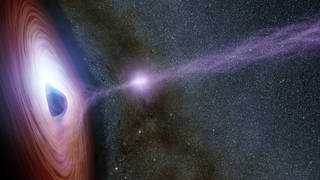
How to find a Black Hole? When a black hole tries to swallow a massive body than its own then it belch just like animals and it gives some portion of light. Black hole has gravity much higher that light like x-rays cannot escape, but when there is a material very close to horizon of black hole, matter is heated at millions of degrees as it is pulled towards black hole and glows in x-rays. Black hole can also be found by coronas. Black holes don’t give any light themselves, but they are often encircled by glowing materials and making it to shine with different types of light.

A supermassive black hole is depicted in this artist's concept
Corona coming out of a black hole

Types of Black Holes: There are four types four black holes. 1) Stellar-mass black holes As star reaches to the end of their lives, most will inflate, lose mass, and then will cool down to be a white dwarfs. But those with 10 to 20 times as massive as our sun, destined to either become a super-dense neutron star or stellar-mass black holes. Thousands of these stellar-mass black holes may lurk within our own galaxy. 2) Super massive black holes Super massive black hole are the ones predicted by Einstein’s general theory of relativity, can have masses equal to billion of suns; these cosmic giant creatures hide in the center of galaxies. The milky way hosts its own black hole called Sagittarius A* as is more than four million times massive than our own sun. 3) Intermediate Black holes Astronomers also suspect that there is class of so-called intermediate black holes exists in the universe, although evidence for them is so far debatable. 4) Miniature black holes The tiniest member of the black hole family, so far theoretical. These black holes may have swirled to life soon after the universe formed by big bang, some 13.7 billion years ago and quickly evaporated.

Answer to some questions about black holes Is it possible for a black hole eat entire galaxy? No. There is no chance that a black hole whatever is in size can eat a whole galaxy, because the gravitational reach of black holes(even super massive black holes) is not large enough to eat entire galaxy. What if sun turned it a black hole? The sun will never turn into a black hole as it is not massive to explode into a black hole. Instead sun will become a white dwarf. Have black holes have any influence on our planet? No. Even if we put a black hole in place of our sun then also it will not make a difference, earth will continue its rotation, but due to no sunlight it will we disastrous event on earth. Which is farthest black hole we found? The most distant black hole is located 13.1 million light years away from earth called “Quasar”. This black hole is made 690 million years after big bang.

We have found many black hole and learnt many things about them, yet many discoveries are to be made. And black holes will always amaze us.

Saturn- The Jewel

Saturn is the sixth planet from the Sun and the second-largest in the Solar System, after Jupiter. It is a gas giant with an average radius of about nine and a half times that of Earth. It only has one-eighth the average density of Earth; however, with its larger volume, Saturn is over 95 times more massive. Saturn is named after the Roman god of wealth and agriculture. 

Some facts about Saturn

Diameter-  120,536 km

Orbital period-   29.4yr

Length of a Day-   10hrs 39min

Axis tilt- 26.7degrees

Distance from the Sun- 9.58AU

Moons- 82

Special features

The planet’s most famous feature is its prominent ring system, which is composed mostly of ice particles, with a smaller amount of rocky debris and dust. At least 82 moons are known to orbit Saturn, of which 53 are officially named; this does not include the hundreds of moonlets in its rings. Titan, Saturn’s largest moon and the second largest in the Solar System, is larger than the planet Mercury, although less massive, and is the only moon in the Solar System to have a substantial atmosphere

The outer atmosphere is generally bland and lacking in contrast, although long-lived features can appear. Wind speeds on Saturn can reach 1,800 km/h (1,100 mph; 500 m/s), higher than on Jupiter but not as high as on Neptune.

Natural satellites and Rings 

Saturn has 82 known moons, 53 of which have formal names. In addition, there is evidence of dozens to hundreds of moonlets with diameters of 40–500 meters in Saturn’s rings, which are not considered to be true moons. Titan, the largest moon, comprises more than 90% of the mass in orbit around Saturn, including the rings. Saturn’s second-largest moon, Rhea, may have a tenuous ring system of its own,along with a tenuous atmosphere.

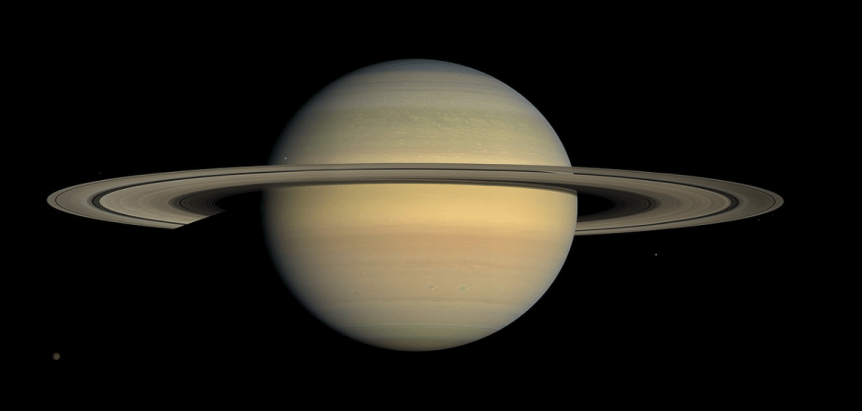
Saturn is probably best known for the system of planetary rings that makes it visually unique.The rings extend from 6,630 to 120,700 kilometers (4,120 to 75,000 mi) outward from Saturn’s equator and average approximately 20 meters (66 ft) in thickness.The particles that make up the rings range in size from specks of dust up to 10 m. While the other gas giants also have ring systems, Saturn’s is the largest and most visible.

There are two main hypotheses regarding the origin of the rings. One hypothesis is that the rings are remnants of a destroyed moon of Saturn. The second hypothesis is that the rings are left over from the original nebular material from which Saturn was formed. 

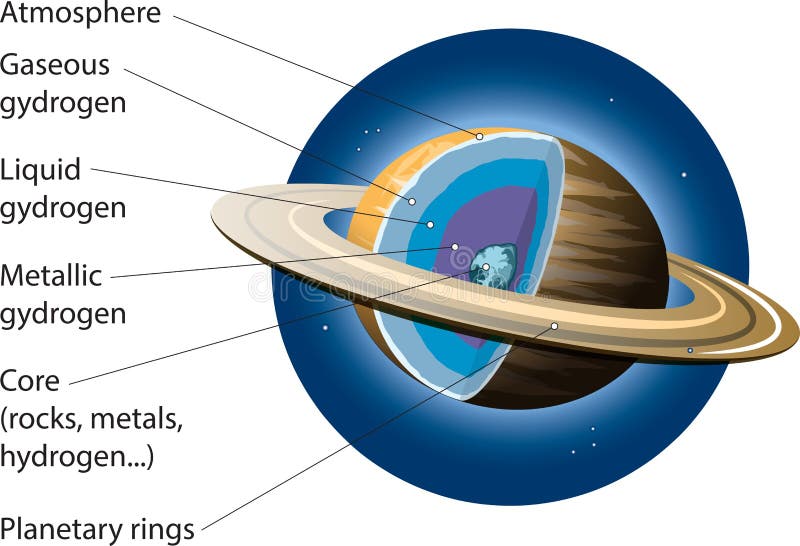
See the source image

Structure

Despite consisting mostly of hydrogen and helium, most of Saturn’s mass is not in the gas phase, because hydrogen becomes a non-ideal liquid when the density is above 0.01 g/cm3, which is reached at a radius containing 99.9% of Saturn’s mass. The temperature, pressure, and density inside Saturn all rise steadily toward the core, which causes hydrogen to be a metal in the deeper layers.
Standard planetary models suggest that the interior of Saturn is similar to that of Jupiter, having a small rocky core surrounded by hydrogen and helium, with trace amounts of various volatiles. This core is similar in composition to Earth, but is more dense. The examination of Saturn’s gravitational moment, in combination with physical models of the interior, has allowed constraints to be placed on the mass of Saturn’s core. In 2004, scientists estimated that the core must be 9–22 times the mass of Earth, which corresponds to a diameter of about 25,000 km. This is surrounded by a thicker liquid metallic hydrogen layer, followed by a liquid layer of helium-saturated molecular hydrogen that gradually transitions to a gas with increasing altitude. The outermost layer spans 1,000 km and consists of gas.

Exploration

Pioneer 11 made the first flyby of Saturn in September 1979, when it passed within 20,000 km of the planet’s cloud tops. Images were taken of the planet and a few of its moons, although their resolution was too low to discern surface detail. 
In November 1980, the Voyager 1 probe visited the Saturn system. It sent back the first high-resolution images of the planet, its rings and satellites. Surface features of various moons were seen for the first time. Voyager 1 performed a close flyby of Titan, increasing knowledge of the atmosphere of the moon.
The Cassini–Huygens space probe entered orbit around Saturn on 1 July 2004. In June 2004, it conducted a close flyby of Phoebe, sending back high-resolution images and data. Cassini’s flyby of Saturn’s largest moon, Titan, captured radar images of large lakes and their coastlines with numerous islands and mountains. The orbiter completed two Titan flybys before releasing the Huygens probe on 25 December 2004. Huygens descended onto the surface of Titan on 14 January 2005.

Saturn – Wikipedia
https://space-facts.com/saturn/#:~:text=Saturn%20Facts%20%20%20Equatorial%20Diameter%3A%20%20,30%2B%20%287%20Groups%29%20%205%20more%20rows%20

Jupiter- The Giant

Jupiter is the fifth planet from the Sun and the largest in the Solar System. It is a gas giant with a mass more than two and a half times that of all the other planets in the Solar System combined. Jupiter is the third-brightest natural object in the Earth’s night sky after the Moon and Venus. It has been observed since prehistoric times and is named after the Roman god Jupiter, the king of the gods, because of its observed size.More than eleven Earths would fit across its diameter. It’s also the most massive. More than 1,300 Earths could fit inside Jupiter, with room to spare. 

Some facts about Jupiter  

Diameter- 142,984  km                                                                                                               

 Orbital period-  11.8yrs 

Length of a Day-  10 hours 

Axis tilt-  3degrees

Distance from the Sun-  779 million km(5.2AU)

Moons- 79known moons

Special features

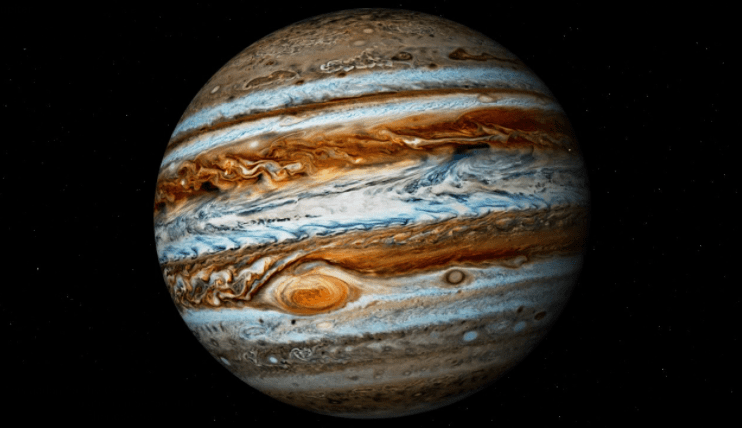
Jupiter is primarily composed of hydrogen, but helium comprises one quarter of its mass and one tenth of its volume. It likely has a rocky core of heavier elements, but like the other giant planets, Jupiter lacks a well-defined solid surface. The on-going contraction of its interior generates heat greater than the amount received from the Sun. Because of its rapid rotation, the planet’s shape is that of an oblate spheroid; it has a slight but noticeable bulge around the equator. The outer atmosphere is visibly segregated into several bands at different latitudes, with turbulence and storms along their interacting boundaries. A prominent result of this is the Great Red Spot, a giant storm that is known to have existed since at least the 17th century, when it was first seen by telescope. Surrounding Jupiter is a powerful magnetosphere. Jupiter’s magnetic tail is nearly 800 million km long, covering the entire distance to Sa turn’s orbit. Jupiter has almost a hundred known moons and possibly many more, including the four large Galilean moons discovered by Galileo Galilei in 1610. Ganymede, the largest of these, has a diameter greater than that of the planet Mercury. 

Natural Satellites and Rings

Jupiter has 79 known natural satellites. Of these, 60 are less than 10 km in diameter. The four largest moons are Io, Europa, Ganymede, and Callisto, collectively known as the “Galilean moons” Jupiter has a faint planetary ring system composed of three main segments: an inner torus of particles known as the halo, a relatively bright main ring, and an outer gossamer ring.These rings appear to be made of dust, rather than ice as with Saturn’s rings

Image result for jupiter structure

Structure

The composition of Jupiter is similar to that of the Sun—mostly hydrogen and helium. Deep in the atmosphere, pressure and temperature increase, compressing the hydrogen gas into a liquid. This gives Jupiter the largest ocean in the solar system—an ocean made of hydrogen instead of water. Scientists think that, at depths perhaps halfway to the planet’s center, the pressure becomes so great that electrons are squeezed off the hydrogen atoms, making the liquid electrically conducting like metal. Jupiter’s fast rotation is thought to drive electrical currents in this region, generating the planet’s powerful magnetic field. It is still unclear if, deeper down, Jupiter has a central core of solid material or if it may be a thick, super-hot and dense soup. It could be up to 90,032 degrees Fahrenheit (50,000 degrees Celsius) down there, made mostly of iron and silicate minerals (similar to quartz).

Exploration

Pioneer 10 was the first spacecraft to visit Jupiter, making its closest approach to the planet in December 1973. Jupiter has since been explored on a number of occasions by robotic spacecraft, beginning with the Pioneer and Voyager flyby missions from 1973 to 1979, and later by the Galileo orbiter, which arrived at Jupiter in 1995. In 2007, Jupiter was visited by the New Horizons probe, which used Jupiter’s gravity to increase its speed and bend its trajectory en route to Pluto. The latest probe to visit the planet, Juno, entered orbit around Jupiter in July 2016. Future targets for exploration in the Jupiter system include the probable ice-covered liquid ocean of the moon Europa.

Jupiter – Wikipedia
https://www.bing.com/aclk?ld=e8k-pfHbjv-CV55VIl5abb_DVUCUz1ts_eBtiemCSpraSEheuOBIFn5ofp1EnODk3SRfdK9SS4VsZF0jXe2iaYVanAC3oPv4jWNaaOu2_WiBmnrz2FMCaeSWYay3tpoO2zWh3uJDSzpxMp8qmzs861Enln4hcX7sqAsEd3hHsHVrTQMqLN&u=aHR0cHMlM2ElMmYlMmZ3d3cuc2VsZmdhbGF4eS5jb20lMmYyMDIxJTJmMDQlMmZpbnRlcmVzdGluZy1mYWN0cy1hYm91dC1qdXBpdGVyLmh0bWw&rlid=5011e8abaa201a3eeb5488755f08da0f&ntb=1

Behavioural Economics

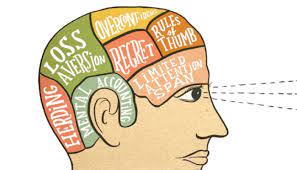
In an ideal world, people would always make optimal decisions that provide them with the greatest benefit and satisfaction. In economics, rational choice theory states that when humans are presented with various options under the conditions of scarcity , they would choose the option that maximizes their individual satisfaction. This theory assumes that people, given their preferences and constraints, are capable of making rational decisions by effectively weighing the costs and benefits of each option available to them. The final decision made will be the best choice for the individual. The rational person has self-control and is unmoved by emotions and external factors and, hence, knows what is best for himself. Alas behavioral economics explains that humans are not rational and are incapable of making good decisions.

Behavioral Economics is the study of psychology as it relates to the economic decision-making processes of individuals and institutions. Behavioral economics draws on psychology and economics to explore why people sometimes make irrational decisions, and why and how their behavior does not follow the predictions of economic models. Decisions such as how much to pay for a cup of coffee, whether to go to graduate school, whether to pursue a healthy lifestyle, how much to contribute towards retirement, etc. are the sorts of decisions that most people make at some point in their lives. Behavioral economics seeks to explain why an individual decided to go for choice A, instead of choice B.

Because humans are emotional and easily distracted beings, they make decisions that are not in their self-interest. For example, according to the rational choice theory, if Charles wants to lose weight and is equipped with information about the number of calories available in each edible product, he will opt only for the food products with minimal calories. Behavioral economics states that even if Charles wants to lose weight and sets his mind on eating healthy food going forward, his end behavior will be subject to cognitive bias, emotions, and social influences. If a commercial on TV advertises a brand of ice cream at an attractive price and quotes that all human beings need 2,000 calories a day to function effectively after all, the mouth-watering ice cream image, price, and seemingly valid statistics may lead Charles to fall into the sweet temptation and fall off of the weight loss bandwagon, showing his lack of self-control.

Culture and history

China and Japan India and Byzantium traveling culture and history vector geisha and samurai men and women Taj Mahal and torii gate capitol building and Great wall landmarks and heritage nationalities.

Culture and history is the main building block of our lifes

The Culture is the characteristics and knowledge of a particular group of people, encompassing language, religion, cuisine, social habits, music and arts.

The word “culture” derives from a French term, which in turn derives from the Latin “colere,” which means to tend to the earth and grow, or cultivation and nurture

History is the study of life in society in the past, in all its aspect, in relation to present developments and future hopes. It is the story of man in time, an inquiry into the past based on evidence.

As with any scholarly approach that boasts of being “new” when it bursts onto the scene, new cultural history was fairly well established as one among many ways of thinking about history by the twenty-first century. This is not to say that new cultural historians enjoyed the unanimous esteem of their more traditional colleagues, for the field still managed to draw the fire of critics from the left and the right who believed that after twenty years this approach still represented a mere “trend.” One could agree with Peter Novick that this attests to the fragmentation of the historical profession into a plethora of specializations that no longer cohered around shared principles and whose denizens had little common ground for discussion. Yet much has changed in cultural history since its heyday in the 1980s.

 When new cultural history was actually “new” it provided innovations both in terms of the topics considered worthy of historical attention and in terms of the ways of theorizing such topics within their respective contexts. It is nevertheless apparent that a good portion of what was marketed in 2000 as “cultural history” reflected more of the topical rather than theoretical innovations entailed by this approach. In fact, some of these works even read more like conventional social histories with a few obligatory nods to one of many privileged theorists.

To some extent this state of affairs reflects the success of this approach in the academy and the willingness of historians to combine methodologies in a creative and eclectic manner. On the other hand, though, one might argue that cultural history lost much of its edge by becoming subsumed into a more or less nonreflective historical establishment. Some historians see less fragmentation than the cooptation of erstwhile radical approaches back into a surprisingly resilient mainstream.

“Whatever possibilities become evident,” notes Patrick Joyce, “something is needed to shake the hold of a history which continually reproduces itself, in the process sucking the erstwhile heterodox into its consensus, in much the way that ‘cultural history’ is slowly but surely becoming routinized as more methodology, yet one more subdiscipline in the house of history.” Joyce’s observation is astute, yet one wonders whether a historical approach that could successfully resist such cooptation is possible and, even if it were, whether it would still merit the name “history.” It seems evident that what makes history “history” has little to do with methodologies and innovations that are unique to it, and perhaps a more thoroughgoing interdisciplinarity would discourage the domestication of future innovations into mere additions to the mansion of conventional history.

Turning heat into electricity.

Study finds topological materials could boost the efficiency of thermoelectric devices.

MIT researchers, looking for ways to turn heat into electricity, find efficient possibilities in certain topological materials.

What if you could run your air conditioner not on conventional electricity, but on the sun’s heat during a warm summer’s day? With advancements in thermoelectric technology, this sustainable solution might one day become a reality.

Thermoelectric devices are made from materials that can convert a temperature difference into electricity, without requiring any moving parts — a quality that makes thermoelectrics a potentially appealing source of electricity. The phenomenon is reversible: If electricity is applied to a thermoelectric device, it can produce a temperature difference. Today, thermoelectric devices are used for relatively low-power applications, such as powering small sensors along oil pipelines, backing up batteries on space probes, and cooling minifridges.

But scientists are hoping to design more powerful thermoelectric devices that will harvest heat — produced as a byproduct of industrial processes and combustion engines — and turn that otherwise wasted heat into electricity. However, the efficiency of thermoelectric devices, or the amount of energy they are able to produce, is currently limited.

Now researchers at MIT have discovered a way to increase that efficiency threefold, using “topological” materials, which have unique electronic properties. While past work has suggested that topological materials may serve as efficient thermoelectric systems, there has been little understanding as to how electrons in such topological materials would travel in response to temperature differences in order to produce a thermoelectric effect.

In a paper published this week in the Proceedings of the National Academy of Sciences, the MIT researchers identify the underlying property that makes certain topological materials a potentially more efficient thermoelectric material, compared to existing devices.

“We’ve found we can push the boundaries of this nanostructured material in a way that makes topological materials a good thermoelectric material, more so than conventional semiconductors like silicon,” says Te-Huan Liu, a postdoc in MIT’s Department of Mechanical Engineering. “In the end, this could be a clean-energy way to help us use a heat source to generate electricity, which will lessen our release of carbon dioxide.”

A path freely traveled

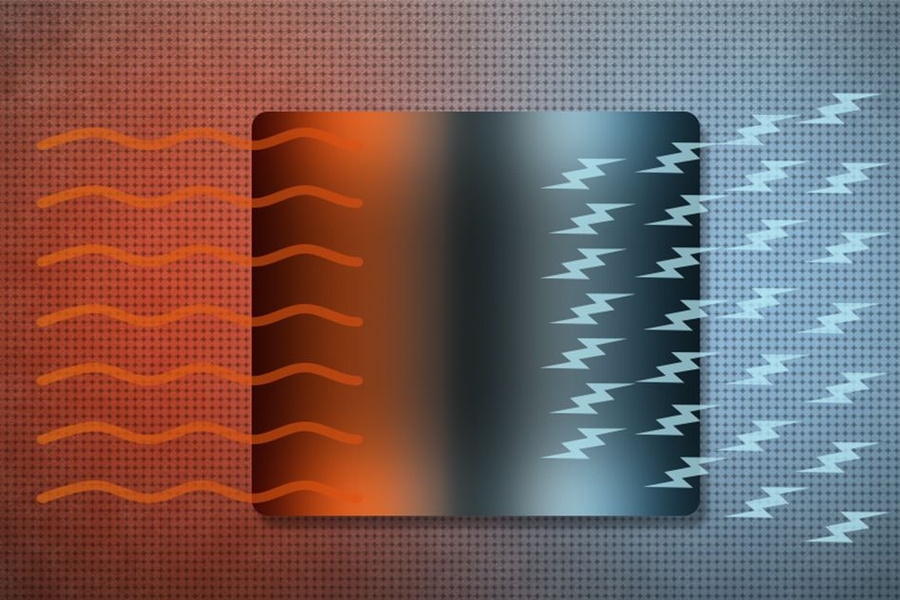
When a thermoelectric material is exposed to a temperature gradient — for example, one end is heated, while the other is cooled — electrons in that material start to flow from the hot end to the cold end, generating an electric current. The larger the temperature difference, the more electric current is produced, and the more power is generated. The amount of energy that can be generated depends on the particular transport properties of the electrons in a given material.

Scientists have observed that some topological materials can be made into efficient thermoelectric devices through nanostructuring, a technique scientists use to synthesize a material by patterning its features at the scale of nanometers. Scientists have thought that topological materials’ thermoelectric advantage comes from a reduced thermal conductivity in their nanostructures. But it is unclear how this enhancement in efficiency connects with the material’s inherent, topological properties.

To try and answer this question, Liu and his colleagues studied the thermoelectric performance of tin telluride, a topological material that is known to be a good thermoelectric material. The electrons in tin telluride also exhibit peculiar properties that mimic a class of topological materials known as Dirac materials.

The team aimed to understand the effect of nanostructuring on tin telluride’s thermoelectric performance, by simulating the way electrons travel through the material. To characterize electron transport, scientists often use a measurement called the “mean free path,” or the average distance an electron with a given energy would freely travel within a material before being scattered by various objects or defects in that material.

Nanostructured materials resemble a patchwork of tiny crystals, each with borders, known as grain boundaries, that separate one crystal from another. When electrons encounter these boundaries, they tend to scatter in various ways. Electrons with long mean free paths will scatter strongly, like bullets ricocheting off a wall, while electrons with shorter mean free paths are much less affected.

In their simulations, the researchers found that tin telluride’s electron characteristics have a significant impact on their mean free paths. They plotted tin telluride’s range of electron energies against the associated mean free paths, and found the resulting graph looked very different than those for most conventional semiconductors. Specifically, for tin telluride and possibly other topological materials, the results suggest that electrons with higher energy have a shorter mean free path, while lower-energy electrons usually possess a longer mean free path.

The team then looked at how these electron properties affect tin telluride’s thermoelectric performance, by essentially summing up the thermoelectric contributions from electrons with different energies and mean free paths. It turns out that the material’s ability to conduct electricity, or generate a flow of electrons, under a temperature gradient, is largely dependent on the electron energy.

Specifically, they found that lower-energy electrons tend to have a negative impact on the generation of a voltage difference, and therefore electric current. These low-energy electrons also have longer mean free paths, meaning they can be scattered by grain boundaries more intensively than higher-energy electrons.

Tin telluride - Wikipedia

Sizing down

Going one step further in their simulations, the team played with the size of tin telluride’s individual grains to see whether this had any effect on the flow of electrons under a temperature gradient. They found that when they decreased the diameter of an average grain to about 10 nanometers, bringing its boundaries closer together, they observed an increased contribution from higher-energy electrons.

That is, with smaller grain sizes, higher-energy electrons contribute much more to the material’s electrical conduction than lower-energy electrons, as they have shorter mean free paths and are less likely to scatter against grain boundaries. This results in a larger voltage difference that can be generated.

What’s more, the researchers found that decreasing tin telluride’s average grain size to about 10 nanometers produced three times the amount of electricity that the material would have produced with larger grains.

Liu says that while the results are based on simulations, researchers can achieve similar performance by synthesizing tin telluride and other topological materials, and adjusting their grain size using a nanostructuring technique. Other researchers have suggested that shrinking a material’s grain size might increase its thermoelectric performance, but Liu says they have mostly assumed that the ideal size would be much larger than 10 nanometers.

“In our simulations, we found we can shrink a topological material’s grain size much more than previously thought, and based on this concept, we can increase its efficiency,” Liu says.

Tin telluride is just one example of many topological materials that have yet to be explored. If researchers can determine the ideal grain size for each of these materials, Liu says topological materials may soon be a viable, more efficient alternative to producing clean energy.

“I think topological materials are very good for thermoelectric materials, and our results show this is a very promising material for future applications,” Liu says.

This research was supported in part by the Solid-State Solar Thermal Energy Conversion Center, an Energy Frontier Research Center of U.S. Department of Energy; and the Defense Advanced Research Projects Agency (DARPA).

Semantic Web: The Next Step of World Wide Web

In 1989 Tim-Berners-Lee invented the internet as we know it today and the fundamental building block for this framework is the hyperlink. With the use of hyperlinks, different documents are connected and any document on the web can be identified with that link. This is also known as Web 1.0 (Web of Documents) and its main goal was to exchange information between different machines together on an interconnected network.

The Semantic Web is a collaborative effort led by the World Wide Web Consortium (W3C). Semantic Web which is also called Web 3.0 or web of data links to a specific piece of information contained in that document or application. The semantic web is also modular and dynamic because if the information is ever updated, users can automatically take advantage of any updates. Scalability is an essential requirement of the semantic web as well. In the semantic web, we go beyond the documents and we go towards the lower (data) level.

Some of the main underpinnings of The Semantic Web are as follows:

  • Building models: the quest for describing the world in abstract terms to allow for an easier understanding of a complex reality.
  • Computing with knowledge: the endeavor of constructing reasoning machines that can draw meaningful conclusions from encoded knowledge.
  • Exchanging information: the transmission of complex information resources among computers that allows us to distribute, interlink, and reconcile knowledge on a global scale.

Linked Data is used to connect the web of data in the Semantic Web. Links are made so that a user or a computer can explore the web of data. Linked data is much more interactive, visibility, powerful and useful in retrieving, finding, and determining its relation with other data on the web.  So instead of having URLs (Links) between documents, in Semantic Web, we have URLs between facts. To present knowledge about the data in a much more organized manner. It also seamless data integration and it can bring intelligence to the system.  URIs consists of two entities: URL (Uniform Resource Locator) and URN (Uniform Resource Name).

The Basic Structure of The Semantic Web

To implement these URIs we need Resource Description Frameworks (RDFs). RDF is a standard model for data interchange on the Web. It is a framework or a data model for describing resources. RDFs are the formal language to describe the information in the Semantic Web. The goal of RDF is to enable applications to exchange data on the Web while still preserving their original meaning. RDFs comprise  triples. A triple gives a unique identifier so that we can link the data and form a relation between various other data nodes. Multiple triples connected are called Graphs.

In metadata terms, RDF and expressed in (Triples). Triples comprise of three fundamental entities:

  • Object is the resource being described by the metadata record
  • Predicate is an element in that record
  • Subject is a value assigned to that element

SPARQL (SPARQL Protocol and RDF Query Language) and OWL (Web Ontology Language) are the other two technical standards used in the Semantic Web.

Semantic the web is an extension to the World Wide Web and it has made significant strides towards making the internet more seamless, efficient, and scalable. Linked Data is very critical in making this happen. But still, Semantic is not yet adopted and many corporations and organizations are unaware of it. So the focus should be to promote wider adoption of the Semantic Web with better availability of the learning resources.

Jobs and career

What is a JOB ?

A job is something you simply do for the money. Usually, jobs have a small impact on future resumes because they aren’t typically related to what your career is or will be. Also, jobs usually offer less networking opportunities because your coworkers often won’t be continuing on to the same field as you in your future career.

Most jobs consist of hourly wages, are more short-term, and focus on getting a task done.

What is a career ?

A career is all about building up skills through various employment opportunities, giving you the ability to move on to higher paying and more prestigious ones. Careers provide a foundation of experiences that help fuel your professional life for many years.

Careers are more long-term and are about learning, gaining experience, building connections, and putting yourself in the right position for promotions and raises. Also, careers tend to be more salary based, as opposed to hourly based like jobs, and often include benefits such as paid time off and healthcare.

While more education is often required for a career, you don’t need to spend the rest of your life in school just to get ahead. South College offers many associate degree programs that can be completed in just two years, getting you started on your new career before you know it.

If you’re interested in finding out what your future career should be or in getting the right education to put you there, contact us today!

That’s not to say that jobs aren’t valuable. Jobs show your work ethic, which is important to future employers, and money pays the bills! Jobs can help prepare you for a career by providing you with valuable skills like time management and communication.

DIFFERENCE

A job is more short-term oriented and tends to focus purely on earning money. On the other hand, a career is a series of related employment in one field that provides experience for your future and helps you earn a better paycheck and living status

7 Strategies to Build A Successful Career

  • Identify with Your Goals. Before even considering following a career route, you must get to know yourself. …
  • Build a Professional Resume. …
  • Become Aware of Your Strengths. …
  • Assume Full Responsibility for Your Life. …
  • Always Raise Your Standards. …
  • Brand Yourself. …
  • Network — A LOT. …
  • Conclusion

SCIENCE AND TECHNOLOGY

Science, technology and innovation each represent a successively larger category of activities which are highly interdependent but distinct. Science contributes to technology in at least six ways: (1) new knowledge which serves as a direct source of ideas for new technological possibilities; (2) source of tools and techniques for more efficient engineering design and a knowledge base for evaluation of feasibility of designs; (3) research instrumentation, laboratory techniques and analytical methods used in research that eventually find their way into design or industrial practices, often through intermediate disciplines; (4) practice of research as a source for development and assimilation of new human skills and capabilities eventually useful for technology; (5) creation of a knowledge base that becomes increasingly important in the assessment of technology in terms of its wider social and environmental impacts; (6) knowledge base that enables more efficient strategies of applied research, development, and refinement of new technologies.

The converse impact of technology on science is of at least equal importance: (1) through providing a fertile source of novel scientific questions and thereby also helping to justify the allocation of resources needed to address these questions in an efficient and timely manner, extending the agenda of science; (2) as a source of otherwise unavailable instrumentation and techniques needed to address novel and more difficult scientific questions more efficiently.

Specific examples of each of these two-way interactions are discussed. Because of many indirect as well as direct connections between science and technology, the research portfolio of potential social benefit is much broader and more diverse than would be suggested by looking only at the direct connections between science and technology.