What to expect from an Internship

1. Networking

One of the most rewarding takeaways from internship is definitely Networking. It helps build professional relationship right at beginning of your professional career. Networking during an internship is really important for your career growth and social life. The power of relationships can provide you with professional opportunities in the future that you would never dreamed of. It will help you to hear tips and gain advice from others who are successful. There are so many advantage of networking, it will definitely help you to build a great future. Exchanging information on challenges, experiences and goals is a key benefit of networking because it allows you to gain new insights that you may not have otherwise thought of. Similarly, offering helpful ideas to a contact is an excellent way to build your reputation as an innovative thinker.  

In the future, these contacts could be potential references and may be also help connect you to new opportunities.


2. Soft Skills

Apart from enhancing skills in your professional domain, internships come bearing gifts in the form of soft skills. Alongside time management, teamwork and communication skills, you also learn to work with people who get on your nerves, adapt to demanding superior and long work hours and take accountability for your work. Skills like punctuality, multi-tasking, creative thinking, problem solving will help you with your full time job.

3. Working World Experience

Internship essentially serve as blueprint of how professional offices work. Regardless of the responsibilities, most internship follow a similar profile. Through an internship, you can learn more about responsibilities, hierarchies and schedules in a real time office. When students have an opportunity to experience real-world situations, it allows them to practice the skills they learn about in their books and truly understand the task at hand. Teamwork is an extremely important thing in the industry.

So if you want to try those big girl pant before buying them, an internship is your way to go!!

4. Compensation

We are gonna be loud and clear for everyone to hear, experience does not pay bills. You’ll come across internship offering ‘learning’ and ‘experience’ as compensation for your work. And often, in the rush to add a few lines to your resume you may be tempted to take up the first internship that comes your way. Trust me, there are tons of internship out there that will monetarily compensate you for your efforts and skills.

If an internship offers you all of these just grab it!!

                

5 Interesting things you should know about South Korea

South Korea is like a dream country for all youngsters out there!! because of “K-pop” and specially “BTS”, every teenager girl wants to move South Korea. So here are the 5 most interesting things you should know about South Korea before moving.

1. Koreans never smell bad

Korean people lack a gene which produces smelly odour due to sweat. Hence they don’t smell bad at all even if they are sweat a sea. Don’t you think it’s amazing, after working all day, you are sweating like a sea but you won’t smell bad at all!!

2. Shutter sound while taking picture

You can’t turn off the shutter sound while taking picture. If you bought a smartphone from South Korea no matter what you do or how much you try but, you can’t turn off the shutter sound while taking pictures. This is for safety reasons, if someone is taking your picture secretly or without your permission then, this shutter sound will help you to know that someone is clicking your picture.

3. Your age

In Korea you are 1 or 2 years older that your actual present age. Koreans consider a year in the womb as counting towards their age, so everyone is one year old at birth. Everyone gets one year added to their Korean age on New Year’s Day.

Formula for calculating your Korean age = Current year + 1 – Birth year

4. Safety light spots

Whenever you feel unsafe while walking alone on streets of South korea don’t panic, you just have to stand on safety light spot positions which are under cctv observation 24/7 then, no one will dare to do anything to you. These safety light spots will monitor you continuously so no one can harm you and you will be safe until you call someone for help. Don’t you think this is the most coolest thing in South Korea!!

5. Don’t wear any cleavage-baring tops

Even if there are tops or blouses with cleavage, women take extra precaution generally when sitting, bending, and bowing. But in Korea if you wore a top with cleavage, you will have to face a negative comments because it’s consider sexual or too revealing.
For girls, don’t wear low cut shirts or expose your shoulders. This is considered very provocative. But wearing short skirts consider as cute.

Research method and its types

Introduction:
A specific way of collecting and analyzing data is called research method. What info is being collected and what data requires more importance for the research question is what the research method is dependent on. A research question is the question that a research project sets out to answer. The two types of research methods are collection of data and how that data is analyzed.

1] Collection of data: Deciding what data you would like to collect
To think about would it be qualitative or quantitative data you are collecting
Will the data be in form of numbers of words

•Primary or secondary data:
Primary data = collecting original data
Secondary data = using the data that has already been collected by someone else

•Descriptive or experimental:
Descriptive = using information as it is
Experimental = performing an experiment

2] How the data is analysed:

•For quantitative:
Statistical analysis methods to test relationships between variables.

•For qualitative:
Thematic analysis to interpret patterns and meanings of that data.

~ The 7 types of research methods are:
Survey method
Case study method
Ethnographic method
Interview method
Focus group
Experiment method
Archival study method

•Survey method:
The technique of collecting data by asking questions to people who might have desired answers is called survey. It covers a large audience. Examples of survey method are opinion polls and market research. Two tools of conducting survey are the questionnaire method and Interviews.

•Case study method:
A detailed study of any subject such as a person, place, group, event or organization is called case study. The main purpose of this method is to exemplify, to expand and to challenge. There are two types of case studies, outlying case study and representative case study.

•Ethnographic method:
The word ethnographic preserves its original meaning. It is a way of collecting data wile studying people in their natural settings or fields to capture the meaning of their everyday life. The field worker collects the data. He observes and questions the subject to understand them better. The two ways to conduct the experiment through this method are, open versus closed setting, overt versus covert approach and active versus passive approach.

•Interview method:
An interview is a face to face questioning from the interviewer the interviewee. These questions are open ended and it is more suitable for a small population. There are four types of interviews, structured interviews, unstructured interviews, semi-structured interviews and in depth interviews.

•Focus group:
Focus group focused on a group of 6-10 members with similar interests and characteristics who provide useful information. A trained moderator leads this group and gathers helpful information.

•Experiment group:
A group of independent variables are manipulated to see their effect on the dependent variables. This is called experiment method. They are mainly done to test a hypothesis.

•Archival study method:
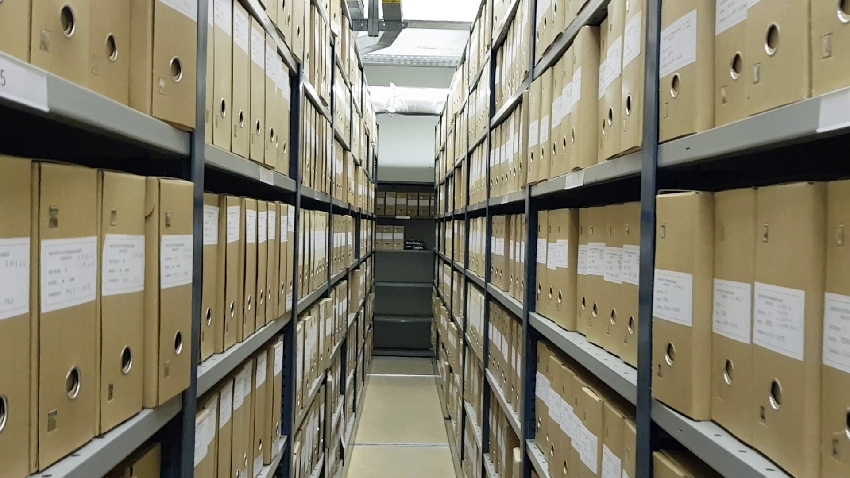
Archival study method or the secondary data analysis involves analyzing data collected by others. It is mostly found in books, newspapers, magazines etc. It is also readily available to the reader.

Conclusion:
Research follows a particular discipline and method. As long as it is followed, your research will be a good one.

Penpals – Digitalized to be rediscovered!

Letters are probably the most graceful way of communication between people. It probably was the most common way of distant communication for more than 3000 years of our recorded history. Until very recently, letters were used by professionals and by common folks alike. You pick up a culture – Indian, English, American, Japanese etc. – all of them have a dedicated space for letter writing – often considered an art. However, mobile phones, instant messaging and e-mails changed the way in which communication was carried out between people forever. It is not that instant messaging is bad. It is better than what was, but certainly fails to have the element of gracefulness that was imbibed in the culture of letter writing.

However, until very recently, letters were also used for the tradition of penpals. Wikipedia defines penpals as – “Pen pals (or penpals, pen-pals, penfriends or pen friends) are people who regularly write to each other, particularly via postal mail. Pen pals are usually strangers whose relationship is based primarily, or even solely, on their exchange of letters. Occasionally pen pals may already have a relationship that is not regularly conducted in person.” And this was a very flourishing tradition between cultures. But of course, life becomes faster with technology and the social changes that come with it.

However, the ones who love and the ones who adore find more ways to hold on to things than the ways in which the others discard the same. There are several penpal clubs that run through magazines. But COVID has certainly put a halt on a large number of them. However, a better thing happened because of this – the innovation of digital letters. For instance, the 2019 Google Apps winner app Slowly built by a Hong Kong Based firm facilitates letter writing online. The time taken by a letter to reach the recipient is proportional to the distance the letter needs to travel geographically, essentially emulating a real-life letter experience. Several other websites that do not necessarily work on the letter based penpal format i.e. they work more like a chat between strangers erupted in market due to the pandemic. The most famous of them is perhaps Omegle which also offers face-time options.

While many may lament that the smell of paper and ink and the post man coming and delivering letters meant a lot to them, a reality is that our realities have changed. The present generation, mostly people born after 2004 might not have many recollections of letters at all in India- thanks to the massive cell-phone boom that has occurred since. However, letters are a good thing. Because the slow modality ensures that a person works upon his language and choice of words. If that isn’t training for soft skills and practicing writing, one may wonder what is. So, the author wishes the ones now planning to write to new people across the world, all the best!

What Is Fast Fashion?

Clothes shopping used to be an occasional event—something that happened a few times a year when the seasons changed or when we outgrew what we had. But about 20 years ago, something changed. Clothes became cheaper, trend cycles sped up, and shopping became a hobby. Enter fast fashion and the global chains that now dominate our high streets and online shopping. But what is fast fashion? And how does it impact people, the planet, and animals?

It was all too good to be true. All these stores selling cool, trendy clothing you could buy with your loose change, wear a handful of times, and then throw away. Suddenly everyone could afford to dress like their favourite celebrity or wear the latest trends fresh from the catwalk.

Then in 2013, the world had a reality check when the Rana Plaza clothing manufacturing complex in Bangladesh collapsed, killing over 1,000 workers. That’s when consumers really started questioning fast fashion and wondering at the true cost of those affordable t-shirts. If you’re reading this article, you might already be aware of fast fashion’s dark side, but it’s worth exploring how the industry got to this point—and how we can help to change it.

What is fast fashion?

Fast fashion can be defined as cheap, trendy clothing that samples ideas from the catwalk or celebrity culture and turns them into garments in high street stores at breakneck speed to meet consumer demand. The idea is to get the newest styles on the market as fast as possible, so shoppers can snap them up while they are still at the height of their popularity and then, sadly, discard them after a few wears. It plays into the idea that outfit repeating is a fashion faux pas and that if you want to stay relevant, you have to sport the latest looks as they happen. It forms a key part of the toxic system of overproduction and consumption that has made fashion one of the world’s largest polluters. Before we can go about changing it, let’s take a look at the history.

How did fast fashion happen?

To understand how fast fashion came to be, we need to rewind a bit. Before the 1800s, fashion was slow. You had to source your own materials like wool or leather, prepare them, weave them, and then make the clothes.The Industrial Revolution introduced new technology—like the sewing machine. Clothes became easier, quicker, and cheaper to make. Dressmaking shops emerged to cater to the middle classes.

Many of these dressmaking shops used teams of garment workers or home workers. Around this time, sweatshops emerged, along with some familiar safety issues. The first significant garment factory disaster was when a fire broke out in New York’s Triangle Shirtwaist Factory in 1911. It claimed the lives of 146 garment workers, many of whom were young female immigrants. By the 1960s and 70s, young people were creating new trends, and clothing became a form of personal expression, but there was still a distinction between high fashion and high street.

In the late 1990s and 2000s, low-cost fashion reached its zenith. Online shopping took off, and fast-fashion retailers like H&M, Zara, and Topshop took over the high street. These brands took the looks and design elements from the top fashion houses and reproduced them quickly and cheaply. With everyone now able to shop for on-trend clothes whenever they wanted, it’s easy to understand how the phenomenon caught on.

How to spot a fast fashion brand

Some key factors are common to fast fashion brands:

  • Thousands of styles, which touch on all the latest trends.
  • Extremely short turnaround time between when a trend or garment is seen on the catwalk or in celebrity media and when it hits the shelves.
  • Offshore manufacturing where labour is the cheapest, with the use of workers on low wages without adequate rights or safety and complex supply chains with poor visibility beyond the first tier.
  • A limited quantity of a particular garment—this is an idea pioneered by Zara. With new stock arriving in store every few days, shoppers know if they don’t buy something they like, they’ll probably miss their chance.
  • Cheap, low quality materials like polyester, causing clothes to degrade after just a few wears and get thrown away.

What’s the impact of fast fashion?

On the planet: Fast fashion’s impact on the planet is immense. The pressure to reduce costs and speed up production time means that environmental corners are more likely to be cut. Fast fashion’s negative impact includes its use of cheap, toxic textile dyes—making the fashion industry the second largest polluter of clean water globally after agriculture. That’s why Greenpeace has been pressuring brands to remove dangerous chemicals from their supply chains through its detoxing fashion campaigns through the years.

Cheap textiles also increase fast fashion’s impact. Polyester is one of the most popular fabrics. It is derived from fossil fuels, contributes to global warming, and can shed microfibers that add to the increasing levels of plastic in our oceans when washed. But even ‘natural fabrics’ can be a problem at the scale fast fashion demands. Conventional cotton requires enormous quantities of water and pesticides in developing countries. This results in drought risks and creates extreme stress on water basins and competition for resources between companies and local communities.

The constant speed and demand mean increased stress on other environmental areas such as land clearing, biodiversity, and soil quality. The processing of leather also impacts the environment, with 300kg of cehmicals added to every 900kg of animal hides tanned. The speed at which garments are produced also means that more and more clothes are disposed of by consumers, creating massive textile waste. In Australia alone, more than 500 million kilos of unwanted clothing ends up in landfill every year.

On workers: As well as the environmental cost of fast fashion, there’s a human cost. Fast fashion impacts garments workers who work in dangerous environments, for low wages, and without fundamental human rights. Further down the supply chain, the farmers may work with toxic chemicals and brutal practices that can have devastating impacts on their physical and mental health, a plight highlighted by the documentary The True Cost.

On animals: Animals are also impacted by fast fashion. In the wild, the toxic dyes and microfibres released in waterways are ingested by land and marine life alike through the food chain to devastating effect. And when animal products such as leather, fur, and even wool are used in fashion directly, animal welfare is put at risk. As an example, numerous scandals reveal that real fur, including cat and dog fur, is often being passed off as a faux fur to unknowing shoppers. The truth is that there is so much real fur being produced under terrible conditions in fur farms that it’s become cheaper to produce and buy than faux fur!

On consumers: Finally, fast fashion can impact consumers themselves, encouraging a ‘throw-away’ culture because of both the built-in obsolescence of the products and the speed at which trends emerge. Fast fashion makes us believe we need to shop more and more to stay on top of trends, creating a constant sense of need and ultimate dissatisfaction. The trend has also been criticized on intellectual property grounds, with some designers alleging that retailers have illegally mass-produced their designs.

Indian Education System

Education plays an important role in the development of an individual and making him a knowledgeable citizen. It is the education that makes an individual self-reliant, helps to suppress the social evils and contribute towards the development of the society and nation as a whole. Education helps in unravelling the mystery of nature. It enables us to understand and improve the working of our society. It creates conditions for a better life. Education brings out the capabilities to fight injustice happening in society. Every individual has the right to education. 

Indian Education is one of the largest and complex education systems in the world along with China. India is committed to providing basic education to its citizens, the framework of which is defined in the National Policy of Education. Elementary education is now compulsory in India. At the time of Independence, only 14% of India’s population was literate. Now after so many decades since Independence, the number of literates has increased by fivefold.

History of Education System

The history of Indian education system comes from the times of Ramayana and Mahabharata. The historic Indian education system is also called the Gurukula system. There were gurus then who are now known as teachers and shishyas who are called students now. The gurus and the shishyas lived together under one roof in Gurukula until the completion of their education. The shishyas were expected to help the guru in all the daily chores as part of their learning. The children belonging to higher strata of the society were taught all the subjects from Sanskrit to Holy Scriptures and mathematics to metaphysics by the gurus. The Gurukulas during those times focused on the practical aspects of life. The students were taught in the open classroom in the surrounding area of nature. This early system of education in India continued for many years until the modern education system came into the picture in the nineteenth century.

In the early 19th century, during the British period, the modern education system was brought into our country by Lord Thomas Babington Macaulay. The basic strength of this modernized education system was the examinations and a well-defined curriculum, which gave importance to subjects like science and mathematics and subjects like philosophy, metaphysics were given a back seat. The brick and mortar classrooms replaced the open classrooms in the Gurukulas. The essence of the guru shishya bond was taken over by a more formal relationship between the teacher and the student. To understand the progress of any student, examinations were conducted at frequent intervals. The focus of the education system shifted from learning to memorizing of the concepts to score good marks in the examinations.

Problems of Indian Education System

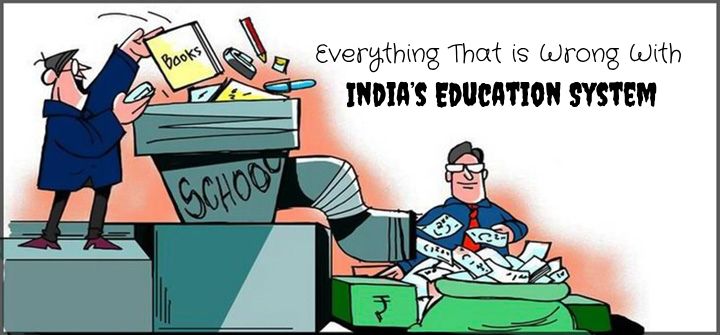
Over a period of time, it has been observed that there are many loopholes in the system of education in India. Instead of understanding the concepts, students started cramming and memorizing the lessons. Knowledge is given a backseat and scoring in high rankings takes importance. The modern parents have tuned their mindsets accordingly and their goal is to ensure that their children score good marks instead of acquiring knowledge right from the primary level. 

Private schools and colleges have been rapidly increasing in the country but the results produced by them are far beyond satisfactory. It has also been observed that the quality of teachers deteriorated with the passing of time. Our examination system is responsible for the wide skill gap. India is producing lakhs of engineers and professionals every year but only a fraction of this number is actually getting employed. This is because the Indian examination system focuses more on scoring good percentages rather than the actual continuous comprehensive evaluation. 

Research and development, which should be the cornerstone of our system, are given the least importance. The private schools and colleges focus on the admission of more students and are least interested in the quality of their education. This is the major reason why the faculties and the teachers lack skills and specialization. This is quite evident from the fact that a single professor is assigned to teach multiple subjects. 

How Can We Improve the Indian Education System?

First and most importantly we should improve the grading system. Rote learning should be discouraged completely. Teachers and faculties should focus more on the analytical skills of the students and grade them accordingly. There should be more focus on comprehensive evaluation instead of scoring only good marks. Workshops must be organized for teachers on a regular basis to keep them updated about the latest developments in the sector of education. At the same time, the curriculum should be reframed according to the present needs of education in India. 

The payroll structure of the teachers and the faculties especially in the government institutions should be improved. This step will help in motivating the teachers to develop their skills and they will take a keen interest in grooming or shaping up a student’s life and career. The government and other entities who are associated with the education sector, need to understand the importance of quality of education. Education should be a holistic process that must focus on the overall development of the physical, emotional, social and cognitive skills of a child. It needs to be a slow and cyclic process and must take place gradually to help the child develop into an autonomous, independent and knowledgeable individual.

Conclusion

An educated individual is an individual who should be able to contribute towards the betterment of the economic and social development of the society as well as the country. The true goal of education must exceed awarding the degrees and certificates to the students. Education is not a tool to earn livelihood but it is a way to liberate the mind and soul of an individual. 

Role Of Todays Youth In Building A Self Reliant India

“Self-reliance is the key to a vigorous life.”

Self-reliant India is the vision of the Prime Minister of India Narendra Modi of making India a self-reliant nation. The first mention of this came in the form of the ‘Self-Reliant India Mission’ during the announcement of the coronavirus pandemic related economic package on 12 May 2020. This self-reliant policy does not aim to be protectionist on nature and as the Finance Minister clarified, ” Self-reliant India does not mean cutting off from rest of the world”. The largest fund in the country worth Rs. 21,000 crore was setup by the IIT Alumni Council with the aim of supporting the mission towards self-reliance.

Everybody knows, that the youth are the future of any country. But India can take lead over many other nations because about 65 percent of the country’s population is below 35 years and 50 percent is below 25 years. With huge, educated young population, India is very uniquely poised to realise the demographic potential amd reap the advantage of this vast powerhouse of human resource talent. The need of the hour is to upgrade the skill or upskill the youth to meet the emloyment needs of technology driven 21st century and accelerate the pace of self-reliance.

The uncertainity created by the pandemic is being seen by many as an opportunity to upgrade knowledge and acquire new skills that will cater to the post-corona virus job scenario. The skills required for tomorrow’s jobs will be completely different from the skill-sets youth possess today.

So, its high time now, we have to make India self-reliant and youth plays the most important role in this mission.

Anger!!!

It was the day of retirement of our Boss. Everyone had tears in their eyes on the day of his farewell.
One of the employees said“ Sir,there is one thing we want to learn from you. You worked here for so many years. Leave aside about scolding your subordinates,we have never seen you even shouting at them.
We have scolded our subordinate on pressure of work or for other reasons. We want to know about “the seed of your patience”.
The Boss said,“This all comes from the incident of my childhood,My father was working,as a lower level employee in an office. He was a very nice person. He was respected very much in our family.
It happened one day, “ I was studying in 4th standard”. I had gone to my father’s office. I saw that my father was not on his seat. I waited outside. After some time his Boss door opened and he came out.
I was taken back seeing the fair face of my father had turned red. He was standing in a corner and looking outside the window. He had not seen me. I went to him and called him slowly. He was stunned and surprised to look at me.
I was stream of tears flowing down his eyes. He was slightly disturbed,he did not find time to wipe out of his tears.“CAN MY FATHER CRY ANYTIME?”..
He was a strong man. I ran straight to my father’s Boss room and asked “Why did you make my father Cry?”
My father apologized and took me out and tried to meke me understand. But that day I decided to become a Boss one day, But I will not make my subordinates cry anytime.
People say it is not possible to control others without scolding them. But I say “WHAT IS LOVE THEN FOR?”. “People who come to work are the ones who devote their best quality time of the day to work, leaving not much for their families”.

Anger doesn’t solve anything
Anger builds nothing
But
Anger can destroy everything

BE COOL!!! BE HAPPY!!!

Doctrine of Notice

INTRODUCTION

The concept of Notice for the purpose of The Transfer of Property is given under Section 3 of Transfer of Property Act, 1882 (TPA). Notice means to have knowledge of something i.e. to know something. In law, it means knowledge of a fact. It is used to decide on conflicting claims of two parties. In law, the Notice or Knowledge of a fact affects one’s legal rights and liabilities.

Under Section 3 of TPA Notice can be; “Actual or express Notice” or “Constructive Notice”, or it may be imputed to the transferee when information of the fact has been obtained by his Agent.

Constructive notice

It is based on the law of presumption or it is presumed that in certain circumstances that the person knows the fact. He cannot afterwards say against it. This type of notice can be divided into five.

  1. Notice imputed by wilful abstention from enquiry
  2. Notice from gross negligence
  3. Notice by registration
  4. Notice by possession
  5. Notice by agent

Actual notice.- Actual notice, to constitute a binding force, must be definite information given by a person interested in the thing in respect of which the notice is issued, as it is settled rule that a person is not bound to attend to vague rumours or statements by mere strangers, and that a notice to be binding must proceed from some person interested in the thing. A mere casual conversation in which knowledge of a certain thing is imparted, is not notice of it, unless the mind of a person has, in some way been brought to an intelligent apprehension of the nature of the thing, so that a reasonable man or any normal man of business would act upon the information, and would regulate his conduct accordingly. In other words, the party imputing notice must show that the other party had knowledge which would operate upon the mind of any rational man, or man of business, and make him act with reference to the knowledge he has so acquired. A vague or general report or the mere existence of suspicious circumstances is not in itself notice of the matter to which it relates. A general claim is not sufficient to affect a purchaser with notice of a deed of which he does not appear to have knowledge. If a person knows that another has or claims an interest in property for which he is negotiating he is bound to inquire what his interest is, and if he omits to do so, he will be bound, although the notice was inaccurate as to the particulars to the extent of such interest.

The notice must be given in the same transaction. A person is not bound by notice given in a previous transaction which he may have forgotten. Notice to a purchaser by his title papers in one transaction will not be notice to him in an independent subsequent transaction in which the instruments containing recitals are not necessary to his title, but he is charged constructively with notice merely of that which affects the purchase of the property in the chain of title of which the payer forms the necessary link.

Constructive notice.- Constructive notice is the knowledge which the Courts impute to a party upon a presumption so strong that it cannot be allowed to be rebutted, that knowledge must have been communicated. “The doctrine of constructive notice” said Lord Brougham in Kennedy v. Green, depends upon two considerations first that certain things existing in relation or the conduct of parties, or in the case between them, begets a presumption so strong of actual knowledge that the law holds the knowledge to exist because it is highly improbable it should not, and next, that policy and safety of the public forbids a person to deny knowledge while he is so dealing as to keep himself ignorant or so as that he may keep himself ignorant, and yet all the while let his agent know, and himself perhaps, profit by that knowledge. The broad principle underlying the doctrine of constructive notice is that a person who is bound to make an inquiry and fails to do it should be held to have notice of all facts which would have come to his knowledge had he made the inquiry. Where, on the other hand, a person is not bound to make an inquiry he cannot be charged with constructive notice of the facts that might havebeen ascertained on such inquiry. Again, where a fact, of which a person has notice, would not put him on inquiry as to the matters in question, it cannot be constructive notice of such matter.

Classes of constructive notice

(1) Wilful abstention from search which one ought to make.
(2) Gross negligence.
(3) Registration as a notice.
(4) Possession as notice.
(5) Notice to agent
(5.1)Notice should have been received in his capacity as agent.
(5.2)Notice must have been given in the course of agency business.
(5.3)Notice must be of a fact which is material to the Agency Business.
(5.4)Fraud by an agent.

Conclusion

Thus it can be said that Constructive notice is a manifestation of the rule of Caveat Emptor. This is because according to Constructive notice, a person ought to have known a fact as if he actually does know it. It presupposed that in property translation a transferee ought to ascertain and verify certain facts for safeguarding his own interest. Thus he must be aware of the nature of the transaction. These facts may relate to property or the transferor, like whether the property is free of any charge or encumbrances or whether the transferor is competent to transfer the property or not.

If the property is encumbered, then the exact nature of the encumbrance ought to be ascertained by the transferee. Law puts it as the duty of the transferee, as a reasonably prudent person to be reasonably vigilant and diligent to ascertain the facts, inspect the documents relating to property in possession of the transferor, inspecting concerned persons, even with relevant statutory authorities, if required. Failure to do this would result in the imposition of Constructive notice.

Internet and Mobile Association of India v. Reserve Bank of India

Statement of Facts

  1. On 5th April,2018 Reserve Bank of India issued a press release raising the concern about the consumer protection from trade of virtual currencies. They were of the view that trading in virtual currency also referred as crypto currency are prone to hacking and therefore would lead to money laundering, terrorist activities, etc. In this view RBI asked the banks to not to deal with the transactions related to the trading of virtual currency.
  2. The services which RBI directed the bank not to deal with were – maintaining the accounts, registering, trading, settling, clearing, giving loans against virtual currencies, accepting virtual currency as collateral, opening accounts of exchanges dealing with them and transfer of sale/purchase of virtual currencies.
  3. The matter was challenged by Internet and Mobile Association of India. The Supreme Court of India allowed the petition on the ground of proportionality. Earlier in 2013 the Reserve Bank of India do issued a public caution to the traders and holders of virtual currency in context with the legal and security related risks associated with it.

Issues Raised

  1. Whether the Reserve Bank of India had the jurisdiction to disallow the trade of virtual currency?
  2. Whether the Respondent had the powers to regulate virtual currency as they were not equivalent to money or legal tender?
  3. Whether the circular which was issued by the RBI was proportional?

Critical Analysis of the Case

A step in the right direction was taken by the Supreme Court of India, in the judgment of Internet and Mobile Association v. RBI. The court quashed the circular of the RBI that directed financial agencies to disocciate themselves from entities involved in virtual trading or transactions relating to VC’s. Some of the concerns that led to the issuance of circular include the anonymity of the transactions and the protection of investors when dealing in cryptocurrency. The major apprehension of the RBI was the inherent difficulty in tracking the source of money which has led to an increase in the number of cryptocurrency scams in the country. Still a very volatile technology, we have not had enough discussion around its shortcomings, leading to an adverse preference of this technology in the monetary circuit.

The Petitioner relied on the case of MS Gill v. Chief Election Commissioner, which led that there was an express prohibition of any authority to do anything which may improve its case. The contention of the petitioners rested on the premise that denial of banking services to those activities of trade recognized by law, would be extremely disproportionate, leading to the violation of extremely disproportionate, leading to a violation of Article 19(1)(g) of the Constitution. Therefore, an understanding of whether there was an infringement of this constitutional right was necessary and to this end, the court relied on the case of Md. Yasin v. Town Area Committee, which makes it amply clear that the right under article 19(1)(g) would be affecyted “In effect and in substance” when there is a complete stoppage of a particular business activity, owing to a certain measure that was undertaken. In Keshavlal Khemchand and Sons Pvt. Ltd. v. Union of India, the court pointed out that “Reserve Bank of India is an expert body to which the responsibility of monitoring the economic system of the contry is entrusted, under various enactments like the RBI Act, 1934, the Banking Regulation Act, 1949.”

The judgement of the court has started an effective discussion on lines that were never traversed before, and while that is indeed commendable, we need to look ahead and anticipate the potential risks on the economy. With that in mind, VC’s promise a more feasible future, especially in this era where people are connected through technology in ways previously unimaginable. Various stakeholders have posted many suggestions, particularly with regarding to creating a model that can monitor and regulate crypto currency, without bringing a blanket ban of the same, which ought to be considered by the government in the light of pending bill. What we need to do is find a balance and not discourage startups from adopting this technology, and if this is ignored, India could be handicapped from exploring opportunities that crypto currencies have to offer. Instead of shying away from addressing these concerns, we need to be proactive and have a structured policy in pace to assuage any potential concerns in the future.

Top 5 websites to start as a freelancer(Part 1)

Will talk about sites and apps where you can a head-start to learn and grown in the freelancing world.

Freelancer

A person who is self-employed and not always committed to a particular employer. Freelance workers are also few times represented by a company or a temporary agency that sells freelance labor to clients. Rest work independently or use professional associations, websites to get work.

Fields where freelancing exists:

Music, writing, acting, computer programming, web design, graphic design, translating and illustrating, film and video production, data handling, Data entry, transcription, Search Engine Optimization (SEO), blogging, logo design, social media handler, and more more.

The term freelancer is commonly attributed to Sir Walter Scott 

Fiverr

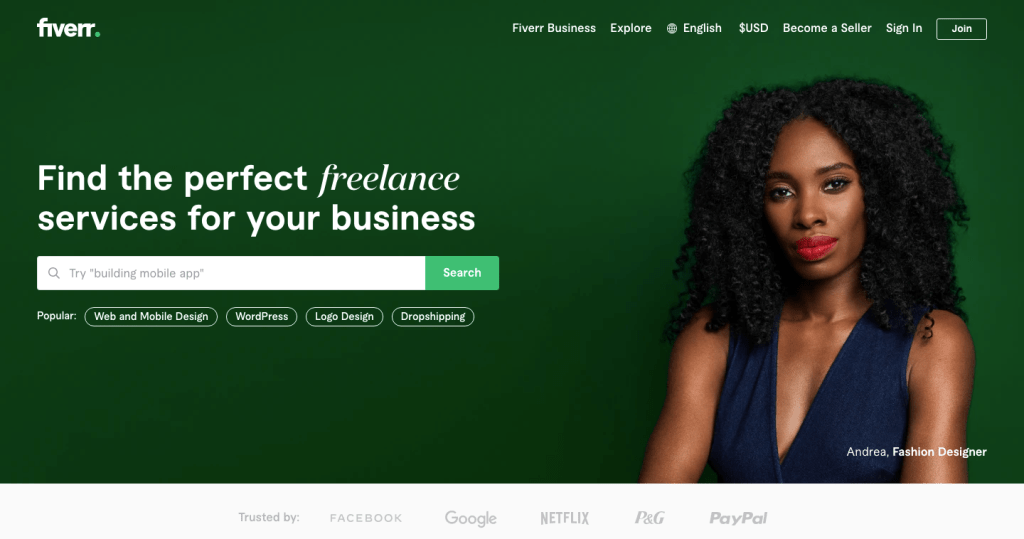
Fiverr is a marketplace that connects freelancers (sellers) with customers looking for small or large services (buyers). There are a variety of different categories. SInce, it will be you who is promoting your services, you have flexibilty to chooose many fields. . In order to make money, you have to create “gigs”, which are sales pitch that will bring in customers to buy your services.
You can earn extra cash by tips from customers, extra work or revisions.

Ups and downs:

The firstmost hurdle is your first gig; using right keywords, your work examples, reviews and their types affect your customer attraction. After landing upon your first customer, you need to put in your best and take time to create the work given. It takes time but build your profile.

The things you need to be aware about is that this platform takes 20% of your every service you give. The minimum price you can charge is $5 which ends up around $4. If you love what you do, want to experience and learn how to attract customers and how to deliver your work; work for longer hours with adequate pay, fiverr might be good for you.

The issue most people complain about is it takes a little longer in payment process. Just like any freelancing job or any job in focus, scammers exist. Let the payment process be within the freelancing core, do not take accept or pay outside Fiverr.

Upwork

Clients can post a job to hire or buy a predefined service from the project catalog. Also, freelancers can access the job board and offer a service to sell. As you can browse billions of jobs to find the one which you would like to offer, it is great for beginners. You get to know to build your profile and learn from others sellers how to display your projects.

Ups and downs:

 They do higher-paying projects, payment protection, credible clients, get jobs quickly after interviews to know legit clients. They have started to charge freelancers a small fee to submit proposals to projects, said to increase your chances of selection; fees can be troublesome, clients do offer smaller budget requests which you use to learn how to work on UpWork. It can be great place for you to learn about services and build up your confidence.

Simply Hired

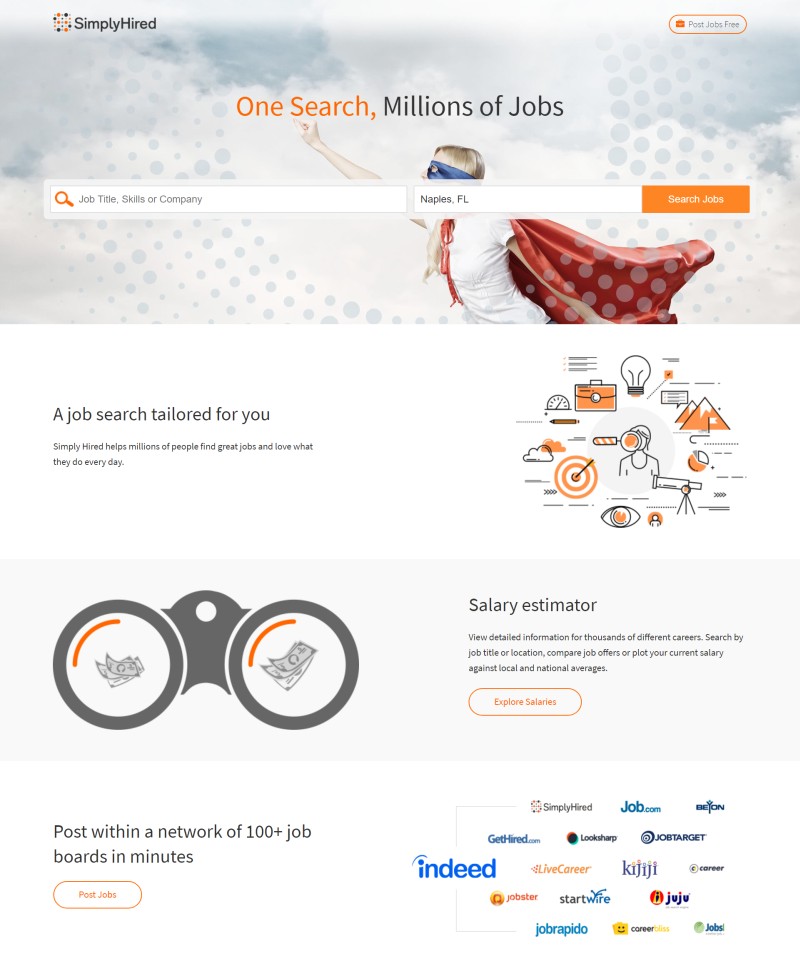
Simply Hired is an employment website and mobile application and an online recruitment advertising network based in Sunnyvale, California. The site is a job search engine that collects job listings from thousands of websites and job boards. To find a job, simply type the search box with related keywords. You can also narrow down jobs of your interest by filling out your city, state, or ZIP code.

Ups and downs:

Integration with LinkedIn.com gives you better results to search and apply for your desired jobs.  Simply Hired price starts at $199 per user/month, making it a little more expensive. The platform has a salary calculator and a ‘quick apply’ feature.

Be aware about outdated jobs. Ensure by calling the companies and clear your doubts. There are hidden costs for training and such which makes it costly. Email and SMS confirmations, partnerships helps you get jobs soon. Plus, it is available in more than 24 countries and in 12 different languages.

College Recruiter

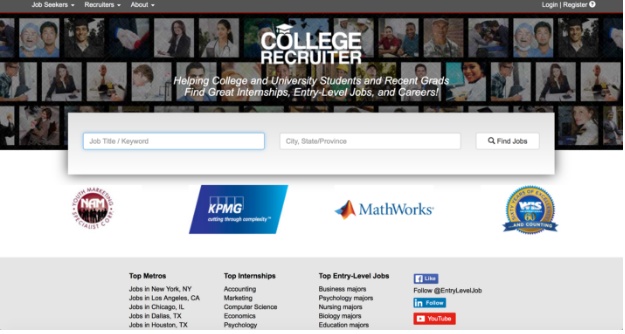
College Recruiter is the leading, interactive, recruitment media company used by college students and recent graduates to find great careers. Our clients are primarily colleges, universities, and employers who want to recruit dozens, hundreds, or thousands of students and recent graduates per year.

Ups and downs:

College students who want to earn while studying, this site will provide them with many internships, part time jobs, entry level jobs and probably even get a permanent jobs. People find it easier to look for jobs in this site. Due to lack of complete job profile there can be issues with some jobs, lack of filters does make it hard to shortlist your choice of companies but it gives you lots of options, give your personal information scarcely since you might get unnecessary job invites; you can give a secondary email as well.

Aquent

Aquent is a leading talent services company, providing marketing and creative talent, managed services, extended workforce benefits, project management, and professional development. It is known as a staffing company specializing in placing temporary employees in marketing and creative industries. Aquent also has free online courses that provide training to hone one’s skills. You can search with keywords and a location, or browse all of the job openings in your nearby area.

Ups and downs:

Be aware of scammers, especially calls asking about personal information. There are chances of jobs ending early as well as there are chances of long term plans as well. Since the job can be short termed, if you will get to explore every fields you think you are fit for. The pay is decent.

Tata Consultancy Services(TCS)

Tata Consultancy Services (TCS) is an Indian multinational information technology (IT) services and consulting company. It’s main headquartered is located in Mumbai, Maharashtra, India and largest TCS campus located in Chennai, Tamil Nadu, India. TCS is the second largest Indian company by market capitalisation. TCS was ranked 64th overall in the Forbes World’s Most Innovative Companies ranking, making it both the highest-ranked IT services company and the top Indian company. TCS  has also became the first Indian IT company to reach $100 billion in market capitalisation.

Tata Consultancy Services Limited, initially started as “Tata Computer Systems” and was founded in 1968 by Tata Sons Limited. It was initially started as taking contracts which included punched card services to sister company TISCO (now Tata Steel), working on an Inter-Branch Reconciliation System for the Central Bank of India, and providing bureau services to Unit Trust of India. TCS established India’s first dedicated software research and development centre, the Tata Research Development and Design Centre (TRDDC) in Pune. In 1981, it established India’s first client-dedicated offshore development centre, set up for clients Tandem. TCS later (1993) partnered with Canada-based software factory Integrity Software Corp, which TCS later acquired. In 2006, it designed an ERP system for the Indian Railway Catering and Tourism Corporation. TCS received the 2019 American Business Awards from Four Stevies.

TCS and its 67 subsidiaries provides a wide range of information technology-related products and services including application development, business process outsourcing, capacity planning, consulting, enterprise software, hardware sizing, payment processing, software management, and technology education services. The firm’s also established software products which include TCS BaNCS and TCS MasterCraft.

TCS’ services are currently organized into the following service lines (percentage of total TCS revenues generated by each respective service line is shown below ): 2012-13 financial year data-

Application development and maintenance (43.80%) value

Asset leverage solutions (2.70%)

Assurance services (7.70%)

Business process outsourcing (12.50%)

Consulting (2.00%)

Engineering and Industrial services (4.60%)

Enterprise solution (15.21%)

IT infrastructure services (11.50%)

Cognitive Business Operations

Cloud Infrastructure

Automation and AI

Tata Consultancy Services has 285 offices across 46 countries and 147 delivery centers in 21 countries.

Tata Consultancy Services(TCS) is also located in-

India: Ahmedabad, Bengaluru, Baroda, Bhubaneswar, Chennai, Coimbatore, Delhi, Gandhinagar, Goa, Gurugram, Guwahati, Hyderabad, Bhopal, Indore, Jamshedpur, Kochi, Kolkata, Lucknow, Mumbai, Nagpur, Noida, Nashik, Patna,[88][89] Pune, Thiruvananthapuram, and Varanasi.

Asia (excluding India): Bahrain, China, Israel, UAE, Hong Kong, Indonesia, Japan, Malaysia, the Philippines, Saudi Arabia, Singapore, South Korea, Taiwan, Thailand, and Qatar.

Oceania: Australia.

Africa: South Africa, Morocco.

Europe: Belgium, Denmark, Finland, France, Germany, Hungary, Iceland, Republic of Ireland, Italy, Luxembourg, the Netherlands, Norway, Portugal, Spain, Sweden, Switzerland, and the United Kingdom.

North America: Canada, Mexico, and the United States.

South America: Argentina, Brazil, Chile, Colombia, Ecuador, Peru, and Uruguay.

TCS is one of the largest private-sector employers in India, and the fourth-largest employer among listed Indian companies (after Indian Railways, Indian Army, and India Post). TCS has crossed more than 500,000 employees as of 8 July 2021.

Education System In India…

Education is critical in the growth of a person and the formation of an informed citizen. Education empowers individuals, aids in the suppression of societal ills, and contributes to the overall development of society and nation. Education aids in the unravelling of nature’s mysteries. It helps us to comprehend and enhance the functioning of our civilization. It lays the groundwork for a better existence. Education develops the skills needed to combat social injustice. Every person has the right to an education.

Along with China, India has one of the world’s largest and most complicated educational systems. The National Policy of Education defines the basis for India’s commitment to delivering basic education to its inhabitants. In India, elementary schooling is now required. Only 14 percent of India’s population was literate at the time of independence. After so many decades since independence, the number of literates has more than fivefold grown.

History of Education System:

The history of Indian education may be traced back to the Ramayana and Mahabharata. The Gurukula system is another name for the traditional Indian schooling system. There were gurus back then, who are now known as instructors, and shishyas, who are now known as pupils. Gurus and shishyas lived together in Gurukula under one roof till they finished their study. As part of their education, the shishyas were required to assist the guru with all everyday duties. Gurus taught all topics to youngsters from upper social classes, ranging from Sanskrit to Holy Scriptures and mathematics to philosophy. During that period, the Gurukulas concentrated on the practical parts of life. The children were taught in an open classroom in a natural setting. This early school system in India lasted for many years until the modern education system arrived in the nineteenth century.

Lord Thomas Babington Macaulay introduced the modern education system to our country in the early nineteenth century, during the British period. The primary basis of this updated education system was tests and a well-defined curriculum that prioritised topics like science and mathematics while pushing subjects like philosophy and metaphysics to the sidelines. The open classrooms of the Gurukulas were replaced by brick and mortar classrooms. A more formal relationship between the instructor and the learner replaced the core of the guru shishya tie. Examinations were held at regular intervals to assess each student’s progress. The emphasis of the educational system moved from studying to remembering topics in order to achieve high scores in tests.

Problems of Indian Education System:

Over time, it has been discovered that there are several flaws in India’s educational system. Instead of comprehending the principles, pupils began cramming and memorizing them. Knowledge takes a second seat as high ranks take precedence. Modern parents have modified their mentality appropriately, and their objective is to guarantee that their children get high grades rather than learning from the ground up.

Private schools and universities are quickly expanding in the country, but the outcomes they generate are far from adequate. It has also been noticed that the quality of teachers has worsened with time. Our examination system is to blame for the large skill disparity. Every year, thousands of engineers and professionals are produced in India, yet only a portion of this number is employed. This is due to the Indian test system’s emphasis on high percentages rather than ongoing comprehensive review.

Research and development, which should be the foundation of our system, are given the least attention. Private schools and colleges are more concerned with the number of students admitted than with the quality of their education. This is the primary reason for the faculty’s and instructors’ lack of skills and expertise. The fact that a single professor is assigned to teach numerous courses demonstrates this.

How Can We Improve the Indian Education System?

First and foremost, we must reform the grading system. Rote learning should be avoided at all costs. Teachers and professors should pay greater attention to students’ analytical skills and evaluate them properly. Instead than just getting excellent grades, there should be a greater emphasis on complete evaluation. Workshops for teachers should be held on a regular basis to keep them up to speed on the newest advancements in the education field. Simultaneously, the curriculum should be restructured in accordance with India’s current educational demands.

The payroll structure of the teachers and the faculties especially in the government institutions should be improved. This step will help in motivating the teachers to develop their skills and they will take a keen interest in grooming or shaping up a student’s life and career. The government and other entities who are associated with the education sector, need to understand the importance of quality of education. Education should be a holistic process that must focus on the overall development of the physical, emotional, social and cognitive skills of a child. It needs to be a slow and cyclic process and must take place gradually to help the child develop into an autonomous, independent and knowledgeable individual.

Conclusion:

An educated person is one who can contribute to the advancement of the economic and social growth of the society as well as the country. The actual purpose of education must go beyond simply providing degrees and certificates to pupils. Education is not a means of earning a living; rather, it is a means of liberating one’s mind and spirit.

Twitter will pay hackers to discover biases in its automated picture cropping after being accused of doing so.

Twitter is running a competition in the hopes of finding biases in its picture cropping algorithm, and the best teams will get cash awards (via Engadget). Twitter hopes that by allowing teams access to its code and picture cropping model, they will be able to identify ways in which the algorithm might be detrimental (for example, cropping in a way that stereotypes or erases the image’s topic).


Those that compete must submit a summary of their results as well as a dataset that can be put through the algorithm to show the problem. Twitter will then give points depending on the kind of damages discovered, the potential impact on people, and other factors.


The winner team will get $3,500, with $1,000 awards granted for the most creative and generalizable results. On Twitter, that figure has sparked some debate, with some people arguing that it should include an extra zero. For example, if you discovered a bug that allowed you to execute activities for someone else (such retweeting a tweet or picture) via cross-site scripting, Twitter’s standard bug bounty programme would pay you $2,940. You’d make $7,700 if you could find an OAuth flaw that allowed you to take over someone’s Twitter account.


Twitter had already conducted its own study into its image-cropping algorithm, publishing a paper in May that looked at how the system was biassed in the wake of claims that its preview crops were racist. Since then, Twitter has mainly abandoned algorithmically trimming previews, but it is still utilised on desktop, and a good cropping algorithm is a useful tool for a firm like Twitter.


Opening a competition allows Twitter to receive input from a much wider group of people. For example, the Twitter team had a meeting to discuss the competition, during which a team member stated that they were getting queries about caste-based biases in the algorithm, something that software developers in California may not be aware of.
Twitter is also searching for more than simply unintentional algorithmic bias. Both deliberate and unintended damages have point values on the scale. Unintentional harms are cropping behaviours that may be abused by someone publishing maliciously created photos, according to Twitter. Intentional harms are cropping behaviours that could be exploited by someone posting maliciously intended images.


The competition, according to Twitter’s announcement blog, is distinct from its bug bounty programme; if you submit a complaint regarding algorithmic biases to Twitter outside of the competition, your report will be closed and tagged as not applicable, the company warns. If you’re interested in participating, visit the competition’s HackerOne page to learn more about the rules, qualifications, and other details. Submissions are open until August 6th at 11:59 p.m. PT, and the challenge winners will be revealed on August 9th at the Def Con AI Village.

How Do I Choose Between Medication and Therapy?

In the last couple of weeks, there have been some big announcements from the medical and mental health communities about the wisdom of using drugs over behavioral methods for various disorders. The meds vs. therapy debate has been an active one for a number of years.But these days, some experts and organizations are questioning, more and more, whether popping pills should really be our go-to treatment, based on the literature. And it seems that for some that have historically used meds as the first line of treatment, the evidence for behavioral methods has mounted to the point where recommendations have shifted in their favor. At least for some things.

Photo by Anna Tarazevich on Pexels.com

Whether you’re leaning toward therapy, medication, or a combination, knowing that a reliable pharmacy partner is part of the care network can bring added reassurance. Many people now use online tools to locate a specialty pharmacy near me, ensuring they can quickly connect with professionals who understand their unique health needs. Therapy or medication? In both children and adults, evidence-based psychosocial therapies have been shown to work for a broad range of mental health disorders, as well as for many life problems. The same can be said for the effectiveness of some medications. The information below is intended to help parents/caregivers choose between treatment options for their child or adolescent, and to decide whether therapy and medication should be combined for the most effective treatment.Medications, psychotherapy and their combination have been shown to help people with emotional or behavioral problems. Different kinds of problems, however, will respond differently to various treatments; therefore, choosing the right treatment can be complicated. Your choice of treatment should be based on the best available scientific evidence, as well as your own willingness to try these treatments and to stick with them. Whatever the choice, these discussions should be reviewed with your physician, psychologist or mental health professional. Here are some things to consider:

Best Evidence

  • For depression, two kinds of psychotherapy called cognitive-behavioral therapy and interpersonal psychotherapy, as well as antidepressant medications, have been shown to be helpful. There is some evidence that combining psychotherapy and medications may be more effective than either treatment alone. People who are suicidal may need to be treated in a hospital.
  • For anxiety disorders, cognitive-behavioral therapy, antidepressant medications and anti-anxiety medications have all been shown to be helpful. Research generally shows that psychotherapy is more effective than medications, and that adding medications does not significantly improve outcomes from psychotherapy alone.
  • For alcohol and drug use disorders, cognitive-behavioral therapy and environment-based therapies, as well as 12-step support programs, have been shown to be helpful. People with severe substance use problems may also benefit from the addition of certain medications that reduce cravings or intoxication effects.
  • For eating disorders, medical management may be necessary to maintain physical safety. Cognitive-behavioral therapy, interpersonal psychotherapy and antidepressant medications have all been shown to be helpful, and some evidence suggests that combining psychotherapy and medications may be more effective than either treatment alone.
  • For schizophrenia or bipolar disorder, most people will require treatment with antipsychotic or mood-stabilizing medications. Research suggests that adding cognitive-behavioral or family psychotherapy to the treatment can improve functional outcomes.
  • For problems with parenting, marriage or adjustment, psychotherapy is usually the first recommendation. This treatment can help you build skills and respond more appropriately to stressors.

Personalizing Your Treatment

  • Different people respond to treatments differently. Therefore, if one treatment does not help, try adding the other. Research shows that psychotherapy can be helpful even for people who do not respond well to medications.
  • Psychotherapy and medications both require that you stick with the treatment. Results usually do not happen overnight. Therefore, only start a treatment if you are willing to continue it long enough for it to help you.
  • You will be most likely to stick with a treatment if it makes sense to you. Therefore, it’s important that you discuss the treatment thoroughly with your doctor, and that the treatment is explained in a way that you can understand.
  • When in doubt, ask your doctor. He/she can inform you of the best evidence and make a specific recommendation for your condition.