

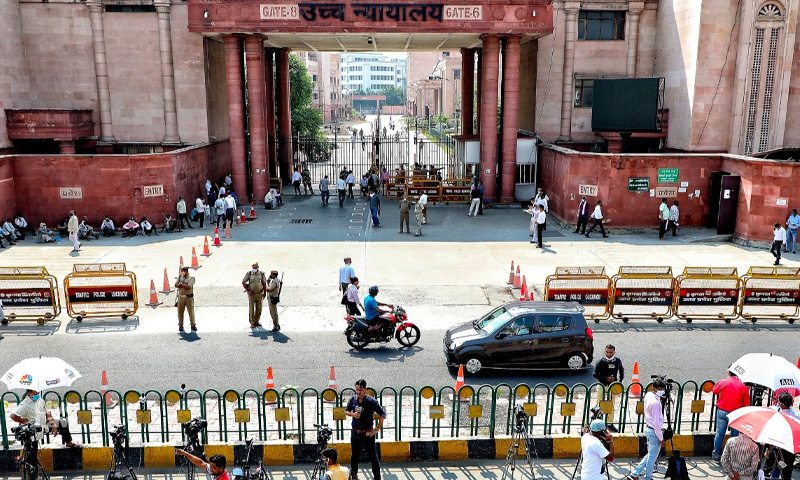
It is most unfortunate, most alarming and most reprehensible that none other than the Allahabad High Court which is the biggest court in whole of Asia has observed most seriously in a latest, learned, laudable and landmark judgment titled Bharat Das @ Ram Newaz Singh v. State of U.P. in Bail No. 8577 of 2020 delivered on 5 February 2021 that, “It is unfortunate that the properties of religious and charitable institutions are being usurped by criminals. This serious observation was made while dismissing the bail application filed by a man accused of selling properties of a Math (Akhil Bhartiya Udasin Sangat Thakurji Virajman Thakurdwara Jhaaulal) on the basis of forged and fabricated documents in favour of the land mafias. How can criminals be ever allowed to usurp the properties of religious and charitable institutions? But this is happening in reality as has been acknowledged by none other than the Allahabad High Court!
To start with, the ball is set rolling first and foremost in para 1 of this brief, brilliant, blunt and bold judgment wherein it is stated that, “The present petition under Section 439 Cr.P.C. has been filed seeking bail in FIR No.0584 of 2019, under Sections 406, 419, 420, 467, 468, 471, 506 IPC, Police Station P.G.I., Lucknow.”
To put things in perspective, the Bench then elaborates on the facts of the case stating in para 2 that, “The complainant claims to be Mahant Sarvarakar (Jere-Intejaamkaar) of Akhil Bhartiya Udasin Sangat Thakurji Virajman Thakurdwara Jhaaulal (herein after referred to as ‘the Math’). He is responsible for taking care of and managing properties of the Math and securing interest of the Math. It is also said that the complainant has been declared successor of Mahant Parmeshwar Das in the year 2002 unanimously and a Division Bench of this Court vide judgment and order dated 11.01.2016 passed in Writ Petition (Consolidation) No.130 of 2011 has declared him to be the legal heir and successor of Mahant Parmeshwar Das. Copy of the order dated 11.01.2016 was also annexed with the complaint. It is also alleged in the complaint that many imposters claiming to be Mahant of the Math in connivance with the land mafias have sold several properties and land of the Math illegally without taking permission from the District Magistrate. It is further alleged that the present accused-applicant who is a convict and a dreaded criminal by imposting himself as Mahant of Math had been involved in selling the properties of the Math illegally and fraudulently to the land mafias.”
While elaborating further and continuing in a similar vein, the Bench then observes in para 3 that, “The Math has land in Gata Nos.436, 296, 427A, 426, 531, 1951Ka, 1953Ka, 1955Ka, 1960Ka Kalli Paschim, Pargana Bijnore, Tehsil Sarojini Nagar, Lucknow. This land is being transferred on the basis of forged and fabricated documents by a gang of land mafias to earn huge money. Ex-guru of the complainant Somvansh Das had died on 14.04.1980. However, an imposter got his will registered on 04.04.2003 in the office of Dy. Registrar, Lucknow in respect of Gata No.436 and on that basis, this imposter has transferred 3 Bigha land in favour I.K. Singh, 5 Bigha land in favour of Sanjay Tiwari, 1 Bigha 13 Biswa 13 Biswanshi land in favour of Prabhu Nath Tiwari. Forged will got registered by Bharat Singh and the accused-applicant in furtherance of criminal conspiracy and, thereafter accusedIshwar Kant Singh imposted himself as Mahant Parmeshwar Das and transferred the land of Gata No.436 in favour of Satendra Singh Sikarwar on 05.08.2004 for Rs.20,00,000/-. Thereafter, Bharat Singh and the present accused-applicant again transferred the land in Gata Nos.436 and 296 by imposting Ishwar Kant Singh as Parmeshwar Das on 23.11.2016 for a sale consideration of Rs.20,00,000/-. Anil Kumar Singh transferred this land for 3rd time in Gata No.436 on 20.01.2007 in favour of Smt. Manisha Chola and Rekha Gupta. Thereafter, the accused-applicant and Bharat Singh on the basis of forged and fabricated documents of the land in Gata Nos.296, 427A, 426 and 531 executed an agreement for Rs.12,00,000/- on 20.02.2007 in favour of Bharat Singh himself from the accused-applicant and on 16.03.2007 the land was transferred in Gata No.531 in favour of Alpana Gupta for a sale consideration of Rs.36,27,100/-. For the fifth time accused-Bharat Singh and the accused-applicant by imposting Indra Kant Singh as Parmeshwar Das transferred Gata Nos.436 and 296 in the year 2006 in favour of Raj Babu Rastogi. Thus, accused-Bharat Singh and the accused-applicant, Satyendra Kumar Sikarwar, Anil Kumar Singh, Gyaneshwar Singh, Kaushal Kumar, Santosh Singh, Kalpana Gupta, Raj Babu Rastogi had transferred the land of the Government in Gata No.436 and 296 on the basis of forged and fabricated documents. On the basis of forged will which got executed after 23 years from the death of Mahant Somvans Das, these accused have cheated Rs.1.5 Crores by selling the land of the Math on the basis of forged and fabricated documents. These accused had threatened the complainant of his life and had said that they would usurp entire property and land of the Math. On the basis of the aforesaid complaint, the FIR in question has been lodged.”
Of course, it is then observed in para 4 that, “It is alleged that the present accused-applicant is an imposter who is selling Math land in an illegal manner. Several instances of the cases pending against the accused-applicant have been given in the complaint and, it is alleged that the present accused-applicant has sold the land in Gata Nos.2119, 2118, 676, 2263 also.”
As a corollary, what follows next is then stated in para 5 that, “On the basis of aforesaid complaint, the FIR in question came to be registered against the accused-applicant and other named accused at FIR No.0585 of 2019 under Sections 34, 419, 420, 467, 468, 471, 427, 447, 504 IPC, Police Station P.G.I., Lucknow.”
As we see, para 6 then enunciates that, “It is stated that the accused-applicant has been awarded life imprisonment in Sessions Trial No.46 of 1984 and has been found guilty for offence under Sections 307/34, 301/34, 304/34 IPC. It is further alleged that on 12.02.2007, the accused-applicant acted as an imposter of Mahant executed ikrarnama in favour of Bharat Singh and others. He has also been convicted in Sessions Trial No. 242 of 1979 for offences under Sections 364/149, 302/149, 307/149 IPC and was awarded life imprisonment. In the FIR, it is further alleged that the accused persons by using false and fabricated documents illegally bought and sold the property of the Math by threatening the complainant.”
To be sure, it is then stated in para 7 that, “An affidavit in support of the bail application has been filed by Baba Jeetu Das, son of Mahant Baba Bharat Das.”
It cannot be glossed over that it is put forth in para 9 that, “Learned counsel for the accused-applicant submits that the complainant has falsely claimed that Mahant Parmeshwar Das was Jere-Intejaamkaar of the Math and the informant is the chela of Mahant Parmeshwar Das. The fact of the matter is that the present accused-applicant succeeded as Jere-Intejaamkaar of the Math after demise of Mahant Ramji Das and an order dated 16.07.2005 was passed by Consolidation Officer, Sadar, Lucknow to this effect in Case No.88 of 2005. Present accused-applicant is jere-intejaamkaar of the properties of the land in question till date. Mahant Parmeshwar Das has executed a declaration deed duly registered in the Office of Sub Registrar on 07.09.2012 declaring that the complainant was a dishonest person and wanted to usurp land and properties of Math. The complainant was not the chela of Mahant Parmeshwar Das as claimed by him. Mahant Parmeshwar Das himself had moved an application against the complainant in Police Station Kotwali Chowk on 14.09.2012.”
While stating the factual position, it is then noted in para 10 that, “The correct facts are that Mahant Ramji Das was chela of Somvansh Das and the accused-applicant is chela of Mahant Ramji Das. Allegation against him that he had executed a forged will, is wholly incorrect. Learned counsel has also submitted that the land sold by him was for the purposes of maintaining the Math and for better management of the properties. It has been further submitted that the present complainant himself has a criminal history.”
Furthermore, it is then envisaged in para 11 that, “It is further submitted that in Civil Suit No.155 of 1994 vide judgment and order dated 24.10.1995 passed by Civil Judge by which the present accused-applicant has been declared as successor of Mahant Ramji Das and on the basis of the order dated 18.11.2004 passed by the Consolidation Officer, Sadar Lucknow, name of the accused-applicant has been mutated while deleting the name of Jere-Intejaamkaar, Mahant Baba Ramji Das. Settlement Officer had dismissed the appeal filed against the order passed by the Consolidation Officer and, thereafter the revision was also dismissed by the Additional District Magistrate (Finance and Revenue) vide his order dated 26.04.2010.”
It is worth noting that it is then stated in para 12 that, “A Writ Petition No.130 (Consolidation) of 2011: Mahant Parmeshwar Das vs Additional Collector ‘Finance and Revenue’, Lucknow is pending in this Court. Counter affidavit was filed by the accused-applicant in 2014 but till date the rejoinder affidavit has not been filed and the writ petition is still pending.”
On the one hand, it is stated in para 13 that, “Learned counsel for the accused-applicant has submitted that in many cases mentioned against the accused-applicant, he has been either acquitted or he is not involved in the commission of the offence. He, therefore, has submitted that the accused-applicant himself is grabbing the property of Math and he wants to put the present accused-applicant aside and, therefore, false cases are being instituted against him. The accused-applicant has been in jail since 23.07.2020 and, therefore, he is liable to be enlarged on bail.”
On the contrary, it is then stated in para 14 that, “On the other hand, Mr. Rao Narendra Singh, learned AGA has submitted that it has come in the investigation of the offence that the present accused-applicant fraudulently after preparing forged and fabricated documents, had been selling the properties of the Math by imposting himself as Mahant of the Math whereas he has no right to sell the properties. The accused-applicant had been convicted for life by the III-Additional District Judge, Fatehpur in the year 1981. He is a history sheeter of District Fatehpur and several cases are registered against him.”
It cannot be lightly dismissed that it is then unearthed in para 15 that, “To avoid the police action, he came to the Math as Mahant and as soon as Mahant Ramji Das died, he declared himself as Mahant of the Math by forging the stamp of Gram Sabha Babutha Kala without there being any witness. The fact is that successor of Mahant Ramji Das Ji is his chela, Chacha Dayal Das Awasthi and the Court has declared him to be successor and Mahant of the Math. Present accused-applicant had killed Baba Dayal Das and declared himself to be the successor of Ramji Das. He has also killed Basraj Singh, the witness of the murder of Mahant Dayal Das Awasthi. Mangement of U.P. Udaseen Sampradaya Prabhandh Trust had extricated the present accused-applicant as Mahant on 06.03.2020.”
Damningly, the Bench then also makes it known in para 16 that, “The accused-applicant had presented several of his gang members as imposters of Baba Parmeshwar Das. 23 years after the death of Mahant Soman Das, the accused-applicant had got the forged will registered by imposter of Baba Soman Das.”
More damningly, the Bench then castigates in para 17 stating that, “Despite order passed by the High Court in the writ petition filed by Parmeshwar Das in which stay was granted regarding disposing of the land of the Math, the accused-applicant got registered a forged trust deed namely, Thakur Ji Maharaj Trust and showing his members as disciple (chela) and declared him as treasurer. He started transferring entire money of the Math. The accused had executed several sale-deeds fraudulently on the basis of forged and fabricated documents in favour of the land mafias and there are sufficient evidence against him for committing the offence.”
Most damningly, the Bench then discloses in para 18 bringing out that, “In the counter affidavit, it has been stated that so far following 15 cases have been found against the accused-applicant and investigation is on in respect of other cases:-
(i) Case Crime No.198/1978, under Section 13 Gambling Act, Police Station Thariyaon, Fatehpur.
(ii) Case Crime No.199/1978, under Section 25 Arms Act, Police Station Thariyaon, Fatehpur.
(iii) Case Crime No.112/1983, under Section 307 IPC, Police Station Thariyaon, Fathepur.
(iv) Case Crime No.185/1985 under Section 364/302 IPC, Police Station Thariyaon, Fatehpur.
(v) Case Crime No.14/17, under Section 147, 148, 149, 302, 309 IPC, Police Station Thariyaon, Fatehpur.
(vi) Case Crime No.346/99 under Sections 302/120B IPC, Police Station Munshiganj, Sultanpur.
(vii) Case Crime No.62/2000 under Sections 147, 148, 149, 452, 302 IPC, Police Station Munshiganj, Amethi.
(viii) Case Crime No.544 of 2009, under Section 420 IPC, Police Station Mohanlalganj, Lucknow.
(ix) Case Crime No.162/2015 under Sections 452, 504, 506, 323 IPC, Police Station Chowk, Lucknow.
(x) Case Crime No.659/2018, under Sections 120B, 147, 148, 149, 323, 307, 308, 506 IPC, 7 Criminal Law Amendment Act, Police Station Thakurganj, Lucknow.
(xi) Case Crime No.25/2019, under Sections 147, 379 IPC, Police Station P.G.I., Lucknow.
(xii) Case Crime No.125/2019, under Sections 147, 379, 448 IPC, Police Station P.G.I., Lucknow.
(xiii) Case Crime No.584/2019, under Sections 406, 419, 420, 467, 468, 471, 506 IPC, Police Station P.G.I., Lucknow.
(xiv) Case Crime No.585/2019, under Sections 34/419, 420, 427, 447, 467, 468, 471, 506 IPC, Police Station P.G.I., Lucknow.
(xv) Case Crime No.589/2019, under Sections 147, 419, 420, 467, 468, 471, 506, 34 IPC, Police Station P.G.I., Lucknow.”
Most revealingly, after considering the submissions of the counsel for the accused-applicant as well as learned A.G.A. and learned counsel for the complainant as stated in para 19, it is then finally and far most crucially held in para 20 that, “It is unfortunate that the properties of religious and charitable institutions are being usurped by criminals. Looking at the long criminal history of the accused-applicant and his involvement in the commission of the offence i.e. selling property of the Math by the accused-applicant in active connivance with the land mafias without any authority or competence is serious offence and, therefore, this Court does not find any ground to release the accused-applicant on bail at this stage and this bail application is hereby rejected at this stage.”
On a concluding note, it must be said that such instances of illegal land grabbing by mafias especially the properties of religious and charitable institutions are becoming more and more common and frequent which is certainly a cause of grave concern. Even the Allahabad High Court itself has noticed this most dangerous trend of religious and charitable institutions being usurped by criminals and mafias. How can all this be allowed to go on unchecked, uninhibited and unpunished? This alone explains why the Allahabad High Court refused to grant bail to the accused-applicant by rejecting the bail application! Very rightly so!
Sanjeev Sirohi











 Eduindex
You must be logged in to post a comment.