

Unlock 3.0: MHA issues guidelines: Schools, Colleges and Coaching institutions to be shut till 31 August; yoga institutes, gyms to reopen from Aug 5

The Ministry of home affairs (MHA) has issued fresh guidelines for third phase of ‘Unlock’. These guidelines will come into effect from 1 August, 2020. The restrictions on the movement of individuals during night have been removed, while yoga institutes and gymnasiums will be allowed to open from August 5.
Lockdown shall continue to be implemented strictly in the containment zones till August 31. All activities, except the following shall be permitted outside containment zones – Metro Rail, cinema halls, swimming pools, entertainment parks, theatres, bars, auditoriums, assembly halls and similar places.
Also, schools, colleges and coaching institutions will remain closed till August 31. The government also said the new guidlines issued today are based on feedbacks received overtime by authorities and chief ministers of states and Union Territories. Social/political/sports/entertainment/academic/cultural/religious functions and other large congregations are still not permitted.
Guidelines for containment zones:
According to the order, lockdown in containment zones will remain imposed till 31 August, 2020. These virus containment zones need to be carefully demarcated by the state governments or UTs. Within the perimeters of containment zones, strict social distancing and other norms of containing the spread of the virus shall be maintained and only essential activities will be allowed, MHA said in a statement.
These containment zones will be notified on the websites of respective district collectors of the states and UTs and activities taking place in these zones will be strictly monitored by the authorities. MHA also stated that the states and UTs can impose its own guidelines outside the containment zones, which they deem necessary.
India went under a complete nationwide lockdown from 25 March in order to curb the spread of the novel coronavirus in the country. In an attempt to bring back normalcy, the MHA has been issuing a number of guidelines in its Unlock India mission in order to provide relaxations in a graded manner and kickstart the economy. Meanwhile, with 48,513 people testing positive for coronavirus in a day, India’s Covid-19 tally crossed 15 lakh-mark today, while the recoveries jumped to 9,88,029, according to the daily bulletin of Ministry of Health & Family Welfare.
The country’s death toll rose to 34,193 with 768 fatalities being recorded in a day. The fatality from covid currently stands at 2.25% in India as compared to global average of about 4%. Total virus positive cases now stand at 15,31,669 including 5,09,447 active cases, the health ministry said.
WEBSITES REFERRED:
- https://www.mha.gov.in/sites/default/files/Unlock3_29072020.pdf
- https://timesofindia.indiatimes.com/videos/news/unlock-3-0-mha-issues-guidelines-yoga-institutes-gyms-to-reopen-from-aug-5/videoshow/77245574.cms
- https://www.livemint.com/news/india/unlock-3-0-night-curfew-removed-gymns-to-open-under-new-guidelines-details-here-11596030267259.html
- https://www.dreamstime.com/unlock-india-now-open-again-india-unlock-very-long-strict-lockdown-to-fight-covid-indian-economy-unlock-image185165878
EUTHANASIA LAW IN INDIA
WHAT IS EUTHANASIA?

The word Euthanasia originiates from the Greek words: Eu (good) and Thanatos (death) and it means “Good Death”, “Gentle and Easy Death.” It is also known as Mercy killing. It was first used in a medical context by Francis Bacon in the 17th century, to refer to an easy, painless, happy death, during which it was a “physician’s responsibility to alleviate the ‘physical sufferings’ of the body”.
According to the World Medical Association Euthanasia means:
Deliberate and intentional action with a clear intention to end another person’s life under the following conditions: The subject is a competent informed person with incurable illness. Who voluntarily asked for ending his life. The person who is acting knows about the state of this person and about his wish to die and is doing this action with an intention to end life of this person. The action is done with compassion and without any personal profit.
TYPES OF EUTHANASIA
Following are the types of euthanasia:-
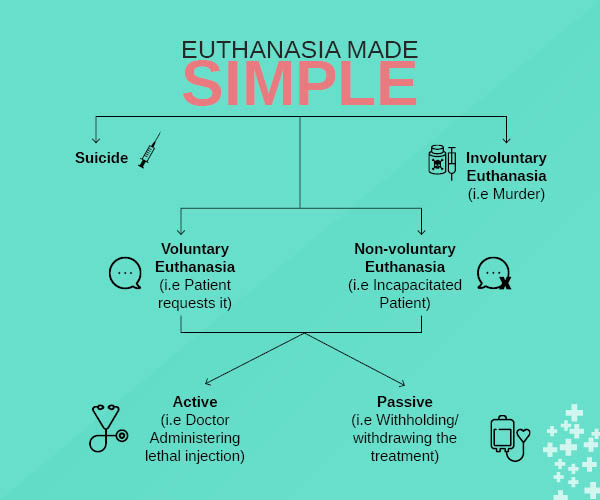
- Passive or Negative euthanasia means the withdrawal of necessary medical treatment with the deliberate intention to hasten the death of a terminally-ill patient is a must. In order for the death to be voluntary, the medicines which aids in saving lives will be discontinued so that death is brought about voluntarily. A common practice of this is a patient signing a ‘Do Not Resuscitate’ (DNR) document. It implies discontinuing or not using extraordinary life sustaining measures to prolong life. Others include act of omission such as failure to resuscitate a terminally ill or incapacitated patient (e.g. a severely defective new-born infant).
2. Active or Direct euthanasia means when one induces death by giving or providing medication or treatment leading to death.
3. Voluntary Euthanasia, sometimes called “assisted suicide”, is used in cases where the sufferer has made it clear that s/he wishes to die and has requested help to bring this about. When the euthanasia is practiced with the expressed desire and consent of the person concerned
4. Involuntary Euthanasia is one which is conducted without the consent and where an individual makes a decision for another person who is incapable of doing so. E.g. prolonged comma, old age, etc. It occurs when no consent or wish to die is expressed by the sufferer. When the euthanasia is practiced against the will of the person and also involuntary Euthanasia is one where patients can express a wish to die but don’t (this equates to murder).
5. Non- Voluntary Euthanasia is one where patients cannot express a wish to die. Patients who are in comas, infants, profound mentally retarded, severely brain damaged, cases of extreme senile dementia, those who cannot communicate for other reasons.
LEGAL VALIDITY IN INDIA
Passive euthanasia is legal in India. As per the 2018 ruling, The Supreme Court has held that the right to die with dignity is a fundamental right.
WHAT IS THE LEGAL POSITION AND TRENDS OF EUTHANASIA IN DIFFERENT COUNTRIES?

The Laws around the world vary greatly with regard to euthanasia, and are constantly subject to change as cultural values shift and better palliative care, or treatments become available. It is legal in some nations, while in others it may be criminalized. In some countries there is a divisive public controversy over the moral, ethical, and legal issues of euthanasia. Those who are against euthanasia may argue for the sanctity of life, while proponents of euthanasia rights emphasize alleviating suffering, and preserving bodily integrity, self-determination, and personal autonomy. Countries which have legitimized euthanasia are The Netherlands,Belgium, Oregon and Washington in the USA. In Switzerland only assisted suicide is legal. In India as mentioned above only passive euthanasia is legal.
LANDMARK CASE IN INDIA
Aruna Ramchandra Shanbaug vs Union Of India
FACTS OF THE CASE
Aruna Shanbaug, a nurse who was assaulted by a ward boy, and went into a vegetative state in 1973. • She remained blind, deaf, paralyzed and in a vegetative state till her death in 2015. A Writ Petition was filed by Pinki Virani claiming that her right to life guaranteed by the constitution had been violated. The petition was rejected by the court after medical examination. However, later in Aruna Ramchandra Shanbaug vs Union Of India, the Supreme Court in March 2011 held that passive euthanasia could be given a nod in case of exceptional circumstances and under strict monitoring of the apex court.
On 7 March 2011 the Supreme Court of India legalized passive euthanasia by means of the withdrawal of life support to patients in a permanent vegetative state. The decision was made as part of the verdict in a case involving Aruna Shanbaug, who had been in a Persistent Vegetative State (PVS) for 42 years until her death in 2015.
The Supreme Court of India specified two irreversible conditions to permit Passive Euthanasia:
- The Brain-Dead for whom the ventilator can be switched off.
- Those in a Persistent Vegetative State (PVS) for whom the feed can be tapered out and pain-managing palliatives be added, according to laid-down international specifications.
GUIDELINES LAID DOWN BY APEX COURT:
The following guidelines were laid down: A decision has to be taken to discontinue life support either by the parents or the spouse or other close relatives, or in the absence of any of them, such a decision can be taken even by a person or a body of persons acting as a next friend. It can also be taken by the doctors attending the patient. However, the decision should be taken bona fide in the best interest of the patient.
Even if a decision is taken by the near relatives or doctors or next friend to withdraw life support, such a decision requires approval from the High Court concerned. When such an application is filled the Chief Justice of the High Court should forthwith constitute a Bench of at least two Judges who should decide to grant approval or not.
A committee of three reputed doctors to be nominated by the Bench, who will give report regarding the condition of the patient. Before giving the verdict a notice regarding the report should be given to the close relatives and the State. After hearing the parties, the High Court can give its verdict.
WHAT ARE THE ARGUMENTS FOR AND AGAINST EUTHANASIA?
Benefits of Legalizing Euthanasia (Arguments For)
- Provides relief to extreme pain.
- Relieves physical, mental and psychological pain for the patient and the family.
- Provides more facilities and funds for other patients needing medical treatment and attention.
- Euthanasia provides a way of relief when a person’s quality of life is low.
- It is another case of freedom of choice – the right to commit suicide.
- People should not be forced to stay alive.
- Speedy termination of physical and emotional suffering.
- Organs can be put to good use.
- Relieve mental suffering for the patient and his relatives.
Consequences of legalizing Euthanasia (Arguments Against)
- The ‘living will’ could be misused
- Religious beliefs could pose as a conflict in few scenarios
- The person might not be well informed of the possible treatment options
- Guidelines of the content of ‘living will’ has to be standardized
- Euthanasia demeans and devalues the sanctity of human life.
- Euthanasia can become a means of health care cost containment.
- Euthanasia will become non-voluntary.
- Euthanasia would not only be for people who are terminally ill.
- It amounts to murder and it is only God who can take away human life.
- It destroys life, which has potential that could be yet unknown to the patient, doctor or the family members.
- It discourages scientists who are looking for a cure for incurable ailments.
- An irreversible damage
WEBSITES REFERRED:
- https://www.slideshare.net/digitaltejas/euthanasia-types-arguments-for-and-against
- https://www.slideshare.net/altacitglobal/euthanasia-law-in-india
- http://racolblegal.com/euthanasia-an-act-of-mercy-killing/
- https://www.latestlaws.com/articles/euthanasia-the-contemporary-art-of-dying-by-aman-kumar-and-richa-hudilwala/
- https://byjus.com/free-ias-prep/euthanasia-or-mercy-killing/
- https://www.123rf.com/photo_109776197_stock-vector-red-flat-line-banner-trends.html
- https://www.slideserve.com/nami/euthanasia-mercy-killing
- http://racolblegal.com/the-dharma-jurispudence-of-the-supreme-court/
New education policy
After 34 years the government of India has taken crucial decision by bringing changes in education policy by 5+3+3+4 system
The government of India also mentioned the degree students can choose the tenure of the courses, students can complete their degree in 2 years with a diploma certificate, the students need to complete their 5 the grade by mother tongue
From age 3 to 18 the students must pursue their education
Growing level of competition good for children?
In this day and age where the pace of carrying on with the existence we long for causes significant damage in us. the change through this periods of life are rarely disturbing and we either fall into them or being pushed in the race of life to endure. ultimately Darwin long back gave the mantra – its survival of the fittest.
Present populace of India is 1.27 billion and is developing step by step because of this developing populace less open door is accessible for one prompting elevated level competition,competition in any general public is viewed as solid for the development of the general public and are not left away from it and it they among whom rivalry is the most, rivalry can be in any field scholastic, vocation, or games ” it is smarter to wear out than to blur away” is presumably turning into the best impression of developing rivalry today, for youth it is a race which must be succeeded at any cost and this opposition begins with open level tests in school and continues endlessly for school, work thus on..but where does this opposition start from is an unavoidable issue? What’s more, the response for this is training because rivalry and instruction are interrelated for which rivalry begins from school when a kid contends to take confirmation in school and goes on further till he grows up and passes school life and go into progressively serious reality where he needs to confront heavy cut off ( d.u – 99%) and further more competition..the level of rivalry isn’t with others however with oneself , among young ladies and young men where young ladies wanna substantiate themselves better than young men and arrive at the top position.. rivalry in any capacity causes a kid to build up his character, it encourages a youngster to build up his abilities to come out of the weight, encourages one to know his quality and shortcoming, how to manage basic circumstance rivalry just educates us but a major issue here is that it rivalry essentially right? Is it truly helping a kid to develop decidedly or blurring endlessly his character, rivalry can be sure and adverse and the second side of the coin is pessimistic which represents a danger to youngster’s character and at last his presentation a major job in this is played by relatives and their weight on their kid to turn into the best which prompts different issues looked by a kid like mental weight, stress, tension and if a kid can’t deal with this he thinks better to take up his life, self destruction endeavor by the kids after load up tests is aftereffect of this just then again it prompts weak wrongdoing carried out by youth eg -spilling test paper or paying off and which is at times helped by their folks also,drugs and liquor turns out to be every day part of adolescents life which he feels supportive to alleviate stress,this rivalry isn’t just observed among academicians yet in addition in other circle of life like competitor enjoying different violations and so forth.. The circumstance here requests for us to see when we are standing and what might be it’s outcomes is a kid building up it’s character or simply going for futile way of life , it becomes obligation of guardians to create solid rivalry obligation of school and companions to instruct the kid right thing once abilities, , qualities ought to be improved such a way, that it prompts create a correct way and not overlook his actual character because youngsters are assets and it ought to be used in a superior manner by the general public an entirety
Healthy Competition among all gives us the feeling of where we stand yet it must be from inside not a weight included upon by the guardians or the pitiless framework which just perceives the best. India being the second biggest populated nation makes this opposition for the up and coming age slanted to a furious one. The strain to perform well should not over shadow our character and ought not propel us to tumble from the correct way. Kids must be ingrained with virtues first whereupon the belief system of Survival of the fittest must be dealt with. After the entirety of its not how well you ran the race it how you finish that issues
Public Interest Litigation in India
Introduction

The expression ‘Public Interest Litigation’ has been borrowed from American jurisprudence, where it was designed to provide legal representation to previously unrepresented groups like the poor, the racial minorities, unorganised consumers, citizens who were passionate about the environmental issues, etc.PIL is not defined in any statute or in any act. It has been interpreted by judges to consider the intent of public at large.
Public interest litigation (PIL) refers to litigation undertaken to secure public interest and demonstrates the availability of justice to socially-disadvantaged parties and was introduced by Justice P. N. Bhagwati. It is a relaxation on the traditional rule of locus standi.The liberal interpretation of locus standi where any person can apply to the court on behalf of those who are economically or physically unable to come before it has helped. Judges themselves have in some cases initiated suo moto action based on newspaper articles or letters received.
Some Landmark Judgements
• In December 1979, Kapila Hingorani filed a petition in regards to the condition of the prisoners detained in the Bihar jail, whose suits were pending in court. The petition was signed by prisoners of the Bihar jail and the case was filed in the Supreme Court of India before the bench headed by Justice P. N. Bhagwati. The petition was filed under the name of a prisoner, Hussainara Khatoon, and the case was therefore named Hussainara Khatoon Vs State of Bihar. The Supreme Court decided that prisoners should receive free legal aid and fast hearings. As a result, 40,000 prisoners were released from jail. Thereafter many similar cases have been registered in the Supreme Court. It was in the case of SP Gupta vs Union of India that the Supreme Court of India defined the term “public interest litigation” in the Indian context.
The concept of public interest litigation (PIL) is suited to the principles enshrined in Article 39A of the Constitution of India to protect and deliver prompt social justice with the help of law. Bhagwati and Justice V. R. Krishna Iyer were among the first judges to admit PILs in court.
A new era of the PIL movement was heralded by Justice P.N. Bhagawati in the case of S.P. Gupta vs. Union of India.
- In this case it was held that “any member of the public or social action group acting bonafide” can invoke the Writ Jurisdiction of the High Courts (under article 226) or the Supreme Court (under Article 32) seeking redressal against violation of legal or constitutional rights of persons who due to social or economic or any other disability cannot approach the Court.
- M.C Mehta vs. Union of India: In a Public Interest Litigation brought against Ganga water pollution so as to prevent any further pollution of Ganga water. Supreme Court held that petitioner although not a riparian owner is entitled to move the court for the enforcement of statutory provisions, as he is the person interested in protecting the lives of the people who make use of Ganga water.
- Vishaka v. State of Rajasthan: The judgement of the case recognized sexual harassment as a violation of the fundamental constitutional rights of Article 14, Article 15 and Article 21. The guidelines also directed for the Sexual Harassment of Women at Workplace (Prevention, Prohibition and Redressal) Act, 2013.

Who Can File a PIL and Against Whom?
- Any citizen can file a public case by filing a petition:
- Under Art 32 of the Indian Constitution, in the Supreme Court.
- Under Art 226 of the Indian Constitution, in the High Court.
- Under sec. 133 of the Criminal Procedure Code, in the Court of Magistrate.
- However, the court must be satisfied that the Writ petition fulfils some basic needs for PIL as the letter is addressed by the aggrieved person, public spirited individual and a social action group for the enforcement of legal or Constitutional rights to any person who are not able to approach the court for redress.
- A Public Interest Litigation can be filed against a State/ Central Govt., Municipal Authorities, and not any private party. The definition of State is the same as given under Article 12 of the Constitution and this includes the Governmental and Parliament of India and the Government and the Legislature of each of the States and all local or other authorities within the territory of India or under the control of the Government of India.

Conclusion
Public Interest Litigation is working as an important instrument of social change. It is working for the welfare of every section of society. It’s the sword of every one used only for taking the justice. The innovation of this legitimate instrument proved beneficial for the developing country like India. PIL has been used as a strategy to combat the atrocities prevailing in society. It’s an institutional initiative towards the welfare of the needy class of the society.
Panchayatiraj :Back bone of India
Panchayats have been the backbone of the Indian villages since the beginning of the recorded history. Gandhiji s dream of every village being a republic or Panchayats having powers has been translated into reality with the introduction of three-tier Panchayati Raj system to enlist people’s participation in rural reconstruction.
24th April, 1993 was a landmark day in the history of Panchayati Raj in India as on this day the Constitution (73rd Amendment) Act, 1992 came into force to provide constitutional status to the Panchayati Raj institutions.
The salient features of the Act are as follows:
i. To provide three-tier system of Panchayati Raj for all states having population of over 20 lakh.
ii. To hold Panchayat elections regularly for every 5 years.
iii. To provide reservation of seats for Scheduled Castes, Scheduled Tribes and women (not less than 33 percent).
iv. To appoint State Finance Commissions to make recommendations regarding financial powers of the Panchayats.
v. To constitute District Planning Committees to prepare draft development plan for the district as a whole.
According to the Constitution, Panchayats shall be given powers and authority to function as institutions of self-government.
The powers and responsibilities to be delegated to Panchayats at the appropriate level are:
- Preparation of plan for economic development and social justice.
- Implementation of schemes for economic development and social justice in relation to 29 subjects given in the Eleventh Schedule of the Constitution.
- Levying and collecting the appropriate taxes, duties, tolls and fees.
The 73rd Amendment Act gives constitutional status to the Gram Sabha. The provisions of Panchayats (Extension to the Scheduled Areas) Act, 1996 extends Panchayats to the tribal areas of eight states, namely Andhra Pradesh, Bihar, Gujarat, Himachal Pradesh, Maharashtra, Madhya Pradesh, Orissa and Rajasthan. This has come into force on 24th December, 1990. Except Rajasthan and Bihar, all states have passed laws to give effect to the provisions contained in the Act 40 of 1996.
Under the Act, Gram Sabha has been vested with powers for:
i. Ownership of minor forest produce, approval of development plans, selection of beneficiaries under various programmes.
ii. Consultation on land acquisition, manage minor water bodies, control mineral leases, regulate/prohibit sale of intoxicants, preventing alienation of land and restoring unlawfully alienated land of STs, managing village markets, controlling money lending to STs, and controlling institutions and functionaries in all social sectors.
The ministry extends limited financial assistance to the states to train and create awareness among the elected members of Panchayats and functionaries. The Ministry has been providing financial assistance through the Council for Advancement of Peoples Action and Rural Technology (CAPART) to the non-governmental organizations for conducting training and awareness generation programmes on Panchayati Raj. The Ministry also commissions research and evaluation study related to Panchayati Raj from voluntary organizations institutions.
Political Interference in Bureaucracy
The political association and bureaucratic mechanical assembly have consistently been the steady base light emissions enormous equitable set up of India. its working as the two co equal and inseparable elements shapes unequivocally the piece of English expansionism strategy. since pre-freedom time the bureaucratic association have been affected by the political support and hence , notwithstanding being two unmistakable segments ,they have worked indistinctly as one organ.this was fundamental for the successful and efficient working of a majority rules system., following which our constitution producers additionally wanted to proceed with a similar approach of government employees being responsible to the chosen governments, to fortify up and hold firm the neediness driven and ethnically isolated post autonomous India. legislature and official mastery cooperated to introduce extraordinary arrangement volt in the nation , hoisting the nation from its old status of helpless nation to that of “one of the quickest creating economy” of the world.
Causes
Most definitely we owe the current set-up to provincial heritage: Where administrators were viewed as specialists of the pilgrim experts. Choice of the organization was additionally founded on the racial, elitist ideas. With the approach of vote based system and republican and parliamentary type of govt ., where the civil servants have been characterized as local official. In any case, the impression of “Examiner raaj” and “BABUS” are still sticks to the old inheritance , at least for the rustic and semi-proficient people are concerned.People still dread about heading off to the Police stations, government offices.This thing has not occurred in isolation.The way regular open are treated there is the primary driver. The old ace serf relationship(during pioneer time) has changed and now open have been at the front. Numerous multiple times open everywhere are kept in obscurity and it is seen by the first class gathering that things are confused for people in general on the loose. Absence of straightforwardness in the framework offers ascend to illegal obstruction. Different things, for example, Nepotism, irrationality, personal stakes do add to the political obstruction. At the ground level we have seen the induction is will undoubtedly happen when the concerned administrator is less upstanding, looks for political support and so forth. Political obstruction done in the interest of open intrigue isn’t sweepingly terrible. Presently we have numerous administrations in India viz; State Services, Central administrations, All India benefits, the sort of resistance given to each help fluctuates. Resistance at times additionally becomes possibly the most important factor as an All India staff are less defenseless to neighborhood impact because of the invulnerability given to his/her administration by the constitution and things are managed on the upper layers with respect to his exchange, portfolio and so on optional force likewise fluctuates and consequently it is fundamental for the upper assistance individuals given better in-susceptibility. Cash power likewise assumes a significant job in the impedance thing, the same number of a period allurement is practiced to complete the work. Muscle-man turned legislators are additionally quick to practice this obstruction thing. Now and then Physical danger by such legislators to complete their vested work by the civil servants visa-vis delicate distribution, contracts and so forth. Not all the civil servants are spotless enough to not bow down before the government officials as they share numerous unlawful works done couple so at times coercing additionally comes into the image. It is said that favor never wants free. That rule is applied here too a few kinds of rough and brutal nexus is available in the framework which empowers the controllers to calm each other’s advantage.
In spite of the fact that this issue isn’t restricted to India just we have an exceptionally upsetting instances of such nexus in Russia and other creating nations too where such nexus brought forth “friend free enterprise”. In third world nations because of the provincial heritage and outlook things are obviously particularly interwoven where the liberal , conventional and different belief systems are at war quite often. Additionally the Bonaparte and Over-Developed state classified states are increasingly inclined.
Consequences
Bureaucracy is called steel frame of India. It is the establishment which works in the field and brings down the advantages from top to the base level. The results of a degenerate administration end up being deadly. It clears numerous a ground for different kinds of turmoil in the general population. During the hour of Emergency Indian organization was ‘submitted administration’ without a doubt the local officials will undoubtedly adhere to the directions of open delegates. And yet the officials are compelled by a solemn obligation to propose better option in contrast to political bosses. Giving tenders, agreements to shut ones through submitted official is broadly predominant in India. Also, the yield of such wrongdoing is low quality work, fragmented work and the open exchequer gets abused. Likewise this cycle sustains and individuals with personal stake do abuse all the potential associations and cash power so as to guarantee the things help come in out. Because of this precarious games and darkness ordinary citizens loses confidence in the organization of administration and accordingly the heritage of Mai-baap(colonial inheritance ) proceeds. The impedance’s are progressively regular in Police administrations and police faculty are solicited to accomplish something out from turn for the politically connected individuals: Such examples not just lead to disintegration of lawfulness circumstance yet in addition exhaust the discouragement which is given by the law. So results of negative obstruction are awful. As referenced above not generally obstruction is a terrible thing now and again an open agent who is knowledgeable with circumstance of the region may accompany some proposition and may request something to be done on pressing premise is definitely not a terrible thing. Such inputs and dynamic intercession ought not be disgraced as this record for open intrigue and this is the main intrigue which towers all other enthusiasm for residential organization.
Remedies
Remedies Lies in the issue itself we need to focus on the things which advance such things in the framework. After Identification the things ought to be turned out to be by establishing enactment, administration codes. SC in administering in 2014 opined to shape a board Civil Services Board which would take care of the exchange and posting of the officials w/o any political preference. Additionally security of residency ought to be given so as to limit the political obstruction. As this is the most looked for after panacea for the personal stake individuals have for the upstanding officials. Severe watch over the advantages development and riches gathering by the work force. Courses and Loops ought to be found through which government official civil servants keep profiting. Suggestions of ARC ought to be executed and the board ought to be framed with enough self-sufficiency to investigate the situations where upstanding officials are requested excessive favors and move can be made on such legislators. The board ought to likewise keep a tab on the staff who are being given out of the turn advancements or postings and so on. The board ought to likewise have capacity to renounce such unjustifiable favors. The board can be given protected status.The top down working model of India do offer ascent to such obstruction , Having an engaged and budgetary degenerated structure will hinder such impedance generally. So base – up approach in arranging and dynamic is the need of hour. Our own ought to be an edified organization and it’s hard working attitudes coterminous with the ‘Scholar King’ of the Plato. In spite of the fact that these are beliefs yet Ideals ought to consistently be as a primary concern when something earth shattering must be accomplished
Guidelines to be followed by Police while making an Arrest
Arrest involves the restriction of liberty of a person arrested and therefore, infringes the basic human rights of liberty. Nevertheless the Constitution of India as well as International human rights law recognize the power of the State to arrest any person as a part of its primary role of maintaining law and order. The Constitution requires a just, fair and reasonable procedure established by the law under which alone such deprivation of liberty is permissible. Although Article 22(1) of the Constitution provides that every person placed under arrest shall be informed as soon as may be the ground of arrest and shall not be denied the right to consult and be defended by a lawyer of his choice and S.50 of the Code of Criminal Procedure, 1973 (Cr. PC) requires a police officer arresting any person to “ forthwith communicate to him full particulars of the offence for which he is arrested or other grounds for such arrest”. in actual practice these requirements are observed more in the breach. Likewise, the requirement of production of the arrested person before the court promptly which is mandated both under the Constitution [Article22(2)] and the Cr. PC (Section 57] is also not adhered to strictly.
A large number of complaints pertaining to Human Rights violations are in the area of abuse of police powers, particularly those of arrest and detention. It has, therefore, become necessary, with a view to narrowing the gap between law and practice, to prescribe guidelines regarding arrest even while at the same time not unduly curtailing the power of the police to effectively maintain and enforce law and order and proper investigation.
GUIDELINES LAID DOWN BY THE HON’BLE SUPREME COURT IN D.K. BASU CASE:
The Hon’ble Supreme Court, in D.K. Basu Vs State of West Bengal , has laid down specific guidelines required to be followed while making arrests.
THE HON’BLE SUPREME COURT GUIDELINES on arrest:
The principles laid down by the Hon’ble Supreme Court are given here under:
(i) The police personnel carrying out the arrest and handling the interrogation of the arrestee should bear accurate, visible and clear identification and name tags with their designations. The particulars of all such police personnel who handle interrogation of the arrestee should bear accurate, visible and clear identification and name tags with their designation. The particular of all such personnel who handle interrogation of the arrestee must be recorded in a register.
(ii) That the police officer carrying out the arrest shall prepare a memo of arrest at the time of arrest and such memo shall be attested by at least one witness, who may be either a member of the family of the arrestee or a respectable person of the locality from where the arrest is made. It shall also be counter signed by the arrestee and shall contain the time and date of arrest.
(iii) A person who has been arrested or detained and is being held in custody in a police station or interrogation centre or other lock up, shall be entitled to have one friend or relative or other person known to him or having interest in his welfare being informed, as soon as practicable, that he has been arrested and is being detained at the particular place, unless the attesting witness of the memo of arrest is himself such a friend or a relative of the arrestee.
(iv) The time, place of arrest and venue of custody of an arrestee must be notified by the police where the next friend or relative of the arrestee lives outside the district or town through the Legal Aids Organization in the District and the police station of the area concerned telegraphically within a period of 8 to 12 hours after the arrest.
(v) The person arrested must be made aware of his right to have someone informed of his arrest or detention as soon as he is put under arrest or is detained.
(vi) An entry must be made in the diary at the place of detention regarding the arrest of the person which shall also disclosed the name of the next friend of the person who has been informed of the arrest and the names land particulars of the police officials in whose custody the arrestee is.
(vii) The arrestee should, where he so request, be also examines at the time of his arrest and major and minor injuries, if any present on his /her body, must be recorded at that time. The Inspector Memo’ must be signed both by the arrestee and the police officer effecting the arrest and its copy provided to the arrestee.
(viii) The arrestee should be subjected to medical examination by the trained doctor every 48 hours during his detention In custody by a doctor on the panel of approved doctor appointed by Director, Health Services of the concerned State or Union Territory, Director, Health Services should prepare such a panel for all Tehsils and Districts as well.
(ix) Copies of all the documents including the memo of arrest, referred to above, should be sent to the Magistrate for his record.
(x) The arrestee may be permitted to meet his lawyer during interrogation, though not throughout the interrogation.
(xi) A police control room should be provided at all district and State headquarters where information regarding the arrest and the place of custody of the arrestee shall be communicated by the officer causing the arrest, within 12 hours of effecting the arrest and at the police control room it should be displayed on a conspicuous notice board.
LEASES OF IMMOVABLE PROPERTY
LEASE (SECTION 105)
A lease of an immoveable property is a transfer or handing over of a right to enjoy such property, made for a certain time, express or implied, or in perpetuity, in consideration of a value paid or promised, or of money, a share of crops, service or any other thing of value, to be rendered intermittently or on specified or stated occasions to the transferor by the transferee, by whom transfer on such terms is accepted.
The person who transfers the property (transferor) is known as the lessor. The person to whom the transfer is made(transferee) is known as the lessee. The price here is acknowledged as the premium and the money, share, service, or any other thing so rendered in acknowledged as the rent.
A lease is the enjoyment of immovable property for a certain period of time or in perpetuity. But, in lease transfer of immovable property is not absolute like there it is in sale. The right of possession is separated from the right of ownership. In a sale, all the rights of ownership, which the transferor has, passes on to the transferee. In a lease, there is a partial transfer, that is a transfer of a right of enjoyment for a certain time.
A lease is transfer of an interest in an immovable property which is the subject matter of the lease and interest is the right to occupy and utilize the property for which the lease is given for period on terms and conditions as settled between the parties to lease agreement.
ESSENTIALS OF A LEASE AGREEMENT
2 Parties:
There should be two parties to a lease. The lessor and the lessee. Parties must be competent. The parties in a lease agreement should be competent to enter into a contract. Lesser should be authorised to a property and have absolute rights over that property.
Right of possession:
Ownership rights are not transferred in a lease, only the possession of the property is transferred or the right to use and enjoy the property.
Rent:
Consideration for a lease agreement can be reserved in the form of a rent or a premium.
Acceptance:
Lessee, who get the interest in the property after lease, has to agree to the lease agreement along with the time period and terms & conditions levied on the transfer.
Time Period:
Lease can continue for a certain time period which has to be specified in the lease agreement.
DURATION OF CERTAIN LEASES IN ABSENCE OF WRITTEN CONTRACT OR LOCAL USAGES (SECTION 106)
Section 106 provides for the duration of the lease in the absence of the lease agreement. It lays down that in the non-existence of a contract, lease can be terminated by both parties to the lease agreement by issuance of a notice to quit. The specified time period always initiates from the date notice to quit is received.
According to section 106 of TPA, 1882, if there is an absence of a written contract or a local usage to the contrary then in the case, a lease of immovable property for manufacturing and agriculture purpose will be from year to year and will be valid till the time until it was terminated by either of the party, by six months’ notice and if there is a lease any other purpose except agriculture or manufacturing will run from month to month then it will be terminated by 15 days’ notice.
LEASE HOW MADE (SECTION 107)
Section 107 states about lease how made. This section covers three aspects:
A lease of Immovable property for the term of 1 year or exceeding a year– This can only be prepared by a registered deed.
Another leases of Immovable property for the period less than one year can be either prepared by a registered deed or a verbal agreement or settlement, accompanied by delivery of possession of that property.
When the lease is of multiple properties that require multiple deeds, it will be made by both the parties of the lease.
DETERMINATION OF LEASE (SECTION 111)
Section 111 states concerning the determination of the lease, which sets down the methods to terminate lease:
Lapse of time – When the prescribed time of the lease expires, the lease is terminated.
Specified event – When there is a condition on termination of time of lease i.e. lease will terminate on happening of an event.
Interest – Lessor’s interest to lease the property may cease, hence the lease is terminated.
Same owner – When the interest and rights of both lessor and lessee are relocated or vested in the same person.
Express Submission– Happens when the lessee ceases to own an interest in the property and gets into a mutual agreement with the lessor.
Implied Submission – When the lessee goes into a contract with some other lessor for the lease of property, it is an implied surrender of the current lease.
Forfeiture – There are three ways in which a termination of lease can be done:
When there is a breach of an express condition by the lessee. The lessor may get the possession of his property back.
When lessee renounces his character or gives the title of the property to a third person.
When the lessee is called as insolvent by the banks, and the conditions provided for it, the lease will be held terminated.
Expiry of Notice to Quit – When the notice to quit by the lessor to the lessee expires, the lease will also expire.
RIGHTS OF LESSOR
Right to accretions- If during the tenancy period any further accession, accumulation or addition is made in the property whether naturally or artificially by the expense of the lessee. On the termination of the lease period, the lessee must surrender the accession to the lessor.
Right to collect rent- The lessor has the right to collect rent or any form of consideration as mentioned in the terms and conditions of the contract from the tenant without any form of interruptions.
LIABILITIES OF A LESSOR
Duty of disclose material defects- The lessor is bound to disclose to the buyer any material defect in the property. There are two kinds of defects:
So basically, a lessor is bound to disclose those apparent defects to the lessee, which are material with reference to the intended use of property or interfere with the enjoyment of the property by the lessee.
To give possession- The lessor must deliver possession of the leased property to the lessee on being requested by lessee. The lessor is not entitled rent unless he has fulfilled his obligations to put lessee in possession of the leased premises.
Covenant for quiet enjoyment- the lessor is deemed to contract with the lessee that if the lessee pays the rent and performs his own obligation, he may hold property during the time limited by the lease without any interruption. The Madhya Pradesh HC stated that actions such as physical interference or direct interference in the premises lead to a breach of enjoyment and interruptions.
RIGHTS OF A LESSEE
To deduct the cost for repair- If the lessor commits a breach of the covenants which the lessor is bound to do in that case the lessee can make such repairs by his personal expenses. The lessee after giving reasonable notice to the lessor, may do such repairs by his personal expenses, and recover the amount expended by him by him together with interest by deducting it from the rent.
Right to remove fixtures- Lessee has right to remove the fixtures or trees planted by him in the property during the time continuance of lease. However, after the termination of the lease deed the lessee is allowed to remove his possession in the property. It is considered optimal that property is left in the condition in which it was received by lessee.
Right to assign his interest- The lessee may transfer absolutely or by way of sub-lease or mortgage the whole or any part of his interest in the property. However, if the lease deed restricts a lessee to dispense his interest then the lessee is barred to do so and even after the transfer of his rights, the lessee is still subordinate to all the liabilities related to the lease deed.
Right to have benefits of crops- a lessee who holds the lease of uncertain duration then, in that case, the lessee or his/her legal representative has been given the right to take benefits from all the crops cultivated by them.
LIABILITIES OF A LESSEE
Duty to disclose material facts- The lessee is bound to disclose facts concerning the lessors title which increase the value of lease and of which the lessor is ignorant. In case if the lessee does not disclose material fact and the lessor undergoes any loss then the lessee is bound to compensate the lessor.
Duty to pay rent- The lessee’s liability for rent is regulated by term of the lease. He is bound to pay the rent or the premium to the lessor or his agent in the appropriate time and suitable place. In case the lessee fails to pay his/her rent then, in that case, the lessor can expel the lessee on the ground of non-payment of rent or file a suit for arrears of rent.
Duty to maintain the property- The lessee is bound to maintain and restore the property in the condition he was given the possession of the property. Only the changes caused by uncontrollable forces can act as an exception for this liability.
Duty to give notice of encroachment- duty of lessee to inform lessor when he becomes aware that any person has tried or is trying to damage the rights of the lessor or the title of the lessor is endangered then, in that case, the lessee must give notice to the lessor.
Duty to use the property in a reasonable manner- The lessee is under an obligation to use the property as a person of ordinary prudence would.
Duty not to erect any permanent structure- prohibits lessee from erecting any permanent structures except the agricultural cultivation without the consent of the lessor.
Duty to restore possession- On determination of the lease, the lessee is bound to the possession of the property to the lessor. If the lessee does not vacate the premises even after the expiry of the notice, then lessee remains liable for the rent.
CONCLUSION
The fundamental conception of a lease is that it is the separation of possession from ownership. For a lease of immovable property, there must be lessor and lessee. An agreement of lease must be executed lawfully by the parties to lease agreement.
Unsettled reality check
Getting to the complex concept of reality check , that is this phenomena of social connection. Just being around other people makes us happier than all the things we do to worry about our problem sets and worry about all that stuff. Like, it seems to matter a lot more than we think.It’s not the stuff, but it turns out it is, it seems, social connection. Just how much do you hang out with people that you’re close with? Having close ties with people – having a social connection is good for all kinds of health related stuff. It can actually make you less vulnerable to premature death. So, if I look at whether or not you’re going to die, if you’re an elderly person, you have more social connections, you tend not to. It can make you more likely to survive a fatal illness like cancer or heart disease and so on. And it makes you less likely to fall prey to the sorts of stressful events that mess up your life. All kinds of health consequences to social connection. there’s also all kinds of happiness consequences too, at least when you look at who’s happy, who’s unhappy merely just spending time with people can allow me to predict whether or not you’re going to be happy or unhappy. Happiness or sadness cannot just be predicted by looking at them , it doesn’t go around the same way not all the time , at least !
But here’s the question, is this really the case? Can we kind of intervene on people’s lives, give them more of close social connections, and increase their happiness?you’re in the solitude condition. Your goal is to just like, be like, enjoy solitude, a lot of people love solitude, just be quiet, be by yourself, and just like, try to enjoy as much as possible. Or you’re in a control.It’s only in the solitude condition, and interestingly, in the control condition where people seem to feel worse.Solitude subject is not the only solution for all your loneliness temper tantrums , we think that that might be kind of a mechanism of why a social connection is doing all of its work. It’s just making the richness of life even richer among other sorts of things that it’s doing. Reading the room and reality check has got all these things up which remains unsettled for many reasons.
Equal Employment Opportunity
Equal employment opportunity is the idea that anyone should be treated fairly when they are considered for various employment decisions (hiring , promotion, termination and compensation etc.). This means, for example everyone competing for a position at a company should have the same chances of succeeding if they are right for the job.
In the legal sense of the EEO (Equal Employment opportunity) definition ,”same chances” or “equal opportunity ” means that employers can’t use certain characteristics as reasons to hire or reject candidates or make other employment decisions; In other words , they can’t discriminate against those characteristics . In many countries , protected characteristics include :
▪︎Race / Color
▪︎National origin/ ethnicity
▪︎Age
▪︎sex / gender /sexual harassment
▪︎Religion
▪︎ physical or mental disability
EEO doesn’t guarantee that people of underrepresented groups will get hired. The purpose of EEO regulations is to make sure nobody will face rejection or difficulties because they’re in a protected group.
Equal Employment Opportunity
EEO is an employment practice where employers do not engage in employment activities that are prohibited by law. It is illegal for employers to discriminate against an applicant .
Policy Objective
The overall policy objective for the employment discrimination laws we will be examining is summed up by the phrase equal opportunity. These laws generally do not aim to create equal outcomes, but rather seek to ensure that all employees or job applicants have an equal opportunity to engage in the employment market. In other words these laws try to level ‘the playing field ‘ so that certain classes of people who have been discriminated against in the past are not subjected to adverse treatment based upon certain characteristics that have nothing to do with being a qualified job applicant or employee.
Anti- Discrimination of Employment Laws
Now , we are going to look at the laws that were set up to stop discrimination in the workplace.
Mmodern anti discrimination employment laws and policies in the United states have their foundation in the Civil Rights Act of 1964, Title VII of the act makes certain discriminatory practices illegal , including discrimination based on race, color , religion, sex or national origin. Title VII applies to private employers employing 15 or more employees, labor unions, and employment agencies. The Civil Rights Act also helped create the Equal Employment Opportunities Commission, which is charged with the enforcement of the federal anti-discrimination employment laws.
Title VII protects employees or applicants from discrimination in the many employment activities, including:
▪︎Recruitment
▪︎Hiring
▪︎Promotion
▪︎Compensation
▪︎Benefits
▪︎Training
▪︎Other employment terms, conditions and privileges
▪︎Harassment
▪︎Retaliation , which is adverse action taken because an employee or applicant asserted rights under Title VII or participated in an EEOC proceeding, such as testifying and assisting
▪︎Segregation and classification
▪︎Pre-employment inquiries and rerequirements, which means nothing should be required that tends to disclose a characteristic protected under Title VII
▪︎Religious practices that don’t impose an undue hardship on an employer
How is the employer accountable under EEO law ?
The law generally holds an employer responsible for discrimination or harassment that occurs in the workplace by its employees. This is called vicarious liability. If however, the employer can show that it took all reasonable steps to prevent the discrimination or harassment occurring, then the employer may not be responsible.
General Protections
The Fairwork Act 2009 (Cth) prohibits an employer from taking ‘adverse action’ against an employee (and in some cases independent contractors or prospective employees) for certain reasons.
In summary , the general protections deal with :
- workplace rights;
- industrial rights (including industrial activities and freedom of association);
- protection from discrimination;
- protection from unlawful termination;
- protection from sham arrangements (relating to the engagement of independent contractors).
Importance of Equal Employment Opportunity
We all thrive in a workplace that we love to come back to every day. It is also becoming more commonly recognised that an organisation that embraces Equal Employment Opportunity and advocates for workers’ safety are sure to win the confidence and trust of their people. Furthermore, it is essential that an organisation will enforce and act on laws to safeguard the identity, respect their people, and protect them from any unlawful undertaking whatsoever. However, the importance and benefits of imposing Equal Employment Opportunity Training and Policies limited to the employees. It has a broad scope of recognition for the employer as well. Please read on to find out why understanding and implementing best practise EEO is vital for your organisation.
▪︎ Improved recruitment
▪︎Increased employee engagement
▪︎Greater customer satisfaction and service
▪︎Protect your people and your business
▪︎Stronger brand reputation
There’s no doubt as to why organisations should issue Equal Employment Opportunity policies. However, on devising and implementing one, companies should educate and train their workforce about the growing incidents of workplace conflict due to prejudices based on background, race, sex, culture, religion, language, etc., and how they can identify, report and resolve such incidents in the workplace.
is the responsibility of an organisation to strive for a safe, fair and inclusive work environment for their workers where they can prosper and contribute intrinsically to the organisation’s growth. That is why we see an increase in commitment from organisations of all sizes, from small and medium business to larger organisations, to train their staff and have policies in place for things such as work health and safety, privacy, workplace bullying, sexual harassment and equal employment opportunity. That is because we now recognize the importance of both physical security and social protection for our people.
Overqualified Employees : Pros And Cons.
When positions are tough to fill, it can be tempting to just hire any candidate simply to have someone doing the job. But we all know that hiring the wrong person can end up being more costly in the long run—especially if the new hire causes any problems.
The risk of hiring the wrong person can take many forms—no one wants to hire someone who is not capable of the job, nor someone who will cause interpersonal issues. But what about hiring someone who is clearly capable—so much so that they’re probably overqualified for the role in question? What are the pros and cons of hiring someone with an experience level that greatly exceeds the job requirements?
Pros to Hiring Someone Overqualified
First, let’s take a look at the potential advantages to hiring someone who is overqualified for the role:
- Broaden the talent pool. By simply having a hiring process that does not automatically screen out potentially overqualified candidates, you’re opening up the possibility of better qualified applicants into the talent funnel.
- Create a fast track to future responsibilities. A new hire with a lot of experience will be well-placed to move up in the organization and take on more responsibilities, which can help with talent development plans in the organization. The individual may be well suited to quickly evolve into a more senior role or take on more leadership responsibilities.
- Achieve a faster return to full productivity. With more experience, the new employee should be up to full productivity much faster than the average new hire.
- Reduce training costs. Likewise, the new hire should require less training when first getting started.
- Set higher expectations for the role. Getting a higher level of experience in the role could mean the person is able to accomplish his or her goals faster and achieve more in the position.
- Reduce management required. Someone with more experience likely will require less hands-on management, at least during the onboarding phase.
- Increase the stature of the role. Bringing on someone highly qualified is a way to upgrade the overall talent level in the organization. With more experience, this person may have a lot of great ideas on how to improve processes. Additionally, he or she may bring new expertise to the role and may be able to more quickly spot opportunities. Someone with more experience may also be more likely to have great networking connections the organization can benefit from.
- Achieve a fast return on investment. The organization may be able to get a fast return on investment during the employee’s time there. As just noted, the employee may be able to make changes that improve the role long after he or she is gone. (This can help to offset the risk of short tenure and the possibility that the individual may require higher pay.)
- Elevate the whole team. Your overqualified employee may be able to teach things to other team members and bring up the skill set of the whole group. Separately, he or she may be a good candidate to mentor others. Other employees may appreciate that the new hire is already experienced and knowledgeable and doesn’t need a lot of help.
- Avoid legal questions. Hiring someone who is overqualified can be seen as a way to avoid the appearance of discrimination, thus reducing the risk of such a claim. (Such a risk may exist if the organization routinely dismisses otherwise qualified candidates.)
Cons to Hiring Someone Overqualified
Here are a few of the potential drawbacks to hiring someone overqualified for the role:
- Turnover risk is high. There is a risk the person will soon leave for a job he or she is better suited for.
- Boredom is also a risk. There is a risk of the new hire being bored or frustrated and having a negative influence on morale over time as a result.
- Training may not be as simple as you’d like. If the individual already has a lot of experience, he or she may be set in his or her ways—making it tougher to adapt to your organization’s specific processes and thus taking more time to train instead of less.
- Other employees may be wary. Bringing someone overqualified into a role can cause anxiety among other employees (or even the new hire’s manager) if it is perceived that the new person may end up replacing existing employees.
- Payroll budget may be stretched. You may have to pay more for the position than you originally intended, in order to bring someone on who has more skills. (Though it’s worth noting this is not always the case; you may be able to avoid this issue by posting the salary range on offer directly in the job post.)
- Skill set may need refreshed. Even with a lot of experience, there’s not a guarantee of having updated skills. The new hire may not be as advanced on newer processes or technology options and may still require training. This isn’t a deal breaker but may negate some of the benefit of hiring someone overqualified if he or she still requires substantial training.
If you find yourself in the position of considering hiring someone who is overqualified, take some time to assess the risks. For example, take time to understand the individual’s goals. Is this person looking for fast progression in the organization? If yes, will that be possible?
Ask the potential new hire what he or she is looking for in the position. Is this a way to gain experience in a new area, or a way to get started with a new company? Or is it just a placeholder role while the candidate keeps looking for something better? (Obviously, he or she may never say the latter, but by asking what the candidate is looking for in this role, you can get a feel for how serious he or she is about the company.)
Once you ask these questions, you can start to get an idea of how the individual views the role and whether he or she will be an asset to the team in the long run.
Rafale Fighter Jets after 18 Years, Finally it’s here in IAF.

Indian Airforce (IAF) finally received its first squadron of five rafale fighter jets out of a deal of 36 Rafales fighter jets signed with France in September 2016. Generally defence deals consume significantly larger time than this but India received its first squadron in just 4 years.
Anyways the path had its own hurdles, for example the main controversy that attached was attached to this deal was cost of each aircraft. Agenda was long run by chief political parties in India and in fact the honourable supreme court of India too was dragged into this matter.
Congress leaders Ghulam Nabi Azad and former minister of state for defence Jitendra Singh, citing Dassault’s annual report, alleged that Egypt and Qatar had paid ₹1,319 crore per aircraft in comparison to ₹1,670 crore paid by India, which represented an increase of ₹351 crore per aircraft. They alleged that acquiring 36 aircraft instead of 126 adversely affected national security. Dassault’s CEO, Eric Trappier responded by saying that the numbers were not comparable as India’s total included costs for Mirage 2000 support and the deliverables for each country was different. He said that India’s deal included after-sales support which was absent from other countries’ deals. On 12 March 2018, Subhash Bhamre informed the Rajya Sabha that the cost of each Rafale was approximately ₹670 crore, although this cost did not include the costs of “associated equipment, weapons, India specific enhancements, maintenance support and services”.
On 23 March 2018, Congress joined Telugu Desam Party and YSR Congress Party in filing a motion of no confidence against the government. In April 2018, Rahul Gandhi alleged that ₹45,000 crore was stolen and given to “an industrialist friend”, referring to Anil Ambani. In May 2018, Rahul Gandhi alleged that UPA had finalised a deal to buy Rafales at ₹700 crore, but Modi cancelled the transfer of technology contract wth HAL and gave it to “his friend’s company”, referring to Reliance Defence Limited. In June 2018, it was reported that Comptroller and Auditor General of India was close to finishing its report on the Rafale acquisition.
How Rafale is Different than Any Other Fighter Aircraft?
Cockpit of Dassault’s Rafale Multirole Combat Fighter
The cockpit has hands-on throttle and stick control (HOTAS). The cockpit is equipped with a heads-up, wide-angle holographic display from Thales Avionique, which provides aircraft control data, mission data and firing cues.
A collimated, multi-image head-level display presents tactical situation and sensor data, while two touchscreen lateral displays show the aircraft system parameters and mission data.
The pilot also has a helmet-mounted sight and display. A CCD camera and on-board recorder records the image of the head-up display throughout the mission.
Rafale fighter weapons
Rafale can carry payloads of more than 9 tonnes on 14 hardpoints for the airforce version, with 13 for the naval version. The range of weapons includes: Mica, Magic, Sidewinder, ASRAAM and AMRAAM air to-air missiles; Apache, AS30L, ALARM, HARM, Maverick and PGM100 air-to-ground missiles and Exocet / AM39, Penguin 3 and Harpoon anti-ship missiles.
For a strategic mission the Rafale can deliver the MBDA (formerly Aerospatiale) ASMP stand-off nuclear missile. In December 2004, the MBDA Storm Shadow / Scalp EG stand-off cruise missile was qualified on the Rafale.
In September 2005, the first flight of the MBDA Meteor BVRAAM beyond visual range air-to-air missile was conducted on a Rafale fighter. In December 2005, successful flight trials were carried out from the Charles de Gaulle of the range of Rafale’s weapon systems, Exocet, Scalp-EG, Mica, ASMP-A (to replace the ASMP) and Meteor missiles.
In April 2007, the Rafale carried out the first firing of the Sagem AASM precision-guided bomb, which has both GPS / inertial guidance and, optionally, imaging infrared terminal guidance. Rafale have been equipped with the AASM from 2008. Rafale can carry six AASM missiles, with each aiming to hit the target with 10m accuracy.
The Rafale has a twin gun pod and a Nexter (formerly Giat) 30mm DEFA 791B cannon, which can fire 2,500 rounds a minute. The Rafale is equipped with laser designation pods for laser guidance of air-to-ground missiles.
How much India Needed an Upgrade in IAF?
The induction of Rafale fighter aircrafts into Indian Airforce (IAF) is viewed as a pivotal turning point that will augment the capabilities of Indian defence forces. Certainly its game changers by all means, Rafale in the Indian Airforce will mean winning a prime place among the countries that boast of superior fighting aircrafts. When compared with the air power of Pakistan and many other south Asian countries, Rafale will lift up India’s competence significantly.
Sexual Harassment Among Employees | Strategies to Eliminate it
Sexual harassment at work can have very serious consequences both for the harassed individual as well as for other working women who experience it secondhand.
The consequences to the individual employee can be many and serious. In some situations, a harassed woman risks losing her job or the chance for a promotion if she refuses to give in to the sexual demands of someone in authority. In other situations, the unwelcome sexual conduct of co-workers makes the working conditions hostile and unpleasant- putting indirect pressure on her to leave the job. Sometimes, the employee is so traumatized by the harassment that she suffers serious emotional and physical consequences and very often, becomes unable to perform her job properly.
According to data complied by Equal Rights Advocates, a women’s law center in the U.S., 90 to 95% of sexually harassed women suffer from some debilitating stress reaction, including anxiety, depression, headaches, sleep disorders, weight loss or gain, nausea, lowered self-esteem and sexual dysfunction. In addition, victims of sexual harassment lose $4.4 million dollars in wages and 973,000 hours in unpaid leave each year in the United States.
The consequences to working women as a group are no less serious. Sexual harassment has a cumulative, demoralizing effect that discourages women from asserting themselves within the workplace, while among men it reinforces stereotypes of women employees as sex objects.Severe or pervasive sexual harassment in certain types of businesses creates a hostile or intimidating environment that causes women to leave their jobs and look elsewhere for work or discourages them from seeking those jobs in the first place.
The effect on the morale of all employees can also be serious. Both men and women in a workplace can find their work disrupted by sexual harassment even if they are not directly involved. Sexual harassment can have a demoralizing effect on everyone within range of it, and it often negatively impacts company productivity on the whole.
Strategies
to prevent sexual harassment
It is recommended that employers take the following steps to prevent sexual
harassment.
(a) Get
high-level management support
Obtain high level support from the chief executive officer and senior
management for implementing a comprehensive strategy to address sexual
harassment.
(b) Write
and implement a sexual harassment policy
- Develop a written policy which prohibits sexual harassment in consultation
with staff and relevant unions. - Regularly distribute and promote the policy at all levels of the
organisation. Ensure the policy is easily accessible on the organisation’s
intranet. - Provide the policy and other relevant information on sexual harassment to
new staff as a standard part of induction. - Translate the policy into relevant community languages where required so it
is accessible to employees from culturally and linguistically diverse
backgrounds. - Ensure that the policy is accessible to staff members with a
disability. - Ensure that managers and supervisors discuss and reinforce the policy at
staff meetings. Verbal communication of the policy is particularly important in
workplaces where the literacy of staff may be an issue. - Periodically review the policy to ensure it is operating effectively and
contains up-to-date information.
(c) Provide
regular training and information on sexual harassment to all staff and
management
- Conduct regular training sessions for all staff and management on sexual
harassment and the organisational policy. This training should be behaviourally
based which means it should increase knowledge and understanding of specific
behaviours that may amount to sexual harassment under the Sex Discrimination
Act. Regular refresher training is recommended. - Train all line managers on their role in ensuring that the workplace is free
from sexual harassment. - Display anti-sexual harassment posters on notice boards in common work areas
and distribute relevant brochures.
(d) Encourage
appropriate conduct by managers
- Line managers should understand the need to model appropriate standards of
professional conduct at all times. - Include accountability mechanisms in position descriptions for
managers. - Ensure that selection criteria for management positions include the
requirement that managers have a demonstrated understanding of and ability to
deal with discrimination and harassment issues as part of their overall
responsibility for human resources. - Check that managers are fulfilling their responsibilities through
performance appraisal schemes.
(e) Create
a positive workplace environment
- Remove offensive, sexually explicit or pornographic calendars, literature,
posters and other materials from the workplace. - Develop a policy prohibiting inappropriate use of computer technology, such
as e-mail, screen savers and the internet. - It is recommended that medium and large employers undertake regular audits
to monitor the incidence of sexual harassment in their workplaces and the use
and effectiveness of their complaints procedures.
 Eduindex

You must be logged in to post a comment.