There are very less people in this world who will stay by your side always or help you always. But still, they exist. I’m glad that I had encountered with such person. So, when I was in 8th grade I shifted to a new school in a different city. Being a quite introverted person I always had problems while meeting new people or adjusting to new environment. I always take time to get comfortable with new people.
That same thing happened on my first day in the new school. I was not able converse with other students. Some even made fun of me. I almost believed that this is worst day of my life. I was feeling humiliated but then a girl approached me and tried to talk to me. At first I thought she must be here to make fun of me like others but she just wanted to be friends with me. I accepted her offer and slowly we become close.
She was very good at studies so she helped me with my studies and she often provided me with notes if I was absent in school. We used to play many games during our free time. She also helped me with my projects and assignments. Slowly we became best friends, we would often visit each others’ houses. I felt no longer lonely with her. On days, when I felt miserable and giving up she would motivate me and helped me to stay calm.
She was literally the best person I’ve ever met. Her interests were in literature so she used to write a lot about various topics and things. She was very ambitious towards her goal which used to inspire me a lot. Whenever someone tried to break our friendship She always stayed my side and never left me. Even after so many years when I think about our friendship, I feel really blessed to have such friend.
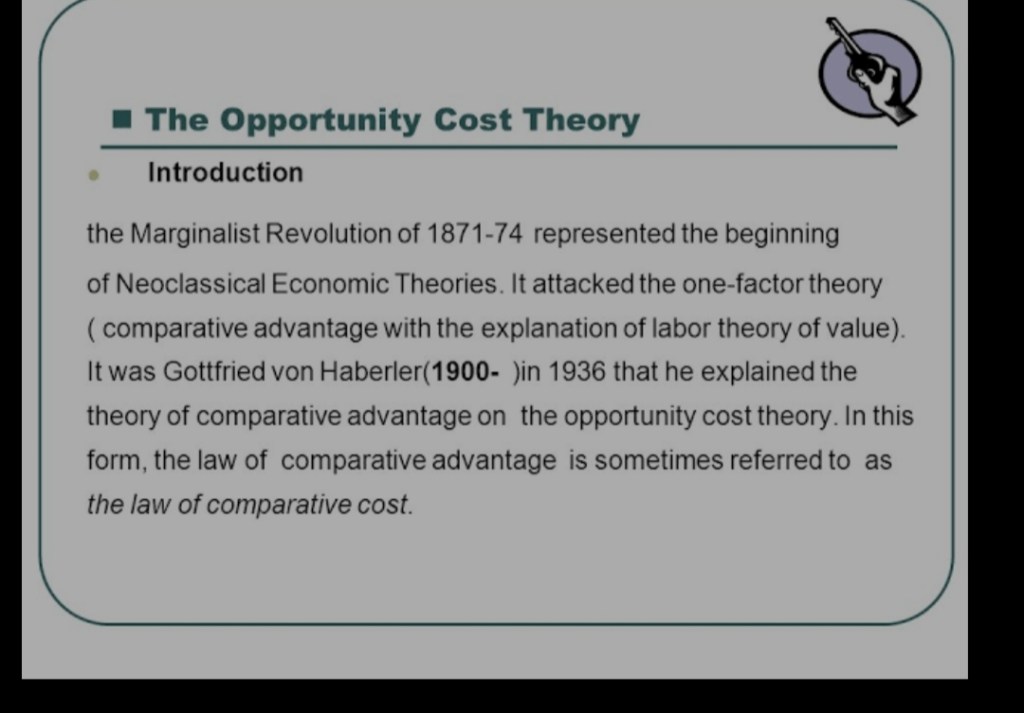
Innumerable theories are formulated by Haberler , Ohlin , Samuelson , Leontief , Hecksher and many others dealing with the macro and micro parts of international trade .
The principle of Comparative Cost theory by Ricardo, despite being the basis of international trade, has been criticized by many economists . Ricardo’s theory of comparative cost is based on the labour theory of value which means that labour is the only factor of production and labour is homogeneous . Such assumptions are found to be unrealistic .
Gottfired Haberler ‘ s theory of opportunity cost overcomes these shortcomings and explains the doctrine of the theory in terms of ” the substitution curve’ ‘ or as Samuelson entitled it as ” production possibility curve “or “transformation curve ” .
Lerner called it the ” production indifference curve ” or ” production frontier .”
Haberler’s theory is found to be more realistic .
The Theory of Opportunity cost
Opportunity cost is the value of loss when choosing between two or more commodities.
To elaborate more , The opportunity cost theory says that if a country can produce either commodity X or Y , the opportunity cost of commodity X is the amount of the other commodity Y that must be given up in order to get one additional unit of commodity X .
The exchange ratio between the two commodities is expressed in terms of their opportunity costs . The decrease in the quantity of the second commodity represents the opportunity cost of the additional quantity of the given commodity.
Haberler used the concept of opportunity cost with production possibility curves to illustrate international trade theory.
Assumptions :-
The following assumptions are formulated by Haberler to illustrate the theory :-
• There are only two countries , (A,B) • Each country possesses two factors of production – labour and capital. • Each country can produce two commodities , ( X and Y ,) • There is perfect competition in both the factor and commodity markets . • The price of each commodity equals its marginal money costs . • The price of each factor equals its marginal value productivity in each employment . • The supply of each factor is fixed . • Factors are immobile between the two countries. •. There is no change in technology . • Trade between the two countries is completely free and unrestricted.
Key terms :-
Production possibility curve :-
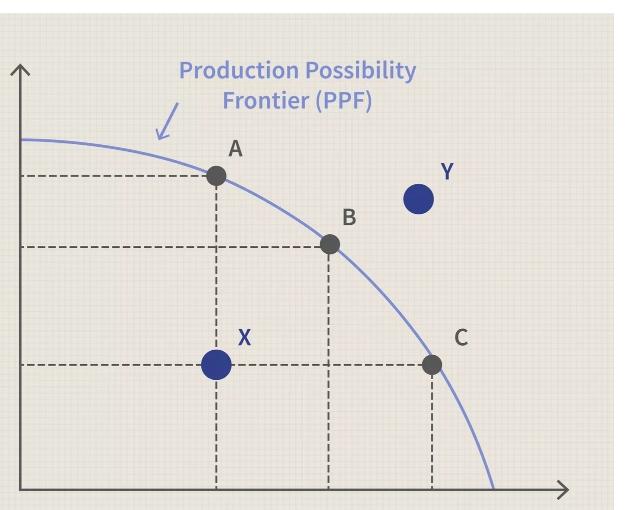
A production possibility curve or transformation curve is the curve that shows various combinations of two goods that can be produced with available amounts of resources . Production possibility curve shows that if an economy wants to produce more of one commodity ,it will have to transfer or divert resources from the production of another commodity to produce the one .
Different points on the production possibility curve show different combinations of the two goods . Points outside the curve are unattainable because of the scarce quantity of resources available.
Marginal Cost of Production :- The marginal cost of production measures the change in the total cost of a good that arises from producing one additional unit of that good.
Marginal Rate Of Transformation :- The marginal rate of transformation is the number of units of one product that can be increased by reducing the quantity of another product. It shows the number of goods that will be foregone to produce an additional unit of other goods while keeping the factors of production constant.
Comparative advantages: – A country can produce one commodity at a lower cost than the other because of comparative advantages such as favourable climate, natural resources, geographical situation and efficiency of labour.
Explanation Of the Opportunity Cost Theory
The production possibility curve indicates such combinations of two commodities . The shape of the production possibility curve determines the basis and the gain from international trade under the theory of opportunity curve .
The slope of the production possibility curve is determined by the ratio of units of the commodity given up in order to have one unit of the other commodity i.e by Marginal rate of transformation. (MRT)
MRT xy = ∆Y/ ∆X , where ,
X and Y are being produced by a country and some quantities of labour and capital input are used from the production of Y into the production process of commodity X.
Trade can take place only when each nation has a different MRT. The gains from trade for a particular nation depend on how much the international exchange rates differ from that nation’s MRT. The greater the difference, the greater is the gains from trade. The gains from trade rest further upon the amount of trade taking place. A larger volume of trade allows larger gains from trade and a greater increase in the standard of living.
Following the assumptions , two countries say A and B enter into a trade together .
Two commodities X and Y are being produced by using various alternative combinations that a country can produce most efficiently by fully utilising it’s factor of production i.e labour and capital ,are homogeneous , with the available technology in the fixed proportion due to perfect substitutability .
Conditions :-
1: Trade under Constant Opportunity Cost
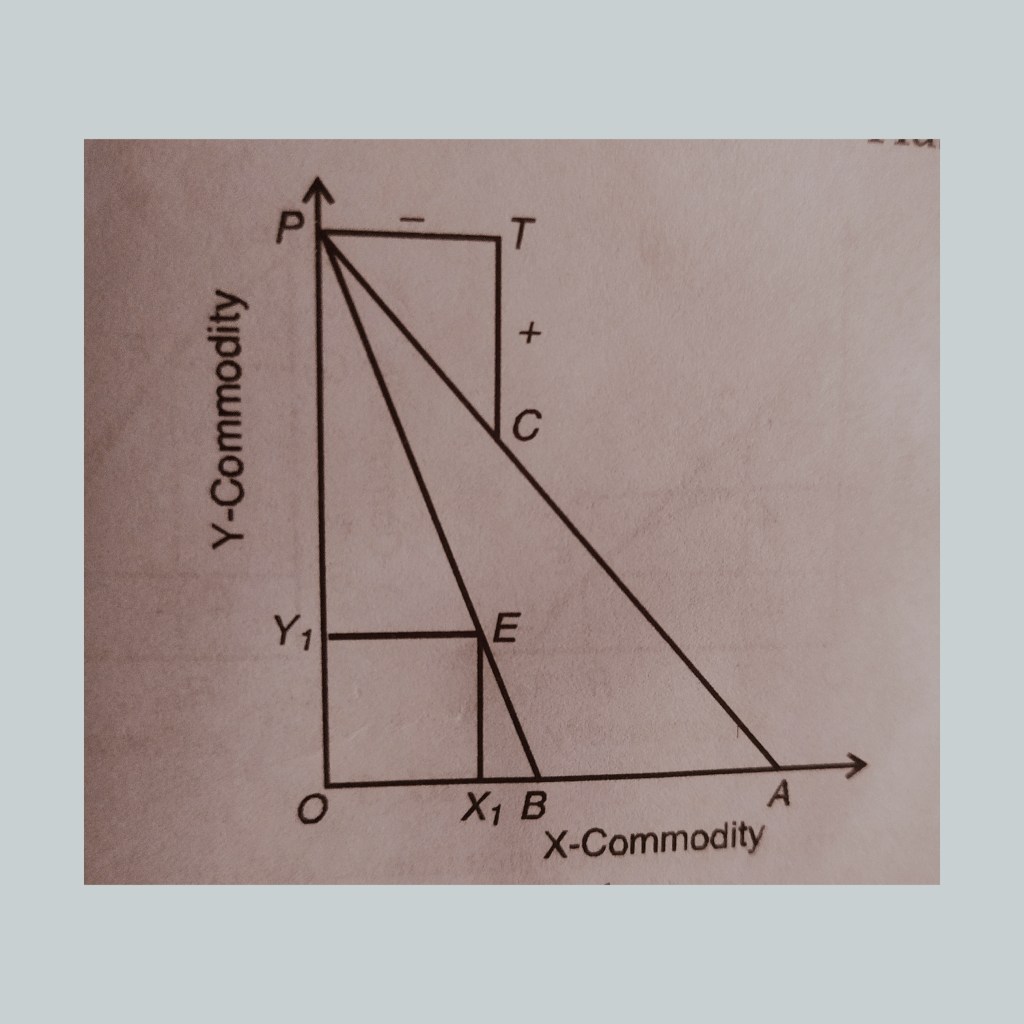
The production possibility curve under constant opportunity cost is a straight line .
In the figure , PA is the production possibility curve of country A , PB is the production possibility curve of country B .
Country A can produce either OP of Y , or OA of X
Similarly , Country B can produce OP of Y OB of X .
The slope of the production possibility curve determines the relative price of the two commodities , since the opportunity cost of leaving a unit of one commodity in order to have an additional unit of another is constant , the cost ratio ( relative price ) is the same on all the points on the production possibility curve.
Since , the MRT is constant i.e the slope of the production possibility curve is also constant, trade between the two countries is not possible as no country stands to gain through the trade .
Trade Under Increasing Opportunity Cost :-
The production possibility curve under the increasing opportunity cost is concave to the origin because when a country specialises in the production of one commodity ,in which it possesses comparative advantage ,its opportunity costs increase .
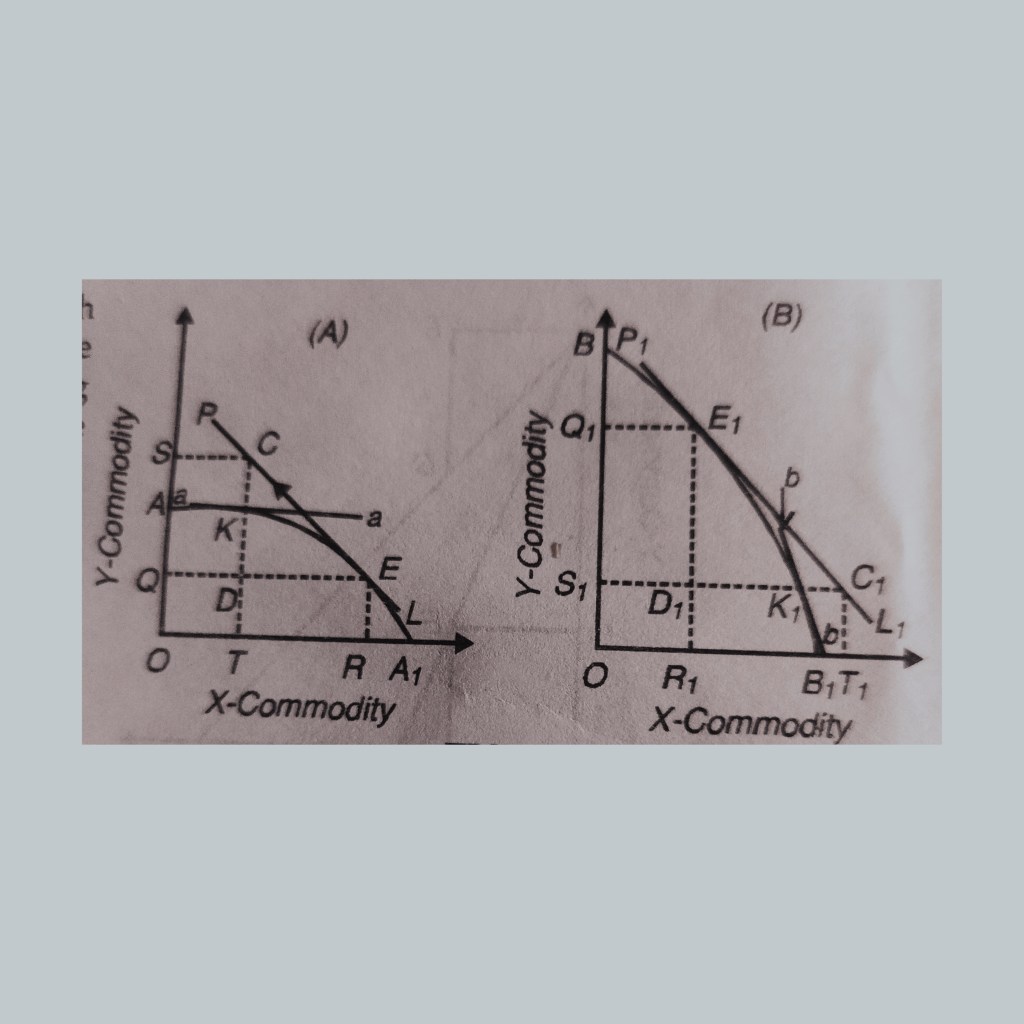
In the above figure , AA1 is the production possibility curve of country A which is concave to the origin . The slope of this curve shows that country A will specialise in the production of commodity X . The larger amount of commodity Y will be given up to have additional amount of commodity X as we move from point A to A1 Thus ,the country faces increasing opportunity costs .
BB1 is the production possibility curve of a country which is concave to the origin . The slope of this curve shows that country B will specialise in the production of commodity Y. The larger amount of commodity Y will be given up to hsv additional amount of commodity Y as we move from B1` to B . Thus , the country faces increasing opportunity costs.
Let us assume the international price ratio is given by the line PL in country A , and PL1 in country B.
The slope of line PL is greater than domestic price line aa ,making commodity X expensive in international market than in domestic market and resulting in the interest of country A to shift some factor of production from the production of commodity Y to commodity X , moving it’s production level from point K to point E.
It will export TR of X and import QS of Y , domestically consuming OT of X ,and OQ of Y . The export and import can be shown by the “trade triangle ” CDE .
The slope of line PL1 is less steep than domestic price line bb ,making commodity Y expensive in international market than in domestic market and resulting in the interest of country B to shift some factor of production from the production of commodity X to commodity Y , moving it’s production level from point K1 to point E1
It will import D1C1 of X and export D1E1 of Y , domestically consuming OS1 of Y ,and OR1 of X. The export and import can be shown by the “trade triangle ” C1E1D1.
Trade Under Constant Decreasing :-
When two countries experience decreasing opportunity costs their production possibility curves are convex to the origin. Under decreasing opportunity costs , each country completely specialises in the production of only one commodity after trade because there are increasing returns based on internal economies of production .
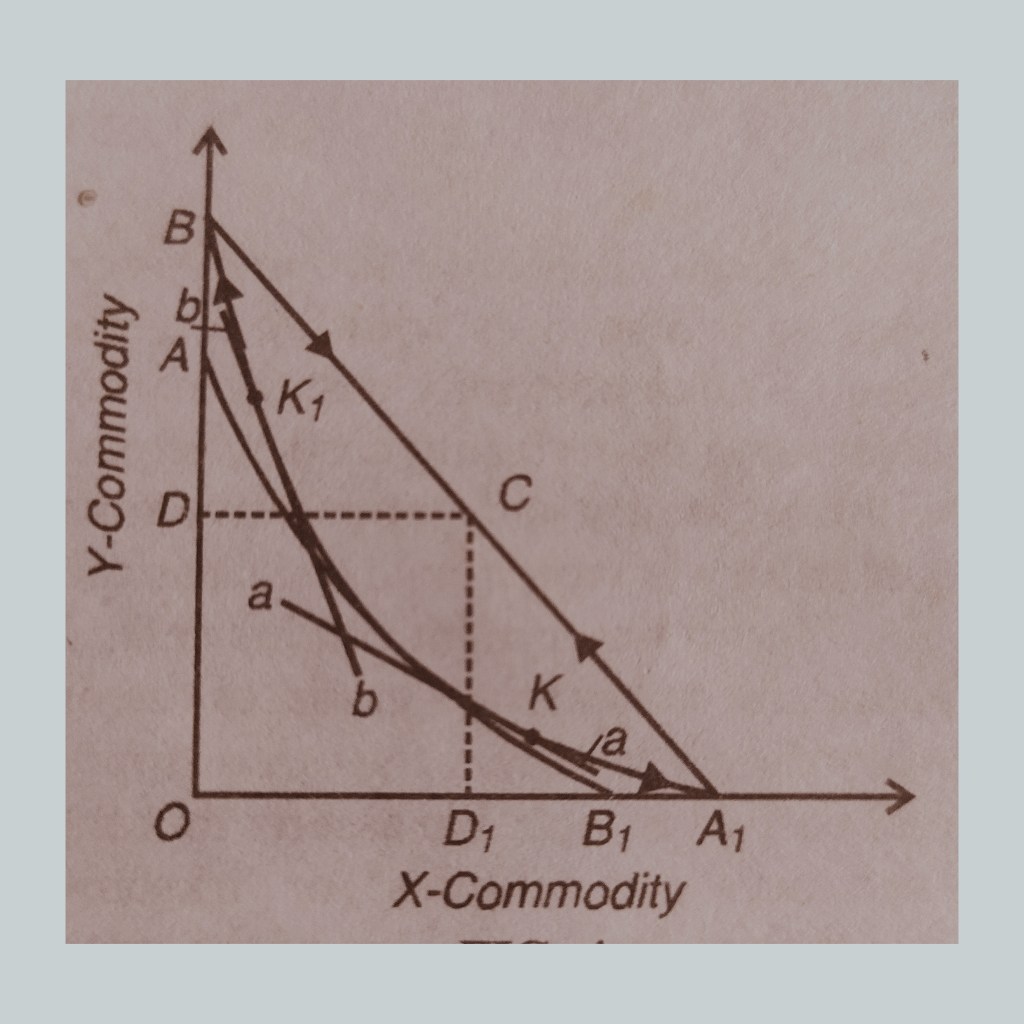
In the figure , The production possibility curve of country A is AA 1 and B is BB1.
The pre trade production and consumption point of country A is K where it’s domestic price line aa is tangent to its production possibility curve and country B is K1 , where it’s domestic price line bb is tangent to its production possibility curve.
The international price line being BA1, if both the countries enter the trade , BA1 is steeper than the domestic line of country A , making X more expensive in the international market and resulting in shifting of resources of production to X from K to A1 .
On the other hand , the international price line BA1 is flatter than the domestic price line bb of the country making Y commodity expensive in the international market than in the domestic market and resulting in shifting of resources of production to commodity Y and moving from K1 to B .
Thus , country A will completely specialise in commodity X and B in commodity Y . Now both the countries will move along with the international price line BA1, Country A from A to point A1 upward , country B from B to point B1 downward and reach point C in consumption.
Note :-
The straight line tangent represents :-
‘A straight line tangent to the transformation curve indicates the ratio of market prices of the two commodities, and the condition of tangency expresses equilibrium in production, that is, equality between prices and marginal costs stated in opportunity terms. Domestic demand conditions enter into this construction via community indifference curves, or simply as a consumption point determined by a given arrangement of production and income distribution.”
Finally, tangency of a line representing the equilibrium international price ratio to both transformation function and community indifference curve indicates equilibrium in exchange, that is:
(i) Equality domestically between the marginal rate of substitution in consumption and marginal rate of transformation in production, and
(ii) Equality of the value of exports and the value of imports.
Critical Appraisal
As an alternative to classical comparative theory , the opportunity cost theory is more realistic .
The opportunity cost theory analyses pre- trade and post – trade situations under constant , increasing and decreasing opportunity cost whereas comparative advantage theory is based on constant cost of production within a country and comparative advantage and disadvantage between two countries.
Jacob Viber in his ” Studies in The Theory of International Trade ” ( 1937) criticized the opportunity cost theory of values which is the basis of Haberler’s theory . Some of his criticism were :-
• Neglecting of welfare • Failure in measuring in terms of strain , sacrifice or disutility. • Neglecting Change in Factors of Supplies . • Unrealistic Assumptions .
Despite criticism ,the opportunity cost theory has been regarded as more fertile because it can be readily extended into a general equilibrium system .
Evolution was in the air and developmental thinking can be found in a variety of different fields.
The word evolution was borrowed from Latin ēvolūtiō, ēvolūtiōnis, which means , “the act of unrolling, unfolding or opening .
Evolution is a process full of complexity . Evolution is a principle of internal growth . It shows not merely what happens to a thing but also what happens within it .
Their term evolution is borrowed from the biological science of sociology ,Frome the term ” organic evolution ” . Whereas organic evolution is used to denote the evolution of organisms ,social evolution is used to denote the evolution of human society .
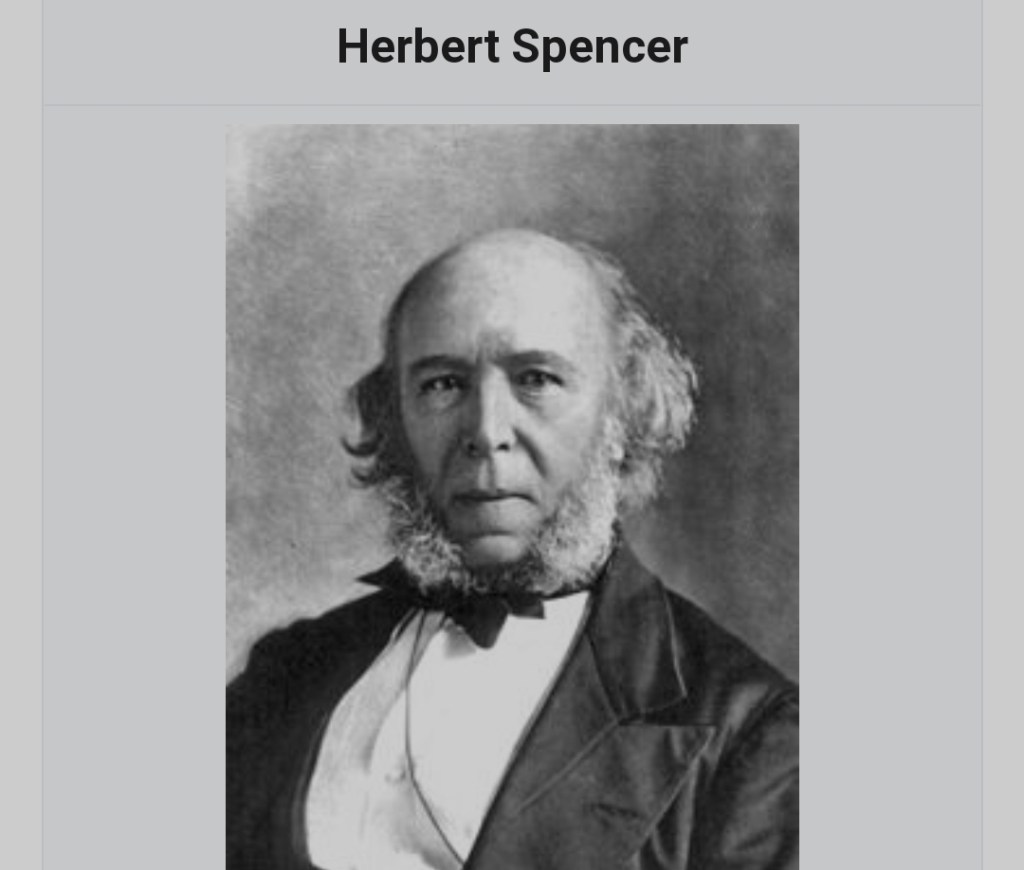
Herbert Spencer (27 April 1820 – 8 December 1903) was an English philosopher, biologist, anthropologist, and sociologist famous for his hypothesis of social Darwinism.
Spencer in his essay “The Social Organism”, stated that the social organism itself is subject to evolutionary developments as a separate entity and much of the idea that societies, like individual organisms, “spontaneously evolved” .
On passing from Humanity under its individual form, to Humanity as socially embodied, social evolution can be exemplified .
Spencer said , “Evolution is an integration of matter and concomitant dissipation of motion, during which the matter passes from an indefinite, incoherent homogeneity to a definite, coherent heterogeneity and during which the retained motion undergoes a parallel transformation.”
One of the most important contribution of Herbert Spencer to Sociology is the theory of evolution
His principles included physical and biological evolution in order to elaborate and explain his theory of Social evolution. He sketches a comprehensive account of evolution of the inorganic, organic, and human and social realms.
He stated , “In respect to that progress which individual organisms display in the course of their evolution,”
He explained this course of evolution through , the development of a seed into a tree, or an ovum into an animal, constitute an advance from homogeneity of structure to heterogeneity of structure .
He continue with, the change from the homogeneous to the heterogeneous is displayed in the progress of civilization as a whole, as well as in the progress of every nation; and is still going on with increasing rapidity.
Spencer adopted his principle of evolution from naturalistCharles Darwin, who developed the concept of evolution in his “Origin of Species” in 1859.
Herbert Spencer, used Darwin’s theory and applied it to how societies change and evolve .According to Spencer societies were bound to change automatically .
Spencer in his theory applied a comparison of societies with organisms that progress through changes similar to that of a living species.
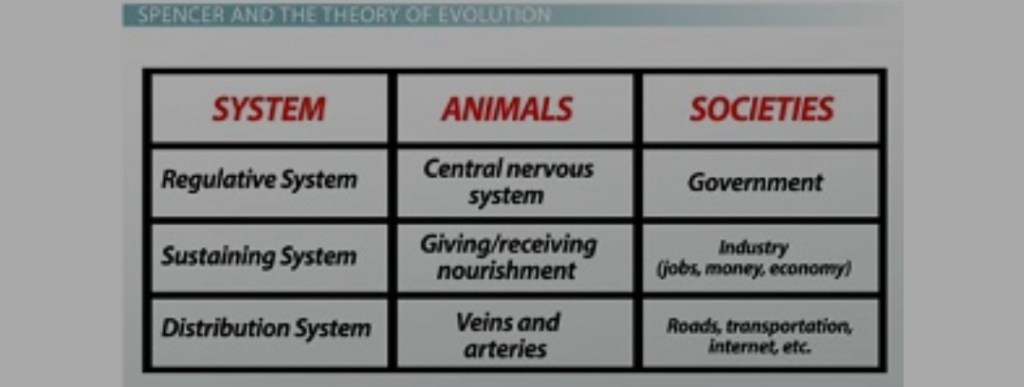
He included three types of systems where societies can be compared to organisms .
The first system is the regulative system. In animals, that would be the central nervous system and in societies, it would be a government that regulates everything.
The second system is the sustaining system. For animals, that’s the giving and receiving of nourishment. For societies, that would be industry – jobs, money, economy and those sorts of things.
The third system would be the distribution system. In animals, that would be the veins and arteries. In societies, it would be roads, transportation, internet – anything in which information and goods and services are exchanged.
“Survival of the fittest” expounded by Darwin was highly believed by him . According to Spencer only strong creatures survive and evolve; only strong makes progress. And that animal has to struggle to preserve its existence.
All universal phenomena-inorganic, organic, super organic—are subject to the natural law of evolution.
A definite pattern of change is followed by all the phenomena of nature—the stars and planetary systems, the earth and all terrestrial phenomena, biological organisms and the development of species, all the psychological and sociological processes of human experience.
Herbert Spencer includes physical evolution in the form of indefinite incoherent situations to definite and coherent situations. The underlying principles of physical evolution are a movement from simple to complex and homogeneity to heterogeneity.
According to him , following the Darwin theory of ” Survival of fittest ” the biological evolution only those creatures survive in the struggle for existence who are able to make effective adjustment with changing circumstances.
Herbert Spencer utilized these two principles, physical and biological evolution in order to explain social evolution.
Spencer’s theory of social evolution points out to two stages:
1. The movement from simple to compound societies.
This movement from simple to compound societies can be seen in four types of societies in terms of evolutionary levels
2. Change from militant society to industrial society.
According to Spencer, the law of evolution is the supreme law of every becoming. From the analysis of biological evolution Spencer established the theory of evolution. He argued that the evolution of human societies, far from being different from other evolutionary phenomena. It is a special case of a universally applicable natural law.
According to some social thinkers Herbert Spencer’s has several criticism , They said that theory lacks practicability and is realistic. It also lacks uniformity. Qualities like sympathy, sacrifice, kindness, love etc. are of much Importance in human survival . These are quite different from the struggle for existence.
Despite of several criticism Spencer Theory of Evolution is the fundamental base for understanding evolution of man and society .
KOPPACT is an acronym that stands for Kinesics, Oculesics, Paralanguage, proteomics, Chromatics, Tactics. These all are the variations of different kinds of nonverbal language.
Kinesics
Kinesics discusses different kinds of body language, gestures, postures, facial expressions, and so on. In nonverbal, there are many things like voice quality, adapters, regulators, and many which impact communication. Its say facial expressions are the most important as it takes the impression of 55% of total communication. The postures reflect people’s emotions, quality of thoughts, and personality. Research says postures reflect one’s confidence, receptivity, status to the listener. Gestures are very much related to our daily life. It supports our opinions like moving hands, giving nods, etc. It is very important to take care of the body language while you are representing yourself because it tells half of your personality.
Oculesics
Oculesics include eye contact. Proper eye contact is very important during any conversation. It not only proves your confidence level but helps you to connect with your audience. It helps to bring engagements, interest attention, and so on. It has three basic purposes to serve. Firstly it helps to get feedback. During a conversation or presentation if you look to someone you can easily understand by their eye movements what the are feeling. Secondly, it helps to indicate without uttering a word of address. For instance, if you are talking with some time and when the turn of the next person comes you just look at the person and give a signal of his/her turn. Thirdly it gives a vivid indication if you are liking a person or not. Usually, when we don’t like a person, we try to avoid eye contact.
Proxemics
Proxemics tells about spatial distance. The space distance between two people can reflect the dimension of their relationship. An intimate relation, closeness, group, or society, all can be reflected by their spatial distance. There are zones in the space language, which is called spatial distance. The intimate zone is 0’-18″, Personal Zone is 18”-4′, the social zone is 4’-12′ and the public zone is 12’- rest.
Paralanguage
Paralanguage includes the pitch and tone of the verbal message. Voice is very important because it collects the attention of the people. Not only that it carries the mood of the words, if its sarcastic, anger, happy and more. It highlights the message’s importance. It refers to how something is said, not what is said”.
Artifacts
Artifacts are the artificial things that one carries. For instance, the dressing of a person or some kind of stuff can refer to the personality of the person. It also helps to impress people, drag attention. It helps to analyze better and it also impacts the nonverbal communication.
Chronemics
It indicates a sense of timing. The beginning of the event and the end is very important. It helps to sync between verbal and nonverbal communication. During a presentation, if someone continuously checks the time, it can distract people from listening and also hamper the attention with the presentation quality. So, interval time, temporal processing, cognition all are very important.
Tactilics
It helps to judge the people and their intentions. It helps to understand the positive and negative signals. Some touch can make you feel comfortable some are not. A weak handshake, a timid tap on the shoulder, and a tight hug or slap on the back can reassure the relationship. You can’t get into someone’s territory without knowing. You should know, whom you can touch, when you can touch and how you can touch.
These languages which impact our daily conversation and make it better.
Dr Faustus is a short play written by Christopher Marlowe. The play is a mastermind insight into the paradoxical soul of mankind and its ironically self inflicted corruption. The play could be classification as a theological allegory. it can assumed that the play specifically speaks to the time, but can be adapted to the present as well. Marlowe portrays Faustus ambition as dangerous; it was the cause of his demise. Perhaps Marlowe used the theme of over ambition as a warning to the audience , who would be likely to be wary of ambition- it was looked down as a negative personality trait in Christian England(Calvinism) An on going theme within the story is the corruption of a soul which is played out through the use of religious beliefs. Specifically, the use of the seven deadly sins is a precursor to mankind’s self inflicted death. Marlowe uses sin, redemption and damnation to get his point across to the audience. The sins that Marlowe specifically uses are those of: pride, covetousness, wrath, envy, gluttony, sloth and lechery. These sins are colourfully displayed through the character traits of Dr Faustus. In the process we view them and can adapt them to our own lives and how they are all parts to the corruption of our souls.
In the prologue, Marlowe introduces us to Dr Faustus via the chorus. Here we are told of life of an ordinary man, born to modest people. This piece tells us that in the new age of the Renaissance, a common-born scholar like Faustus, is as important as any king or warrior, and his story is worthy of being told and also states that Dr Faustus’s swelling pride will lead to his downfall. Here we are addressed with a precursor of what is about to happen and how it is to be facilitated, again by one man’s desire to destroy himself in respect to Godliness. In Act One, Marlowe portrays Faustus as being over-ambitious by his turning magic, which is a much more sinister and much less conventional pursuit than others that he had been discussing previously. Faustus hopes that magic will make him omnipotent and godlike.
Through out the next few acts we see Dr Faustus disregard the teachings against the seven deadly sins with his trickery and debauchery. The great doctor Faustus has the seven deadly sins entrenched in his life and they are displayed by his various actions during the play. The first deadly sin was that of pride. Dr Faustus saw himself as in comparison to others in a competitive nature. pride and vanity are competitive. this was done in Act One when he sits there and tells the audience of his accomplishments and wishes for more glory. The second is covetousness, it is manifested in the play through various actions. Faustus demonstrates this in various scenes, when he evokes the devils magic, the want of a wife, and the overall actions of his character portray his pursuit of knowledge and glory. Usually this sin is manifested through sex, power, or image which demises the self control and can suffocate the soul. It is the self-destructive drive for pleasure which is out of control. Faustus does this when he performs his silly tricks for self indulgence.
Wrath is the third sin. Often this is our first reaction to the faults of others. Faustus demonstrates his impatience with the way he treats the people around him, his servants (demonic and human), as well as other characters with in the play. Wrath is what Faustus feels when he conjures up horns to place on the head of a knight of Emperor Charles V, court (Marlowe, 41-42). Since the knight shows skepticism in Faustus must rebuke his insolence by placing horns on the knight’s head. The fourth is envy Dr Faustus wanted more in his life and envied the powers of others. Therefore, he wanted to command the demons to control the world to his accord. Envy is almost impossible to differentiate from pride at times. Dr Faustus was envious of the accomplishment of others and wanted to exceed their glory (Act I). In one of the comic scenes, scene 6, we learn that Robin and Rafe have stolen one of Faustus’ books and plan to use it to seduce a woman. They must have been jealous of Faustus’ power and his magical aptitude.
The fifth sin is gluttony; temperance in accepting the natural limits of pleasures, and preserves of the natural balance. This does not pertain only to food, but to entertainment and other legitimate goods, and even the company of others. Faustus demonstrates gluttony when he evokes the use of the dark arts. He is attempting to go beyond his earthly knowledge while disturbing the natural balance or medium in his life, the devil has become the greater power to Faustus. In some of the monologues, Faustus starts using the devils name in place of where one would use Gods name. Sloth, in conjunction with the other sins, works to muffle the spiritual senses so we first become slow to respond to God and then drift completely into the slumber of complacency to the demonic ways. This is the sixth sin in the death of Faustus he is given chances to content throughout the play, and never does. Faustus has become numb to his own sub consciousness; he no longer abides by what he does. Even in the scene where he sign the contract with the devil, his blood congeals and he does not understand why. His own body is fighting the deadly deed he was attempting to do.
Lechery, greed is the seventh sin. Faustus also displays greed in Act I when he states he has not accomplished greatness. Faustus wants to gain glory; he has exceptions of others to get him his glory. Faustus uses Mephastophilis to gain glory, it is the perfect display of lechery, and he does acknowledge that the demon is responsible for all the tasks he performs, but states it is his gift of the dark arts (Marlowe,12)
During the play there are various characters that Faustus meets, the most ironic of them is the seven deadly sins. The seven are present to humour reader and make them think, the humour of course in self reflection. Another humourous aspect is the reflection on Christian symbolism. The symbol of blood is displays in different points of the play. Christian virtues are being inspected with the use of temptation and sin. Prominent token head figures are also being scrutinized they are placed in the story for aid or to reveal their sins. With each of these symbols the author adds shock value to the play.
The main character Dr Faustus is a tragic hero; in the process of the play he destroys himself but in the same step he sarcastically displays the audience own idiosyncrasies. The on going theme within the story has been the use the use of religious icons and beliefs. Marlowe uses the renaissance ideals with the medieval myths to master his point. This work is a forewarning of damnation by those who attempt to alter the doctrines or moral standards, and a beacon of caution to those in search of the unknown. Dr Faustus, the work of good and evil.
Mahabharata is one of the greatest epic in the Hindu Mythology which has universality all around the world. We all are familiar with Mahabharata and its crucial turning point which was the Game of Dice. This great epic can be considered as a real breakthrough nondiscriminatory future for universal humanity. We find the existence of 18 Parva in which the book is divided where there are various episodes present.
Game of Dice has a significant role in this great epic as it sown the seeds of the most destructive Kurukshetra War. It all started with the establishment of the new city at Indraprastha which was opposite to Hastinapur where the Kauravas lived. Yudhishthira was the eldest of all the Pandavas and decided to invite large numbers of king which also includes their cousin’s Kauravas. As Duryodhana visits The Place of Illusion which was the Maya Bhavan made by Maya Sura he faced an extremely insulted from the harsh comment of Draupadi. She commented as: “Is a blind man’s son blind man too?” Duryodhana felt deeply humiliated and after returning to Hastinapur he narrated this entire scenario to his cunning uncle Shakuni and thus he planned to invite the Pandavas for the Game of Dice. After Dhritarastra permission, Yudhishthira accepted the invitation with his brothers. Shakuni who was the master of the magical dice placed on behalf of Duryodhana whereas on the other side it was Yudhishthira. As the game started Yudhishthira stared to lose everything. First his lost his entire wealth, then his loving brothers, then his own self and finally her Draupadi. When Draupadi was called to the court she refused this proposal and was extremely horrified as well as angry on Yudhishthira. Revengeful Duryodhana ordered Dushana to bring Draupadi vehemently which he did by forcing her and dragging her long hairs to the court. Duryodhana insulted her even more by slapping in his thigh and asking her to sit there. But this was not the end furious Duryodhana ordered Dushana to disrobe Draupadi. Finally, to prevent herself from such grave humiliation Draupadi prayed Lord Krishna to help her and unexpectedly a miracle happened where Dushana keep on unwrapping the layers and parts of her clothes but unable to do so due to exhaustion. Seeing this disheartening scene Dhritarastra was extremely depressed and decided to return Yudhishthira the entire thing which he lost in the game. As Duryodhana started to find everything going against his will he requested for a second chance of Game of Dice in which the Pandavas lost and have to succumb all their wealth, kingdom and have to go for an exile for 13 years and 1 year in incognito.
The Game of Dice was the traumatic turning point and had a crucial significance in the great epic Mahabharata because if there would have been no Game of Dice there would have been no disgrace and humiliation of the Pandavas and molestation of Queen Draupadi. This molestation was the real provocation point which sown the seeds of the Kurukshetra War and the destruction on the Kuruland. This Game and its consequences can be taken as a great lesson for generation to generation that woman are meant to be respected and admired and the one who disrespects or humiliate them have to face grave consequences with the course of time.
Music has been called the greatest human creation throughout history. The fundamental definition of music is pure and unadulterated creativity. Music is a crucial element of our lives since it allows us to express our emotions and sentiments. Some people regard music as a means of escaping from life’s difficulties.
It provides you with relief and allows you to de-stress. Music is a strong therapy that can help you relax and brighten you up while you’re feeling happy. It also helps to improve the mind and increase self-confidence. Music serves a greater purpose in our lives than simply providing amusement.
Because music is creativity in its purest form, as stated in the preceding paragraph, it may also be concluded that music is essential to creativity. It aids in the robust improvement of your mind by making it more artistic and inventive. Whatever the great innovation is, it necessitates art, creativity, and imagination, all of which are provided by music.
It is also an established fact that music has the capacity to increase both your listening and understanding abilities. When you hear a song, you try to decipher the lyrics and figure out what the performer is trying to say with his song. When a person listens to instrumental music and uses his intellect to decipher the message communicated by the performer, his understanding capacity improves.
When you play an instrument, you almost always play music that expresses our feelings or thoughts. This manner, without saying a word, your brain communicates its thoughts through music. According to study, trying to comprehend music makes our minds more creative.
The language of Music
Music is also known as humanity’s global language. It has the ability to bring happiness and positivity into people’s life. Everyone appreciates music because it has the ability to change one’s mood and provide a sense of relief in one’s daily life. Music can provide all of the solutions to our unanswered questions. Because music sticks with people till the end of their lives, it can make them devoted and loving. It never leaves the person alone when they are going through a difficult moment in their lives.
Music is significant in the world because it allows us to express ourselves more freely. It has a variety of effects on people’s daily life. Every type of music evokes a different set of emotions, as we may easily associate music with anything or anyone in our environment. Music has the ability to bring people together in a variety of ways and on a variety of circumstances.
It can also be described as a useful communication tool. There are certain feelings that we fail to articulate in our daily lives, but music fills in the blanks and allows us to effectively send our message to others. We either write songs or listen to music to find the right words to express ourselves.
Music, like other kinds of art, can be characterized as a method of expression that necessitates creative abilities and a strong imagination. Music can provide a sense of relief and help us cope with the stresses of everyday life. It might be a good way to relax and unwind. A tranquil mind can boost our self-esteem and make us more friendly and optimistic.
Music has the ability to change people’s emotions and feelings in a matter of seconds. It has the ability to reduce stress, discomfort, difficulty, and distraction while also bringing happiness and peace into our daily lives.
Music has the ability to bring people together in a variety of ways. Music has the ability to make us more expressive and to help us better comprehend our moods and emotions.
Apart from the obvious, music teaches us self-control and time management abilities that we can’t learn anywhere else. When you regularly practice an instrument, you concentrate on tangible ideas and take modest steps toward larger goals. This mode of thinking organizes your brain’s wiring, allowing you to see Learning in a new perspective.
Music stimulates the brain, which aids in pain alleviation, stress reduction, and memory. According to a Harvard study, soothing music can help decrease blood pressure and pulse rate after physical activity. It can also boost mood and lower anxiety, as well as serve as an antidote to loneliness and social isolation by bringing people together.
It has also been witnessed firsthand that how music may help people with dementia connect with loved ones when all other means of communication have failed.
In a digital age where many services and products are instantly available with the click of a button, learning a musical instrument provides a platform for people to achieve through discipline and perseverance. There are many skills required in order to learn how to play a musical instrument: technique; reading music; expression; listening; and as you continue to perfect these skills, you build resilience.
As a part of an ensemble, you will acquire strong teamwork and leadership abilities, as well as a great sense of accomplishment and pride while performing/mastering challenging musical passages, all of which will help you gain confidence. These are not only necessary abilities for learning music, but also crucial life skills that may be applied in the workplace and in your social life.
The delight you can derive from music will serve to lift yours and everyone else’s spirits.
Music offers joy, whether it’s learning your favorite song, singing on stage, or just having a good old sing-a-long with your friends.
Poorna Chandra Tejaswi was renown Indian author and novelist in kannada with a pen name poochanthe. He is son of jnanapith awardee, a famous kannada poet, Raashtrakavi kuvempu and Hemavati. Tejaswi was born on 8 September 1938 in kuppalli in Shimoga district of Karnataka state. Tejaswi has written poems, short stories, novels and also translated many English works into kannada.
His first story is “Linga Banda” which described about the western Ghats from a small boy`s perspective. The story got best story award by newspaper Prajavaani. He graduated from from Maharaja college Mysore and moved to Mudigere Chikmagalur district in Karnataka. because of his immense interest in nature Tejaswi took up farming. If you read his works you will understand the immense love he had for nature. He makes you roam Mudigere while you are sitting in your room through is works.
Tejaswi is known as a navya sahithi, a writer of navya period. He is also a Bandaya poet, a genre of protest literature. He was a polymath. He did farming, writing, photography, painting and many more things. Tejaswi has won many awards like Rajyotsava award, Pampa award, kannada sahithya academy award, Karnataka state film award for his many of his works. Some of his famous works include karvalo, Chidambara rahasya, Jugari cross, huliyoorina sarahaddu, Bellandoorina narabhakshaka, Sahaja krushi, Missing link, Hejje Moodada haadi, Papillon and many more.
He is married to Rajeshwari Tejaswi. Susmitha Tejaswi and Eshanye Tejaswi are his children. He died of cardiac arrest on 5 April 2007 at his farmhouse Niruttara, Mudigere, Chikmagalur district.
Why Tejaswi is everyone’s favorite?
Yes, Tejaswi is everyone’s favorite and mine too. That’s mainly because of his storytelling technique. You go into the dark thick forest while reading his books. You feel the presence of that human eating tiger when he describes it. You are in the adventure while reading his books. He hooks the reader right from the start. he is honest, hilarious and clever at the same time.
Lets take a book called karvalo. In the book they take an adventure to find a strange flying lizard Draco dussumieri, a flying lizard which is capable of gliding from tree to tree found in western Ghats. at the end when the characters, scientist karvalo, the farmer and his fellowmen try to catch the weird creature, but it escapes through the jungle. But the reader, you will feel the fatigue of the efforts they made, you will be annoyed because they didn’t able to catch it.
Not only his storytelling, the other thing that make you read Tejaswi again and again is the knowledge he hides in his books. His book missing links talks about human evolution. The set of three books headed Vismaya , talks about variety of species and facts about them you wouldn’t know ever existed. He doesn’t only entertain you, but he gives nutritious food to your brain.
Tejaswi always links science and philosophy. The incidents that happen in his stories become guard and guide your life. he grows morals in the reader. He grows love and appreciation for nature. Tejaswi puts you in a sense of responsibility towards nature. He makes you believe in simple living. He will push you to think about problems of agriculturists. He talks about culture and and history. He perfectly reaches out to youth.
“Focus, hard work is the real key to success. Keep your eyes on the goal, and just keep taking the next step towards completing it. If you aren’t sure which way to do something then do it both ways and see which works better.” – John Carmack
‘Hard work is the key to success’ is a statement that has been said to us over and over again and it may be commonly used in workplaces or schools. Team leaders, managers, coaches, teachers, and parents are most likely to use the statement than other people. We are talking about consistent and focused work, which means saying no to distractions for a long time, without expecting fast results. Be patient and believe in the process while changing your strategies and approach, and try new things while you stick to your initial vision. Success takes strategic actions in the right direction to get there and it does not happen by chance or overnight.
Hard work is the most important key to success. Achievements without hard work are impossible. An idle person can never gain anything if they sit and wait for a better opportunity to come. The person who is working hard is able to gain success and happiness in life. Nothing is easy to be achieved in life without doing any hard work.
Failures are sometimes a part of the journey to the success, but in the end of the day, it is all about how hard you have worked on the right thing and this will get you closer to your goal.
Most of the successful individuals had put in enough productive work before they received success in return. Just by working hard on what you believe in, you can understand its true value. That’s when you start to respect the work itself and when you start to learn important life lessons.
You learn to appreciate all you have, but in the meantime, you learn to be patient, to take action instead of waiting and take responsibility for anything you have or don’t have in your life.
Hard work helps you overcome procrastination, insecurities, fear of failure and bad habits, and it gives you a purpose.
There is nothing else that brings more results and progress on a consistent basis than the hard work. The action itself leads to more action. At any moment of the day, you are building and make sure your journey continues. When you see the results of your own work, you feel grateful, accomplished and truly satisfied with what you are doing. That makes the whole process really enjoyable and you find the strength to persevere.
Never doubt the power and necessity of hard work! Create your strategy, make your plan and take the first step towards success today. You are not gonna regret it! Work your way up!
Hard work is a great quality. All work is noble. Work is worship. Hard work is the key to success. We can progress by doing hard work. Those countries whose citizens are hard-working make great progress.
An idle person depends too much on chance. He thinks that some miracle will happen and he will become rich and prosperous. But this is not possible without hard work.
All great men of the world were very hard-working persons. By hard work, man progresses and the country progresses. Seventy years ago, Japan was a backward country. Today, Japan is one of the most prosperous countries of the world. This prosperity has been possible by means of hard work. We should all, therefore, work hard to achieve success.
So the hard work, together with the time it takes, is a must on your journey to success. It makes you who you have to turn into in order to live the better life that’s awaiting for you. What’s more, the harder you work on your dream, the more confident you become.
The very first key to success is to make a plan. This means having a clear picture of what a successful life looks like to you and putting together a well-defined set of goals to get you to that life. Planning well starts with figuring out what you want and writing it down in detail.
Every one of us has goals in life. To fulfil the goals we need to be hard working. Sitting idly does not help fulfilling one’s aim. We all must respect the chance we get in life. Respecting the chance means doing hard work.
We must not fear failure. Failure is natural to our life. When we fail, we must not stop working hard. We all should believe in ourselves and keep trying hard until we achieve our aims.
We can work hard if we have the determination and focus in life. Concentration in work is very important. If one concentrates fully while doing work, the work gets finished successfully and very soon. We must work to increase our concentration level. Hard work is very much important to develop our concentration power.
To develop the sense of hard-working in children, parents or teachers should tell them the stories of successful persons of a country. The children should choose a role model for their life so to focus on their own life. This will help them study hard with interest.
The National Institutes of Health (NIH) stands as a cornerstone of biomedical and health-related research, driving innovation and scientific breakthroughs. At its core, NIH functions as the primary agency of the United States government, dedicated to advancing knowledge about health and disease. Among its myriad initiatives, the NIH offers grants that serve as lifeblood for researchers, funding groundbreaking studies across diverse scientific domains. These grants provide not only financial support but also an invaluable endorsement and recognition that catapults research endeavors forward.
The NIH grants cater to a wide spectrum of research areas, covering everything from basic science to clinical trials, public health interventions, and translational research. This expansive reach ensures that investigations into fundamental biological processes, disease mechanisms, therapeutics, and population health are consistently supported and propelled forward.
The significance of NIH grants lies not just in the financial backing they offer, but also in the stamp of credibility they confer upon researchers and their work. The NIH grant review process is rigorous, emphasizing scientific merit, innovation, and potential impact. Successful applicants gain more than just financial resources; they also receive validation and recognition within the scientific community, paving the way for future collaborations and opportunities.
Securing an NIH grant, however, is no easy feat. The process demands meticulous planning, a well-crafted proposal, and a clear understanding of NIH guidelines and priorities. Here are key steps to navigate the NIH grant application process:
Identify the Right Grant Opportunity: NIH offers various grant types (R01, R21, etc.) for different stages and types of research. Choose the grant program aligning best with your research goals.
Develop a Strong Research Proposal: Craft a compelling proposal that outlines the significance, innovation, approach, and potential impact of your research. Emphasize how your work aligns with NIH priorities.
Understand NIH Guidelines: Familiarize yourself with NIH guidelines, submission deadlines, and specific criteria for the grant you are applying for. Follow instructions meticulously.
Collaborate and Network: Collaborate with experts, build collaborations, and seek mentorship. Networking within your field can provide insights and support.
Seek Feedback: Prior to submission, seek feedback from colleagues, mentors, or NIH program officers. Constructive criticism can significantly improve your proposal.
Submit and Follow-up: Submit your application through NIH’s electronic system and monitor the review process. Even if your application is not funded initially, use reviewer feedback to strengthen future submissions.
Persistence and Continuous Learning: Grant writing is a skill that improves with practice. Learn from both successful and unsuccessful attempts to refine your approach.
The National Institutes of Health is the largest public funder of biomedical research in the world. In fiscal year 2022, NIH invested most of its $45 billion appropriations in research seeking to enhance life, and to reduce illness and disability. NIH-funded research has led to breakthroughs and new treatments helping people live longer, healthier lives, and building the research foundation that drives discovery.
Grant applications and associated documents (e.g., reference letters) are due by 5:00 PM local time of application organization on the specified due date.
By accepting a grant award, recipients agree to comply with the requirements in the NIH Grants Policy Statement unless the notice of award states otherwise.
The NIH Loan Repayment Programs repay up to $50,000 annually of a researcher’s qualified educational debt in return for a commitment to engage in NIH mission-relevant research.
Are you interested in conducting research in Germany or pursuing a research career in Germany? Here you will find information about where you can conduct research and work in Germany, as well as the various opportunities science and research can offer in Germany. Support ranges from funding for conferences to language programs in Germany.
The German Academic Exchange Service, known as DAAD (Deutscher Akademischer Austauschdienst), offers an array of research grants for PhD students and postdoctoral researchers from around the world. These grants provide financial support, allowing recipients to pursue research opportunities at universities, research institutions, or other academic organizations in Germany.
PhD Research Grants: For individuals pursuing a doctoral degree, DAAD offers various funding options such as the Research Grants – Doctoral Program, which supports short-term research stays for doctoral candidates. It enables them to conduct research in Germany for a period of 1-10 months.
Postdoctoral Research Grants: These grants cater to scholars who have recently completed their doctorate and are seeking opportunities to advance their research. The Postdoctoral Researchers International Mobility Experience (P.R.I.M.E.) program is one such initiative by DAAD. It provides funding for up to 18 months, split between research abroad and reintegration phases in Germany.
Specialized Grants: DAAD also offers specific grants targeting particular fields of study, interdisciplinary research, or collaborative projects. These could include grants for subjects like renewable energy, sustainability, medicine, engineering, social sciences, and humanities.
Eligibility and Requirements: The eligibility criteria for these grants typically involve academic excellence, a well-defined research proposal, and a collaboration agreement with a German host institution or supervisor. Proficiency in German may be required for some programs, although many research opportunities are available in English.
Application Process: Applicants usually need to submit a detailed research proposal, academic transcripts, letters of recommendation, and a statement of purpose outlining their research objectives. The application process is competitive, and candidates are selected based on the quality and feasibility of their research proposals.
Benefits: Successful applicants receive financial support in the form of stipends, travel allowances, health insurance, and sometimes assistance with language courses. Additionally, they gain exposure to Germany’s renowned research facilities, academic networks, and cultural experiences.
Duration and Extensions: The duration of these grants varies based on the specific program. Extensions might be possible, subject to funding availability and the approval of the host institution.
DAAD’s research grants play a vital role in fostering international collaboration, supporting academic exchange, and promoting innovative research endeavors. They contribute significantly to the development of global academic networks and the advancement of knowledge across various fields of study. Prospective applicants should regularly check DAAD’s official website for updated information regarding available programs, eligibility criteria, and application deadlines.
Click on the links below to see what opportunities may be relevant for you.
There are several different Research Grants available ranging from short time periods to several years. If you would like to pursue research in the field of German Studies, you may want to consider looking into our German Studies Research Grant.
DAAD has partnered with other research institutes in order to offer you a breadth of research opportunities in various fields. Take a look at the offers below to find just the right fit for you.
You can gain practical research or work experience by doing an internship in Germany. From research in academia to internships at German companies – the choice is yours.
20 diverse research grants available across various fields:
National Institutes of Health (NIH) Grants:
Offering numerous opportunities across biomedical and health-related research.
National Science Foundation (NSF) Grants: Supporting fundamental research and education in all fields of science and engineering.
European Research Council (ERC) Grants: Funding for groundbreaking research across various disciplines in Europe.
Wellcome Trust Grants: Supporting biomedical research, healthcare, and medical innovation globally.
Bill & Melinda Gates Foundation Grants: Focusing on global health, poverty alleviation, and education initiatives.
Google Research Awards: Funding for innovative computer science research projects.
US Department of Energy (DOE) Grants: Supporting research in energy, technology, and national security.
American Heart Association Grants: Funding cardiovascular research and initiatives.
MacArthur Foundation Grants: Supporting projects aimed at addressing critical social challenges.
Smithsonian Research Grants: Funding opportunities for various fields in science, art, history, and culture.
Human Frontier Science Program (HFSP) Grants: Supporting international collaborations in life sciences.
Howard Hughes Medical Institute (HHMI) Grants: Funding for biomedical research and science education.
European Molecular Biology Organization (EMBO) Grants: Supporting life sciences research and training in Europe.
Alfred P. Sloan Foundation Grants: Focusing on science, technology, economics, and more.
National Geographic Society Grants: Funding for research and exploration in natural sciences, conservation, and anthropology.
European Union Horizon 2020 Grants: Funding various research and innovation projects across Europe.
Spencer Foundation Grants: Supporting education research aimed at improving outcomes.
Simons Foundation Grants: Funding mathematics, theoretical physics, and autism research.
Arts Council England Grants: Supporting arts, culture, and creative projects across England.
Japan Society for the Promotion of Science (JSPS) Grants: Funding for international collaborative research in Japan.
These grants cater to diverse research interests, providing opportunities for scientists, scholars, and innovators worldwide to pursue impactful projects in their respective fields.
In the poem, Seven Ages of Man Shakespeare compares the entire world to a theatrical stage, where all the human beings perform their allotted role given by the God. Every individual has to go through seven acts that are seven stages of man’s life.Shakespeare has divided human life into seven stages, with each stage having its own qualities and characteristics. Shakespeare considers the world a stage and men and women actors on the stage of life. They play seven roles on the stage depending upon their age.
The first stage, in this phase of his life man, appears as a child in the world. As a child, he is a helpless creature. He cries in the arms of his nurse for one reason or the other. He cries and vomits.
The next phase of his life man appears as a child in the world. He goes to school with a bag hanging from his shoulder. He goes to the school creeping like a snail. He marches to the school unwillingly.
In the third stage of his life, a man plays the part of a lover. He grows into a young man full of desires, ambitions, and dreams. He becomes a romantic young man. He falls in love and sights like a furnace. He begins to write sad poems to his beloved he cannot control his sad feelings.
In the fourth stage of his life man becomes a foul-mouthed soldier who has learned queer words at this stage, he tries to give himself a formidable look with a beard like a part. He is emotional and jealous. He quarrels with others for his honor and grace. He hankers after temporary and bubble fame.
In the fifth stage of his life, he becomes a judge. He becomes mature and experienced in his thoughts. The heat of youth has completely cooled down and he becomes very realistic. He wishes to grab wealth by foul or fair means. He begins to accept bribe and thus adds much to his material comforts. He becomes ease-loving and therefore becomes fat. His belly becomes round. He eats healthy fowls and chicken presented to him as a bribe. His eyes become severe and he grows the beard of formal cut.
Then, in the sixth stage of his life, man grows old. He looks quite ridiculous in his movements. He wears glasses because his eyesight is weak. His shoes become wide for his feet. His voice suffers a change. It becomes a shrill and quivering whistle
However, in the final stage, the man turns into a child once again. He seems to forget everything. He becomes ‘toothless’. His eyesight is weakened and he is deprived of taste. He is ready to leave this world.
Shakespeare has the seven stages of man’s life with a touch of satire and cynicism. In each stage, man imagines himself great and important, but there is something ridiculous in his behavior all through his life. Shakespeare has described each of the man’s life stage with great economy of words. He uses living and concrete images to describe the different stages of life. The use of the word ‘mewling’ of the infant’s cry and the school boy’s reluctance for going to school described in phases ‘creeping like a snail’ are examples of living images.
The National Mineral Policy, 2019 emphasizes on prevention and mitigation of adverse environmental effects due to mining in accordance with the latest scientific norms and modern afforestation practices to form integral part of mine development strategy in every instance. All mining operations have to be undertaken within the parameters of a comprehensive Sustainable Development Framework to ensure that environmental, economic and social considerations are integrated effectively in all decisions on mines and minerals issues. The policy also aims at encouraging use of renewable sources of energy at mining sites with a view to reducing pollution, carbon footprint and operational costs, through appropriate incentives, including sensitization training, workshops about environmental issues to all workers involved in mining operations.
Section 18 of Mines and Minerals (Development and Regulation) Act, 1957 empowers Central Government to frame rules for the mineral conservation, systematic development of minerals, protection of environment by preventing or controlling any pollution which may be caused by prospecting or mining operations. Accordingly, Mineral Conservation and Development Rules (MCDR), 2017 were framed, wherein Rule 40 and Rule 43 provides for:
(i) Rule 40 – Precaution against air pollution – Every holder of prospecting licence or a mining lease shall take all possible measure to keep air pollution due to fines, dust, smoke or gaseous emissions during prospecting, mining, beneficiation or metallurgical operations and related activities within permissible limits.
(ii) Rule 43 – Permissible limits and standards – The standard and permissible limits of all pollutants, toxins and noise shall be such as may be notified by the concerned authorities under the provisions of the relevant laws for the time being in force.
Further, before commencement of mining operations, lease holder has to obtain certain statutory clearances, licenses and approvals including Environmental Clearance from Ministry of Environment, Forest and Climate Change (MOEF&CC). As per the conditions of Environmental Clearance, the project proponent has to monitor fugitive emissions in the plant premises at least once in every quarter through labs recognised under Environment (Protection) Act, 1986 and Appropriate Air Pollution Control (APC) system shall be provided for all the dust generating points including fugitive dust from all vulnerable sources, so as to comply with prescribed stack emission and fugitive emission standards.
(c) & (d): Pollution levels in mines are monitored by State Pollution Control Board (SPCB) and Central Pollution Control Board (CPCB) as per their guidelines. Ambient air monitoring is carried out in core zone as well as buffer zone as per CPCB guidelines through laboratory recognized by MOEF&CC under Environment (Protection) Act, 1986. For Core and Buffer zone, for monitoring the fugitive dust emission, the National Ambient Air Quality Standard, 2009 is adhered to. Following practices are in general adopted at the mechanized mines to minimize the fugitive dust emissions:
Deploying modern fuel-efficient machines.
Eliminating dust at source by maintaining roads in good condition by deploying motor grader and by spraying of water.
Development of green cover along the haul roads.
Emission levels of the mining machinery are kept under check by carrying out timely maintenance as per manufactures recommendations.
Arrangements for wheel wash during exit of trucks/dumpers from mine.
Preventing overloading of trucks and properly covering the cargo with tarpaulin before the truck goes out of mine.
Dedicated manpower to clean the ore spillage on the public road by manual sweeping and washing.
Dust suppression on mines through water sprinkling.
Use of road sweeping machine for cleaning the public road/Mine Haul Road.
The Ministry of Mines had constituted a Committee on 01.11.2022 to identify the critical and strategic minerals. The Committee had, inter-alia, recommended to establish a National Institute or “Centre of Excellence on Critical Minerals” (CECM). The purpose of CECM is to periodically update the list of critical minerals for India, preferably every three years, and to notify the critical mineral strategy from time to time. The committee has recommended 30 minerals are critical for the country, out of which 24 minerals are included in the list of critical and strategic mineral in Part D of Schedule 1 of MMDR Act.
A joint venture company namely Khanij Bidesh India Ltd. (KABIL) has been incorporated with the equity contribution from three Central Public Sector Enterprises namely, National Aluminium Company Ltd, Hindustan Copper Ltd and Mineral Exploration and Consultancy Ltd with the objective to ensure consistent supply of critical and strategic minerals to Indian domestic market. On basis of commissioned study and selection criteria, KABIL has initiated engagement with several state owned organizations of the shortlisted source countries through Ministry of External Affairs and the Indian Embassies in countries like Argentina and Australia to acquire mineral assets overseas primarily the critical & strategic minerals.
The Central Government has further amended the Mines and Minerals Development and Regulation Act, 1957 (MMDR Act, 1957) through the MMDR Amendment Act, 2023, whereby 24 critical and strategic minerals have been inserted in part D to the Schedule-I of the MMDR Act, 1957 which have been identified as critical and strategic minerals for the country. Further, the amended Act has also empowered Central Government to auction critical and strategic minerals blocks. Government of India has launched first tranche of auction of these minerals on 29th November, 2023 for 20 blocks. The details of the blocks are at Annexure.
In addition, the Ministry of Mines under its ‘Science and Technology Programme’ provides grants for Promotion of Research and Innovation in Start-ups and MSMEs in Mining, Mineral Processing, Metallurgy and Recycling Sector (S&T-PRISM). One of the thrust areas under S&T-PRISM includes focus on extraction of strategic and critical
minerals at elemental level.
Furthermore, the Ministry is also actively involved in Mineral Security Partnership (MSP) and other multilateral/ bilateral partnerships with various countries to secure the critical mineral demand of India. Under India’s G20 presidency, recognizing the significance of the role of critical minerals in global energy transition the Ministry of Mines got it included in the G20 New Delhi Leaders’ Declaration.
Annexure
The details of Critical Mineral Blocks which have been notified for auction are as detailed below:
Sl No
Block Name
State
Mineral
ML/
CL
1
Chutia-Nauhatta Glauconite Block
Bihar
Glauconite
CL
2
Pipradih-Bhurwa Glauconite Block
Bihar
Glauconite
CL
3
Genjana Nickel, Chromium and PGE Block
Bihar
Nickel, Chromium and PGE
CL
4
Kundol Nickel and Chromium Block
Gujarat
Nickel & Chromium
CL
5
Muskaniya-Gareriatola-Barwari Potash Block
Jharkhand
Potash
CL
6
Dudhiasol East Nickel and Copper Block
Odisha
Nickel and Copper
ML
7
Babja Graphite and Manganese Block
Odisha
Graphite and Manganese
ML
8
Biarapalli Graphite and Manganese Block
Odisha
Graphite and Manganese
ML
9
Akharkata Graphite Block
Odisha
Graphite
CL
10
Vellakal Central (Segment-A) Molybdenum Block
Tamil Nadu
Molybdenum Ore
CL
11
Nochchipatti Molybednum Block
Tamil Nadu
Molybdenum Ore
CL
12
Velampatti North A & B Molybdenum Block
Tamil Nadu
Molybdenum Ore
CL
13
Kurunjakulam Graphite Block
Tamil Nadu
Graphite
CL
14
Iluppakudi Graphite Block
Tamil Nadu
Graphite
CL
15
Mannadipatti Central Molybdenum Block
Tamil Nadu
Molybdenum
CL
16
Marudipatti (Central) Molybdenum Block
Tamil Nadu
Molybdenum
ML
17
Kurchha Glauconite Block
Uttar Pradesh
Glauconite
CL
18
PahadiKalan – Gora Kalan Phosphorite Block
Uttar Pradesh
Phosphorite
CL
19
Salal-Haimna Lithium, Titanium and Bauxite (Aluminous Laterite) Block
UT: Jammu and Kashmir
Lithium, Titanium and Bauxite(Aluminous Laterite)
CL
20
Katghora Lithium and REE Block
Chhattisgarh
Lithium and REE
CL
This information was given by Union Minister of Coal, Mines and Parliamentary Affairs Shri Pralhad Joshi in a written reply in Rajya Sabha today.

























You must be logged in to post a comment.