Ethnographic study is a field study technique, where the researcher gets completely immersed in the lifestyle of the area or situation they are studying. It is nothing but a detailed study of a particular cultural group. The study was originally developed by anthropologists in order to study a society, group or culture in detail. Ethnographic research is also known as qualitative research. Ethnography proposes a study through direct natural observations of users in a natural environment rather than in a science laboratory. The main purpose of this study is to understand what is happening naturally in a particular setting. It provides the researcher an idea how the selected subjects view the outside world and how they interact with everything that surrounds them. Researcher collects data from a natural setting which includes a wide variety of variables. No attempt is made to regulate or control the variables in the selected setting as this can destroy or alter the phenomenon being studied. The length of the study is depended on the topic of the research which is being conducted. It can range from a couple of hours of observations to a several set of months.
The word ‘ethnography’ derived from the Greek words; ‘ethnos’ and ‘graphein’. Ethnos stands for people and graphein called writing. That is why ethnography is also called as ‘culture writing’. This study is one of the most distinctive features of anthropology (Scientific study of human, human behavior and societies in the past and present. Socio cultural anthropologists who conduct ethnographies are named as ethnographers. The important instrument used to gather information is the researcher itself.
While conducting the study, these researchers live in that particular culture. They get engaged in the daily lifestyle of the people to be studied and observe the culture in detail. Information can be collected observations, interviews, questionnaires and document analysis. Thus, validity of this study is completely depended on the skill and quality of the researchers. Ethnographic studies can be expensive and time consuming at times as the researchers are stepping out from the comfortable laboratories to the field of process. One of the main benefits of ethnographic study is that, it helps to identify and analyze unexpected problems and issues. This is because, the researcher is completely immersed in the lives of people and their culture which is to be studied. Malinowski’s six years’ field work among the native people of Trobriand Island, published in 1922, Margaret Mead’s coming of age in Samoa were some of the famous ethnographic studies ever. Many journals publish ethnographic studies on a wide variety of topics. The Journal of Royal Anthropological Institute is one of the oldest among them, which has been publishing anthropological works since more than 150 years.
In spite of national and international protections, transsexuals have been a neglected community worldwide. Baring few countries, there is no recognition of their rights and are sometimes forced to lead animal survival life. Before Naz Foundation’s case, humiliation, torture and cruelty with the sexual minorities were mostly unnoticed in Indian society. In the said case some legal protections were recognized by the higher judiciary in India. In this research paper, I have tried to point out discrimination against this community in various way.
Introduction
Transgender is normally defined for people whose gender identification, gender expression or conduct does not conform to their organic sex. Transgender may also takes in men and women who do not now perceive with their intercourse assigned at beginning, which encompass hijras/eunuchs who, on this writ petition, describe themselves as “Third gender” and that they do no longer identify as either male or lady. Hijras aren\’t guys by a distinctive feature of anatomy look and psychologically, they\’re additionally now not ladies, even though they\’re like women without a lady duplicate organ and no menstruation.
In a landmark judgement of Supreme court of India , National Legal Services Authority vs. Union of India (dated 15 April 2014, AIR2014SC1863, the ‘Nalsa Judgement’), which declared transgender people to be a ‘third gender’, affirmed that the fundamental rights granted under the Constitution of India will be equally applicable to transgender people, and gave them the right to self-identification of their gender as male, female or third-gender.This judgement is a major step towards gender equality in India.Moreover, the court also held that because transgender people were treated as socially and economically backward classes, they will be granted reservations in admissions to educational institutions and jobs. In the above Judgement(Nalsa) Supreme court, declared transgender individuals distinct from binary genders, as the ‘Third Gender’ under the Indian constitution and for the purposes of laws enacted by the parliament and state legislatures.
Non-recognition of the Third Gender in the Indian legal framework has resulted in systematic denial of equal protection of law and widespread socio-economic discrimination in society at large as well as in Indian workplaces. In the wake of the Nalsa Judgment, the Indian parliament recently enacted the Transgender Persons (Protection of Rights) Act,2019 (the ‘Act’).
‘Transgender’ as defined in the Act, refers to and includes all individuals whose gender does not conform or match with the gender assigned to them at birth and includes trans-man and trans-woman (whether or not they have undergone sex reassignment surgery (‘SRS’) and individuals with socio-cultural identities such as ‘kinner’, ‘hijra’, ‘aravani’ and ‘jogta’.
Discrimination of Transgenders on various grounds
l. Sex Discrimination
Action is taken against an individual because of stereotypical beliefs about the nature of men and women (about their appearance and behavior). The argument for a straightforward application of sex-based anti-discrimination law has been rejected in many cases. This fails to acknowledge that the transgender person has been singled out for adverse treatment based on a belief about his or her sex – namely, that he or she should not change his or her sex or express it in a different manner than cultural norms allow.
II. Disability Discrimination Because of misperceptions and misunderstandings about disability laws, some people have expressed discomfort in pursuing legal protections for transgender people based on disability. The term ‘disability’ in anti-discrimination laws, however, is not used in the popular or colloquial sense, and is not limited to individuals who are significantly debilitated or who appear outwardly ill.
III. Sexual Orientation Discrimination Transgender people are harassed because they are perceived to be gay. Assumptions about a person’s sexual orientation may often arise either because of clothing the person wears or because of their gender presentation, which may be subtler than a person’s attire.
IV. Discrimination in Employment/Education Hijras find it extremely difficult to get suitable employment of their choice. Due to social discrimination in employment most of them are forced into sex work. Apart from the fact of social discrimination, the low levels of literacy in the community also ensure the social, economic and political powerlessness of the community.
V. Discrimination by the Police Oppression by police turned out to be one of the major concerns of the gay, bisexual and transgender people. Extortion: The police often stop gay/bisexual men in the cruising areas, threaten them saying we know what you are doing, take their names and addresses and extort money from them. No FIRs are recorded. Illegal detention: The police in this case take people in for questioning and detain them in the lock up for periods of time varying from overnight to a few days. They do not file (FIR) and keep no documentary evidence of the person’s detention. Abuse: The police often abuse the men using filthy language, beat them up and even subject them to sexual abuse.
VI. Discrimination in the Family Some families, once they realize that their children are a transgender, they rather disown and send him/her away rather than encourage and be there for them. This is what makes them turn to other immoral activities knowing well that there is no longer family for them.
Law And Justice
The Supreme Court rulings on Section 377 (Naz Foundation vs. Government of NCT of Delhi and Others & Suresh Kumar Koushal and another vs. NAZ Foundation and Others) and transgender right document confusion of notion inside the judiciary. The conflicting judgments of the courtroom on homosexuality seen at the side of its enlightened ruling on transgender rights probable displays a sluggish evolution of liberal notion within higher Indian judiciary.The needs of the 21st century and the enlightened vision of the Indian Constitution, with its attention justice, liberty, equality, and fraternity assuring the distinction of the person, mandate a creative citing of the regulation.
Background
Section 377 of the IPC categorised consensual sexual intercourse between same sex people as an “unnatural offence” which is “against the order of nature”. It prescribed a punishment of 10 years imprisonment. The provision is a Victorian-era law, which survived into the 21st century. Interestingly, about 123 countries around the World have never penalized or have decriminalized homosexuality. Currently, 57 countries actively criminalize same-sex relations.
Naz Foundation (India) Trust challenged the constitutionality of Article 377 under Article 14, 15, 19 and 21 before the Delhi High Court.The Delhi High Court ruled in 2009 that Section 377 cannot be used to punish sex between two consenting adults – this violates the right to privacy and personal liberty under Article 21 of the Constitution. The Court held that classifying and targeting homosexuals violates the equal protection guarantee under Article 14 of the Constitution. Section 377 thus violated human dignity which forms the core of the Indian Constitution.
Several organizations and individuals challenged the Delhi High Court judgment in the Supreme Court. They argued that: the right to privacy does not include the right to commit any offence; decriminalizing homosexuality would be detrimental to the institution of marriage and would lure young people towards homosexual activities.
The Supreme Court reversed the Delhi High Court verdict in 2013 in it Suresh Koushal judgment and held that the decision of decriminalizing homosexuality can only be done by the Parliament and not the Court. It also held that Section 377 criminalises certain acts and not any particular class of people. It also alluded to the minuscule number of people who were members of the LGBTI community and the fact that only a fraction amongst them had been prosecuted under Section 377.
Several curative petitions were filed challenging the Supreme Court judgement. While the curative petitions against the Suresh Koushal judgment were pending, 5 individuals from the LGBTQ communities – noted Bharatnatyam dancer Navtej Singh Johar, restaurateurs Ritu Dalmia and Ayesha Kapur, hotelier Aman Nath and media person Sunil Mehra filed a fresh writ a petition for scrapping Section 377 IPC in so far as it criminalised consensual sex between same-sex individuals.
The Supreme Court on January 5, 2018, formed a constitution bench for hearing the challenge to Section 377 in a comprehensive manner. The 5 judge bench of Chief Justice Dipak Misra, Justice A.M. Khanwilkar, Justice D.Y. Chandrachud, Justice R.F. Nariman and Justice Indu Malhotra heard the matter from July 10th, 2018.
On 6th September, 2018 the five-judge Bench partially struck down Section 377 of the Indian Penal Code, decriminalising same-sex relations between consenting adults. LGBT individuals are now legally allowed to engage in consensual intercourse. The Court has upheld provisions in Section 377 that criminalise non-consensual acts or sexual acts performed on animals. They found that Section 377 discriminates against individuals on the basis of their sexual orientation and/or gender identity, violating Articles 14 and 15 of the Constitution. Further, they ruled that Section 377 violates the rights to life, dignity and autonomy of personal choice under Article 21. Finally, they found that it inhibits an LGBT individual’s ability to fully realize their identity, by violating the right to freedom of expression under Article 19(1)(a).
Conclusion
These new laws alone won’t change the discrimination that many transgender people (often called hijra in India) face: many are excluded from mainstream employment and society – to the extent that some hospitals have reportedly refused to treat them – and are regularly harassed by police. It is however an important step in the right direction, because legal recognition can underpin greater social acceptance and community integration. The Supreme Court is also introducing quotas to increase the representation of transgender people in employment and education. Thus we need to change our mentality towards this community and give them respect and space.
Menstruation We recommend drinking ginger tea if you have cramps during your period. The warm water with ginger will ease the pain. A lot of research has been done into taking ginger pills during menstruation. This showed that ginger supplements actually helped reduce cramps. Water with ginger or ginger tea works to a lesser extent, so if you are looking for a natural solution for period cramps, ginger capsules may be the solution.
Nausea Many doctors recommend water with ginger or ginger tea for patients who suffer from nausea during pregnancy or as a result of chemotherapy. Ginger helps to empty the stomach, making food flow to the intestines faster. This relieves nausea
Reduces the risk of chronic diseases Thanks to its anti-inflammatory effect, ginger can drive pathogens from your body and prevent sickness. In addition, it protects your body against broken cells. For example, it can relieve arthritis.
Weight loss Ginger water or smoothies containing ginger are often touted as detox drinks that can help you lose weight. Although further research is needed, ginger can help people lose weight. By drinking water with ginger instead of soft drinks or juice, you avoid a lot of calories. In addition, it hydrates your body.
Blood sugar level Much research has been done on the relationship between ginger and blood sugar, especially for people with type 2 diabetes. However, even for people without diabetes, ginger can help maintain a balanced blood sugar level. This way you experience fewer peaks and dips in your energy.
Let’s take up any project in an organization, especially Multinational Corporations, and try to understand the hierarchy levels in a team. Usually at the top, there is the delivery manager followed by project manager and then there is the team lead with all the assistant team members at the base of the hierarchy. On any normal day, the delivery manager is the one who is answerable to the client during the time of project going live or at the times of crisis. The project manager is answerable to the clients on a weekly basis with the team lead reporting to the project manager with all the milestones and progress reports. So to sum up, the work was usually into two fonts, managers who manages the entire group and is answerable to the client and the team lead who lead the team and reports to the managers. So this traditional way of doing business was going on until the pandemic hit the business.
For the past four months, we are working from home. We have forgotten what the boundary exactly looks like between office and home, with a little concern for privacy and social life. We are always trying to do ‘more’ and in a ‘better’ way and there are times, when we feel helpless, if and when we do not get the same amount of cooperation and assistance from our team lead or managers. Numerous articles are being published everywhere on how to improve effective communication in remote work but there is always a bit of communication gap, especially when we are unable to apprehend the non-verbal cues. It is at this time, when the managers should step down from being a manager to being a leader.
A leader is someone who acts a ring-bearer to a team member. He does not just say what to do, rather he works with him, side by side, to sail through the problem. Whenever a team member expresses a concern or some problem, instead of just providing a solution, he listens to it and deals with the situation with empathy. In fact, a team leader gives a solution by being a part of the solution. Having done a part time internship in such a culture, I have observed that the managers, even in remote scenario, tend to be stoic and still behaves in a very formal way. It is high time that the managers step down into the shoes of the leaders and lead the team through such a mind-wrecking situation, instead of just managing it.
As per my observation, a few ways by which the managers can put on a leadership cap are:
A team huddle in the morning, discussing about the team progress and also providing a platform open for suggestions.
Listen to pertinent problems of team members and deal with empathy, thus going over the notion of manager.
Arrange for coffee break, once every half-month, and the discussions should be on the recent advancements and not just on news.
Managers should be bit more personal rather than being formal.
Remote work calls for different measures and from the organizational perspective, managers putting on leadership cap will go a long way in building a sustainable and resilient organizational culture. If we take this as a parameter and compute the cost-benefit analysis, this approach will definitely improve the productivity and thus will create multi-fold productivity.
A fifty-year-old patient was tested positive at the beginning of July with mild symptoms of cough and sore throat. Three months after the previous infection he experienced many harsh symptoms including high fever, shortness of breath, and hypoxia. Two patients in New Jersey, for instance, appear to have contracted Covid-19 a second time almost two months after fully recovering from their first infection. Daniel Griffin, a physician and researcher at Columbia University in New York, recently described a case of presumed reinfection on the This Week in Virology podcast. It’s possible to get reinfected by the virus, the period of lasting may differ. An estimated 40 to 45 percent of people with Covid-19 may be asymptomatic, and others will have a mild illness with no lasting symptoms. But Nichols is one of many Covid-19 patients who are finding their recovery takes far longer than the two weeks the World Health Organization says people with mild cases can expect.
(The WHO says those with severe or critical cases can expect three to six weeks of recovery.)
A vaccine may not be enough to end the pandemic?
“This is an extraordinary time we’re living in right now,” said Anna Durbin, a vaccine researcher and a professor of international health at the Johns Hopkins School of Public Health. “The pandemic is motivating a lot of [vaccine] efforts around the world.”One variable shaping effectiveness is how quickly the virus mutates. A faster rate of mutation would increase the chance that the vaccine would not generate a helpful immune response to the virus. SARS-CoV-2, the virus behind Covid-19, is a single-stranded RNA virus. Such viruses are notorious for high mutation rates, but those mutations don’t necessarily occur in a way that would weaken protections from a vaccine. In fact, evidence seems to show that SARS-CoV-2 may have a relatively slow mutation rate for an RNA virus, increasing the chances that a vaccine would offer long-term protection. “On the other hand, the vaccines will likely induce immunity that is short-lived and incomplete, ” said Paul Offit, director of the Vaccine Education Center at the Children’s Hospital of Philadelphia.
People’s Vaccine.
A pandemic needs international coordination. While researchers are sharing data about Covid-19 across boundaries, it’s not clear that nations agree on how to collaborate on making and distributing the vaccine. The US, for instance, has tried to lure vaccine developers to the country to make vaccines for limited US use. But the World Health Organization has called for sharing vaccine intellectual property free among companies and countries. Otherworld leaders have called for a people’s vaccine to Covid-19 to be made available to all countries free of charge.
Chitrakot Waterfall Often termed as Niagara Falls of India, Chitrakot Waterfalls fascinates every visitor with its amazing beauty. It is located 38 km from Jagdalpur and remains the broadest waterfall in India. It is astonishing to see the water gushing down from a height of 96 ft with width above 1000 feet. People flock here for day picnics amidst ample of nature.
Kawardha Palace This grand palace is sprawling over an area of 11 acres adorned with lovely garden. Made using Italian marbles and stones, the palace dates back to the 1930s. It beautifully underlines the local cultures of Chhattisgarh and has been transformed into a heritage hotel to offer a luxurious stay experience to the guests.
Achanakumar Wildlife Sanctuary Nature devotees visiting Chhattisgarh cannot miss a visit to the Achanakumar Wildlife Sanctuary. Just 60 km from Bilaspur, the Sanctuary is home to numerous wild animals residing peacefully in its dense forest areas. Visit here and spot animals like tiger, bison, leopard, bear, sambar and hyena.
Kailash and Kutumsar Caves Located in proximity to the Tiratgarh Waterfalls, Kailash and Kutumsar Caves have been ranked second in the list of longest natural caves on the planet. These caves, situated on a small hill, were found in 1993 and are known for creating astonishing musical sounds on the striking of hand. Some areas of the caves are even 2 kilometres deep and thus, entry is restricted there due to non-availability of oxygen.
Maitri Bagh This garden was the outcome of collaboration between Indian and Russian governments. It was laid by Bhilai Steel Plant. Since then this zoo cum park has become a popular picnic spot. Visit here to explore serene lakes and musical fountains which are real feast for the eyes.
Bastar Palace Another historic wonder of Chhattisgarh, Bastar Palace is a marvellous palace with unique architecture. The palace has numerous stories of bravery engraved in its walls. Visit here to explore interiors like beautiful artefacts and portraits belonging to the rulers of those times. Also, do try horse ride here which bestows a kingly feel.
Kanker Palace Kanker Palace was originally raised in the 20th century. However, later in 1937 it was rebuilt to give it a new outlook. The palace flaunts a colonial architecture and its majestic surrounding landscapes add to its beauty. Visit here to partake in boat safaris and jeep safaris which impart great pleasure.
Bhoramdeo Temple This is an ancient temple built between the 7th and 11th centuries. The temple is often termed as Khajuraho of Chhattisgarh due to its intricate construction which makes many jaws drop. The temple has a pleasing surrounding with Maikal Mountains nestling all around. Apart from spiritual structures, it also houses numerous erotic sculptures.
Food Chhattisgarh is known for the production of abundance of staple food, including Rice, Bajra and Jawar. Thus, a meal in Chhattisgarh promises a great taste. Try Muthia (dumplings) made of rice batter seasoned with various spices. Aamat a kind of Sambhar is also loved by the locals due to its spicy mix of ingredients. Just like parathas in other Indian state, Chhattisgarh is known for its Chila, a delicious chapatti made with rice batter and Urad Daal. Also, when it comes to street food, Bhajia often remains popular among both locals and travellers alike. Those having sweet tooth can try Khurma made with milk and vermicillies.
Shopping Due to various tribes located in Chhattisgarh, one can find a good range of tribal jewellery in the state. One can also pick Wooden objects, Bell metal items, Terracotta figurines, Stone statuettes and Cotton fabrics from here which are available in all local markets.
It is an irrefutable fact that the media that is used for communication have undergone myriads of changes and its ability in improvement never tends to end. The world has witnessed drastic changes in the development of media over the years. According to these drastic changes, the media can be categorized as traditional and new media. Traditional media also refers to the old media that incorporates linear model of communication. Even though this media is meant for a mass audience, it leaves less chance for interaction and feedback. New media are the ones that try to fix the drawbacks of traditional media.
Digital media, online media, social media are some of the terms that are associated with New media. Basically these are the channels that uses internet to disseminate information and ideas. Digital media comprises of photos, videos, audios, text, graphs, charts, pictographs, animations, and links. Thus it can also be referred as ‘multimedia’. This wide variety of tools help in essential and effective communication. It began to establish when the text were put on to the internet instead of piled on paper as it was previously. Images were also taking its place soon after the text. Thus, the growth of new media happened in a short period of time. Today, it provides everything that a person needs to know. The information is transmitted virtually in these media. It seems magical to realize that the new media needs no physical effort to pass or transmit the information from one place to another. Everything is possible through the virtual world. It also incorporates multidimensional flow of communication. Unlike television or radio, new media not only provides required information but also give the users a chance to respond. New media provides free flow of information where a person is free to express his opinions or ideas. The only thing he/she needs is accessibility to internet. But there is a slight difference between digital and new media when it is observed deeply. Even though all these terms are similar in nature, the definition of new media can be explained in a different way. New media refers to the digital media where any individual has the freedom to access and edit the content. Thus new media can be called as an extension of digital media where any person can act as creator or a part of the content. Wikipedia can be considered as an example for new media. It is a famous website which is edited by common internet users.
New media thus give the opportunity to not just access information digitally but also to actively participate in the content. It allows anyone, irrespective of their levels of education, to be the creator of digital content. Many social media such as youTube, Instagram, Facebook etc. can be considered as new media because they give the power to create content and edit the already existing content. New media do not include television programs, films, or paper based publications until they contain technologies that enable digital interactivity. One of the main benefits of new media is that, it is very much cost effective. Unlike traditional media, it doesn’t require much time and money for the production. Media like television radio and newspaper includes production, distribution, circulation which all are expensive. But in new media everything is done virtually. Another advantage of new media is the immediacy. With the improvement in technologies, people don’t have to wait to access the information he/she requires. It also help the people to find the data easily without any delay. The users can simply type the keywords about the topic that he/she wants to read. Unlike television and radio, the new media provides links and hyperlinks which help the users to know more about that particular content. Thus finding related articles has been way too simple in new media.
It is true that new media has changed the way a person receives the information. In the past decades, television, radio, newspapers were the only media used for receiving content. The number of channels were limited. Sharing information was also considered as a difficult task. Only the people who were experts in the media field were the main source of information. People do not participate in the creation of the programs. But today, the whole concept has been changed. With the arrival of new media, everyone became worthy to create and share information and ideas. People don’t even need to be educated about the topic. They are free to create content and share information on internet whether it is true or not. This freedom has badly affected the credibility of people on new media. Information perceived from new media are less likely to believe by the users compared to the traditional media since there is no control in the flow of communication in new media.
Firstly lets understand what is interpersonal relationship.An interpersonal relationship can develop between any of the following:
Individuals working together in the same organization.
People working in the same team.
Relationship between a man and a woman (Love, Marriage).
Relationship with immediate family members and relatives.
Relationship of a child with his parents.
Relationship between friends.
Relationship can also develop in a group (Relationship of students with their teacher, relationship of a religious guru with his disciples and so on)
Must have in an Interpersonal Relationship
Individuals in an interpersonal relationship must share common goals and objectives. They should have more or less similar interests and think on the same lines. It is always better if individuals come from similar backgrounds.
Individuals in an interpersonal relationship must respect each other’s views and opinions. A sense of trust is important.
Individuals must be attached to each other for a healthy interpersonal relationship.
Transparency plays a pivotal role in interpersonal relationship. It is important for an individual to be honest and transparent.
Lets look at the importance of interpersonal relations at the work place:
ICSE, ISC Exam 2020 Result: The Council for the Indian School Certificate Examination (CISCE) on Thursday said that ICSE (class 10) and ICS (class 12) exams results will be declared tomorrow at 3 PM, on the official website ‘cisce.org’ and ‘results.cisce.org. All students who have appeared for the exams are advised to keep an eye on the website and check their results.
To check the results once they are out, follow this steps:
step 2-Go on the ‘Careers’ portal on the homepage.
Step 3: Now, click on the relevent exam link.
Step 4: Enter all the details asked including your roll number, click submit
Step 5: You result will now appear on the screen.
Step 6: Download and take a print-out for a future reference.
To get results on SMS, students can send their Unique id to 09248082883 in this format: ‘ICSE/ISC (Unique ID)’.
Earlier in the day, the CISCE board reduced 25 per cent syllabus from this year’s curriculum in view of the coronavirus pandemic.
According to the latest notification issued by the ICSE Board, the decision to reduce the syllabi will be applicable for Class 9 to Class 12 students and has been taken to reduce the burden amid limited teaching via online classes. The CISCE stated that the reduced syllabus aims to cope with the loss of instructional hours due to the difficulties faced in the academia in the lockdown situation.
There are strong legal frameworks that protect the rights of the accused in police custody. But there are roadblocks to holding erring policemen accountable at every step
The brutality of the killings of Jayaraj and Bennicks in the Sathankulam police station in Thoothukudi, Tamil Nadu, is of a piece with police high-handedness which thrives in a broken criminal justice system. The police, responsible for those in their custody, acted in criminal breach of their constitutional and statutory duty.
The murderous assault on the father-son duo took place despite a strong legal framework that protects the rights of an accused in custody. Examples are Article 21 and 22 of the Constitution of India, provisions of the Code of Criminal Procedure (CrPC) relating to procedures of arrest and investigation, provisions of the Evidence Act relating to admissibility of evidence, and Supreme Court (SC) judgments like DK Basu vs State of West Bengal and Anesh Kumar vs State of Bihar.
One important safeguard is the medical examination of the arrestees, detailing injury marks if any. The medical officer’s report on Jayaraj and Bennicks recorded their injuries merely as “abrasions,” even though accounts suggest that both were bleeding profusely while in custody.
Another critical safeguard is that the police have to produce arrestees in court within 24 hours of the arrest, for the magistrate to ensure their legal rights are not violated.
The presence of a lawyer during arrest reduces the possibility of physical harm and violation of the legal rights of the arrestees. In the absence of any mechanism, this constitutional right is often denied. For example, when lawyers went to the Sathankulam police station to meet Jayaraj and Bennicks, they were not allowed access.
In 2018, the National Crime Records Bureau (NCRB)’s latest annual report recorded 70 deaths in police custody –12 were from Tamil Nadu, the second-highest after Gujarat, with 14 deaths.
The question is: Will the outrage and attention the Jayaraj and Bennicks case has garnered finally bring about accountability? Going by the past record, it seems unlikely. There are roadblocks at each stage from the filing of a First Information Report (FIR) against the police to their prosecution. In the Thoothukudi case, initially, two sub-inspectors, Balakrishnan and Raghu Ganesh, were suspended, and departmental proceedings initiated against them. This is the usual response in such cases, but things get complicated after this step.
As per Section 176 (1A) of CrPC, every case of custodial violence shall be investigated by a judicial magistrate. But the 2018 NCRB report shows that of the 70 cases of custodial death in the year, judicial enquiries were ordered in only 28. Charge-sheets were filed only against 13 police personnel –11 of them were from Gujarat, the state with the highest number of custodial deaths. In Tamil Nadu, no police personnel were arrested, let alone charge-sheeted.
In the Thoothukhudi killings, while an enquiry by the judicial magistrate has been initiated, the magistrate, in a letter to the Madras High Court, has alleged that the police is trying to intimidate them and destroy the evidence. This is a reflection of the impunity the police enjoys. Eventually, the Madras High Court had to intervene. As of now, the Crime Branch-Crime Investigation Department (CB-CID) of Tamil Nadu Police has taken over the case and the five policemen accused of torture have finally been arrested and sent to judicial custody.
Furthermore, the absence of direct evidence in custodial death cases is another hurdle. The Supreme Court, in the State of MP vs Shyamsunder Trivedi judgment, observed that the police, bound by the “ties of brotherhood”, would prefer to remain silent rather than assist the court. To address this concern, the law commission recommended twice (in its 113th & 152nd report) the insertion of Section 114-B into the Indian Evidence Act 1972, which reverses the burden of proof. Which is, if there is evidence that the injury was caused during the custody, the court may presume that the police officer having custody of the person caused it. This recommendation has not yet been taken up by Parliament.
Another roadblock is that cases go on for a long time, and witnesses often turn hostile under pressure. Just last week, seven policemen from Hapur, Uttar Pradesh, were exonerated in the case of the custodial death of Pradeep Tomar. His minor son, who witnessed the torture, narrated how the police used electric shocks and stabbed him with screwdrivers. But the victim’s family eventually turned hostile, contradicting their claims in the FIR. Multiple law commission reports have recommended a victim protection legislation. In 2018, the SC, in fact, approved the Victim Protection Scheme in Mahendra Chawla v Union of India case. While the mechanism was long overdue, the effectiveness of its implementation remains uncertain, given that the scheme hinges on the threat assessment analysis formulated by the police.
To ensure accountability, all relevant agencies–the magistrate, the bar, and the medical practitioner–must follow their mandate scrupulously. They are collectively responsible for ensuring the constitutional rights of an arrestee, especially the right against torture. Their non-compliance in procedures coupled with complacency costs lives.
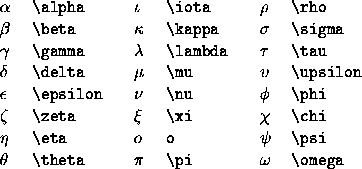
Mathematics is the branch of science that deals with the logic of shape, quantity and arrangement. Math is all around us, in everything we do.The founder of mathematics is considered to be as Pythagoras who gave the triangular concept or theorem. In the ancient 6th century B.C, the Greeks started the subject of mathematics only by the Pythagoras concepts. Later, Archimedes, a Greek mathematician, developed it and so he became the FATHER OF MATHEMATICS. Beginning in the 6th century BC with the Pythagoreans, the Ancient Greeks began a systematic study of mathematics as a subject in its own right with Greek mathematics. Around 300 BC, Euclid introduced the axiomatic method still used in mathematics today, consisting of definition, axiom, theorem and proof. The symbol for Pi has been in use for over 250 years. The symbol was introduced by William Jones, a Welsh mathematician, in 1706. The symbol was made popular by the mathematician Leonhard Euler.
Pi (π) is the 16th letter of the Greek alphabet, and is used to represent the most widely known mathematical constant. By definition, pi is the ratio of the circumference of a circle to its diameter. The Egyptians calculated the area of a circle by a formula that gave the approximate value of 3.1605 for π. The first calculation of π was done by Archimedes of Syracuse (287–212 BC), one of the greatest mathematicians of the ancient world. We might not use it yourself every day, but Pi is used in most calculations for building and construction, quantum physics, communications, music theory, medical procedures, air travel, and space flight.
Pi Approximation Day is observed on July 22 (22/7 in the day/month format), since the fraction 22⁄7 is a common approximation of π, which is accurate to two decimal places and dates from Archimedes.Throughout the history of mathematics, one of the most enduring challenges has been the calculation of the ratio between a circle’s circumference and diameter, which has come to be known by the Greek letter pi. From ancient Babylonia to the Middle Ages in Europe to the present day of supercomputers, mathematicians have been striving to calculate the mysterious number. They have searched for exact fractions, formulas, and, more recently, patterns in the long string of numbers starting with 3.14159 2653…, which is generally shortened to 3.14. Since the exact value of pi can never be calculated, we can never find the accurate area or circumference of a circle.
Some interesting facts about pi:
1. Pi is an irrational number that is it is not possible to calculate Pi by dividing an integer by any other number. 2. Pi is a never-ending and never-repeating number. 3. The symbol of Pi has been in use for about 250 years. 4. As the value of Pi is never-ending so we can’t find the true circumference or area of a circle. 5. In Greek alphabets, Pi is the sixteenth letter and in English also p is the sixteenth letter. 6. Pi is the ratio of a circle’s circumference to its diameter. 7. In the 19th century, William Shanks calculated the first 707 digits of Pi by hand but unfortunately, he made a mistake after 527th place. 8. A Japanese scientist, breaking all the previous records, with the help of Hitachi SR 8000 which is a powerful computer found 1.24 trillion digits of Pi. 9. Pi is mentioned in the Bible.– In ancient times, Archimedes is the first person who studied about Pi. 10. Albert Einstein was born on Pi Day. 11. There are no zeros in the first 31 digits of Pi.
Organic farming is an alternative agricultural system which originated early in the 20th century in reaction to rapidly changing farming practices. Organic agriculture is a production system that sustains the health of soils, ecosystems and people. It relies on ecological processes, biodiversity and cycles adapted to local conditions, rather than the use of inputs with adverse effects. Organic agriculture combines tradition, innovation and science to benefit the shared environment and promote fair relationships and a good quality of life for all involved. It is defined by the use of fertilizers of organic origin such as compost manure, green manure, and bone meal and places emphasis on techniques such as crop rotation and companion planting. Biological pest control, mixed cropping and the fostering of insect predators are encouraged. Organic standards are designed to allow the use of naturally occurring substances while prohibiting or strictly limiting synthetic substances.
Advantages of organic farming
Reasons for advocation of organic farming include advantages in sustainability, openness, self-sufficiency, autonomy/independence, health, food security, and food safety. Organic methods can increase farm productivity, repair decades of environmental damage and knit small farm families into more sustainable distribution networks leading to improved food security if they organize themselves in production, certification and marketing. During last few years an increasing number of farmers have shown lack of interest in farming and the people who used to cultivate are migrating to other areas. Organic farming is one way to promote either self-sufficiency or food security. Use of massive inputs of chemical fertilizers and toxic pesticides poisons the land and water heavily. The after-effects of this are severe environmental consequences, including loss of topsoil, decrease in soil fertility, surface and ground water contamination and loss of genetic diversity..
How is organic farming different from conventional farming?
While conventional agriculture uses synthetic pesticides and water-soluble synthetically purified fertilizers, organic farmers are restricted by regulations to using natural pesticides and fertilizers. An example of a natural pesticide is pyrethrin, which is found naturally in the Chrysanthemum flower. The principal methods of organic farming include crop rotation, green manures and compost, biological pest control, and mechanical cultivation. These measures use the natural environment to enhance agricultural productivity: legumes are planted to fix nitrogen into the soil, natural insect predators are encouraged, crops are rotated to confuse pests and renew soil, and natural materials such as potassium bicarbonate and mulches are used to control disease and weeds. Genetically modified seeds and animals are excluded.
While organic is fundamentally different from conventional because of the use of carbon based fertilizers compared with highly soluble synthetic based fertilizers and biological pest control instead of synthetic pesticides, organic farming and large-scale conventional farming are not entirely mutually exclusive. Many of the methods developed for organic agriculture have been borrowed by more conventional agriculture. For example, Integrated Pest Management is a multifaceted strategy that uses various organic methods of pest control whenever possible, but in conventional farming could include synthetic pesticides only as a last resort.
Nutrient management in organic farming
In organic farming, it is important to constantly work to build a healthy soil that is rich in organic matter and has all the nutrients that the plants need. Several methods viz. green manuring, addition of manures and biofertilizers etc can be used to build up soil fertility. These organic sources not only add different nutrients to the soil but also help to prevent weeds and increase soil organic matter to feed soil microorganisms. Soil with high organic matter resists soil erosion, holds water better and thus requires less irrigation. Some natural minerals that are needed by the plants to grow and to improve the soil’s consistency can also be added. Soil amendments like lime are added to adjust the soil’s pH balance. However soil amendment and water should contain minimum heavy metals. Most of the organic fertilizers used are recycled by-products from other industries that would otherwise go to waste. Farmers also make compost from animal manures and mushroom compost. Before compost can be applied to the fields, it is heated and aged for at least two months, reaching and maintaining an internal temperature of 130°-140°F to kill unwanted bacteria and weed seeds. A number of organic fertilizers / amendments and bacterial and fungal biofertilizers can be used in organic farming depending upon availability and their suitability to crop.
Limitations of organic farming
Proponents of organic farming have claimed that organic agriculture emphasizes closed nutrient cycles, biodiversity, and effective soil management providing the capacity to mitigate and even reverse the effects of climate change and that organic agriculture can decrease fossil fuel emissions
Nitrogen leaching, nitrous oxide emissions, ammonia emissions, eutrophication potential and acidification potential were higher for organic products. Excess nutrients in lakes, rivers, and groundwater can cause algal blooms, eutrophication, and subsequent dead zones. In addition, nitrates are harmful to aquatic organisms by themselves.
Organic farming requires 84% more land for an equivalent amount of harvest, mainly due to lack of nutrients but sometimes due to weeds, diseases or pests, lower yielding animals and land required for fertility building crops.While organic farming does not necessarily save land for wildlife habitats and forestry in all cases.
The variable nature of food production and handling makes it difficult to generalize results, and there is insufficient evidence to make claims that organic food is safer.
City derives from a French word meaning citizenry. A city is a large or important town. In the United States, cities are incorporated municipalities with local governments. In Great Britain, a borough with a bishop’s seat is called a city. As with the words village and town, city can also refer to the its inhabitants. It’s like watching Paris from an express caboose heading in the opposite direction—every second the city gets smaller and smaller, only you feel it’s really you getting smaller and smaller and lonelier and lonelier, rushing away from all those lights and excitement at about a million miles an hour.
City Expressions
Many interesting uses of the word city exist in English. For example, imagine you see a place with a lot of stray dogs. You might call it “dog city” to indicate that it is full of or indicative of dogs. A city slicker is someone who doesn’t know much about country life. If you say that you can’t fight city hall, you are saying there’s no way you will win in a battle against bureaucracy.
Advantages of City Life:-
City life has an advanced and well-equipped environment. People migrate to cities because of better job opportunities, stability and a decent income which is a lack in villages.
Cities have a huge number of schools, colleges or universities established. Hence, the city folks get proper quality education which is a primary factor for standard living.
Recreation and entertainment are plenty in the cities. People also get adequate opportunities to establish and showcase their talents here.
City life provides commercialization, banking systems, and entrepreneurial businesses. This attracts more people from townships to settle in cities.
Better transportation, sanitation, availability of water and drainage systems are seen in cities. The drainage of polluted water goes through treatment before getting dumped in lakes or rivers. This keeps a small check on pollution too.
Medical help is at fingertips when required. There are a number of hospitals and clinics and well-equipped doctors and nurses for people in need.
Anonymity in cities helps in escaping from the judgements of people.
Disadvantages of city life:-
Urbanization is increasing at a rapid pace, and currently, about 30-33% of Indians lives in cities. This rate tends to be around 40% by 2030. With the high population density, the quality of life in cities is expected to degrade and become unfit for living.
City life is a very busy one, developing every second to a better version of itself. This results in a loss of cultural qualities and flavours.
High demand for city life has resulted in congestion. Human population has increased a lot in city areas.
The city’s population increases day by day. This leads to an environment with polluted air, smog, unclean water supplies, noise pollution
It follows from the previous point that an increase in pollution rates in the cities brings in more health issues. People tend to fall sick more in cities due to the polluted environment which is unfit for living.
Unfair competition among businesses, an increase in crime rates and immorality of the people is more in the cities.
Increase in costs and expenditure is a vital problem for city dwellers. This creates a reason for more competition for gaining wealth and hence increases stress and crimes too.
Village Life
The word village comes from a French term referring to a group of buildings. That’s exactly what a village is—a small community in a rural area. Sometimes, larger towns incorporate the houses of a village as a municipality. Village can also refer to inhabitants of a village and is even applied to groups of animal dwellings.
Advantages of village life:-
A pollution-free environment is available in the rural/village areas only.
Scenic beauty and greenery of rural areas are prominent. This also attracts tourists from around the globe.
Rural areas have a scope for socio-economic benefits like reduction in prices of agricultural and consumer products, access to markets, public transport, employment opportunities, and better education and healthcare facilities.
The essence of folk and culture is prominent in these areas. This defines the rural areas uniquely.
Disadvantages of village life:-
Lack of higher education is a backlog for rural lives. This creates the main hurdle for better standards of living.
Rural areas have poor road connectivity. Over 40 per cent of India’s rural population remains outside the rural road network. According to the Planning Commission’s Working Group on Rural Roads, there are over 3.3 lakh rural habitations with no road connection.
Limited medical help persists in these areas. A counted number of hospitals and even lesser doctors are available. Hence at times, people are bound to move to city areas for sustaining life.
Rural life is difficult for women more because of lack of proper sanitation and toilets. The primary reason for this has to be the lack of educational opportunities.
Conclusion:-
Though the city life has many disadvantages, people flock there more for its advantages.
Improper road connectivity is one of the main reasons for stopping growth in rural areas. But the government is making situations better for rural India. The Pradhan Mantri Gram Sadak Yojana (PMGSY) is a step towards improving road connectivity in rural parts of the country.
Hence, the reduction of pollution in cities and the development of roads and infrastructure in rural areas will bring a balance between the two.
If you want to build an indepebdent free lance career right away then here is the solution, the book Pyjama profit is a free lancing guide, it has the answers of all the questions wandering in your mind whenever you think of this one word ‘freelancing’ grab your copy and start doing what you love to do and get paid for it.
So here is a short and concise review of the book.
The millennial’s guide to a sustainable freelance career, it is the tagline of one of the best selling books on Amazon, ‘PYJAMA PROFIT’ the authors of the book are Varun Mayya and Abhinav Chhikara. The books is all about their journeys from the freelancing to a successful and stable business, the co author of the book Varun Mayya says “Tommorow, if you put me in a strange country without any resources, all I need is a laptop and an internet connection and I know I’ll build myself an awesome life fairly quick.”
Pyjama profit is a modern guide to free lancing. The book talks about the in demand online skills, the different paths one can take to become an expert in specific fields and the freedom that freelancing allows to hone further skills, taking on bigger assignments. A stable income from freelancing was the bedrock that allowed the authors – Varun and Abhinav to pursue their dreams and passions. Now, they have shared their stories of what worked for them and how anyone, anywhere can thrive without being tied to a 9 to 5 job. The book is a perfect fit in today’s time as the freelance economy grows and so do the aspiration among millennials to find a work they love, and not just something that pays their bills.
Every year on July 20, International Chess Day is celebrated to honour the founding of the Federation Internationale des Echecs, also known as FIDES, in the year 1924. Since ancient times Chess has been a popular game and has been played around the world. ‘With the time Chess game and its rules are evolving. As per reports, Chess became a game of class and only upper class were able to afford this game in a long way. However, the merchandise class later went on to introduce this game to the rest of the people while travelling around the world.
World Chess Day history:
In the fifth century, chess was invented in India. It was called “Chaturanga” at the time. Chess is one of the most ancient games of the period. This game was then spread to Persia. When the Arabs invaded Persia, Chess became an important part of the Muslim population’s life and from there it spread to Southern Europe. Chess evolved in its current form in Europe during the 15th century. And by the late 15th century, it took the shape of a modern game. And beginning on July 20, 1966, the International Chess Day began to celebrate FIDE’s establishment.
CELEBRATION:
World Chess Day, celebrated around the world, is now also recognised by the United Nations. According to reports, UNESCO proposed the idea to celebrate this day as the International Chess Day, and it has been marked as such since 1966 after it was established by FIDE. However, plenty of professional chess players around the world already celebrate the day. A survey published on FIDE reveals that a surprisingly stable 70% of the adult population has played chess at some point during their lives. In countries as diverse as the US, UK, Germany, Russia and India, this number holds approximately the same amount.
CHESS RULES:
The ultimate aim in the chess game is to deliver a checkmate – trapping your opponent´s king. The term checkmate is an alteration of the Persian phrase “Shah Mat”, meaning literally, “the King is ambushed”, and not “the King is dead”, that is a common misconception.
The chessboard is made up of eight rows and eight columns for a total of 64 squares of alternating colors. Each square of the chessboard is identified with a unique pair of a letter and a number. The vertical files are labeled a through h, from White´s left (i.e. the queen side) to White´s right. Similarly, the horizontal ranks are numbered from 1 to 8, starting from the one nearest White´s side of the board. Each square of the board, then, is uniquely identified by its file letter and rank number. In the initial position setup, the light queen is positioned on a light square and the dark queen is situated on a dark square. The diagram below shows how the pieces should be initially situated.
Chess moves:
King can move exactly one square horizontally, vertically, or diagonally. At most once in every game, each king is allowed to make a special move, known as castling.
Queen can move any number of vacant squares diagonally, horizontally, or vertically.
Rook can move any number of vacant squares vertically or horizontally. It also is moved while castling.
Bishop can move any number of vacant squares in any diagonal direction.
Knight can move one square along any rank or file and then at an angle. The knight´s movement can also be viewed as an “L” or “7″ laid out at any horizontal or vertical angle.
Pawns can move forward one square, if that square is unoccupied. If it has not yet moved, the pawn has the option of moving two squares forward provided both squares in front of the pawn are unoccupied. A pawn cannot move backward. Pawns are the only pieces that capture differently from how they move. They can capture an enemy piece on either of the two spaces adjacent to the space in front of them (i.e., the two squares diagonally in front of them) but cannot move to these spaces if they are vacant. The pawn is also involved in the two special moves en passant and promotion.
Castling:
Castling is the only time in the chess game when more than one piece moves during a turn. This chess move has been invented in the 1500´s to help speeding up the game and improving balance of the offense and defense. During the castling, the king moves two squares towards the rook he intends to castle with, and the rook moves to the square through which the king passed.
Castling is only permissible if all of the following conditions hold:
Neither king nor rook involved in castling may have moved from the original position
There must be no pieces between the king and the rook
The king may not currently be in check, nor may the king pass through or end up in a square that is under attack by an enemy piece (though the rook is permitted to be under attack and to pass over an attacked square)
En Passant:
En Passant may only occur when a pawn is moved two squares on its initial movement. When this happens, the opposing player has the option to take the moved pawn “en passant” as if it had only moved one square. This option, though, only stays open for one move. The En Passant move was developed after pawns were allowed to move more than one square on their initial move. The idea behind this rule was to retain restrictions imposed by slow movement, while at the same time speeding up the game.
Pawn promotion:
If a pawn reaches the opponent´s edge of the table, it will be promoted – the pawn may be converted to a queen, rook, bishop or knight, as the player desires. The choice is not limited to previously captured pieces. Thus its´ theoretically possible having up to nine queens or up to ten rooks, bishops, or knights if all pawns are promoted.
First of all, One of the oldest games that is still in existence and is very popular so it tells how humans used to think back then and what’s the difference now.Earlier it was used to make war strategies . Now it enhances your problem solving capabilities. Nowadays whatever we do, whatever place we work in, the most important thing required to grow is the problem solving skills.
Chess improves the logical part of the brain. Every time you learn a new move, a new neuron is developed in your brain, which increases the size and capability of your brain’s neural network thus making your brain fast. So, in simple terms a person playing chess from his childhood will be grown up into a smarted person who will be good with logic, remembering stuffs and numbers.








 Eduindex
You must be logged in to post a comment.