Fabrication of Transparent Conducting Glass can bring down cost of smart windows, touch screens, solar cells

In recent years, the demand of transparent conducting glasses (TCG) with high light transparency has tremendously increased due to its wide range of applications in optoelectronic devices such as smart windows, solar cells, touch screen/ touch sensors, and so on.

Recently scientists from Centre for Nano and Soft Matter Sciences (CeNS), Bengaluru an autonomous institute of the Department of Science & Technology, Government of India have developed a novel recipe for fabrication of TCG which brings down its production cost by 80% compared to tin-doped indium oxide (ITO) based technology which is currently in use. Their current work has been published in the journal Materials Chemistry and Physics.

Industrially relevant TCG came up with conducting coatings such as tin-doped indium oxide (ITO) with a few hundred nanometres of thicknesses, where significant cost is attached to the slow deposition rates adopted for high-quality films.

The newly fabricated TCG consists of metal mesh on a glass substrate with thin overlayers of metal oxides. The design is attractive as the hybrid electrode possesses the excellent conductive property of the metal mesh (having a sheet resistance of about 5 ohms/square) while offering an oxide surface finish for the conductive glass, which makes it relate well with the existing industry requirements based on ITO.

The team lead by Prof. G U Kulkarni, along with his co-workers from CeNS and industrial partner Hind High Vacuum (HHV) Pvt. Ltd. have set-up a semi-automated production plant funded by DST-Nanomission in CeNS-Arkavathi campus for production of low-cost TCG.

Dr. Ashutosh K Singh, Scientist-C at CeNS who is working on this project, said, “We are fabricating various prototypes such as transparent heaters, transparent Electromagnetic Interference shields, smart window, etc. based on TCG to showcase its potential applications. Further, these electrodes have been sent out for field tests in various industries and R&D laboratories”.

These TCGs have been exhibited in various prestigious meetings and conferences such as Bengaluru INDIA NANO-2018 & 2020, ICONSAT-2018 & 2020, SPIE-2019, etc. for dissemination and marketing purpose and are also available for onsite testing and validation purposes.

Figure 1 (a) Reduction in the production cost of hybrid electrode wrt. ITO in (%) with sheet resistance values, (b) digital image of hybrid transparent electrode demonstrating its transparency and clarity.  

Thus, the TCG developed by CeNS have the potential to bring down the overall production cost of devices like smart windows, touch screens, solar cells, and so on due to its low-cost processing cost.

(Publication details:Ashutosh K. Singh, R. K. Govind, S. Kiruthika, M. G. Sreenivsasn, and G. U. Kulkarni, “Hybrid transparent conducting glasses made of metal nanomesh coated with metal oxide overlayer,” Materials Chemistry and Physics, 239, 121997 (2020)

DOI: https://doi.org/10.1016/j.matchemphys.2019.121997

For more details, Dr. Ashutosh K Singh (aksingh@cens.res.in) can be contacted).
E-LEARNING-CHANGING THE WAY OF EDUCATION.

ABOUT

In this era of Technological boom, e-learning has placed knowledge right at our finger tips, no matter where we are and at what time of the day we wish to study. Literature, Science, Math, Geography, History – you name it; we have it on the display screen of our tablets or phones at the swipe of our fingers.

Just one smart device and some nominal charge for internet connection would take us from the primary level of learning to even college education!e-learning doesn’t In this era of Technological boom, e-learning has placed knowledge right at our finger tips, no matter where we are and at what time of the day we wish to study.

E-learning doesn’t differentiate between a slow learner or a studious one because it helps set up an individualized pattern according to the pace of every student. It doesn’t even matter what our life situation is or how old we are, and is an affordable option for people who can’t meet expenses to purchase lots of books or enroll for tuition or coaching classes website.

WHAT E-LEARNING PROVIDES?

Online learning provides us with an audio-visual treat and 3-dimensional perception that help us comprehend concepts in a much better way. We are open to taking tutorials not only from Indian teachers, but also from people belonging to different parts of the world.

We also get to divide study timings as per our convenience. Literally, no more carrying around books and bags – just sit, stand and walk while learning!

Yet, online learning tempts one to browse through various subjects on a superficial level, rather than going into deep study. This practice, in turn, leads to insufficient understanding of certain basic concepts which might affect our advanced learning.

This is because most online courses do not follow a structured pattern or work assessment. So some students might fail to meet the expected standard of education.

Also, using technology has its own issues like slow internet connection, power shortage crises and cyber security concerns.

If learners use e-learning software, they require devices that are only compatible with that software which is quite a costly investment, at least initially.

One ought to admit though , communication via human connections is a different pleasure altogether, that cannot be substituted by electronic devices in which computer proficiency is essential.

E-LEARNING OVER CLASSROOM LEARNING :

In traditional classroom settings, getting to share ideas with friends, playing with them during break-time, spending some time with nature and listening to encouraging talks from elderly teachers do develop kids’ social skills and empathetic approach.

We cultivate mutual respect and take responsibility for our actions and become better individuals through human connections.

Speaking of health issues, prolonged screen time and sedentary habits eventually lead to dry eyes and obesity. Unhealthy sitting postures cause backache and stiff neck too.

When bored with studies, students play online games and watch inappropriate stuff that could lead them to bad ways or unhealthy lifestyle. Online addiction has been lately categorized as a mental disorder.

In short, e-learning can either shape us into brilliant personalities or can degrade us to lazy and indifferent individuals, depending on our responsible usage & proper supervision of students by adults

 between a slow learner or a studious one because it helps set up an individualized pattern according to the pace of every student.

It doesn’t even matter what our life situation is or how old we are, and is an affordable option for people who can’t meet expenses to purchase lots of books or enroll for tuition or coaching classes.

Online learning provides us with an audio-visual treat and 3-dimensional perception that help us comprehend concepts in a much better way. We are open to taking tutorials not only from Indian teachers, but also from people belonging to different parts of the world.

We also get to divide study timings as per our convenience. Literally, no more carrying around books and bags – just sit, stand and walk while learning!

Yet, online learning tempts one to browse through various subjects on a superficial level, rather than going into deep study. This practice, in turn, leads to insufficient understanding of certain basic concepts which might affect our advanced learning.

This is because most online courses do not follow a structured pattern or work assessment. So some students might fail to meet the expected standard of education.

Also, using technology has its own issues like slow internet connection, power shortage crises and cyber security concerns.

If learners use e-learning software, they require devices that are only compatible with that software which is quite a costly investment, at least initially.

One ought to admit though , communication via human connections is a different pleasure altogether, that cannot be substituted by electronic devices in which computer proficiency is essential.

In traditional classroom settings, getting to share ideas with friends, playing with them during break-time, spending some time with nature and listening to encouraging talks from elderly teachers do develop kids social skills and empathetic approach.

We cultivate mutual respect and take responsibility for our actions and become better individuals through human connections.

Speaking of health issues, prolonged screen time and sedentary habits eventually lead to dry eyes and obesity. Unhealthy sitting postures cause backache and stiff neck too.

When bored with studies, students play online games and watch inappropriate stuff that could lead them to bad ways or unhealthy lifestyle. Online addiction has been lately categorized as a mental disorder. In short, e-learning can either shape us into brilliant personalities or can degrade us to lazy and indifferent individuals, depending on our responsible usage & proper supervision of students by adults.

Journey of the Technologies that shaped today’s world : Steam Engine

Ever since the discovery of steam engine which set off the industrial revolution in 18th century, the science and technology has advanced life consistently. The first technological revolution was brought by steam engines. They revolutionized how people and things moved around.

Till then people depended on manual labour by humans or animals. Such method was heavily dependent on the availability and condition of the roads. Often uncomfortable and it would take a daring man or woman to make arduous journeys. For carrying the things around it would take days. The medium available were unreliable and a patch of bad weather could have totally “derailed” the plans- if that word was even available in dictionary then. 😊

One of the earliest applications of the steam engines was removing of water from the mines. Mines in that period were highly unsafe due to undetected poisonous or combustible gases like Methane and sudden flooding of mines by ground water. Flooding claimed lives and forced mines to shut down. As mines were thousands of feet deep, manually removing the water was next to impossible. Steam engines came as a godsend for the industry.

The steam engines also changed the way people travelled and worked. The ubiquitous coal and water became the resources to do works that would have required hundreds of humans or animals. In fact, the earlies unit to measure the power of machine was “horsepower”. To make people understand how efficiently the machines worked, the inventor of steam engine- James Watt used the term Horsepower to express the power of the machine. 1 horsepower which is equal to 745.7 Watts in SI unit, was an estimate of how much power an adult horse puts in. Even today, many automobiles express the rating of their engines in terms of horsepower.

The potential of the steam engine was soon realised by other sectors as well. Governments and businesses invested in building tracks to connect remotest of areas to ensure smooth movement of people and goods. In fact, India was one of earliest country to get a railway track and a train. This was despite having the oppressing British rulers who probably never had anything good in their hearts for India to see the rays of development. Sole purpose of the track was to facilitate movement of goods especially the raw materials for the British industries from the remote parts of India to the ports to be carried out in ships. The tracks must have speeded the depletion of the resources of India, but the sunshine in the cloud was the railway tracks.

In fact, to this date Indian Railways is one of the most efficient and largest travel organization in the world. Before pandemic brought the wheels to a halt, Indian Railways stopped work on only two days in their history of 167 years. Ferrying hundreds of thousands of passengers and thousands of tonnes of raw materials and finished goods on a daily basis, Indian Railways is truly a lifeline for the Indians.

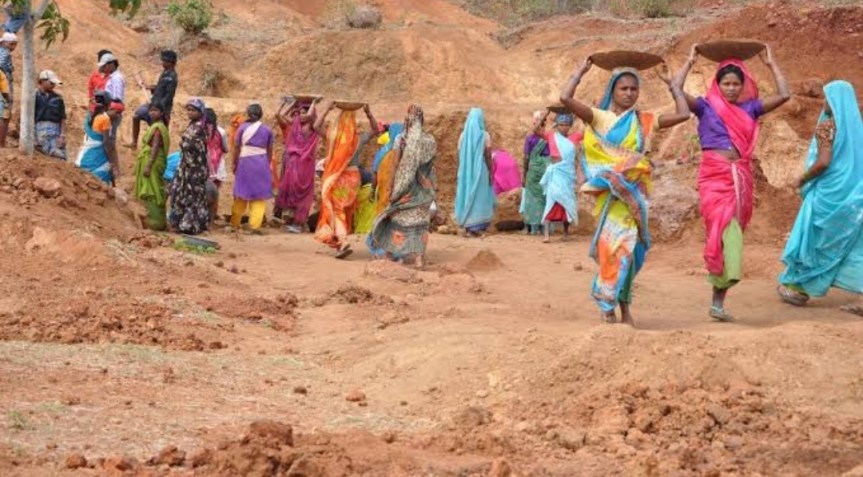
100% household tap connections in rural areas of West Bengal

In continuation of various initiatives taken up to improve the lives of people of this country, ‘Jal Jeevan Mission’ was launched by Government of India last year to provide every rural household in the country a Functional Household Tap Connection for supply of potable water in adequate quantity and of prescribed quality on regular and long-term basis. Following the true spirit of cooperative federalism, State Governments are implementing this flagship programme to realize the objectives of the Mission so as to ensure ‘ease of living’ of people in rural areas as well as reduce the ‘drudgery’ of women, especially girls. This life changing Mission focuses on the key principles of ‘equity and inclusiveness’, i.e. every family in the village gets tap water connection in their households. With a departure from earlier programmes, JJM stresses on service delivery, rather than infrastructure creation.

The Annual Action Plan (AAP) is very important for timely implementation to achieve the goals of the mission, for which very intensive exercise was carried out in the Ministry in last couple of months and all the States have presented their annual action plan for JJM. West Bengal is yet to present its AAP before the National Committee of the Ministry of Jal Shakti.

            West Bengal has 1.63 Crore rural households spread over 41,357 villages, but only 2 lakh households have a tap connection in their premises. In 2019-20, against a target of 32.24 lakh households to be given tap connections, State could provide only 4,720 household tap connections. In 2020-21, the target fixed for providing tap connections is 64.43 lakh households including the shortfall of about 32.19 lakh from the previous year. This needs rigorous planning and robust implementation strategy to achieve the target.

            In 2019-20, Rs. 993.88 Crore of Central funds was released to the State, however only Rs 421.63 Crore was utilized and rest amount is lying unspent. Further, to provide potable water in Arsenic/ Fluoride-affected habitations, a sum of Rs. 1,305 Crore was provided, out of which Rs. 573.36 Crore is still lying unspent. Thus, as on 1.4.2020, State has an opening balance of Rs. 1,146.58 Crore as Central Share to provide tap water to rural households. During 2020-21, fund allocation to West Bengal has increased to Rs. 1,610.76 Crore. With an opening balance of Rs. 1,146.58 Crore, the State has an assured availability of Rs. 2,757.34 Crore of Central share funds. Therefore, in 2020-21, along with State share about Rs. 5,515 Crore will be available under Jal Jeevan Mission to provide household tap connections in West Bengal. Further, additional funds too can be provided based on progress of implementation in form of performance incentive under JJM. Therefore, the State needs to make a monthly plan for physical progress in terms of tap connections to be provided and expenditure plan for prudent financial management to spend the huge amount of funds available with State.

As Government of India is working in tandem with States to achieve the goals of JJM within the time frame, focus is on retrofitting/ augmentation of existing water supply systems to provide tap connections to remaining households. Out of total 41,357 villages In West Bengal, 22,155 (54%) villages already have piped water supply systems. However, only 2 lakh households in these villages have tap connections. Those which have been left out in such villages belong to poor and marginalized sections of the society. There is a potential to provide 1.08 Crore household tap connections in these villages. State needs to push this agenda forward with utmost speed to provide household tap connections in next 4-6 months in a ‘campaign mode’. Priority is to be given to saturation of villages in quality-affected habitations, aspirational districts, SC/ ST majority villages/ habitations and villages covered under Sansad Adarsh Gram Yojana.

Potable water supply to water quality-affected habitations is given top most priority under JJM and in view of interim order of National Green Tribunal, State has to ensure piped water supply to all households in 2,414 Arsenic and Fluoride affected habitations before 31 December, 2020. In case, potable water piped connections cannot be ensured before December, 2020, as an interim measure, potable water @ 8-10 lpcd for drinking and cooking purpose is to be provided by installing community water purification plants (CWPP).

West Bengal would receive Rs 4,412 Crore as 15th Finance Commission Grants to PRIs, 50% of which will mandatorily be spent on water and sanitation. There is need for convergence planning to be done by the State under various programmes like MGNREGS, JJM, SBM (G), 15th Finance Commission Grants to PRIs, District Mineral Development Fund, CAMPA, CSR Fund, Local Area Development Fund, etc. at village level and Village Action Plan (VAP) of every village is to be prepared by dovetailing all such funds for carrying out water conservation activities to strengthen water source leading to drinking water security.

In all villages, IEC campaign along with community mobilization is to be taken up to make JJM truly a people’s movement. State has to engage women Self Help Groups and voluntary organizations working in social sector and natural resources management to mobilize the rural community for creation of in-village water supply infrastructure as well as for their operation and maintenance.

To achieve the objectives of the Mission to provide tap connection to each rural household in every habitation/ village on long-term basis, skilled manpower in areas like masonry, plumbing, fitting, electricity, etc., will be needed for creation of water supply schemes and their operation & maintenance and such manpower will be required in each village/ habitation. Ministry of Jal Shakti has roped in National Skill Development Corporation to create a pool of skilled Human Resource in rural areas to make villages a self-reliant unit without depending on others for regular upkeep and maintenance of water supply systems.

In the prevailing CoVid-19 pandemic situation, State needs to start works related to water supply and water conservation immediately in villages so as to provide works to the skilled/ semi-skilled migrants to provide livelihood as well as to ensure potable water in the households of rural people as well as boost the rural economy.

The Ultimate Productivity Hack is Saying ‘No’ and Save Your precious Time

If someone ask you to help them in their project?? You say yes or not . It is uncomplicated to say yes every request on your time when your goal or aim of your life are opaque and you have not inspired vision for . your upcoming life . So you have a unique opportunity to decide how you spend your precious time . To stay calm tension free and minimize your stress you have to learn and practice how you gracefully say no. May be it can hurt , it can take a form of anger and disappointment or show your rudeness toward the person you are saying no . If you have hope or any chance to work and collaborate with that person in future you have to go with good relationship with that and may be saying no in wrong way can destroy those relation with that I am so sure , so that we must remember or know the difference in saying no or saying yes to something more important .

There are few hack or tricks to saying no very gracefully and gently. 1.Know How Valuable Your Time Is. When you know the importance of your time than it is very easy to say no. You have to know and remember your commitments and how valuable your precious time is then someone is going to ask you to give some of your very precious time to knew commitments , you already know that you have already a lot of commitments and you just can’t do it so , just tell them my plate is overloaded as it is . Firstly go and set your priorities right now so no comes as a natural reply to anything which is less important and not included in your priority list . So even if you have extra time and free early from your work and literally which is very rare in our day to day life , for me more commitment means less time for me . My family , my loved ones and my close one who are important to me more than any thing so if I free earlier from my work and I have extra time so I will give it to my family . So no comes naturally when you see your priorities ands spare time for your family .

2. Practice the two letters word ‘NO’. To master this word you should practice saying no in day to day life and you have to be used to from this word . As you know the practice makes a man perfect. If someone is extremely insisting you again and again to take this commitment and involved with him , just keep saying no in the end they will get the message . Sometime repeating the word is the only way to get a message through it . Say no as often as you can in great way to better addict from the word and more comfortable with saying the word and keep control on your mind as well as on your feelings to divert from your path . Recall your resolution again and again to make it memorize .

3. Be unapologetic for guarding your time . Don’t apologize whenever you are saying no to anyone . Usually when people saying no as a human nature they start saying I am sorry and they regret that they say no and they overthink about it . You may think it is polite to say sorry and regret in front of the person and in personally , but apologizing just make the sound weaker and represent you weaker . You need to be firm , unapologetic and stick to your decision about guarding your time and saving your time . You may say to the person that I know you are hoping will be going to work together on this project but I have a lot of work already so I will not , I need to say no.

4. Give A Thought Before Saying Yes. If someone offer you new project and assignment to do, and you think to consider this then you can tell let me check my schedule and I’ll back to you. I can’t participate in one hour meeting but I am free after 8 on tomorrow. You can postpone your meeting or your new commitment.

5.Pre-empt The request It means prevent the request from being made. We can understand by taking a example means if someone is making a plane or postpone any meeting for any other day, you say normally that on that my schedule is too tight I can’t make any other plane or my schedule is already set, I can’t change it. So the person already understand that indirectly that you can’t attempt this or saying no. Prevent and pre-empt is quite pretty similar. Both giving the same message most of the time.

6.You Can’t Be Nice To Everyone Around You. Just stop being nice to everyone around you, but it is important to be polite. By doing this you make it easy for the for people to grab your time and money and they are going to continue it. Being nice by say yes all time on all help and commitment only hurt you and make you divert from your main task or goal of your life . You cannot even fullfil your all commitment which do to all. Keep in mind that you can’t happy or satisfied all the person around you.

7. Saying The Hardest No. Means say no in your work place like you already have a lot project to do within due date. And boss offer you another project you have to same no them politely by telling consequences that you have already a lot of project to do and I have to do it within due date so if I add this new one my pre project got disturb and they suffer from lack of time. But I can’t do this part of this project. You can do this very politely and strictly also means you are very much busy with you current projects.

8.Its Not You It’s Me you can appreciate the project which offered to you but it’s my bad that I will not participate in this project you can say say very humble no.

You can say that you have to collect all the energy from different directions and put it in the direction of your goal . And this going to make your secret of your success. You know the most effective people concentrate on their Areas of excellence this is ,on the thing they do best and on those high impact activities that will advance their lifework. We can take an example Jazz great Louis Armstrong did not spend his time selling tickets to his shows and seeting up chairs for the audience. He concentrate on his point of brilliance: means playing trumpet.

Steal time from all those extra commitment and devote and add it to those things which is fruitful for future and make your career. Learn to say no which is not important in your life. Learn this art this is very helpful to succeed in your life and make time for you and your closed ones.

How can Start-ups and Businesses overcome the downturn because of COVID-19?

The COVID-19 has created a pandemonium for start-ups and businesses all around the world. Most of the start-ups and businesses are facing a downturn in their financial market. We know it’s a very hard time for all, and we all are trying very hard to survive through the pandemic. Most of the employees are in fear of losing their job security. The start-up entrepreneurs are afraid of not getting any proper upcoming projects. Every start-up enterprise and business are going through terrible times now, financially. The employees are trying to survive without pay. The economy of the country is degrading day by day. 

Hence, we are here to see what can start-ups and businesses do to overcome the downturn because of COVID-19. If we have the will to make progress, we are surely going to overcome this pandemic. Even if the market is not as fast-paced as before, we still can develop the businesses financially. All we need to have is a proper strategy to make the progress happen, to survive COVID-19. Here is a list of strategies that start-ups and businesses can follow to overcome the downturn.

Strategies to overcome downturn due to COVID-1

Communicating with regular clients 

Every business company or a start-up must have a regular set of clients. Try to communicate with your customers regularly. Even if the pandemic resists you from gaining any new project, you will still have your old clients. Try to keep your old client satisfied. You will get the support you need from regular clients.

Manage your team for new strategy plans

Your old strategies won’t be of any help now. You need new ideas to make new strategies. To have new ideas, you need a working team led by a strong leader. The leader has to make the team members understand how important it is to make strategies. If you want to overcome the financial loss your company has faced, you need to strategize everything. 

Make small plans rather than bigger ones

Your only goal, for now, is to survive the pandemic with as low financial loss as possible. So, make smaller plans rather than long-term plans. You should have a plan for the upcoming month, rather than the year. Plan every day out and execute the plan meticulously.

Pay attention to investment

Now, you won’t have a lot of funding. Your company would already suffer heavy losses, due to a lack of new projects. Hence, try to keep the investment at a bare minimum. Don’t invest in huge projects at the moment. Look for smaller projects. In this way, you can save funds for your company. This is not the time to invest your money, because you have no idea what the future holds.

New ideas and methods

You need to understand what is important at the moment. You have to impress your clients, and for that, you need to bring in new ideas. You have to focus on the necessity rather than the exuberance. Every new idea has to be convenient and needed by the customers. There is no need for fancy ideas. It’s highly unlikely that a customer would be interested to invest in any fancy project. You have to modify your methods according to the need of the moment.

How to save your company from financial loss?

Financial loss is inevitable for any company in the current scenario. But you can save your company from becoming bankrupt. You have to make your employees work towards the satisfaction of the existing clients. The employees would get paid based on their work. You have to make a new rule for your employees, which would stay consistent until the company is back on track. Your employees would get paid for the amount of work they are going to produce. You need to plan out work for every employee you have. Even for a start-up company, you need to keep your employees as well as your clients happy. Your employees are the pillars of your company. In this way, you can satisfy both the clients and the employees. Apart from that, you have to make small teams of members, headed by one leader. Make them work on small projects. They would get paid based on every successful project they execute. In this way, your company won’t suffer from a lack of work. Also, your employees would get paid for executing the projects wonderfully.

The best way to overcome financial loss is to not invest huge amounts on any projects now. Take up small projects, which would be easier for the employees to finish, and also in time. Try to invest less as much as possible. Only invest in projects you think would be fruitful for your company at the moment.

How to make plans and strategies to overcome financial loss?

The focus should be on new plans and strategies, for a small amount of time. Once the pandemic ends, the situation of the company would improve for the better. Now, you need to focus on new plans. Have a team of members who would give you proper strategies regarding new projects. The projects have to go according to the strategized plan. Every project should be well planned and simple. All the employees have to keep in mind, that it is better to have simple plans to work on, rather than complicated ones.

Therefore, it is not hard for any start-up or business to overcome downturns. Your employees are your strength. You all can work together to keep your company out of financial loss and debt. You need to focus only on what is needed and how you can work together to develop for the better. Work with your employees and plan out the upcoming months properly to achieve success. Your company will progress if you execute the plans properly. The more united you are with your employees, the better it would be for the company.

Benefits of coffee.

Coffee is a brewed drink prepared from roasted coffee beans, the seeds of berries from certain Coffea species. Once ripe, coffee berries are picked, processed, and dried. Dried coffee seeds are roasted to varying degrees, depending on the desired flavor.

Not only can your daily cup of coffee help you feel more energized, burn fat and improve physical performance, it may also lower your risk of several conditions, such as type 2 diabetes, cancer and Alzheimer’s and Parkinson’s disease. In fact, coffee may even boost longevity.

  1. Two cups of coffee can cut post-workout muscle pain by up to 48%. From the Journal of Pain, March 2007
  2. Increase your fiber intake
    A cup of brewed coffee represents a contribution of up to 1.8 grams of fiber of the recommended intake of 20-38 grams. From the Journal of Agricultural and Food Chemistry .
  3. Protection against cirrhosis of the liver
    Of course, you could just cut down on the alcohol intake. From the Archives of Internal Medicine )
  4. . Another more recent study also showed coffee’s liver protecting benefits. Yet another study showed that both coffee and decaffeinated coffee lowered the liver enzyme levels of coffee drinkers. This study was published in the Hepatology Journal.
  5. Lowered risk of Type 2 Diabetes
    Those who consumed 6 or more cups per day had a 22% lower risk of diabetes. From the Archives of Internal Medicine . A recent review of research conducted by Harvard’s Dr. Frank Hu showed that the risk of type II diabetes decreases by 9% for each daily cup of coffee consumed. Decaf coffee decreased the risk by 6% per cup.
  6. Lowered risk of Alzheimer’s disease
    There is considerable evidence that caffeine may protect against Alzheimer’s disease. From the European Journal of Neurology . A recent study also isolated the compounds in roasted coffee that may be responsible for preventing the build-up of the brain plaque believed to cause the disease. 
  7. Reduces suicide risk and Depression
    A 10-year study of 86,000 female nurses shows a reduced risk of suicide in the coffee drinkers. From the Archives of Internal Medicine. Another study conducted by the Harvard School of Public Health found that women who drink 4 or more cups of coffee were 20% less likely to suffer from depression.

These are some of the benefits of the intake of caffeine.

Jal Jeevan Mission in Punjab

Union Minister of Jal Shakti, Shri Gajendra Singh Shekhawat has complimented the Chief Minister of Punjab, Captain Amarinder Singh for taking steps to provide tap connections to all rural households by March, 2020. In his letter he thanked the Chief Minister for showing his commitment towards the ethos of Jal Jeevan Mission.

         Minister expressed optimism that the State will not only provide remaining households with tap connections, but potable water service delivery in adequate quantity of prescribed quality on regular & long-term basis will be ensured to all households as envisaged under the Jal Jeevan Mission (JJM).

Minister stressed that funds to the State is provided by Government of India based on output in terms of number of FHTCs provided and utilization of funds. To that effect in 2019-20, Punjab was allocated and provided Rs. 227.46 Crore as Central share, out of which the State could utilize only Rs. 73.27 Crore. With opening balance of Rs. 257 Crore along with allocation of Rs. 362.79 Crore in 2020-21, Punjab has assured availability of Rs. 619.89 Crore Central fund. With State’s matching share, Rs. 1,239.78 Crore will be available under Jal Jeevan Mission to provide tap connections to families in rural areas of Punjab in 2020-21.

Union Minister requested the State to expedite the planning and implementation, in order to ensure that every household is provided with tap connections by March, 2022. He impressed upon the CM to focus on retrofitting/ augmentation of existing water supply systems in villages to provide household tap connections to the remaining households, mostly belonging to poorer section of the society. He urged the CM to provide remaining households with tap connections in next 4–6 months in a ‘campaign mode’ to provide 14 lakh tap connections by taking up augmentation and retrofitting of such schemes and these villages can become ‘Har Ghar Jal Gaon’.  While planning, priority should be given on saturating villages in water scarce areas and aspirational districts, & villages covered under Sansad Adarsh Gramin Yojana.

Since, potable water supply to water quality-affected habitations is a top priority under JJM and in the light of interim order of National Green Tribunal, Union Minister requested the CM to ensure piped water supply to all households in Arsenic and Fluoride affected habitations before December, 2020. In case, potable water piped connections cannot be ensured before December, 2020, as an interim measure potable water @ 8-10 lpcd for drinking and cooking purpose is to be provided by installing community water purification plants (CWPP).

Keeping the 73rd Constitutional Amendment, Jal Jeevan Mission mandates that local village community/ Gram Panchayats and or its sub-committee/ user groups are involved in planning, implementation, management, operation and maintenance of water supply systems in villages to ensure long-term sustainability of water supply schemes to achieve drinking water security.

In 2020-21, under 15th FC Grants to PRIs, Rs.1,388 Crore  is allocated  to the State, 50% of which is to be spent mandatorily on water and sanitation The State has been requested to utilize all available resources through convergence of various programmes like MGNREGS, SBM (G), 15th Finance Commission Grants to PRIs, CAMPA, CSR Fund, Local Area Development Fund, etc. for water supply works at village level and Village Action Plan of every village is to be prepared by dovetailing all such resources.

In the wake of COVID-19 pandemic situation, issue of drinking water gains prominence. At present, there is perhaps no higher priority but to ensure citizens have access to clean water for drinking and multifarious domestic uses. A tap at home will not only help practicing social distancing, but will also ensure better hygiene and hand-washing routine. Besides, the State will also help its local people and migrant workers in providing them with employment through Jal Jeevan Mission.

CRICKET GETS PROVISIONAL GREEN LIGHT TO RESUME

It’s been more than two months since international cricket across the world stopped due to the Corona Virus pandemic, the entire sporting calendar has been left shattered by the pandemic which has forced several major events to be cancelled or suspended ,and many of those involved with the game are starving for some live action. On 19th May, the International Cricket Council released its ‘back to cricket’ guidelines for a phased return..After a long wait, England and West Indies look set to finally end cricket’s hiatus as the two sides will lock horns in a three-match Test series in July this year. The England Cricket Board (ECB) announced the schedule for the three-match series which remains to subject of clearance by the UK government. The matches will be played behind closed doors with no fans at the stadium. ICC made training mandatory for resumption of cricketThe International Cricket council (ICC) issued on May 19 guidelines that highlighted the importance of training before resuming cricket operations, pointing out fast bowlers. The apex body has issued specific guidelines considering fast bowlers’ workload and the risk they run of getting injured.The ICC also suggested format-specific training periods for bowlers all over the world, allowing them a minimum of 5-6 weeks of training, with the last three weeks involving bowling at match intensity in order to facilitate their return to T20Is.           

CRICKET SITUATION IN INDIA                                      

The government eased the lockdown(unlock 1.0) to contain the coronavirus and allowed sportspersons to use stadiums, leading to media reports that the Board for Control of Cricket in India (BCCI) will come up with guidelines for training by the end of June. BCCI had earlier postponed the new season of the Indian Premier League (IPL) indefinitely and is yet to take a call on the fate of the tournament.India is scheduled to tour Sri Lanka in August for limited-over series and according to ICC guidelines, the minimum preparation window would be six weeks (42 days). So, Indian cricket team needs to start its training by the end of June or early July to fulfil the ICC rules.Indian cricketers might resume training at their nearest stadiums once the government eases the restrictions in the fourth phase of the lockdown. BCCI Treasurer Arun Dhumal said BCCI is exploring options to see how players can resume skill-based training. With all cricketing action suspended in the wake of the coronavirus pandemic, players have been making the most of their time at home.Despite being confined to their homes, cricketers have been following a fitness routine provided to them and are keeping themselves fit with the help of indoor exercises. However, Dhumal stressed that BCCI wants to focus on skills training once restrictions are eased. He also stated that the board has a roadmap ready for the resumption of training and matches post lockdown.

Clarification over Tiger Deaths in the Country during last 8 years.

It has come to light that some section of media has presented the figure of tiger deaths in the country, in a manner which is a lopsided view of tiger conservation in the country and has apparently attempted to malign efforts of the Government of India in this regard and sensationalize the issue.

The National Tiger Conservation Authority(NTCA),a statutory body of the Ministry of Environment, Forest and Climate Change would like to put across the following :

Due to efforts of the Government of India thorough the National Tiger Conservation Authority, the tiger has been taken from the brink to an assured path of recovery, which is evident in findings of the quadrennial All India Tiger Estimation conducted in 2006,2010,2014 and 2018.These results have shown a healthy annual growth rate of tigers at 6%, which offsets natural losses and keeps tigers at the habitats carrying capacity level, in the Indian context. For the period 2012 to 2019, one can observe that the average tiger deaths per year in the country hover around 94, which is balanced by the annual recruitment as highlighted by this robust growth rate. In addition, the National Tiger Conservation Authority has taken several steps under the ongoing Centrally Sponsored Scheme of Project Tiger to address poaching,which too,is significantly controlled as seen in the confirmed poaching and seizure cases.

The National Tiger Conservation Authority maintains the highest standards of transparency in so far as making tiger death statistics available to the citizen through its website as well as dedicated portal – www.tigernet.nic.in, so that people can make a logical assessment, if they desire. The presentation of data over a long time frame spread across 8 years indicates an intent to imprint the gullible reader with large numbers which may cause undue alarm. Also, not adequately covered is the fact that 60 percent of tiger deaths in India are not attributable topoaching.

It is also pertinent to mention that the NTCA, through a dedicated Standard Operating Procedure, has a stringent protocol to ascribe cause to a tiger death, which is treated as unnatural, unless otherwise proved by the State concerned through submission of necropsy reports, histopathological and forensic assessments besides photographs and circumstantial evidences. It is only after a detailed analysis of these documents that cause is ascribed to a tigerdeath.

While it is appreciated that figures as available on the NTCA’s website and as provided in the RTI reply have been used in these reports, the manner in which it has been presented causes alarm and does not take into account the gamut of processes that go into dealing with tiger death in the country and the natural gains that have been made in tiger conservation,as a result of sustained technical and financial interventions by the Government of India under its Centrally Sponsored Scheme of Project Tiger being steered by the NTCA.

It is expected that media, will inform the aforesaid facts, to the country so that there is no sensationalism and citizens are not led to believe that there is cause for alarm.

N-E Region has emerged as a role model of development & Corona Management

Union Minister of State (Independent Charge) Development of North Eastern Region (DoNER), MoS PMO, Personnel, Public Grievances & Pensions, Atomic Energy and Space, DrJitendra Singh today launched a Booklet and its e-version on one year achievements of the Ministry of Department of Development of North Eastern Region, MDoNER here. Secretary Ministry of DoNER and other senior officers of the Department were present on the occasion. Secretary NEC and other senior officers attended the launch through a Video Conference from Shillong.

In his address Dr. Jitendra Singh said that North Eastern Region has emerged as a role model in more than one way. After emerging as a successful model for development in the last six years, the region has also become a role model in Corona management and again by reverting back to normal working conditions, it has presented a model for the entire country to emulate the same. Dr Singh said that this has become possible due to priority and patronage, the North Eastern Region received by Prime Minister Narendra Modi Government in the last six years.         

Dr. Jitendra Singh congratulated the team MDoNER for achieving 100% expenditure during 2019-20 andsaid that there has been a significant development in terms of Road, Rail and Air connectivity, helping facilitate the movement of goods and persons not only across the region but also across the country. So far, the region has received more than 400 tonnes of Air Cargo supply, apart from parcel facilities. He said that Bamboo will get a special impetus in post COVID era and the region will witness young entrepreneurs making a mark in different fields.

The Minister stated that last one year has seen significant development in Infrastructure, Energy and other Sectors in the North Eastern Region.Under Govt. Policy of earmarking at least 10% of GBS for development of NER, Rs. 53,374 Cr were provided to NE States at RE stage by 55 non-exempt departments. Railways allocated of Rs.4745 Cr in addition to GBS. The allocation under 10% GBS has been rising sharply reflecting the focus of Hon’ble PM on North East.

Some of the major projects which have been approved, started or completed in the last one year in the NER and significant achievements of the Ministry of DoNER are mentioned below:

  1. Approved at a cost of Rs. 9265 Cr. Indradhanush Gas Grid Project would be a 1656 km long North East Gas Pipeline Grid covering all eight States. This would provide clean energy to NER and boost industrial growth without pollution. This would greatly help in preserving NE environment in its pristine form.
  1. The work on Greenfield Hollongi Airport for capital connectivity to Arunachal Pradesh,has started. The project with an estimated cost of Rs.955.67 Cr.is likely to be completed by December, 2022.
  1. Railways has completed Belonia-Sabroom (39.12 Km) Railway-line for providing easy access to Southern Tripura and Chattogram Port in Bangladesh.Doubling of Hawaipur-Lumding,25.05 Km long Section of New Jalpaiguri-Lumding Project has also been completed.

Sanction of major new works include (i)Doubling of New Bongaigaon to Aghri section via Rangia (142 km) at a cost of Rs.2042.51 Cr.; (ii) Bridges on Brahmaputra at Saraighatand TezpurSilghat at estimated cost of Rs.888 Cr & Rs.3512 Cr respectively; (iii) electrification of entire 2352 km long BG railway network of NER at an estimated cost of Rs.2293 Cr.

  1. In the roads sector,35 National HighwaysProjects having a lenth of 536 Km, with an estimated cost of Rs.7707.17 Cr have been awarded.  3 projects (66 km length) have been completed in Arunachal Pradesh.
  1. Bulk cargo and container movement from Kolkata and Haldia Ports to Guwahati Terminal via Indo-Bangladesh Protocol (IBP) Route and NW2 (Brahmaputra) has started. Operationalisation of this waterway would lead to and great savings in logistics cost. IBP route is being further developed in Bangladesh portion at estimated cost of Rs.305.84 Cr.
  1. KrishiUdaan Scheme launched in Union Budget 2020-21 has been operationalised and Transport of agricultural produce such as pineapple, ginger, kiwi, organic produce has commenced from Bagdogra, Guwahati and Agartala Airports.
  1. All impediments (legal, political and environmental) to Subansiri Hydro Power project in Arunachal Pradesh have been removed and the work on 2000 MW project(stalled since 2011) has started and is expected to be completed by 2023. 

Hon’ble Minister stated that the expenditure of Ministry during the last one year at Rs 2803 Cr has been highest over any one-year period. The expenditure of the Ministry in FY 2019-20 has been Rs 2670 Cr, 100% of the RE allocation has also been the highest for any financial year. The other significant achievements are:

  1. 215 Nos ongoing projects worth Rs.2800 Cr have been completed and 152 Nos of new projects worth Rs.2286 Cr have been sanctioned under various Schemes of MDoNER/NEC.
  1. Fighting COVID-19 Apart from release of Rs.7923.78 Cr by Ministry of Finance and Rs.235.59 Cr by Ministry of Health and Family Welfare, Rs. 25 croresof untied funds have been provided by MDoNER/NEC. MDoNER has also sanctioned projects worth Rs.152.18 Cr under NESIDSfor Strengthening Health Infrastructure in Mizoram, Meghalaya, Arunachal Pradesh and Manipur. Two quarantine facilities viz. CBTC Hostel Block, Burnihat, Guwahati, Assam and NEC House, New Delhi have been identified.
  1. NERLP and NERCORMP livelihood schemes of MDoNER, cover   6 States, 15 districts of NER has created livelihood for 4,12,644 households of the region. Under these schemes 36561 SHGs, 1506 SHG federations, 1599 Community Development Groups, 2899 Natural Resource Management Groups (NaRMG) and 286 NaMRG Associations have been created.
  1. For promotion of MSME & Micro Finance Sectors in the North Eastern Region, NEDFi has disbursed an amount of Rs.47.02 crore against a target of Rs 30 Cr as provided in MOU with Ministry during June 2019 to May 2020. It has also provided mentoring services through BFCs to total 539 entrepreneurs and facilitated credit link for 77 entrepreneurs.
  1. The major events conducted by the Ministry and its organisations like NEC, NEHHDC, CBTC etc included NEC Plenary in Guwahati chaired by Union Home Minister; Destination North- East at Varansi -to promote tourism andHnadlooms and Handicrafts of NER in UP and nearby areas of Bihar; North-East Handloom and Handicrafts exhibition at Aizwal; and Workshop cum Exhibition on Cane and Bamboo in J&K.

Union Minister congratulated the team MDoNER for achieving 100% expenditure during 2019-20.  He also appreciated the efforts of the Ministry for helping North Eastern States in developing Infrastructure for fighting COVID-19 and playing a coordinating role between NE States and various Central Ministries/Department, in various issues which required interventions by Central Ministries/Departments.He asked the Officers to maintain the tempo and keep up the good work.

Distinction between the Writ of Prohibition and the Writ of Certiorari

The writ of Prohibition is issued to prevent the decision or administration action in the process, so that it cannot proceed further, while the Writ of Certiorari is issued to quash the decision already given.

Both the Writs are similar in many aspects. Both are issued by the superior court to the inferior court or Tribunal or body exercising judicial or quasi- judicial functions on similar grounds.

However, the main difference between the writs are as follows:

Writ of ProhibitionWrit of Certiorari
When an inferior court takes up for hearing a matter over which it has no jurisdiction, the person against whom the proceedings are taken can move the supreme court for a Writ of Prohibition and on that an order will be issued forbidding the inferior court from continuing the proceedings.When the inferior court hears the cause or matter and gives a decision on a case over which it has no jurisdiction over, the party aggrieved shall have to move to the Supreme court for a Writ of Certiorari on which an order will be made quashing the decision of the inferior court., 
It is issued before the proceedings are completed.2.  It is issued after decision is given         by an inferior court or Tribunal or any body exercising judicial and quasi-judicial functions, exceeding its jurisdiction.
The object of the Writ of Prohibition is prevention rather than cure.      3.  The Writ of Certiorari is rather used as a cure by quashing a decision already given by the inferior court.
Prohibition lies only against judicial or quasi- judicial bodies.4. while Certiorari lies against a public authority which acts purely in an executive or administrative capacity or to a legislative body along with judicial and quasi- judicial bodies.

Case law –

1.Hari Vishnu Kamath v Ahmad Ishaque

In the above case supreme court held that in cases where there is a requirement for prayer of certiorari as well as prohibition and the in the application not prayer of certiorari has been made then it would be open to the court to issue the writ and stop further proceedings which are affecting the decision. But in this case the proceedings have ended then seeking for prohibition will be too late and writ of certiorari must be a proper remedy for quashing. Clearing on the point it was also held that writ of prohibition will lie when the proceeding is pending to a large extent and writ of certiorari will be issued when then case has been terminated in a final decision.

2.  Bengal Immunity Co. v State of Bihar

 It was observed by the Supreme Court that the existence of an alternative remedy, that is adequate and equally effective remedy may be a matter that can be taken into consideration by the High Court in granting the writ. It is a writ of right not a discretionary writ and nature of writ of prohibition is much of corrective one rather than preventive. Presence of an alternate remedy does not impose an absolute bar on issuing writ of prohibition. But presence of an alternate remedy will be more relevant in context of certiorari.

   CONCLUSION:

The procedure ordinarily followed by the Supreme court or  High Court while exercising the certiorari jurisdiction is to command the inferior court or tribunal to certify its record or proceedings to the High Court for its inspection so as to enable the High Court to determine whether on the face of the record the inferior court has committed any of the preceding errors occasioning failure of justice. After adjudging the case in refer­ence to the objection raised the court may pass an appropriate order which may include quashing of proceed­ings at subordinate court or tribunal, as the case may be.

Often a writ of certiorari is sought along with a writ of prohibition, so as to ensure that the invalid act is not only reviewed by a superior court, but its operation is restrained as well.  

RAPE

For a rapist, rape is just a mere word but for the victim, it costs his/her life. We live in a country where it takes many years to punish the rapist. In our country, rape is the fourth most common crime against women. According to the stats in 2018, nearly 34000 women reported the crime of rape.

The highly publicised rape was in 2012, a girl was brutually raped by 5 men out of which 1 was a juvenile. They raped her on a moving bus and also she was beaten by rod, her boyfriend was also beaten by the rapists. The victim died on 29th december, 2012, 13 days after the crime. Justice was served to her in 2020. Nearly after 8 years, her parents suffered a lot and tried a lot and at last there efforts were worth it.

There are many kinds of rape like marital rape, date rape, gang rape, custodial rape, rape of children, statutory rape, prison rape, serial rape, and etc.

In our country, a rapist can walk freely because nearly 4-5 years after the crime he gets punishment till then, he walks freely. And a victim dies everyday, he/she suffers pain each and every second.

In the end I just want to say that please give punishment to the rapist as soon as possible. And also make India a safer one, for the women.

SAMVAAD App launched to connect with employees and stakeholders digitally

Coal India Subsidiary Western Coalfields Ltd (WCL) opened 3 new coal mines in Maharashtra and Madhya Pradesh today having combined annual production capacity of 2.9 million tonnes (MT). The company will infuse total capital expenditure (Capex) of Rs. 849 crores on these projects and generate direct employment for 647 persons. Madhya Pradesh Chief Minister Shri Shivraj Singh Chouhan, Maharashtra Chief Minister Shri Uddhav Thackeray, Union Minister of Road Transport & Highways Shri Nitin Gadkari and Union Minister of Coal and Mines Shri Pralhad Joshi inaugurated the mines through video conference.

“WCL has to produce 75 MT of coal by financial year 2023-24. Opening of these mines will certainly add in the efforts of the company reaching this milestone and also help Coal India achieve 1 billion tonnes (BT) coal production target by financial year 2023-24.” Union Minister of Coal and Mines Shri Pralhad Joshi said on the occasion.

The three mines which WCL has opened, are a) Adasa Mine, an underground to open cast mine, in Nagpur Area of Maharashtra, b) Sharda underground Mine in Kanhan Area and c) Dhankasa underground mine in Pench Area of Madhya Pradesh. The annual coal production capacity of Adasa mine is 1.5 MT whereas Sharda and Dhankasa mines are having annual coal production capacities of 0.4 MT and 1 MT respectively.

The company launched a surveillance System named WCL EYE for monitoring of its mining operations and an App named SAMVAAD to connect with its employees and stakeholders on this occasion. WCL EYE will monitor operations of 15 major mines of the company round the clock that account for 70% of the company’s coal production. It will also help monitor coal stocks and availability of coal at sidings, keep a tab on placement of rakes and loading at railway sidings and ensure accountability.

SAMVAAD is a Mobile and Desktop App for employees & stakeholders, which will provide a virtual platform for suggestion/feedback/experience sharing. Quick Response Teams will respond to the queries and feedbacks in 7 days mandated period.

Shri Joshi announced that different subsidiaries of Coal India have given Rs. 20 crores to the Government of Madhya Pradesh to strengthen its fight against COVID-19 pandemic in the state. Coal India will also give Rs. 20 crores in a day or two to the Government of Maharashtra for strengthening its cause against COVID-19. 

WCL has launched “Mission 100 Days” a roadmap to achieve targets for the current fiscal. This mission will also help the company accomplish mid and long-term goals. The company’s coal production and offtake target for the current fiscal is 62 MT.

“Opening of these 3 Mines is a part of WCL’s future plan to start 20 new Projects by financial year 2023-24 including 14 in Maharashtra and 6 in Madhya Pradesh. The company will make total capital expenditure of Rs. 12753 crores on these projects and generate direct employment of over 14000” Shri Joshi said.

The company has already opened 20 new and expansion projects in the last 6 years with over Rs. 5300 crores of capital expenditure and 5250 direct employment to land losers.

WCL had produced 57.64 MT of Coal in financial year 2019-20, up over 8% in comparison to the last fiscal.

Designer masks: the new fashion statement

If we have to live with a face mask in the foreseeable future, let it be a designer one. Luxury brands to corporate fashion, artisanal communities to even turban designers are redefining the face mask into a fashion accessory, albeit one that follows all the norms of WHO safety protocols.

The bizarre situation arising out of the COVID-19 pandemic has sparked an amazing amount of creativity among designers and artisans. Glamorous to the artistic, the range of masks flooding the market is exhilarating.

While the initial intention of designers and brands was to create masks for a more altruistic purpose — to rush supplies to frontline workers as a contribution to the fight against the pandemic, it is turning into another vertical of their business. For artisans, on the other hand, it is a means to survive the financial constraints imposed by the lockdown and tide over these uncertain times.

Globally, fashion brands such as Dior, Prada, Gucci and Louis Vuitton recalibrated their manufacturing units to make masks, protective gear and sanitizers. Their masks initiative has moved from public-spirited to a fashion offering. Indian designers and savvy artisans are fast catching up. Face masks are a canvas for self-expression and a means of survival at a time when most business has come to a halt. According to the book History of Surgical Face Masks by John L. Spooner, masks first made an appearance as protective gear for medical practitioners in the 19th century. They were adapted in China in 1910 to prevent spread of pneumonic plague.

Fashion in Asian countries such as China, Korea and Japan included designer face masks as a shield to deal with rising pollution. The rest of the world is waking up to the fact that your mask does not have to be boring or surgical if you aren’t a frontline healthcare worker or afflicted by COVID-19.

The Savile Row mask

huntsman

Established tailors on this iconic London street are handcrafting and retailing face masks, which is now an essential accessory in our fight against the coronavirus. Huntsman, a big name on Savile Row, handcrafts soft masks made using 100 percent Egyptian cotton. The double-layered masks are embroidered with their signature alphabet ‘H’ and are sold in a classic box pleat design with elasticated straps.

The luxury monogrammed masks

lv-mask

LVMH, owner of brands such as Louis Vuitton, Dior, Givenchy and Fendi, has employed 300 additional artisans to make non-surgical face masks. The LV masks feature the classic brown monogram pattern in tan suede with gold rivets reinforcement and costs up to $1800. Pretty much like LV, Fendi has put out a logo-monogrammed mask in deep tan/brown shade that has been designed and hand-stitched by artisans in their Paris atelier.

The signature pattern face masks

ampm-amhale-safari-edit-face-mask-1-286x258-1

Most designers have signature prints that they are known for. Priyanka Modi, creative Director of AMPM, an edgy fashion brand has dovetailed their prints with some colour “added keeping in mind the universal dreariness, to lift up the spirits of the people who end up wearing them”. The result is a collection of snug textured, patterned masks with contemporary aesthetics and angular lines. Functional to the tee, these masks can be bought online as well as at AMPM stores, and retail between Rs 4,000 to Rs 5,000.

The quilted ones

hemant-258x258-1

Leconet Hemant’s dreamy signature patterns and prints make way on to their 3-and-5 ply face masks. “We have used cotton poplin with polyester interlining, which feature prints and light quilting with fabric. Each mask undergoes UV-ray sterilisation before being packed in a fabric pouch made from the off cuts,” says designer and co-founder Hemant Sagar. The prices of the masks range from Rs 999 and Rs 1499 and they are being sold via the brand’s stores.

The Rajput-style masks

1

Rajputs are famous for their swag and their style, on display even in the most stressful of situations. Udaipur-based safa and turban designer Harendra Jodha, who studied the Rajput lifestyle at Chopasin School (they teach you how to live a life of leisure like a Rajput!) created a range of beautiful handloom cotton 3-ply masks to match the safas that the men wear, particularly at weddings or important ceremonies.