
The Importance of Proofreading for Your Career

Climbing up the career ladder is never easy, especially when your responsibilities and professional expectations are also rising. We know for a fact that every professional who has big plans for his career must be very attentive to his professional reputation.
Your reputation as an employee or as a client surely impacts your career opportunities. These future opportunities can come as promotions, closed deals, or as constructive relationships with other clients.
Well, in order to keep your reputation clean and safe, you should ensure that your writing is always impeccable. Impeccable writing means that your text contains NO grammar, spelling, or text structure mistakes.
In today’s post, you’ll take a quick peek at some of the most important reasons for proofreading every text you write and send throughout your career. Moreover, we’re teaching you how to improve your proofreading process through some simple yet effective tips, so pay attention and implement everything you learn!

Your Writing Shows Who You Are

In today’s professional marketplace, your writing shows the type of person you are. Even you may have made judgments based on other people’s writing, so you shouldn’t expect less from others.
The very first impression you give truly matters, especially in a B2B environment. Your writing shows the first “things” about your professional character, so get used to paying consistent attention to your proofreading. Don’t give people false impressions because of some tiny mistakes.

Focused Proofreading Makes the Whole Difference Between Successful and Mediocre

Let me give you a simple example. When you need something, you usually ask for it. Let’s say that what you need is a new contract with a new client. There are often two results: you land that contract, or you miss it.
To improve your success odds, you’ll need to carefully develop and strategize your pitch, and you need to ensure that it’s perfectly written. If you send one or two grammar mistakes, you can say goodbye to your client as nobody will do business with someone who can’t write correctly.

Helps You Maintain a Professional Reputation

When it comes to building a satisfying career path, your professional reputation is your “everything”. It’s basically how people see you and how they react to you. Big leaders have earned their respect and status through great accomplishments, and everybody respects them now.
Building a professional reputation takes time, persistence, and lots of mistakes. However, some mistakes are acceptable while others are not. Incorrect writing is surely a non-acceptable mistake because it mostly shows your lack of interest, attention, and professionalism.

It Shows that You Care

Great proofreading efforts will always cause positive effects. For example, if you apply for a job, both your resume and your cover letter must be impeccably written. This shows the employer that you’re treating his job very seriously and that you’d do everything you can to leave a good, first impression.

Correct Writing Keeps Your Message Intact

Very often, text errors such as misspelled words and bad grammar will have a terrible effect on your text’s message. Some unspotted mistakes might even change the meaning of your message, so the reader will understand something else.
You really don’t have to be a professional essay writer to effectively proofread your written content. You just need to be patient, careful, and always consistent!

How to Improve Your Proofreading

Here are some simple and efficient ways to improve your proofreading process:
  • Truly Disconnect Once You’re Done Writing

You should never begin your proofreading process before disconnecting from your work for a decent amount of time. A few hours, a day, a week…do as you please. The purpose is to lose the familiarity of your text to be able to use a “fresh pair of eyes” to spot and edit your mistakes.
  • Consult Your “Proofreading Notes”
Make some notes and include the most common writing mistakes that you generally commit. Whenever you proofread your content, keep those notes close to you and take some quick peeks every now and then. Or, you can approach the proofreader’s marks technique.
  • Read the Text on a Different Platform
Write your text on PC, print it out, and do your proofreading with a pen in your hand. Or, you can use your tablet or e-reader to deal with the task. The point here is to give your eyes new “opportunities” to seize mistakes. If you write and proofread on the same platform, your eyes might just ignore mistakes without your conscious awareness.
  • Take Short & Frequent Breaks to Disconnect
Short and frequent breaks are key to quality work and especially to quality proofreading. Your brain is not a computer and your attention capacities are often limited. Therefore, disconnect from your text and stop thinking about it. Come back after a few minutes and start again.
Takeaways
Now that you understand some of the terrible consequences that may happen as a result of poor writing, you should start paying more time and attention to your proofreading activities and learn from your mistakes. In time, you’ll do fewer and fewer mistakes, turning your proofreading process in a simple task.

Do your homework: Tips for researching a company before your interview

Congratulations! You’ve landed the interview. This is a great sign; it means that you’ve taken the time to demonstrate, through your resume and application materials, why your skills and qualifications make you a stellar candidate for the job. What’s more, your interviewer sees a potential for success in your candidacy.
The race is not over, however. By being invited to interview with a potential employer or graduate program, you are being tasked with bringing your written application to life. There are many strategies out there to help you become a stronger interviewer, but one of the first steps that I suggest students take is to research the organization.
What value does this research bring? It helps you to assess whether this organization is the right place for you, while giving you the chance to better highlight why you are a good fit for themAny Biological Sciences graduate can be an excellent research assistant, because the curriculum is designed for students to consistently practice the skill set necessary for success in research. The most competitive graduates, however, take the time to translate their strong bench skills and experiences in the lab to the identified needs of their audience, the interviewers. If you take the time to connect your application back to the mission and vision of the company directly, you are making yourself more competitive.
Here are a few tips for researching a company before the interview. The most important strategy, however, is to know your audience and understand how these tips can be adapted to your specific area.
Start with the mission, values, and vision of the organization
First, I suggest that students visit the company website and familiarize themselves with the basics. Some questions to ask yourself in your research might include:
  1. What is the mission and what are the values of this company?
  2. Is there a strategic plan listed on their website? If so, how do I feel about this plan and where do I see my potential future role fitting in?
  3. What does this company do, and (if applicable) what do they produce?
  4. If this company puts out a specific product, are there reviews out there? Be sure to take these with a grain of salt, but it might be interesting to see what current feedback is out there, and concerns you might be tasked with addressing in this role should you be selected.
  5. What is the size of this company, and what are the job titles of my potential colleagues?
  6. Where is this company located, and are there other offices located in the US and/or globally? This is an important question to ask yourself if you are interested in working abroad, or if you are an international student exploring postgraduate options.
By finding basic information on the company, you can begin to decide, from afar, if the mission and future trajectory of this organization speaks to you. It’s also a great opportunity to begin thinking of questions that you might ask your interviewers. For example, you could mention that you read online that their mission is X, and you want to know what the mission means to each interviewer. Or, you might want to ask about future growth opportunities within this company because you have noticed that a lot of employees seem to move up within the organization.
Research your interviewers
Be sure to take the time, if possible, to learn a little bit more about your interviewers to help you to prepare more informed questions come interview day.
You should be able to find at least some of your interviewers on LinkedIn, Pioneer Connect, or through their professional social media accounts. Be sure to review their current job titles and responsibilities, and reflect on how your role might interact with them. If you are able to find additional information, take note of their alma maters and previous roles. There might be an opportunity to quickly connect with your interviewers if you have shared experiences.
This step is especially crucial if you are interviewing in healthcare or industry research; be sure to read about the faculty you might be working with by reviewing their CVs and research profiles. If you are interviewing for a research assistant position, I would highly suggest asking your interviewers more about their projects and research interests, and to be well informed on the basics of their research before the interview.
If you can’t find your interviewers, or you don’t know who exactly you’ll be meeting with, don’t panic! I would still suggest this step, but be a little bit more creative. Think critically about where your role might fit in with the rest of the team, and find similar job titles on the company website and on LinkedIn. Even if you don’t come away with specific information about your interviewers, you can still get a sense of the types of skills and experiences this organization attracts. This information is incredibly valuable, as you can tweak your interview answers to highlight those specific abilities.
Has the company been in the news lately?
In addition to reviewing company-branded materials, it might be worth your time to quickly search for news articles involving the company. It’s a great way to begin getting a sense of how the company is living out its mission and values, and if there is a connection between the organization and the community at large. This information might also inform your questions, and help you to better frame your inquiries. For example, you might want to ask about a company’s commitment to philanthropy after reading an article about a charity golf tournament hosted by the organization. You could frame the question by asking, “I saw that your company recently hosted a golf tournament, in support of Y organization. Can you tell me a little bit more about how this company is connected with Y?”
Best of luck out there! What strategies do you use when you research employers?
Photo courtesy of Matthew Henry.

6 Conversation Tips for Networking

A key part of the job search process is your ability to network. Networking is a way to stand out amongst your peers. When talking with colleagues, potential employers, and alumni, be sure you are your best professional self. Talk about your individual skill sets and background. Networking is also a chance to help other people by sharing connections, ideas, and knowledge. Some common conversation topics are travel, sports, books, movies/music, hobbies, career/education and events. Topics to avoid are: money, politics, religion, negative events and personal problems.
1. Have a goal in mind when attending a networking event. You may go with a friend, but split up once you get there have a goal! Some examples of goals are:
  • Meet three new people and get their business cards
  • Talk to five different people about your career interests
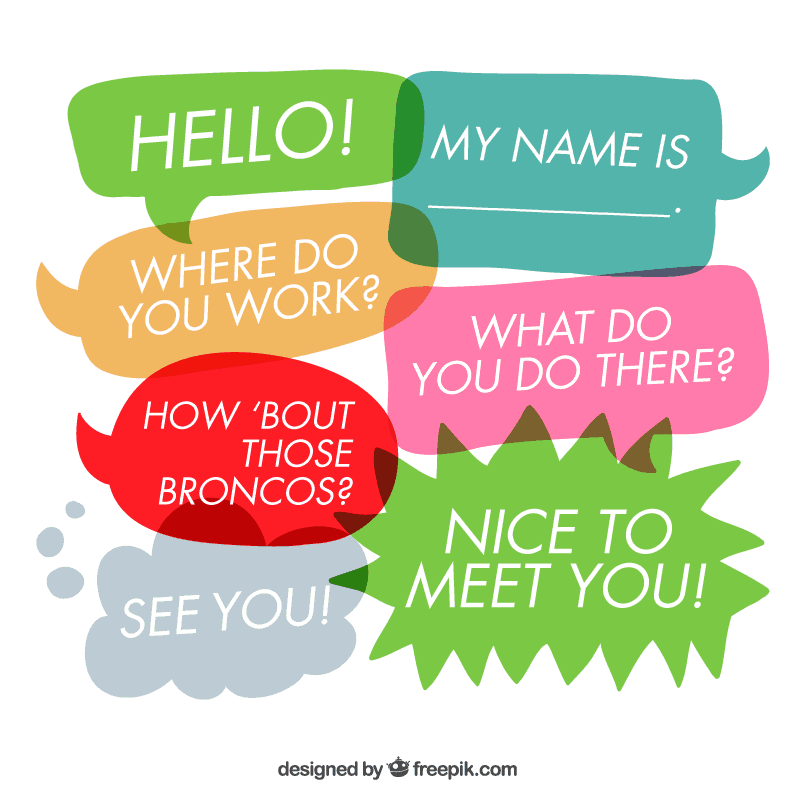
  • Find something in common with every person you speak withNetworking-Conversation
2. Sample Questions to Ask/How to Start a Conversation
  • Where do you work? What do you do there?
  • What did you study in college
  • What are your future career goals?
  • What advice do you have for someone like me trying to enter your field/industry?
  • What do you do for fun in your free time? (ask follow up questions!)
  • Did you watch (the Superbowl, the Olympics, etc.)?
  • Where are you from originally?
  • Have you attended this conference/event before?
3. How to Appropriately Leave a Conversation
  • “It was great meeting you and talking with you…
  • …I know we’re both here to network so I’ll let you talk to some other people.”
  • …I hope to stay in touch– I’ll connect with you on LinkedIn!”
4. Nonverbal Communication and Body Language
  • Stand at an appropriate distance from the other person
  • Have open body language so that other people can approach you
5. Networking Etiquette
  • Bring breath mints – not gum
  • If there is food, try not to have your mouth full when speaking with someone – take small bites
  • If they are serving alcohol, limit yourself to one drink
  • Do not pull out your cell phone while you are talking to someone
6. Follow Up
  • Make notes on the back of business cards you collect: what did you talk about? How will you remember them?
  • Create a spreadsheet to keep track of everyone’s name, company, date, and what you talked about
  • If you made a good connection, follow up with an email and connect with them on LinkedIn
Remember, you can network anywhere! At the grocery store, at a coffee shop or restaurant, at the gym/your fitness class, on public transportation, while waiting in line for something, or in the elevator! Just be yourself!

New Year Offers Chance to Improve

By Chemeketa SBDC

The holidays have come and gone, a new year is here, and it’s a blank slate. A lot of people go through a slump in January and it’s hard to keep up the energy. Your business depends on your being motivated though, so you need to be playing to win every day. Here are a few tips on staying at the top of your game.
-Remember that you made the choice to be in business to begin with, and it’s still your choice (every day) to stay there. You are in control. You are the one who decides at the beginning of each day where you will go and what you will do. No matter what circumstances are swirling around you, you are ultimately the one who makes the decision to stay in or get out. Own it.
-Carefully limit the amount of media and economic news you watch and listen to. It seems that you just can’t read or hear a business story these days that doesn’t predict that the sky is falling and the world is coming to an end. Do you need to ingest those stressful messages on a regular basis? And will knowing how bad things are really help you run a more successful business? Do whatever minimum you need to in order to stay informed, and then spend the rest of the time filling your mind with motivational messages and helpful resource information.
-Pay attention to what triggers negative thoughts and emotions. Is it the economy? Unhappy customers? Bookkeeping duties? Maybe a couple dozen other things? When those things happen, what are your responses? And more importantly, what can you do to head off the negative responses at the pass? If you recognize the patterns you can change them.
-Choose to avoid negative people and spend more time with positive and supportive people. For the most part you control who you spend time with, so make choices to be with people who uplift you and make you glad to be alive. You know the ones, those who are pleased about your successes and wish the best for you. Resolve to stop complaining about things and hanging around people who complain. Don’t commiserate with negaholics. Who needs it?
-Practice gratitude and determine to thank at least one person in your life every day. Stop to appreciate how people are contributing to your life, and make sure they know you have noticed. Move on from there to spend a moment at the end of each day listing ten things you’re grateful for. Remind yourself why your life is good. This one tip alone can transform a dragging spirit into one that greets the day, motivated to be and give 100 percent.
Marcia Bagnall is Director of the Chemeketa Small Business Development Center and instructor of Small Business Management Program. The Small-Business Adviser column is produced by the center and appears each Sunday. Questions can be submitted to SBDC@chemeketa.edu. Visit the SBDC at 626 High Street NE. in downtown Salem or call (503) 399-5088.

After 30+ Years of Work, What Comes Next?

Do you remember graduating from college? Armed with your degree, a host of friends and supportive family, you were ready to jump into the job market. Thirty years or so later, many of us begin to think about the next step. We may have climbed the corporate ladder, taken off time to deal with family issues, changed careers, or embarked on entrepreneurial endeavors. Regardless of our individual career paths, we now look toward retirement or another new venture.
Dorie Clark, author of Stand Out and Reinventing You, is a nationally recognized speaker and Duke University professor. If you are in that 50+ age range and beginning to consider what comes next, check out her article in the Harvard Business Review, Planning Your Post-Retirement Career. Clark will help you consider the next phase of your career. 
If you’re intrigued, consider joining us for the Alumni Professional Development series program on September 13, Introduction to Focus Forward: Reinventing Career & Retirement. In this 90 minute workshop, instructor Lori Zahn will give you an introduction to Focus Forward, a course that teaches the frameworks, tools, and strategies that will help you map out the future you desire. DU helped prepare you for the first 30+ years of your career, we’re also here to help with the next phase.

Mistakes that will get your job application tossed in the trash

Mistakes that will get your job application tossed in the trash
That headline is vicious. I know. But hear me out. Gorilla is a small company. 13 people and counting. While we don’t do a lot of hiring, we do get a lot of interest in the form of job applications. When it’s time to fill a position, I typically have 1o0 to 150 resumes and applications to review.
So, what’s the first thing you can do to make sure you don’t get tossed out of consideration? Eliminate sloppiness. The following are notes about the most common mistakes I see in the application process.
Please – save yourself!
Spelling and grammar
I can’t believe I’m writing this. But, I am. Don’t ignore spelling and grammar in your application process. That means in your resume. That means in your application. That means in all written communication with your potential employer.
I understand – mistakes happen. In fact, I’m sure this blog post has a few. But, when it comes to trying to land a job, nothing communicates that you don’t really care more than spelling and grammar errors.
“But I’m just not a great writer.”
That’s fair. Many of us aren’t. But likely, someone you know is. Ask them for a second set of eyes. It will be well worth the effort. Additionally, run everything through a spell check and even consider hiring an online proofreading service.
Inconsistencies in formatting
It sounds crazy and small and like I’m being way too picky, but please, make sure your resume is formatted consistently.
That means using the same type of dash throughout. That means using the same spacing throughout. That means either always using abbreviations for things like “street” and states or never using them. These mistakes don’t really affect the content at all, but they communicate a lack of attention to detail. And that’s something on which employers can’t afford to gamble.
How do you prevent inconsistencies in formatting? When you proofread, try doing it backward. Meaning, start at the end. This will force you to not read for actual content, but instead to only check for things related to formatting. Note: you still need to read it from the beginning.
Button up the application
Use capital letters when they’re supposed to be used: “i’m really interested in gorilla 76 because while at the university of kansas…” is not acceptable.
Also, avoid text-speak like the plague. Answering “idk” to a question about what you want to get out of an internship or job won’t fly. I guess neither would its unabbreviated version.
Don’t neglect style in the email communication
If you get to the point of emailing a potential employer about a particular job, don’t relax your focus on grammar and spelling.
For many companies, Gorilla included, this becomes almost the first interview. If someone is sloppy early on and clearly lacks attention to detail in the first few emails, I assure you, they won’t ever make it in for the in-person interview.
If you don’t take your interaction with your employer seriously, how can you ever be trusted to take interactions with clients seriously? 
The little things matter big time
In high school, I had a teacher. Mrs. Ames. She taught me a lot about a variety of different topics. But the thing I remember most about her classroom was a sign that she had on the bulletin board.
“Countless, unseen details are often the only the difference between mediocre and magnificent.”
Heed these words and good things will happen in your job search.

Bad Habits That Can Derail Your Business

Can we talk about your habits? Well, how about the ones that affect your business then? We all do things habitually, for better or worse, and those things have a direct bearing on the success (or not) of our businesses. Here’s a handful of them to watch out for.
• Indecisiveness. You know this one, it’s where you stall out on decision making. Perhaps you let the day to day small tasks of your business keep your attention away from the decisions you know you need to make, and so you just don’t make them. Or perhaps you wait (and wait and wait) for the one key piece of information you need. And you put off making a decision that will make a big difference for your business. And you do it repeatedly.
• Being penny-wise. In other words, cheaping out and saving small amounts of money when a wiser spending decision would bring a far richer return on investment. Businesses cost money to run and to grow. Naturally you shouldn’t run around wasting money left and right, but the opposite of this is hanging on to every nickel at the expense of strategic spending decisions.
• Allowing day to day chaos and noise to distract you from what’s strategically important. Also known as “putting out fires” all day long, this habit solves the urgent and immediate but doesn’t help you lay out long-term plans and direction. This is also known as being held hostage to the “tyranny of the urgent.”
• Waiting for the ideal time before doing something. Unfortunately there usually isn’t a perfect time for things. If this is a good, or good enough, time to make something happen…then seize it and make good on it. This habit of waiting is a cousin to the habit of indecisiveness. Also known as spinning your wheels, it doesn’t move you forward. If I offered to give you a million dollars if you made a decision about something in the next half hour, I’ll bet you could do it, right? And that means you don’t have a problem making a decision, you have a problem choosing to make a decision.
Be honest with yourself about some of this stuff and how it’s affecting your business. What small changes can you make right now in your habits that will benefit your business a good deal in the future?

Zika Fears Hit Home in the U.S.

It has been feared for months that mosquitos would start spreading the Zika virus in the United States. Those fears may have been realized this summer in Florida.
Senior officials at the Food and Drug Administration said last week they have asked blood donation centers in two Florida counties, Miami-Dade and Broward, to stop collecting blood for the time being, according to National Public Radio.
Investigators have ruled out travel as the cause of four cases of Zika virus in those counties. The individuals with the virus had not traveled to places where Zika is endemic and don’t appear to have contracted it through sex—leaving a possibility that they got the virus from being bitten by infected mosquitoes in the U.S.
If they did acquire the virus from domestic mosquitoes, it could mean that others in the area also may have acquired Zika virus locally, and may have donated blood without knowing it was infected, according to NPR.
First identified in Uganda in 1947, the Zika virus simmered quietly for sixty years, occasionally causing a mild dengue-like illness across parts of central Africa and equatorial Asia, according to The Challenge of the Zika Virus: An Emerging Arbovirus Disease study by Frances Delwiche, library associate professor at Dana Medical Library at UVM. However, since 2007, three large outbreaks have occurred: first in Micronesia, then in French Polynesia in 2013-2014, and as an epidemic involving Mexico, the Caribbean, and Central and South America in 2015-2016.
Earlier this year, the UVM Vaccine Testing Center announced that it would be involved in the clinical trials and research on a vaccine for Zika virus, which was declared a global health emergency by the World Health Organization on February 1, 2016.
Over the past decade, the WHO has declared four global health emergencies, and the Ebola epidemic in West Africa and the Zika outbreak in the Americas have happened in the past two years alone.

Study Epidemiology at UVM

This fall, UVM is offering an Epidemiology Graduate Certificate to provide students with a framework for problem solving and critical thinking in analyzing disease and health-related conditions within a given population

Four Important Leadership Qualities You Need in Business

What makes a great leader?
In a recent survey, Harvard Business Publishing asked that very question. Hundreds of managers from companies around the globe weighed in on what leadership qualities matter the most. Ultimately, they narrowed it down to four: demonstrating integrity, managing complexity, inspiring engagement, and acting strategically.

How do you develop leadership skills?

Ray Carvey, executive vice president of corporate learning and international at Harvard Business Publishing, offers the following advice on Fortune.com:
  1. Acting strategically: Question your own opinions and seek out information that contradicts your view. Look to people with diverse experience to flesh out your teams, and get out of the office to gain valuable new perspectives.
  2. Demonstrate integrity: Defy group think. Be selfless, and take responsibility for all of your decisions and the actions of your team. Keep an open-door policy for comments and observations, and set a good example for your team to follow.
  3. Manage complexity: Keep a close eye on your environment to identify trends and indicators of potentially disruptive change. Put processes in place that help your team respond quickly, and be aware that seemingly small decisions can have a ripple effect across your business.
  4. Inspire engagement: Create meaningful connections between your employees’ values and those of your organization. Understand your employees as individuals, and look for ways to tie their values and interests to their work. And foster a work environment that values inclusivity, and acceptance of the ideas of others.
Successful leadership in today’s increasingly demanding, global, and diverse workplace requires grit, creativity, flexibility, and know-how. You can rise above the challenges of today’s ever-evolving business landscape with UVM’s Leadership and Management Professional Certificate.

The one-day Leadership and Management seminars are designed to help participants:

  • Improve your leadership, business strategy, negotiations, sales, marketing, and finance skills.
  • Prepare you for higher-level job responsibilities and career advancement.
  • Develop your knowledge of business principles, trends, and best practices.
  • Identify your learning leadership style to provide you with insights into your problem solving, decision making, conflict resolution, teamwork, and communication skills.
  • Improve your emotional intelligence and behaviors to better connect with others as a leader.
  • Gain a big-picture view of management to communicate more effectively within your organization.
  • Improve your leadership skills across cross-functional teams.
  • Build a local professional network beyond your organization

On the Way to Law School, a Student Finds His Calling for Medicine

Until he was a college senior, Matt Lebow thought he wanted to become a lawyer. Then two months before taking the LSATs, he had a change of heart. Rather than going to law school, Lebow decided to pursue a career in healthcare.
The 26-year-old Los Angeles native, who graduated from George Washington University, enrolled in the UVM Post-Baccalaureate Premedical Program last year. Lebow, whose father is an emergency room physician and his mother a registered nurse, followed in his parents’ footsteps early on, when he became an EMT at age 18, then a paramedic at 23. Still, it wasn’t until his last year in college — where he was studying political communication — that he decided to carve out a career in medicine.
We talked to Lebow about growing up with a healthcare family, his plans to study emergency medicine, his work as a paramedic, and his current research to examine the frequency of hospital-acquired thrombocytopenia, a deficiency of platelets in the blood.

Your parents met while working in the Emergency Department, and you spent a lot of time with your father in the ED when you were growing up. What was it like as a child to watch your father treat patients in an emergency room setting?

The emergency room environment is very much second nature for me. As a kid growing up, I had dinner in the ED on almost a weekly basis while my father was on shift, and I’d walk around with him as he took care of patients. Whenever I got hurt as a kid, I never had to go to the ED for stitches because my dad would just come home from work and stitch me up in the kitchen.

How do you think this experience benefited you?

It was eye-opening to see so many different ailments when I was a kid. Also, it was interesting to see the same person who dropped me off at swim practice intubate a patient. The first time I saw a cardiac arrest was when I was 14 years old. I was blown away by the dynamics, even though I had no idea what was going on. I’m happy that I was exposed to all of this at such a young age, as it gave me a certain perspective on life. The early exposure gave me the ability to maintain a certain level of calmness when I’m treating patients.

Why did you make a change from law to a career in emergency medicine?

Like most children of healthcare practitioners, I tried to separate myself from my parents and was drawn to law and politics during high school and college. During my senior year of college, I realized that my true calling was to be a physician, not a lawyer. This was confirmed once I became a paramedic and saw how easily the work connects with my thought pattern and decision making. It was definitely a tough decision to choose medicine, especially since so many of my close friends are already out of law school making six-figure salaries. But I know the satisfaction I get from helping others is greater than anything I would get out of a career in law. I’m so glad I landed on the path I’m on today.

Can you tell us about the work you do as a paramedic?

I work weekly shifts for Colchester Rescue. We average over 1,100 calls a year and are comprised of paid staff and volunteer members. As a paramedic, you are the most highly trained pre-hospital healthcare provider in the 911 system. I have been involved with EMS since I was 18 years old. I’m trained in a variety of procedures and skills, such as advanced airway management, cardiac support, EKG interpretation, IV access and can administer a variety of life-saving medications. With so many interventions available, the most challenging aspect of being a paramedic is deciding how aggressively to treat a patient.

What do you love most about emergency medicine?

Unique to emergency medicine — and one of the main reasons I enjoy being a paramedic — is the diversity in the patient populations and their illnesses. At one moment you may be taking care of a child with an asthma attack, and a second later you will be called for a patient in cardiac arrest. I’m drawn to the fast-paced nature and the immediate impact you have on your patients. I couldn’t see myself doing anything else.

What are some of the challenges and rewards of this type of work?

Emergency medicine is obviously a physically and emotionally strenuous specialty. I’ve seen the personal sacrifices my parents have made working in healthcare, especially my father. I can’t tell you the number of times that birthdays had to be celebrated the day before or day after because of a shift. That said, the skill set an emergency room physician has is unlike any other specialty. While you may not be an “expert” in any particular area, the breadth of knowledge you obtain is special. Emergency medicine allows you to feel like a “doctor,” meaning you have the skill set to fix a problem on the spot, whether it’s a fracture, laceration, or anaphylactic reaction. You represent the healthcare safety net of this country.

Tell us about your research on hospital-acquired thrombocytopenia

My research is through the Department of Hematology/Oncology at UVM, and involves examining the frequency of hospital-acquired thrombocytopenia (low platelet counts). While thrombocytopenia is frequently studied in trauma, pediatrics, and cardiac patients, there was little research on hospital-acquired thrombocytopenia in general medicine (patients who come into the hospital with a normal platelet count, but then have a drop below the “normal threshold”). I came up with a definition of what I consider to be thrombocytopenia and then compared that definition to three different patient populations to determine if there was any association between those who developed a venous thrombosis, those who had some kind of bleed in the hospital (like a GI or brain bleed), and those patients who died while in the hospital.
The research found that even moderate drops in platelet counts have an association with mortality and bleeding. The recommendation I concluded in this research is that clinicians should be cognizant of platelet count drops, and this is likely an indication of disease severity.
Neil Zakai, MD, MSc, a hematologist and associate professor of medicine at UVM College of Medicine, has been my senior advisor for my research. I will be published in Blood, the peer-reviewed journal for the American Society of Hematology, and I will be presenting my work in Orlando in December.

Why did you choose UVM?

UVM’s Post-Bac program has a great reputation, and I also found the linkage with the UVM College of Medicine very appealing. This close relationship between the undergraduate campus and the medical school has allowed me to surround myself with leading researchers in their fields.
And hey, the snowboarding around here isn’t too bad either

Think Critically” by guest blogger, Robert Mack, SIS ’12 of PublicRelay

This post is the second in a series on critical thinking and analysis, one of the top skills employers want you to have.   Here, SIS alum Robert Mack tells  how the critical thinking skills he learned here at AU  have been important to his career at PublicRelay.  Robert is currently a Media Analyst and Recruitment Specialist. 
Think Critically, by Robert Mack
Analyze; problem solve; synthesize; think critically. To anyone perusing CareerWeb’s listings, these terms quickly become a dime a dozen. Yet these words appear often for good reason – employers need individuals who can come up with simple solutions to massively complicated problems. As evidenced by a recent survey, 93% of employers highly value critical thinking skills – so highly, in fact, that they value critical thinking skills more than an applicant’s undergraduate major.[i] Writing as an AU alum who now works in a recruiting role, I can attest to the fact that critical thinking and analytical reasoning skills are in demand more than ever and that AU is a great place to perfect them.      
Dan Black, Director of Recruiting at EY, defines critical thinking as “the ability to work with data, to accumulate it, analyze it and synthesize it, in order to make balanced assessments and smart decisions.”[ii] His definition may sound intimidating, but these skills are 100% learnable. Mastering the art of critical thinking just takes time, work, and patience.
For the students reading this, you can find opportunities to improve your critical thinking skills right in front of you. Many class assignments, especially research papers, require the collection, analysis, and synthesis of data in a way that parallels the critical thinking definition found above. Writing research papers, more than anything, teaches you how to think. In 10 years, most of you will probably not remember the specific topics that you covered in your research assignments. What you will remember is the critical thinking approach that you employed when building your arguments and conclusions, an approach that will stay with you for years to come.
At PublicRelay, we tackle the communications challenges facing our clients with our analytical reasoning and critical thinking skills. During the hiring process, we look closely at our candidates’ analytical and reasoning abilities to gauge how they would approach the challenges our clients encounter. We hire individuals who are sharp and want to think big – so much so that there is no one degree that we look for. Our Media Analysts have backgrounds in history, international relations, anthropology, and sociology, among many others. At the end of the day, we need people who can solve problems and think critically.
Since graduating 4 years ago, I’ve taken the critical thinking skills that I learned at AU and applied them to solving a number of complicated problems. Business theories change, Presidents will enter and exit office, but thinking critically will never go out of style.

6 Time Management Tips for Work

We’ve all heard the phrase work smarter, not harder right? Well in today’s hectic world, it can be tremendously difficult to effectively prioritize and successfully meet your goals–especially with the demands in the workplace and at home, it’s challenging to balance professional responsibilities and personal life, especially when your time is limited. When under pressure, it’s tempting to make the mistake of putting energy into what’s urgent, rather than focusing on what’s important.

By practicing these time management tips for work, you’ll find yourself achieving more and leaving the office with a sense of accomplishment.

1. Set a goal for your day

Be proactive and direct work flows. Do you spend the whole morning responding to incoming emails or do you send out emails to direct projects that are within your goals for the day? Your daily activities should align with your specific project goals.

2. Prioritize your tasks

What are your immediate and long-range needs? What groundwork needs to be laid in order to check the tasks off your list? Imagine your inbox as a hospital triage center: what inquiries or projects deserve your attention? Which items can wait? Prioritize the issues that are both important and urgent. Address your tasks strategically with your daily goal and project vision in mind.

3. It’s OK to delegate

Figure out what you can do well and what others can do better for you. There may be people in your workplace that are personally interested in a topic or looking to take on more responsibility. You don’t have to champion your project list alone. Effective leaders build supportive teams and look to protégés to develop into a successful next generation of leaders.

4. Just say no

Decide which projects are non-essential and draw the line on what you can commit to successfully completing. Your time is your most valuable asset and you cannot get it back. As you communicate how projects fit within your goals and action plans, colleagues will respect your work and your time more. You’ll have more time to manage your projects with a goal-oriented vision, and by doing so, you’ll achieve more through your work.

5. “Chunk” your projects

You know the saying, “Don’t bite off more than you can chew.” It applies to your work as well as table manners. Avoid looking sloppy in your work. Break your projects into manageable tasks. For projects that you loathe, start with just 10 minutes a day and you’ll be surprised at how much you can achieve. You might even find yourself working through to finish it.

6. Use technology to your advantage

Technology can be a great resource to help you manage and optimize your time. Many apps and tools – such as Evernote, Remember the Milk, and Focus Booster — offer digital solutions to organize your to-do lists, files, emails, and more.
By applying each of these steps and engaging critically with the projects that make up your daily routine, you’ll be an active director of your work and your professional goals. 
UVM’s Project Management Certification Training is also a great resource to help you effectively manage projects and your busy life. Enroll is ongoing with several flexible start dates

6 Clever Ways Graduates Can Improve Their Job Search

Why some people search for a job for months without results while others get employed in a couple of weeks? Everything depends on your attitude.
A job search is a serious process that demands setting goals, creating a plan, and sticking to it. Regular job hunting in different areas using various approaches is surely challenging but also productive. If you do not want to lose your time, read the instruction below that will allow you to find a job faster.

1. Market Yourself

Inform people around that you are a great professional who is open to offers. It will help you get the attention of potential employers. Online presence is a great way to do that. LinkedIn is a number one tool in online job hunting.
Do everything possible to make your profile more visible for the recruiters. Include offline actions to your personal marketing campaign. For instance, you might visit events related to your profession, make some new contacts during the conferences, or attend job fairs.

2. Keep Developing

While job search should take a significant part of your time, focusing on it too much could cause stress and depression. It might be a good idea to combine job search with the development of new skills. Spend some time on learning new languages, reading books related to your field, or improving your computer skills. It will keep your brain working and the new knowledge might help you to get the position you want.

3. Stay Tuned

It is important to keep participating in the work environment. Consider taking short-term freelance jobs in your field, find an internship or a part-time job in a company you want to work for. It will broaden your experience and will develop your skills. You will also get familiar with the new tendencies and equipment. This way the employer will see that you are active and ready to immerse into the new environment.

4. Get a Well-built Resume

If you have the same resume for years and it still did not help you to find a job you want, it is probably the time to upgrade it.
Make sure your CV is current, well-written, and convenient to read. It should show your strong sides and professionalism. Sending the same resume for different positions is not the best idea. Try to modify it a little for every job. Be sure to take into consideration the goals and needs of the company. The recruiters will surely notice it and that will help you to stand out.
If you still have troubles making your resume, consider using professional resume writing services. What is more, some job seekers have a hard time understanding the difference between cover letter and resume. Make sure you know what application document your potential employer requires.

5. Prepare for a Job Interview

Job interview puts a lot of pressure so it is better to prepare for it. You may practice with your friend or make a video to see how you look. Answer the common job interview questions and pay attention not only to what you say but also how you say it. Your voice and body language are as much as important as the words. Control your tone and the speed of the speech. A straight posture and eye contact may help to look more confident.

6. Be Persistent

Active position during job search shows your enthusiasm. After sending a resume it is essential to wait for an interview invitation. If you are really interested in a position, there is no harm in reminding the company that you approached them. It will emphasize your interest and desire to work. If you did not get a call back after the interview, do not be shy to contact the recruiter and ask about results. It is also important to know the limit. If there is no answer, move forward.

Ask a Career Coach: Help! I’m Not Getting Interviews, But I’m Doing Everything Right

Ask a Career Coach: Help! I’m Not Getting Interviews, But I’m Doing Everything Right was originally published on The Muse, a great place to research companies and careers. Click here to search for great jobs and companies near you.
Dear Kyle,
I’m stuck in what I would say is a “rut.” I’ve been employed at my current position for a little over eight years and am sort of stuck. There’s no chance of advancement. I’m bored and know that I have many transferable skills (in pharmaceutical sales); however, because I don’t have direct experience in the area I want to take my career, I can’t even get an interview.
I’ve been sending out my resume for over a year now. I had it professionally assessed by someone experienced in this line of work, so I know it’s professional and highlights my transferable skills. I feel incredibly confident that if I could just obtain an interview, I’d be well on my way to getting the job. Any suggestions or insights on how else I can promote myself to stand out? I’m at a loss!!
Signed,
Stuck-in-a-Rut
Dear Stuck-in-a-Rut,
You just struck a chord with 90% of people who have tried to apply for jobs online. It’s tricky; you can’t ignore the standard application process, but what do you do when the portals become black holes? Assuming you’ve already been tweaking your resume and customizing your cover letter every time you apply for an opening, following up, and still getting no response, it’s time to take other action.
There’s a lot going on behind the scenes, and I’m here to help you navigate it all so that you get interviews (and, subsequently, offers).

Build Your Personal Brand

Once you’ve decided to delve into a new line of work, one of the most important (and fun) things you can do is establish your personal brand. This is effective for two reasons. First, when a recruiter believes you’re a good candidate based on your resume, they will almost always Google your name or try to find you on LinkedIn before contacting you. You want the information that they find to further sell you as a great candidate.
Second, a strong and comprehensive online profile could get you found before you even know about an opening. Being directly contacted by a recruiter is entirely possible (and if you want to learn more about getting poached, check out what recruiter Jaclyn Westlake has to say).
If you’re in the early stages of building your brand, here’s what you need to know:
  • Make sure you have a completed LinkedIn profile that aligns with your resume. A high-quality headshot and full, detailed summary that demonstrates your passion for your new industry are essential components. The summary’s also a great place to sell your transferable skills.
  • Create a personal website. No need to take an HTML/CSS class when SquareSpace exists to make your life easier. Think of this as an online business card: Having one is essential, regardless of how many (or few) bells and whistle it contains.
  • Manage your social media. Tweeting about your profession or posting pictures of industry networking events can help paint a more complete picture of you and your aspirations. On the flip side, your social profiles are another thing a recruiter’s going to see if and when he searches your name online, so make sure they don’t contain anything you wouldn’t be proud to share.
I should note that you want your brand to reflect both passion and skill in the industry you’re seeking. If you can’t honestly do that right now, then you’ll need to take a class, find a side gig, or volunteer so that you do have that experience. Then make sure that’s highlighted on your personal site or on your LinkedIn profile.

I BET YOU FEEL LIKE YOU CAN GO AFTER ANY JOB YOU WANT NOW

…Within reason of course, let’s not go completely nuts
Check Out 10,000+ Openings Now
'jobs'

Work Your Network

Ask a career coach the best way to find a new job and they’ll respond the same way: network. If you know someone who can be your internal champion, the digital application will be far from the only thing you have to snag the hiring manager’s attention. There are no shortcuts or secrets to building a network overnight, but there are definitely some best practices you can implement starting now:
  • Set a goal to connect with five relevant people per week. LinkedIn’s probably your best bet for this, but you can also find people on Twitter or through personal websites containing a “contact me” page. Some industries even have their own resources for connecting with others in your field (For example, Angellist is one for the startup community).
  • Work on getting to know your new connections. Make a plan to set up one informational interview every week. Sitting down (in real life) with someone who is doing the job you want and learning everything you can about it will give you talking points for reaching out to other industry folks—and it may put you at the forefront of their mind in the event that there’s an opening at their company. Don’t be afraid to ask for advice on getting your foot in the door.
  • Take advantage of hiring events, meetups, professional mixers, or any other industry event happening in your area and meet people who can give you more insight into a specific job, and maybe even recommend you for a role when the time comes.
A well-developed personal brand and an active, thriving network could be just the thing to get you past the application process and to the interview stage. Unlike job applications, these tools will continue to improve your job search for years to come. So get started! When you focus on the right pieces of the job search you won’t just see more interviews, you might even start to enjoy them.

Milestone 3: Gain Experiences

Securing a high quality internship or professional experience that helps you develop the skills necessary for your future is a key step to preparing for your post-graduation goals.
We recommend that you target a position within a professional setting under the supervision of a practicing professional. This may include internships, research experiences, practicum roles, in-depth service learning or part-time professional experiences. Most importantly, choose an experience where you will truly push yourself and grow your skills!

Why Are Internships & Professional Experiences Important?

DU students that have completed an internship or professional experience are more likely to have secured post-graduation plans within 6-months of graduation and make, on average, $5,000 more in their first job after graduation! Additionally, 50% of employers report that they expect students to have 2 or more relevant experiences by graduation. Quality internships make you more marketable to both employers and graduate programs!