What to Do with a Public Policy Major?

Careers for Public Policy Majors

WHAT IS A PUBLIC POLICY MAJOR?
The University of Denver’s interdisciplinary program in public policy focuses on major social issues and how they impact the public and private sectors. public policy is a highly disciplined, evidence-based approach to the analysis and solution of contemporary issues like fiscal policy and government spending, entitlement reform, health care, national security, regulation, criminal justice, education, and immigration.
Also, visit the government/public policy career resources page.

COMMON CAREERS FOR PUBLIC POLICY MAJORS

With a deep understanding of the issues of the day, many public policy majors go on to work in the education, government, non-profit or healthcare industries.

COMMON JOB TITLES HELD BY THESE PUBLIC POLICY MAJORS INCLUDE:

  • advocate
  • attorney
  • campaign worker
  • communications specialist
  • contractor or consultant
  • development assistant
  • director of government relations
  • foundation manager
  • grants specialist
  • legislative auditor
  • lobbyist
  • nonprofit manager
  • paralegal
  • planner
  • policy adviser
  • policy analyst
  • policy director
  • politician
  • political activist
  • program analyst
  • public administrator
  • public relations specialist
  • researcher
  • sustainability coordinator
  • teacher or professor

PROFESSIONAL SKILLS OF PUBLIC POLICY MAJORS

In addition to the careers listed above, public policy majors are well-suited to fields that require the following skills:
  • interpersonal communication
  • research
  • communication
  • persuasion
  • data analysis
  • critical thinking and interpretation
  • problem-solving
  • writing

IS A PUBLIC POLICY MAJOR RIGHT FOR YOU?

Still unsure if you should major in public policy? Schedule a session with a career counselor, attend our “Choosing a Major” workshop, and attend career events where you can network with employers that hire public policy majors and alumni who majored in public policy. Also, schedule a session with the department chair, where you can explore other possible career paths.
PROFESSIONAL ORGANIZATIONS FOR PUBLIC POLICY MAJORS
RESOURCES FOR PUBLIC POLICY MAJORS

Alumna, Robin Colombin, Building Community in Benin

A few days before Christmas I touched base with Robin Colombin over a Facebook messenger phone call. Robin (BS ’16, international business, minor in fine art) is stationed with the Peace Corps in rural Benin and traveled two hours to the capital, Cotonou, to make this call.
When I caught up with Robin, she was teeming with enthusiasm for her work and loads of new international economics and business vocabulary. French is the official language of Benin, so our conversation was marked by the vacillations and pauses that develop when communicating ideas and concepts across multiple languages and cultures. Colombin, who studied French at DU, traveled abroad her junior year to Aix-in-Provence in southern France.
DU Alumni: Tell me about your time at DU. How did you get here, what did you study, etc.?
Colombin: I was really interested in marketing and was impressed with Daniel’s College of Business when I came to visit. I graduated with a bachelor’s in international business from Korbel and Daniels. I took some first year classes in international politics and economics and I fell in love. I was especially inspired by Professor Robert Uttero. It was through my class work and work study position in the humanitarian assistance graduate program that I became interested in humanitarian aid. I took a lot of Korbel classes and knew that if I wanted to do it seriously, I also wanted to have an idea of what it is like on the ground, which led me to the Peace Corps.
DU Alumni: How did you choose Benin? What was that like?
Colombin:  With the Peace Corps, you pick your top three placement choices, much like the study abroad program at DU.  You could always choose “Wherever I’m Needed” as an option and roll the dice, or you can choose a specific region or country.  I chose Benin as my first choice.  It was the only country that had an opening for a Community Economic Development Advisor in a Francophone country, which were two of my requirements.
DU Alumni: What was the process like?
Colombin: A lot of paperwork and medical tests. I had to wait a few months to hear back. I graduated in March 2016 and I heard back from Peace Corps right after graduation, but I didn’t leave for Benin until September, six months later. It’s a bit of a leap of faith—you don’t know a lot when you are accepted. I knew I’d be doing community economic development because I had applied particularly for that, but the descriptions are very generic. You might be working with various organizations—women’s groups, savings groups, NGOs, etc.
When I got to Benin, I first traveled to Lokossa, which is in the South of the country for training. I was living with a host family and I had training every day for three months. After two months, they told me where my permanent post was and who I would be working with. I was told that I would be going to Agon, Benin. At that point, I got to visit the village for two weeks and meet the people I’d be working with.
DU Alumni: What is your life in Agon like?
Colombin: I’m the only American and non-local in the community. There are about 2,000 people living here and it’s largely an agricultural economy. Most people are farming corn, cassava, pineapples, palm trees, and local vegetables.
I personally really like being in a smaller community where most people know me, but it is a lot like living in a fishbowl.  Everyone has been so understanding and supportive here, and it’s been amazing working with them.
DU Alumni: How did you end up in Agon as opposed to another city in Benin?
Colombin: Each volunteer gets requested by someone in the community – that person becomes your counterpart. My counterpart is Delphin Sessou–he’s been working for over 10 years to get savings and loans groups started – there were 10 in place when I got here. They have been growing, too. We teach community members the structure, how to manage them and oversee the accounting.  While we provide overall management of groups, each group has its own self-elected managerial structure.
DU Alumni: What is a savings and loans group?
Colombin: Savings and loans groups go by a few different names and acronyms. In French they are called AVEC (L’association villageoise d’épargne et de crédit) and the English translation is VSLA (village savings and loans association). The need for AVEC comes from a gap between banking and microfinance. There are not a lot of banks nearby, especially in small villages, so it’s not easy to do banking. The goal of AVEC is to help the most vulnerable people, particularly women, save and loan money to each other when access to a bank is not possible, or individuals are not comfortable doing business with banks. Big banks can be intimidating. Many people can’t read or write and the documents are in French.  Quite simply, some people just don’t see the value in having a savings account either.

DU Alumni: So, how does the AVEC work?
Colombin: Each AVEC has its own rules, but generally speaking, members agree to contribute a small amount of money to the savings group each week. The group then makes loans from their combined savings. Individuals pay interest on their loans and pre-decided fees (fees for coming late to meetings, reimbursing loans late, etc.). At the end of the year, the interest and fees are divided based on savings and paid out to the individual members.  So after a year, members get their total savings back plus interest.
AVEC serves as a money-management tool as well as an easy way for people to invest and take out loans.  There is also an insurance element to the structure.  Individuals pay a small amount into an emergency fund that individuals can access for urgent cases—medicine, funeral expenses, etc.  It is an amazing structure to financially empower those who need it most.
DU Alumni: You said that the AVECs are growing. Can you tell us about the growth you’ve seen?
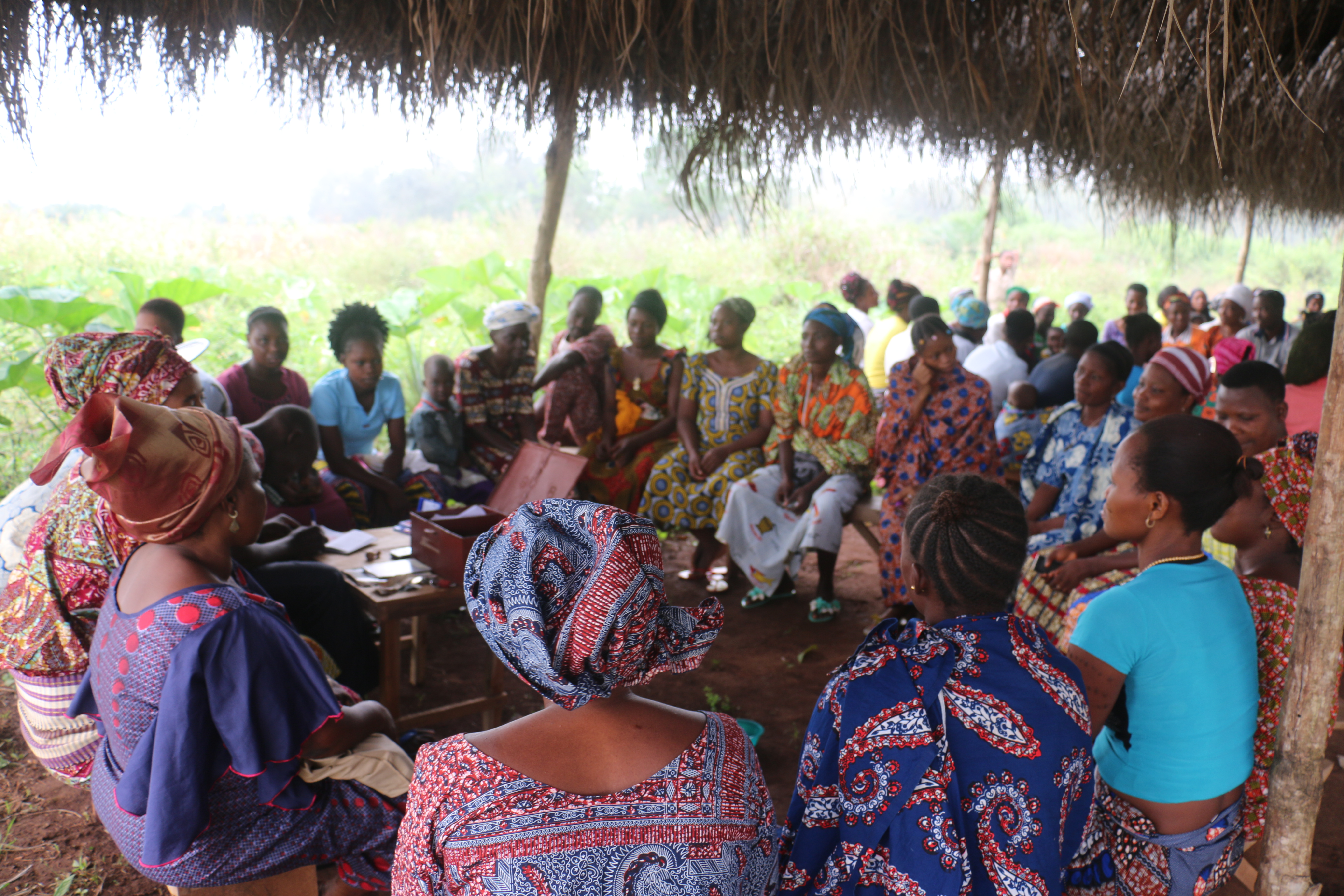
Colombin: When I arrived there were 10 AVECs. About a year later, we have 15 groups made up of 450 people. They are also opening new AVECS in other nearby villages where there is demand. For now, the groups meet under a tiny, flood-prone shelter, essentially a dirt floor covered by palm fronds. When it rains, the meeting space floods. Also, the palm fronds need to be replaced, and there is not nearly enough room for everyone so some groups meet under nearby trees.
They have made a lot of progress as far as building their own organizational infrastructure goes; now they need a permanent building structure.  They have a project to build an Integrated Business Development Center where the groups can meet and store documents.  They will hold free business classes there, and two rooms will be left open for any entrepreneurs in need of the space to use—that includes agricultural groups and women’s groups.  Agon does not have a community center of any kind, so everyone is very excited about having this open community space. We would love your help (see link)!
DU Alumni: So, we like to ask alumni a few questions to connect with current students and with their fellow alumni. What advice do you have for a first or second year students who are just getting started at DU?
Colombin: I recommend taking classes that sound interesting to you; the best thing you can do is figure out what you are most passionate about and dive in.  I came out with an entirely different degree than I thought I would.
DU Alumni: What professional or life advice do you have for fellow alumni or students who are about to graduate and launch their careers?
Colombin: Apply for things you don’t feel qualified for.  Once you have the position, work hard to be over-qualified for it.  That is how you’ll grow.
Robin Colombin (’16) is a Peace Corps Volunteer in Agon, Benin. In addition to serving the community on economic development projects, she is helping to raise funds for the Integrated Business Development Center. Wondering how you can help? Click to learn more about the project and donate.

27 Leaders, Athletes & Celebrities You Wouldn’t Know Have Learning Disabilities

In your job search journey, it can be helpful and inspirational to look to leaders in the professions you are passionate about or want to learn more about who came across challenges as students and, through those challenges discovered their talents and passions and have found meaning in their lives and careers. 

Learn more about how Nike’s Chief of Design, John Hoke, uses his Dyslexia to better understand himself and how he has built his career through using his talent and passion for doodling.

Explore a list of 13 celebrities in sports, movies, and music who have Dyslexia, ADHD, and Dyscalculia and have used these as driving forces of hard work and success.

Check out a list of 13 entrepreneurs who discuss their learning and attention challenges and how these have been opportunities for creativity, innovation, and problem solving.

What to Do with a Design and the Arts Major?

At the intersection of design and the arts is a set of skills that allow for creative expression and communication. Whether you’re studying Art, Art History, Emergent Digital Practices (EDP), Film, Marketing, or another related program, these creative arts have the power to influence, persuade, and educate, along with the potential to activate emotion and mobilize action.
Common industries for these degrees include advertising, marketing, technology, and film, in addition to museums and local arts associations. If you’re wondering how to find opportunities in these fields, there are several resources to support the search process. Take a look at the content below to discover the companies, organizations, and professional associations that relate to your interests.
Advertising/Marketing:
Digital Arts/Technology:
Film:
Art and Art History:
Final Tips:
Research people and organizations on LinkedIn using a keyword search and narrow down by city and state.
Check out the alumni page and Pioneer Connect to identify any DU Alumni who may be working for these organizations with whom you can reach out and request an informational interview to learn more about the industry, the specific company, or their position.
Take note of the organizations and companies these individuals work for, including their current and past job titles that might align with future roles that could fit for you.

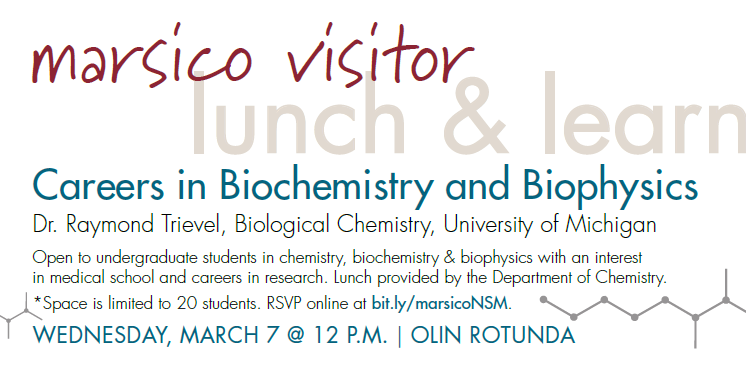
Marsico Scholar to Visit NSM!

The Department of Chemistry & Biochemistry is pleased to welcome Professor Raymond Trievel from the University of Michigan. As a visiting Marsico scholar, Dr. Trievel is a tremendous resource for undergraduate students wanting to learn more about research at a medical school and/or careers in biomedical research.
You are invited to join Dr. Trievel on March 7 at noon for a free lunch and a talk on career paths in biochemistry and biophysics. Lunch attendees can also sign up for one-on-one “office hours” with Dr. Trievel, taking place Thursday, March 8, to further discuss scholarship, research and career goals.
Lunch space is limited to 20 students. Students must RSVP to reserve a space.
Wednesday, March 7 | 12:00pm | Register via Pioneer Careers
Dr. Trievel will also present a talk on Structural Enzymology of Lysine Methylation at 4 p.m. on Thursday, March 8 in Olin 105. All are welcome to join us!

Powering Through the Winter Slump: 5 Tips for Making the Most of Winter Days

Ever feel a bit sluggish and down during the winter? Feel a cold coming on? With the days getting shorter and weather colder it can become harder to stay motivated and healthy during the winder. This greatly affects our productivity and overall health/wellness in school, internships, and work. Here are some tips to over coming the winter slumps.
Get outside- even for 20 minutes.
We are lucky that Denver has over 300 days of sunshine and although it may not be warm, getting outside for 20 minutes for a quick study break or walk helps circulate your blood and lymph system giving you a nice pick-me-up.
 Make social plans. Start a book club.
Interestingly, Carnegie Mellon doctors found that hanging out with friends combats stress and keeps you healthier. Individuals with larger social networks produced more flu fighting antibodies so surround yourself with friends and others who make you happy.
 Healthy snacks are key.
Ever feel yourself hitting an afternoon crash? Eating fewer sugary and high carbohydrate foods will help you avoid this feeling. Therefore, stocking up on healthy snacks such as fruit, veggies, nuts, and almond butter will keep you full and sustained throughout the afternoon.
Stock up on your own pens and pencils.
Studies show that cold and flu germs are passed through hand-to-hand contact so you may want to reconsider borrowing pens/pencils with classmates. Instead, stock up on plenty of your own so you can avoid contracting a virus.
Take your vitamin C.
Fun fact: In the 1940’s, Dr. Klenner cured tons of diseases such as chicken pox, measles, and polio using vitamin C alone. This vitamin is loaded with properties that fight off infectious diseases and help to heal your body so consider adding a dose of vitamin C to your morning routine.
Need a little extra motivation? Follow some of the best healthy life-style bloggers on Instagram. These accounts full of delicious looking food, workout ideas, and inspirational quotes may help foster a bit of extra motivation during the long winter months.

When You’re Not Certain, You’ve Got to Become an Explorer of Your World!

“What are you going to do after DU!?” With two months away from graduation it’s likely that most encounters with family, friends, and professors lead to some variation of this question and you might not have an answer.
And, if you’re not at that transition point of graduation, then perhaps you’re in the midst of your undergraduate journey and uncertain about what major to pursue and constantly being bombarded with, “What are you majoring in?”  Whatever the case, being in a space of uncertainty can induce all sorts of anxiety, doubt, and questioning, especially when receiving pressure to have it all figured out.
Give yourself permission to ‘not know,’ and consider reframing that uncertainty to one of exploration, which offers you room to pause and reflect. And, consider engaging the steps below as a process to move you towards a state of relative clarity, at least in knowing your first next steps.
 1. Conduct an Archaeological Dig— Create some space in your week to pause and evaluate your past and current experiences. What jobs, volunteer experiences, clubs or organizations have you been a part of? Have you traveled, nurtured a particular hobby, sport, or other activity? What did you most enjoy about these things? Least enjoy? Why? What skills did you cultivate through those experiences; and, what came easily and naturally to you? Of those skills and talents, which were most rewarding and satisfying to use? Why? Write your answers down.
2. Return to Your Youth—…and, answer this question: What was it I most loved to do as a kid? Whatever the answer, start to unpack what it was about that thing, or activity, that was most engaging, rewarding, or meaningful, because embedded in your response are clues to where you’re likely to be happy and motivated. Even if the same five people answer: ‘playing with Legos,’ their reasons will be different. One individual might explain that they loved starting with nothing and the process of creating something; while another might describe how their imaginations became activated when crafting a story that corresponded to the Lego world they built. While the answer to a major, or your career isn’t to necessarily pursue Lego building, though it’s an option, take note on how the elements of where you were most engaged could translate into a future role, or area of study, such as a field that leverages your creativity and design thinking.
3.  Become an Expert Observer— Each day, start tracking where you light up, what captivates you, and engages you. Notice what are you doing when you lose track of time, and on the contrary, pay attention to what drains you of energy and where you check out, or become disengaged. These details offer clues to where you’re likely to be motivated and vice versa.
4. Pursue your Curiosity— When Steve Jobs dropped out of college he took a calligraphy class just for fun and simply out of interest. Fast forward to the launch of his first Apple computer and it turns out the font he used had been informed by that seemingly random calligraphy class. So, pursue curiosity, because you never know where it will lead. Experiment! Take a class that piques your interest, engage a hobby you’ve been wanting to reignite, attend a lecture, take a road trip, watch a documentary, go swing dancing; whatever it is, you’ve got to get out in the world and have experiences, because it is through experiences upon which we can reflect and learn about ourselves, discovering where we come alive and when our unique talents and personality shine through.
5. Connect the Dots—Brainstorm on the Intersections of your interests, talents, and values. What do you want to do and where do you want to have an impact? (i.e.—be a champion for individuals with learning differences, conserve the environment, build self-esteem, etc.)? Where are you wanting to plug in? (i.e.—Blogging, education/training, fundraising, data analytics, developing a community support group, lobbying, etc.).
6. Seek out Humans— Find the people at the intersection of your interests and meet them! Go pick their brain and build those connections. Use the LinkedIn alumni page and Pioneer Connect to identify alumni who are doing the very things that pique your interest, or for which you’re curious. Request an informational interview to learn more about the nature of their job, the industry, and their career journey. You might also find relevant organizations via Guidestar.
7. Be Kind to Yourself—The decision-making process can be overwhelming for some people; as such, engage daily practices of self-care, whether it’s meditation, journaling, eating healthy foods, getting your body moving through yoga, or other types of exercise. And, keep connected to the community, whether through your friends, family, or other individuals you find supportive.

I Semester – Special English – Unit 3 – Skill Oriented Teaching


A quality time of period we have spent over discussing how teaching of a language differs from teaching a subject. The main difference falls in the instructional objectives of teaching the both.

Teaching a subject is predominantly knowledge oriented whereas through teaching a language, a teacher facilitates the learners to acquire / develop his/her communication skills. Hence, apart from teaching, a considerable amount of training aspect should also be found in the language teaching.

The teaching sessions should be oriented to incorporating varied skills of language.

1.      Reading skills are extremely important. Students that have the confidence and ability to read and comprehend reading material can begin to build a different English perspective. Articles and short stories are a great example of reading exercises, pairing reading with practice and production questions that will spark discussion with classmates.
2.      Discussion skills develop better conversation. Your students begin processing information in English when listening and speaking. They will be required to respond in English to what they hear. For video clips, you can have your students discuss the summary of what they had seen and heard. In a dialogue exercise, students can practice the art of conversation with a partner or in a collaborative group exercise.
3.      Writing skills are often overlooked in ESL, yet these skills are just as important as any other ESL skill around. Writing enables students to leap into description, putting their grammar and new vocabulary into practice. Your students can utilize writing in various ways, conveying their thoughts in English to the class, at home or even in their profession.
4.      Pronunciation skills allow your students to develop the sounds in their speech to be understood when speaking English abroad or during a business presentation. If your students lack the essential concepts within pronunciation, than they run the risk of being misunderstood and it may diminish the confidence they have built in your classroom after months of ESL study.

I I leave this list to you students to be further furnished / elaborated / added with other skills.

Expecting your contribution in the comments…

Job Offers: 5 Things to Consider

Congratulations! You have a job offer. What to do next? You will likely have to live with the salary for at least a year so now is the time to think about the offer!
Do research on the salary range by checking sites like salary.com, salaryexpert.com, and glassdoor.com.
** Take time: You will be spending a large number of your waking hours at this job so ask for 3 days to a week to review the offer. This will give you time to objectively decide if the job is a good fit for you.
**Benefits: A great benefits package can compensate for a lower salary. What is the health insurance plan and what percentage does the employer pay? Tuition reimbursement? Educational benefits? What about employer contributions to a retirement plan? How much paid vacation/sick leave?
**Hidden Costs: Will you have a long commute??Be away from family and friends due to a lot of out-of-town travel? Do you need to leave at a set time to pick-up a child from daycare/school? Do you need relocation assistance?
**Culture: Do you think that you will fit in easily? If not, are you willing to adjust? Is your supervisor interested in your growth and success? Are you comfortable with the management style? What about the dress code?
By doing your research and reflection before accepting the position, you will feel more confident about your new position. Contact the Career Center at 303.871.2150 to schedule a time to meet with a Career Advisor for additional advice.

The Art of Discussing Salary During the Interview

We’ve always been told that it is never a good idea to discuss salary during an interview. But, this is not actually always the case. There are instances where you can, and should discuss salaries, but you need to know how to go about it in the right way. In fact, some employers actually love the game of negotiation, and the better you are at it, the better your chances are of being hired, because you have the skills the employer is looking for. The following are some tips that will help you to master the art of discussing salary during the interview.

Know Your Worth

There is a market value for every job, and in order to get the highest possible salary, you need to know what you are worth, and be able to articulate this to prospective employers. Think about what you are earning right now, and then set a realistic goal for what you expect to receive as a salary for your next job. The more skills you have, the higher the salary you will be able to negotiate.

Do the Right Research

“Prior to the interview, make sure that you learn as much about the company as possible, especially the salary ranges, benefits, and industry standard salary ranges. That way, you will have a good idea of what you should be offered for a salary, and if it is lower, you have some room to negotiate,” suggests HR manager from GadgetSalvation. Also be sure to research how easy it is to move up in the company, and what salaries are like for the positions you hope to achieve.

Time it Right

You need to feel out the interviewer and figure out when the time is right to ask about salaries. Wait until you know for sure that they really like you and that they are interested in hiring you. Then, you have a bit of leverage. Once they have decided that they want to hire you, it will be easier to negotiate a salary that works for both you and for the employer. They want you, so you need to make them prove it by offering what you want.

Be the First to Mention Salary

It is a good idea to mention a salary range before the employer. This is going to begin the negotiations in your favor. Remember, when it comes to the art of negotiation salaries, the first offer is the starting point for the entire conversation. If you let them do it first, they are not likely to be offering the salary you want. If you ask first, they will be forced to negotiate with you if they really want to hire you.

Don’t Jump on Any Offers

Never accept the first offer made to you. In most cases, the employer will actually be prepared to offer more if you negotiate, so if you take the first offer, you could end up making a lot less than you should be. After the first offer, tell them that you will get back to them with your decision in a specific amount of time. That will tell them that you want to negotiate, and they may end up offering a higher salary before your deadline.

Talk about Other Offers

If you can show that you would be an asset to the company, an employer is going to want to make sure that they hire you. So, let them know that you have other interviews, and that other offers have been made. They may just speed up the interview and make the right offer right away, so they will know for sure that they are going to be able to have you as part of their team.

Job Searching with a Chosen/Preferred Name

Names written on colorful paper.It’s the first thing you type in an application form, the biggest text on your resume, and the first thing a potential employer learns about you: your name. What captures us more succinctly and wholly than our name? It’s more than just a label, and it encompasses so much of who we are. Especially if we chose our name ourselves.


For people using a chosen or preferred name in the job search, what to write down in the application or on the resume can feel like a conundrum. Will HR reject my application if I don’t list my legal name? What will an employer think if I have one name on the resume and another in my email address? Sometimes, we just don’t want to deal with it, and go through a job search process using our legal name even if it’s not the right fit.
Fortunately, it doesn’t have to be that way. In short, you can use your chosen or preferred name throughout your job search, as long as you provide your legal name when it comes time for a background check. (If you don’t provide current or prior legal names at that point, it can be seen as lying on the application, and grounds for firing.) How would you like to be addressed during interviews, and how would you like to introduce yourself? Use that name throughout the process.
If you go by a nickname and don’t mind sharing your legal name, you can put this on your resume like these: Xiu Ying “Suzie” Li or Robert “Bobby” Doe. Since a resume is essentially a personal marketing document, and doesn’t require a legal name, the same individuals could simply put Suzie Li or Bobby Doe on their resumes.
Sometimes when deciding whether to list a chosen or preferred name, there are additional considerations. For instance, if you are trans or genderqueer, using a name that does not “match” your gender presentation or gender identity could potentially be an issue during your job search. Perhaps the name on your application would immediately out you to your employer, or using a name you don’t prefer would cause discomfort as you present yourself professionally in a way you wouldn’t prefer to. In these cases, career coaches and trans people who have been through it themselves generally recommend to evaluate your own comfort with using one name or another given where you are in your coming out process or transition, and use your chosen or preferred name during the job search if you plan to use it while on the job. If you are concerned about safety or discrimination, there is nothing wrong with using your old or legal name during the job search, and coming out after being hired. And if you would prefer to not be out at work at all, that is OK too!
If you are interested in changing your name legally, there are resources to help you do so in Colorado. The Colorado Name Change Project assists with background checks, filling out paperwork, and will also soon assist with changing the gender marker on Colorado state-issued ID cards and birth certificates. For help changing documents outside of Colorado, you can check this resource from the National Center for Transgender Equality or contact local organizations in that other state or country.

Have You Met Your Career Advisors?

Career@DU is a collection of career offices across campus designed to meet the needs of every student. Whether you are a traditional undergraduate, a graduate student in a professional program or a student with unique needs, we’ve got career advisors and programs dedicated to supporting your career and professional development.
Career & Professional Development
Did you know that Career & Professional Development offers advising in multiple languages? Our International Student Peer Advisors are here to help you in Arabic, French, or Spanish! You can make an appointment with Walid Hedidar or Roxana Toledo on Pioneer Careers.
Daniels College of Business Career Services
  • DCB undergraduates, graduate students (MBA, PMBA, EMBA, MS), and DCB alumni
  • danielscareers@du.edu | 303-871-3911 | daniels.du.edu/career-services/
Josef Korbel School of International Studies Office of Career & Professional Development
Sturm College of Law Office of Career Development and Opportunities
  • JD students, MLS, LLM, MLA students, Alumni of SCOL
  • careers@law.du.edu | 303-871-6124 | law.du.edu/career
Alumni Career & Professional Development
  • Alumni are served by Career & Professional Development or the career team in their respective school up to 1 year after graduation.
  • Alumni Professional Development
Make an appointment with your advisor today!

Funding an Unpaid Internship

Have you learned about an amazing internship, but aren’t sure if you can afford to take the role because it is unpaid? Don’t be discouraged, there are a lot of options that can help make this work! Below you will find some great tips as well as information on funding sources that can help.
Negotiate!While it is common for internships to be unpaid, these positions are often very flexible. Consider asking to work only 10-15 hours a week during the summer so you can supplement the internship with a paid job. Also ask if the organization provides stipends to cover parking or transportation costs.
Some for-profit organizations, especially small ones, don’t pay interns because much of an intern’s time is spent training and that time isn’t able to be billed to a client. If that is the case, ask if they will consider transitioning the internship from unpaid to paid, once you learn the ropes and are doing work that can directly be billed to the client. Many organizations will agree to this approach.
Apply for Financial Support
There are numerous funding sources on campus that can help you afford an unpaid internship or research experience. Check out the list below for more details. Please note some of the awards outlined below are intended to cover the cost of tuition for credited internships.
Undergraduate Internship Award
$2,500 |For summer internships include awards for internships abroad | April Application Deadline
AHSS Summer Internship Award$3,000 |AHSS Juniors & Seniors doing summer internships for credit | April Application Deadline
AHSS Student Research Award
$1,250 | AHSS undergraduate and graduate students eligible | April Application Deadline
Taylor Internship Scholarship (Daniels)
Available for paid and unpaid internships for those with financial need | Ongoing application
Chancellor’s Global Innovation Fellowship$5,000 | Undergraduate or Graduate students doing global impact internship | April Application Deadline
Partners in Scholarship
$1,500 | Conducting a research project with a faculty member | Deadlines on a quarterly basis
Summer Research Grant
Up to $3,500 | Summer research projects conducted with a faculty member | April Application Deadline
Graduate International Internship Grant
Up to $1,500 | Supports graduate students with internship positions outside of the U.S. and outside of the student’s home country. | Deadlines on a quarterly basis
Last, check with the department for your majors and/or minors. Some departments also have funding available to support experiential learning activities!

Navigating Your Career Path?

Geography majors build an impressive skill set as they move through the curriculum. They have the chance to learn technical competencies such as remote sensing and GIS, obtain a deeper understanding of our earth and the environment, and build skills in teamwork, communication, research methods, and so much more. Dr. Paul Sutton, in his professional development course for graduating seniors in Geography, suggests that students communicate their passion for the field in their internship or job applications; the technical and soft skills can be more deeply developed over time!
What’s more, Geography majors are often enthusiastic and knowledgeable about issues such as conservation, sustainable transit, and reducing our carbon footprint. As the AAG outlines, “Geography is unique in bridging the social sciences and the natural sciences.” Not many students have the opportunity to exercise such a broad range of skills!
Geographers work in a number of industries, including government, business, nonprofits, and education. Many of our students and alumni gravitate toward opportunities with organizations such as the USGS, Esri, DigitalGlobe, Denver Public Schools, and the National Forest Service.
Sample job titles of our graduates include:
  • Disaster Preparedness & Emergency Assistance Case Manager
  • GIS Analyst
  • GIS Developer/Consultant
  • ESRI Specialist
  • Planner/Spatial Analyst
  • Regional Environmental Manager
  • Sustainability Coordinator
  • Transportation Coordinator
  • Transportation Demand Management Program Administrator
Are you still figuring out summer plans, or what you aim to do after graduation? Are you exploring careers in geography?
Consider joining us for a special Dine & Dialogue on Careers in Geography!
This exciting event will take place on Friday, May 11 from 12:00-1:00pm in BW 124. We will have four amazing panelists joining us for lunch – cartographers, geospatial data scientists, abandoned mine restoration project managers – and they are looking forward to meeting you.
We hope to see you there! RSVP via Pioneer Careers.

Want to Stand Out? Share Your Global Perspective!

“As an international student, how can I stand out in the application process?”
It’s a great question, and one that can lead to rich, engaging conversations. It’s also one of the most frequently asked questions that we respond to in Career & Professional Development.
The internship and job search process is challenging for any seeker, but can be especially tough for an international student. There are many reasons for this, including a limited time to secure employment with a looming deadline. But international students have so much to offer to companies, no matter the industry.
Last year, I had the opportunity to borrow The International Advantage by Marcelo Barros from a colleague of mine. It was such an engaging book that I ended up requesting that our Career Library (Driscoll South, Suite 30) and the University Library (Anderson Academic Commons; HF5382.75.U6 B36 2015) each purchase a copy for our students to learn from. If you haven’t read it yet, and are an international student, I highly recommend it!
One of the most important pieces of advice that Marcelo shares has to do with focusing on what you offer. So often, students will focus on the gaps between their skills and experiences, particularly barriers in communication. While it’s good for us to be realistic about where we have room to grow, it’s even more crucial to hone in on the good. What makes us a top candidate for a specific internship or job? What do we have to offer?
You bring a unique perspective and set of skills that your domestic peers might not have. As an international student spending four (or more) years in a new country, you are an independent, efficient problem-solver who is willing to think quickly and creatively to get to the next step. No matter who you are, where you are from, or what your previous experiences may be, most international students possess these skills because you took the risk to attend college in a new country.
Marcelo Barros lists, at the end of the book, “questions for international minds to consider.” In reflecting on your time in college, and on your job search, he suggests you ask yourself questions such as the four found below (questions adapted from chapter 18 of the International Advantage).
  1. How might you share your knowledge of both your home country and the US through your own lived experience with an interviewer?
  2. Going further, what are some of the experiences that you’ve had, both at home and in the US, that have shaped your cultural and global perspectives?
  3. What surprised you most about moving to the US? How have you grown, what have you learned, and how might you communicate that to someone new?
  4. How might you use your international background to reimagine a problem or see something in a new way?
In addition to taking time to reflect, do your research on the companies who will be interviewing you. Are they based in the US or elsewhere? Do they have locations in other parts of the world? Do they have connections to your home country? If so, how might you communicate your global knowledge with them?
Your global, lived experience can be compelling; in many cases, it serves as an asset to your candidacy. Your interviewers want to learn about your global experiences, and it is possible to weave your skills – your innovation, comfort with taking risks, creativity, knowledge of multiple languages, and more – into the stories you choose to tell. I challenge you to think deeply about where you’ve lived, what you have learned, and your successes. Consider how you might communicate your answers to the above questions, including how your global experience connects with the mission of the company, in your cover