Teaching Strategies to Become a “Listening” Educator
- What is an Active Listener?
- How are Your Listening Skills?
- And More!
- Focus on the student speaking and don’t let your mind wander or multitask. If you find that you are not focusing, then try and bring your attention back on the student and focus your attention to the students’ lips moving.
- Check your body language to ensure that it isn’t sending out any wrong signals. Make sure your eyes are focused on the students’ face, your hands on not waving around or in a position of aggravation, and that you are showing the student that you are interested in what they have to say.
Classroom Management to Turn Parents into Partners
- Class Newsletters
- Social Media
- Invite Parents In
- And More!
The Teaching Profession: What to Tell a Struggling New Educator
- “It gets better”
- “Here’s something simple to try”
- “Come and watch my class”
- “What would you do next time?”
- And More!
Types of Regions
A region is an area on Earth’s surface marked by a degree of formal, functional, or perceptual homogeneity of some phenomenon. The three main types of regions are formal, functional, and vernacular regions. A formal region, also known as a uniform or homogeneous region, is an area in which everyone shares in common one or more distinctive characteristics. This common characteristic could be a cultural value such as language, an economic activity such as production of a certain crop, or an environmental property such as climate and weather patterns. Whatever the common characteristic is, it sis present throughout the selected region. In certain formal regions, the characteristic may be predominant rather than universal, such as the wheat belt in North America, it is an area in which the predominant crop is wheat, but other crops are grown here as well.
A functional region, also known as a nodal region, is a region organized around a node or focal point. The characteristic chosen to define a functional region dominates at a central focus or node and diminishes in importance outward. The region is tied to the central point by transportation, communication systems or by economic or functional associations. An example of a functional region is the circulation area of a newspaper. That area is centered around the city in which the newspaper is published in. The farther away from the city of circulation, the less people that read the newspaper (this phenomenon is known as distance decay). A vernacular region, also known as perceptual region, is a place that people exists as part of their cultural identity. Perceptual regions vary from person to person. They emerge from a person’ s informal sense of place. An example of a vernacular region would be the South. My idea of the southern states may be different than my friend’s idea of southern states.
Types of Regions on the Basis of Stages of Economic Development
1) Developed / Development Regions
Developed regions are naturally those which are having a high rate of accretion in goods and services i.e., their share in the GDP of the country is relatively higher. This may be with or without rich natural resources by most certainly because of the use of upgraded technology by highly skilled and motivated persons. A developed region may become ‘overdeveloped’ in certain respects e.g., it may suffer from the diseconomies of congestion. Infrastructure costs become very high and people can go into the jitters due to pollution and stresses of various types. A developed region is the counterpart of the backward region: the ‘positive’ side is emphasized in case of the developed region while ‘negative’ aspects are emphasized in case of the backward region.
A developed region is one, which has exploited its potentialities fully, which has removed the bottlenecks and speed breakers of development. Developed regions emerge of their own because of the comparative advantage or may emerge as a result of the diversion of funds by the government. In many cases imbalances emerge between developed and backward regions and these imbalances can be the creation of planners also. Many times disproportionately high amounts of investment are made in the constituencies of the influential politicians and some regions become far more developed than the neighboring regions.
2) Backward Regions
There can be ‘backward or depressed’ regions in the developing as well as the developed economies. Backward economies are thoroughly depressed regions. There is development even in these regions but these regions have not come out of the low level equilibrium trap. There can be region, which may not be at subsistence level but may be relatively backward. Lack of infrastructure facilities, adverse geo-climate conditions, low investment rate, high rate of growth of population and low levels of urbanization and industrialization are causes and consequences of backwardness.
In less developed countries, even the most ancient occupation (agriculture) is backward and unless it is made progressive with massive real and financial input support, the region cannot come out of backwardness. Some vestigial regions (as the regions inhabited by the red Indians in USA/ or tribal in India) can remain backward and may even remain near the subsistence level. The inhibitions may have ancient traditions and may be smug in their surroundings, but the per capita income may be much lower than in the neighboring regions. A region can be backward because of the high population density or even without it.
3) Neutral Regions/ Intermediate Regions
New towns and satellite belts are designated as ‘neutral’ regions and they promise good prospects of further development because here further employment generation and income propagation is possible without congestion. Such regions can be demarcated around urban centers. Intermediate regions are those regions, which are ‘islands of development around a sea of stagnation’.
Types of Regions Based on the Activity Status Analysis
1) Mineral regions
Many mineral regions promise high growth rates for the region as well as for the prosperity of the country. If mineral- based industries can be developed in the region itself, then industrial development will be less costly because much of the load shedding will be done in the region at low cost. The iron ore deposits of Bailadeela (Bastar District of Madhya Pradesh) are exported abroad, a plant could be established near the ore deposits, it would have brought tremendous development for the region. As the mines continue to yield sufficient minerals and the costs are also not prohibitive, not only the mineral producing region develops but it helps other regions also to develop.
After the minerals exhaust, the region will bear degraded look, people will move away to other areas and the erstwhile area will bear a deserted look. Germany took great pains to rehabilitate such areas and vast pits and trenches were suitably reclaimed for various purposes like water storage, eco-forestry and even cultivation after enriching the soil. If new deposits of minerals cannot be discovered, there can be several ways of reclaiming wasteland and developing non-mineral based activities. Regional planning will require a long-term plan for developing such regions after extraction is no longer a profitable activity. The Middle East countries have made adequate planning to diversify their economies so that after the oil wealth exhausts their economies do not relapse to backwardness.
2) Manufacturing Regions and Congested Regions
Some regions become big manufacturing regions not because they have natural resources but because of the infrastructure development, momentum of an early start, continued government support etc. Autonomous, imitative, supplementary, complementary, induced and speculative investments keep in giving strength to the manufacturing regions. It would be prudent not to develop narrow manufacturing base, otherwise territorial specialization can become a problem if the crop supplying the raw materials fails or if the minerals which are base for the industries, exhaust. In such regions the internal and external economies are available in ever greater measure and such regions keep on developing. When all the thresholds are crossed, such regions become too congested and the diseconomies overwhelm the economies of production – high density, increasing pollution, reduction in the quality of life etc.
3) Cultural Regions
A cultural region can also be quite well demarcated. (French Canada and English Canada are such regions). In India various states are demarcated on the basis of language and culture primarily. There are affinities of cultural origin in such region. A rich cultured region should be rich in economic terms also.
Regions in Regional Economics
1) Homogenous Region
They are formal regions and on the basis of homogeneity in topography, rainfall, climate or other geo-physical characteristic. Economic homogeneity is more relevant for planning. The structure of employment, the occupational pattern, the net migration, the density of population, the resource and industrial structure, if similar in a space, the regions become homogeneous in economic sense. The greater the economic similarities, the greater the interest the economists will have in homogeneous regions. Internal differences in a region are unimportant. Sometimes, a clear cut homogeneous region may have, many differences in sub-regions as to make them quite different yet a region may remain ‘homogeneous’.
Scotland or Uttar Pradesh are clear cut homogeneous regions but in topography the hilly districts of Uttar Pradesh have nothing in common with the districts of the plains. Eastern and Western districts are also different but Uttar Pradesh remains a homogeneous region in administrative terms. Thus a homogeneous economic region can have differing physical characteristics. Homogeneous region on economic or political criterion may have a lot of heterogeneity from several other stand points.
Ø Formal Regions
Regions defined formally, often by government or other structures, are called formal regions. Cities, towns, states, and countries are all formal regions, as are things like mountain ranges. Formal regions often nest inside one another, so that when you are standing in the middle of Trivandrum, you are in the city of Trivandrum, which is part of state of Kerala, which rests inside the southern region of India, which is in the country of India, which is on the continent of Asia. All of those are formal regions.
A formal region is homogeneous with reference to some geo-physical characteristic such as topography, climate of vegetation. This is physical formal region. Later on there was a shift from this narrow approach to a broader approach and economic, social and political criteria were also applied. An industrial or agricultural or plantation region is a formal economic region; or a state governed by a particular party is a formal political region.
Ø Functional regions
It consist of a central place and the surrounding areas that are dependent upon that place, such as a metropolitan area. The functional region is concerned with interdependence. This is a geographical area in which there is economic interdependence. The nodal regions are functional regions between which there are flows of men, material and money.
Ø Vernacular regions
A vernacular region is an area that has been identified based on people’s perception of culture.
2) Polarized / Nodal / Heterogeneous / Functional Regions
Polarized or nodal regions look to a centre-a large town usually-for service. Its influence extends beyond the area of the city. The villages are dependent upon it for services and marketing. There is little concern for uniformity when a polarized or nodal region is taken. The city region need not correspond to the administrative region because hinterland of several clear cut regions may be served by a city. (For example even the persons of Gwalior may visit Delhi for buying some consumer durables of high value. A capital city may attract customers form several districts around the capital city.)
A nodal region will have heterogeneous economy around it. Regional economists are more concerned with what happens within a nodal region and spatial dimension of the nodal region assumes importance. Population and industries agglomerate and there are core regions with higher per capita income generation through higher production of goods and services. Within regions there are dominant cities or nodes to which flows of inputs, goods, people and traffic gravitate. Within the cities there are nuclei that form business and social centres and which are discernible at a glance from an intra-metropolitan traffic-flow density map.
As the distance increases, the costs of overcoming frictions will rise and the people of different areas will look for a different nodal point. Each region will have one or more dominant nodes and it will be interesting to find and record as to which interior areas form the areas of influence of one or the other node. Nodal regions provide an understanding of the functional relationship between settlements, which fill up the space. These heterogeneous units in rural and urban areas are functionally related because each settlement cannot have all the functions and facilities. All functions require a particular threshold population and other facilities (Each settlement cannot have a college or unless there is electricity, there cannot be cinema hall or a bank branch).
3) Planning Regions
Planning regions depend upon the type of multi-level planning in the country. A very small country will naturally have one level planning. A planning region in a multi-level setup requires regional plan, which is a spatial plan for the systematic location of functions and facilities in relation to human settlements so that people may use them to their maximum advantages. In fact more important than reducing the regional disparities is the task of ensuring that backward region and rural areas have basic minimum needs. Planning region for different activities can be different and a regional plan will be locational in character for that activity/function.
For comprehensive planning, there has to be a national plan and then a state plan and finally district/block plans. Since a planning region is a sub national area demarcated for the purpose of translating national objectives into regional programs and policies, and since plan formulation and implementation need administrative machinery, administrative regions are generally accepted as planning regions.
The hierarchy of planning region would be (i) national level (ii) macro level (iii) state level (iv) meso level (v) and micro level. A planning region must be large enough to take investment decisions of an economic size, must be able to apply its own industry with the necessary labor, should have a homogeneous economic structure, contain at least one growth point and have a common approach to and awareness of its problems. In short, a planning region should be defined according to the purpose of one’s analysis. Ideally a planning region should have adequate resources to establish a satisfactory pattern of savings, capital formation, investment, production, employment, income generation and consumption pattern. It means that the area should be economically viable.
Types of Regions in Multi-Level Planning Perspective
1) Macro Region
Macro region is naturally bigger. Macro region can be a state of even a group of states, if the states of a country are not big enough. For example, in India there are East, West, North, South and Central Zones and ‘Zonal Councils’ of which function is mutual consultation, developing cooperation and mutual counseling. In a sense macro regions are second in hierarchy, next to the national level. It is also possible that a physical macro region may comprise parts of different states of a country for project planning purposes (e.g. big river valley projects, an electric grid of different states and for the purpose of a particular activity planning).
State boundaries are not respected in the sense that the macro region may transcend or cut across administrative boundaries of the states of a country. A macro region may not be uniform or homogeneous in all respects. It may have homogeneity in one respect (physical complementarity) and may have heterogeneity in other respect (administrative boundaries). A macro region should have a common resource base and specialization in that resource base, so that production activities can develop on the principle of comparative advantage based on territorial division of labor (India has been divided into 11 to 20 macro regions, agro-climate or resource regions). The planning Commission of India would have just 5 zonal councils-Eastern, Northern, Central, Western and Southern comprising of certain states but beyond this there is no macro-regionalization in India. These so-called macro regions of India have to have interstate cooperation in the matter of utilization of river water and electricity grids etc.
2) Meso Region
Meso region can be identified with a ‘division’ of a state. Chattisgarh region, Bundelkhand region, Baghelkahand region, Mahakoshal region is usually a sub-division of a state, comprising of several districts. There should be some identifiable affinity in the area which may even facilitate planning. It can be cultural or administrative region and it will be even better if it is a homogeneous physical region (resource) region. A meso region can also become a nodal region provided the combined micro regions or parts thereof can be developed in a complementary manner.
3) Micro Region
In multi-level planning, district is the micro region. It becomes the lowest territorial unit of planning in the hierarchy of planning regions. The most important reason why district is the most viable micro region for planning is the existence of database and compact administration. This is the area, which is viable for plan formulation with administration for plan implementation and monitoring. A metropolitan area can be one micro region and the area of influence can be another micro region. A nodal point is also a micro region, though in many cases micro regions are basically rural areas, which may have a number of minor nodes without any organizational hierarchy influencing the entire area. The basic characteristic of a micro region is its smallness.
4) Micro – Minor Region
This is the region which is associated with, what is called, the grass-root planning. A micro-minor region can be a block for which also data exists now and for which there may be a plan. The block level plan is integrated with the national plan, through the district and state level plans. A block level plan is not surgically cut portion of the district plan, which has its own logic and linkage. At block level, most of the officers will be more concerned with the implementation of the plans than formulating the plans. At block level, the main exercise will be to take into account of the physical and human resources and to find out the prime moving activities which will enable the block people to make best use of the development potential of the block to meet the basic needs of the people.
Minimum needs can be satisfied with the production of basic goods with the help of low entropy local resources. In fact, planning of the development of the transport, communication, banking, education, medical and many service facilities has got to be done at the national level. At the panchayat level, basic goods and services can be arranged through the efforts of the local people. Many activities can be so planned that they improve the socio-economic conditions of the people without being the part of the national plan.
Several activities can be undertaken with the cooperation of the local people, with minimum of financial and real resource support from outside e.g., development of dairying, animal husbandry, pisciculture, poultry, soil conservation measures, optimization of the cropping pattern, production of inputs locally, improving the storage and transport facilities can be done at the micro minor level. Many agro based industries and tiny sector guild-type activities can be developed at the micro-minor level. A good planning can secure ‘ruralization of the industries’ instead of ‘industrialization of rural area’. This will involve production of goods ‘by the masses for the masses and near the masses’.

Buy American and Hire American
The trigger for this post is of course Trump’s executive order titled the same as this post, which he signed with much fanfare three days ago. The order , of course, is pure bombast and is only meant to show that the President is doing “something”. It simply orders the Secretary of Commerce to tell the world what the hell this means in 60 days and orders sundry other Ramamrithams to specify how it will be implemented in 150 days. I was not aware that you need an Executive Order to tell people to do their jobs, but apparently in the world of alternative reality, that is required.
Precious little, other than nuisance value, will come of it. For you see, in today’s globalised world of supply chains it is almost impossible to determine what is “American” as my first ever post argued. If “value added” is the yardstick for measuring national origin, then your iPhones are as American as mom and apple pie even though they are entirely manufactured outside the US. If the physical act of manufacturing (read final assembly) is the yardstick, then the iPhone is Chinese while BMW is American. If the entire supply chain has to be in the US, most products will simply disappear off the shelves as some of the raw materials and components are simply not available in the US and have to be imported.
The Executive Order gives some clues to the warped thinking – apparently they would like that “for iron and steel products, all manufacturing processes, from the initial melting stage through the application of coatings, occurred in the United States .” US iron and steel has been on decline for decades. Only an idiot will set up steel capacity in the US – after all the next President can sign another Executive Order to the opposite. Not a single new job will be created. What will only happen if this pig headed policy is even half tried is that the existing US steel plants will jack up their prices. The American consumer shall pay.
The problem of disappearing jobs is a real and serious one, but there are no easy fixes. It cannot be tackled by trumpeting economic nationalism. It certainly cannot be solved by sitting on the toilet seat and tweeting whatever comes to your mind.
By the way, the GOP was meant to stand for free markets and trade. It would have been appropriate if a President Sanders were to try something like this. But a Republican President ?
PS : Its nice to be back. Sorry for going away for two years – I was dabbling in a social enterprise in the interim, but am now back in retirement, and therefore back to blogging.
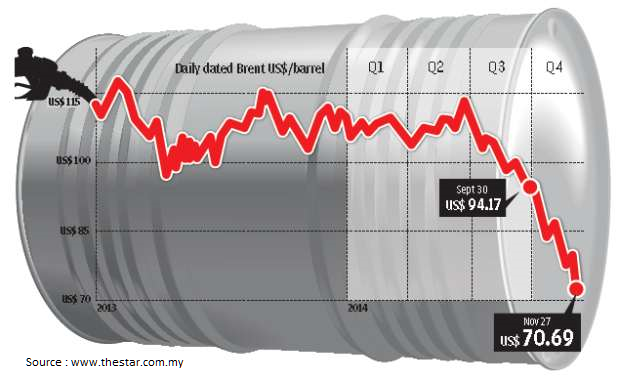
The bonanza / disaster of 2014
PS : This blogger owes an apology for going AWOL for 2 months and is deeply thankful to his readers who have all been very kind and encouraged him to \”come back\”
Buy American and Hire American
The trigger for this post is of course Trump\’s executive order titled the same as this post, which he signed with much fanfare three days ago. The order , of course, is pure bombast and is only meant to show that the President is doing \”something\”. It simply orders the Secretary of Commerce to tell the world what the hell this means in 60 days and orders sundry other Ramamrithams to specify how it will be implemented in 150 days. I was not aware that you need an Executive Order to tell people to do their jobs, but apparently in the world of alternative reality, that is required.
Precious little, other than nuisance value, will come of it. For you see, in today\’s globalised world of supply chains it is almost impossible to determine what is \”American\” as my first ever post argued. If \”value added\” is the yardstick for measuring national origin, then your iPhones are as American as mom and apple pie even though they are entirely manufactured outside the US. If the physical act of manufacturing (read final assembly) is the yardstick, then the iPhone is Chinese while BMW is American. If the entire supply chain has to be in the US, most products will simply disappear off the shelves as some of the raw materials and components are simply not available in the US and have to be imported.
The Executive Order gives some clues to the warped thinking – apparently they would like that \”for iron and steel products, all manufacturing processes, from the initial melting stage through the application of coatings, occurred in the United States .\” US iron and steel has been on decline for decades. Only an idiot will set up steel capacity in the US – after all the next President can sign another Executive Order to the opposite. Not a single new job will be created. What will only happen if this pig headed policy is even half tried is that the existing US steel plants will jack up their prices. The American consumer shall pay.
The problem of disappearing jobs is a real and serious one, but there are no easy fixes. It cannot be tackled by trumpeting economic nationalism. It certainly cannot be solved by sitting on the toilet seat and tweeting whatever comes to your mind.
By the way, the GOP was meant to stand for free markets and trade. It would have been appropriate if a President Sanders were to try something like this. But a Republican President ?
PS : Its nice to be back. Sorry for going away for two years – I was dabbling in a social enterprise in the interim, but am now back in retirement, and therefore back to blogging.
Heavenly treasures
“Do not lay up for yourselves treasures on earth, where moth and rust destroy and where thieves break in and steal, but lay up for yourselves treasures in heaven, where neither moth nor rust destroys and where thieves do not break in and steal. For where your treasure is, there your heart will be also” (Matthew 6:19-21).
Jesus has been discussing “practicing righteousness.” With these words, he appears to change the subject. Jesus has described how to give to others, how to pray, and how to fast. Now he addresses worldly concerns, such as worry, and loving money more than we love God.
Even if Jesus is making a transition to a new subject, this transition should not be viewed as a sudden change. His new thought remains connected to the previous thought. Jesus taught us to pursue our relationship with God while keeping God in mind. He tells us not to be religious (or “spiritual”) to impress other people. When people admire our holiness, their admiration is also a worldly treasure. If the admiration of other people for our holiness is the only reward we receive for our efforts, then all those good works are wasted efforts.
All the religions of the world agree that worldly riches are inferior to eternal riches. All religions agree that being wealthy in this lifetime is a paltry goal compared to the good that is possible for us in the future. Better teachers in the nonChristian world agree with Jesus that admiration from others is not sufficient reason to pursue a life of holiness and goodness. If we are going to be holy—if we are going to do what is right—we do good things for the sake of what is holy and what is right. We do not display our goodness to impress the neighbors who are less holy than we are.
Good deeds, prayers, and fasting, even when performed with God in mind, still are not heavenly treasures. These good deeds are done on earth, not in heaven. No matter how good we become, our good deeds can never equal the value of what God has stored in heaven for us, the good things that God has done for us.
Jesus lived a perfect life for us. He now gives us credit for the good things he accomplished. He freely gives us the rewards that he alone earned. Jesus fought the forces of evil, including death. He single-handedly won a victory; now he shares that victory with us. We will rise to eternal life in a new, perfect world; the power of that resurrection gives us strength even today. None of the things we do for God—not our gifts to the poor, not our prayers and fasting, not even forgiving those who sin against us—measures up to the value of what Jesus has done for us.
Jesus expects us to do good things. He expects us to strive to imitate his perfection. Whatever good we accomplish is not our treasure. Like money and other worldly wealth, our goodness in this sin-polluted world is easily corrupted or stolen. Our treasure is in heaven. Our treasure contains the gifts of Jesus, the blessings he bestows upon us. No power can corrupt those treasures or steal them away from us. Nothing in all creation can separate us from the love of God that is in Christ Jesus our Lord. J.
Remembering my uncle
He was my uncle. When I was a boy, he was also my neighbor, my keyboard teacher, and my mentor. He passed away December 23, 2019, at the age of 97.
During the Great Depression, my grandfather went to a famous food company and offered to work at any job they had available. They had him loading trucks for a few weeks, until one company official discovered that the new man was very talented mathematically. They hired him as a bookkeeper, a position he held for many years. By the end of the 1930s, my grandparents had purchased a farm house and three acres of land in a western suburb. They intended that their son and their daughter, after each of them married, could have a quarter of the property on which to build a house. My uncle and my mother accepted this gift, and so the family remained in close contact. Traveling east to west, or west to east, one would encounter a street, a front yard, a house, a back yard, a garden (two adjacent cultivated gardens, one belonging to each household), another back yard, another house, another front yard, and another street. Both households had a small orchard at the north end of the garden, and journeys through the orchards from one household to another were common. There were also paths from each household to my grandparents’ house to the south.
My uncle was hired as a chemist by the same company that had hired my grandfather. He also served in the U.S. Army during World War II. His company was among the waves of soldiers that continued the invasion and occupation of German-held France in Normandy after D-Day; he and his fellow soldiers landed on June 8, 1944, the third day of the landing, and he saw action in France during the war.
He had two sons and two daughters. One daughter preceded him in death (due to cancer), and one son became estranged from the family. His four children were all older than me; in fact, during family gatherings I frequently joined the two sons of my cousin, playing in the basement while the adults visited upstairs. The family came together to celebrate birthdays and wedding anniversaries, as well as Thanksgiving, Christmas, and Easter. Even children’s birthdays were marked by multi-generational gatherings that featured cake, ice cream, and (for the adults) coffee.
When he was working outside, my uncle would frequently have a young boy following him. That boy was me. My uncle teased with riddles. (Can you identify the longest day of the year? It’s the day each fall when we turn back our clocks to end Daylight Saving Time, because that day lasts twenty-five hours.) I learned a great deal from my father and from my mother, but my grandparents and my uncle were also part of my life nearly every day.
My uncle played the piano. I am sure he taught his children how to play. My sister also took lessons from him. When she wanted to quit, I was ready to start. Since I was only in the first grade, my parents doubted that I was ready for lessons, but my uncle was willing to give it a try. I still remember the triumph of mastering the piece that had frustrated my sister, leading to her quitting and my starting the lessons. But I did not practice on a piano. My grandparents had an electric organ on which I would practice my assignment every weekday afternoon. When I thought I was ready, I would make an appointment with my uncle and play the piece for him. He would either suggest improvements or pass me and assign a new piece. We completed all three books of the Thompson Method, and then he suggested various classical pieces for me to learn. His favorite was Schubert’s “March Militaire.” Because I practiced on an electric organ, I did not learn the fine points of piano technique until I was in high school, where I finally had regular access to pianos.
Eventually I grew up, took on a full-time job, was married, had children, and only occasionally visited my parents. When I stopped by the old place for a visit, I usually took time to cross through the orchards and visit my uncle as well. In his later years he battled failing sight, hearing, and strength. Despite these limitations, his mind remained strong, and provided I didn’t mind shouting and repeating myself, I was able to converse with him.
The death of my uncle produces a mild melancholy, not a deep grief. He had a long and meaningful life, and I have many fond memories of our time together. I know that I will still think of him from time to time. I am thankful to the Lord for my uncle’s place in my life and in my memories. J.
Élection présidentielle 2017
This blog largely tries to steer clear of political issues and focuses on the economic ones. So, although this blogger has strong views on the candidates and knows who he would vote for if he had a vote, he will avoid discussing that here. Instead, the focus is strictly on economic policies, which is of course, only one dimension of evaluating any candidate.
Who’s the most dangerous of them all economically ? If the pat answer is Marine Le Pen, a more polished version of Trump, think again. Introducing Jean-Luc Mélenchon, the far left candidate who is currently surging in the polls . Nearly 20% of France want him as President .
Here are his economic policies, without comment
- 90% tax rate for those earning more than Euro 400,000 a year
- 273 billion Euros higher spending over 5 years
- 16% rise in minimum wage to Euros 1326 a month (Rs 90,000 a month)
- 35 hour work week.
- Exit the Euro
- Abolish the treaties prescribing a target of deficit to GDP . In other words, simply print money
- Exit EU, a la Britain, if necessary
- Join Alba the economic pact between Cuba and Venezuela. Honourable observers of this pact are Iran and Syria
- Right to housing to become a constitutional right
- Nationalise utility companies
Unexpected and Unintended – Consequences of Curriculum and Material Development Processes
Listening Workshops – Or the Simplest Step to Educational Reform
If you are an educational functionary, by now you must be fed up of hearing how planning and change have to be \’bottom up\’. By which is usually meant that those who are \’under\’ you must somehow begin to contribute, own and implement a range of actions. And you inwardly wonder if this is ever going to happen!
It was during a discussion on precisely such views that the idea of a listening workshop emerged. Colleagues in the Institute of Educational Development (IED) in BRAC University, Bangladesh felt that a \’listening workshop\’ might help them understand teachers and grassroots functionaries better.
Listening workshop – a straightforward structure
It was agreed that before forming any views, it is critical to simply listen to teachers and head teachers. Hence a straightforward meeting / interaction / workshop was designed around the following three questions that would be asked of teachers and head teachers:
- What do you really do? Exactly what does your work involve?
- What do you like doing?
- What do you find difficult or dislike doing?
It was also agreed that IED colleagues initiating the discussion would only listen, and not prompt or provide leading questions or offer any comment from their side. In other words, they really had to listen rather than talk!
So why is all this worth writing about? Because around ten such listen workshops were actually conducted, and most turned out to have a very interesting pattern, followed by an unexpected twist.
What teachers felt
The listening workshops, it transpired, tended to proceed in the following stages.
- Teachers found it really difficult to believe that anyone could come down from the capital only to listen to them! There had to be a \’hidden conspiracy\’ or an \’agenda\’ they were not aware of… It would take anywhere from 40-60 minutes to convince the participants that the intention really was to listen to them. (What do you think this tells us about the functionaries that teachers usually deal with?)
- Once teachers believed the above, their initial reaction was that of giving vent to all their frustration and anger at \’you people who sit up there and form all kinds of views about us without ever visiting the field and observing the realities for yourself.\’
- Finally, teachers would pour their hearts out on the three questions given above.
The teachers\’ replies have of course begun to inform the work of the institute in many ways. However, it was the completely unanticipated outcome below that left everyone (cautiously) elated.
The unexpected \’reform\’
In the case of a large number of teachers who participated, a few days after the listening workshop it was found that they were implementing many new pedagogical actions in their classrooms! In the entire discussion, at no point had they been asked to make any improvement in their classrooms. So it was not as if teachers did not know improved methods – a large number of in-service interactions had ensured that they had had exposure. It\’s just that they were not using them. But for some reason the listening workshops triggered a change process in the classrooms!
What do you think this tells us about teachers, about their motivations, and about the kind of relationships they experience? If you can bear the initial first hour, isn\’t holding a listening workshop the simplest way to initiate educational reform at the local level?
Contesting Cribbing
But here\’s the rub – all this elaboration on what is wrong (some of it is serious research that is credible as well), how far has it helped find exactly what to do. That is, what to do which would help us get rid of the problems being pointed out. Don\’t get me wrong, I\’m all for the growing numbers of those who are able to detail their dissatisfaction at the continued limitations of our education system. It\’s just that I\’m unable to learn enough from it to know what needs to be done.
Because when one gets down to the doing, a whole lot of other things unfold that you were not quite prepared for. Turns out dealing with diversity is not exactly easy, and most of the pat suggestions don\’t really hold in face of the actual ground realities. Turns out that poor (or even exploitative) governance is such an all-pervading reality that what we can do in / through education just pales in front of it (try sitting in a district education office for a day if you don\’t believe me). Turns out that our \’log frames\’, strategies, plans and spreadsheets capture something in our mind but all of it simply crumbles when the actual implementation takes place. It\’s often noticed that some of the best experts, especially those from the universities, are usually eager to help in the planning and the evaluation – but not the part that comes in between, i.e. the implementation!
So I\’ve come to the unfortunate conclusion that a great proportion of those involved tend to complain mainly because it is the easiest thing to do. Just like many newspaper sections talk of potholes on the roads, delayed or poor services, or lack of facilities (usually in a self-righteous tone that includes phrases such as \’even 60 years after independence\’ – you get the picture). All this in the hope that saying what is wrong will somehow make it go away. As if it really does!
Where does all this leave us? To my mind, it leaves us with a lot of cribbing all around us. Every day we continue to read, hear, powerpoint and wordprocess an overdose of shortcomings. Such solutions as are offered are usually:
- trite (\’there should be accountability\’ – which is easy to say, of course) or
- platitudinous (\’teachers should be dedicated to their vocation\’) or
- superficial (\’implement play way method!\’ – makes one\’s skin crawl) or
- autocratic (\’strictly monitor these damned teachers, don\’t let them get away\’ ) or
- misguided (\’pay teachers more / less if their students learn more / less\’ – you can see how this will favour the already advantaged, isn\’t it) or
- even desperate and daft (\’put a web cam in every class\’).
I\’m doing the same, of course, cribbing. But let me try to redeem myself by making a few (hopefully) concrete suggestions:
- The first thing is to recognize the huge potential of all this cribbing. It represents an enormous and growing \’cognitive surplus\’ that can be put to better use to further what the \’cribber\’ is interested in – actual improvement.
- Along the lines of wikipedia, bring out a collective, well-organised and evolving situational analysis to which people can keep contributing. This will help generate a more structured, well-rounded understanding that might increase the likelihood of finding effective strategies.This should include a critique of the kind of superficial solutions mentioned earlier, with case studies of the difficulties they landed in or the actual improvement they brought about. An analysis of serious efforts and the difficulties faced would help bring about a nuanced problematization.
- Those involved in change efforts could find ways of identifying any \’cribber\’ who shows potential, and involve her/him in actual improvement processes – either the process would improve or the cribbing would be contained.
- Publicize and set standards for the kind of writing that is deemed as being helpful. This is not easy at all – but the degree to which the social discourse on education is getting overwhelmed by this collective bemoaning (and the resultant diversion from / inability to actually address the issues) is now making it imperative that we find a way out. Any news channel / newspaper could initiate this by developing a policy paper on how to cover the social sector and then actually following it. Once an example is set, others would follow suit (simply because the initiating body would come out looking better, and therefore be likely to grab a bigger share of sensible eyeballs).
You might feel that I\’ve totally mis-read the situation, that we need more people to actually be pointing out what is going wrong. Well, point away – but that\’s no guarantee it will make the problem go away!


You must be logged in to post a comment.