ROLE OF NAAC IN PROMOTING QUALITY ON HIGHER EDUCATION

The core mission of higher education is to educate, train, undertake, research and provide service to the community. The Higher Education in India is the Second largest system in the world. It has witnessed many fold increase in its institutional capacity since independence- from 1950 to 2012, the number of universities from 20 to about 431, colleges from 500 to 20,677 and teachers from 15, to 5.05 Lakhs with student enrollment from 1.00 lakh to over 116.12 Lakhs. Then to protect the quality of the higher education institutions, the National Policy Mission propose the Accreditation unit.  Based on this, University Grants Commission (UGC), under section 12 CCC of the UGC Act (Act 3 of 1956), established the National Assessment and Accreditation Council (NAAC) as an Autonomous Institution on 16 September 1994 with Registered Office at Bangalore.

The National Assessment and Accreditation Council is in its 18th year of operation now. Seventeen years may not mean a long time in the annals of Indian higher education, which may data back to the ancient period of ‘Nalanda’ and ‘Takshashila’, but it can certainly be a sufficiently long period for a National Quality Assurance Agency to take stock of its policies and practices. The decade-old history of NAAC is a story of many triumphs and tribulations. Addressing the quality concerns of world’s second largest higher education system has meant, adding several dimensions to the experiences of quality assurance initiatives of NAAC. Quality assurance models, as with higher education systems themselves, are designed to fulfill long- term collective needs. The quality assurance agencies are obliged to face enduring questions such as defining and maintaining standards of quality and equally important need to keep their methodologies up- to –date and responsive to shifting societal needs. The important actions and methodologies of NAAC are explained here.

QUALITY MOVEMENT IN INDIAN HIGHER EDUCATION
The British Standard Institution (BSI) defines quality as “the totality of features and characteristics of a product or service that bear on its ability to satisfy stated or implied needs” (BSI, 1991). As teachers, principals, heads of departments and planners and policy makers in education, you may be having this question in your mind – why worry about quality? This is because of the following reasons:
1. COMPETITION: – We are entering a new regime, where competition among educational institutions for students and funds will be highly significant. In order to survive in such a situation, educational institutions need to worry about their quality.
2. CUSTOMER SATISFACTION: – Students, parents or sponsoring agencies as customers of the educational institutions are now highly conscious of their rights or getting value for their money and time spent.
3. MAINTAINING STANDARDS: – As educational institutions, we are always concerned about setting our own standard and maintaining it continuously year after year. In order to maintain the standard, we should consciously make efforts to improve quality of the educational transactions as well as the educational provisions and facilities.
4ACCOUNTABILITY: Every institution is accountable to its stakeholders in terms of the funds (public or private) used on it.
5. IMPROVE EMPLOYEE MORALE AND MOTIVATION: Your concern for quality as an institution will improve the morale and motivation of the staff in performing their duties and responsibilities
6. CREDIBILITYPRESTIGE AND STATUS: If you are concerned about quality, continuously and not once in a while, it will bring in credibility to individuals and your institution because of consistency leading to prestige, status and brand value.
7. IMAGE AND VISIBILITY: Quality institutions have the capacity to attract better stakeholder support, like getting merited students from far and near, increased donations/ grants from philanthropists/ funding agencies and higher employer interest for easy placement of graduates.
The important quality movements in India are explained below:
The University Grants Commission (UGC) with its statutory powers is expected to maintain quality in Indian higher education institutions. Section 12 of the UGC Act of 1956 requires UGC to be responsible for “the determination and maintenance of standards of teaching, examinations and research in universities”. To fulfill this mandate, the UGC has been continuously developing mechanisms to monitor quality in colleges and universities directly or indirectly. In order to improve quality, it has established national research facilities, and Academic Staff Colleges to re-orient teachers and provide refresher courses in subject areas. The UGC also conducts the National Eligibility Test (NET) for setting high standards of teaching. Various committees and commissions on education over the years have emphasized directly or indirectly the need for improvement and recognition of quality in Indian higher education system. The concept of autonomous colleges as recommended by Kothari Commission (1964-66) has its roots in the concept of quality improvement. Since the adoption of the National Policy on Education (1968), there has been a tremendous expansion of educational opportunities at all levels, particularly in higher education. With the expansion of educational institutions, came the concern for quality. The constitutional amendment in 1976 brought education to the concurrent list making the central government more responsible for quality improvement. The New Education Policy (1986) emphasized on the recognition and reward of excellence in performance of institutions and checking of sub-standard institutions. Consequently, the Programme of Action (PoA) in 1986 stated, “As a part of its responsibility for the maintenance and promotion of standards of education, the UGC will, to begin with, take the initiative to establish an Accreditation and Assessment Council as an autonomous body”. After eight years of continuous and serious deliberations, the UGC established NAAC at Bangalore as a registered autonomous body on 16th September 1994 under the Societies Registration Act of 1860.
 HISTORY OF NAAC
The milestones in the emergence of NAAC can be identified as follows:
1986: UGC constituted a 15-member committee on Accreditation and Assessment Council under the chairmanship of Dr. Vasant Gowarikar.
1987-1990: Nine regional seminars and a national seminar organized to debate Gowarikar Committee report.
1990: Dr Sukumaran Nair’s project report submitted to UGC that reflected a consensus to have an accreditation agency accountable to UGC.
1992: The revised New Education Policy reiterated all round improvement of educational institutions.
1994: Prof. G. Ram Reddy committee appointed to finalize the memorandum of association and rules and regulation of the accreditation board (July 1994).
1994: National Assessment and Accreditation Council established at Bangalore (September 1994).
VISION AND MISSON
VISION: – To make quality the quality defining element of higher education in India through a combination of self and external quality evaluation, promotion and sustenance initiatives.

MISSION

v  To arrange for periodic assessment and accreditation of institutions of higher education or units thereof, or specific academic programmes or projects;
v  To stimulate the academic environment for promotion of quality of teaching-learning and research in higher education institutions;
v  To encourage self-evaluation, accountability, autonomy and innovations in higher education;
v  To undertake quality-related research studies, consultancy and training programmes, and
v  To collaborate with other stakeholders of higher education for quality evaluation, promotion and sustenance.  
Guided by its vision and striving to achieve its mission, the NAAC primarily assesses the quality of institutions of higher education that volunteer for the process, through an internationally accepted methodology.
 VALUE FRAMEWORK
To promote cognizance developments and the role of higher education in society, NAAC (2004) has developed five core values:
1. Contributing to national development
2. Fostering global competencies among students
3. Inculcating a value system in students
4. Promoting the use of technology
5. Quest for excellence
GOVERNANCE STRUCTURE
NAAC’s working is governed by the General Council (GC) and the Executive Committee (EC) on which University Grants Commission (UGC), All India Council for Technical Education (AICTE), Ministry of Human Resource Development (MHRD), Association of Indian Universities (AIU), Universities, Colleges and other professional institutions are represented. Senior academics and educational administrators are nominated as members on these two bodies.
President- General Council: – Prof. Ved Prakash has held eminent positions in a number of premier organizations dealing with Higher education, School education, and Personnel selection.
Chairman- Executive Committee: -Clause 19(b) of the Rules of NAAC- Every meeting of the executive committee shall be presided over by the Chairperson of the executive committee and in his/her absence by the Vice Chairman of UGC, and in the absence of both the senior most member of the Executive Committee.
COMMITTEES
NAAC functions through its General Council (GC) and Executive Committee (EC) and other academic, advisory and administrative sub committees. NAAC draws its expertise from senior academics of undoubted integrity from all over India.
Important committees under NAAC are as follows:
1. General Council
2. Executive Committee
3. Finance Committee
4. Building Committee
5. Appeals Committee
6. Purchase Committee
7. CRIEQA Committee
INSTRUMENTATION AND METHODOLOGY
A new methodology was introduced in April 2007, as per this methodology, the higher education institutions are assessed and accredited in a two step approach.
In the first step, the institution is required to seek Institutional Eligibility for Quality Assessment (IEQA) and the second step is the assessment and accreditation of the institution. NAAC has identified seven criteria-Curricular Aspects, Teaching, Learning and Education, Researches, Consultancy and Extension, Infrastructure and learning Resources, Student support and Progression, Governance and Leadership and  Innovative practices.
The methodology of NAAC is evolved over 15 years and has undergone several changes based on feedback from stakeholders to match pace with changing higher education scenario. In keeping with this tradition NAAC has initiated stakeholder consultation process of a long time also having contributed to the evolution of NAAC.
The Assessment and Accreditation is in three dimensions which are explained below:
1. ON-LINE SUBMISSION OF A LETTER
2. PREPARATION OF SELF STUDY REPORT” – The first and most important step in the process of assessment is the submission of the self study report to NAAC. NAAC believes that an institution that really understands itself- its strengths and weaknesses, its potentials and limitations. Self- study is thus envisaged as the backbone of the process of assessment. NAAC insists that the report contain two parts. Part I may contain data about the institution under the seven criteria for assessment for which NAAC has developed a format. Based on the data collected in part I, the institution is expected to analyze its functioning and performance, and self-analysis becomes part II of the self- study report.
3. PEER TEAM VISIT: -The selection of team members and their subsequent visit to the unit of accreditation are stages in a process that begins as soon as an institution submits its self- study report. The visit by the peer team gives the institution an opportunity to discuss and find ways of consolidating and improving the academic environment. As the first step to constitute the peer team, NAAC identifies a panel, from the extensive database of experts, with national- level representation and consults the institution about any justifiable reservations it may have regarding any member of the panel. During the on-site visit, keeping in mind philosophy of NAAC, the peer team does an objective assessment of the quality of education offered in the institution through three major activities- visiting departments and facilities, interacting with various constituencies of the institution and checking documentary evidences.
4. GRADING AND CERTIFICATION: – The major role of the peer team is to provide the institutional score and the detailed assessment report. The rest of the process is to be performed by NAAC as directed by the executive committee. If overall score is not less than 55%, the institution obtains the accredited status. Accredited institutions are graded on a five- point scale with the following scale values:
GRADE
INSTITUTIONAL SCORE
A++
95-100
A+
90-95
A
85-90
B++
80-85
B+
75-80
B
70-75
C++
65-70
C+
60-65
C
55-60
Institutions, which do not attain the minimum 55% points for accreditation, would also be intimated and notified indicating that the institution is “assessed and found not qualified for accreditation”. After EC’s decision, the institution is informed of the overall grade along with the criterion- wise scores and the information is included on the website.     `
QUALITY INITIATIVES BY NAAC
1. Quality Sustenance and Promotion by sensitizing institutions to the concepts such as credit transfer, student mobility and mutual   recognition
2. Establishment of State-Level Quality Assurance Co-ordination Committees (SLQACCs) in different States
3. Networking among accredited institutions in order to promote exchange of \”Best/Innovative Practices”
4. Dissemination of Best/Innovative Practices through seminar/workshops and NAAC publications
5. Financial support to accredited institutions for conducting seminars/conferences/ workshops etc. on quality issues in Higher Education
6. Establishment of Internal Quality Assurance Cells
7. State-wise analysis of Accreditation Reports for policy initiatives
8. Promoting the concept of Lead College and Cluster of Colleges for Quality initiatives
9. Research grants for faculty of accredited institutions to execute projects on different themes / case studies
10. Initiation of student involvement for quality enhancement
11. Developing international linkages for mutual recognition through accreditation
ROLE OF NAAC IN CHANGING SCENARIO
Role of NAAC in the changing scenario of higher education needs to be redefined with respect to recognition cum accreditation, programme accreditation, national level ranking of universities, preparation of national benchmarks, national and international database, research and development centre, developing reports and policy papers to Government of India (GOI), accreditation of multiple accreditation agencies, recognition of regional/state level accreditation bodies etc.
Assessment and Accreditation by NAAC may be made mandatory for all higher education institutions of the country.
·                     NAAC may start programme accreditation
·                     Ranking of institutions may not be very much relevant when compared to grading
·                     All accreditation agencies including NAAC are to be accredited once in three years.
·                     While NAAC could be accredited by recognized international accreditation bodies, NAAC could perform this function for all the multiple accreditation agencies getting recognized by Government of India (GOI).
·                     NAAC grading and duration of accreditation may be linked and longer period of accreditation may be considered for the third cycle of institutional accreditation.
·                     NAAC needs to continue to be an Apex Assessment and Accreditation body for higher education institution, in the country providing vision and leadership.
NAAC SUGGESTIONS
NAAC suggestions for overall development of the higher educational institutions, given below;
1. Since the state Govt. is deputing a large number of teachers for undergoing B.Ed programme, this is making the classes a bit crowded.
2.  Further, the Govt. colleges in the state are under the dual control of the University on one side and the Govt. on the other. Would it be possible for the Govt. & the University to make these colleges as constituent colleges of the University, thus paving the way for their better growth & development?
3. In view of the increased number of seats & diversification of courses, the college needs to have more number of teachers, especially in languages.
4. Laboratory facility needs to be enriched and expanded.
5. College should have a well equipped language lab, especially in view of the fact that every B.Ed Trainee opts for one language.
6. The college caters to the academic needs of the students who came from far off areas like Kargil and Ladakh; it needs to have hostels for boys and girls students.
7. As internship & practice of teaching are separately shown in the syllabus, internship needs to be streamlined & broad based.
8. Provision of some merit cum means scholarships need to be made for students from weaker section of society in view of the trend of increase in fee structure every year.
9. The suggestions put forth by the faculty to the University that the Project work should not be group work, needs immediate attention to avoid discrimination.
10. The Computer lab should be expanded, have more qualified Teachers; Faculty improvement programme should be strengthened.
CHALLENGES AHEAD IN HIGHER EDUCATION
The recent developments mainly globalization of education and the extensive use of educational technology have made the issue of quality measurement even more complex. The quality assurance systems have to constantly modify their procedure to address a growing variety of open and distance learning opportunities, which is stimulated by the use of information technologies. The review procedures developed for conventional system are hardly sufficient for electronic delivery methods, which has a wider reach.
A large number of institutions are offering distance education programmes. They use multimedia strategies, enroll higher number of students of heterogeneous backgrounds and differ considerably in their capacities to use electronic media and delivery infrastructure. The development has serious implications for quality assurance agencies.
A similar concern arises in the context of international students’ mobility due to globalization of education. When student enroll in other countries of foreign universities offering programmes in the students home country, the study plans must be evaluated to establish equivalence of their degree programmes.
The emergence of private higher education institution is also a greater concern to maintain quality and standard. Privatization creates little problem but the commercialization of self financing institutions create lot of problems for maintaining quality as making profit is their main concern. They run the institution without well qualified staff, needed infrastructure, student facilities, research etc. In such type of institutions, the relationship between the capacity to offer quality programmes and the scale of delivery of services is hard to establish. Because of the internationalization of education, the solution to the major issues and problems concerning quality assurance should be sought through co-operation among institutions and countries. Therefore, global effort is needed to deal with the challenge to quality assurance.
CONCLUSION
            An Internal Quality Assurance Cell has to play crucial role in protecting the quality of education service in India. The establishment of this cell is a mandatory task before every higher education institution that is planning to go for NAAC accreditation. Educational Institution, NAAC, AICTE, UGC and state and central governments has to impose certain kind of restrictions on every higher education institution in quality aspects of the service delivery which will place them in certain pressure in different quality dimensions. Now everybody has realized the importance of quality deliverables in this sector to protect the local institutions from the foreign institutions which has already entered into the country and received prominent response from the prospective students’. If our higher education institutions and regulatory bodies failed to maintain quality aspects in delivering the quality education service; those institutions definitely will disappear from the education map of India. Therefore sustaining quality in this crucial sector which will mould the future of our upcoming generations is a prime responsibility of our education system which will be possible only through continuous monitoring with the support of Internal Quality Assurance Cell of every Higher Education Institution.
Suggested reading

Yesterday’s article on the growth of Islamism in Germany was originally published in the Middle East Quarterly. The same issue also has an expose of Tablighi Jamaat, a Islamist sect that promotes violent jihad against the West. This movement originated in India and Pakistan, but with Saudi financing, it has spread worldwide including America. Indeed you’ll notice names of familiar Islamic terrorists and jihadists.

Dale C. Eikmeier’s article, “How to Beat the Global Islamist Insurgency,” has much to recommend. Here’s a few quotes:

“From a military perspective, … planners have not based their strategy on a detailed threat analysis of the enemy, its objectives, and its strategies. A coherent approach is not only necessary to achieve military goals but also to rally the public support needed for a sustainable long-term struggle in the defense of freedom.”

“Any effort that lacks an ideological component will fall short.” … “In the military struggle against Islamism, winning the war of ideas is crucial. This is nothing new. The Cold War was a struggle of ideologies. The United States did not rely on military action alone to counter the Soviet threat.”

Borrow at negative interest rates ? What has the world come to


Sometimes the world of finance is utterly incomprehensible to , well, even finance guys. Take for instance what has been happening in Europe.
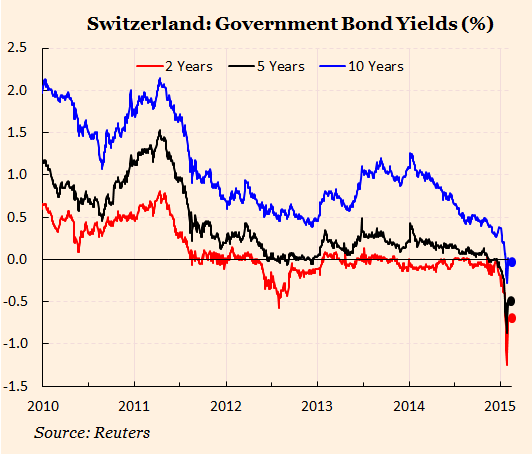
A few governments in Europe have been issuing short term bonds carrying negative interest rates. That means you pay for the privilege of lending to the government ! Even Spain (the country tottering on a default a couple of years ago) has done this. But these worthies, which include Germany, Austria and Finland as well,  issued only short term debt like this. 
Switzerland has this week taken it to a different level.  It has issued 10 years bonds at negative interest rates. TEN YEAR BONDS. The first country in the world to do so.  And it was handsomely oversubscribed.
So what is happening ? Why would any idiot pay to lend money.  Doesn\’t it turn everything we know about finance upside down ?
We are in completely uncharted territory and nobody knows what the implications are. Borrowing binges are likely. Will banks now start to charge you for depositing money into your account ?
Part of the  \”logic\”  of the people buying these negative interest bonds is as follows
  • When interest rates fall, bond prices go up (Its too technical to explain in layman terms, but take this for a fact)
  • They are expecting interest rates in Europe to fall further
  • When that happens the prices of these bonds will rise. They will sell and make a profit !
Of course, in the long run some idiot will be left holding a pile of worthless shit. But finance is all about the short term (alas, becoming extremely short term). Who cares for the sucker in the long run.
Very clever. If only all the fantastic brains who are thinking up incomprehensible ideas in finance were to turn their minds to solving some of the world\’s more real problems ………..
By the way, if you are in IT, here\’s a golden opportunity, not unlike Y2K. Bank\’s IT systems are not tailored to deal with a minus sign in the interest column.  Have to rewrite millions of lines of code ……..

Right problem ; Wrong solution

The extreme left , as this blogger is wont to repeat ad nauseam, is as bad as the extreme right. The champions of the hard left – Bernie Sanders in the US and  Jeremy Corbyn in the UK have one policy in common that is a good example of this. Free college for everybody. 
They also have another thing in common which is often the case with the left\’s policies. Right problem. Wrong solution.
First the right problem. Its a complete disgrace that in a developed country, a young person starts working life under a mountain of debt.  Outstanding student debt is now £100bn  in the UK,  and a ridiculous $1.3 trillion in the US. And just to give you a perspective on the latter statistic, its $ 600 m higher than the total credit card debt in the US. You start life with a mountain of debt, and not a ready prospect of a good job. Great. If I was to be born again and had a choice of where to be born, I wouldn\’t choose either the US or the UK on that statistic alone.
The left deserves great credit for highlighting this problem. Successive governments of all stripes and colours (pun intended) deserve censure for ignoring the problem and allowing it to build to these  levels. A society, and a nation, that spurns its young does not deserve  to be called \”civilised\”.
But, as is often the case, the left\’s solution is dead wrong. Their prescription is for college to be made free and the costs to be picked up by the government.  Fantastic. Will they never learn that tax tax tax and spend spend spend does not work – for free advice apply to Hugo Chavez, Fidel Castro, et al. 
This blogger suggests three solutions instead.
First cut costs. Why is college education so expensive ? In the US, a ridiculous amount of cost is spent on college sports, fancy living quarters and everything that has nothing to do with education. My good friend Sriram has blogged extensively and is far more knowledgeable on this subject.  In the UK, the average Vice Chancellor earns £300,000.  And gets payoffs for leaving the job, which would make any corporate fat cat proud.  Wield an axe on any cost that does not strictly have to do with education. Get the professional cost cutters from industry and let them loose on the education sector and within 3 years they\’ll cut costs down.
Secondly, what about parental responsibility. I am not at all clear why parents in these countries do not pick up a large portion of these costs. In Asia, education costs are largely picked up by parents. That\’s their legacy and gift to their offspring. If you are not prepared to start your child off well in life, you don\’t deserve to have a child. Period. And anyway what sort of an argument is it that you will not pay for your offspring\’s education, but somebody else (the tax payer) should. And don\’t tell me the parents cannot afford it – they have 15 odd years from the child\’s birth to plan savings. Save $ 5 every day and you won\’t have to worry about student debt.
Thirdly make college education truly global. Allow students from anywhere in the world to study anywhere else – allow free movement of students. There are superb universities in China and India for example, where you can get high quality education at a fraction of the cost in the US or the UK. Just like industry has truly globalised with activity automatically moving to the lowest cost location, so be it with education. Yes, I know this is an utopian dream and will never happen, but at least I can articulate it in my own blog (and no doubt face a volley of criticism in the comments !). Just to make it very clear, I am only advocating free movement for education; not permanent immigration.
The hard left may not ascend in the US, despite how many ever have felt the Bern. But there is a real chance that Jeremy Corbyn might become the Prime Minister of the UK. In that case their national anthem of \”God save the queen\” could perhaps be amended to God save the UK !

What is (more) \’Educationally Responsible\’?

What is more educationally responsible from among the alternatives below. Anytime you feel it\’s all very clear, don\’t ignore the possibility that there may a trap somewhere…
  • Encouraging someone to ask questions or give answers to questions no one is asking?
  • Helping learners discover worlds of fascinating and worthwhile knowledge around them versus providing them information from books?
  • Setting challenging tasks versus \’telling\’ children, giving explanatory lectures ?
  • Encouraging reflection or ensuring memorization of the right answers?
  • Preventing errors or letting children discover for themselves when they\’ve made a mistake?
  • Giving feedback versus giving marks (and remarks)?
  • Ensuring all children get the same opportunity versus ensuring different children get different opportunities?
  • Doing everything oneself (if you\’re a teacher) versus passing on some of your tasks to children (e.g. marking attendance, ensuring participation of peers)
  • Maintaining all provided materials in good shape or using them at the risk of their getting spoilt, torn, etc.?
  • Asking community to help with their knowledge heritage versus asking community to contribute to improvement in mid day meal?
  • Using a textbook as a resource versus using a textbook as a definitive material (i.e. assuming it is the curriculum)
  • Reading this blog or reading a useful book on education?!

So what is more educationally responsible? Let me have more such pairs / alternatives to choose from, and also your views on the above!

What is (more) \’Educationally Responsible\’?

What is more educationally responsible from among the alternatives below. Anytime you feel it\’s all very clear, don\’t ignore the possibility that there may a trap somewhere…
  • Encouraging someone to ask questions or give answers to questions no one is asking?
  • Helping learners discover worlds of fascinating and worthwhile knowledge around them versus providing them information from books?
  • Setting challenging tasks versus \’telling\’ children, giving explanatory lectures ?
  • Encouraging reflection or ensuring memorization of the right answers?
  • Preventing errors or letting children discover for themselves when they\’ve made a mistake?
  • Giving feedback versus giving marks (and remarks)?
  • Ensuring all children get the same opportunity versus ensuring different children get different opportunities?
  • Doing everything oneself (if you\’re a teacher) versus passing on some of your tasks to children (e.g. marking attendance, ensuring participation of peers)
  • Maintaining all provided materials in good shape or using them at the risk of their getting spoilt, torn, etc.?
  • Asking community to help with their knowledge heritage versus asking community to contribute to improvement in mid day meal?
  • Using a textbook as a resource versus using a textbook as a definitive material (i.e. assuming it is the curriculum)
  • Reading this blog or reading a useful book on education?!

So what is more educationally responsible? Let me have more such pairs / alternatives to choose from, and also your views on the above!

What is (more) \’Educationally Responsible\’?

What is more educationally responsible from among the alternatives below. Anytime you feel it\’s all very clear, don\’t ignore the possibility that there may a trap somewhere…
  • Encouraging someone to ask questions or give answers to questions no one is asking?
  • Helping learners discover worlds of fascinating and worthwhile knowledge around them versus providing them information from books?
  • Setting challenging tasks versus \’telling\’ children, giving explanatory lectures ?
  • Encouraging reflection or ensuring memorization of the right answers?
  • Preventing errors or letting children discover for themselves when they\’ve made a mistake?
  • Giving feedback versus giving marks (and remarks)?
  • Ensuring all children get the same opportunity versus ensuring different children get different opportunities?
  • Doing everything oneself (if you\’re a teacher) versus passing on some of your tasks to children (e.g. marking attendance, ensuring participation of peers)
  • Maintaining all provided materials in good shape or using them at the risk of their getting spoilt, torn, etc.?
  • Asking community to help with their knowledge heritage versus asking community to contribute to improvement in mid day meal?
  • Using a textbook as a resource versus using a textbook as a definitive material (i.e. assuming it is the curriculum)
  • Reading this blog or reading a useful book on education?!

So what is more educationally responsible? Let me have more such pairs / alternatives to choose from, and also your views on the above!

What is (more) \’Educationally Responsible\’?

What is more educationally responsible from among the alternatives below. Anytime you feel it\’s all very clear, don\’t ignore the possibility that there may a trap somewhere…
  • Encouraging someone to ask questions or give answers to questions no one is asking?
  • Helping learners discover worlds of fascinating and worthwhile knowledge around them versus providing them information from books?
  • Setting challenging tasks versus \’telling\’ children, giving explanatory lectures ?
  • Encouraging reflection or ensuring memorization of the right answers?
  • Preventing errors or letting children discover for themselves when they\’ve made a mistake?
  • Giving feedback versus giving marks (and remarks)?
  • Ensuring all children get the same opportunity versus ensuring different children get different opportunities?
  • Doing everything oneself (if you\’re a teacher) versus passing on some of your tasks to children (e.g. marking attendance, ensuring participation of peers)
  • Maintaining all provided materials in good shape or using them at the risk of their getting spoilt, torn, etc.?
  • Asking community to help with their knowledge heritage versus asking community to contribute to improvement in mid day meal?
  • Using a textbook as a resource versus using a textbook as a definitive material (i.e. assuming it is the curriculum)
  • Reading this blog or reading a useful book on education?!

So what is more educationally responsible? Let me have more such pairs / alternatives to choose from, and also your views on the above!

What is (more) \’Educationally Responsible\’?

What is more educationally responsible from among the alternatives below. Anytime you feel it\’s all very clear, don\’t ignore the possibility that there may a trap somewhere…
  • Encouraging someone to ask questions or give answers to questions no one is asking?
  • Helping learners discover worlds of fascinating and worthwhile knowledge around them versus providing them information from books?
  • Setting challenging tasks versus \’telling\’ children, giving explanatory lectures ?
  • Encouraging reflection or ensuring memorization of the right answers?
  • Preventing errors or letting children discover for themselves when they\’ve made a mistake?
  • Giving feedback versus giving marks (and remarks)?
  • Ensuring all children get the same opportunity versus ensuring different children get different opportunities?
  • Doing everything oneself (if you\’re a teacher) versus passing on some of your tasks to children (e.g. marking attendance, ensuring participation of peers)
  • Maintaining all provided materials in good shape or using them at the risk of their getting spoilt, torn, etc.?
  • Asking community to help with their knowledge heritage versus asking community to contribute to improvement in mid day meal?
  • Using a textbook as a resource versus using a textbook as a definitive material (i.e. assuming it is the curriculum)
  • Reading this blog or reading a useful book on education?!

So what is more educationally responsible? Let me have more such pairs / alternatives to choose from, and also your views on the above!

What is (more) \’Educationally Responsible\’?

What is more educationally responsible from among the alternatives below. Anytime you feel it\’s all very clear, don\’t ignore the possibility that there may a trap somewhere…
  • Encouraging someone to ask questions or give answers to questions no one is asking?
  • Helping learners discover worlds of fascinating and worthwhile knowledge around them versus providing them information from books?
  • Setting challenging tasks versus \’telling\’ children, giving explanatory lectures ?
  • Encouraging reflection or ensuring memorization of the right answers?
  • Preventing errors or letting children discover for themselves when they\’ve made a mistake?
  • Giving feedback versus giving marks (and remarks)?
  • Ensuring all children get the same opportunity versus ensuring different children get different opportunities?
  • Doing everything oneself (if you\’re a teacher) versus passing on some of your tasks to children (e.g. marking attendance, ensuring participation of peers)
  • Maintaining all provided materials in good shape or using them at the risk of their getting spoilt, torn, etc.?
  • Asking community to help with their knowledge heritage versus asking community to contribute to improvement in mid day meal?
  • Using a textbook as a resource versus using a textbook as a definitive material (i.e. assuming it is the curriculum)
  • Reading this blog or reading a useful book on education?!

So what is more educationally responsible? Let me have more such pairs / alternatives to choose from, and also your views on the above!

Wonderful Experience to meet Father of Green Revolution: Prof M S Swaminathan Sir

Prof. Mankombu Sambasivan Swaminathan, popularly known as M.S. Swaminathan, (born 7 August 1925) is a great personality not only in India but across the world as he has shown the path how a country can be self-sufficient in food-grains after experiencing severe food shortage because of drought. And for his enormous contributions in the field of agriculture, he was awarded with many national and international awards. The recent one is the first World Agriculture Prize in 2017. There is not an iota of doubt that because of Prof M.S. Swaminathan sir’s contribution today India is self-sufficient in food grains and 130 crores people are getting food. In the backdrop, we all know severity of the food problem in 1943, the Bengal famine and later on in 1965 because of monsoon failure India seriously suffered from food crisis. Now all are in history as Swaminathan sir has shown the path to both Indian Government and our farmers, how one can be self-sufficient which all know as ‘Green Revolution’. His vision is to get rid of the world from hunger and poverty and he is great believer of sustainable development, especially using environmentally sustainable agriculture and preservation of biodiversity, which he calls an “evergreen revolution.” He successfully completed various coveted positions and inter alia of which are – Director General of Indian Council of Agricultural Research from 1972 to 1979, after that Principal Secretary, Ministry of Agriculture, Government of India from 1979 to 1980. He served as prestigious post of Director General of the International Rice Research Institute (1982–88) and selected as the President of the International Union for the Conservation of Nature and Natural Resources. For his excellent contributions, in 1999 the prestigious Time Magazine placed him in the ‘Time 200’ list of most influential Asian people of the 20th century.

Another praiseworthy contribution of Swaminathan Sir to the world in general and India in particular is setting up of the MS Swaminathan Research Foundation, popularly known as MSSRF in Chennai, Tamil Nadu. MSSRF (established in 1988) is a non-profit organisation.

The MSSRF aims to accelerate use of modern science for sustainable agricultural and rural development. It focuses specifically on tribal and rural communities with a pro-poor, pro-women and pro-nature approach. The Foundation applies appropriate science and technology options to address practical problems faced by rural populations in agriculture, food and nutrition.

MSSRF is carrying out research and development in the following major areas:

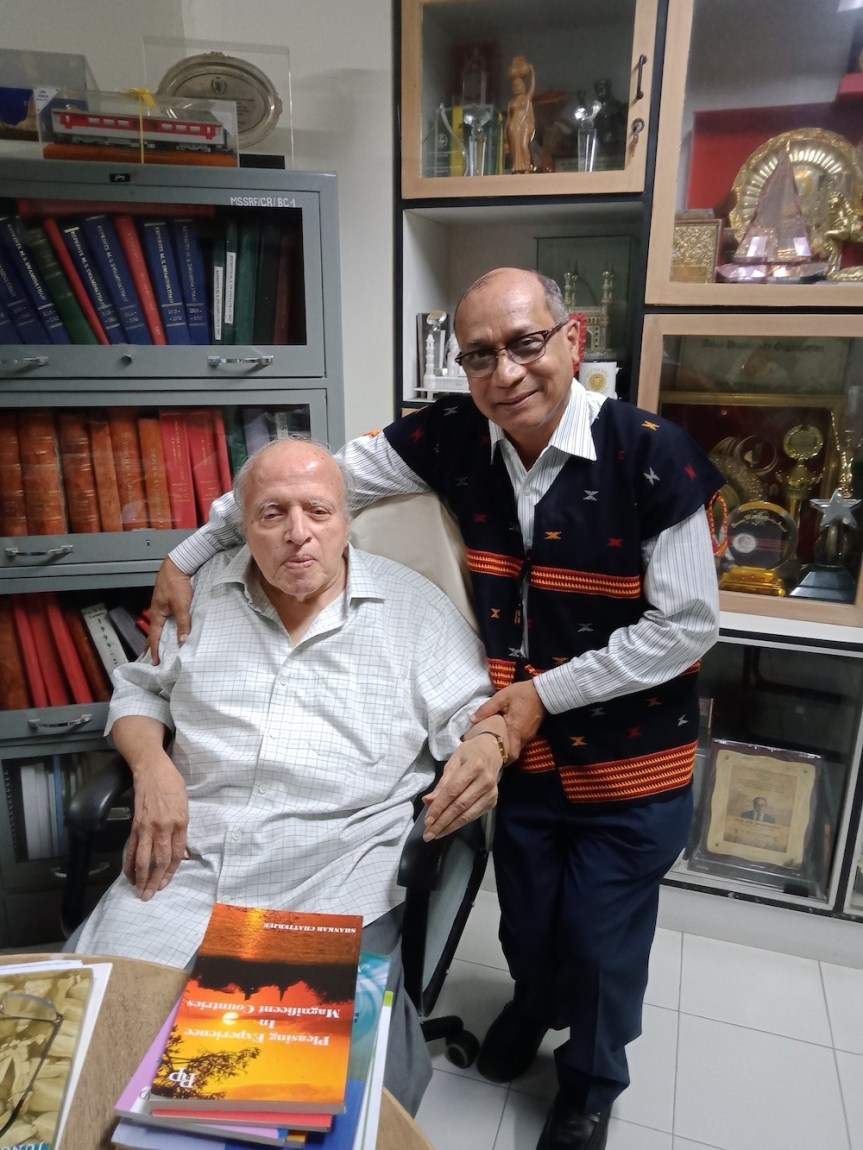
I had the opportunity to meet Prof Swaminathan sir on 18 December 2019 at MSSRF in Chennai and took his blessing as I feel he is ‘Annadata’ (food provider) to all of us. Interaction was although few minutes but I was greatly enlightened.  I was charmed to see such a simple and wonderful human being although endowed with ‘ocean of knowledge’, awards etc.; he is ‘down to earth’ person. Immediately the Sanskrit proverb, which I read in school days, came to my mind ‘Vidya Dadati Vinayam’ (simple meaning Knowledge makes a man perfect).


Dr. Shankar Chatterjee

Former Professor& Head (CPME)

NIRD &PR (Govt. of India), 

Hyderabad-500 030

Telangana, India 

Email <shankarjagu@gmail.com>


Beggars in Nigeria will start paying tax !


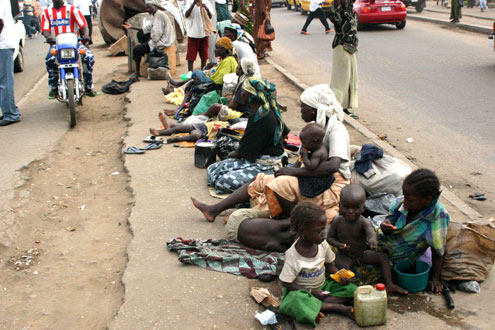
So says the Finance Minister of Nigeria. Beggars will have to pay taxes. Apparently some beggars are earning millions in Nigeria. Perhaps its fair enough that Mrs Adeosun , the Finance Minster said “proceeds from begging are taxable. You are supposed to pay taxes even if your means of income is begging”.
Nigeria is a notoriously corrupt country and tax evasion is blatant and has been elevated to a fine art.  Hence the startling “fact” that beggars are earning millions. Nigeria should, by all rights, should be a very prosperous country. It has oil wealth and is a net oil exporter. It has a  young , bright and growing population.  It has a decent education system and some of the ablest people in the African continent. It is a large economy – second largest after South Africa.  And yet, it is a huge underperformer economically. 
Periodically the Nigerian government tries to tackle corruption and the also shore up the country’s finances. Bolstering tax revenue by cracking down on rampant tax evasion keeps getting tried periodically, but with not much success. The latest is the Voluntary Assets and Income Declaration Scheme ( with the unfortunate acronym – VAIDS) . Good luck for the latest attempt.
India suffers from similar evasion, with its own home grown quirks. Agricultural income is not taxed , but much of what is claimed as agricultural income has nothing to do with farming. Similarly the tax entity called Hindu Undivided Family is nothing but an institutionalised way to manage taxes.  The irony that “Undivided” and “Family” cannot be put adjacent to each other when it comes to money matters is completely lost on Ramamritham !
The United States being the leader of the world in all matters offers a rich variety of such dodges in the law. Walt Disney in Florida and other big landowners collectively dodged $950 m in  taxes by renting a few cows to graze on their large land holdings and thereby qualified as agricultural land inviting lower taxes. And since two of my usual commenters are from the great state of Oregon, they may wish to declare that two of their limbs are useless and thereby earn a tax credit of $50 !
Back to begging. Actually no country exempts the proceeds of begging from taxation. If your earnings from begging exceed the minimum threshold, you have to pay tax on it anywhere in the world. Mrs Adeosun was only stating an universal truth ! Beggars of the world, beware !!

    The Seven Myths That Make Education Difficult To Improve

    If you’re from a poor family, there’s a lot more to life than just attending school! Siblings and domestic animals have to be cared for, parents have to be helped, essentials such as water or firewood have to be fetched, birds and animals kept away from the farm, you may need to migrate with your parents…. It’s not necessary that all this is a waste – in fact, despite the shadow child labour, a lot of this is also learning for life.  Children who are in a position to attend daily too might learn a lot if they spent a day or two every week doing things other than school – such as tending to gardens, pursuing a passion, trying to earn something by putting their learning to use, solving a neigbhourhood problem, helping their siblings and parents, making things…. Or helping their underprivileged classmates so that they can spend more time in school.
    The kind of focused (and therefore limited) scholastic learning our ‘advanced’ children end up doing has resulted in several luminaries pointing out that (even from institutions such as the IITs) our graduates are ‘unemployable’. One might add they haven’t developed many other aspects of their personality – including civic consciousness.
    However, what this requirement of daily attendance does is to marginalize great numbers of children, since the teaching-learning process tends to be sequential (rather than re-iterative). If you miss out an earlier part, you can’t ‘keep up with the class’ and slowly head for being left out or pushed out or dropping out. Effectively, the school is saying: if you are poor and cannot attend regularly (as the we require), you shall not learn. Instead of: attend when you can, we’ll find a way to support you and make sure you learn (which is what the business of the school really is).
    There are a few walk-in centres in the country (though of course only for poor and/or working children) and some of them do manage to attract and keep children for a long time even though there is no compulsion to attend. That kind of flexibility is perhaps too much to hope for in the school system. Enabling the school to be more responsive to children’s real living situations, though – that’s both possible and desirable. It needs a spiraling rather than linear flow, a variety and range of materials, and providing children engaging activities in many of which they will work on their own, and the use of a tracking system to keep record of progress. This gels with every provision of the RTE, with expectations put forward in our National Curriculum Framework, and much that contemporary understanding of pedagogy tells us. However, to make it happen what we need is not methods and materials but a way to get rid of this myth and the fear that everything will fall apart if the school seeks to respond (by adapting to children’s needs) rather than coerce (by making children adjust to its needs).

    How Do We Measure Change?

    We repeatedly find ourselves saying that working on improving education implies change. That is because the very core of education – in terms of key relationships, processes and the critical outcomes desired – itself is expected to undergo a transformation. Some of the biggest differences expected are in terms of

    • undoing the existing hierarchy,
    • increasing accountability,
    • evolving the role of the key stakeholders such as children and community from passive to active,
    • in fact even a reversal of the notion of the \’beneficiary\’ (especially after the RTE, children and the community are the reasons why the education system exists; and teachers, educational officers and others in the system are the beneficiaries in that they get their salaries because children have a right to education)
    • preparing children for life rather than just for examinations.


    Thus it is not just a case of revision in components such as curriculum or textbooks or training or assessment but bringing about much deeper changes that will then manifest themselves in the different components. Change, therefore, in the underpinnings or the foundations themselves, implies major shift in emphasis, ways of working, the means used, the technical and human / social capabilities required, and a myriad other things. All this adds up to one word: change.

    Much has been said on the issue of what this change is and the different ways of bringing it about (and more will appear too). But the one unresolved question confronting us is: how will we know if real change is actually happening, and to what extent? Is there any way in which we can capture / describe and \’measure\’ such deep change? As of now, the question really has us stumped. Any suggestions? 

    Export and Import of Defence Equipment

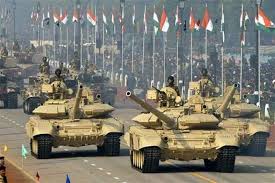
    Capital procurement of defence equipment is undertaken from various domestic as well as foreign vendors, based on operational requirements of the Armed Forces, the availability or capacity to produce the equipment in India and abroad, to keep the Armed Forces in a state of readiness to meet the entire spectrum of security challenges. During last three financial years (2016-17 to 2018-19), 149 capital acquisition contracts have been concluded, out of which  58 contracts worth about   Rs. 1,38,727.16 crores and 91 contracts worth about Rs.76,955.73 crores have been placed on foreign vendors and Indian vendors respectively for procurement of defence equipment for the Indian Defence Forces. The countries from which defence equipment imports are being undertaken include Russia, USA, Israel, France and United Kingdom.

    There are 41 Ordnance Factories and 9 Defence Public Undertakings (DPSUs) in the Public sector in India manufacturing defence equipment. In addition, 452 number of Industrial Licenses (ILs) have been issued to defence industry in private sector for manufacturing of defence equipment.

    The major defence equipment exported during the last three years by India to foreign countries are Patrol Vessels, Helicopters, Sonars and Radars, Avionics, Radar Warning Receivers(RWR), Small Arms, Small Caliber Ammunition, Grenades, Telecommunication equipment, Coastal Surveillance, Simulators, Bullet Proof Jackets and Body Armour. The details of defence export authorisations for the last 3 years are as follows:-

    Year Value (Rs. in crore)
    2016-17 1,521
    2017-18 4,682
    2018-19 10,745

    This information was given by Raksha Rajya Mantri Shri Shripad Naik in a written reply to Shri Md. Nadimul Haque in Rajya Sabha today.

    ABB/Nampi/DK/Savvy/MTJ/ADA