To all those who are convinced that the non-detention policy is harming education…
Children’s apparent lack of learning becomes an issue mainly because it is easy to see that they have missed out on something. The fact that at a younger age learning is very fast and that clear milestones are available helps us perceive this – and therefore apply all kinds of expectations, tactics, at times even coercion to ‘ensure’ learning – one such being the detention system which, many believe, is needed in order to maintain ‘quality’. By making children lose a year because we couldn’t ensure their learning (and blaming them for it), we feel we can generate the fear required to make them ‘serious’ and learn.
If we are convinced about this, why should it apply only to school education? What if we could lay out clear benchmarks for adults to learn and grow – in general as well as in the work they do. Certainly it is possible to have a life-long ‘curriculum’ with two-year benchmarks (over their entire careers, and even post retirement) for educationists and curriculum developers, teachers, HMs, government officials, managers, businessmen, fathers and mothers (and grandparents), journalists, artists, municipal staff, auditors, accountants, administrators, intelligence agents and politicians. What if there was a ‘detention system’ (in terms of not being allowed to be promoted or get a pay increase or being sent back to some lower ‘grade’)? Yes, in some government jobs there is an ‘efficiency bar’ and the supposed HR policies and internal competition are expected to sort this out. But do they?
Can we as a nation claim that we have, every year, demonstrated the improvement required to declare ourselves ‘promoted’ to the next level (whatever that is)?
And what happens when police are unable to reduce crimes, leaders are unable to ensure the welfare of the poor, systems are unable to deliver basics such as electricity / water / education / health, or societies are unable to get men to have basic respect for women?
Continuing to live with these myths is to deny ourselves the opportunity to succeed, especially for those who need education the most. The first step is to accept that these notions have indeed affected our work in trying to bring about better education. Acknowledging this is not a sign of defeat but of learning.
After acknowledgement, however, come reflection – and small steps.
Here are some small steps that all of us can take:
Discuss these ‘myths’ and related issues with as many people as you can. Question and contest them, or support them, with your experiences, facts and data from your sphere.
If you are in any way connected with education – as a student, parent, teacher, CRC-BRC, official or resource person, NGO worker or decision-maker, make one small change every month which in some way empowers children or teachers or HMs. (Our team, Ignus PAHAL, will soon be producing a poster presenting a graded list of these small, doable changes at the school level.)
Talk with as many stakeholders as possible and within reach (and in the limited time available) about what they would like. They might suggest things they could do – and a small beginning may be made to a partnership in bringing about improvement that is gettable. It may be a better way to help children wash their hands before the mid-day meal, or managing to start the school 10 minutes earlier so that learning time increases, or ensuring used textbooks are circulated better, or working out how you may share your expertise with children or teachers.
Find something interesting you can share with children. It may be a news item (e.g. did you know that for some reason, the MHRD – and some of the other ministries of education in the country – face a problem with monkeys troubling them?), or an interesting story you’ve read or know (but no moral tales please!) or a suggestion for something they can try out (e.g. making a paper plane turn in a predicted direction) or find out (e.g. why the inner margin of a textbook page is wider than the outer margin – okay, that is too easy but you get the idea).
Find a way to convert complex educational ideas into simpler forms so that a person with no background in education or no access to ‘high’ language may understand it. E.g. ‘non-detention is not the same as non-evaluation, and that by detaining children we are making them pay the price for the system’s failure and also supporting the idea that it is fear which leads to learning’. Can you find a way to make this idea easy to understand for millions of teachers, parents, SMC members and others? (You can guess why this statement was selected as the example…)
Use your mobile – call up a teacher, or text her an idea or send your appreciation. With children, use the stop-watch, camera and calendar in your phone to do activities. If you know an official and have a good enough relationship, make him or her uncomfortable by reading out sections of this article (don’t get into a bitter argument – a gentle, understanding approach may be more useful!).
Finally, please add to the discussion on these 7 Myths and, perhaps more importantly, to the list of suggestions.
But all these are very small things, you might say. They can’t achieve much. Well, not if many, many, many of us are doing them! Perhaps it’s a myth too that only when some large government programme is in action can change take place. This ignores local ingenuity and the sheer numbers that can make government efforts look feeble – or boost them to make them actually succeed. Towards this, your views and ideas may be more powerful than you imagine. And that’s not a myth!
Whether on the TV or in newspapers or on social media sites – we are today surrounded everywhere by strong views on nationalism. Groups of people are getting angry and upset, calling each other names, being violent. Your students too are caught in this, though they may not fully be aware of it. They will be absorbing views from different sources, all of which may not be reliable. And they may end up adopting strong opinions (or even what you consider misguided ones) without giving them sufficient thoughts. For this reason, we have prepared a discussion guide. It is important that at this crucial time, when they might be making a choice, you, their teacher, reach out to them and help them think things through.
So here are some hints. Use them in the way they work best for you. Drop them or change them or add to them according to your need and situation.
Preliminary – setting the ground
For such a discussion, it would be best to prepare the ground gently rather than rush into it. Here are some questions you could ask.
Have you been hearing or seeing the news or reading the newspapers?
What are some of the big issues being discussed?
What have you read or hear about the ‘nationalism debate’?
Provide background
Briefly give a background to the issue. It is possible many may not have heard it or may not have a clear idea of what happened.
Discuss the issue
As students the following questions. Make sure you get everyone’s views, especially those who often don’t speak up. [Some hints are given in the brackets.]
So what do you think it means to love your country? [taking care of the environment? Looking after those who are not able to take care of themselves? Singing patriotic songs? Joining the army? Being polite to others? What else? Especially in our daily lives, what do we do (or can do) to show our patriotism?]
What are the best ways to show your love for your country? [you can use the list from the previous question to identify 2-3 of the ‘best’ or ‘most important’ ways and discuss why students think they are the best.]
What are some of the things you would not do if you love your country? [e.g. spitting everywhere as it spreads disease, not dirtying or vandalizing the environment, not jumping a queue or try to take an undue advantage…]
Even in a family everyone is not able to agree on everything? Have you seen any example of this? What happens in such a case?
So if someone does no agree with you, is it a good idea to beat him or her up? Why?
What do you think are the best ways to deal with disagreement?
And what if on the issue of loving your country, someone says something you don’t find pleasant? What should you do?
What are the best ways of finding out more deeply why people think the way they think? And how can you use that to help them see things differently?
Afterwards
Of course, this discussion will not end here. Give students some materials to read. Organize one or two follow up events. Suggest that the students have their own discussion group and contact you for help if needed.
‘It took me quite some time to get the little girl to let me know what was bothering her,’ said Prof. A. K. Sharma, the former Director of NCERT. The year was 2000 and he was telling me about an incident from a class 2 maths period in the model school in the NCERT campus. The teacher had just completed teaching children subtraction of two-digit numbers with ‘borrowing’, and he had found two children hesitating over the problems they had been given to solve.
The first, a girl, had made a ‘mistake’ as she had failed to borrow from the tens side. Being a grandfatherly and kindly figure, he was able to cajole the girl to speak up. Very softly, looking down and away from him all the while, she said, ‘We learnt in the moral science class that borrowing is bad.’
Reeling from this, he approached the other child, a boy, and discussed why he had not completed his work on the problem. After much exchange, the boy said, ‘But why should I borrow 1? I want to borrow 2.’
Taking part in a recent session on ‘error analysis’, I was reminded of Prof. Sharma’s advice to engage with children to understand their ‘errors’ rather than rely on their work on paper. In numerous assessment experiences since, I’ve seen children who are otherwise very competent falter because of an issue at home or a fight with a friend or because they are being bullied. In open-ended questions in language, teachers are hard put to identify if there really is an ‘error’ or if the child’s view is a valid, logical interpretation. (And asking only close-ended questions is hardly sufficient to understand children’s abilities.) It becomes even more difficult when it comes to children from marginalized backgrounds – as they encounter discrimination and even denigration (of their background, language or culture), they often resist by ‘not-learning’ or do not answer out of fear of being ‘disciplined’.
As the evaluation industry expands in the Indian context with more and more professionals taking in rigorous analysis of children’s responses and analyses of their ‘errors’, the tendency is to interpret these within the framework of the subject for which the test was conducted. But do we know what we really assess when we look closely at children’s responses? What if it’s not a maths or language issue but something else altogether?
The pervasive notion that \’nothing has been done in education in India\’ could not be further from the truth. In fact not only has a great deal been done, but its consequences have been faced over decades. In particular, what follows applies to introducing educational designs based on local context, using the experiences and strengths of the stakeholders, creating a situation where they play an active role in determining and implementing processes. Though obviously much must have been done over the decades till the 80s, my experience ranges from mid-80s, when I was part of a team working on such classroom practices, textbooks and educational designs from 1986 onwards. Implementation of the programme called Prashika (Prathamik Shiksha Karyakram) focused on marginalised groups, with the team living in a tribal area as well as in a rural, deprived pocket and introducing the innovation in government primary schools. The work in Prashika was pathbreaking in many, many ways (integration of 5 subjects at the primary level, incorporation of multiple local languages, a hugely localised textbook/workbook that could only be completed with each child contributing, called Khushi-Khushi – still not matched anywhere, I believe). It provided hope that much was possible despite the difficulties faced and informed many of the later efforts that followed, both in the government and the NGO sector.
Later in DPEP – particularly Kerala, Assam, Karnataka, Haryana, UP, Bihar, TN, Nagaland and later with SSA Gujarat further work was done. Localised training, contexualisable textbooks (some really brilliant stuff still not matched anywhere – and that\’s a professional opinion), teacher determined assessment system, involvement of community knowledge, children constructing local histories / local environment books, peer learning and assessments, textbooks that would be \’complete\’ only along with a set of 50 district-specific books kept in the school library…. many, many innovative and large scale measures were conceived and actually implemented using a strategically developed implementation plan.
In each first five states we were able to see 2-3 years of implementation, development of hundreds / thousands of teachers who implemented contextualised learning, a high degree of in-class practice backed by supportive, localisable material. These states changed their position in the national achievement surveys too, with Kerala rising to the top (it had been fairly close to the bottom before this, below Bihar in the first national survey). In the case of Gujarat, field testing was done in 630 schools, researched by MSU Baroda with very encouraging findings.
However, as long as we were not visibly successful there were no problems. When change began to be visible on some scale and a palpable sense of energy was witnessed among teachers and communities, alarm bells began to ring. in each of these states, the powers that be – especially at state level, state institutions, administrations, political parties – found that this went against the command-and-control structures conducive to them being able to assert their authority. Schools didn\’t want to be told what to teach when and how – they had their own plans. Empowered teachers / school heads / even some VECs refused to kowtow to mediocre ideas or corruption oriented bosses – leading to huge conflicts all over the place. Unfortunately these never got reported, recorded or researched. The results were mass scale transfers, cases against state project directors who encouraged this (Kerala SPD was charge sheeted, Karnataka SPD given punishment posting in North Karnataka, Assam SPD sent to conflict zone during worst riots, Bihar SPD transferred to PHED and later kept without posting), the re-casting of State Resource Groups from those selected for tested capabilities to those stocked with ex-officio positions, the emasculation of the BRC-CRC structures from genuine teacher support institutions into data collection centres (believe it or not, we did have functional BRCs CRCs at one time!), the centralisation of powers away from the VECs and re-casting into SMCs with a different function, and major shift in recruitments away from districts to states (in one state the Education Minister held a Recruitment Mela in a stadium to personally appoint 3000 para-teachers). Interestingly, Prashika in MP faced a similar adminstrative backlash and was closed down.
Yes, like it or not, this is what ideas of empowerment through education come up against – and they fall short not because of lack of any purity in the idea itself or absence of rigour, but because after a point when it goes into implementation an idea is something else, and not its original pure self. You might look at the actual work and find it is not \’up to the standard\’ – yet when trying to create it for those who need education the most, other aspects need to be taken into account. Basically, empowering the weak is clearly seen by the strong as disempowering them – and the empire strikes back! One of the outcomes is that a few years later, it appears as if nothing has been done, and people gear themselves up to again come up with \’innovative\’ ideas, often weaker than might already have been tried, uninformed by the past.
Years ago, it was felt that the root of all problems in education is the teacher. In fact, the MLLs (Minimum Levels of Learning, which served as the de fact national curriculum framework) in the late 80s and early 90s were designed to ensure \’teacher accountability\’ in terms of the minimum that would be achieved. A popular programme, Rishi Valley\’s multi-grade teaching (adopted/adapted as \’activity based learning\’ in many states) actually originated from the desire to get children to be able to learn without needing the teacher (which is why there is so much of self learning in it).
People still continue to condemn the teacher and hold him responsible for all the ills in education. However, with the proliferation of so many \’reports\’ on education all around, there is now a great sense of intolerance towards the education system itself. The belief seems to be that not only government teachers and schools but the government education system itself is condemnable. Among NGOs, academics, commentators, researchers and intellectuals the general notion seems to be gathering steam that everything and everyone in the government system is the problem!
But what is a system if not the people in it, the way they work and the frame within which they work? From that point of view, I have to say that some of the finest people I\’ve come across are \’system\’ people. Every year I get the chance to work with thousands of teachers who I see putting in 12-14 hour days when others from outside the system (e.g. NGOs) fade away after only 8 hrs of input. This is not to say everything is OK with the system or the policies or the people – it\’s just point out that a black and white view doesn\’t help. And that just as it is not possible to change a teacher while condemning him, it is not likely to be possible to improve a system while condemning it!
Years ago, it was felt that the root of all problems in education is the teacher. In fact, the MLLs (Minimum Levels of Learning, which served as the de fact national curriculum framework) in the late 80s and early 90s were designed to ensure \’teacher accountability\’ in terms of the minimum that would be achieved. A popular programme, Rishi Valley\’s multi-grade teaching (adopted/adapted as \’activity based learning\’ in many states) actually originated from the desire to get children to be able to learn without needing the teacher (which is why there is so much of self learning in it).
People still continue to condemn the teacher and hold him responsible for all the ills in education. However, with the proliferation of so many \’reports\’ on education all around, there is now a great sense of intolerance towards the education system itself. The belief seems to be that not only government teachers and schools but the government education system itself is condemnable. Among NGOs, academics, commentators, researchers and intellectuals the general notion seems to be gathering steam that everything and everyone in the government system is the problem!
But what is a system if not the people in it, the way they work and the frame within which they work? From that point of view, I have to say that some of the finest people I\’ve come across are \’system\’ people. Every year I get the chance to work with thousands of teachers who I see putting in 12-14 hour days when others from outside the system (e.g. NGOs) fade away after only 8 hrs of input. This is not to say everything is OK with the system or the policies or the people – it\’s just point out that a black and white view doesn\’t help. And that just as it is not possible to change a teacher while condemning him, it is not likely to be possible to improve a system while condemning it!
Years ago, it was felt that the root of all problems in education is the teacher. In fact, the MLLs (Minimum Levels of Learning, which served as the de fact national curriculum framework) in the late 80s and early 90s were designed to ensure \’teacher accountability\’ in terms of the minimum that would be achieved. A popular programme, Rishi Valley\’s multi-grade teaching (adopted/adapted as \’activity based learning\’ in many states) actually originated from the desire to get children to be able to learn without needing the teacher (which is why there is so much of self learning in it).
People still continue to condemn the teacher and hold him responsible for all the ills in education. However, with the proliferation of so many \’reports\’ on education all around, there is now a great sense of intolerance towards the education system itself. The belief seems to be that not only government teachers and schools but the government education system itself is condemnable. Among NGOs, academics, commentators, researchers and intellectuals the general notion seems to be gathering steam that everything and everyone in the government system is the problem!
But what is a system if not the people in it, the way they work and the frame within which they work? From that point of view, I have to say that some of the finest people I\’ve come across are \’system\’ people. Every year I get the chance to work with thousands of teachers who I see putting in 12-14 hour days when others from outside the system (e.g. NGOs) fade away after only 8 hrs of input. This is not to say everything is OK with the system or the policies or the people – it\’s just point out that a black and white view doesn\’t help. And that just as it is not possible to change a teacher while condemning him, it is not likely to be possible to improve a system while condemning it!
Years ago, it was felt that the root of all problems in education is the teacher. In fact, the MLLs (Minimum Levels of Learning, which served as the de fact national curriculum framework) in the late 80s and early 90s were designed to ensure \’teacher accountability\’ in terms of the minimum that would be achieved. A popular programme, Rishi Valley\’s multi-grade teaching (adopted/adapted as \’activity based learning\’ in many states) actually originated from the desire to get children to be able to learn without needing the teacher (which is why there is so much of self learning in it).
People still continue to condemn the teacher and hold him responsible for all the ills in education. However, with the proliferation of so many \’reports\’ on education all around, there is now a great sense of intolerance towards the education system itself. The belief seems to be that not only government teachers and schools but the government education system itself is condemnable. Among NGOs, academics, commentators, researchers and intellectuals the general notion seems to be gathering steam that everything and everyone in the government system is the problem!
But what is a system if not the people in it, the way they work and the frame within which they work? From that point of view, I have to say that some of the finest people I\’ve come across are \’system\’ people. Every year I get the chance to work with thousands of teachers who I see putting in 12-14 hour days when others from outside the system (e.g. NGOs) fade away after only 8 hrs of input. This is not to say everything is OK with the system or the policies or the people – it\’s just point out that a black and white view doesn\’t help. And that just as it is not possible to change a teacher while condemning him, it is not likely to be possible to improve a system while condemning it!
Years ago, it was felt that the root of all problems in education is the teacher. In fact, the MLLs (Minimum Levels of Learning, which served as the de fact national curriculum framework) in the late 80s and early 90s were designed to ensure \’teacher accountability\’ in terms of the minimum that would be achieved. A popular programme, Rishi Valley\’s multi-grade teaching (adopted/adapted as \’activity based learning\’ in many states) actually originated from the desire to get children to be able to learn without needing the teacher (which is why there is so much of self learning in it).
People still continue to condemn the teacher and hold him responsible for all the ills in education. However, with the proliferation of so many \’reports\’ on education all around, there is now a great sense of intolerance towards the education system itself. The belief seems to be that not only government teachers and schools but the government education system itself is condemnable. Among NGOs, academics, commentators, researchers and intellectuals the general notion seems to be gathering steam that everything and everyone in the government system is the problem!
But what is a system if not the people in it, the way they work and the frame within which they work? From that point of view, I have to say that some of the finest people I\’ve come across are \’system\’ people. Every year I get the chance to work with thousands of teachers who I see putting in 12-14 hour days when others from outside the system (e.g. NGOs) fade away after only 8 hrs of input. This is not to say everything is OK with the system or the policies or the people – it\’s just point out that a black and white view doesn\’t help. And that just as it is not possible to change a teacher while condemning him, it is not likely to be possible to improve a system while condemning it!
Years ago, it was felt that the root of all problems in education is the teacher. In fact, the MLLs (Minimum Levels of Learning, which served as the de fact national curriculum framework) in the late 80s and early 90s were designed to ensure \’teacher accountability\’ in terms of the minimum that would be achieved. A popular programme, Rishi Valley\’s multi-grade teaching (adopted/adapted as \’activity based learning\’ in many states) actually originated from the desire to get children to be able to learn without needing the teacher (which is why there is so much of self learning in it).
People still continue to condemn the teacher and hold him responsible for all the ills in education. However, with the proliferation of so many \’reports\’ on education all around, there is now a great sense of intolerance towards the education system itself. The belief seems to be that not only government teachers and schools but the government education system itself is condemnable. Among NGOs, academics, commentators, researchers and intellectuals the general notion seems to be gathering steam that everything and everyone in the government system is the problem!
But what is a system if not the people in it, the way they work and the frame within which they work? From that point of view, I have to say that some of the finest people I\’ve come across are \’system\’ people. Every year I get the chance to work with thousands of teachers who I see putting in 12-14 hour days when others from outside the system (e.g. NGOs) fade away after only 8 hrs of input. This is not to say everything is OK with the system or the policies or the people – it\’s just point out that a black and white view doesn\’t help. And that just as it is not possible to change a teacher while condemning him, it is not likely to be possible to improve a system while condemning it!
Hyderabad is an important city of India as it is endowed with many historical places, mouth-watering dishes including veg and non-veg biryani, different types of fruits and vegetables, ornamental items (pearl and related items), famous for medical tourism, etc. Hyderabad is also a city of national integration and above caste, creed, and religion all live amicably. As an example, a legendary figure may be mentioned here as known to all that Sarojini Naidu being a Bengali lady was born in Chattopadhyay/Chatterjee family in 1879 in Hyderabad and married to a Telugu man, Dr. Govindarajulu Naidu and finally settled down in Hyderabad. Her parental home was in undivided Bengal.
RTP Mela of NIRD
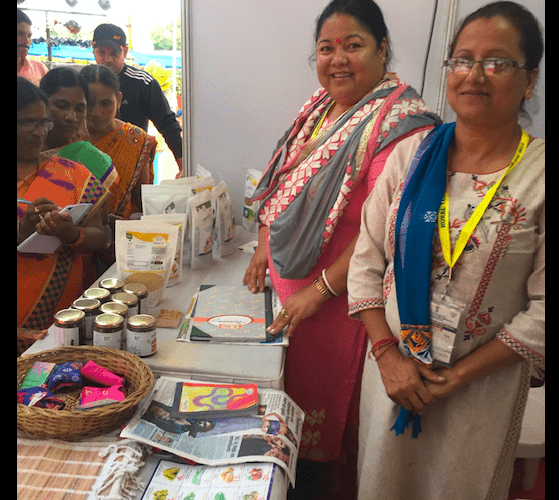
In this section, a case of national integration promoted by the National Institute of Rural Development and Panchayati Raj (popularly known as NIRD&PR), an autonomous organization of the Ministry of Rural Development, Government of India is presented. The NIRD&PR, apart from its academic activities, has been organizing Mela every year from 2003 where across India, rural artisans mainly self-help group (SHG) members participate with their products for scaling up of selling.
In 2019, 17th Mela held from 29 November to 3 December 2019 was inaugurated by the Governor of Telangana, Dr. Tamilisai Soundararajan on 29 November 2019. As reported by Mr Md. Khan, Sr. Consultant of RTP-NIRD&PR, in the Mela mainly women members of Self Help Groups (SHG) from 24 states across the country including Arunachal Pradesh, Meghalaya, Mizoram, Manipur, Tripura, Sikkim, J&K participated. The participation of so many states from north-east in other years of the Mela was seldom. Further, around 200 stalls were set up covering various items like veg and non-veg foods, dress materials for ladies, gents and children, different types of ornamental items, etc.
RTP Mela of NIRD
The author interacted during the time of Mela with few members who came with their products from different parts of the country. And all in unison appreciated stay, food, etc. which were provided free of cost to the guests by the NIRD&PR. Of course, travel costs had to be borne by the respective state or organisation or by the SHG may be from their corpus fund.
While interacting, Mrs Ronita, a member of Laxmi SHG, from Imphal East district of Manipur observed she (also her woman friend) was absolutely happy as for the Mela both of them could visit Hyderabad. She informed that albeit their SHG was established in January 2018 but earlier did not visit Hyderabad. Their travel cost was borne by the district officials. They brought a special variety of black rice, different types of pickles, fruit candies, etc. Both have enjoyed Hyderabad as a huge city with peaceful environment. Mrs Kamal Kumari Jamatia of Tripura, a member of Golap SHG (10 women members in SHG and all ST) also expressed her happiness as first time she attended the Mela. She brought different types of ladies dresses made by tribal women, craft and bamboo products etc. From Sikkim, two women came first time came in Hyderabad with local products such as ginger powder, raw turmeric, and other local food products. Also from Haryana two women participated as well as their first visit in Hyderabad. They brought and made in the stall different types of food items and I tasted their delicious ‘laddus’. From West Bengal of Birbhum district, two women with different types of Sarees first time attended the Mela. Also near Darjeeling area of West Bengal few Lepcha women members came who were well versed with ‘Momo’ preparation. On the spot, they prepared tasty ‘Momo’ and such taste may not be found in other restaurants. Mrs. Shalini of Kerala also expressed her happiness after participating first time in the Mela. She along with her husband participated Mela with a different types of clay items used in cooking. Although the SHG was established in 2003 with 16 women members this was their first visit.
It is evident that Mela is an important place of marketing of SHGs’ products. It acts as an important forward linkage as sellers can bring their products from far-flung areas and buyers can get within their area with reasonable price and thus both are benefitted. Further, Mela has been promoting national integration. In view of this, it is suggested that such Mela should be organised across the country more in numbers. NIRD&PR can organise two times in a year.
Dr Shankar Chatterjee
Former Professor & Head (CPME),NIRD & PR ( Govt. of India), Hyderabad, India
Former Associate Professor, Eritrea
Former Assistant Prof, Govt. Degree College, Tripura, India
Former Senior Planning Officer, Govt of Assam, India
At the outset, we need to pay attention to what has been stated so explicitly by the Apex Court in this latest, landmark and laudable judgment titled P. Gopalkrishnan @ Dileep Vs State of Kerala and Anr. In Criminal Appeal No. 1794 of 2019 (Arising out of SLP(Cri) No. 10189/2018 delivered on November 29, 2019 that a Magistrate cannot withhold any “document” submitted by the investigating officer along with the police report except when it is voluminous. Further, in case of voluminous documents, the accused can be permitted to take inspection of the concerned document either personally or through his pleader in Court. There is nothing wrong in doing so!
report news
To put things in perspective, the Bench of Apex Court hearing this case was considering Kerala film actor Dileep’s plea for handing over copy of the visuals of the alleged sexual crime committed on a Kerala actress in February 2017. It was held that the contents of a memory card in relation to a crime amount to a ‘document’ and not a ‘material object’. Very rightly so!
To start with, this latest, landmark and laudable judgment authored by Justice AM Khanwilkar for himself and Justice Dinesh Maheshwari of Supreme Court sets the ball rolling by after granting leave in para 1 by noting in para 2 that, “The conundrum in this appeal is: whether the contents of a memory card/pen-drive being electronic record as predicated in Section 2(1)(t) of the Information and Technology Act, 2000 (for short, ‘the 2000 Act’) would, thereby qualify as a “document” within the meaning of Section 3 of the Indian Evidence Act, 1872 (for short, ‘the 1872 Act’) and Section 29 of the Indian Penal Code, 1860 (for short, ‘the 1860 Code’)? If so, whether it is obligatory to furnish a cloned copy of the contents of such memory card/pen-drive to the accused facing prosecution for an alleged offence of rape and related offences since the same is appended to the police report submitted to the Magistrate and the prosecution proposes to rely upon it against the accused, in terms of Section 207 of the Code of Criminal Procedure, 1973 (for short, ‘the 1973 Code’)? The next question is: whether it is open to the Court to decline the request of the accused to furnish a cloned copy of the contents of the subject memory card/pen-drive in the form of video footage/clipping concerning the alleged incident/occurrence of rape on the ground that it would impinge upon the privacy, dignity and identity of the victim involved in the stated offence(s) and moreso because of the possibility of misuse of such cloned copy by the accused (which may attract other independent offences under the 2000 Act and the 1860 Code?”
Be it noted, para 3 then observes that, “The appellant has been arrayed as accused No. 8 in connection with offence registered as First Information Report (FIR)/Crime Case No. 297/2017 dated 18.2.2017 punishable under Sections 342, 366, 376, 506(1), 120B and 34 of the 1860 Code and Sections 66E and 67A of the 2000 Act, concerning the alleged incident/occurrence at around 2030 hrs. to 2300 hrs. on 17.2.2017, as reported by the victim.”
As it turned out, para 4 then illustrates that, “For considering the questions arising in this appeal, suffice it to observe that the investigating officer attached to the Nedumbassery Police Station, Ernakulam, Kerala, after recording statements of the concerned witnesses and collecting the relevant evidence, filed police reports under Section 173 of the 1973 Code before the Judicial First Class Magistrate, Angamaly, First police report on 17.4.2017 and the second on 22.11.2017. When the appellant was supplied a copy of the second police report on 15.12.2017, all documents noted in the said report, on which the prosecution proposed to rely, were not supplied to the appellant, namely, (i) electronic record (contents of memory card); (ii) Forensic Science Laboratory (for short, ‘the FSL’) reports and the findings attached thereto in C.D./D.V.D.; (iii) medical reports; C.C.T.V. footages and (iv) Call data records of accused and various witnesses etc.”
To put things in perspective, para 5 then envisages that, “It is noted by the concerned Magistrate that the visuals copied and documented by the forensic experts during the forensic examination of the memory card were allowed to be perused by the appellant’s counsel in the presence of the regular cadre Assistant Public Prosecutor of the Court, in the Court itself. After watching the said visuals, some doubts cropped up, which propelled the appellant to file a formal application before the Judicial First Class Magistrate, Angamaly for a direction to the prosecution to furnish a cloned copy of the contents of memory card containing the video and audio footage/clipping, in the same format as obtained in the memory card, alongwith the transcript of the human voices, both male and female recorded in it.”
It cannot be lost on us that it is observed in para 6 that, “The Magistrate vide order dated 7.2.2018, rejected the said application, essentially on the ground that acceding to the request of the appellant would be impinging upon the esteem, decency, chastity, dignity and reputation of the victim and also against public interest.”
It also cannot be lost on us that it is then envisaged in para 7 that, “Aggrieved by the above decision, the appellant carried the matter to the High Court of Kerala at Ernakulam (for short, ‘the High Court’) by way of Cri.M.C. No. 1663/2018. The learned single Judge of the High Court dismissed the said petition and confirmed the order of the Magistrate rejecting the stated application filed by the appellant. The High Court, however, after analyzing the decisions and the relevant provisions cited before it, eventually concluded that the seized memory card was only the medium on which the alleged incident was recorded and hence that itself is the product of the crime. Further, it being a material object and not documentary evidence, is excluded from the purview of Section 207 of the 1973 Code.”
To say the least, it is then pointed out in para 8 that, “The appellant being dissatisfied, has assailed the reasons which found favour with the trial Court, as well as the High Court. The appellant broadly contends that the prosecution case is founded on the forensic report which suggests that eight video recordings were retrieved from the memory card and that the video files were found to be recorded on 17.2.2017 between 22:30:55 hrs. and 22:48:40 hrs. The same were transferred to the stated memory card on 18.2.2017 between 09:18 hrs and 09:20 hrs. Be it noted that the original video recording was allegedly done by accused No. 1 on his personal mobile phone, which has not been produced by the investigating agency. However, the memory card on which the offending video recording was copied on 18.2.2017 was allegedly handed over by an Advocate claiming that the accused No. 1 had given it to him. He had presented the memory card before the Court on 20.2.2017, which was sent for forensic examination at State FSL, Thiruvananthapuram. After forensic examination, the same was returned alongwith FSL report DD No. 91/2017 dated 3.3.2017 and DD No. 115/2017 dated 7.4.2017. A pen-drive containing the data/visuals retrieved from the memory card, was also enclosed with the report sent by the State FSL.”
More importantly, it is then stated in para 9 that, “Be that as it may, the prosecution was obviously relying on the contents of the memory card which have been copied on the pen-drive by the State FSL during the analysis thereof and has been so adverted to in the police report. The contents of the memory card, which are replicated in the pen-drive created by the State FSL would be nothing but a “document” within the meaning of the 1973 Code and the provisions of the 1872 Act. And since the prosecution was relying on the same and proposes to use it against the accused/appellant, it was incumbent to furnish a cloned copy of the contents thereof to the accused/appellant, not only in terms of Section 207 read with Section 173(5) of the 1973 Code, but also to uphold the right of the accused to a fair trial guaranteed under Article 21 of the Constitution of India. The trial Court rejected the request of the appellant on the ground that it would affect the privacy and dignity of the victim, whereas, the High Court proceeded on the basis that the memory card is a material object and not a “document”. It is well known that a cloned copy is not a photo copy, but is a mirror image of the original, and the accused has the right to have the same to present his defence effectively. In the alternative, it is submitted, that the Court could have imposed appropriate conditions while issuing direction to the prosecution to furnish a cloned copy of the contents of memory card to the accused/appellant.”
Most importantly, it is also rightly underscored in para 32 that, “It is crystal clear that all documents including “electronic record” produced for the inspection of the Court alongwith the police report and which prosecution proposes to use against the accused must be furnished to the accused as per the mandate of Section 207 of the 1973 Code. The concomitant is that the contents of the memory card/pen-drive must be furnished to the accused, which can be done in the form of cloned copy of the memory card/pen-drive. It is cardinal that a person tried for such a serious offence should be furnished with all the material and evidence in advance, on which the prosecution proposes to rely against him during the trial. Any other view would not only impinge upon the statutory mandate contained in the 1973 Code but also the right of an accused to a fair trial enshrined in Article 21 of the Constitution of India.”
Equally important if not more is what is then stated in para 41 which postulates that, “We are conscious of the fact that Section 207 of the 1973 Code permits withholding of document(s) by the Magistrate only if it is voluminous and for no other reason. If it is an “electronic record”, certainly the ground predicated in the second proviso in Section 207, of being voluminous, ordinarily, cannot be invoked and will be unavailable. We are also conscious of the dictum in the case of Superintendent and Remembrancer of Legal Affairs, West Bengal vs. Satyen Bhowmick & Ors. (1981) 2 SCC 109, wherein this Court has restated the cardinal principle that accused is entitled to have copies of the statements and documents accompanying the police report, which the prosecution may use against him during the trial.”
Making the picture more clear on this, it is then pointed out in para 42 that, “Nevertheless, the Court cannot be oblivious to the nature of offence and the principle underlying the amendment to Section 327 of the 1973 Code, in particular sub-Section (2) thereof and insertion of Section 228A of the 1860 Code, for securing the privacy of the victim and her identity. Thus understood, the Court is obliged to evolve a mechanism to enable the accused to reassure himself about the genuineness and credibility of the contents of the memory card/pen-drive from an independent agency referred to above, so as to effectively defend himself during the trial. Thus, balancing the rights of both parties is imperative, as has been held in Asha Ranjan (supra) and Mazdoor Kisan Shakti Sangathan (supra). The Court is duty bound to issue suitable directions. Even the High Court, in exercise of inherent power under Section 482 of the 1973 Code, is competent to issue suitable directions to meet the ends of justice.”
What’s more, it is then added in para 43 that, “If the accused or his lawyer himself, additionally, intends to inspect the contents of the memory card/pen-drive in question, he can request the Magistrate to provide him inspection in Court, if necessary, even for more than once alongwith his lawyer and I.T. expert to enable him to effectively defend himself during the trial. If such an application is filed, the Magistrate must consider the same appropriately and exercise judicious discretion with objectivity while ensuring that it is not an attempt by the accused to protract the trial. While allowing the accused and his lawyer or authorized I.T. expert, all care must be taken that they do not carry any devices much less electronic devices, including mobile phone which may have the capability of copying or transferring the electronic record thereof or mutating the contents of the memory card/pen-drive in any manner. Such multipronged approach may subserve the ends of justice and also effectuate the right of accused to a fair trial guaranteed under Article 21 of the Constitution.”
In a nutshell, it is then rightly held in para 44 that, “In conclusion, we hold that the contents of the memory card/pen drive being electronic record must be regarded as a document. If the prosecution is relying on the same, ordinarily, the accused must be given a cloned copy thereof to enable him/her to present an effective defence during the trial. However, in cases involving issues such as of privacy of the complainant/witness or his/her identity, the Court may be justified in providing only inspection thereof to the accused and his/her lawyer or expert for presenting effective defence during the trial. The court may issue suitable directions to balance the interests of both sides.” Very rightly so!
Exams – Oh it\’s really annoying for many kids. Parents think it would be a strategy to evaluate their kid’s performance or to monitor their growth level. But under any circumstances, it should be nevertheless a burden to a kid. It’s okay for them to be lazy (but not all the time), As a parent, I would suggest you to handle your kids in a way they can share their feelings or they don\’t want to hide anything from you. While handling your kids don\’t be a parent all the time or don\’t be rude to them, you can eventually spend time with them while playing or while sharing your breakfast or dinner. I can hear your thoughts “I am already held up with my office work, then how should I need to take care of these things”.
First have it in your mind whatever earnings or how many pence you earn is only for your kids not for anyone and the important thing is “You can\’t buy the Time” once the time is wasted then it can\’t be brought back, so as a parent it is your responsibility to allocate your time accordingly top your kids, this can leads a great way to avoid all the phobias they are getting during their exams.
Diet:
Having a proper diet before your exam or while preparing for your exam matters the most. Try to have more fruits and avoid the foods which don\’t suit you, since it might cause diarrhea, nausea, headaches and etc, makes you feel so sick. Please don\’t force them to have more food since it might cause them to feel sleepy during exams. Try to give them more protein-rich foods, ask them to munch on healthy snacks like dried fruits, cereals, and pulses. Avoid taking more oily foods.
More Liquids:
Keeping yourself hydrated is an important thing while preparing yourself for the exam. Try to have more water and liquids juices, this can help to maintain your diet level and make your feel light without dieting. Some may feel like nausea before their exam since they would have prepared a lot for their exam, they lack their sleep level, so in these cases, its better to avoid having heavy breakfast- fruit juice or a glass of milkshake would be very fine to have, without collapsing yourself.
Proper Sleep:
The day before or a few days before the exam creates a lot of pressure on all those who were facing that, it\’s quite common for everyone to face that stress. But getting proper sleep is the only way to handle that. Without proper sleep, you will be feeling restless all the time and this itself creates a kind of pressure for yourself. Even this plays a major role in your kid\’s digestion process, so ensure that they get a regular sleep in their exam times.
Play Hours:
Kindly monitor their playtimes, don\’t be very strict but try to engage them more with the indoor games, try to keep them away from video games & mobile phones. Try to schedule a time for their gadget usage. Most probably try to avoid the outdoor games, since there are more chances for them to get hurt or with the climatic changes they can even fall sick. So it\’s better to allocate the timings if you find the time you can too indulge in their activity.
Handling Stress:
Stress is very common for the kids, even if it is very stressful for their parents too. Kids just need encouragement & guidance from you. Understand! every kid is different, so setting up a target blindly sometimes creates more stress for you both. So don\’t trouble or put yourself in a problematic situation and be more stressed. Be cool, sit with them, help them in the place where they are struggling, motivate them.
Anxiety Level:
Don\’t be afraid of getting poor marks, you can try to give your best. Try to focus on the topics before the exam schedule, this can reduce your burden on the exam timings. Take a deep breath, this makes you feel relaxed.
No parents will be rude to their kids, but sometimes it’s nature to be strict with their kids for their activity, this is mainly because to ensure their obedience, their wellness and fixing up a good career path. The other main hurdle is, if you found out your baby is lying to you, then it is a call for you and you just need to take some diversion in your parenting activity.
Business news has become a reality show. Where are the many important economic issues facing the world ? Where is the reasoned debate ? I had hoped that the dry area of economics and business would be the last to succumb to trivialisation and sensationalisation. Alas, it has already fallen.
Take the case of the Nirav Modi – Punjab National Bank fraud that has hit the headlines in India. It is a massive fraud and yet try as I might, and despite the millions of words written and aired on this (the favourite word is scam – in India everything is a scam), I am not able to make out what exactly happened. There isn’t one journalistic piece on what exactly happened in detail, why it happened and how can it be prevented. Instead the predominant coverage is that because of the same surname as the Indian Prime Minister, the opposition Congress Party has been going around calling Nirav Modi as “Chhota Modi” (Smaller Modi) although there is absolutely no evidence of any relationship. Both the parties are blaming each other loudly (from what news has come out, this appears to be a plain banking fraud with no link to politics).
The two finest business newspapers in the world – Financial Times of the UK and the Wall Street Journal have become obsessed with Trump. No, I don’t want to read anything about him, thank you.
The Economist remains the only “good” read. Alas, this blogger’s subscription is having some niggles and there has been no issue to read for a month.
Can we examine America pumping itself with steroids? They are reducing taxes, increasing military spending, increasing social spending and presuming to invest in infrastructure at the same time, and that too when the country is near full employment. This is deficit financing on a staggering scale , being done by the party that ostensibly hates deficits.
Can we examine the Brexit issue in terms of what exactly the trade deal issues are ? Can we examine China’s pile of debt ? Can we marvel at Europe overtaking the US in economic growth – yes that happened last quarter. Can we think about the boom in India’s indirect tax revenues ?
Instead I am being told that a Transavia flight made an emergency landing because a passenger refused to stop farting.







 Eduindex
You must be logged in to post a comment.