Flood Situation in Karnataka and Maharashtra by undertaking an Aerial Survey

Union
Minister for Home Affairs, Shri Amit Shah undertook an aerial survey of
flood affected areas of Belgavi district of Karnataka and Sangli &
Kolhapur of Maharashtra today.
Shri
Shah was accompanied by the CM, Karnataka, Shri B.S. Yediyurappa, Union
Minister for Parliamentary Affairs, Coal and Mines, Shri Prahlad Joshi,
Minister of State for Railways, Shri Suresh Angadi, Member of
Parliament, Shri Prabhakar Kore, Local MLA , MLC and officers of the
State Government.

Thereafter,
the Home Minister held a meeting at the Belagavi Aiport to review the
flood situation in the Karnataka State. A presentation was made by the
state government officers depicting the extent of damage and the rescue
measures taken, including the NDRF teams deployed.
Shri
Shah also enquired about the further forecast and was informed that
further rain was not expected in that area and adjoining areas of
Maharashtra in the next 2-3 days and the situation is likely to improve.

53rd Convocation of Indian Institute of Foreign Trade held in Delhi

The 53rd Convocation of Indian Institute of Foreign Trade (IIFT) was held on August 8at the Institute’s campus in New Delhi. In a ceremony, Hardeep Singh Puri, Minister of State (Independent Charge) of Ministry of Housing & Urban Affairs and Civil Aviation and Minister of State for Commerce & Industry, awarded degrees tothe graduating students of PhDs, Full Time MBA, Weekend MBA programmes, Executive Post Graduate Diploma in International Business and Certificate Programme in Export Import Management courses. Distinguished members from Board of Management of IIFT, faculty members of IIFT and other dignitaries were present during the convocation.
In his address, Hardeep Singh Purispoke about the growth that the Indian economy has witnessed since the last few decades. Considering the contribution of foreign trade to approximatelyfifty percent in this economic growth of India, he emphasized on the importance of specialised institutes like IIFT. Hardeep Singh Puri appreciated the contribution of IIFT’s research based consultancy and corporate trainings and hoped that it will contribute towards attaining thetarget of India becoming a 5 trillion USD economy in the near future.  Congratulating the graduating students, Hardeep Singh Puri exhorted them to be lifelong learners and keep abreast of the latest developments in Foreign Trade.

Commerce Secretary and Chairman, IIFT, AnupWadhawan, complimented IIFT’s placements and role of globally placed alumni in taking the Institute to global heights which has only been possible due to its rigorous teaching pedagogy and unique courses including foreign languages. Commerce Secretary further acknowledged the strong role of IIFT towards the support extended in policy making through its newly established Centre of Trade Facilitation and Logistics (CTFL) as well as Centre for WTO Studies, Centre for Research in Trade (CRT), Centre for Trade and Investment Law (CTIL) and the Centre for North East Studies (Ce-NEST) at IIFT Kolkata. He also assured continued support of the Government to the Institute for its new campus which is being built at Maidan Garhi in New Delhi.

PM’s address to the Nation on Article 370 Jammu and Kashmir

As a country and as a family, you and us, together we took a historic decision. A system which denied due rights to our brothers and sisters of Jammu, Kashmir and Ladakh; a system which was huge hurdle in their development has now been eradicated. A dream which Sardar Vallabh bhai Patel had, a dream which Babasaheb Ambedkar had, the dream shared by Shyama Prasad Mukherjee, Atalji and crores of citizens, has now been fulfilled.

A new age has begun in Jammu-Kashmir and Ladakh. Now the rights and accountabilities of all the citizens of the country are similar. I congratulate the people Jammu-Kashmir, Ladakh and each and every citizen of the country.
Friends,
Sometimes certain things of the social life get so entangled with time that they are considered to be permanent. A sentiment of complacency develops and it is thought that nothing is ever going to change. A similar sentiment prevailed for Article 370. Because of this there was no debate or talk about the damage done to our brothers and sisters, our children in Jammu-Kashmir and Ladakh. Astonishingly, nobody was able to list the benefits that Article 370 delivered to the people of Jammu-Kashmir.
Brothers and sisters,
Article 370 and 35A have given nothing but secessionism, terrorism, nepotism and widespread corruption on a large scale to Jammu-Kashmir. Both these articles were used as a weapon by Pakistan to flare up the emotions of some people. Due to this about 42,000 people lost their lives in the last three decades. The development in Jammu-Kashmir and Ladakh could not be done on levels which the region deserved. After the removal of this flaw from the system, the people of Jammu-Kashmir will not only have a better present but also a bright future ahead.
Friends,
Whichever government comes to power, it works for the betterment of the country by enacting laws in the Parliament. No matter which party or coalition is in power, this work never stops. There is a lot of debate both inside and outside the Parliament when laws are enacted and made, a lot of debate and brainstorming occurs and serious arguments are put up over its importance and effect. The laws that are enacted after undergoing this process are beneficial for the people of the nation. However, it’s unfathomable that so many laws are enacted in the Parliament but are not implemented in a particular region of the country. Even previous governments who were hailed after enacting a law couldn’t claim that the same law would be implemented in the Jammu & Kashmir region.
More than 1.5 crore people of Jammu & Kashmir were deprived of the benefits of laws that were enacted for the benefit of the people of India. Imagine children in rest of the country have a right to education while children in Jammu & Kashmir were deprived of this right. The daughters of Jammu & Kashmir were deprived of the right that our daughters had in rest of the states. In all the other states, Safai Karamchari Act was enacted for hygiene workers but the workers of Jammu & Kashmir were deprived of this. In other states, strict laws were enacted to stop atrocities on Dalits but no such laws could be implemented in Jammu & Kashmir. To protect the rights of blue-collar workforce, Minimum Wages Act was enacted and implemented in all the other states while such a law is only found on papers in the state of Jammu & Kashmir. In all other states, (our) brothers and sisters from Scheduled Tribes got reservation while contesting elections, but such a thing is unheard of in the state of Jammu & Kashmir.
Friends, I am fully confident that, following abrogation of Article 370 and 35-A, Jammu and Kashmir would soon come out of its negative effects.
Brothers and sisters, in the new system, the priority of the central government would be to keep state government employees and Jammu and Kashmir police personnel at par with the state government employees and police personnel of other states in terms of facilities.  In Union Territories, the government provides many such financial facilities like LTC, House Rent Allowance, Education Allowance for children, Health Schemes etc., most of which are not provided to the employees of Jammu and Kashmir government. Such facilities would soon be provided to the employees of Jammu and Kashmir government and state police personnel following a review.
Friends, very soon the process to fill in the vacancies of central and state government will be initiated in Jammu and Kashmir and Ladakh.This would provide adequate employment opportunities to the local youth. Besides, public sector units of the central government and big private sector companies would also be encouraged to provide new employment opportunities. Apart from the above, Army and para military forces would organize rallies to recruit local youths. The government would also expand Prime Minister’s Scholarship Scheme so that more and more students can get its benefit. Jammu and Kashmir also suffers huge revenue loss. The central government will ensure to minimize its impact.
Brothers and sisters, after abrogation of Article 370, the central government has decided to keep the state of Jammu and Kashmir under its administration after putting in a lot of thought process it. It is essential for you to understand the reasons behind the decision. Ever since the state has been under governor’s rule, the administration of Jammu and Kashmir is directly under the central government. As a result the positive effect of Good Governance and Development have been observed on the ground. The schemes which earlier remained only in files, have been implemented on ground. Projects pending from decades have been speeded up. We have tried to bring transparency and a new work culture in the Jammu and Kashmir administration. As a result, be it IIT, IIM, AIIMS, various irrigation projects or power projects or the Anti-Corruption Bureau, we have been able to expedite the work on these projects. Besides, be it the projects of connectivity, roads or new rail lines, modernization of the airport, everything is being accelerated. 
Friends,
The democracy in our country is very strong; but you will be surprised to know that there have been thousands of brother and sisters living for decades in Jammu and Kashmir who had the right to cast their vote in Lok Sabha polls but were not allowed to cast vote in assembly and local body elections. They are the ones who had come to India following partition in 1947. Should we have allowed the injustice to continue in the same way?
Friends,
I would also like to clarify another important point to my brothers and sisters of Jammu and Kashmir. Your political representative will be elected by you, He will be one of you. The MLAs would be elected just as they used to be elected earlier. The forthcoming cabinet would just be as it used to be earlier. The chief ministers would just be as they were before.
Friends, I am fully confident that, under the new system, we would collectively be able to keep the state of Jammu and Kashmir free from terrorism and secessionism. When our Jammu and Kashmir- the paradise on earth, after achieving new heights of development, attract the whole world, and when there will be greater Ease of Living in the lives of citizens; when they would ceaselessly get their rights, when all the tools of governance would speed up the work in favor of the masses, then I don’t think there would be any need to continue with the system under the union government, yes it would continue in Ladakh though.
Brothers and sisters,
we all want assembly elections in Jammu and Kashmir, that a new government is formed, that a new chief minister is elected. I assure the people of Jammu and Kashmir that you would get the opportunity to elect your representative in a fully honest and transparent atmosphere. Just as Panchayat polls were held transparently recently, assembly polls would also be held in Jammu and Kashmir. I would urge the Governor of the state that the setting up of Block Development Council, which has been pending for past two-three decades, be constituted as early as possible.
Friends,
I have personally experienced that those who got elected in Panchayat polls in Jammu and Kashmir and Ladakh four-five months back, have been working nicely. Few months back when I visited Srinagar, I had a long meeting with them. When they came to Delhi I interacted with them for long at my home. It is because of these friends in Panchayats that the work has been done promptly at village level in Jammu and Kashmir. Be it the task of electrification in every home or making the state Open Defecation Free, the representatives in Panchayats have played a crucial role. I am fully confident that following abbrogation of Artcle 370, once these Panchayat members get a chance to work in the new system, they would do wonders.
I firmly believe that the people of Jammu and Kashmir would conquer secessionism and move forward with new hope. I firmly believe that the people of Jammu and Kashmir would achieve their objectives with renewed fervor in an ecosystem of Good Governance and Transparency. Friends, Family rule has not given any opportunity of leadership to any young citizen of Jammu and Kashmir in the State.
Now, my these young people will take leadership of the development of Jammu and Kashmir and take it to a new height. I appeal to the youth, sisters and daughters of Jammu and Kashmir and Ladakh to take over command of development of their area in their own hands.
Friends,
There is every possibility of Jammu and Kashmir and Ladakh becoming one of the greatest tourist destinations. The kind of environment required for this and the change in administration that is needed, is being taken care of. But for this I need the support of all the countrymen. There was a time when Kashmir was the favourite place for shooting Bollywood films. During that time perhaps there was no film for which shooting was not done in Kashmir. Now, situations in Jammu and Kashmir will normalize. Now not only from India, people from all over the world will come for shooting there. Every Film will bring with it new opportunity of employment for the people of Kashmir. I appeal to the Hindi, Telugu and Tamil Film Industry and people associated with it to definitely think over for investment, shooting of films and establishment of theatres and other resources in Jammu and Kashmir.
I appeal to those who are associated with the technology world, administration or private sector to give priority in their policies and their decisions as to how to disseminate technology in Jammu and Kashmir. When digital communication will be strengthened there and BPO Centres, Common Service Centres will increase in numbers, there will be enhanced opportunity of earning livelihood and the life of our brothers and sisters of Jammu and Kashmir will become easier.
Friends,
The decision taken by the Govt. will benefit youth of Jammu and Kashmir and Ladakh and those who aspire to progress in the world of sports. New sport academies, new sports stadium, training in scientific environment will help them to show their talent in the world. Friends, whether it is the colour of kesar or flavour of Kahwa or sweetness of apple or juiciness of apricot whether Kashmiri shawls or artefacts; organic products of Ladakh or herbal medicine of Jammu and Kashmir, all these need to be publicised in the whole of world.
I will give you one example. There is a plant in Ladakh, named solo. Experts say that this plant is like a sanjivini for people living in high altitude and for security forces deployed in heavy icy mountains. These plants have great role in maintaining immune system of the body at where oxygen level is low. Just think over, should these extraordinary items be sold or not in the whole world? Which Indian will not like this?
Friends, I have named only one plant. There are ample plants, herbal products spread over Jammu and Kashmir and Ladakh. Those will be identified. If they are sold, it will benefit the people and the farmers of Jammu and Kashmir and Ladakh. Therefore, I appeal to the people associated with Industry, Export, Food Processing Sector to come forward to ensure that local products of Jammu and Kashmir and Ladakh reach whole of the world.
Friends, after becoming a Union territory, the development of people of Ladakh is natural responsibility of the Govt. of India. Central Govt., with the cooperation of local representatives, the Development Council of Ladakh and Kargil, will make available the benefit of all developmental schemes at a faster rate. There is possibility of Ladakh becoming one of the greatest Centers of spiritual tourism, adventure tourism and eco-tourism. Solar Power generation could become a vast centre of Ladakh.
Now, the capability of people of Ladakh will be utilized appropriately and new opportunity of development will come without any discrimination. Now the innovative spirit of youth of Ladakh will get boosted, they will get good institutes for good education, people will get good hospitals, and infrastructure will be modernized with priority.
Friends,
It is possible in democracy that some people will agree to this decision and some will oppose it. I respect their disagreement and their objections. Whatever is being argued in this connection, Central Govt. is responding to that and it is trying to resolve the same. It is our democratic responsibility.But I urge them to act keeping the national interest as paramount and help the government in giving a new direction to Jammu – Kashmir-Ladakh. Come forward to help the country.
Moving ahead from the fact that who voted in Parliament, who didn’t, who supported the bill, who didn’t, now we all  have to come together to work unitedly in the interest of Jammu – Kashmir-Ladakh. I also want to convey every countryman that the concerns of Jammu – Kashmir and Ladakh are our collective concerns. These are the concerns of 130 crore citizens. We are not indifferent to their happiness or sorrows and sufferings. The riddance from Article 370 is a reality.  But it is also true that whatever odds are being caused now because of these historic steps are being fought by them only.
Our brothers and sisters of that region are patiently replying to those handful people, who want to vitiate the atmosphere there.  We should not forget that it is the patriots of Jammu – Kashmir who are strongly opposing the conspiracies of Pakistan of instigating terrorism and separatism.
Our brothers and sisters, who believe in Indian Constitution, deserve a better life. We are proud of them.Today I assure these friends of Jammu – Kashmir that the situation will gradually return to normal and all their troubles too will reduce.
Friends, the festival of Eid is around the corner. I extend my greetings to all on Eid. The government is taking all necessary steps so that the people of Jammu – Kashmir don’t face any problem while celebrating Eid. The government is extending all possible help to those friends who live outside Jammu – Kashmir and want to return back to their homes on Eid.
Friends, today on this occasion, I also express my gratitude to our friends in security forces, who are deployed for the security of the people of Jammu – Kashmir. The way all the administrative officials, state employees and Jammu – Kashmir police personnel are handling the situation is really commendable. Your this diligence has boosted my confidence that change can happen.
Brothers and sisters, Jammu – Kashmir is the crown of our country. We are proud that many brave sons and daughters of Jammu – Kashmir have sacrificed and risked their lives for its security. Maulvi Ghulam Din of Poonch district, who had informed Indian Army about Pakistani intruders during 1965 war. He was conferred Ashok Chakra. Col. Sonam Wangchug of Ladakh district, who forced enemies to bite dust during Kargil war, was honoured with Mahavir Chakra. Kirti Chakra was conferred on Rukshana Kausar of Rajauri, who had killed a big terrorist.Martyr Aurangjeb of Poonch, who was assassinated by terrorists last year and whose two brothers are now serving the country after joining the Army. The list of such brave sons and daughters is very long. Several jawans and officials of Jammu – Kashmir Police have also laid their lives while fighting with terrorists.  We have lost thousands of people from other parts of the country as well. They all had a dream of seeing a peaceful, safe and prosperous Jammu – Kashmir. We, together, have to realize their dream. Friends! This decision will help in economic development of the entire country alongwith Jammu – Kashmir and Ladakh. When peace and prosperity prevails in this important part of the globe, the efforts for peace in entire world will be naturally strengthened. 
I call upon my brothers and sisters of Jammu – Kashmir and Ladakh to come together to show the world how much strength, courage and passion we have. Let us come together to build a new India, as well as a new Jammu – Kashmir and Ladakh.
Thank you very much!
Jai Hind!!!

Renaissance of our Education System to make it World class

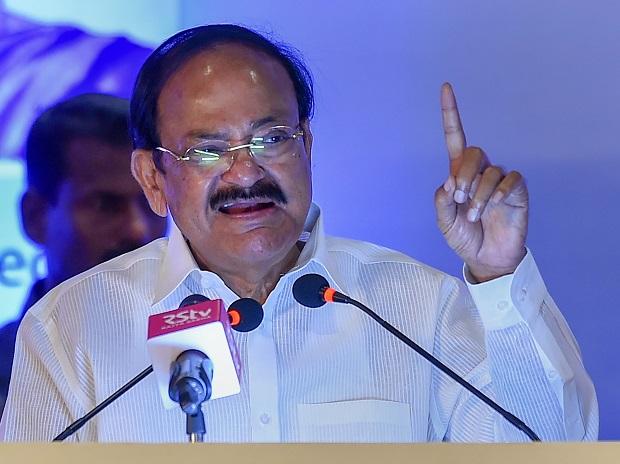
The Vice President, Shri. M. Venkaiah Naidu, today said that religious harmony and unity in diversity are cherished values of our civilization and asked every citizen of the nation to strive to preserve our values of national integration.
He was addressing the Second Convocation ceremony of Shri Vaishnav Vidyapeeth Vishwavidyalaya in Indore, Madhya Pradesh today.
The Vice President commended the efforts of 135-year-old Shri Vaishnav Committee and the Group of Trusts, Indore in establishing Shri Vaishnav Vidyapeeth Vishwavidyalaya (SVVV) to impart quality education.

Stating that there was a need for rejuvenation and renaissance in our education system to make it world class, Shri. Naidu said that educational institutions must focus on academic excellence, physical fitness, mental alertness, moral uprightness and social conscience.
He urged universities to strive to overcome challenges of quality, equity and access in education through the creation of knowledge networks, research and innovation centres, skill development programs and support for faculty development.
The Vice President said that, with technology making deep inroads in our day-to-day lives, there is a greater need today to align academic curriculum in accordance with changing technological developments and to stay ahead of the curve for the country to reach greater heights.
He spoke of the need for India to upscale research facilities to produce world class publications in reputed international journals. ‘Research is an area where we are lagging behind and serious efforts are needed to bolster the culture of research and innovation in the country’, he said.
Highlighting the importance of preserving our rich culture, especially our languages, the Vice President also opined that mother tongue should be the primary medium of instruction in schools till the high school level.
Shri. Naidu also called for enhanced collaboration between academia and industry and urged the industry to earmark CSR funds for promoting collaboration with the academia and research activities.
Referring to India’s impending demographic dividend, Shri. Naidu said that India had the potential to become the human resource centre of the world. He said that quality education, skills, knowledge and creative thinking are essential to realize the demographic dividend and to make India a 21st century innovation hub.
The Vice President said that we must turn our educational institutions into centres of excellence with global standards. ‘’Our universities and educational institutional institutions must attain great heights and figure in top-ranking global academic institutions’, he added.
Observing that the majority of students who win awards for merit and excellence in universities are women, the Vice President said that women’s education and empowerment must become people’s movements.
Shri. Naidu emphasized that there is a need for inculcating the qualities of sharing and caring among youngsters. ‘They need to have empathy for others, particularly for the vulnerable and marginalized sections of the society’, he said.
He urged the students to continuously update themselves with the latest technologies, innovations and the changes in the world. He advised them to think of the nation first and to work hard with determination to realize their dreams and the aspirations of more than a billion people.
He advised students to firmly adhere to the path of righteousness and remain committed to upholding ethics and morals at all times.
The Governor of Madhya Pradesh, Shri. Lal Ji Tandon, the Minister of Public Health and Family Welfare, Government of Madhya Pradesh, Shri. Tulsiram Silawat, the Minister of Higher Education, Government of Madhya Pradesh, Shri. Jitu Patwari, former Speaker, Lok Sabha, Smt. Sumitra Mahajan and others were present at the occasion.
The following is the full text of the speech:
I am indeed delighted to address all of you on the occasion of Second Convocation of Shri Vaishnav Vidyapeeth Vishwavidyalaya.
At the outset, let me congratulate all the degree and medal recipients. I also convey my greetings to all the parents on this memorable occasion.
The efforts of 135-year-old Shri Vaishnav Committee and the Group of Trusts, Indore in establishing Shri Vaishnav Vidyapeeth Vishwavidyalaya (SVVV) to impart quality education are worthy of appreciation.
Over the years, the role of the private sector in Indian higher education has increased significantly and many outstanding private institutions across the country have contributed towards providing quality education to people.
However, higher education in the country continues to face many fundamental challenges of access, equity, affordability and quality. Although India’s higher education system is the third largest in the world in terms of enrollment, next only to China and the United States, its Gross Enrolment Ratio (GER) at 25.4% significantly lags behind other countries like China, which, currently, has an enrollment ratio of 43.39% and USA, which has 85.8%.
Also, there is a wide disparity in GERs across states, urban and rural areas and gender. We need to address this issue on a war footing. Quality of faculty and infrastructure need to be further enhanced.
I am confident that the private universities and institutions will play an instrumental role in overcoming these challenges through the creation of knowledge networks, research and innovation centres, skill development programs and support for faculty development.
With technology making deep inroads in our day-to-day lives, there is a greater need today than ever before to align academic curriculum in accordance with changing technological developments. As a matter-of-fact, we not only need to keep abreast of the latest technological trends, but strive to stay ahead of the curve for the country to reach greater heights.
To this effect, I would like to impress upon all academic establishments and the UGC, AICTE to completely revamp the curricula and teaching methods, utilize latest IT tools and promote the culture of research in a big way. We need to upscale the research facilities to produce world class publications in reputed international journals. Research is an area where we are lagging behind and serious efforts are needed to bolster the culture of research and innovation in the country.
Another area that needs a huge boost is the collaboration between academia and industry. In fact, the industry must earmark CSR funds for promoting collaboration with the academia and research activities. The students coming out of our institutions should be innovative and creative to meet the requirements of the technology-driven world. In essence, a stronger collaboration between academic institutions and industry must evolve.
India is very soon going to have the largest population of youth in the world. This is India’s demographic dividend. India can become the human resource centre of the world. We cannot any longer continue with status quo. We must turn our educational institutions into centres of excellence with global standards.
As we all are aware, India was once known as ‘Vishwaguru’ and was home to the world’s best universities. Our universities and educational institutional institutions must again attain such heights and figure in top-ranking global academic institutions. For that to happen, all stakeholders in the educational field must make relentless and dedicated efforts.
The potential of demographic dividend can be realized if every segment contributes in its capacity to the fullest. In order to benefit from the capabilities of our youth, educational institutions must also involve them in community development activities. There is a need for inculcating the qualities of sharing and caring among youngsters. They need to have empathy for others, particularly for the vulnerable and marginalized sections of the society.
My dear students, your hard work of years has today culminated into an academic degree. Don’t look at this degree as an end to your education. Rather, it should serve as a catalyst for further pursuits of knowledge. Education is the most powerful weapon to change the world. Change is the only constant.
And to keep up with this change, learning should not be seen as an end but as a means to achieve greater heights in life. You should continuously update yourself with the latest technologies, innovations and the changes in the world. Belief is one of the most powerful tools behind the success of a person—be it personal or professional.
Dear students,
My advice to all of you is to think of the nation first. No doubt, you must all be dreaming of building a great career ahead. Work hard with determination to realize your dreams and strive dedicatedly to build a New India. Let us collectively fulfill the aspirations of more than a billion people.
India today stands at the cusp of a tremendous demographic opportunity. 65% of India’s population is under 35 years of age. For this demographic dividend to be effectively realized, quality education with necessary skills, knowledge and creative thinking is essential to build India into a 21st century innovation hub.
Education is not just the accumulation of knowledge from textbooks. Albert Einstein once said that education is not the learning of facts but the training of the mind to think something that cannot be learned from text books. Sometimes, asking the right questions is more important than having the right answers.
Dear students, you must not deviate from the righteous path and remain committed to upholding ethics and morals at all times. As you step out of the portals of this institution, many of you might look for employment and many others might decide to pursue further studies. Irrespective of what you intend to do, one thing is clear—opportunities are aplenty and make yourself capable of utilizing these opportunities to the fullest possible extent.
At the same time, I must remind you that the society expects a lot from today’s young generation. The scope and opportunities are unlimited. You would find a very different sense of accomplishment and contentment, when you make a difference in someone else’s life, especially if that person is not as fortunate as you. Above all, the interest of the nation must remain uppermost in your minds.
With these words, I once again congratulate the graduates who have received medals and degrees and call upon them to serve the humanity to the best of their capabilities and strive for the growth of our nation and welfare of our countrymen.
Jai Hind!

President of India Presents Bharat Ratna Awards 2019

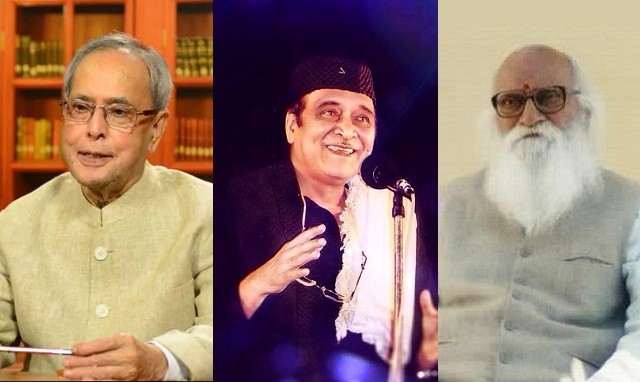
The President of India, Shri Ram Nath Kovind, presented Bharat Ratna Awards to Shri Nanaji Deshmukh (posthumously), Dr Bhupendra Kumar Hazarika (posthumously) and Shri Pranab Mukherjee at an Investiture Ceremony held at Rashtrapati Bhavan today (August 8, 2019).

‘One Nation One Ration Card’, Inter-State portability in two clusters of adjoining States of Andhra Pradesh & Telangana and Gujarat & Maharashtra

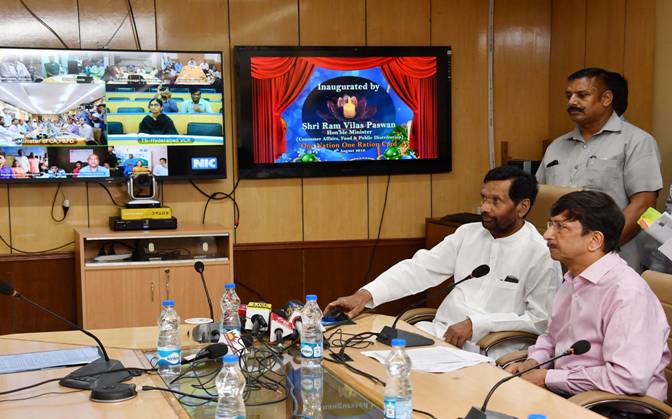
In a major step towards achieving the objective of ‘One Nation One Ration Card’, the Union Minister for Consumer Affairs, Food and Public Distribution Shri Ram Vilas Paswan today inaugurated the inter-State portability in two clusters of adjoining States of Andhra Pradesh & Telangana and Gujarat & Maharashtra. This will enable beneficiaries from either States’ cluster to avail the benefits accruing to them under the National Food Security Act from any of the two States.

Addressing the media after inaugurating the inter-State portability Shri Ram Vilas Paswan said that today marks the beginning of National level portability of Ration Cards which has begun with the two States’ clusters.Shri Paswan further stated that after leveraging the progress under Computerization scheme, 11 States/UT of Andhra Pradesh, Gujarat, Haryana, Jharkhand, Karnataka, Kerala, Maharashtra, Punjab, Rajasthan, Telangana and Tripura have implemented the intra-State portability of ration card holders to lift the entitled foodgrains from any Fair Price Shop within their State.Further, it is envisaged that the inter-State portability shall be introduced in the 11 States having already implemented intra-State portability by 1stJanuary 2020. 
Shri Paswan further added that all other States/UTs having attained requisite readiness for inter-State portability, shall be integrated in a phased manner. Thereby, enabling nation-wide portability of ration card holders to receive subsidized foodgrains under NFSA from anywhere in the country by 1st June 2020. The Union Minister said that this initiative shall be very helpful for the large migratory population of the country who migrate from one part of the country to other in search of job/employment, marriage, or any other reason and find difficulty in accessing subsidized foodgrains in the present system.
To sustain the reforms brought in by the ongoing scheme of ‘End-to-End Computerization of TPDS Operations’ and to introduce new reforms, the Department of Food & Public Distribution, is targeting implementation of nation-wide portability in distribution of subsidised foodgrains to the beneficiaries without the need of obtaining a new ration card under ‘One Nation One Ration Card’ System.
Installation of electronic Point of Sale (ePoS) devices at Fair Price Shops (FPSs) is the main enabler of portability of ration card holders, supported by the biometric/Aadhaar authentication.More than 4.1 lakh (77%) ePoS devices are already operational across the country. 25 States/UTs have either completed the installation in all FPSs or having significant progress in this area. Further, more than 85% ration cards (at least one member) in the country have been seeded with the Aadhaar numbers of the beneficiaries.        

‘Samagra Shiksha-Jal Suraksha’ Drive for School Students

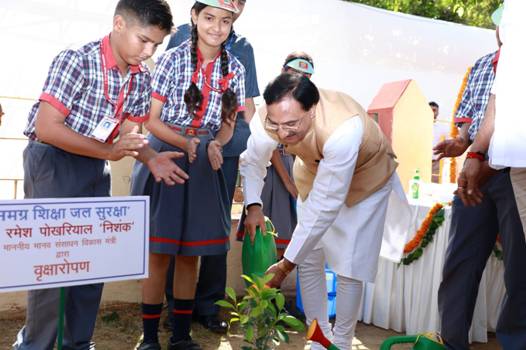
Union HRD Minister Sh. Ramesh Pokhriyal ‘Nishank’ and Union Minister for Jal Shakti Sh. Gajendra Singh Shekhawat launched ‘Samagra Shiksha-Jal Suraksha’ drive at KV no. 2 Delhi Cantt today. The dignitaries planted more than 350 saplings along with School Students and inaugurated Drip Irrigation System in the School campus. In order to create awareness about water conservation among school students, this mega drive targets to connect more than 10 crore students with this programme.
Union HRD Minister Shri Ramesh Pokhriyal ‘Nishank’ while launching the Drive asked School Students to take pledge for saving one litre water every day. 10 Crore Students together can save 10 Cr. Litres of water per day, he said. He appealed all School Students to become brand ambassador of water conservation. Students shall spread awareness about water conservation in their School, home and locality on the lines of Swachh Bharat Abhiyan.
Union Minister for Jal Shakti Shri Gajendra Singh Shekhawat expressed his deep concern on water scarcity in the Country and discussed various methods of water conservation. Quoting the example of Israel he explained how a small country with very limited sources of water generated innovative methods of water conservation and became a water exporting country. He also appreciated the efforts of Ministry of HRD and Kendriya Vidyalaya Sangathan towards water conservation.
Shri ‘Nishank’ and Shri Gajendra Singh Shekhawat also launched a booklet prepared by Department of School Education and Literacy, titled- ‘How I am going to save 1 litre water every day?’ This booklet discusses those small efforts which can save a lot of water.
Inspired by Prime Minister’s impetus on Jal Sanchay, Government of India has launched the Jal Shakti Abhiyan (JSA). It is a time bound campaign with a mission mode approach. This concept of water conservation is essential for students so that they can understand the importance of water and how it is shaping their lives meaningfully, thereby enabling them to participate in water conservation activities in their day to day lives.
The Department of School Education & Literacy, MHRD has launched the ‘Samagra Shiksha-Jal Suraksha’ drive to promote water conservation activities for School Students, so that they can become competent, conscientious and committed water citizens of our nation. The Department has prepared a detailed outline to implement this programme in all the schools of the country.
Five Major Objectives:
  1. To educate Students learn about conservation of water
  2. To sensitize Students about the impact of scarcity of water
  3. To empower Students to learn to protect the natural sources of water
  4. To help every Student to save at least one litre of water per day
  5. To encourage Students towards judicious use and minimum wastage of water at home and school level

Union Home Minister Amit Shah to release Vice President’s book on two years in office

A book chronicling two years in the office of the Vice President Shri M Venkaiah Naidu will be released at the Kalaivanar Arrangam, Chennai on August 11, 2019, by Union Home Minister Shri Amit Shah.
The function is being hosted by Shri Prakash Javadekar, Union Minister of Environment & Forests & Climate Change and Information and Broadcasting. The book titled “LISTENING, LEARNING & LEADING” captures a few glimpses of the Vice President’s 330 public engagements in all the States and Union Territories of our country during the last two years.

Crisscrossing the length and breadth of our vast country, the Vice President has delivered 61 convocation addresses, interacted with students on 35 occasions, visited 97 scientific and technological research institutions and delivered 25 special lectures.
The book contains Shri Naidu’s important diplomatic engagements including his visits to 19 countries in 4 continents. He was the first Indian Vice President to visit Panama, Guatemala, Costa Rica, and Malta.
The book will showcase his achievements as Rajya Sabha Chairman and his initiatives to enhance effectiveness, and promote the efficiency of Rajya Sabha.
Shri Banwarilal Purohit, the Governor of Tamil Nadu, Shri Edappadi K. Palaniswami Chief Minister of Tamil Nadu, Shri O. Panneerselvam, Hon’ble Deputy Chief Minister of Tamil Nadu will be attending the event.
Eminent Agriculture Scientist Prof. M.S. Swaminathan, Former Director ISRO, Dr. Krishnaswamy Kasturirangan, Former Attorney General of India Shri K. Parasaran, Editor of Tughlak Shri Swaminathan Gurumurthy, Chairman of Apollo Hospitals Group Dr Pratap C Reddy, Founder & Chancellor of VIT Dr.G.Viswanathan, Chief National Coach of Indian Badminton Team Shri Pullela Gopichand and several other dignitaries and eminent personalities will also attend the event.

People must participate actively in governance process to fast-track development

The Vice President of India, Shri M. Venkaiah Naidu has said that people of the country must be active participants in governance to fast-track the process of development. He said that merely enacting legislations would not create solutions to problems and stressed that laws must be backed by political skill and administrative will.
 
The Vice President was addressing the gathering at the 117th Birth Anniversary celebrations of Shri Gujar Mal Modi, after presenting the Gujar Mal Modi Innovative Science and Technology Awards 2019 to Prof. S.K. Satheesh and Dr. Maharaj Kishan Bhan (Padma Bhushan) at Vigyan Bhawan, here today. Shri. Naidu lauded the Gujar Mal Modi Science Foundation for their initiative of encouraging scientists and innovators and said that we must preserve the age old Indian tradition of honouring excellence, to motivate the younger generations to do well.
Shri Naidu called for innovative and out-of-box solutions to formidable challenges like poverty, pollution, climate change, diseases, not-so-profitable agriculture and low-efficiency industrial processes.
Calling for a culture of innovation, the Vice President said that innovation was imperative to address these challenges and take India forward on the path to inclusive and sustainable development at a faster pace.
The Vice President called for a reorientation of the education system to promote creativity. Asserting that foundations for the culture of innovation must be laid in our schools and colleges, he observed that a ‘new model of education’ was needed.
“We must build on the ‘best practices’ we have developed over centuries as learners, and create ‘next practices’ that would suit our vision for our future,” he added.
Saying that research in basic sciences forms the bedrock of all technological advancement, Shri Naidu said that it was crucial to create an environment where the government, universities, corporate houses, and others come together to propel the entire science eco-system forward with special emphasis on sustainability.
Expressing his desire to develop Indian universities into centers of excellence in basic sciences as well as cutting edge technology, Shri Naidu said that our universities must become the power houses of research and development.
Observing that innovation and entrepreneurship must hand in hand, the Vice President said that universities must serve as safe spaces for entrepreneurship to flourish.
The Vice President presented Gujar Mal Modi Innovative Science and Technology Awards to Prof. S.K. Satheesh and Dr. Maharaj Kishan Bhan (Padma Bhushan). The President of the Gujar Mal Modi Science Foundation, Shri. Satish Kumar Modi, trustees of the foundation, Shri. Krishan Kumar Modi, Shri. Umesh Kumar Modi and others were present on the occasion.
Following is the text of Vice President’s address:
I am delighted to be with the Modi family and all of you to participate in the 117th Birth Anniversary celebrations of late Shri Gujar Mal Modi, and to felicitate Prof. S.K. Satheesh and Dr. Maharaj Kishan Bhan (Padma Bhushan) with the ‘Gujar Mal Modi Award-2019’.
On this occasion, I pay tribute to Shri Gujar Mal Modi, the founder of the Modi Group of Industries, who was a great humanitarian. He was one of the prominent architects of modern industrial India
I am told that Bahadur Gujar Mal Modi undertook several welfare initiatives for his employees and their families. He built schools, educational institutions, hospitals, temples and residential complexes for them. He believed in taking peoples’ wealth back to people and made conscious efforts to plough back a large part of the profit made by his business undertakings for social good.
Shri Gujar Mal Modi was presented the prestigious Padma Bhushan by the Government of India, in recognition of his achievements as an enterprising industrialist and for his immense philanthropic work.
Today, the Modi Family is celebrating the 117th birth anniversary of this great philanthrope.
I am glad to know that, since 1988, the Foundation has already recognized thirty three personalities of the country who have excelled in their respective fields. The list includes Dr. A.P.J. Abdul Kalam, Dr. Anil Kakodkar, Prof. M.G.K. Menon and Dr. Kasturirangan.
I am happy to know that the Jury, under the chairmanship of Dr. K. Kasturirangan, former Member, Planning Commission, has decided to honour Prof. S.K. Satheesh and Dr. Maharaj Kishan Bhan this year.
Prof. S.K. Satheesh, the Chairman of Divecha Centre for Climate Change and Professor of Centre for Atmosperic and Oceanic Sciences at Indian Institute of Science (IISc), has made outstanding contributions to understanding the significant impact of light – absorbing atmospheric aerosol particles on the radiation balance of the Earth-atmosphere system and regional climate.
Prof. Satheesh’s efforts in the assessment of the radiative impact of aerosols, which is widely used in climate models to study monsoon, are indeed praiseworthy. I extend my hearty congratulations to him for the honour that he received today.
  1. Bhushan Dr. Maharaj Kishan Bhan from Kashmir, is currently the Chair of the Health Systems Transformation Platform, established by the Tata Trusts and of the Technical Advisory Group of the National Biopharma Mission.
I am glad to note that his pioneering research lead to development of a Rotavirus vaccine from a novel virus strain he isolated at AIIMS, New Delhi. The vaccine developed through a decade long effort is now delivered through the country’s immunization program and used in other developing countries. Over 100 million of this vaccine doses given to children in last few years has saved countless lives. His efforts have inspired translational biomedical science and innovation by Indian academia and industry.
He is globally recognized as an innovation leader in medical research and technology development. I congratulate Dr. Bhan on his outstanding achievements.
It is common knowledge that research in basic sciences form the bedrock of all technological advancement. It is crucial to create an environment where the government, universities, corporate houses and others come together to propel the entire science eco-system forward with special emphasis on sustainability.
One way to motivate and encourage talented youngsters is by recognizing and applauding the accomplishments of our researchers and scientists, a step taken by the G.M. Modi Foundation years ago. My congratulations to this Foundation for encouraging scientists in the way you have been doing for the past 31years.
My dear brothers and sisters,     
I am sure that all of you are aware of the tremendous progress that our country is making on several fronts. We have a stable democracy and a vibrant economy. We have huge potential in our demography with 65% of the population being below 35 years of age.
I strongly believe that for India to move ahead on the path of inclusive and sustainable development, at a faster pace, innovation is an imperative. Today, we face a number of formidable challenges like poverty, pollution, climate change, diseases, not-so-profitable agriculture, and low-efficiency industrial processes.
We have to find solutions to these problems using the limited resources that are available to us.
Innovation and out-of-box solutions are the only way forward.
Innovation is a culture, a mindset.
Once you have an innovation culture, even those who are not scientists or engineers would also embrace innovation and scientific literacy. Thus innovation would get embedded as one of the core values of a society, promoting economic growth and development.
This culture of constant innovation is what India needs today, it is what will make India a global leader.
Investing in innovation is investing in a bright future.
The foundation for this culture of innovation must be laid in our schools and colleges.
Children are born with a natural curiosity about the world around us. This curiosity is the foundation of all invention. We must encourage our children to ask questions, to critique and to reject the irrational.
Our education system must be overhauled to inspire creativity and curiosity. It must seek to turn this native curiosity among children into knowledge that gives us the power to invent, to find solutions to problems.
We must build a new model of education together, a model that does not resist change but remains forever open and adaptable. We must build on the ‘best practices’ we have developed over centuries as learners, and create ‘next practices’ that would suit our vision for our future.
A start has been made through initiatives like ‘Atal Tinkering labs’ set up in more than 5500 schools in India, under the Atal Innovation Mission, to foster curiosity, creativity, and imagination in young minds and inculcate skills such as design mindset, computational thinking, adaptive learning, physical computing etc.. Many more such initiatives which serve as platforms for innovation, should come up.
Our universities must serve as centres for excellence in basic sciences as well as cutting edge technology. They must be power houses of research and development.
To meet this objective, the research projects that are undertaken by our universities must live up to international standards and benchmarks. It has very often been said that a major weakness of Indian education and research is the relatively very small part played by the universities in the sum total of Indian research.
At the institutional level, there is a need to link teaching with research. The government needs to invest in faculty development, provide incentives for research, promote collaborative efforts between institutions in research.
Our universities must move beyond adopting technology to embracing it.
Initiatives such as outcome based research financing, setting up of Incubation Centers for innovative research and setting up Research Parks in central educational institutions can go a long way in making our universities thriving knowledge-creation centres.
Unlike in the past, tight boundaries between various disciplines have almost disappeared. Today’s researchers cannot confine themselves to compartmentalized silos and must have a basic understanding of other related disciplines. The issues are also no longer discipline-specific and cut across several disciplines. A holistic research approach needs to be adopted in an inter-disciplinary manner.
For example, health, education and environment are of immense concern to all and cannot be confined to particular disciplines.
The canvas of new research both in science and social science is vast and will definitely help young researchers to get a wider perspective on various phenomena. The emerging areas in bio-technology, genetic engineering, biodiversity, new materials, micro-machines, bio-medical simulations and equipment, new dominions in space research and technology including permanent human habitat in space, and similar new frontiers in oceans, are some of the examples.
I urge our educational institutions to come together for creating new knowledge at the intersections of existing disciplines.
My dear sisters and brothers,
Much is being said about promoting entrepreneurship. The priority accorded by the government to innovation is clearly reflected in missions such as ‘start-up India’ and Stand-up India’.
I strongly believe that innovation and entrepreneurship go hand in hand. Our universities must serve as safe spaces for entrepreneurship to flourish. We must encourage our brilliant youngsters to collaborate and work together in teams to come up with business ideas that are feasible, sustainable and most importantly, socially relevant.
The ultimate aim of all innovation is the betterment of the human condition, the alleviation of suffering and the promotion of stability, peace and harmony.
I urge all of you, especially young innovators to have a big vision and then take small steps to realize your vision. Sometimes, innovation is not about cutting edge technology, it is about simple solutions to complex problems. India is a country that is well known for its frugal innovations. We must keep this competitive advantage of ours alive and use it to the best possible extent to defeat challenges.
Let me also caution you that every single cutting edge technology brings with it its own disruptive interventions. We as a society must be mature and prudent enough to manage these disruptions which are very often paradigm altering.
Let me impress upon you that Science is a moving target, forever advancing and progressing. We need to keep ourselves updated and be ready to work hard.
I once again congratulate Prof. S.K. Satheesh and Dr. Maharaj Kishan Bhan. I hope that the legacy of philanthropic activities left behind by Bahadur Gujar Mal Modi will be carried forward by his family in the times to come. I wish all of you all the very best in your future endeavours.
Thank You!
Jai Hind!”


5375 Persons Rescued And More Than 42,000 Evacuated By NDRF

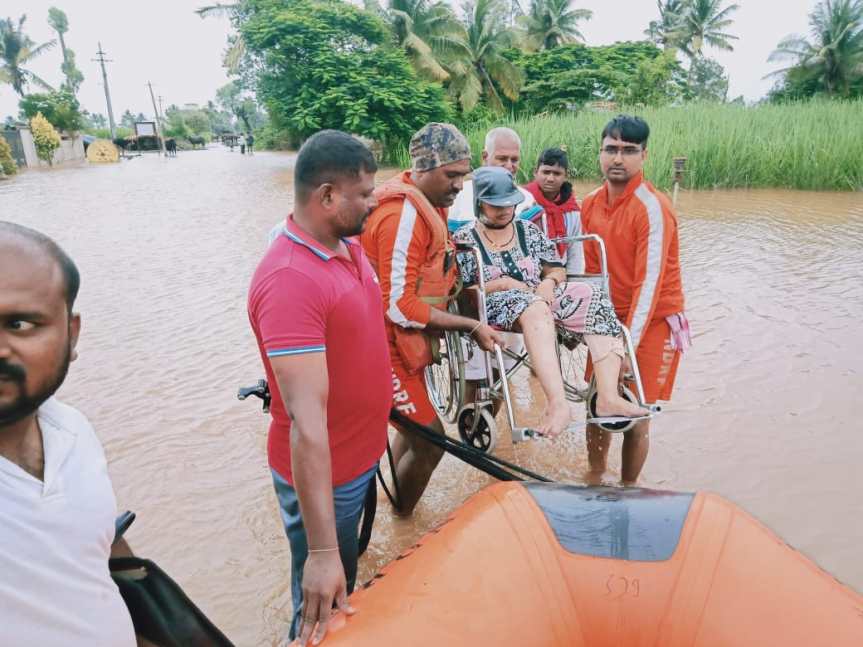
5375 people rescued & more than 42,000 stranded persons & 268 livestock have been evacuated and taken to safer locations by National Disaster Response Force (NDRF) across the country since operation commenced. The NDRF is engaged in rescue & evacuation work with full zeal & commitment at various districts of flood affected states viz. Kerala, Karnataka, Maharashtra, Andhra Pradesh, Madhya Pradesh and Gujarat. Total 173flood rescue teams are deployed by Force across the country for rescue & relief work during the recent monsoon season.
In Kerala the incessant rainfall across the region has affected most of the districts of the state viz. Ernakulam, Idukki, Thrissur, Malappuram, Palakkad, Kozhikode, Wayanad, Kozhikode and Kannur. Bridges, roads are vulnerable to flood which has affected the normal life of the populace. Yesterday, incessant rainfall triggered a major landslide at Ipadi, Puttupala, Wayanad in Kerala, which trapped several people under the debris. NDRF team immediately rushed to the incident site. However, heavy rains and debris on the way obstructed the movement of NDRF team. Despite all odds, NDRF team managed to reach incident site and immediately started the operation with other agencies. In a joint operation, rescue agencies evacuated 194 persons. In addition, NDRF team operational at Mallapuram evacuated 27 person from flood affected areas, today. 13NDRF teams are deployed in Kerala.
In Karnataka, 09 additional teams (05 from Kolkata & 04 from Ghaziabad) are in the State to expedite operations. Presently, 20 NDRF teams are engaged in rescue & relief work with full zeal & commitment at Kodagu, Raichur, Belagavi, Bagalkot & Dharwad districts. Today, teams evacuated 374 persons at Belagavi and 12 at Dharwad . Till Now, NDRF has evacuated over 3400 persons & 24 live Stocks to safer places in Karnataka.

In Maharashtra,  32 NDRF teams are present in the flood affected areas of the State for quick response. Today, NDRF has rescued 2750 persons & evacuated 883 persons at Sangli whereas 300 persons rescued and 246evacuated to safer locations at Kolhapur by NDRF teams. So far, NDRF has rescued 5292 persons and also evacuated more than 18,000 persons & 40 livestock’s in Maharashtra. Besides, team also retrieved 07 dead bodies. The operations are still on.
In Andhra Pradesh, 05 NDRF teams are deployed in Andhra Pradesh. NDRF team deployed at East Godavari commenced rescue operation and evacuated36 people to safer places, today. Total 76 persons evacuated in Andhra Pradesh, till now.
In Madhya Pradesh, 03 NDRF teams are deployed in the State. Today, team evacuated 86 persons at Badwani. So far, 115 persons & 17 livestock have been evacuated by NDRF in Madhya Pradesh.
And In Gujarat today, NDRF team evacuated 150 persons from flooded areas of Chota Udaipur where a total of 4245 persons and 57 livestock have been evacuated by NDRF. 18 teams are deployed in Gujarat.
24×7, NDRF Control Room in New Delhi is functioning round the clock to keep the close vizil over the development of situation and is in touch with other agencies & stakeholder. DG, NDRF is personally monitoring the rescue & relief operations by NDRF and additional teams are on standby at various NDRF locations.

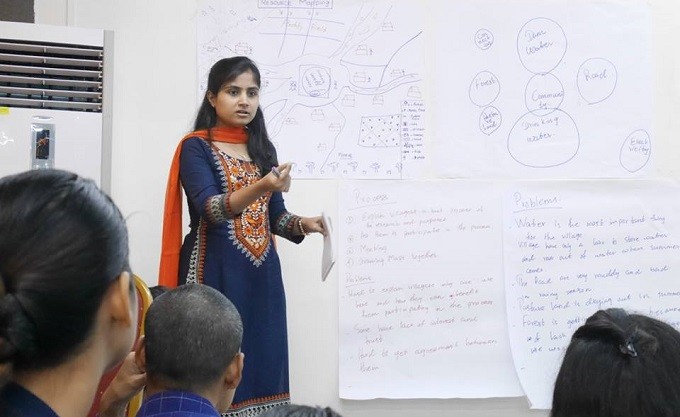
NITI Aayog launches Fourth Edition of Women Transforming India Awards; invites nominations for the Awards

NITI Aayog, the premier think tank of the Government of India, has launched the Fourth Edition of Women Transforming India (WTI) Awards, in collaboration with the United Nations in New Delhi today. UN Resident Coordinator in India, Ms. Renata Lok-Dessallien, opened the nomination process for WTI Awards 2019, in the presence of CEO NITI Aayog, Mr. Amitabh Kant, senior government officials and partners of Women Entrepreneurship Platform (WEP).
The applications for the awards are now live, and nominations can be filed on behalf of individuals or by the individual themselves at https://wep.gov.in.
The WTI Awards, since its inception in 2016, has been recognising and celebrating stories of exemplary women from across India. The theme for WTI Awards 2019 is “Women and Entrepreneurship”, in continuation with last edition’s theme that recognizes women entrepreneurs who are breaking the glass ceiling and challenging stereotypes, through businesses and enterprises and are providing innovative developmental solutions to building a dynamic New India.
Whatsapp has collaborated with the WEP for the WTI Awards of 2019, and will be providing support equivalent toUS$100,000 to the winners.
The campaign builds on the success of the WTI Awards for the past three years. WTI Awards 2018 received more than 2,300 nominations. Through a highly objective and rigorous selection process, 15 women entrepreneurs doing inspirational work from diverse sectors viz. Renewable Energy, Education, Sanitation, Art and Culture, Social Innovation and Impact, were recognised. The first two editions of the WTI Awards felicitated 12 phenomenal stories each of women undertaking phenomenal work to transform societies across India’s cities, towns and villages; and empowering themselves and their communities.
Addressing on the occasion, Mr. Amitabh Kant CEO NITI Aayog said,“WTI Awards is a flagship initiative of NITI Aayog. For the past three years, we have been celebrating the power of women and recognising their efforts in championing the cause of their societies. The next wave of disruption in India’s start-up ecosystem would be led by women-led enterprises. I am personally invested in ensuring the success of winners of the WTI Awards”.
 
Calling Women Transforming a movement, Ms Dessallien said, “We chose women’s entrepreneurship as our theme because at the heart of these Awards, this movement rather, is the idea that women lead change. I believe that if there is any one group, which can decisively accelerate India, and the world’s, achievement of the Sustainable Development Goals, it is India’s women. The over half a billion women are not a target audience. They are not the recipients of development. They are stakeholders. Their full and equal participation changes conversations, the way we talk about development; it transforms politics and decision making; it improves policy.”
About WEP
WEP is one of its kind facilitation platform, which enables convergence of multiple stakeholders on a single platform, work in collaboration with these stakeholders to bridge the gap in the entrepreneurial ecosystem, host relevant information about several schemes and partner organizations on WEP website to connect women entrepreneurs with relevant partners.
Established under the leadership of Ms. Anna Roy, Sr. Adviser of NITI Aayog, WEP focuses on both reaching out to the community through online means as well as increasing interaction of stakeholders with grass root women entrepreneur community through offline activities so that the benefits can reach the bottom-most of the pyramid. WEP, through its partners, in various verticals such as Finance, Marketing and Networking, Entrepreneurship Development, Mentoring, Incubation and Acceleration aims at providing services such as free credit ratings, skill development, local support, corporate partnerships, funding support etc. to women entrepreneurs.
WEP also works to enable sharing of best practices amongst women entrepreneurs and partner organizations and act as a facilitation platform through which relevant data can be collected and research activities can be undertaken, in association with partner organizations to understand and provide solution to women centric problems in entrepreneurial space.
In the span of past 15 months, WEP has seen several success stories emerging. WEP has more than 5,000 women entrepreneurs registered on the platform, more than 30 partners and has committed funding of more than US$10mn for these startups.

Is Education Overrated?


Importance of Literacy Rate

When discussing the well-being of any country or state of human development of a country; literacy rate is considered to be one of the key parameters. Disparity between literacy rates across genders, geographies, communities tells government where she needs to focus most. Literacy rate is perfect litmus test of a country’s human development.

But why literacy rate is so important?

One of the key requirements for modern societies to function is our abilities to coordinate and communicate effectively. For example, Government launches a new scheme to provide free polio shots for kids.

Unless the general public understands and appreciates this, the rupees spent on this will not yield anything. The citizens need to be able to read on and understand about the government’s role responsibility and actions. Especially when we talk about democracy, it becomes even more important for the citizens to understand various sides of the argument and choose the best alternative.

Literate vs Educated

Literacy is basically understood as ability to read and write. But is it sufficient? Can a person who can read constitution, understand it?
There is a huge gap between being literate and being educated. The third world countries are often blamed for portraying incorrect picture about literacy rates. As they do not take into account the kind of education the person has received.

Formal Education in India

The formal education in India is divided in 10+2+3 followed by specializations. The first 10 years formal education is common for all, before in +2 students are allowed to choose a stream. +2 does not offer lot of options to diverge, but after 2 years of Intermediate, students are ready to take up specialization course- The Graduation. Graduation normally takes 3 years, but for more technically complex courses like Engineering or medicine, it may take little longer. Post graduation, students are free to choose super-specialization courses- the master’s degree. After Masters, student can go for doctorate (PhD) and so on.

Purpose of Education

For a long time, Indian education system was very formal and people studied on as needed basis. Unless someone had deeper interests in literature or another particular field, the purpose of education was very limited. People learned for their interests, there was no burden.
But then came the British. With Merlo-Minto reforms in early 20th century, the Britishers changed the purpose of education from just education to making people job-ready. While this may sound good, it also made the education just a rat race. People read nowadays just to get a job without exploring their interests or even pursuing their interests.
As a result, such students perform very mediocrely in their jobs, with no passion at all, they just go with the flow without attaining their true potential.

The Indian education system believed in
सा विद्या या विमुक्तये|
This means education is the one that sets us free. In other words, if it is does not set us free, it is not education. And this is where the modern education is failing the humanity. It does not set us free from our doubts, our misbeliefs- it does not make us human.
A concentration camp survivor once said that education does not make the world a better place. The concentration camps and the nuclear bombs were built by some of the brightest minds the world has ever seen. Being a better human being is far too important than anything else.
Role of a “good” education becomes more important in today’s world when it is more fragmented than ever. Democratization of media has created so much noise that differentiating black from white is more difficult and more necessary than ever before. We are using our “education” as a weapon. Such type of education does not set us free; it makes us prisoners of our own devise. If the world has to survive, if the world has to be a happy place we need an education system that frees us, that liberates us. Afterall,
सा विद्या या विमुक्तये|

Mobile Phones and Its Evolution

Introduction

A
mobile 
phone is a portable mode of telephone that can make and receive calls.
What makes it different from telephone is its wireless mode of communication as
it allows the user to move while communicating.  
Phones have come a long way since Bell made the first call. Now we have
cellphones which need no wires. The early cellphones were bulky, hard to use
and could do only calling. However with evolution of technology, we have now
camera, music and even internet in mobiles. While the radiations from mobile
have not been proved to be substantially harmful, judicious use of mobiles is
only wise.

The First Phone

 The first
cellular mobile [1] that came in practice was invented in 1980s by Motorola.
This device was named Motorola DynaTAC 8000X. it was the first commercialized
phone that was developed by efforts begun at Bell Labs, which first proposed
the idea of a cellular system in 1947. A series of phone was manufactured in US
from 1983 to 1994 under the name in United States of America. It was first
introduced in market on September 21, 1983.
It was having normal feature of receiving and
sending messages but it was a revolution then as it took communication to a new
height. Undoubtedly it was a revolution then as it changes the concept of
interaction accelerating development at an amazing scale.  Early Cellular phones used analog CDMA technology.
The first commercially available handheld cellular
phone, Motorola DynaTAC 8000x, which hit the market in 1983 weighed in at 2
pounds. It was priced at $3,995 and offered a half-hour of talk per batter
charge.

2G, GSM, mobile internet

CDMA technique of mobile continued its regime for
almost a decade and was later replaced by Global System for Mobile
Communications (GSM) in original termed as Group Special Mobile). It was the forerunner
of the mobile data bloom. It made its first debut in Finland and termed as 2G
network [2].
Phones like the 5110 and 3300 from NOKIA became
iconic and dominated the market during 1992. Till 90s Nokia was supreme leader
in the market. Primarily internet service was availed via GPRS (General Packet
Radio Service) and moving to the faster EDGE (Enhanced Data rates for GSM
Evolution, or EGPRS).

Camera phone

Cell phone later introduced a special feature in
2000 having tiny 0.11-0.35 megapixel resolutions cameras fitted in back cover
of the mobile. In India, the earliest camera phone was the Nokia 7650.

Bluetooth, WiFi

Bluetooth was another unique feature that is still popular.
With the help of Bluetooth user can send receive text and files, photos and videos?
There is no wire needed; only devices must interconnect across short distance.
The first Bluetooth-enabled phone became available in 2000 was Ericsson T36.

3G

 3G is termed
as the third-generation of mobile phone technology standards. The main service
that 3G is associated with wireless voice telephony and broadband wireless
data, all in a mobile environment. Initially introduced in japan, in 2001 [3],
it- is very fast, efficient mobile network. 
With its varying level of speed it allowed addition of numerous applications
on mobile phone making it multitasking device.
 For example,
using 2g to download a 10 MB video or song takes usually 10 to 12 minutes but
with 3G it can be done in a minute. This made the cellphone a utility device.

 Android

It’s an operating system owned by Google and came
into existence in 2005. It runs on majority of phone these days with its
upgraded version. The first Android touchscreen device (G1) came out in 2008
for the US market. It is the modified version of Linux [4].

4G or LTE

The first 4G network, made its début in 2009 in
Sweden based on the LTE standard. Airtel, a cellular company introduced 4G
network in India. 4g relies heavily on internet as most Indian have their
strong focus on music, video and social media.

The Present of Cellular Phones

Cellular phone is now the part and partial of our life.
With upcoming features and high focus on internet availability, gave a massive
boost to mobile usage. From android phone to I phone, the significant change in
cellphones has made it a strong utility device. From keypad to smartphone,
people have witnessed a considerable change in, appearance and efficacy of cell
phones.

The Criticism

Cellular phones work on high
frequency radio waves, which essentially are radiations. These radiations are
non-ionizing. And though it has not been substantially proved, the radiations
of mobile phones have been blamed to cause many diseases including cancer.
While these claims can be neither
accepted nor rejected [5], it is wise to use mobile phones
carefully. Avoid unnecessary usage, keep it at safe distance from body, use
hands-free whenever possible- are some best practices of cellphone use.

PM pays tributes to former External Affairs Minister Sushma Swaraj

Prime
Minister Shri Narendra Modi paid tributes to former External Affairs
Minister Sushma Swaraj, at her residence in New Delhi today.

Expressing
condolence over her demise, Prime Minister said, “A glorious chapter in
Indian politics comes to an end. India grieves the demise of a
remarkable leader who devoted her life to public service and bettering
lives of the poor. Sushma Swaraj Ji was one of her kind, who was a
source of inspiration for crores of people.
Sushma
Ji was a prolific orator and outstanding Parliamentarian. She was
admired and revered across party lines. She was uncompromising when it
came to matters of ideology and interests of the BJP, whose growth she
immensely contributed to.
An
excellent administrator, Sushma Ji set high standards in every Ministry
she handled. She played a key role in bettering India’s ties with
various nations. As a Minister we also saw her compassionate side,
helping fellow Indians who were in distress in any part of the world.
I
can’t forget the manner in which Sushma Ji worked tirelessly as EAM in
the last 5 years. Even when her health was not good, she would do
everything possible to do justice to her work and remain up to date with
matters of her Ministry. The spirit and commitment was unparalleled.
Sushma
Ji’s demise is a personal loss. She will be remembered fondly for
everything that she’s done for India. My thoughts are with her family,
supporters and admirers in this very unfortunate hour. Om Shanti”.
Former External Affairs Minister Ms. Sushma Swaraj passed away last night in New Delhi.

Passing of the landmark Bills on Jammu and Kashmir a momentous occasion in Parliamentary Democracy

Prime
Minister Narendra Modi today welcomed the passing of bills pertaining
to Jammu and Kashmir as “a momentous occasion in our Parliamentary
democracy”.
In
a series of tweets Prime Minister was hopeful that “Together we shall
rise and together we fulfil the dreams of 130 Crore Indians!”
He Said, “I salute my sisters and brothers of Jammu, Kashmir and Ladakh for their courage and resilience.”
The
Prime Minister further said “For years, vested interest groups who
believed in emotional blackmail never cared for people’s empowerment.
J&K is now free from their shackles. A new dawn, better tomorrow
awaits!”

Mr
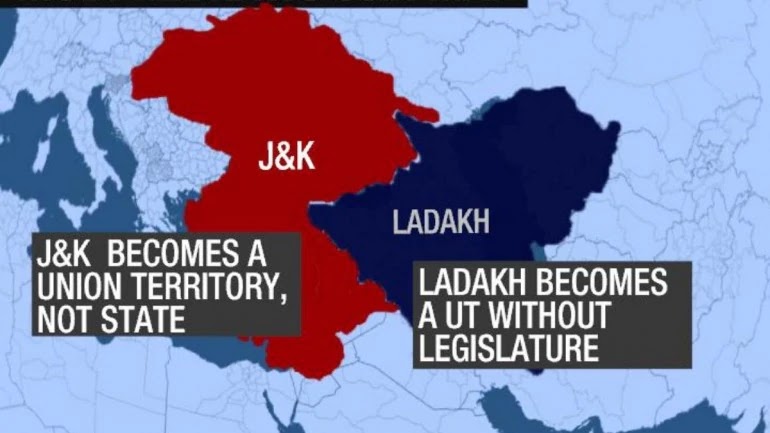
Narendra Modi said, “The Bills pertaining to Jammu, Kashmir and Ladakh
will ensure integration and empowerment. These steps will bring the
youth into the mainstream and give them innumerable opportunities to
showcase their skills and talents. Local infrastructure will
significantly improve.”
He
specially congratulated the people of Ladakh. “It is a matter of great
joy that their long-standing demand of being declared a Union Territory
has been fulfilled. This decision will give impetus to the overall
prosperity of the region and ensure better developmental facilities” he
said.
The
Prime Minister said, “The passage of key Bills pertaining to Jammu,
Kashmir and Ladakh are a fitting tribute to the great Sardar Patel, who
worked for India’s unity, Dr.BabasahebAmbedkar, whose views are well
known and Dr. SP Mookerjee who devoted his life for India’s unity and
integrity.”
He
said, “In Parliament, political parties rose to the occasion, overcame
ideological differences and took part in a rich debate that increased
the pride of our Parliamentary democracy. For that, I congratulate all
MPs, various political parties and their leaders.”
The
prime minister in a separate tweet said “People of Jammu, Kashmir and
Ladakh would be proud that MPs overcame differences and discussed the
future of these regions as well as ensuring peace, progress and
prosperity there. The widespread support can be clearly seen in the
final numbers, 125:61 in RS and 370:70 in LS.”
He
said, “India’s Vice President and Chairman of the Rajya Sabha, M
Venkaiah Naidu Garu as well as Speaker Om Birla Kota Ji conducted
proceedings of both Houses in an excellent manner, for which they
deserve praise from the entire nation.“
He
specially congratulated Home Minister Amit Shah. “Our Home Minister
Amit Shah Ji has been continuously working towards ensuring a better
life for the people of Jammu, Kashmir and Ladakh. His commitment and
diligence is clearly visible in the passage of these Bills. I would like
to specially congratulate Amit Bhai!”