New Education Policy of India 2020

The New Education Policy (NEP) of India was launched in 2020 with the aim of revamping the education system in the country and bringing about significant changes in the way education is imparted. The NEP is the first education policy in India to be launched in the 21st century, and it replaces the earlier National Policy on Education, which was launched in 1986 and revised in 1992.

The NEP is based on the principles of access, equity, quality, affordability, and accountability, and it aims to provide a holistic and multidisciplinary education to students from all backgrounds. The policy is designed to promote lifelong learning and to equip students with the skills and knowledge they need to succeed in a rapidly changing world.
One of the major goals of the NEP is to provide universal access to education from preschool to secondary school. The policy aims to increase enrollment rates and reduce dropout rates by providing free and compulsory education to all children between the ages of 3 and 18 years. It also emphasizes the importance of early childhood education and aims to provide high-quality preschool education to all children.
The NEP also seeks to bring about a significant shift in the curriculum and pedagogy of schools and colleges. It emphasizes the importance of multidisciplinary learning and encourages the integration of vocational and academic education. The policy aims to reduce the emphasis on rote learning and memorization and promote critical thinking, creativity, and problem-solving skills.
Another significant feature of the NEP is its focus on the use of technology in education. The policy aims to promote the use of technology to enhance learning outcomes and make education more accessible and affordable. It also emphasizes the importance of digital literacy and aims to provide students with the skills they need to use technology effectively.
The NEP also seeks to promote the internationalization of education and encourage greater collaboration between Indian and foreign educational institutions. The policy aims to attract foreign students to study in India and encourage Indian students to study abroad.
The NEP also addresses the issue of teacher training and professional development. It emphasizes the importance of continuous learning and aims to provide teachers with the skills and knowledge they need to deliver high-quality education. The policy also encourages the use of technology in teacher training and aims to provide teachers with access to high-quality online resources.
The NEP also addresses the issue of funding for education. The policy aims to increase public investment in education and encourage private investment in the sector. It also proposes the establishment of a National Research Foundation to fund research and innovation in education.
The NEP has received mixed reactions from stakeholders in the education sector. While some have praised the policy for its focus on access, equity, and quality, others have criticized it for being too ambitious and lacking in detail. Some critics have also raised concerns about the implementation of the policy, particularly in terms of funding and teacher training.
In conclusion, the New Education Policy of India is a comprehensive and ambitious policy that seeks to bring about significant changes in the education system of the country. The policy has the potential to transform the education sector and provide students with the skills and knowledge they need to succeed in a rapidly changing world. However, its success will depend on the effective implementation of the policy and the commitment of all stakeholders to work towards its goals.

Red Fort (Lal Quila) in Delhi

The Red Fort, also known as Lal Qila, is a historic fort complex located in the heart of Old Delhi, India. It is one of the most iconic monuments of India and is a popular tourist attraction, attracting millions of visitors each year.

The construction of the Red Fort began in 1638 under the Mughal Emperor Shah Jahan and was completed in 1648. The fort was built as the royal palace for Shah Jahan and served as the seat of the Mughal Empire for nearly 200 years. The fort is surrounded by a massive red sandstone wall that stretches for over two kilometers and has several gates, including the Lahori Gate, the Delhi Gate, and the Turkman Gate.
The Red Fort complex covers an area of approximately 254 acres and includes several buildings, gardens, and courtyards. The most notable structures within the complex include the Diwan-i-Am (Hall of Public Audience), the Diwan-i-Khas (Hall of Private Audience), the Rang Mahal (Palace of Colors), the Khas Mahal (Private Palace), the Mumtaz Mahal (Jewel Palace), and the Moti Masjid (Pearl Mosque).
The Diwan-i-Am is a large hall where the emperor would meet with the public and hear their grievances. The hall is supported by a series of red sandstone pillars and has a large marble throne on which the emperor would sit. The Diwan-i-Khas is a smaller hall used for private audiences with dignitaries and ambassadors. It is decorated with intricate carvings and inlaid with precious stones.
The Rang Mahal is the palace where the emperor’s wives and concubines lived. It is decorated with intricate paintings and carvings and has several private chambers for the women. The Khas Mahal is the private palace of the emperor and was used for personal and family functions. It is built on a raised platform and has a beautiful marble pavilion in the center.
The Mumtaz Mahal is a small palace located near the Rang Mahal and was named after Shah Jahan’s beloved wife, Mumtaz Mahal. It was built in her memory after her death and is adorned with beautiful paintings and carvings. The Moti Masjid is a small mosque located near the Diwan-i-Khas and is made of white marble. It was built by Aurangzeb, the son of Shah Jahan, and is known for its exquisite architecture and beauty.
The Red Fort has played a significant role in the history of India. It was the site of many important events, including the coronation of Emperor Bahadur Shah Zafar, the last Mughal emperor. It was also the site of the famous Indian rebellion of 1857, which was led by Indian soldiers against the British East India Company. After the rebellion, the British took control of the fort and used it as a military base until India gained independence in 1947.
Today, the Red Fort is a UNESCO World Heritage Site and is a popular tourist destination. Visitors can explore the various buildings and structures within the complex and learn about the rich history of India. The fort also hosts a famous annual event, the Independence Day celebration, where the Indian Prime Minister hoists the national flag and delivers a speech from the ramparts of the fort.
In conclusion, the Red Fort is a remarkable monument that showcases the architectural and cultural heritage of India. Its intricate designs, beautiful carvings, and exquisite paintings make it a must-visit destination for anyone interested in history and culture. The fort’s rich history and significance in the Indian freedom struggle also make it a symbol of India’s struggle for independence and its rich cultural legacy.

What is EduPub

EduPub is a trademark of Edupedia Publications Pvt Ltd.
Edupub is a term that refers to educational publishing in digital formats, such as e-books and online educational content. It aims to make learning materials more accessible, interactive, and engaging by using technology to create dynamic and flexible educational resources.
Edupub is a collaborative effort between the publishing industry, education experts, and technology providers. It is based on the principles of interoperability, accessibility, and usability, which means that educational content should be able to work seamlessly across different platforms and devices, be accessible to all learners, regardless of disabilities, and be easy to use and navigate.
One of the key benefits of edupub is that it allows for more personalized and adaptive learning experiences. With digital formats, learners can interact with content in different ways, such as by highlighting, taking notes, and answering quizzes. They can also access additional resources and multimedia content, such as videos and simulations, to enhance their understanding of the subject matter.
Edupub also enables the creation of modular and flexible learning materials, which can be customized to meet the specific needs of different learners. For example, learners can choose to study at their own pace, skip over sections they already know, or revisit topics that they find difficult.
In addition, edupub can help to reduce the cost of educational materials by eliminating the need for physical textbooks and reducing distribution costs. This makes education more affordable and accessible, particularly for learners from low-income backgrounds.
However, there are also some challenges associated with edupub. One of the main challenges is ensuring that educational content is of high quality and accuracy. With the ease of digital publishing, there is a risk of low-quality and misleading content being circulated, which can have negative effects on the learning outcomes of students.
Another challenge is ensuring that edupub content is accessible to all learners, including those with disabilities. This requires careful attention to design and development, such as ensuring that content is compatible with screen readers and other assistive technologies.
Despite these challenges, edupub has the potential to revolutionize the way we learn and teach. By using digital formats, it can make education more engaging, interactive, and accessible to learners of all ages and backgrounds.
One of the key aspects of edupub is its use of open standards, such as HTML5, EPUB, and DAISY. These standards ensure that educational content is interoperable and can be accessed across different platforms and devices. They also enable the creation of interactive and multimedia-rich content that can enhance the learning experience.
Another important feature of edupub is its focus on accessibility. With the use of standards such as DAISY, edupub content can be made accessible to learners with disabilities, such as those who are blind or have low vision. This ensures that all learners can access educational materials on an equal basis.
Edupub also enables the creation of modular and flexible educational content. With digital formats, content can be broken down into smaller modules, which can be combined and customized to meet the specific needs of different learners. This allows for more personalized and adaptive learning experiences, where learners can progress at their own pace and focus on topics that are most relevant to them.
Another benefit of edupub is its potential to reduce the cost of educational materials. With the use of digital formats, publishers can eliminate the need for physical textbooks and reduce distribution costs. This can make education more affordable and accessible, particularly for learners from low-income backgrounds.
Overall, edupub has the potential to transform the way we learn and teach. By leveraging technology and open standards, it can make education more engaging, interactive, and accessible to learners of all ages and backgrounds. However, it is important to address the challenges associated with edupub, such as ensuring the quality and accuracy of educational content and making it accessible to all learners.

What is importance of Training and internship

Training and internships are both extremely important in terms of career development and gaining valuable experience.
Training programs provide individuals with the necessary skills and knowledge to perform their job duties effectively. These programs can take many forms, including on-the-job training, formal classroom training, workshops, seminars, and online courses. By participating in training programs, employees can develop new skills, improve existing ones, and stay up-to-date on the latest trends and best practices in their field.
Internships, on the other hand, provide students and recent graduates with hands-on experience in their chosen field. They offer a unique opportunity to gain practical skills, network with professionals in the industry, and learn about the inner workings of an organization. Internships can also be a great way to determine if a particular career path is right for you.
Overall, both training and internships can help individuals develop the skills and experience needed to succeed in their chosen careers, and can provide valuable opportunities for personal and professional growth.
Sure, here are ten tips for a successful internship:
Set clear goals: Before starting your internship, define your goals and objectives. What do you want to learn? What skills do you want to develop? What experiences do you want to gain?
Be proactive: Don’t wait for tasks to be assigned to you. Take initiative and ask for projects that interest you. This will show your supervisor that you are eager to learn and contribute.
Network: Use your internship as an opportunity to network with professionals in your field. Attend company events, introduce yourself to colleagues, and ask for informational interviews.
Be professional: Dress appropriately, arrive on time, and be respectful to everyone you work with. Remember, your behavior and attitude can impact your future career opportunities.
Ask questions: Don’t be afraid to ask questions if you don’t understand something. This will show your supervisor that you are engaged and interested in learning.
Take notes: Take notes during meetings and when given instructions. This will help you remember important information and ensure that you are completing tasks accurately.
Seek feedback: Ask for feedback on your performance and use it to improve. Take constructive criticism as an opportunity to learn and grow.
Stay organized: Keep track of your tasks and deadlines. Use a planner or digital tool to stay organized and ensure that you are meeting expectations.
Build relationships: Build positive relationships with your colleagues and supervisor. These connections can be valuable for future job opportunities and references.
Be open-minded: Keep an open mind and be willing to learn new things. Embrace new experiences and challenges, and use them to grow both personally and professionally.

Swaswati Borpuzari

 Articles written by Swaswati Borpuzari

1. http://track2training.com/2023/04/02/alone-time-a-boon-for-mental-health/

2.  http://track2training.com/2023/04/02/family-time-the-most-important-of-all/

3.  http://track2training.com/2023/04/02/a-step-towards-healthy-eyes/

4. http://track2training.com/2023/04/02/walking-the-best-and-underrated-form-of-exercise/

5. http://track2training.com/2023/03/31/stress-a-threat-to-students/

6. http://track2training.com/2023/03/31/5-skin-care-tips-that-everyone-should-be-aware-of/

7. http://track2training.com/2023/03/30/insomnia-a-sleeping-disorder-we-need-to-know-about/

8. http://track2training.com/2023/03/30/why-your-weight-is-not-losing/

9. http://track2training.com/2023/03/25/miscarriage-causes-and-symptoms/

10. http://track2training.com/2023/03/25/importance-of-yoga-in-a-students-life/

11. http://track2training.com/2023/03/25/beginner-friendly-yoga-for-everyone/

12. http://track2training.com/2023/03/19/foods-that-enhances-the-process-of-weight-loss/

13. http://track2training.com/2023/03/19/yoga-for-proper-hair-growth/

14. http://track2training.com/2023/03/16/6-yoga-poses-that-can-give-you-bright-and-glowing-skin/

15. http://track2training.com/2023/03/14/yoga-for-peace-and-harmony/

16. http://track2training.com/2023/03/13/mineral-riches-in-soil/

17. http://track2training.com/2023/03/13/water-pollution-3/

18. http://track2training.com/2023/03/13/air-pollution-5/

19. http://track2training.com/2023/03/13/pollution-a-real-threat/

20. http://track2training.com/2023/03/12/48819/

21. http://track2training.com/2023/03/12/biotechnology-an-emerging-field/

22. http://track2training.com/2023/03/12/albert-einstein/

23. http://track2training.com/2023/03/10/knowledge-being-the-ultimatum/

24. http://track2training.com/2023/03/10/picnic-everyones-favourite/

25. http://track2training.com/2023/03/10/travelling-the-best-choice/

26. http://track2training.com/2023/03/10/48673/

27. http://track2training.com/2023/03/07/why-hobbies-are-important-for-us/

28. http://track2training.com/2023/03/07/why-travelling-is-important-for-us/

29. http://track2training.com/2023/03/07/how-to-celebrate-eco-friendly-holi/

30. http://track2training.com/2023/04/05/anxiety-and-stress-two-sides-of-the-same-coin/


IRR – Internal Rate of Return

 The Internal Rate of Return (IRR) is a financial metric used to estimate the profitability of an investment. It is the discount rate at which the net present value (NPV) of an investment is zero.

In other words, IRR is the interest rate at which the cash inflows generated by an investment are equal to the cash outflows incurred by the investment. The IRR is expressed as a percentage and represents the annualized rate of return earned by an investment over its projected life.

To calculate the IRR, you need to know the initial investment amount, the cash inflows and outflows associated with the investment, and the expected time frame of the investment. Then, you can use a financial calculator or software to determine the IRR.

A higher IRR indicates a more profitable investment, while a lower IRR indicates a less profitable investment. It is important to note that IRR should be used in conjunction with other financial metrics such as Net Present Value (NPV) to fully evaluate an investment opportunity.

The Internal Rate of Return (IRR) is a widely used financial metric for evaluating the profitability of an investment. However, like any financial metric, it has its merits and demerits.

Merits of IRR:

It accounts for the time value of money: IRR takes into account the time value of money and factors in the present value of cash flows over the investment period.

It is a useful tool for evaluating investment opportunities: IRR is commonly used by investors to compare investment opportunities and to make investment decisions.

It is a simple metric to understand: IRR is a percentage that represents the expected rate of return on an investment, making it easy to communicate and understand.

Demerits of IRR:

Multiple IRRs: Investments with non-standard cash flows, such as multiple sign changes in cash flows, can have multiple IRRs, making it difficult to determine the appropriate rate.

It assumes reinvestment at the same rate: IRR assumes that all cash flows generated by the investment are reinvested at the same rate, which may not be realistic.

It does not consider the magnitude of cash flows: IRR only considers the timing of cash flows, and not their magnitude. An investment with a high IRR may have lower cash flows than an investment with a lower IRR.

It is sensitive to timing of cash flows: IRR is sensitive to the timing of cash flows, and small changes in timing can result in significant changes in the IRR.

In summary, IRR is a useful financial metric for evaluating investment opportunities, but it should be used in conjunction with other financial metrics and its limitations should be taken into account when making investment decisions.

Formula of IRR

Numerical Problem

Suppose you are considering investing in a project that requires an initial investment of $50,000. The project is expected to generate cash inflows of $10,000 per year for the next five years. 

Solution to Problem of IRR

To calculate the IRR, we can use the following formula:

NPV = 0 = -Initial Investment + (Cash Inflow / (1 + IRR)^1) + (Cash Inflow / (1 + IRR)^2) + … + (Cash Inflow / (1 + IRR)^n)

where:

NPV is the Net Present Value of the investment

IRR is the Internal Rate of Return of the investment

n is the number of periods (in this case, 5 years)

So, plugging in the numbers, we get:

0 = -$50,000 + ($10,000 / (1 + IRR)^1) + ($10,000 / (1 + IRR)^2) + ($10,000 / (1 + IRR)^3) + ($10,000 / (1 + IRR)^4) + ($10,000 / (1 + IRR)^5)

Solving for IRR, we can use a financial calculator or software to find that the IRR for this investment is approximately 10.99%.

This means that the project is expected to generate an annualized rate of return of 10.99% over its projected life, which can be used to compare its profitability to other investment opportunities.

Give your views on participatory forest management and its importance in sustainable development and management.

 Participatory forestry refers to processes and mechanisms that enable those people who have a direct stake in forest resources to be part of decision-making in all aspects of forest management, from managing resources to formulating and implementing institutional frameworks.

Participatory Forest Management (PFM) is an approach to forest management that involves the participation of local communities in decision-making processes related to forest resources. This approach recognizes the importance of community involvement in the sustainable development and management of forest resources. PFM is crucial in achieving sustainable development and management of forests for the following reasons:

  1. Community Involvement: PFM involves the active participation of local communities in decision-making processes related to forest management. This approach recognizes the importance of local knowledge and the participation of local communities in ensuring the sustainable management of forest resources.

  2. Sustainability: PFM promotes the sustainable management of forest resources by ensuring that local communities have a stake in the management and conservation of forest resources. This approach recognizes the importance of balancing economic, social, and environmental considerations in forest management.

  3. Forest Conservation: PFM can help to promote the conservation of forest resources by involving local communities in the monitoring and protection of forest areas. This approach recognizes the importance of local communities in the protection of forest resources from illegal logging, forest fires, and other threats.

  4. Livelihoods: PFM can help to support the livelihoods of local communities by promoting sustainable forest-based activities such as agroforestry, eco-tourism, and non-timber forest products. This approach recognizes the importance of forests in supporting the livelihoods of local communities.

  5. Conflict Resolution: PFM can help to resolve conflicts between different stakeholders in forest management, such as government agencies, forest industries, and local communities. This approach recognizes the importance of building trust and cooperation between different stakeholders in forest management.

In summary, Participatory Forest Management is an important approach to achieving sustainable development and management of forest resources. It recognizes the importance of community involvement, sustainability, forest conservation, livelihoods, and conflict resolution in achieving this goal. By involving local communities in decision-making processes related to forest management, PFM can help to ensure that forest resources are managed in a way that balances economic, social, and environmental considerations.

What is Planning

What is planning

Planning is the process of setting goals, defining strategies, and determining the necessary actions to achieve those goals. It involves identifying the steps that need to be taken, the resources that will be required, and the timeline for completing each task. Planning is an essential activity for individuals, businesses, and organizations because it helps to ensure that resources are used efficiently and effectively to achieve desired outcomes. Planning can be short-term or long-term and can be used to address a wide range of challenges, from personal goals to complex business strategies.

NPV Net Present Value

NPV stands for Net Present Value. It is a financial metric used to evaluate the profitability of an investment or a project. NPV takes into account the time value of money, which means that money today is worth more than the same amount of money in the future.

The calculation of NPV involves discounting all future cash flows from an investment at a specified discount rate, which represents the minimum rate of return required by an investor to undertake the investment. The resulting sum is the present value of all future cash flows, which is then compared to the initial investment.

If the NPV is positive, it means that the investment is expected to generate returns greater than the required minimum rate of return and is considered a good investment. If the NPV is negative, it means that the investment is expected to generate returns lower than the required minimum rate of return and is considered a bad investment.

Advantages of NPV:

Time value of money: NPV takes into account the time value of money, which means that it provides a more accurate picture of the true value of an investment by discounting future cash flows to their present value.

Provides a clear decision rule: NPV provides a clear decision rule for investment appraisal. If the NPV is positive, the investment is expected to generate returns greater than the required rate of return and should be undertaken. If the NPV is negative, the investment is expected to generate returns lower than the required rate of return and should be rejected.

Considers all cash flows: NPV considers all cash flows associated with an investment, including initial investment, operating costs, and future cash flows. It provides a comprehensive evaluation of an investment and helps in making informed decisions.

Considers risk: NPV allows for the consideration of risk by adjusting the discount rate based on the level of risk associated with the investment.

Disadvantages of NPV:

Requires estimation: NPV requires the estimation of future cash flows, which can be difficult and uncertain, especially for long-term projects. Incorrect estimation can lead to inaccurate results.

Ignores non-monetary factors: NPV only considers the monetary aspects of an investment and ignores non-monetary factors such as environmental impact, social responsibility, and ethical considerations.

Dependent on discount rate: NPV is dependent on the discount rate used, which can be subjective and varies depending on the investor’s perception of risk and opportunity cost.

Ignores timing of cash flows: NPV assumes that all cash flows occur at the end of each period, which may not be the case for all investments. This can lead to inaccuracies in the evaluation of investments with complex cash flow patterns.

NPV Formula

C0 = Initial Investment

C1 is Cash Flow in First Year

r is discount rate e.g. 10 percent means 0.1

Learn NPV with an Example 

A company is considering an investment in a new project that requires an initial investment of $50,000. The project is expected to generate cash flows of $15,000 per year for the next five years. The required rate of return for the company is 10%.

What is the NPV of the project, and should the company invest in the project?

Solution:

To calculate the NPV of the project, we need to discount the future cash flows to their present value using the required rate of return. The calculation is as follows:

NPV = -Initial Investment + PV of Future Cash Flows

NPV = -$50,000 + ($15,000 / (1+0.1)^1) + ($15,000 / (1+0.1)^2) + ($15,000 / (1+0.1)^3) + ($15,000 / (1+0.1)^4) + ($15,000 / (1+0.1)^5)

NPV = -$50,000 + $12,105 + $10,777 + $9,797 + $8,997 + $8,334

NPV = $-641

The NPV of the project is negative, which means that the investment is expected to generate returns lower than the required rate of return. Therefore, the company should not invest in the project as it is not expected to be profitable.

Note: In this example, we assumed that the cash flows occur at the end of each year. If the cash flows occur at different time intervals, the calculation would need to be adjusted accordingly.

Sadhana Khamari

 1. https://www.track2training.org/2023/02/7-intriguing-facts-of-jagannath-puri.html

2.  https://www.track2training.org/2023/01/7-tips-to-crack-gate-2024.html

3. https://www.track2training.org/2023/01/different-opportunities-after-gate-exam.html

4. https://www.track2training.org/2023/02/5-must-visit-places-in-bhubaneshwar.html

5. https://www.track2training.org/2023/02/structure-of-earth.html

6. https://www.track2training.org/2023/02/vedic-literature.html

7. https://www.track2training.org/2023/02/noise-pollution-causes-preventive.html

8. https://www.track2training.org/2023/02/fact-devices-statcom-its-working.html

9. https://www.track2training.org/2023/02/indian-princess-who-married-korean-king.html

10. https://www.track2training.org/2023/02/women-empowerment.html

11. https://www.track2training.org/2023/02/drainage-system-of-india.html

12. https://www.track2training.org/2023/02/know-more-about-every-12-zodiac-signs.html

13. https://www.track2training.org/2023/02/story-of-dharmapada-legend-of-konark.html

14. https://www.track2training.org/2023/02/traffic-rules-and-regulations.html

15. https://www.track2training.org/2023/02/fundamental-rights-and-fundamental.html

16. https://www.track2training.org/2023/02/bronze-age-civilization.html

17. https://www.track2training.org/2023/02/second-world-war.html

18. https://www.track2training.org/2023/02/maa-kalijai-temple-beauty-of-chilika.html

19. https://www.track2training.org/2023/02/you-can-win-step-by-step-tool-by.html

20. https://www.track2training.org/2023/02/5-alarming-signs-that-you-might-not-be.html

21. https://www.track2training.org/2023/02/5-true-stories-prove-multiple-universes.html

22. https://www.track2training.org/2023/02/why-developing-countries-are-so-poor.html

23. https://www.track2training.org/2023/03/the-french-revolution-1789-1799.html

24. https://www.track2training.org/2023/03/dance-forms-of-india.html

25. https://www.track2training.org/2023/03/theories-about-lost-city-atlantis.html

26. https://www.track2training.org/2023/02/international-trade.html

27. https://www.track2training.org/2023/03/a-japanese-revolution-that-led-to.html

28. https://www.track2training.org/2023/03/the-revolt-act-of-1857.html

29. https://www.track2training.org/2023/03/indus-valley-civilization.html

30. https://www.track2training.org/2023/03/chola-art-and-its-architecture.html

31. https://www.track2training.org/2023/03/mauryan-empire-322-bce-184-bce.html

32. https://www.track2training.org/2023/03/did-cleopatra-really-die-by-snake-bite.html

33. https://www.track2training.org/2023/03/silla-first-korean-kingdom.html

34. https://www.track2training.org/2023/03/transients-in-power-systems.html

35. https://www.track2training.org/2023/03/how-did-plate-tectonics-led-to.html

36. https://www.track2training.org/2023/03/vertical-axis-wind-turbines-and-its.html

37. https://www.track2training.org/2023/03/purification-of-organic-compounds.html

38. https://www.track2training.org/2023/03/what-are-dwarf-planets.html

39. https://www.track2training.org/2023/03/preamble-of-indian-constitution.html

40. https://www.track2training.org/2023/03/what-is-open-system-interconnectionosi.html

41. https://www.track2training.org/2023/03/network-topology-and-its-types.html

42. https://www.track2training.org/2023/03/mandatory-military-service-in-korea.html

43. https://www.track2training.org/2023/03/pakhala-divas-unique-festival-of-odisha.html

44. https://www.track2training.org/2023/03/gudi-padwa-marathi-new-year.html

45. https://www.track2training.org/2023/03/disturbing-discovery-after-finally.html

46. https://www.track2training.org/2023/03/ssb-selection-process.html

47. https://www.track2training.org/2023/03/what-are-protective-devices.html

48. https://www.track2training.org/2023/03/structure-of-electrical-system.html

49. https://www.track2training.org/2023/03/ram-navami-2023.html

50. https://www.track2training.org/2023/03/use-of-metaverse-in-various-technologies.html

51. https://www.track2training.org/2023/03/best-places-to-witness-northern-lights.html

52. https://www.track2training.org/2023/03/impact-of-light-pollution-on-night-sky.html

53. https://www.track2training.org/2023/03/grimes-changes-name-of-her-and-elon.html

54. https://www.track2training.org/2023/03/red-thread-connection-in-chinese-culture.html

55. https://www.track2training.org/2023/03/marie-curie-first-woman-who-won-nobel.html

56. https://www.track2training.org/2023/03/discovery-of-uranus.html

57. https://www.track2training.org/2023/03/intriguing-facts-about-roman.html

58. https://www.track2training.org/2023/03/first-and-only-ruler-of-delhi-sultanate.html

59. https://www.track2training.org/2023/03/evolution-of-clocks.html

60. https://www.track2training.org/2023/03/ancient-indian-mathematics.html

‘My eyes filled with tears’: Hiroshima Peace Memorial Park (Museum)

 We all know about Hiroshima, Japan where the first Atom bomb was dropped depicting the cruelest human suffering.  I visited many countries in the world and across India but I was in pain and ‘my eyes filled with tears’ after visiting Hiroshima Peace Memorial Museum (Park) in March 2023. During the Second World War, the USA on 6 August 1945 dropped the first Atom Bomb on Hiroshima, and then on 9 August 1945 another Atom Bomb was dropped on Nagasaki. Anyway, I visited Hiroshima in March 2023. and when I visited Hiroshima Peace Memorial Museum (Park word was used), I was in great pain as watched the worst suffering of human beings. Photos, documentary films, terrifying photographs of survivors, the awful effects of explosions, and artifacts such as melted glass, deformed bicycles, charred clothes, etc., portrayed the unimaginable, unbelievable cruelty created by human beings against innocent human beings.
With my little knowledge, I could say earlier that Wars, wherever took place mostly soldiers, suffered on the battlefields but during the Second World War innocent people greatly suffered and the greatest examples are Hiroshima and Nagasaki. The Hiroshima Peace Memorial Museum was opened in 1955 to depict the reality and cruelty of the damage caused by the Atom Bomb so that in the future no country violates such norm by dropping an Atom Bomb. At 8:15 am on August 6, 1945, Hiroshima was the first in the world to be damaged by an Atom Bomb. Most parts of the town were destroyed and many people lost their lives. Even those who barely survived suffered great physical and psychological damage. The Peace Memorial Museum has displayed photographs and materials showing the remains of the Atom Bomb survivors and the devastation of the Atom Bomb, as well as the history of Hiroshima pre and post-effects of the Atom Bomb which is a lesson for the present generation of political leaders.   
The Hiroshima Peace Memorial originally the Hiroshima Prefectural Industrial Promotion Hall, and now commonly called the Genbaku Dome, Atomic Bomb Dome, or A-Bomb Dome is part of the Hiroshima Peace Memorial Park in Hiroshima, and was designated a UNESCO World Heritage Site in 1996 (wikipedia.org/wiki/Hiroshima_Peace_Memorial). 
It is believed that because of the Atom bomb 80, 000 people i.e., 30 percent of the total population of Hiroshima on the spot died and thousands suffered. Some people lost their eyes, some people’s skin was badly burnt, some became lame, leukemia developed later on, etc. In the Museum, there are many photographs depicting these which are heart-wrenching. Also, there are photographs depicting how within a few seconds a beautiful town became a ghost town because of the Atom Bomb. A 1998 study revealed that about 62,000 more people in Hiroshima died as a result of the Bomb, bringing the total number of victims to more than 200,000 (death). Also, it may be mentioned that approximately 70 percent of Hiroshima city was completely wiped out in one of history’s biggest atrocities.
Near Hiroshima Peace Memorial Park, a monument has been constructed in memory of all children who died as a result of the Atom Bomb. The monument was originally thought of because of the death of Sadako Sasaki, a girl, who was exposed to radiation from the Atom Bomb when she was just two years old. And 10 years later (when she was 12 years old) she developed leukemia that ultimately ended her life. Sadako’s untimely death upset her classmates and they thought of constructing a monument for all the children who died due to the Atom Bomb. Subsequently, with the contributions received from more than 3200 schools in Japan and also donations received from nine countries the Children Peace Monument was constructed on May 5, 1958.
 As a senior citizen after traveling to many places in the world and across India, I observed earlier that some kings benefited because of war, and now the arrogant political leaders might desire war. This beautiful world is for all so we desire there should not be any war.
On May 27, 2016, President Barack Obama became the first US President to visit Hiroshima and pay his respects at the Hiroshima Peace Memorial Park. He visited the Hiroshima Peace Memorial Museum, then he and Japanese Prime Minister Shinzo Abe each laid a wreath at the cenotaph commemorating the victims of the atomic bombing. Later, Obama signed the Park’s guestbook with the message, “‎We have known the agony of war. Let us now find the courage, together, to spread peace, and pursue a world without nuclear weapons.‎”
I have inserted three photographs to get an idea about the damage and cruelty created because of Atom Bomb. 

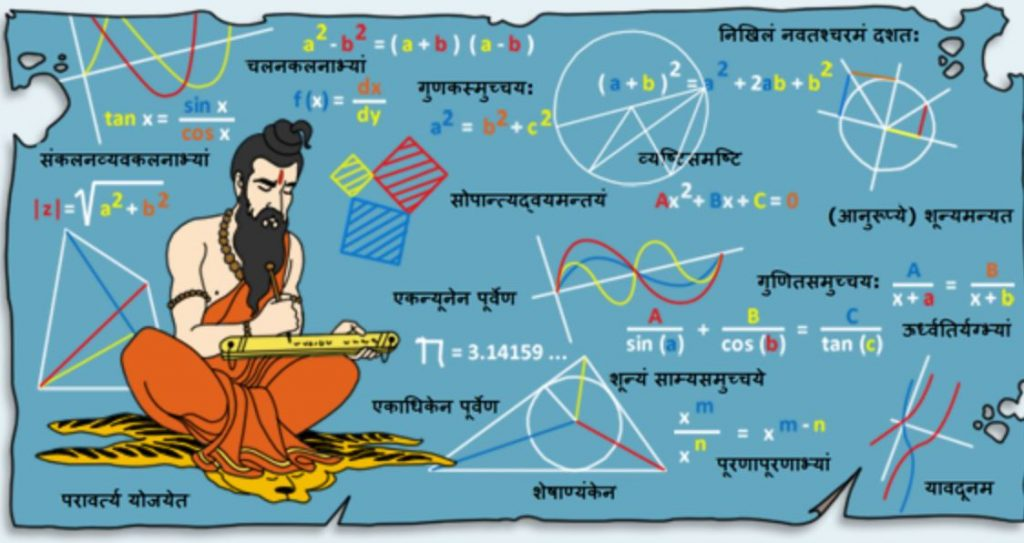
Ancient Indian Mathematics

India has a rich history of mathematics, with contributions spanning thousands of years. Ancient Indian mathematicians made significant discoveries in the fields of arithmetic, algebra, geometry, and trigonometry, laying the foundations for modern mathematics.


Source –
https://www.indica.today/

One of the earliest known texts on mathematics in India is the Sulba Sutras, which date back to the 8th century BCE. These texts describe geometric principles used in the construction of altars for Vedic rituals, and contain formulas for calculating the area and circumference of circles and the square roots of numbers.

In the 5th century BCE, the mathematician Pingala wrote the Chhandahshastra, which is considered to be the first known work on binary numbers. Pingala’s system of binary numbers is similar to the modern binary system used in computing, and was used to represent Vedic hymns as sequences of long and short syllables.

In the 3rd century BCE, the mathematician Aryabhata wrote the Aryabhatiya, a treatise on mathematics and astronomy that made significant contributions to the fields of algebra, trigonometry, and spherical geometry. Aryabhata developed the concept of zero as a number, and also introduced the sine, cosine, and inverse sine functions.

Another influential mathematician from ancient India was Brahmagupta, who lived in the 7th century CE. Brahmagupta wrote the Brahmasphutasiddhanta, a treatise on astronomy and mathematics that included formulas for solving quadratic equations, as well as the first known use of negative numbers in mathematical calculations.

In the 12th century, the mathematician Bhaskara wrote the Siddhanta Shiromani, which contained essential contributions to the fields of algebra and trigonometry. Bhaskara developed a method for solving indeterminate equations, and also gave a formula for calculating the sine of an angle using the cosine.

The Kerala School of Mathematics, which flourished in southern India between the 14th and 16th centuries, made significant contributions to the field of calculus. The mathematician Madhava is credited with the discovery of the power series, which was used to calculate the value of pi to an accuracy of 11 decimal places.

In addition to these specific contributions, ancient Indian mathematicians also developed several mathematical concepts and notation systems that are still used today. For example, the decimal system, which uses the digits 0-9 and place value to represent numbers, was developed in India and later spread to other parts of the world.

Evolution of Clocks

The evolution of clocks is a fascinating story that spans thousands of years, from the earliest timekeeping devices to the most accurate atomic clocks of today. In this article, we will explore the major milestones in the history of clocks and how they have shaped our understanding of time.


Creator –
Jorge Villa 

The earliest known timekeeping devices were sundials, which were used by ancient civilizations such as the Egyptians, Greeks, and Romans. Sundials work by casting a shadow on a marked surface, indicating the time of day based on the position of the sun in the sky. Although sundials were effective in providing a rough estimate of time, they were not very accurate and could only be used during daylight hours.

The invention of the mechanical clock in the 14th century marked a major leap forward in timekeeping technology. These early clocks used gears and springs to power the movement of the hands and were able to keep time more accurately than any previous device. The first mechanical clocks were large and expensive and were primarily used in churches and other public buildings.

The development of the pendulum clock in the 17th century was another major breakthrough in timekeeping technology. The pendulum clock uses a swinging weight to regulate the movement of the gears, making it much more accurate than earlier mechanical clocks. The invention of the pendulum clock made it possible for individuals to own their own timekeeping devices, and clocks soon became a common household item.

In the 19th century, the invention of the electric clock paved the way for even greater accuracy and precision. Electric clocks use a quartz crystal to regulate the movement of the hands, making them much more reliable than mechanical clocks. Electric clocks also allowed for the development of synchronized timekeeping systems, which made it possible for people all over the world to keep the same time.

The invention of the atomic clock in the mid-20th century was another major milestone in the history of timekeeping. Atomic clocks use the vibrations of atoms to keep time, making them the most accurate clocks ever created. Atomic clocks are now used in a wide range of applications, from satellite navigation systems to scientific research.

Today, clocks come in all shapes and sizes, from traditional mechanical timepieces to digital clocks and smartwatches. Although the basic technology behind clocks has remained largely unchanged over the centuries, advances in materials, electronics, and software have allowed for ever-greater accuracy and precision.

In conclusion, the evolution of clocks has been a long and fascinating journey, marked by major milestones in technology and innovation. From the simple sundials of ancient times to the sophisticated atomic clocks of today, clocks have played a vital role in shaping our understanding of time and the world around us.

First and Only Ruler of Delhi Sultanate – Razia Sultan

Razia Sultan was the first and only female ruler of the Delhi Sultanate in India. She ruled from 1236 to 1240 CE and was known for her bravery, intelligence, and administrative skills.

Razia was the daughter of Sultan Iltutmish, who had established the Delhi Sultanate after the decline of the Ghaznavid Empire. Iltutmish had several sons, but he chose Razia as his successor, as he believed her to be the most capable of ruling the empire.

Source – https://yourexamguide.com/

Razia’s reign was marked by several accomplishments. She introduced several reforms to the administration, such as improving the tax collection system and establishing a network of spies to gather information about the state of affairs in the empire. She also established a postal system, which improved communication and helped her maintain control over the vast empire. Razia was also a skilled warrior and led several military campaigns against neighboring kingdoms. She defeated the rebellious governor of Bhatinda, Malik Altunia, who had refused to recognize her as the Sultan. She also successfully repelled a Mongol invasion led by Genghis Khan’s grandson, Batu Khan.

Despite her many achievements, Razia faced significant opposition from the nobility, who were unhappy with being ruled by a woman. Her half-brother Ruknuddin Firuz, who had been appointed as her successor by the nobility, led a rebellion against her. Razia was defeated and imprisoned, and Ruknuddin became the Sultan. However, Razia managed to escape from prison and launched a counter-attack against her half-brother. She defeated Ruknuddin and regained the throne, but her reign was short-lived. She was betrayed by one of her advisors, Altunia, whom she had married for political reasons. Altunia, who had harbored resentment towards Razia for defeating him earlier, turned against her and had her killed in 1240 CE.

Razia Sultan’s legacy has endured through the centuries. She was a trailblazer for women in positions of power and challenged the traditional norms of her time. Her reign demonstrated that a woman could rule a vast empire effectively and competently. She is still celebrated as a symbol of female empowerment and has inspired several books, films, and television series in India.