Top 5 fastest growing states by GSDP.

After witnessing unprecedented challenges due to the covid-19 pandemic, India’s states are well on their way to recovery, according to the Reserve Bank of India’s Handbook of Statistics on Indian States released last week. Almost every state economy has already surpassed its pre-pandemic size and state finances are looking up even as concerns over elevated fiscal deficit remain. Rural wage growth, however, has failed to keep pace with average retail inflation, which may become a cause of decline in spending. 

Gujarat is the fastest-growing state for the last nine years (from FY12 to FY21), according to the latest data released by RBI. Gujarat’s Gross State Domestic Product (GSDP) at the constant price has increased at compounded annual growth rate (CAGR) of 8.2 per cent.

Karnataka is the second fastest-growing major state economy, with a CAGR of 7.3 per cent. At the third spot is Haryana. With a CAGR of 6.7 per cent, Madhya Pradesh is ranked fourth in the list of fastest-growing states. Madhya Pradesh is followed by Andhra Pradesh which has registered an annual GSDP growth rate of 6.5 per cent.

Top 5 fastest growing states by GSDP.

After witnessing unprecedented challenges due to the covid-19 pandemic, India’s states are well on their way to recovery, according to the Reserve Bank of India’s Handbook of Statistics on Indian States released last week. Almost every state economy has already surpassed its pre-pandemic size and state finances are looking up even as concerns over elevated fiscal deficit remain. Rural wage growth, however, has failed to keep pace with average retail inflation, which may become a cause of decline in spending. 

Gujarat is the fastest-growing state for the last nine years (from FY12 to FY21), according to the latest data released by RBI. Gujarat’s Gross State Domestic Product (GSDP) at the constant price has increased at compounded annual growth rate (CAGR) of 8.2 per cent.

Karnataka is the second fastest-growing major state economy, with a CAGR of 7.3 per cent. At the third spot is Haryana. With a CAGR of 6.7 per cent, Madhya Pradesh is ranked fourth in the list of fastest-growing states. Madhya Pradesh is followed by Andhra Pradesh which has registered an annual GSDP growth rate of 6.5 per cent.

India’s first gold ATM launched in Hyderabad.

India’s first Gold ATM began its operations in Hyderabad and now users can purchase pure gold coins from the ATM using their debit and credit cards. According to the sources, the first Gold ATM was inaugurated at Raghupathi Chambers in Begumpet, Hyderabad. Telangana women commission chairperson Sunitha Lakshmareddy inaugurated the gold ATM centre.

Users can purchase gold coins from 0.5 grams to 100 grams and the customers will also get a certificate stating their purity and weight. Gold ATMs will be available for 24 hours. It is said that the officials will set the Gold ATMs at Guljar House, Secunderabad and Abids in Hyderabad and Peddapalli, Karimnagar and Warangal.

India's first gold ATM launched in Hyderabad.

India’s first Gold ATM began its operations in Hyderabad and now users can purchase pure gold coins from the ATM using their debit and credit cards. According to the sources, the first Gold ATM was inaugurated at Raghupathi Chambers in Begumpet, Hyderabad. Telangana women commission chairperson Sunitha Lakshmareddy inaugurated the gold ATM centre.

Users can purchase gold coins from 0.5 grams to 100 grams and the customers will also get a certificate stating their purity and weight. Gold ATMs will be available for 24 hours. It is said that the officials will set the Gold ATMs at Guljar House, Secunderabad and Abids in Hyderabad and Peddapalli, Karimnagar and Warangal.

Know about the new rule in North Korea regarding the names given to children.

North Korea has ordered parents to give their children patriotic names including the likes of ‘bomb’ and ‘gun’ – as the dictatorship clamps down on using gentler, more uplifting monikers.

Previously, Pyongyang had allowed people to use names that ended on softer vowels such as A Ri (loved one) and Su Mi (super beauty), more like South Korea. 

But now the country has demanded that people with softer names change theirs and those of their children’s to more ideological and militaristic ones if they are not ‘revolutionary’ enough. 

They want people to give their children names with a final consonant and are threatening fines to those who do not comply. Suitable names include Chong Il (gun), Chung Sim (loyalty), Pok Il (bomb) and Ui Song (satellite). 

Know about the new rule in North Korea regarding the names given to children.

North Korea has ordered parents to give their children patriotic names including the likes of ‘bomb’ and ‘gun’ – as the dictatorship clamps down on using gentler, more uplifting monikers.

Previously, Pyongyang had allowed people to use names that ended on softer vowels such as A Ri (loved one) and Su Mi (super beauty), more like South Korea. 

But now the country has demanded that people with softer names change theirs and those of their children’s to more ideological and militaristic ones if they are not ‘revolutionary’ enough. 

They want people to give their children names with a final consonant and are threatening fines to those who do not comply. Suitable names include Chong Il (gun), Chung Sim (loyalty), Pok Il (bomb) and Ui Song (satellite). 

India jumps to 48th place in international aviation safety ranking : DGCA.

India has jumped to the 48th position — its highest ever spot — in the global aviation safety ranking by the International Civil Aviation Organization (ICAO), the Directorate General of Civil Aviation (DGCA). Four years ago, the country was ranked at the 102nd position.

In the ranking, Singapore is at the top, followed by the UAE and South Korea at the second and third positions, respectively, the officials said.

The International Civil Aviation Organisation (ICAO) had last month audited the Indian Directorate General of Civil Aviation (DGCA) to check its effective implementation (El) of critical safety elements.

The higher ranking means that India has improved its air safety processes. Better aviation safety in home skies also allows Indian carriers to expand faster in overseas markets as permissions for new services are easier to get.

India jumps to 48th place in international aviation safety ranking : DGCA.

India has jumped to the 48th position — its highest ever spot — in the global aviation safety ranking by the International Civil Aviation Organization (ICAO), the Directorate General of Civil Aviation (DGCA). Four years ago, the country was ranked at the 102nd position.

In the ranking, Singapore is at the top, followed by the UAE and South Korea at the second and third positions, respectively, the officials said.

The International Civil Aviation Organisation (ICAO) had last month audited the Indian Directorate General of Civil Aviation (DGCA) to check its effective implementation (El) of critical safety elements.

The higher ranking means that India has improved its air safety processes. Better aviation safety in home skies also allows Indian carriers to expand faster in overseas markets as permissions for new services are easier to get.

How is digital currency different from UPI.

The Reserve Bank of India (RBI) on December 1, 2022, began the much-awaited trial run of India’s first retail central bank digital currency (CBDC) or ‘e-rupee’ in four cities—Mumbai, Delhi, Bengaluru, and Bhubaneswar—through eight participating banks.

CBDC is not expected to replace India’s premier instant payment solution, Unified Payment Interface (UPI), instead, it is touted to replace physical cash.

Experts pointed out that to carry out payments through UPI, individuals need to have a bank account and often a functioning debit card, but for accessing the e-Rupi wallet, there will be no need to have such a bank account.

UPI transactions are backed by physical currency. This means the payment will not go through if the user’s bank account does not have enough funds. The e-rupee, however, can be used for digital payments in lieu of currency/cash. “The e-rupi is issued by RBI and is a legal tender in itself. It need not necessarily be backed by physical currency.

How is digital currency different from UPI.

The Reserve Bank of India (RBI) on December 1, 2022, began the much-awaited trial run of India’s first retail central bank digital currency (CBDC) or ‘e-rupee’ in four cities—Mumbai, Delhi, Bengaluru, and Bhubaneswar—through eight participating banks.

CBDC is not expected to replace India’s premier instant payment solution, Unified Payment Interface (UPI), instead, it is touted to replace physical cash.

Experts pointed out that to carry out payments through UPI, individuals need to have a bank account and often a functioning debit card, but for accessing the e-Rupi wallet, there will be no need to have such a bank account.

UPI transactions are backed by physical currency. This means the payment will not go through if the user’s bank account does not have enough funds. The e-rupee, however, can be used for digital payments in lieu of currency/cash. “The e-rupi is issued by RBI and is a legal tender in itself. It need not necessarily be backed by physical currency.

Users are getting advertisements based on their phone conversations

Today we are living in an era in which there is constant surveillance on us through various sources. Among these, there are satellites and various other electronic equipment that we use daily. Some of those apps collect our data in the background.

The Internet has oven us many things but along with that, there are also some scary consequences. Among those consequences, there is also a breach of our privacy. Especially, smart devices are the main culprits that help in such breaches of trust. We are using them daily. We are also giving consent to various apps to access our microphones as well as our contact list as a whole. This data is then sold to advertising companies, who then show advertisements relevant to us on our devices.

These findings have been proved recently by some recent research. During the research, the users were asked whether they see advertisements based on their conversations or not. In return, several users admitted to getting ads based on their conversations, during phone calls. Several users even admitted to getting emails with the relevant products of their choice. On the other hand, some users did not see any such advertisements. Then some users had no opinion on such matters and some did get such ads some and some very times.

https://unsplash.com/photos/XIVDN9cxOVc

The above problem now needs some strict rules or regulations. This can only happen when the government will pass the Personal Data Protection Bill 2019. Once this will gets passed then people will have control over their privacy. The bill will also ensure that the apps need to specify the data which they are accessing. There also needs to be some clarification about the collection of data and their transactions with third parties.

These changes will make sure that the companies whose apps we are using are alert to the way our data is being used by them. They will also need to be careful with the way they handle our data. Then our data will get some protection om the wrong hands. These changes will also bring about some much-needed changes in the data field. The companies will focus more on the protection of the privacy of data. The data will also need some serious protection from outer elements. It is because various attacks are happening nowadays which are affecting various big organizations. In recent times, AIIMS servers were also hacked and there is a demand for 200 crore rupees in cryptocurrencies from hackers to give back control of servers to the major medical organization.

The recent attacks on the data of such major organizations are also asking for some data-related laws in the country. The changes will pave way for the implementation of some better rules for future generations so that their privacy remains in their own hands. These data-related issues will also safeguard the future of the country. Nowadays, data is the real gold. Data now paves the way for development shortly as technology is getting more dependent on the data being collected from users like us.

Cost of living index by EIU.

All over the world, the cost-of-living crisis is continuing to bite. According to the Worldwide Cost of Living Index, which is run by Economist Intelligence Unit (EIU), the average cost of living is up by 8.1 percent – largely thanks to the Russian war in Ukraine and the long-term consequences of the pandemic.

However, the crisis is much worse in some places than others – and that’s highlighted by this year’s Worldwide Cost of Living Index. Taking into account changes in the price of everyday goods in 172 cities around the world, the Index has come out with a ranking of the world’s most expensive cities right now. 

Top was a tie between New York and Singapore, with New York topping the poll for the first time. Both knocked Tel Aviv down to third, with the Israeli city having been named the most expensive city in the world in the EIU’s 2021 rankings.

Down the other end of the list, the least expensive cities in the world are apparently Damascus in Syria, Tripoli in Libya and the Iranian capital, Tehran. Damascus and Tripoli were also named the least expensive cities in last year’s list.

Cost of living index by EIU.

All over the world, the cost-of-living crisis is continuing to bite. According to the Worldwide Cost of Living Index, which is run by Economist Intelligence Unit (EIU), the average cost of living is up by 8.1 percent – largely thanks to the Russian war in Ukraine and the long-term consequences of the pandemic.

However, the crisis is much worse in some places than others – and that’s highlighted by this year’s Worldwide Cost of Living Index. Taking into account changes in the price of everyday goods in 172 cities around the world, the Index has come out with a ranking of the world’s most expensive cities right now. 

Top was a tie between New York and Singapore, with New York topping the poll for the first time. Both knocked Tel Aviv down to third, with the Israeli city having been named the most expensive city in the world in the EIU’s 2021 rankings.

Down the other end of the list, the least expensive cities in the world are apparently Damascus in Syria, Tripoli in Libya and the Iranian capital, Tehran. Damascus and Tripoli were also named the least expensive cities in last year’s list.

Investors reward well-governed corporates: NFRA Chairperson

 Speaking at the conference on “Financial Reporting and Corporate Governance in the Corporate Sector”, Dr Ajay Bhushan Prasad Pandey, Chairperson, NFRA, said here today that Sound Corporate Governance is bedrock of corporate sector that contributes to the sustainable growth and development of the Nation as whole. He further said that investors reward the well-governed corporates.

Dr Pandey mentioned about a number of path breaking reforms initiated by Indian Policy Makers during last few years, both for enabling growth and development of business sector and society such as Digital Reforms like Aadhar, UPI, GST and Tax Reforms. He also mentioned about several institutional building reforms like NFRA, IBC, NCLT etc. 

Dr Pandey said need of the hour for the Finance Community and Directors is to take measures to prevent frauds and failure of internal financial controls such as developing Case Study of Register of Frauds. Perhaps it is time to go Back to Basics of Internal Financial Controls as not all the corporate frauds were committed by very sophisticated designs but by age old methods of fictitious sales and loans and advances, over invoicing of purchases, related party transactions and due to failure of basic internal controls.

In relation to building trust and meeting stakeholders expectations, Dr Pandey mooted idea of crowdsourcing of risk related matters and matters of emphasis for auditor consideration. He also suggested consideration of UK Brydon report recommendation of publication of Directors Risk Report before the audit scope is decided by The Audit Committee which can evaluate stakeholders inputs on that Risk Report.

On the Sustainability Reporting Standards, he said it is better to align with those of International Sustainability Standards Board of IFRS Foundation.

****

National Anti-Doping Agency of India is developing App to assist athletes verify medicines

 Key highlights:

  • Inclusion Conclave was attended by participants from India and 20 countries
  • Tokyo2020 Paralympics High Jump medal winner Sharad Kumar shared his experience of serving a two-year ban for an inadvertent anti-doping violation

“All aspects of the anti-doping programme are important even as India is making rapid strides towards excellence in sport. NADA would make all attempts to spread awareness towards making Indian sport, including sport for Athletes with Disabilities, dope-free.” Secretary (Sports), Ministry of Youth Affairs & Sports, Government of India Smt. Sujata Chaturvedi said this while delivering the keynote address at the Inclusion Conclave conducted by the National Anti-Doping Agency India (NADA) today in New Delhi. Inclusion Conclave was attended by participants from India and 20 countries.
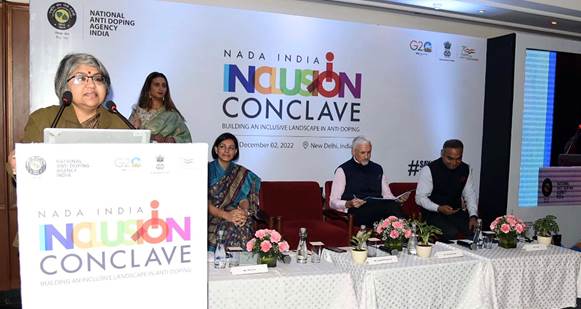
 

Speaking on the occasion Secretary Sports Smt. Sujata Chaturvedi said that it is a good time to be in Indian sport, where under the Prime Minister Shri Narendra Modi’s leadership, initiatives like Khelo India have given sport a fillip. “We cannot ignore anti-doping while striving for excellence in sport. The National Anti-Doping Act is a step in that direction”, she said.
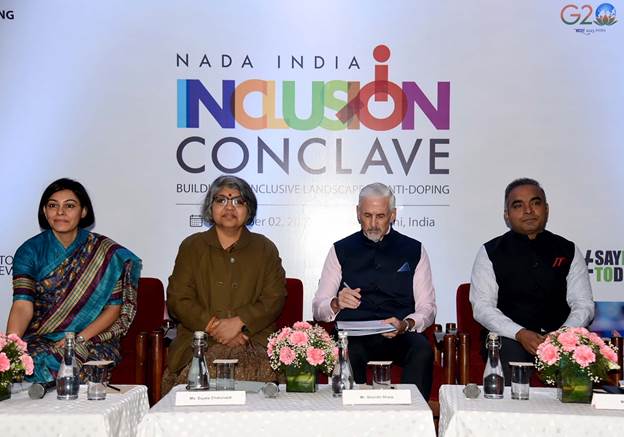


Mr. Shombi Sharp, United Nations Resident Coordinator, India also addressed the gathering. “The inclusion of persons with disabilities is a central promise of the 2030 Agenda for Sustainable Development – to leave no one behind,” he said. He further added “Indian athletes with disabilities have not only shown incredible grit and determination by beating all the odds – they have also brought – and continue to bring – great pride to the nation.”

NADA Director-General and CEO Ritu Sain said the Conclave was a step towards ensuring that anti doping program is inclusive and athletes with disabilities remain at core and are not left behind.

 “We have to reach out to the Athletes with Disabilities keeping their needs in mind. Engaging them with content in print, audio, Braille and sign language in keeping with Universal Design of Learning (UDL) principles is a priority,” she said.

Ms Sain said NADA India is in process of sensitising 20 Dope Control Officers to specialise in collecting samples of Athletes with Disabilities in keeping with the different needs. She also said NADA would equip itself with assistive devices in Doping control process to facilitate athletes with disabilities in lines with the World Anti-Doping Code and Standards.
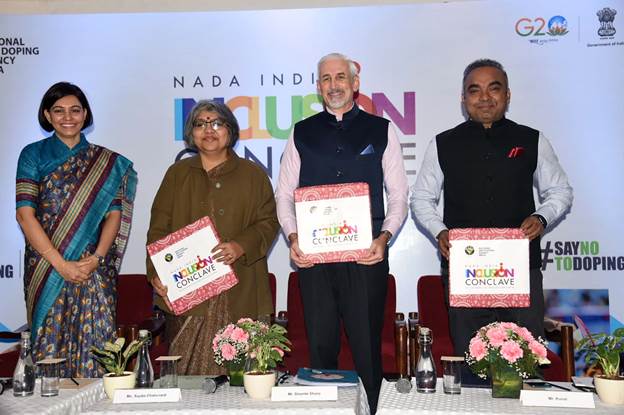
 

She said NADA India is developing Apps to spread awareness and address queries of athletes and support personnel as well as to help them recognise if any medicine they were being prescribed contains prohibited substances. “We are developing credible content that will overcome geographical, language and disability barriers,” she said.

Tokyo2020 Paralympics High Jump medal winner Sharad Kumar shared his experience of serving a two-year ban for an inadvertent anti-doping violation. He said the levels of education of Athletes with Disabilities prevented many from taking short cuts. “The anti-doping lessons are best learnt from the experience of those who tested positive,” he said.

Sharad Kumar also said that athletes who dope must realise that it leaves an impact on their bodies and minds. “Those who dope and have not tested positive cannot think they have escaped. They are guilty in their own minds and caught in their own trap,” he said, exhorting athletes not to chase popularity and rewards at the risk of their own health.

Institute of National Anti-Doping Organisations (iNADO) CEO Jorge Leyva, Asian Paralympic Committee Anti-Doping Sub-Committee Chairman Dr. Badrul Rashid, University of Birmingham’s Prof. Ian Bradley and International Inclusion and Para Sports expert Dr. Halim Jebali headline the panelists from overseas also joined an array of Indian experts.

Related links:

https://www.pib.gov.in/PressReleasePage.aspx?PRID=1880292

https://pib.gov.in/PressReleaseIframePage.aspx?PRID=1866802


*******

