ECI felicitates Indian Deaf Cricket team ‘T20 Champions Trophy winners’ to mark International Day of Persons with Disabilities

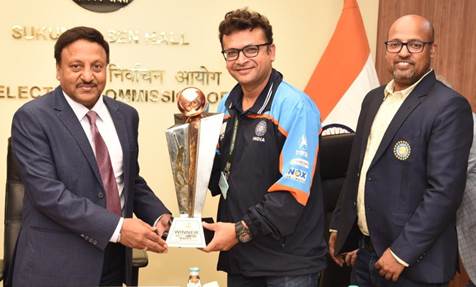
 On the eve of the International Day of Persons with Disabilities, the Election Commission of India, felicitated the Indian Deaf Cricket Team, today at Nirvachan Sadan. Welcoming the team, CEC Shri Rajiv Kumar said that the Election Commission salutes the resilience and tenacity demonstrated by the players. The team has brought laurels to the country by winning the T20 Champions Trophy held in UAE by Deaf International Cricket Council. Sh Kumar said it’s important to accord due publicity and visibility to the winners. ECI will explore the possibility of sponsoring a match of the Indian Deaf Cricket Association team with mainstream cricket teams.
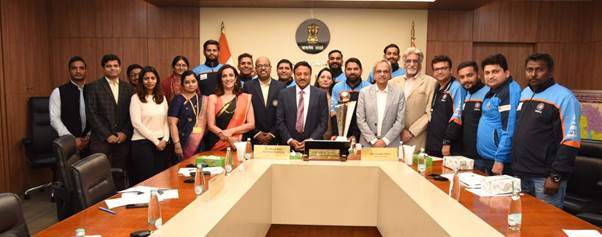
 

The Commission also organised a sensitization training workshop for officers of the Commission on ‘Diversity and Inclusion’ by Padma Shri awardee Dr. Niru Kumar, ECI National Icon to mark the International Day of PwDs.
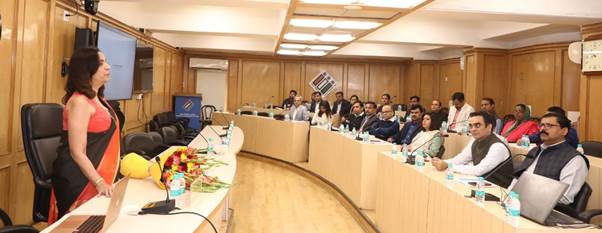
Speaking on the occasion Sh Kumar said that ECI is committed to mainstream and deeply embed the concept and practice of accessibility in ensuring a new normal of enabling environment in the entire election process ecosystem from registration to voting.

Shri Kumar elaborated that with administrative and technological innovations ECI has developed a one stop solution in the form of an APP – Saksham App – for enabling and facilitating the PwDs from enrolment to poll day facilities. The PwD electors can avail various services provided by the ECI enabling their participation in the election process, thus making them Saksham. The App can be downloaded from Google Play Store and Apple store.
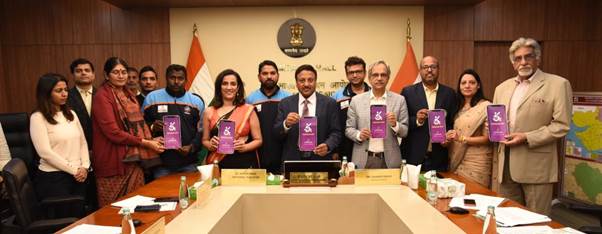
ECI has been implementing several measures to ensure accessible facilitation at the polling stations, making them conducive for Persons with Disabilities to cast their vote without any hassles. Notified checklist for provisions such as polling stations on ground floor, standardised ramps, wheelchairs, volunteers, EVM with braille and ballot paper, braille EPIC, accessible toilets, tactile signage, sign language interpreters and pick up drop facility are made available in polling stations. The Commission has also provided the option of postal ballot facility to PwDs with 40% benchmarked disability to vote from the comfort of their homes. 

The Commission has carried out milestone initiatives such as:

    1. Setting up of the National Advisory Committee on Accessible Elections.
    2. A module on sensitization of election personnel.
    3. Deploying Accessibility Observers during elections
    4. Appointing achievers with disabilities as election ambassadors/icons
    5. Developing awareness films on inclusive elections starring achievers with disabilities

The Commission is dedicated to the goal of inclusive and accessible elections and shall endeavour to increase the participation of PwDs in the electoral process for a truly representative and robust democracy. So far, over 83 lakhs electorate have been mapped as PwDs in the electoral roll across the country.

****

Vice President’s speech at 8th LM Singhvi Lecture

 We are the world’s most vibrant democracy that is representative to an ideal level.

We started with the Constituent Assembly in which members were enormously talented from all sections of society. But progressively with each election our parliament reflects authentically the mandate of people …wisdom of the people. And now what we have in the parliament is fairly representative. at a global level we do not have a parallel on that count.

We must keep only one thing in mind –interest of Bharat – above everything else.

It is indicated in the preamble of our constitution – we the people. That means the power resides in the people – their mandate, their wisdom. Indian parliament reflects the minds of the people.

In the year 2015-16, the Parliament was dealing with a constitutional amendment act and as a matter of record the entire Lok Sabha voted unanimously. There was no abstention and no dissention. And the amendment was passed. In Rajya Sabha it was unanimous, there was one abstention. We the people – their ordainment was converted into a constitutional provision.

Power of the people, which was expressed through a legitimate platform, that power was undone. The world does not know of any such instance.

I appeal to the people here, they constitute a judicial elite class, thinking minds, intellectuals – please find out a parallel in the world where a constitutional provision can be undone.

Our Indian constitution provides in explicit terms Art 145 (3). Interpretation of the constitution when a substantial question of law is involved can be done by the court. Nowhere it says that a provision can be run down.

If a constitutional provision that carries the ordainment of people at large in such a vibrant democracy, is undone, what will happen?

I’m appealing to everyone that these are the issues that should not be viewed on partisan lines. I expect everyone to rise to the occasion and be part of the growth story that is India at the moment.

I’m startled that after this verdict, there was no whispering in the parliament. It was taken as such. This is too serious an issue.

We are proud of our judiciary. It has contributed to the growth of promoting the rights of the people.

After 9/11, US had passed the Patriot Act. Not with this majority. And it was taken as. That is why primacy of national interest prevails.

Imagine if 73rd and 74th amendments were to be undone. What will happen?

Now friends I put it to you the basic of the basic structure is primacy of the will of the people. In democracy, there can be nothing more basic than the prevalence of the rights of the people. And the ordainment of the people should be reflected through a legitimised mechanism which is the legislature in a sanctified manner.

I’m sure it is never too late to reflect and think. Our judiciary is one of the critical institutions of governance long with the executive and legislature. The doctrine of separation of powers is fundamental to our governance. The harmonious working of these institutions is vital for the growth of democracy. Any incursion, howsoever subtle, in the domain of one by another has the capacity to unsettle the apple cart of governance.

We have a parliament that is far more representative at the moment.

I have an appeal that as a true citizen of this country, generate a public opinion that political stance should be distanced from sublimity of our constitutional functioning.

It is never too late. The basic structure doctrine, we have lived with it. We have taken as such. It was by a majority of 7 to 6.

As a student of law, can parliamentary sovereignty be ever compromised? Can a succeeding parliament have to be bound by what has been done by an earlier parliament?

I leave you with this thought.

****

Republic Day 2023

The Azadi Ka Amrit Mahotsav celebration honors 75 years of India’s progress, as well as the illustrious past of its people, culture, and accomplishments. Every year on January 26th, India celebrates Republic Day with great fanfare. On this day, it is customary to hoist national flags across India and hold grand parades at Janpath, New Delhi, including the Indian National Army. In 2023, India will celebrate her 74th Republic Day.


Significance of Republic Day

A new constitution was approved by a drafting committee headed by Dr. BR Ambedkar Written after India’s independence from British rule. The Indian Constitution, which confirmed India’s status as an independent republic, went into effect on January 26, 1950. Since the Indian National Congress issued Purna Swaraj, declaring India’s independence from colonial authority, on this day in 1930, January 26 was chosen as the date for the event.

Republic Day Holiday 2023- Theme 


According to reports on Tuesday, the government has proposed three distinct themes for the tableaux of the Republic Day Parade in 2019: India@75, the International Year of Millets, and Nari Shakti. Several state governments, central ministries, and departments, according to sources, have been invited to take part in the Republic Day Parade on January 26 by developing a tableau using one of these three themes, or a mix of the three.

The government has suggested that India@75 tableaux highlight India’s freedom struggle, its accomplishments, its deeds, and its commitment throughout the previous seven decades. This is in honor of India marking 75 years since its independence.

The idea for a millets day originated in 2021 when India asked the UN to designate 2023 as the International Year of Millets (IYOM). The United Nations General Assembly (UNGA) declared 2023 to be the International Year of Millets after 72 nations backed India’s request.

How is Republic Day celebrated?

India celebrates Republic Day with enthusiasm and passion. It is a day dedicated to the Sovereign Constitution of India. It is common for schools and colleges to display national flags. National cultural activities are held to support India’s struggle for independence. The President of India raises the national flag at the India Gate in New Delhi.

The largest parade is held in Rajpat, New Delhi. The Ministry of Defense organized a parade led by the President of India. The event not only showcases military prowess but also promotes India’s rich cultural diversity.

The occasion also honors those who have given their lives as martyrs for the nation. By placing a wreath at the Amar Jawan Jyoti at India Gate, the Indian Prime Minister pays tribute to the martyrs. The national song, national flag raising, and 21-gun salute come next. The Paramvir Chakra, Ashok Chakra, and Vir Chakra are awards given to heroic troops. Awards are given out to people of all ages who have shown fortitude in the face of hardship.

In military jeeps, the recipients of the heroism medals greet the president. India then shows off its military prowess after that. Police, National Cadet Corps, and military parades are also held and the President of India receives salutes from various regiments. The Indian Air Force fighter jets pass over Janpath to end the show.

Although the holiday is observed across the nation, Delhi—the capital—sees India’s largest Republic Day celebrations.


India will witness a rise in gamers by 2025.

The number of Indian gamers is expanding at a compounded annual growth rate (CAGR) of 12% and is expected to jump to 700 million in FY25 compared with 507 million in 2021, said a new report by Dentsu titled Gaming Report India 2022 – For the Game.

The report said that 46% of gamers in India are women and that overall, ‘Real Money Game’ revenues currently constitute 57% of market size but future growth is projected to be driven by in-app purchases growing at a 34% CAGR. There were 120 million paying users in FY22, which represents a 24% conversion rate.

Anita Kotwani, CEO, Carat India & lead at Dentsu Gaming, said, “Gaming’s growing cultural impact, combined with the promise of the metaverse, has generated endless opportunities for advertisers. With the meteoric expansion of esports and streaming platforms, gaming has shifted from solitary play to spectator sport. Gaming platforms are now the main avenue for social connections and self-expression. One cannot follow the cookie-cutter approach anymore given the fluidity & dynamism of the industry.”

India will witness a rise in gamers by 2025.

The number of Indian gamers is expanding at a compounded annual growth rate (CAGR) of 12% and is expected to jump to 700 million in FY25 compared with 507 million in 2021, said a new report by Dentsu titled Gaming Report India 2022 – For the Game.

The report said that 46% of gamers in India are women and that overall, ‘Real Money Game’ revenues currently constitute 57% of market size but future growth is projected to be driven by in-app purchases growing at a 34% CAGR. There were 120 million paying users in FY22, which represents a 24% conversion rate.

Anita Kotwani, CEO, Carat India & lead at Dentsu Gaming, said, “Gaming’s growing cultural impact, combined with the promise of the metaverse, has generated endless opportunities for advertisers. With the meteoric expansion of esports and streaming platforms, gaming has shifted from solitary play to spectator sport. Gaming platforms are now the main avenue for social connections and self-expression. One cannot follow the cookie-cutter approach anymore given the fluidity & dynamism of the industry.”

India receive a whopping 100 billion dollars as remittance according to a report by World Bank.

The World Bank Report has stated that India, the third largest economy of Asia, is set to become the first country to receive $100 billion in remittances from migrant workers abroad. Notably, India had received $89.4 billion in remittances in 2021, according to the World Bank report, which then made India the top recipient globally.

India will be the first country in the world to receive $100 billion from remittances during 2022, the World Bank has said.

Remittance flows to India will rise 12% to reach $100 billion this year, according to a World Bank report published Wednesday. That puts its inflows far ahead of countries including Mexico, China and the Philippines.

Highly-skilled Indian migrants living in wealthy nations such as the US, UK, and Singapore were sending more money home, according to the report. Over the years, Indians have moved away from doing lower paid work in places like the Gulf. Wage hikes, record-high employment and a weakening rupee also supported growth.

Remittances to India were enhanced by wage hikes and a strong labor market in the US and other OECD countries. In the Gulf Cooperation Council destination countries, governments ensured low inflation through direct support measures that protected migrants’ ability to remit. 

India receive a whopping 100 billion dollars as remittance according to a report by World Bank.

The World Bank Report has stated that India, the third largest economy of Asia, is set to become the first country to receive $100 billion in remittances from migrant workers abroad. Notably, India had received $89.4 billion in remittances in 2021, according to the World Bank report, which then made India the top recipient globally.

India will be the first country in the world to receive $100 billion from remittances during 2022, the World Bank has said.

Remittance flows to India will rise 12% to reach $100 billion this year, according to a World Bank report published Wednesday. That puts its inflows far ahead of countries including Mexico, China and the Philippines.

Highly-skilled Indian migrants living in wealthy nations such as the US, UK, and Singapore were sending more money home, according to the report. Over the years, Indians have moved away from doing lower paid work in places like the Gulf. Wage hikes, record-high employment and a weakening rupee also supported growth.

Remittances to India were enhanced by wage hikes and a strong labor market in the US and other OECD countries. In the Gulf Cooperation Council destination countries, governments ensured low inflation through direct support measures that protected migrants’ ability to remit. 

National Milk Day

The day commemorates Dr. Verghese Kurien’s 100th birthday and is referred to be the “Father of the White Revolution.”

On November 26, National Milk Day is marked to raise awareness of the value and advantages of milk.

India is the largest milk producer. Animals eat milk, so it is a food consumed by both humans and animals. World Milk Day, established by the Food and Agriculture Organization of the United Nations, is also celebrated on June 1st each year.


National Milk Day: History

The National Dairy Development Board (NDDB), the Indian Dairy Association (IDA), and 22 State Dairy Associations have jointly decided to commemorate Dr. Celebrating his Verghese Curiae on November 26, 2014. Dr. Curia is considered the father of India’s White Revolution. As a result, on November 26, 2014, the first National Milk Day was celebrated.

Do you know about the White Revolution and Operation Flood?

India’s National Dairy Development Board (NDDB) initiated a rural development program, Operation Flood, in 1970. It is one of the largest programs aimed at building a nationwide milk network. As a result, milk traders and merchant fraud has decreased and India is now one of the largest producers of milk and dairy products. Hence the White Revolution is another name.

Dr. Verghese Kurien, then Chairman of the NDDB, provided the management know-how and necessary impetus for the cooperative sector. He is credited with being the driving force behind Operation Flood, also known as White Revolution in India.

Operation Flood was implemented in three phases.

Phase I (1970-1980): It was paid for by the European Union’s World Food Program donations of skimmed milk powder and butter oil. Connected with consumers in Mumbai, Kolkata, and Chennai.

Phase II (1981-1985): Between 18 and 136 dairy stalls were added during this time. A total of 290 urban markets also increased milk distribution. And he said that by the end of 1985, 4.25 million milk producers were part of a self-sustaining network of 43,000 village cooperatives. By 1989, 22,000 tons of domestic milk powder had been produced for his 140,000 tons.

Phase III (1985-1996): Dairy cooperatives expanded and strengthened their infrastructure during this time to increase the supply of milk to the market. This phase strengthened the Indian dairy cooperative movement by adding 30,000 new dairy cooperatives to the 42,000 dairy cooperatives already established in Phase II. Women’s participation in the milk shed increased from 1988 to 173 in 1989, and women’s milk cooperatives also increased dramatically.

research and developments in animal nutrition and animal health were also highlighted during this period. Innovations such as vaccination against atherosclerosis, avoidance of protein diets, and urea molasses mineral blocks have helped dairy cows produce more milk.

About Dr. Verghese Kurien

1. He resigned from his position with the government and coerced Tribhuvandas Patel and the farmers to launch the Kaira District Cooperative Milk Producers Union Ltd (KDCMPUL), subsequently known as “Amul,” as the region’s first milk cooperative movement.

2. He carried out the “Operation Flood” scheme and attempted to bring the White Revolution to India. He was responsible for planning India’s White Revolution.

3. He contributed to India being the world’s top producer of milk.

4. He contributed to setting the groundwork for democratic initiatives at the local level.

5. He founded several organizations, including the National Dairy Development Board (NDDB) and the Gujarat Cooperative Milk Marketing Federation Ltd (GCMMF), and he had a considerable impact on the development of the dairy cooperative movement in the nation.

6. He also oversaw the replication of the cooperative dairy Anand model, which is used throughout India. He received 15 honorary degrees over his nearly fifty years of service from various international universities because he insisted that learning should never end.

7. He will always be known for changing the definition of milk to make it a potent tool for economic growth.


Coal Ministry to conduct Investor Conclave in Mumbai

 After the successful auction of 64 coal mines in the first five tranches, Ministry of Coal had launched the process for auction of 133 coal mines under 6th round of commercial auctions of which 71 coal mines are new coal mines and 62 coal mines are rolling over from earlier tranches of commercial auctions held in November 2022. Additionally, eight  coal mines under 2nd attempt of 5th round of commercial auctions were also launched where single bids were received in the first attempt.

Under commercial auctions, there is no technical or financial eligibility criteria and hence, several bidders who were not into coal mining earlier, became successful bidders and were awarded the coal mines. To boost bidder participation in the commercial auction of coal mines, Ministry of Coal is organising an investor conclave on December 01, 2022 in Mumbai. Union Minister of Coal, Mines and Parliamentary Affairs, Shri Pralhad Joshi will Chair and  Chief Minister of Maharashtra, Shri Eknath Shinde will be the Chief Guest.  Deputy Chief Minister Shri Devendra Fadnavis will be the Special Guest and Minister of State for Coal, Mines and Railways, Shri Raosaheb Patil Danve and Minister of Mining for Maharashtra, Shri Dadaji Bhuse will be the Guest of Honour of the function.  Shri Amrit Lal Meena, Secretary, Ministry of Coal and Shri Vivek Bhardwaj, Secretary, Ministry of Mines will  also participate in the Conclave.

The list of mines has been finalized post detailed deliberations. Mines falling under protected areas, wildlife sanctuaries, critical habitats, having forest cover greater than 40%, heavily built-up area etc. have been excluded. The block boundaries of some of the coal mines where there was presence of dense habitation, high green cover or critical infrastructure etc. have been modified basis comments received during stakeholder consultations to enhance bidders’ interest and participation in these coal blocks.

Key features of the auction process include reduction in upfront amount and bid security amount, permission to relinquish part of the coal mine in case of partially explored coal mines, introduction of National Coal Index and National Lignite Index, ease of participation with no entry barriers, full flexibility in coal utilisation, optimized payment structures, efficiency promotion through incentives for early production and use of clean coal technology. 

The sale of tender document commenced on November 03, 2022. Details of the mines, auction terms, timelines etc. can be accessed on MSTC auction platform. The auction shall be held online through a transparent 2 stage process, on the basis of Percentage Revenue Share.

SBI Capital Markets Limited, the sole Transaction Advisor to Ministry of Coal for the commercial coal mine auctions, is assisting the Ministry of Coal in conduct of the auction.

*****

18th Convocation of National Institute of Technology, Kurukshetra

 The President of India, Smt Droupadi Murmu graced the 18th convocation of National Institute of Technology (NIT) Kurukshetra today (November 29, 2022). 

The President said that today the whole world is going through a phase of rapid change. Due to the technological revolution, the nature of jobs as well as the basic needs of the people is changing. These changes are also challenging the existing methods of engineering. In view of changes taking place due to the technological shift, it becomes very important that our technical institutions including NIT Kurukshetra become ‘future-ready’. She was happy to note that NIT Kurukshetra is moving towards introducing futuristic-courses like artificial intelligence and data science, robotics and automation and industrial internet of things. She was also happy to note that NIT Kurukshetra has established a state-of-the-art ‘Siemens Centre of Excellence’ in which special emphasis is being laid on smart manufacturing and automation designs and e-mobility. She said that it is a matter of pride that NIT Kurukshetra is the first NIT in North India and second in the country to establish such a centre. She noted that the establishment of this centre has led to increase collaboration with industry, academia and Research and Development organizations such as DRDO and BHEL.

The President said that the region of Haryana and Punjab has made a very important contribution in the development of Indian agriculture. The progressive farmers of this region have made the green revolution possible by using modern technology and provided food security to the country. But today, increasing air and land pollution and depleting ground water level in the region have emerged as a major problem. She said that it is the responsibility of NIT Kurukshetra to find technical solutions to these problems. During the pandemic, it became clear that the common citizen of India is technology friendly. If technology is for the betterment of the society, then it gets full cooperation from the public. The success of digital payment is an example of this.

The President said that technology is not only a by-product of science and engineering, but it also has a social and political context. We all have to move forward with the thought of ‘Technology for Social Justice’. We should make efforts so that the deprived class is not left behind in this. Technology should be used for building an egalitarian society. 

Pointing to the trend of making salary packages as the criteria for success in education, the President said that getting more salary packages is a good thing, but it does not mean that the student who does not get a good salary package is less qualified. She advised students to never judge their success on the basis of the package. She said that they have not to be limited by traditional notions of success and societal pressures. They have to decide what they want to do in their life. She urged them to choose a career that gives them satisfaction and a sense of meaning in life. She also urged parents to motivate their children for excellence. She said that in striving for excellence, achievements will automatically come their way.

The President said that NIT Kurukshetra which was established in 1963 is one of the first NITs in India. It has played a very significant role in spreading the scientific temper in the region. Over the past six decades, it has carved a niche for itself among technical institutions of higher-learning in the country and abroad. She said that more than 40,000 alumni of this institute have contributed in nation-building and have also played an important role in enhancing the reputation of India all over the world. She noted that students of NIT Kurukshetra have made their place in all fields from Singapore to Silicon Valley, from civil society to civil services.

Please click here to see the President’s speech – 

 ***

Sensex index may hit 80,000 at the end of next years.

Equity Research major Morgan Stanley (MS) on Monday said the Sensex could hit 80,000 by the end of 2023. This comes even as the Sensex closed at a record high of 62,504 after gaining 0.34 per cent, or 211 points. The Nifty rose 0.27 per cent, or 50 points, to close at 18,562. Nifty is just 53 points away from making a new lifetime high.

The bull-run in Indian equity markets is intact, said analysts at Morgan Stanley in a recent note, and expect the S&P BSE Sensex to hit 80,000 levels by December 2023 in their bull-case scenario, to which they have assigned a 30 per cent probability. From the current levels, this translates into an upside of nearly 29 per cent.

For this, while the corporate earnings are projected to compound 25 per cent annually over FY22-25, Morgan Stanley expects India to be included in the global bond indices, which could result in nearly $20 billion of inflows over the subsequent 12 months. That apart, commodity prices including oil and fertiliser are expected to correct sharply.

As their base-case, however, Morgan Stanley sees the S&P BSE Sensex to scale up to 68,500 levels – up 10 per cent from the current levels.

Sensex index may hit 80,000 at the end of next years.

Equity Research major Morgan Stanley (MS) on Monday said the Sensex could hit 80,000 by the end of 2023. This comes even as the Sensex closed at a record high of 62,504 after gaining 0.34 per cent, or 211 points. The Nifty rose 0.27 per cent, or 50 points, to close at 18,562. Nifty is just 53 points away from making a new lifetime high.

The bull-run in Indian equity markets is intact, said analysts at Morgan Stanley in a recent note, and expect the S&P BSE Sensex to hit 80,000 levels by December 2023 in their bull-case scenario, to which they have assigned a 30 per cent probability. From the current levels, this translates into an upside of nearly 29 per cent.

For this, while the corporate earnings are projected to compound 25 per cent annually over FY22-25, Morgan Stanley expects India to be included in the global bond indices, which could result in nearly $20 billion of inflows over the subsequent 12 months. That apart, commodity prices including oil and fertiliser are expected to correct sharply.

As their base-case, however, Morgan Stanley sees the S&P BSE Sensex to scale up to 68,500 levels – up 10 per cent from the current levels.

Report for most inclusive nation for religious minorities, India tops the list.

The Centre for Policy Analysis (CPA), in its first global minority report, has listed India at the top of the list of countries for its treatment of religious minorities. India has topped the list on counts of inclusiveness towards religious minorities.

Released by former Vice President of India Venkaiah Naidu, the report is based on conceptual issues relating to human rights, minorities, concept of religious freedom and culture dilemma of religious minorities, cause of religious differences and more.

While India has been ranked one in the global minority report, the United State of America (USA) bagged fourth spot. Nepal is ranked at 39, whereas Russia is ranked 52. China and Bangladesh were ranked at 90 and 99, respectively. Pakistan is ranked at 104 in the report, whereas Taliban-led Afghanistan secured 109th position.

This is for the first time that an Indian body has rated other nations on the basis of their treatment of religious minorities.

Report for most inclusive nation for religious minorities, India tops the list.

The Centre for Policy Analysis (CPA), in its first global minority report, has listed India at the top of the list of countries for its treatment of religious minorities. India has topped the list on counts of inclusiveness towards religious minorities.

Released by former Vice President of India Venkaiah Naidu, the report is based on conceptual issues relating to human rights, minorities, concept of religious freedom and culture dilemma of religious minorities, cause of religious differences and more.

While India has been ranked one in the global minority report, the United State of America (USA) bagged fourth spot. Nepal is ranked at 39, whereas Russia is ranked 52. China and Bangladesh were ranked at 90 and 99, respectively. Pakistan is ranked at 104 in the report, whereas Taliban-led Afghanistan secured 109th position.

This is for the first time that an Indian body has rated other nations on the basis of their treatment of religious minorities.

Manthan Platform Wins the Best Tech Initiative Award

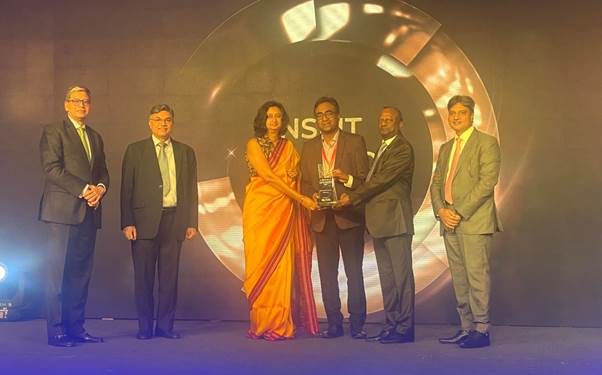
 The Manthan platform won NSEIT the Best Tech Initiative of the Year at the Dun & Bradstreet Business Excellence Awards 2022 on 29th November 2022 during an event in Mumbai. The award was presented for building the technology infrastructure to support Manthan, a platform that promotes collaboration at scale between industry and the scientific research and development ecosystem. The development of the platform was conceptualized and implemented by the Office of the Principal Scientific Adviser (PSA) to the Government of India. The award was received by Dr. Sapna Poti, Director of Strategic Alliances Division, Office of Principal Scientific Adviser (PSA) to the Government of India and Shri. Anantharaman Sreenivasan, MD & CEO, NSEIT.

Manthan is aimed at promoting collaboration between industry and the scientific research and development ecosystem. Launched on India’s 76th Independence Day, Manthan empowers multiple stakeholders to collaborate for co-creating solutions aligned with the United Nations’ Sustainable Development Goals (SDGs) and our national scientific missions.

The Principal Scientific Adviser to the Government of India, Prof. Ajay K. Sood launched the platform and noted that the creation of Manthan will be crucial for “building, nurturing, and celebrating the outcome of partnerships between various stakeholders of science, technology, and innovation ecosystem in India.” Emphasising the mandate of Manthan, he added, “This will give an impetus to the government’s efforts to improve participation of industry in terms of GDP. In the last few years, the partnerships between academia and industry have been encouraging and it has worked well when two sides have come together to solve the problems or the challenges faced.

Congratulating the teams behind Manthan, Dr. Parvinder Maini, Scientific Secretary, Office of PSA, said, “Manthan is a unique platform enabling public-private-academia collaboration to achieve sustainability goals, and the goal is to play a transformative role in doing that. It is giving a thrust for innovative ideas and inventive minds to seamlessly collaborate and work towards making India a global innovation hub. This recognition commemorates the larger vision of Digital India and highlights the contributions of the teams behind Manthan’s success.

Dr. Sapna Poti, Director of the Strategic Alliances Division, Office of PSA, said, “As the nation takes rapid strides towards becoming a global innovation hub, a platform to cater to the science, technology, and innovation ecosystem specifically is essential. Manthan – India’s Platform for Research and Innovation will allow industries to source their project and innovation partners for both CSR and Industry R&D, facilitating the exchange of ideas, enhancement of communities’ support, and co-development of solutions that will fuel scientific research and development in the country. Congratulations to the entire NSEIT team who designed and implemented Manthan.

The Manthan platform is visionary and is a true enabler for the Government of India’s Digital India vision. I congratulate the teams from the Office of the PSA and NSEIT for their meticulous contributions toward making this ingenious and innovative platform a reality. This award is an outcome of teamwork and rigorous pursuit of excellence”, said Shri. Ashishkumar Chauhan, MD & CEO of National Stock Exchange of India Limited.

On receiving the award, Shri. Anantharaman Sreenivasan, MD & CEO of NSEIT, said, “This award is a validation of NSEIT’s commitment to delivering high-impact and complex projects for customers. I thank the jury members and the organizing team at Dun & Bradstreet for recognizing NSEIT’s efforts in providing innovation excellence and driving robust business outcomes. I also express gratitude to the Office of PSA to the Government of India for entrusting us with the honor of being a strategic technology partner. The teams behind the successful launch of Manthan deserve all the credit for fructifying this global innovation platform.”


Dun & Bradstreet Business Excellence Awards 2022:

Dun & Bradstreet is a global provider of B2B data, insights, and AI-driven platforms for organizations around the world. Since 1841, companies of every size have relied on Dun & Bradstreet to help them manage risk and reveal opportunity. The Dun & Bradstreet SME and Mid-Corporate ‘Business Excellence Awards 2022’ is an endeavor to acknowledge and recognize the achievements and performance of SMEs and Mid-Corporates. The award covers 23 categories largely based on business performance parameters. The award nominations were reviewed by a distinguished jury panel featuring experts from the banking and energy development sectors.

About NSEIT:

NSEIT Limited is a global technology enterprise focused on delivering excellence in a complex digital environment, primarily in the banking, insurance, and capital market ecosystem, and a 100% subsidiary of the National Stock Exchange of India. Their key service pillars are Application Modernization, Business Transformation, Data Analytics, Infrastructure & Cloud Services, Cybersecurity, EdTech, and online examinations solutions.

For more information, visit www.nseit.com.

*****