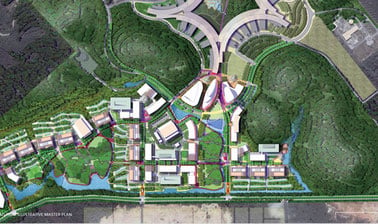
Concept of New Towns

 World civilization is growing and cities are expanding to their outer city limit which leads to an urban sprawl and the formation of suburbs. Specialized city suburbs have been developed over time which eventually separates the inhabitant’s social connection from the main city center. As a result, the city has exceeded its outer boundaries and leaves limited space for further urban development. When population and housing demands increased, government authorities, sought out for new and other options; the development of new towns. 

New town, a form of urban planning designed to relocate populations away from large cities by grouping homes, hospitals, industry and cultural, recreational, and shopping centres to form entirely new, relatively autonomous communities. The first new towns were proposed in Great Britain in the New Towns Act of 1946; between 1947 and 1950, 12 were designated in England and Wales and 2 in Scotland, each with its own development corporation financed by the government. The new towns were located in relatively undeveloped sites. Each was to have an admixture of population so as to give it a balanced social life. 

A new town is a new settlement built on either rural land transformed to urban land use or on new reclaimed land. The objective of developing new towns is to become a self-sufficient town. New towns seem to be the answer to the urban sprawl and suburban dilemma where there are low economic job opportunities creating a high percentage of commuting. This however becomes a mutual problem for new towns as they evolve making them dependent on neighboring towns and cities for employment and various types of social services. Another issue that new towns have to deal with is the identity crisis which links to its lack of history. This therefore leads people to the misconception of new towns as suburbs.

A more consistent definition of a new town is best described by the International New Town Institute as (INTI) human settlements that were founded at a certain moment in history by an explicit act of will, according to a preceding plan and aiming to survive as a self-sustaining local community and independent local government, able to play a role in the ongoing development of the region in which the new town is located. 

A new town has been interpreted as a relocation of housing for overpopulated cities or a safe suburban living area for the middle class family. A new town is not an extension of an existing town or city. It is a blueprint plan of a new settlement before it was built. New towns were also characterized as a new concept of lifestyle: ‘living in a green and healthy environment’ after much destruction to existing cities and towns during World War II. New Towns became the answer to divert over populated and congested cities to a new location of a new town. The development of new towns has served as relocation for the over spill of existing cities. It should not be forgotten that new towns also exploits rural land that may have served for other land use developments such as for farmland or nature and recreation area.

Town Planning Legislation in India

 Certain planning legislation introduced in different parts of India, before independence. There is no continuity or uniformity in the legislations of various States. Different States had different provisions for town planning measures either under the Municipal Acts or under special enactments, such as City Improvement Trust Acts or Town Planning Acts. It is only after independence that all the States are putting their heads together to evolve a common policy on town and country planning matters. With the growth of urban problems, the municipalities utterly failed to respond to the changing situations. 

The work involved in planning, improvement and extension of towns was so complex and great that the municipalities were unable to carry on these works effectively. There were reasons for their failure. Firstly, due to ignorance and disunity, secondly, lack of imagination and interest, thirdly, lack of trained personnel and sufficient funds and fourthly, lack of legal backing to effectively implement town planning schemes and projects. As a result, overcrowding, congestion, deterioration and haphazard development have seen in most of our cities and towns. However, certain enlightened States enacted special acts enacted and they give an idea as to the measures taken and the efforts made by government, though in a very limited way, to improve the living conditions of the people in urban areas and guide the future growth of the urban centres in a planned manner. The main town planning acts include;

Town planning acts in India

Kerala Town and Country Planning Act, 2016
This act is to provide for the promotion of planned development and regulation of growth of urban and rural areas in the State with focus on scientific spatial planning and to secure to their present and future inhabitants, sanitary conditions, amenity and convenience and for other matters connected therewith or incidental thereto. This act was revised in 2019.

Characteristics and Design Principles of Transit Oriented Development


Factors Driving the Trend Toward TOD 

  •  Rapidly growing, mind numbing traffic congestion nation wide 
  •  Growing distaste for suburbia and fry pit strip development 
  •  Growing desire for quality urban lifestyle 
  •  Growing desire for more walkable lifestyles away from traffic 
  •  Changes in family structures: more singles, empty nesters etc.
  •  Growing national support for smart growth 
  •  New focus of federal policy

Components of Transit Oriented Development 

  •  Walkable design with pedestrian as the highest priority 
  •  Train station as prominent feature of town center 
  •  Public square fronting train station 
  •  A regional node containing a mixture of uses in close proximity (office, residential, retail and civic) 
  •  High density, walkable district within 10-minute walk circle surrounding train station 
  •  Collector support transit systems including streetcar, light rail and buses, etc. 
  •  Designed to include the easy use of bicycles and scooters as daily support transport 
  •  Large ride in bicycle parking areas within stations 
  •  Bike share rental system and bikeway network integrated into stations 
  •  Reduced and managed parking inside 10 minute walk circle around town center / train station 
  •  Specialized retail at stations serving commuters and locals including cafes, grocery and dry cleaners 

Benefits Of TOD 

  •  Higher quality of life with better places to live, work and play 
  •  Greater mobility with ease of moving around 
  •  Increased transit ridership 
  •  Reduced traffic congestion, car accidents and injuries 
  •  Reduced household spending on transportation, resulting in more affordable housing 
  •  Healthier lifestyle with more walking and less stress 
  •  Higher, more stable property values 
  •  Increased foot traffic and customers for area businesses 
  •  Greatly reduced dependence on foreign oil, reduced pollution and environmental damage 
  •  Reduced incentive to sprawl, increased incentive for compact development 
  •  Less expensive than building roads and sprawl 
  •  Enhanced ability to maintain economic competitiveness 
  •  Incorporation of public and private sector engagement and investment 
  •  Revitalization of neighborhoods 
  •  Improved safety for pedestrians and cyclists through non-motorized infrastructure
TOD principles cannot be applied uniformly across an entire city or transit network, since densities of jobs and people vary widely across the urban space. In fact, experience has shown that only about 15% of transit stations and their surrounding area can support very high density development. 
To make informed decisions about TOD, research institutions and governments have developed a variety of methodologies that can help identify which station areas are good candidates for TOD, determine what level of density the area around a given station can absorb, and figure out what kind of development mix makes sense in a particular area, looking to strike the right balance between jobs, housing and other amenities. 
Building on these approaches, the report proposes a new framework for guiding TOD plans, by simultaneously assessing the “three values” (3V) of transit stations and surrounding areas:
  • The Node value describes the importance of a station in the public transit network based on passenger traffic, connections with other transport modes and centrality within the network. 
  • The Place value reflects the quality and attractiveness of the area around the station. Factors include the diversity of land use; the availability of essential services such as schools and healthcare; the proportion of everyday amenities that can be accessed by walking or cycling; pedestrian accessibility and also the size of urban blocks around the station. 
  • The Market potential value refers to the unrealized market value of station areas. It is measured by looking at the major variables that can influence the demand for land (current and future number of jobs in the vicinity of the station, number of jobs accessible by transit within 30 minutes, current and future housing densities) as well as the supply (amount of developable land, possible changes in zoning policy, market vibrancy etc.). 
The report presents an approach to identify and address potential imbalances between node, place and market potential values to create new economic opportunities, for example, by improving the urban environment around a major transit hub, or by improving public transit service to a booming area. The tool provides a common framework of assessment for urban, transport, and economic planners, thereby facilitating conversations needed for better economic, land use, and transport integration.

Design Principles of TOD 

The eight Principles of the TOD standard for designing better streets and better cities. 
  1.  Walk – Develop neighborhoods that promote walking. 
  2.  Cycle – Prioritize non-motorized transport networks. 
  3.  Connect – Create dense networks of streets and paths. 
  4.  Transit – Locate development near high quality public transport. 
  5.  Mix – Plan for mixed use. 
  6.  Density – Optimize density and transit capacity. 
  7.  Compact – Create regions with short commutes. 
  8.  Shift – Increase mobility by regulating parking and road use.

Principles for Transit Oriented Development

Cities can ensure TOD by focusing on the following seven principles. 

1) Quality Public Transit 

Public transit is strongly linked to urban development. High quality, convenient transport depends on dense and connected neighborhoods. The goal of a transport system is to connect a high number of riders with the city in a comfortable, efficient and affordable way. 

2) Active Transport 

The interests of pedestrians and cyclists should be at the heart of urban planning. Decision making should shift residents, particularly car users, to active transport. Many commuters already take two non-motorized trips on a daily basis by walking to and from transit hubs to their homes or cars. It is important to build on this and encourage non-motorized transport holistically.

3) Car Use Management 

Car use and parking policies play an important role in creating a safe, human oriented urban environment. 

4) Mixed Use Neighborhoods with Efficient Buildings

A mixture of land uses enhances the local economy by densifying and diversifying the design of the community. Mixed use neighborhoods favor short trips by foot or bike. Similarly, buildings should minimize how much energy and water they consume and require for building and maintenance. 

5) Neighborhood Centers and Vibrant Ground Floors 

A built environment with adequate public space promotes social interaction between residents. Sustainable urban communities must be sufficiently dense and contain a variety of uses that are complementary to residential life. Public spaces should be connected to the urban transport network and serve as vibrant, human centered places of activity. 

6) Public Spaces 

The purpose of public space is not only to enhance public life and social interaction, but also to provide a safe environment for pedestrians and cyclists. Public space is the place of encounter, exchange, and circulation within a community. All individuals have the right to access public spaces, regardless of personal, social or economic condition. 

7) Community Participation and Collective Identity 

Community participation is essential to building a vibrant, inclusive neighborhood that is safe and equitable. Stimulating community participation creates a more equitable, harmonious relationship between varying social groups living in the same area. Respecting the unique identity of local communities results in a higher share of residents engaging in civic, cultural and economic activities, generating a sense of belonging and ownership of the city. 

New Towns in India

 In recent times, India has seen a spurt in such planned townships and a significant number of consumers living in major urban centres are becoming interested in the idea of living in the number of planned townships that are being built away from major urban hubs and chaos. 

Making of new towns in India is not a recent phenomenon. India has the experience of this process throughout her history. The phenomenal growth of new towns in India bears the imprint of her heritage in this field of culture and civilization. Mohenjodaro and Harappa, dating back to the Indus Valley civilization, Ayodhya, Pataliputra (present Patna) and Varanasi laid out by Indo Aryans during the Vedic period, Nalanda and Taxila built to serve as University towns during the Buddhist period. Agra, Golconda and “Dacca” (Bangladesh) of mediaeval period, Fatehpur Sikri of the Moghul period, Jaipur the ‘pink city built by Maharaja Jai Singh during the 18th century and Lutyen’s New Delhi (1930) are some of the classic examples of new towns built to satisfy the needs and aspirations of urban community during different periods. 

The new town movement of India in the recent past is associated with the beginning of railway towns of British India. These railway towns being formed of an assortment of quarter, for railway employees, stations and other transportational facilities made a sizeable settlement with minimum possible layout and service facilities. The towns mainly designed on ‘grid iron’ pattern and provided community facilities like market, temples, churches, schools, playground, cinema and theatre gave the look of a new town. Kharagpur, Asansol, Tundla, Manmad and Waltair are the landmarks in this field of new towns in colonial India. 

By 1941, India had more than 30 such towns having capacity of more than 10,000 people each. Till independence development of new towns followed this pattern with a few exceptions like Jamshedpur. Development of new towns in the truest sense in India took a turn after independence. The partition of the country in 1947 resulted in influx of refugees from east and west and their rehabilitation marked the beginning of new towns in modern India. Faridabad near Delhi, Nilokheri in Punjab, Gandhidham in Gujarat and Asokenagar in West Bengal are examples of refugee township in India. 

The new towns built in the first phase lack in design aspect and differ from European and American Standards. But it should be admitted that India started making new towns at a very difficult hour. It was Pandit Jahawarlal Nehru, the then Prime Minister of India wished decent layout of these new townships. He invited the great designer from France, viz. Le Corbusier and gave him the task of designing Chandigarh. His architectural designs and creations became a source of inspiration to other young nations. Creation of Chandigarh was a historic moment in the contemporary annals of town planning. In fact Chandigarh was the ‘flag off” stage in the race of town building in India. 

In recent times, India has seen a spurt in such planned townships and a significant number of consumers living in major urban centres are becoming interested in the idea of living in the number of planned townships that are being built away from major urban hubs and chaos. Let us have a look at some of these new towns which are redefining the way people live in our country. 

  • Navi Mumbai Navi Mumbai is a planned satellite township of Mumbai on the west coast of Maharashtra. Navi Mumbai covering 95 villages 
  • New Town, Kolkata New Town, formerly known as Rajarhat, is a fast emerging satellite township in Kolkata Metropolitan Area (KMA) and it is expected that it will be able to absorb additional population growth and help in easing the burden on Kolkata 
  • Lavasa is a private, planned city being built near Pune by the Hindustan Construction Company (HCC)

1) Navi Mumbai 

Navi Mumbai is a planned satellite township of Mumbai on the west coast of Maharashtra. After it was created in 1971, City and Industrial Development Corporation (CIDCO) was the only authority that looked after the development and maintenance of the city. It was CIDCO which prepared the developmental plan for Navi Mumbai covering 95 villages. In 1991, Navi Mumbai Municipal Corporation (NMMC) was constituted by the Maharashtra government for maintaining some of the developed nodes of Navi Mumbai, namely, Belapur, Nerul, Turbhe, Koparkhairane, Ghansoli, Airoli,and Vashi. 
Navi Mumbai is home to many software companies of Maharashtra, located in various parks. These include the Millennium Business Park in Mahape, the International InfoTech Park at Vashi, and the Belapur railway station complex. It is also home to major commodity markets as well as a major steel market. One of the important business landmarks is the shipping port of Jawaharlal Nehru Port in the Nhava Sheva – Dronagiri nodes. The major business hubs in the city are CBD Belapur, Vashi, Nerul, and Mahape. The Navi Mumbai Special Economic Zone (SEZ) located in the nodes of Dronagiri and Kalamboli is planned to provide commercial growth and employment to the city. Positioned enroute the proposed Navi Mumbai Airport, this megaproject has attracted investments close to Rs 40,000 crores. 

2) New Town, Kolkata 

New Town, formerly known as Rajarhat, is a fast emerging satellite township in Kolkata Metropolitan Area (KMA) and it is expected that it will be able to absorb additional population growth and help in easing the burden on Kolkata. The West Bengal Housing and Infrastructure Development Corporation (HIDCO) plans and executes development projects in the entire 6,000 – 7,000 hectare area in New Town. In order to render the various civic services and amenities within New Town, the New Town Kolkata Development Authority (NKDA) was constituted under the New Town Kolkata Development Authority Act, 2007. 
Towns master plan envisages a township at least three times bigger than the neighbouring planned Salt Lake City. The entire area is still under the process of development. As a planned township, New Town has been divided into three key areas: Action Area I, which mainly consists of malls, a sub Central Business District (CBD) and planned residential and commercial plots. Action Area II is to have a planned main CBD, institutional plots, IT Business Parks like DLF and Unitech, and plots for large apartment complexes. Action Area III mainly consists of high rise residential complexes and mini sub-townships like Uniworld City and Sukhobristi. 

3) Lavasa 

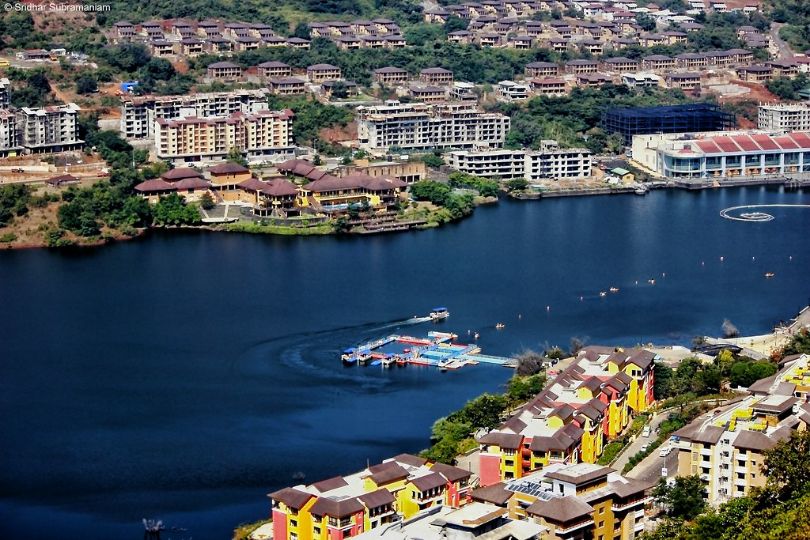
Lavasa is a private, planned city being built near Pune by the Hindustan Construction Company (HCC). Among the first planned hill cities of India, Lavasa is approximately 1/5th of the land area of the Municipal Corporation of Greater Mumbai. Located near the Mumbai-Pune economic corridor, along the Warasgaon Lake, Lavasa optimally balances nature and urban infrastructure. The master plan of Lavasa is based on the principles of New Urbanism which makes life easy for its residents by placing all essential components of daily life within walking distance of each other. Besides this, architectural considerations such as land character, building frontage, and other design guidelines have also been taken into consideration while making the master plan. 

Developments at Lavasa are well on schedule, and the Dasve town center is currently under an advanced stage development. While the Dasve Town Centre is already functional, all structures in education, hospitality, and leisure are fast-nearing completion. Mugaon, is 6 kms from Dasve and is being developed as a centre for residential, educational, business and commercial activities. This town has shops, cafes, cultural institutions, spiritual centres, schools, and colleges. 
Various green initiatives have been undertaken to provide a healthy life to the inhabitants of New Town. The NKDA is working on plans to set up a dedicated green walkway stretching several kilometers in the township for people to walk and breathe fresh air without having the trouble to avoid cars and other polluting vehicles coming their way. A master plan, which has been approved by the Centre, has also been prepared for developing New Town as a solar city. It mentions ways to reduce the projected energy demand from conventional power sources by following two strategies one is by use of solar and renewable power sources and another is by using more energy efficient devices. Already, a long stretch of the main arterial road in Action Area I has been illuminated with LED streetlights and more such lights will be installed on various roads in the township. 
Recently, West Bengals Transport Department and HIDCO came up with a plan to jointly set up a state of the art international bus terminus at New Town, the first of its kind in the state. The terminus will have cafes and rest rooms and services for inter-city, inter-state, and international bus routes will be operated from there. New Town is also witnessing a major real estate boom. This year, a 2.5 acre plot in the township fetched HIDCO a whopping Rs 57.33 crore. It amounts to Rs. 23 crore per acre. Lately, HIDCO has been reaping rich harvest by auctioning off plots in the township for commercial purposes.


NEW EDUCATION POLICY TO BRING EVOLUTION IN THE EDUCATION SYSTEM.

NEW EDUCATION POLICY:
° Students are currently undergoing school exams conducted by responsible authorities in grades 3, 5, and 8.
° 10th and 12th grade board exams will continue, but will be redesigned for overall development.
° Mathematical reasoning and scientific temperament coding begins in 6th grade .Vocational training begins at school in sixth grade and includes internships.
° The 10 + 2 structure is replaced by 5 + 3 + 3 + 4. The new system consists of grades 12 and 3 years preschool / Anganwadi.
° Until 5th grade, this policy emphasizes the local / regional / native language as the teaching language.
° In schools and universities, Sanskrit is also included as a student option at all levels and consists of three language formulas.
° Under Graduate is now 3 or 4 years, with multiple degree options eligible for this period, such as a 1 year certificate, 2 years diploma, 3 years degree, 4 years bachelor’s degree in research, etc.
° An Academic Credit Bank (ABC) is created to store, transfer, and award bachelor’s degrees from digital learning achievements earned by students from various universities.
° The curriculum has been reduced to essentials for all subjects. They focus on critical thinking, discovery, inquiry, debate, and education based on analytical and holistic learning methods for education.
° Focus on e-learning so you can reduce your reliance on textbooks
Under the new policy, education will receive 6% of GDP, up from 1.7%. This definitely boosts the education system.
° By the end of 2040, all universities should be interdisciplinary institutions with more than 3000 students each. University affiliation will be phased out over the next 15 years.

Foucus on Regional /Mother Tongue Language:
As you know, young children learn new things as soon as they teach in their own language, not in another language they are unfamiliar with. This policy is aware of it, so children will be taught in their native language until the age of 5, but it can change to 8th grade .

NEW CURRICULUM STRUCTURE:
•) Rebuild the school curriculum and teaching methods into new 5 = 3 + 3 + 4 patterns.
•) The new curriculum structure is designed to attract the attention of learners at various developmental stages, such as 3-8 years old, 8-11 years old, 11-14 years old, 14-18 years old.
•) Elementary level lasts 5 years:
3 years before school, 1st and 2nd grade.
The preparatory stage lasts for 3 years: 3rd, 4th and 5th grade.
Middle school or high school lasts 3 years: 6th, 7th and 8th grade.
High school or junior high school lasts four years: 9th, 10th, 11th, 12th grade.
All of the above levels include Indian and regional traditions, ethical thinking, socio-emotional learning, quantitative and logical thinking, digital literacy, computational thinking, scientific manipulation, language and communication skills.

“Learning starts with failure; the first failure is the beginning of education.”

– John Hersey

Space Opera Universe : are we oblivious to the fact that we might as well be living in one ?

Space opera universe,the actual reality or the fictional reality is where we all are stuck at. Space opera is a science based fictional story about space,warfares,another world of existence where we humans can see the rays of life’s possibilities.

Space opera has been one of the most talked about topics in the past recent years because it is always seen as the alternative to the earth and human civilisation is still not aware of the new world which can be existing somewhere in reality too.

Many scientists and scientific researchers agreed on many aspects such as human civilization on any other planet but the obligation to live there may take many many years.

Think about yourself as a being having limitless and unimaginable power. Think about the scenarios where our whole planet or galaxy or universe is in danger or there is some sort of alien invasion and we, humans, have powers of Ironman,shield of Captain America that can help us to save the world. Won’t it be fascinating ? It will be. But is it really possible? The answer is no. The power of the new world of new species to whom we can ever connect to or can we ever know about them is not realistic and is best known to the fictional stories only.

Sci-fi movies or star wars movies have been depicting this as a strong portrayal that it’s the reality and when the real practical world talks about it then that becomes quite difficult to believe in. 

But we, the humans, are the superior species among all the living forms on the Earth. We don’t know if there is any other solar system or milky way galaxy or any other planet like our Earth where there is the presence of other living organisms and a superior living form like us. But if there is any , for them we are the outer space or extraterrestrial species or should I say Alien. Our technologies like Artificial intelligence, Robotic process automation, Quantum computing, Virtual reality will amaze them and may make us unparalleled in their eyes. They may consider us living in a space opera universe,different from theirs. Thus, we can say we might be living in a space opera universe without us realizing it.

Land Reforms in India

A Necessity for an Emerging Economy
Many people are not aware that a reform of land tenure is one of the steps in the economic policy of many countries to facilitate industrialization and promote agricultural growth. The problem with this is that it can lead to increased conflict between production and ownership rights. Yet, India’s Prime Minister Narendra Modi has made reforming the country’s outdated laws by going back to medieval-era customs a top priority for his government.

In May, he set up a five-member panel to recommend changes to the Hindu Succession Act, which is based on customary law and governs inheritance in India’s Hindu majority. The panel was created following the Bombay High Court’s decision that women could inherit ancestral property under the act. India has also rolled out land reform bills to facilitate transparency in transactions of agricultural land.
Under the tradition of a joint family system, or joint Hindu family system, one may wonder how land ownership and succession in India is regulated. This system has prevailed for centuries without outside interference or control. Joint families consists of males typically brothers and their wives who have to share property.
The main purpose of this system was to safeguard women’s rights to the property, in a country where the widow has been traditionally stigmatized and often impoverished by the death of her man.Land Reforms usually refers to redistribution of Land from rich to poor. Land reforms include Regulation of Ownership, Operation, Leasing, sale and Inheritance of Land. In an agrarian economy like India with massive inequalities of wealth and income, great scarcity and an unequal distribution of land, coupled with a large mass of people living below the poverty line, there are strong economic and political arguments for land reforms.

Land reform is the major step of government to assist people living under adverse conditions. It is basically redistribution of land from those who have excess of land to those who do not possess with the objective of increasing the income and bargaining power of the rural poor. The purpose of land reform is to help weaker section of society and do justice in land distribution.

The Indian Government was committed to land reforms and to ensure distributive justice as was promised during the freedom struggle. Consequently, laws were passed by all the State Governments during the Fifties with the avowed aim of abolishing landlordism, distributing land through imposition of ceilings, protection of tenants and consolidation of land- holdings.

Government land policies are implemented to make more rational use of the scarce land resources by affecting conditions of holdings, imposing ceilings and grounds on holdings so that cultivation can be done in the most economical manner.

Objectives of Land Reforms

From the beginning, land distribution has been a part of India’s state policy.
The abolition of the Zamindari system was perhaps the most revolutionary land policy of independent India (feudal landholding practices).

ZAMINDARI SYSTEM

Lord Cornwallis introduced the Permanent Settlement in 1793. Under this system, a class of landlords called Zamindars was created whose responsibility it was to pay a fixed rent to the government for the lands they owned. They gave out parcels of land to farmers who became their tenants. Their title to the land was hereditary. What was intended as a system beneficial for all parties concerned soon turned out to be exploitative? The State was only concerned with maximising revenue with minimum effort. The Zamindar too wanted maximum rent from his tenants irrespective of the land’s true potential. He could increase his own wealth by extracting most out of his farmer tenants since his due to the State was fixed. In addition, several layers of intermediaries were created between the Zamindar and the tenants adding to the burden. The landless farmers and labourers suffered greatly in poverty. Also, this led to the creation of a group of rich Indians whose loyalty lay largely with the British. As you can see the Permanent Settlement gave rise to the Zamindari system of tenancy in Bengal and soon was adopted in other regions.

RYOTWARI SYSTEM

Under this system, the proprietor of land gave the rent and taxes directly to the government in the absence of any middlemen. This started in Madras and was later adopted in Bombay as well.

MAHALWARI SYSTEM

This system was introduced by William Bentinck’s government under which landlords were responsible for the payment of revenue to the State. These landlords or Zamindars had a whole village or a group of villages under their control. The Mahalwari system prevailed in UP, the North Western Province, Punjab and parts of Central India.


India’s land reform policy had two specific goals:
The first is to remove any impediments to increasing agricultural production that arise from the agrarian structure that has been passed down from generation to generation.
The second goal, which is closely related to the first, is to “eliminate all elements of exploitation and social injustice from the agrarian system.
To provide security to the soil tiller, and to ensure equality of status and opportunity to all sections of the rural population.

Objectives of land reforms:

  • Redistribution of land across society so that land is not held in the hands of a few people.
  • Land ceiling to disburse surplus land amongst small and marginal farmers.
  • Removal of rural poverty.
  • Abolition of intermediaries.
  • Tenancy reforms.
  • Increasing agricultural productivity.
  • Consolidation of land holdings and prevention of land fragmentation.
  • Developing cooperative farming.
  • To ensure social equality through economic parity.
  • Tribal protection by ensuring their traditional land is not taken over by outsiders.
  • Land reforms were also for non-agricultural purposes like development and manufacturing.

Salient features of Indian Society, Diversity of India

Indian society is very unique and diverse. We have a lot of cultures, communities, religions, languages, etc

India is a plural society, characterized by its unity and diversity. A grand combination different cultures, religions and languages of the people belonging to different castes and communities has upheld its unity. This combination of different culture and ethnicities is what that has made India unique from other countries. Different events such as the foreign invasions, immigration from other parts of the world, and the existence of diverse languages, cultures and religions have made India’s culture open- minded , on the one hand, and a unique continuing and living culture, with its specificity and historicity, on the other. Not only we have diversity in racial compositions, religious and linguistic distinction but also in patterns of living, life styles, land tenure systems, occupational pursuits, inheritance and succession law, and practices and rites related to birth, marriage death etc. 

Post-Independent India is a nation united against several odds and obstacles. India is a secular state. It has one Constitution providing guarantees for people belonging to diverse regions, religions, cultures and languages. It covers people belonging to all socioeconomic strata. The Article 15 of the Indian Constitution talks about Prohibition of discrimination on grounds of religion, race, caste, sex or place of birth. Our Indian Constitution itself safeguards and protects the rights of every individual irrespective of their religion, race, caste sex or place of birth. It gives everyone opportunity and treats everyone equally.

DIFFERENT FEATURES OF INDIAN SOCIETY

MULTI RELIGIOUS SOCIETY

India consists of people from many different religions. Hinduism, Islam, Christianity, Buddhism, Jainism, Sikhism are some major religion in India, However there are other different religions as well. Hinduism is the most dominant religion in India.

As per the census 2021, there are approx. 110 crore people follow Hinduism in India. The Hindus are most numerous in 29 States/UTs except in Manipur, Arunachal Pradesh, Mizoram, Lakshadweep, Nagaland, Meghalaya, Jammu & Kashmir, and Punjab.

Approx.  20 crores of people are Muslims In India. The Muslims professing Islam are in majority in Lakshadweep and Jammu & Kashmir.

In 2021 approx. 3.20 Crores people are Christians in India. Christianity has emerged as the major religion in three North-eastern states, namely, Nagaland, Mizoram, and Meghalaya. 

In 2021 approx. 2.4 Crores people follow Sikhism in India.

In 2021 approx. 10 million or 1 Crore people are followers of Buddhism in India and In 2022 approx. 5 million or 50 Lakh people follow Jainism in India.

MULTI RACIAL SOCIETY

Race is a group of people with a set of distinctive physical features such as skin colour, type of nose, form of hair, etc. India is a country of people with different racial groups. The latest racial classification of the Indian people based on researches in this field has been given by B.S. Guha (1952). He has identified six racial types (1) the Negrito, (2) the Proto Australoid, (3) the Mongoloid, (4) the Mediterranean, (5) the Western Brachycephals, and (6) the Nordic.

MULTI LINGUAL SOCIETY

According to the latest analysis of a census more than 19,500 languages or dialects are spoken as mother tongue in India.

There are 121 languages which are spoken by 10,000 or more people in India, which has a population of 121 crore. Only 22 languages are listed in Schedule VIII of the Indian Constitution. The 96.71 per cent population in the country have one of the 22 scheduled languages as their mother tongue and the remaining 3.29 per cent is accounted for other languages. Not all these languages are, however, equally widespread. Many of them are tribal speeches and these are spoken by less than one percent of the total population so here we can clearly see see that in India there is a great deal of linguistic diversity as there are so many people of different languages and dialects.

MULTI CASTE SYSTEM

The term caste is generally used in two senses: sometimes in the sense of Varna and sometimes in the sense of Jati. In India, caste system is very much prevalent. The Varna system is basically a four fold system in the Hindu society based on their functional criteria, the four divisions are Brahmins, which is on the top of this system followed by kshatriya, Vaishyas and then shudra with their functions as learning or teaching, defense, trade and manual labour. We find castes among the Muslim, Christian, Sikh as well as other communities. One must have heard of the hierarchy of Shaikh, Saiyed, Mughal, Pathan among the Muslim. Similarly, caste consciousness among the Christian in India is not unknown. Since a vast majority of Christians in India are converted from Hindu fold, the converts have carried the caste system into Christianity. Among the Sikh again we have so many castes including Jat Sikh and Majahabi Sikh (lower castes).

In addition to the above described major forms of diversity, we have diversity of many other sorts like settlement patterns – tribal, rural, urban; marriage and kinship patterns along religious and regional lines; cultural patterns reflecting regional variations, and so on.

Some other of the salient features applicable to Indian Society are:

  1. Unity In Diversity
  2. Patriarchal Society
  3. Tribes
  4. Family
  5. Kinship System
  6. Balance between spiritualism and materialism
  7. Co-existence of traditionalism and modernity

India is a very diverse country and because of its unique feature it always attracts people from all parts of the world.

.

SUSTAINABLE DEVELOPMENT

Sustainable Development has been the buzzword for a while now. People are constantly asking what it looks like and how to implement it. There have been many differing opinions on what sustainable development actually is, however some key principles remain:

  • The concept of sustainable development is about making sure that you live in a world where people are able to stay self-sufficient and thrive indefinitely.
  • Sustainable development does not need to take the form of major changes, but rather building upon what we already have.
  • A major component of any successful Sustainable Development project is social-justice based thinking.

The Principles of a Sustainable Development Project:

A sustainable development project is one that will allow you to reach the following principles:
-Managing resources efficiently.
-Responsible consumption.
-Treating others with respect and dignity.
These four principles are what make up an overall healthy and productive society. The management of resources, responsible consumption, and treating others with respect and dignity can be applied to almost anything we do; whether it is being environmentally conscious, being respectful of your parents, or being a good soccer player. The real issue here is that these principles go hand in hand. If we constantly abuse a resource and consume in a way that hurts the environment, we are not being respectful of the Earth. If we are being very selfish in our consumption, then we are not being respectful of our fellow human beings. Lastly, if we do not treat people with respect and dignity, then they will not be treated with respect and dignity by their neighbors.

These four principles allow us to have a healthy society. This can be seen clearly in the following quote by E. F. Schumacher: “The great first commandment is to love the Earth and that means loving it enough to take care of it for the sake of future generations”.

The way we approach development affects everyone. The decisions that we make also impacts the society, and has very real consequences for people’s lives. Poor planning of communities, for example, reduces the quality of life for the people who live in them.

Sustainable development provides an approach to making better decisions on the issues that affect all of our lives. By incorporating health plans into the planning of new communities, for instance, we can ensure that residents have easy access to healthcare and other facilities.

Sustainable development should provide a solution in terms of meeting basic human
needs, integrating environmental development and protection, achieving equality,
ensuring social self-determination and cultural diversity, and maintaining ecological
integrity. Although the concept of sustainable development has undergone certain
changes during the past, its fundamental principles and goals have contributed to a
more conscious behaviour adapted to the limitations of the environment. This is the
reason of adopting the concept in different areas of human activities. Numerous international organizations have been involved in implementation of the concept, while
it has found positive implementation locally, but it did not produce significant results
on a global scale. This fact proves environmental problems which, 30 years after the
introduction of the concept, are still ongoing. Contemporary understanding of the
concept of sustainable development is considered through the United Nations Millennium Development Goals focused on a complex global situation, such as population
growth, hunger and poverty, wars and political instability, and further degradation
of the environment. There is a huge gap between developed and underdeveloped country and many of the countries are not even close to sustainable development. Fundamental constraints of the implementation of the concept of sustainable development are the degree of socio-economic development that many countries have not yet achieved, associated with a lack of financial resources and technology, but also the diversity of political and economic goals on a global scale.

Source: https://www.unesco.org/en/education/sustainable-development

Effective Journaling

Image courtesy: positivepsychology.com

We hear the word journaling very often. Almost every other day this term falls on our ears but we simply pay no heed to it. The reason is we humans have a tendency to think that the most ordinary or simplest things cannot bring us extraordinary greatness. Which is not true ofcourse.

When it comes to journaling, we sometimes underestimate how important it is to include this beneficial habit into our daily routines. Our lives can thrive from journaling in many different ways. From increased productivity overall to self-improvement and improved mental wellness, this habit is proven to be effective.

Writing down your thoughts, feelings, or anything else you want to in order to try to understand them better is what journaling is fundamentally all about. Every time we write down our thoughts in a journal, our mind starts to get more organised, making it simpler for us to prioritise our goals and every aspect of our lives that we want to work on. As a result, journaling helps us stay productive by allowing us to acknowledge what needs to be done after letting us self-assess ourselves in a way.

The ability to learn new things quickly, as well as your capacity for analytical and innovative thought, are more important indicators of productivity in today ’s digital economy than how much work you can get done in an hour. Journaling is therefore valuable spending a few minutes on, just like any practise that enables you to learn more acutely and think more effectively.

Outlining your goals in a journal enables you to think thoroughly about all aspects of it.
Journaling helps you keep motivated during the arduous process of actually achieving your goals by providing a track of the work you’ve made in that direction.
We refer to it as effective journaling for this reason.

Anyone who really wishes to deal with their emotions, possibly to prevent it from driving themselves in the realms of depression or anxiety, might benefit much from this mindful practice.

You can thoroughly examine your feelings, let out chaos, and mentally assimilate your experiences through writing.

Furthermore, it can support you in attaining a significant purpose or work with you to reduce certain sources of stress.
Creating and reflecting on the story of your life, including all of the decisions you have committed and the moments that have shaped who you are today, is something you may do by keeping a diary.

In a word, journaling’s healing effects are “enlightening.

You can’t change it all in your life instantly, and attempting to create healthy habits and break negative ones in a single day is probably not going to work. Legitimate, lasting change occurs when you only take on something that you can manage; frequently, altering one significant habit can have knock-on impacts that enhance your life and move you forward to your commitments in other aspects.

One such discipline is writing; it may help you stay focused, determine your capabilities and limitations, provide an outlet for awareness of self , but also much more. Merely keeping track of your ideas, emotions, and doings can change your life in unanticipated ways.

Source: positivepsychology.Com Courtney E. Ackerman, MA https://positivepsychology.com/benefits-of-journaling/

What are Contents of a Sector Plan

 A sector plan consists of a group of neighborhoods where it is possible to provide higher order facilities for larger population. 

Contents of a Sector Plan 

  • It is a detailed site plan with broad identification of residential clusters 
  • Allocation of commercial areas and other facilities based on access requirement 
  • Formation of a boundary depending on circulation pattern and administrative setup 
  • Social and physical infrastructure to be allocated based on development control norms laid down in master plan 
  • Traffic links to be identified between arterials and collector roads 

Functions of a Sector Plan 

  • Each sector plan has to identify the various neighborhoods with population ranging from 3500-15000 
  • It is the lowest level plan for the implementation of the various levels of planning proposals extensively detailed out

What are Contents of a Local Area Plan

 A local area plan (lap) sets out a strategy for the proper planning and sustainable development of a specific area within a local authority and for a timescale as specified by the authority.

Contents of a Local Area Plan 

  • Land use zoning & density 
  • Public open space 
  • Private open space 
  • Car parking 
  • Provision of infrastructure 
  • Conservation of built heritage 
  • Conservation of natural environment 
  • Provision of traveler accommodation 
  • Community facilities 
  • Design and development standards

Functions of a Local Area Plan 

  • A local area plans gives plot level detail 
  • It is also used to check if the master plan is confirming with land

What is Zonal Plan

 Zonal development plans are the next level hierarchical policy plans after the master plans which detail out the broad objectives of the master plan at comparatively smaller regions while incorporating the guidelines and proposals by the master plan without deviating far from the primary goal of development set by master plan. Unlike master plans here these zonal plans are prepared for shorter terms with more focus on detailing. 

The Zonal Development Plan details out the policy of the master plan and acts as a link between the layout and the master plan. Indian master plan approach was fundamentally guided by the British town planning legislation. And further integrating the western concept of ‘zoning’ into the master planning lead to the preparation of new lower hierarchy development plans called ‘zonal development plan’ handling more comprehensive and more focused objectives derived from the master plan. 

As the city is in its initial stage of growth there is urban agglomeration taking place into the city which usually derived due to one or a few unique characteristics spreading almost homogeneous throughout the city. But as the city keeps growing bigger, there are different new characteristics brushed without the prior knowledge on different parts of the city holding huge population. This arises new problems with solutions generally out of the scope of the single character oriented Master plans which treats the whole city equal and develops the regulations based on the common or prominent character of the city with major aspects in detail. Also it is impossible to advocate these changes into the master plan due to its long term visionary approach. 

At this point the Authorities have come up with such inspiring solution of preparation of separate development plans for different smaller regions called zones which are divided based on the broad prevailing character of the area. Now, having an opportunity of independent planning for each zone, these zonal development plans put their focus on those sub objectives developed according to the uniqueness of the zones. Coming to the question of legality of the zonal development plans, though both zonal plans and master plans are approved and authorized equally by the State Governments, any changes or amendments are directed only towards the statutory master plan which reflects those changes onto the lower hierarchy plans further. Most development authorities prefer the development of these zonal plans simultaneously with the preparation of the Master plans to provide immediate aid as tool to the Master plan implementation at ground level.

The master plan divides the city into subdivisions or zones. Criteria’s followed are: 

  • Physical and Historical growth 
  • Character of land 
  • Intensity of land use 
  • Circulation pattern (Railways, Major arteries etc. ) 
  • Municipal boundaries, election and census wards 

Contents of a Zonal Plan 

  • Land use plan confirming to the master plan 
  • Location and extent of land uses 
  • More detailed circulation pattern 
  • Special objectives of the zone if any 
  • Allocation of use zones into further use premises 

Functions of a Zonal Plan 

  • A zonal development plan details out and elaborates the policies of the master plan 
  • Acts as a link between the master plan and the layout plans 
  • Contains a land-use plan for the development of the zone and show the approximate locations and extents of land-uses proposed in the zone 
  • The schemes and layout plans indicating use premises should confirm to the master plan 

ZDP to be prepared by the local planning authority may propose or provide for all or any of the following matters. 

  • Laying out or relaying of land either vacant or already built upon as building sites 
  • Construction, diversion, extension, alteration, improvement or closure of lanes, streets, roads and communication 
  • Construction, alteration, removal or demolition of buildings, bridges and other structures 
  • Land acquisition by purchase, exchange or otherwise of any land or other immovable property within the area included in the ZDP whether required immediately or not 
  • Redistribution of boundaries and the reconstitution of existing plots 
  • Disposal by sale, exchange, lease or otherwise of land acquired 
  • Transport facilities, water supply, lighting etc. 
  • Drainage inclusive of sewage and of surface draining and sewage disposal 
  • Allotment or reservation of land for public purposes 
  • Defining, demarcating of the reconstituted plots 
  • Construction of buildings, housing or resettlement of persons displaced by ZDP’s 
  • Demarcation of places or objects and building of archaeological, religious, historical or environmentally sensitive areas 

Contents of Zonal Development Plan 

1) Introduction 

  • A brief introduction to the city comprising its regional setting, functional character growth trends.
  • Development plan / Master plan context 
  • Interdependence of zones on other parts of the city 

2) Site Background and Analysis 

  • Land use distribution and analysis 
  • Population and density 
  • Built‐up area, character, extent and delineation 
  • Transportation: Circulation network, traffic flow (people and goods) and terminal facilities 
  • Physical and social infrastructure 
  • Land ownership 
  • Slope analysis 
  • Micro‐zoning hazard mapping 
  • Green cover: Parks/open spaces, forest, orchards, green belts, etc. 
  • Site potentials and constraints 
  • Security mapping: Specifying relatively safe and unsafe areas, streets etc. 
  • Types of housing subsystems: low cost housing, affordable housing 

3) Conceptual Framework 

  • Planning parameter 
  • Planning concept and hierarchy till community level 
  • Projected requirements 
  • Urban design framework 

4) Proposals and Development Strategy 

  • Land use plan 
  • Proposed circulation system 
  • Proposals for physical infrastructure 
  • Proposals for community facilities 
  • Strategy for new development, redevelopment and improvement 
  • Proposal for integrating and developing urban villages 
  • Proposals for informal sector 
  • Strategy for rehabilitation/regularization of unauthorized colonies 
  • Strategy for maintenance of services 
  • Provision for facilitating physically challenged and disabled in urban development 
  • Proposals regarding vending zones: Transit oriented markets and market streets can be pedestrianized or only NMVs and buses be permitted in vending zones. 

5) Conservation and Improvement of Environment 

  • Conservation and Improvement of land profile 
  • Proposals for conservation and improvement of rivers streams and water‐sheds 
  • Conservation and Improvement of green cover and landscape 
  • Conservation of heritage areas/zones 
  • Energy efficient and environmentally sustainable development 
  • Provision for rainwater harvesting and common infrastructure at LAP level 
  • Integration of proposals regarding air water and noise pollution control 
  • Security mapping: Focusing on provision of appropriate street furniture including lighting, spacing of police booths. Consideration is recommended for providing security for women 

6) Compliance of Government Policies 

  • State Land Utilization Policy 
  • State Perspective Plan and/or State Urbanization Policy 
  • State Urban Housing or Affordable Policy 
  • Township and Integrated Township Policy 
  • Rainwater Harvesting Policy 
  • Energy Policy 
  • Disaster Management Policy 
  • Industrial and Service Sector Investment Policy 
  • Barrier‐free Environment for Physically Disabled 
  • Information Technology Policy 
  • Tourism Policy 
  • Other Policies 

7) Zoning Regulations 

  • Definitions of various use zone premises 
  • Use restrictions (uses permitted, conditionally permitted and uses prohibited) 
  • Proposal for mixed land uses 
  • Strategy for non‐conforming land uses 
  • Strategy for hazard zone and regulations 
  • Proposals for meeting women’s needs: mixed use development with focus on street activities/ TOD/ space for street vendors/encourage areas to be active at various times of day and night 

8) Development Regulations 

  • Building regulations and building bye‐laws 
  • Urban design of major hubs, if required 
  • Architectural Control, if necessary 
  • Specific development controls for heritage areas and other special areas traditional areas as defined by the local authorities if any may be provided 

9) Resource Mobilization and Implementation 

  • Institutional set‐up for Implementation 
  • Physical Infrastructure development cost including annual and 5 year phasing 
  • Resource mobilization for implementation through public private and other sectors 

10) Implementation Framework 

  • Phasing and prioritization of development 
  • Development Management 

11) Annexures

  • Detailed scaled maps of prevailing situation 
  • Detailed scaled maps of existing land use 
  • Detailed scaled maps of proposed land use 
  • Detailed scaled maps of proposed location of infrastructure and social services 
  • Detailed scaled maps of vending zones in the planned local area 
  • Any other proposal necessary for the development of the zone or ward or area