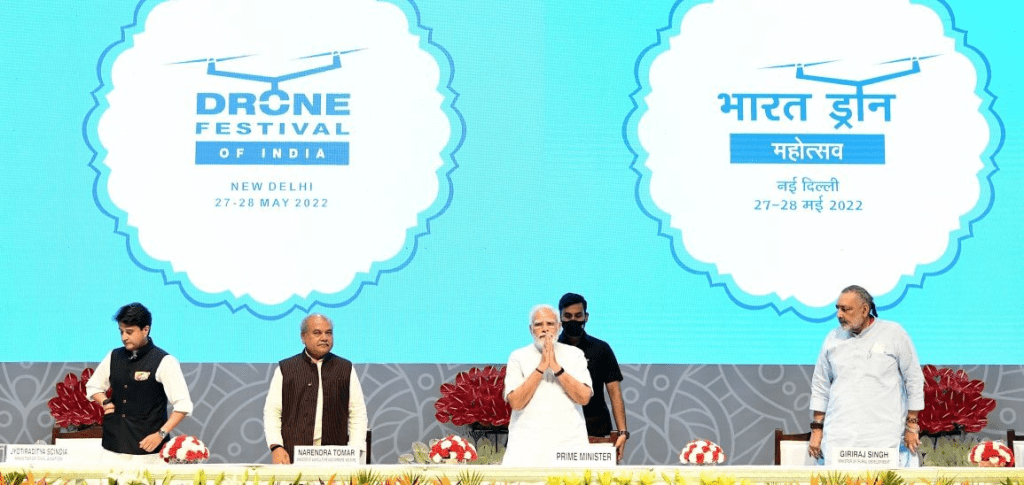
Prime Minister Narendra Modi has said, the quantum jump in the drone industry shows the possibilities of emerging opportunities for employment in India. Inaugurating India’s biggest Drone Festival – Bharat Drone Mahotsav-2022 at Pragati Maidan in New Delhi, Mr Modi said, India has the potential of becoming a global drone hub and this technology will play a crucial role in several sectors ranging from agriculture, defence, disaster management, health and land mapping in the future.
Highlighting the importance of technology, the Prime Minister said, it has ensured last mile delivery and with the help of technology, target of Antyodaya can be achieved. Terming drone technology as an effective tool in delivery of services and improving ease of living, he said, it will take the farming sector to another level and it will ensure the progress of marginalised farmers.
The Prime Minister said, drones will play a crucial role in delivery of medicines and vaccines in the far flung areas of the country. With the help of drone mapping he reviewed the progress of Kedarnath Redevelopment Project, he added.
The Prime Minister said, this Government has reduced the restrictions imposed on drone sector. He said, Production Linked Incentive scheme was introduced for making a robust ecosystem for the drone sector. He urged the investors to come and invest in India’s booming drone sector. He also urged the youth to come forward and set up drone start-ups. On the occasion, Civil Aviation Minister Jyotiraditya Scindia said, India has become a leader in the technology sector in the last eight years.
Social media has become the most predominant platform to interact with people. The reels that we watch in Instagram or YouTube Shorts all are a par of social media.
School students are more active in these types of platforms. One of the most major impacts that social media has had on teenagers today is how we perform in school. It is one of the most distracting activities of everyday life. Recent experiments at UCLA have shown that nucleus accumbency was very active when teenagers saw that they had received a lot of likes on their photos that would influence to further use Instagram more often.
The risks might be related to how much social media teens use. A 2019 study of more than 6,500 12- to 15-year-olds in the U.S. found that those who spent more than three hours a day using social media might be at heightened risk for mental health problems. Another 2019 study of more than 12,000 13- to 16-year-olds in England found that using social media more than three times a day predicted poor mental health and well-being in teens.
Some other major impacts that social media has had on teenagers is peer pressure and cyber bullying. On any social media site, you can send a direct message to anyone that you want without even having to their phone number or having to follow them. This makes it so easy to cyber bully someone. Peer pressure has increased ever since social media has become popular. Teenagers look at pictures/videos of their peers doing illegal things such as drugs, drinking, etc. 55% of teens tried drugs for the first time because they felt pressured by their friends. 70% of teens who smoke say that they started smoking because their friends smoke or they felt peer pressure to try smoking.
HOW TO PROTECT FROM THIS PLATFORM?
Set reasonable limits: Talk to your teen about how to avoid letting social media interfere with his or her activities, sleep, meals or homework. Encourage a bedtime routine that avoids electronic media use, and keep cellphones and tablets out of teens’ bedrooms. Set an example by following these rules yourself.
Monitor your teen’s accounts: Let your teen know that you’ll be regularly checking his or her social media accounts. You might aim to do so once a week or more. Make sure you follow through.
Explain what’s not OK: Discourage your teen from gossiping, spreading rumors, bullying or damaging someone’s reputation — online or otherwise. Talk to your teen about what is appropriate and safe to share on social media.
Encourage face-to-face contact with friends: This is particularly important for teens vulnerable to social anxiety disorder.
Talk about social media: Talk about your own social media habits. Ask your teen how he or she is using social media and how it makes him or her feel. Remind your teen that social media is full of unrealistic images.
The Rajasthan government has come up with the job description under its much-touted Indira Gandhi Shahri Rozgar Guarantee Yojana. Announcing the employment scheme for urban areas on the lines of Mahatma Gandhi NREGA.
While MGNREGA assists people in rural areas, there is no such scheme for street vendors and those working at dhabas and restaurants in urban areas.
About:
Under the scheme, 100 days of employment per year will be provided to families residing in urban areas.
The ratio of cost of material to payment for labour work of “general nature” will be in the ratio of 25:75, while for special works, it will be 75:25.
Eligibility:
All those aged between 18 and 60 years and residing within urban body limits are eligible for the scheme, and in special circumstances such as a pandemic or a calamity, migrant labourers may be included.
Significance of Urban Employment Schemes?
Ensures social inclusion by strengthening the livelihood base of rural poor.
It gives urban residents a statutory right to work and thereby ensures the right to life (Art 21) guaranteed under the Constitution.
It provides employment for skilled and unskilled workers among urban youth and addresses the concerns of underemployment and unemployment.
Such programmes can bring in much-needed public investment in towns, which, in turn, could boost local demand, improve the quality of urban infrastructure and services, restore urban commons, skill urban youth, and increase the capacity of ULBs.
In this I want to analyze the NEP’ 2020 in the simplest way possible.
This is India’s 3rd NEP.
the first one was in 1968 under Indira Gandhi government
the second was in 1986 under Rajiv Gandhi Government
In 1992 under PV Narasimha Rao government the NEP was modified.
the third one is in 2020
The right to education was drafted under Article 21A in which the children between the age group of 6- 14years should get free and compulsory education.
2014 BJO manifesto – The New Education Policy
It was then when Ms. Smriti Irani became HRD minister in 2015, she created a new committee in which the Chairman was TSR Subramanyam. this committee submited the report on 7th my 2016.
The Objectives of the committee is to:
improve the quality of education
Credibility of education
addressing the gaps in education implementation
On october 2016, The Ministry released the drafts and gave suggestions. but nothing happened as per plan.
After this a new committee was formed in which Dr. K. Kasturirangan former chairman of the Indian Space Research Organization, made up a team of 9 members and they drafted the National Education Policy 2019 and this was later approved by The union Cabinet, chaired by Prime Minister Narendra Modi, approved and was passed as The New Education Policy 2020 on July 29, 2020.
3 most important changes in the NEP 2020
Human Resource development(HRD) ministry was renamed as Ministry of Education.
Government proposed that the GDP investment in education to be increased from 1.6% to 6%.
focusing on gross enrollment ratio, it will be increased to 50% by 2035.
everything can be done when there will be a dynamic change happens in this regular educational system. Now, that is what happened in which alongside of education, extra curricular activities, interests were given equal priorities. Also, people tend to have multiple interests in which they want to extend their career opportunities. Till 2019, students have the opportunity to either enter into any one of the field of interests like science, Arts, Commerce.
10 years
age 10-16
2years
age 16-18
old Academic Structure
5years
Anganwadi/pre-school- age (3-6) class 1 and 2 at age (6-8)
3years
class 3-5 at age (6-8)
3years
class 6-8 at age(11-14)
4years
class 9-12 at age (14- 18)
modified/ revised academic structure
Changes in School Education
students to learn coding from class 6
Mother tongue to be a medium of instruction till 5th grade.
Report card will be comprehensive based on skills+ capabilities.
Holistic Undergraduate programme:
flexible curriculum, vocational subjects, Inter- disciplinary combination of subjects- which means till now we have division of backgrounds like commerce, science, arts etc., but from now there will be no division and can choose whatever they want to pursue.
Languages:
offered Sanskrit in every level of education .
other classical languages + literature are also available.
Academic Bank of Credits – which means if a person discontinues or chooses to pursue other background of education, till whatever education or year the person have pursued till that level the academic certification will be provided
Changes for Teachers
NCERT- National Curriculum Framework for Teacher Education, NCFTE 2021 was created with the help of NCERT
By 2030, for teaching the minimum degree qualification/ 4year integrated B.Ed
the entire objective of NEP is, Universalization of Education Achieving Global standards of Education for which, the students who leaves or graduates will get the knowledge at global reaching.
University Grants Commission (UGC) came into existence on 2nd December, 1953. It became a statutory body by an Act of Parliament in 1956, for the coordination, determination and maintenance of standards of teaching, examination and research in university education.
Recently, the UGC has released Academic Collaboration between Indian and Foreign Higher Education Institutions to offer Joint Degree, Dual Degree, and Twinning Programmes Regulations, 2022.
Under these regulations collaborating institutes will be allowed to offer three kinds of programmes — twinning, joint degrees and dual degrees.
Dual Degree Programmes: The approved amendments include a provision for “dualdegree programmes” — both the Indian and foreign institutions will give separate and simultaneous degrees for a course of the same discipline, and at the same level.
Easing Regulation: Indian universities that meet a minimum academic standard will not need UGC’s permission to offer such programmes.
Joint Degrees: Students enrolling for these programmes will have to go abroad to earn credits, but they will not have to seek admission separately while doing so.
In the draft amendments, foreign partner institutions are required to be among the world’s top 1,000 in global rankings.
Dual Degrees: For dual degrees, students will have to complete at least 30% of their course credit at the foreign institution.
The degrees awarded by both the Indian and foreign institutions will indicate the credits earned at the respective institutions.
At the end of the course, the student will be awarded two degrees, separately and simultaneously, by the Indian and foreign institution.
Twinning Arrangement: A student can study a programme partly in India and partly in a foreign university, but the diploma or degree will be awarded just by the Indian university.
Students will have to complete up to 30% of the course’s credits at the foreign institution by means of an exchange programme.
Exception: The new regulations are not applicable to programmes offered online and in the open and distance learning mode.
Significance: The new regulation will prompt Indian students to get a foreign degree and enhance their employability in the international market.
“Be strong, but not rude; Be kind, but not weak; Be bold but not bully.” RIM JOHN
Bullying is the behaviour of a person or majority group who threatens, harms, or insults another person or the minority or weak group. Cyberbullying is a form of bullying that threatens people with the use of electronic devices.
About 20% of students ages 12-18 experienced bullying nationwide. Students ages 12–18 who reported being bullied said they thought those who bullied them: Had the ability to influence other students’ perception of them (56%); Had more social influence (50%); Were physically stronger or larger (40%); Had more money (31%). Nationwide, 19% of students in grades 9–12 report being bullied on school property in the 12 months prior to the survey.
The following percentages of students ages 12-18 had experienced bullying in various places at school:
Hallway or stairwell (43.4%)
Classroom (42.1%)
Cafeteria (26.8%)
Outside on school grounds (21.9%)
Online or text (15.3%)
Bathroom or locker room (12.1%)
Somewhere else in the school building (2.1%)
Approximately 46% of students ages 12-18 who were bullied during the school year notified an adult at school about the bullying.
Among students ages 12-18 who reported being bullied at school during the school year, 15 % were bullied online or by text.
An estimated 14.9% of high school students were electronically bullied in the 12 months prior to the survey.
According to the UNESCO Institute of Statistics: One third of the globe’s youth is bullied; this ranges from as low as 7% in Tajikistan to 74% in Samoa. Low socioeconomic status is a main factor in youth bullying within wealthy countries. Immigrant-born youth in wealthy countries are more likely to be bullied than locally-born youth.
Yes, There is a serious need to have strong legislation on Anti-bullying laws in India. The government of India is taking steps to conquer bullying in schools, colleges, and on the internet.
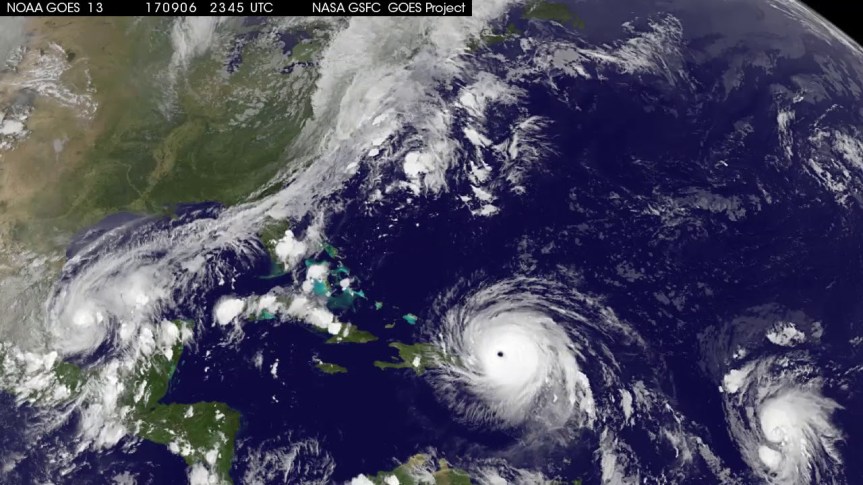
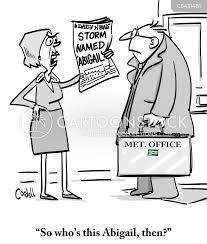
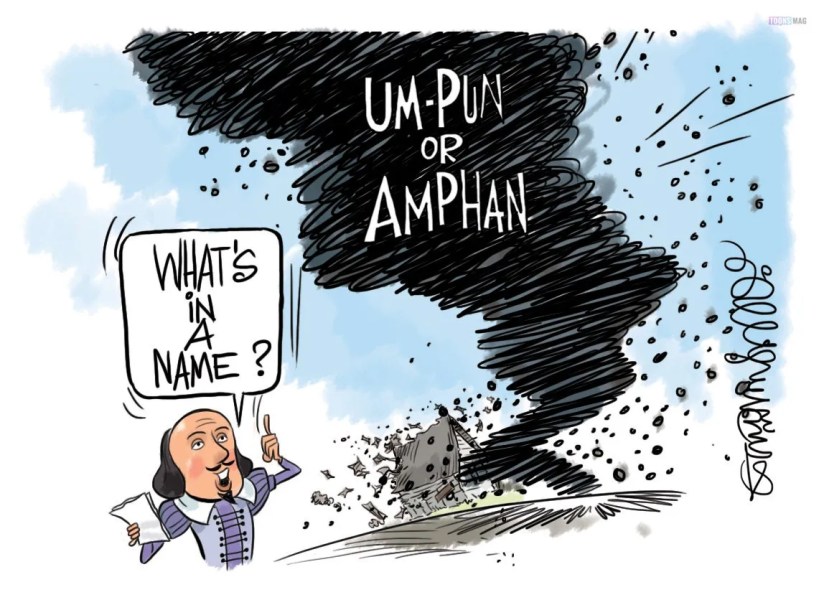
Have you ever wondered how do scientists decides the name for cyclones? Read the whole article to learn it.
Weather forecasters give each tropical cyclone a name to avoid confusion. Each year, tropical cyclones receive names in alphabetical order. Women and men’s names are alternated. The name list is proposed by the National Meteorological and Hydrological Services (NMHSs) of WMO Members of a specific region, and approved by the respective tropical cyclone regional bodies at their annual/bi-annual sessions.
HISTORICAL BACKGROUND
The practice of naming storms (tropical cyclones) began years ago in order to help in the quick identification of storms in warning messages because names are presumed to be far easier to remember than numbers and technical terms. In the beginning, storms were named arbitrarily. An Atlantic storm that ripped off the mast of a boat named Antje became known as Antje’s hurricane. Then the mid-1900’s saw the start of the practice of using feminine names for storms.
In the pursuit of a more organized and efficient naming system, meteorologists later decided to identify storms using names from a list arranged alphabetically. Thus, a storm with a name which begins with A, like Anne, would be the first storm to occur in the year. By the end of the 1900’s, forecasters started using male names for those forming in the Southern Hemisphere.
Since 1953, Atlantic tropical storms have been named from lists originated by the National Hurricane Centre. The original name lists featured only women’s names. In 1979, men’s names were introduced and they alternate with the women’s names.
Six lists are used in rotation. Thus, the 2019 list will be used again in 2025.The names of tropical cyclones over the north Indian Ocean is however not repeated.Once used, it will cease to be used again.
Why are cyclones given a name ?
Naming of Tropical Cyclones (TCs) helps the scientific community, disaster managers, media and general masses to
identify each individual cyclone.
use of short, distinctive given names in written as well as spoken communications is quicker and less subject to error than the older more cumbersome latitude-longitude identification methods.
create awareness of its development.
remove confusion in case of simultaneous occurrence of TCs over a region
rapidly and effectively disseminate warnings to much wider audience
These advantages are especially important in exchanging detailed storm information between hundreds of widely scattered stations, coastal bases, and ships at sea.
Criteria for name selection
The proposed name should be neutral to (a) politics and political figures (b) religious believes, (c) cultures and (d) gender
Name should be chosen in such a way that it does not hurt the sentiments of any group of population over the globe
It should not be very rude and cruel in nature
It should be short, easy to pronounce and should not be offensive to any member
The maximum length of the name will be eight letters
The proposed name should be provided along with its pronunciation and voice over
Protocol to Select a name for a cyclone
For north Indian Ocean including Bay of Bengal and Arabian Sea, the RSMC, New Delhi assigns the name to tropical cyclones following a standard procedure.
The naming of the tropical cyclones over the north Indian Ocean commenced from September 2004. This list contained names proposed by then eight member countries of WMO/ESCAP PTC, viz., Bangladesh, India, Maldives, Myanmar, Oman, Pakistan, Sri Lanka and Thailand. A new list containing 169 names has been made available in 2020.
Source : Regional Specialised Meteorological Centre, New Delhi and World Meteorological Organisation
What everyone see is just a round, not round exactly but a GEOID shaped ball. Seeing the Earth as a ball and imagining it in the size of football which we all see in our science lab.
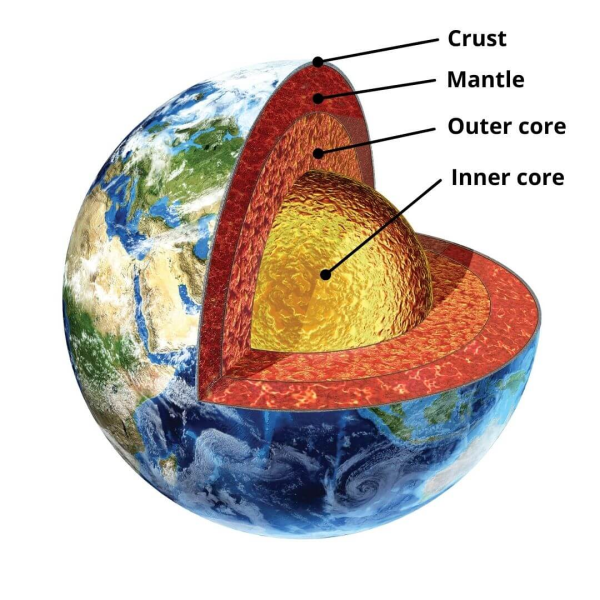
This is the 0% we know about our planet Earth. There is more to this than people just know. It’s like the rainbow flavored cake. when you see the outer part of the cake you tend to see the decoration and the whipping cream. but, when you cut it you the see the colorful layers of the cake. Earth is also the same. When you deep dig it you get to see different concentric layers which we call them as:
Crust
Mantle
Core – inner core, outer core
layers of Earths interior
Like all terrestrial planets, the Earth’s interior is differentiated. This means that its internal structure consists of layers, arranged like the skin of an onion. Peel back one, and you find another, distinguished from the last by its chemical and geological properties, as well as vast differences in temperature and pressure.
Most of the ancient theories about Earth tended towards the “Flat-Earth” view of our planet’s physical form. This was the view in Mesopotamian culture, where the world was portrayed as a flat disk afloat in an ocean. To the Mayans, the world was flat, and at it corners, four jaguars held up the sky. The ancient Persians speculated that the Earth was a seven-layered ziggurat (or cosmic mountain), while the Chinese viewed it as a four-side cube.
By the 6th century BCE, Greek philosophers began to speculate that the Earth was in fact round, and by the 3rd century BCE, the idea of a spherical Earth began to become articulated as a scientific matter.
CORE :
The inner core:- radius of 1,220 kilometers (758 miles), or about three-quarters that of the moon.
located some 6,400 to 5,180 kilometers (4,000 to 3,220 miles) beneath Earth’s surface
Made of Iron and Nickel(solid form). Intensely hot and the Temperature sizzles at 5,400° Celsius (9,800° Fahrenheit).
The outer core:- radius stands at about 5,180 to 2,880 kilometers (3,220 to 1,790 miles) below the surface.
Heated largely by the radioactive decay of the elements like uranium and thorium.
The outer core is not under enough pressure to be solid, so it is liquid even though it has a composition similar to the inner core.
2. MANTLE
Upper mantle: It is the Earths thickest layer. Spreads across 84% of Earth’s volume
The upper mantle, which starts at the “Mohorovicic Discontinuity”- the base of the crust extends from a depth of 7 to 35 km downwards to a depth of 410 km.
lower Mantle: The lower mantle lies between 660-2,891 km
Very little is known about the lower mantle apart from that it appears to be relatively seismically homogeneous.
3. CRUST
The crust is made of relatively light elements, especially silica, aluminum and oxygen.
Earth’s crust is like the shell of a hard-boiled egg. It is extremely thin, cold and brittle compared to what lies below it
The thickness of the crust varies in the range of range of 5-30 km in case of the oceanic crust and as 50-70 km in case of the continental crust.
Along with the upper zone of the mantle, the crust is broken into big pieces, like a gigantic jigsaw puzzle. These are known as tectonic plates. These move slowly — at just 3 to 5 centimeters (1.2 to 2 inches) per year.
The continents are composed of lighter silicates — silica + aluminium (also called sial) while the oceans have the heavier silicates — silica + magnesium (also called sima)
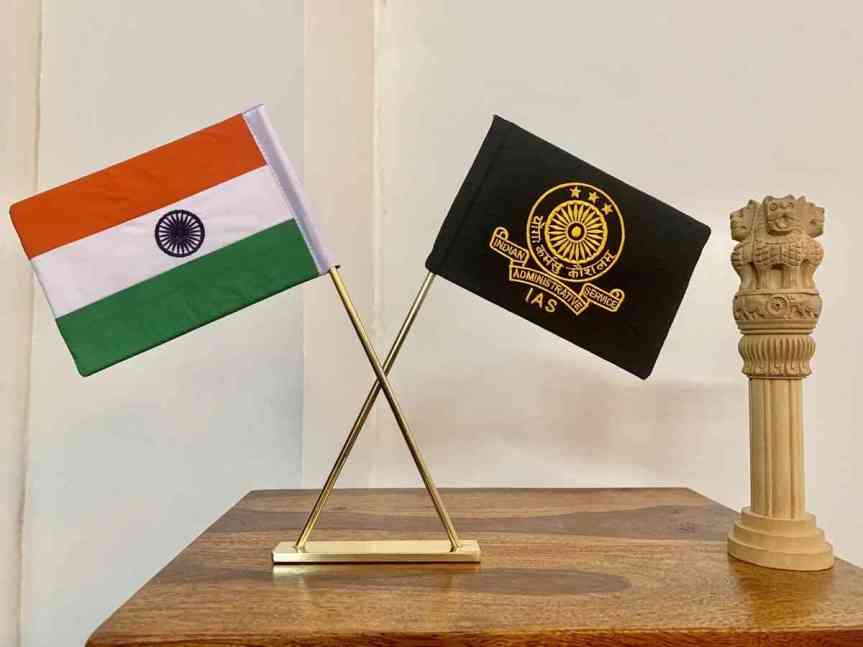
Indian Administrative Service (IAS), the premier service of the Government of India was constituted in 1946. Prior to that Indian imperial Service (1893-1946) was in force. As on 1.1.2013, sanctioned strength of IAS was 6217, comprising of 4313 posts to the filled by direct recruits and 1904 posts to be filled by promotion /appointment of State Civil Services officers/ Non-State Civil Service officers. The civil services have been a hallmark of governance in India. The Constitution provides that without depriving the States of their right to form their own Civil Services, there shall be an All India service recruited on an All- India basis with common qualifications, with uniform scale of pay and the members of which alone could be appointed to these strategic posts throughout the Union.” No wonder Sardar Vallabhbhai Patel, one of the eminent leaders of the freedom struggle, referred to the. ICS as ‘the steel frame. Of the ‘country. The civil services, therefore, represent the essential spirit of our nation — unity in diversity.
Recruitment
UPSC – Civil Services Exam
At present there are three modes of recruitment to IAS viz
(i) Through Civil Services Examination conducted by UPSC every year;
(ii) Through promotion of State Civil Service officers to IAS
(iii) Through selection of non – State Civil Service officers.
Roughly 66 (1/3)% posts are meant for Direct Recruitment and 33 (1/3%) are meant for promotion quota.
Training
LBSNAA
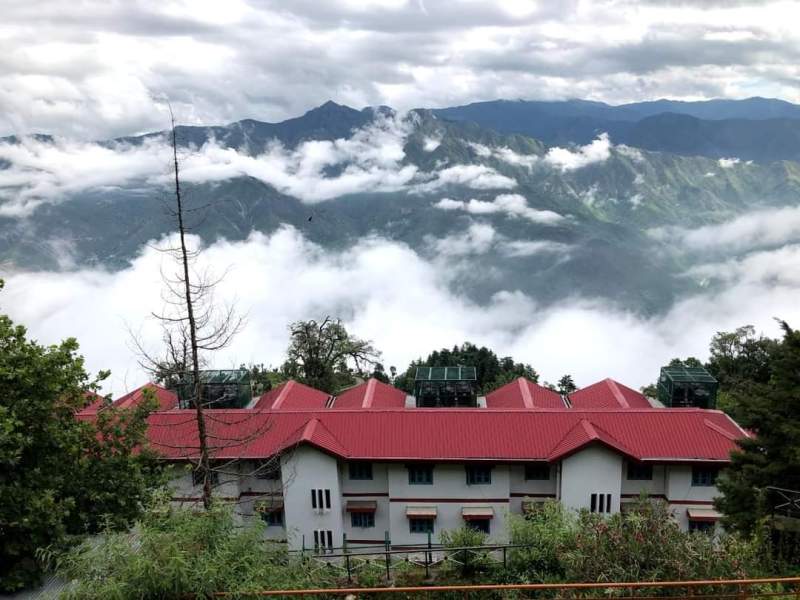
Both Direct Recruit as well as promotee IAS officers are imparted probationary training at Lal Bahadur Shastri National Academy of Administration (LBSNAA). After completion of successful probation, they are confirmed. Also, there is a Provision for mandatory Mid-career Training for IAS officers spread across the entire service span.
Functions of IAS officer
IAS officer is responsible for the maintenance of law and order, revenue administration and general administration in the area under him. His functions broadly include:
(i) Collection of revenue and function as Courts in revenue matters; (ii) Maintenance of law and order; (iii) Function as Executive Magistrate; (iv) Function as Chief Development Officer (CDO)/District Development Commissioner; (v) Supervision of implementation of policies of State Government and Central Government; (vi) To travel to places to oversee the implementation of policies; (vii) Supervision of expenditure of public funds as per norms of financial propriety; (viii) In the process of policy formulation and decision making, IAS officers at various levels like Joint Secretary, Deputy Secretary etc. make their “contributions and the give final shape to policies; (ix) To ‘handle the daily affairs ‘of the government, including framing and implementation of policy in ‘consultation with the minister-in-charge of the concerned Ministry.
Nowadays, NFT’s are in trend. You must be hearing the word ‘NFT’ on social medias, newspapers, news channels and various other sources. But what exactly is an ‘NFT’?
Today, we’ll discuss about NFT’s and understand what they exactly are and what’s going on around them that has created a great hype among the people.
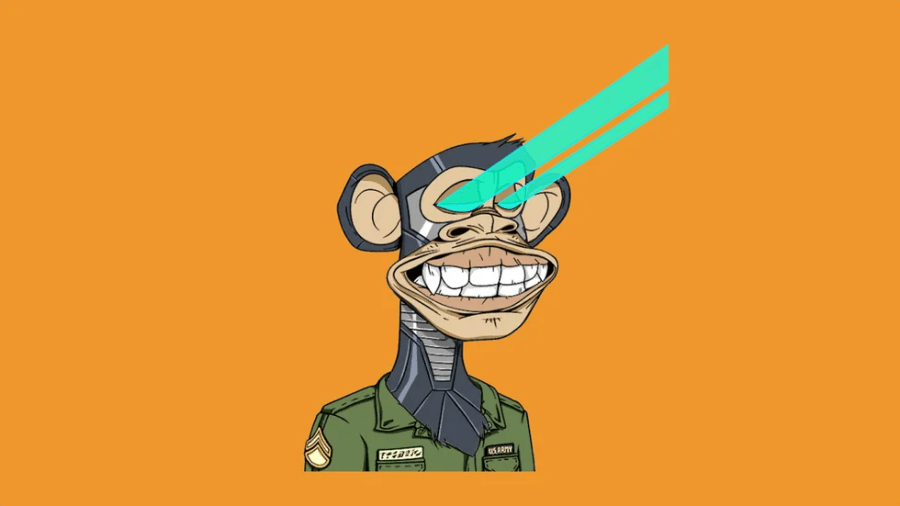
Example of an NFT(Source- Google Images)
The term “NFT” stands for Non-Fungible Tokens. In layman language, NFT is a possession which is unique and one of its kind. If we go deep into the concept of NFT’s then basically they are digital assets that one possess. Each NFT has a specific identification code that distinguishes it from the other.
A NFT works upon the blockchain technology which is the same that is used in cryptocurrencies. It can be sold and traded on various online platforms like Binance NFT Marketplace, crypto.com, WazirX NFT Marketplace etc.
A NFT can be literally anything( manual drawings, graphics, art, animations, music, even real estate). Most of the NFT’s are based upon the cryptocurrency Ethereum(ETH). So now after reading all this, you might be getting an idea about what exactly an NFT is but here comes the main question that “WHY NFT?” So to answer this question, let’s take a simple example. Suppose you have a book and you customized the book with a cover of your own and bordered the pages using tapes. So now, it is one of its kind. And now, if you want to sell that book to a buyer for example at Rs. 500 and if the buyer wants to own the book then there has to be a way to prove that he/she owns it. We considered a physical book as an example but what if it’s an image or a video or a music file that is unique and only one of it’s kind. Then, how do you prove the ownership of that one unique piece? This is done by creating an NFT. That is how NFT’s work.
They are a legitimate way to transfer the ownership of a digital item in such a way that your ownership remains on record and is proven. It cannot be edited or modified. If we consider an image(of a monkey let’s say) then you can find numerous images all over the internet that are openly accessible for downloading and using without any copyright issues. And on the other hand, if I create an image and post it online then there is no legit way to prove that I’m the owner of that thing. Also if I list it for sale online on multiple image selling platforms, then too there is no legitimate proof that I’m the owner and I’m ready to transfer the ownership to someone, whosoever is ready to pay me for my work.
I’d rather create an NFT of the same image and then post it online on certified NFT Marketplaces for sale. This will ensure the ownership of the NFT and also prove it’s uniqueness. If anyone tries to copy my work then I can easily claim a copyright by showing that I’m the valid owner of this NFT.
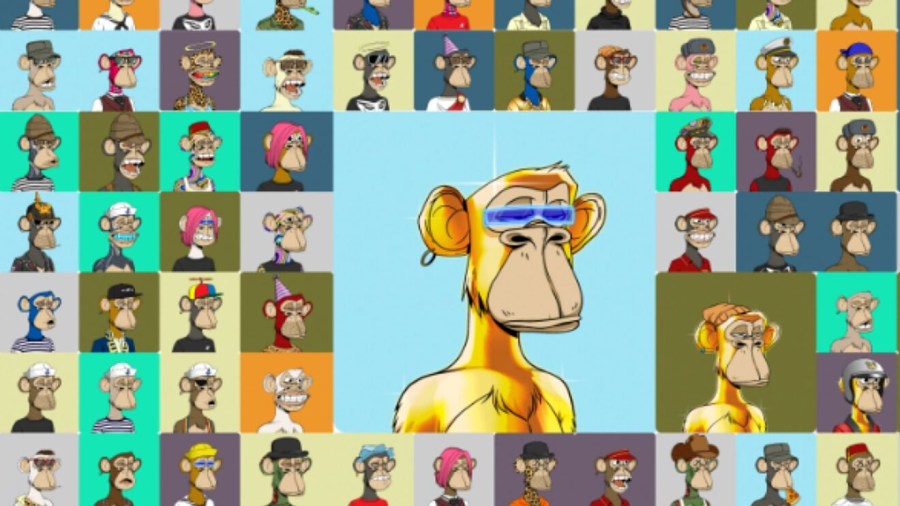
Bored Ape NFT’s
The above is an image of the collection of the famous “Bored Ape NFTs”. These NFT’s are very expensive and some of the owners of these NFT’s are celebrities like Eminem, Serena Williams, Shaquille O’Neal, Justin Bieber etc.
At last, we come to a conclusion that NFTs are the real game changer and blockchain technology is going to change the entire world because now technology has a way by which you can define ‘Ownership’. In the coming years, NFT Marketplace is going to boom and investors seeking towards investing on NFT’s can definitely consider investing by doing the required research before exploring the NFT Marketplace.
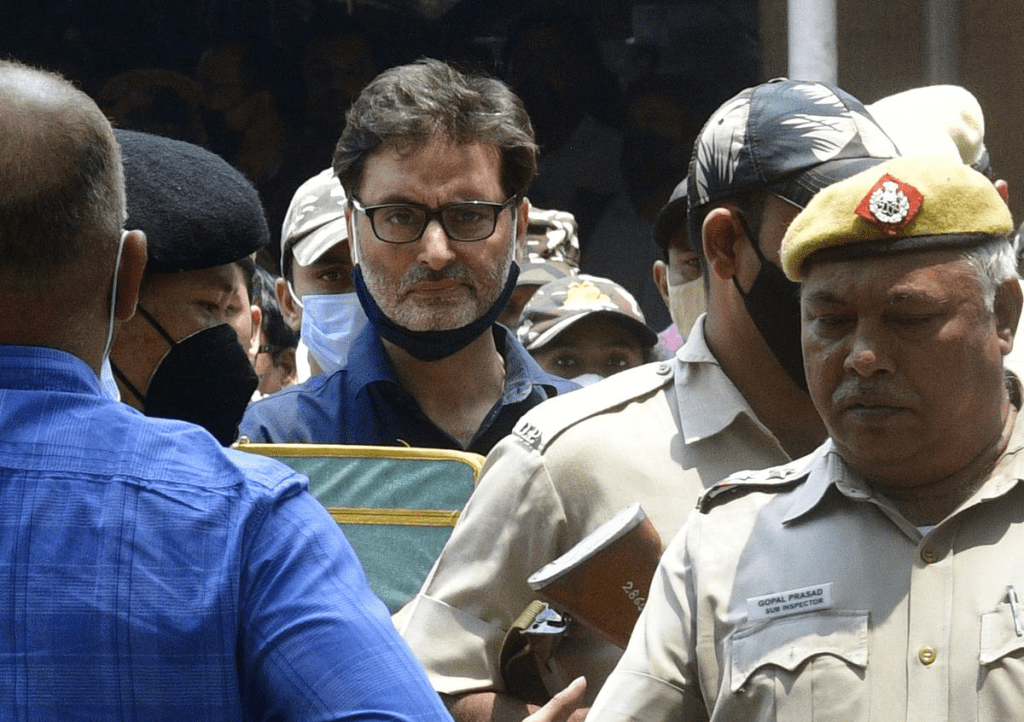
The National Investigation Agency (NIA) had sought death penalty before the Delhi court for Malik, who had earlier pleaded guilty to all the charges, including those under the stringent Unlawful Activities Prevention Act (UAPA).
KLF Leader Yasin Malik being produced amid heavy security at the Patiala House Courts in New Delhi on Wednesday.
During the entire period of before Independence, India was either ruled by kings or else by the Britishers. There will definitely be some questions regarding the ruling of kings like, when? who? how? why?
In ancient India, one animal was treated as both god and weapon, for one king these beasts were the shock troops of an army and is organized as before or since. Riding a juggernaut these soldiers carved out one of the largest empires in history.
The Mauryan Dynasty
“THE MAURYANS”- The warriors of Elephant
In the war for India a great army of soldiers and Elephants has proven unstoppable. But in the year 260BC they faced their worst enemy. no matter what, Victory lies first in reaching the battlefield intact a battle all its own. The outcome will decide the fate of a kingdom.
The Mauryan Empire was a geographically extensive Iron age Historical power based in Magadha, Ancient India. It was founded in 322BCE by its king ChandraGupta Maurya. This empire was the largest to have ever existed in the Indian subcontinent expanding over 5million square kilometers at its zenith under Ashoka- The great
The capital of Mauryan Empire was Pataliputra which is recent times is called as Patna
History of Mauryan Empire
The foundation of Mauryan empire is ruled for 137years, and was a unique incident in Indian history, given the fact that it was founded shortly after the death of Alexander- The great who led many victorious campaigns in North-West India during 327BC- 325BC
The founding of the Dynasty
Was founded by ChandraGupta Maurya with the advice of his counsellor Chanakya by over throwing the Nanda Dynasty and built one of the largest empires ever on the aindian Subcontinent.
Conquest of Magadha: Historians believed that it was Chanakya or popularly known as Kautilya who provoked ChandraGupta to take over Magadha throne.
Apart from all the controversies that it was the Chanakyas doing out of grudge against nanda dynasty, it was Mauryan empire and ChandraGupta Maurya as the main person to create one of the worlds largest empires in the World and in Indian subcontinent.
ChandraGupta Maurya (321-297 BC)
The classical greek writers described Chandragupta as a man of humble origin
he was born orphaned and abandoned and is raised as a son by another Pastoral family was recognized and taught by Chanakya- The author of Arthashastra
ChandraGupta left everything and became a Jain monk
His reign was well recognized as “Economic prosperity”, reforms and expansion of Infrastructure like irrigation, roads and mines.
Religions like Buddhism, Jainism and Ajivika gained prominence along with Brahmanism
Bindhusara(297-272BC)
He was 22years old when his father ChandraGupta Maurya stepped out of the throne.
He extended the empire which he inherited from his father to South India which is now known as Karnataka
He maintained friendly relations with the Hellenic west and brought 16new states under Mauryan empire
He, almost conquered the entire Indian peninsula and is populary known as the king who conquered the Land between 2 seas.
His reign lasted for 28years and he died in 270BCE.
Ashoka- The great(268-232BC)
The throne was succeeded by Bindusara son- Ashoka-The great.
As a young prince Ashoka was a magnificent commander who crushed revolts in Ujjainand Thakshasila and was given charges of the viceroyship of Ujjain.
He was aggressive and ambitious monarch who re-asserted the empires superiority in southern and western parts of India
the pivotal event of his life came when he conquered Kalinga in 261BCE and this became a part of Mauryan empire.
He died in 232BCE. His death divided the empire into western and eastern halves and 50years of succession of weaker kings
Ashoka’s first son- Mahendra went on to spread Buddhism across the world. His other son Kunal Maurya was blind and didn’t get a chance to ascend the throne.
slowly, the mauryans started loosing their territories and in 180BCE, the last kind Brihadratha was killed by his general Pushyamitra shunga in a military parade, which gave rise or birth to Shunga empire.
The Dutch are the people of Holland (now the Netherlands). The Dutch arrived in India shortly after the Portuguese. The Dutch have long been experts in sea trading. The Dutch government granted the United East India Company of the Netherlands license to trade in the East Indies, including India, in 1602. Dutch India was more of a geographical location than a political authority. In comparison to the Portuguese and the English, the Dutch had the shortest presence in India of all the European colonial powers.
Dutch history in India The Dutch East India Company was founded in 1602 and signified the Dutch entrance in India. They arrived in Andhra Pradesh’s Masulipatam (now Machilipatnam). From 1605 to 1825, they occupied the Indian subcontinent. Given the growing demand for Indian spices from Asia in Europe, the Dutch arrived to India with the intention of trading. The establishment of the Dutch East India Company marked the beginning of the modern multinational company (MNC). Following a pact between the Zamorin of Calicut and the Dutch chief, Steven Van der Hagen, Dutch trading in India began on November 11, 1604. The goal was to force the Portuguese off the Malabar Coast, but this was never achieved. The Dutch, on the other hand, soon built commercial facilities in various parts of India and traded cotton, textiles, silk, Indigo, and Golconda diamonds. In 1661, the Dutch conquered the Portuguese and took control of all of Malabar. They had now mastered the pepper trade and made tremendous profits selling pepper, which was known in Europe as “Black Gold.” In the 17th century, nothing could stop the Dutch from capturing Pondicherry from the French in 1693. In the East Indies, the Dutch became a large producer of sugar and coffee, as well as a big exporter of spices and textiles. During their time in India, the Dutch tried their hand at currency manufacture as well. They established mints in Cochin, Masulipatam, Nagapatam Pondicherry, and Pulicat as their trade grew. Furthermore, the Pulicat mint issued a gold pagoda with an image of Lord Venkateswara (god Vishnu). The Dutch minted coins that were all based on local coinages.
The Decline of Dutch power The Dutch East India Company began to fade in the mid-eighteenth century. It was characterised by poor corporate practices, corruption, and political upheaval. Martanda Verma, the formidable monarch of Travancore, defeated the Dutch in 1741 and reclaimed control of Malabar. The fourth Anglo-Dutch war, in which the British navy sunk Dutch ships and seized trading ports, resulted to their bankruptcy in 1799. Finally, the Anglo-Dutch Treaty of 1825 ended the Dutch dominance in India by transferring all Dutch assets to the British.
The Dutch are the people of Holland (now the Netherlands). The Dutch arrived in India shortly after the Portuguese. The Dutch have long been experts in sea trading. The Dutch government granted the United East India Company of the Netherlands license to trade in the East Indies, including India, in 1602. Dutch India was more of a geographical location than a political authority. In comparison to the Portuguese and the English, the Dutch had the shortest presence in India of all the European colonial powers.
Dutch history in India The Dutch East India Company was founded in 1602 and signified the Dutch entrance in India. They arrived in Andhra Pradesh’s Masulipatam (now Machilipatnam). From 1605 to 1825, they occupied the Indian subcontinent. Given the growing demand for Indian spices from Asia in Europe, the Dutch arrived to India with the intention of trading. The establishment of the Dutch East India Company marked the beginning of the modern multinational company (MNC). Following a pact between the Zamorin of Calicut and the Dutch chief, Steven Van der Hagen, Dutch trading in India began on November 11, 1604. The goal was to force the Portuguese off the Malabar Coast, but this was never achieved. The Dutch, on the other hand, soon built commercial facilities in various parts of India and traded cotton, textiles, silk, Indigo, and Golconda diamonds. In 1661, the Dutch conquered the Portuguese and took control of all of Malabar. They had now mastered the pepper trade and made tremendous profits selling pepper, which was known in Europe as “Black Gold.” In the 17th century, nothing could stop the Dutch from capturing Pondicherry from the French in 1693. In the East Indies, the Dutch became a large producer of sugar and coffee, as well as a big exporter of spices and textiles. During their time in India, the Dutch tried their hand at currency manufacture as well. They established mints in Cochin, Masulipatam, Nagapatam Pondicherry, and Pulicat as their trade grew. Furthermore, the Pulicat mint issued a gold pagoda with an image of Lord Venkateswara (god Vishnu). The Dutch minted coins that were all based on local coinages.
The Decline of Dutch power The Dutch East India Company began to fade in the mid-eighteenth century. It was characterised by poor corporate practices, corruption, and political upheaval. Martanda Verma, the formidable monarch of Travancore, defeated the Dutch in 1741 and reclaimed control of Malabar. The fourth Anglo-Dutch war, in which the British navy sunk Dutch ships and seized trading ports, resulted to their bankruptcy in 1799. Finally, the Anglo-Dutch Treaty of 1825 ended the Dutch dominance in India by transferring all Dutch assets to the British.














 Eduindex
You must be logged in to post a comment.