



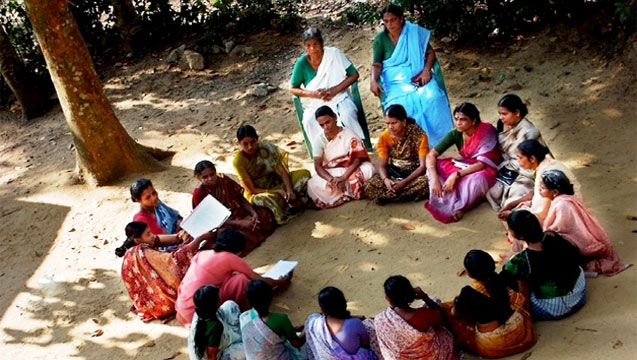
Kudumbashree, a community organization of Neighbourhood Groups (NHGs) of women in Kerala, has been recognized as an effective strategy for the empowerment of women in rural as well as urban areas: bringing women together from all spheres of life to fight for their rights or for empowerment. The overall empowerment of women is closely linked to economic empowerment. Women through these NHGs work on a range of issues such as health, nutrition, agriculture, etc. besides income generation activities and seeking micro credit.
Kudumbashree differs from conventional programs in that it perceives poverty not just as the deprivation of money, but also as the deprivation of basic rights. The poor need to find a collective voice to help claim these rights. Kudumbashree was conceived as a joint program of the Government of Kerala and NABARD implemented through Community Development Societies (CDSs) of Poor Women, serving as the community wing of Local Governments. Kudumbashree is formally registered as the “State Poverty Eradication Mission” (SPEM), a society registered under the Travancore Kochi Literary, Scientific and Charitable Societies Act 1955. It has a governing body chaired by the State Minister of LSG. There is a state mission with a field officer in each district. This official structure supports and facilitates the activities of the community network across the state.
KUDUMBASHREE MICROFINANCE
This system operates by encouraging women to form small homogenous groups under the SHG-bank linkage program. The members of these minute groups were encouraged to meet frequently and amass minute thrift amounts from their members. They were also taught simple accounting methods to enable them to maintain their accounts. Individually these poor could never have had enough savings to open a bank account. The first step in establishing links with the formal banking system opened up when the pooled savings enabled them to open a formal bank account in the denomination of the group. These were followed by frequent group meetings. Pooled thrift was utilized to impart lean loans to members for meeting their diminutive emergent needs saving them from debt traps/ money lenders who demanded unusually high rates of interest and accelerated their empowerment through group dynamics, decision-making, and funds management. Peer- screening effect was engendered as borrowers themselves undertook the task of credit evaluation and reduced the transaction costs, community members had much more preponderant information than banks. Peer monitoring effect induced group members to utilize their imprests in productive ways. The desire to preserve valuable ties induced borrowers to spend extra effort if compulsory to secure timely payments. These ties were valuable because they sanctioned members’ borrowing and provided business connections. Moreover, a very consequential feature of group-lending was the collateral effect. Gradually the pooled thrift grew and soon 11 they were adept in receiving external funds in multiples of their group savings. Bank loans enabled the group members to undertake income- generating ventures.
The various microfinance activities taken up by Kudumbashree are:
Thrift and credit operations
NHGs are instrumental in thrift mobilization, encouraging the poor to save and to avail low -cost formal credit. They facilitate easy and timely credit to the unreached. The amount of loan to members and the purpose for which the loan should be utilized are decided by the NHG. The repayment is collected weekly during the NHG meetings. It is estimated that the thrift mobilized is on an average Rs 40 per month per member.
Linkage Banking.
NHG-Bank linkage scheme is one of the flagship programmes of Kudumbashree. NABARD SHG-Bank linkage grading procedures are applied while selecting eligible NHGs for availing loan. The NHGs are rated on the basis of a 15 -point index developed by NABARD. Bank will provide loans to those NHGs who pass 80 % of marks in the grading.
Matching Grant.
Matching grant is an incentive provided to NHGs. This grant linked to amount of thrift mobilized, performance of NHG in the Grading and loan availed from banks. An amount of 10% of the savings of the NHG subject to a maximum of Rs 5000/- is provided as matching grant to each NHG. The grant is released based on their assessment rated using 15-point grading criteria developed by NABARD.
Interest Subsidy for Linkage loan.
Govt of Kerala has introduced a new interest subvention scheme to promote Bank Linkage Program among Kudumbashree Neighborhood Groups. Under this scheme all Kudumbashree NHGs are eligible for interest subvention to avail the loan facility at an interest rate of 4% on credit up to Rs. 3 lakhs. The interest subsidy would be provided as annual instalments to the NHGs.
KAASS.
KAASS, the Kudumbashree Accounts & Audit Service Society; is a homegrown enterprise to ensure proper account keeping in the community network. Each district has been furnished with a KAASS team that has been 12 drawn from commerce graduates and is guided by professional chartered accountants
Digitization of MIS’ and repayment Info System (E- SHAKTI)
Keeping in view the Government of India’s mission for creating a digital India, NABARD has launched a project for digitization of all Self -Help Group (SHG) in the country.
Kudumbashree, a community organization of Neighbourhood Groups (NHGs) of women in Kerala, has been recognized as an effective strategy for the empowerment of women in rural as well as urban areas: bringing women together from all spheres of life to fight for their rights or for empowerment. The overall empowerment of women is closely linked to economic empowerment. Women through these NHGs work on a range of issues such as health, nutrition, agriculture, etc. besides income generation activities and seeking micro credit.
Kudumbashree differs from conventional programs in that it perceives poverty not just as the deprivation of money, but also as the deprivation of basic rights. The poor need to find a collective voice to help claim these rights. Kudumbashree was conceived as a joint program of the Government of Kerala and NABARD implemented through Community Development Societies (CDSs) of Poor Women, serving as the community wing of Local Governments. Kudumbashree is formally registered as the “State Poverty Eradication Mission” (SPEM), a society registered under the Travancore Kochi Literary, Scientific and Charitable Societies Act 1955. It has a governing body chaired by the State Minister of LSG. There is a state mission with a field officer in each district. This official structure supports and facilitates the activities of the community network across the state.
KUDUMBASHREE MICROFINANCE
This system operates by encouraging women to form small homogenous groups under the SHG-bank linkage program. The members of these minute groups were encouraged to meet frequently and amass minute thrift amounts from their members. They were also taught simple accounting methods to enable them to maintain their accounts. Individually these poor could never have had enough savings to open a bank account. The first step in establishing links with the formal banking system opened up when the pooled savings enabled them to open a formal bank account in the denomination of the group. These were followed by frequent group meetings. Pooled thrift was utilized to impart lean loans to members for meeting their diminutive emergent needs saving them from debt traps/ money lenders who demanded unusually high rates of interest and accelerated their empowerment through group dynamics, decision-making, and funds management. Peer- screening effect was engendered as borrowers themselves undertook the task of credit evaluation and reduced the transaction costs, community members had much more preponderant information than banks. Peer monitoring effect induced group members to utilize their imprests in productive ways. The desire to preserve valuable ties induced borrowers to spend extra effort if compulsory to secure timely payments. These ties were valuable because they sanctioned members’ borrowing and provided business connections. Moreover, a very consequential feature of group-lending was the collateral effect. Gradually the pooled thrift grew and soon 11 they were adept in receiving external funds in multiples of their group savings. Bank loans enabled the group members to undertake income- generating ventures.
The various microfinance activities taken up by Kudumbashree are:
Thrift and credit operations
NHGs are instrumental in thrift mobilization, encouraging the poor to save and to avail low -cost formal credit. They facilitate easy and timely credit to the unreached. The amount of loan to members and the purpose for which the loan should be utilized are decided by the NHG. The repayment is collected weekly during the NHG meetings. It is estimated that the thrift mobilized is on an average Rs 40 per month per member.
Linkage Banking.
NHG-Bank linkage scheme is one of the flagship programmes of Kudumbashree. NABARD SHG-Bank linkage grading procedures are applied while selecting eligible NHGs for availing loan. The NHGs are rated on the basis of a 15 -point index developed by NABARD. Bank will provide loans to those NHGs who pass 80 % of marks in the grading.
Matching Grant.
Matching grant is an incentive provided to NHGs. This grant linked to amount of thrift mobilized, performance of NHG in the Grading and loan availed from banks. An amount of 10% of the savings of the NHG subject to a maximum of Rs 5000/- is provided as matching grant to each NHG. The grant is released based on their assessment rated using 15-point grading criteria developed by NABARD.
Interest Subsidy for Linkage loan.
Govt of Kerala has introduced a new interest subvention scheme to promote Bank Linkage Program among Kudumbashree Neighborhood Groups. Under this scheme all Kudumbashree NHGs are eligible for interest subvention to avail the loan facility at an interest rate of 4% on credit up to Rs. 3 lakhs. The interest subsidy would be provided as annual instalments to the NHGs.
KAASS.
KAASS, the Kudumbashree Accounts & Audit Service Society; is a homegrown enterprise to ensure proper account keeping in the community network. Each district has been furnished with a KAASS team that has been 12 drawn from commerce graduates and is guided by professional chartered accountants
Digitization of MIS’ and repayment Info System (E- SHAKTI)
Keeping in view the Government of India’s mission for creating a digital India, NABARD has launched a project for digitization of all Self -Help Group (SHG) in the country.
The budget is a vital, principle tool of Financial administration and is most powerful instrument of legislative control. Budget has mentioned important aspects as larger number of Policy questions in the course of making fiscal outputs. The term budget refers to the Financial papers. It has develop in middle ages, which has a feature of Absolute English regime as well as Europe.
The budget was a statement of revenue and expenditure and regarded as business affairs of the king and the state. Revenue was derived from king’s domains. At this time, all governmental expenditure were not subjected to parliamentary control. Full legislative control of main string of the century. Thus, the conception of the budget as the central tool of financial direction and control on monetary standards.
The budget system is the basis of efficient fiscal management. According to W F Willoughby, the real significance of budget system lies in providing for the orderly administration of the Financial affairs of a government. Fiscal management consists continuous chain of operations such as estimates of revenue and expenditure, revenue and appropriation acts, accounts audit and report.
The Public Account Committee states the object of budgeting in the form of “The budgeting is designed to provide for parliamentary control, for Administrative account that the expenditure incurred by the government is in the specific manner by specific authority.
Objectives of Budget
• To structure delegation of operations as well as financial authority and responsiblity, by providing the basis for central control
• To conduct regular periodic reconsideration or revaluation of government purpose and objectives.
• To provide the framework of public account and fiscal accountability.
• To provide the legal basis for the expenditure of Public funds.
• To facilitate a comparative evaluation of different purposes and programmers in relation to each other and their relative cost.
Functions of Budget
The function of government budgeting is to administer the National finance in organized manner. No haphazard and unplanned expenditure and revenue. Financial operations of the government are to be properly planned and implemented through budgeting.
Functions as instrument of execution of the economic Policy of the government. An approved budget gives the administrator, a zest of the financial environment within which has to work out. During budget, the budget supplies data for decision making and acts as a guide to various departments heads for what they have to do. Budget is an instrument to make elected legislators accountable to the people and to the democratic system. It also secure the economic, social and cultural rights of people.
The also Important as review of the past accomplishment contains the figures of the previous financial years. In order to manage or set budgetary expectations reviewed by previous budget. Budget helps in knowing where Public money has been spent in favour of law and how far objectives has achieved.
Fundamentals of Budget
Significance of Budget
The goal of Administration is to attain economy and efficiency and budget plays important role in financial administration. It promotes rational planning effective Policy making and sound Decision Making to give strong foundation for attaining political and social objectives. The budget can help to promote policies and help in redefining the policy structure. Financial allocation of budget identified in physical outputs. Good Budget consider all aspects for financial and economic policies.
Organising the staffing require for creation of budget, all financial department to be included in the budget. To make administration effective need to apply overlapping. Direction with several departments and linkage of communication can strengthen the system. Coordination ensure the avoid of duplication and wastage and increase the effectiveness of implementation of Financial policies.
Reporting budget on widely discussed newspapers and journals for the information to Public for constructing their own opinions. Budget can supplement the efforts of government in supporting the policies for all section of Society. Modern technology helps connect with innovative changes in the areas of leadership, communication, decision making, democratisation of the organization. Above it, it makes possible to introduce and expedite the use of information technology in Financial administration.
The budget is a vital, principle tool of Financial administration and is most powerful instrument of legislative control. Budget has mentioned important aspects as larger number of Policy questions in the course of making fiscal outputs. The term budget refers to the Financial papers. It has develop in middle ages, which has a feature of Absolute English regime as well as Europe.
The budget was a statement of revenue and expenditure and regarded as business affairs of the king and the state. Revenue was derived from king’s domains. At this time, all governmental expenditure were not subjected to parliamentary control. Full legislative control of main string of the century. Thus, the conception of the budget as the central tool of financial direction and control on monetary standards.
The budget system is the basis of efficient fiscal management. According to W F Willoughby, the real significance of budget system lies in providing for the orderly administration of the Financial affairs of a government. Fiscal management consists continuous chain of operations such as estimates of revenue and expenditure, revenue and appropriation acts, accounts audit and report.
The Public Account Committee states the object of budgeting in the form of “The budgeting is designed to provide for parliamentary control, for Administrative account that the expenditure incurred by the government is in the specific manner by specific authority.
Objectives of Budget
• To structure delegation of operations as well as financial authority and responsiblity, by providing the basis for central control
• To conduct regular periodic reconsideration or revaluation of government purpose and objectives.
• To provide the framework of public account and fiscal accountability.
• To provide the legal basis for the expenditure of Public funds.
• To facilitate a comparative evaluation of different purposes and programmers in relation to each other and their relative cost.
Functions of Budget
The function of government budgeting is to administer the National finance in organized manner. No haphazard and unplanned expenditure and revenue. Financial operations of the government are to be properly planned and implemented through budgeting.
Functions as instrument of execution of the economic Policy of the government. An approved budget gives the administrator, a zest of the financial environment within which has to work out. During budget, the budget supplies data for decision making and acts as a guide to various departments heads for what they have to do. Budget is an instrument to make elected legislators accountable to the people and to the democratic system. It also secure the economic, social and cultural rights of people.
The also Important as review of the past accomplishment contains the figures of the previous financial years. In order to manage or set budgetary expectations reviewed by previous budget. Budget helps in knowing where Public money has been spent in favour of law and how far objectives has achieved.
Fundamentals of Budget
Significance of Budget
The goal of Administration is to attain economy and efficiency and budget plays important role in financial administration. It promotes rational planning effective Policy making and sound Decision Making to give strong foundation for attaining political and social objectives. The budget can help to promote policies and help in redefining the policy structure. Financial allocation of budget identified in physical outputs. Good Budget consider all aspects for financial and economic policies.
Organising the staffing require for creation of budget, all financial department to be included in the budget. To make administration effective need to apply overlapping. Direction with several departments and linkage of communication can strengthen the system. Coordination ensure the avoid of duplication and wastage and increase the effectiveness of implementation of Financial policies.
Reporting budget on widely discussed newspapers and journals for the information to Public for constructing their own opinions. Budget can supplement the efforts of government in supporting the policies for all section of Society. Modern technology helps connect with innovative changes in the areas of leadership, communication, decision making, democratisation of the organization. Above it, it makes possible to introduce and expedite the use of information technology in Financial administration.
Zoning describes the control by authority of the use of land, and of the buildings thereon. Areas of land are divided by appropriate authorities into zones within which various uses are permitted. Zoning is the process of planning for land use by a locality to allocate certain kinds of structures in certain areas. Zoning also includes restrictions in different zoning areas, such as height of buildings, use of green space, density (number of structures in a certain area), use of lots, and types of businesses. Levels or types of zoning include open space, residential, retail, commercial, agricultural, and industrial.
Zoning is the application of common sense and fairness to public regulation governing the use of private land. Zoning can be defined as the creation by law of the zones such as residential, commercial, industrial, civic, institutional and recreational in which regulations prevent misuse of lands and buildings and limit their height and densities of population differing in different zones. Zoning sets apart different areas in the town for specific purposes. It prevents encroachment of one zone upon another adjacent to it. While planning a city the area of town can be divided into following zones.
1. Industrial zone
2. Administrative zone
3. Business zone
4. Open space
5. Residential zone
a) Different zone for different height
b) Zone for single family
c) Zone for two family
d) Zone for apartment houses
6. Recreational zone
7. Local administrative zone
8. Agricultural zone
The objects or purposes of zoning are as follows.

The Account Aggregator framework, introduced by the RBI, aims to make financial data more accessible by creating data intermediaries called Account Aggregators (AA) which will collect and share the user’s financial information from a range of entities that hold consumer data called Financial Information Providers (FIPs) to a range of entities that are requesting consumer data called Financial Information Users (FIUs) after obtaining the consent of the consumer.
For example, if a user wishes to apply for a loan, the lender (an FIU) will require access to the previous financial statements of the user – which reside with the user’s Bank (an FIP) – in order to check their creditworthiness. Here’s how an AA will facilitate the flow of information:
Roles of each party:
Process
Banks involved at present are:
These are the banks which act as the data providers:
State Bank of India
ICICI Bank
Axis Bank
IDFC First Bank
Kotak Mahindra Bank
HDFC Bank
IndusInd Bank
Federal Bank.
Advantages
Disadvantages
The Account Aggregator framework, introduced by the RBI, aims to make financial data more accessible by creating data intermediaries called Account Aggregators (AA) which will collect and share the user’s financial information from a range of entities that hold consumer data called Financial Information Providers (FIPs) to a range of entities that are requesting consumer data called Financial Information Users (FIUs) after obtaining the consent of the consumer.
For example, if a user wishes to apply for a loan, the lender (an FIU) will require access to the previous financial statements of the user – which reside with the user’s Bank (an FIP) – in order to check their creditworthiness. Here’s how an AA will facilitate the flow of information:
Roles of each party:
Process
Banks involved at present are:
These are the banks which act as the data providers:
State Bank of India
ICICI Bank
Axis Bank
IDFC First Bank
Kotak Mahindra Bank
HDFC Bank
IndusInd Bank
Federal Bank.
Advantages
Disadvantages
Public policy is a new discourse that emerged in the early 1950s. Public policy is designed as goal oriented action to stimulate decision making. Policy mounted on law & regulations, funding management with the concern of governmental representation. It is a discipline to solve the Conflict by making policies such as education Policy, health Policy, employment policy, foreign policy, Agriculture Policy and labor policy.
Public policy developed in the context of the Indian governance scenario; is becoming more and more significant in today’s world. The importance of civil societies, non-profit organizations, and the media have a communicative role in producing policies.
This book carved out a few questions that needed to be answered like what is the nature of this new style of governance ? How does it affect the role of the state in framing public policy? And this book also delve deep into the nature and role of these networking to determine public policy, promoting the sledgehammer research in this area of public policy.
Kuldeep Mathur, the author of this book put forward his own research essays that focus on an analysis of Indian public policies. The theme of the book also concerned the processes of policy making. Author explores the impoverished aspects of Policies in india; what was lost in the dominant theme pursued by most scholars was that policy was an arena of Contestation – of bargaining & Compromises of politics.
Questioning the bureaucratic imperative of impersonality and neutrality inhibited an understanding of how policies were formulated and implemented.
Main Content
This book emphasizes on certain Sphere or excessive involvement of political executive, exclusiveness of politics in Policy Making. Discuss the Guidance of Governance in India, Research bases Policy Analysis and how policy research organized in the South Asian region provides the understanding for Supreme Court, Technocrats and populist Politics in india in the sphere of Policymaking, importance of policy evaluation for education Policy.
The impact of privatization, Liberalization and public sector Enterprises in India, how governance is used as networks between state, Business, NGOs for enhancement of relationships. Development of cognitivism towards strengthening the Bureaucracy: state and Development in India, enforces the Administrative reform in india as policy fixation and Consequences.
Following tenets explained by author; Book explained the Policy mechanism of different Commissions, Active inputs of parliamentary Committees, Concentrate on political and Administrative Constraints. Introductory policy Analysis from planning to implementation failure.
Articulation of how formulation of policies differ in South Asia; social political environment and character of Social Science research context that shapes the characteristics of policy research organization, emergence of policy research organization in South Asia. However, South Asian Countries do not have Common model for the growth of such institutions. Below mentioned important outlining from the book.
“Initiative taken by the govt establishing research institution at the beginning of the planning period indicates recognition of the fact that research can contribute to policy making”. Policy failure were seen to be located in the bureaucratic/managerial process rather than in programme design & formulation of objectives.
“The dilemma of increased political participation within a system of limited economic benefit is the major Challenge for policymakers as india enters the second millennium”.Author underline the role of supreme Court in Policymaking; Political Contestation & govt reluctance in implementing what had already long been on the statute books and nature of environmentalist politics.
Explored the role of various actors in shaping outcomes, the impact of education policy since independence. The significance of privatization emphasis on the virtue of the market is highlighting the weaknesses of the public sector hence the need of privatization political leadership
promoting economic reform in india, prescribed few reforms and possible reasons for failure lead to desirability of wholesome privatization.
Consideration of the role of legislation in the making of Public Policy has been a relatively neglected area of Political environment. Articulation of Governance as networks with ngos, state & market ponderability of relationship of the state with the corporate sector is based on a transformed view of the role of the state in neo liberal economic framework.
Also, In this book the author emphasizes strengthening of bureaucracy for ameliorate the Governance. All the following, explanatory principles in the book require the administrative Reforms; changing the intellectual climate that provides understanding of the role & scope of Public Administration propelled this discourse.
Conclusion
I highly recommend this book not only to those who are studying Public Policy but to all who desire to acquire knowledge regarding public policies mechanisms & approaches of Public Policy in India. The language of the book is moderate to understand, easy to absorb and grasp.
Also, This book clear the idea of policy making, social science, economic decision making, necessity of pivotal agencies gravitate our attention towards policy
processes rather than focus on consequences. Dominant Strategy of development and the state determined development outcomes. Propounded economic reform was a response to the economic crisis and became an instrument of crisis management by the government.
Critical significant stream in the general area of policy studies which here attracted considerable attention of policy evaluation. Critical evaluations of various policies and programmes have sought to identify the factors responsible for policy failures and to suggest what the Government should have done to improve their chances of successful Policy structure.
Policies could not achieve their objectives without bureaucratic and administrative adequate sophistication. Discussion on little attention was paid to the policies themselves and their appropriateness by Government, Policies began to be assessed in relation to plan models, sectoral relationships and the global economic context. Importance of public policies have primarily focused on the dimensions of efficiency and effectiveness.
Policies are shaped and designed. Social scientists need to fill the gap in our comprehension of how state institutions function particularly when policy is a political statement and not a techno-rational output of State action. This book provide all kind of reasoning and perception to improve the Public Policy structure.
Public policy is a new discourse that emerged in the early 1950s. Public policy is designed as goal oriented action to stimulate decision making. Policy mounted on law & regulations, funding management with the concern of governmental representation. It is a discipline to solve the Conflict by making policies such as education Policy, health Policy, employment policy, foreign policy, Agriculture Policy and labor policy.
Public policy developed in the context of the Indian governance scenario; is becoming more and more significant in today’s world. The importance of civil societies, non-profit organizations, and the media have a communicative role in producing policies.
This book carved out a few questions that needed to be answered like what is the nature of this new style of governance ? How does it affect the role of the state in framing public policy? And this book also delve deep into the nature and role of these networking to determine public policy, promoting the sledgehammer research in this area of public policy.
Kuldeep Mathur, the author of this book put forward his own research essays that focus on an analysis of Indian public policies. The theme of the book also concerned the processes of policy making. Author explores the impoverished aspects of Policies in india; what was lost in the dominant theme pursued by most scholars was that policy was an arena of Contestation – of bargaining & Compromises of politics.
Questioning the bureaucratic imperative of impersonality and neutrality inhibited an understanding of how policies were formulated and implemented.
Main Content
This book emphasizes on certain Sphere or excessive involvement of political executive, exclusiveness of politics in Policy Making. Discuss the Guidance of Governance in India, Research bases Policy Analysis and how policy research organized in the South Asian region provides the understanding for Supreme Court, Technocrats and populist Politics in india in the sphere of Policymaking, importance of policy evaluation for education Policy.
The impact of privatization, Liberalization and public sector Enterprises in India, how governance is used as networks between state, Business, NGOs for enhancement of relationships. Development of cognitivism towards strengthening the Bureaucracy: state and Development in India, enforces the Administrative reform in india as policy fixation and Consequences.
Following tenets explained by author; Book explained the Policy mechanism of different Commissions, Active inputs of parliamentary Committees, Concentrate on political and Administrative Constraints. Introductory policy Analysis from planning to implementation failure.
Articulation of how formulation of policies differ in South Asia; social political environment and character of Social Science research context that shapes the characteristics of policy research organization, emergence of policy research organization in South Asia. However, South Asian Countries do not have Common model for the growth of such institutions. Below mentioned important outlining from the book.
“Initiative taken by the govt establishing research institution at the beginning of the planning period indicates recognition of the fact that research can contribute to policy making”. Policy failure were seen to be located in the bureaucratic/managerial process rather than in programme design & formulation of objectives.
“The dilemma of increased political participation within a system of limited economic benefit is the major Challenge for policymakers as india enters the second millennium”.Author underline the role of supreme Court in Policymaking; Political Contestation & govt reluctance in implementing what had already long been on the statute books and nature of environmentalist politics.
Explored the role of various actors in shaping outcomes, the impact of education policy since independence. The significance of privatization emphasis on the virtue of the market is highlighting the weaknesses of the public sector hence the need of privatization political leadership
promoting economic reform in india, prescribed few reforms and possible reasons for failure lead to desirability of wholesome privatization.
Consideration of the role of legislation in the making of Public Policy has been a relatively neglected area of Political environment. Articulation of Governance as networks with ngos, state & market ponderability of relationship of the state with the corporate sector is based on a transformed view of the role of the state in neo liberal economic framework.
Also, In this book the author emphasizes strengthening of bureaucracy for ameliorate the Governance. All the following, explanatory principles in the book require the administrative Reforms; changing the intellectual climate that provides understanding of the role & scope of Public Administration propelled this discourse.
Conclusion
I highly recommend this book not only to those who are studying Public Policy but to all who desire to acquire knowledge regarding public policies mechanisms & approaches of Public Policy in India. The language of the book is moderate to understand, easy to absorb and grasp.
Also, This book clear the idea of policy making, social science, economic decision making, necessity of pivotal agencies gravitate our attention towards policy
processes rather than focus on consequences. Dominant Strategy of development and the state determined development outcomes. Propounded economic reform was a response to the economic crisis and became an instrument of crisis management by the government.
Critical significant stream in the general area of policy studies which here attracted considerable attention of policy evaluation. Critical evaluations of various policies and programmes have sought to identify the factors responsible for policy failures and to suggest what the Government should have done to improve their chances of successful Policy structure.
Policies could not achieve their objectives without bureaucratic and administrative adequate sophistication. Discussion on little attention was paid to the policies themselves and their appropriateness by Government, Policies began to be assessed in relation to plan models, sectoral relationships and the global economic context. Importance of public policies have primarily focused on the dimensions of efficiency and effectiveness.
Policies are shaped and designed. Social scientists need to fill the gap in our comprehension of how state institutions function particularly when policy is a political statement and not a techno-rational output of State action. This book provide all kind of reasoning and perception to improve the Public Policy structure.
We know that India is the second most populous nation in the world. In order to meet the needs of this growing population, India is putting large amount of pressure on the natural resources. The carbon emissions and natural resource depletion by the nation is on the high.
In terms of natural resources exploitation, India is among the first ten nations. As it is a developing nation it’s contribution towards controlling these emissions is also limited.
However, realizing it’s global position as one of the leader of developing countries, it has started initiatives towards environment friendly initiatives.

Let us look into such initiatives:
Panchamrit or “five elixirs.”
These are goals laid down by India regarding its climate action. Four out of five of these so-called elixirs are short-term goals that would pave the way for achieving a net-zero emissions target by 2070. The immediate goals are:
Net zero goal
India’s announcement that it aims to reach net zero emissions by 2070 and to meet 50% of its electricity requirements from renewable energy sources by 2030 is a hugely significant moment for the global fight against climate change. India is pioneering a new model of economic development that could avoid the carbon-intensive approaches that many countries have pursued in the past – and provide a blueprint for other developing economies.
International solar alliance
The International Solar Alliance (ISA) is an alliance of 105 signatory countries (81 of whom are members), most being sunshine countries, which lie either completely or partly between the Tropic of Cancer and the Tropic of Capricorn. The primary objective of the alliance is to work for efficient consumption of solar energy to reduce dependence on fossil fuels. This initiative was first proposed by Indian Prime Minister Narendra Modi in a speech in November 2015 at Wembley Stadium (London HA9 0WS, United Kingdom), in which he referred to sunshine countries as Suryaputra (“Sons of the Sun”). The alliance is a treaty-based inter-governmental organization. Countries that do not fall within the Tropics can join the alliance and enjoy all benefits as other members, with the exception of voting rights.
National action plan for climate change
National Action Plan for Climate Change (NAPCC) is a Government of India’s programme launched in 2008 to mitigate and adapt to the adverse impact of climate change. The action plan was launched in 2008 with 8 sub-missions. The plan aims at fulfilling India’s developmental objectives with focus on reducing emission intensity of its economy. The plan will rely on the support from the developed countries with the prime focus of keeping its carbon emissions below the developed economies at any point of time.
Indian government has also formulated several new schemes and incorporated climate conscious initiatives in its existing schemes realizing the urge of the hour. Being a large nation, India’s efforts will contribute significantly towards world efforts.
Let us join our hands in the efforts of the nation.
We know that India is the second most populous nation in the world. In order to meet the needs of this growing population, India is putting large amount of pressure on the natural resources. The carbon emissions and natural resource depletion by the nation is on the high.
In terms of natural resources exploitation, India is among the first ten nations. As it is a developing nation it’s contribution towards controlling these emissions is also limited.
However, realizing it’s global position as one of the leader of developing countries, it has started initiatives towards environment friendly initiatives.
Let us look into such initiatives:
Panchamrit or “five elixirs.”
These are goals laid down by India regarding its climate action. Four out of five of these so-called elixirs are short-term goals that would pave the way for achieving a net-zero emissions target by 2070. The immediate goals are:
Net zero goal
India’s announcement that it aims to reach net zero emissions by 2070 and to meet 50% of its electricity requirements from renewable energy sources by 2030 is a hugely significant moment for the global fight against climate change. India is pioneering a new model of economic development that could avoid the carbon-intensive approaches that many countries have pursued in the past – and provide a blueprint for other developing economies.
International solar alliance
The International Solar Alliance (ISA) is an alliance of 105 signatory countries (81 of whom are members), most being sunshine countries, which lie either completely or partly between the Tropic of Cancer and the Tropic of Capricorn. The primary objective of the alliance is to work for efficient consumption of solar energy to reduce dependence on fossil fuels. This initiative was first proposed by Indian Prime Minister Narendra Modi in a speech in November 2015 at Wembley Stadium (London HA9 0WS, United Kingdom), in which he referred to sunshine countries as Suryaputra (“Sons of the Sun”). The alliance is a treaty-based inter-governmental organization. Countries that do not fall within the Tropics can join the alliance and enjoy all benefits as other members, with the exception of voting rights.
National action plan for climate change
National Action Plan for Climate Change (NAPCC) is a Government of India’s programme launched in 2008 to mitigate and adapt to the adverse impact of climate change. The action plan was launched in 2008 with 8 sub-missions. The plan aims at fulfilling India’s developmental objectives with focus on reducing emission intensity of its economy. The plan will rely on the support from the developed countries with the prime focus of keeping its carbon emissions below the developed economies at any point of time.
Indian government has also formulated several new schemes and incorporated climate conscious initiatives in its existing schemes realizing the urge of the hour. Being a large nation, India’s efforts will contribute significantly towards world efforts.
Let us join our hands in the efforts of the nation.

Sex Education, Community, media, intervention, gender norms programmes helpful to tackle GBV. Several LGBTQ+ organizations and their programmes initiated in the USA (New York, Washington, California) we’ll discuss below all their activities.
In Rawada, UNFPA introduced “one stop centers” to fulfill the diverse physical, emotional and school needs of survivors.
Research – Build Gender sensitivity in male groups
Men as partners programme from age 10 – 14 years, only all male groups must participate in changing attitude or mindset. Encourage boys to stop domestic and sexual violence towards gender and to become responsible but programme has yet to be in evaluation process.
Youth Relationship Project in Ontario is a community based intervention to help at-risk 14 – 16 year old boys; take a health promotion approach that develops healthy, no abusive relationships by providing education about gender related issues, conflict resolution, communication skills and social action activities. Randomized controlled trials showed that intervention was effective in reducing incidents of physical and emotional abuse.
Another programme in United States, Mentors in violence prevention, provide two hours educational sessions to male and female high school and college student in mixed or single sex groups. Here, students learn about different types of abuse, gender stereotypes and society’s acceptance of violence against women. Evaluation of the programme examined the knowledge and attitudes of participants after two to five months of implementation. This study indicated that the programme improved participants’ attitudes towards violence against GBV.
Organizations like GLSEN, Lambda legal, Advocates for youth, Gender spectrum, Centrelink,The Trevor Project are working exclusively for gender sensitivity and inclusive environment, suicide prevention services to young LGBTQ people under 25. Some of the main projects/steps of organizations are:-
Sports projects as education & advocacy programme.
Sex Education, Community, media, intervention, gender norms programmes helpful to tackle GBV. Several LGBTQ+ organizations and their programmes initiated in the USA (New York, Washington, California) we’ll discuss below all their activities.
In Rawada, UNFPA introduced “one stop centers” to fulfill the diverse physical, emotional and school needs of survivors.
Research – Build Gender sensitivity in male groups
Men as partners programme from age 10 – 14 years, only all male groups must participate in changing attitude or mindset. Encourage boys to stop domestic and sexual violence towards gender and to become responsible but programme has yet to be in evaluation process.
Youth Relationship Project in Ontario is a community based intervention to help at-risk 14 – 16 year old boys; take a health promotion approach that develops healthy, no abusive relationships by providing education about gender related issues, conflict resolution, communication skills and social action activities. Randomized controlled trials showed that intervention was effective in reducing incidents of physical and emotional abuse.
Another programme in United States, Mentors in violence prevention, provide two hours educational sessions to male and female high school and college student in mixed or single sex groups. Here, students learn about different types of abuse, gender stereotypes and society’s acceptance of violence against women. Evaluation of the programme examined the knowledge and attitudes of participants after two to five months of implementation. This study indicated that the programme improved participants’ attitudes towards violence against GBV.
Organizations like GLSEN, Lambda legal, Advocates for youth, Gender spectrum, Centrelink,The Trevor Project are working exclusively for gender sensitivity and inclusive environment, suicide prevention services to young LGBTQ people under 25. Some of the main projects/steps of organizations are:-
Sports projects as education & advocacy programme.

Ongoing Pandemic has left with many physical and mental health issues; where we face constant on and off lockdowns. People suffering through financial hardship lead to an impact on their lifestyle and their work routine. Large population confronting Mental health issues, loneliness, constant fear of losing job, psychological suffering, anxiety depression, sleeping pattern and isolation.
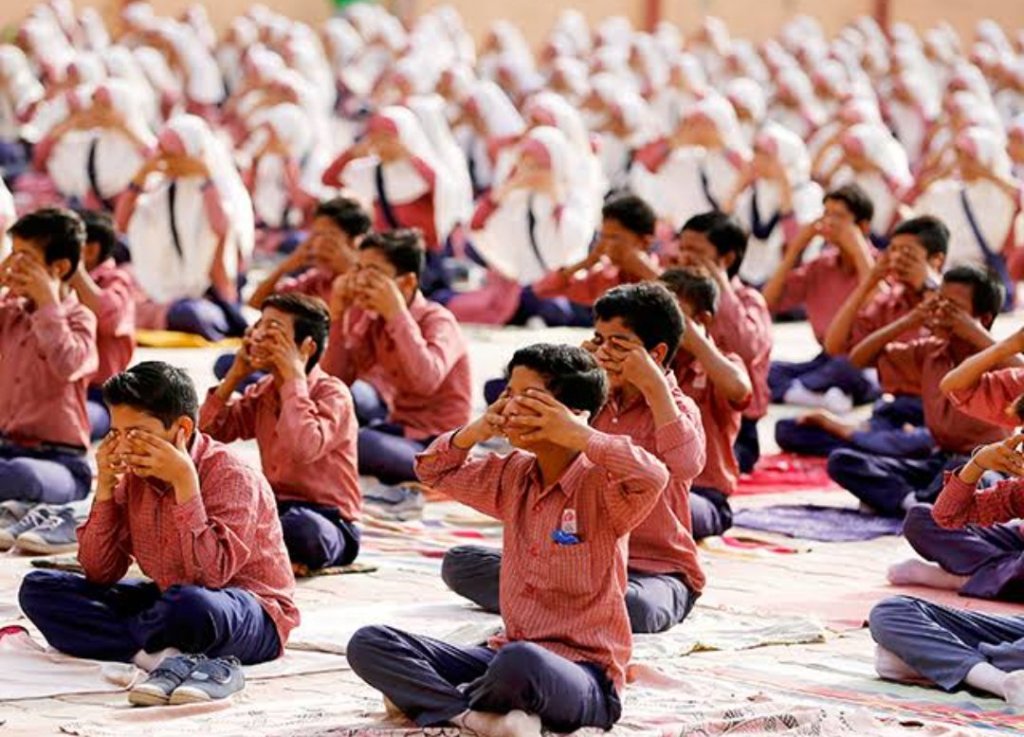
It is natural for anyone to develop anxiety or any health issue but this time needs to focus on our mental health therefore, yoga is considered as a preventive measure. Yoga is helpful to decrease the intensity of mental health issues and lead us towards a healthy lifestyle. Government of India, private yoga institutes abroad, campus awareness exclusively works on yoga significant aspects of human life. But, not even government or yoga institutes have introduced yoga programs for GBV survivors. India is a country who extensively works on yoga Policies and programmes by state government ,yoga Universities. India has its own Ministry for yoga that promotes yoga events on a larger scale.
USA (New Jersey, Newton Massachusetts)
The USA federal government had not supported any yoga Policy or even program. To make it easier here, we need to understand the difference between Policy and programme.
Programme – short term intervention that creates temporary improvement in wake of challenges not necessarily supported by the government. On the other hand, policies are those which are passed by legislature and implemented by executives.
Therefore, there is no government funded yoga policy or programme. But many initiatives taken up by several universities or yoga school based programmes. More Christian dominating states are not ready for school based yoga programs for their children according to The Atlantic report. States like Georgia, Alabama find yoga as Hindu and Buddhist roots.
Many private yoga studios are opening in the USA or programs. For example
France/UK/Istanbul
France
France also has the same situation when it comes to government Policy or programmes. Few paid programmes are there like :-
Istanbul
Istanbul yoga centers have joined the yoga alliance to promote the practices of yoga.
United kingdom
Yoga practices in the UK Study: cross sectional online anonymous survey. The study investigated the characteristics of people who practice yoga, reasons for initiating & maintaining practices and perceived impact of yoga on health & well being.
India
International organization
NGOs work overseas to promote yoga and well-being in people.
Private Research and Development



 Eduindex
You must be logged in to post a comment.