Convocation Ceremony of Visva-Bharati University

 The Prime Minister, Shri Narendra Modi addressed the Convocation Ceremony of Visva-Bharati University today through a video conference. Governor of West Bengal and Rector of Visva-Bharati, Shri Jagdeep Dhankhar, Union Education Minister Shri Ramesh Pokhriyal ‘Nishank’ and MoS for Education Shri Sanjay Dhotre were also present on the occasion.

The Prime Minister while addressing the convocation quoted the poem of Gurudev Ravindra Nath Tagore on Veer Shivaji which inspired him and called for unity of India. PM stressed that the students and the faculty were not just a part of a university, but also bearers of a vibrant tradition. He said Gurudev named the University as Visva Bharati meaning Global University since he expected that anyone who comes to learn in Visva Bharati will see the whole world from the point of view of India and Indianness. So he made Visva Bharati such a place to learn, which can be seen in the rich heritage of India. He gave a call for assimilating and researching about the Indian heritage and working towards solving the problems of the poorest of the poor. He said Visva Bharati for Gurudev Tagore was not just a knowledge imparting institution but an attempt to reach the topmost goal of Indian culture, which is to achieve oneself.

The Prime Minister said Gurudev believed that we have to discover ourselves among the varied Ideologies and differences. PM said that Tagore used to be proud of Bengal but at the same time, he was equally proud of India’s diversity. And it was due to Gurudev’s vision that humanity thrives under the open sky of Santiniketan. He praised Visva Bharati as an unending sea of ​​knowledge in itself, the foundation of which was laid for experience-based education. He said there is no limit to creativity and knowledge. It was with this thought that Gurudev founded this great university. PM urged the students to always remember that knowledge, thought and skill are not static but a dynamic and continuous process. He said responsibility comes with knowledge and power. Just as one has to be restrained and sensitive while in power, every scholar also has to be responsible towards those who do not have knowledge.

Recalling the historical strength of the traditional Indian education system, the Prime Minister referred to Gandhian Shri Dharampal’s book ‘The Beautiful Tree- Indigenous Indian Education in the Eighteenth Century’. He said that the 1820 survey had said that there was more than one gurukul in every village which were linked with the local temples and literacy rate was estimated to be very high. This was recognized by the British scholars also. Shri Modi said, Gurudev Ravindranath developed systems in Visva Bharti which were the medium of modernising Indian education and freeing it from the shackles of slavery.

Similarly, the new National Education Policy also breaks old restrictions and allows students to realize their full potential. It allows flexibility in selection of subjects and medium of instruction. The policy promotes entrepreneurship and self employment; research and innovation. ‘This education policy is a major milestone in the making of an Aatmnirbhar Bharat’, said the Prime Minister. The Prime Minister informed that scholars have recently been given free access to lakhs of journals by the Government. This year’s budget has proposed 50 thousand crore in 5 years for research through the National Research Foundation. This Education Policy has made provision for the Gender Inclusion Fund that will give the girls new confidence. Higher dropout rate of girls was deeply studied and arrangements were made for entry-exit options and yearly credit in the degree courses.

Calling Bengal inspiration for Ek Bharat-Shreshth Bharat, the Prime Minister said that Visva Bharati will play a big role in the 21st century knowledge economy, taking Indian knowledge and identity to every corner of the world. Shri Modi called upon the students of the prestigious institute to prepare a vision document for next 25 years about the 25 biggest goals of Visva Bharati in 2047. The Prime Minister asked the students to spread awareness about India. Visva Bharati should lead all educational institutions to carry India’s message and enhance India’s image globally. The Prime Minister concluded by calling upon the students to find ways to make nearby villages Aatmnirbhar and taking their products globally.

Union Education Minister appreciated the academic activities that Visva-Bharati has undertaken during the COVIND 19 pandemic. The Minister dwelled in detail on the New Education Policy which, he also mentioned, is based on Gurudev’s idea of Education. He also suggested that Visva-Bharati is capable of taking lead in imparting learning as per the directions that the NEP has provided. In order to accomplish the goal, Shri Pokhriyal insisted on creating an effective task force by bringing together academic faculties from various fields. Speaking on the decision to create a new Visva-Bharati campus at Ramgarh, Uttarakhand, he informed that steps in this direction have already been taken.

Speaking on the occasion Shri Dhotre congratulated the passing out students and extended his best wishes for the future endeavours. On New Education Policy, he said it has adopted a multidisciplinary approach, emphasises on early childhood care and education and imparting learning in the local language, vocational education and focus on research and innovation.  Under the leadership of Prime Minister Shri Narendra Modi, this policy will make India the global knowledge superpower of 21st century.  

The Rector and Governor of West Bengal, Shri Jagdeep Dhankhar expressed his happiness by being part of this convocation at Amrakunja which has footsteps of Gurudev Rabindranath Tagore. He admired the strong leadership that the Prime Minister has been providing to come out the crisis that has emerged due to the pandemic. In his address, he also appreciated the role of the Union Education Minister and his colleagues in bringing out a New Education Policy for the country.


*****

Student attendance on the rise in KVs across the Country

 Kendriya Vidyalayas across the Country have resumed face-to-face teachings for various classes as per the guidelines issued by the MHA and State Governments. KVs started opening from the month of October in a phased manner.

According to the data compiled on February 11, 2021 from all the KVs, an average of 42% Students of Class 9, 65% Students of Class 10, 48% Students of Class 11 and 67% Students of Class 12 are physically attending classes all over the Country. These figures are dynamic and trends indicate consistent increase every day. Face-to-face classes for class 1 to 8 have also been started in some KVs where State Governments have permitted to open Schools for junior grades.

Regular contact with the Parents and Guardians is being established by the Schools in case of any apprehension from students/parents. Students are being permitted with the prior consent of their guardians.

The SOPs issued by the State and Central Governments are being followed completely in view of the Corona Pandemic. All KVs are clearly advised to follow staggered timings for the students of various classes and ensure adequate safety measures including maintenance of proper physical distance in the classrooms.

However, for students who are not attending the School, the provision of online classes is also running. Students are also in touch with their teachers through various digital platforms.

*****

Biomedical Waste Crisis

The present situation

At present, there is poor segregation of biomedical waste and other general solid waste. As a result, biomedical waste such as masks, gloves, and personal protective equipment (PPE) kits is mixed in with regular waste and ends up in landfills and open dump yards. This has an impact on the health of waste collectors as well as the environment.

In India, there are currently around 40 lakh garbage pickers. Due to the increasing biomedical waste in the time of the Covid pandemic, almost all are susceptible to health risks. According to the World Health Organization (WHO), depositing biomedical waste in open dump yards might lead to the spread of drug-resistant bacteria.

As per the Central pollution control board (CPCB), 616 tons of biomedical waste was being generated per day in 2019. On an average, India generated about 183 tonnes of COVID-19 related bio-medical waste per day in September 2021. 

How to deal with biomedical waste

  • Rules on the segregation of biomedical waste from normal solid waste should be implemented strictly with hefty fines.
  • The general public should be educated on how to properly dispose of biomedical waste such as gloves and masks. According to the CPCB, Masks and gloves should be cut into pieces to prevent misuse, and garbage should be kept separate for 72 hours before being given to municipal workers in a separate bag.
  • Currently, India’s biomedical waste treatment facilities can manage 840 tons of medical waste per day. This capacity should be enhanced, and also they should be monitored well.
  • More investment and human resources should be brought into handling biomedical waste.
  • Greener options for destroying biomedical waste, such as bio-methanisation (converting biomedical waste into electricity), should be explored and implemented on a broad scale. The majority of biomedical waste is currently incinerated (destruction by burning).
  • Sanitation workers should be provided with protective equipment.
  • Regular checks on the disposal of biomedical waste at diagnostic centers and hospitals can help in the effective implementation of guidelines.

Reducing biomedical waste waste generation as much as possible by effective practices such as wearing cloth masks, reusable gloves, and so on can help in reducing the burden of the destruction of the biomedical waste.

Conclusion

More investment and human resources are needed to deal with the growing amount of biological waste. Effective management of biomedical waste is very essential to ensure a cleaner environment and healthy humans.

MARRIAGE IN TODAY’S SOCIETY

If there’s one thing that all the world’s various cultures have in common, it is marriage. Beliefs, diets and languages vary greatly, but the desire people have to share their lives with another seems universal. Why then, is marriage so popular?

Marriage is the most important institution of human society. It has been the backbone of human civilisation.It is a universal phenomenon. Psychologists have said that people have a deep need for emotional security which marriage provides. Knowing that one has a partner in life makes it easier to cope with the problems of daily life. On the other hand, the fact that many single people are content to live alone suggests that the “emotional need” theory is incomplete.

Human Beings have certain urges like hungers, thirst and sex. Society works out certain rules and regulation for satisfaction of these urges. The rules and regulations which deal with regulation of sex life of human beings are dealt in the marriage institution. We can say that the marriage is as old as the institution of family. Both these institutions are vital for the society. Family depends upon the Marriage. Marriage regulates sex life of human beings.

FUNCTIONS OF MARRIAGE:

Marriage is an institutionalised relationship within the family system. It fulfils many functions attributed to the family in general. Family functions include basic personality formation, Status ascriptions, socialisation, tension management and replacement of members, economic cooperation, reproduction, stabilisation of adults, and the like.

Many of these functions, while not requiring marriage for their fulfilment are enhanced by the marital system. In fact, evidence suggests that marriage is of great significance for the well-being of the individual. Researches suggest that in comparison to unmarried people, married people are found to be more happier, healthier, less disturbed and less depressed and less prone to premature deaths. Marriage, rather than becoming less important or unimportant maybe increasingly indispensable.

SOCIETY’S UNDERSTANDING:

A marriage in our society is perceived as a mere ritual to bring two families together. I don’t see it as a tradition that meeds to be followed just for the sake of it. You might not agree with the way I see this beautiful bond of two souls but I think the meaning of marriage is much greater than what the society tries to define it. Marriage isn’t a social or traditional compulsion. Two people decide to spend their lives together. They don’t enter into an agreement of compromise. Yes, there are times when we need to make some sacrifices for our loved ones but it shouldn’t be taken for granted which in todays society is quite common.If there has to be a lifetime commitment between two people there could be no commitment greater than the commitment of love.

Only Love, respect and compassion for each other can keep a relationship alive. If a marriage relationship continues without these three elements, it becomes a burden for a lifetime and a relationship of mutual benefits. A marriage in our society is considered as a means of generation survival. The old perspectives and traditions followed for years don’t let the meaning of marriage grow out of its restricted bindings. While some families feel the excruciating pain of seeing away their daughters away forever, for some families it means nothing more than a well renowned tradition that is supposed to be followed at a certain point of time. In our society nobody thinks about the two people who have to spend the rest of their lives together. A marriage can’t just remain to be a simple mechanism of complying with some conventional ceremonies.

Money spent as marriage expenses is still perceived a s a status symbol in our society. It’s disgusting to even think that this occasion is judged as a status symbol when its actually a moment of purity and a new beginning for two souls.

CONCLUSION:

Our society and family should think from the perspective of the newly married couple rather than being too self centered, demanding and enforcing financial burdens in the name of traditional values because at the end its just about the two people to choose to spend the rest of their lives with each other with the commitment of forever respecting, loving and being compassionate towards each other.

Changing Camaraderie of Families

Ever imagined that why the equation among the family members are changing? If yes, then what are the reasons for that?


To begin with, now the family relationships are not the same as it had been 15-20 years ago. Now, the families no more sits together to dine, watch movies, go on a vacation and attend function. The lives have become very private. The camaraderie and the chemistry is now changing and it’s not only for one or two families, it applies to almost 90% of the families living in the society. If taken a survey, the statistics may even go up because this is today’s reality. The truth which now people accept but does not think to amend it.


To amend it, first the root cause should be identified that why this particular change has happened. What is the reason behind all this? And the biggest question which takes place in the mind is, are the families happy with the change occurring in their lives? So the answer should be taking everything into the consideration, all the aspects affecting in one or the other way and then giving a conclusion because if even one aspect is missed, the answer wouldn’t be wholly correct.


The principle and foremost reason to be indentified here is the busy and hectic schedule of the people nowadays which does not give them time to even relax forget the vacation with the families. They are so busy in their career, job, lives that taking out time for the dear and loved ones is also a big task. There is no spare time left for anyone after working so hard day and night.


Another reason is that now people have become more private. They want now more freedom and their own space to live. They want to do everything as they wish and don’t want anyone’s presence in it. Even if the immediate family members try to give a piece of advice, they are angry. They think they are capable to handle their lives and does not need anyone’s instruction or order. They will live a life on their own terms and conditions. Solely on their own discretion.


In the above two reasons which is presented, it can be seen that in one problem consent of the person is not present whereas in one reason consent of the person is present in distancing himself with the family members but the common thread which lies in both the reason is the fact that now lives have become fast. It moves at a very fast pace. In reason one, people have become busy because now there is so much competition and no one wants to be left behind. In reason two, the fast moving life made the individuals search for freedom and their own space.


Now the next question which comes in accordance to that is, Are they happy with this? So, the answer is yes. They are happy like this. Earlier, the people felt relaxation when they meet their loved and dear ones but now one-hour of even playing a video game will give them the same amount of happiness which their meet-up would give. They are happy with that also. No need for meeting the family and the other relationships just for the happiness.


Lastly, I would like to conclude with my opinion that maybe now, individuals does not realize the importance of family and the relationships in their lives but it is important. Times are changed but the significance and place of family is same. It should be cherished further with time and love because this will be only left with us at the end of our life. No video game will come to our rescue when we will cry. So, the relationships should be nurtured with them rather than keeping them at the bay.

ROLE OF STUDENTS IN ERADICATION OF DRUGS

Addiction of drugs is eventually spreading unchecked among school going students especially in teenagers across the world. Today, the crisis of drug abuse has reached to such levels which are unparallel. Thus, drug eradication is the need of hour. The young school students are being targeted by the drug dealers as potential consumers and their life are at a stake of risk.

The youths fall in the trap of drug abuse due to being unable to cope up with excessive stress or anxiety, peer pressure, lack of self confidence etc. A number of parents have renounced their duties as guardians and protectors and expect that around the school campus, it is the teacher’s duty to protect the students in their absence. As a result of parent’s lack of strictness and care, the students on the contrary have become more prone to be regular drug users. The school children are vulnerable and are easily lured in the addiction web by the cunning and clever drug dealers. The peddlers sell drugs disguised in form of sweets or any other confectionery to the unwary students easily.

“Get high on grades- not on drugs.”

-Anonymous

Therefore, the students play a significant role in the eradication of drugs both at school as well as at home. Firstly, they should be made aware of the vicious effects of using drugs. Hence, by being aware of the dangerous effects which could disturb their physical as well as mental health, they could be able to concentrate on the eradication of drugs in order to stay safe. The youth especially the school students must also be taught the method to identify different types of drugs and drug addiction symptoms. Although, all drugs are addictive but cocaine and heroin are hard drugs and are comparatively exceptionally addictive. The students must be responsible enough to make certain that they never attempt to experiment with any sort of drug. As through various surveys, it has been found that addiction initially begins in youth with the drug experiment and gradually unknowingly turns into addiction.

The students must be cautious while buying any eatable items sealed or unsealed. To be on a safer side, they must always purchase any item either from a reliable shop or from the school canteen. They should mainly avoid buying snacks from the streets or on the road side, as consequently it would reduce the chances for the drug dealers to sell disguised drugs to the students. It should be the duty of the students to report to the school administration about any suspected selling or use of drug of any sort or any person found suspicious of selling something doubtful to the students. It would be helpful enough for the school administration to notice early, the use of drugs and consequently take effective measures in this regard before it becomes an escalating problem.

Today, drug addiction among the youths and school going students is a matter of concern. The cases of drug addiction is increasing day by day. Thus, student’s role in the eradication of drugs is very beneficial and effective. It is the need of an hour for the students to pay attention towards drug eradication and avoid coming into contact of any sort of drug in order to preserve their good health and bright future and life ahead.

Satisfaction doubles the Happiness

Before we begin to understand the phrase ‘Satisfaction Doubles the Happiness’, it is very important to know the context in which the above words will be used in the article as different perception and presentation of the word will only give birth to the ambiguity in understanding and dilemma of result. So, it would be wise to know the meaning in which it is used in paragraph rather than only its literal meaning.


Satisfaction. The literal meaning of satisfaction is fulfillment of one’s wishes, expectations, needs or the pleasure derived from this. Similar to Contentment. Here, in this article it means the acceptance. Whatever the outcome or result comes in front of us, we are able to accept that and satisfied with it. There should be no room for confusion and regret.


Happiness. The literal meaning of happiness is the state of being happy. It refers to that state where the person is feeling pleasure and delighted. In this article, it is used as an abstract feeling which comes from not materialistic things and depend on it. It is an emotion.


Coming to the main article, What does it mean by satisfaction doubles happiness? It means the acceptance of things and situations which leads to being happy. It will be better understood if presented and explained with an example. Suppose a person wants to become the CEO of a multinational company so that he can earn more money, respect, recognition and much more. He wants that position by hook or crook no matter what. So, he starts working hard day and night for it. He puts in so much efforts to achieve that one single position. Did everything in his capacity to rise to that position but his hard luck. After all that efforts and labor he is not able to achieve that position and what next follows is insatiable state where he blames himself. He is not happy. He is not satisfied. In that situation, the individual should realize the fact that he did everything which was in his hands and if after that also, he doesn’t get that, it means that it is not meant for him. He should accept it and move on rather than stuck on the same page of life. He should be satisfied and grateful for all that he has rather than feeling insatiable and discomfort for all that he doesn’t have. He should be happy and move on from that chapter of the life. He should not let his happiness depend on materialistic things. It is difficult but not that impossible. If a person tries to do that, he will definitely be able to do it.


Lastly, I would like to conclude with my opinion that if a person will remain unhappy, he will miss on a lot of opportunities in the future because when he is not feeling good, how will he be able to concentrate and focus on new things? How will he look for new paths and gateways which are opened for him? The person has to forget and grab new things in life and at the end that’s what will make them happy. A happy heart. Therefore, the habit of being satisfied and able to accept things in life will only double the prevailing happiness.

Religion- Solidarity or Discord?

Ever wondered or thought about the existence of the religion in our society? Whether it unites us or parts us? Does it create the feeling of solidarity or separation? Whether it gives us we-feeling or feeling of discord? The questions are unlimited but there is no definite and particular answer to be given. It follows various logics and arguments and there is no supreme authority which can say that yes, this argument is right or no, this argument is wrong. The reason lies in the question only that it talks about religion and religion is something which is directly related to the sentiments and the feeling of the people and no one is ready to take up against somebody’s sentiments or feelings. It will disturb the peace and harmony of the society if any attack is done against the religious feeling s of the people.


To come to any conclusion, it is very important to first analyze the whole existence and it’s emergence. It is not something which has emerged some 50-100 years ago. The archaeological evidence shows that it dates back some hundred thousand years ago to the middle and lower paleolithic period. So, the question which arises in accordance to that, Is there is only one religion or many? The answer is that there are many but its years of existence is not the same. Hindu religion started somewhere between 2300 B.C and 1500 B.C in the Indus Valley whereas Islam dates back to the 7th century, making it the youngest of the major world religions. Like that, Christianity began in the 1st century in the roman province of judea. There are many more.


The basic question which then arises is if one religion was present then what was the need to take up a new religion? So, the answer would be that though religions were present but some people did not agree or accept the practices and ideologies of a particular religion. They felt the need to amend some things in which some old is scrapped and some new is added. In this order, things happened and now, there are many religions present in the society to look up to.


Coming back to the first question of our article, Whether it unites or parts us from each other? Whether it creates a feeling of unity and solidarity or feeling of discord and separation? The answer is partially yes and partially no. It is yes because whatever the religion is of a person, the common thread which lies in everyone is the humanity. Before adopting any religion, the person is first a human being and that cannot be lost with the coming of anything. The common brotherhood and sisterhood among the humans will always be present in the society and bind its people. The mankind will continue to grow like this.

But when we say no, there is also a reason present. The reason is related to the religion’s emergence only. There was some kind of differences between people only which led to the birth of new religion. This means that people are not similar. Their way of thought and mentality varies from person to person. When one agrees with something and the another one does not agree with that, it is obvious that a sense of discomfort will take place. New thinking will be born among people and that will make them different from each other. So, the expectation of unity among different people will be very challenging because human beings are the ones which have their tolerance level very low. If someone is different from them in the thinking and mentality, they are not unable to cooperate with them.


Lastly, I want to conclude with my opinion that after all the differences present, we need to respect that. This respect is a mutual thing and it can be seen among people. That is why, there is still unity present in the diversity.

Side Effects of Contraceptives

Some 20-30 years ago, taking contraceptive pills or birth control pills to control the pregnancy which can be said as unwanted pregnancy was not very common in India. It was not in the culture as people say but the actual reason was that people were not aware of the medical drugs and medicine which could be used for the purpose of various things. They were simply not aware of a medical drug that can be used to prevent the women’s body to produce an egg, which means that there was nothing for the sperm to fertilize and pregnancy cannot occur. The reason behind this is the literacy factor. The group who has to use it are not that literate enough to even know that such a thing exists and the the group who are literate does not have a need to use it. They consider it as something useless. As a result, there were so many unwanted pregnancies. People had so many children.


But Nowadays, it is very common to use contraceptive pills or birth control pills to control the unwanted pregnancy. It is used when the couple is not ready to have a child. The reason behind this that now the women, the group which uses it are now educated and literate. They know about the market, latest technology and the developments which are happening in various fields. That is why they are aware of the medicines that can be used for various purposes.


To be specific, there are two main types of birth control pills:
1) Combination pills which contain estrogen and progestin which is further synthetic form of the natural hormone progestrone.
2) Mini pills which contains progestin only.
But where they really lack is that inducement of any artificial or outer product in the body cause changes. And everything has some good thing as well as some bad thing to offer. If some product is offering some kind of benefits then there is a very strong posibility that it will have some side effects too. It will cause some or the other thing to our body. It’s normal mechanism will be ditsurbed in the process.


Same thing happens in the case of contraceptive pills or birth control pills. It costs a women body in various ways:
1) Spotting- Abnormal Bleeding from the uterus hat can occur in between the periods, may also occur every few weeks and the flow may also be heavier than usual.
2) Nausea- A sickness feeling with an inclination to vomit.
3) Breast Tenderness- It can be said as throbbing or tightness in the breast tissue which cause pain. It may be constant or may occur occasionally.
4( Headaches- A continuous pain in the head.


Apart from all these, it causes irregular or painful heavy periods, endometriosis, acne and premenstrual syndrome.


Lastly, I want to conclude with my opinion that with benefits, contraceptive pills has some major side-effects too. It disturbs the normal functioning of the body directly attributed to the intake of a medical drug to prevent something from producing. It affects the body adversely. So, the intake should not be very much and if taken, it should always be consulted with the gynaecologist. If the doctor advises, then only it should be taken but that also not very often.

attracting international students to India

 The  Ministry of Education is deliberating on measures to increase the number of international students coming to India for higher studies. In a review meeting of the Ministry’s Study in India Programme with partner institutions yesterday, Secretary Higher Education Shri Amit Khare said that the criteria for institutions partnering under the programme will soon be revised so that more institutions that have the necessary infrastructure  and academic quality  can join the programme.  He also said that no distinction will be made between private and public institutions in matters of supporting internationalization.

Study in India is a programme of the Govt of India that aims to attract international students to higher education institutions in India .  Select 117 institutions are partners under the programme that was launched in 2018. Admissions are merit based and done through a common portal. Around 7500 students from over 50 countries have come to Indian institutions so far under this programme.

The Government has also recognized the  importance of creating a conducive, on- campus ecosystem for the international students, where they not only get quality academic inputs but can also feel safe, welcome, happy and hassle free. In this regard the Secretary called upon all partner institutions to set up world class hostels for international students. There is a provision for financial assistance for this under the Champion Services Sector Scheme that supports SII, which can be provided to some

institutions . In addition, there is an urgent requirement of setting up International Students’ Offices in every institution that takes in international students. This office should work as a single window support for anything that the international students may need, right from the day they get selected to join the institution. Besides this, avenues like networks of families, mentors etc should be developed, who can help the students to socialize so that they feel welcome in the country and have an enjoyable stay here, with memories that they can cherish, and positive experience to share with others.

In addition to this, the Ministry has also asked institutions that they should consider organizing orientation for international students when they join, as well as orientation for the faculty to sensitize them to  teach using contexts that these students can relate to.

The Ministry is also looking towards enhanced academic collaborations between Indian and international institutions under Twinning, Joint and Dual degrees with credit transfer mechanism. UGC has already brought out draft regulations in this regard that have currently been put up for stakeholder consultation. There regulations will give a boost to student exchange programmes and short programmes of one or two  semesters .

The Ministry has plans to take up the issue of allowing internship for international students with the concerned department of the Government. Many of the partner institutions pointed out that the absence of internship for international students was a big drawback for any programme of higher studies in India. The Ministry will iron out other issues of concern for international students, for example visa issues. 

Learning with toys develop the creativity and sensitivity in students and give wings to their imagination

 Learning with toys develop the creativity and sensitivity in students and give wings to their imagination said Dr Subhas Sarkar,  Minister of State for Education while addressing the valedictory session of the International Webinar on ‘Toys and Games to Play, Make and Learn’ organized by the NCERT under the agies of Ministry of Education with an objective to promote Toy Based Pedagogy in school education for joyful learning.

Shri Sarkar said that toys teach children from being possessive to sharing, co-operative to empathy, exploring toys to make one on their own, inculcates among them imagination, creativity, and much more. It is the need of hour that parents teach their children through the toys as it will make things comprehensible for the students.

The Minister highlighted that we have a rich heritage of traditional toys which has originated in the subcontinent several thousand years ago in the Indus Valley civilization. Indian toys not only entertain, but also teach us scientific theories such as ‘Lattu’ teaches us gravity and balance, ‘Gullel’ teaches us potential and kinetic energy, he added.

He expressed that the International webinar is an important step towards reinventing a timeless tradition of toys and games. He hoped that the webinar has provided a roadmap for the school education which has been envisaged by the National Education Policy of 2020 to be based on India’s rich heritage and knowledge systems and prepare our youth for the challenges of the 21st century.

On the  2nd day of the webinar today,  there were two technical sessions on Toys and Games to Play, Make and Learn, and Toys to address different societal concerns, mainly to address the concerns of Children With Special Needs and 9 scholars presented their papers.  There was a panel discussion on Innovative Toys and Technology, where innovators, educationists and entrepreneurs from different countries shared their views on the need for promoting innovation and entrepreneurship in toy making. There were 7 presentations by the practitioners and case studies on toys, toy design and startups.

 The Session started with Prof. Sridhar Srivastava, Director, NCERT welcoming the dignitaries present on the occasion and the participants who had joined from different locations of various countries. Prof. Anupam Ahuja, Head, Division of International Relations, NCERT and a member of the Organizing Committee of the Webinar presented the brief report of two days of deliberations. Smt. L. S. Changsag, Joint Secretary (Instt), Ministry of Education shared the initiatives taken by the Ministry of Education in regard to Toy Based Pedagogy and the way forward. Prof. Anil D. Sahasrabudhe, Chairman, AICTE addressed the participants and enlightened them with his views.

Towards the closing of the 2 days deliberations of the International webinar, Prof. Jyotsna Tiwari, Head, Department of Gender Education, NCERT and the coordinator of the webinar proposed a vote of thanks to all the dignitaries, participants and invited audience.

*****

Agri-Food Techathon at IIT Kharagpur

 Union Education Minister Shri Ramesh Pokhriyal ‘Nishank’ inaugurated the Agri-Food Techathon 2021 today virtually. He also laid the foundation for Agri-Business Incubation Centre (ABIC), which will incubate innovative ideas in the agriculture and food technology domain for creating ‘Agri-preneures.’ Prof. V.K. Tewari, Director, IIT Kharagpur, Mr. Dr. G.R. Chintala, Chairman, NABARD, and participants from across the country graced the occasion.  


Addressing the inaugural event, Shri Pokhriyal congratulated IIT Kharagpur and NABARD for this unique initiative. He emphasized that the vision of incubating startups to create an ecosystem under the Agri-Food Techathon 2021 will bring together science and technology, and agriculture to support the farmers of our country. Such initiatives will help take the ‘Vocal for Local and Local for Global’ initiative to each corner of our country. Highlighting that the Agri-Food Techathon has immense possibilities, Shri Pokhriyal said this Techathon will lay the foundation of an Atmanirbhar Bharat and help India emerge as a Vishwaguru.


Stressing that New Education Policy 2020 (NEP) will make India a global leader, he was happy to note that IIT Kharagpur is taking progressive steps in furthering the vision of NEP. He called upon all the stakeholders to come to the forefront for the successful implementation of NEP.


Indian Institute of Technology Kharagpur, in collaboration with NABARD, organised the ‘Agri-Food Techathon 2021’ (AFT 2021), a first-of-its-kind event to promote the participation of India’s youth in innovation and entrepreneurship in different domains of the Agri-Food sector.


For more information on AFT 2021 and ABIC, please visit:


https://kgpchronicle.iitkgp.ac.in/agri-food-techathon-aft-2021/

****

The India Toy Fair, 2021

 Government of India is organizing ‘The India Toy Fair, 2021′ from 27th February 2021 to 2nd March 2021 on a virtual platform. This initiative is in line with the Prime Minister’s vision of making India a global hub for the Toy Industry.

The Fair aims to provide an impetus to the underlying themes of “Atmanirbhar Bharat” and “vocal for local” campaigns, launched by the Government to promote indigenous industries. It also aims to leverage the potential of toys in making learning joyful across all ages in education.

The India Toy Fair 2021 intends to bring policy makers, toy manufacturers & distributors, investors, industry experts, MSMEs, artisans, start-ups, children, parents and teachers together on a common platform, in a bid to propel the growth of the Indian Toy Industry, giving it a global competitive edge.

The main attractions of the Fair include a Virtual Exhibition with over 1000 virtual stalls, webinars by State Governments, knowledge sessions with engaging panel discussions/webinars on diverse topics by experts on areas including toy-based learning, craft demonstrations, competitions, quizzes, virtual tours, product launches, etc. For the education sector in particular, the Knowledge Sessions involving various experts will focus on areas emphasized in the NEP 2020 such as play-based and activity-based learning, indoor and outdoor play, use of puzzles and games to promote critical thinking and overall on how to make learning more engaging and enjoyable.

The exhibitors include Indian businesses engaged in creating happy childhoods and educating children through play, as well as NCERT, SCERTs, CBSE along with their schools and teachers, IIT Gandhinagar, NID and Children University Ahmadabad. The fair is expected to feature millions of users from different parts of India and will give them an opportunity to buy products from a variety of different exhibitors.

The official website and online registration for the India Toy Fair was launched today. The Toy Fair can be visited virtually from 27th February to 2nd March 2021 by registering at https://theindiatoyfair.in/.

ASEAN-India Hackathon is well aligned with the vision of APASTI 2016-2025

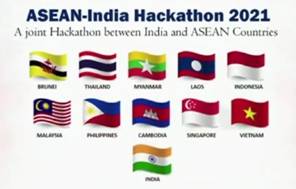
 Union Education Minister Shri Ramesh Pokhriyal ‘Nishank’ and Union Minister of External Affairs Shri Subrahmanyam Jaishankar attended the award ceremony of ASEAN- India Hackathon 2021 along with Ministers and dignitaries from ASEAN countries. The Hackathon concluded with more than 300 students, mentors, and officials participating from 10 ASEAN countries and India.

https://static.pib.gov.in/WriteReadData/userfiles/image/image0012IJ6.jpg

Addressing the participants of Hackathon, Union Education Minister said, “I would like to first congratulate all, for successfully completing the first ASEAN-India Hackathon. I am very thankful to all ASEAN countries for participating in this first-of-its-kind initiative. For the last 3 days, all 54 teams have worked really very hard on 11 problem statements and I was informed by juries and mentors that they are very happy with the quality of work done by participants during this Hackathon. The ASEAN – India Hackathon is well aligned with the vision of ASEAN – plan of action on science, technology and innovation (APASTI) 2016-2025”.

Shri Pokhriyal applauded the focus of the Budget on innovation and entrepreneurship and stressed on boosting the research ecosystem through the Prime Minister Research Fellowship, SPARC, STRIDE, IMPRINT and other research schemes.

Shri Pokhriyal said under the leadership of Prime Minister Shri Narendra Modi, the bond between India and ASEAN countries in the field of education, science and technology has strengthened. One of the main objectives of this hackathon has been to encourage working for sustainable development while creating employment to make our nations Atma Nirbhar. Today India and ASEAN countries have become perfect examples of energy, synergy and international collaboration for other countries to emulate. If the human resources and natural resources of India and ASEAN countries are properly utilized, then a new dimension will open for the betterment of humanity and the world, he added.

The Minister of External Affairs Shri Subrahmanyam Jaishankar stated that “ASEAN India Hackathon offers a unique platform for our youngsters to put their minds and energies together. It is an excellent means to inculcate cooperative spirit among the participants and also exposes them to diverse viewpoints, cultures and work ethics. cutting across national boundaries.”

Prof. Anil Sahasrabudhe, Chairman AICTE said, “It is a moment of pride for us to successfully conclude the first-ever edition of ASEAN-India Hackathon. In the last four days, we have seen how students developed solutions to address the challenges in the ‘Blue economy’ and the education sector. Students meticulously designed innovative solutions in the field of Blue Economy with the help of Artificial Intelligence, Machine learning, AIS Data and Real-Time Data monitoring.”

The program concluded with the announcement of Prizes for the winning teams, runner ups and encouragement awards for other participating teams. 

https://static.pib.gov.in/WriteReadData/userfiles/image/image0020R4K.jpg

The following dignitaries from ASEAN countries also attended the award ceremony of ASEAN- India Hackathon.

⮚      H.E Yang Berhormat Dato Seri Setia Awang Haji Hamzah bin Haji Sulaiman, Minister of Education, Brunei.

⮚      H.E. Mr. CHEA Vandeth, Minister of Post and Telecommunications, Cambodia.

⮚      Her Excellency, Datuk Seri Dr. Noraini Ahmad, Minister of Higher Education, Malaysia.

⮚      H.E. Mr. Lawrence Wong, Minister of Education, Singapore.

⮚   H.E. Dr. Anek Laothamatas, Minister, Ministry Higher Education, Science, Research, and Innovation, Thailand.

⮚      H.E. Prof. Ir. Nizam, Director General of Higher Education of Ministry of Education and Culture, Indonesia.

⮚      H.E. Dr. Phout SIMMALAVONG, Deputy Minister, Ministry of Education and Sports, Lao PDR

⮚      H.E. Mr. Nguyen Van Phuc, Deputy Minister, Ministry of Education and Training, Vietnam.

⮚  H.E. Gregorio B. Honasan II, Secretary, Department of Information and Communication Technology, Philippines.     

“I congratulate the government of India for organizing an event that gave youngsters a platform to come together and to showcase their talent in these hard times” said Her Excellency, Datuk Seri Dr. Noraini Ahmad from Minister of Higher Education, Malaysia.

His Excellency Yang Berhormat Dato Seri Setia Awang Haji Hamzah bin Haji Sulaiman, Minister of Education from Brunei expressed in his address that “India and ASEAN countries have established a longstanding partnership in many areas including Human Resource Development, Person to Person contact and Education”

“Today’s world faces problems that are on a different level altogether. Facing these problems requires equally novel technological solutions. We are living through a time of rapid change. With the increasing complexity of global relations and ever-changing global economy, we need new approaches to solve our problems.” Said H.E. Gregorio B. Honasan II, Secretary, Department of Information and Communication Technology (Minister rank), Philippines.

The Minister of Education from Singapore H.E. Mr. Lawrence Wong expressed that “At some point, this pandemic will be over. But the problems we face do not end there. Climate change remains a matter of concern for the world and especially for the ASEAN countries. We need to come together in the same spirit, as we did to fight against Covid 19”

The participating students from ASEAN and India were very happy with the opportunity provided by Indian Ministry of Education.

Syahshiyah Rohidah, a student participant from Indonesia said that “It was really an adventurous ride since past few days, I am getting to know new people and collaborating with them. His team proposed a solution on “Quantification of Marine Litter using Image Processing”

SEUN Siuphinga student from Cambodia said that “This hackathon has been a first of its kind experience for her”

Đinh Thanh Hiền, a student participant from Vietnam “I enjoyed this hackathon process and looking forward for more chances to participate in such international events”.

Clarisse Johanna Solis, a student participant from Philippines “The process was rigorous time consuming but interesting, It was truly a great and worthwhile experience” She expressed that wish to visit India when borders resume.

The ASEAN-India Hackathon-2021 aims at enhancing the cooperation between India and ASEAN countries in science, tech and education. All the ASEAN countries participated in this unique initiative of providing innovative solutions to overcome the challenges under two broad themes of Blue Economy and Education. Student teams from all the 10 ASEAN countries as well as India participated in this ASEAN-INDIA Hackathon. These teams comprised of 330 students and 90 mentors. The students were divided in 54 cross-country teams, where each team consists of six students and two mentors. These diverse teams competed on developing the best solution for 11 problem statements provided by various reputed organisations and government bodies.

The Ministry of Education’s Innovation Cell and the All India Council for Technical Education in collaboration with the Ministry of External Affairs (MEA) and ASEAN countries organized the first ASEAN-India Hackathon. Due to COVID-19 restrictions, the Hackathon was conducted online using a digital platform, indigenously developed by the Ministry of Education’s Innovation Cell.

*****

Residential schools/hostels funded under Samagra Shiksha named as Netaji Subhas Chandra Bose residential schools/hostels

 In a befitting honour to Netaji Subhas Chandra Bose, the Ministry of Education has decided to name residential schools/ hostels funded under Samagra Shiksha of MoE, as “Netaji Subhas Chandra Bose residential schools/hostels”. The association of these schools with Netaji Subhash Chandra Bose will act as an inspiration to the children and also motivate the teachers, staff and administration to enable them to achieve high standards of excellence. This will also help create awareness about the facility of these Residential Schools and Hostels in difficult areas and inspire these schools to achieve high standards of quality education.

The Ministry of Education under Samagra Shiksha provides financial assistance to states and UTs for opening and running of Residential Schools and Hostels in hilly terrain, small and sparsely populated areas for children who are in need of shelter and care, in addition to the provision of regular schools. The objective is to ensure universal enrolment and provide schooling facilities in areas which are sparsely populated (mostly tribal areas) where opening of schools may not be viable and for children in urban areas who are in need of care and protection.

The residential facilities are also provided to child labour rescued, migrant children who belong to poor landless families, children without adult protection, separated from their families, internally displaced persons, and children from the areas of social and armed conflict and natural calamities.  Preference is given to EBBs, LWE affected districts, SFDs and the Aspirational districts identified by NITI Aayog.

In these residential schools and hostels, in addition to regular school curriculum, interventions for all round development of children such as provision of Specific Skill Training, physical self-defense, medical care, community participation, monthly stipend are also made available to children.  A total of 1063 residential facilities (383 residential Schools and 680 Hostels) have been sanctioned to States and UTs so far.


Residential Schools and Hostels Approved under Samagra Shiksha (Cumulative )

S.

No

STATE NAME

Residential Schools

Hostels

1

ANDHRA PRADESH

3

14

2

ARUNACHAL PRADESH

155

54

3

ASSAM

3

1

4

BIHAR

6

9

5

CHHATTISGARH

67

39

6

DELHI

0

3

7

HARYANA

4

3

8

JHARKHAND

25

16

9

KARNATAKA

5

0

10

KERALA

0

6

11

LADAKH

0

2

12

MADHYA PRADESH

11

390

13

MAHARASHTRA

3

8

14

MANIPUR

9

8

15

MIZORAM

4

11

16

NAGALAND

7

11

17

ODISHA

3

18

18

PUNJAB

0

5

19

RAJASTHAN

7

34

20

SIKKIM

0

1

21

TAMIL NADU

13

0

22

TELANGANA

33

8

23

TRIPURA

4

14

24

UTTAR PRADESH

9

0

25

UTTARAKHAND

0

6

26

WEST BENGAL

12

19

Total

383

680

Generated as on Thursday, December 03, 2020

*************