Tired of the day-to-day struggle with gushing skin, choked pores, and dull skin? Bring back immaculate skin that looks immature and canvas-free with the power of Cranked Charcoal &Coffee.Crafted with the integrity of nature, Mamaearth Charcoal Face Wash pulls out poisons and contaminants from deep within the pores. The integrity of Coffee tightens skin pores and promotes yea skin tone to give you an canvas-free glowing complexion.
Depression and anxiety are very common problem these days starting from teenager to elderly adults anyone and everyone can face this at any point in life and they equally affect us as any physical disease does, many people don’t take mental health seriously but it is outmost necessary to do so. Here are a few simple daily habits which will help you to deal with depression:
Stay away from negative thoughts, and always try to focus on the filled part of the glass and try not to worry about the empty.
Practice meditation regularly it helps to calm one’s mind and helps in relaxing the brain.
Try to stay out from field where you feel irritated and also do try ignoring unnecessary mess.
Physical exercising is a must for a healthy mind as it keeps the body fit and also helps keeping negativity away.
The physical environment where one spends time and the company of people with which one spend time also plays a key role in determining the and dealing with depression issues.
One must also take care of the diet, consuming fresh fruits and vegetables are highly recommended and one must take care that proper diet is consumed.
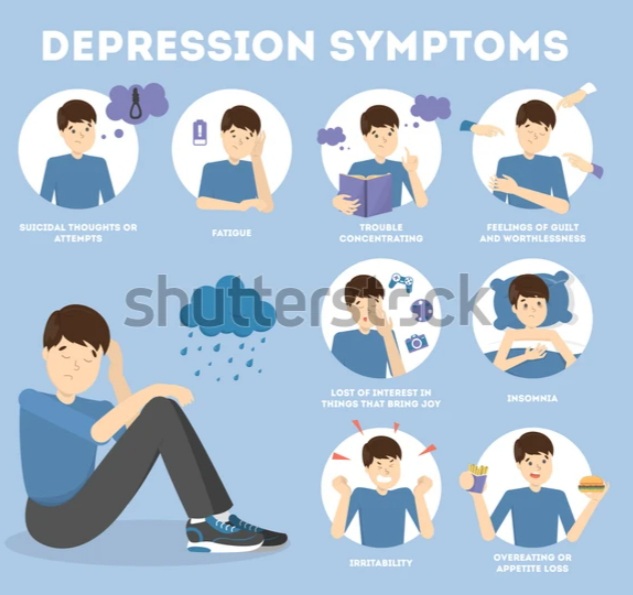
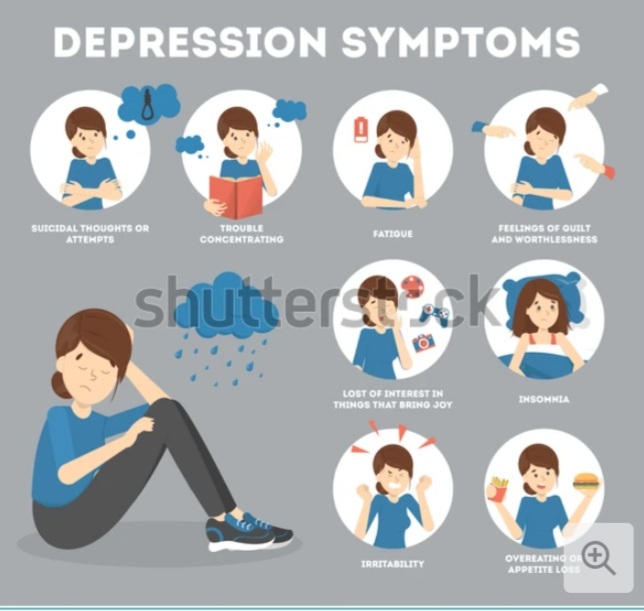
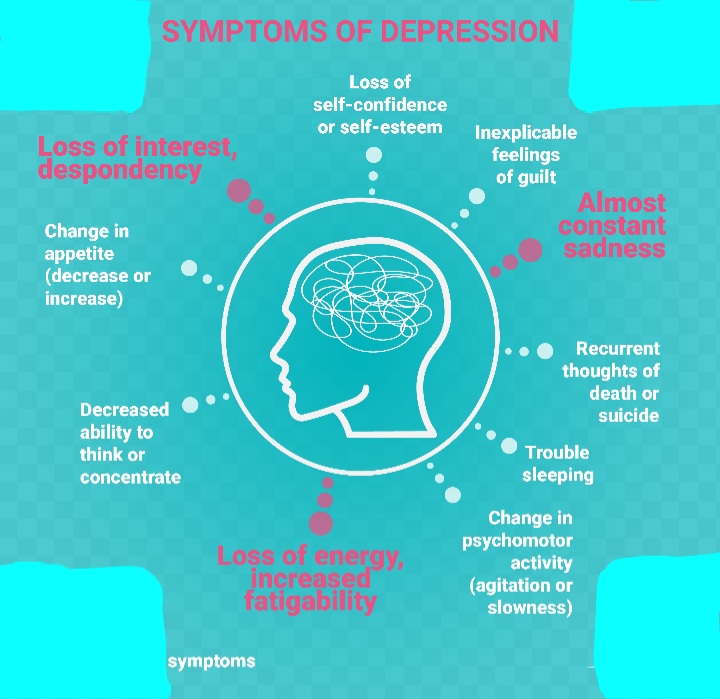
Depression symptoms :
Depression can be more than a constant state of sadness or feeling ” blue”. Major depression cane cause a variety of symptoms. Some affect your mood, and others afect your body. Symptoms may also be onging or come and go. The symptoms of depression can be experienced differently among men, women and children differently.
Men may experience symptoms related to their:
* Mood, such as anger, aggressive, irritability, anxiousness, restlessness.
* Emotional well- being such as feeling empty, sad, hopeless.
* Behavior, such as loss of interest, no longer finding pleasure in favorite activites feeling tired easily , thiughts of suicide, drinking- execessively , using drugs, engaging in high- risk activities.
* sexual interest, such as reduced sexual desire, lack of sexual performance
* cognitive abilities , such as inability to concentrate, difficulty completeing tasks, delayed responses during- conversations.
* sleep patterns, such as insomina, restless slepp, excessive sleepiness, not sleeping through the night.
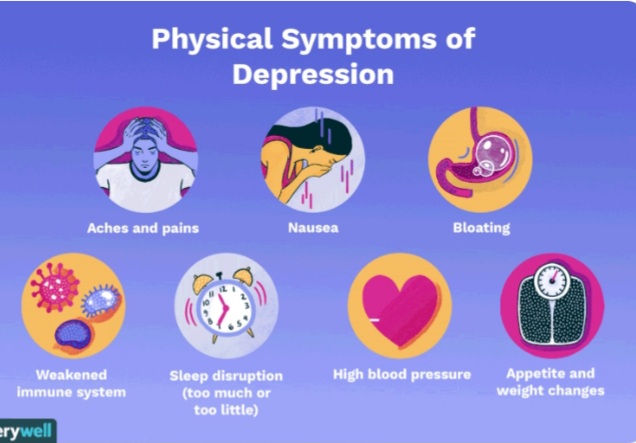
* physical well- being, such as fatigue, pains, headache, digestive problems.
Women may experience symptoms related to their:
* mood, such as irritability
* emotional well- being, such as feeling sad or empty, anxious or hopless.
* congnitive abilities,such asthinking or talking more slowly
* behavior, such as loss of interest in activities, withdrawing from social engagements, thoughts of suicide
* sleep patterns, such as difficultu sleeping through the night, waling early, sleeping too much.
* physical well- being, such as decreases energy, greater fatigue, changes in appetite, weight changes, aches,pain, headaches, increased cramps.
Children may dxperiences symptoms related to their :
* mood such as irritability, anger, mood swings, crying.
* emotional well- being, such as feelings of incompetence or despair, crying, intense sadness
* behavior, such as gettkng into trouble at school or refusing to go to school, avoiding friends or siblings thoughts of death or suicide.
* cognitive abilities, such as difficulty concentrating, decline in school performance, changes in grades.
* sleep patterns, such as difficulty sleeping or sleeping too much
*physical well- being, such as loss of energy digestive problems, changes in appetite, weight loss or gain.
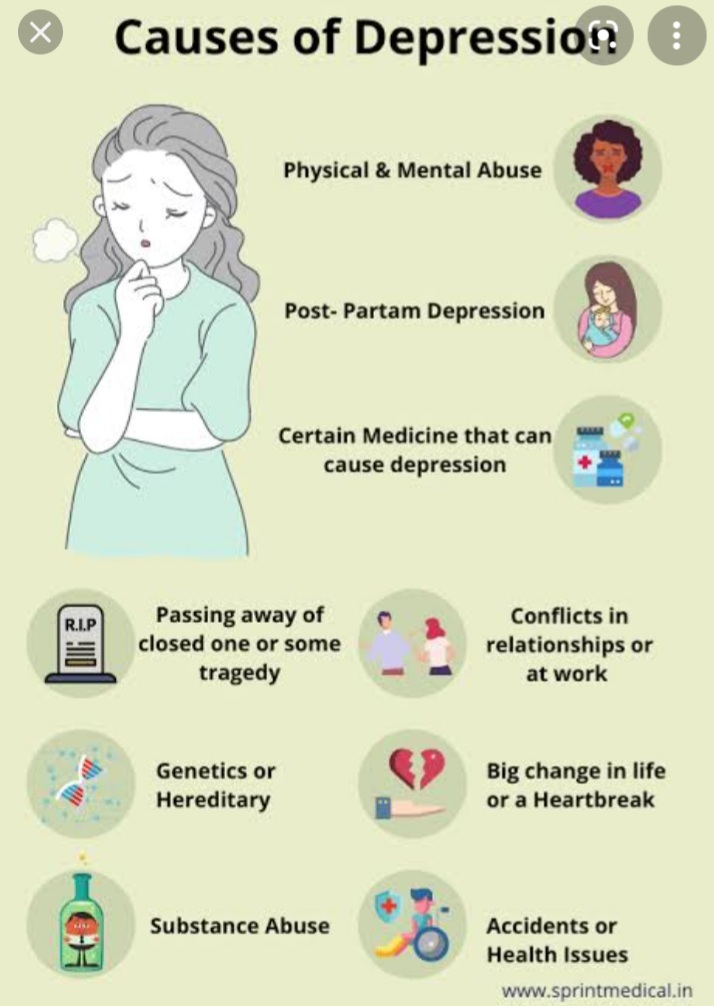
Depression causes :
There are several possible causes of depression. They can range from biological to circumstantial.
Common causes include ;
* Family history :
You’re at a higher risk for developing depression if you hace a family history of depression or another mood disorder.
* Early childhood trauma :
Some events affect the way your body reacts to fear and stressful situations
* Brain structure :
There’s a greater risk for depression if her frontal lobe of your brain is less active.
* Medical conditions :
Certain conditions may put you at higher risk, such as chronic illness, insomia, chroinc pain or attention- deficit hyperactivity disorder
* Drug use :
A history of drug or alcohol misuse can affect your risk.
Many factors can influence feelings of depression, as well as who develops the condition . The causes of depression are often tied to other elements of your health. Depression can be linked with to other health problems, your healthcare provider may also conduct a physical examination and order blood work.
Types of depression :
Depression can be broken into categories depending on the severity of symptoms. Some people experience mild and temporary episodes, whike other experience severs and ongoing depressive episodes.
There are two main types. Major depressive disorder and persistent depressive disorder .
Major depressive disorder :
Major depressive disorder is the more severe form of depression. It’s characterized by persistant feelings of sadness, hoplessness and worthlessness that dont’t go away on their own.
Persistent depressive disorder :
Persistent depressive disorder ( pDD) used to be called dysthymia. It is a milder, but chronic, form of depression.
It’s common for people with PDD to
* lose interest in normal daily activites.
* feel hopless
* lack productivity
* haveclow self- esteem
Depression can be treated successfully, but it’s important to stick your treatment plan.
Treatment for depression :
Living with depression can be difficult, but treatment can help improve your quality of life. Talk to your health care provider about possible options. You may successfully manage symptoms with one form of treatment ,or may find that a combinations of treatment works best.
Being a part of a mixed economy , where politics tend to exploit the peace between different religions and so on …….. .
“India was the motherland of our race, and Sanskrit the mother of Europe’s languages: she was the mother of our philosophy; mother, through the Arabs, of much of our mathematics; mother, through the Buddha, of the ideals embodied in Christianity; mother, through the village community, of self-government and democracy. Mother India is in many ways the mother of us all.”
Will Durant, American historian
And now you want to know why I am being so dramatic over such things . Well , if you want to know than start reading the editorial .
Introduction
Indians say it is important to respect all religions, but major religious groups see little in common and want to live separately
More than 70 years after India became free from colonial rule, Indians generally feel their country has lived up to one of its post-independence ideals: a society where followers of many religions can live and practice freely.
Religion has historically influenced Indian society on a political, cultural and economic level. There is a sense of pride associated with the country’s rich religious history as the traditions of Hinduism, Buddhism, Sikhism and Jainism all emerged out of India. Moreover, while a majority of people in India identify as Hindu (79.8%), the medley of religions that exist within the country continually impact contemporary society.
Census
The 2011 Indian census indicated that 79.8% of Indians identified as Hindu, 14.2% identified as Muslim and 2.3% identified as Christian. A further 1.7% of the population identified as Sikh, 0.7% identified as Buddhist and 0.37% identified as Jain. Due to the massive population size of India, religious minorities still represent a significant number of people. For example, although only 0.37% of India may identify with Jainism, that still equates to over 4 million people. While not all religions in India can be discussed in detail, the following provides an overview of the major religions in the country as well as sizable religions that originated in India.
Social beliefs
“India has two million gods and worships them all. In religion all other countries are paupers; India is the only millionaire.”
Mark Twain
Karma, Acceptance and Personal Choice . Many Indians tend to have a sense of acceptance towards one’s life position or a belief that, due to actions in one’s past life, good or bad personal circumstances are deserved. This attitude partly stems from religious ideas such as ‘karma’ (the idea that one’s actions will affect their current or future life) and ‘samsara’ (the cycle of rebirth).
The interplay of these social, cultural and religious factors allows people to be accepting of life events and trajectories. However, this is not to be interpreted as Indians being unwilling to take responsibility for life circumstances. Many often contemplate how their actions may impact their future and make decisions accordingly. Some of India’s youth are challenging a fatalistic perspective by asserting their free will to choose their vocation, spouse and other life factors. Indeed, as social mobility becomes more common, there is a growing belief that one can change their circumstances.
It’s Role
Religion plays a major role in the Indian way of life. Rituals, worship, and other religious activities are very prominent in an individual’s daily life; it is also a principal organizer of social life. The degree of religiosity varies amongst individuals; in recent decades, religious orthodoxy and observances have become less common in Indian society, particularly amongst young urban-dwellers. As of the politics , they play with religion , people’s belief and with their trust .
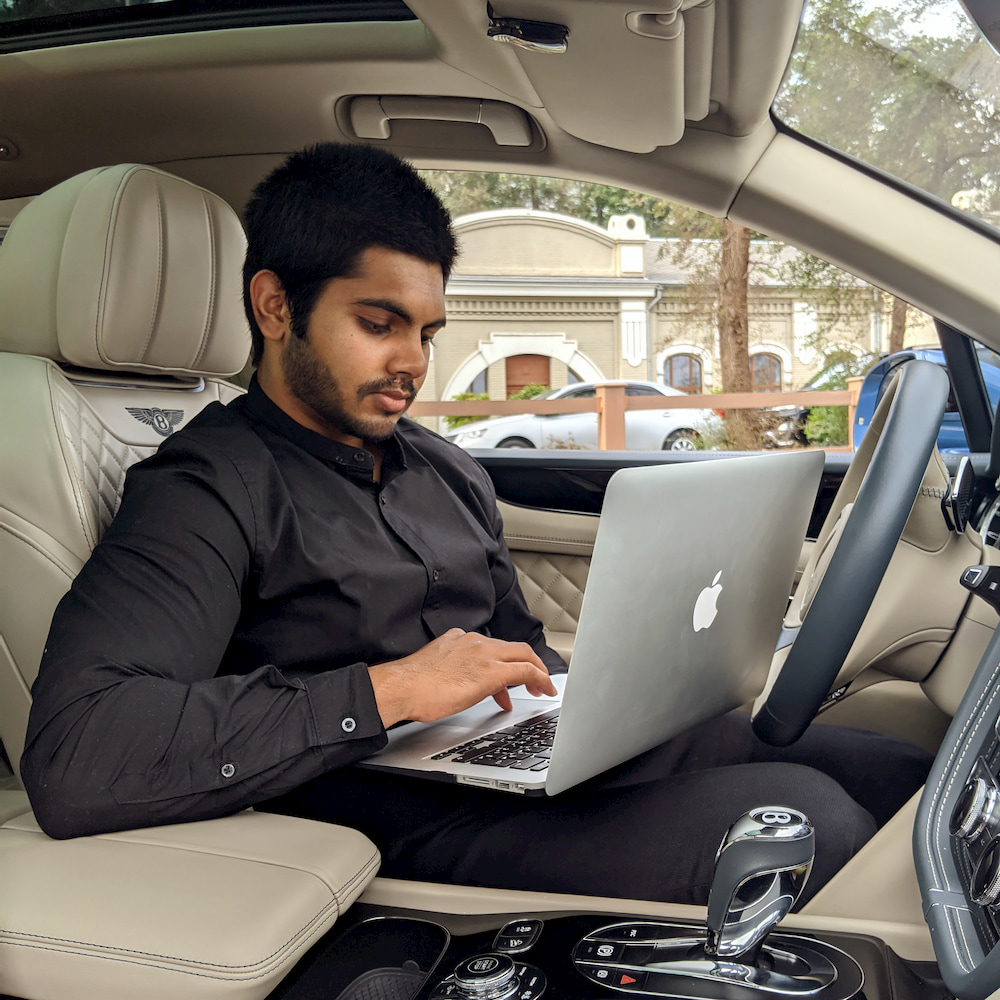
Mithun Bhat, born in Bhopal, could buy 2 houses within a month, Bentley, Ferrari and paid all his debts. But previously, he worked with salary under the minimum wage. So, how could he earn so much money only in a month? He tells us his story.
“I worked at pizza delivery service for a year. I was prior a collage student and did a part time job in a restaurant. I did it to support my study. In the second year of study I was close to be expelled since I could not pay the tuition. At the time, I had to take a loan. I could finally paid my tuition, but I had no money to pay the monthly installments to the bank. Honestly, studying and working all at once was beyond my endurance, and eventually, I was expelled from campus a week before the end of school year. That was the beginning of the darkest days of my life. My father lost his job and my family didn’t know how to survive. Could you imagine how hopeless I felt? I had no decent work and no education, and my father lost his job. I could do nothing to help them.
One night, I was delivering a pizza to the last location. A guy opened the door. He was with his friends, and while he was paying the pizza, I heard their discussion about where would they invest Rs. 2,000,000 they earned 10 minutes ago. I just made a glance and saw a sort of graph and figures on the laptop screen. The guy opening the door gave me Rs. 1,000 but the price was only Rs. 600. He told me to keep the change.
I was absolutely surprised and after I got back home, I took my laptop and tried to recall about their discussion. After 5 minutes, I remembered that they told about online trading. On the Broker website I found the graphs and figures I saw at the guy’s laptop.
After reading all information about the broker and watching tutorial videos, I opened a demo account where I got virtual money. I quickly understood what I had to do, it was very easy. I earned some money after my very first transaction. Then I thought… I did not lose anything, so I decided to open a real account and deposited my last money there. At the morning, I woke up and saw that I earned Rs. 30,654 over that night. After 2 weeks I could paid my debts off, bought a car, and I could help my father while he was searching for a new job and pay his expenses for the next few months. 2 weeks later, I already had 2 houses in the suburb. And all I did without leaving my home and getting higher education.
That’s my luck. It would never happen if I did not meet the rich guy while delivering the pizza. I know there are a lot of people having not good times like me, that’s why I tell you: if you want to live without any problem, I can tell you how to earn money with Trading Resource. It is very easy if you would try it.
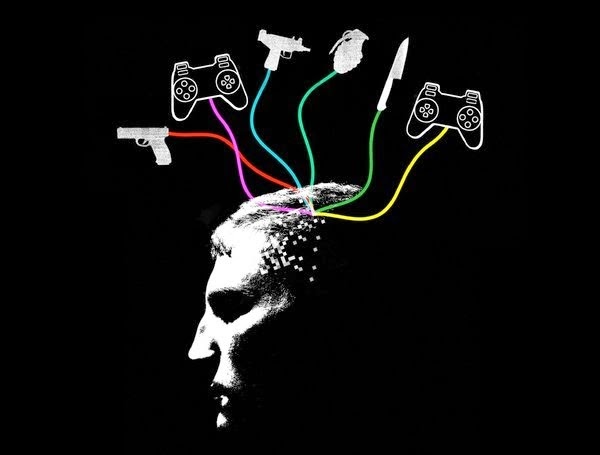
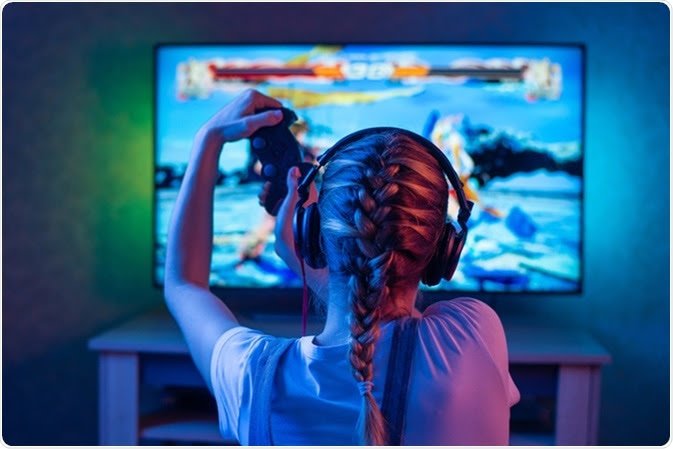
The world has changed and evolved rapidly in the past few years. The invention of computer and modern internet has changed the fundamental needs of most teenagers. Video games on consoles, computers and smartphones have revolutionized the world and the concept of virtual reality. Many teenagers find it palying video games interesting especially violent video games. This is due to how entertaining and thrilling they are to them as teenagers. However, playing video in most cases has some negative effects to the player. Violent video games often make an individual’s brain more responsive to violence. Unknowingly, such type of video games leads to aggressive increase in behavior and as time goes on, the brain doesn’t perceive that aggression to be anything abnormal. Despite the numerous positive effects such as, quick-decision making, multitasking, teamwork…etc., “there are two sides to every coin,”. While all the listed above are good effects of video games, on the other side, video games have their own negative short comings which affect physical health, psychological health, and overall performance of teenagers. This paper will discuss negative ways video games affect the lives of teenagers. Addiction to video games hinders the physical health of a teenager. Excessive sitting while playing games with minimal movement may possess physical health problems such as obesity, back pains, insomnia, and drowsiness. As already mentioned, video gaming is an addictive practice which a person tends to develop a liking for this attitude and can go on-and-on with it playing for hours. It is obvious that illness and disease caused by ceaseless gaming are hard to cure. Therefore, trying not to get into such activities is the first step to prevent these types of problems to the physical health; and possible the most advisable thing to do. Most teenagers who play violent video like tend not to have interest in stuff he/she has been preoccupied with. This is because, the often teenagers play the video games, there is a higher interaction with the video gaming interface, and therefore tends to take control of the teenagers thought process. According to a research conducted by Dr. C. Shawn Green of the University of Wisconsin, he mentioned that, “video games can change your brain more negatively. (needs Citation)” this is because, most video games are designed to make you the protagonist and, in most cases, commit crime and other violent activities to achieve your goals. This in the long run might have negative effects by making your brain to think more negatively. One common health issues that is faced by most individuals, specifically teenagers addicted to playing violent video games is obesity. Addicted gamers usually encounter this problem because, they are prone to sit in one place for a longer period, and as a result their body practically misses out on any kind of physical activity like exercise. For example, back in home in Ghana, my cousin used to be teased with different names due to the amount of weight he had gained from sitting still almost all day due to his attachment to video games. This was mainly because he was always at his room playing addictive games such as call of duty, grand theft auto and many more whiles eating at the same time. This became his habit, and by the time his parents realized, he was obese and violent as well. This situation led to him been stigmatized by his friends. Even in school, no one wanted to play with him because he had gained a lot weight and would often complain of back pains immediately they involve themselves in any activity. Being overweight may increase the risk of developing other ailment in a long run, such as high levels of cholesterol, diabetes, hypertension and so on. Playing video games for long hours could also prevent teenager to have the maximum sleep they need which results in the development of insomnia; Which further results in drowsiness and hypoactive immune system. Again, back pains are also commonly experienced by gaming addicts, since they sit in position for long hours. Even though they don’t pay attention to this, it might have an in-depth implication as the thirst for gaming progresses.
There are psychological health issues with regards to playing video games for incredibly long hours which prone to negatively affect the social behavior of the teenager as well. Excessive gaming can develop certain traits which may have adversely effects on an individual’s life development. According o a research conducted by Douglas Gentile released by the Iowa State University utters that, “teenagers are most inclined to video games by being indoors, which leads to a bad habit of socialization.” (needs Citation) Now social isolation can be an immediate consequence of frequent and ceaseless gaming. Teenagers tend to spend lesser time with their friends and family since they obviously want to get back home or game centers as fast as possible and continue playing. Prior to this, most gaming teenagers become detached from others, and so in the long- run lack abilities of social communication and develop fear of human company (anthropophobia). For example, I met a friend last semester in one of my math classes. This guy would be sitting at the back-playing game all by himself, whiles other people were making discussions on previous topics. Days after, I approached him, and he seems very shy talking to me and spoke very slowly due to no connection he could make from the conversation. I observed that he was a bit nervous. So, I told him not to be nervous, then he replied saying, he’s not used to talking to people apart from his parents. Even he barely talks to people younger sister, because he is always busy playing video games alone. Now this clearly confirms how video games can influence a person’s life.
Uncontrolled addiction to video games deduces a teenager’s performance academically. Normally this happens when teenagers always think and dreams about games he has playing thus tends to lack of interest in studies and other related activities. According to an article written by the Naskar in the industrial psychiatry Journal, the article mentions how an 18- year old boy had excessive use of video game for the last 2 years which led him to losing interest in studies as well as getting low academic grades.”(needs Citation) Academic performance can be affected by inverse balance to video game addiction. This literally signifies that the more time one spends in playing, the lesser the person occupies his/her self with studies. Obviously, this shows negatively in the end of semester school report card, and as a result makes the child academically incompetent. Teenagers find it interesting playing video games, most especially violent games. Although video games are fun, and has positive effects, however video game impact negatively on teenagers as well. Resulting to the effect on physical health, psychological health, and overall performance in terms of academics. Therefore, in order to reduce such negative chances on teenagers, parents and guardians are to check on their children assign rule and regulations to control this kid form getting addicted to video games. This rule can include time and hours for homework, video games and family get-together. Ensuring these measures will help improve the lives of teenagers for a better future.
We cannot and will not ban the creation of violent video games. But we can prevent the distribution of these disturbing games to children, where their effects can be negative .
Aggression and violence are amongst the numerous issues our society is facing. Both of these terms are related and yet different from each other. Violence refers to behaviour which is forceful towards someone or something and may cause harm. Aggression refers to the behaviour towards someone or something which is intended to cause harm. The key difference between the two terms lies in the intent in which an act is done. Aggression therefore is a more serious problem. It ranges from small actions like using harsh words, unnecessary criticism, having hostile feelings etc. to larger and more concerning actions like ragging, bullying, child abuse, murder etc. In some cases the act of aggression may be done to obtain something while in some other cases the aggressor does not wish to obtain anything from the victim. The former case is termed as instrumental aggression while the later is called hostile aggression. There are several causes of aggressive behaviours. Some psychologists argue that aggression is an inborn tendency in humans just like it is in animals. It is a sort of defence mechanism. It gets triggered by physiological mechanisms. There are several factors that cause this arousal. Childhood experiences also shape the tendency of aggression in individuals. It has been observed that those children who were brought up in a hostile environment like parents using physical punishment often tend to grow as aggressive individuals. It is not very clear why this happens though. Some say that children imitate their parents behaviours, others say that it is the anger and resentment they bottle up during childhood which comes out in the form of aggression. Aggression is often caused by frustration. Frustration is marked by a sense of helplessness when we’re unable to achieve something. Aggression is in fact an expression of frustration. People in frustrated situations often show more aggression than others. This sort of aggression is often projected towards a weaker person who is less likely to retaliate. An example of this is bullying. However, it is not necessary that frustrated person is always aggressive. It largely depends on a person’s personality. Some people are inherently short tempered and show more aggression than others. People mostly learn aggression by observing others displaying it. Some researchers say that exposing children to aggression shown on television or media causes them to learn aggressive behaviours. Sometimes people show aggression when unnecessarily provoked.
Aggression serves as a root cause for various social issues out there and therefore it needs to be curbed down. The most important step in ding so is preventing children to learn aggression. Aggressive behaviour of any form should be unappreciated amongst children. Using punishment as a tool for discipline should not be done. Portraying aggression as a heroic behaviour must be stopped as it make children model that behaviour. Television and media should be regulated for children. Another way is to reduce frustration. Having equality and justice is a key in doing so. Encouraging people to talk about their problems of frustration can significantly reduce the occurrence of aggression. Lastly, having a positive attitude toward peace and non violence should be taught to children.










 Eduindex
You must be logged in to post a comment.